
A complete issue · 36 pages · 1925
Life — February 26, 1925
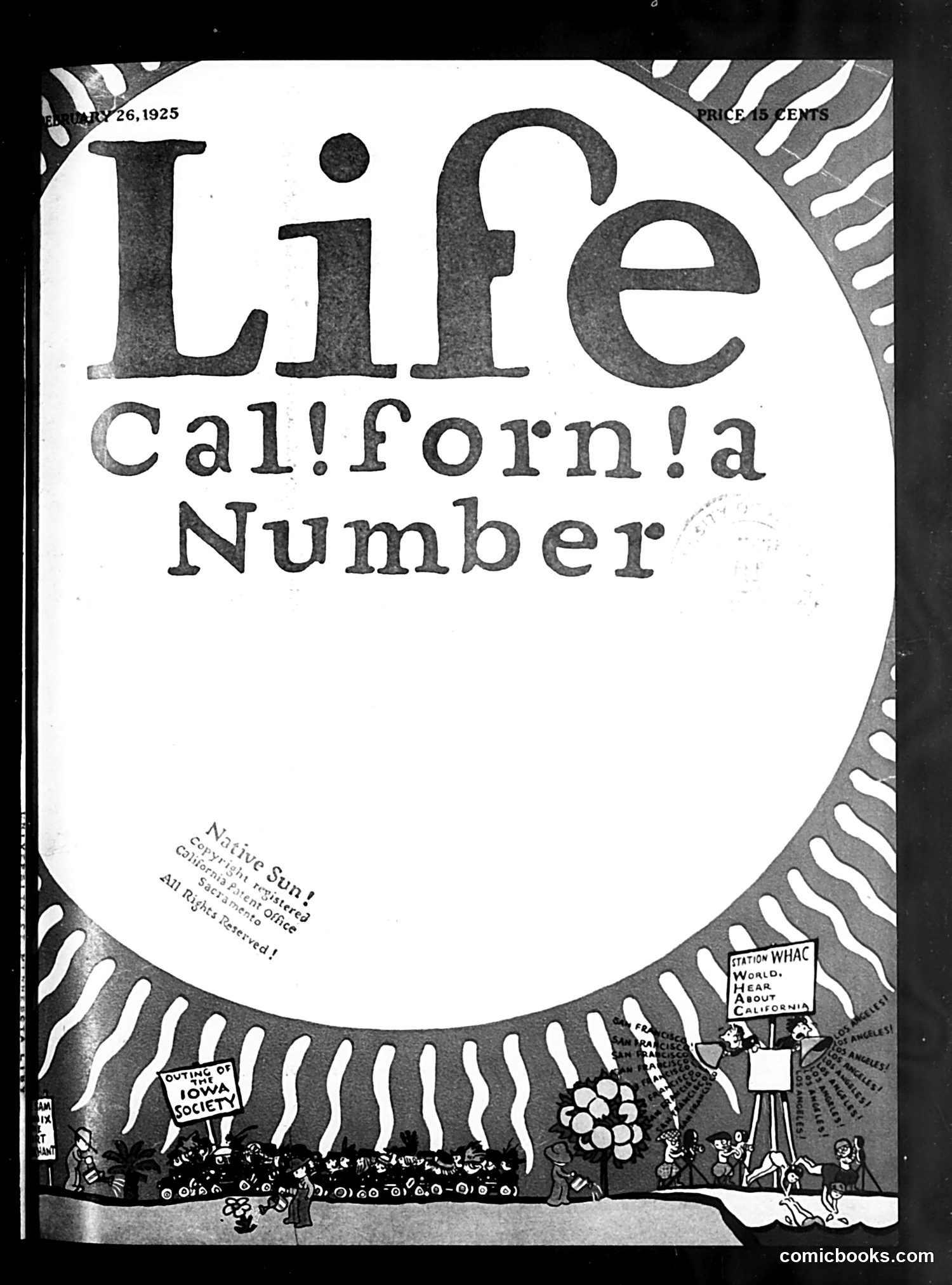
This is the cover of *Life* magazine from January 26, 1925 (price: 15 cents). The dominant visual is simply the enormous text "Life California Number," suggesting this is a special issue devoted to California. The bottom illustration depicts a satirical scene of California promotion. Small figures hold signs reading "Boating of Iowa Gollect" (likely "Boating of Iowa Collect") on the left and "Station WHAC World Hear About California" on the right. These appear to mock California's aggressive self-promotion to the rest of America—the joke being that Californians were relentlessly broadcasting their region's attractions to outsiders, particularly to the Midwest. The radiating lines suggest broadcasting or widespread publicity campaigns typical of 1920s boosterism.
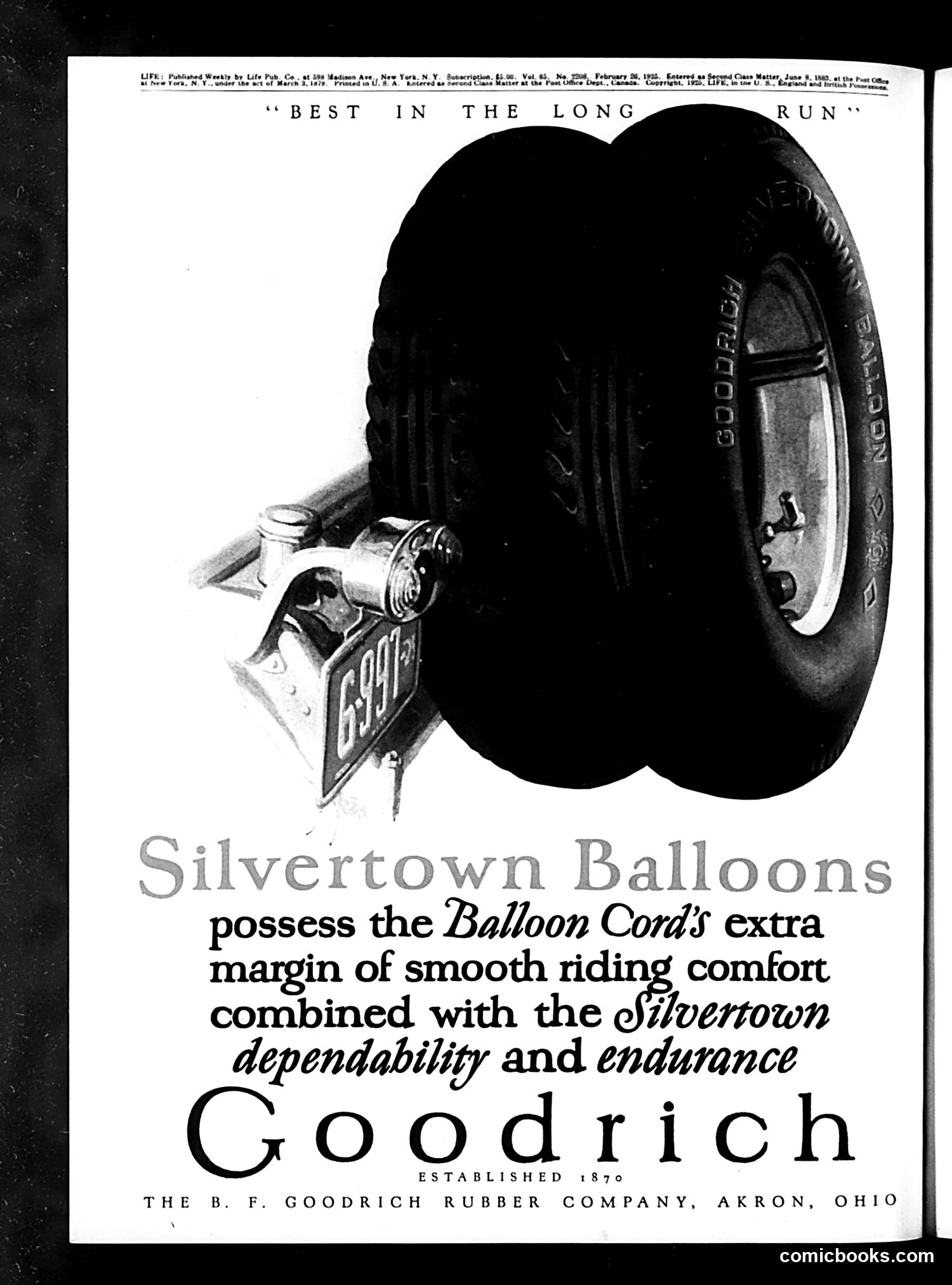
This is primarily a **commercial advertisement**, not political satire. It promotes Silvertown Balloons tires, manufactured by B.F. Goodrich (established 1879) in Akron, Ohio. The ad's tagline—"Best in the Long Run"—is a pun playing on both tire durability and racing. The visual shows a large tire alongside what appears to be an early racing car or vehicle component, emphasizing performance and reliability. The "Balloon Cord" technology mentioned refers to Silvertown's balloon tire innovation, which provided smoother riding comfort compared to earlier solid tires. The advertisement highlights the product's combination of comfort ("smooth riding"), dependability, and endurance—standard tire marketing appeals of this era (the magazine's masthead indicates February 28, 1925). This is straightforward product promotion, not satire.
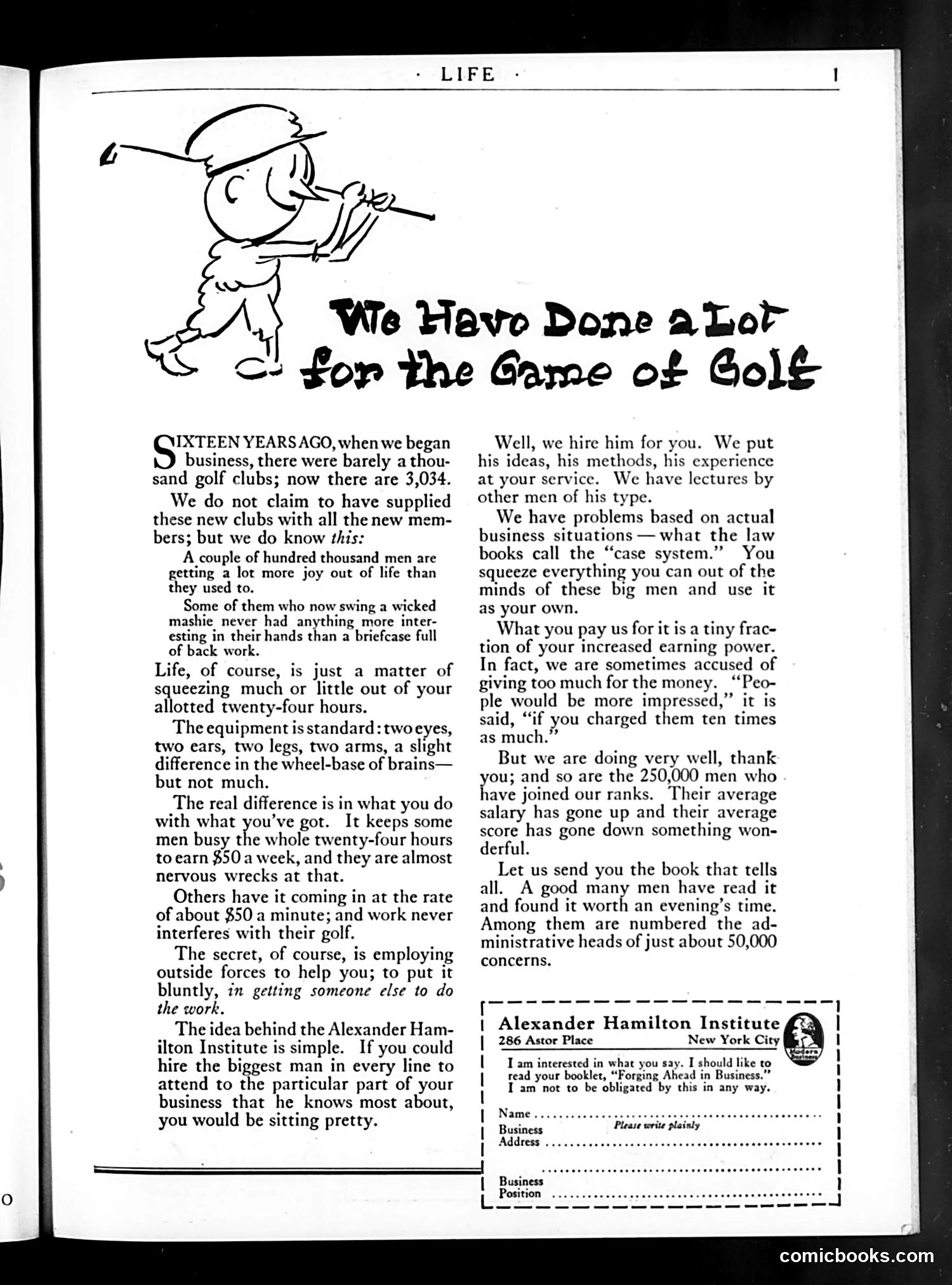
This page contains a satirical advertisement for the Alexander Hamilton Institute, a business education service. The cartoon shows a golfer mid-swing, illustrating the article's central joke: **golf as a metaphor for business success**. The text argues that the Institute's value lies in hiring expert consultants to handle business problems—just as one might hire a professional caddy or coach to improve their golf game. The satire suggests that businessmen obsessed with golf (a status symbol of the wealthy) should apply the same principle to their actual work: employing outside expertise. The article claims the Institute has helped grow golf club membership from nearly zero to 3,034 clubs in sixteen years, positioning business education as equally transformative. The humor targets wealthy executives who prioritize leisure while neglecting professional development.
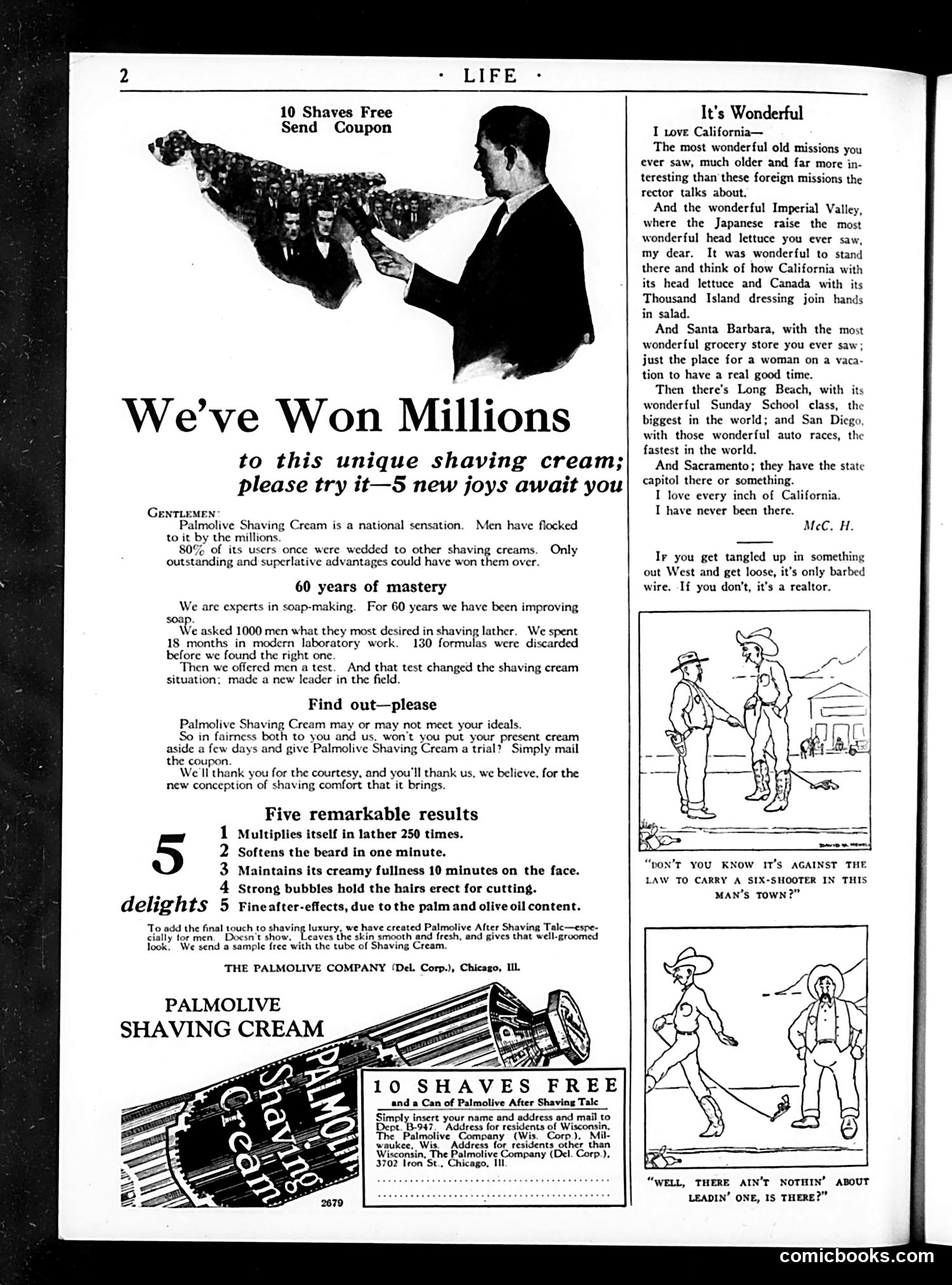
This page is primarily a **Palmolive Shaving Cream advertisement** with minimal satirical content. The main image shows a man holding a map of the United States filled with tiny faces, illustrating the product's claimed popularity ("We've Won Millions"). The only comic elements are two cartoons on the right side depicting Western/frontier scenes. The first shows cowboys with caption questioning the legality of carrying a six-shooter in town. The second shows a similar scene with the punchline "Well, there ain't nothin' about leadin' one, is there?"—a play on words exploiting the ambiguity of "leading" (guiding a horse vs. shooting bullets). These comics are generic Western humor unrelated to the advertisement, typical filler content for period magazines.
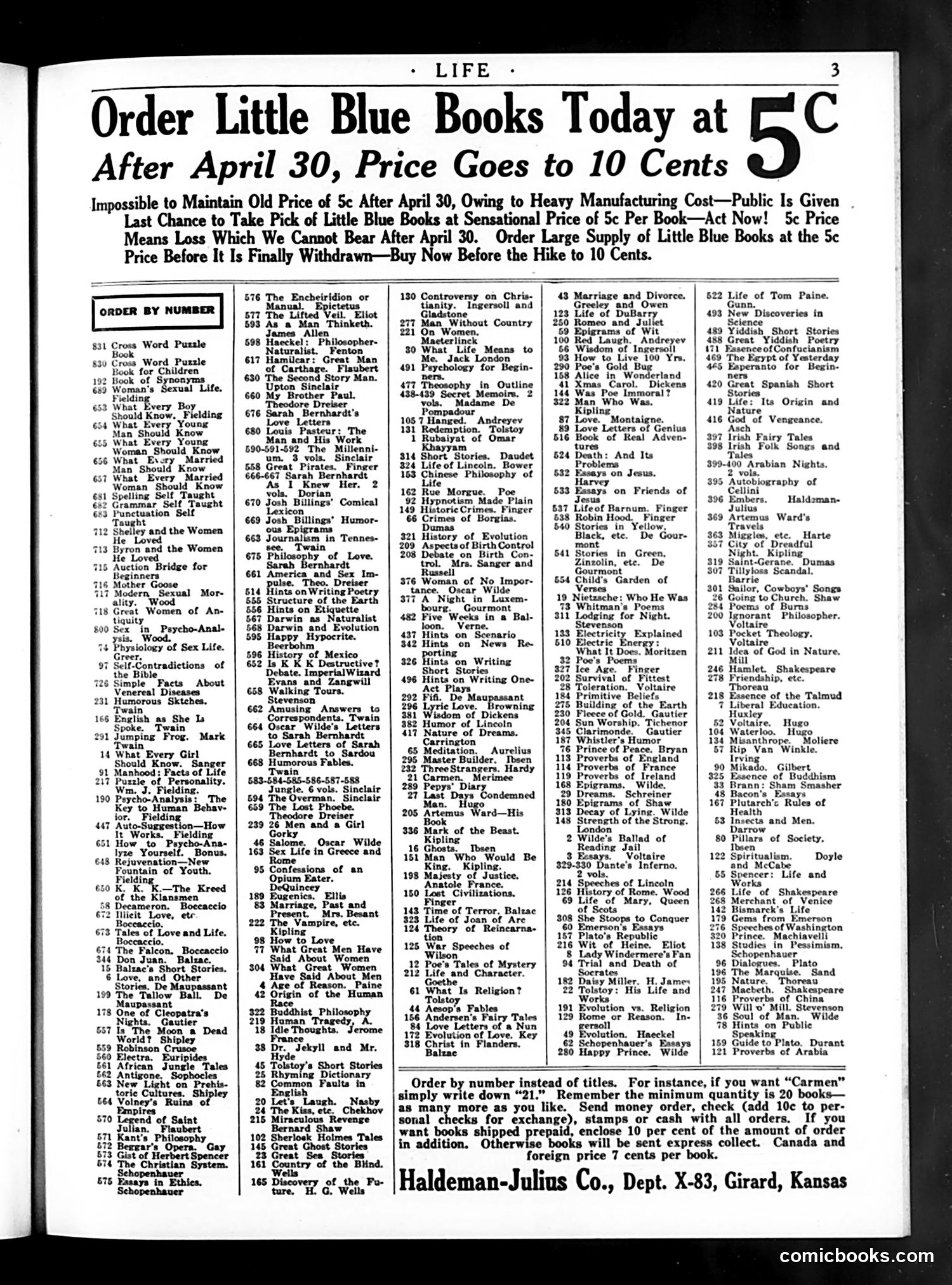
This page is entirely **advertising**, not editorial content or cartoons. It's a full-page advertisement for Little Blue Books, an inexpensive paperback series published by Haldeman-Julius Co. of Girard, Kansas. The ad announces a price increase from 5 cents to 10 cents after April 30, attributing this to rising manufacturing costs. It urges readers to order immediately at the lower price, calling it their "last chance" to get books cheaply. The bulk of the page lists available titles—hundreds of them—organized by catalog number, covering literature, philosophy, history, and practical topics typical of early-20th-century educational publishing. No political satire, cartoons, or jokes are present on this page.
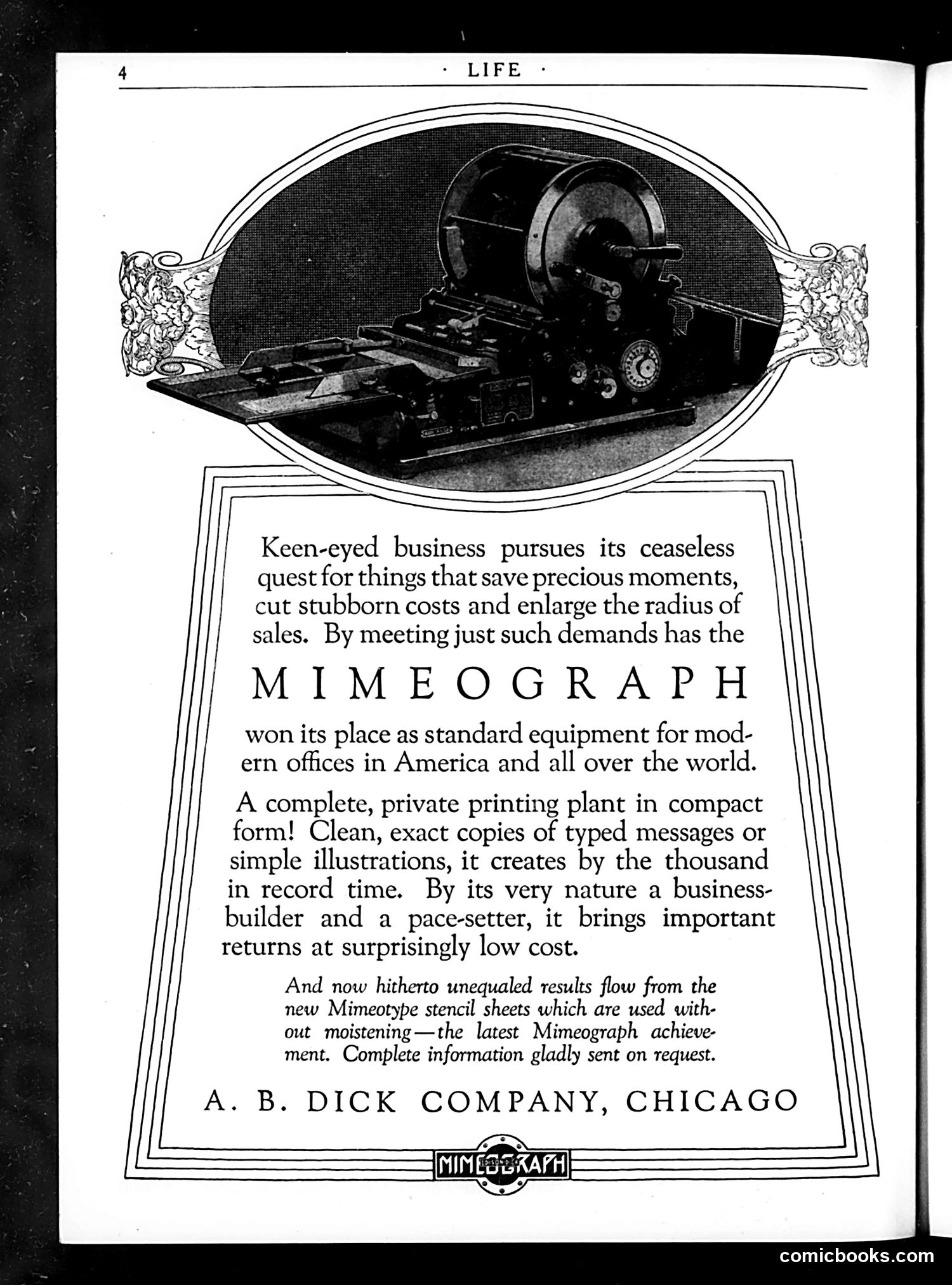
This page is primarily an advertisement for the Mimeograph machine, manufactured by A.B. Dick Company of Chicago. The advertisement is not satirical—it's a straightforward commercial pitch. The ad promotes the mimeograph as essential office equipment that produces copies quickly and cheaply, describing it as a "complete, private printing plant in compact form." It emphasizes the machine's business value: copying typed messages and illustrations rapidly while keeping costs low. The image shows the actual mimeograph device—a drum-based printing machine typical of early-to-mid 20th century offices. The advertisement highlights new "Mimeotype stencil sheets" that work without moistening, positioning this as a competitive advantage. This represents Life magazine's advertising content rather than editorial satire or political commentary.
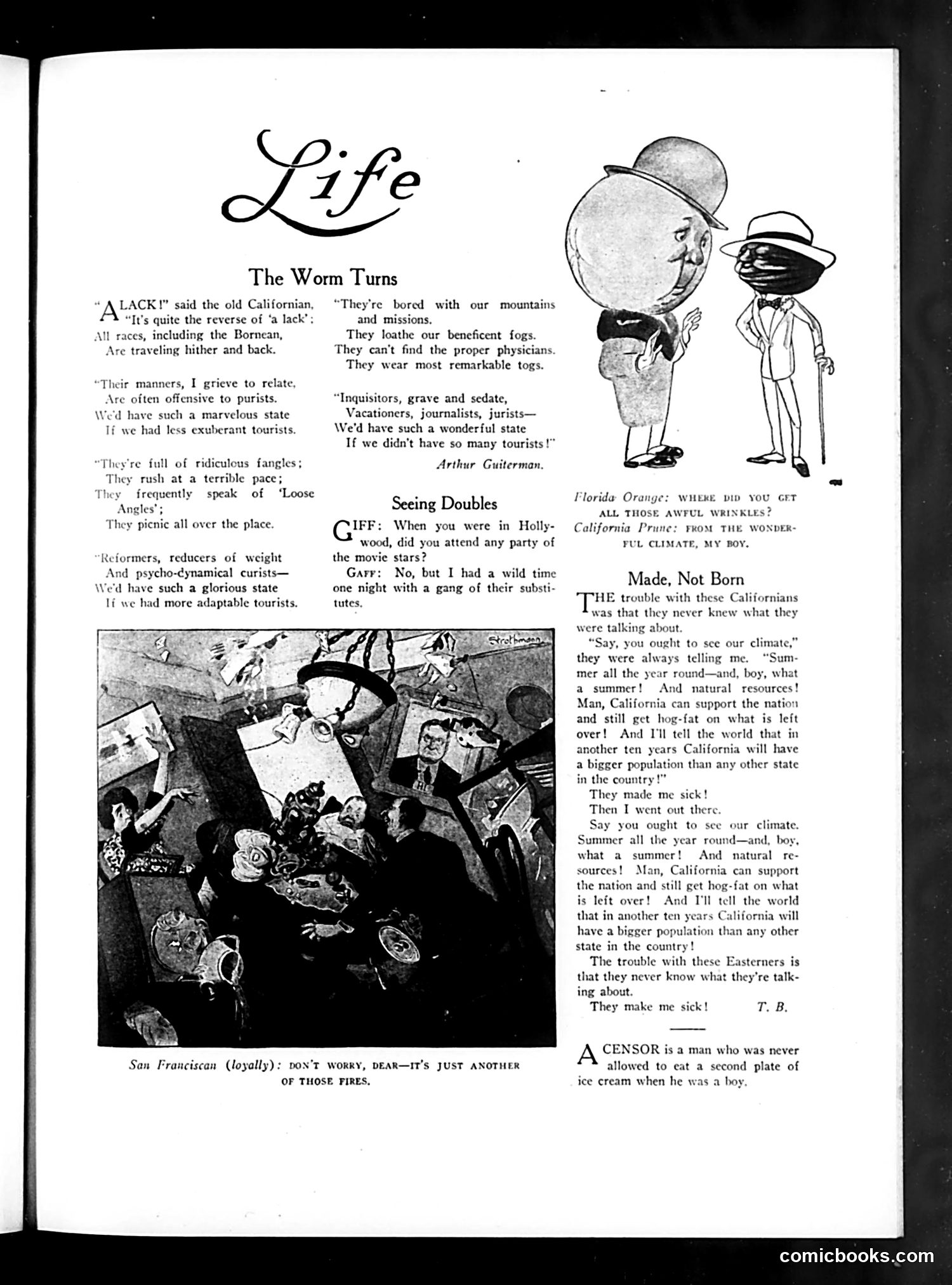
This page satirizes California tourism and boosterism. The poem mocks visitors to California — describing them as having "ridiculous fangles," rushing about, and engaging in excessive tourism. It attacks California's self-promotional claims about climate and natural resources. The main cartoon depicts a crowded, chaotic dining scene labeled "San Francisco (loyally)" with the caption "Don't worry, dear—it's just another of those fires," darkly joking about San Francisco's devastating 1906 earthquake and fires, suggesting tourists casually accept disaster as part of the city's character. The accompanying sections ("Seeing Doubles," "Made, Not Born") continue mocking Californians and Eastern tourists' mutual incomprehension. The satire suggests California's promotion of itself as a paradise is exaggerated and that its boosters and visitors are equally ridiculous.
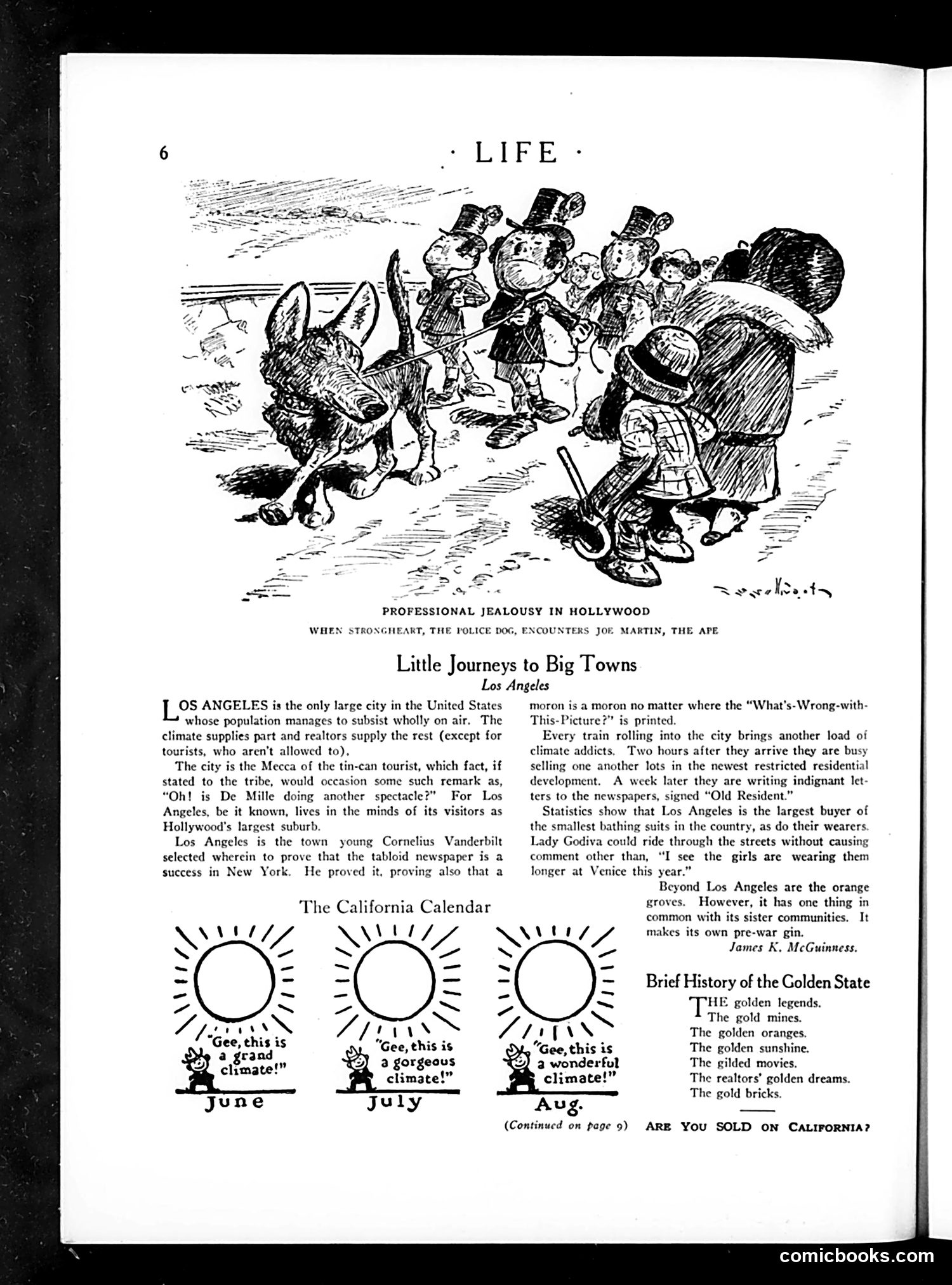
This page features satirical content about Los Angeles from *Life* magazine's "Little Journeys to Big Towns" series. The top cartoon depicts "Professional Jealousy in Hollywood," showing a police dog (Strongheart) encountering Joe Martin, "the ape"—likely referring to an actual performing animal act popular in 1920s entertainment. The joke satirizes Hollywood's competitive culture by treating animal performers as rivals, reflecting the era's fascination with exotic animal acts in film. The accompanying text mocks LA as a superficial tourist destination obsessed with real estate schemes and climate claims. "The California Calendar" cartoon humorously exaggerates the city's perpetual sunshine by having characters repeat variations of "gorgeous climate" across summer months—satirizing LA's relentless promotional self-marketing to potential residents and investors seeking the promised California dream.
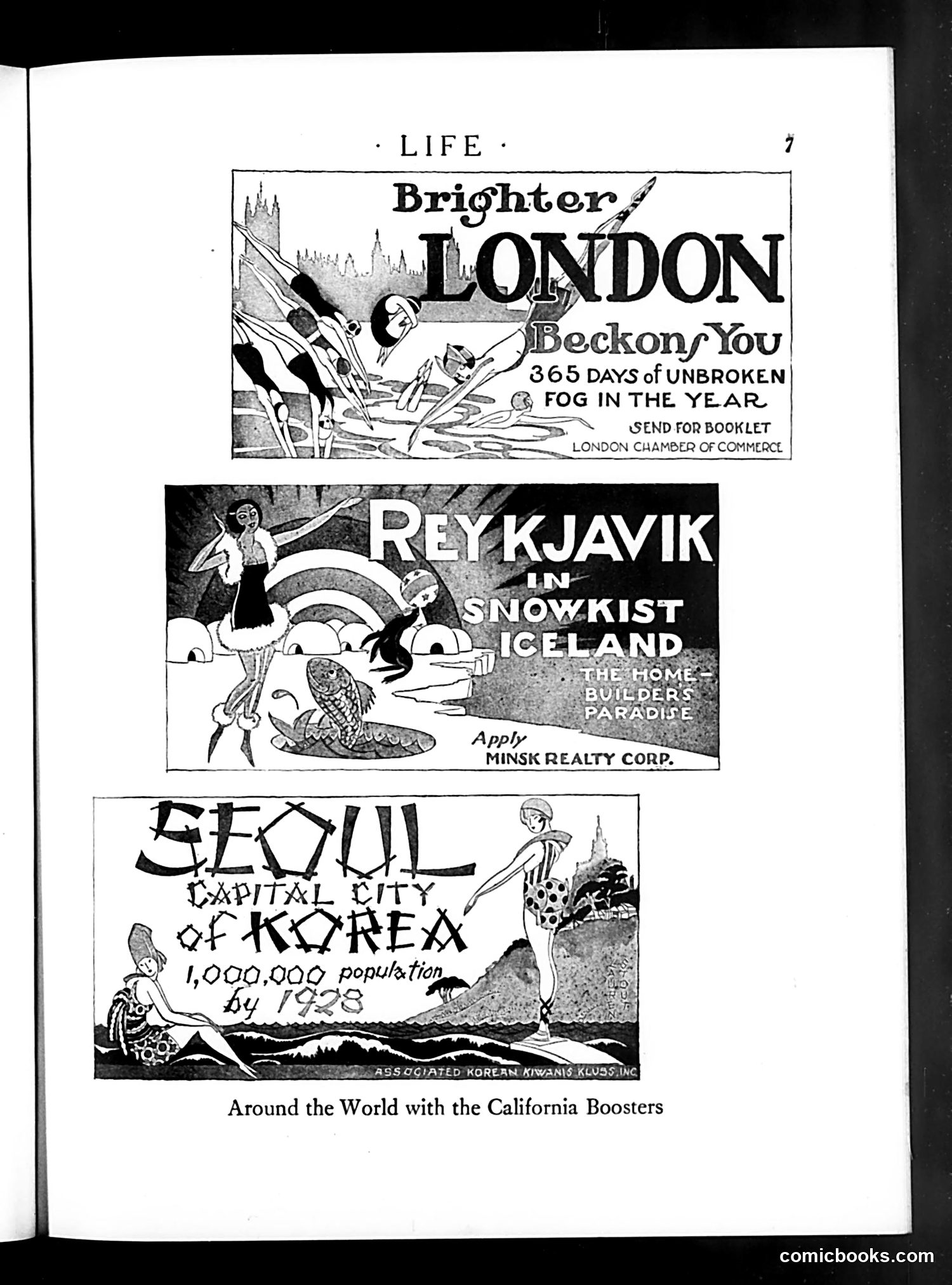
This page consists primarily of **travel and real estate advertisements** rather than editorial cartoons. The three advertisements promote: 1. **"Brighter London Beckons You"** — a London Chamber of Commerce promotional campaign highlighting 365 days of "unbroken fog in the year," which appears to be **satirical** (inverting London's notorious fog problem as a selling point). 2. **"Reykjavik in Snowkist Iceland"** — promoting Iceland as "the home-builders paradise," with stylized figures suggesting leisure and resort appeal. 3. **"Seoul: Capital City of Korea"** — advertising Korea's 1,000,000 population by 1928, published by Associated Korean Migrants/Klass Inc. The page footer references **"Around the World with the California Boosters,"** suggesting these ads promote travel destinations to American audiences. The overall tone mixes genuine promotional content with subtle irony (particularly the London fog advertisement).
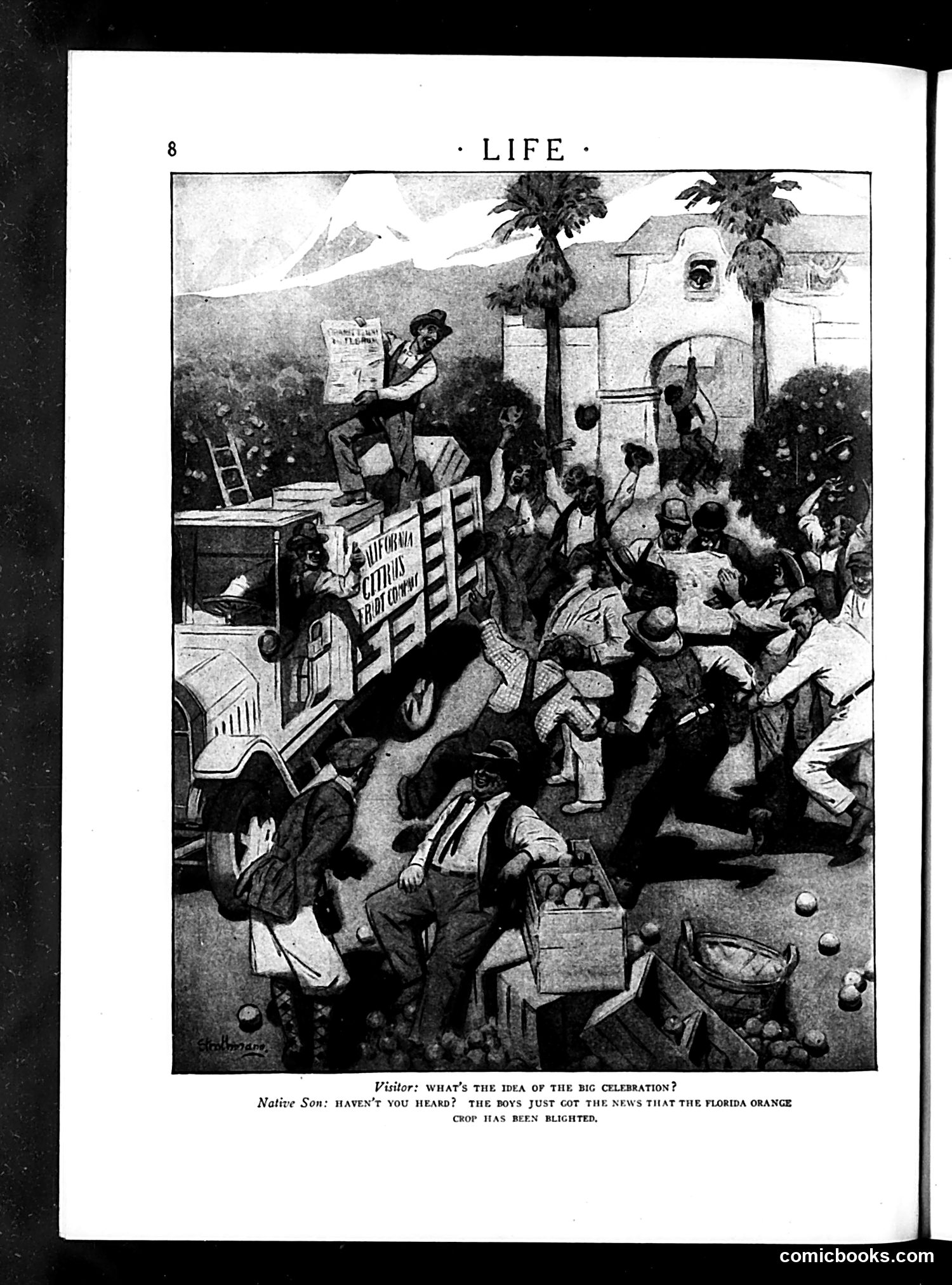
This satirical cartoon from *Life* magazine depicts a celebration in what appears to be a rural Florida setting, marked by palm trees and a simple building. A visitor asks about "the big celebration," and a Native Son responds that "the boys just got the news that the Florida orange crop has been blighted." **The satire:** The joke inverts expectations—normally a crop blight would be bad news causing despair. Instead, the townspeople are celebrating. This suggests they profited from the crop failure, likely through commodity speculation, insurance fraud, or market manipulation. The cartoon mocks the moral inversion where disaster becomes occasion for profit-seeking rather than community concern. It's a commentary on financial corruption and greed in early 20th-century American agriculture.
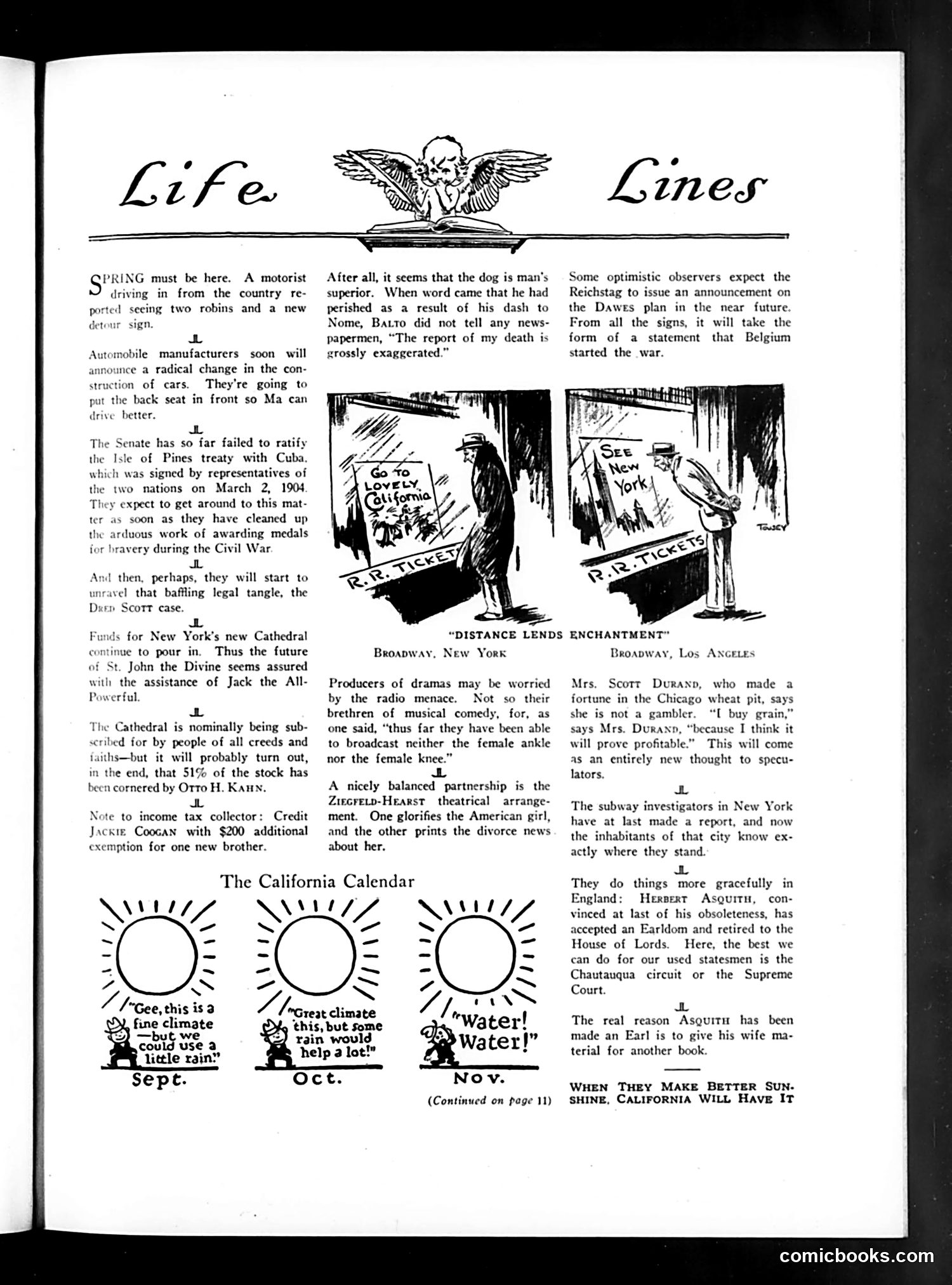
This cartoon satirizes the contrast between travel aspirations and reality. Two figures stand at railroad ticket windows—one in Broadway, New York and one in Broadway, Los Angeles. Each holds a ticket to the opposite city, gazing at romanticized posters: "Oh, Lovely California" and "See New York." The joke is that people are enchanted by distant places they haven't experienced, while failing to appreciate where they actually are. The cartoon mocks the common human tendency to idealize faraway locations—New Yorkers dream of California's sunshine, while Californians fantasize about New York's urban attractions—despite each location having its own merits. The title emphasizes this theme: distance literally lends enchantment to our perception.
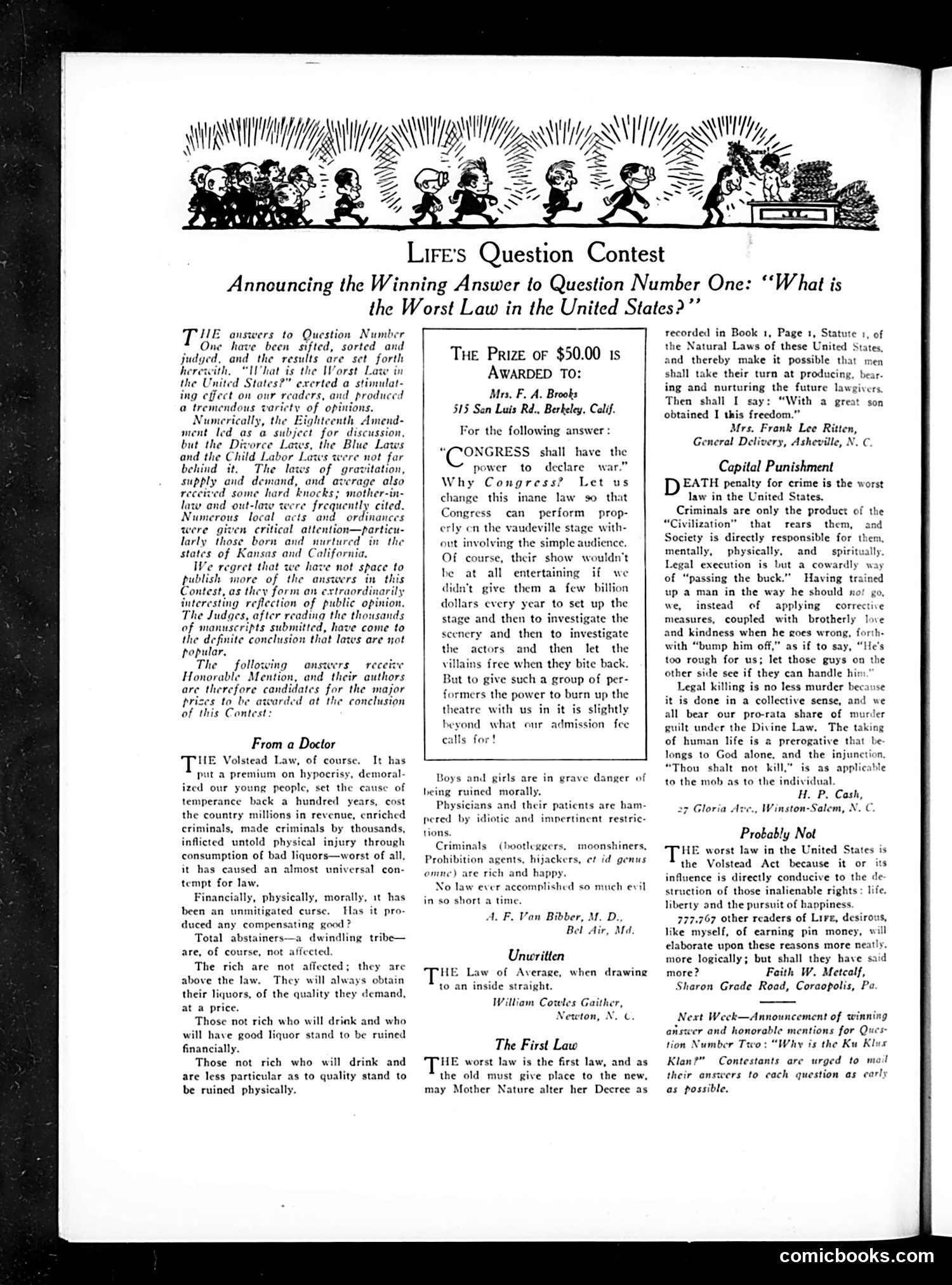
This page announces winners of "Life's Question Contest," specifically answering "What is the Worst Law in the United States?" The $50 prize went to Mrs. F.A. Breek for identifying Congress's power to declare war as the worst law. Other responses critiqued capital punishment, the Volstead Law (Prohibition), and the Law of Averages. Contributors included doctors and professionals offering serious social commentary. The cartoon header shows children of various ethnicities in a playful procession, likely representing Life's satirical approach to social issues. The contest format itself was satirical—inviting readers to identify genuinely problematic laws while presenting their answers as humorous commentary. This reflects early-20th-century Life magazine's characteristic blend of social criticism and comedy, targeting specific legislation and legal systems readers found objectionable.
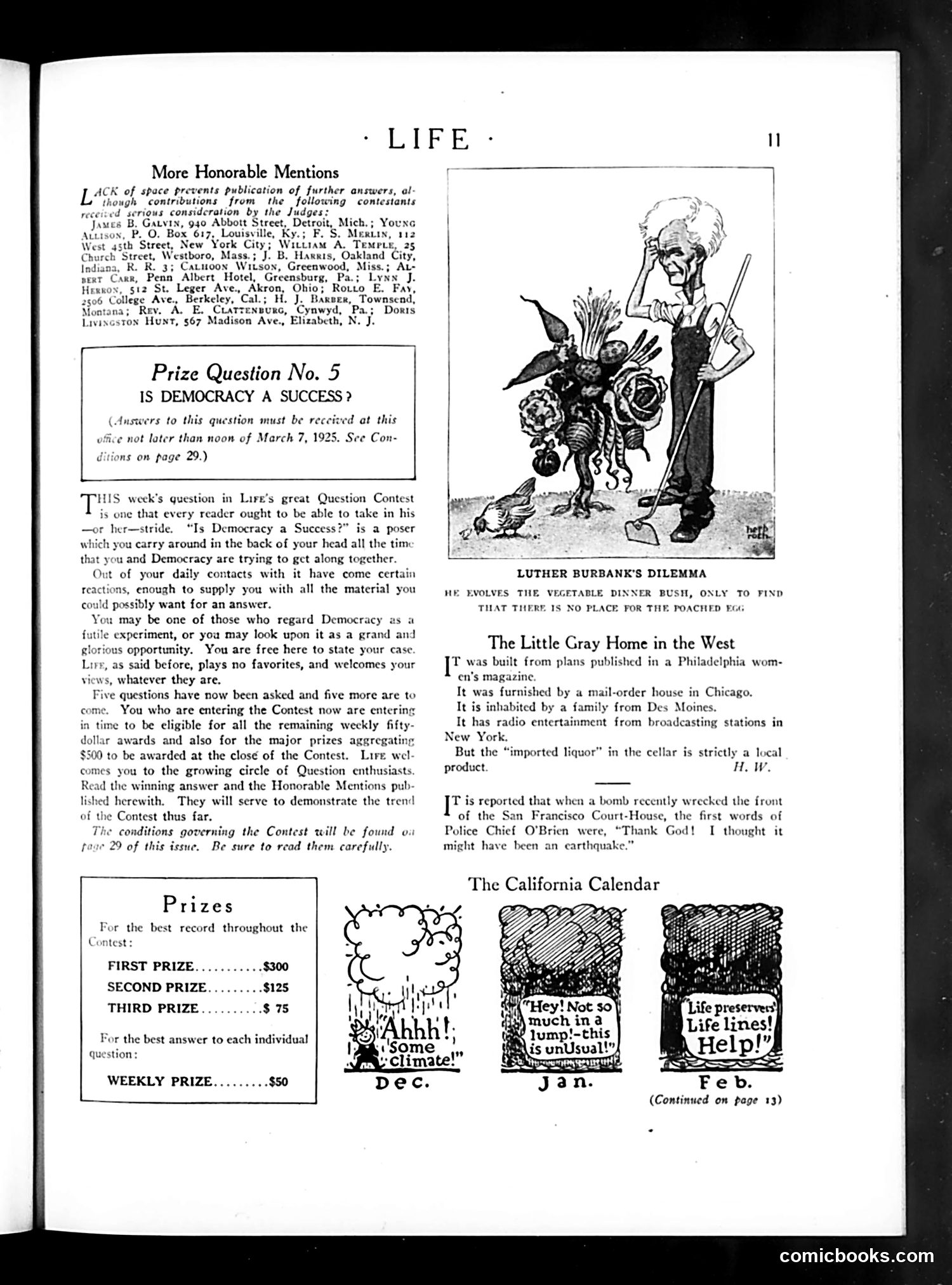
The main cartoon depicts **Luther Burbank**, the famous American horticulturist and plant breeder, confronting a gardening problem. He's shown as an elderly man with white hair holding a spade, facing wilted vegetables and an egg. The caption explains his dilemma: "He evolves the vegetable dinner bush, only to find that there is no place for the poached egg." This is satire of Burbank's celebrity status as a botanical innovator. The joke mocks the gap between scientific achievement and practical reality—Burbank could breed remarkable hybrid plants, but his creations don't solve the fundamental problems of actual meal preparation. It's a gentle ribbing suggesting that technological progress doesn't always translate to solving everyday human needs.
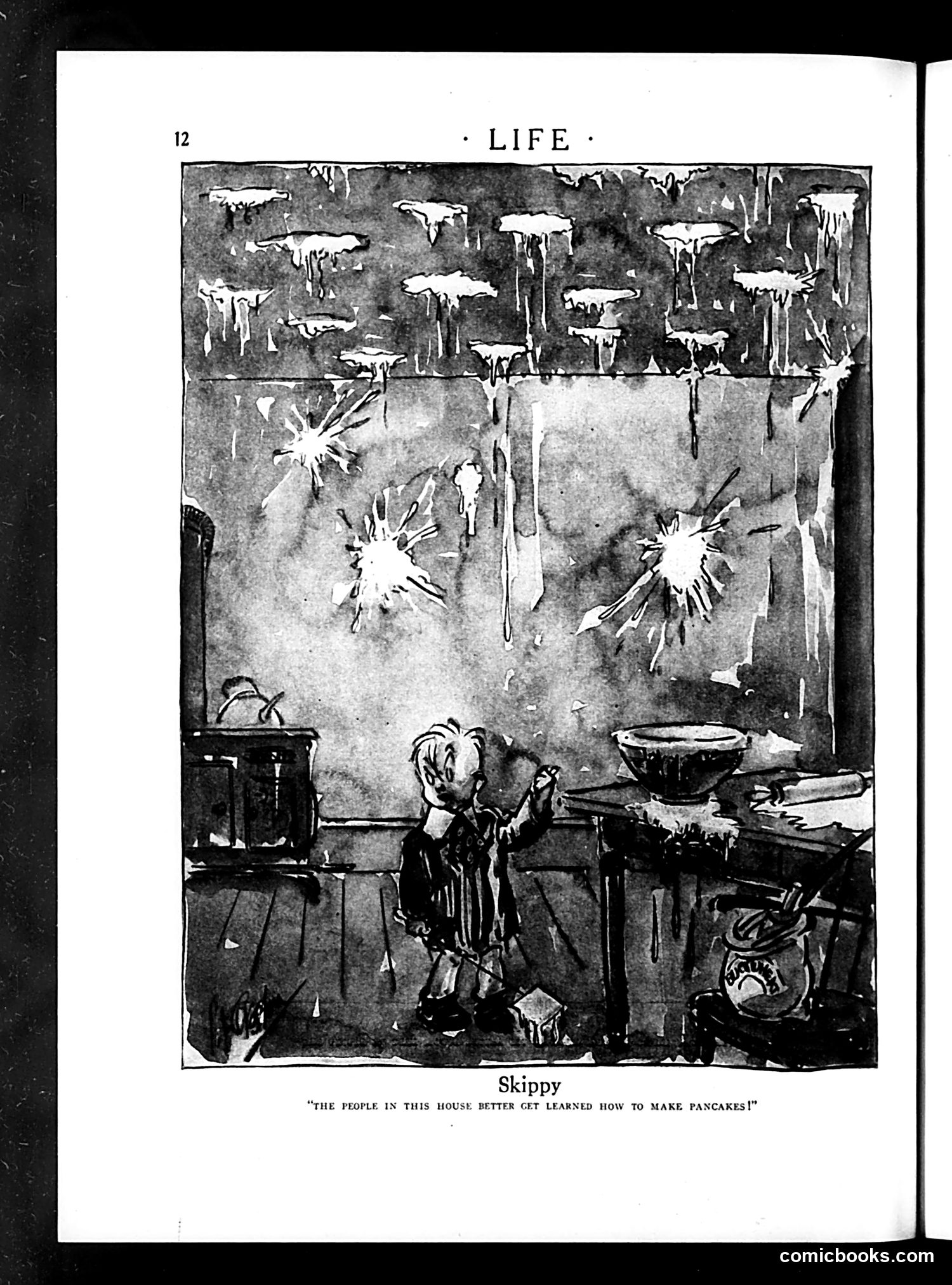
This is a single-panel comic strip titled "Skippy" with the caption: "THE PEOPLE IN THIS HOUSE BETTER GET LEARNED HOW TO MAKE PANCAKES!" The cartoon depicts a young boy (Skippy) standing in a kitchen, having apparently attempted to cook pancakes. The ceiling and walls are covered with numerous pancakes that have clearly gone awry—stuck to surfaces, dripping, and scattered chaotically throughout the room. Various kitchen implements and items are visible on the counter and floor. The humor is straightforward domestic comedy: a child's cooking mishap has resulted in comical disaster, with pancakes everywhere except presumably on plates where they belong. The caption humorously suggests this catastrophe should motivate the household members to learn proper pancake-making technique. This reflects early 20th-century comic sensibilities about childhood pranks and domestic mishaps.
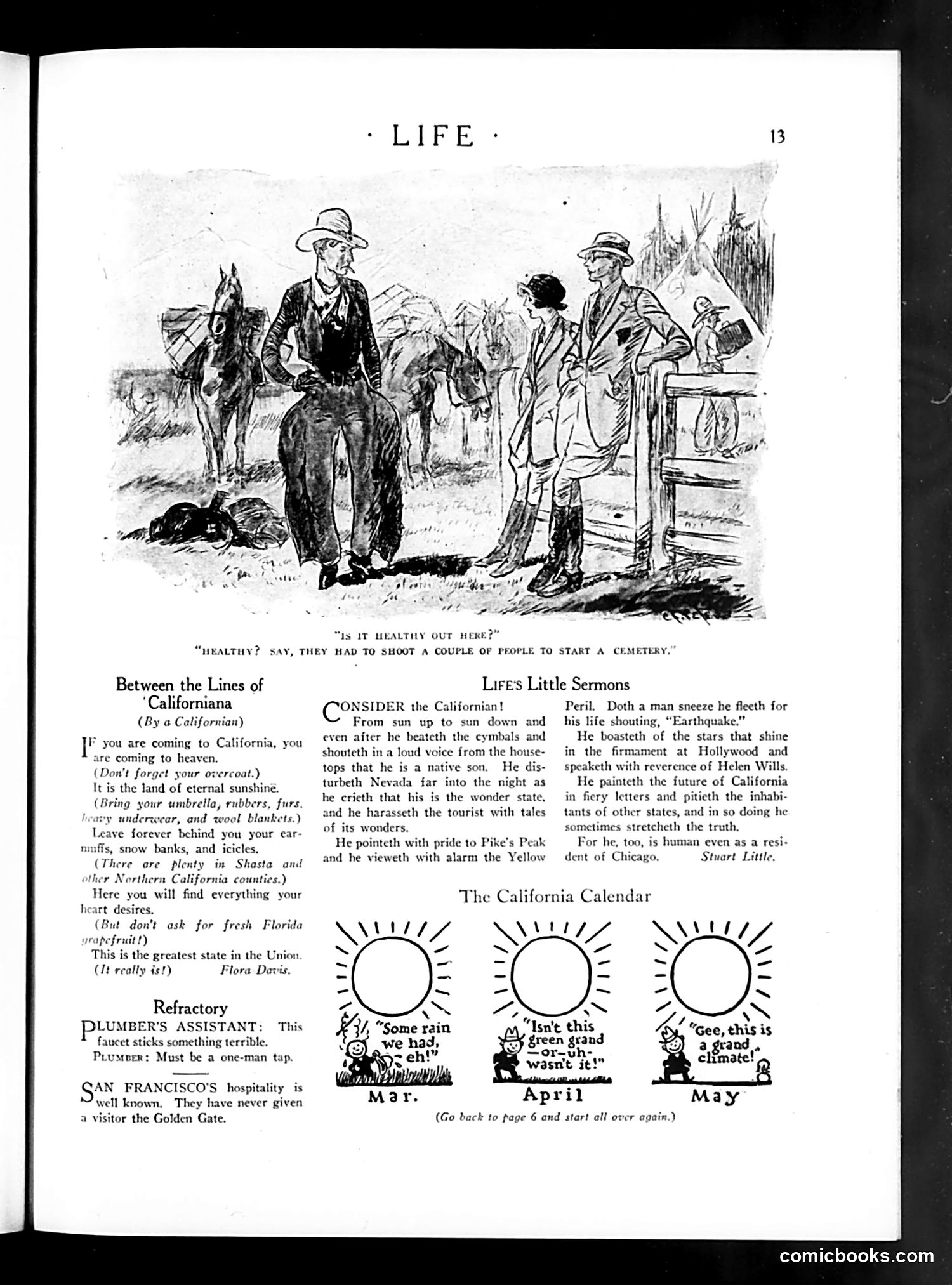
This page contains satirical commentary on California and its reputation. The main cartoon depicts what appears to be a rancher or settler discussing California's health benefits with visitors—the caption reveals dark humor: establishing a healthy reputation required shooting people to start a cemetery, implying California's deadly frontier conditions contradicted its marketing as a health destination. The "Between the Lines of Californiana" section mocks California boosterism—exaggerated claims about sunshine, natural resources, and superiority. It parodies promotional literature's dishonest marketing while acknowledging California's genuine appeal. "The California Calendar" humorously depicts the state's famously inconsistent spring weather through three identical sunny panels with contradictory captions about rain and climate, satirizing the unpredictability locals experience despite the region's advertised perfect weather.
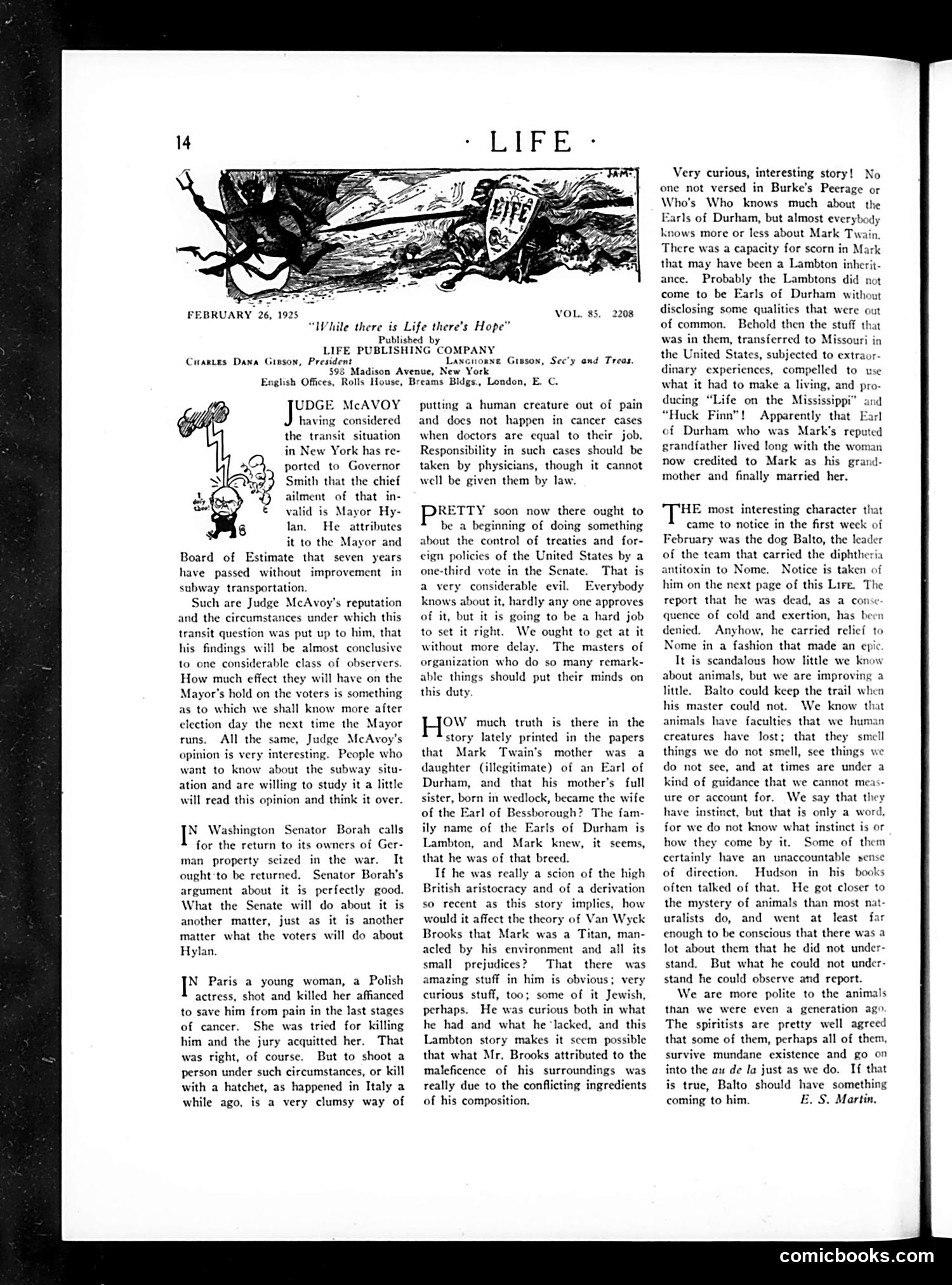
The page features editorial commentary rather than a prominent political cartoon. The small illustration shows a simplified figure labeled "Judge McAvoy" addressing what appears to be a complaint about human suffering and medical ethics in New York. The main articles discuss contemporary issues: Judge McAvoy's stance on euthanasia, Senate debates over treaty control and voting procedures, and a discussion of Mark Twain's alleged connection to an Earl of Durham through the Lambton family lineage. The "Balto" reference mentions a sled dog that apparently became famous (likely the 1925 serum run to Nome, Alaska), used here to discuss animal consciousness and instinct versus human reasoning. Overall, this page reflects 1920s concerns with legal reform, democratic governance, and cultural figures.
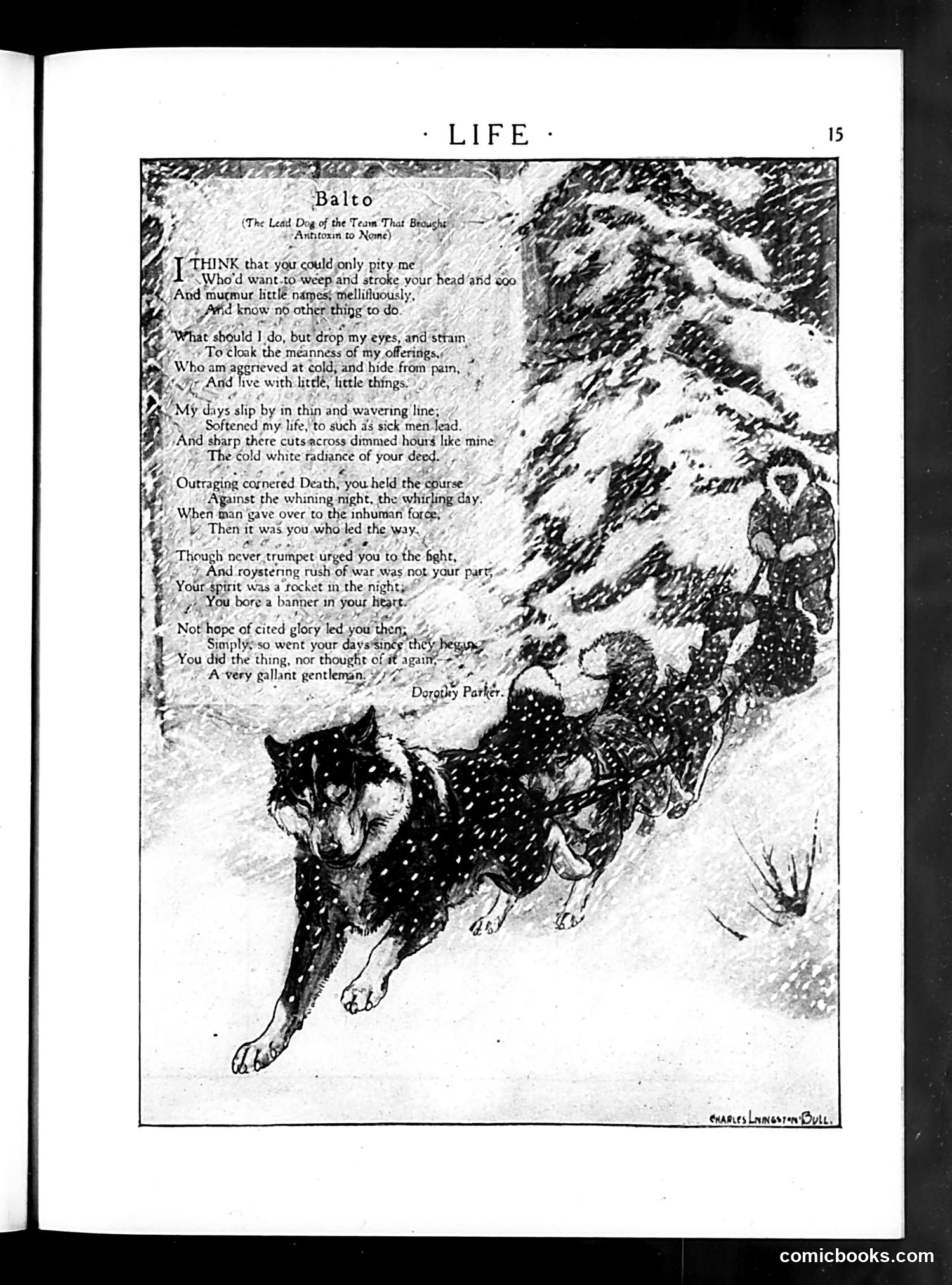
This page features a poem by Dorothy Parker titled "Balto (The Lead Dog of the Team That Brought Antitoxin to Nome)," accompanied by an illustration by Charles Livingston Bull. The poem honors Balto, a sled dog who led a famous 1925 dogsled relay delivering diphtheria antitoxin to the isolated town of Nome, Alaska during a health crisis. Parker's verse celebrates the dog's heroism and endurance, contrasting Balto's quiet courage with human seeking of glory. The illustration shows Balto leading the sled team through harsh snow. This represents Life magazine's use of poetry and illustration to commemorate an actual heroic animal, treating Balto's service with genuine reverence rather than satire.
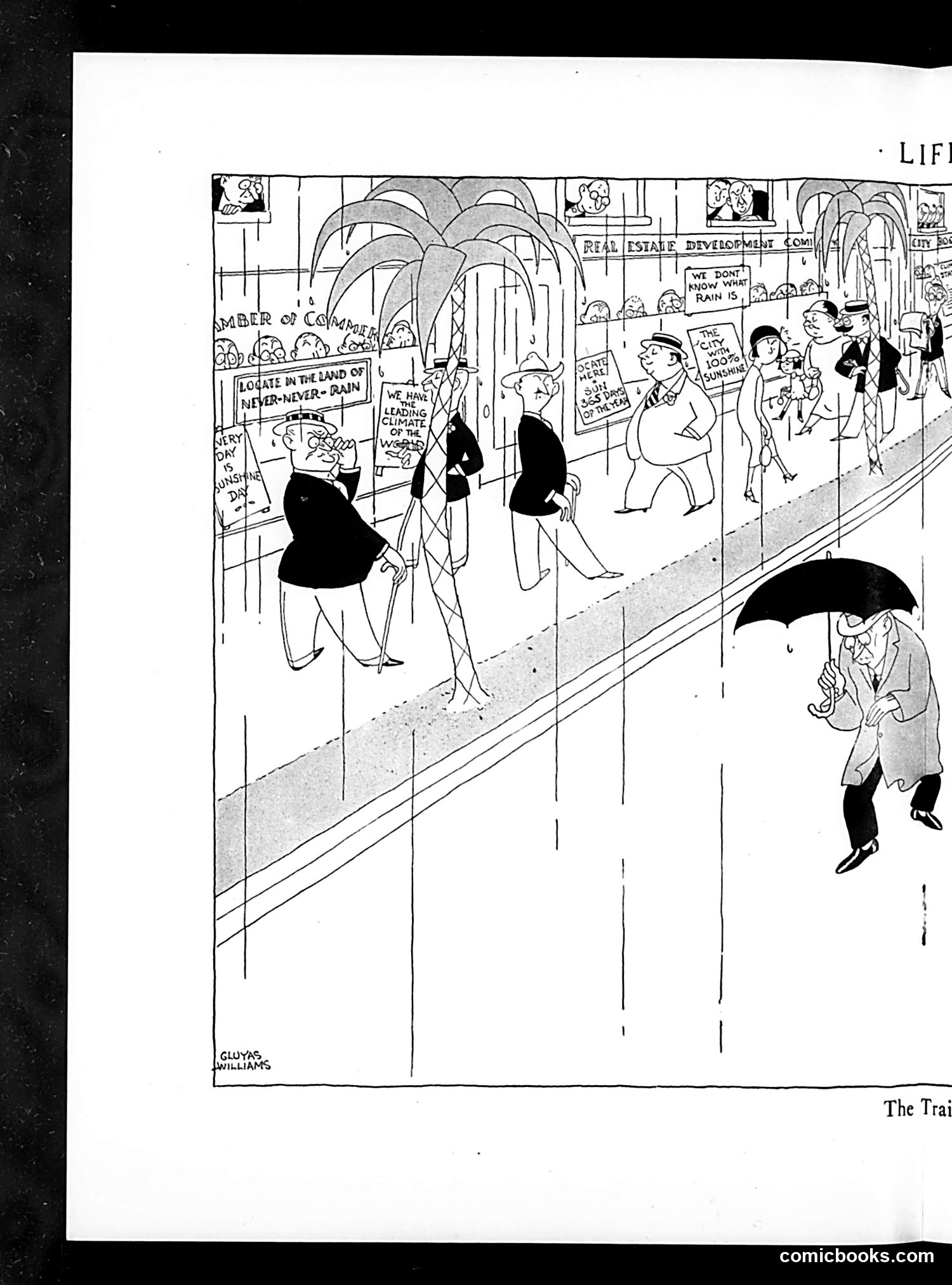
This satirical cartoon depicts a stark contrast between two groups separated by a street or barrier. On the upper left, well-dressed businessmen stand beneath an elaborate awning labeled "LOCATE IN THE LAND OF NEVER-NEVER-LAND," promoting real estate development with signs about "PERFECT CLIMATE" and "SUNSHINE." They appear prosperous and optimistic. On the lower right, a solitary figure huddles under an umbrella in the rain, seemingly excluded from this promised paradise. The cartoon satirizes the gap between glamorous real estate marketing promises and the reality facing ordinary people—likely during an economic downturn. The "Never-Never Land" reference suggests the developers' promises are fantasical rather than genuine. The cartoonist (Gluyas Williams) critiques how promotional schemes exploit hopeful buyers while ignoring economic hardship.
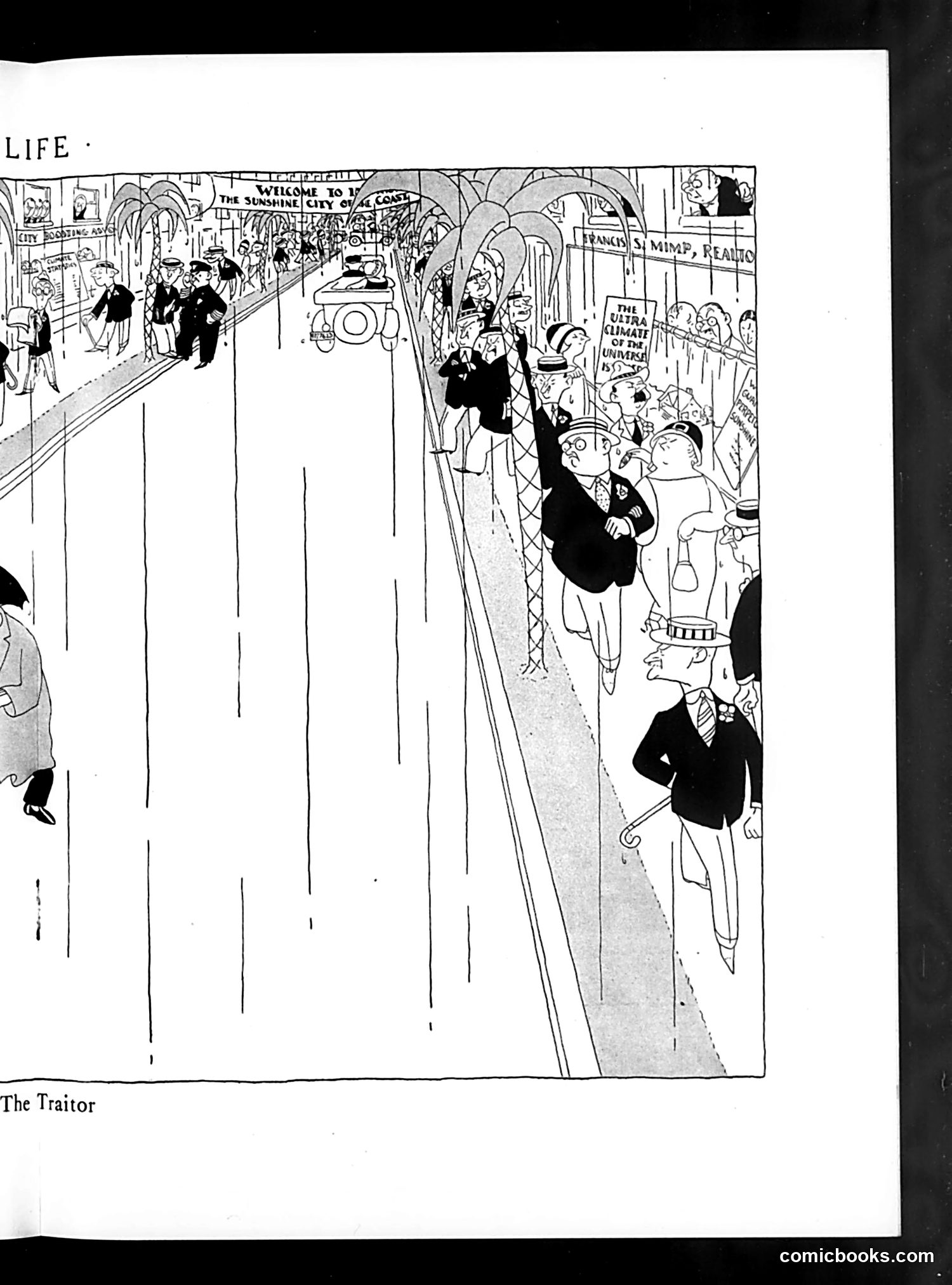
This appears to be a satirical cartoon from *Life* magazine depicting a rainy urban street scene, likely from the early-to-mid 20th century based on the art style and clothing. The title "The Traitor" suggests political or social commentary, though the specific identity of the central figure and the exact historical context are unclear from the image alone. The scene shows pedestrians on a city street with storefronts visible, including what appears to be "The Sunshine City" sign. A figure in dark clothing stands prominently, seemingly isolated or conspicuous among other passersby—consistent with the "traitor" designation. Without additional context about the publication date or surrounding text, the precise political or social reference cannot be definitively identified.
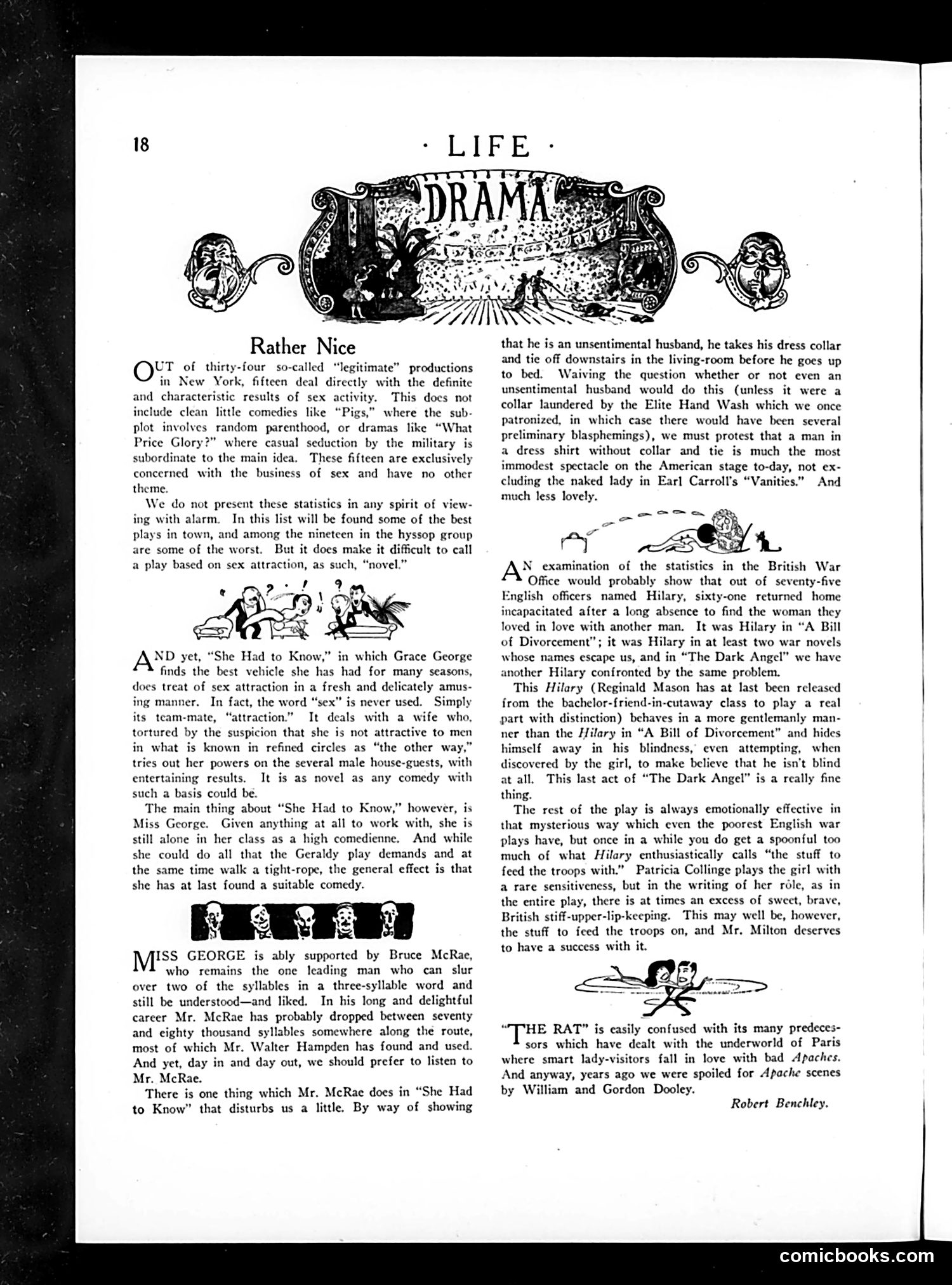
This page reviews two Broadway plays. The main article discusses "She Had to Know," starring Grace George, praising her as a superior comedienne while critiquing an odd staging choice where the male lead (Bruce McRae) removes his collar and tie downstairs—the reviewer argues this is an immodest spectacle, less appropriate even than nudity in Earl Carroll's "Vanities." The page opens with social commentary: of 34 "legitimate" New York productions, 15 deal explicitly with sex, yet plays based on sex attraction claim novelty. The review treats this without moral alarm, simply noting the statistical reality. A secondary review discusses "The Dark Angel," featuring a character named Hilary (played by Reginald Mason). The reviewer jokes that British War Office statistics would show most officers named Hilary returned from war to discover their lovers unfaithful—referencing this as a tired theatrical trope appearing in multiple plays and novels.
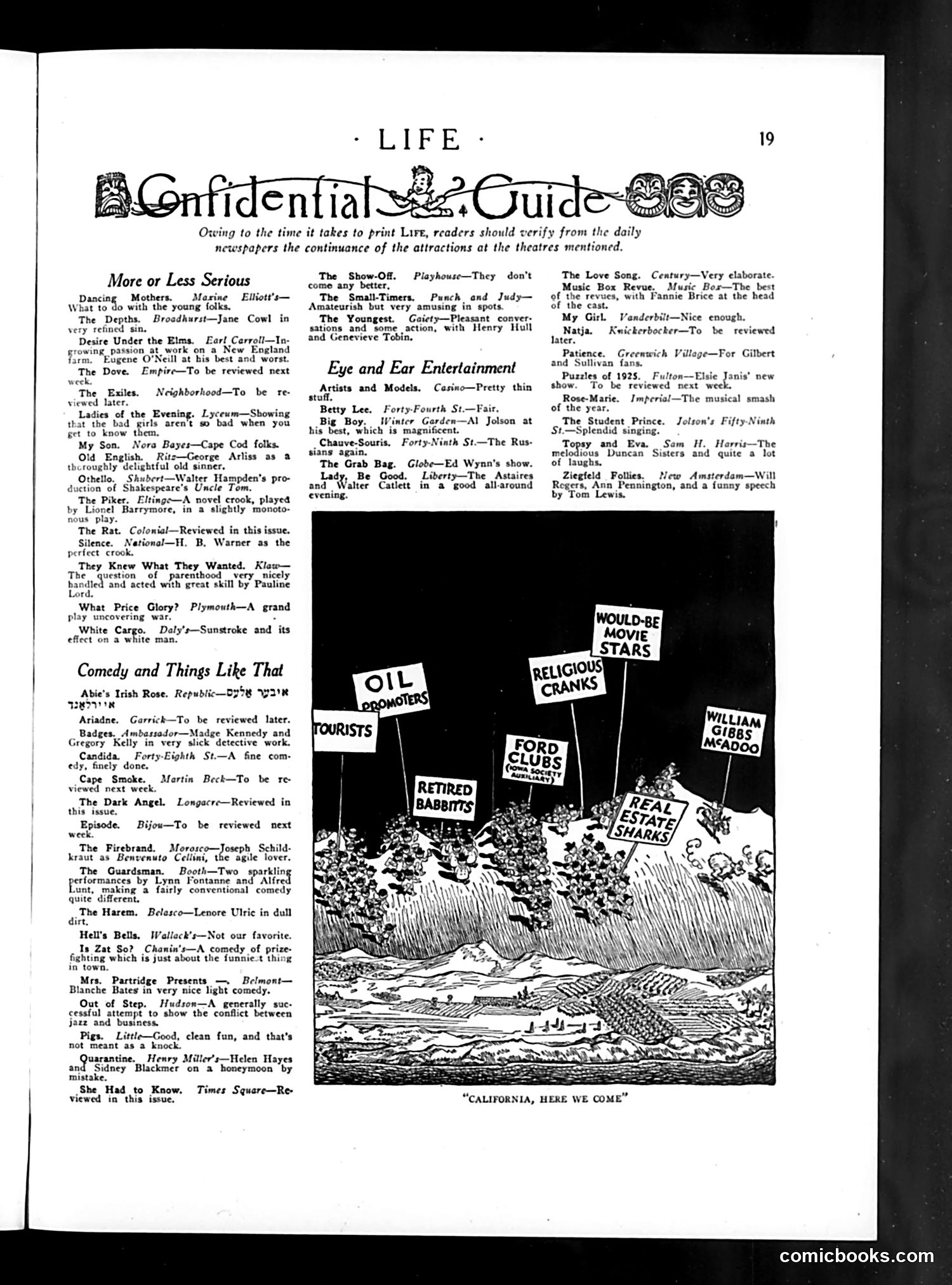
This cartoon satirizes the mass migration to California during the 1920s real estate and oil boom. The drawing shows a massive crowd of diverse Americans — labeled with signs indicating their types ("Oil Promoters," "Religious Cranks," "Tourists," "Retired Rabbits," "Ford Club," "Would-Be Movie Stars," "William Gibbs Harding") — flowing toward California like a human flood. The satire targets not California itself but the *types* of people rushing there seeking fortune or reinvention: speculators, con artists, religious zealots, celebrity-seekers, and the gullible. The overlapping, chaotic crowd suggests both the scale of migration and the satirist's skepticism about whether this motley group represents genuine progress or merely greedy opportunism exploiting California's allure. This reflects 1920s anxieties about rapid social change, commercialism, and the "anything goes" mentality of the Jazz Age.
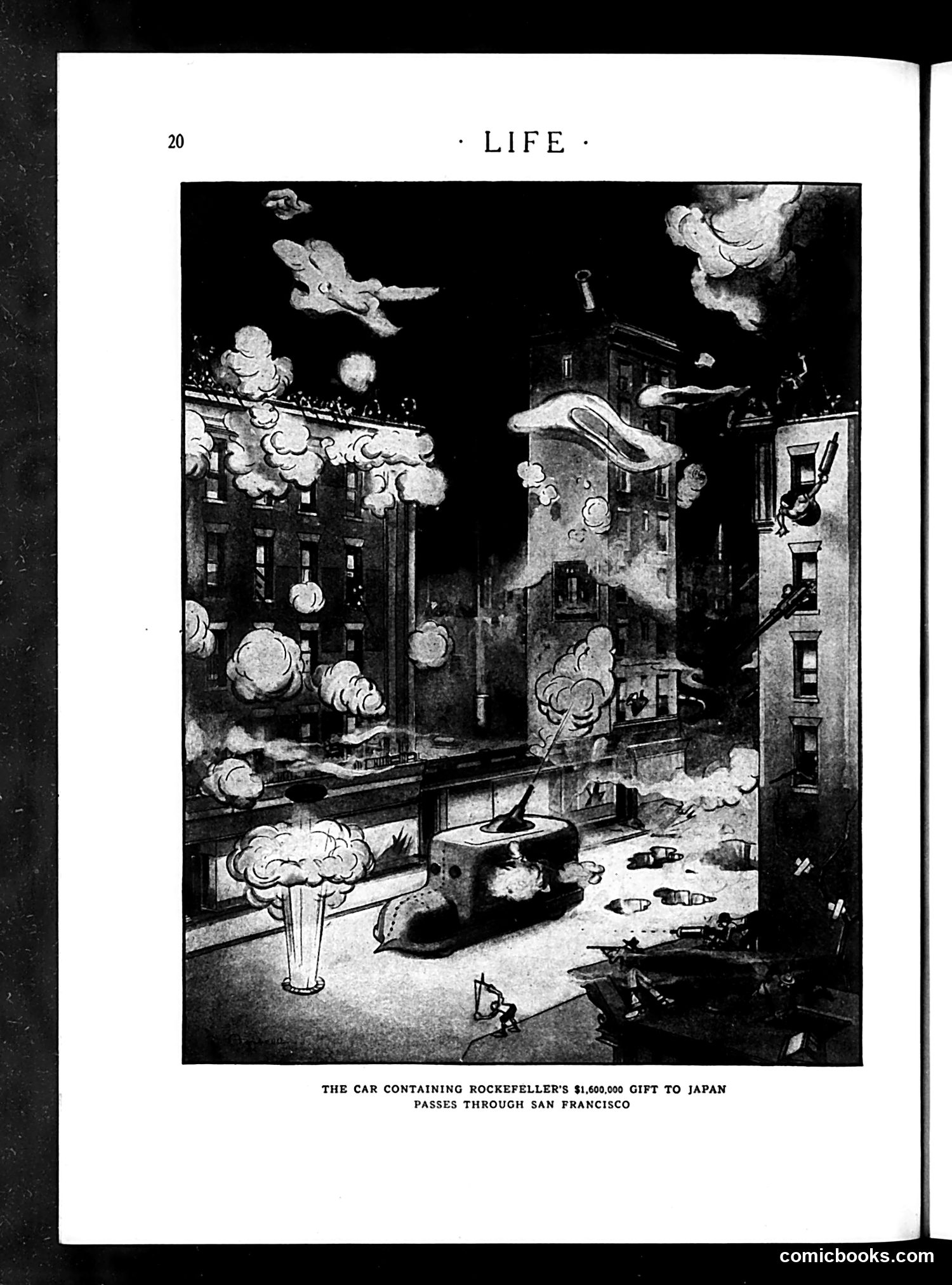
This satirical illustration depicts a chaotic urban street scene with explosions and destruction. According to the caption, it illustrates "the car containing Rockefeller's $1,600,000 gift to Japan passes through San Francisco." The cartoon appears to satirize American philanthropy and foreign aid, likely from the early 20th century. The exaggerated explosions and mayhem suggest irony about the gift's actual impact or the absurdity of such massive donations while domestic conditions remained problematic. The cartoon uses visual hyperbole—showing San Francisco in apparent turmoil—to mock either the extravagance of the gift or questions about its true value and purpose. Without the magazine's date, the precise historical context remains unclear, but this appears to critique wealthy American industrialists' high-profile international charitable gestures.
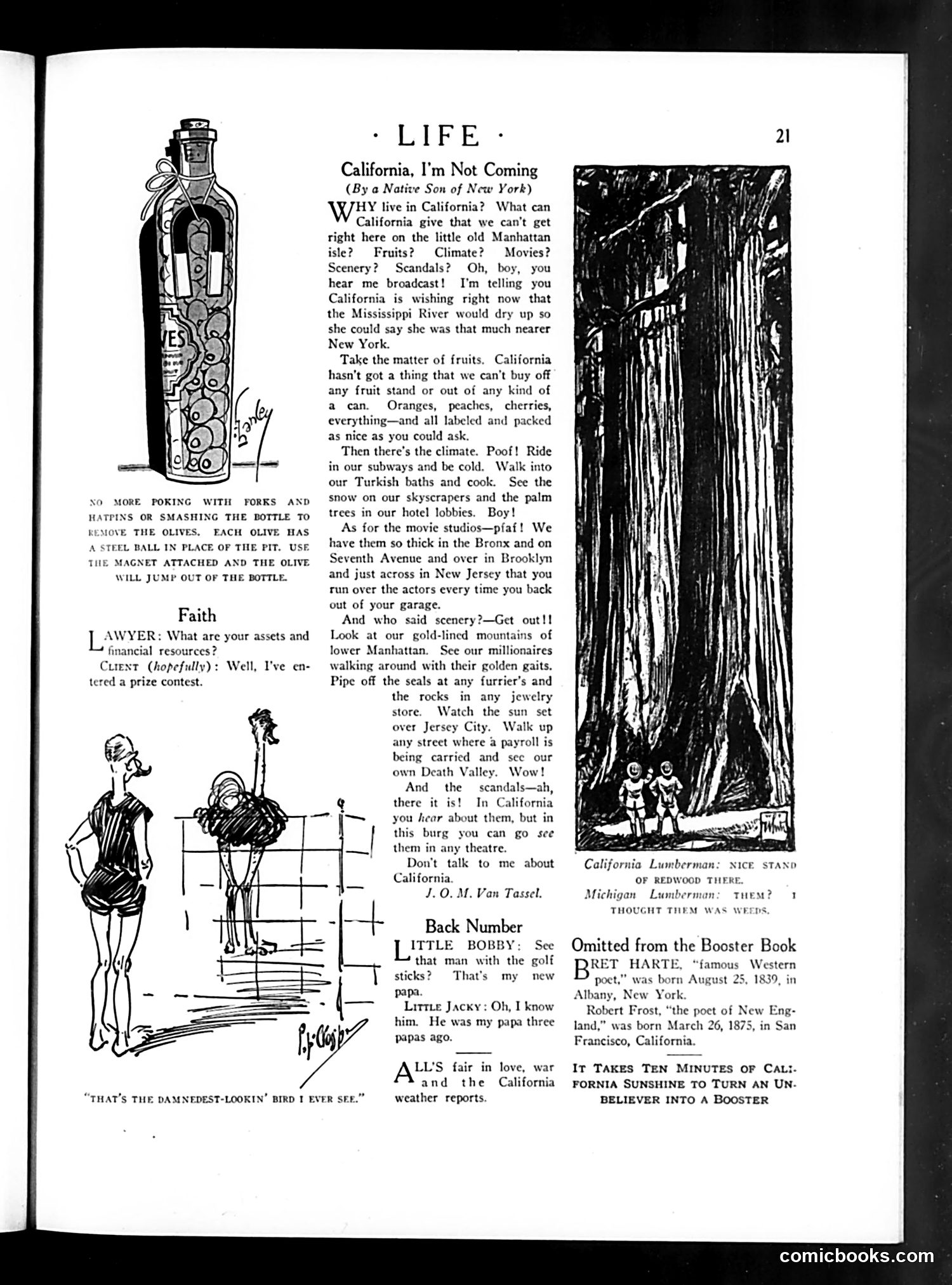
This page satirizes California's booster culture—the aggressive promotion of California as paradise—through a New York perspective. The main article, "California, I'm Not Coming," uses humorous exaggeration to argue that New York offers everything California does, only better: fruits available in cans, artificial climate control via subways and Turkish baths, movie studios scattered throughout the Bronx and New Jersey, and most importantly, *real* scandals you can witness live in theaters rather than merely hear about. The "Back Number" jokes mock California's appeal: one features a child whose father is a temporary visitor (suggesting California attracts transient wealthy men), another features a lumberman mistaking massive redwoods for "weeds," and a final jab notes that famous "Western" and "New England" poets were actually born in New York and California respectively—inverting expectations. The satire targets 1920s-era California real estate promotion while defending New York's cultural and material superiority through comedic exaggeration.
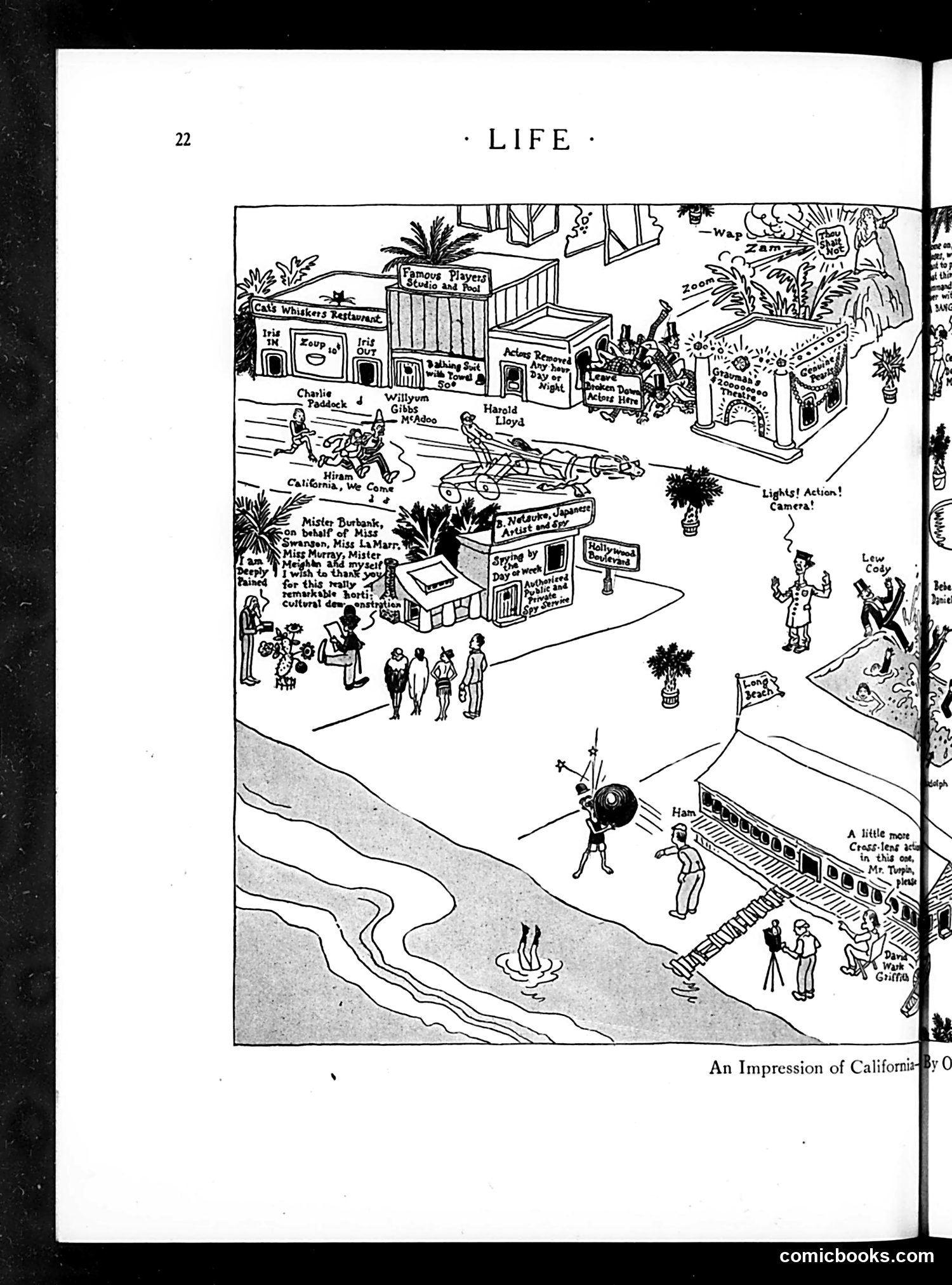
This is a humorous bird's-eye-view map of early Hollywood, satirizing the film industry's rapid growth and self-importance. The illustration labels various studio buildings and identifies silent film stars and directors of the era, including names like Charlie Chaplin, William Gibbs, Harold Lloyd, and Mister Burbank. The satire mocks Hollywood's pretensions: sprawling studio complexes are depicted prominently, while beach scenes show both glamorous activity and comedic chaos—people in bathing suits, someone being launched from a cannon ("Light! Action! Camera!"), and general mayhem. The map presents California's entertainment industry as a strange, somewhat chaotic wonderland of ego and spectacle. For modern readers, it captures the early 1920s fascination with cinema as both an artistic and commercial juggernaut that was rapidly transforming Southern California into an entertainment capital.
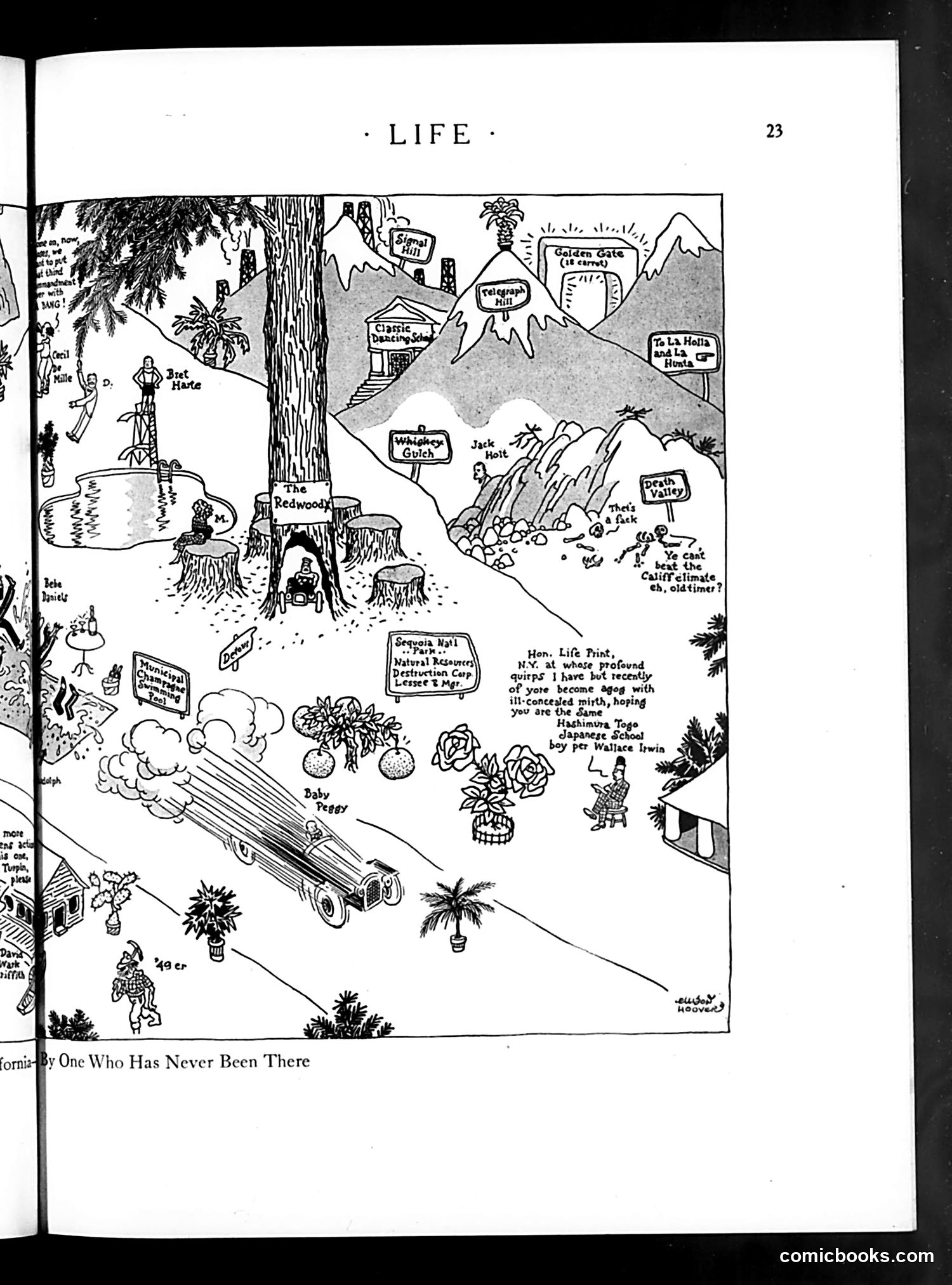
This is a satirical map of California landmarks and attractions, presented as a tourist's guide. The cartoon depicts famous sites like the Golden Gate, Telegraph Hill, and Yosemite Valley alongside natural resources and development projects. A character labeled "Life Print" addresses an "oldtimer," asking whether he's noticed California's changed climate—a joke about the state's rapid transformation through tourism and commercialization. The satire targets how California was being packaged and commodified for visitors, with natural wonders reduced to labeled attractions. References to "Baby Poppy" (California poppies) and various named locations suggest this mocks the over-commercialization of the state's landscape during the early 20th century, when California tourism was booming and natural areas were being increasingly developed and promoted.
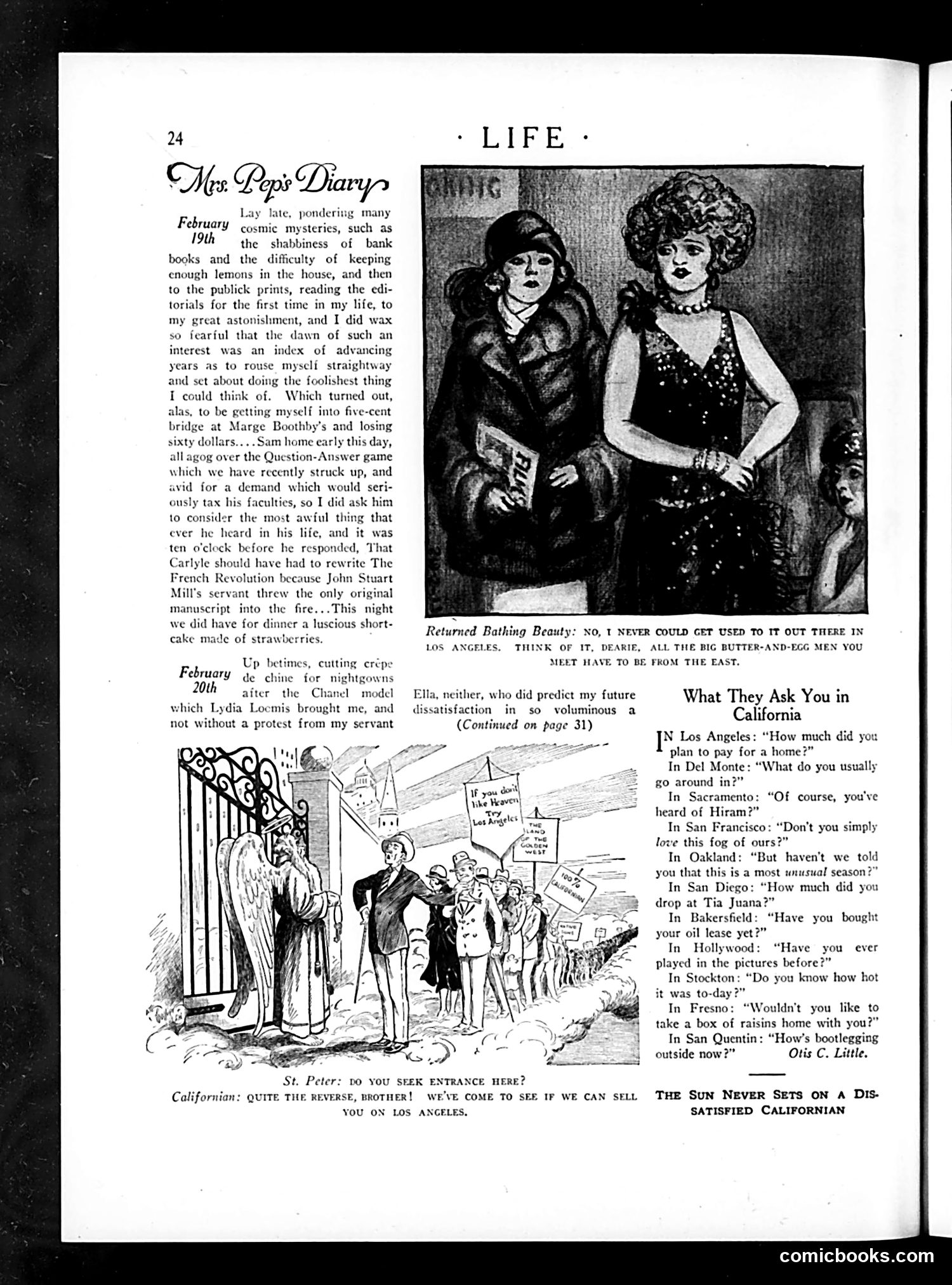
This page contains a personal diary column and regional humor mocking California's boosterism and transplants. **"Her Pop's Diary"** presents mundane domestic observations—losing money at bridge, losing sixty dollars, discussing obscure literary trivia (Carlyle's *French Revolution*). The humor lies in its self-aware pettiness: the diarist worries that reading editorials signals advancing age, then deliberately does something foolish to counter it. **The cartoons mock California culture**: The "St. Peter" panel satirizes aggressive California salesmanship—Californians so eager to sell their state they'd bypass heaven's entrance. The "Returned Bathing Beauty" photo caption jokes that Los Angeles beach culture and wealthy "butter-and-egg men" (nouveau riche investors) seem foreign to East Coast sensibilities. **"What They Ask You in California"** catalogs regional stereotypes across California cities—oil leases in Bakersfield, raisins in Fresno, bootlegging references (Prohibition-era), Hollywood stardom questions—suggesting Californians are provincially obsessed with local industries and concerns. The overall tone is East Coast condescension toward West Coast materialism and relentless boosterism.
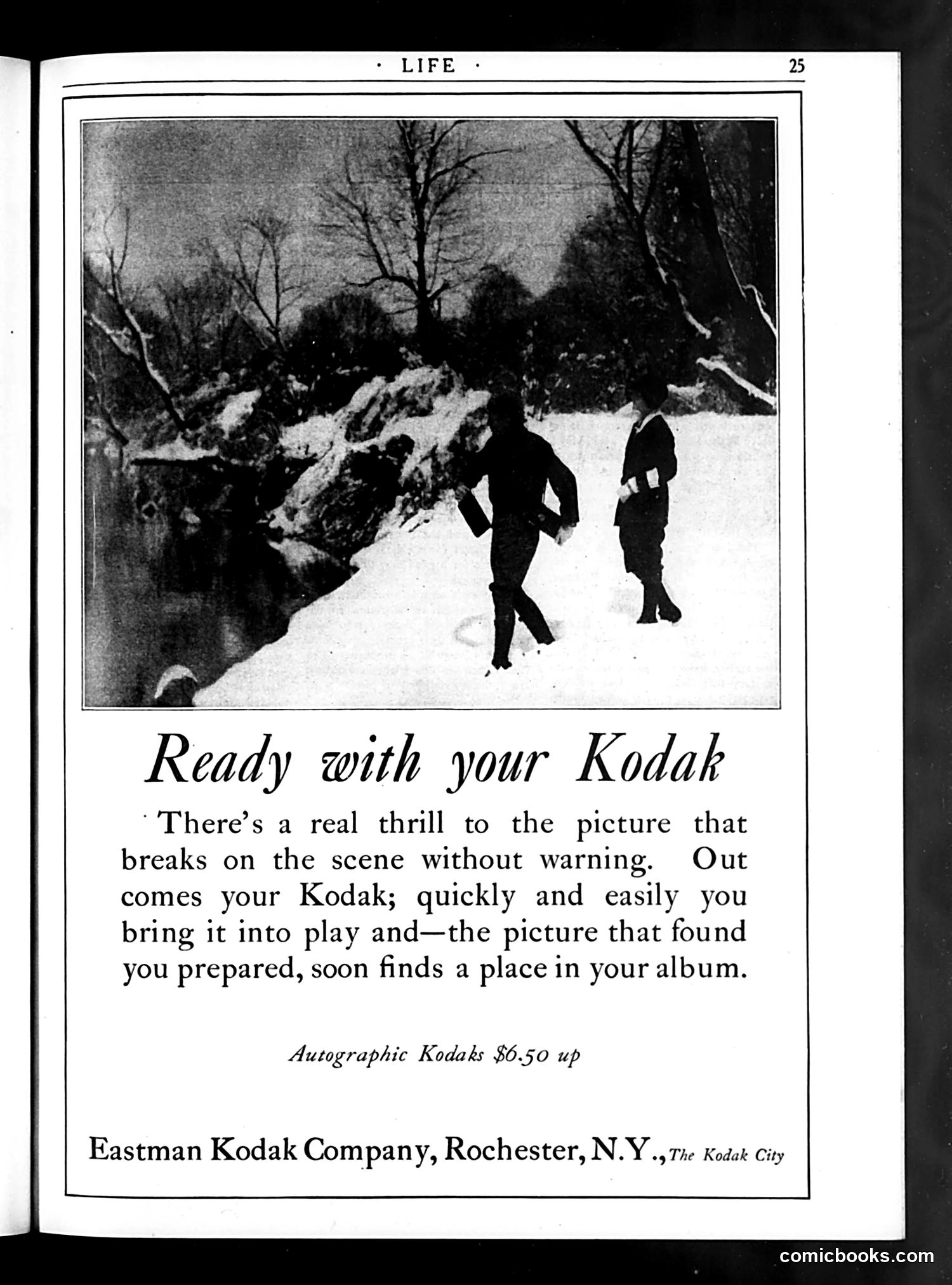
This page is a Kodak advertisement, not political satire. It shows two people jogging or running through a snowy winter landscape with bare trees, promoting the portability and readiness of Kodak cameras for spontaneous photography. The ad's appeal is that photographers can quickly capture unexpected moments outdoors—in this case, winter sports or leisure activities—without missing the shot. The text emphasizes the camera's ease of use and accessibility ("quickly and easily"). This reflects early-20th-century marketing that positioned Kodak cameras as essential for capturing modern life's fleeting moments. "Autographic Kodaks" refers to Kodak's feature allowing photographers to write on film. This is commercial messaging, not editorial commentary.
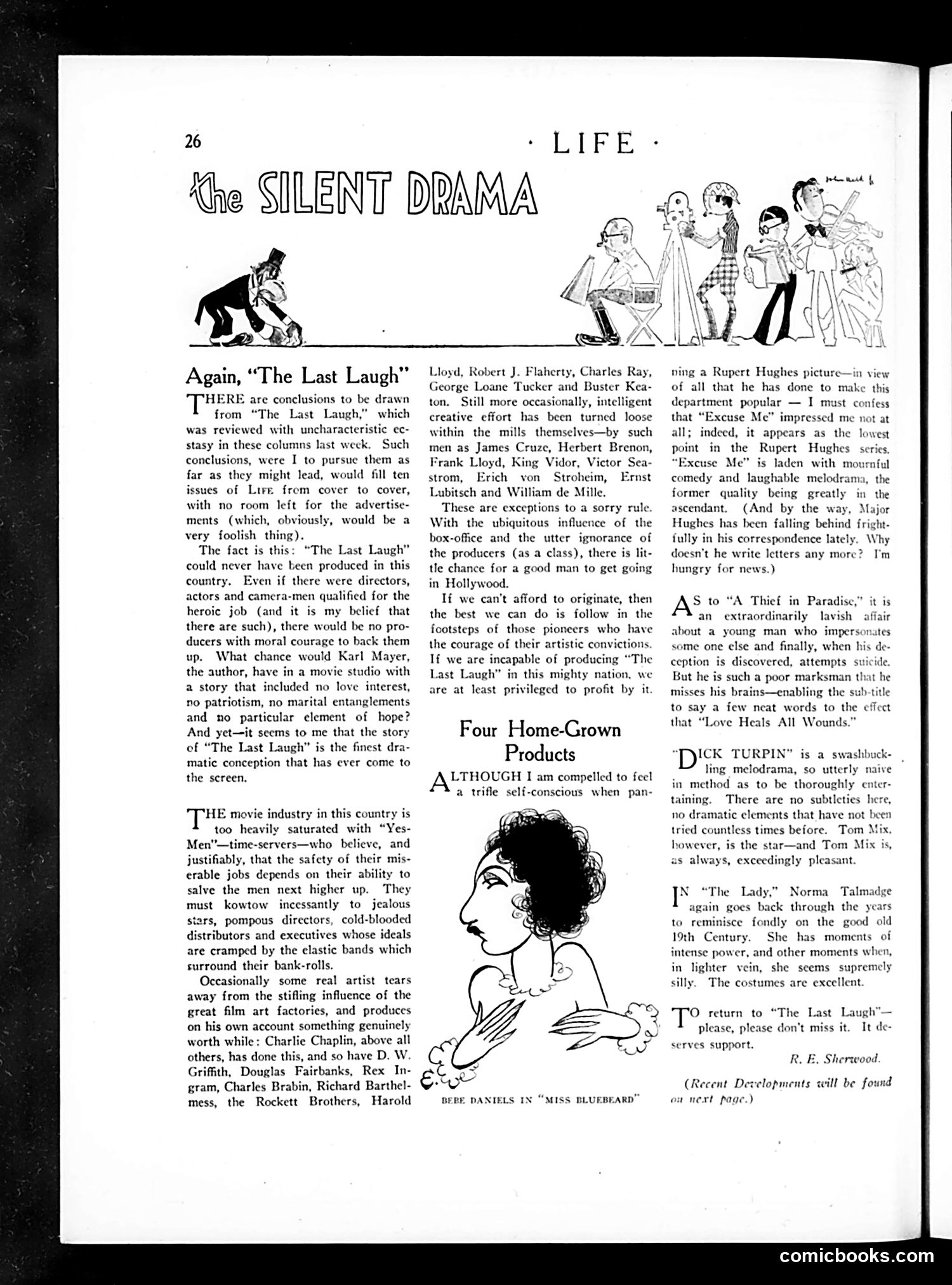
This page critiques American cinema through two illustrations. The top cartoon depicts a *homo sapiens* evolving into a film director or producer—satirizing how the movie industry supposedly "civilizes" or transforms people, though the intent here appears ironic. The text argues that German film "The Last Laugh" could never be produced in Hollywood because American studios prioritize commercial appeal (love interest, patriotism, hope) over artistic merit. The author criticizes the "Yes Men" system: producers and executives beholden to stars and box-office returns, stifling creative risk-taking. He names exceptions—Chaplin, Fairbanks, Brenon, Vidor—who succeeded despite the system, but claims most American filmmakers lack courage. The review then dismisses several contemporary American films as derivative mediocrity, suggesting Hollywood should at least imitate European artistic pioneers rather than chasing profit alone.
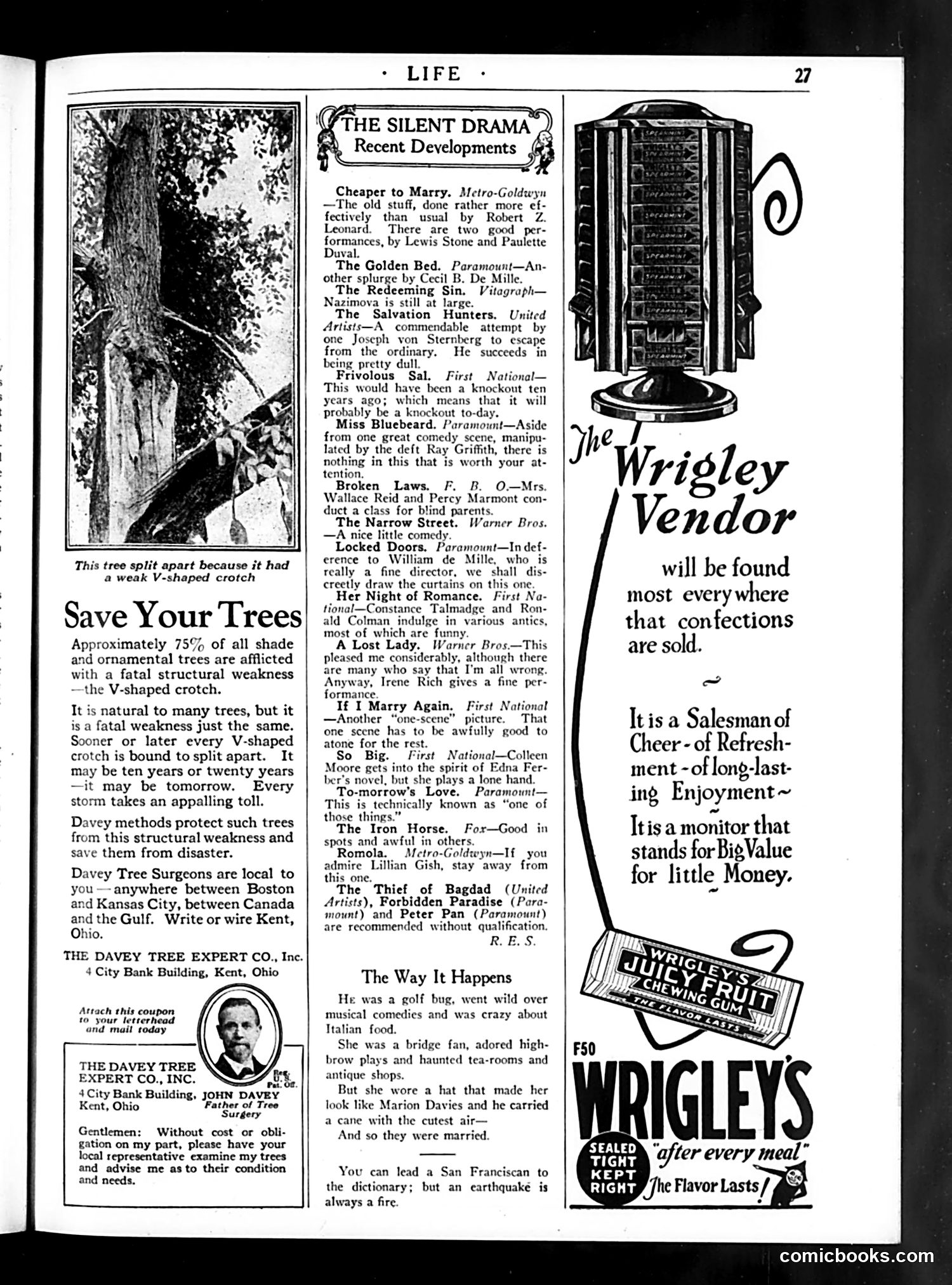
This page mixes public service messaging with entertainment criticism and advertising. **Left side**: A genuine public health notice from the Davey Tree Expert Company warns that V-shaped tree crotches are structurally weak and prone to splitting. This is legitimate arboricultural advice, not satire—the photo demonstrates the problem. **Center**: "The Silent Drama" reviews recent films, offering sharp critical takes on contemporary movies. The reviews are brief, witty dismissals or endorsements (e.g., "If I Marry Again" is just one scene that "has to be awfully good"). This reflects Life's satirical stance toward Hollywood's output. "The Way It Happens" is a brief comedic vignette about unlikely romance. **Right side**: Two advertisements—one for Wrigley's Vendor (chewing gum dispensers) and one for Wrigley's gum itself—dominate the space with period commercial messaging. The page is primarily commercial/entertainment-focused rather than politically satirical.
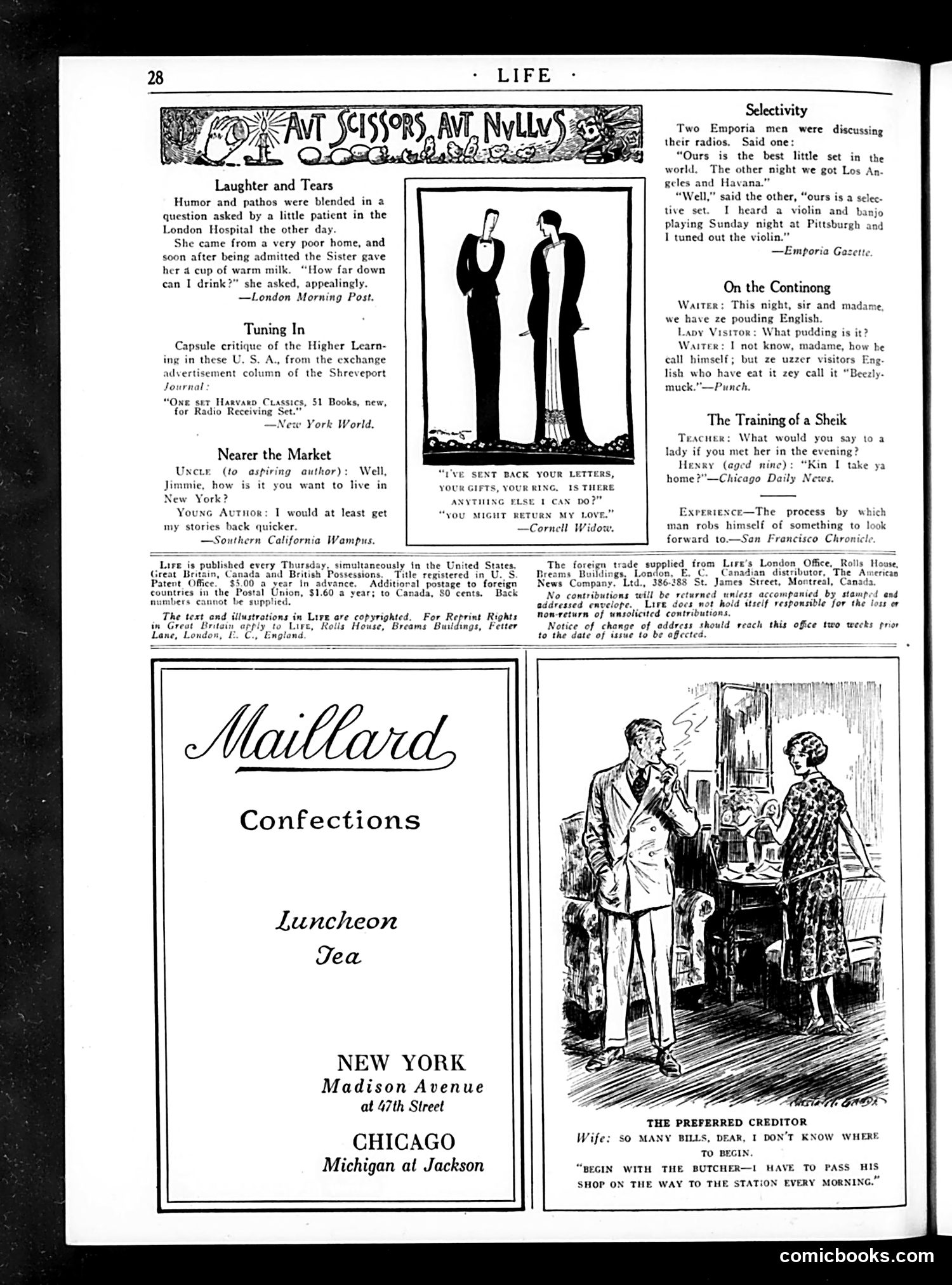
This page contains brief humorous anecdotes and advertisements typical of Life's satirical format. The main cartoon depicts a husband advising his wife which bills to pay first—prioritizing the butcher because he passes the shop daily and wants to avoid awkward encounters. The joke reflects Depression-era financial anxiety and the social embarrassment of owing money to local tradespeople. The surrounding text snippets mock contemporary issues: a London hospital patient's poverty (asking how far down she can drink milk), American radio reception enthusiasts' boasting, aspiring authors seeking New York publication, and hotel staff's linguistic confusion. "The Training of a Sheik" references popular 1920s fascination with romantic "Sheik" fantasies. These brief jokes target middle-class anxieties, consumerism, and social pretension through everyday situations. The Maillard Confections advertisement occupies the lower left, typical of the magazine's mixed editorial-commercial format.
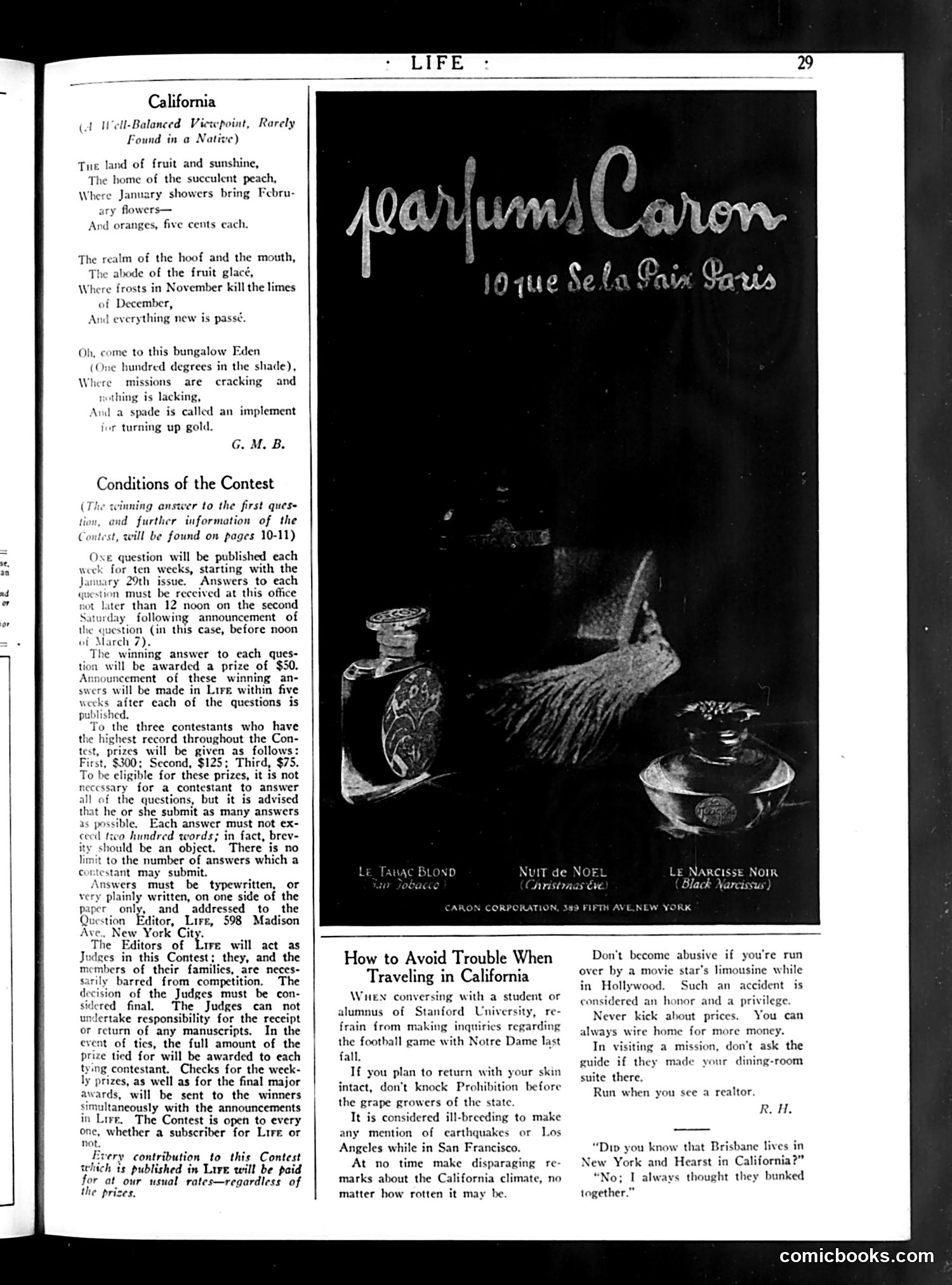
This page contains two distinct pieces of satire about California: **"California" Poem (top left):** A mock-romantic poem that undercuts California's celebrated image. It presents the state as a contradictory paradise—advertising sunshine and cheap fruit while acknowledging extreme heat, crop failures from November frosts, and a culture where everything trendy quickly becomes outdated. The final stanza satirizes California's real estate boom, mockingly calling it "bungalow Eden" while noting missions are deteriorating and the landscape is being aggressively developed for gold-seeking. **"How to Avoid Trouble When Traveling in California" (bottom):** Humorous etiquette advice that exposes California's sensitivities and hypocrisies—Stanford's football rivalry, Prohibition enforcement among grape growers, earthquake denial in San Francisco, inflated real estate prices, and the film industry's outsized ego in Hollywood. The closing joke about Hearst and Brisbane (prominent publishers) living in California suggests the state attracts eccentric wealthy figures. Both pieces mock California's boosterism and contradictions during what appears to be the 1920s real estate and oil boom era.
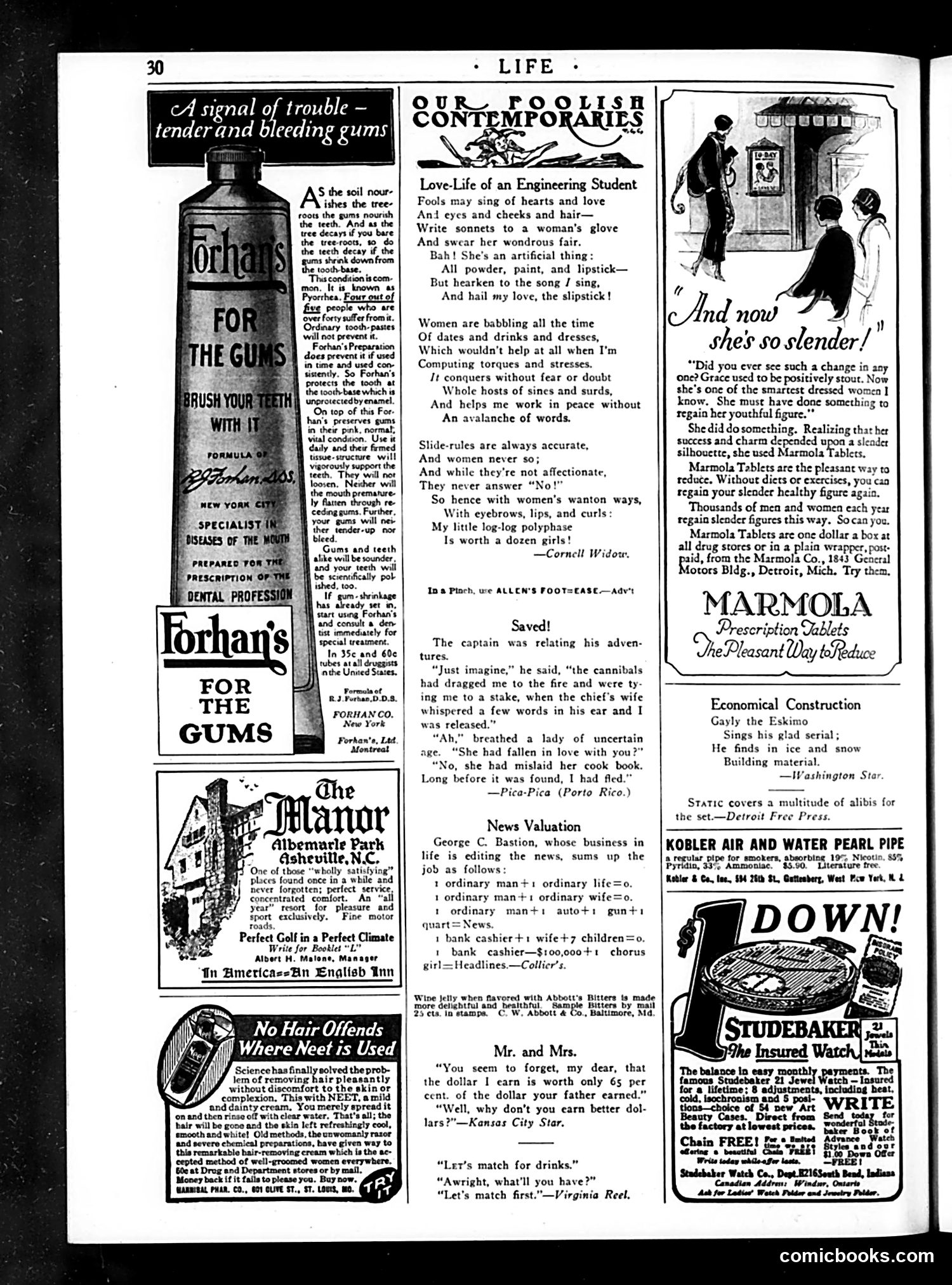
This page is primarily **advertising and light humor**, not political satire. The main content includes: **Advertisements** for dental care (Forhan's toothpaste for gum disease), hair removal cream (Neet), a resort (The Molanor), and watches—typical early 20th-century product pitches with health claims. **"Our Foolish Contemporaries"** is a humor section mocking an engineering student who prefers his slide rule to women, preferring its accuracy and reliability over romantic pursuits. This satirizes both academic obsession and contemporary dating culture. **"Saved!"** and **"News Valuation"** are brief jokes: one plays on a cannibal captain's wife losing interest when she mislaid her cookbook; the other uses math equations to suggest scandals (bank embezzlement, actresses) generate headlines while ordinary lives don't. The overall tone reflects 1920s-era assumptions about gender, courtship, and what constitutes "news"—now dated but not deeply political.
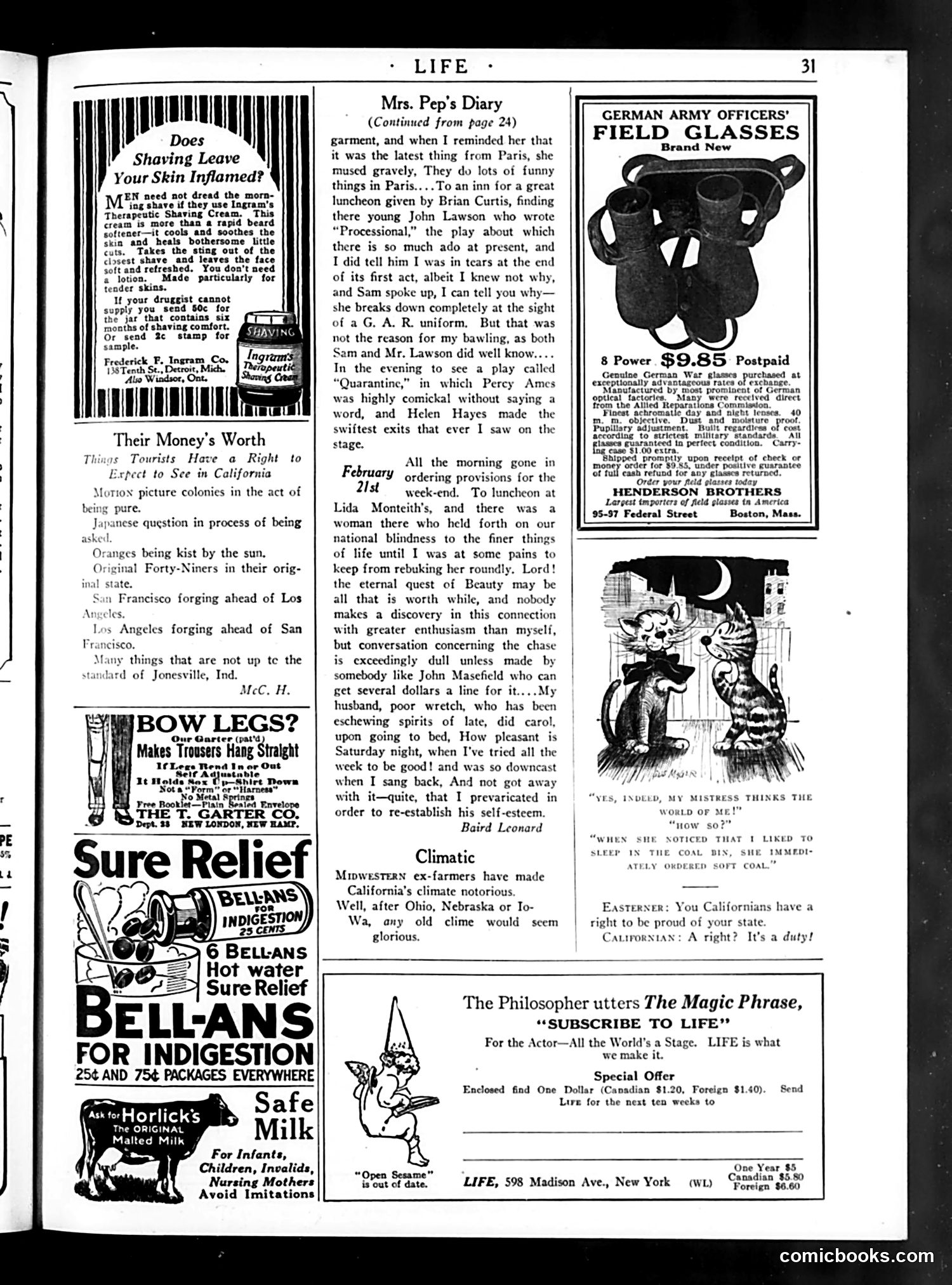
This page is primarily **advertising and editorial content** rather than political cartoons. The notable elements include: **"Mrs. Pep's Diary"** (center): A society column documenting theatrical outings and social events. References include John Lawson's play "Processional" and Helen Hayes' performance—these were contemporary 1920s theater events the readers would recognize. **"Their Money's Worth"** (left): Satirical commentary on California tourism expectations versus reality—poking fun at the gap between the region's romanticized image (pure movie colonies, 49ers, competitive cities) and actual experience. The humor targets tourist disappointment. **"Climatic" section** (bottom): Jokes that Midwestern farmers' migration to California made the state's climate seem better merely by comparison to harsh Midwest winters. The page is otherwise dominated by **period advertisements** for shaving cream, digestive remedies (Bellans), malted milk, and notably **German Army field glasses**—surplus WWI military equipment being sold to American civilians, reflecting post-war commerce.
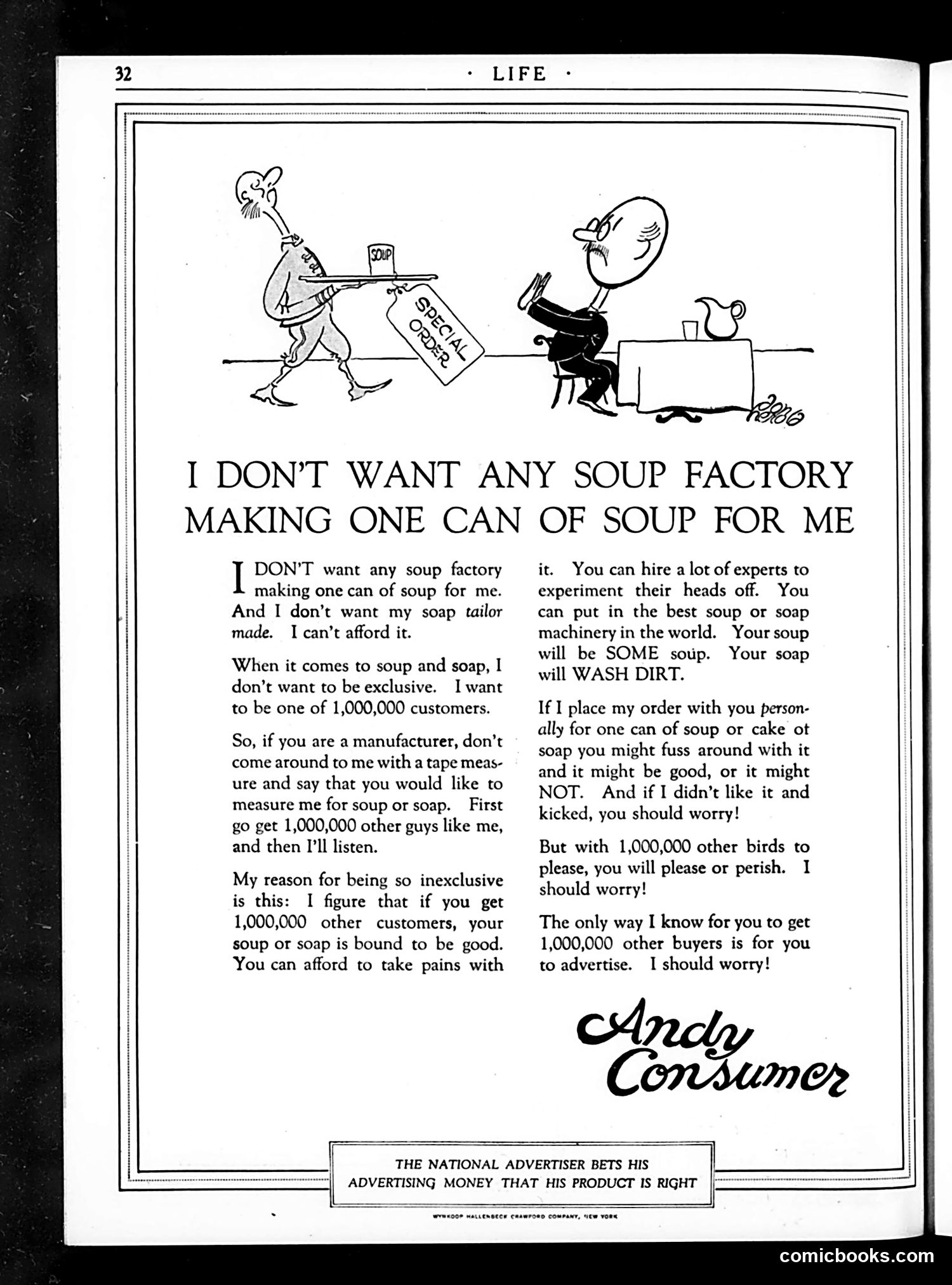
This satirical piece argues for **mass production over custom/artisanal manufacturing**. The cartoon shows a manufacturer attempting to "tailor-make" soup for an individual customer—a visual absurdity meant to mock exclusive, handcrafted goods. **The argument**: Andy Consumer refuses custom production because he believes **scale drives quality**. Only when a manufacturer serves 1,000,000 customers can they afford experts, machinery, and rigorous standards. A single bespoke order invites corner-cutting; mass production demands reliability or the company fails. **The satire targets**: Both the appeal of luxury "made-to-order" goods and manufacturers who pitch exclusivity. Andy's working-class voice ("I can't afford it") suggests this was likely written during early-20th-century debates over industrial standardization versus craftsmanship. **The footer** reveals the real pitch: national advertising creates mass markets, benefiting consumers through competitive quality and low prices. This is essentially propaganda for **modern consumer capitalism and mass marketing**.
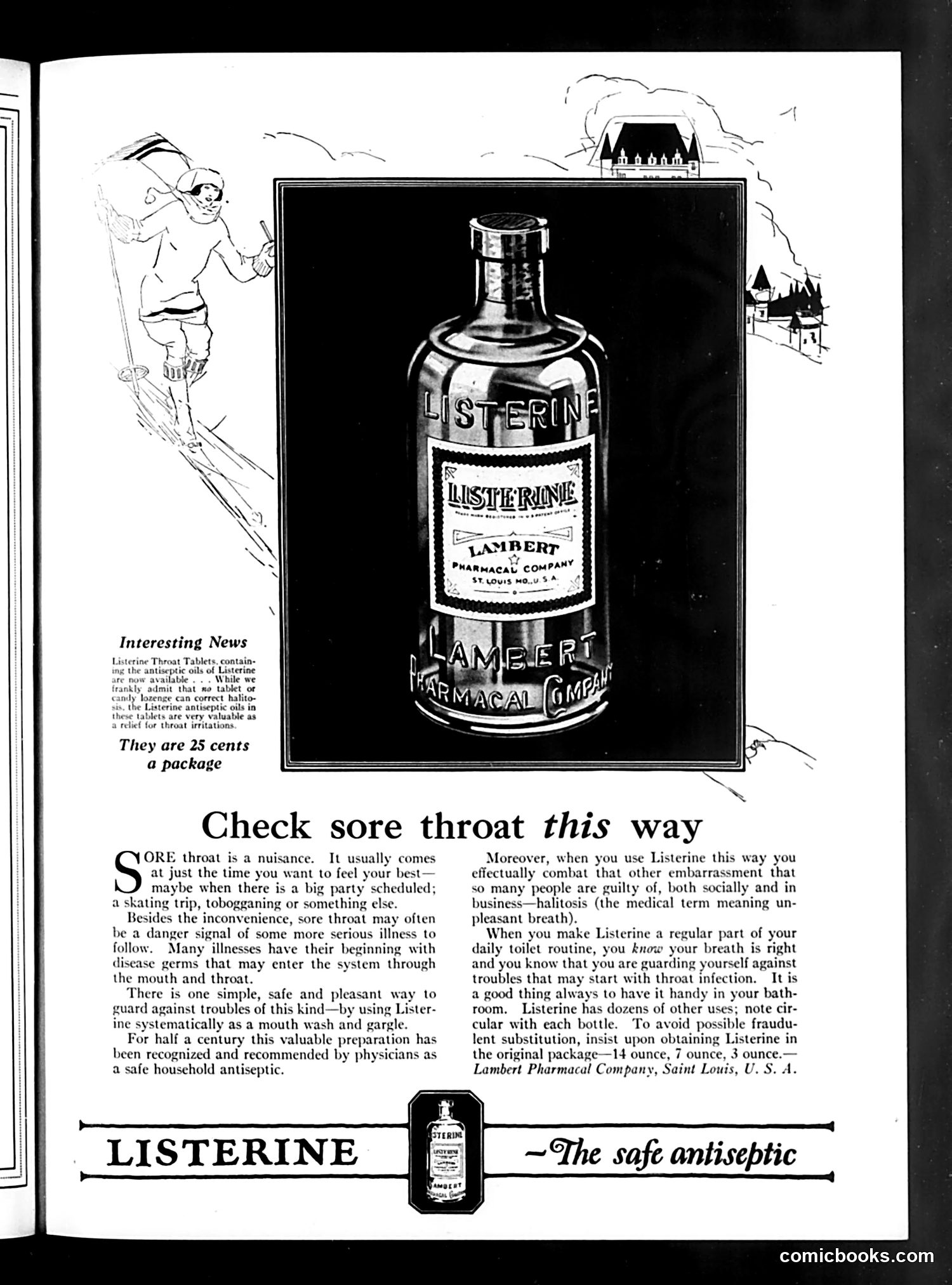
This is **primarily a Listerine advertisement**, not political satire. The page promotes Listerine mouthwash and newly-available throat tablets. The small sketch at top left depicts a skier, representing the "inconvenience" of sore throats interrupting leisure activities like "a big party scheduled; a skating trip, tobogganing or something else." The central image shows a large Listerine bottle. The castle illustration at top right is decorative branding imagery unrelated to the advertisement's message. The ad's actual point: Listerine prevents sore throats and "halitosis" (bad breath)—a medical term the ad explains parenthetically, suggesting it was still relatively new terminology to readers. The copy emphasizes that using Listerine as a daily mouth rinse guards "against troubles that may start with throat infection." This reflects early-20th-century advertising strategy: positioning antiseptic products as preventative health measures while also appealing to social embarrassment about breath odor.
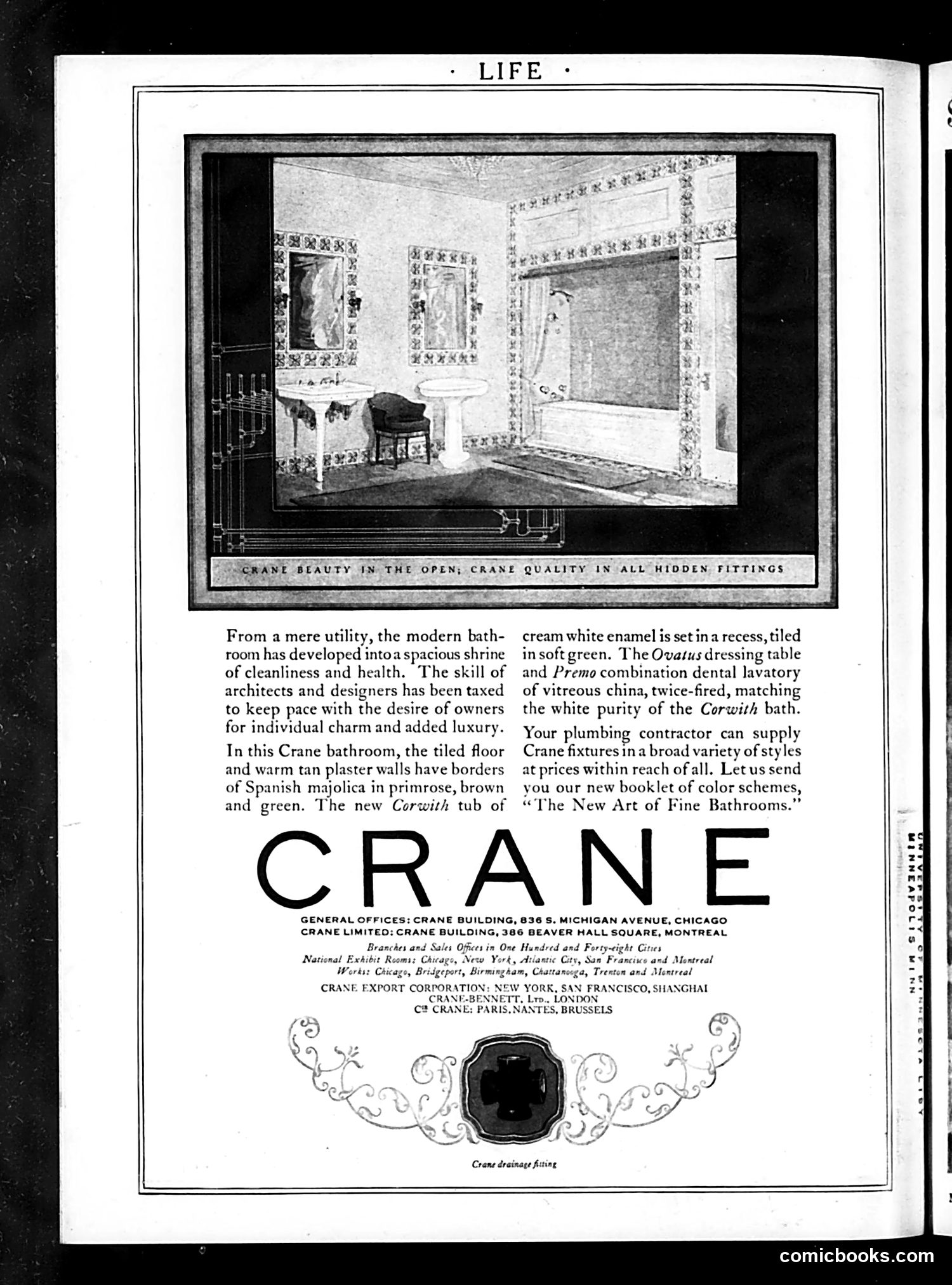
The image shows a luxurious bathroom interior design from what appears to be the early 20th century. The text emphasizes how bathrooms evolved from mere utilities into spaces of "cleanliness and health" reflecting owners' desires for luxury and individual charm. The ad highlights specific Crane products: the Corwith tub, Ovatus dressing table, and Premo dental lavatory, all featuring cream-white enamel and vitreous china finishes. Spanish majolica tile borders in primrose, brown, and green provide decorative elements. The message appeals to middle-to-upper-class homeowners by suggesting that quality plumbing fixtures are now affordable ("at prices within reach of all") and available through their local plumbing contractor. Crane's extensive network of branches, showrooms, and manufacturing facilities across North America and internationally is listed to emphasize the company's reach and reliability.