
Life, 1925-02-26 · page 28 of 36
Life — February 26, 1925 — page 28: what you’re looking at
What you’re looking at
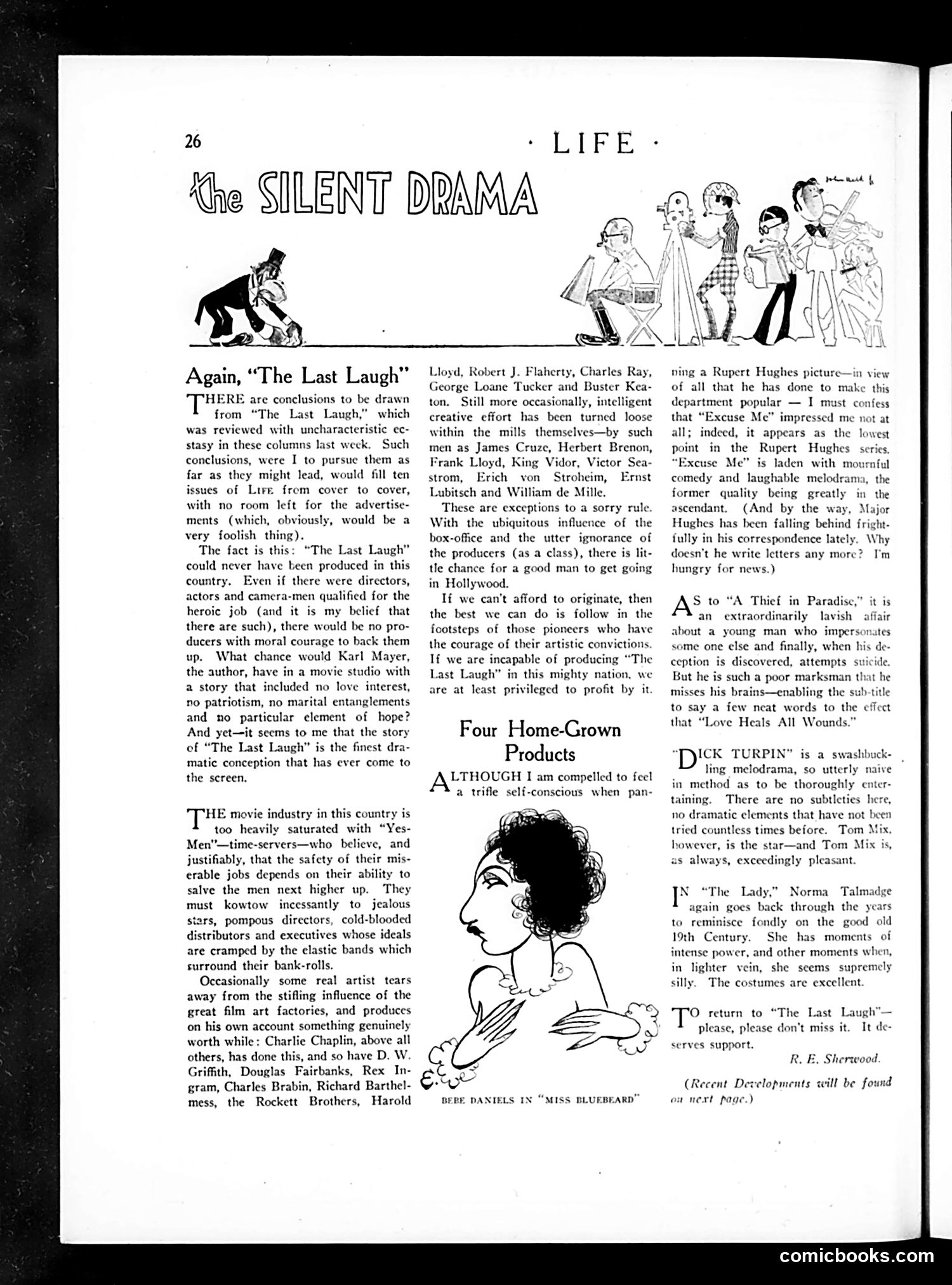
This page critiques American cinema through two illustrations. The top cartoon depicts a *homo sapiens* evolving into a film director or producer—satirizing how the movie industry supposedly "civilizes" or transforms people, though the intent here appears ironic. The text argues that German film "The Last Laugh" could never be produced in Hollywood because American studios prioritize commercial appeal (love interest, patriotism, hope) over artistic merit. The author criticizes the "Yes Men" system: producers and executives beholden to stars and box-office returns, stifling creative risk-taking. He names exceptions—Chaplin, Fairbanks, Brenon, Vidor—who succeeded despite the system, but claims most American filmmakers lack courage. The review then dismisses several contemporary American films as derivative mediocrity, suggesting Hollywood should at least imitate European artistic pioneers rather than chasing profit alone.
📄 Transcribed text from this page (OCR, searchable)
Machine-transcribed from the original scan — historical spelling and the odd misread are preserved.
26 ‘ LIFE » the SILENT DRAMA Again, “The Last Laugh” HERE are conclusions to be drawn from “The Last Laugh,” which was reviewed with uncharacteristic ec- stasy in these columns last week. Such conclusions, were I to pursue them as far as they might lead, would fill ten issues of Lire frem cover to cover, with no room left for the advertise- ments (which, obviously, would be a very foolish thing). The fact is this: “The Last Laugh” could never have been produced in this country. Even if there were directors, actors and camera-men qualified for the heroic job (and it is my belief that there are such), there would be no pro- ducers with moral courage to back them up. What chance would Karl Mayer, the author, have in a movie studio with a story that included no love interest, no patriotism, no marital entanglements and no particular element of hope? And yet—it seems to me that the story of “The Last Laugh” is the finest dra- matic conception that has ever come to the screen, THE movie industry in this country is too heavily saturated with “Yes- Men"”—time-servers—who believe, and justifiably, that the safety of their mis- erable jobs depends on their ability to salve the men next higher up. They must kowtow incessantly to jealous stars, pompous directors, cold-blooded distributors and executives whose ideals are cramped by the elastic bands which surround their bank-rolls. Occasionally some real artist tears away from the stifling influence of the great film art factories, and produces on his own account something genuinely worth while: Charlie Chaplin, above all others, has done this, and so have D. W. Griffith, Douglas Fairbanks, Rex In- gram, Charles Brabin, Richard Barthel- mess, the Rockett Brothers, Harold Lloyd, Robert J. Flaherty, Charles Ray, George Loane Tucker and Buster Kea- ton. Still more occasionally, intelligent creative effort has been turned loose within the mills themselves—by such men as James Cruze, Herbert Brenon, Frank Lloyd, King Vidor, Victor Sea- strom, Erich von Stroheim, Ernst Lubitsch and William de Mille. These are exceptions to a sorry rule. With the ubiquitous influence of the box-office and the utter ignorance of the producers (as a class), there is lit- tle chance for a good man to get going in Hollywood. If we can't afford to originate, then the best we can do is follow in the footsteps of those pioneers who have the courage of their artistic convictions. If we are incapable of producing “The Last Laugh” in this mighty nation, we are at least privileged to profit by it. Four Home-Grown Products LTHOUGH I am compelled to feel a trifle self-conscious when pan- BERE DANIELS IN “MISS BLUEBEARD™ ning a Rupert Hughes picture—in view of all that he has done to make this department popular — I must c that “Excuse Me” impressed me not at all; indeed, it appears as the lowest point in the Rupert Hughes series. “Excuse Me” is laden with mournful comedy and laughable melodrama, the former quality being greatly in the ascendant. (And by the way, Major Hughes has been falling behind fright- fully in his correspondence lately. Why doesn’t he write letters any more? I'm hungry for news.) AS to “A Thief in Paradise,” an extraordinarily lavish about a young man who impersona some one else and finally, when his de- ception is discovered, attempts suicide. But he is such a poor marksman that he misses his brains—enabling the title to say a few neat words to the effect that “Love Heals All Wounds.” “PYICK TURPIN” is a swashbuck- ling melodrama, so utterly naive in method as to be thoroughly enter- taining. There are no subtleties here, no dramatic elements that have not b tried countless times before. Tom Mix, however, is the star—and Tom M as always, exceedingly pleasant. “The Lad Norma Talmadge Is again goes back through the years to reminisce fondly on the good old 19th Century. She has moments of intense power, and other moments when, in lighter vein, she seems supremely silly. The costumes are excellent 'O return to “The Last Laugh”— please, please don't miss it. It de- serves support. R. E. Sherwood. (Recent D. ou next page.) clopments will be found comicbooks.com