
Life, 1925-02-26 · page 16 of 36
Life — February 26, 1925 — page 16: what you’re looking at
What you’re looking at
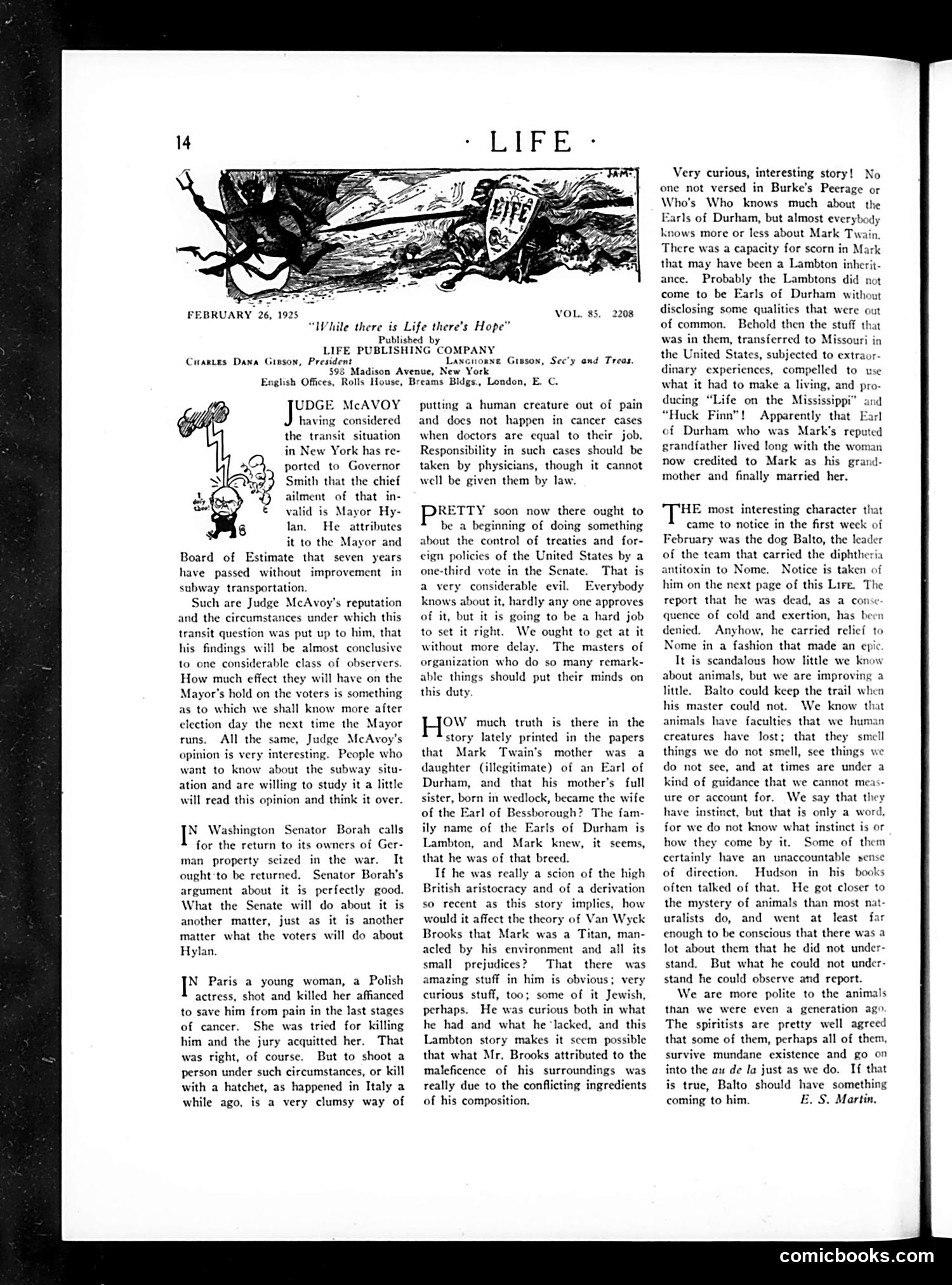
The page features editorial commentary rather than a prominent political cartoon. The small illustration shows a simplified figure labeled "Judge McAvoy" addressing what appears to be a complaint about human suffering and medical ethics in New York. The main articles discuss contemporary issues: Judge McAvoy's stance on euthanasia, Senate debates over treaty control and voting procedures, and a discussion of Mark Twain's alleged connection to an Earl of Durham through the Lambton family lineage. The "Balto" reference mentions a sled dog that apparently became famous (likely the 1925 serum run to Nome, Alaska), used here to discuss animal consciousness and instinct versus human reasoning. Overall, this page reflects 1920s concerns with legal reform, democratic governance, and cultural figures.
📄 Transcribed text from this page (OCR, searchable)
Machine-transcribed from the original scan — historical spelling and the odd misread are preserved.
VOL. 85, 2208 “While there is Life there’s Hope” Published by LIFE PUBLISHING COMPANY Cuartes Dana Ginson, President Lancuorne Gtasox, Sec’y and Treas. $98 Madison Avenue, New York sh Offices, Rolls House, Breams Bldgs., London, E. C. UDGE McAVOY having considered the transit situation in New York has re- ported to Governor Smith that the chief ailment of that in- valid is Mayor Hy- lan. He attributes it to the Mayor and Board of Estimate that seven years have passed without improvement in subway transportation. Such are Judge McAvoy's reputation and the circumstances under which this transit question was put up to him, that his findings will be almost conclusive to one considerable class of observers. How much effect they will have on the Mayor's hold on the voters is something as to which we shall know more after election day the next time the Mayor runs. All the same, Judge McAvoy's opinion is very interesting. People who want to know about the subway situ- ation and are willing to study it a little will read this opinion and think it over. N Washington Senator Borah calls for the return to its owners of Ger- man property seized in the war. It ought'to be returned. Senator Borah's argument about it perfectly good. What the Senate will do about it is another matter, just as it is another matter what the voters will do about Hylan. N Paris a young woman, a Polish actress, shot and killed her afhanced to save him from pain in the last stages of cancer, She was tried for killing him and the jury acquitted her. That was right, of course. But to shoot a person under such circumstances, or kill with a hatchet, as happened in Italy a while ago, is a very clumsy way of putting a human creature out of pain and does not happen in cancer cases when doctors are equal to their job. Responsibility in such cases should be taken by physicians, though it cannot well be given them by law. RETTY soon now there ought to be a beginning of doing something about the control of treaties and for- cign policies of the United States by a one-third vote in the Senate. That is a very considerable ¢ Everybody knows about it, hardly any one approves of it, but it is going to be a hard job to set it right. We ought to get at it without more delay. The masters of organization who do so many remark- able things should put their minds on this duty. OW much truth is there in the story lately printed in the papers that Mark Twain's mother was a daughter (illegitimate) of an Earl of Durham, and that his mother’s full sister, born in wedlock, became the wife of the Earl of Bessborough? The fam- ily name of the Earls of Durham is Lambton, and Mark knew, it scems, that he was of that breed. If he was really a scion of the high British aristocracy and of a derivation so recent as this story implies, how would it affect the theory of Van Wyck Brooks that Mark was a Titan, man- acled by his environment and all its small prejudices? That there was amazing stuff in him is obvious; very curious stuff, too; some of it Jewish, perhaps. He was curious both in what he had and what he ‘lacked, and this Lambton story makes it scem possible that what Mr. Brooks attributed to the maleficence of his surroundings was really due to the conflicting ingredients of his composition. Very curious, interesting story! No one not versed in Burke's Peerage or Who's Who knows much about the Earls of Durham, but almost everybody knows more or less about Mark Twain. There was a capacity for scorn in Mark that may have been a Lambton inherit- ance. Probably the Lambtons did not come to be Earls of Durham without disclosing some qualities that were out of common. Behold then the stuff that was in them, transferred to Missouri in the United States, subjected to extraor- dinary experiences, compelled to. use what it had to make a living, and pro- ducing “Life on the Mississippi” and “Huck Finn"! Apparently that Earl of Durham who was Mark's reputed grandfather lived long with the woman now credited to Mark as his grand- mother and finally married her. HE most interesting character that came to notice in the first week of February was the dog Balto, the leader of the team that carried the diphtheria antitoxin to Nome. Notice is taken of him on the next page of this Lire. The report that he was dead, as a conse. quence of cold and rtion, has been denied. Anyhow, he carried relief to ome in a fashion that made an epic. It is scandalous how little we know about animals, but we are improving a little. Balto could keep the trail when his master could not. We know that animals have faculties that we human creatures have lost; that they smell things we do not smell, see things we do not see, and at times are under a kind of guidance that we cannot meas- ure or account for. We say that they have instinct, but that is only a word, for we do not know what instinct is or how they come by it. Some of them certainly have an unaccountable sense of direction. Hudson in his often talked of that. He got closer to the mystery of animals than most nat uralists do, and went at least fa enough to be conscious that there was a lot about them that he did not under- stand. But what he could not under- stand he could observe and report. We are more polite to the animals than we were even a generation ago. The spiritists are pretty well agreed that some of them, perhaps all of them, survive mundane existence and go on into the au de la just as we do. If that is true, Balto should have something coming to him. E. S. Martin. books comicbooks.com