
Life, 1925-02-26 · page 20 of 36
Life — February 26, 1925 — page 20: what you’re looking at
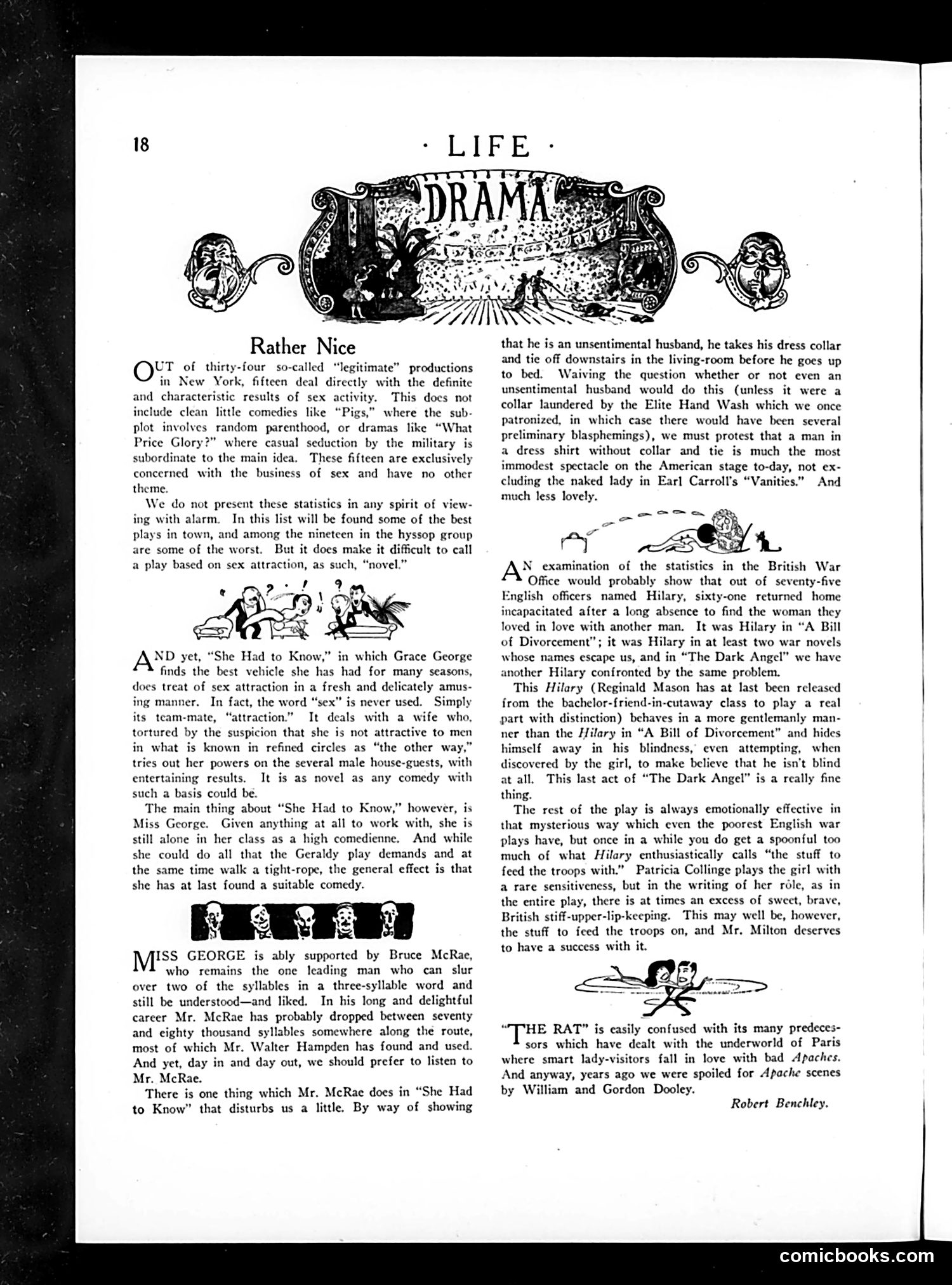
What you’re looking at
This page reviews two Broadway plays. The main article discusses "She Had to Know," starring Grace George, praising her as a superior comedienne while critiquing an odd staging choice where the male lead (Bruce McRae) removes his collar and tie downstairs—the reviewer argues this is an immodest spectacle, less appropriate even than nudity in Earl Carroll's "Vanities." The page opens with social commentary: of 34 "legitimate" New York productions, 15 deal explicitly with sex, yet plays based on sex attraction claim novelty. The review treats this without moral alarm, simply noting the statistical reality. A secondary review discusses "The Dark Angel," featuring a character named Hilary (played by Reginald Mason). The reviewer jokes that British War Office statistics would show most officers named Hilary returned from war to discover their lovers unfaithful—referencing this as a tired theatrical trope appearing in multiple plays and novels.
📄 Transcribed text from this page (OCR, searchable)
Machine-transcribed from the original scan — historical spelling and the odd misread are preserved.
Rather Nice JT of thirty-four so-called “legitimate” productions in New York, fifteen deal directly with the definite and characteristic results of sex acti This docs not include clean little comedies like “Pigs,” where the sub- plot involves random parenthood, or dramas like “What Price Glory?” where casual seduction by the military is subordinate to the main idea. These fifteen are exclusively concerned with the business of sex and have no other theme. We do not present these statistics in any spirit of view- ing with alarm. In this list will be found some of the best plays in town, and among the nineteen in the hyssop group are some of the worst. But it does make it difficult to call a play based on sex attraction, as such, “novel.” ND yet, “She Had to Know,” in which Grace George finds the best vehicle she has had for many seasons, does treat of sex attraction in a fresh and delicately amus- ing manner. In fact, the word “sex” is never used. Simply its team-mate, “attraction.” It deals with a wife who, tortured by the suspicion that she is not attractive to men in what is known in refined circles as “the other way, tries out her powers on the several male house-guests, wi entertaining results. It is as novel as any comedy with such a basis could be. The main thing about “She Had to Know,” however, is Miss George. Given anything at all to work with, she is still alone in her class as a high comedienne, And while she could do all that the Geraldy play demands and at the same time walk a tight-rope, the general effect is that she has at last found a suitable comedy. ISS GEORGE is ably supported by Bruce McRae, who remains the one leading man who can slur over two of the syllables in a three-syllable word and still be understood—and liked. In his long and delightful career Mr. McRae has probably dropped between seventy and eighty thousand syllables somewhere along the route, most of which Mr. Walter Hampden has found and used. And yet, day in and day out, we should prefer to listen to Mr. McRae. There is one thing which Mr. McRae does in “She Had to Know” that disturbs us a little, By way of showing that he is an unsentimental husband, he takes his dress collar and tie off downstairs in the living-room before he goes up to bed. Waiving the question whether or not even an unsentimental husband would do this (unless it were a collar laundered by the Elite Hand Wash which we once patronized, in which case there would have been several preliminary blasphemings), we must protest that a man in a dress shirt without collar and tie is much the most immodest spectacle on the American stage to-day, not ex- cluding the naked lady in Earl Carroll's “Vanities.” And much less lovely. N examination of the statistics in the British War Office would probably show that out of seventy-five English officers named Hilary, sixty-one returned home incapacitated after a long absence to find the woman they loved in love with another man. It was Hilary in “A Bill of Divorcement”; it was Hilary in at least two war novels whose names escape us, and in “The Dark Angel” we have another Hilary confronted by the same problem. This Hilary (Reginald Mason has at last been released from the bachelor-friend-in-cutaway class to play a real part with distinction) behaves in a more gentlemanly man- ner than the Hilary in “A Bill of Divorcement” and hides himself away in his blindness, even attempting, when discovered by the girl, to make believe that he isn’t blind at all. This last act of “The Dark Angel” is a really fine thing. The rest of the play is always emotionally effective in that mysterious way which even the poorest English war plays have, but once in a while you do get a spoonful too much of what Hilary enthusiastically calls “the stuff to feed the troops with.” Patricia Collinge plays the girl with a rare sensitiveness, but in the writing of her role, as in the entire play, there is at times an excess of sweet, brave, British stiff-upper-lip-keeping. This may well be, however, the stuff to feed the troops on, and Mr. Milton deserves to have a success with it. “THE RAT” is casily confused with its many predeces- sors which have dealt with the underworld of Paris where smart lady-visitors fall in love with bad Apaches. And anyway, years ago we were spoiled for Apache scenes by William and Gordon Dooley. Robert Benchley. comicbooks.com