
A complete issue · 37 pages · 1924
Life — November 27, 1924
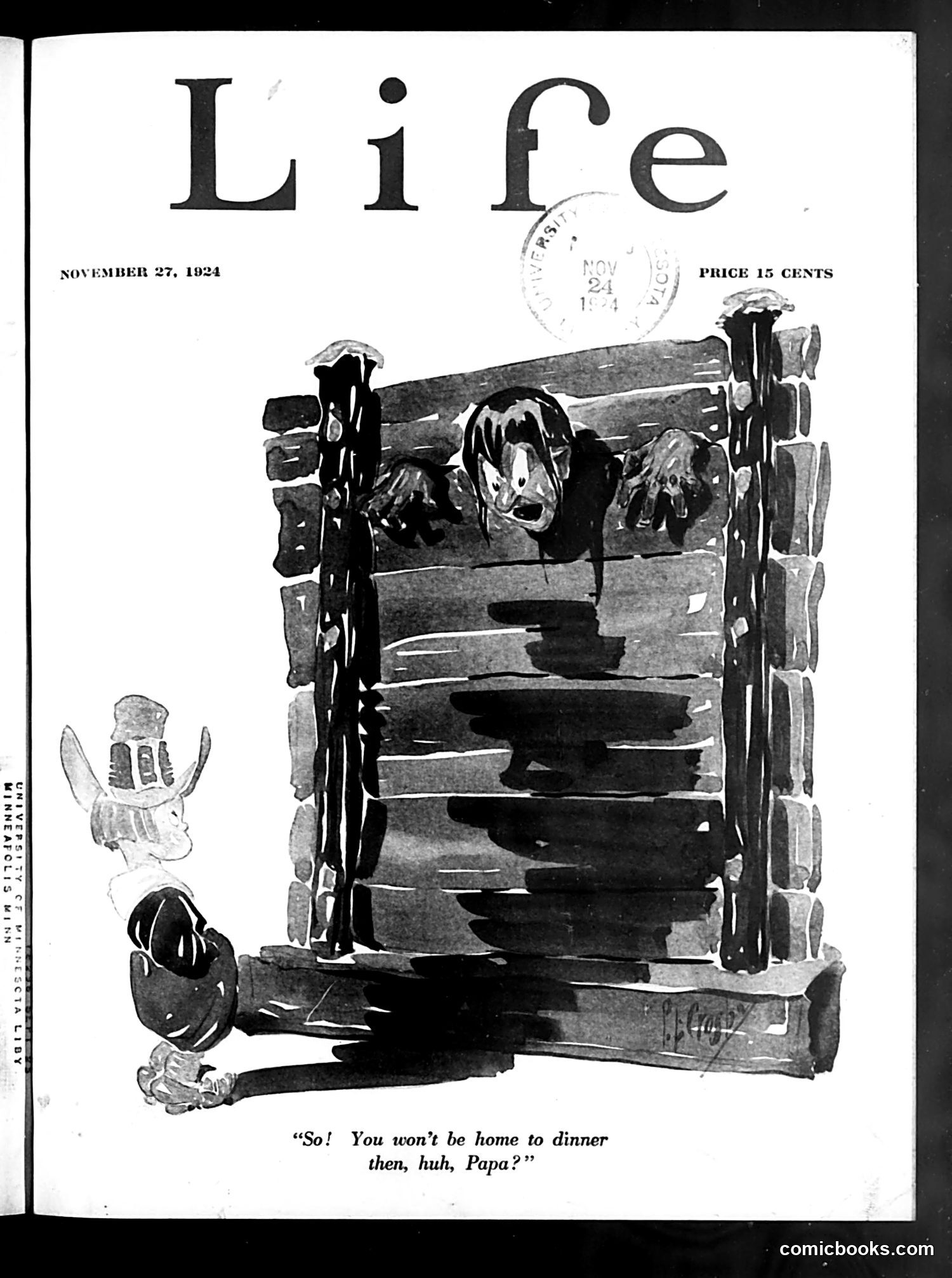
This cover depicts a domestic humor cartoon showing a child's concern about a father's absence. A young child peeks through a farm fence, observing what appears to be his father (Papa) riding in or with a horse and wagon, asking anxiously: "So! You won't be home to dinner then, huh, Papa?" The joke satirizes the conflicting demands on American fathers of the 1920s—balancing work obligations against family responsibilities and dinner-table expectations. The child's casual yet pointed question suggests parental neglect of domestic duties, a common comedic theme in this era's satire about modernizing American life and changing gender/family roles during the post-WWI period.
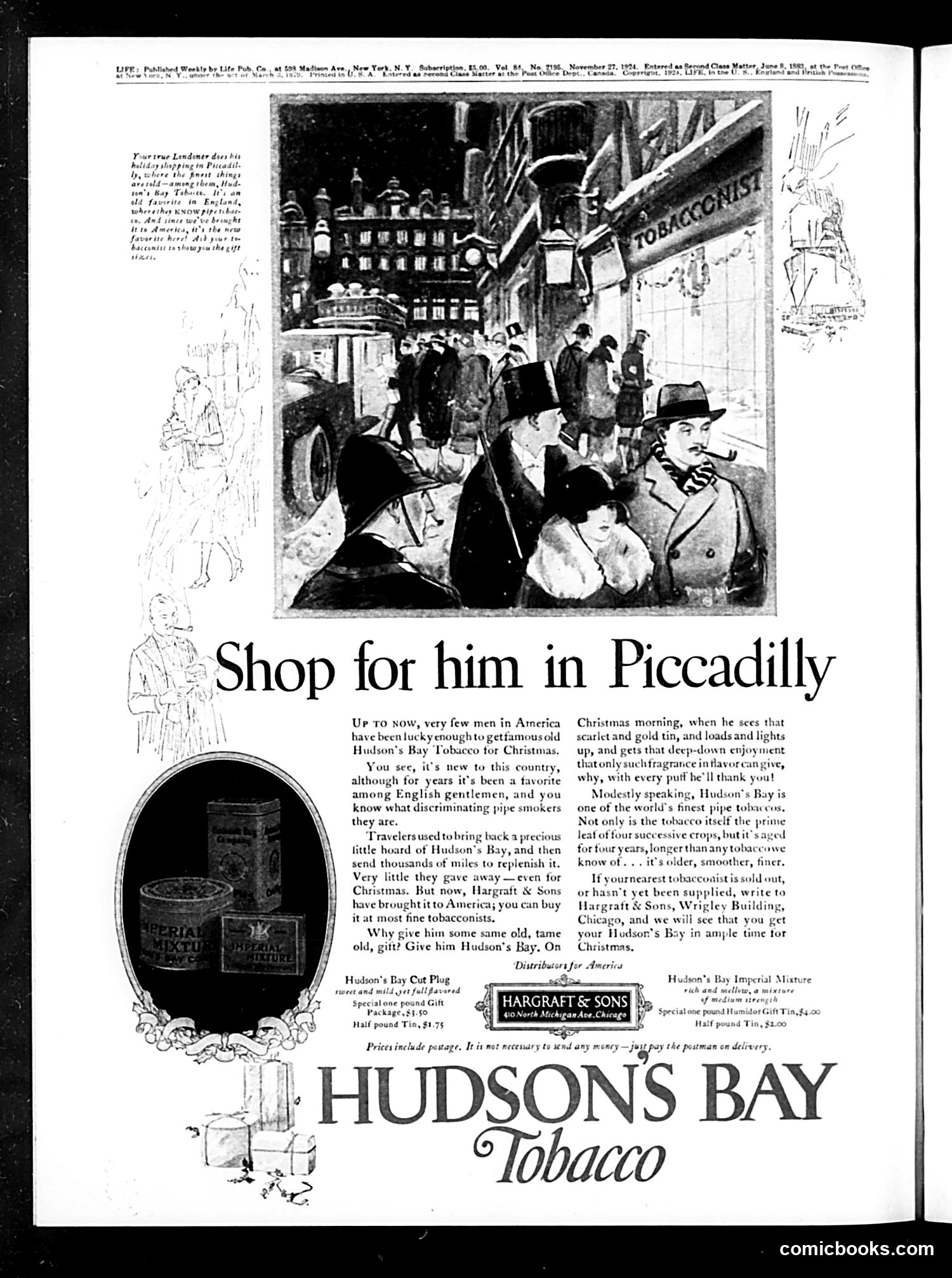
This is primarily a **Hudson's Bay Tobacco advertisement**, not political satire. The page features a photograph of a crowded London street scene (Piccadilly) as its visual centerpiece. The ad's appeal is nostalgic and aspirational: it frames Hudson's Bay tobacco as a prestigious British import newly available to American consumers. The text emphasizes the product's exclusivity among "English gentlemen" and its rarity in America, positioning it as a luxury Christmas gift. The surrounding sketches are decorative vignettes typical of 1920s advertisements, showing well-dressed figures and holiday imagery rather than satirizing any political figures or events. **Bottom line:** This is commercial advertising dressed in sophisticated imagery, not political commentary.
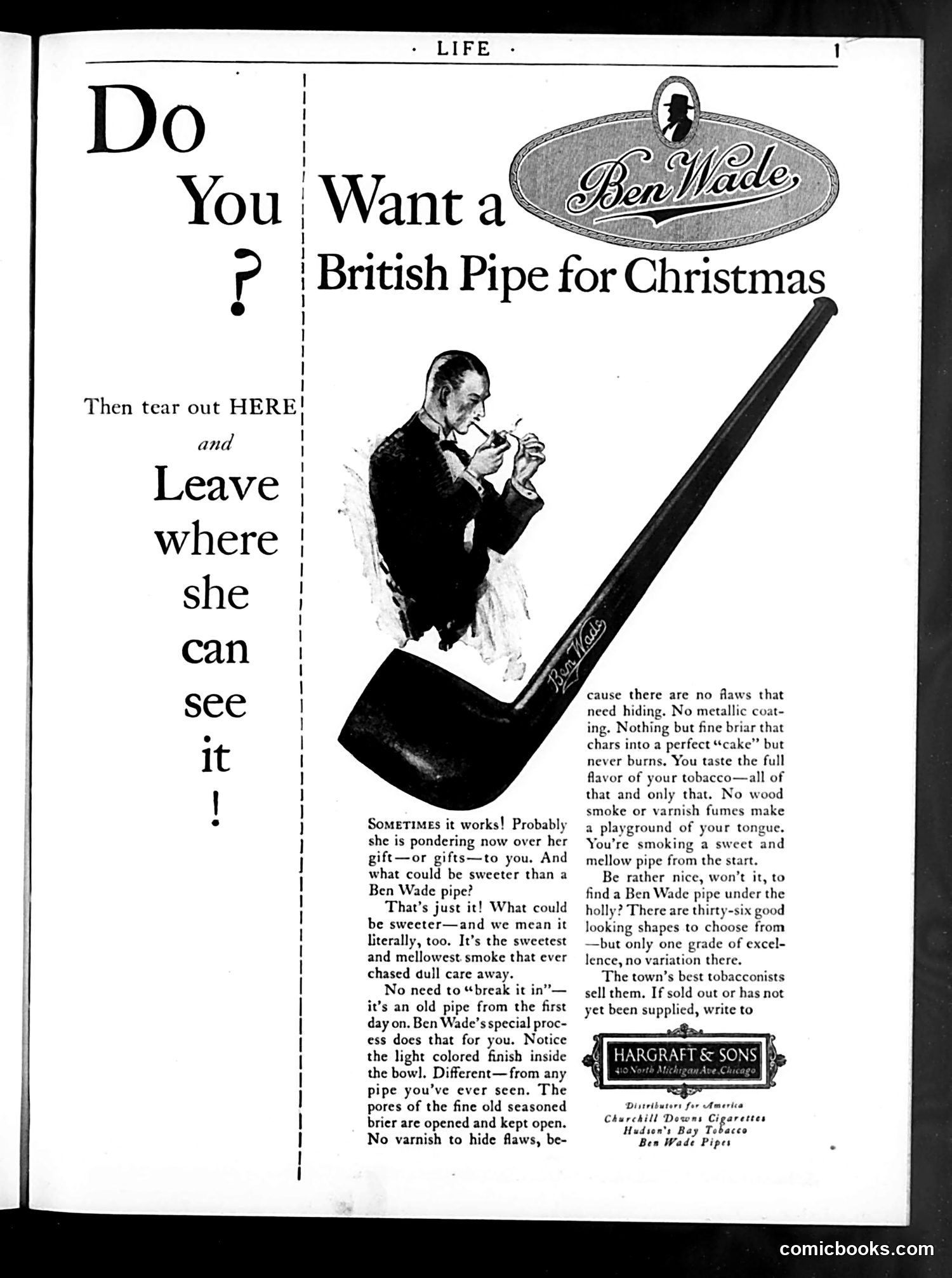
This is primarily a **commercial advertisement**, not political satire. It promotes Ben Wade brand pipes as Christmas gifts, distributed by Hargraft & Sons of Chicago. The ad's humor is gentle rather than satirical: it depicts a man smoking a pipe, suggesting that a woman might be uncertain what gift to buy him—hence the instruction to "tear out HERE and Leave where she can see it," a common advertising gimmick. The copy emphasizes the pipe's quality: fine briar construction, no metallic coating, pure tobacco flavor, and no need for "breaking in." It claims thirty-six styles are available through tobacconists. This reflects early 20th-century consumer culture and gender norms (assuming women shop for men), rather than political commentary.
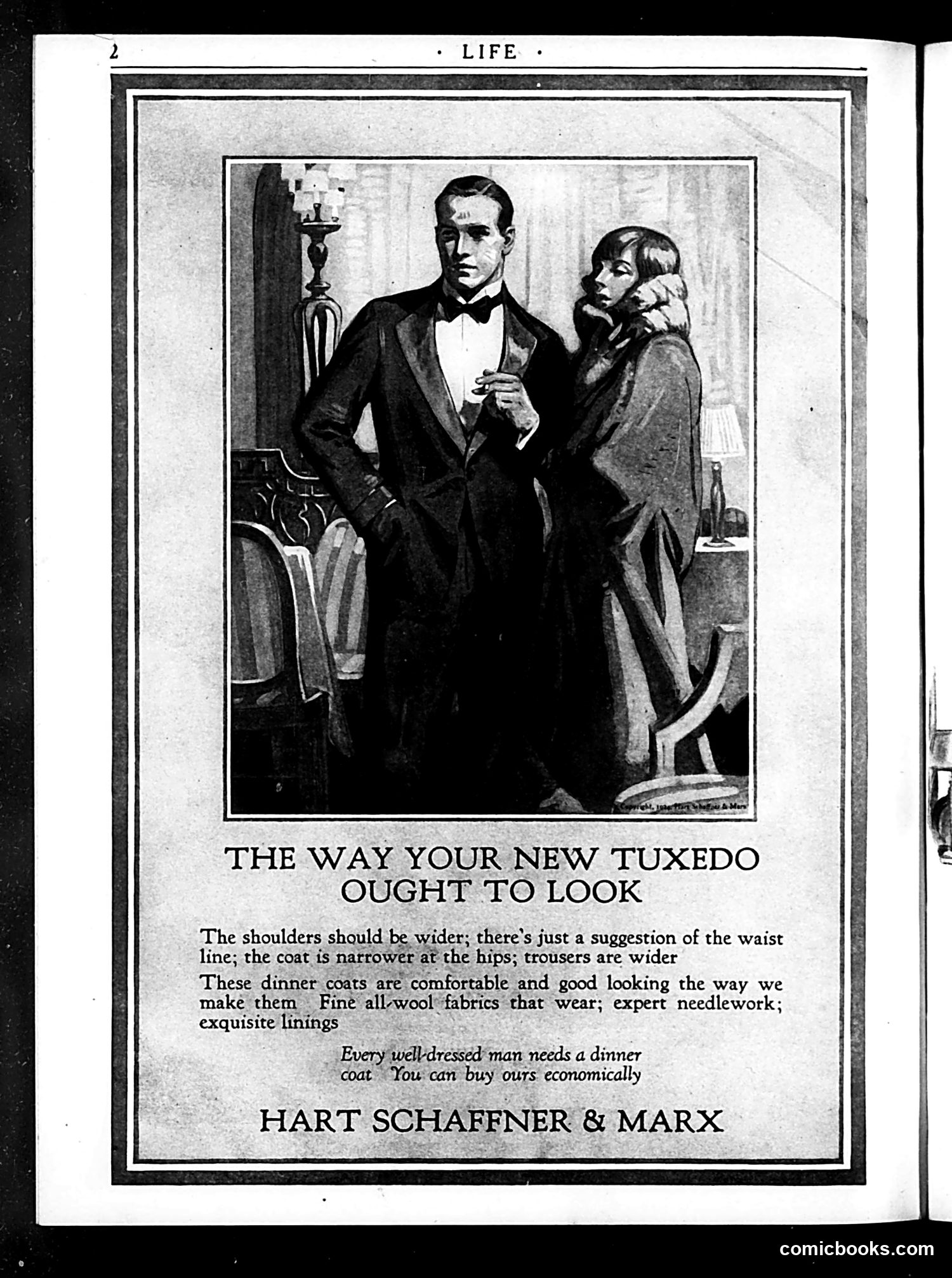
This is **not a political cartoon or satire**—it's a straightforward **advertisement** for Hart Schaffner & Marx menswear. The image shows a well-dressed man in a tuxedo with two women, illustrating fashionable evening wear. The accompanying text describes the tuxedo's tailoring details: wider shoulders, narrower waist and hips, wider trousers. The ad's message is purely commercial: Hart Schaffner & Marx sells quality dinner jackets made from fine all-wool fabrics with expert needlework. The closing line—"Every well-dressed man needs a dinner coat. You can buy ours economically"—is a direct sales pitch. There is no satire, political commentary, or hidden meaning here. This represents Life magazine's typical advertising revenue model.
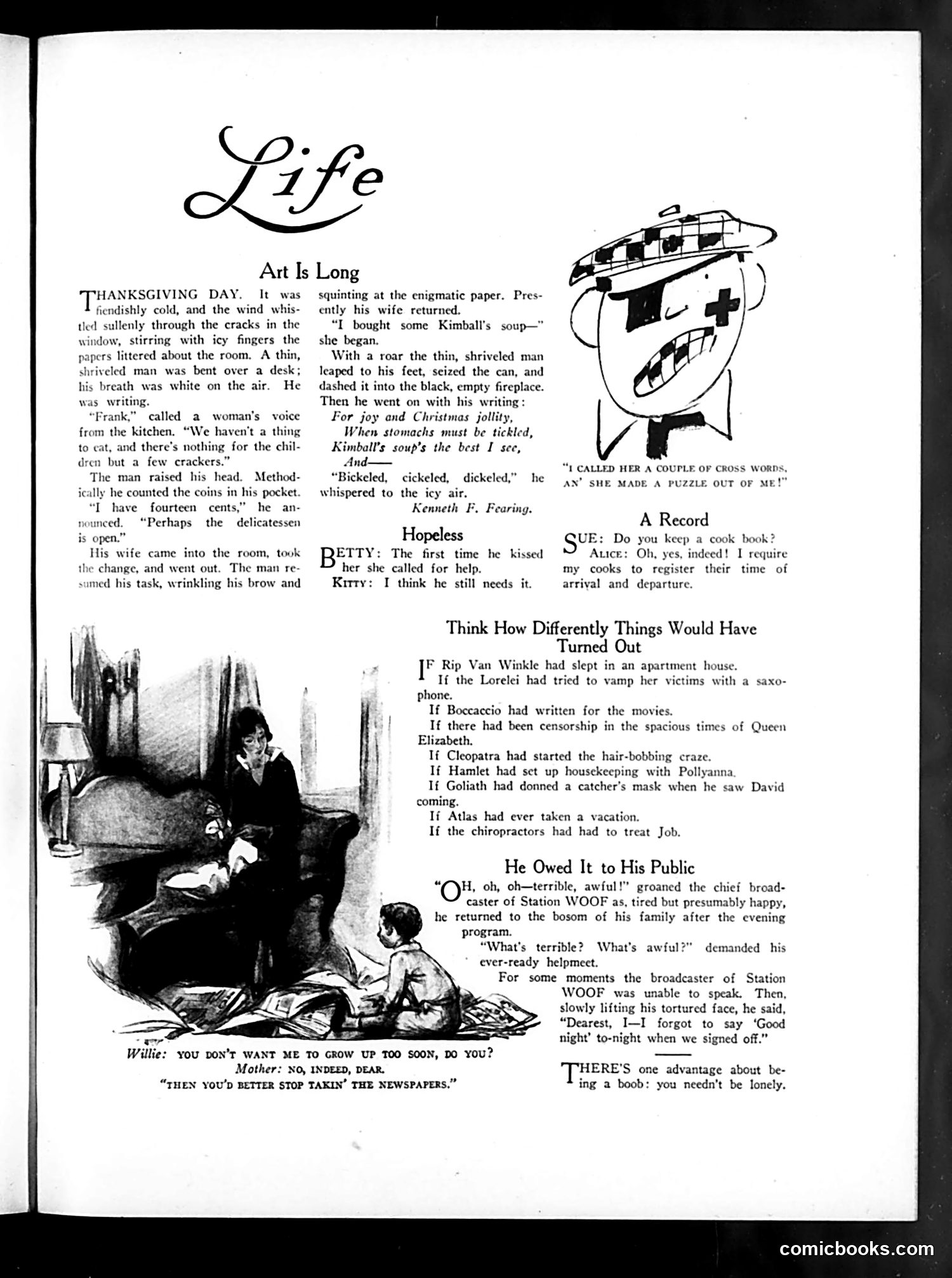
This page contains several satirical pieces rather than a single cartoon. **"Art Is Long"** (top left): A humorous short story about a poor man counting coins while his wife complains about having nothing to eat—poking fun at financial hardship and domestic tension. **The illustration** (left): Shows a woman at a window, accompanying dialogue about not wanting children to grow up too soon. The caption "'Then you'd better stop takin' the newspapers'" suggests satirizing how current events (likely war news or economic crisis) depress children. **"Hopeless"** and **"A Record"**: Brief comedic exchanges about relationships and domestic management. **"Think How Differently Things Would Have Turned Out"**: A whimsical list imagining alternate histories of famous figures—literary and historical—in humorous "what-if" scenarios. The page reflects *Life* magazine's typical mix of humor addressing everyday American life and cultural commentary.
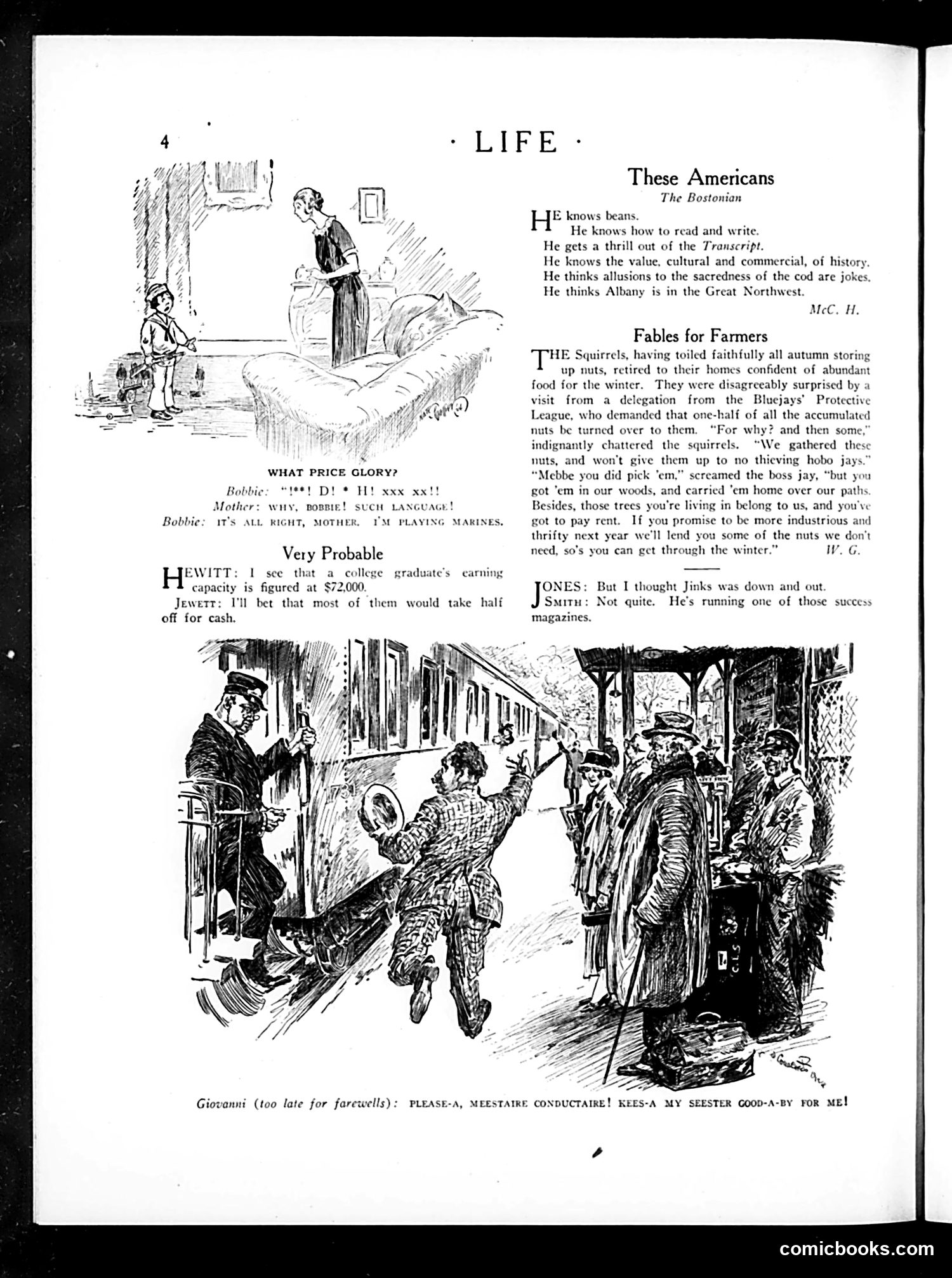
This page contains three satirical pieces from *Life* magazine: 1. **"What Price Glory?"** - A dialogue joke about a mother criticizing her son's language ("playing marines"), suggesting theatrical/military pretense among the young. 2. **"These Americans: The Bostonian"** - A brief profile mocking an educated Bostonian who knows literature and history but holds provincial views (thinking Albany is in the "Great Northwest"). 3. **"Fables for Farmers"** and **"Very Probable"** - Short anecdotes satirizing farmers and businessmen (Hewitt and Jewett discussing college graduate earning capacity). 4. **Bottom cartoon** - Italian immigrant "Giovanni" attempting to say farewell ("Please-a, Maestaire Conductaire!") to a train conductor, depicting the comedic accent and cultural unfamiliarity typical of early 20th-century immigrant humor. The page employs stereotypes about regional Americans, immigrants, and class differences as humor.
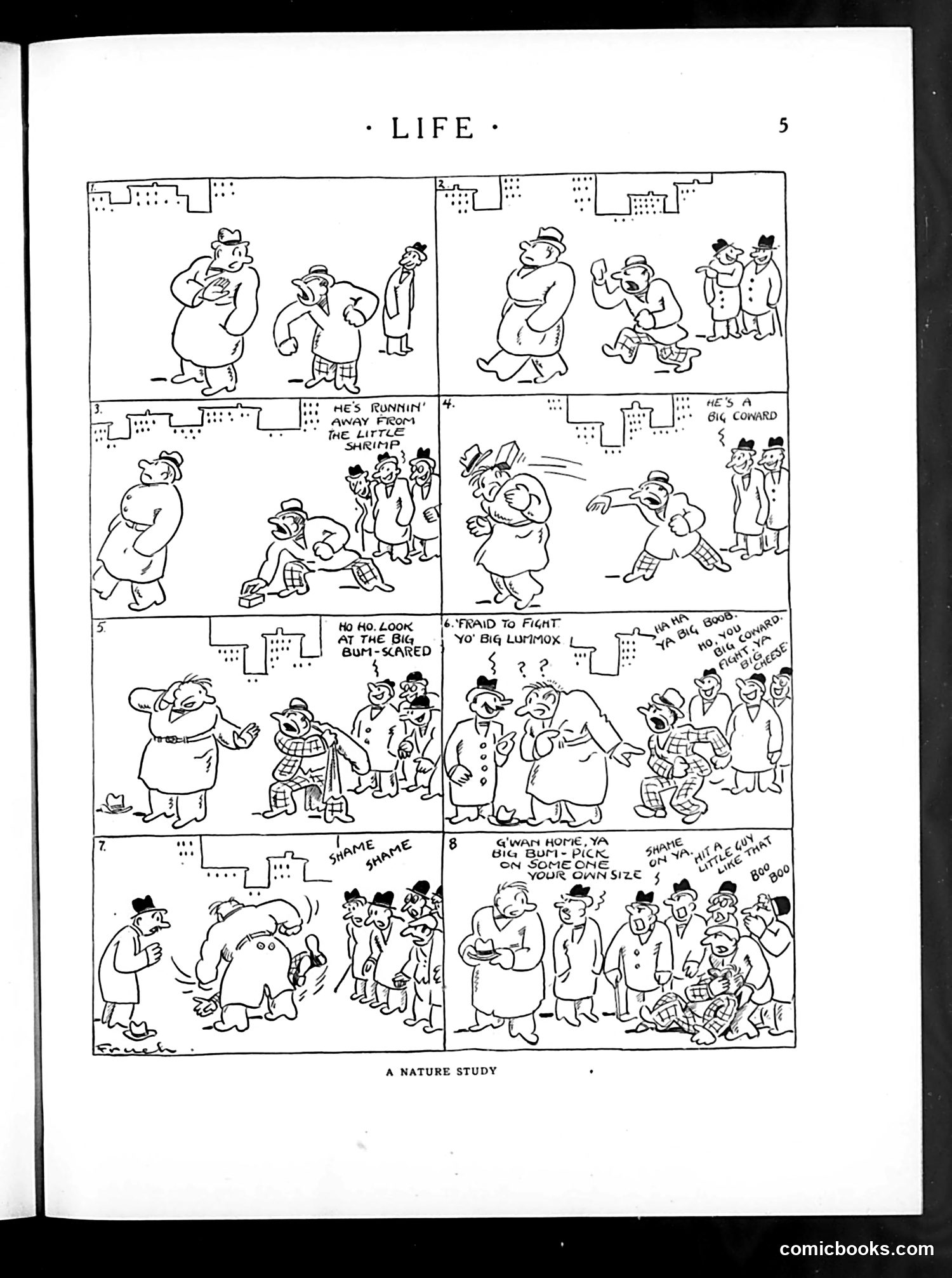
This eight-panel comic satirizes bullying behavior through slapstick humor. A rotund, well-dressed man (appears to be a wealthy or pompous figure) repeatedly bullies a smaller man in plaid clothing. The sequence shows the victim being chased, mocked as a "big coward," and shamed publicly by onlookers who laugh at him. The final panels reveal social hypocrisy: when the victim finally stands up to his tormentor, the bully immediately retreats and pleads to "go home." The assembled crowd then shames the victim for fighting back, calling him a "big bully" himself. The cartoon's point—labeled "A Nature Study"—appears to satirize how society enables bullies while punishing those who resist, a commentary on social conformity and mob mentality.
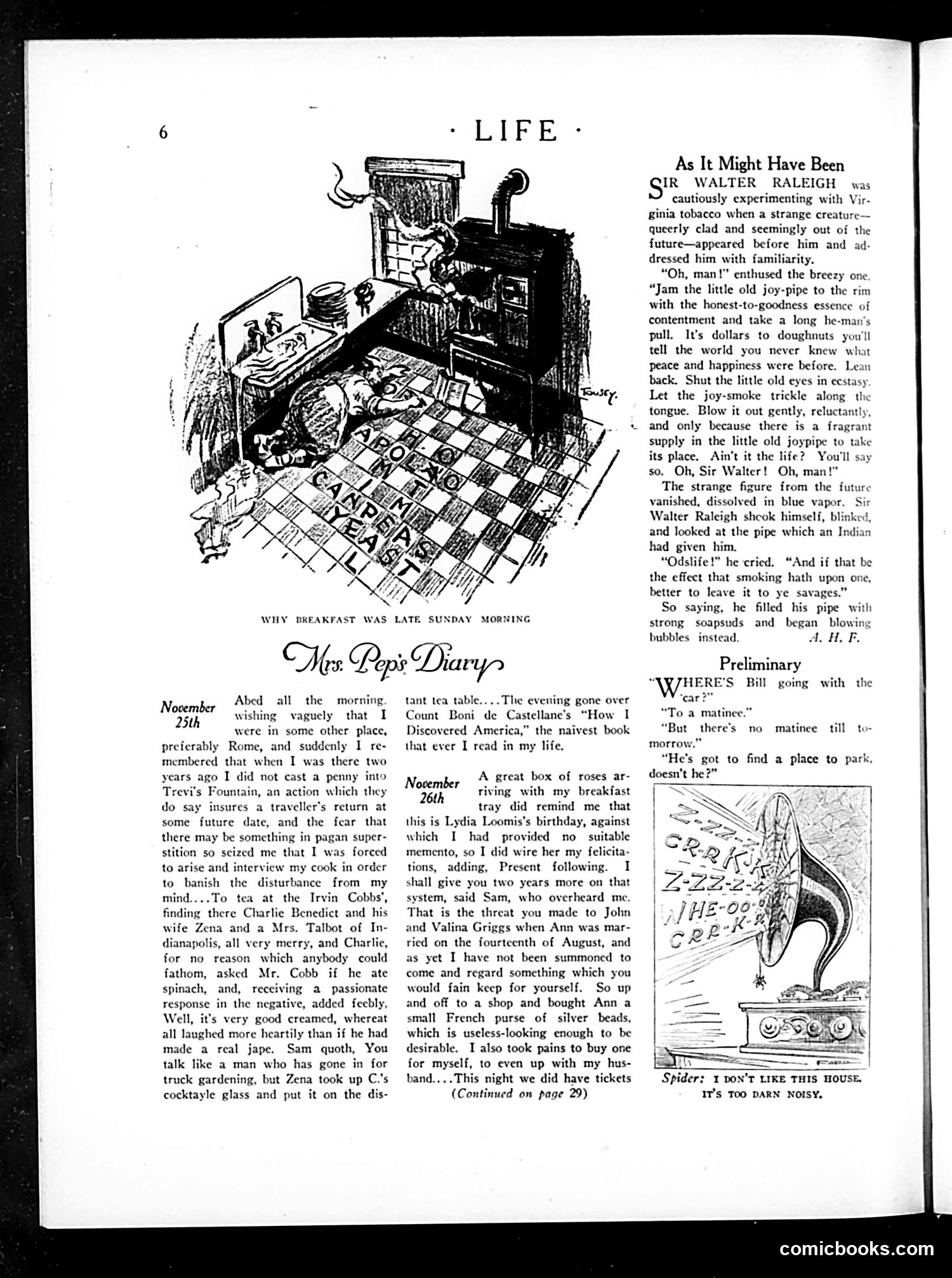
This page contains two distinct pieces: a humorous story titled "Mrs. Pep's Diary" and a fantasy illustration titled "As It Might Have Been." The main cartoon depicts **Sir Walter Raleigh** in a fantastical encounter with a creature from the future who introduces him to a pipe and tobacco. The joke plays on the historical legend that Raleigh introduced tobacco to England. The "creature" represents modernity invading the past, suggesting that smoking's future popularity was predetermined. The diary entries below describe mundane domestic life—visiting relatives, receiving roses, shopping—presented as elaborate gossip, satirizing how trivial social activities were documented and discussed among the upper classes. The spider cartoon critiques urban noise and crowding, likely referencing contemporary housing complaints.
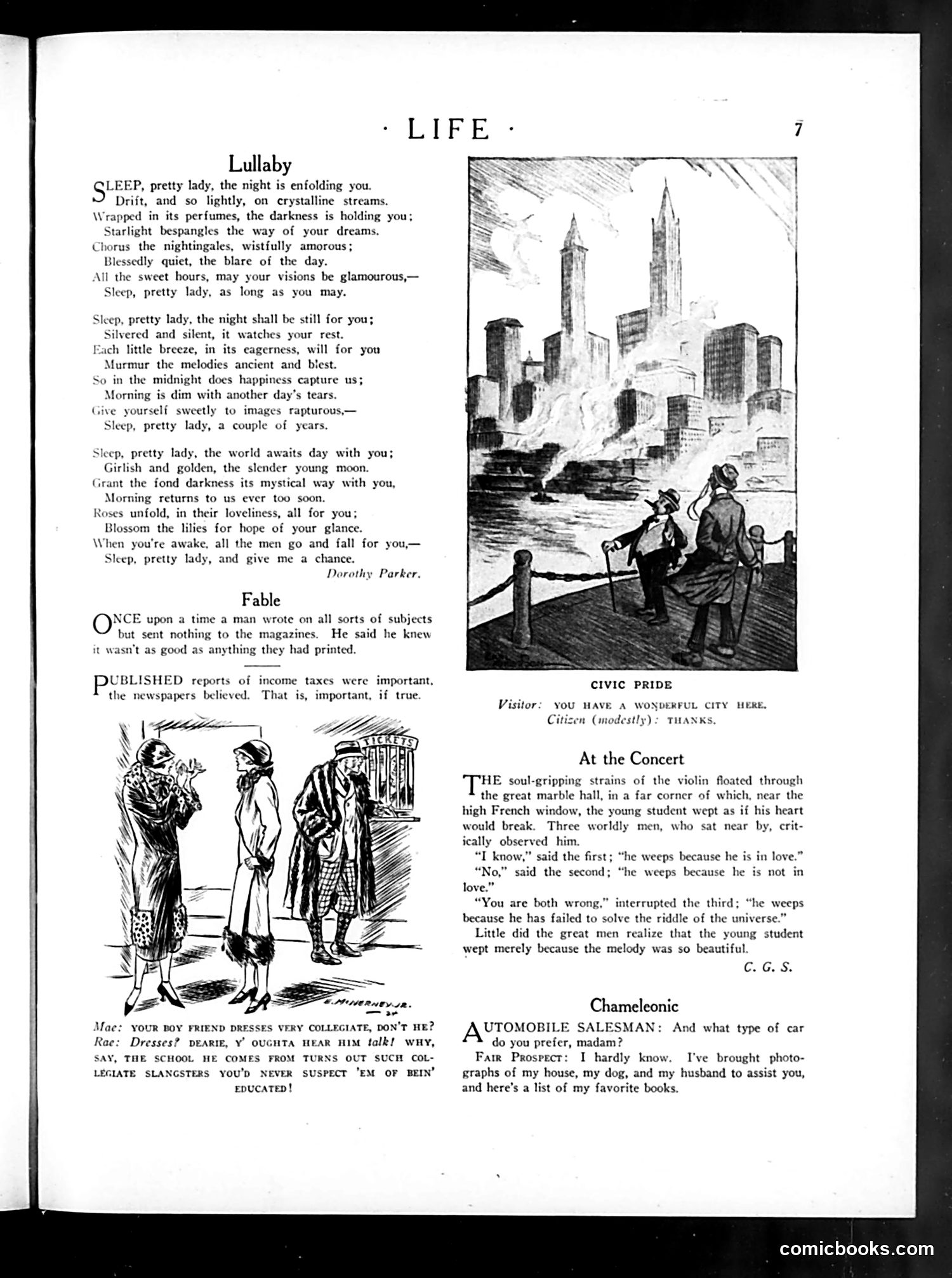
The page contains three distinct pieces: 1. **"Lullaby"** - A sentimental poem by Dorothy Parker about sleep and childhood. 2. **"Fable"** - A brief satirical story about a man who writes on various subjects but submits nothing to magazines, claiming their content isn't good. The accompanying cartoon shows three figures (appears to be editors or magazine staff) discussing this man. The satire mocks both struggling writers with inflated self-regard and perhaps magazine editors' selectivity. 3. **"At the Concert"** and **"Chameleonic"** - Short humorous pieces about a weeping student and an automobile saleswoman, respectively. The illustration labeled "Civic Pride" depicts a visitor admiring a city skyline while citizens beam with pride—likely satirizing American urban boosterism.
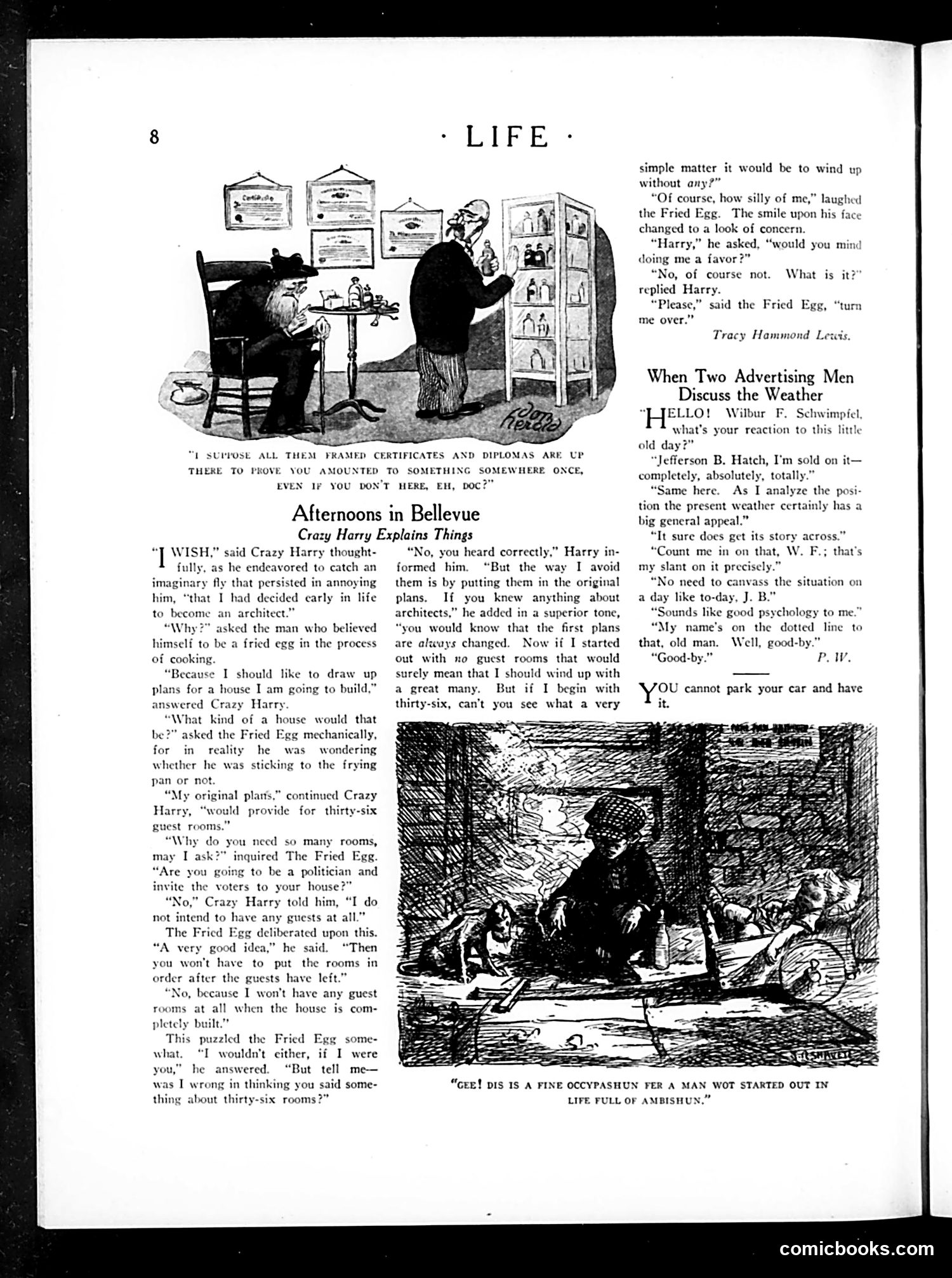
This page contains a satirical sketch titled "Afternoons in Bellevue," featuring dialogue between two characters: "Crazy Harry" and "The Fried Egg." The satire mocks architectural pretension. Crazy Harry wants to design a house with thirty-six guest rooms but won't actually host guests. When questioned about this contradiction, he explains he doesn't want to "put the rooms in order after the guests have left." The joke lampoons wealthy individuals who design ostentatiously large homes for status rather than practical use—they'd rather maintain unused rooms than endure the minor inconvenience of tidying up afterward. The "Bellevue" title references the famous psychiatric hospital, suggesting both characters are somewhat absurd or unhinged in their thinking.
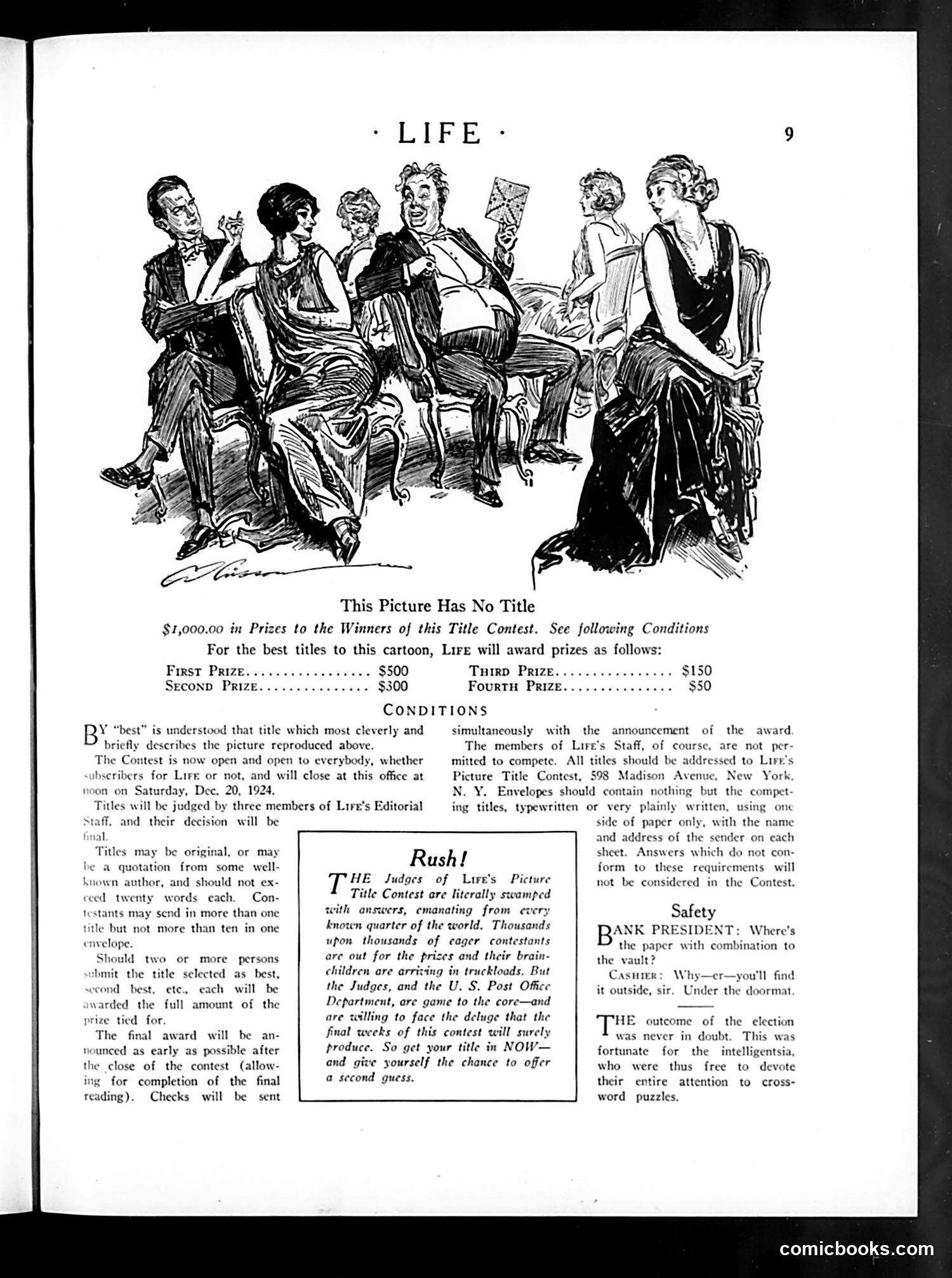
This page announces a contest inviting readers to suggest titles for an untitled cartoon. The illustration shows six figures in 1920s attire in what appears to be a social gathering—men in tuxedos and women in evening wear, seated and conversing. The cartoon likely depicts a fashionable social scene, though without its intended caption, the specific satire isn't clear from the image alone. The contest offered $1,000 in total prizes (first prize $500), requiring submissions by December 20, 1924, judged by Life's editorial staff. The page also includes two short humorous items: "Rush!" (about judges overwhelmed with contest entries) and "Safety" (a banker's joke about vault security). This was typical Life content—mixing reader participation contests with brief comedic vignettes.
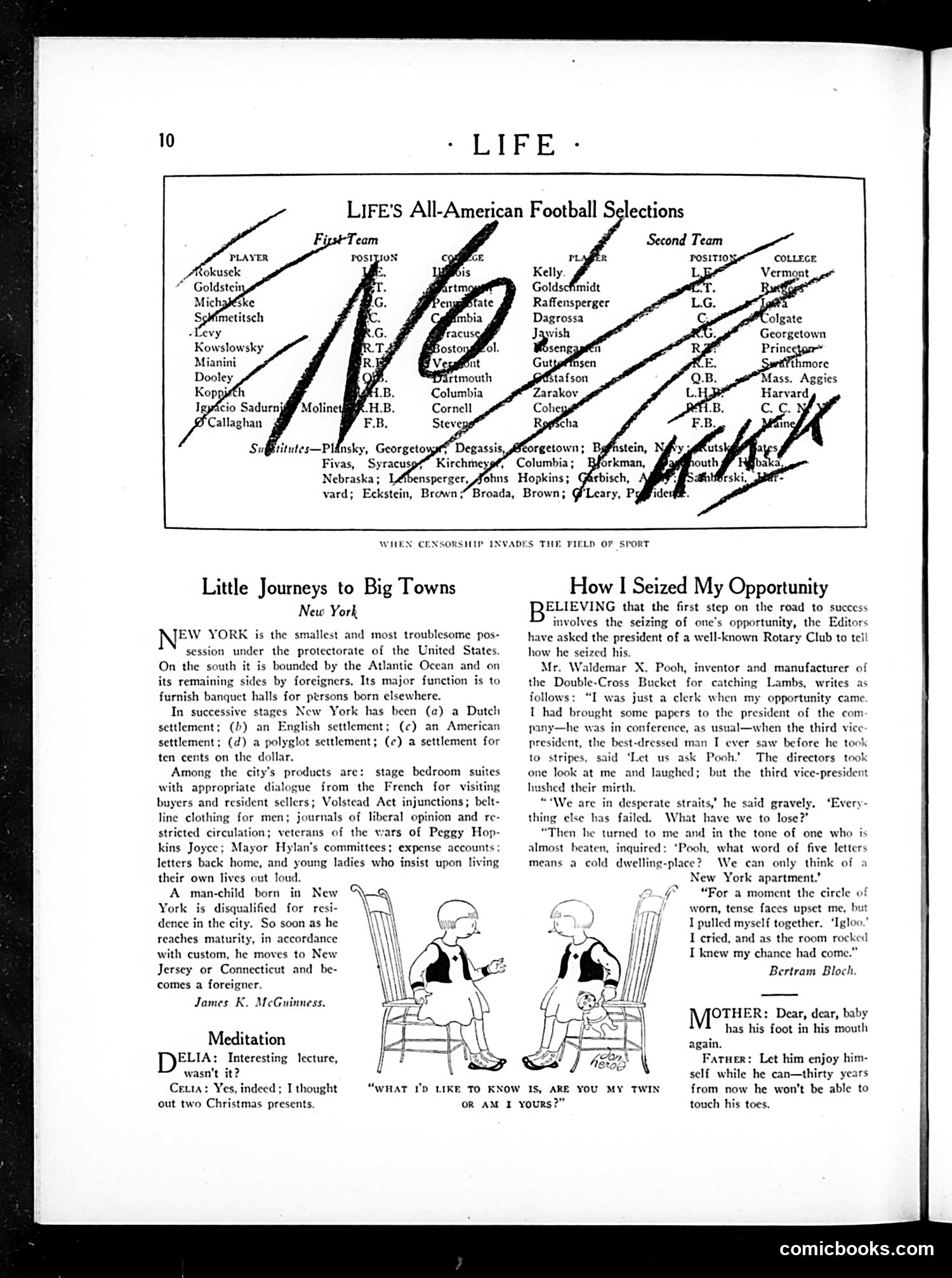
This page features sports and humor content from an early 20th-century LIFE magazine. The top section displays "LIFE's All-American Football Selections" with First and Second team rosters from various colleges. Below are three separate pieces: "Little Journeys to Big Towns" discusses New York's character; "How I Seized My Opportunity" presents an anecdote by Waldemar X. Pooh about recognizing a business chance (the Double-Cross Bucket invention); and "Meditation" offers a brief comic exchange between two characters discussing Christmas presents. The central illustration shows two men in chairs having a conversation with the caption "What I'd like to know is, are you my twin or am I yours?" — a joke about their identical appearance. The content represents typical early-century American magazine humor and social commentary.
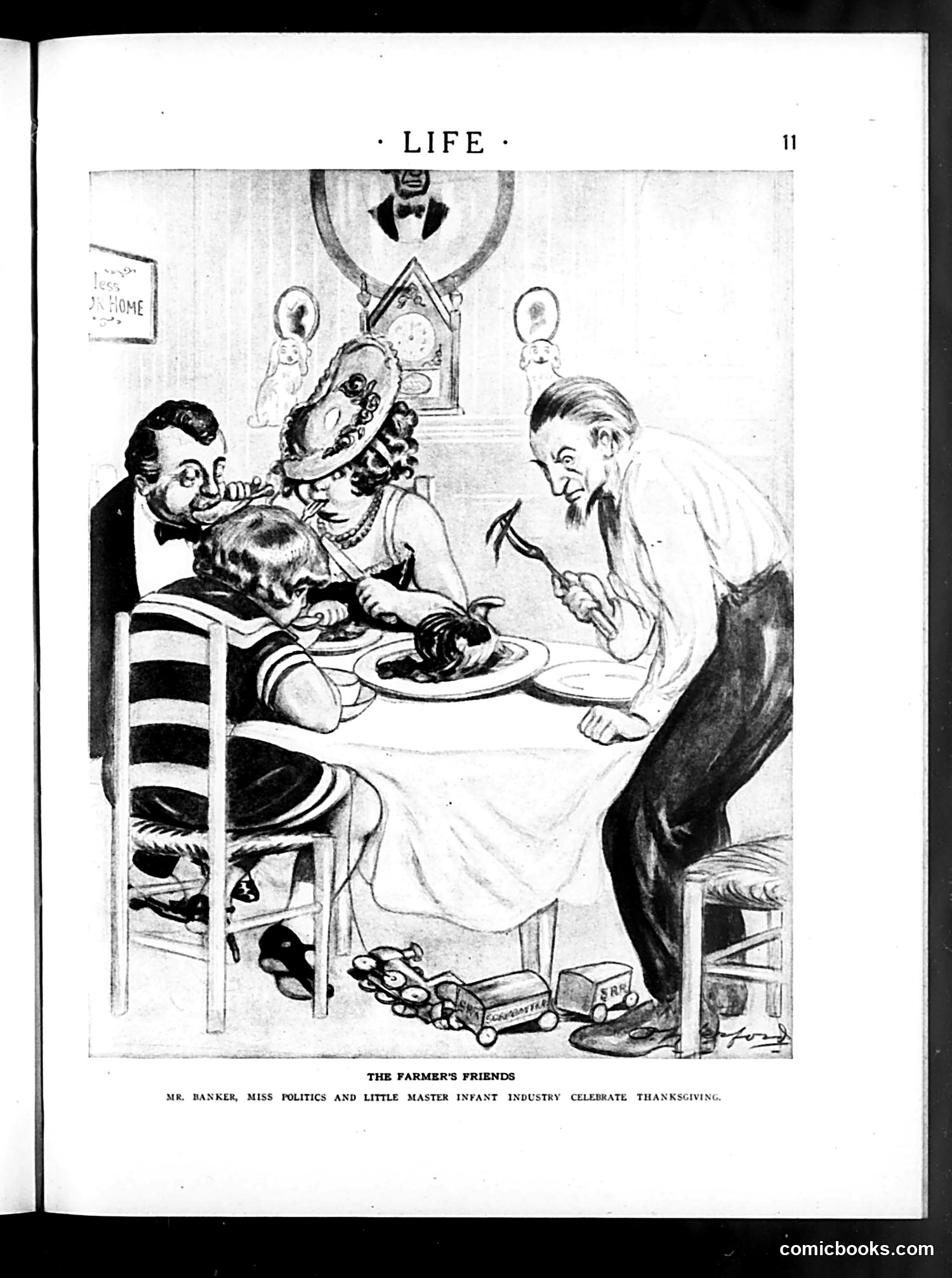
This satirical cartoon depicts a Thanksgiving dinner scene with three allegorical figures joining a farmer at his table: "Mr. Banker," "Miss Politics," and "Little Master Infant Industry." The satire critiques how these three entities exploit farmers. The banker likely represents predatory lending practices; "Miss Politics" embodies corrupt or self-serving government; and "Little Master Infant Industry" refers to industrial interests receiving government protection (tariffs/subsidies) at farmers' expense. The joke is darkly ironic: these figures present themselves as the farmer's "friends" while dining at his table—suggesting they extract wealth and resources from agricultural producers. The toys scattered beneath suggest infantilized or parasitic behavior. This reflects late 19th/early 20th-century agrarian grievances about economic exploitation.
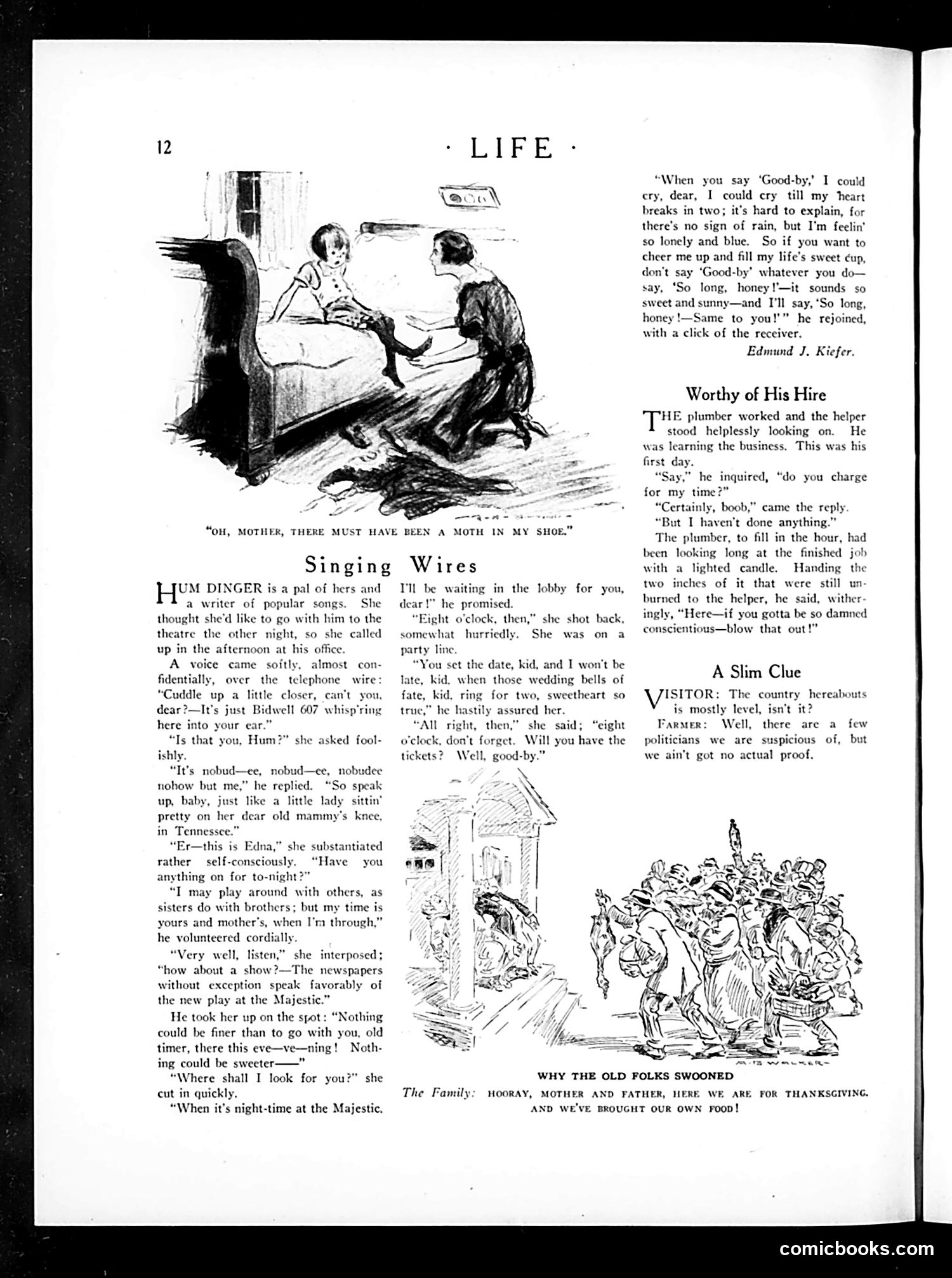
This page contains three separate humorous pieces rather than political cartoons: 1. **"Singing Wires"**: A sketch-illustrated story about a woman calling her husband at his office, using the novelty of telephone technology for romantic banter. The humor plays on early 20th-century expectations about marital communication and workplace decorum. 2. **"Worthy of His Hire"**: A brief story about a plumber's first day, poking fun at labor relations and the plumber's casual attitude toward billing for time. 3. **"Why the Old Folks Swooned"**: A cartoon captioned "The Family" showing what appears to be a chaotic family gathering, with the joke being that parents are surprised their children brought their own food to Thanksgiving rather than eating the parents' meal. These are light domestic and social humor pieces rather than political satire.
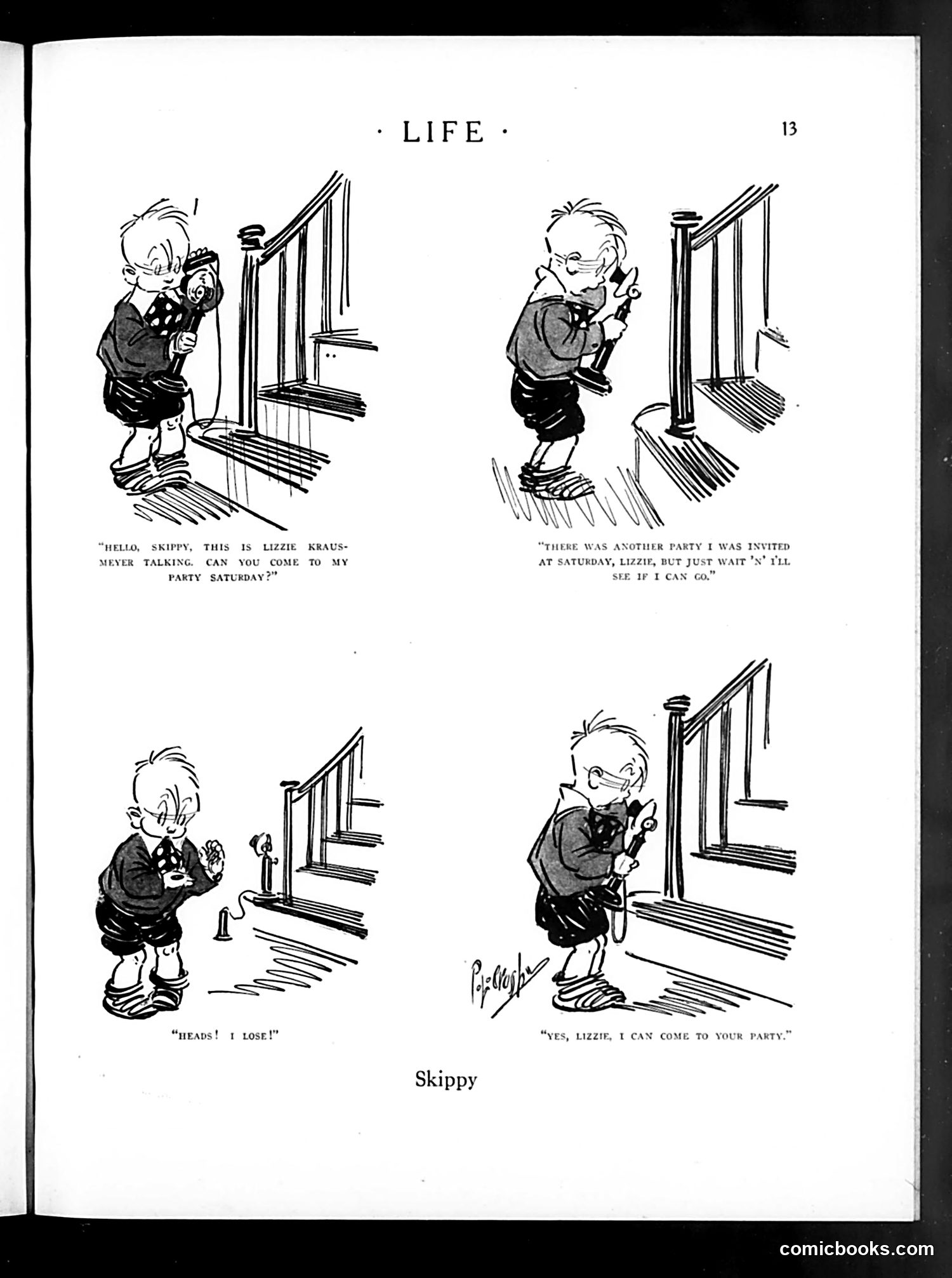
This is a four-panel comic strip titled "Skippy" showing a young boy making a phone call. The humor centers on a simple social dilemma: Skippy receives an invitation to Lizzie Krausmeyer's party on Saturday, but he's already committed to attending another party that same day. When Skippy asks to attend Lizzie's party instead, she responds that she "just wait[s]" to see if she can go to the other event first. After a coin flip ("Heads! I lose!"), Skippy accepts Lizzie's invitation as a fallback option. The joke satirizes childhood social anxieties and the casual way children rank party invitations—Skippy is literally Lizzie's second choice, and both children openly acknowledge this awkward hierarchy without pretense.
This page commemorates **Henry Cabot Lodge's death** at age seventy-three. Lodge was a prominent Republican senator and political figure who opposed U.S. entry into the League of Nations—a major issue of the era. The article praises Lodge's long political career while noting his "heart was not right" regarding humanitarian causes. It credits him with keeping America out of the League and winning Senate battles, though questions remain about whether this was ultimately correct. The small illustrations at bottom appear to show figures representing different political positions or outcomes of Lodge's career. The piece observes that despite Democrats' hopes, Lodge's departure made them wonder about emerging Democratic political divisions, ultimately won by "Business" (the Republican candidate).
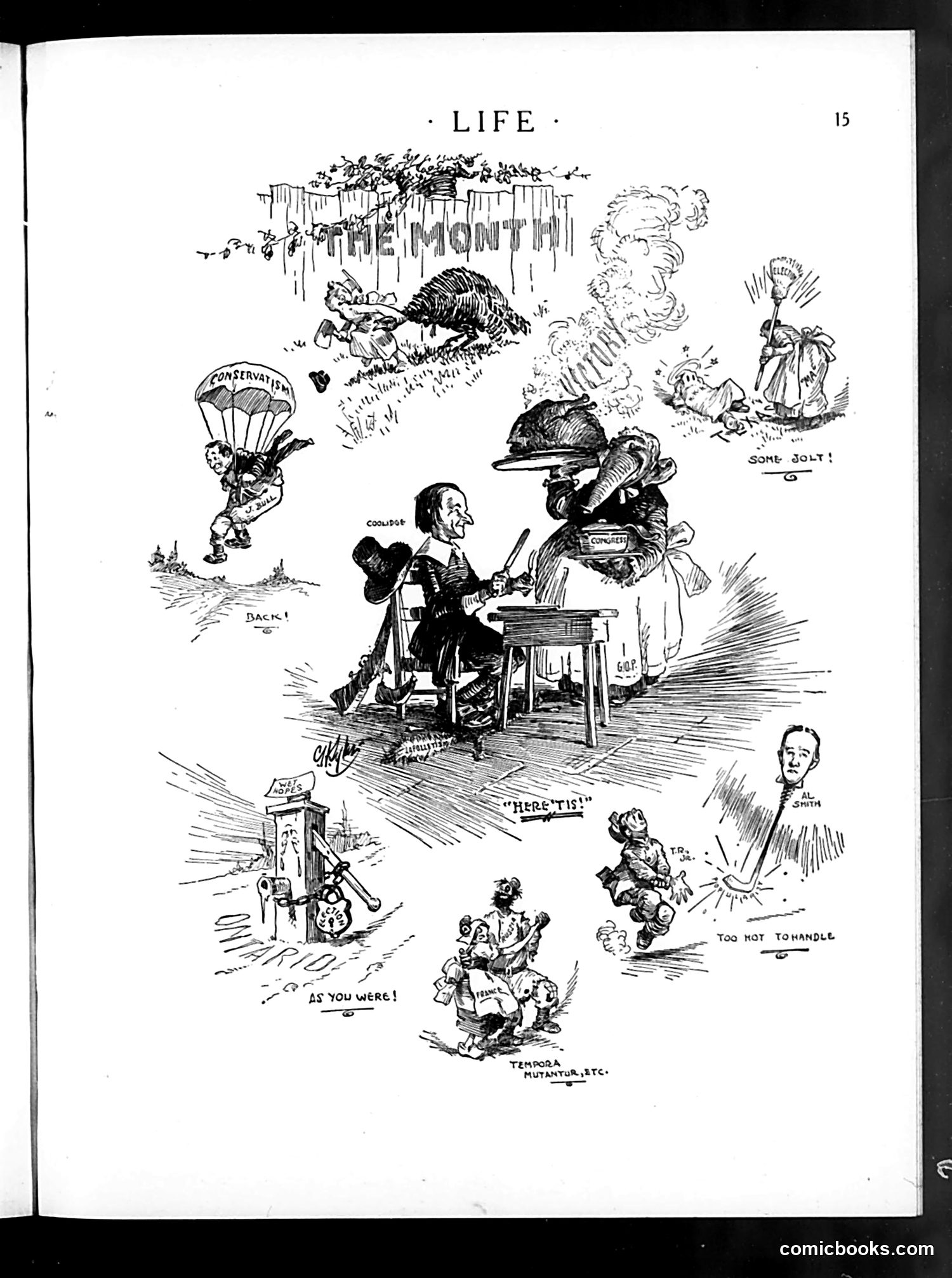
This page presents a satirical "Life in [the] Month" featuring multiple vignettes about contemporary social issues. The central scene shows two figures at a desk labeled "Congress" - one labeled "Coolidge" (U.S. President Calvin Coolidge) appearing to conduct business with another figure. Surrounding scenes depict various social problems with captions including "Conservation," "Back!," "Here 'tis!," "Some Jolt!," "Too Hot to Handle," "As You Were!," and "Temperament, etc." These likely satirize governmental inaction or contradictory policies on conservation, budget issues, and social matters of the 1920s era. The cartoon's overall message critiques Congress and the Coolidge administration's ineffectiveness in addressing pressing national concerns through satirical exaggeration and wordplay.
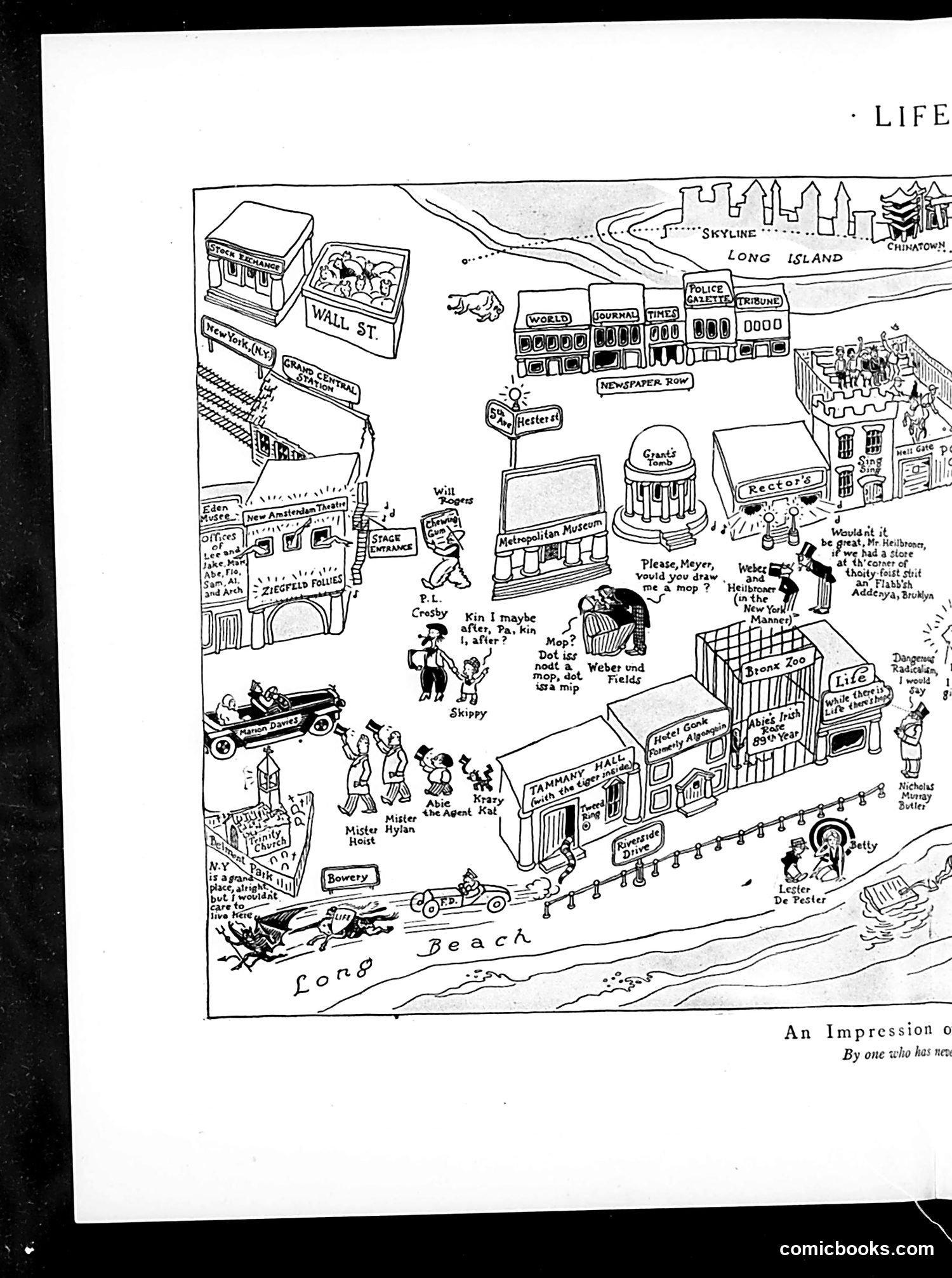
This is a satirical map of New York City landmarks and personalities, titled "An Impression of" (text cut off). The cartoon depicts recognizable locations—Wall Street, Grand Central, the Metropolitan Museum, newspaper row—alongside caricatured figures with dialogue. The humor relies on ethnic stereotypes and dialect humor common to 1920s-era American satire. Characters speak in exaggerated accents (German, Yiddish, Brooklyn), making malapropisms and requests. References include "Mister Hylan" (likely Mayor John Hylan) and "P.L. Crosby" (possibly the cartoonist), alongside unnamed New Yorkers. The satire appears to mock New York's diverse immigrant populations and their aspirations—one character wishes for a store at a Brooklyn corner, another asks for a "mop" (possibly a malapropism). The overall effect caricatures working-class and immigrant New Yorkers' speech patterns and ambitions as comic material. Without the missing title and date, the specific topical references remain partially unclear.
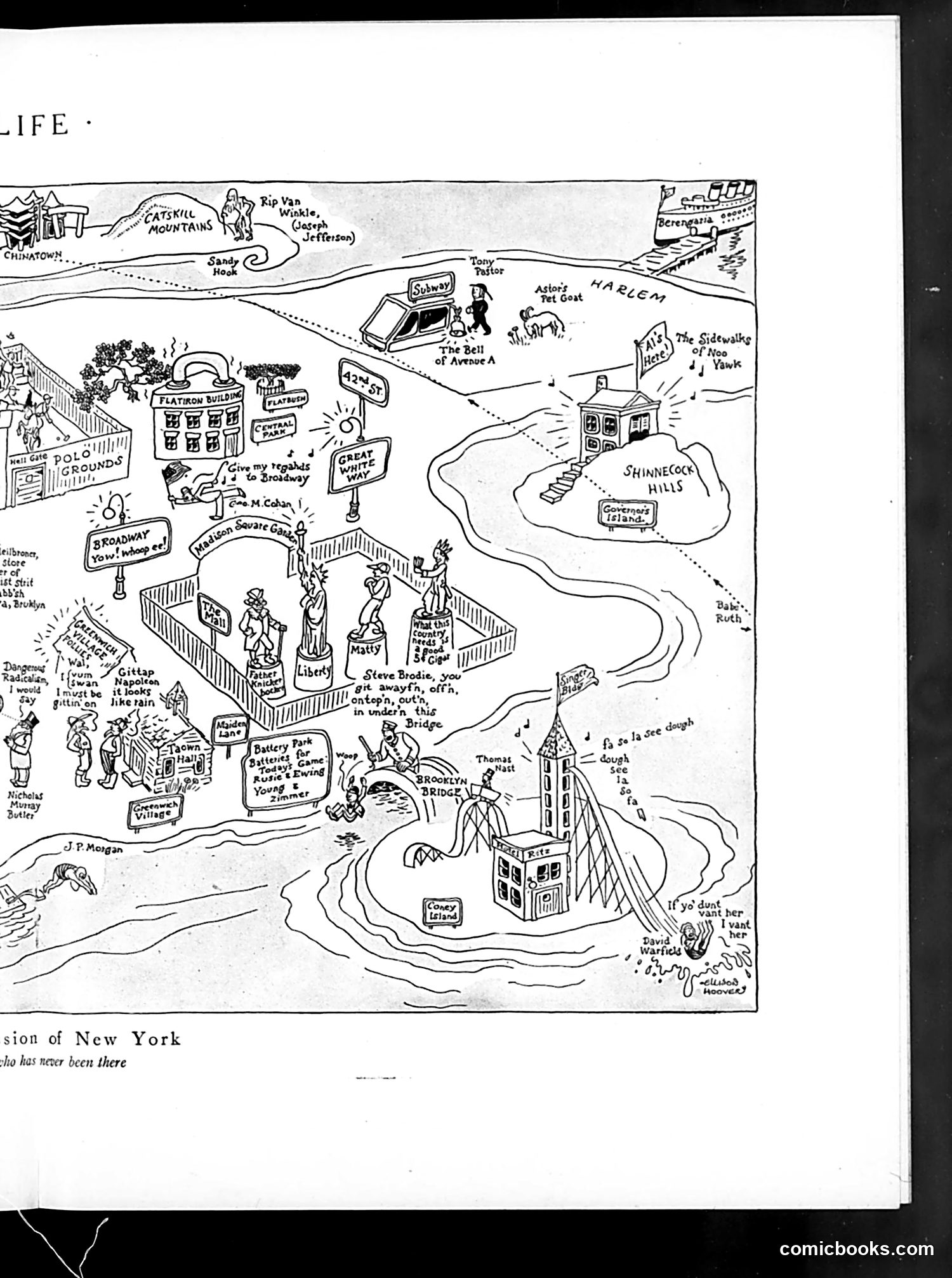
This is a humorous satirical map of New York City presented as a fantastical landscape, likely from the early 20th century. The cartoonist labels actual Manhattan locations and institutions (Catskill Mountains, Broadway, Battery Park, Brooklyn Bridge, Shinnecock Hills) alongside literary and cultural references. Key satirical elements include: references to Washington Irving's "Rip Van Winkle," the Statue of Liberty ("Matty" and "Liberty"), and various prominent New York figures and institutions. The map playfully treats the city as mythical territory, mocking both tourist perceptions of New York and locals' pretensions. The inclusion of society names like "Astor" and references to cultural institutions suggests satire of New York's wealthy elite and their self-importance. The overall joke appears to be that New York—treated as legendary and exotic—is actually a familiar, modern city that many New Yorkers themselves claim never to have properly explored or understood.
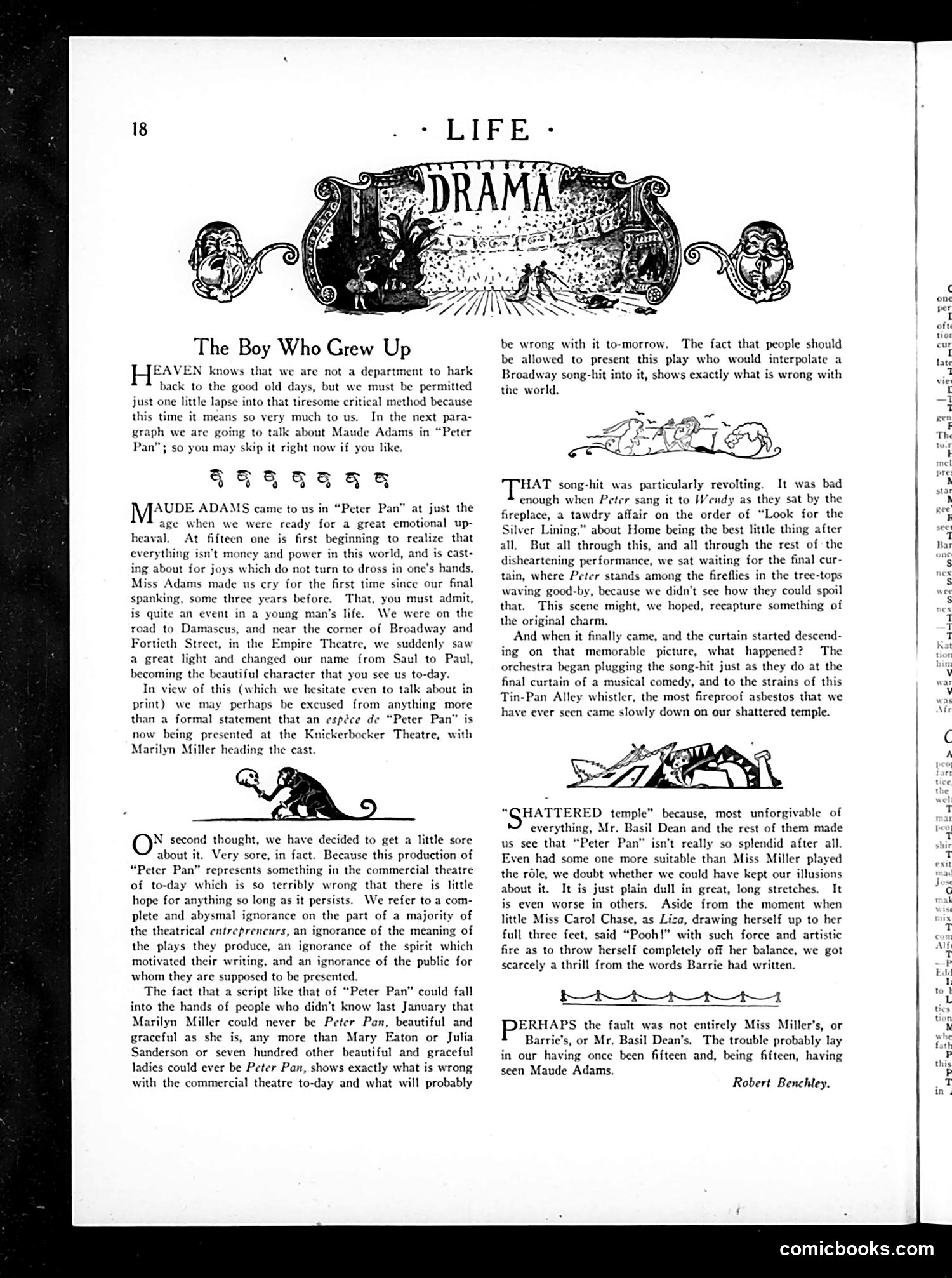
This is a theater review criticizing a 1920s production of *Peter Pan* at the Knickerbocker Theatre, starring Marilyn Miller, directed by Basil Dean. The author nostalgically recalls seeing Maude Adams in the original *Peter Pan*, which deeply moved him emotionally as a teenager. However, he's furious that the new production—despite Miller's beauty and grace—fundamentally misunderstands the play's spiritual meaning. The specific offense: inserting a Broadway "song-hit" (a popular commercial tune like "Look for the Silver Lining") into the sacred final scene where Peter bids farewell among the fireflies. This represents everything wrong with contemporary commercial theatre—producers ignorant of a script's true meaning, prioritizing commercial appeal over artistic integrity. The satire targets theatrical entrepreneurs who treat serious plays as vehicles for profit-driven spectacle, destroying the original work's "charm" and emotional power.
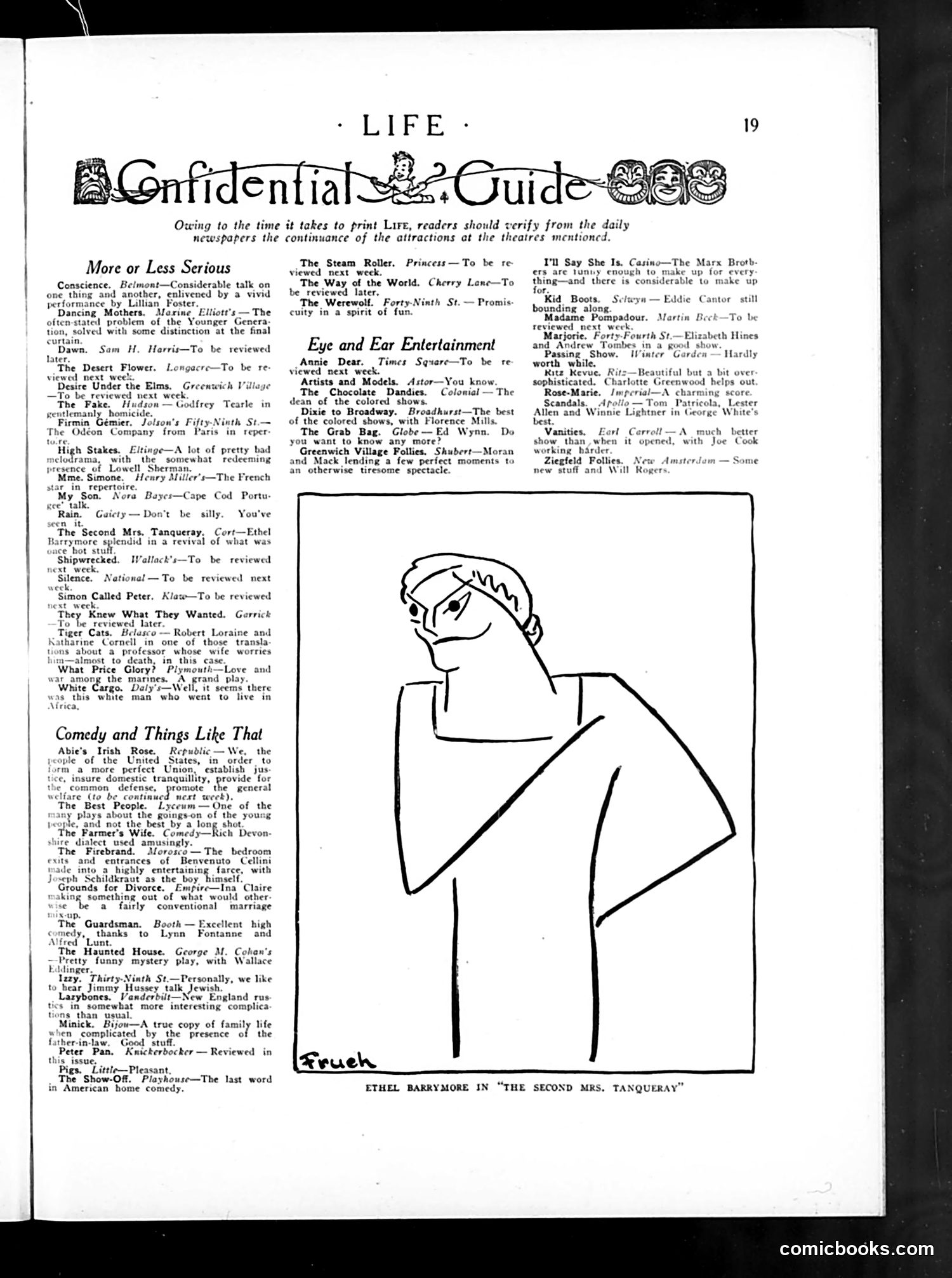
This page is a **theatre review section** from Life magazine's "Confidential Guide," listing current Broadway productions with brief critiques. The cartoon illustrates **Ethel Barrymore in "The Second Mrs. Tanqueray,"** a dramatic play about a woman of questionable past entering high society. The simple line-drawn figure shows a woman in an elegant, form-fitting gown—capturing the play's central tension: a socially "compromised" woman attempting to navigate respectable society through her beauty and charm. The drawing's minimalist style emphasizes her fashionable silhouette, reflecting 1920s theatrical aesthetics. The play itself (originally by Arthur Wing Pinero) was a Victorian social drama about class prejudice and a woman's impossible quest for acceptance. Barrymore's starring role was prestigious; her dignified performance would have been noted by contemporary audiences familiar with the play's moral dimensions.
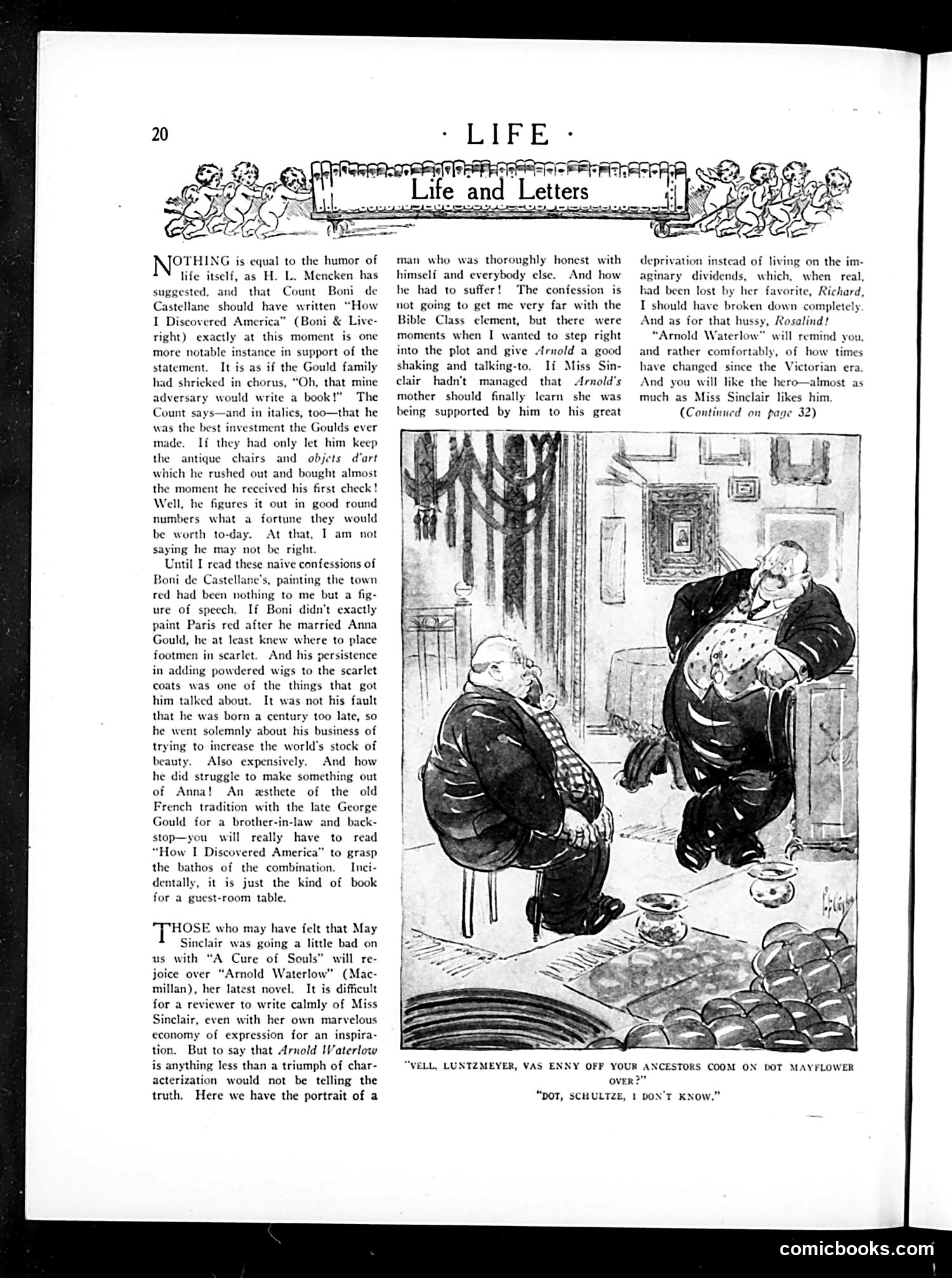
This page reviews two books while satirizing their subjects. The main text criticizes Count Boni de Castellane, a French aristocrat who married American heiress Anna Gould (daughter of railroad magnate Jay Gould). The satire mocks Castellane's memoir "How I Discovered America," ridiculing his extravagant spending on French aesthetic pursuits—scarlet-livered footmen, powdered wigs—after marrying into the Gould fortune. The reviewer suggests his lavish lifestyle was the family's best "investment" precisely because it was so wasteful. The cartoon below depicts two working-class immigrant men (suggested by their German-accented dialect) discussing ancestry. One asks if the other's ancestors came on the Mayflower; the response "I don't know" humorously reflects the reality that most Americans—particularly immigrants—had no such prestigious colonial ancestry. This mocks pretensions about American genealogy and social status.
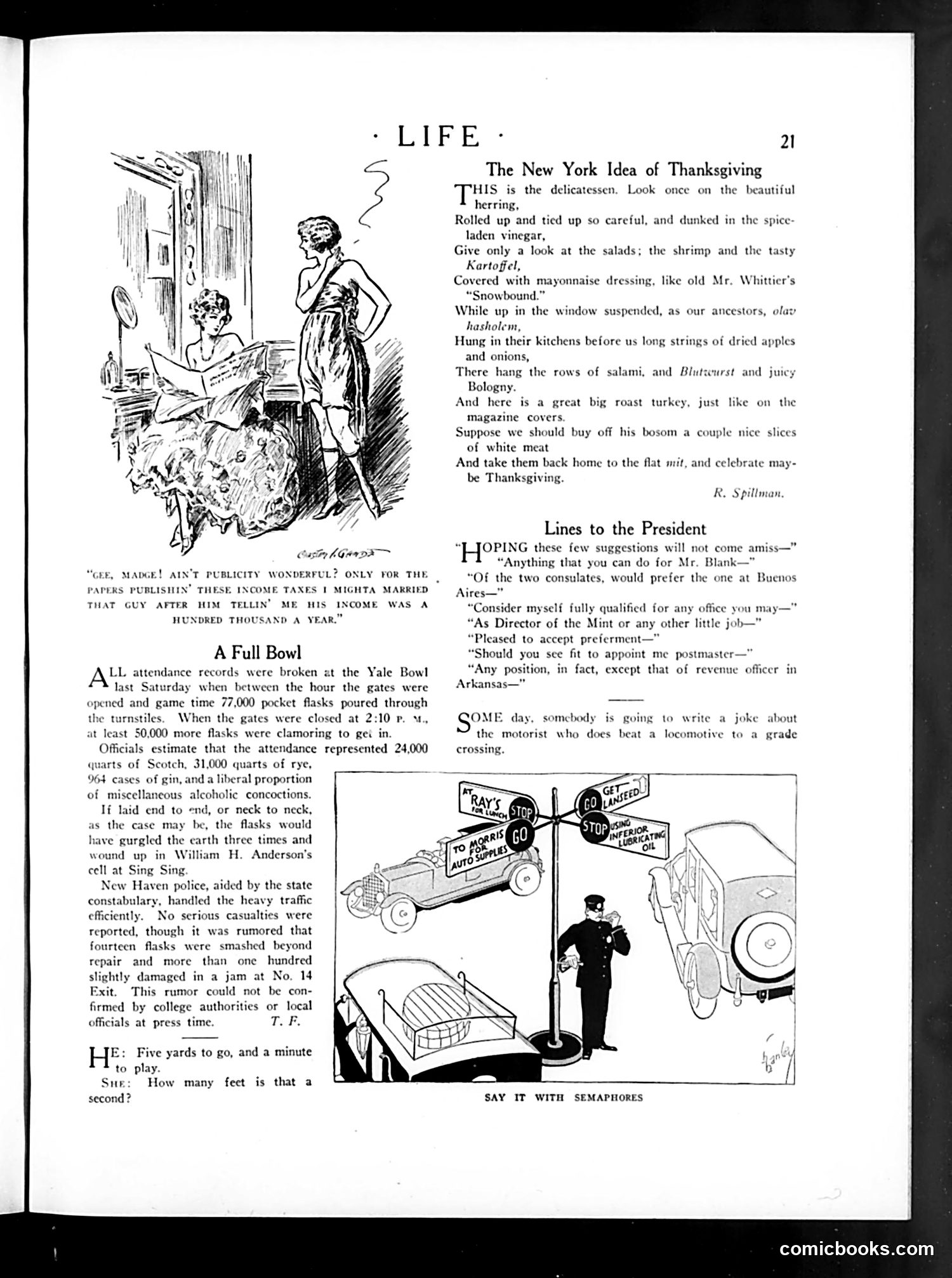
This page contains multiple satirical pieces reflecting 1920s American anxieties: **"A Full Bowl"** mocks Prohibition's failure at Yale's football game, where 77,000 flasks allegedly entered the stadium. The absurd inventory (24,000 quarts of Scotch, 31,000 of rye) underscores how widespread bootlegging was despite the alcohol ban. **"The New York Idea of Thanksgiving"** satirizes Jewish immigrant culture through Yiddish-inflected English, depicting a delicatessen Thanksgiving with herring, salami, and bologna instead of traditional fare—gentle mockery of ethnic assimilation. **"Lines to the President"** depicts job-seekers pestering the President with patronage requests, reflecting corrupt political appointment practices of the era. The punchline about avoiding "revenue officer in Arkansas" likely references unpopular tax collection. **"Say It with Semaphores"** cartoon jokes about a motorist's dangerous driving near a railroad crossing, using flag semaphore signals—a period-appropriate visual gag about traffic safety.
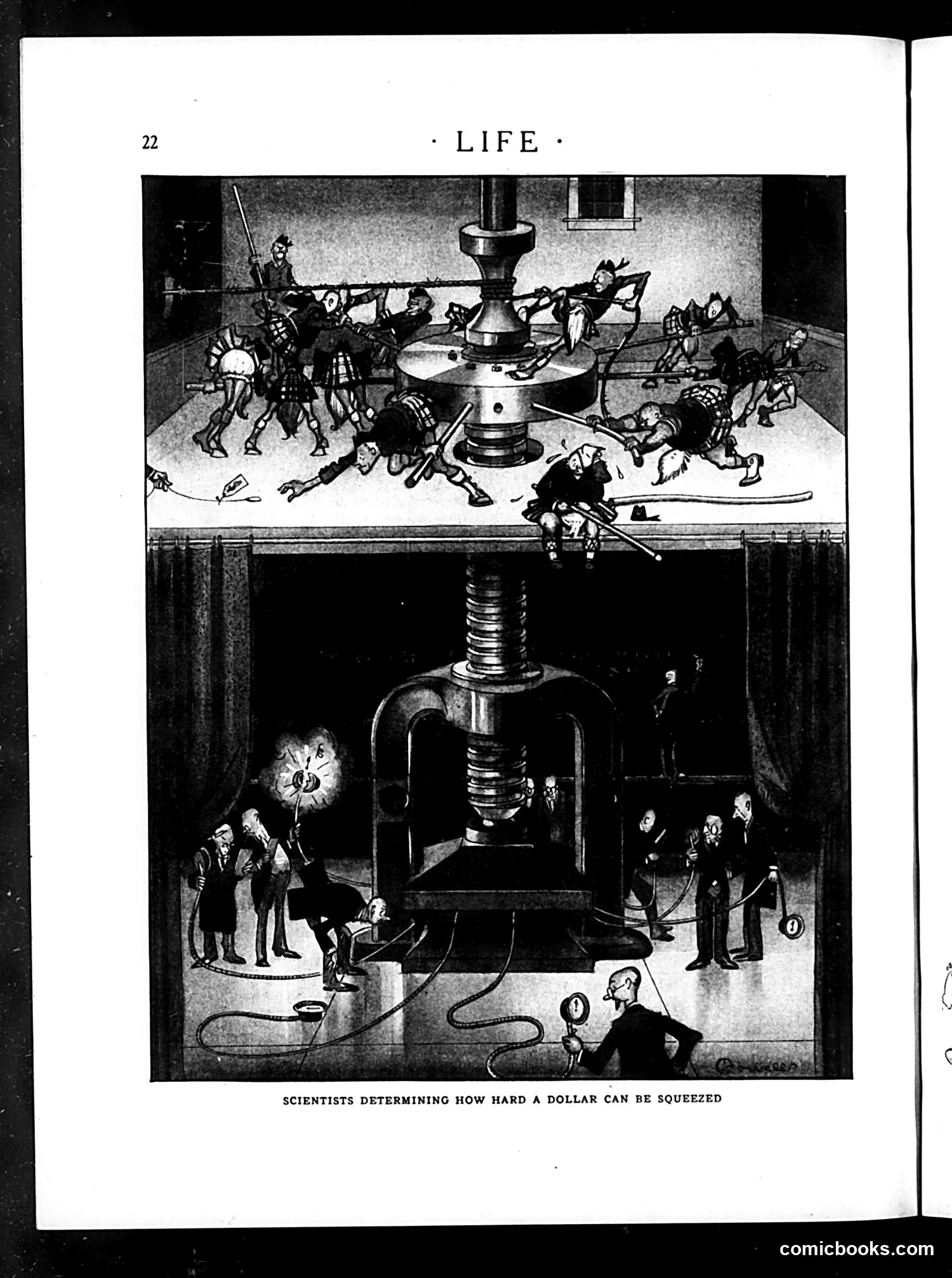
This is a satirical illustration showing scientists conducting an experiment to determine "how hard a dollar can be squeezed"—a critique of fiscal austerity or cost-cutting measures. The image depicts a giant mechanical press (likely representing government or institutional pressure) with scientists observing from above and below. The top panel shows researchers with various instruments, while the bottom shows officials examining results, with what appears to be a light bulb or energy output illustration. The satire targets the era's obsession with efficiency and squeezing maximum value from minimal resources—likely referencing post-WWI economic policies or Depression-era budget cuts. The cartoon mocks the notion that scientists could literally test monetary limits, suggesting the absurdity of economic thinking that prioritizes extraction over human welfare or practical reality.
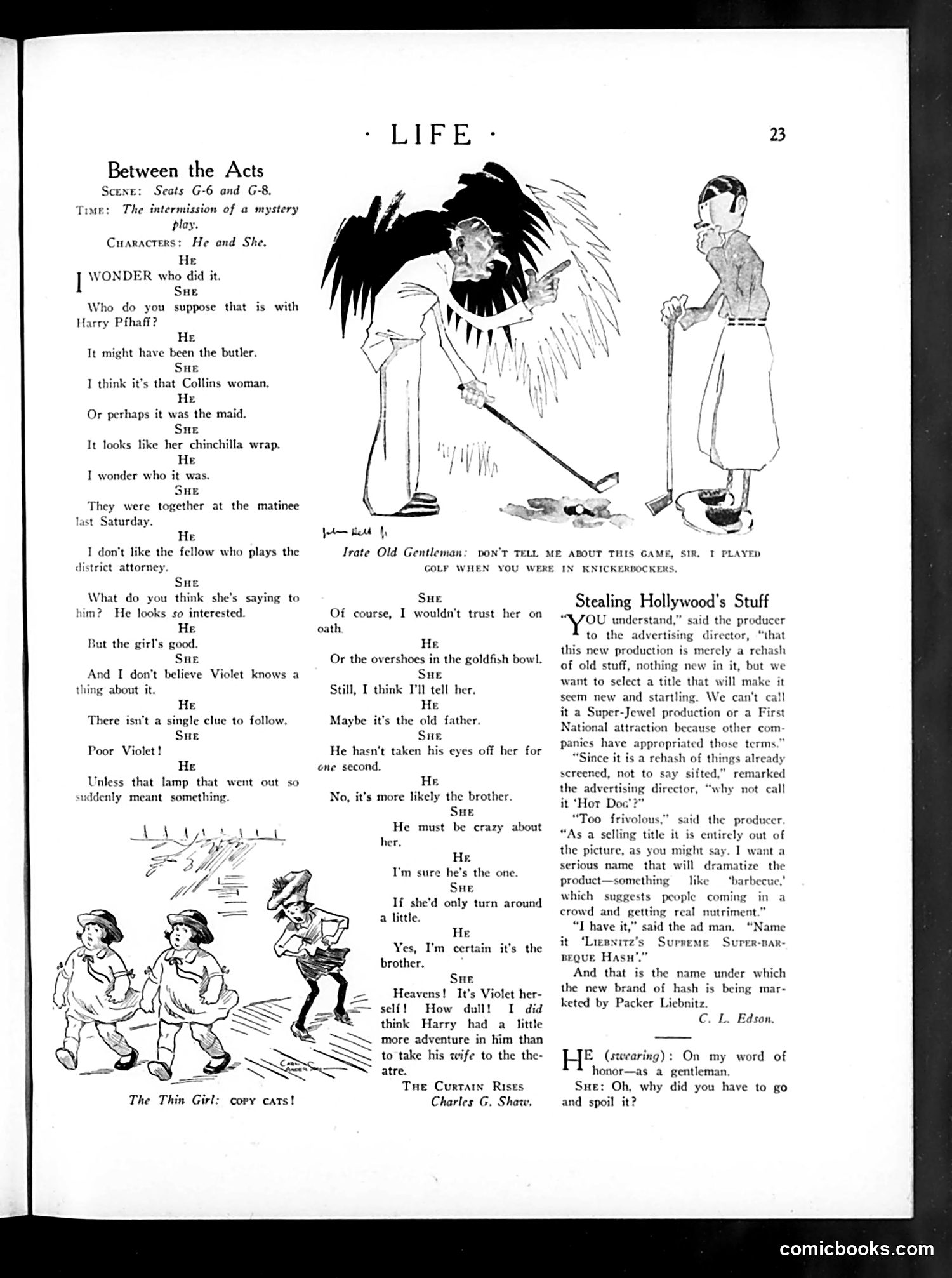
This page contains two satirical pieces mocking early 20th-century entertainment and advertising. **"Between the Acts"** depicts theater intermission gossip, where two audience members speculate endlessly about a mystery play's plot while completely missing the obvious resolution—the woman they've been discussing is actually Violet, the protagonist's wife. The satire mocks theatergoers' tendency to create elaborate theories while ignoring simple facts, and the banality of their conversation despite attending sophisticated drama. **"Stealing Hollywood's Stuff"** ridicules film industry practices where studios recycle old material under pretentious new titles. A producer and advertising director cynically rebrand a "rehash of old stuff" with an obscure title ("Liebnitz's Supreme Superbargue Hash") to disguise its lack of originality. The satire exposes how Hollywood used marketing deception to sell derivative content as novel productions. Both pieces critique how audiences and consumers are easily fooled by superficial presentation over substance.
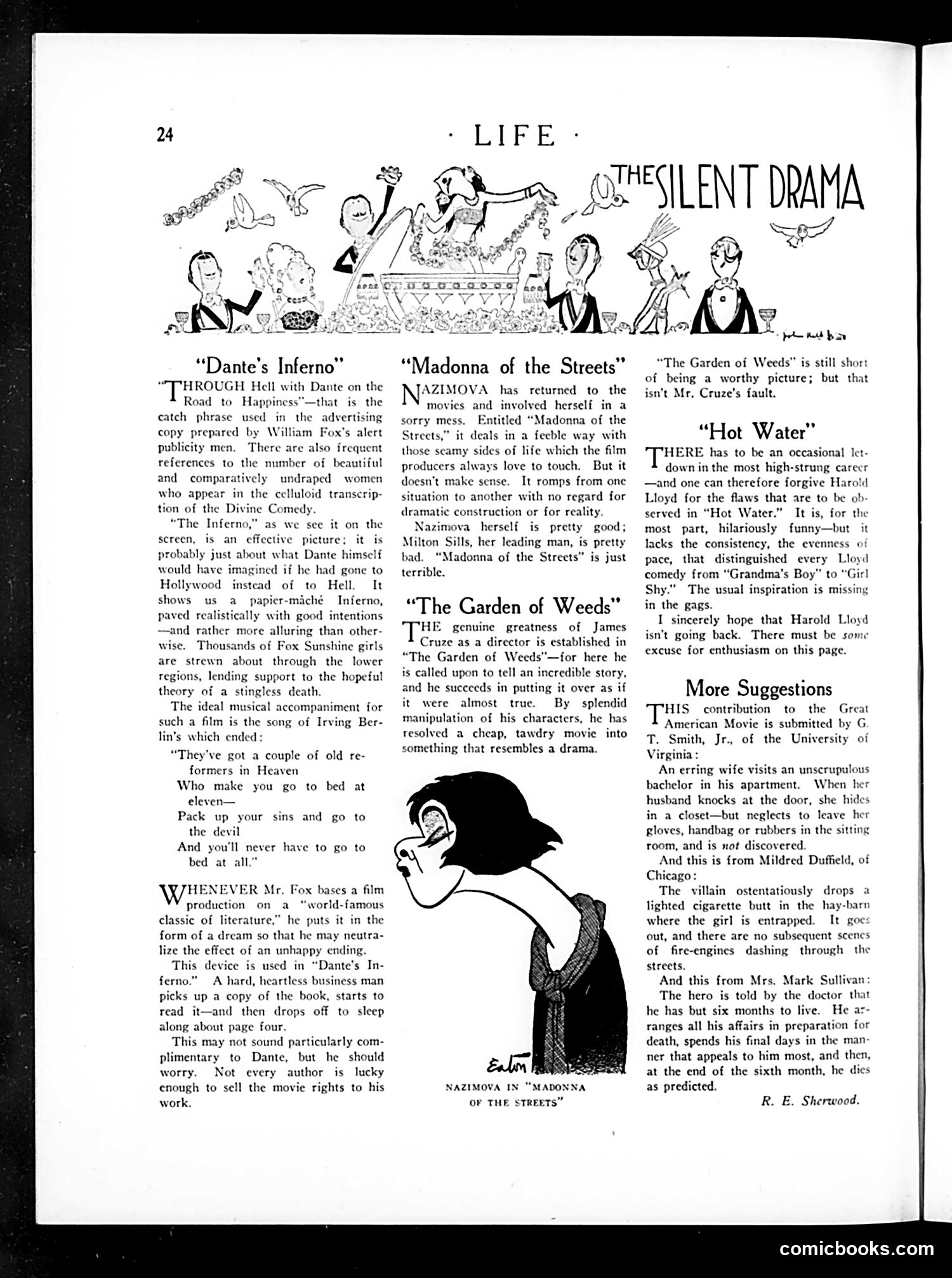
This page reviews four silent films from the early 1920s. The satire targets both the films themselves and Hollywood's approach to adapting classic literature. **"Dante's Inferno"** is mocked for William Fox's vulgar adaptation: the reviewer notes Fox has replaced Dante's actual Hell with a "papier-mâché Inferno" populated by "thousands of Fox Sunshine girls"—the studio's contract actresses—to make damnation seem appealing. The joke is that Hollywood has turned serious religious literature into cheesecake spectacle. **"Madonna of the Streets"** and **"The Garden of Weeds"** receive straightforward negative and positive reviews respectively. **"Hot Water"** critiques Harold Lloyd's latest comedy for lacking the consistent quality of his previous hits. The **"More Suggestions"** section parodies common plot holes in silent films—absurd contrivances where characters fail to notice obvious evidence (a wife's belongings, a dropped cigarette). The cartoon header depicts chaotic film production, satirizing Hollywood's sensationalism and disorder. The overall tone mocks both studios' commercialism and audiences' appetite for sensation over artistry.
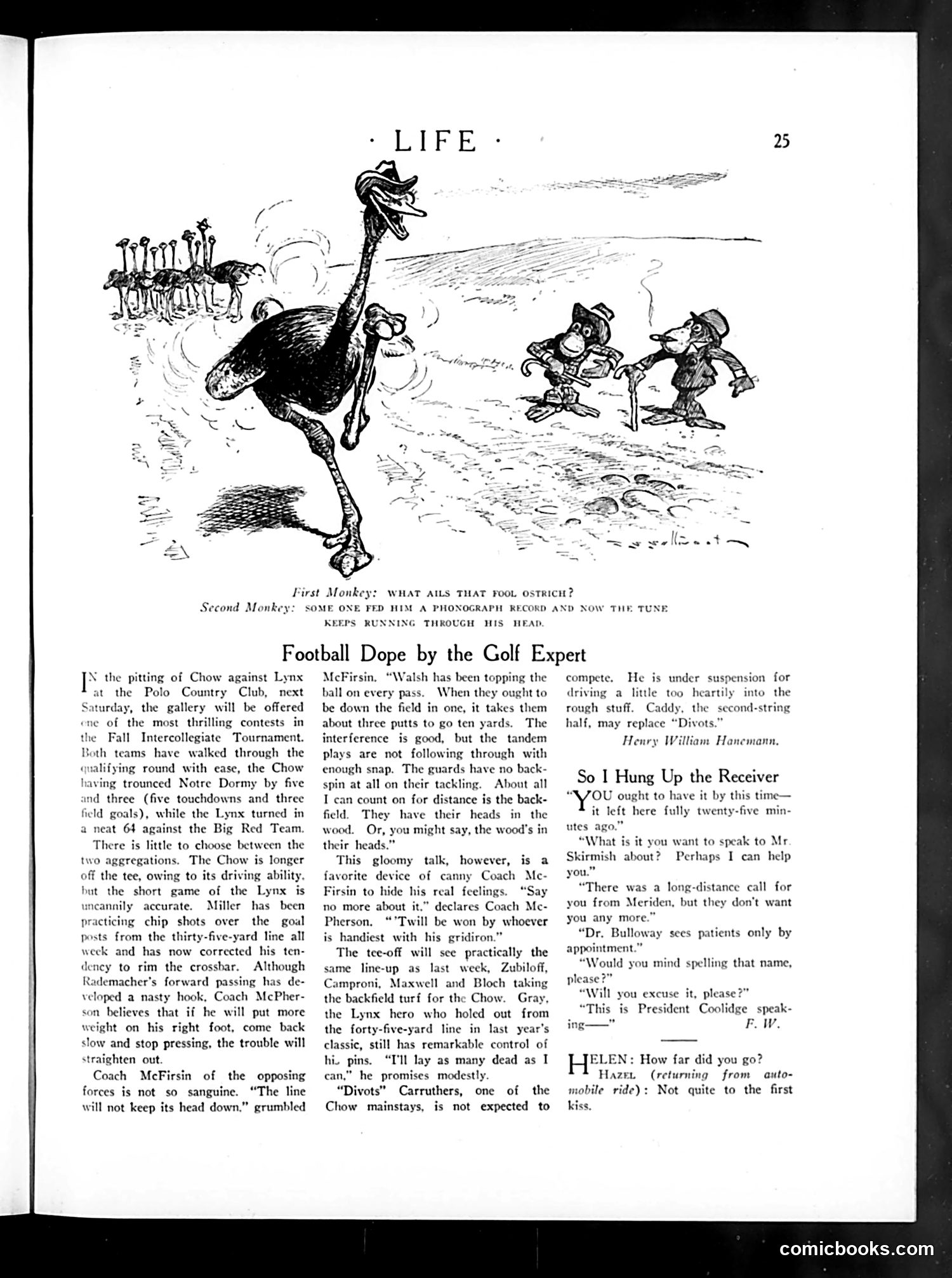
This *Life* magazine page contains two distinct satirical pieces: **The Ostrich Cartoon**: A visual gag showing monkeys discussing an ostrich running in circles. The joke plays on the phrase "got a tune stuck in your head"—here literally, as the ostrich has a phonograph record physically in its head, causing it to run compulsively. It's absurdist humor typical of early 20th-century comedy. **"Football Dope by the Golf Expert"**: A longer satire mocking sportswriters who apply golf terminology to football analysis. Coaches discuss football strategy using golf jargon—"chip shots," "putts," "tee-offs," "divots," "holing out"—creating deliberate confusion. The joke targets pretentious sports commentary and the absurdity of mixing sports vocabularies. Names like "Coach McFirsin" appear fictional. **"So I Hung Up the Receiver"**: Brief vignettes satirizing telephone etiquette and miscommunication, including a joke about someone claiming to be President Coolidge. The page exemplifies *Life*'s satirical approach: mocking social pretension, miscommunication, and pseudo-expert commentary through wordplay and conceptual incongruity.
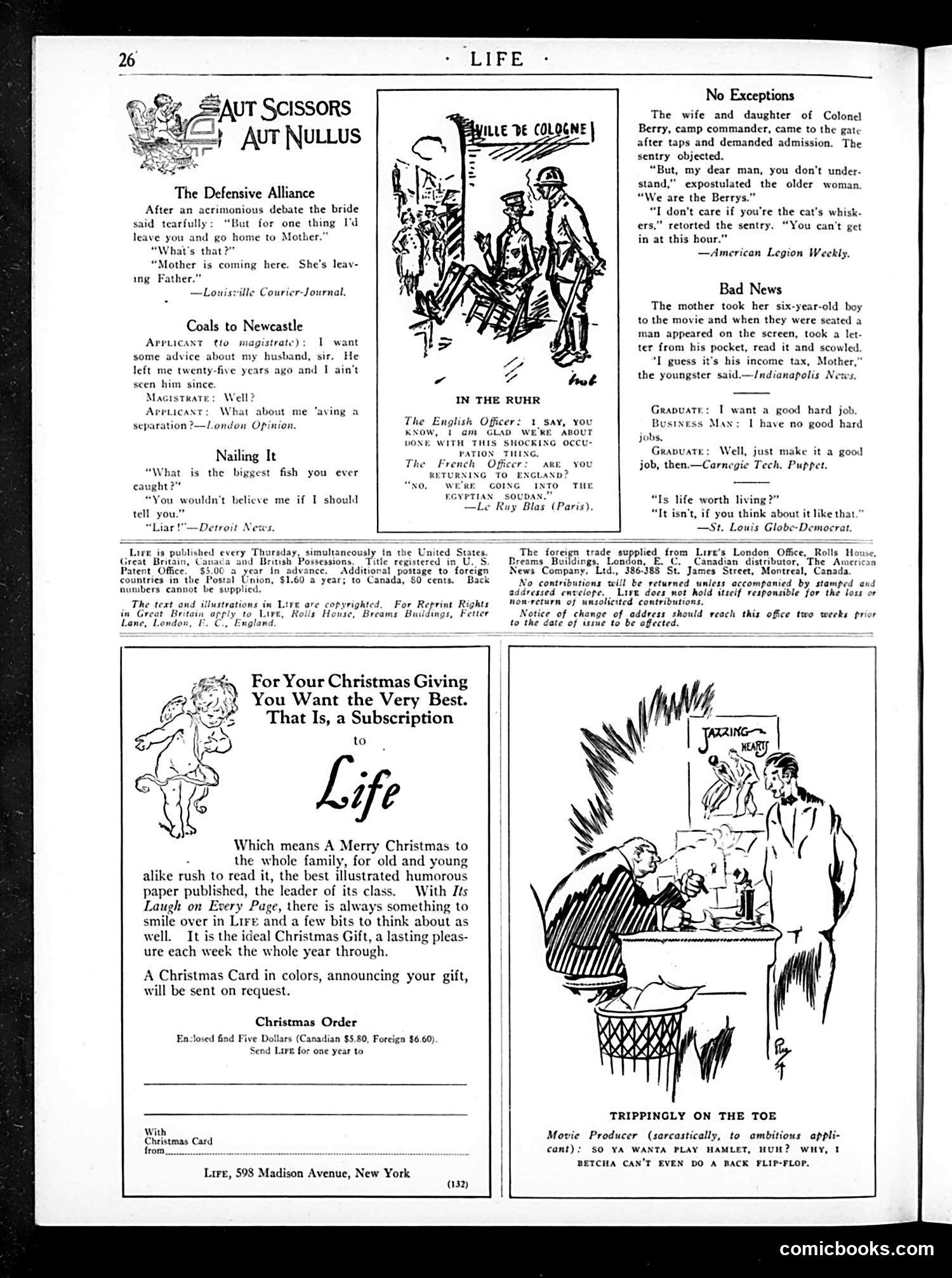
This page contains several short humorous anecdotes and advertisements from *Life*, the American satirical magazine. The jokes reflect early 20th-century domestic and social anxieties: **"The Defensive Alliance"** mocks marital discord—a bride threatens to leave her husband for her mother, but won't because her father is also coming. **"Coals to Newcastle"** satirizes a woman seeking legal separation from a husband absent 25 years—absurdly asking a magistrate's advice on a moot point. **"In the Ruhr"** references post-WWI occupation: English and French officers discuss leaving the Ruhr region (occupied after WWI) for Egypt/Sudan, suggesting exhaustion with military occupation duties. **"No Exceptions"** shows military camp discipline overriding social status—even a colonel's family cannot enter after hours. **"Movie Producer"** mocks Hollywood's superficiality: a producer sarcastically dismisses an ambitious actor's aspirations to play Hamlet, demanding acrobatic skills instead—suggesting entertainment industry values spectacle over Shakespeare. The page also advertises *Life* subscriptions as Christmas gifts, positioning the magazine as family entertainment.
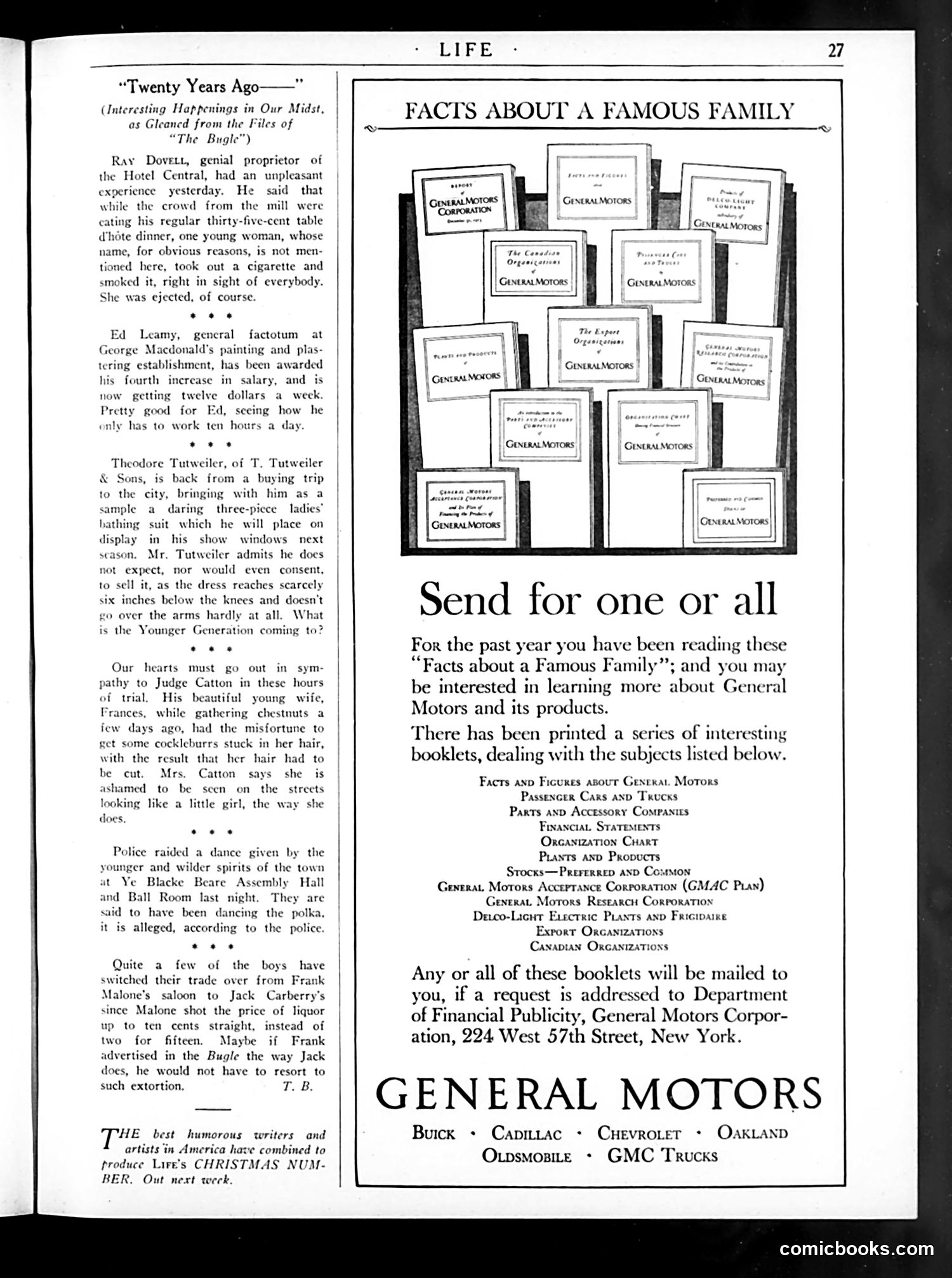
This page presents humorous anecdotes from a fictional small-town newspaper ("The Bug"), satirizing early 20th-century social anxieties and changing mores. The jokes mock conservative outrage over modernization: a woman smoking in public gets ejected from a hotel dining room; a shopkeeper displays a scandalous ladies' bathing suit that reaches only six inches below the knee; a respectable judge's wife is mortified after having her hair cut short due to cockleburrs; police raid a dance for the "crime" of polka dancing. The satire targets the "Younger Generation" and their perceived moral decay, while implicitly mocking the older generation's prudishness. A competing saloon's price-gouging is dismissed as foolish business practice. The page is primarily **satirical commentary on social conservatism**, not political cartooning. The right side contains a General Motors advertisement unrelated to the satire.
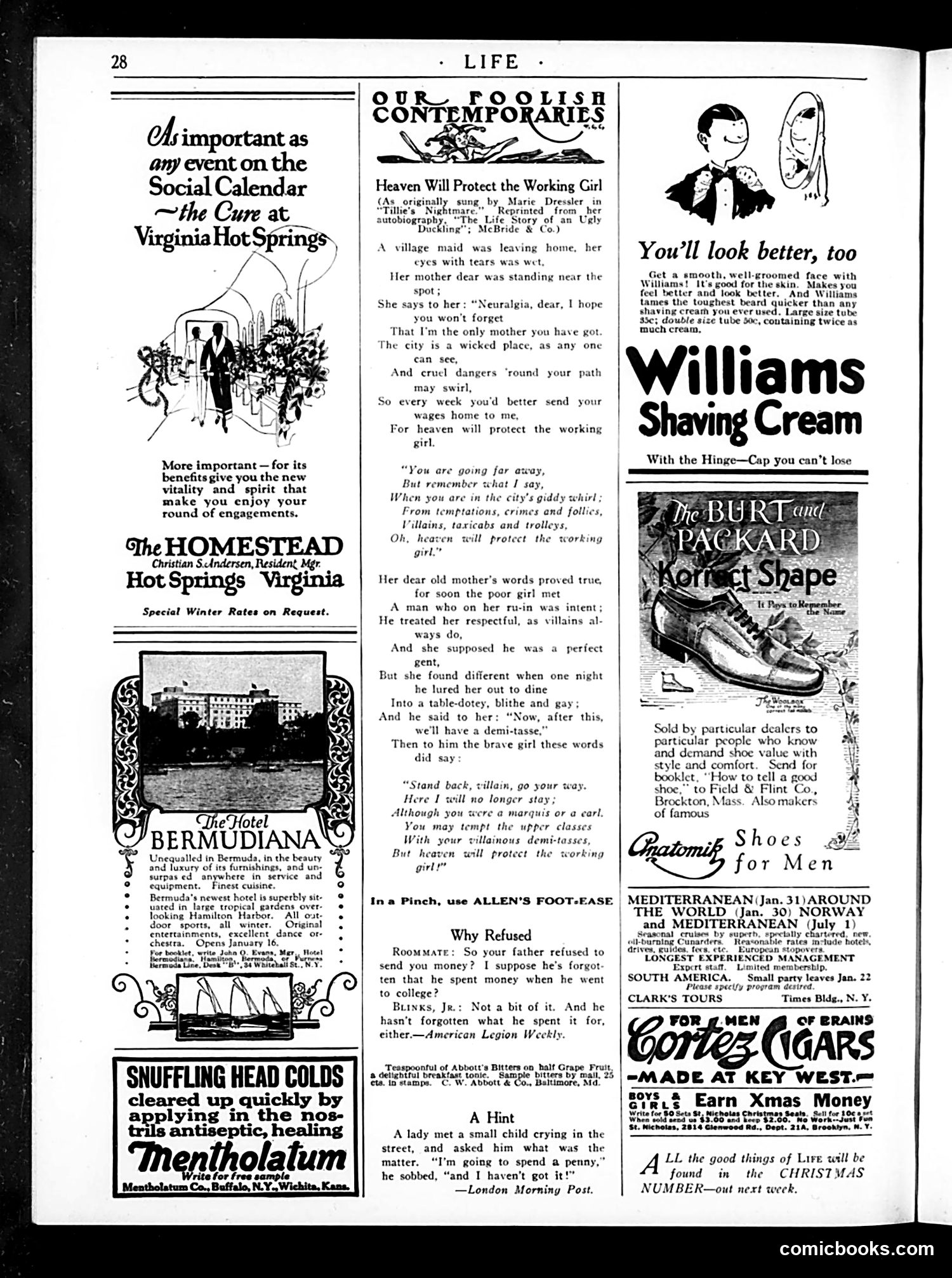
This page is primarily **advertisements and humor pieces**, not political satire. The main content is a song-poem titled "Heaven Will Protect the Working Girl," originally performed by Marie Dressler. It satirizes the naive optimism of working-class women entering cities in the early 20th century. The joke: A village girl's mother warns her about urban dangers (temptation, crime, "villains, taxicabs and trolleys"), trusting "heaven" will protect her. When a man seduces her with dinner and sophisticated talk of "demi-tasses" (small coffee cups), the girl ultimately refuses him—suggesting that heavenly protection (or simple virtue) actually *does* work, ironically confirming the mother's faith. The satire targets both naive rural parents and the patronizing urban gentleman preying on working girls. The page is filled with period product ads (shaving cream, shoes, hotel stays, foot powder) typical of Life magazine's revenue model.
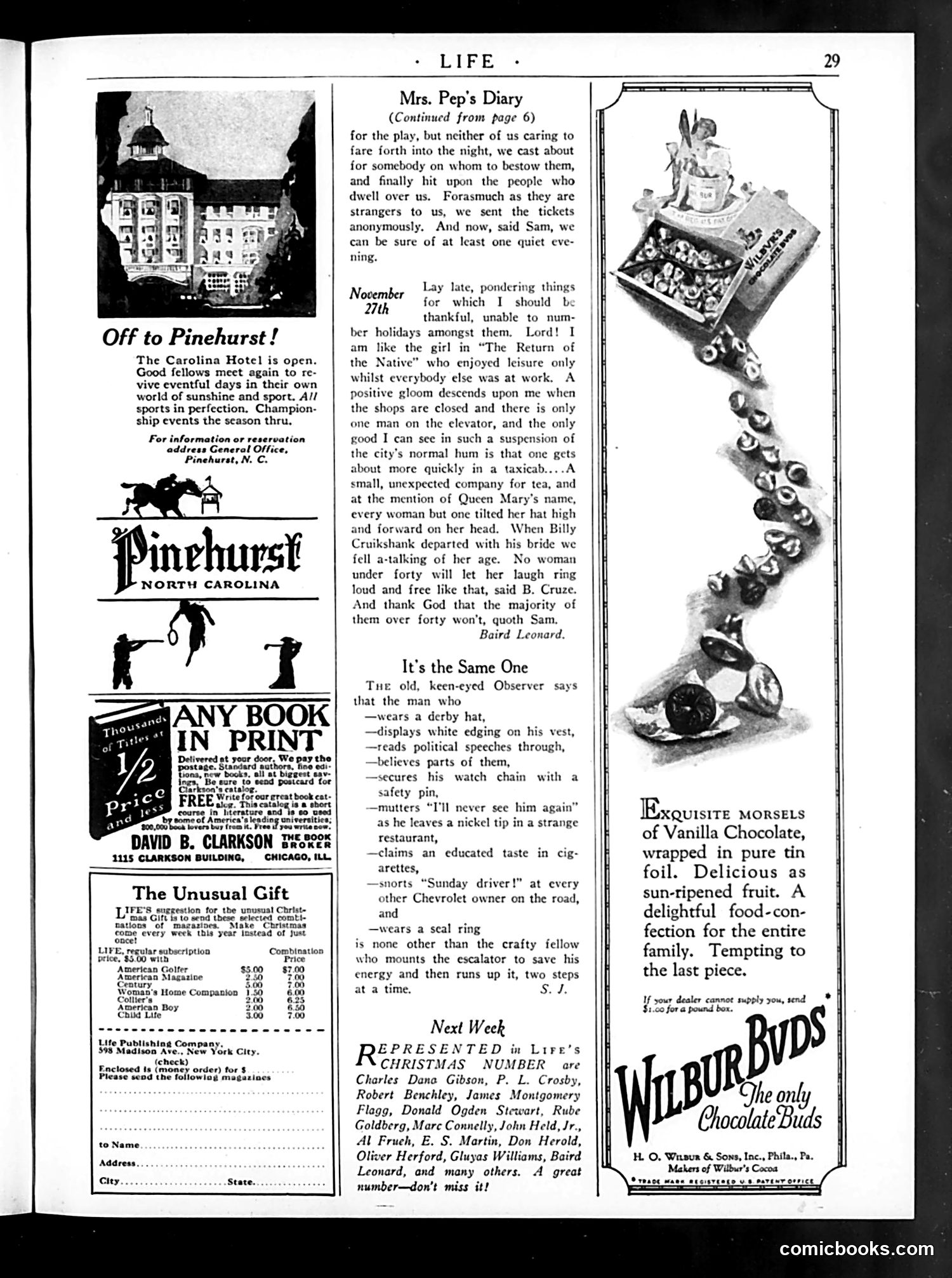
This page is primarily **advertising and miscellaneous content** rather than political satire. The main features are: **Advertisements:** Pinehurst resort in North Carolina, a book service, magazine subscriptions, and Wilbur's chocolate. **Content:** "Mrs. Pep's Diary" continues a serialized column featuring domestic observations and social commentary. The "Observer" section satirizes a recognizable American type—a man who projects sophistication (derby hat, educated taste) while performing contradictory behaviors (saving energy on escalators then rushing up stairs). This gentle mockery targets middle-class pretension and hypocritical behavior. **Context:** This appears to be a 1920s-era Life issue, when the magazine published satirical social commentary alongside lifestyle content. The humor relies on readers recognizing familiar social types and their self-contradictions—typical of the era's light satirical style.
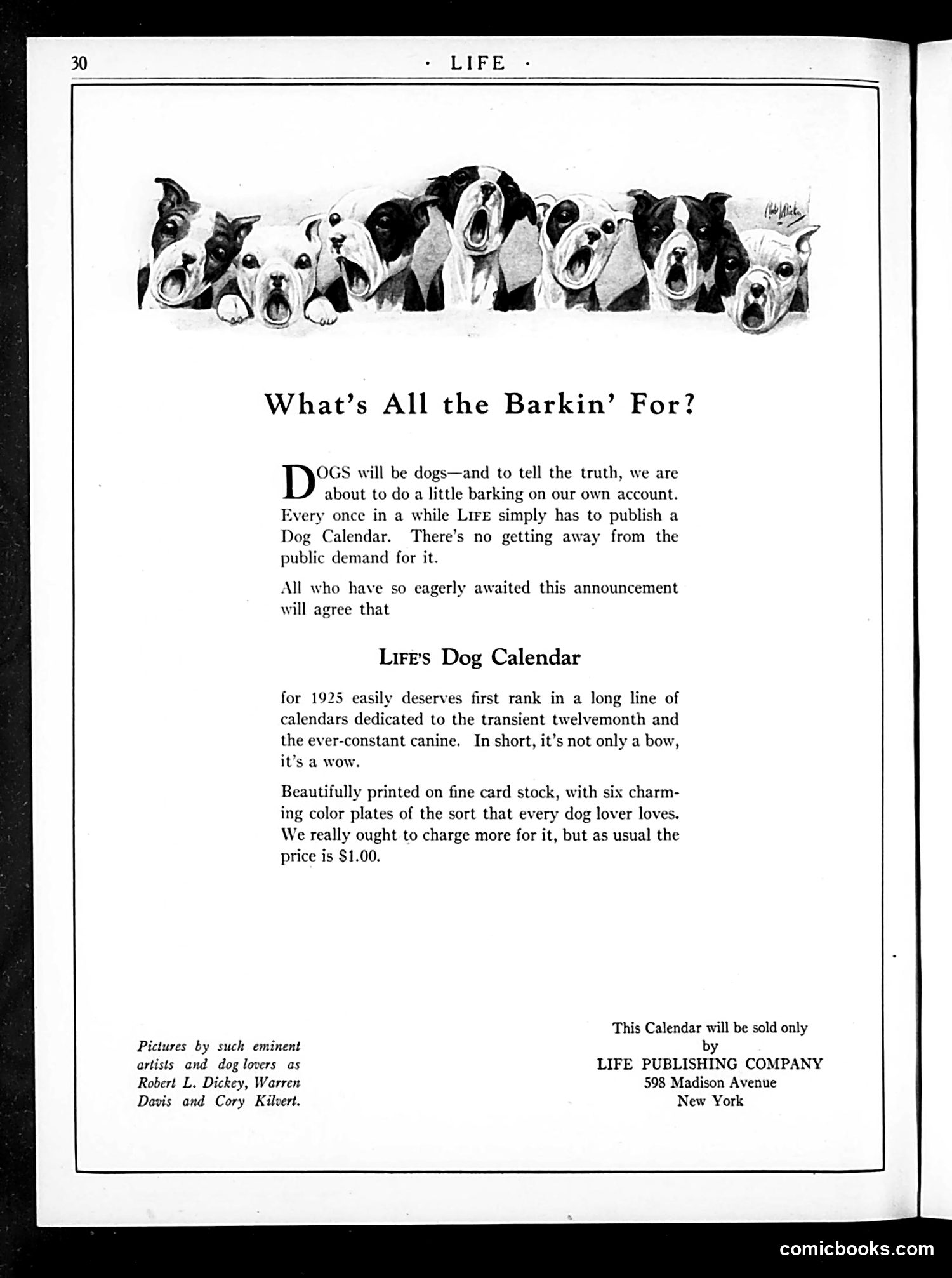
This is primarily an advertisement for *Life* magazine's 1925 Dog Calendar. The page features an illustration of multiple dogs with open mouths, appearing to bark enthusiastically. The humor is self-referential: *Life* jokingly apologizes for "barking" (making noise/promoting) its own product, while announcing the calendar itself. The pun "it's not only a bow, it's a wow" plays on the dog theme—a bow (as in bowing) that's a "wow" (success). The calendar features six color illustrations by notable artists including Robert L. Dickey, Warren Davis, and Cory Kilvert. Priced at $1.00, it's positioned as a popular item with sufficient public demand that *Life* felt compelled to publish it. This is essentially a self-promotional piece leveraging dogs' cultural popularity in 1920s America to market the magazine's merchandise.
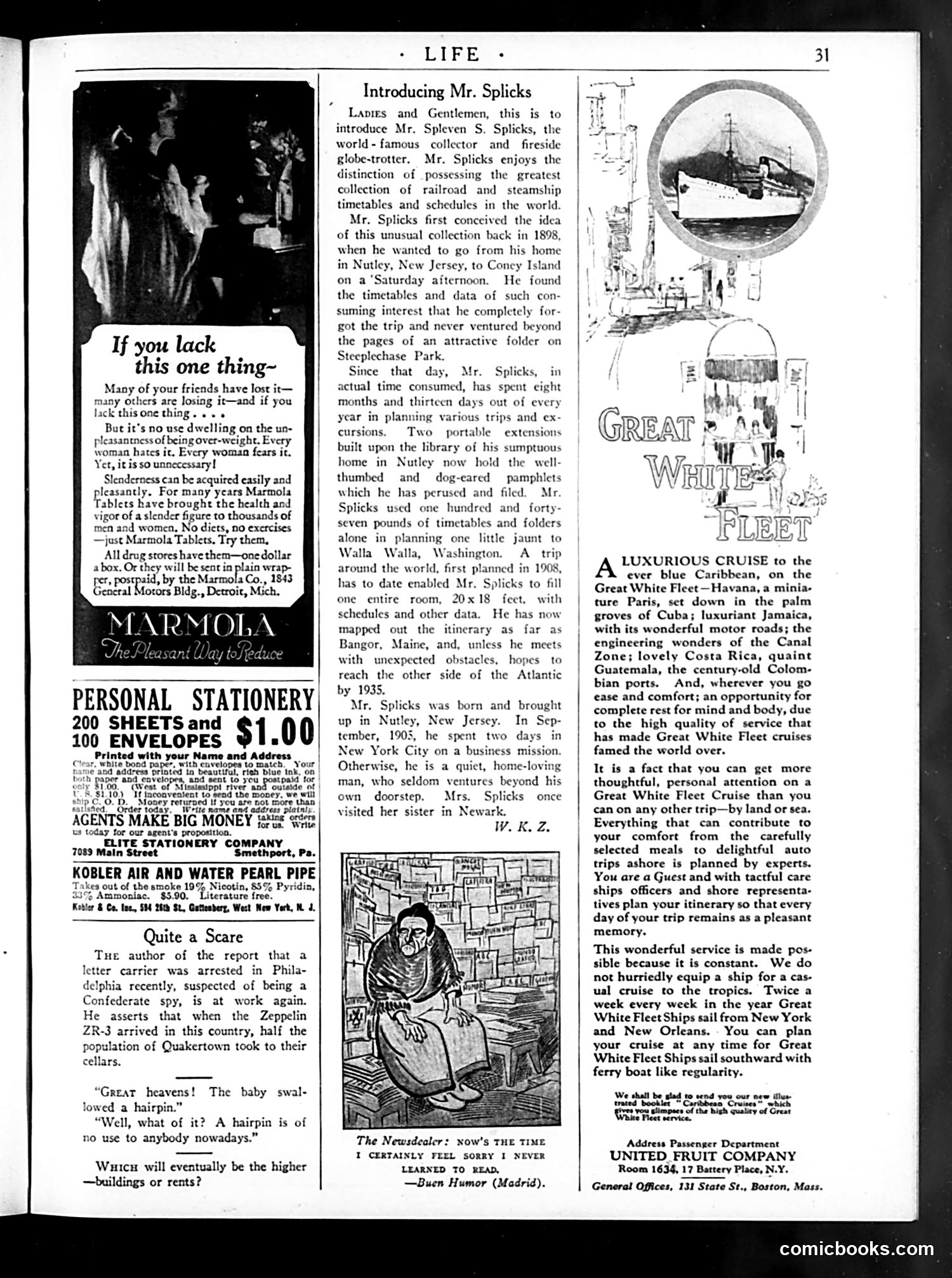
This page contains primarily **advertisements and light humor** rather than political satire. The main content is a humorous character sketch of "Mr. Splicks," a parody of obsessive travel planners. The joke: Splicks has spent eight months yearly *planning* trips using timetables and schedules—yet rarely actually travels. He's collected 147 pounds of pamphlets for one trip to Walla Walla and has been planning a 1908 world tour still unfinished by the article's time. The satire gently mocks people who become so consumed with organizing leisure that they never experience it. The surrounding advertisements promote Marmola weight-loss tablets, personal stationery, and other products typical of 1920s-era magazines. The small humor piece "Quite a Scare" jokes that when the German Zeppelin ZR-3 arrived in America, Quakertown residents hid in cellars—reflecting post-WWI anxiety about German aircraft, though the tone is dismissive of such fears as silly overreaction.
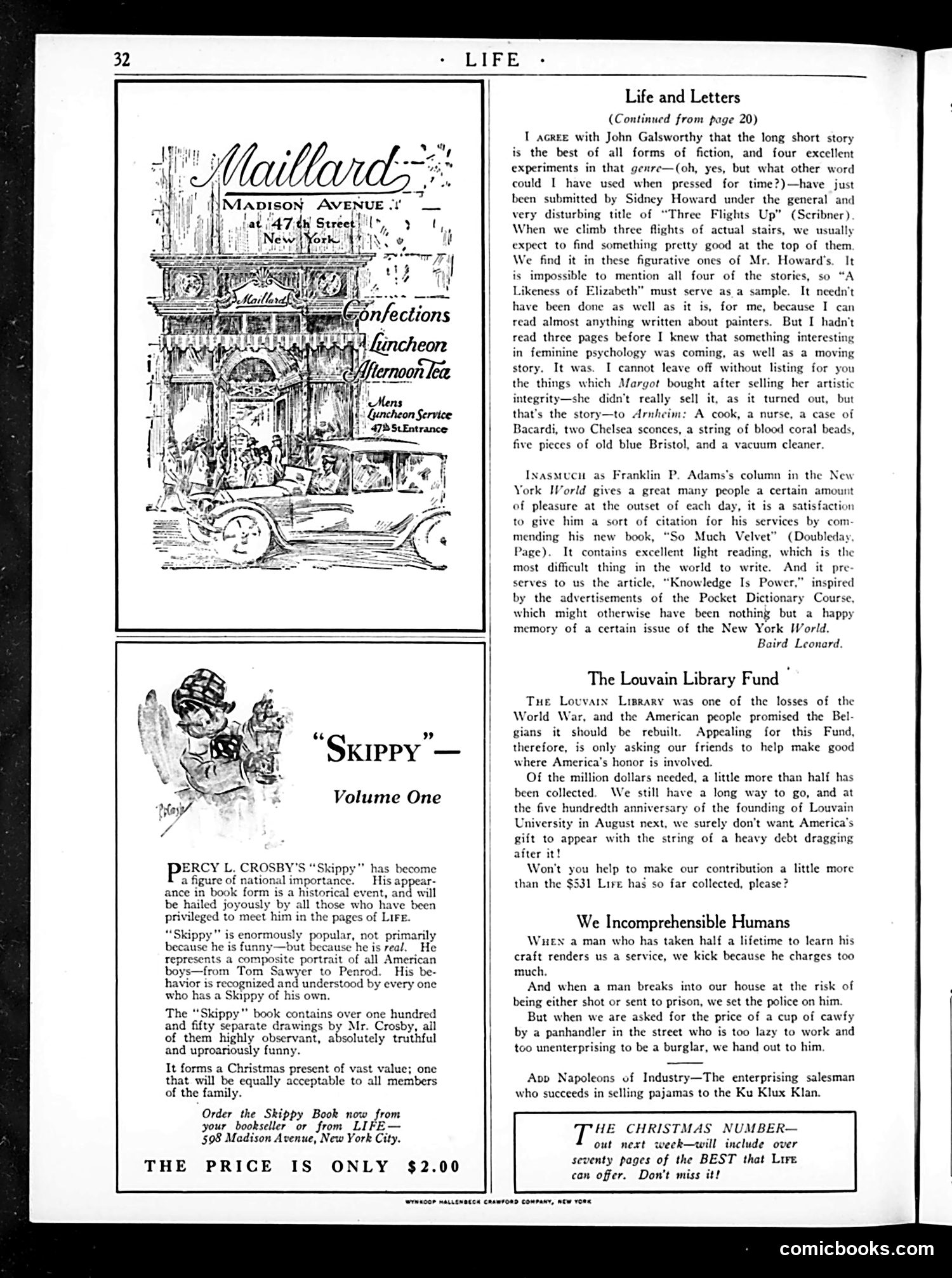
This page is primarily **advertising and book promotion** rather than political satire. The main content advertises Percy L. Crosby's "Skippy" comic strip collection—described as a portrait of the "real" American boy, appealing to readers because Skippy represents all American boyhood from Tom Sawyer to Penrod. The $2 book is pitched as a Christmas gift. The right column contains literary reviews by Baird Leonard, discussing short stories by Sidney Howard and Franklin P. Adams's new book "So Much Velvet," treating light literature as a serious craft. A fundraising appeal for rebuilding the Louvain Library (destroyed in WWI) appears below, framing American donations as a matter of national honor. The top illustration is a decorative advertisement for "Mailliard" confections at a Madison Avenue address—typical period retail advertising. No political cartoons or satirical commentary appears on this page.
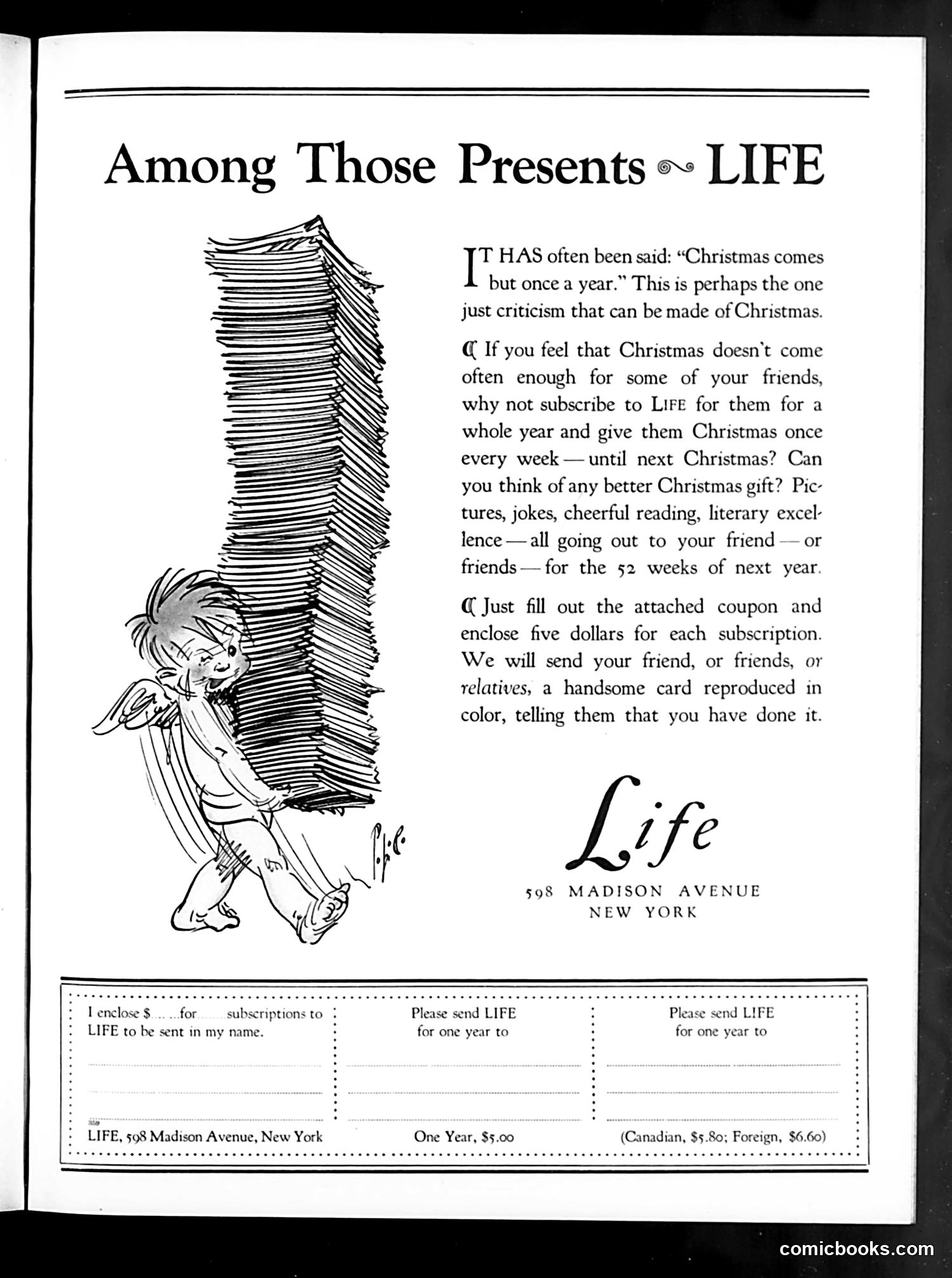
This is primarily a **Christmas gift advertisement** for *Life* magazine subscriptions, not political satire. The small illustration shows a cherub or angel figure struggling to carry an enormous stack of magazines—a visual joke emphasizing the volume of content a year-long subscription provides. The ad's satire is gentle and self-promotional: it pokes fun at the complaint that "Christmas comes but once a year" by proposing that a *Life* subscription delivers "Christmas" weekly for 52 weeks. The pitch emphasizes the magazine's content—pictures, jokes, literary excellence—as ideal gifts. At $5 per subscription, readers could purchase gift subscriptions via the attached coupon. This represents typical mid-century magazine marketing: positioning periodic entertainment as a year-round gift solution. The humor relies on treating magazine delivery as equivalent to holiday joy.
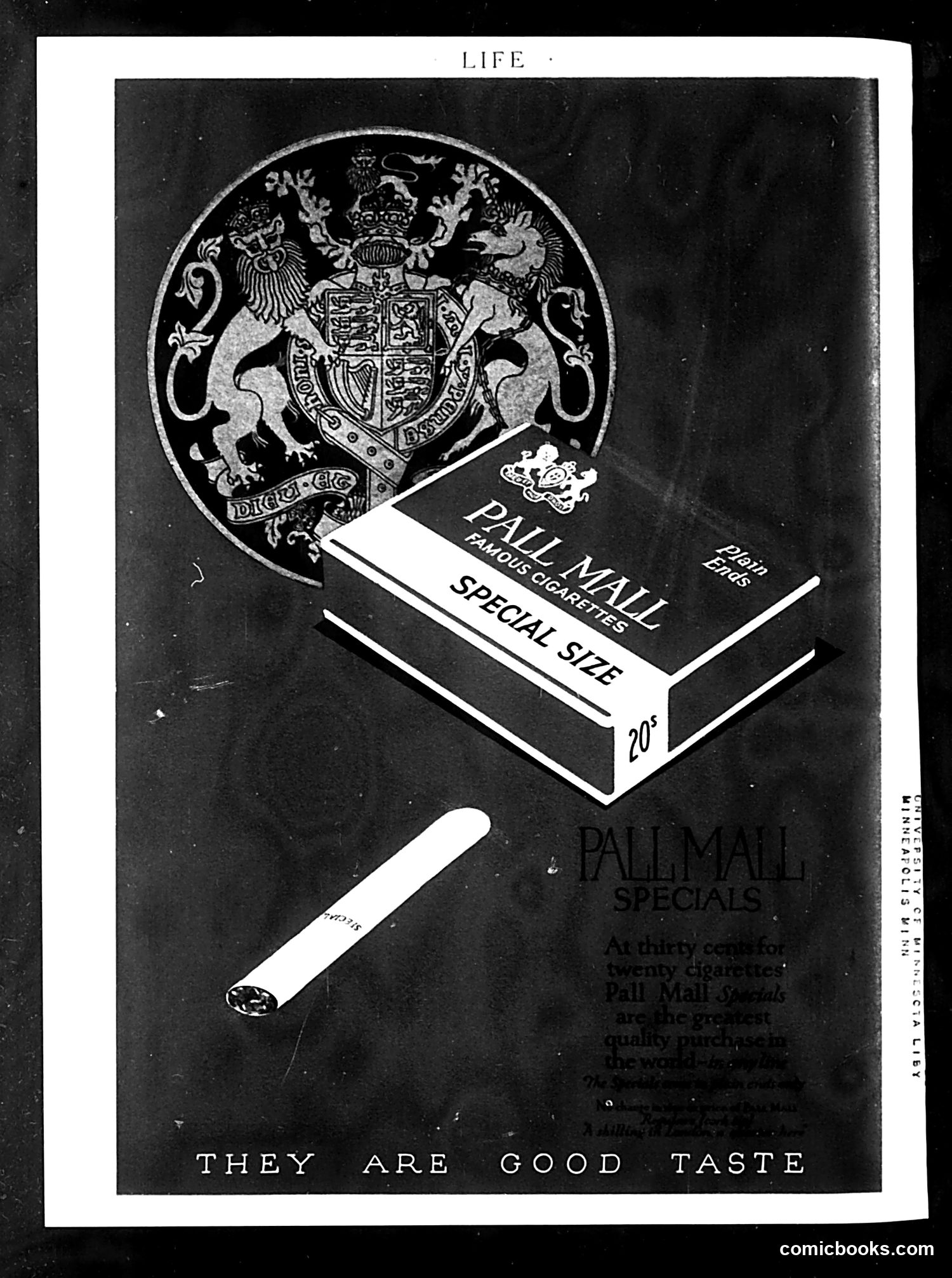
This is a **cigarette advertisement**, not political satire or a cartoon. It promotes Pall Mall Special Size cigarettes using the British Royal Coat of Arms as a prestige marker. The ad claims these cigarettes represent "the greatest quality purchase in the world" and are "good taste." The imagery—the formal heraldic seal, the elegant presentation box, the single cigarette—aims to associate smoking with sophistication and British aristocratic refinement. This is a straightforward commercial using royal symbolism to convey luxury and class status to consumers. There is no political commentary or satire present; it's simply period advertising from when such cigarette promotions were standard in magazines like *Life*.

I can see this is a very dark, low-contrast page from Life magazine, but I cannot make out sufficient detail to identify specific cartoons, figures, or text with confidence. The image quality and darkness prevent me from reading captions, distinguishing individual illustrations, or determining what political or social commentary may be present. To provide accurate historical analysis per your rules, I would need a clearer version of this page. I can confirm the comicbooks.com watermark and the left margin text visible, but cannot responsibly identify the content, figures, or satirical intent without being able to see the actual illustrations and text clearly enough. Could you provide a higher-contrast or clearer version of this page?