
Life, 1924-11-27 · page 22 of 37
Life — November 27, 1924 — page 22: what you’re looking at
What you’re looking at
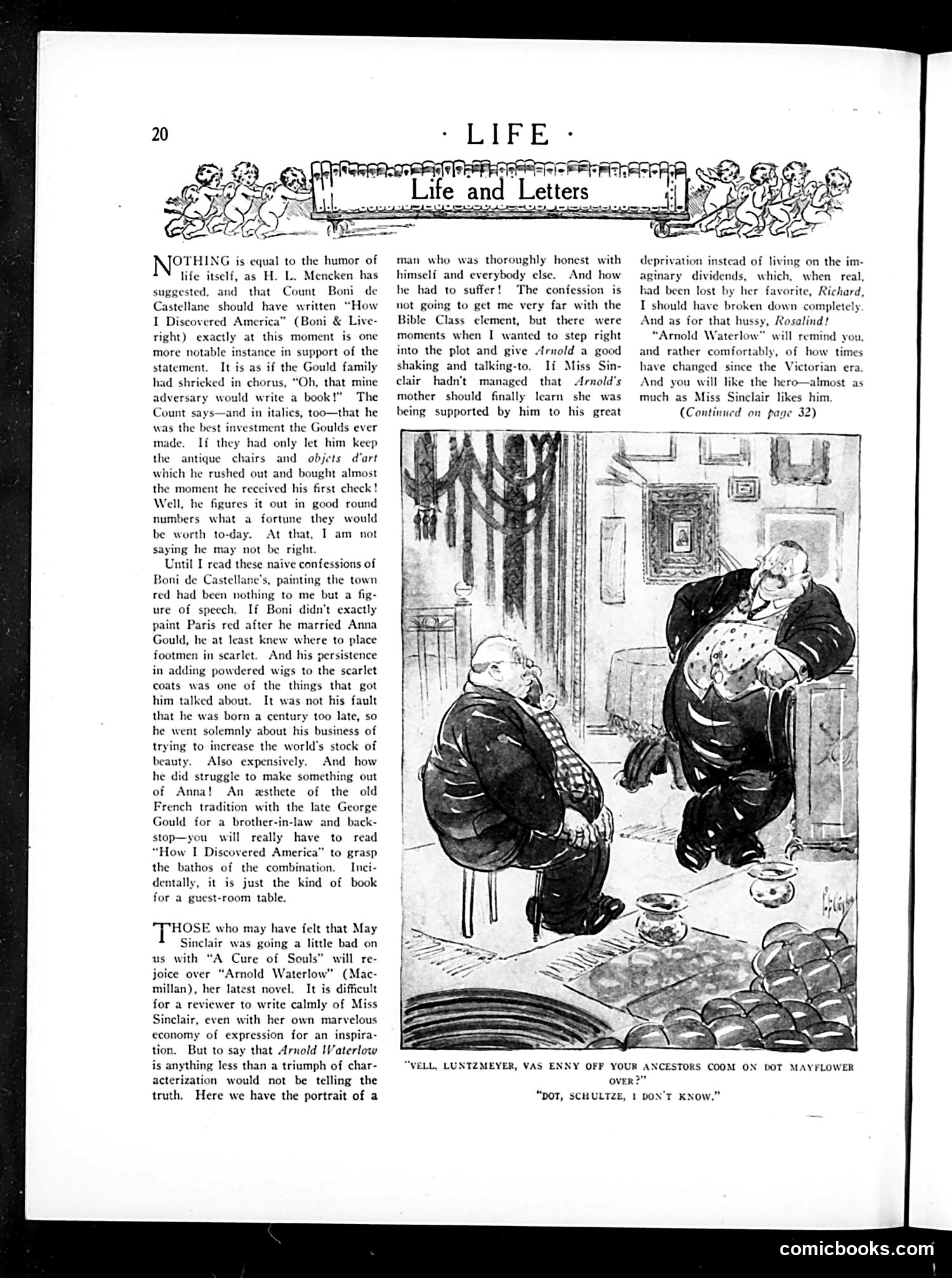
This page reviews two books while satirizing their subjects. The main text criticizes Count Boni de Castellane, a French aristocrat who married American heiress Anna Gould (daughter of railroad magnate Jay Gould). The satire mocks Castellane's memoir "How I Discovered America," ridiculing his extravagant spending on French aesthetic pursuits—scarlet-livered footmen, powdered wigs—after marrying into the Gould fortune. The reviewer suggests his lavish lifestyle was the family's best "investment" precisely because it was so wasteful. The cartoon below depicts two working-class immigrant men (suggested by their German-accented dialect) discussing ancestry. One asks if the other's ancestors came on the Mayflower; the response "I don't know" humorously reflects the reality that most Americans—particularly immigrants—had no such prestigious colonial ancestry. This mocks pretensions about American genealogy and social status.
📄 Transcribed text from this page (OCR, searchable)
Machine-transcribed from the original scan — historical spelling and the odd misread are preserved.
t. hao a NOTHING is equal to the humor of life itself, as H. L. Mencken has suggested, and that Count Boni de Castellane should have written “How I Discovered America” (Boni & Live- right) exactly at this moment is onc more notable instance in support of the statement. It is as if the Gould family had shricked in chorus, “Oh, that mine adversary would write a book!” The Count says—and in italics, too—that he was the best investment the Goulds ever made. If they had only let him keep the antique chairs and objets d'art which he rushed out and bought almost the moment he received his first check ! Well, he figures it out in good round numbers what a fortune they would be worth to-day. At that, 1 am not saying he may not be right. Until I read these naive confessions of 3oni de Castellane’s, painting the town red had been nothing to me but a fig- ure of specch. If Boni didn’t exactly paint Paris red after he married Anna Gould, he at least knew where to place footmen in scarlet. And his persistence in adding powdered wigs to the scarlet coats was one of the things that got him talked about. It was not his fault that he was born a century too late, so he went solemnly about his business of trying to increase the world’s stock of beauty. Also expensively. And how he did struggle to make something out of Anna! An asthete of the old French tradition with the late George Gould for a brother-in-law and back- stop—you will really have to read “How I Discovered America” to grasp the bathos of the combination, — Inci- dentally, it is just the kind of book for a guest-room table. HOSE who may have felt that May Sinclair was going a little bad on us with “A Cure of Souls” will re- joice over “Arnold Waterlow” (Mac- millan), her latest novel. It is difficult for a reviewer to write calmly of Miss Sinclair, even with her own marvelous economy of expression for an inspira- tion. But to say that Arnold Waterlow is anything less than a triumph of char- acterization would not be telling the truth, Here we have the portrait of a man who was thoroughly honest with himself and everybody else. And how he had to suffer! The confession is not going to get me very far with the Bible Class clement, but there were moments when I wanted to step right into the plot and give Arnold a good shaking and talking-to. If Miss Sin- clair hadn't managed that Arnold's mother should finally learn she was being supported by him to his great deprivation instead of living on the im- aginary dividends, which, when real, had been lost by her favorite, Richard, I should have broken down completely And as for that hussy, Rosalind! Arnold Waterlow” will remind you, and rather comfortably, of how times have changed since the Victorian era. And you will like the hero—almost as much as Miss Sinclair likes him. (Continued on page 32) ae —)] “VELL, LUNTZMEYER, VAS ENNY OFF YOUR ANCESTORS COOM ON DOT MAYFLOWER OVER?) “DOT, SCHULTZE, | DON'T KNow.” comicbooks.com