
Life, 1924-11-27 · page 16 of 37
Life — November 27, 1924 — page 16: what you’re looking at
What you’re looking at
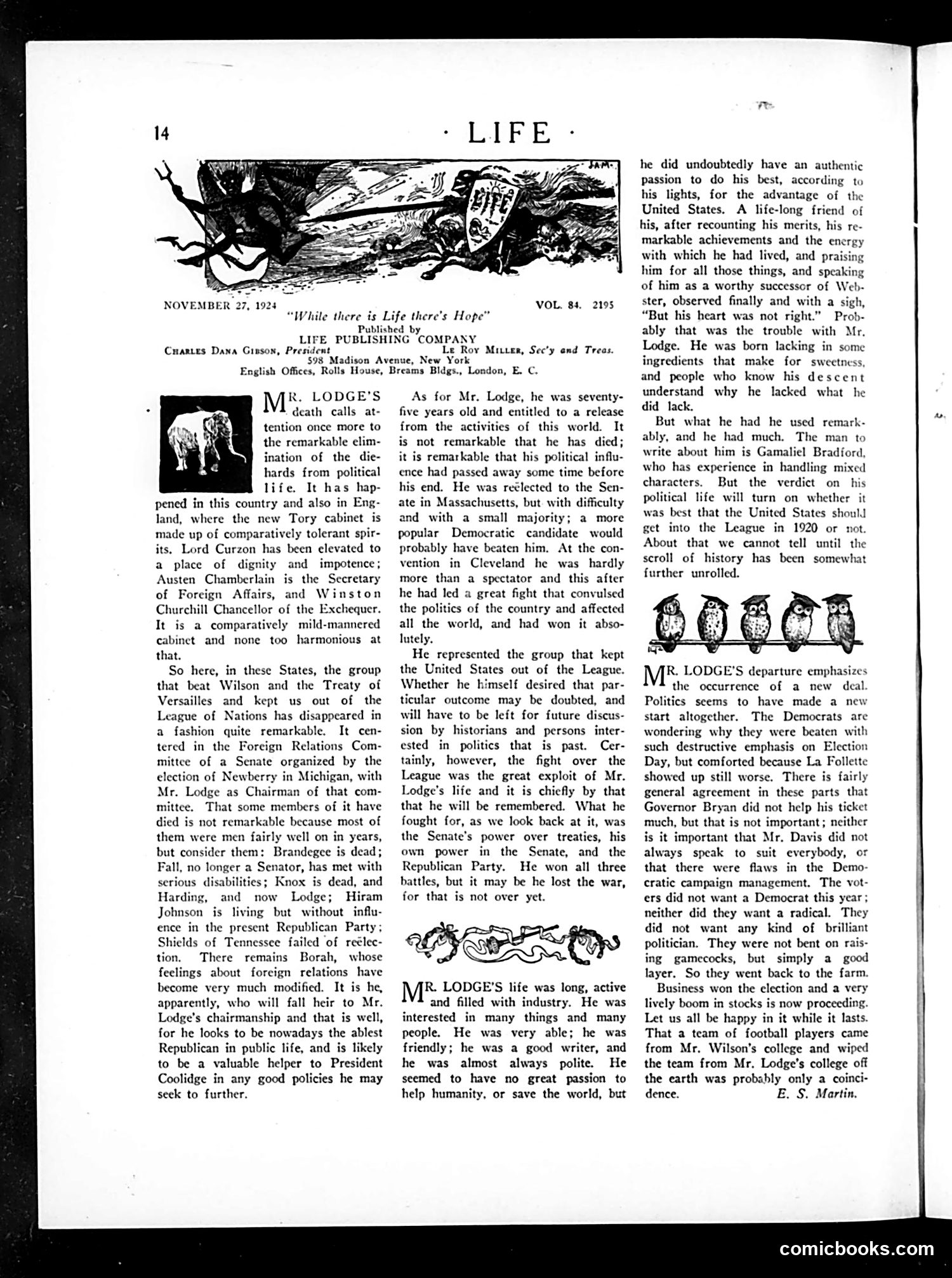
This page commemorates **Henry Cabot Lodge's death** at age seventy-three. Lodge was a prominent Republican senator and political figure who opposed U.S. entry into the League of Nations—a major issue of the era. The article praises Lodge's long political career while noting his "heart was not right" regarding humanitarian causes. It credits him with keeping America out of the League and winning Senate battles, though questions remain about whether this was ultimately correct. The small illustrations at bottom appear to show figures representing different political positions or outcomes of Lodge's career. The piece observes that despite Democrats' hopes, Lodge's departure made them wonder about emerging Democratic political divisions, ultimately won by "Business" (the Republican candidate).
📄 Transcribed text from this page (OCR, searchable)
Machine-transcribed from the original scan — historical spelling and the odd misread are preserved.
NOVEMBER 27, 1924 VOL. 84. 2195 “While there is Life there’s Hope” Published by LIFE PUBLISHING COMPANY Cuantes Dana Gipson, President Le Rov Mirter, Sec’y and Treas. $98 Madison Avenue, New York English Offices, Rolls House, Breams Bldgs., London, E. C. R. LODGE'S death calls at- tention once more to the remarkable elim- ination of the die- hards from political life. It has hap- pened in this country and also in Eng- land, where the new Tory cabinet is made up of comparatively tolerant spir- its. Lord Curzon has been elevated to a place of dignity and impotence; Austen Chamberlain is the Secretary of Foreign Affairs, and Winston Churchill Chancellor of the Exchequer. It is a comparatively mild-mannered cabinet and none too harmonious at that. So here, in these States, the group that beat Wilson and the Treaty of Versailles and kept us out of the League of Nations has disappeared in a fashion quite remarkable. It cen- tered in the Foreign Relations Com- mittee of a Senate organized by the election of Newberry in Michigan, with Mr. Lodge as Chairman of that com- mittee. That some members of it have died is not remarkable because most of them were men fairly well on in years, but consider them: Brandegee is dead; Fall, no longer a Senator, has met with serious disabilities; Knox is dead, and Harding, and now Lodge; Hiram Johnson is living but without influ- ence in the present Republican Party; Shields of Tennessee failed of reélec- tion, There remains Borah, whose feelings about foreign relations have become very much modified. It is he, apparently, who will fall heir to Mr. Lodge's chairmanship and that is well, for he looks to be nowadays the ablest Republican in public life, and is likely to be a valuable helper to President Coolidge in any good policies he may seek to further. As for Mr. Lodge, he was seventy- five years old and entitled to a release from the activities of this world. It is not remarkable that he has died; it is remarkable that his political influ- ence had passed away some time before his end. He was reélected to the Sen- ate in Massachusetts, but with difficulty and with a small majority; a more popular Democratic candidate would probably have beaten him. At the con- vention in Cleveland he was hardly more than a spectator and this after he had led a great fight that convulsed the politics of the country and affected all the world, and had won it abso- lutely. He represented the group that kept the United States out of the League. Whether he himself desired that par- ticular outcome may be doubted, and will have to be left for future discus- sion by historians and persons inter- ested in politics that is past. Cer- tainly, however, the fight over the League was the great exploit of Mr. Lodge's life and it is chiefly by that that he will be remembered. What he fought for, as we look back at it, was the Senate's power over treaties, his own power in the Senate, and the Republican Party. He won all three battles, but it may be he lost the war, for that is not over yet. R. LODGE'S life was long, active and filled with industry. He was interested in many things and many people. He was very able; he was friendly; he was a good writer, and he was almost always polite. He seemed to have no great passion to help humanity, or save the world, but he did undoubtedly have an authentic passion to do his best, according to his lights, for the advantage of the United States. A life-long friend of his, after recounting his merits, his re- markable achievements and the energy with which he had lived, and praisin him for all those things, and speaking of him as a worthy successor of V ster, observed finally and with a sigh “But his heart was not right.” Prob- ably that was the trouble with Mr, Lodge. He was born lacking in some ingredients that make for sweetness, and people who know his descent understand why he lacked what he did lack. But what he had he used remark- ably, and he had much. The man to write about him is Gamaliel Bradford, who has experience in handling mixed characters. But the verdict on his political life will turn on whether it was best that the United States should get into the League in 1920 or not. About that we cannot tell until the scroll of history has been somewhat further unrolled. R. LODGE’S departure emphasizes the occurrence of a new deal. Politics seems to have made a new start altogether. The Democrats are wondering why they were beaten with such destructive emphasis on Election Day, but comforted because La Follette showed up still worse. There is fairly general agreement in these parts that Governor Bryan did not help his ticket much, but that is not important; neither is it important that Mr. Davis did not always speak to suit everybody, or that there were fiaws in the Demo- cratic campaign management. The vot- ers did not want a Democrat this year; neither did they want a radical. They did not want any kind of brilliant politician. They were not bent on rais- ing gamecocks, but simply a good layer. So they went back to the farm. Business won the clection and a very lively boom in stocks is now proceeding. Let us all be happy in it while it lasts. That a team of football players came from Mr. Wilson’s college and wiped the team from Mr. Lodge’s college off the earth was probably only a coinci- dence. E, S. Martin. comicbooks.com