
Life, 1924-11-27 · page 20 of 37
Life — November 27, 1924 — page 20: what you’re looking at
What you’re looking at
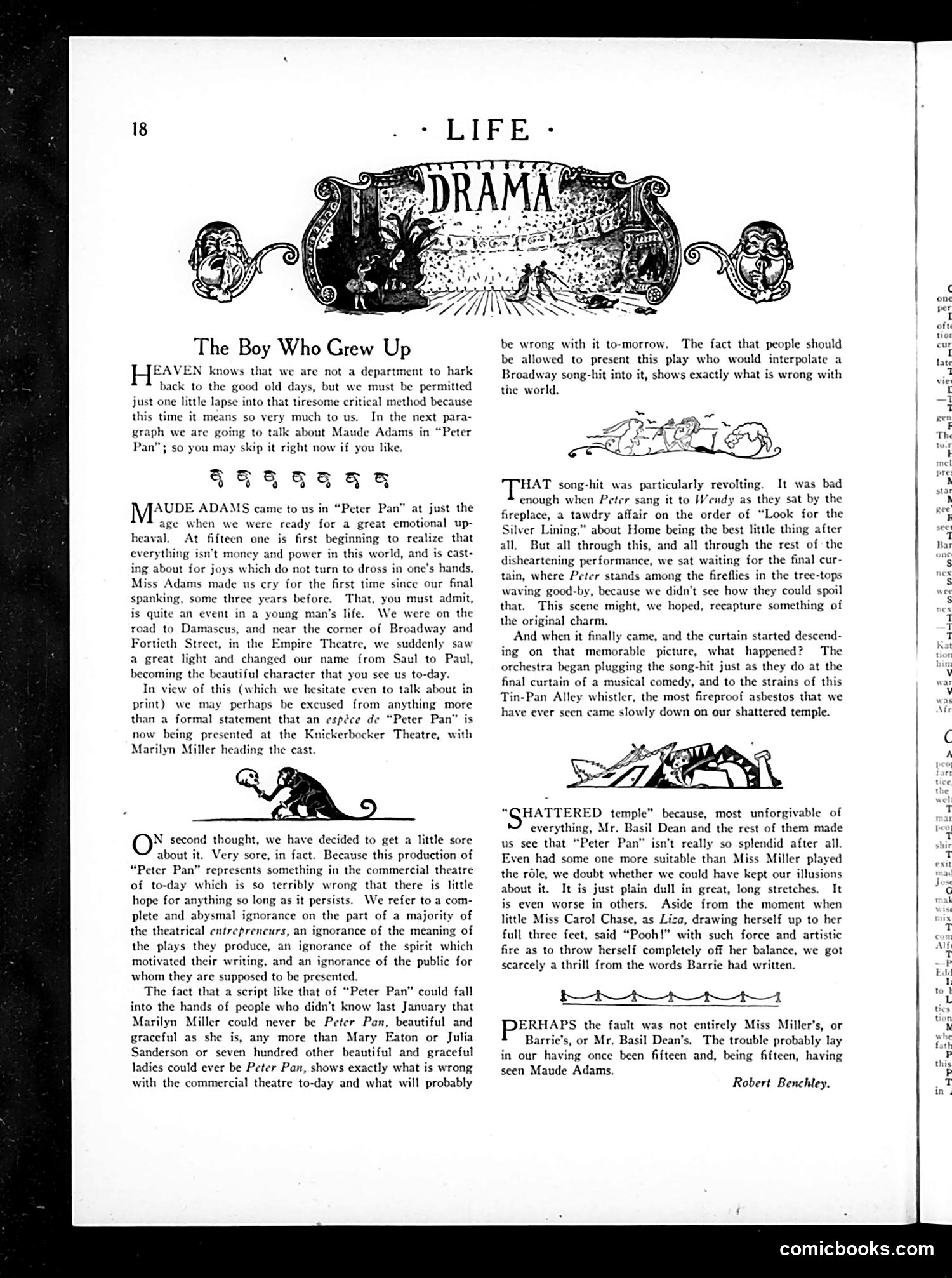
This is a theater review criticizing a 1920s production of *Peter Pan* at the Knickerbocker Theatre, starring Marilyn Miller, directed by Basil Dean. The author nostalgically recalls seeing Maude Adams in the original *Peter Pan*, which deeply moved him emotionally as a teenager. However, he's furious that the new production—despite Miller's beauty and grace—fundamentally misunderstands the play's spiritual meaning. The specific offense: inserting a Broadway "song-hit" (a popular commercial tune like "Look for the Silver Lining") into the sacred final scene where Peter bids farewell among the fireflies. This represents everything wrong with contemporary commercial theatre—producers ignorant of a script's true meaning, prioritizing commercial appeal over artistic integrity. The satire targets theatrical entrepreneurs who treat serious plays as vehicles for profit-driven spectacle, destroying the original work's "charm" and emotional power.
📄 Transcribed text from this page (OCR, searchable)
Machine-transcribed from the original scan — historical spelling and the odd misread are preserved.
The Boy Who Grew Up EAVEN knows that we are not a department to hark back to the good old days, but we must be permitted just one little lapse into that tiresome critical method because this time it means so very much to us. In the next para- graph we are going to talk about Maude Adams in “Peter Pan”; so you may skip it right now if you like. SSRSSRS UDE ADAMS came to us in “Peter Pan” at just the ge when we were ready for a great emotional up- heaval. At fifteen one is first beginning to realize that everything isn’t money and power in this world, and is cast- ing about for joys which do not turn to dross in one’s hands. Miss Adams made us cry for the first time since our final spanking, some three years before. That, you must admit, is quite an event in a young man’s life. We were on the road to Damascus, and near the corner of Broadway and Forticth Street, in the Empire Theatre, we suddenly saw a great light and changed our name from Saul to Paul, becoming the beautiful character that you see us to-day. In view of this (which we hesitate even to talk about in print) we may perhaps be excused from anything more than a formal statement that an espéce de “Peter Pan” is now being presented at the Knickerbocker Theatre, with Marilyn Miller heading the cast. D N second thought, we have decided to get a little sore about it. V sore, in fact. Because this production of “Peter Pan" represents something in the commercial theatre of to-day which is so terribly wrong that there is little hope for anything so long as it persists. We refer to a com- plete and abysmal ignorance on the part of a majority of the theatrical entrepreneurs, an ignorance of the meaning of the plays they produce, an ignorance of the spirit which motivated their writing, and an ignorance of the public for whom they are supposed to be presented. The fact that a script like that of “Peter Pan” could fall into the hands of people who didn’t know last January that Marilyn Miller could never be Peter Pan, beautiful and graceful as she is, any more than Mary Eaton or Julia Sanderson or seven hundred other beautiful and graceful ladies could ever be Peter Pan, shows exactly what is wrong with the commercial theatre to-day and what will probably be wrong with it to-morrow. The fact that people should be allowed to present this play who would interpolate a Broadway song-hit into it, shows exactly what is wrong with the world. Aa oer HAT song-hit was particularly revolting. It was bad enough when Peter sang it to Wendy as they sat by the fireplace, a tawdry affair on the order of “Look for the Silver Lining,” about Home being the best little thing after all. But all through this, and all through the rest of the disheartening performance, we sat waiting for the final cur- tain, where Peter stands among the fireflies in the tree-tops waving good-by, because we didn’t see how they could spoil that. This scene might, we hoped, recapture something of the original charm. And when it finally came, and the curtain started descend- ing on that memorable picture, what happened? The orchestra began plugging the song-hit just as they do at the final curtain of a musical comedy, and to the strains of this Tin-Pan Alley whistler, the most fireproof asbestos that we have ever seen came slowly down on our shattered temple. “GHATTER =D temple” because, most unforgivable of everything, Mr. Basil Dean and the rest of them made us see that “Peter Pan” isn’t really so splendid after all. Even had some one more suitable than Miss Miller played the rdle, we doubt whether we could have kept our illusions about it. It is just plain dull in great, long stretches. It is even worse in others. Aside from the moment when little Miss Carol Chase, as Liza, drawing herself up to her full three feet, said “Pooh!” with such force and artistic fire as to throw herself completely off her balance, we got scarcely a thrill from the words Barrie had written. ERHAPS the fault was not entirely Miss Miller’s, or Barrie's, or Mr. Basil Dean's, The trouble probably lay in our having once been fifteen and, being fifteen, having seen Maude Adams. Robert Benchley. comicbooks.com