
Life, 1924-11-27 · page 26 of 37
Life — November 27, 1924 — page 26: what you’re looking at
What you’re looking at
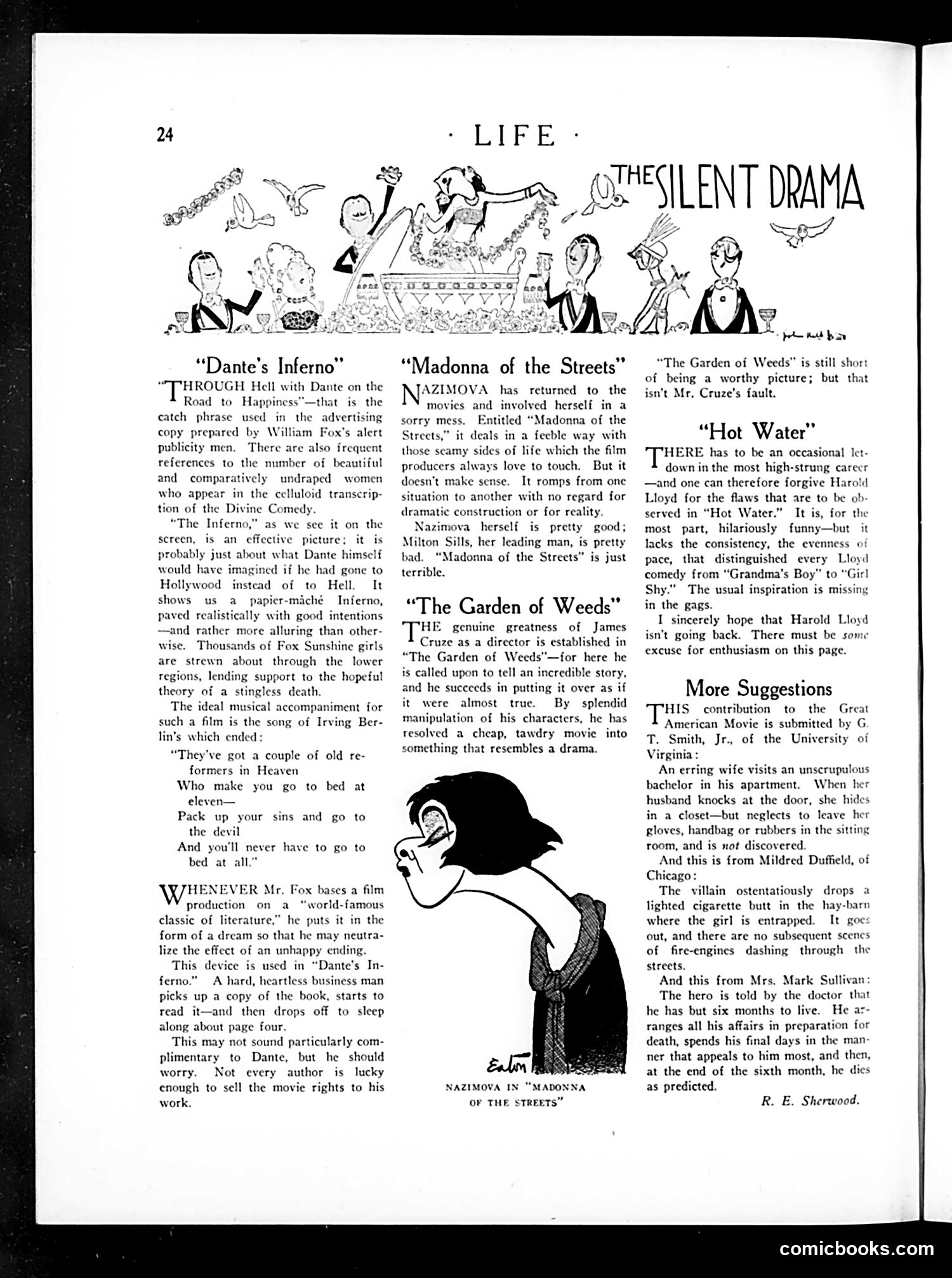
This page reviews four silent films from the early 1920s. The satire targets both the films themselves and Hollywood's approach to adapting classic literature. **"Dante's Inferno"** is mocked for William Fox's vulgar adaptation: the reviewer notes Fox has replaced Dante's actual Hell with a "papier-mâché Inferno" populated by "thousands of Fox Sunshine girls"—the studio's contract actresses—to make damnation seem appealing. The joke is that Hollywood has turned serious religious literature into cheesecake spectacle. **"Madonna of the Streets"** and **"The Garden of Weeds"** receive straightforward negative and positive reviews respectively. **"Hot Water"** critiques Harold Lloyd's latest comedy for lacking the consistent quality of his previous hits. The **"More Suggestions"** section parodies common plot holes in silent films—absurd contrivances where characters fail to notice obvious evidence (a wife's belongings, a dropped cigarette). The cartoon header depicts chaotic film production, satirizing Hollywood's sensationalism and disorder. The overall tone mocks both studios' commercialism and audiences' appetite for sensation over artistry.
📄 Transcribed text from this page (OCR, searchable)
Machine-transcribed from the original scan — historical spelling and the odd misread are preserved.
“Dante's Inferno” ““THROUGH Hell with Dante on the Road to Happiness"—that is the catch phrase used in the advertising copy prepared by William Fox's alert publicity men. There are also frequent references to the number of beautiful and comparatively undraped women who appear in the celluloid transcrip- tion of the Divine Comedy. “The Inferno,” as we see it on the screen, is an effective picture; it is probably just about what Dante himself would have imagined if he had gone to Hollywood instead of to Hell. It shows us a_ papier-maché Inferno, paved realistically with good intentions —and rather more alluring than other- wise. Thousands of Fox Sunshine girls are strewn about through the lower regions, lending support to the hopeful theory of a stingless death. The ideal musical accompaniment for such a film is the song of Irving Ber- lin’s which ended : “They've got a couple of old re- formers in Heaven Who make you go eleven— Pack up your the devil And you'll never have to go to bed at all.” to bed at sins and go to HENEVER Mr. Fox bases a film production on a classic of literature,” he puts it in the form of a dream so that he may neutra- lize the effect of an unhappy ending. This device is used in “Dante's In- ferno.” A hard, heartless business man picks up a copy of the book, starts to read it—and then drops off to sleep along about page four. This may not sound particularly com- plimentary to Dante, but he should worry. Not every author is lucky enough to sell the movie rights to his work. “world-famous LEP, - _SESSLENTD bi AD? “Madonna of the Streets” AZIMOVA has returned to the movies and involved herself in a sorry mess. Entitled “Madonna of the Streets,” it deals in a feeble way with those seamy sides of life which the film producers always love to touch. But it doesn’t make sense. It romps from one situation to another with no regard for dramatic construction or for reality. Nazimova herself is pretty good; Milton Sills, her leading man, is pretty bad, “Madonna of the Streets” is just terrible. “The Garden of Weeds” HE genuine greatness of James Cruze as a director is established in “The Garden of Weeds"—for here he is called upon to tell an incredible story, and he succeeds in putting it over as if it were almost true. By splendid manipulation of his characters, he has resolved a cheap, tawdry movie into something that resembles a drama. Rata a m6 ff 7 Ts pte Beth by ae “The Garden of Weeds” is still short of being a worthy picture; but that isn’t Mr. Cruze’s fault. “Hot Water” HERE has to be an occasional Iet- down inthe most high-strung career —and one can therefore forgive Harold Lloyd for the flaws that are to be ob- served in “Hot Water.” It is, for the most part, hilariously funny—but it lacks the consistency, the evenness of pace, that distinguished every Lloyd comedy from “Grandma's Boy” to “Girl Shy.” The usual inspiration is missing in the gags. I sincerely hope that Harold Lloyd isn’t going back. There must be some excuse for enthusiasm on this page. More Suggestions HIS contribution to the Great American Movie is submitted by G T. Smith, Jr., of the University of Virginia: An erring wife visits an unscrupulous bachelor in his apartment. When her husband knocks at the door, she hides in a closet—but neglects to leave her gloves, handbag or rubbers in the sitting room, and is not discovered. And this is from Mildred Duffield, of Chicago: The villain ostentatiously drops a lighted cigarette butt in the hay-barn where the girl is entrapped. It goe out, and there are no subsequent scenes of fire-engines dashing through the streets. And this from Mrs. Mark Sullivan: The hero is told by the doctor that he has but six months to live. He az- ranges all his affairs in preparation for death, spends his final days in the man- ner that appeals to him most, and then, at the end of the sixth month, he dies as predicted. R. E. Sherwood. comicbooks.com