
A complete issue · 40 pages · 1924
Life — November 20, 1924
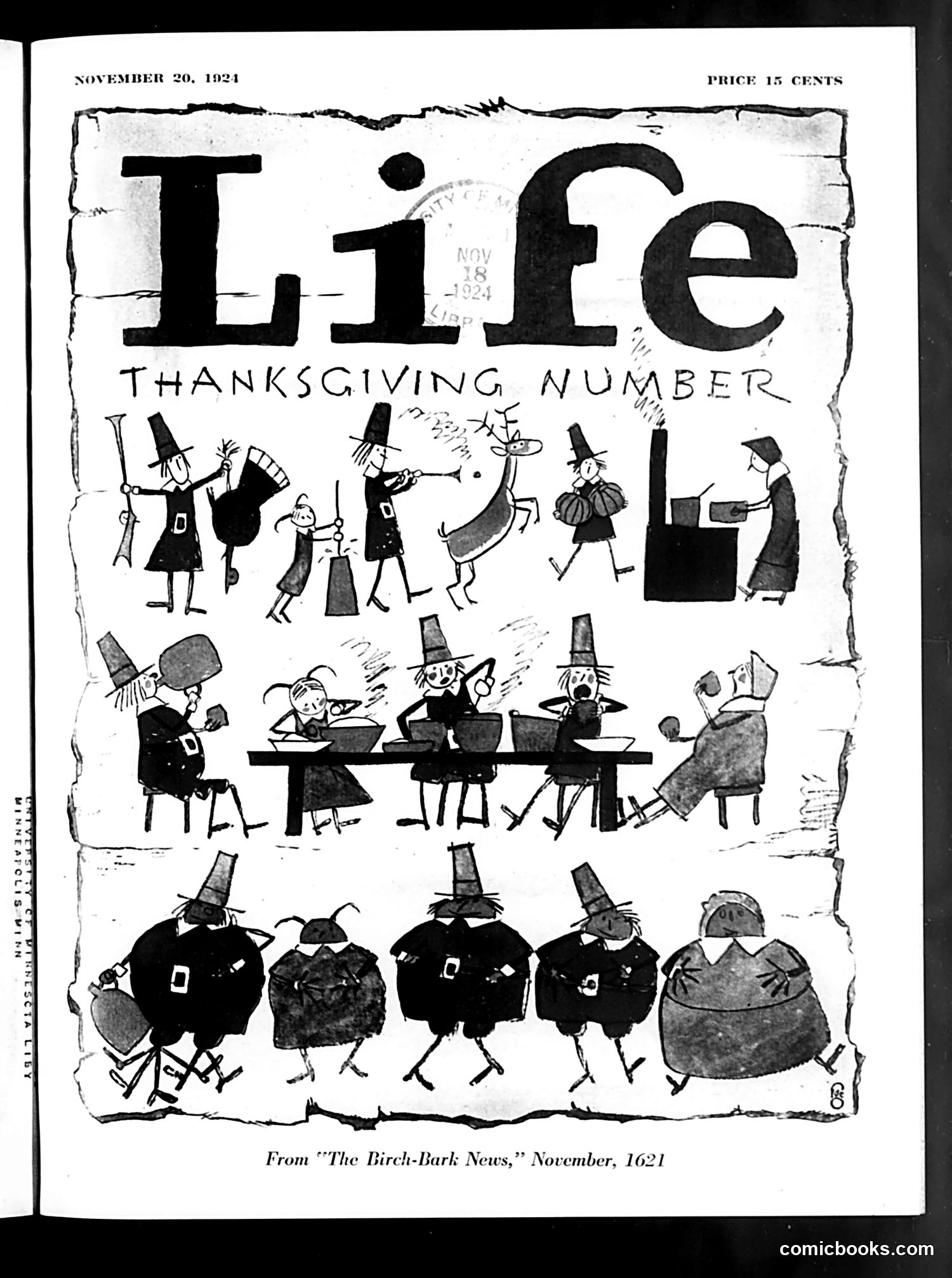
This is the cover of Life's "Thanksgiving Number," featuring whimsical illustrations of Pilgrims and Native Americans celebrating together. The imagery depicts the traditional Thanksgiving narrative: Pilgrims in buckled hats and period dress, along with figures in Native American attire, sharing a feast and preparing food. The caption credits "The Birch-Bark News, November, 1621," creating a fictional historical reference that frames Thanksgiving as a 1621 celebration—aligning with the popular origin myth of Thanksgiving. For modern readers: This reflects the holiday's sanitized historical narrative common in 1920s America, celebrating Native-Settler cooperation without acknowledging colonization's devastating effects. The romanticized imagery perpetuates a "peaceful coexistence" myth that obscures the actual history of displacement and cultural destruction.
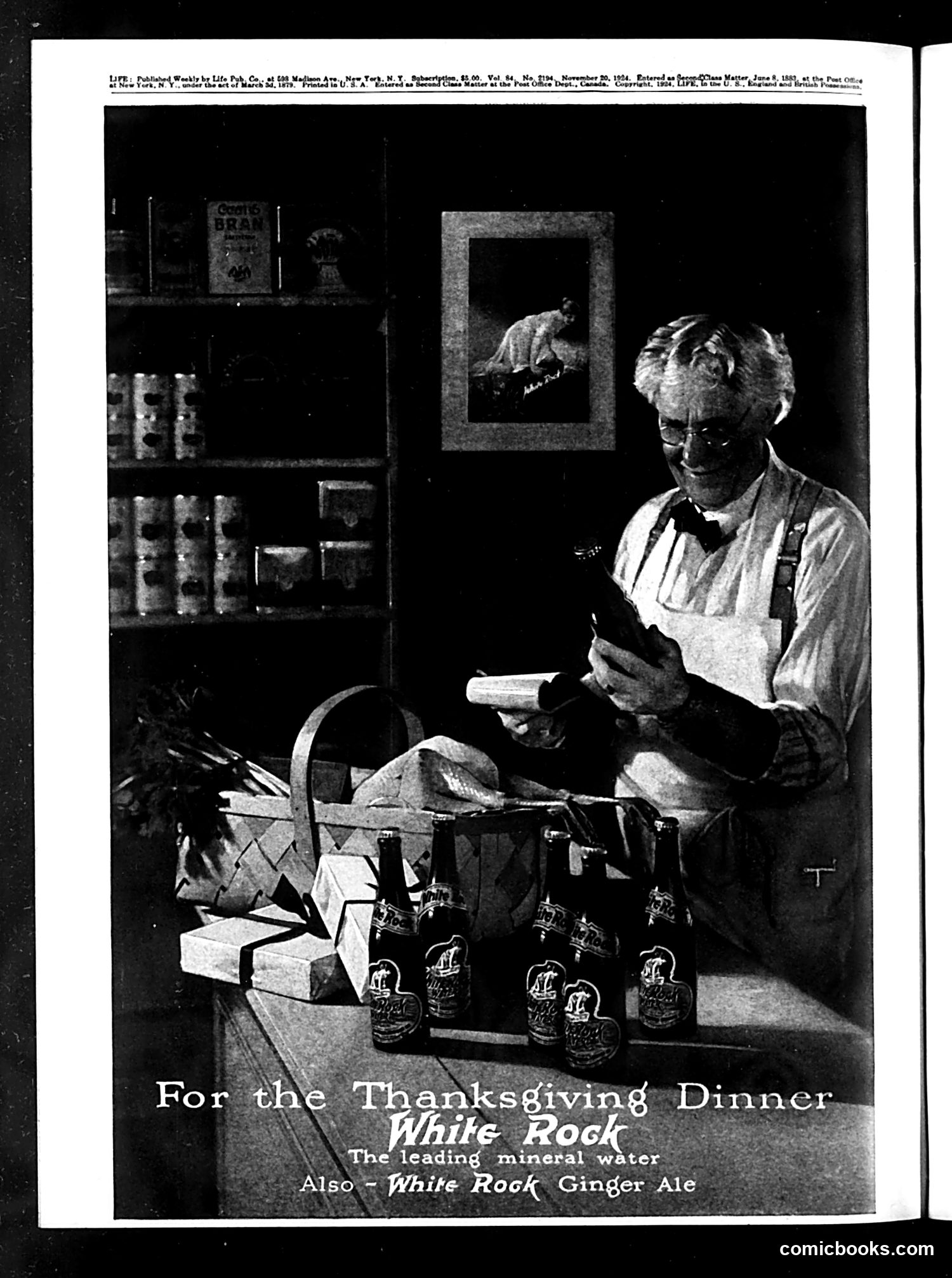
This page is primarily **advertising, not satire or political commentary**. It features a White Rock mineral water advertisement from Life magazine (dated November 28, 1924, per the header). The image shows an elderly man in an apron examining bottles of White Rock mineral water and ginger ale, with a basket of provisions visible. The setting appears to be a kitchen or pantry, with shelves and period furnishings in the background. The advertisement's message is straightforward commercial copy: promoting White Rock products as suitable beverages "for the Thanksgiving Dinner." The image uses a domestic, trustworthy figure to endorse the product to readers planning holiday meals. There is no political satire or social commentary evident—this is a conventional period advertisement.
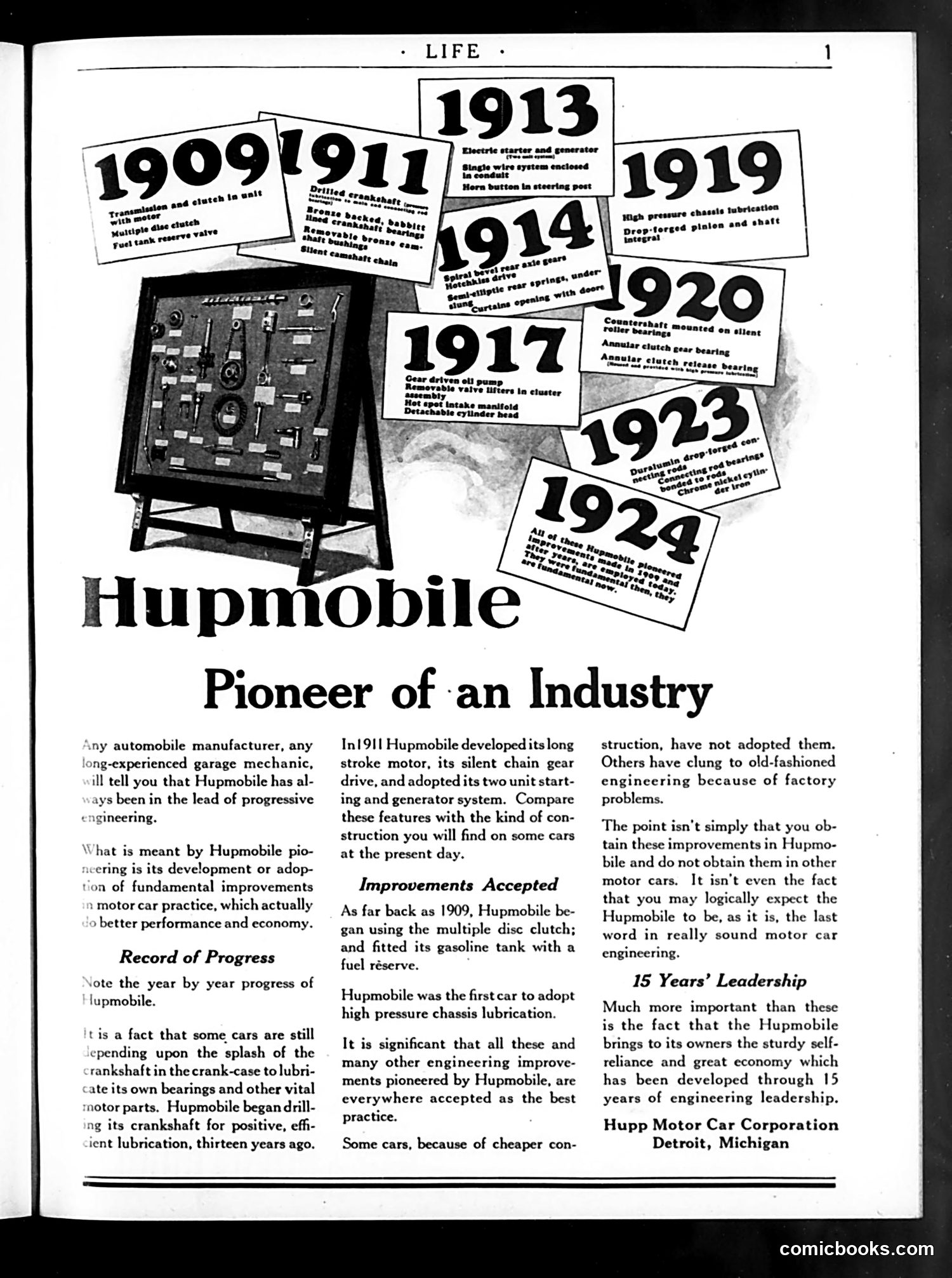
This is **not a cartoon or satire page**—it's an advertisement for Hupmobile automobiles. The page showcases the company's engineering innovations from 1909-1924, displayed as numbered boxes radiating from a technical diagram of the car's internal mechanisms. The ad's central claim is that Hupmobile was a "Pioneer of an Industry," adopting progressive features (long-stroke motors, silent chain drives, multiple disc clutches, high-pressure chassis lubrication) that competitors later copied. The text argues these weren't merely fashionable additions but genuine engineering improvements that other manufacturers eventually accepted as "best practice." The visual presentation emphasizes Hupmobile's 15-year leadership in automotive development. This is corporate marketing, not political commentary.
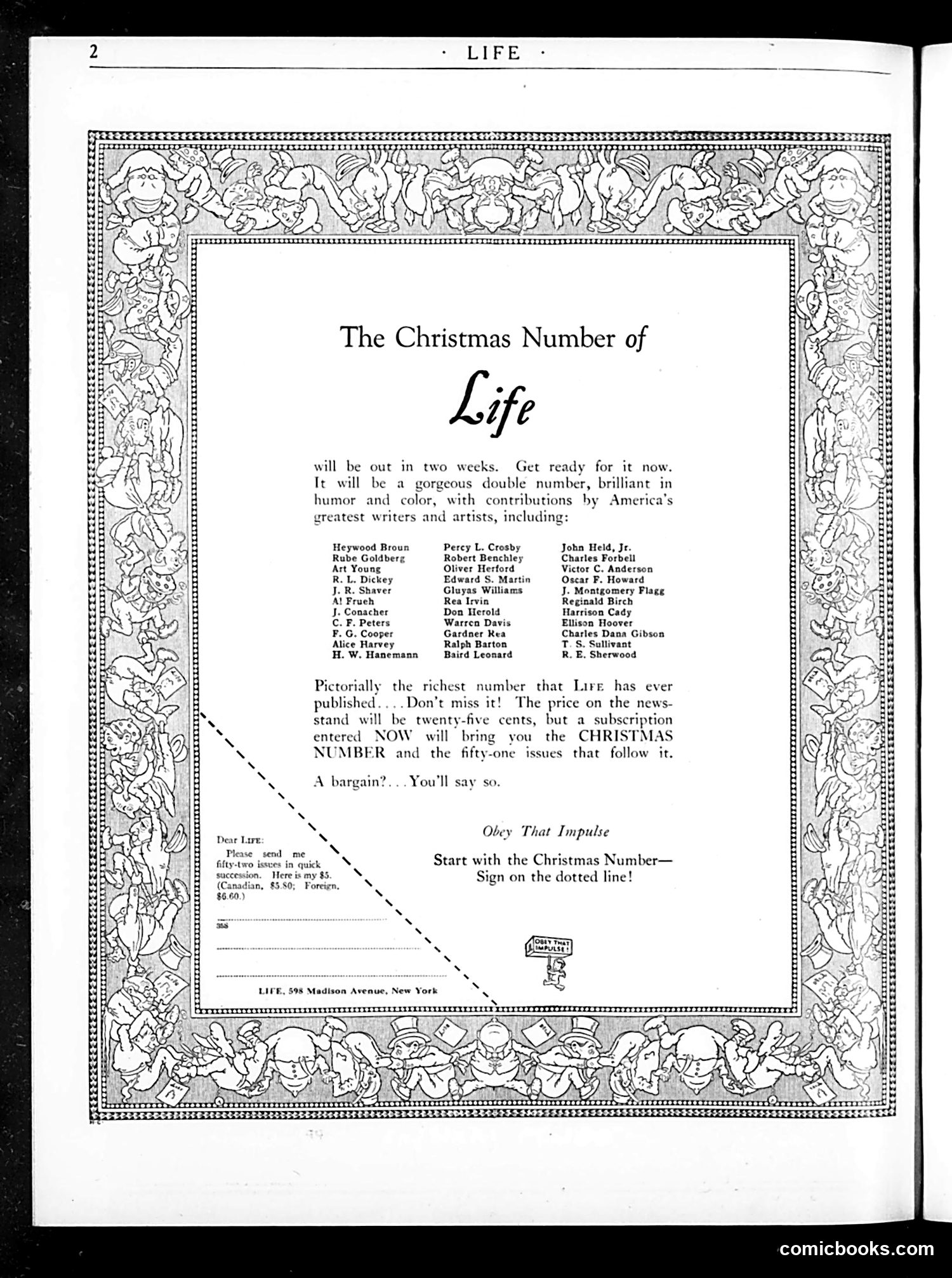
This page is primarily an **advertisement for Life magazine itself**, not a political cartoon. It announces the upcoming Christmas Number, which Life describes as "a gorgeous double number, brilliant in humor and color, with contributions by America's greatest writers and artists." The ad lists notable contributors including Heywood Broun, Art Young, Percy L. Crosby, and others—popular humorists and illustrators of the era. The decorative border features cherubs and holiday imagery appropriate to the Christmas theme. The pitch emphasizes value: newsstand price of twenty-five cents versus subscription entry offering 51 subsequent issues. The tone is lighthearted, using phrases like "A bargain?...You'll say so" to appeal to readers. This reflects Life's status as a major American humor and satire publication during this period.
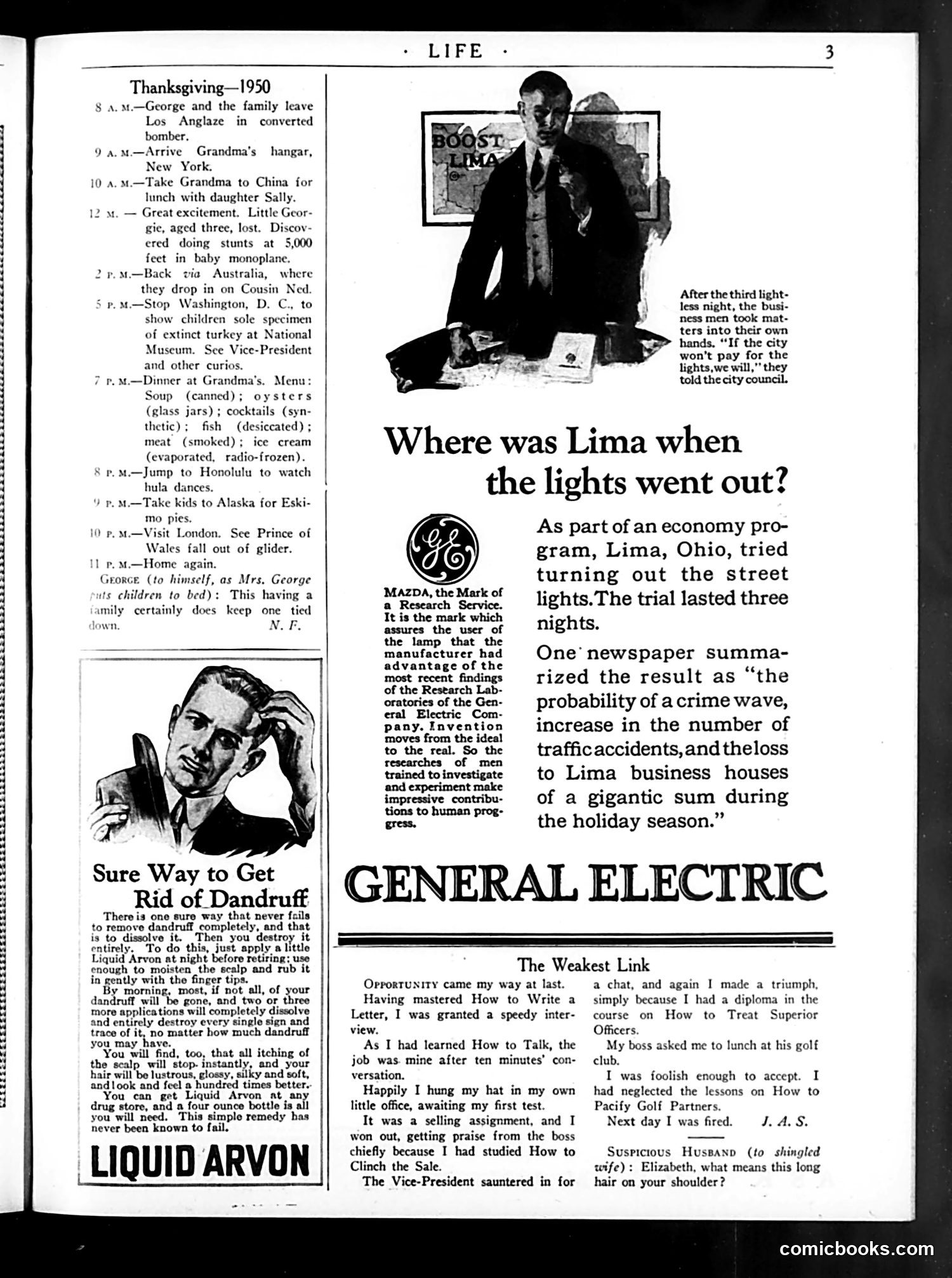
This page is primarily **advertising content** rather than political satire. The main features are: 1. **General Electric advertisement**: Satirizes Lima, Ohio's 1950 experiment turning off streetlights to save money. The ad mocks the resulting crime wave and business losses, using this as a cautionary tale to promote reliable electrical service. 2. **Liquid Arvon advertisement**: A dandruff treatment ad featuring a man's portrait, offering pseudo-scientific instructions for application. 3. **"The Weakest Link" column**: A humorous workplace anecdote about someone who learned "how to write a letter" but failed at other skills, leading to termination. The page reflects 1950 consumer culture and light office humor rather than sharp political commentary.
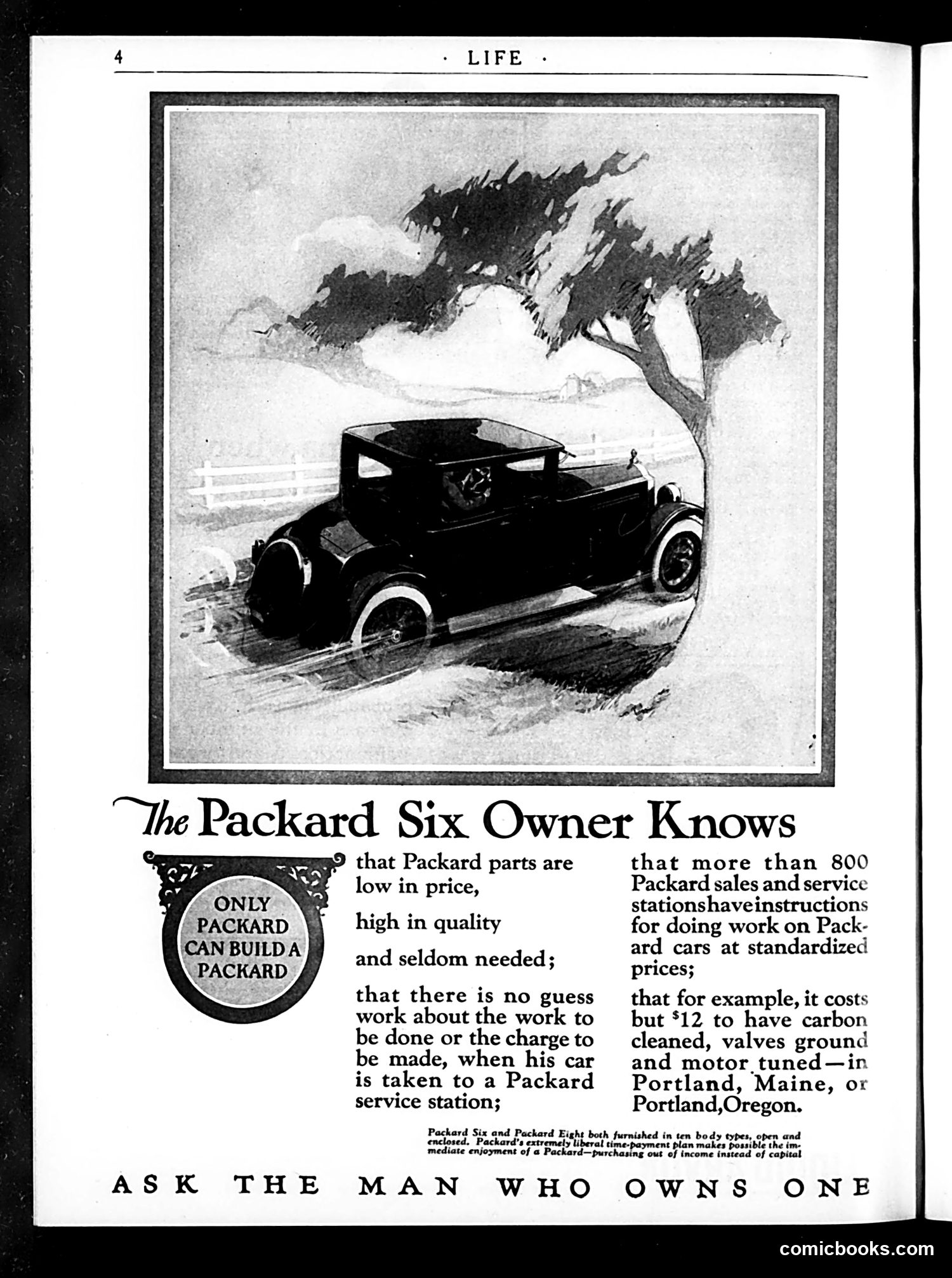
This is a **Packard automobile advertisement**, not a political cartoon. The page promotes the Packard Six luxury car to potential buyers. The image shows a black Packard automobile parked beneath a windswept tree, establishing an aspirational, scenic mood. The ad's rhetorical strategy targets existing Packard owners, claiming they understand the brand's value: parts cost less while maintaining quality, repairs involve transparent pricing, and over 800 service stations offer standardized maintenance rates. The circular seal stating "ONLY PACKARD CAN BUILD A PACKARD" emphasizes brand exclusivity and quality control. The bottom tagline—"ASK THE MAN WHO OWNS ONE"—uses testimonial marketing, suggesting satisfied customers validate the product's superiority. This was typical early-20th-century advertising targeting middle-to-upper-class automobile buyers concerned with ownership costs and reliability.
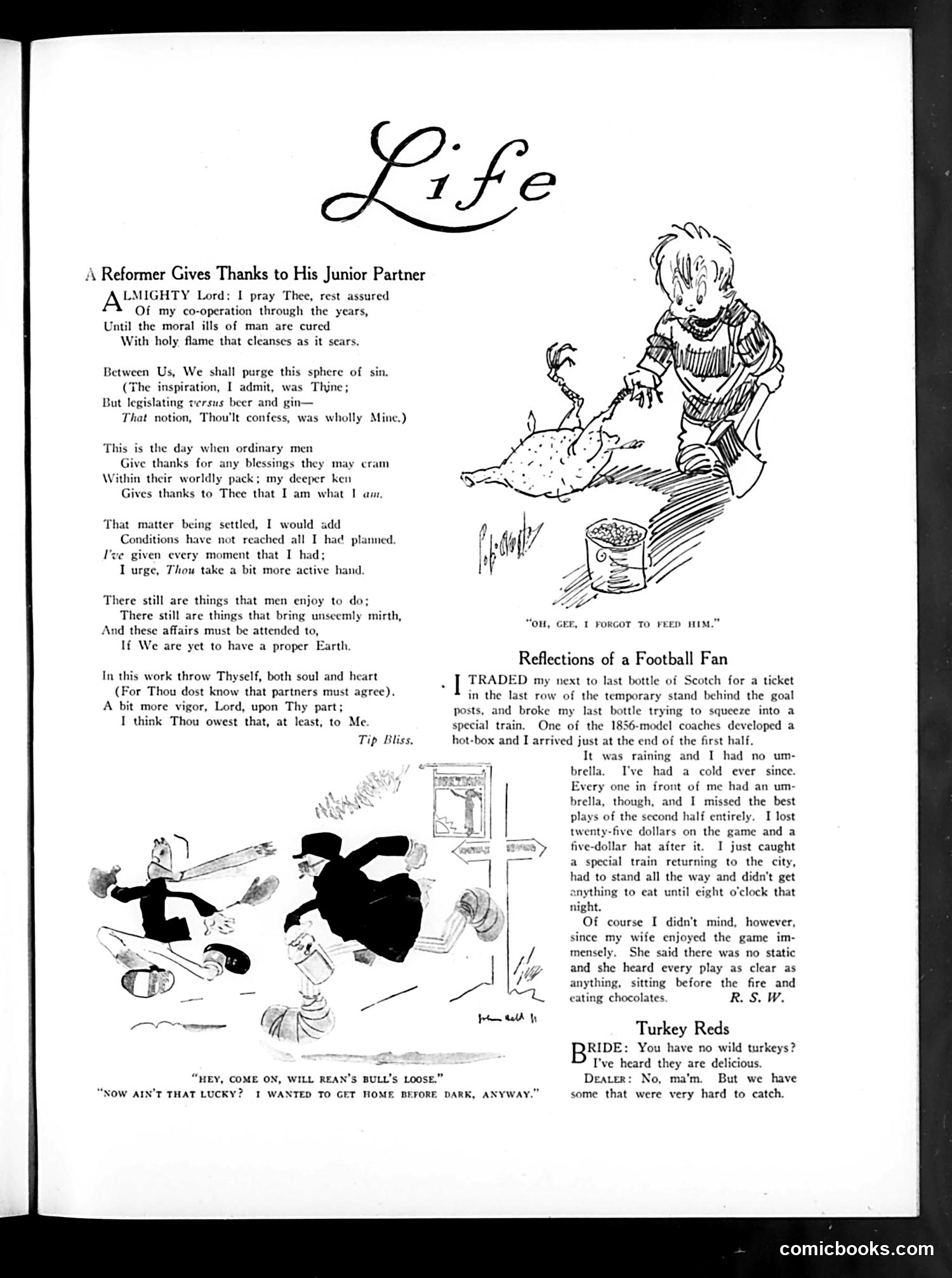
This page from *Life* magazine contains three satirical pieces: 1. **"A Reformer Gives Thanks to His Junior Partner"**: A poem where a religious reformer thanks God for help "cleansing" society of moral ills, particularly mentioning "beer and gin." The speaker admits their partner deserves credit and asks them to take more active involvement. This satirizes temperance/prohibition reformers and their self-righteousness. 2. **"Reflections of a Football Fan"**: A humorous account of a fan's miserable game-day experience—trading his liquor for a ticket, enduring rain without an umbrella, losing money, and arriving home at 8 PM starving. His wife enjoyed it more from home by the fire. This mocks the supposed glamour of attending live sports. 3. **"Turkey Reds"**: A brief comedic dialogue between a bride and dealer about wild turkeys, suggesting innocent double entendre. The cartoons accompany these pieces with visual humor.
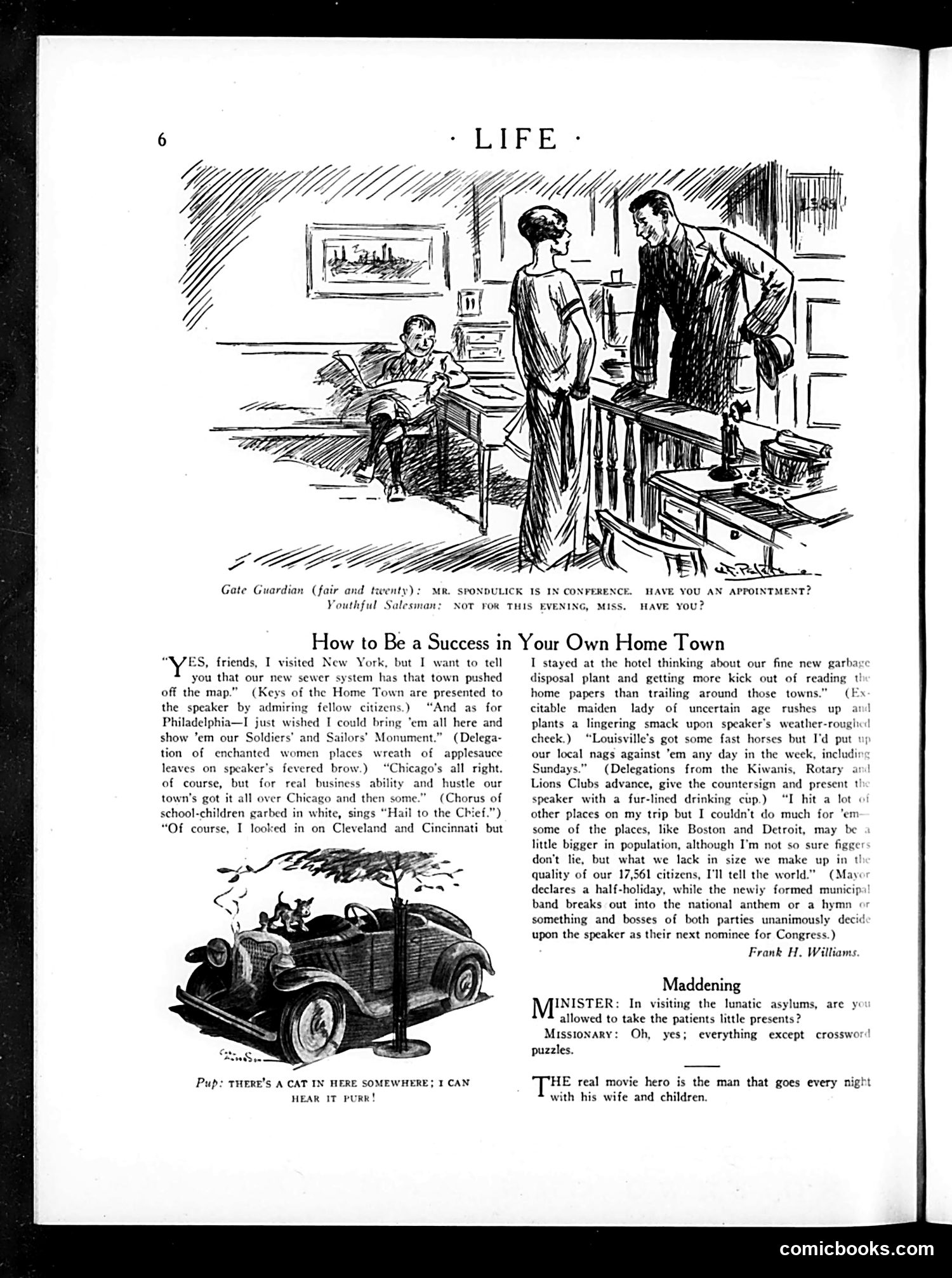
This page contains three distinct humor pieces satirizing early 20th-century American life: 1. **Top cartoon**: A gate guardian questions a visitor about an appointment with "Mr. Sponduick," satirizing the pretentious gatekeeping of wealthy households. 2. **Main article** "How to Be a Success in Your Own Home Town": The author boasts about visiting New York and various cities, ironically claiming superiority while acknowledging his small hometown's mundane qualities (17,561 citizens). The satire mocks provincial pride and self-deception about local importance. 3. **Bottom cartoon**: A man's car has a cat hiding underneath; the joke plays on the absurdity of the situation and the man's obliviousness. The **"Maddening"** and **"Minister"** jokes at bottom are brief quips about asylums and family life, typical of the magazine's quick-hit humor format.
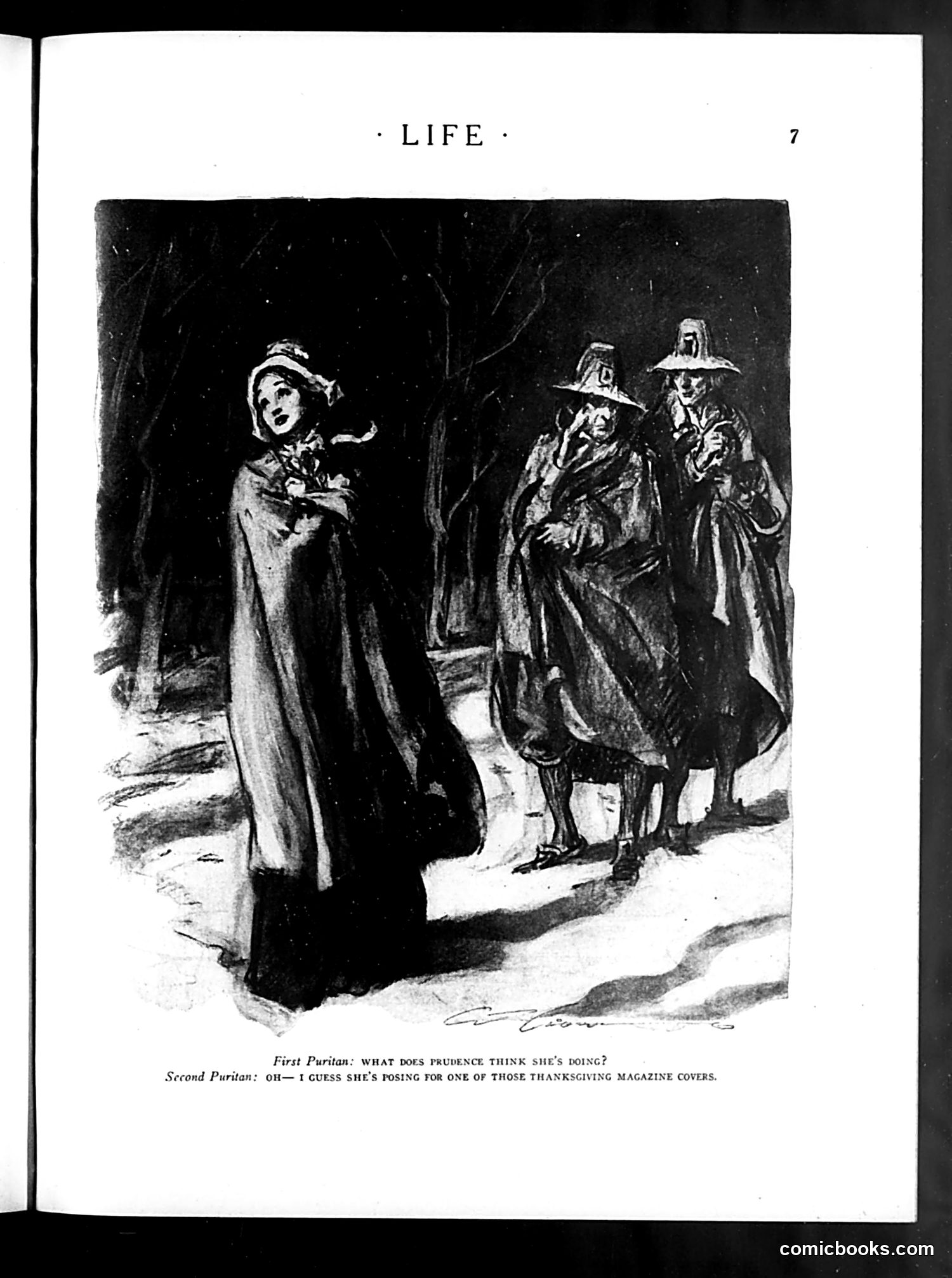
This is a satirical cartoon from *Life* magazine mocking Puritan social attitudes. The scene shows a woman in a long cape striking a dramatic pose on a snowy street, observed by three men in coats and hats. The joke, explained in the caption, contrasts two Puritan perspectives: the first wonders "what does prudence think she's doing?" while the second guesses she's "posing for one of those Thanksgiving magazine covers." The satire targets how Puritans—associated with strict morality and religiosity—were nonetheless willing to embrace theatrical, attention-seeking poses for popular media. The cartoon implies hypocrisy: the woman's dramatic stance contradicts the modesty Puritanism supposedly demands, yet she performs it for commercial purposes (magazine covers). This mocks the gap between Puritan values and their actual behavior in modern consumer culture.
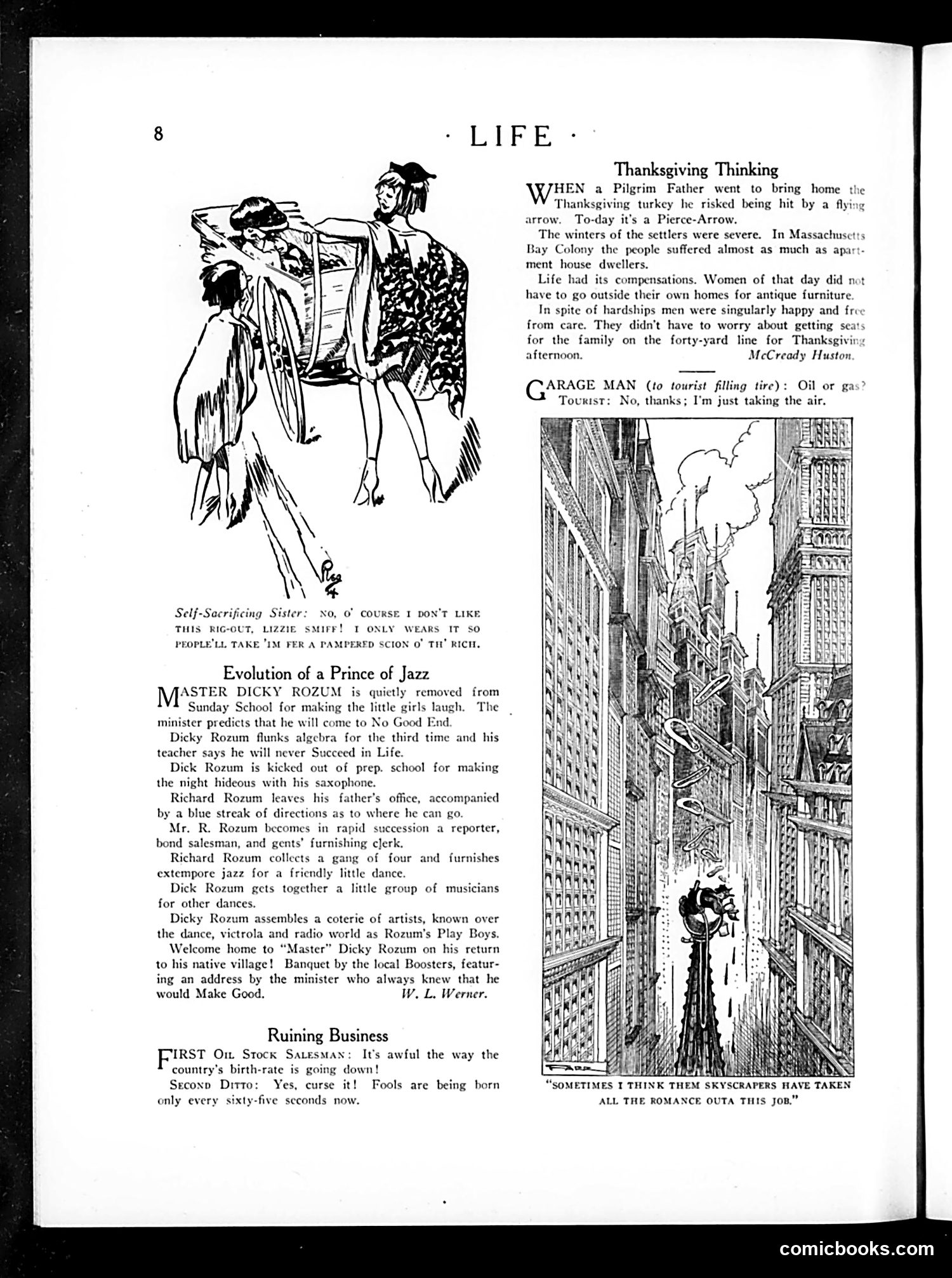
This page contains three separate satirical pieces: 1. **"Thanksgiving Thinking"** (top): A sketch mocking Pilgrims' arrival and Thanksgiving hardships. The joke contrasts historical suffering with modern men's trivial concerns about football seating. 2. **"Garage Man" dialogue**: A tourist refuses gas from a garage attendant, claiming he's "just taking the air"—satirizing the leisure class's wasteful driving habits during the automobile era. 3. **"Evolution of a Prince of Jazz"**: Traces "Master Dicky Rozum" from Sunday School student to jazz musician to nightclub performer. The satire critiques jazz culture's perceived moral degradation—a common 1920s concern about jazz corrupting youth. 4. **"Ruining Business"**: A brief joke about falling birth rates among the wealthy, contrasted with working-class fertility—reflecting contemporary anxieties about social class demographics.
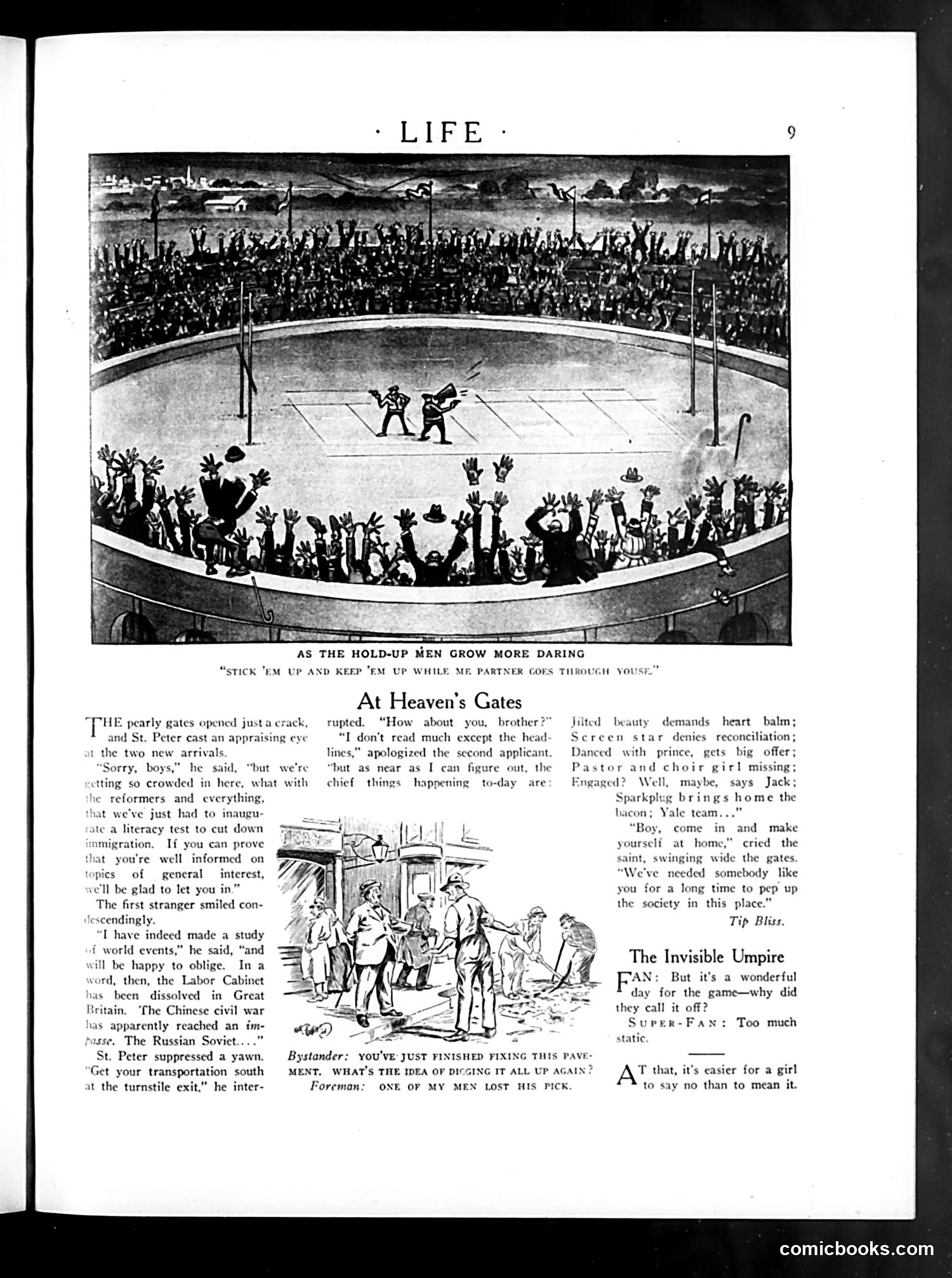
**The Top Image:** A boxing or wrestling match in a packed arena, with the caption "AS THE HOLD-UP MEN GROW MORE DARING / 'STICK 'EM UP AND KEEP 'EM UP WHILE ME PARTNER GOES THROUGH YOUSE.'" This satirizes street robbery, depicting criminals using a boxing hold as a metaphor for organized crime tactics. **"At Heaven's Gates":** A satirical dialogue where St. Peter interviews applicants at heaven's gates. The humor critiques contemporary concerns—immigration policy, labor issues, and social anxieties. References to "Chinese civil war," "Russian" matters, and "Labor Cabinet" suggest early 20th-century political debates. The piece mocks both heavenly gatekeeping and earthly bureaucratic restrictions. **Minor sections** include brief humorous quips about dating and sports ("Yale team").
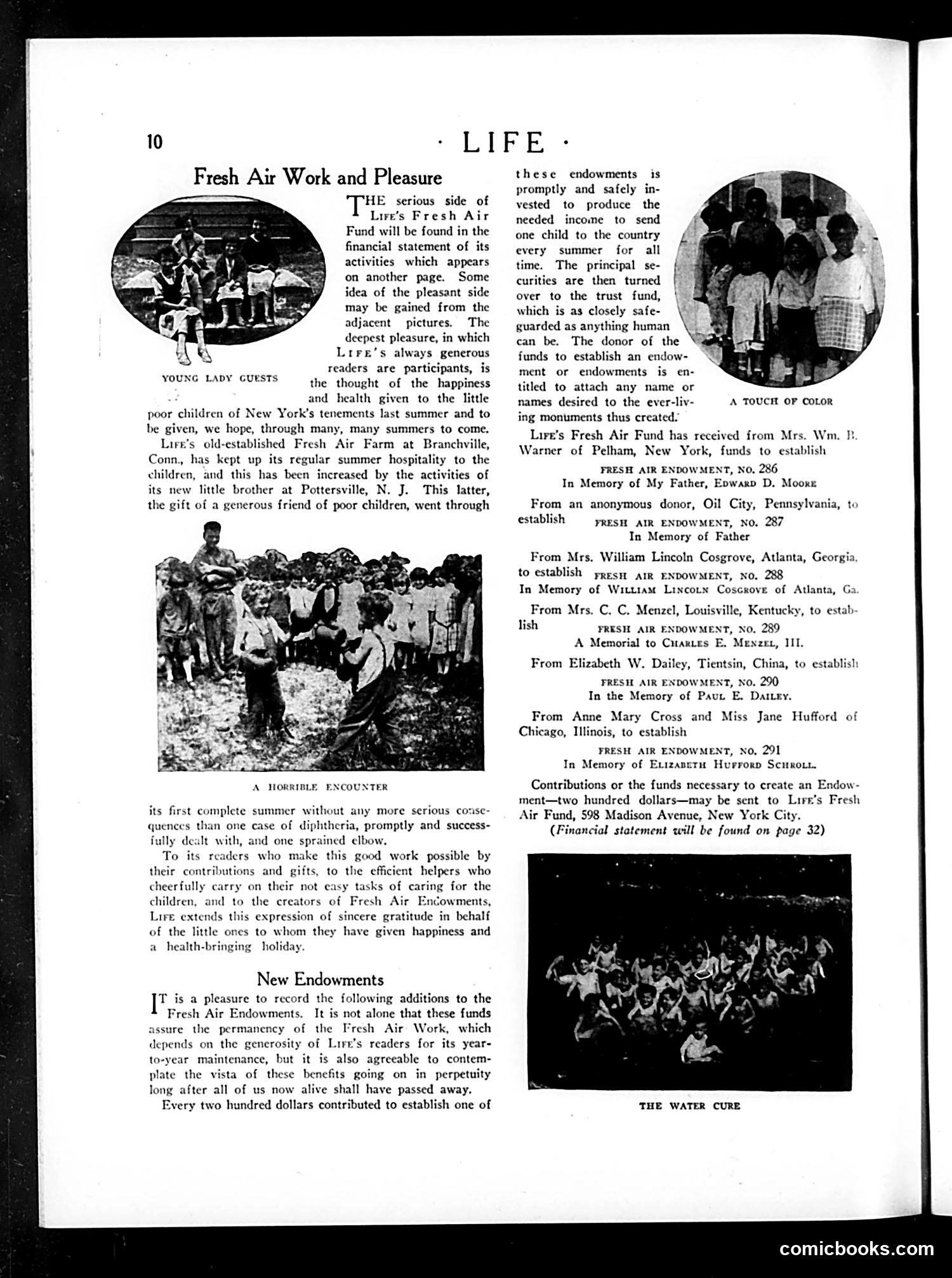
This page documents Life magazine's coverage of the Fresh Air Fund, a charitable organization providing summer respite for poor children in New York City. The page is primarily **informational rather than satirical**. The images show: - "Young Lady Guests" at what appears to be a summer facility - "A Horrible Encounter" depicting children at play - "A Touch of Color" (partially visible) - "The Water Cure" showing children in water activities The text celebrates the Fresh Air Fund's work sending underprivileged urban children to the countryside, listing recent endowments established in donors' names. This represents Life magazine's philanthropic reporting rather than political satire—it's advocating for the charitable cause and publicizing donors' contributions to maintain the program's continuity.
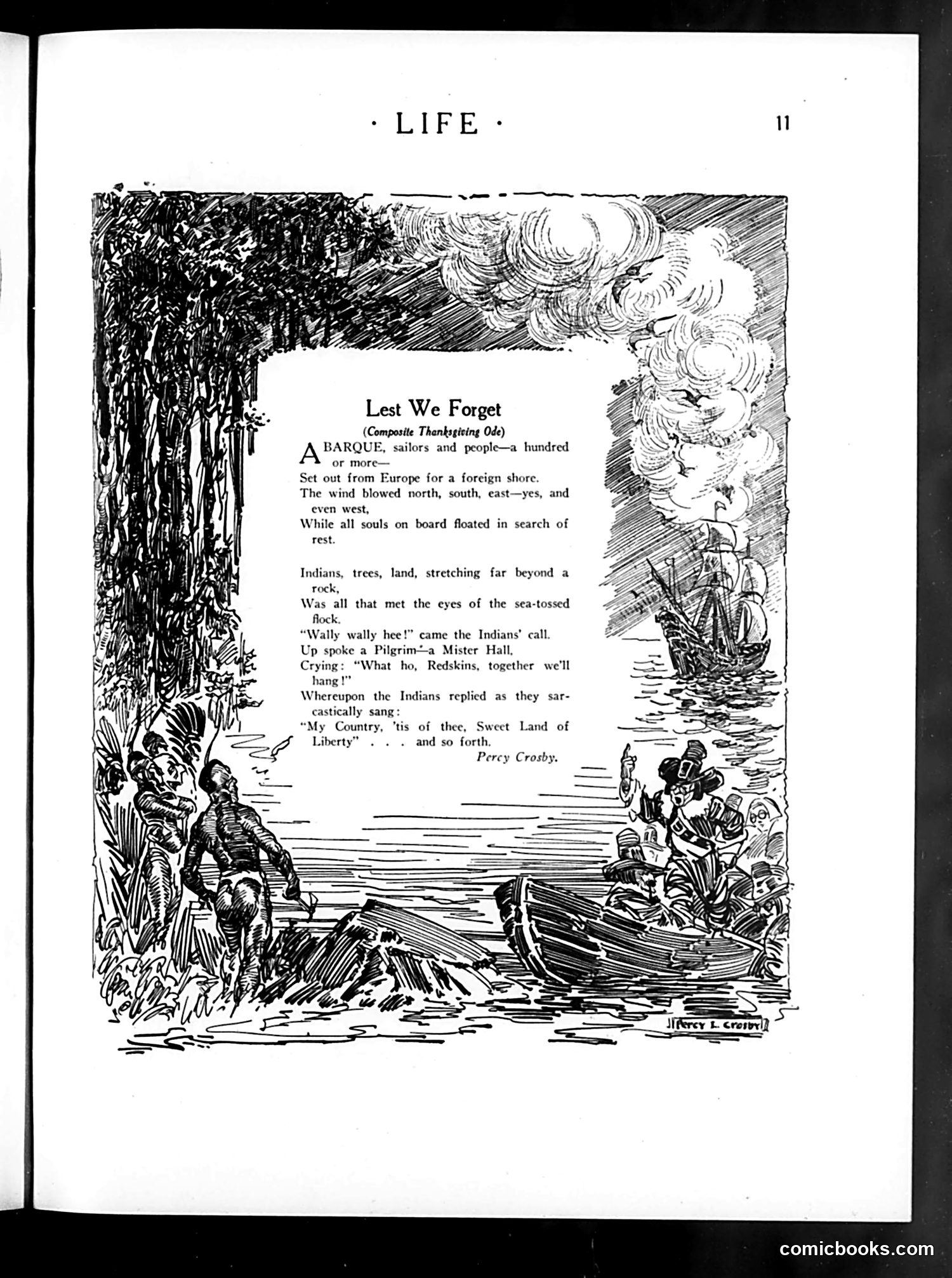
This is a poem by Percy Crosby with accompanying illustration depicting early colonial encounter. The narrative describes a European barque with sailors arriving at a foreign shore, where Native Americans greet them with the traditional call "Wally wally hee!" A Pilgrim character (Mister Hall) responds enthusiastically, proposing they "hang" together. The Indians reply by sarcastically singing "My Country, 'tis of thee, Sweet Land of Liberty." The satire's point appears to be ironic: the cartoon critiques European/American hypocrisy regarding liberty and freedom, given the subsequent treatment of Native Americans. The title "Lest We Forget" suggests this is a cautionary reminder about broken promises and the gap between ideals and historical actions toward indigenous peoples.
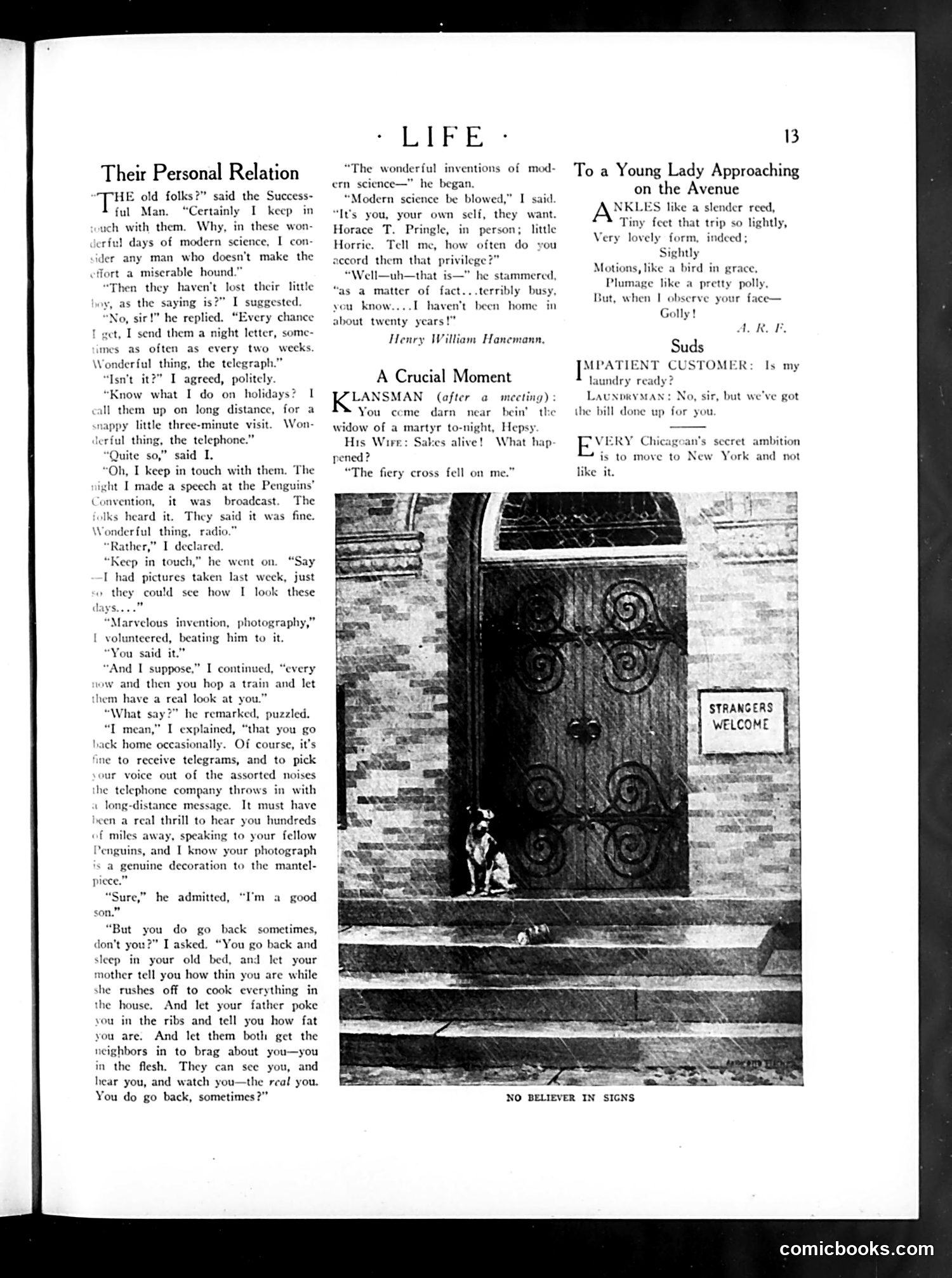
The cartoon shows a dog sitting in front of a brick doorway decorated with ornamental ironwork and a sign reading "STRANGERS WELCOME." The joke satirizes the disconnect between symbolic hospitality and actual behavior. Despite the explicit invitation to strangers, the dog—positioned as a "no believer in signs"—presumably represents skepticism about whether the welcome is genuine. The humor lies in the irony that signs proclaiming friendliness don't necessarily reflect reality; people (or animals) learn through experience that stated welcomes may not match actual treatment. This reflects early-20th-century American social commentary about hypocrisy and the gap between public courtesy and private attitudes toward outsiders.
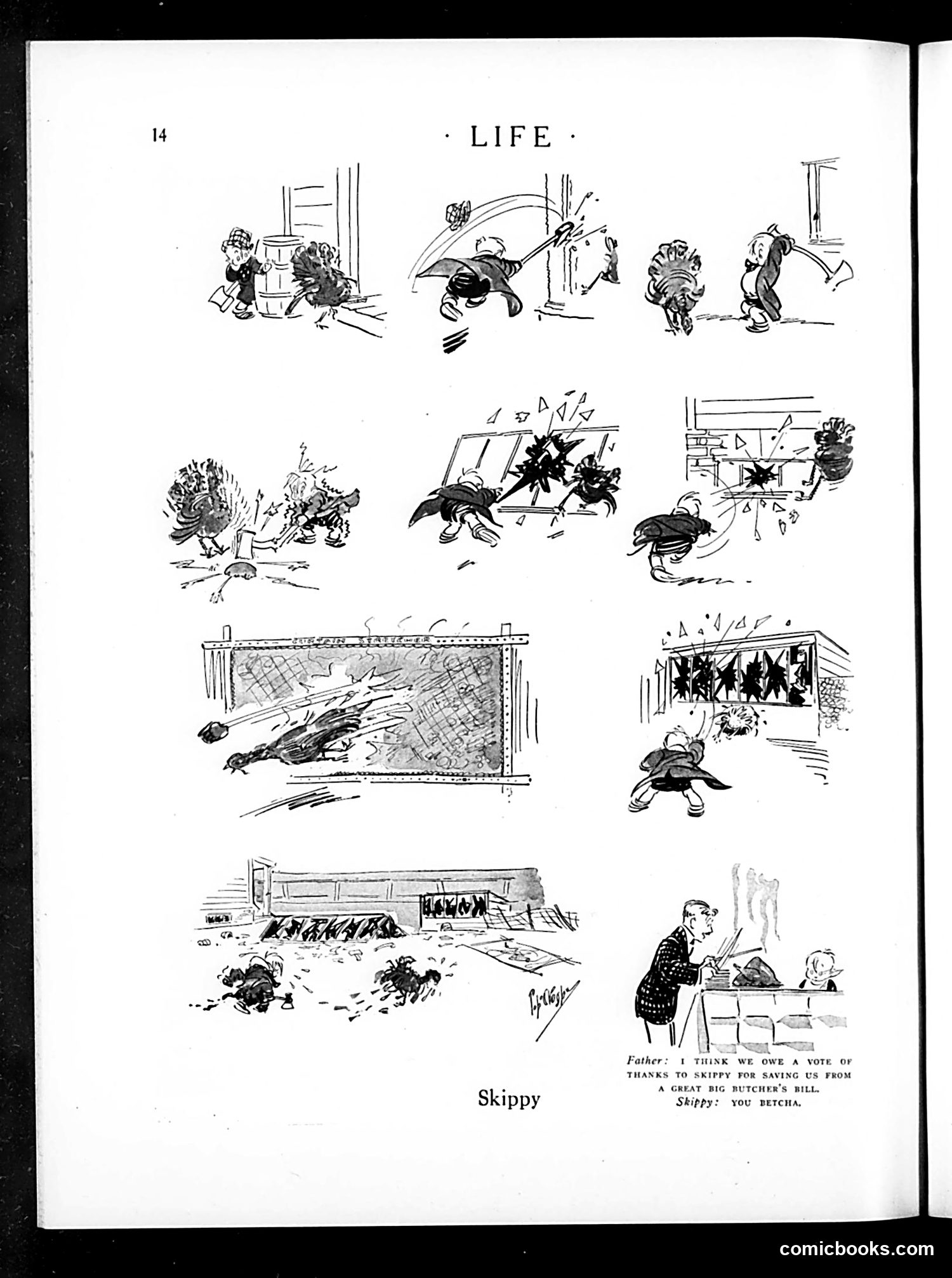
This is a comic strip series titled "Skippy" featuring a mischievous young boy character. The strip depicts a sequence of humorous incidents involving Skippy and what appears to be a large crab or crustacean creating chaos in various settings—around adults, in buildings, and near vehicles. The final panel shows a domestic scene where Skippy's father thanks him for "saving us from a great big butcher's bill," with Skippy responding "You betcha." The joke appears to be that despite the destructive mayhem shown throughout the strip, Skippy has somehow managed to save the family money, likely by the crab attacking or disrupting something expensive. The humor relies on slapstick chaos and the ironic twist ending common to 1920s-30s comic strips.
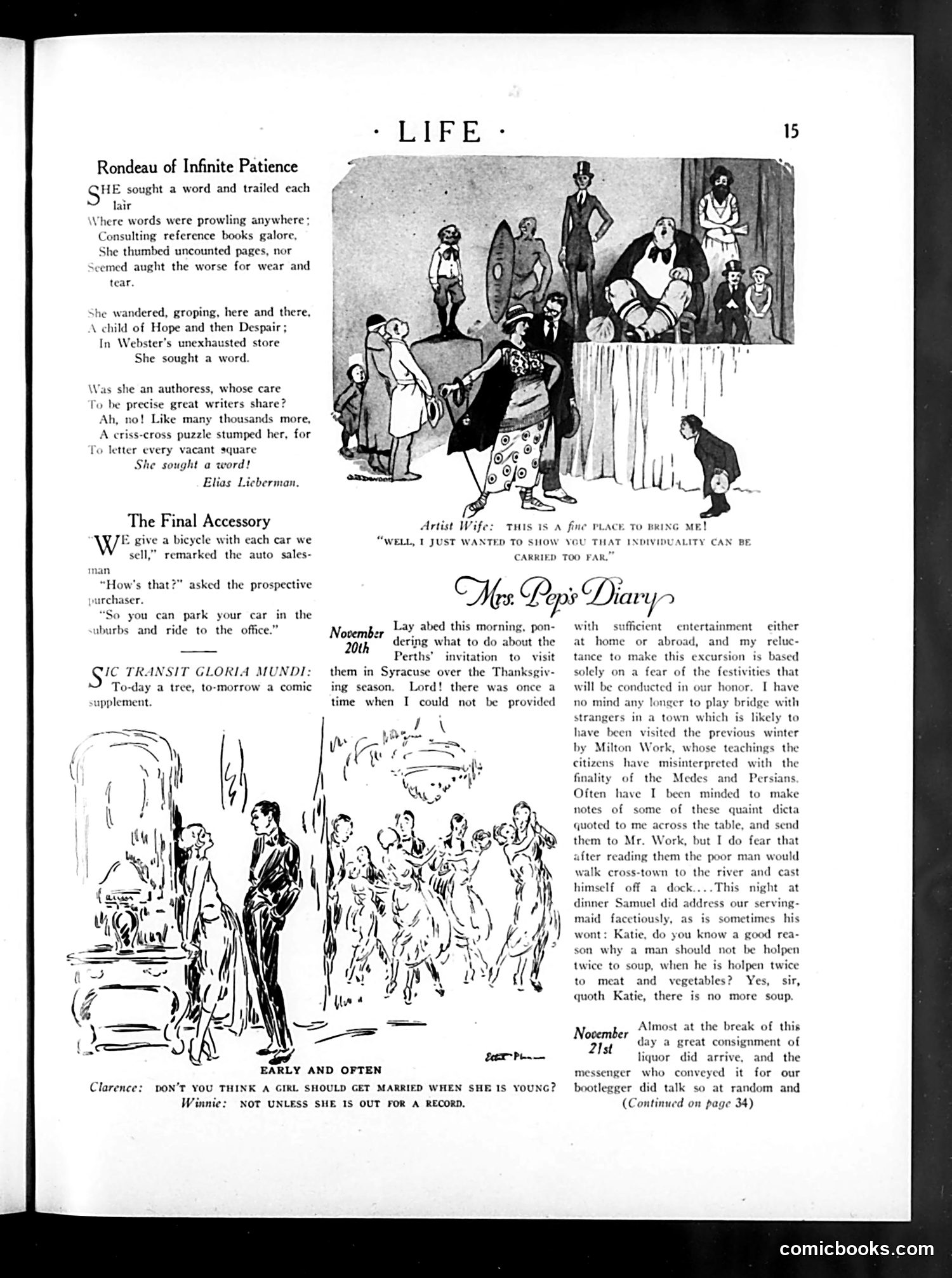
This page contains three distinct satirical pieces: 1. **"Rondeau of Infinite Patience"** — A poem by Elias Lieberman mocking a librarian's exhausting job searching reference materials for patrons. 2. **"The Final Accessory"** — A brief joke about auto salesmen promoting bicycles as parking solutions for suburban commuters. 3. **"Mrs. Pep's Diary"** — The main feature, showing a social diary entry dated November 20th-21st. The accompanying cartoon depicts a woman presenting herself at what appears to be a high-society gathering, with the caption suggesting she's demonstrating that "individuality can be carried too far." The joke satirizes excessive eccentricity or unconventional behavior among the wealthy elite. The page targets early 20th-century social pretensions and professional frustrations.
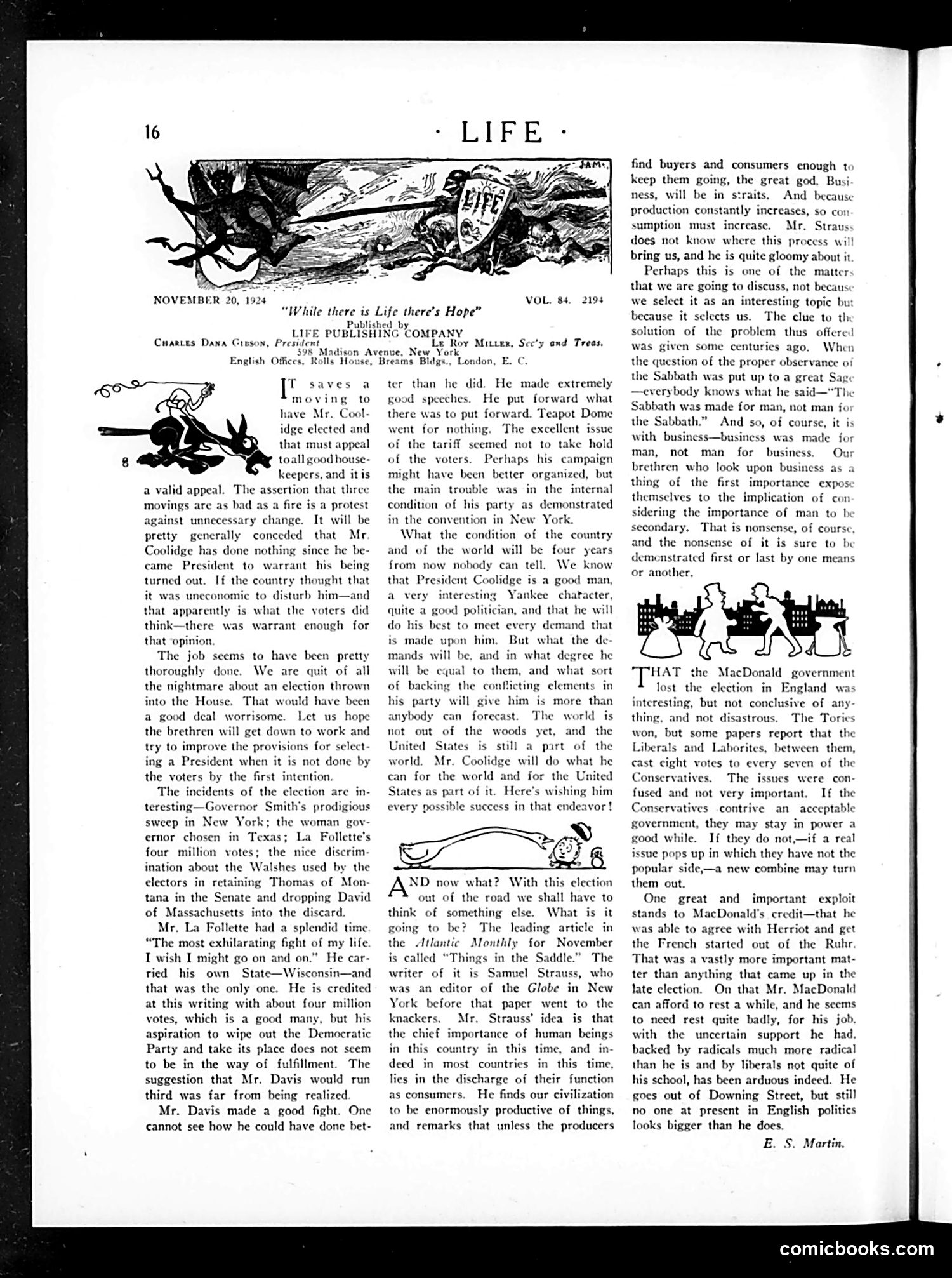
This page from Life magazine analyzes the 1924 U.S. presidential election results. The editorial celebrates President Coolidge's victory, noting voters rejected unnecessary "change" (depicted by the moving/fire metaphor in the cartoon). The piece discusses notable election outcomes: Governor Smith's landslide in New York, a female governor elected in Texas, and Robert La Follette's surprisingly strong third-party performance (four million votes, though winning only Wisconsin). It dismisses Democratic candidate John W. Davis's defeat as partly due to internal party division. The editorial expresses cautious optimism about Coolidge's presidency while acknowledging uncertainty about global conditions ahead. A secondary article excerpt discusses "Things in the Saddle," arguing that Americans' primary importance in modern life derives from their role as **consumers**—a notably early articulation of consumer culture's centrality to national identity. The overall tone is conservative, establishment-friendly, and focused on economic stability over political upheaval.
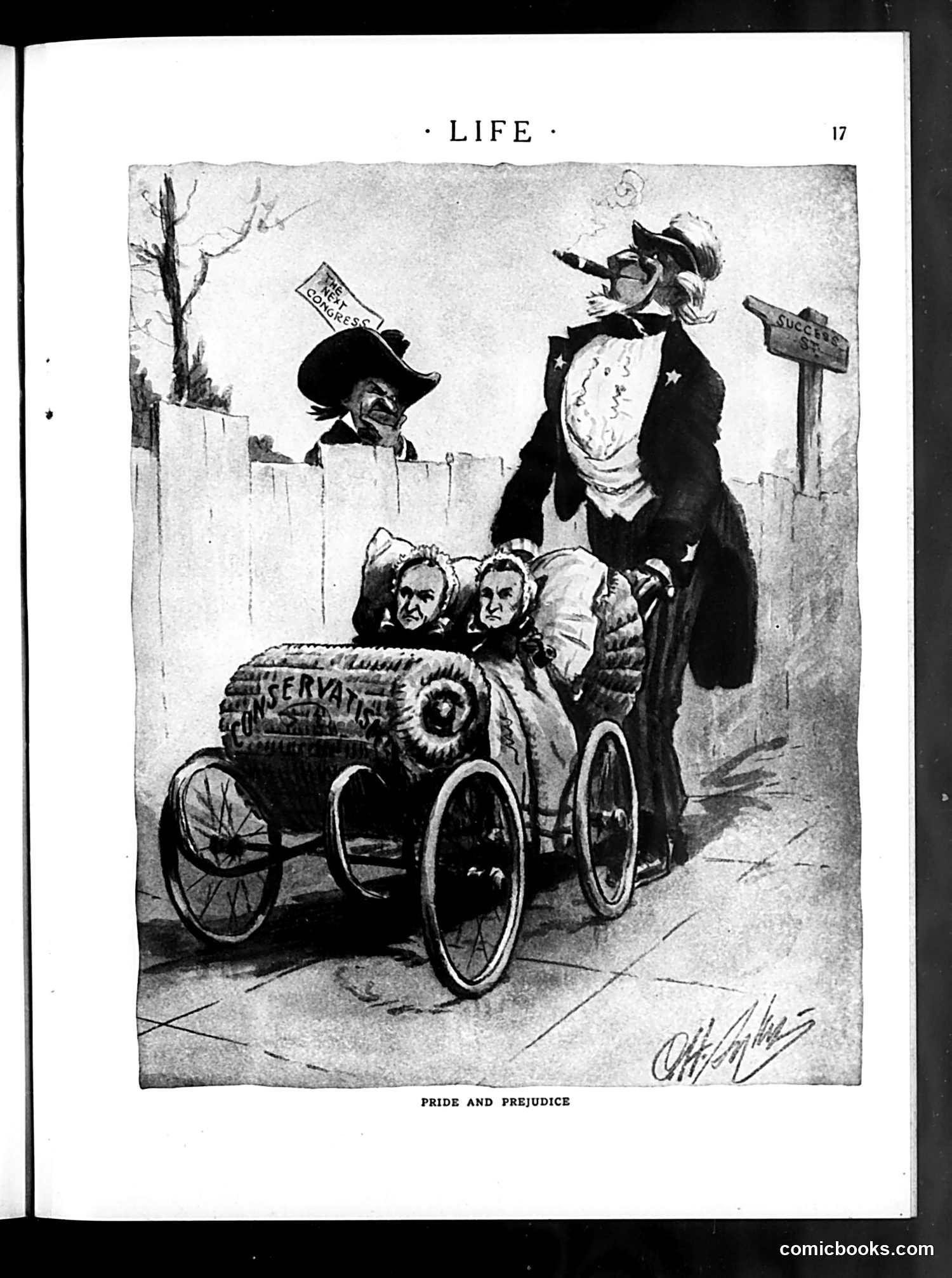
This is a political cartoon satirizing two figures—likely representing "Pride" and "Prejudice" as abstract vices or political positions. The well-dressed man on the left wears a sign reading "Old Congress," while the figure on the right displays "Success." They're pulling a carriage labeled "Conservatism" containing two baby-faced figures, past a signpost marked "Success." The satire appears to criticize how pride and prejudice (possibly referring to stubborn political conservatism or congressional obstruction) are being perpetuated through institutional momentum. The "babies" suggest either naiveté or the next generation inheriting these flawed values. The fenced enclosure and barren tree evoke a grim, constrained environment, suggesting these attitudes limit progress. The exact historical moment remains unclear without dating context.
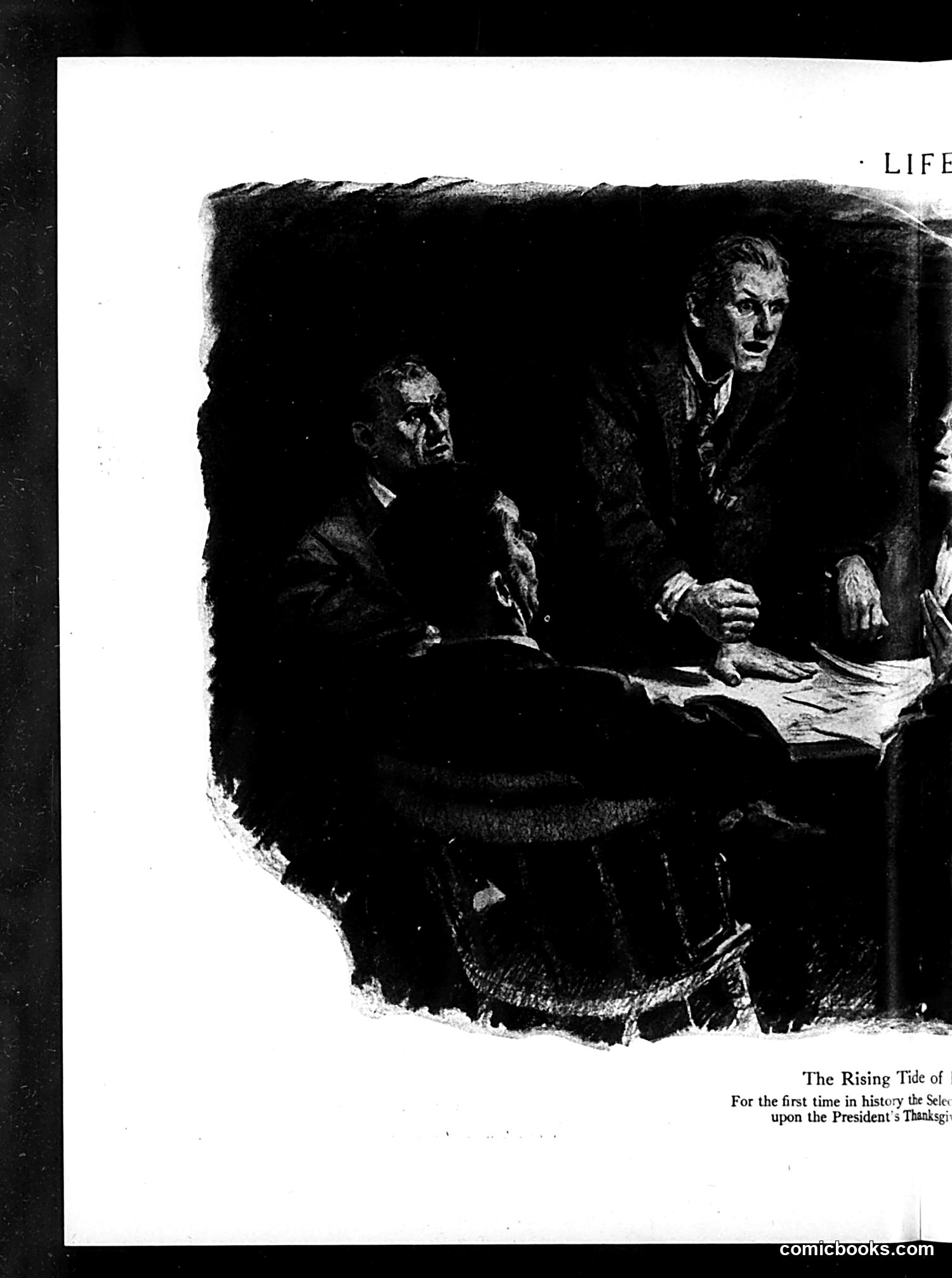
This page from *Life* magazine appears to show a political cartoon depicting what the caption calls "The Rising Tide of" (text cuts off). The visible text references "the first time in history the Sele[ct]...upon the President's Thanksgi[ving]"—likely referring to some Congressional group's unprecedented action during a presidential Thanksgiving. The sketch shows three men in formal 19th-century dress gathered around a table with documents, rendered in dark, dramatic charcoal. The style and composition suggest a serious political moment being satirized. Without the complete caption, the specific identity of the figures and the exact nature of their action remains unclear, though it appears to critique some form of legislative or political intervention during a traditionally ceremonial occasion.
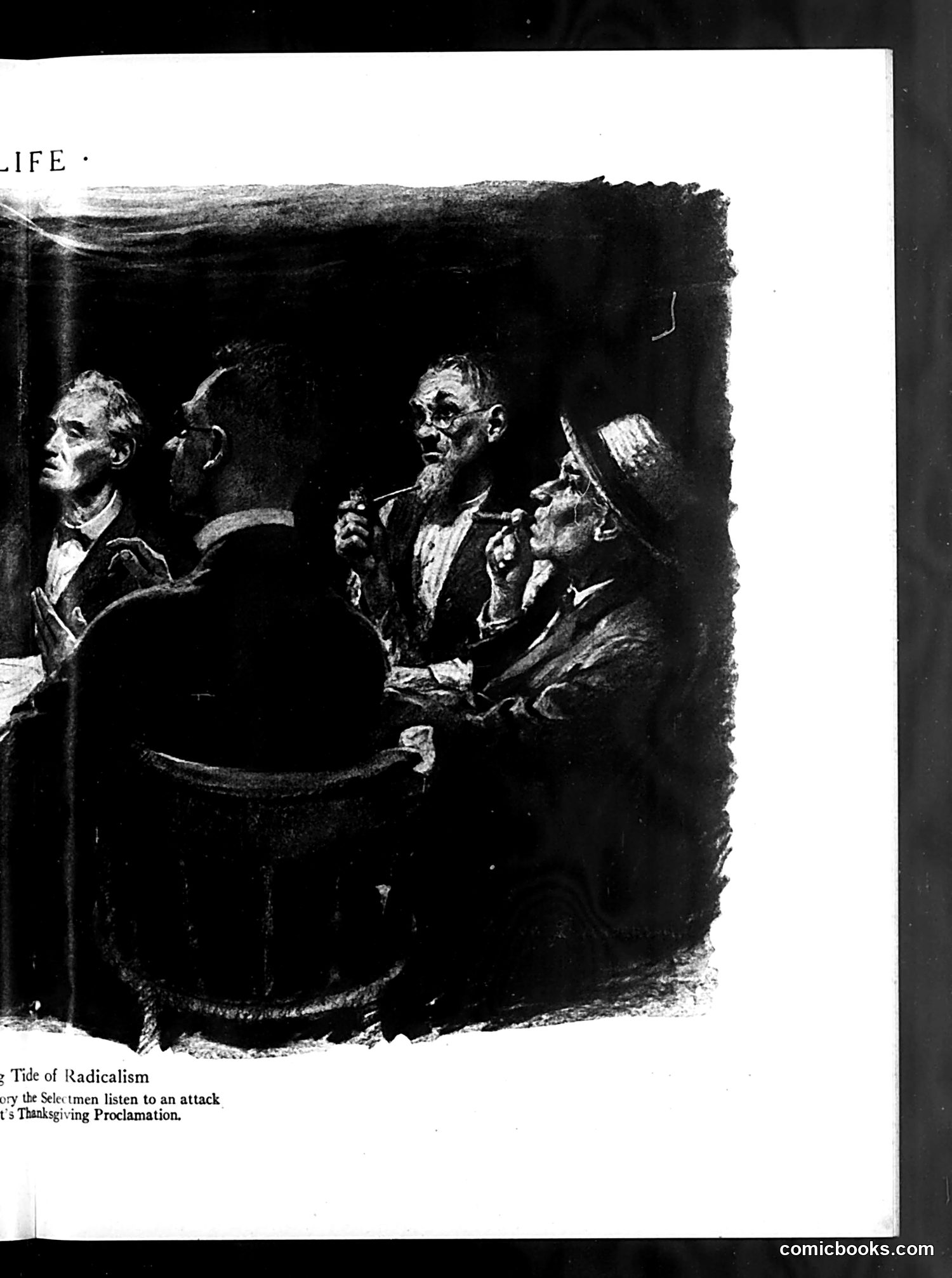
This appears to be a political cartoon titled "The Tide of Radicalism" depicting selectmen (local officials) listening to criticism of a Thanksgiving Proclamation. The illustration shows several men in period dress (likely late 19th/early 20th century) in what seems to be an indoor setting, with one figure gesturing while speaking to others. The satire critiques radical political attacks against traditional civic institutions and proclamations. The cartoon suggests that even routine governmental acts like Thanksgiving declarations face assault from radical political movements of the era. The "tide" metaphor implies radicalism is rising as an unstoppable force challenging established authority. Without clearer OCR text or visible dates, the specific historical moment remains uncertain, though this reflects broader tensions between progressive reformers and traditional governance during America's Gilded Age or Progressive Era.
This piece mocks both the Soviet Russian government and theatrical impresario Florenz Ziegfeld's Fall "Follies" production featuring a troupe of Russian dwarves ("Lilliputians"). The satire works on two levels: First, it ridicules the absurd claim that Soviet leader Lenin orchestrated the expulsion of performer Ratoucheff's dwarf troupe as a genuine threat to the Red government—suggesting the Bolsheviks are so petty and paranoid they'd target midgets. Second, it sarcastically praises Life's own willingness to support restricting "Lilliputian actors" through quotas, even jokingly offering to join the KKK to help exclude theatrical midgets from undesirables lists. The humor relies on Cold War-era anti-Soviet sentiment, mock-heroic language about Lenin's "desperate" military campaigns against tiny performers, and absurdist exaggeration to highlight perceived Soviet irrationality. The final joke about Mitty and Tillio (likely other performers) dancing while raising their legs above their heads completes the mockery of this "unstarling, but pleasant" show.
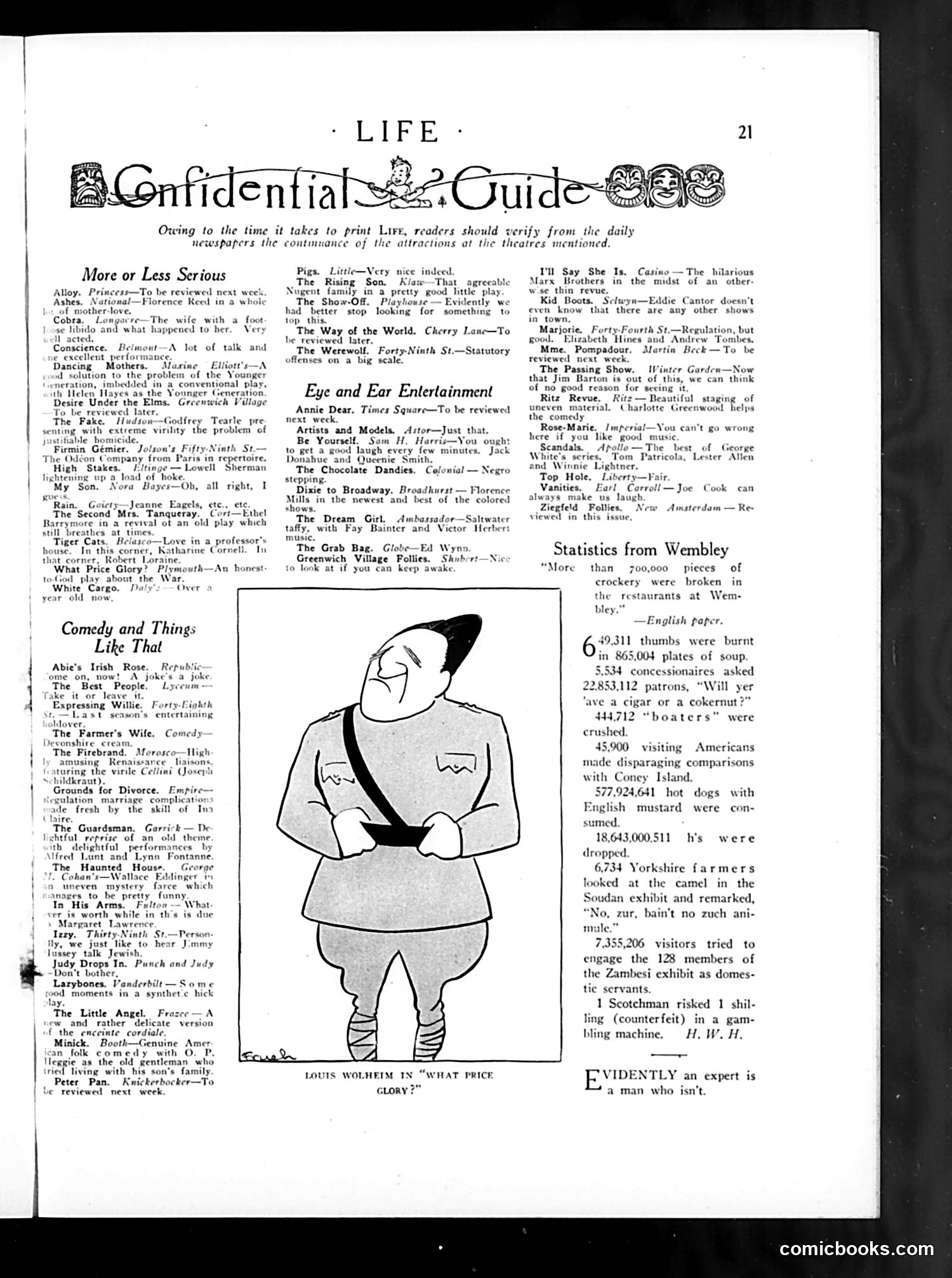
This is a **theater listings and reviews page** from *Life* magazine, a satirical publication. The main cartoon depicts **Louis Wolheim in "What Price Glory?"**—a famous 1924 anti-war play about American soldiers in World War I. Wolheim, a respected character actor, appears as a gruff, heavyset military figure, capturing the play's unflinching portrayal of war's brutality and soldiers' experiences. The page predominantly lists Broadway productions of the era, mixed with brief critical commentary. Shows range from serious dramas (*Rain*, *Desire Under the Elms*) to comedies and musicals featuring contemporary stars like Eddie Cantor, the Marx Brothers, and Florence Mills. The right sidebar contains "Statistics from Wembley"—absurdist facts about the British Wembley Exhibition, a humorous touch typical of *Life*'s satirical approach, ending with the definition: "EVIDENTLY an expert is a man who isn't."
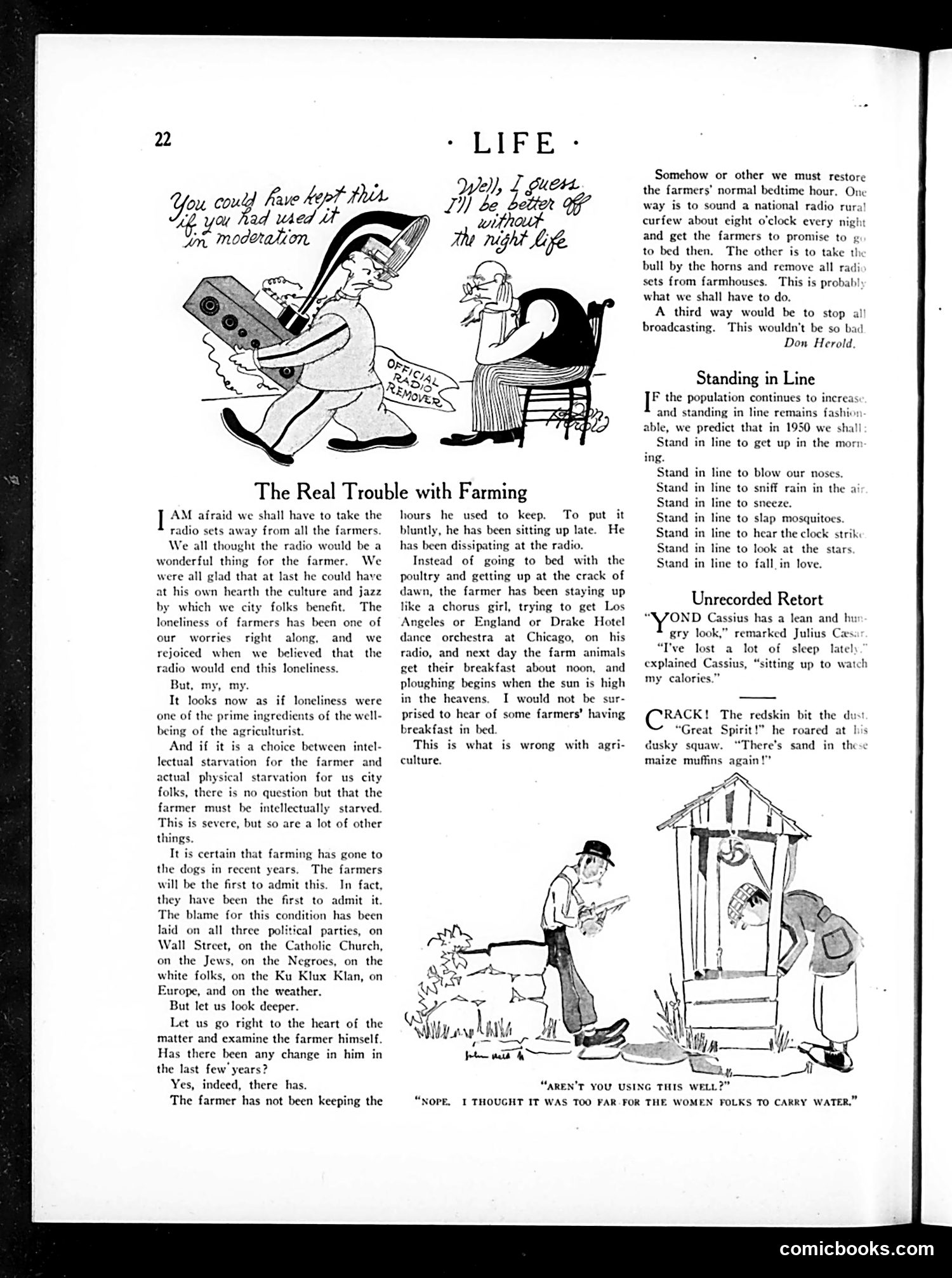
This article satirizes the agricultural crisis of the 1920s by proposing an absurd diagnosis: **radios have ruined farmers by disrupting their sleep schedules.** The writer argues that farmers, newly equipped with radio sets meant to combat rural isolation, now stay up late listening to distant broadcasts (Los Angeles, England, Chicago dance orchestras) instead of maintaining traditional early bedtimes. This causes them to sleep through dawn chores, delay farm work until midday, and neglect livestock—thus destroying agriculture. The satire mocks both contemporary farmer complaints (blaming "Wall Street," political parties, various scapegoat groups) and urban middle-class assumptions about rural life. By proposing that the solution is removing radios entirely—or implementing a "rural curfew"—the author ridicules the era's tendency to blame new technology for social problems rather than addressing actual economic causes. The accompanying cartoons and short humorous pieces (about standing in line, Shakespeare puns) reinforce the magazine's satirical tone throughout the page.
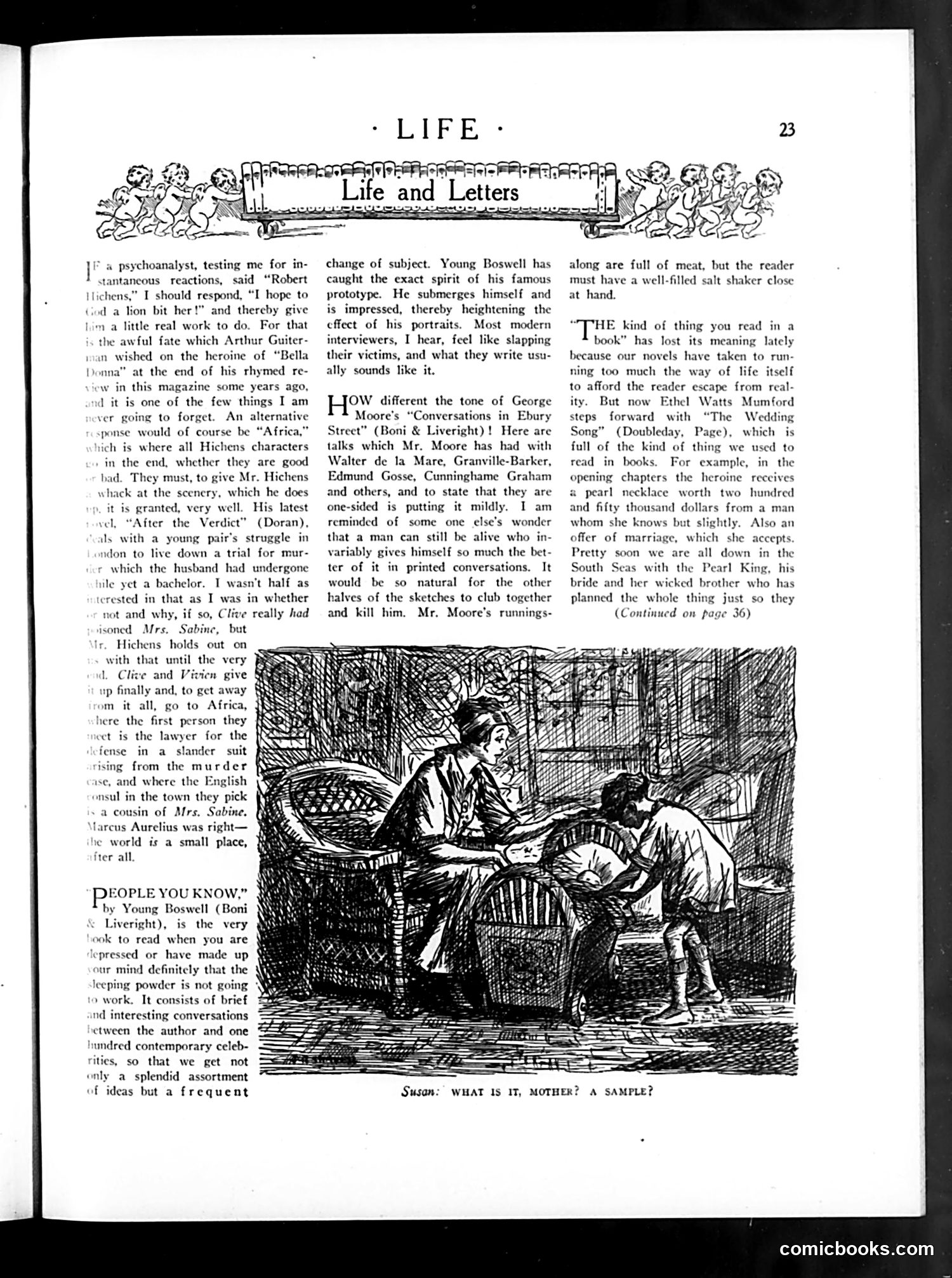
This page reviews contemporary books, featuring one illustration. The cartoon shows a woman offering a man a sample from a basket, with the caption "SUSAN: WHAT IS IT, MOTHER? A SAMPLE?" The joke appears to reference **Robert Hichens**, a popular novelist whom the critic discusses extensively. Hichens was known for sensational plots and romantic entanglements. The illustration likely alludes to one of his novels' plot devices—possibly a woman offering something (literally or figuratively) to a man in a compromising situation, playing on readers' expectations of scandal or seduction common in Hichens's work. The surrounding text mocks Hichens's formulaic approach: his characters always end up in Africa, his plots involve murder trials and poisonings, and his narratives are predictable. The cartoon's domestic scene—a mother asking about a "sample"—is likely satirizing how Hichens sensationalizes ordinary situations into melodrama. The page is primarily book criticism, not political satire.
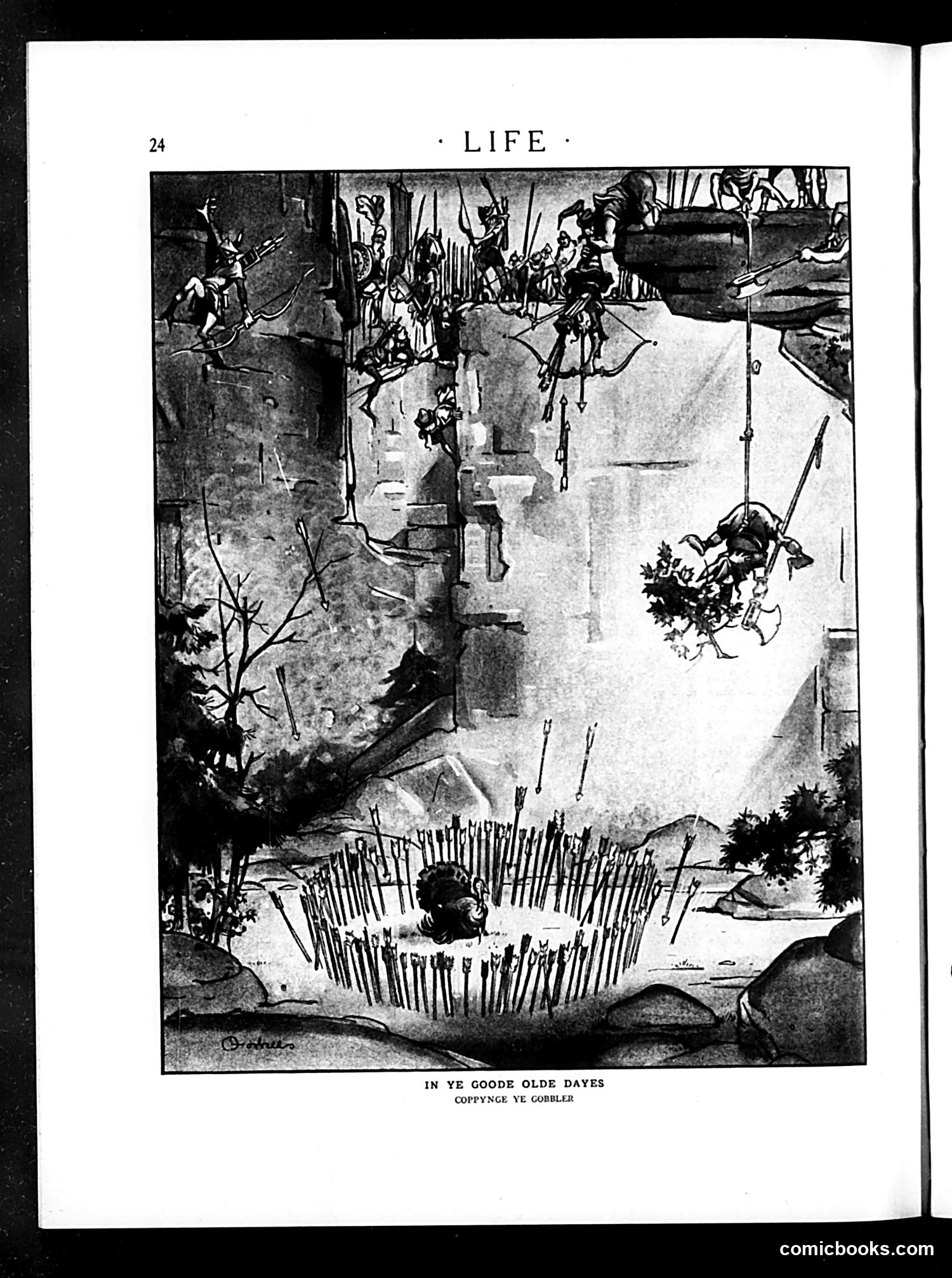
This cartoon employs mock-archaic language ("ye goode olde dayes," "coppynge") to satirize something about copying or imitating a "gobbler" (turkey). The image depicts figures suspended from above in what appears to be a dungeon or torture chamber, with spikes below and architectural elements suggesting a medieval setting. The satire likely critiques either: - Blind imitation of past practices presented as quaint or noble - The dangers of nostalgia for "the good old days" - Some contemporary practice being mocked as primitive or barbaric by dressing it in pseudo-historical language Without additional context about Life magazine's specific issues of that era, the exact target remains unclear, but the tone suggests mockery of either historical romanticization or a contemporary trend defended through appeals to tradition.
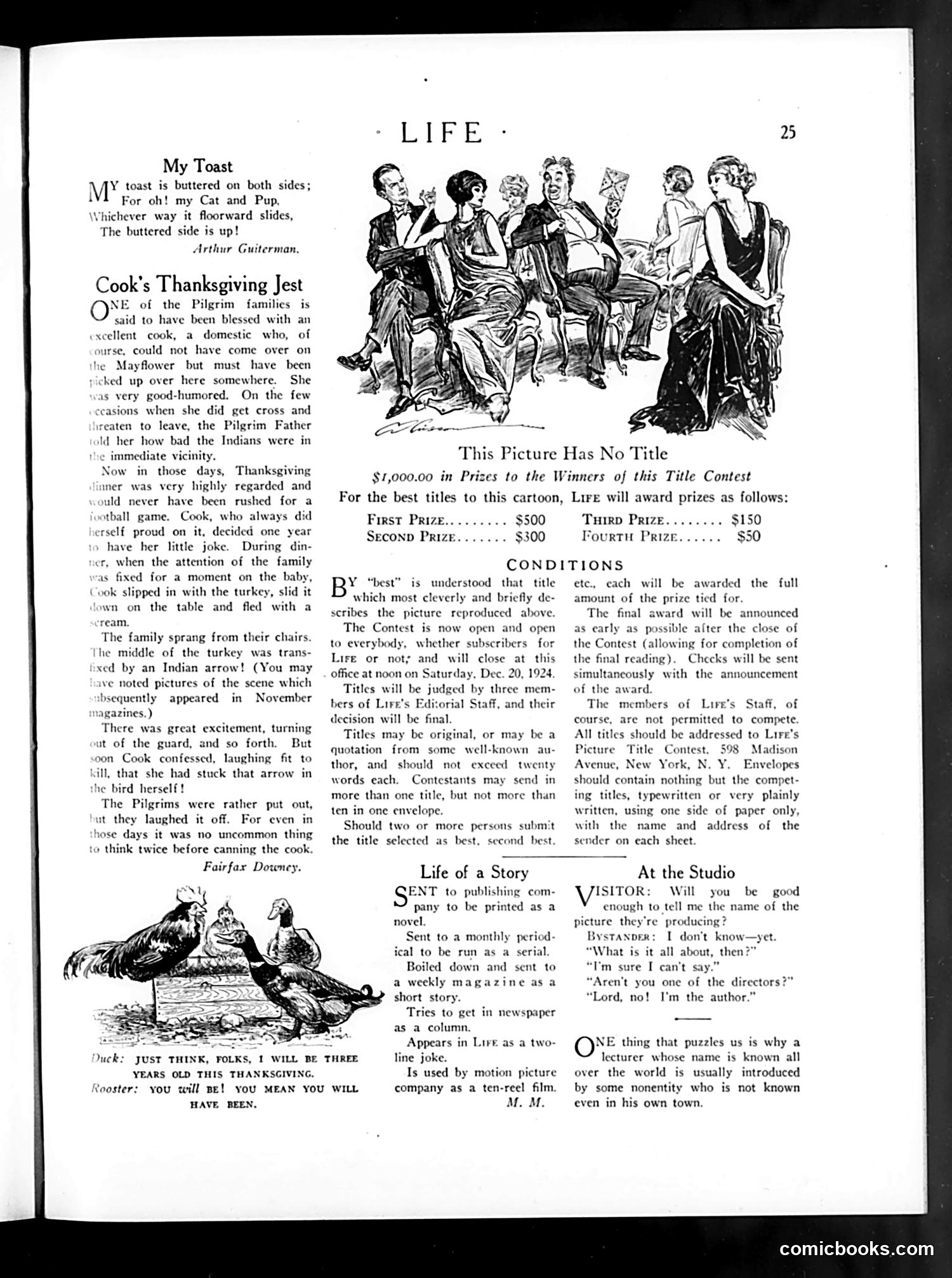
This page from Life magazine (appears to be December 1924 based on contest deadline) contains several humorous pieces targeting early 20th-century American domestic life and publishing culture. **"Cook's Thanksgiving Jest"** humorously recounts a Pilgrim-era story where a domestic servant pranks her employers by placing an Indian arrow through the turkey—a joke about foolish servants and the precarious position of household help (note the joke about "canning the cook"). **"This Picture Has No Title"** announces a $1,000 contest for readers to title an untitled cartoon showing what appears to be a social gathering. This was a popular Life feature encouraging reader participation. **"Life of a Story"** satirizes how narratives get recycled and degraded across media—from novels to serials to short stories to newspaper columns, eventually becoming mere two-line jokes in Life magazine itself. It's self-aware satire about mass media's appetite for content. The bottom section mocks Hollywood's creative process, where studio workers begin production without knowing the film's actual plot—commentary on formulaic 1920s filmmaking.
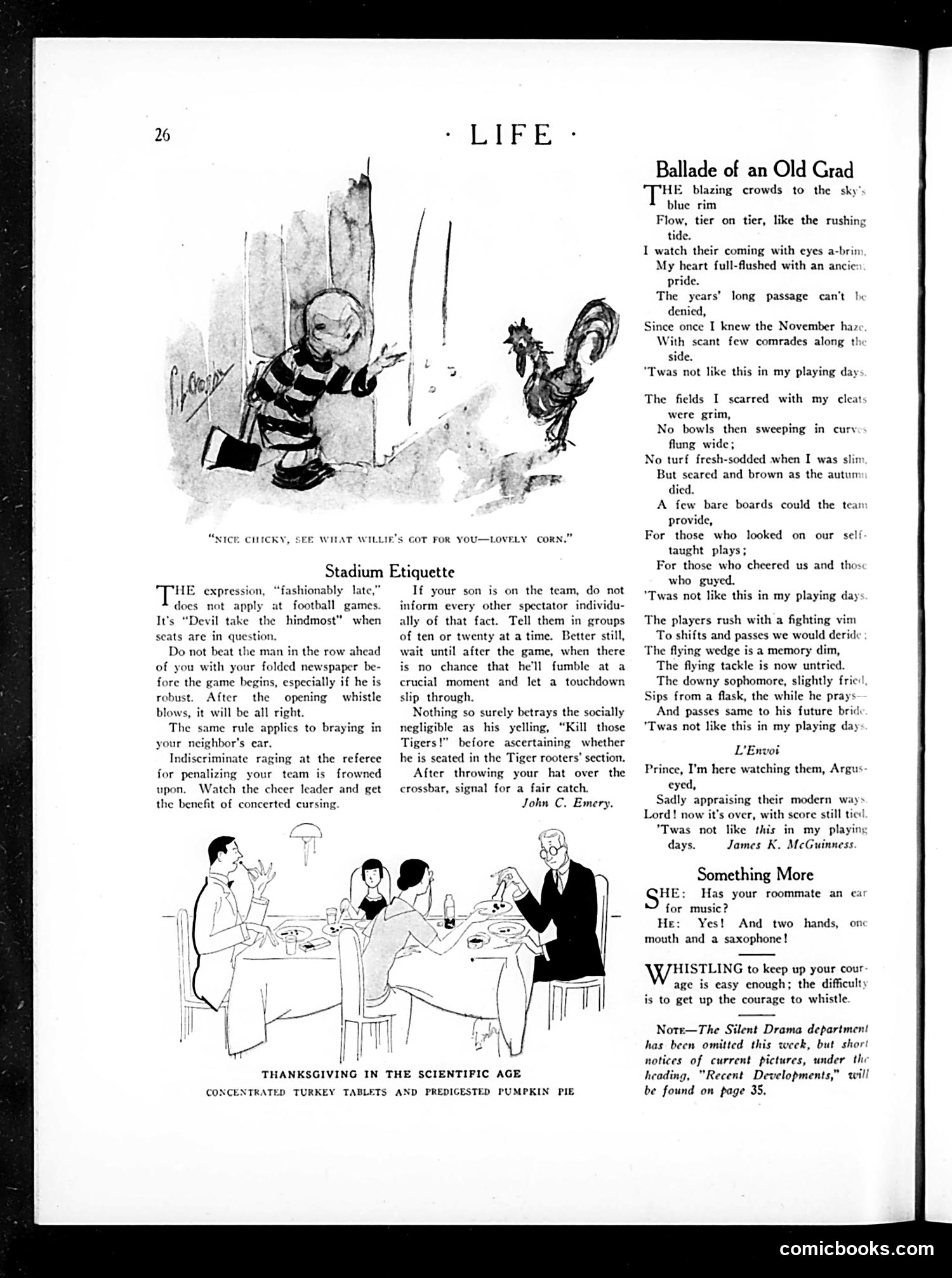
This page contains three distinct pieces of social satire typical of early 20th-century Life magazine humor: **"Stadium Etiquette"** mocks nouveau riche and socially awkward football spectators—people who arrive late, beat newspaper-reading neighbors, bray loudly, inform strangers about their sons on the team, and yell for the wrong team. The humor targets social climbers unfamiliar with proper conduct at collegiate sporting events. **"Thanksgiving in the Scientific Age"** cartoon jokes about modernity reducing a traditional holiday to efficiency: concentrated turkey tablets and predigested pumpkin pie. It satirizes the era's faith in scientific/industrial solutions to everyday life. **"Ballade of an Old Grad"** is a nostalgic poem where an alumnus laments that modern football—with its organized plays, flying wedges replaced by passes, and flask-drinking sophomores—lacks the grit and simplicity of his playing days. It's gentle satire of aging nostalgia. The "Something More" joke puns on musical talent versus saxophone noise-making. Overall, the page reflects 1920s anxieties about modernization, social propriety, and generational decline.
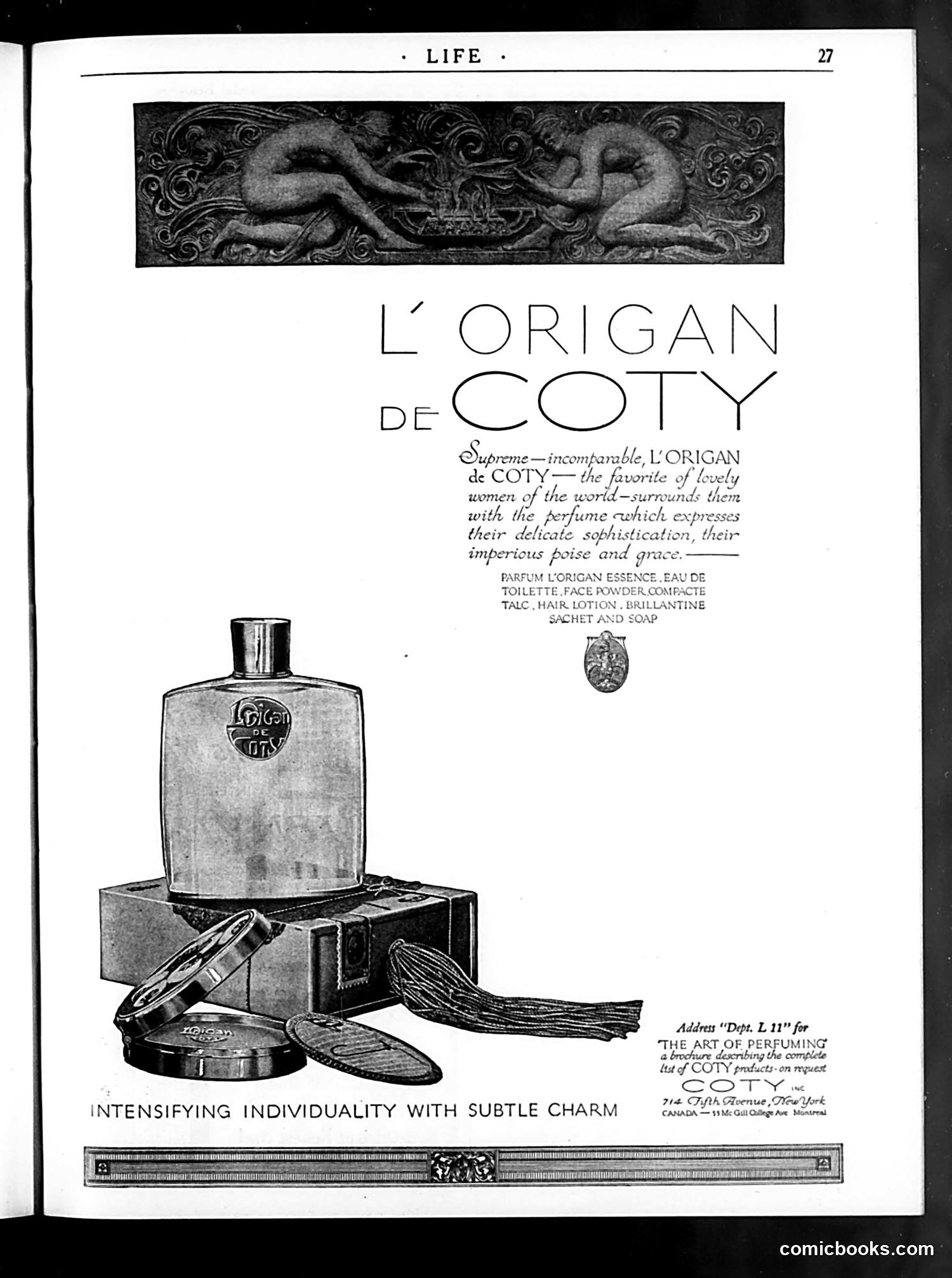
This is a **full-page advertisement**, not a cartoon or satire. It promotes **L'Origan de Coty**, a French perfume brand, in what appears to be a 1920s-era Life magazine. The page features decorative classical imagery (cherubs at top) and displays a perfume bottle surrounded by complementary beauty products (powder, soap, hair lotion). The ad emphasizes luxury and sophistication, describing the perfume as the choice of "lovely women of the world" with "delicate sophistication" and "imperious poise and grace." The tagline—"Intensifying Individuality with Subtle Charm"—targets upscale female consumers by suggesting the product enhances personal refinement. The French branding and Fifth Avenue New York address signal premium positioning. There is no political satire or social commentary present; this is straightforward cosmetic marketing.
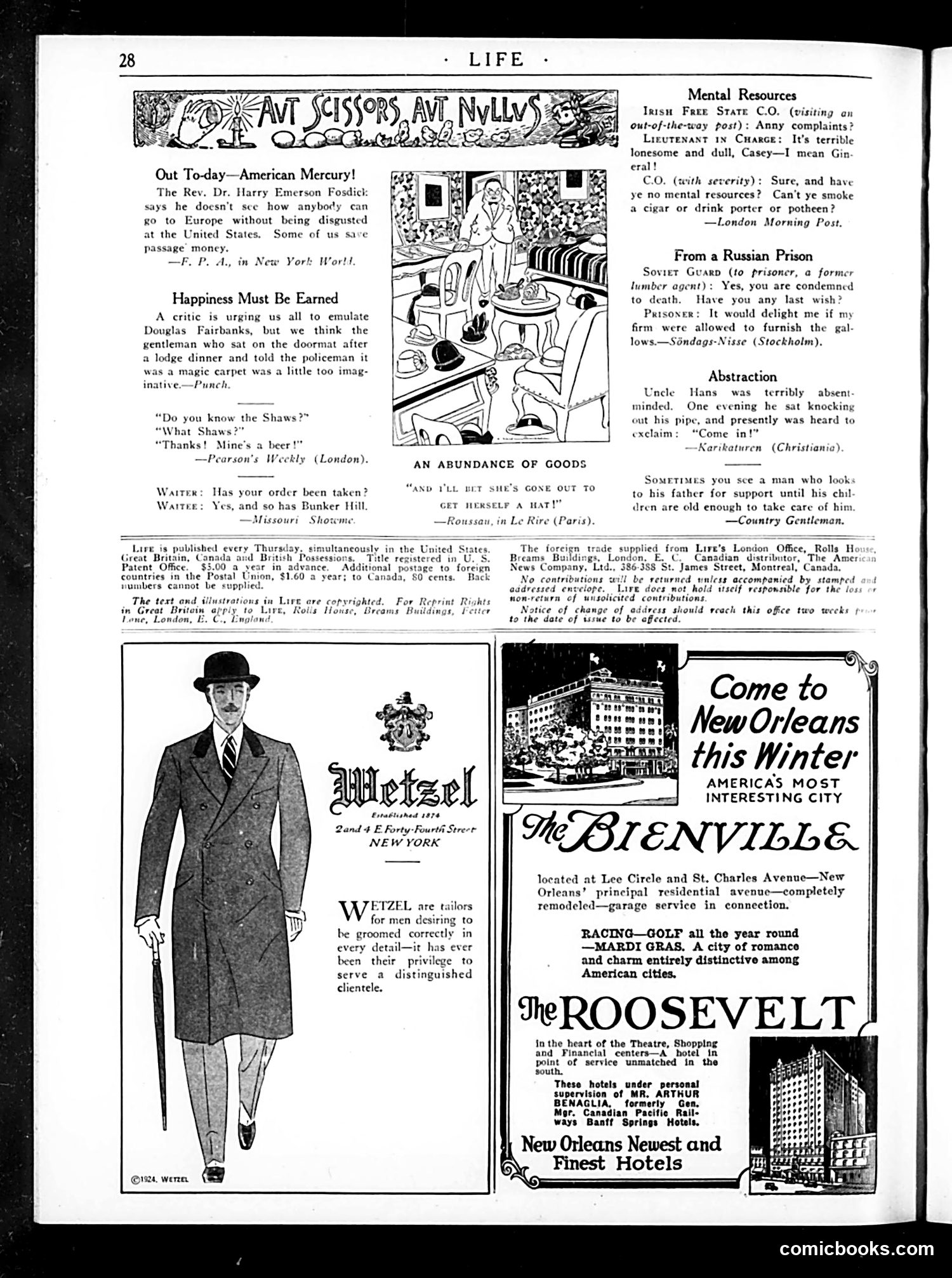
This page mixes short satirical quips with advertisements. The humor relies on period-specific references: **"Out To-day—American Mercury"** mocks Reverend Fosdick's criticism of America by suggesting people skip expensive European trips if they're already disgusted with the U.S. **The lodge dinner joke** ridicules Douglas Fairbanks' idealizing influence—contrasting his glamorous image with an ordinary drunk man imagining a doormat is magic. **The "Shaws" pun** exploits accents: asking about "the Shaws" (people) but receiving "a beer" (homophonic mishearing). **The military exchange** jokes that taking an order for supplies is equivalent to conquering Bunker Hill—deflating military glory through grocery-store mundanity. Other snippets satirize Irish soldiers, absentminded behavior, and commercialism. The **Wetzel tailors advertisement** occupies significant space, typical of Life's revenue model blending satire with luxury advertising targeting affluent readers.
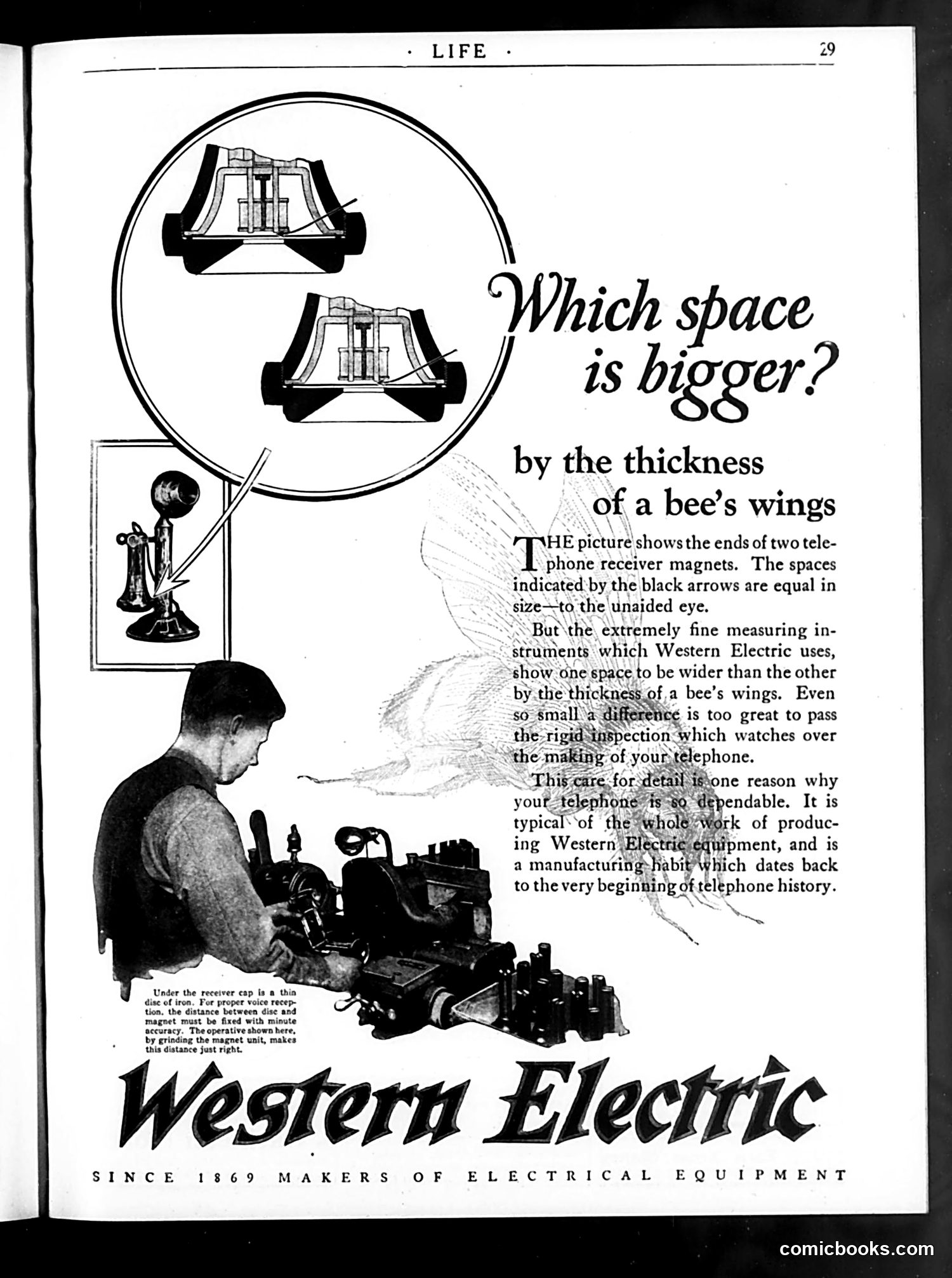
This is not satire but rather a **corporate advertisement** for Western Electric, a major telephone equipment manufacturer. The piece showcases the company's manufacturing precision and quality control. The "joke" in the headline—asking which space is bigger when they appear equal to the naked eye—demonstrates Western Electric's obsessive attention to microscopic detail. The company uses an optical illusion to illustrate that their measuring instruments can detect differences "by the thickness of a bee's wings," emphasizing inhuman precision. The accompanying photograph shows a worker grinding a magnet unit to achieve exact spacing between a disc and magnet in telephone receiver components. This visual proof of painstaking craftsmanship supports the advertiser's claim that such meticulous quality-control practices have been standard since 1869. For modern readers: this represents vintage corporate advertising that equates manufacturing excellence with product reliability—a common mid-20th-century marketing strategy emphasizing American industrial competence.
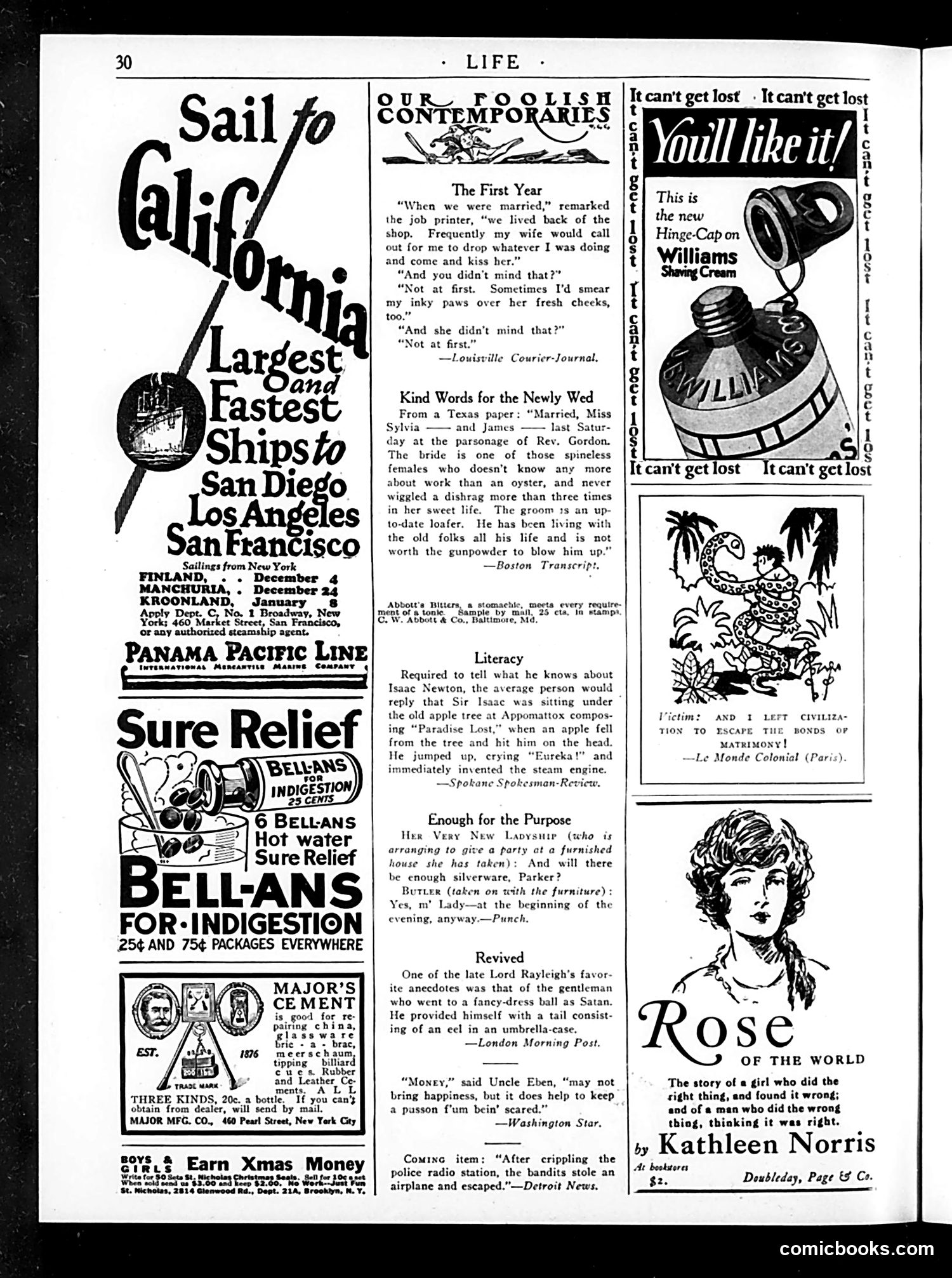
This page is primarily **advertising and humor columns**, typical of Life's early 20th-century format. The main advertisements promote ship travel to California, Bell-Ans indigestion remedy, and Major's cement. The "Our Foolish Contemporaries" section reprints humorous anecdotes from other newspapers, mocking them gently: - A Texas newspaper's brutal wedding announcement describing the bride as "spineless" and groom as worthless appears absurdly cruel, likely satirizing small-town gossip journalism. - An anecdote about Isaac Newton confuses basic facts (Appomattox, "Paradise Lost"), mocking public ignorance of science. - A joke about a butler assuring there's "enough silverware...at the beginning of the evening" suggests guests steal during fancy dinners—commentary on servant cynicism about wealthy employers. The page also advertises "Rose of the World," a serialized novel about doing the right thing and finding it wrong—typical serialized fiction for the era. Overall, this reflects Life's role as a **satirical magazine mocking contemporary culture, journalism, and social pretension** through reprinted humor and advertisements.
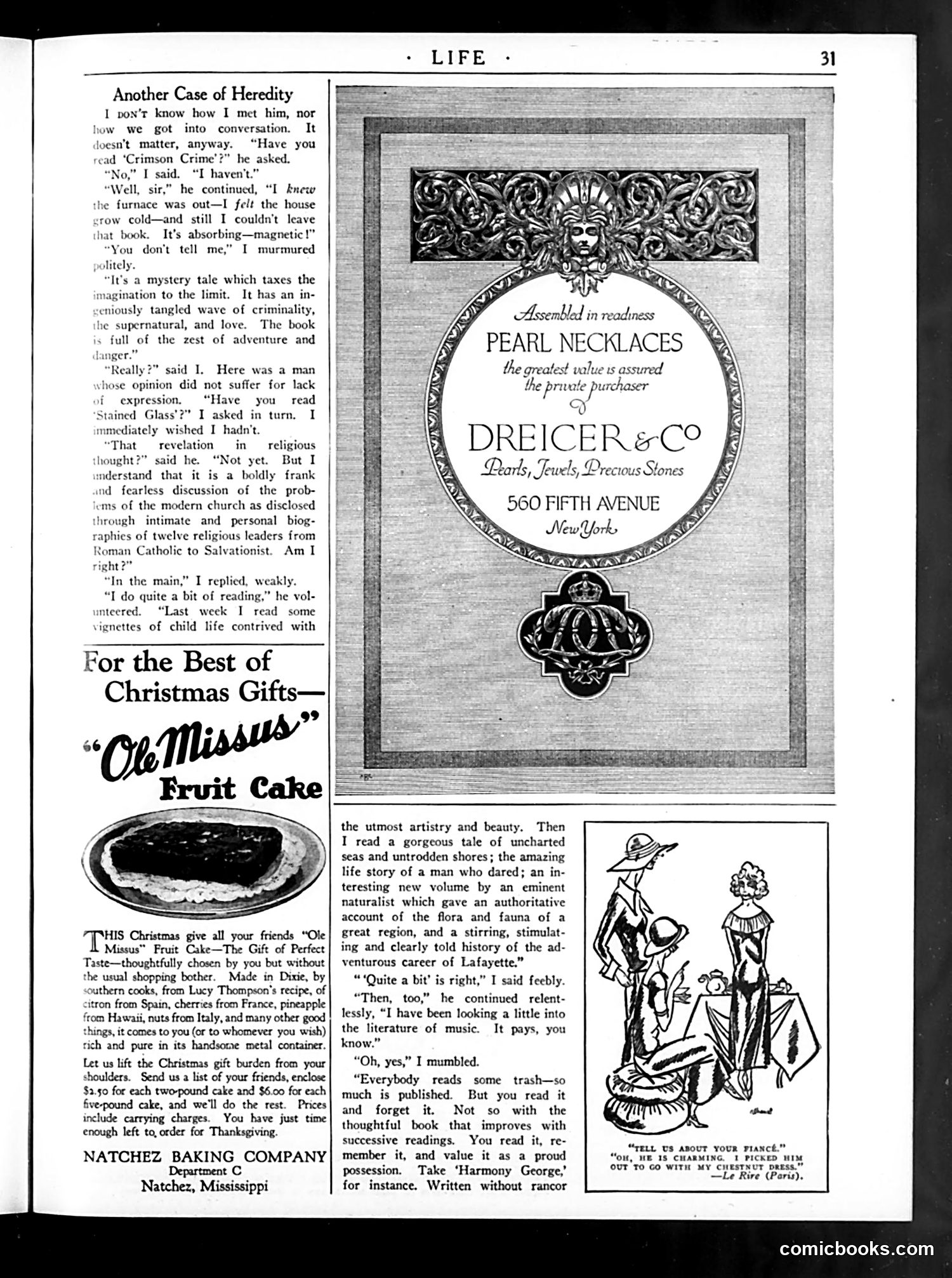
This is a humorous short story (not a political cartoon) satirizing verbose, pretentious people who dominate conversations with tedious literary opinions. The narrator meets an acquaintance who launches into an unstoppable monologue about books he's read—*Crimson Crime*, *Stained Glass*, children's literature, and *Harmony George*. The man demonstrates affected intellectualism, name-dropping titles while the narrator grows increasingly silent and exhausted. The "heredity" joke appears in the accompanying small cartoon (bottom right): a woman explaining her fiancé choice by saying he matches her chestnut dress—implying shallow, inherited values passed through generations. The satire targets both pompous self-proclaimed intellectuals and those guided by superficial concerns, suggesting both represent ingrained personality flaws rather than choices.
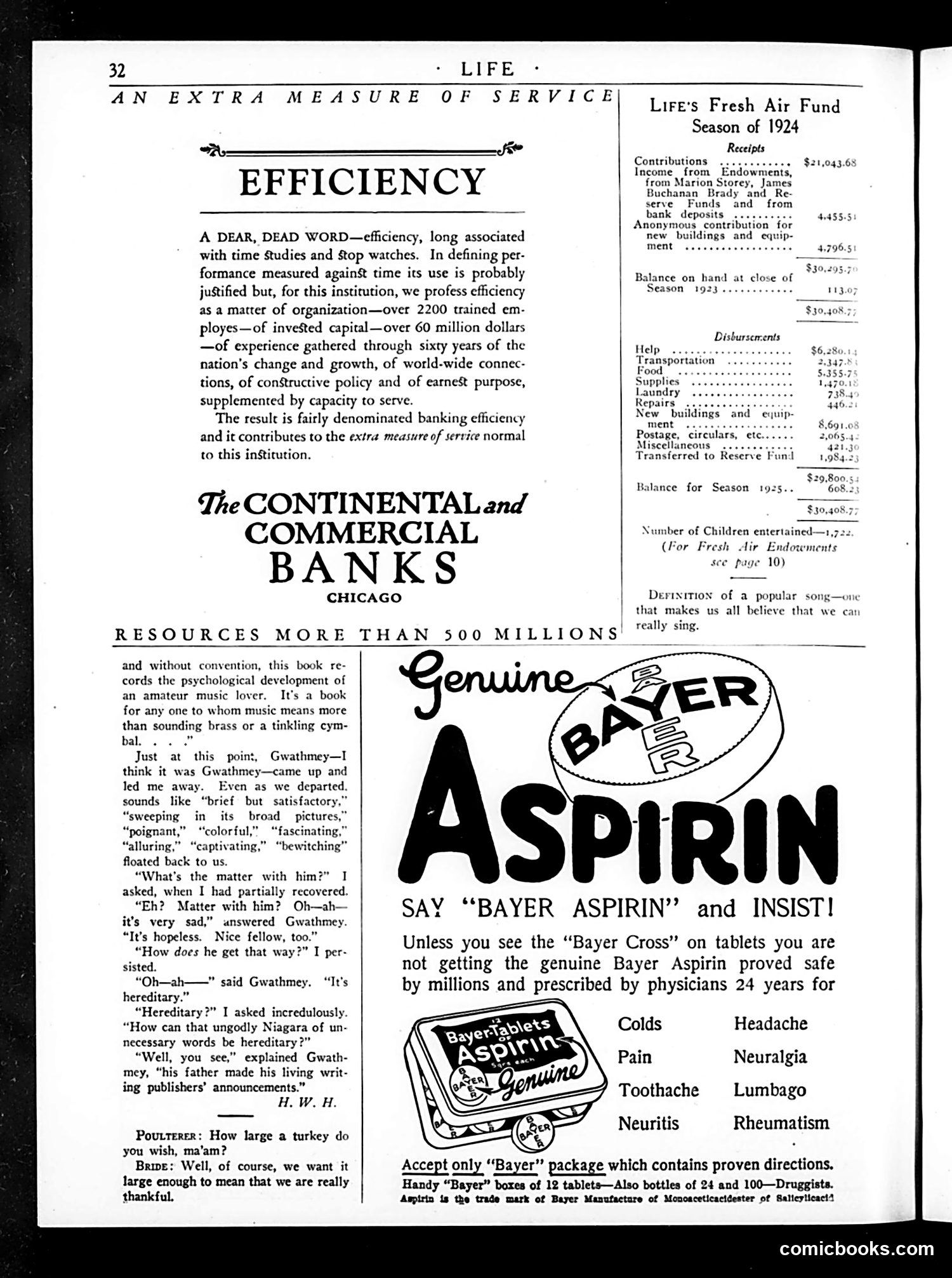
This page contains **three distinct elements**: a banking advertisement, a short humorous story, and a Bayer Aspirin ad. **Main Content**: The centerpiece is a satirical anecdote about an overly verbose music critic named Gwathmey who uses grandiose, affected language ("sweeping," "poignant," "captivating") to describe mundane things. When the narrator asks why he speaks this way, Gwathmey explains it's hereditary—his father made his living writing publishers' announcements, implying a profession built on inflated prose. The joke mocks pretentious literary criticism and advertising copywriting of the era. **Context**: The Continental and Commercial Banks advertisement emphasizes "efficiency" and "service," while also noting Life's Fresh Air Fund charity work. The final vignette about turkey size is a separate brief joke about gratitude. **The Bayer Aspirin ad** dominates the lower half, emphasizing brand authenticity and medical credibility—addressing 1920s concerns about counterfeit medicines.
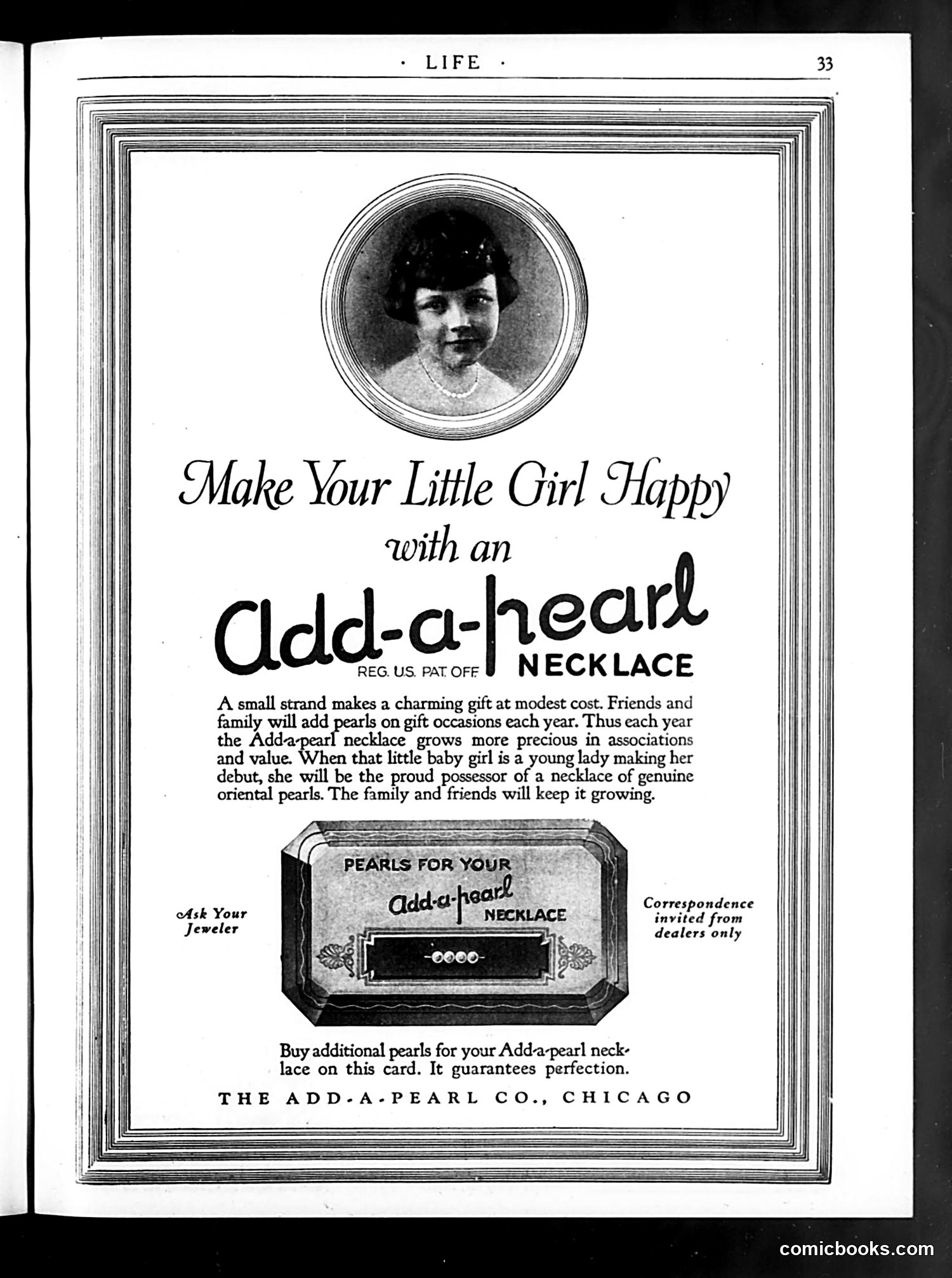
This is a **product advertisement, not satire**—a full-page ad for the Add-a-Pearl Necklace by The Add-a-Pearl Co. of Chicago. The concept targets wealthy or middle-class parents: buy your daughter an initial pearl necklace, then friends and family add pearls incrementally on birthdays and special occasions. By adulthood, she'll own a "genuine oriental pearl" necklace of sentimental value. The advertisement plays on **early 20th-century social conventions**: a girl's "debut" (formal introduction to society) marks her readiness for marriage. The necklace becomes both a status symbol and a keepsake documenting family relationships through gifts. The modest photograph of a young girl and the earnest language emphasize gentility and tradition. There's no humor intended—this represents genuine marketing strategy for an affluent consumer base valuing heirlooms and social ritual.
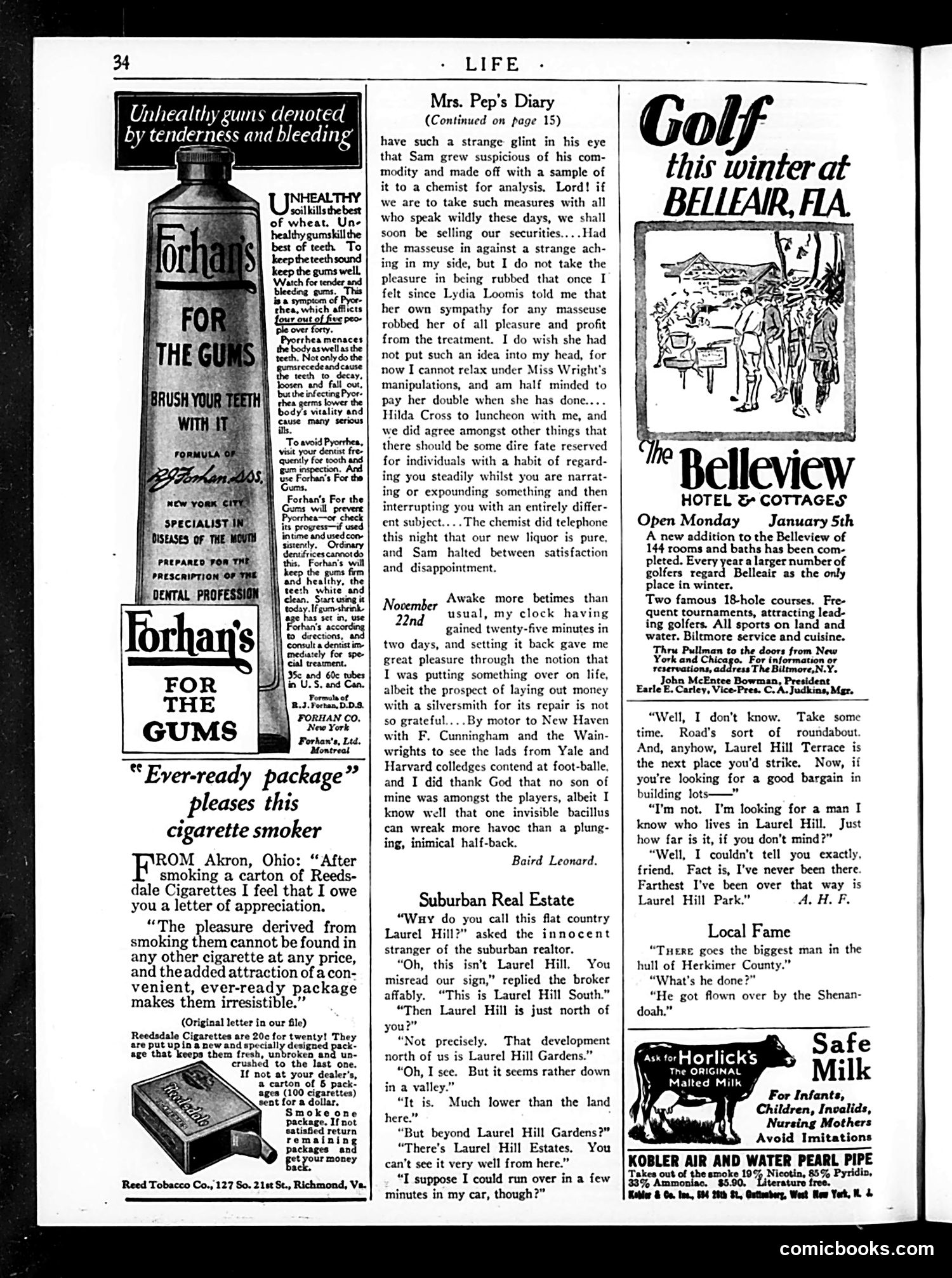
This page contains **advertisements and satirical diary entries** rather than political cartoons. The main content is "Mrs. Pep's Diary"—a humorous column mocking upper-class anxieties. Mrs. Pep worries about her masseuse's "sympathy" ruining her massage enjoyment, frets over financial securities, and obsesses over a clock gaining minutes. The November entry satirizes pretentious social rituals (attending Yale-Harvard football) and absurd real estate marketing. The "Suburban Real Estate" dialogue at bottom ridicules developer naming schemes: Laurel Hill, Laurel Hill South, Laurel Hill Gardens, and Laurel Hill Terrace are apparently all different developments in the same area—a jab at suburban sprawl and deceptive marketing practices that confuse buyers. Surrounding ads promote Forhan's toothpaste, Reedsdale cigarettes, and Belleair golf resort—typical 1920s product placement targeting affluent readers. The satire targets wealthy people's trivial concerns and real estate fraud.
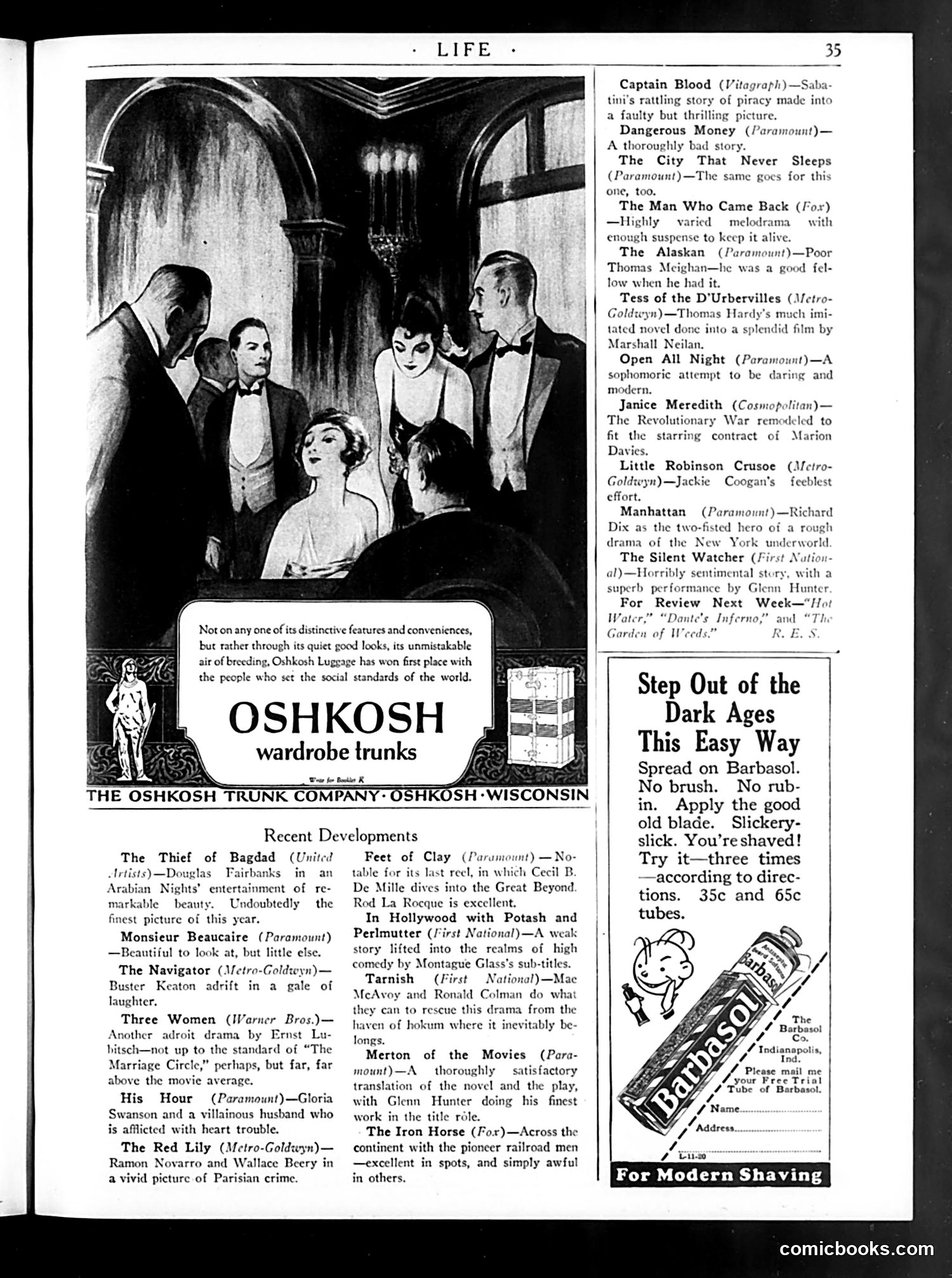
This page is primarily **film reviews and advertising** rather than political satire or editorial cartoons. The main content consists of brief movie critiques from early 1920s Hollywood, reviewing films starring Douglas Fairbanks, Buster Keaton, Gloria Swanson, and others. The reviews are sardonic—dismissing several films as "thoroughly bad" or "horribly sentimental"—reflecting Life's satirical voice toward contemporary entertainment. The advertisements occupy significant space: an Oshkosh wardrobe trunk ad emphasizes social status and "breeding," while a Barbasol shaving cream ad promotes ease-of-use with comedic language ("Dark Ages," "Slickery-slick"). The photograph at top shows formally dressed people in what appears to be a 1920s social scene, likely accompanying one of the film reviews, though the specific connection is unclear from the visible text. There are no political cartoons or caricatures on this page.
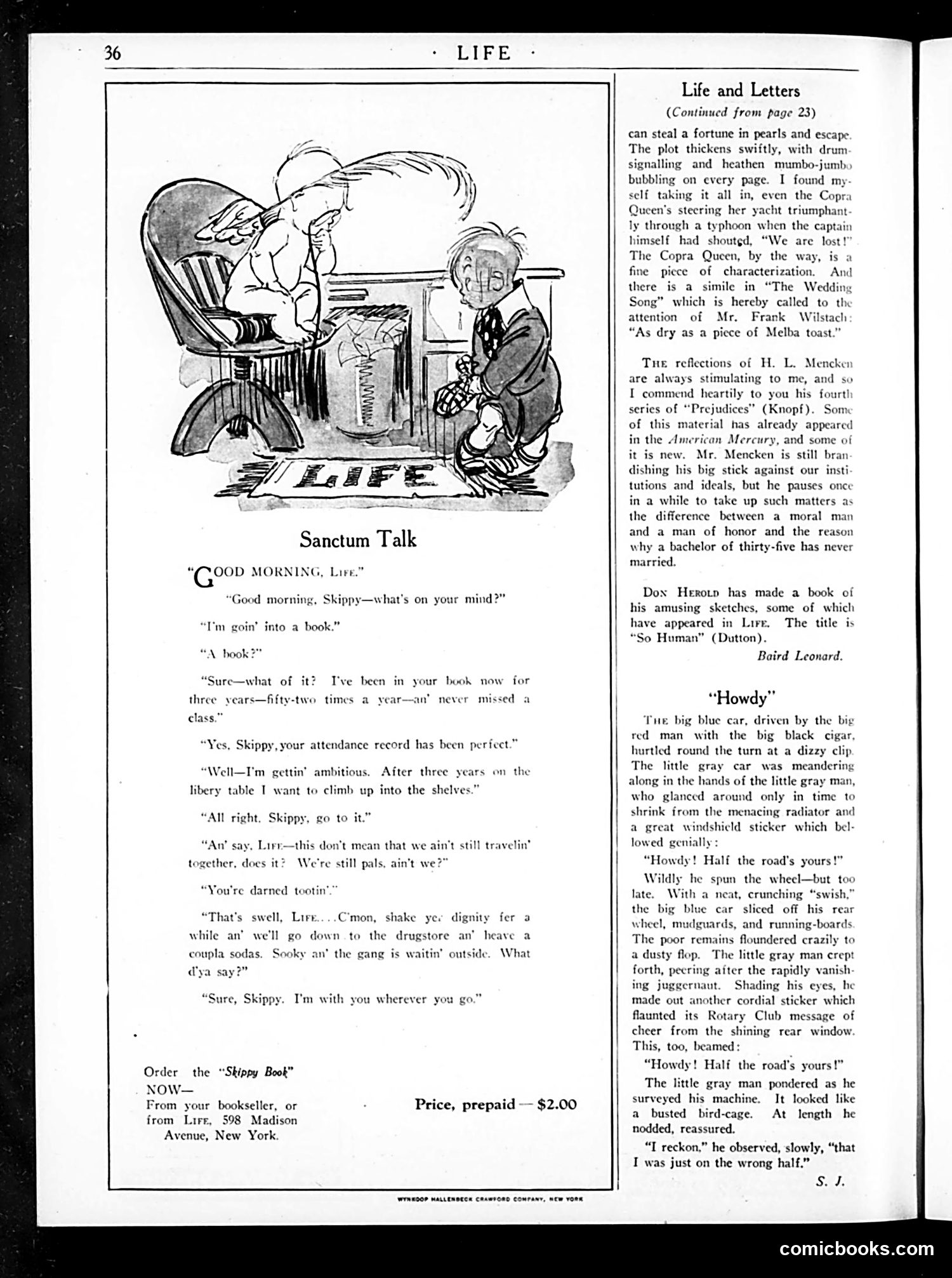
**"Sanctum Talk"** is a promotional piece disguised as dialogue between "Life" magazine personified and "Skippy," a popular comic strip character. Skippy announces he's graduating from appearing in Life's pages to being published as a standalone book. The joke plays on the metaphor of "being in Life's book"—Skippy has been featured fifty-two times yearly for three years, and now wants to "climb up into the shelves" as his own published volume. It's essentially an advertisement for the Skippy Book, using the character's charm to sell readers on purchasing it. **"Howdy"** is a humorous short story about road etiquette. A reckless driver in a big blue car, displaying a Rotary Club sticker reading "Howdy! Half the road's yours!", crashes into a cautious little gray car, destroying it. When the gray car's owner examines the wreckage, he spots an identical sticker on the fleeing blue car. His resigned conclusion: he was simply on the "wrong half" of the road. The satire mocks aggressive drivers and ironic civic-minded signage.
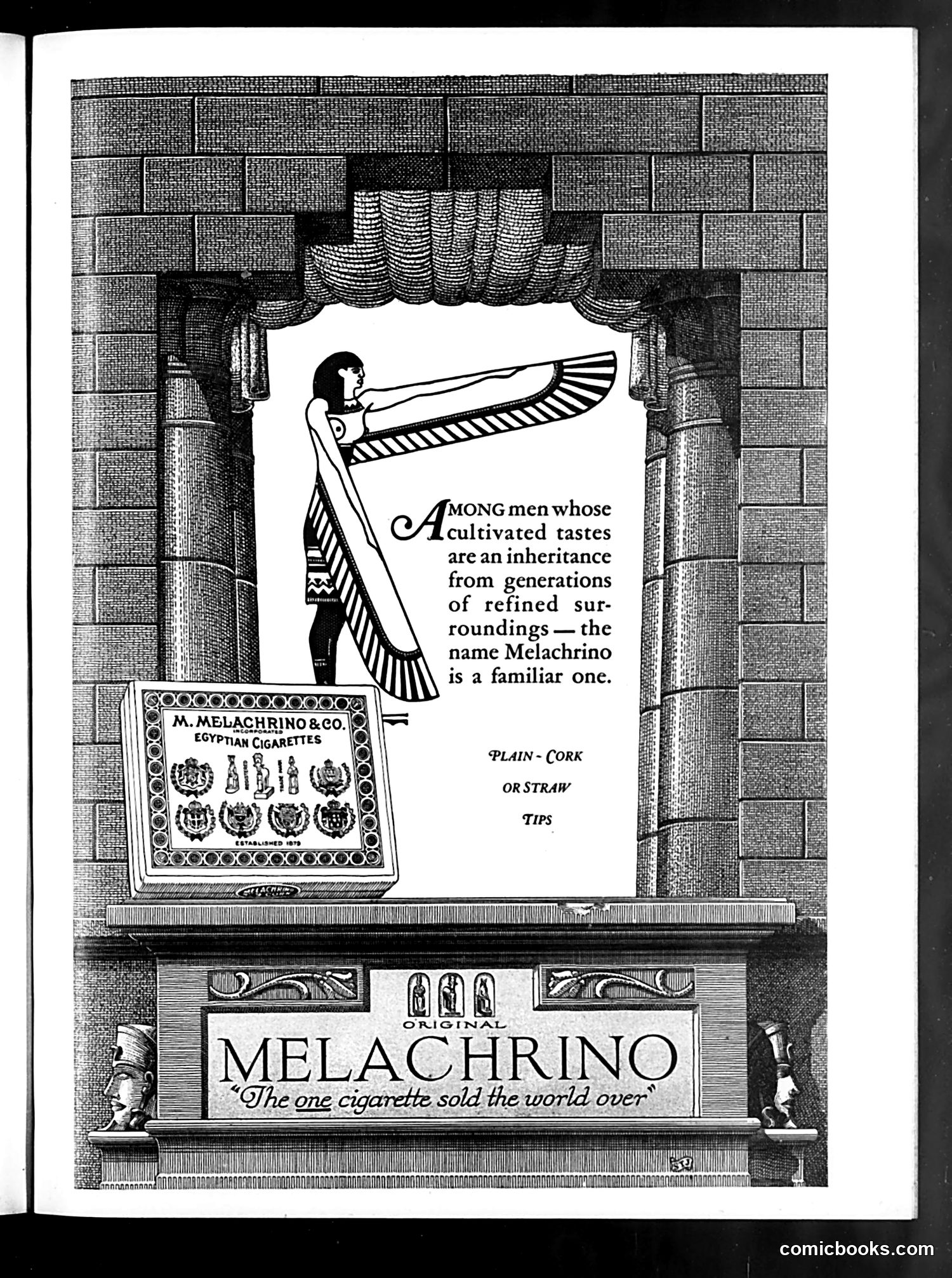
This is a **cigarette advertisement**, not political satire or a cartoon. It promotes Melachrino brand Egyptian cigarettes. The imagery uses Orientalist aesthetics common in early 20th-century advertising: an Egyptian figure in ancient dress holding a large decorative fan, framed within an Egyptian temple doorway. This visual appeals to fantasies of exotic luxury and refinement. The text's core message is snobbish: the Melachrino brand supposedly appeals to men of "cultivated tastes" and "refined surroundings"—positioning cigarette smoking as a marker of social class and inherited sophistication. The tagline "the one cigarette sold the world over" claims universal prestige. The page emphasizes available options (plain, cork, or straw tips), suggesting product variety for discerning consumers. This is pure marketing leveraging status anxiety and exoticism—standard advertising strategy of the era, though the racial and cultural stereotyping would be considered offensive today.
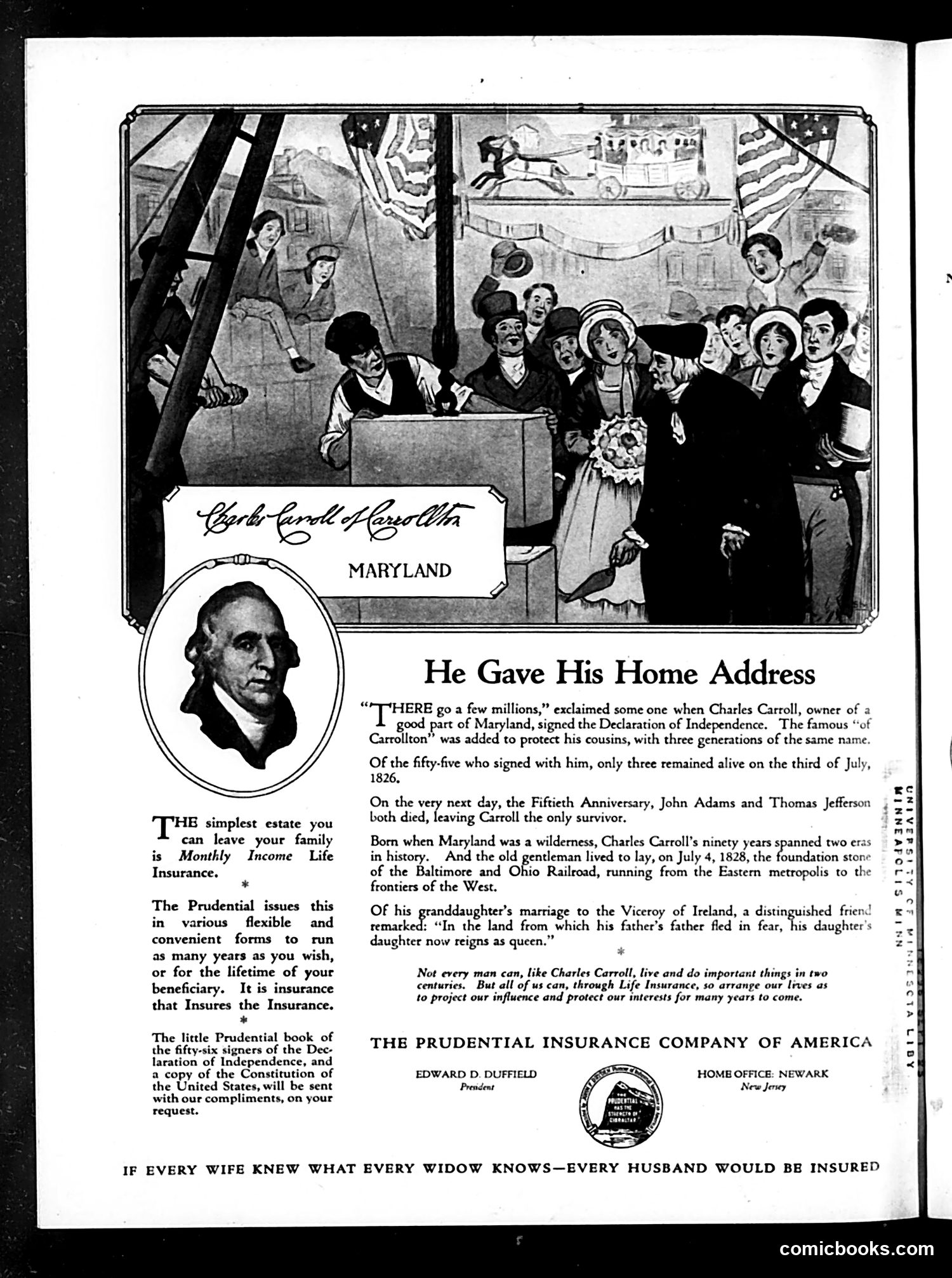
This is primarily a **Prudential Insurance advertisement** dressed as historical content, using Charles Carroll of Carrollton (a Declaration of Independence signer) as its pitch. **The Historical Figure:** Carroll lived 1735–1832, the last surviving Declaration signer. He witnessed America's founding and industrial expansion (laying the B&O Railroad cornerstone in 1828). His family added "of Carrollton" to distinguish him from cousins with the same name. **The Sales Angle:** Prudential exploits Carroll's longevity to argue that life insurance lets people "project influence" across generations—just as Carroll's great-granddaughter married Irish nobility. The subtext: without insurance, your family loses security; with it, your legacy endures. **The Dark Tagline:** "If every wife knew what every widow knows—every husband would be insured" implies widows face financial ruin, using shame to motivate male breadwinners to buy policies. The cartoon at top shows Carroll signing the Declaration while crowds celebrate—romanticizing patriotism to associate Prudential with American values.