
Life, 1924-11-20 · page 18 of 40
Life — November 20, 1924 — page 18: what you’re looking at
What you’re looking at
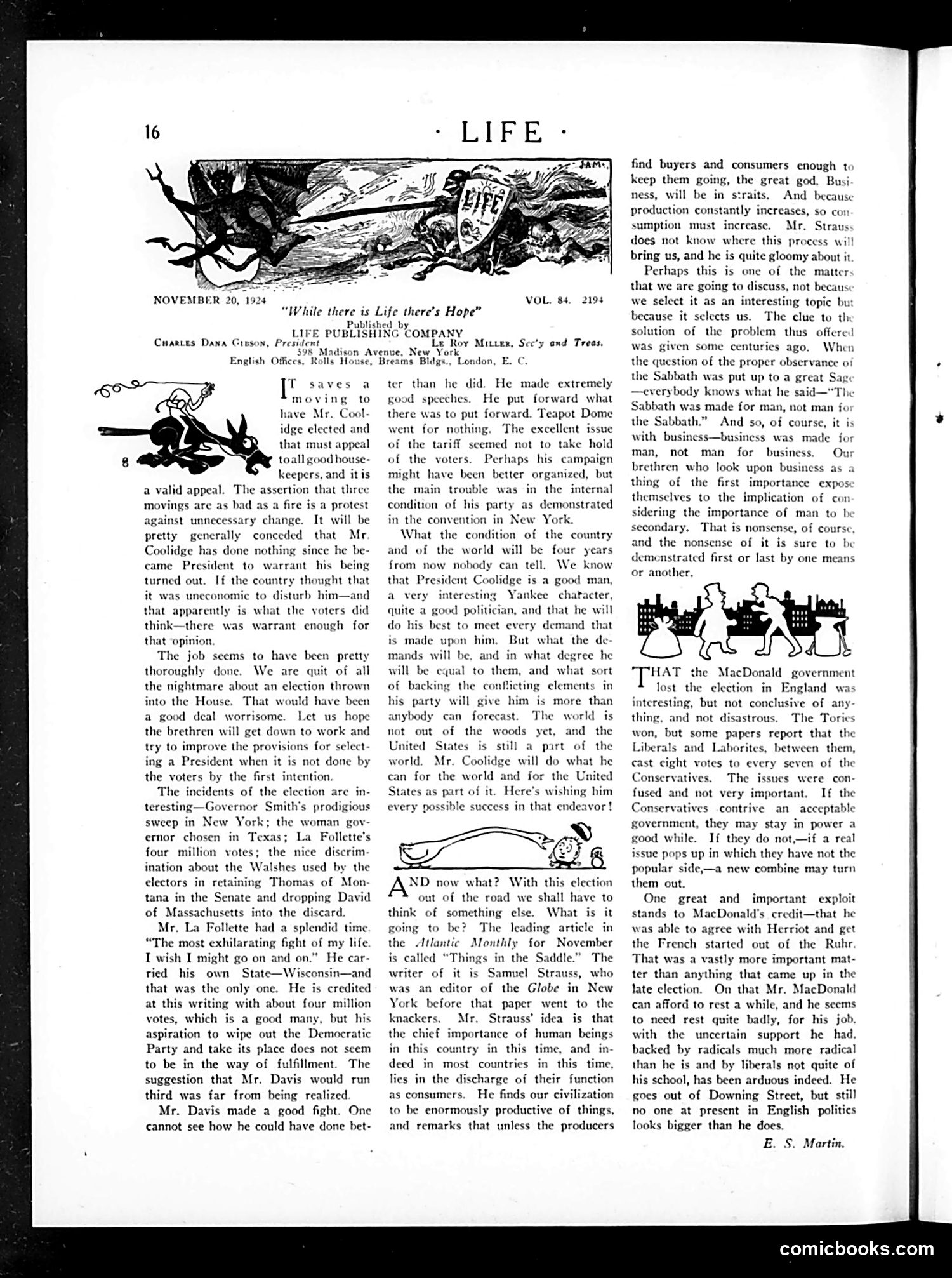
This page from Life magazine analyzes the 1924 U.S. presidential election results. The editorial celebrates President Coolidge's victory, noting voters rejected unnecessary "change" (depicted by the moving/fire metaphor in the cartoon). The piece discusses notable election outcomes: Governor Smith's landslide in New York, a female governor elected in Texas, and Robert La Follette's surprisingly strong third-party performance (four million votes, though winning only Wisconsin). It dismisses Democratic candidate John W. Davis's defeat as partly due to internal party division. The editorial expresses cautious optimism about Coolidge's presidency while acknowledging uncertainty about global conditions ahead. A secondary article excerpt discusses "Things in the Saddle," arguing that Americans' primary importance in modern life derives from their role as **consumers**—a notably early articulation of consumer culture's centrality to national identity. The overall tone is conservative, establishment-friendly, and focused on economic stability over political upheaval.
📄 Transcribed text from this page (OCR, searchable)
Machine-transcribed from the original scan — historical spelling and the odd misread are preserved.
Ee NOVEMBER 20, 1924 VOL. 84. 2194 “While there is Life there’s Hop Published by °E PUBLISHING COMPANY Cuartes Dana Cinson, Pri Madison Avenue, ¢, Brea English Offices, Rolls H ie saves a moving to have Mr. Cool- idge elected and that must appeal toall good house- keepers, and itis a valid appeal. The assertion that three movings are as bad as a fire is a protest against unnecessary change. It will be pretty generally conceded that Mr Coolidge has done nothing since he be- came President to warrant his being turned out. If the country thought that it was uneconomic to disturb him—and that apparently is what the voters did think—there was warrant enough for that opinion. The job seems to have been pretty thoroughly done. We are quit of all the nightmare about an election thrown into the House. That would have been a good deal worrisome. Let us hope the brethren will get down to work and try to improve the provisions for select- ing a President when it is not done by the voters by the first intention. The incidents of the election are in- teresting—Governor Smith's prodigious sweep in New York; the woman gov- ernor chosen in Texas; La Follette's four million votes; the nice discrim- ination about the Walshes used by the electors in retaining Thomas of Mon- tana in the Senate and dropping David of Massachusetts into the discard. Mr. La Follette had a splendid time. “The most exhilarating fight of my life. I wish I might go on and on.” He car- tied his own State—Wisconsin—and that was the only one. He is credited at this writing with about four million votes, which is a good many, but his aspiration to wipe out the Democratic Party and take its place does not seem to be in the way of fulfillment. The suggestion that Mr. Davis would run third was far from being realized Mr. Davis made a good fight. One cannot see how he could have done bet- Le Roy Miter, Sec’y and Treas. New York s Bldg lon, E. C. ter than he did. He made extremely good speeches. He put forward what there was to put forward. Teapot Dome went for nothing. The excellent issue of the tariff seemed not to take hold of the voters. Perhaps his campaign might have been better organized, but the main trouble was in the internal condition of his party as demonstrated in the convention in New York. What the condition of the country and of the world will be four years from now nobody can tell. We know that President Coolidge is a good man, a very interesting Yankee chatacter, quite a good politician, and that he will do his best to meet every demand that is made upon him. But what the de- mands will be, and in what degree he will be 1 to them, and what sort of backing the confticting elements in his party will give him is more than anybody can forecast. The world is not out of the woods yet, and the United States is still a part of the world. Mr. Coolidge will do what he can for the world and for the United States as part of it. Here’s wishing him every possible success in that endeavor ! ND now what? With this election out of the road we shall hav think of something else. What is it going to be? The leading article in the Atlantic Monthly for November is called “Things in the Saddle.” The writer of it is Samuel Strauss, who was an editor of the Globe in New York before that paper went to the knackers. Mr. Strauss’ idea is that the chief importance of human beings in this country in this time, and in- deed in most countries in this time, lies in the discharge of their function as consumers. He finds our civilization to be enormously productive of things, and remarks that unless the producers find buyers and consumers enough t: keep them going, the great god, Busi ness, will be in straits. And because production constantly increases, so con sumption must increase. Mr. Straus does not know where this process wil bring us, and he is quite gloomy about it Perhaps this is one of the matter that we are going to discuss, not becaus: we select it as an interesting topic but because it selects us. The clue to th solution of the problem thus offered was given some centuries ago. When the question of the proper observance of the Sabbath was put up to a great Sage ‘erybody knows what he said—"The Sabbath was made for man, not man fo’ the Sabbath.” And so, of course, it with business—business was made man, not man for business. Our brethren who look upon business as a thing of the first importance expos themselves to the implication of con sidering the importance of man to be secondary, That is nonsense, of course, and the nonsense of it is sure to be demonstrated first or last by one means or another, HAT the MacDonald government lost the election in England w interesting, but not conclusive of any- thing, and not disa The Tories won, but some papers report that the Liberals and Laborites, between them, cast cight votes to every seven of the Conservatives. The issues were con- fused and not very important. If the Conservatives contrive an acceptable government, they may stay in power a good while. If they do not,—if a real issue pops up in which they have not the popular side,—a new combine may turn them out. One great and important exploit stands to MacDonald's credit—that he was able to agree with Herriot and get the French started out of the Ruhr. That was a vastly more important mat- ter than anything that came up in the late election. On that Mr. MacDonald can afford to rest a while, and he seems to need rest quite badly, for his job. with the uncertain support he had, backed by radicals much more radical than he is and by liberals not quite of his school, has been arduous indeed. He goes out of Downing Street, but still no one at present in English politics looks bigger than he does. E. S. Martin. trous. comicbooks.com