
Life, 1924-11-20 · page 22 of 40
Life — November 20, 1924 — page 22: what you’re looking at
What you’re looking at
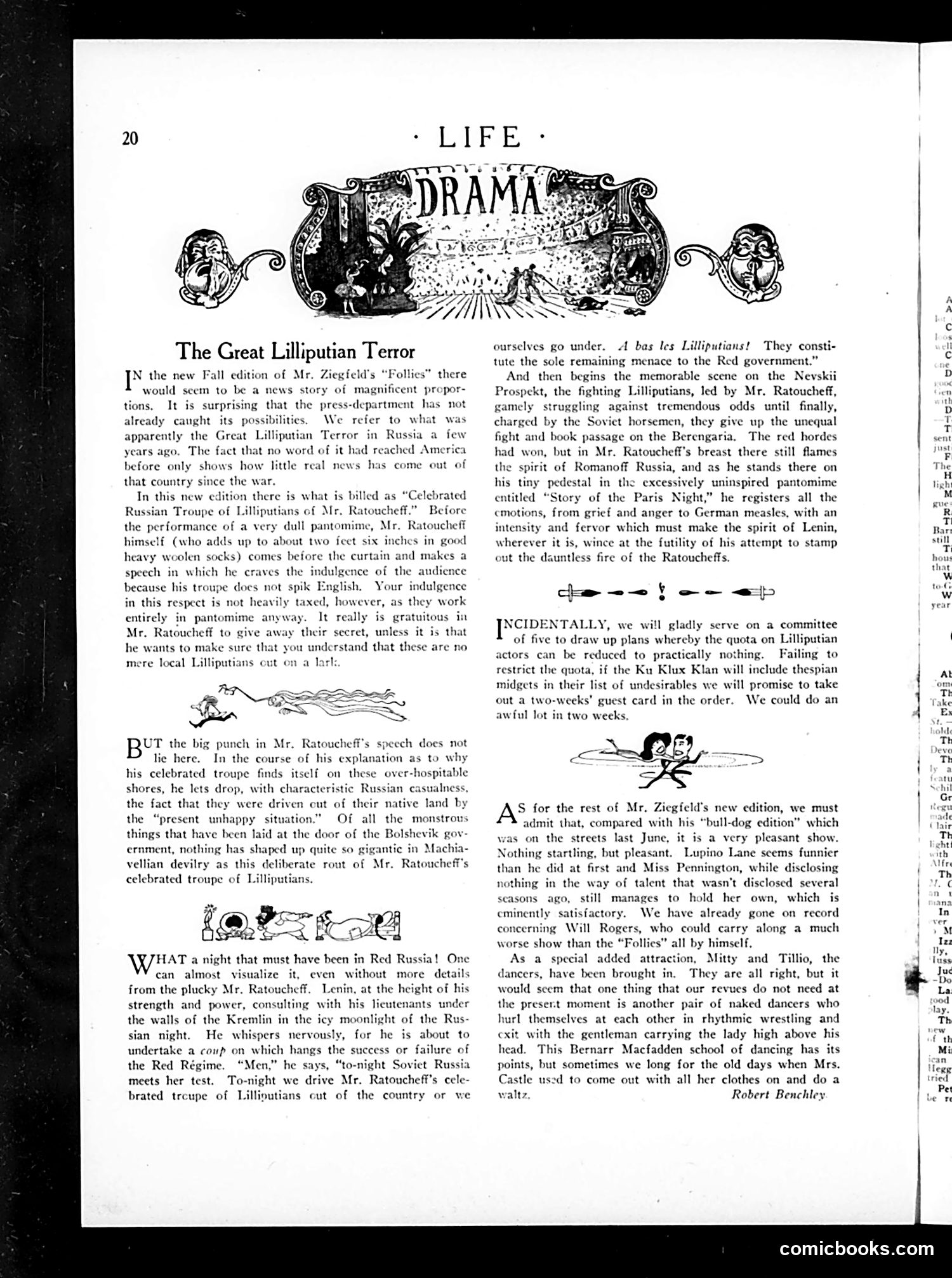
This piece mocks both the Soviet Russian government and theatrical impresario Florenz Ziegfeld's Fall "Follies" production featuring a troupe of Russian dwarves ("Lilliputians"). The satire works on two levels: First, it ridicules the absurd claim that Soviet leader Lenin orchestrated the expulsion of performer Ratoucheff's dwarf troupe as a genuine threat to the Red government—suggesting the Bolsheviks are so petty and paranoid they'd target midgets. Second, it sarcastically praises Life's own willingness to support restricting "Lilliputian actors" through quotas, even jokingly offering to join the KKK to help exclude theatrical midgets from undesirables lists. The humor relies on Cold War-era anti-Soviet sentiment, mock-heroic language about Lenin's "desperate" military campaigns against tiny performers, and absurdist exaggeration to highlight perceived Soviet irrationality. The final joke about Mitty and Tillio (likely other performers) dancing while raising their legs above their heads completes the mockery of this "unstarling, but pleasant" show.
📄 Transcribed text from this page (OCR, searchable)
Machine-transcribed from the original scan — historical spelling and the odd misread are preserved.
The Great Lilliputian Terror IX the new Fall edition of Mr. Ziegfeld’s “Follies” there would seem to be a news story of magnificent propor- tions, It is surprising that the press-department has not i We refer to what was possibili already caught its apparently the Great Lilliputian Terror in Russia years a The fact that no word of it had reached Ame before only shows how little real news has come out of 2 few a that country since the war, In this new edition there is what is billed as “Celebrated Russian Troupe of Lilliputians of Mr. Ratoucheff.” Before the performance of a very dull pantomime, Mr, Ratoucheff himself (who adds up to about two fect six inches in good heavy woolen socks) comes before the curtain and makes a speech in whi lulgence of the audi because his troupe docs not spik English. Your indulgence in this respect is not heavily taxed, however, as they work entirely in pantomime anyway. It really is gratuitous in Mr. Ratoucheff to give away their secret, unless it is that he wants to make sure that you understand that these are no mere local Lilliputians out on a lark. - RS = wea UT the big punch in Mr. Ratoucheff’s speech does not lie here. In the course of his explanation as to why his celebrated troupe finds itself on these over-hospitable shores, he lets drop, with characteristic Russian casualness, the fact that they were driven out of their native land by the “present unhappy situation.” Of all the monstrou: things that have been laid at the door of the Bolshevik ernment, nothing has shaped up quite so gigantic in Machia- vellian devilry as this deliberate rout of Mr. Ratoucheff’s celebrated troupe of Lilliputians. h he craves th c iN Ri wit a night that must have been in Red Russia! One can almost visualize it, even without more de! from the plucky Mr. Ratoucheff. Lenin, at the height of his strength and power, consulting with his licuten: the walls of the Kremlin in the icy moonlight of the Rus- sian night. He whispers nervously, for he is about to undertake a coup on which hangs the success or failure of the Red Régime. “Men,” he says, “to-night Sovict Russia meets her test. To-night we drive Mr. Ratoucheff’s cele- brated treupe of Lilliputians cut of the country or we s under A bas les Lilliputians!’ They consti- tute the sole remaining menace to the Red government.” And then begins the memorable scene on the Nevsk Prospekt, the fighting Lilliputians, led by Mr. Ratoucheff, gamely struggling against tremendous odds until finally, charged by the Soviet horsemen, they give up the unequal fight and book passage on the Berengaria, The red hordes had won, but in Mr. Ratoucheff’s breast there still flames it of Romanoff Russia, and as he stands there on his tiny pedestal in the excessively uninspired pantomime entitled “Story of the Paris Night,” he registers all the cmotions, from grief and anger to German measles, with an intensity and fervor which must make the spirit of Lenin, wherever it is, wince at the futility of his attempt to stamp out the dauntless fire of the Ratoucheffs. che --— $$ oe ~<— ourselves go unde: ‘TALLY, we will gladly serve on a committee to draw up plans whereby the quota on Lilliputian actors can be reduced to practically nothing. Failing to restrict the quota, if the Ku Klux Klan will include thespian midgets in their list of undesirables we will promise to take out a two-weeks’ guest card in the order. We could do an awful lot in two weeks, for the rest of Mr. Ziegfeld’s new edition, we must admit that, compared with his “bull-dog edition” which was on the streets last June, it is a very pleasant show. Nothing startling, but pleasant. Lupino Lane seems funnier than he did at first and Miss Pennington, while disclosing nothing in the way of talent that wasn't disclosed several a still manages to hold her own, which is cminently satisfactory. We have already gone on record concerning Will Rogers, who could carry along a much worse show than the “Follies” all by himself, As a special added attraction, Mitty and Tillio, the dancers, have been brought in. They are all right, but it would scem that one thing that our revues do not need at the presert moment is another pair of naked dancers who hurl themselves at each other in rhythmic wrestling ai cxit with the gentleman carrying the lady high above his head. This Bernarr Macfadden school of dancing has its points, but sometimes we long for the old days when Mrs. Castle used to come out with all her clothes on and do a waltz. Robert Benchley scasons comicbooks.com