
Life, 1924-11-20 · page 25 of 40
Life — November 20, 1924 — page 25: what you’re looking at
What you’re looking at
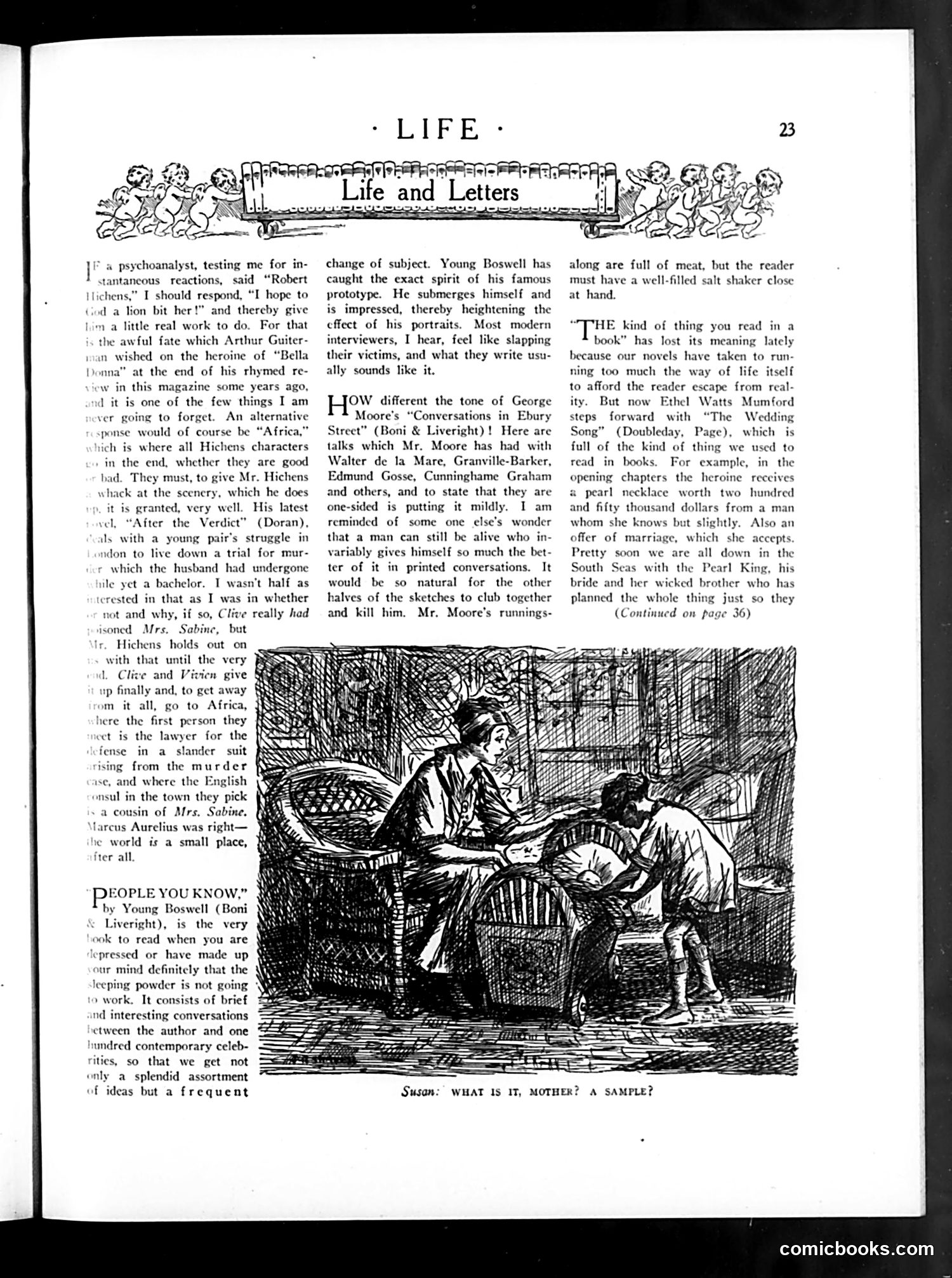
This page reviews contemporary books, featuring one illustration. The cartoon shows a woman offering a man a sample from a basket, with the caption "SUSAN: WHAT IS IT, MOTHER? A SAMPLE?" The joke appears to reference **Robert Hichens**, a popular novelist whom the critic discusses extensively. Hichens was known for sensational plots and romantic entanglements. The illustration likely alludes to one of his novels' plot devices—possibly a woman offering something (literally or figuratively) to a man in a compromising situation, playing on readers' expectations of scandal or seduction common in Hichens's work. The surrounding text mocks Hichens's formulaic approach: his characters always end up in Africa, his plots involve murder trials and poisonings, and his narratives are predictable. The cartoon's domestic scene—a mother asking about a "sample"—is likely satirizing how Hichens sensationalizes ordinary situations into melodrama. The page is primarily book criticism, not political satire.
📄 Transcribed text from this page (OCR, searchable)
Machine-transcribed from the original scan — historical spelling and the odd misread are preserved.
\° a psychoanalyst, testing me for in- stantaneous reactions, said “Robert ilichens,” I should respond, “I hope to God a lion bit her!” and thereby give Lima little real work to do. For that the awful fate which Arthur Guiter- aan wished on the heroine of “Bella at the end of his rhymed re- w in this magazine some years ago, 1 it is one of the few things I am ver going to forget. An alternative sponse would of course be “Africa,” rich is where all Hichens characters in the end, whether they are good bad. They must, to give Mr. Hichens whack at the scenery, which he does it is granted, very well. His latest cl, “After the Verdict” (Doran), ils with a young pair’s struggle in ndon to live down a trial for mur- which the husband had undergone ile yet a bachelor. I wasn’t half as crested in that as I was in whether t and why, if so, Clive really had isoned Mrs. Sabine, but ir. Hichens holds out on with that until the very 1. Clive and Vi ive up finally and, to get away om it all, go to Africa, here the first person they cet is the lawyer for the fense in a slander suit ising from the murder ase, and where the English onsul in the town they pick >a cousin of Mrs. Sabine. tareus Aurelius was right— ¢ world is a small place, fter all. Donna’ EOPLE YOU KNOW,” by Young Boswell (Boni Liveright), is the very ook to read when you are lepressed or have made up ur mind definitely that the leeping powder is not going » work. It consists of brief nd interesting conversations etween the author and one lumdred contemporary celeb- rities, so that we get not change of subject. Young Boswell has caught the exact spirit of his famous prototype. He submerges himself and is impressed, thereby heightening the effect of his portraits. Most modern interviewers, I hear, feel like slapping their victii and what they write usu- ally sounds like it. OW different the tone of George Moore's “Conversations in Ebury Street” (Boni & Liveright)! Here are talks which Mr. Moore has had with Walter de la Mare, Granville-Barker, Edmund Gosse, Cunninghame Graham and others, and to state that they are one-sided is putting it mildly. I am reminded of some one else’s wonder that a man can still be alive who in- variably gives himself so much the bet- ter of it in printed conversations. It would be so natural for the other halves of the sketches to club together and kill him. Mr. Moore's runnings- only a splendid assortment. of ideas but a frequent Susan: along are full of meat, but the reader must have a well-filled salt shaker close at hand. “THE kind of thing you read in a book” has lost its meaning lately because our novels have taken to run- ning too much the way of life itself to afford the reader escape from real- ity. But now Ethel Watts Mumford steps forward with “The Wedding Song” (Doubleday, Pag which is full of the kind of thing we used to read in books. For example, in the opening chapters the heroine receives a pearl necklace worth two hundred and fifty thousand dollars from a man whom she knows but slightly. Also an offer of marriage, which she accepts. Pretty soon we are all down in the South Seas with the Pearl King, his bride and her wicked brother who has planned the whole thing just so they (Continued on pagi WHAT 1S 1T, MOTHER? A SAMPLE? comicbooks.com