
A complete issue · 36 pages · 1924
Life — August 7, 1924
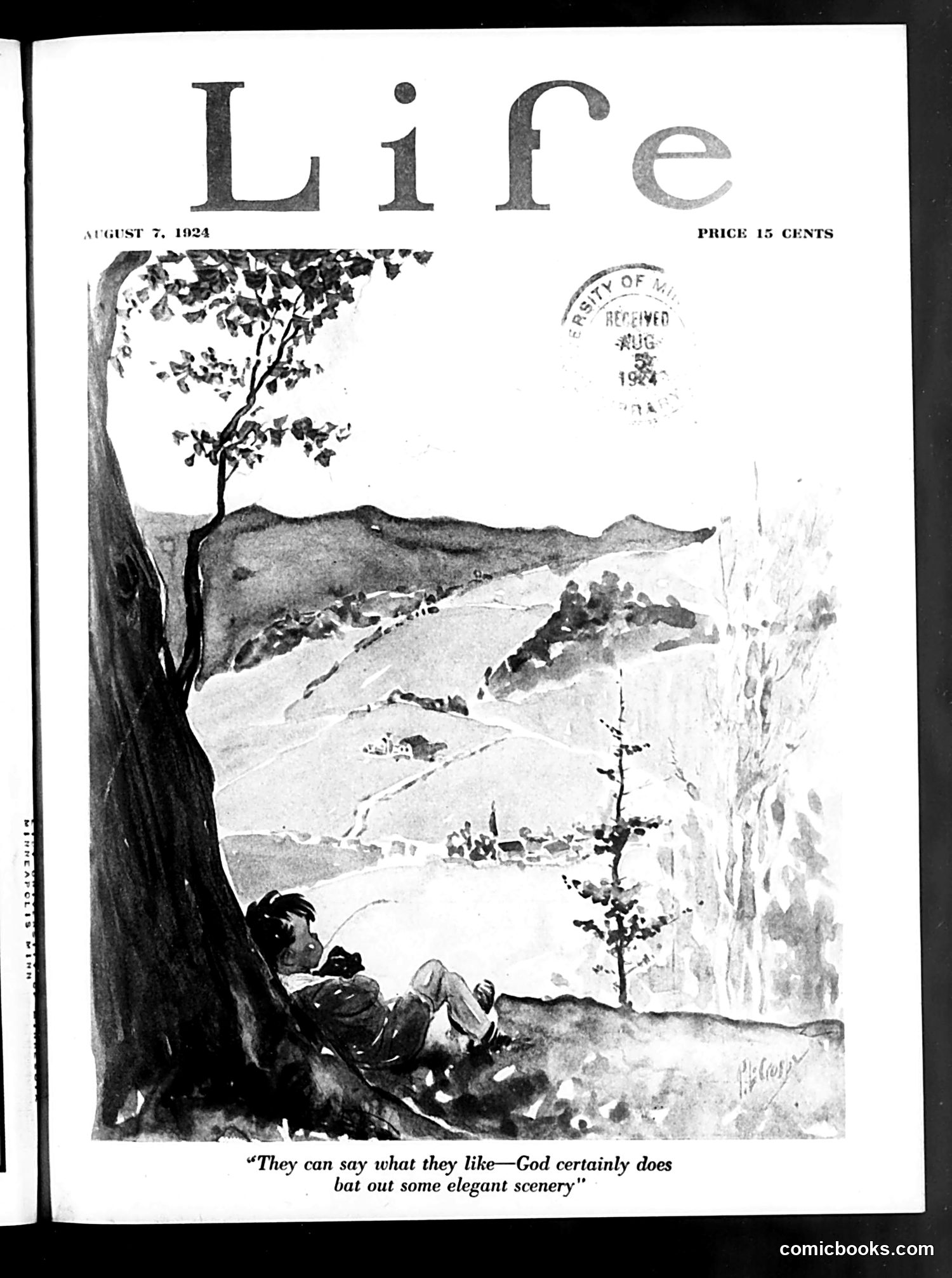
This cover illustration depicts a person resting beneath a large tree, gazing out at an expansive pastoral landscape with rolling hills, scattered buildings, and farmland. The accompanying caption—"They can say what they like—God certainly does bat out some elegant scenery"—expresses appreciation for natural beauty. The satire appears gentle rather than pointed: it's likely mocking either excessive sentimentality about nature, or perhaps the sort of people who offer platitudes about God's creation while remaining passive observers. The figure's relaxed contentment suggests ironic detachment from grander concerns, a common Life magazine theme of the 1920s. Without additional context from the issue, the specific target remains unclear, though the tone suggests mild social commentary rather than sharp political critique.
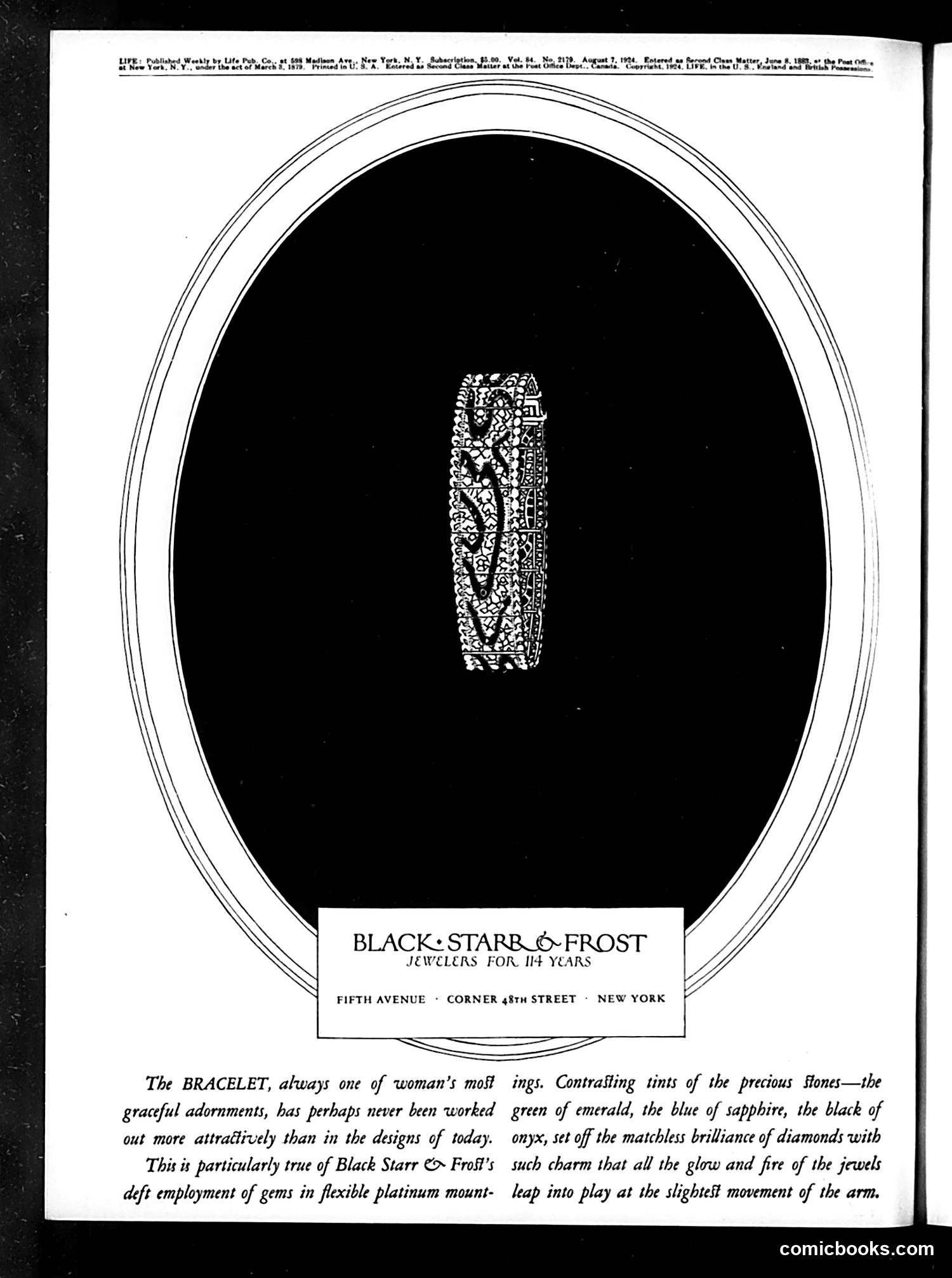
This page is **primarily an advertisement**, not satirical content. It features a Black Starr & Frost jewelry company ad for a bracelet, positioned in an oval frame against a black background. The ornate bracelet displayed is shown as a luxury item. The accompanying text emphasizes the bracelet's elegance and the company's expertise in gemstone settings—featuring emeralds, sapphires, onyx, and diamonds in platinum mounts. The ad highlights that Black Starr & Frost has been "jewelers for 114 years," positioning the company as an established, prestigious luxury brand. The messaging targets wealthy women, describing the bracelet as "always one of woman's most prized adornings." This represents standard early 20th-century luxury advertising with no apparent political satire or social commentary.
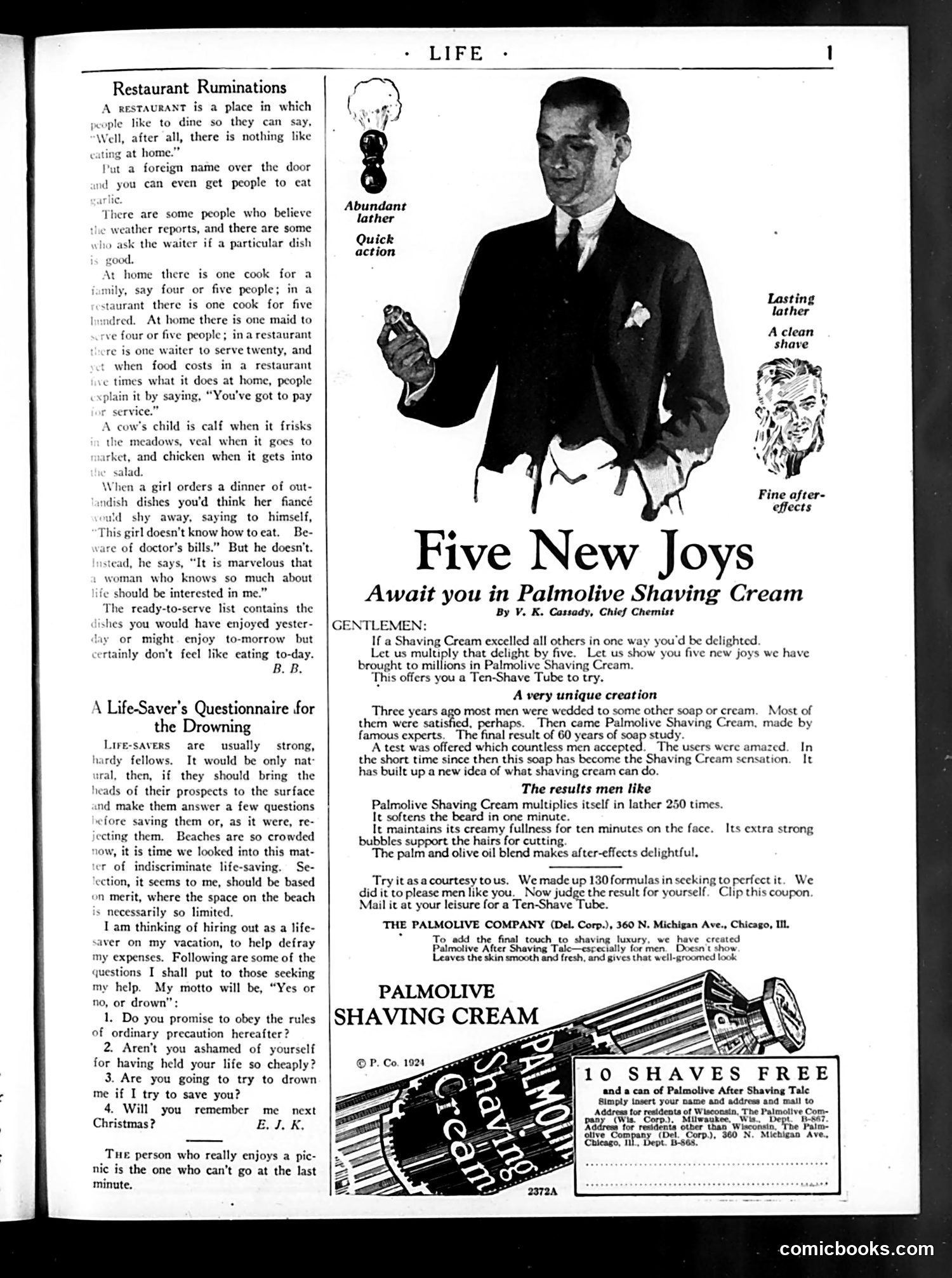
This page is primarily an **advertisement for Palmolive Shaving Cream** (1920s era, based on the copyright mark "© P. Co 1921"). The top-left section contains "Restaurant Ruminations"—a brief satirical column mocking dining culture, particularly the pretension of restaurants compared to home cooking and the tendency to blame high prices on "service." The central image shows **a well-dressed man in formal attire** holding what appears to be a grenade or explosive device, alongside illustrations of shaving products. The headline "Five New Joys" advertises benefits of Palmolive Shaving Cream. The right sidebar includes "A Life-Saver's Questionnaire for the Drowning"—another humorous column with absurdist advice for vacation hiring. The page is **primarily commercial content** rather than political satire. The "grenade" imagery likely emphasizes the product's effectiveness humorously, comparing shaving quality to explosive results.
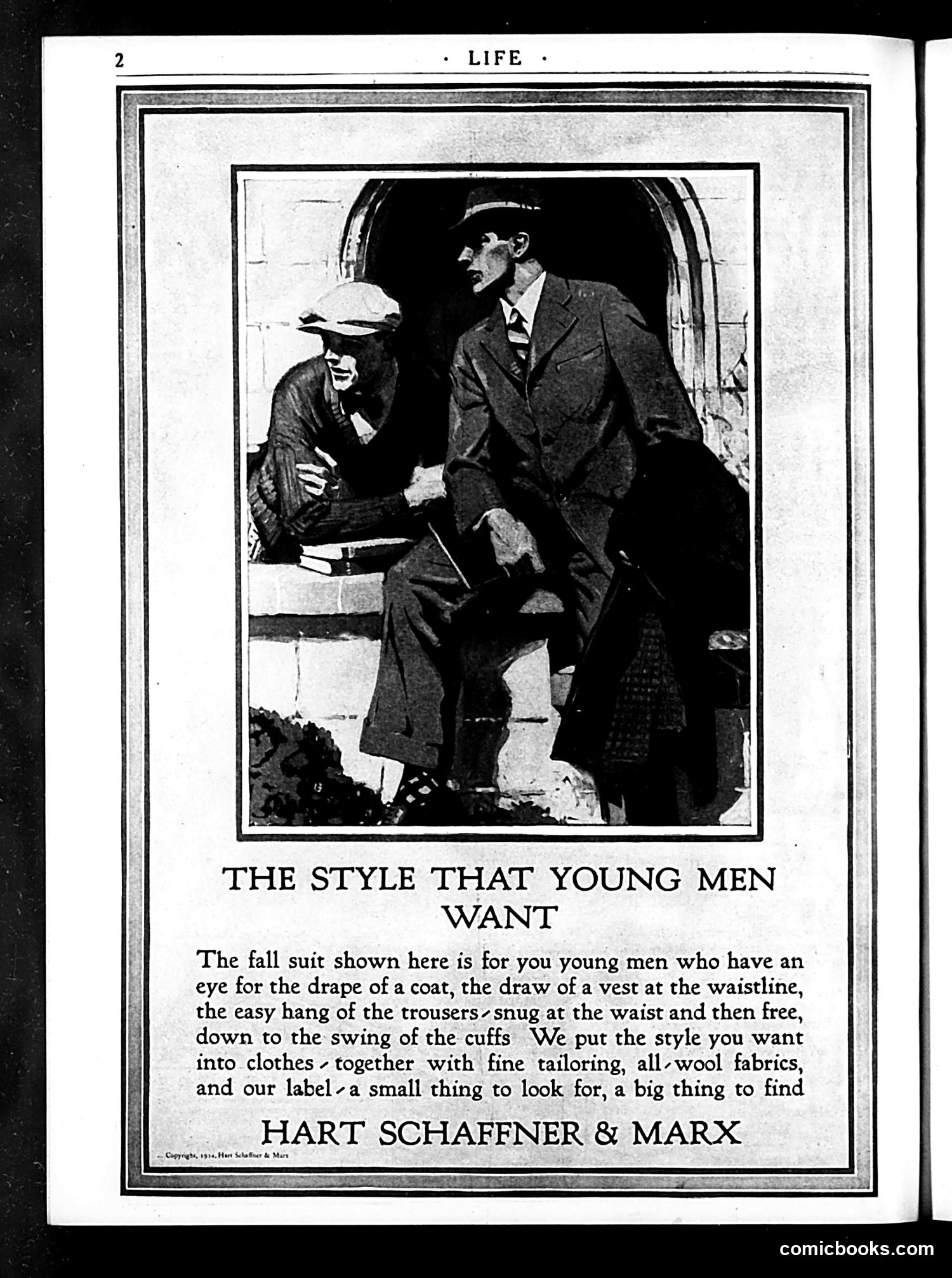
This is a **fashion advertisement**, not political satire. Hart Schaffner & Marx, a menswear company, uses the headline "The Style That Young Men Want" to market fall suits to an affluent male audience. The image shows two well-dressed men in suits examining clothing, likely in a tailor shop or fitting room. The advertisement emphasizes specific tailoring details appealing to 1920s men's fashion preferences: proper coat drape, vest fit at the waistline, and trousers that are "snug at the waist and then free, down to the swing of the cuffs." The brand positions itself as offering quality all-wool fabrics with fine tailoring, using the tagline "a small thing to look for, a big thing to find"—referring to their label as a marker of quality and status among discerning young men of the era.
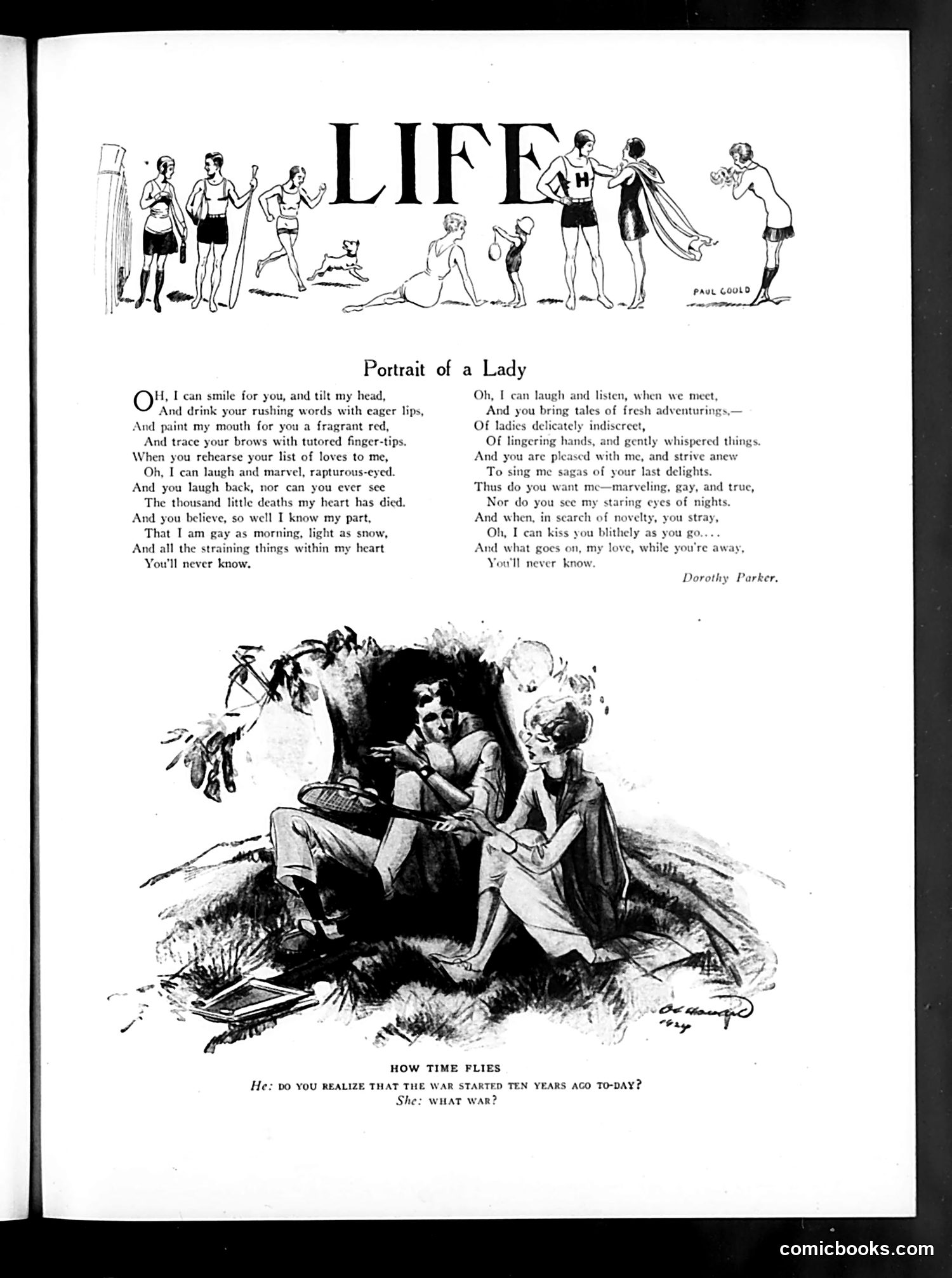
This page from *Life* magazine contains poetry and satirical illustrations. The title poem "Portrait of a Lady" by Dorothy Parker uses ironic romanticism—the speaker claims devotion while admitting the lady will "never know" his true feelings, suggesting emotional distance masked by performance. The lower cartoon titled "How Time Flies" depicts a couple in wartime. The man mentions "the war started ten years ago to-day," and the woman responds "WHAT WAR?"—satirizing how civilians, particularly women removed from combat, lose track of or remain indifferent to ongoing military conflict. The illustration suggests the disconnect between those experiencing war's reality and those insulated from it, likely referencing World War I (given the publication era and the "ten years" reference).
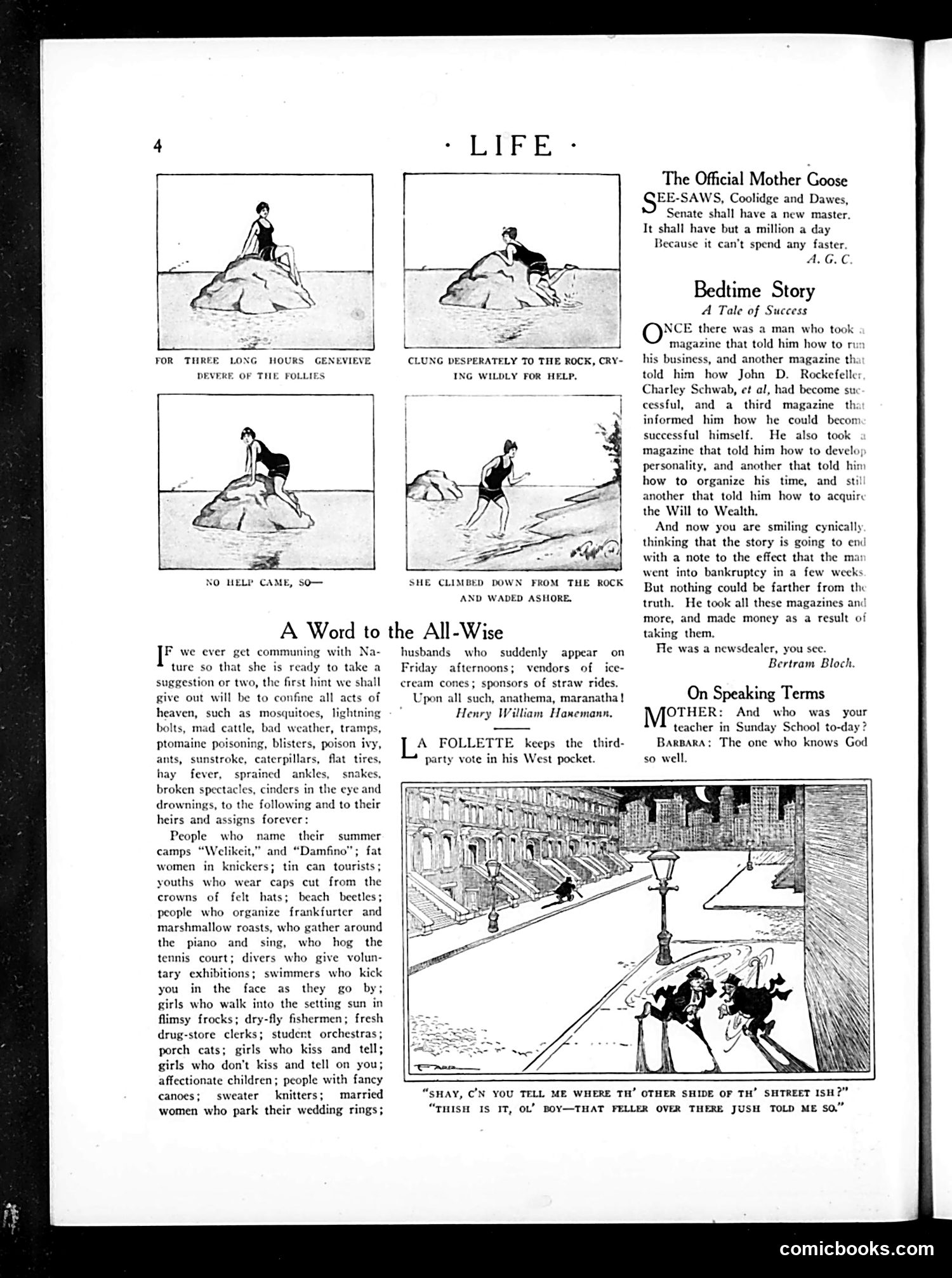
The top panel depicts a humorous sequence about a woman stranded on a rock. The captions suggest she's been there "three long hours" while "devising devery of the follies," then "clung desperately to the rock, crying willy for help." When "no help came," she ultimately "climbed down from the rock and waded ashore"—satirizing exaggerated female helplessness and melodrama. The lower section includes brief satirical pieces: "A Word to the All-Wise" critiques nature conservation excess, "On Speaking Terms" presents a mother-daughter joke about Sunday school teachers, and a street scene cartoon shows boys discussing directions, using period working-class dialect. These pieces exemplify Life's early 20th-century humor targeting social pretension, gender stereotypes, and everyday absurdities through visual gags and sharp prose.
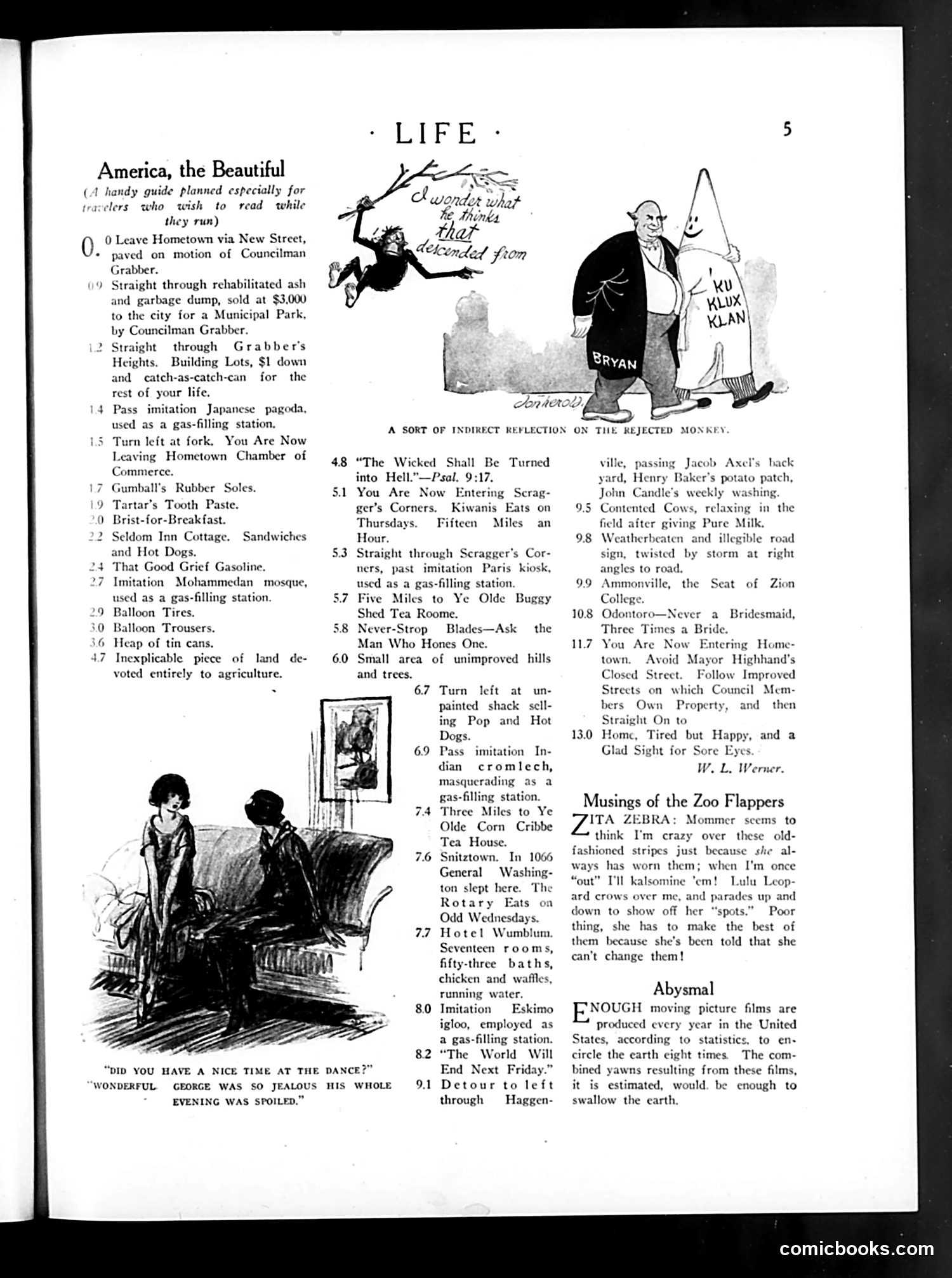
This page contains a satirical cartoon titled "A Sort of Indirect Reflection on the Rejected Monkey," depicting a figure labeled "Bryan" standing next to a KKK member in white robes. The cartoon's caption suggests a pointed comparison between Bryan and the Klan figure, likely referencing William Jennings Bryan's association with conservative or reactionary politics. The remaining content is a travel guide titled "America, the Beautiful" listing various roadside attractions and establishments (gas stations, restaurants, tea rooms), mixed with columns about zoo animals and general observations. The cartoon's juxtaposition appears designed to satirize Bryan's political positions or associations, though the specific historical context would require knowing the exact publication date for full clarity on the reference.
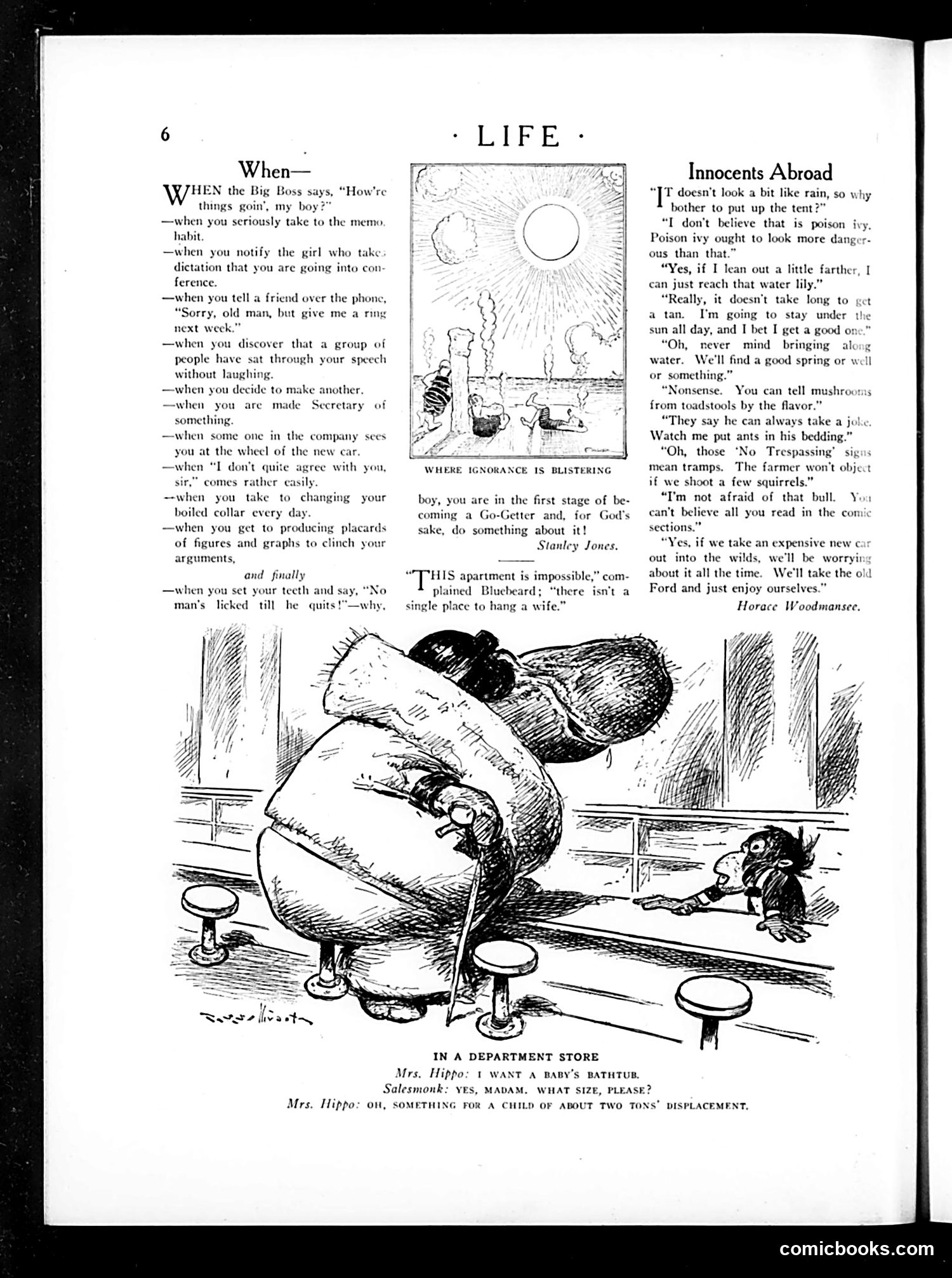
This page contains two distinct sections: **Left Column ("When"):** A humorous list of situations that define becoming a "Go-Getter"—someone obsessively focused on self-improvement and ambition. The joke satirizes early 20th-century business culture's emphasis on constant productivity and success-chasing, even in absurd contexts (changing boiled collars daily, using statistics to win arguments). **Right Section ("Innocents Abroad"):** A dialogue satirizing naive tourists who overthink outdoor activities. The humor mocks urban people's anxiety about nature and their tendency to over-prepare or worry excessively about minor dangers. **Bottom Cartoon ("In a Department Store"):** Shows a very large woman requesting a baby bathtub, claiming it's for a child weighing "two tons' displacement." The joke relies on physical comedy—her massive size makes the request absurd—typical of early Life's body-humor style.
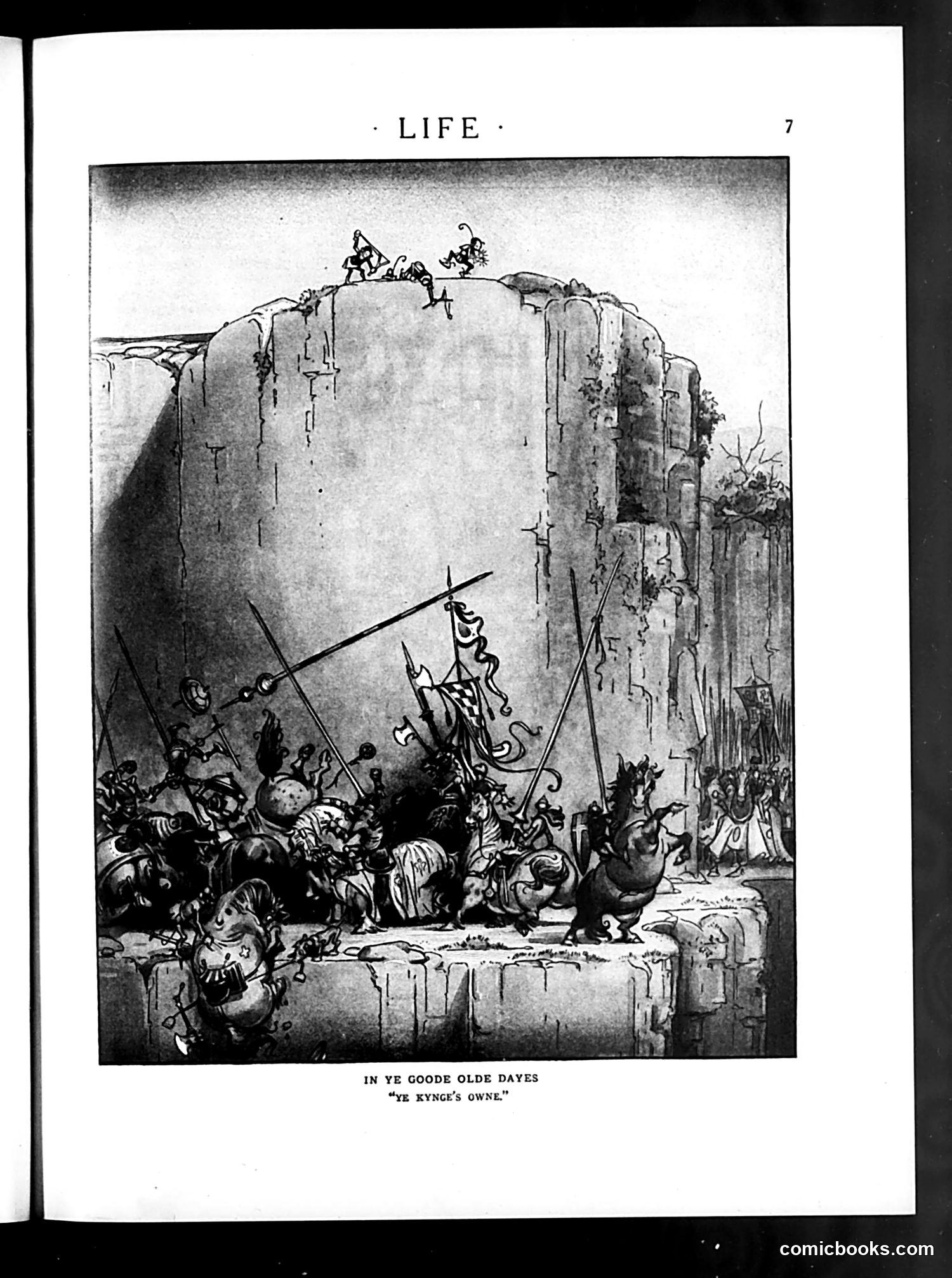
This satirical illustration depicts a medieval siege scene with a massive fortified tower under attack. The caption invokes "ye goode olde dayes" (the good old days), suggesting nostalgia for historical times. The cartoon likely satirizes contemporary attitudes romanticizing the past. A crowd of armed figures assault the tower with long poles and weapons while defenders resist from above and within the walls. The chaotic, violent scene contrasts sharply with any "good old days" sentiment. The phrase "Ye Kynge's Owne" (The King's Own) possibly references royal authority or military forces. The satire appears to mock the common tendency to idealize history while ignoring its actual brutality and conflict—a timeless commentary on selective nostalgia for simpler, supposedly better times.
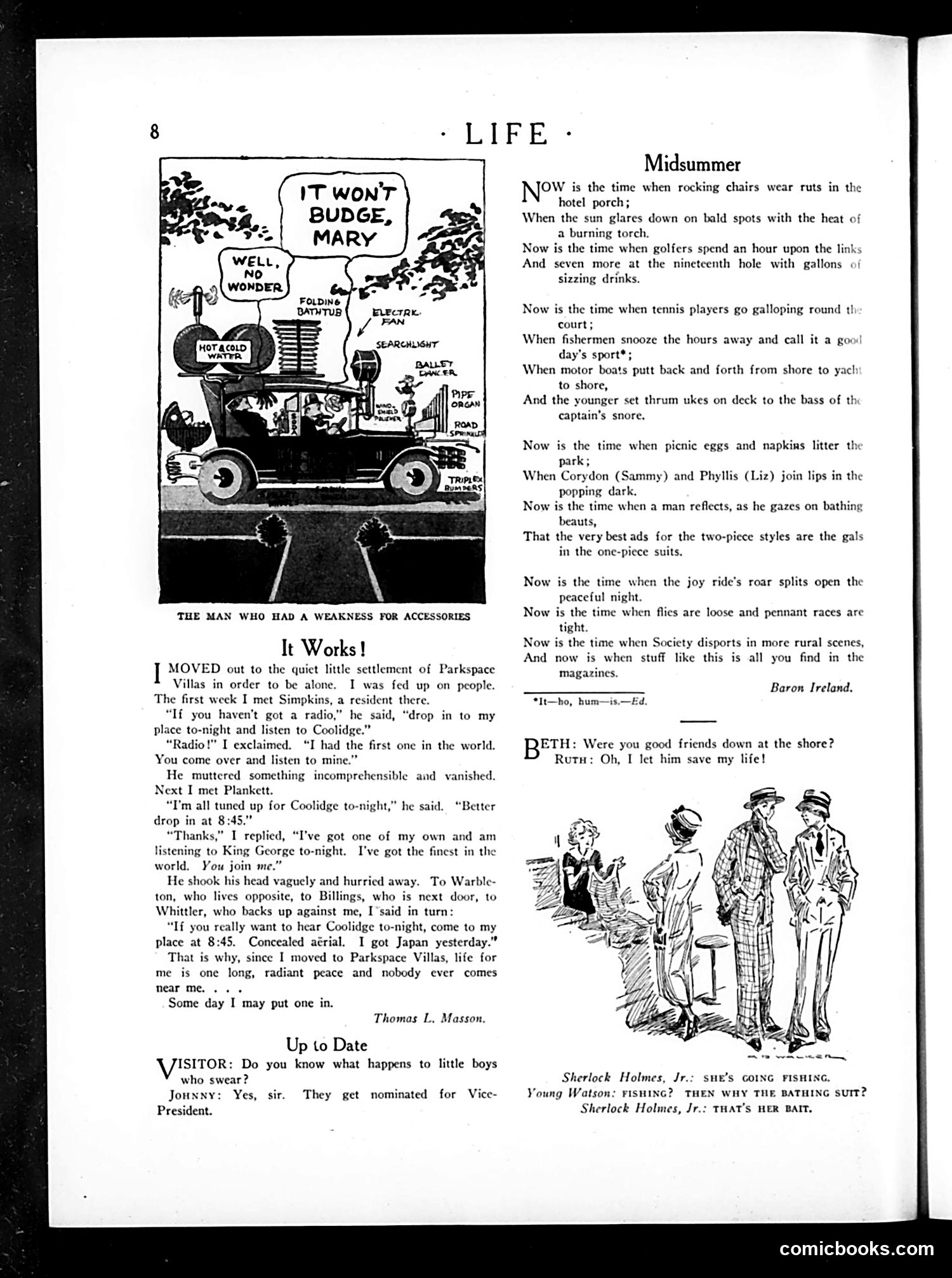
**"The Man Who Had a Weakness for Accessories"** (cartoon, upper left): A satirical drawing of an overstuffed automobile bristling with gadgets and add-ons—hot/cold water, folding daybed, electric searchlight, radio, etc. The joke mocks the 1920s automobile accessory craze, when owners competed to outfit their cars with luxury features. The caption "It Won't Budge, Mary" suggests the vehicle has become so laden with extras it's immobilized—a commentary on conspicuous consumption and the absurdity of endless accessorizing. **"It Works!"** (article below): A humorous account about discovering radio reception in rural Pennsylvania, depicting early radio adoption's novelty and social appeal. **"Up to Date"** and the Sherlock Holmes illustration (right): Light conversational humor about contemporary social behaviors and children's slang.
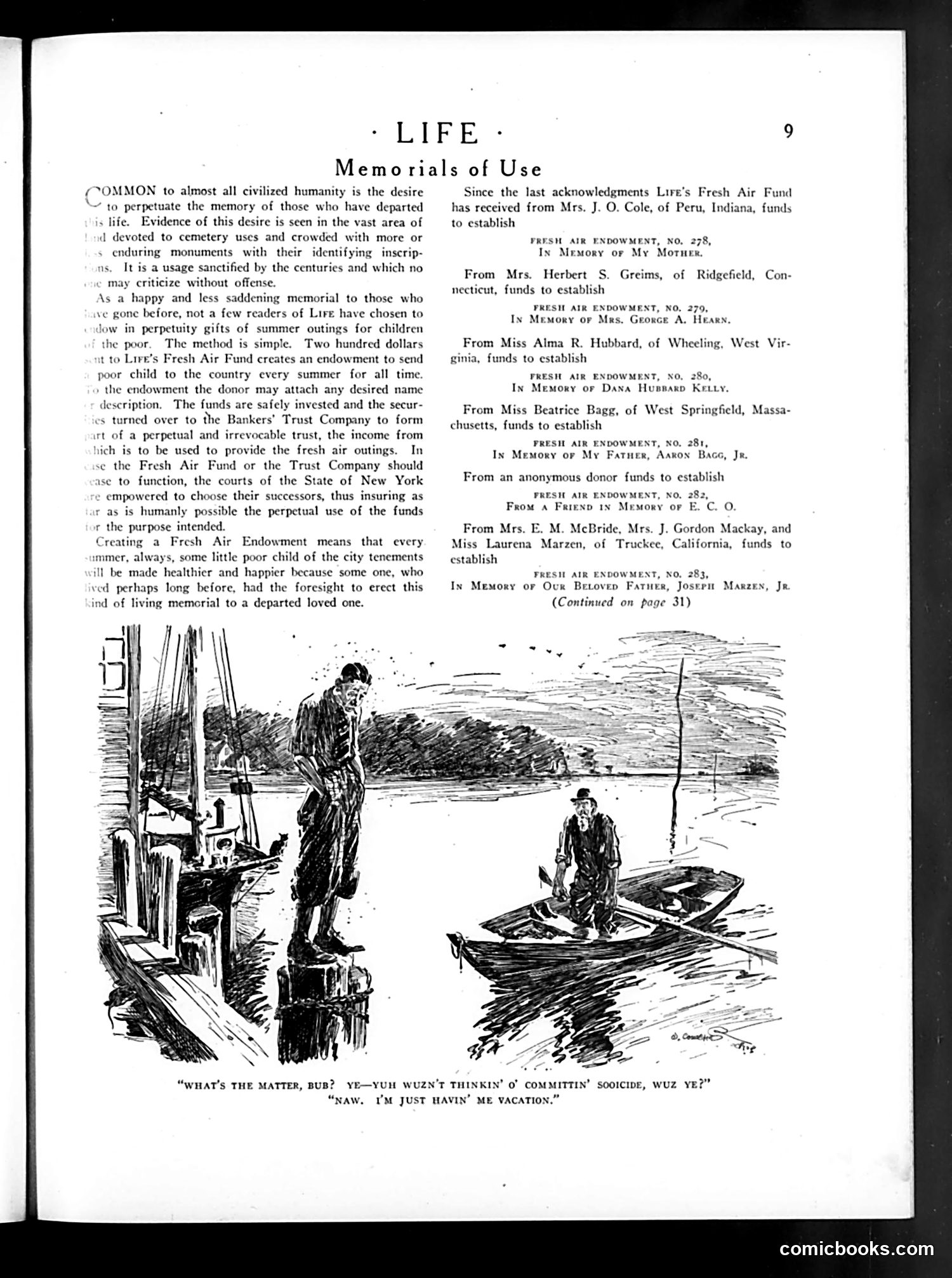
This page combines memorial notices with a single cartoon at the bottom. The main content announces **Fresh Air Endowment donations**—a charitable program sending poor city children to the countryside for summer respite. Multiple donors are listed, establishing these as memorial gifts honoring deceased loved ones. The cartoon depicts two working-class men by a waterfront. One, appearing unwell or distressed, is questioned by the other about "committing suicide." He responds he's "just havin' me vacation"—a dark joke implying the fresh air program is so meager or undesirable that it's barely preferable to death. The satire critiques the inadequacy of these charitable efforts to meaningfully improve poor children's lives, despite donors' good intentions.
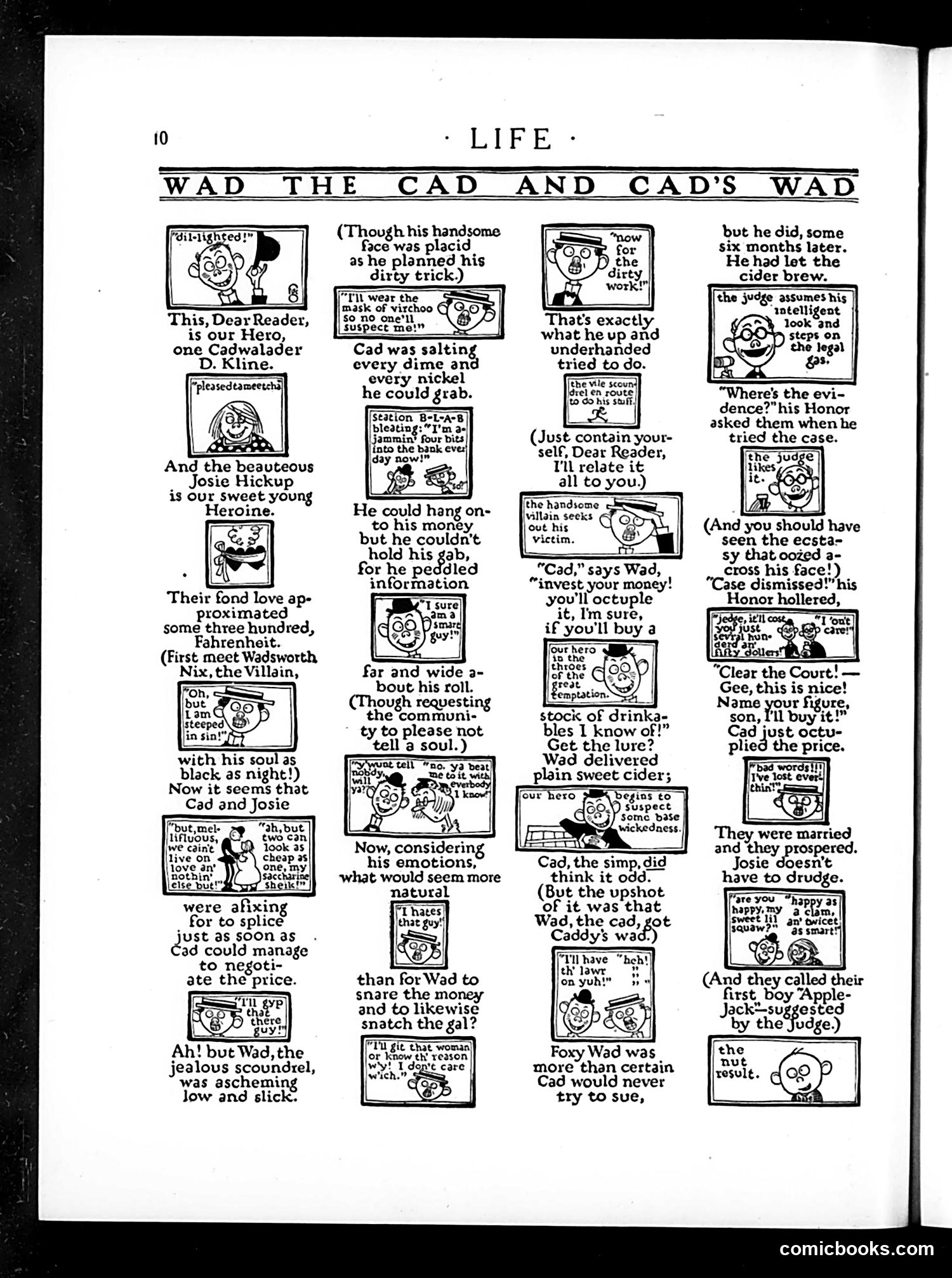
This is a satirical comic story about two characters: Wad (the protagonist and "hero") and Cad (the villain). The narrative follows their romantic and financial rivalry. The satire mocks class pretension and get-rich-quick schemes. Wad is portrayed as a scheming fortune-hunter who pursues the wealthy Josie Hickup. Cad is his jealous rival. The humor centers on Wad's attempts to gain money through marriage and manipulation—offering Cad investment opportunities, negotiating dowries, and ultimately "buying" the bride. The comic satirizes Gilded Age materialism: romance reduced to financial transaction, with judges and legal systems complicit in the mercenary nature of marriage among the wealthy. The characters' names themselves—"Wad" (money) and "Cad" (unscrupulous man)—signal the story's cynical view of relationships.
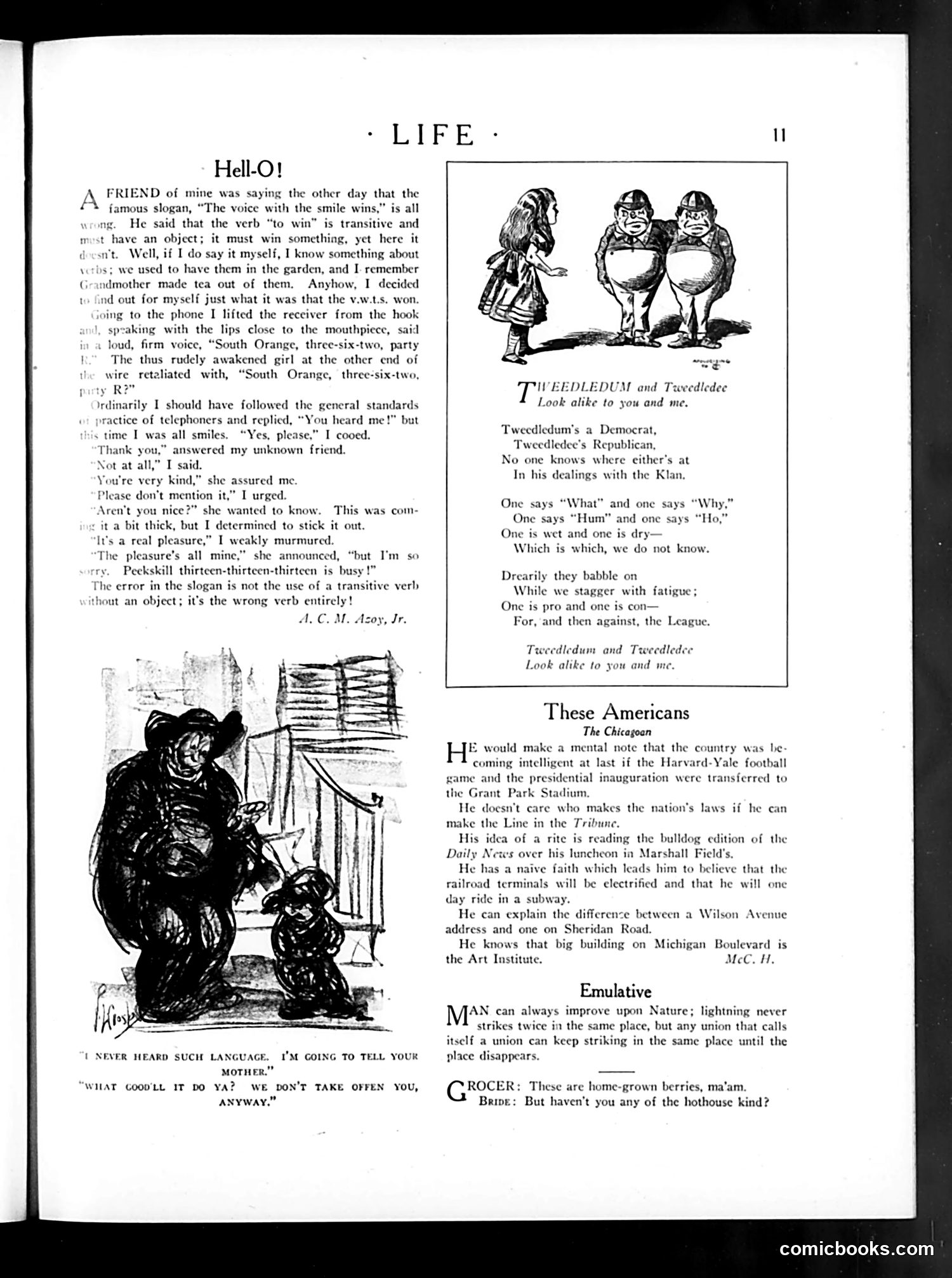
The page contains three distinct satirical pieces: 1. **"Hell-O!"** (top left): A humorous letter correcting a friend's grammar about "winning" arguments, using a personal anecdote about telephone operators. 2. **"Tweedledum and Tweedledee"** (center): A political poem comparing two Democratic figures (the names reference Carroll's characters). The verse mocks their indistinguishable positions on Republican issues and the Klan, suggesting both are equally ineffective or problematic. The illustration shows two rotund, identical figures—emphasizing their interchangeability and lack of distinction. 3. **"These Americans"** and **"Emulative"** (bottom): Brief satirical observations about American pretension and social climbing. The Tweedledum/Tweedledee piece appears to be the main political content, criticizing Democratic leadership for lacking clear differentiation or effective opposition to Republican policies during the 1920s-era Klan controversy.
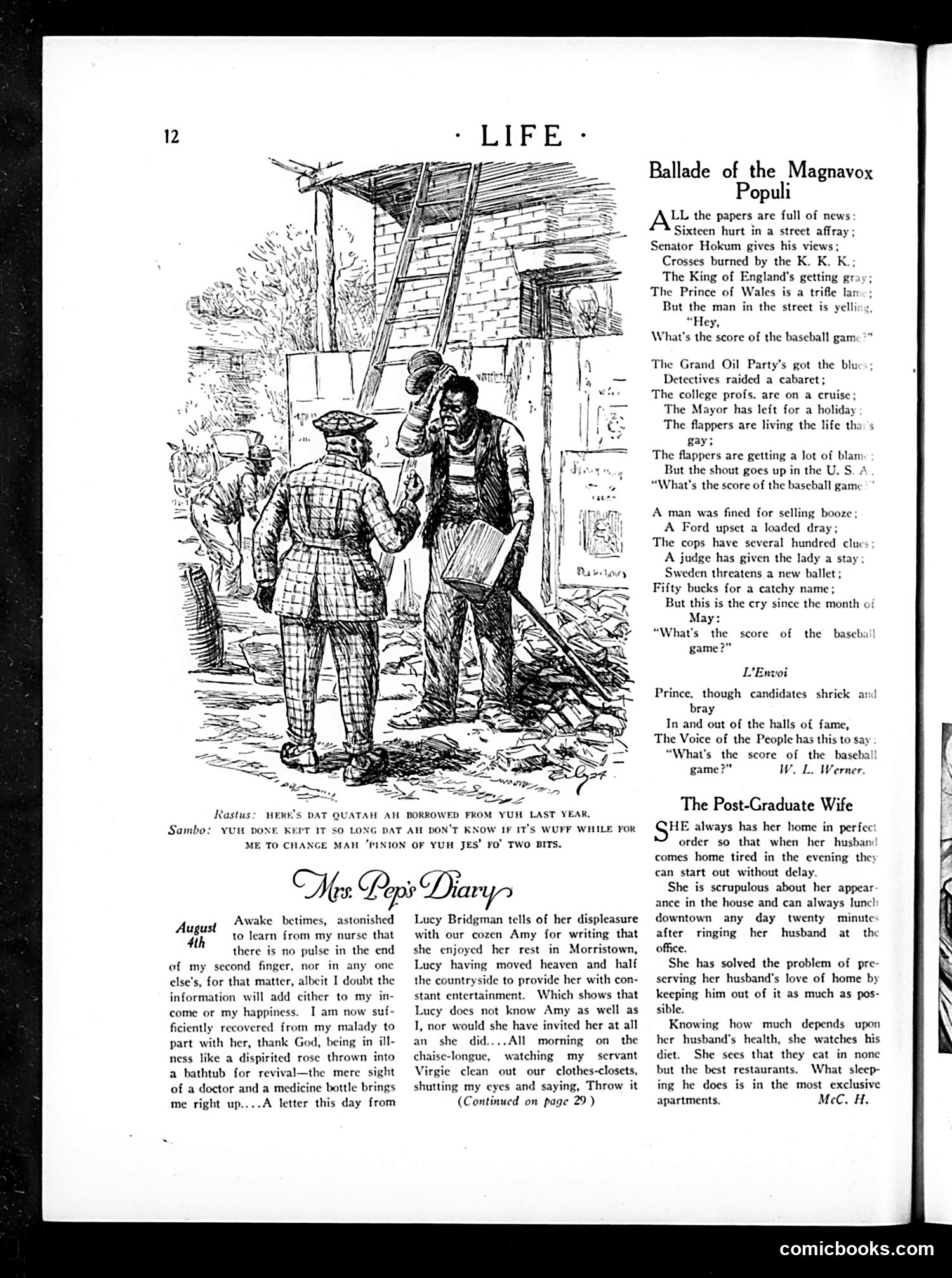
This satirical poem mocks the public's obsession with trivial news and entertainment during what appears to be the 1920s. The repeated refrain "What's the score of the baseball game?" emphasizes how Americans fixate on sports while ignoring serious matters: political violence (KKK activity), scandal, and social upheaval. The cartoon illustration shows two figures in conversation, likely representing common people discussing gossip. The accompanying "Mrs. Pep's Diary" column depicts domestic life concerns. The satire criticizes mass culture's superficiality—the "voice of the people" cares more about baseball scores than meaningful events. This reflects broader 1920s intellectual anxiety about American popular culture prioritizing entertainment and sports over substantive civic engagement.
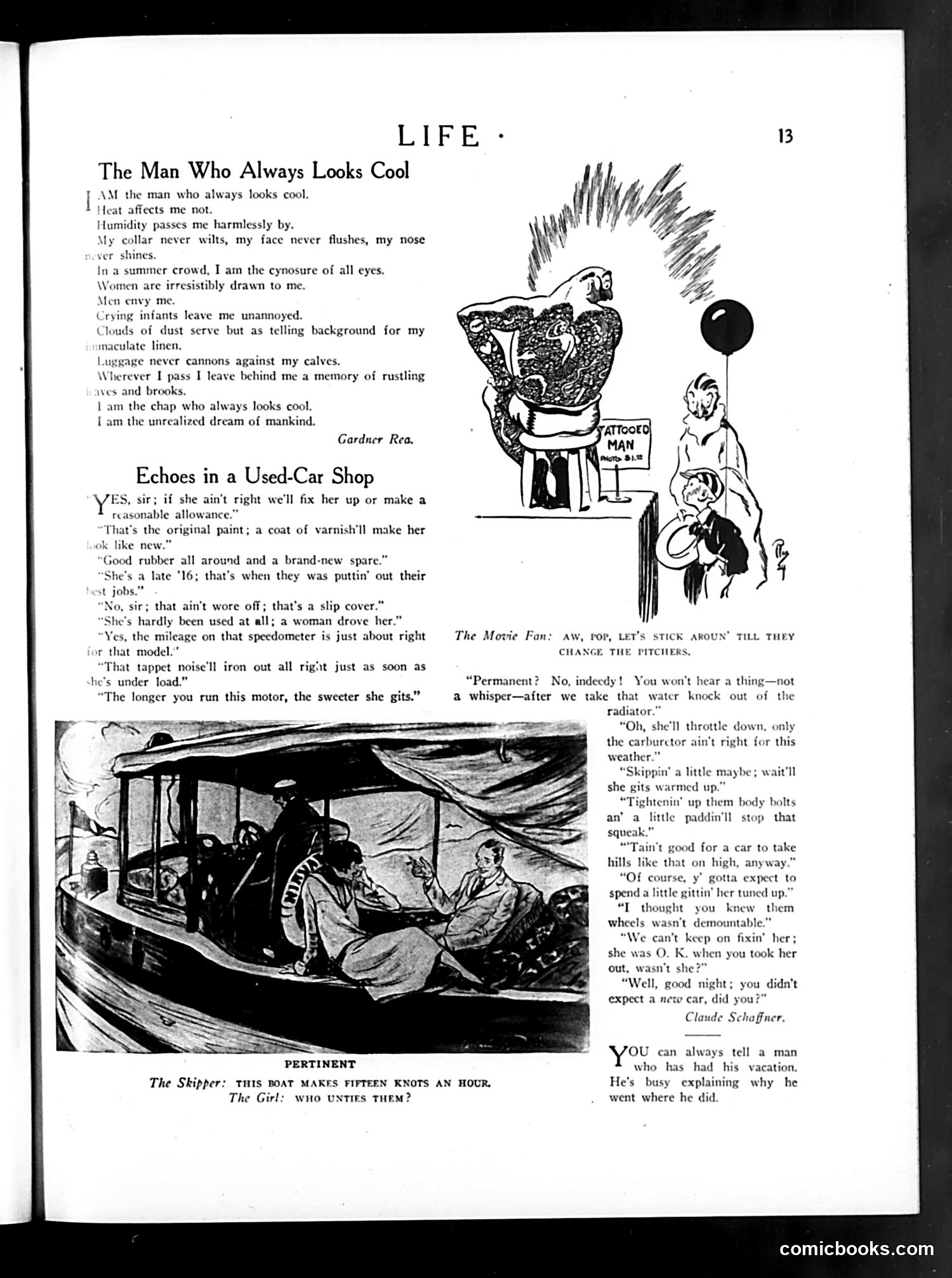
This page contains three distinct pieces of humor content: **"The Man Who Always Looks Cool"** (by Gardner Rea) is a sardonic poem mocking masculine vanity—a man who claims complete emotional detachment and effortless appeal to women, yet whose boasts reveal insecurity. **"Echoes in a Used-Car Shop"** satirizes the dishonest sales tactics of used-car dealers. The dialogue shows salesmen making absurd excuses for a vehicle's poor condition while pressuring the buyer, illustrating how used-car dealers were notorious for deceptive practices. **"The Movie Fan"** (by Claude Schaffner) shows a couple discussing car maintenance using movie-production slang, poking fun at both automotive ignorance and Hollywood's influence on everyday speech. The cartoon of a boat-building scene is captioned with wordplay about knots.
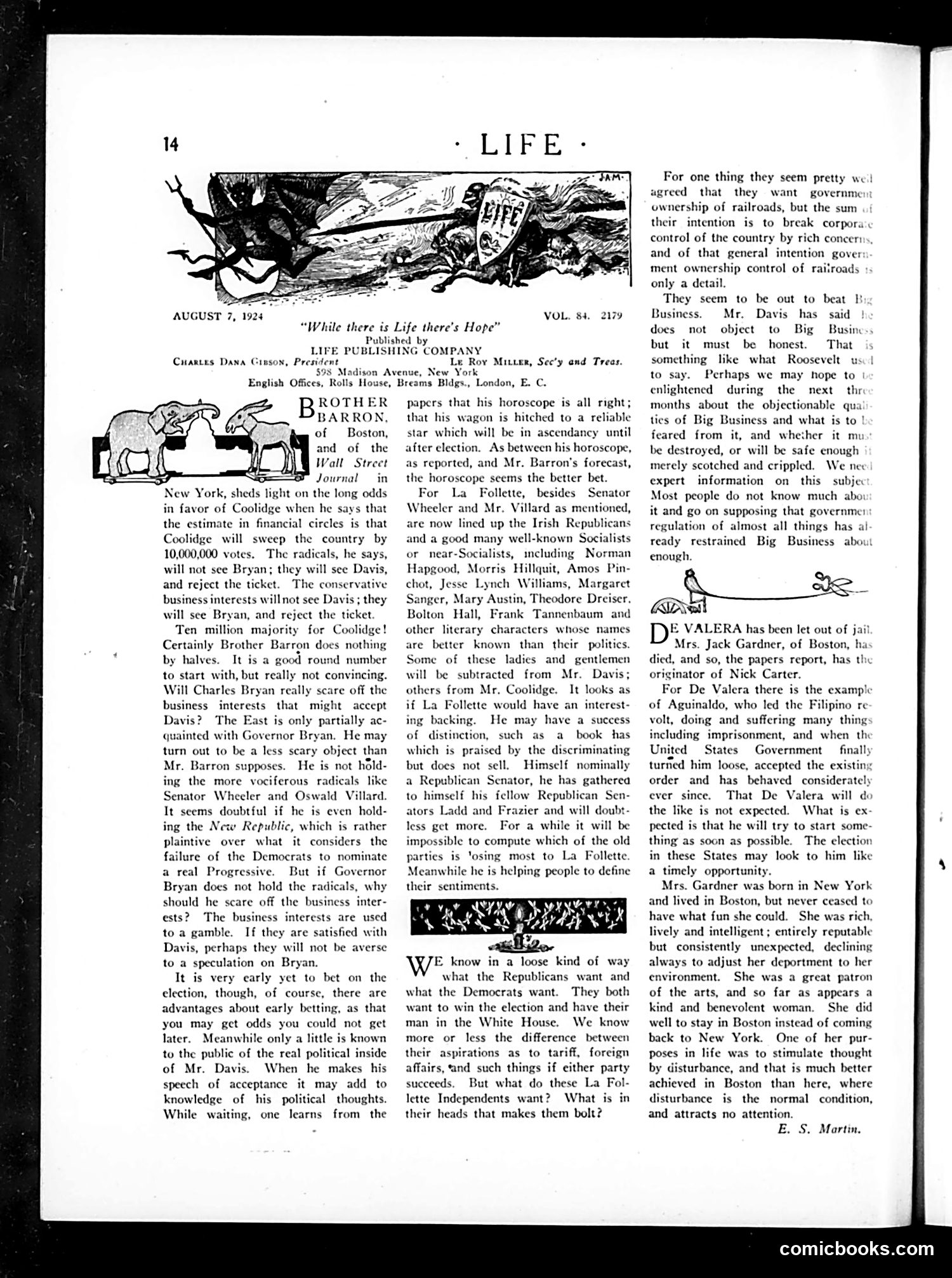
The main cartoon depicts Brother Barron of Boston offering political commentary on the 1924 election. The text discusses tension within Republican circles: Barron's horoscope suggests his favored candidate will win, but he supports the conservative ticket while progressives back La Follette's independent candidacy. The satire critiques wealthy business interests attempting to control politics. Barron represents conservative Republicans worried that independent/progressive candidates might split the vote and weaken their position. The cartoon mocks how business elites use pseudointellectual justifications (like horoscopes) to rationalize their political preferences. The piece also addresses the actual political split: wealthy Republicans versus La Follette's progressive insurgency—a genuine 1924 electoral tension—while questioning what ordinary independents actually want politically.
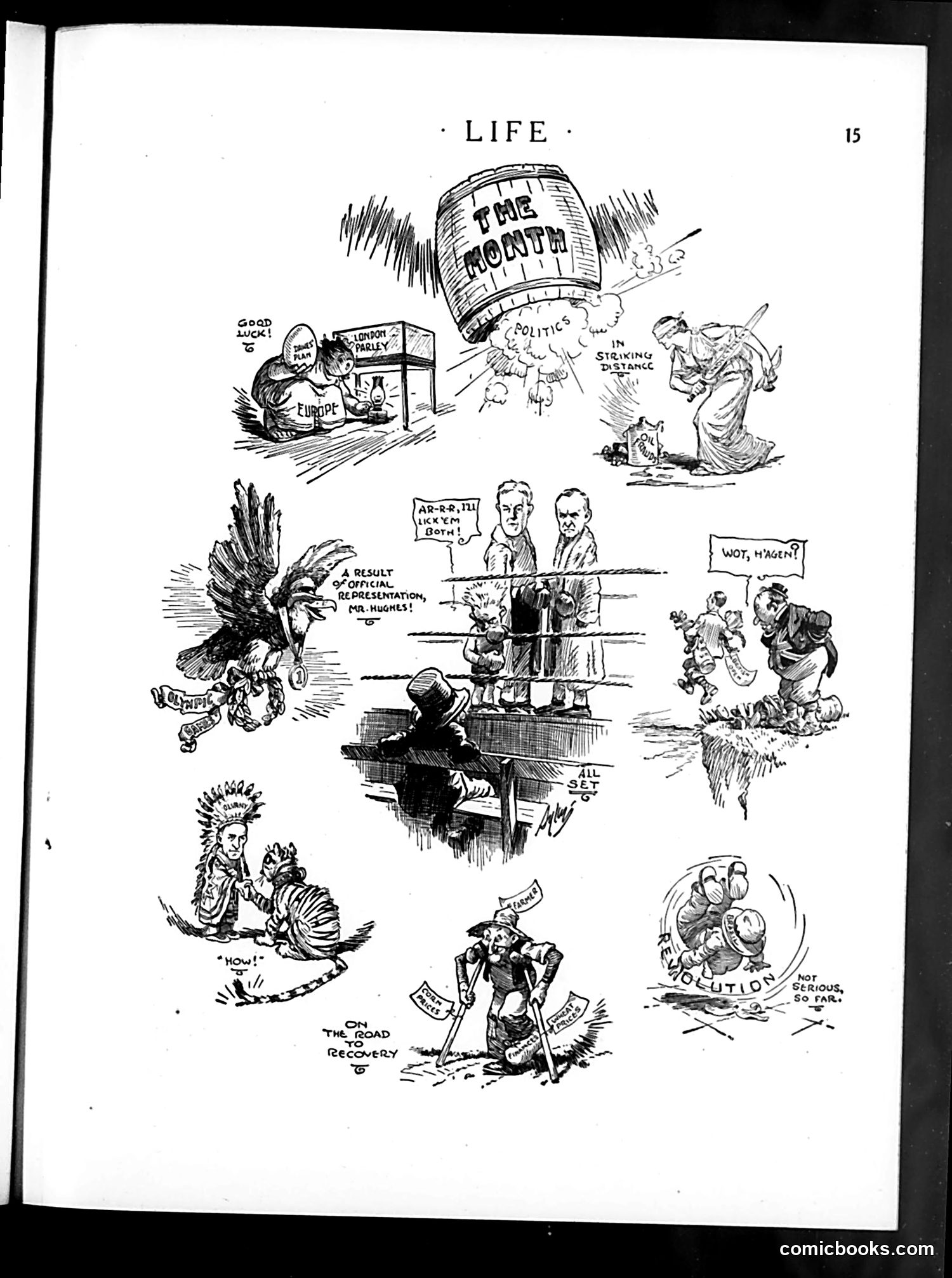
This page contains multiple satirical cartoons commenting on early 20th-century politics and international affairs. The central image shows "The Month" dumping various political crises—including "Politics in Striking Distance"—onto figures below. Other panels appear to reference: - European political turmoil (top left, labeled "Europe") - A Native American figure, likely satirizing U.S. policy - International diplomatic incidents - References to "Hughes" (appears to be Charles Evans Hughes, a political figure of the era) The cartoons employ exaggerated character types and visual metaphors typical of period satire—using caricature and symbolic imagery to mock political incompetence, failed diplomacy, and administrative scandals. The specific events referenced are unclear without additional historical context, but collectively they mock political dysfunction.
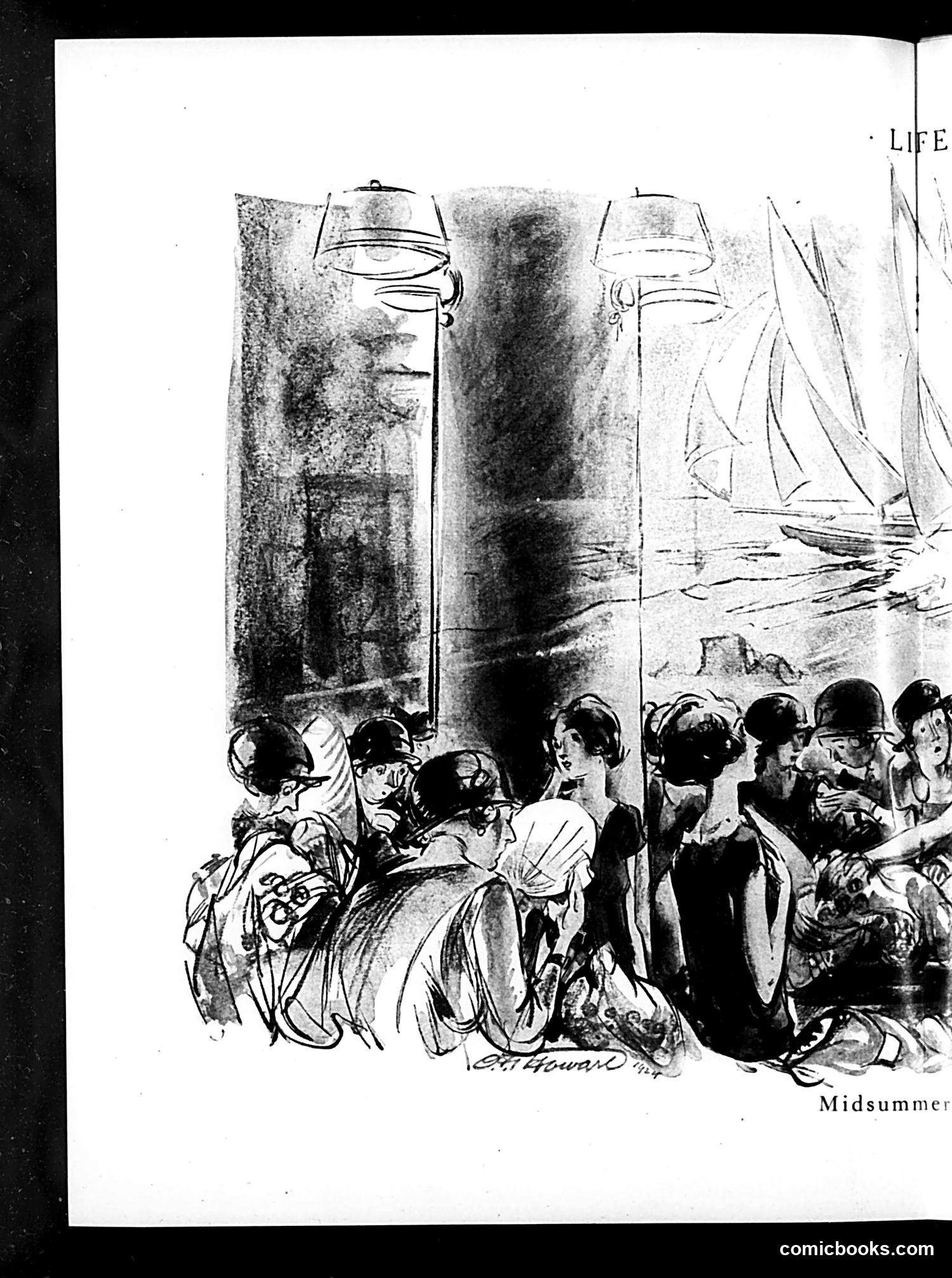
This appears to be an illustration titled "Midsummer" from *Life* magazine, signed by what looks like "Cesare" or similar. The image shows a group of women gathered at a seaside location, with sailboats visible in the background. The women are depicted wearing 1920s-style clothing and hats, and appear to be socializing or vacationing together. The illustration style is characteristic of early-to-mid 20th century satirical magazine artwork. Without additional context text on this page, the specific satirical point is unclear—it may comment on women's leisure activities, beach culture, or social conventions of the era, but I cannot definitively identify the intended subject of satire from the image alone. The "Midsummer" reference suggests a seasonal summer leisure scene.
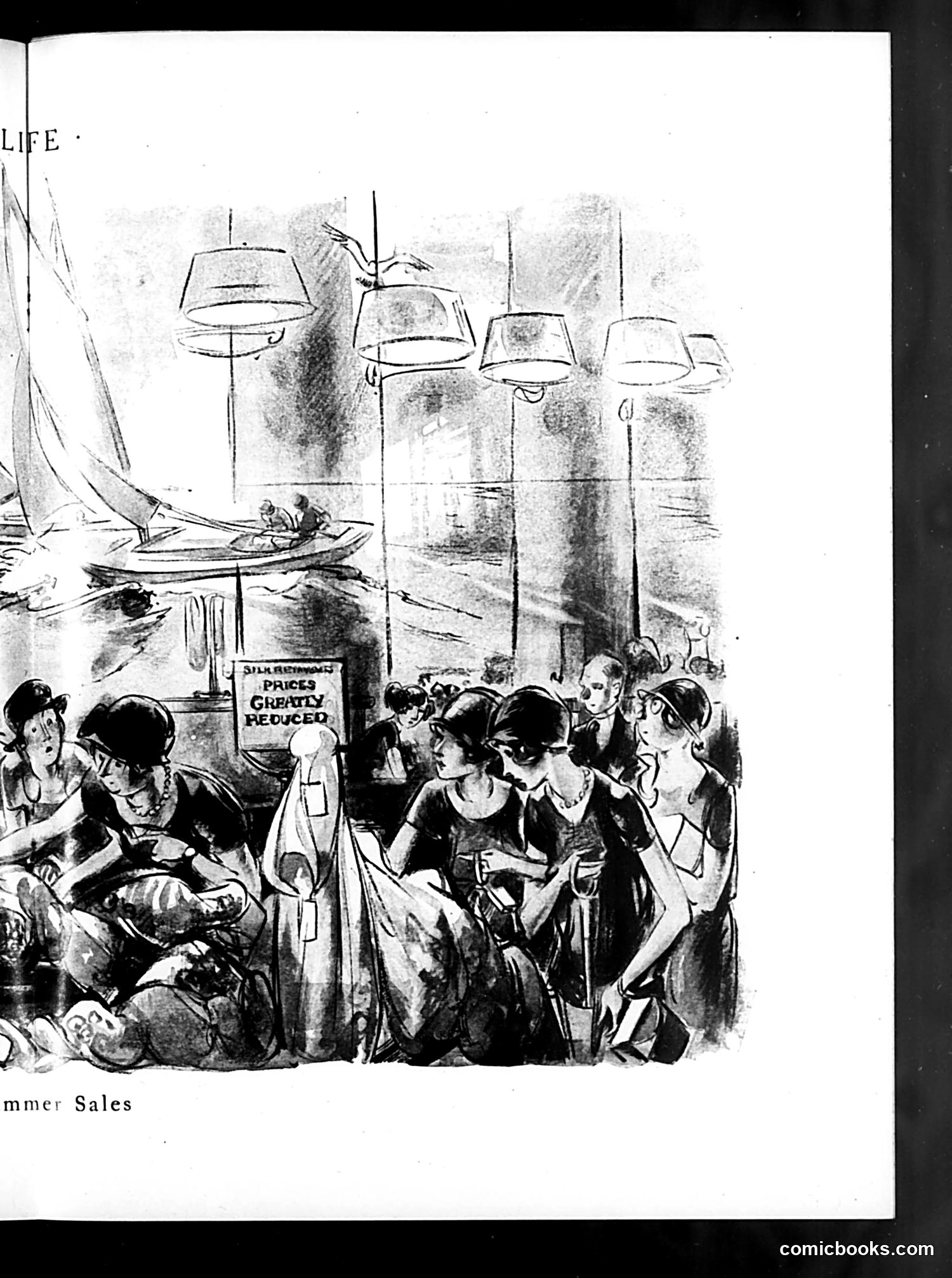
This appears to be a satirical illustration from Life magazine depicting a "Summer Sales" scene. The cartoon shows a crowded group of women gathered beneath hanging lamps outside what appears to be a store with a sign reading "PRICES GREATLY REDUCED." The women's expressions and body language suggest eager, competitive shopping behavior typical of end-of-season sales events. The satire likely mocks the frenzy and desperation of bargain-hunting consumers—particularly women—during summer clearance sales. The exaggerated crowding and intense focus on discounted merchandise suggests commentary on consumer culture and materialism. The hanging lamps overhead frame the chaotic scene, emphasizing the commercial nature of the spectacle being ridiculed.
This 1910s Life article satirizes New York's theatrical community after a Democratic Convention failed to boost box office receipts as hoped. The piece mocks theater managers who avoided opening new productions, fearful of financial loss—instead suggesting they might as well let children perform plays in backyards for pennies admission. The main review covers a revival of "Sweeney Todd, the Barber of Fleet Street"—a Victorian melodrama about a murderous barber who kills customers and sells them as meat pies through his partner Mrs. Lovett. The critic uses the play's absurd plot (trapdoors, secret buttons, bodies converted to pie filling) to gently mock both the archaic theatrical form and the desperate state of summer entertainment. The satire targets theatrical entrepreneurs' risk-aversion post-convention, while affectionately covering a campy period piece that appeals only to those deluded enough to think New York offers decent summer resort entertainment.
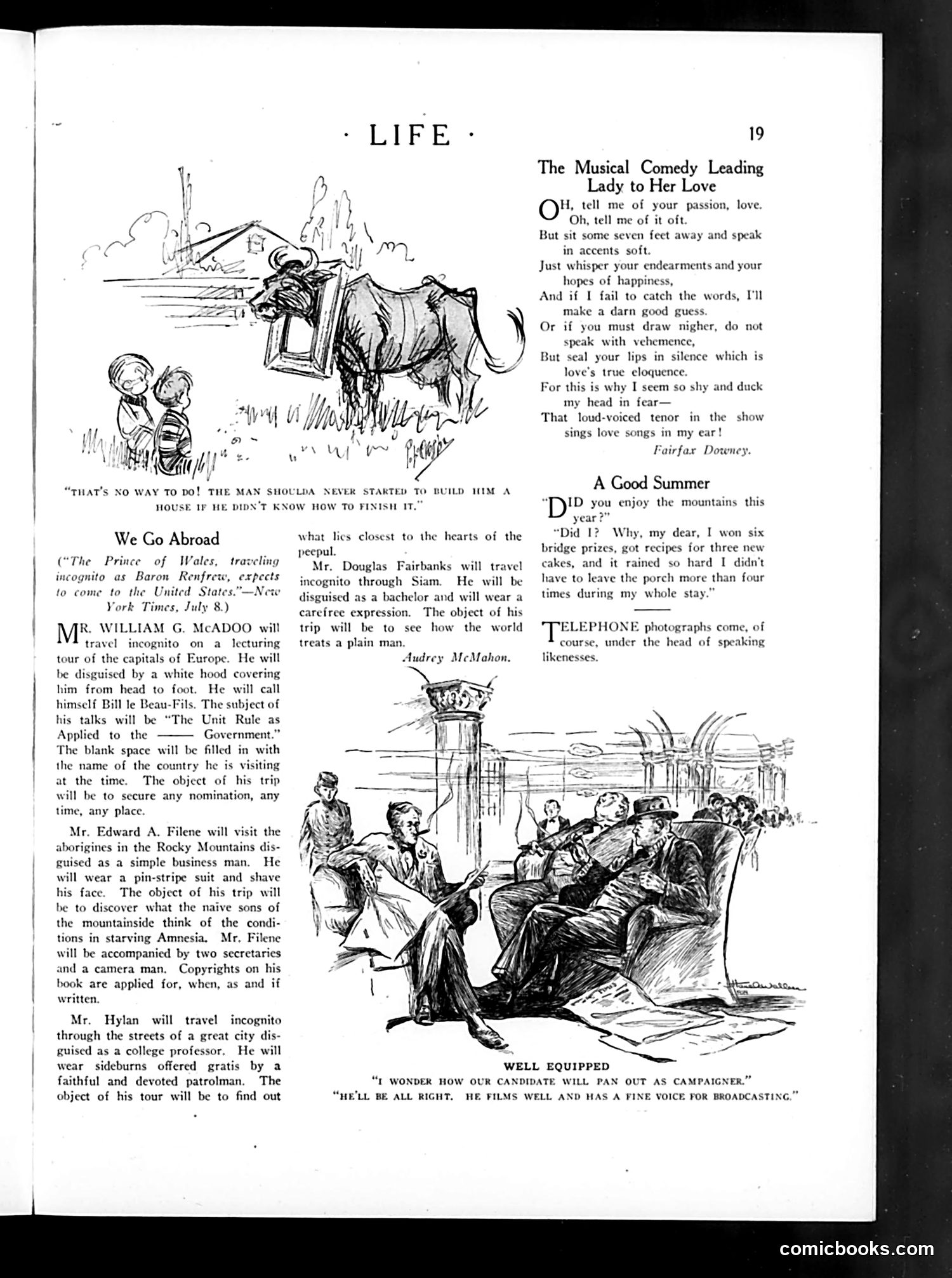
This page contains political satire about prominent figures traveling "incognito"—a joke about their inability to truly hide their identities or intentions. **"We Go Abroad"** mocks several public figures: - **William G. McAdoo** (Treasury Secretary/politician): satirized as traveling in a white hood, seeking political nominations everywhere - **Edward Filene** (businessman): disguised to study "starving Amnesia" (likely "America"), accompanied by secretaries and camera—suggesting his research is performative - **Mayor Hylan** of New York: dressed as a college professor to learn what people really think - **Douglas Fairbanks** (actor): traveling as a "bachelor" because that's his true nature The humor lies in the premise that these men cannot genuinely disguise themselves—their true natures (ambition, vanity, fakeness) are transparent regardless of costume. The cartoon at top illustrates the foolishness of starting projects without completion capability—possibly commentary on political promises. The page also includes lighter humor about theater and social life, unrelated to political satire.
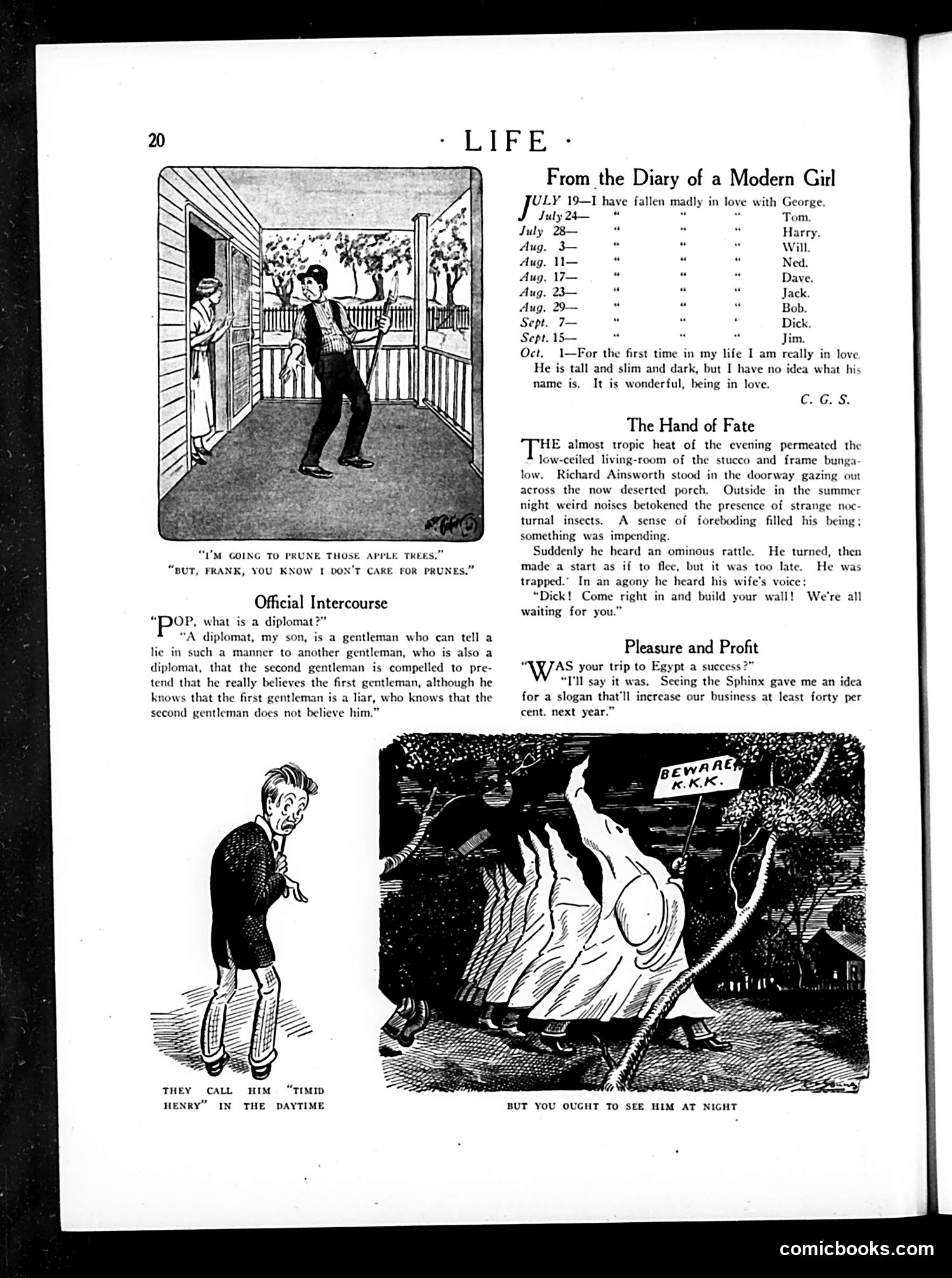
This page contains several satirical pieces typical of early 20th-century Life magazine humor: **"Official Intercourse"** defines a diplomat as someone skilled in lying to other liars while all parties pretend to believe each other—a cynical commentary on diplomatic hypocrisy. **"From the Diary of a Modern Girl"** satirizes the fickleness of young women, listing a series of men she's fallen in love with in rapid succession (George, Tom, Harry, Will, etc.), culminating in admitting she loves someone whose name she doesn't even know. This mocks both female romanticism and the dating culture of the era. **"The Hand of Fate"** appears to be a humorous short story subverting dramatic tension—a man hears "ominous" sounds, feels trapped, only to discover his wife simply wants him to build a wall. The anticlimax jokes about domestic obligations. **"Pleasure and Profit"** jokes that a businessman found inspiration for a profitable marketing slogan by seeing the Sphinx in Egypt—treating exotic tourism as merely a means to commercial gain. The cartoons use visual gags and exaggeration typical of the period's satirical style.
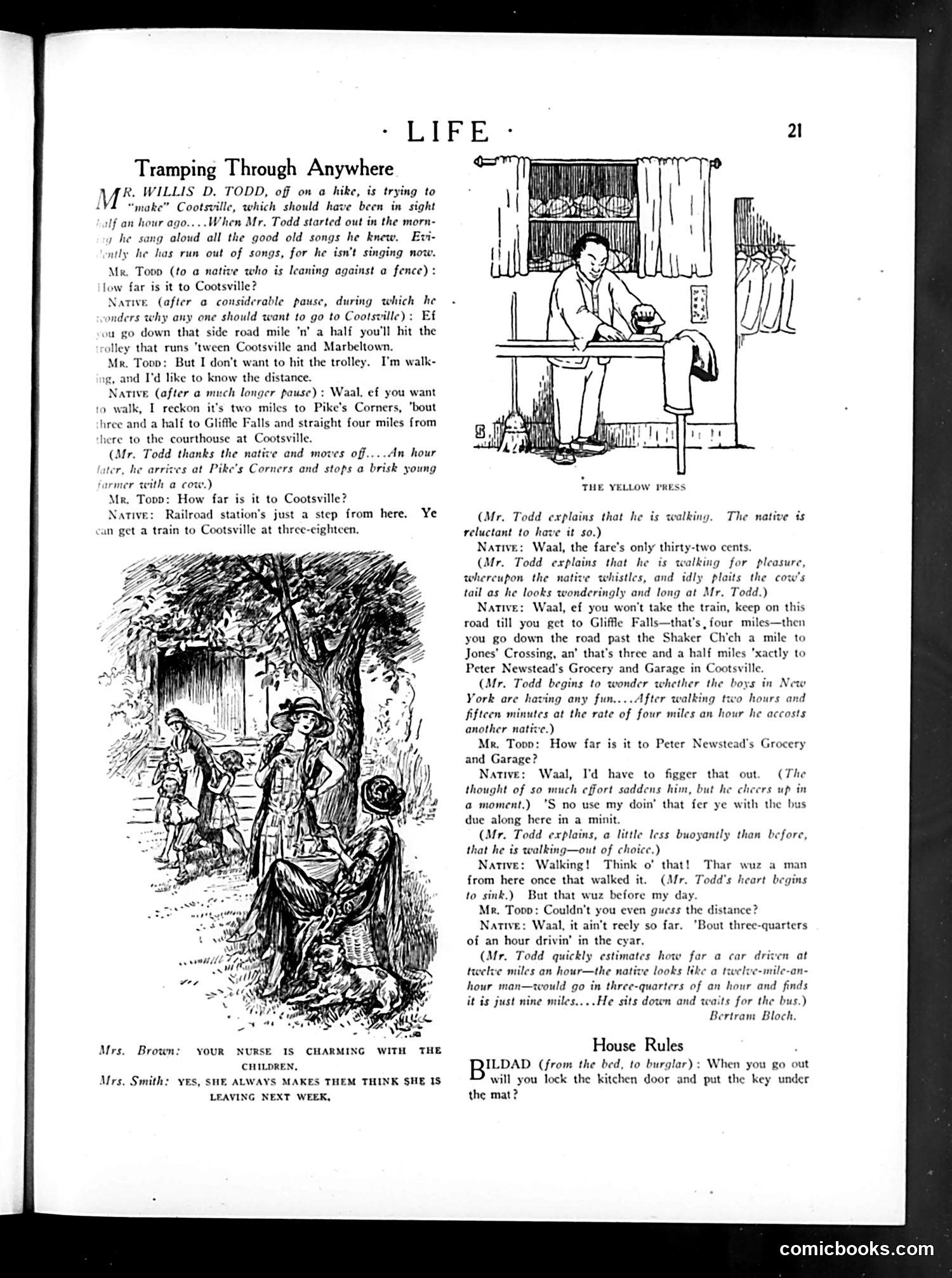
This page contains two satirical pieces: **"Tramping Through Anywhere"** mocks rural communication and direction-giving. Mr. Willis D. Todd, a city man attempting to walk to "Cootsville," repeatedly asks natives for distance estimates. Each native gives wildly different answers (two miles, four miles, nine miles by car), reflecting either rural vagueness or the locals' inability to conceive why anyone would *walk* for pleasure. The humor satirizes the culture clash between urban efficiency and rural indifference, plus the difficulty of getting straight answers in small towns. **"The Yellow Press"** (the illustration at top right) shows a man at a desk—likely representing sensationalist journalism. The caption about a nurse making children think she's leaving next week suggests the press exaggerates or fabricates stories for dramatic effect, a common criticism of yellow journalism in early 20th-century America. **"House Rules"** is a brief joke about a homeowner asking a burglar to lock the kitchen door—absurdist humor playing on politeness.
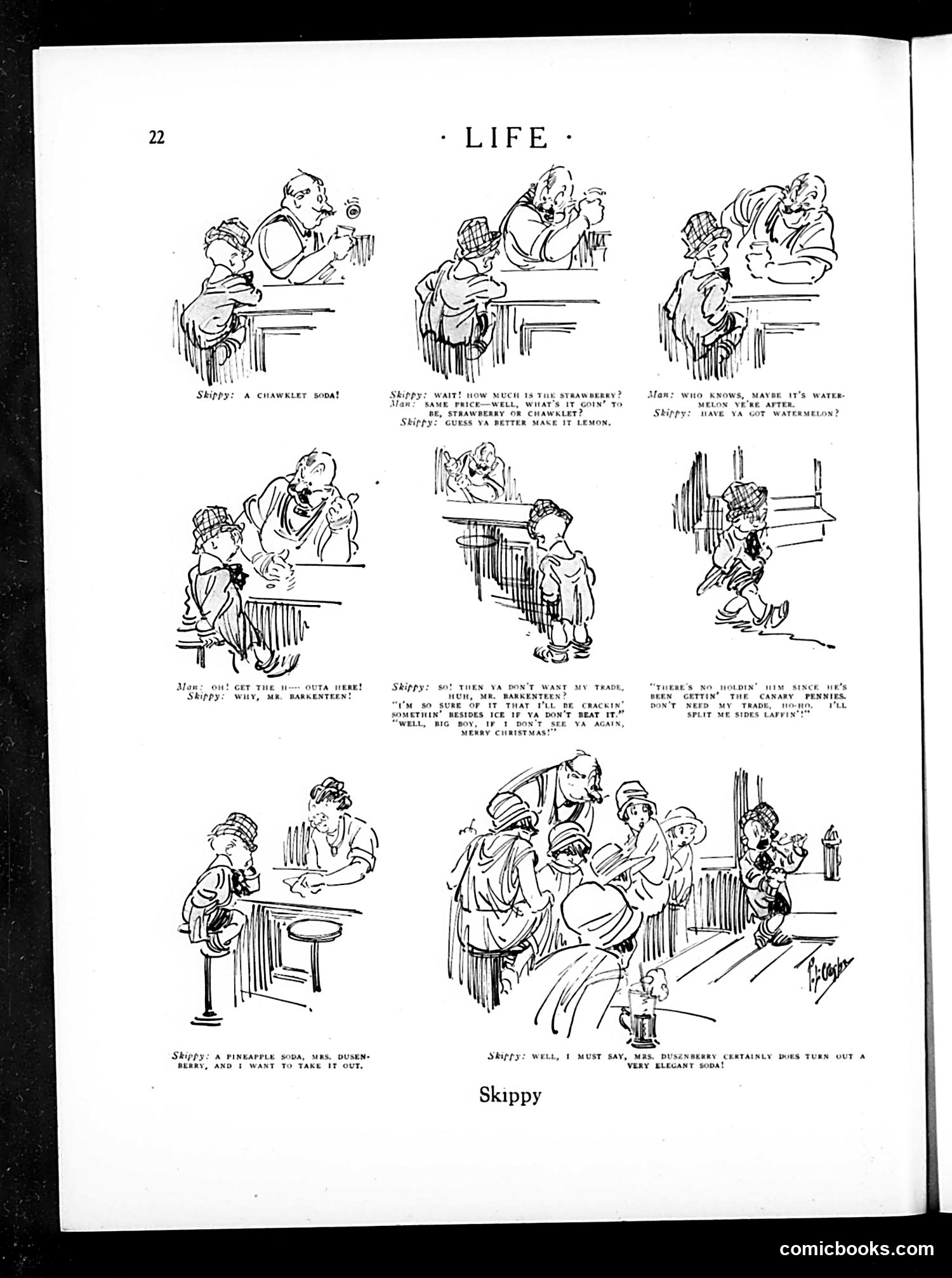
This page features "Skippy," a classic early 20th-century comic strip depicting a mischievous young boy and his adult associate (likely a street vendor or working-class man). The humor derives from Skippy's clever, cheeky dialogue and schemes—he manipulates adults through wit and negotiation rather than obedience. Key recurring elements: Skippy haggling over food prices, suggesting substitutions ("make it lemon"), attempting trades, and generally outsmarting or charming authority figures. The satire gently mocks both childhood precocity and adult gullibility. The strip's appeal lay in depicting a working-class urban child as resourceful and verbally quick rather than respectful or subservient—a relatively progressive characterization for the era that resonated with Depression-era audiences valuing cleverness and survival instincts.
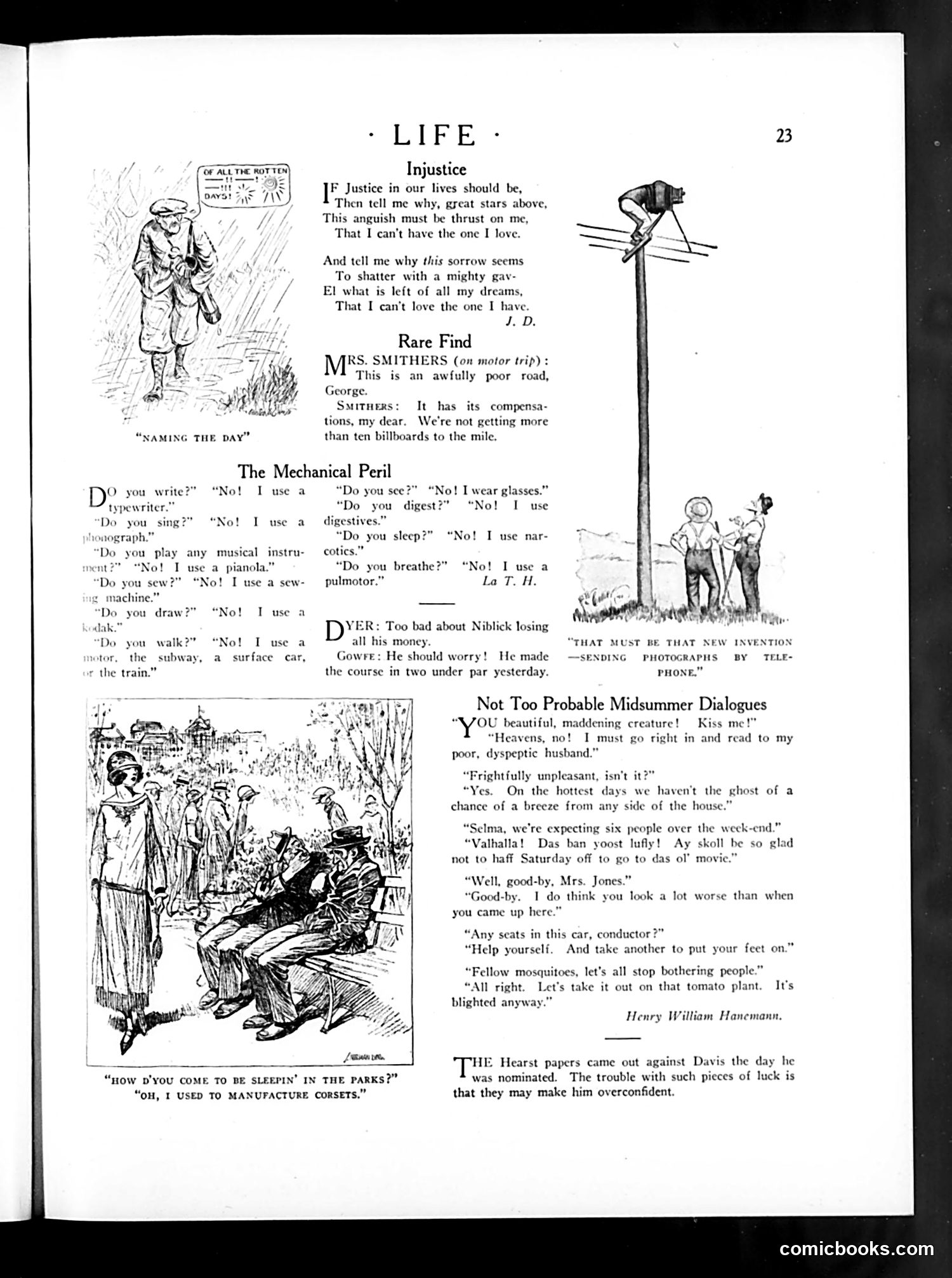
This page contains several satirical pieces typical of early 20th-century American humor: **"The Mechanical Peril"** mocks modern over-reliance on technology and conveniences. The joke lists increasingly absurd claims—people no longer write, sing, photograph, walk, or even breathe naturally, instead using typewriters, phonographs, pulomotors, etc. It's social satire about mechanization replacing human activity. **"Rare Find"** jokes about highway billboard pollution: a couple on a motor trip finds the road's only compensation is sparse advertising (ten billboards per mile rather than more). **The bottom cartoons** offer romantic and domestic humor: wives rejecting advances, complaining about summer heat and social obligations, and a conductor offering passengers space to stretch out—all gentle social commentary. **The final note** references William Randolph Hearst's newspapers opposing some candidate named Davis after his nomination, warning overconfidence could result. Overall, the page satirizes modern technology, commercialism, domestic life, and political coverage—common Life magazine targets of this era.
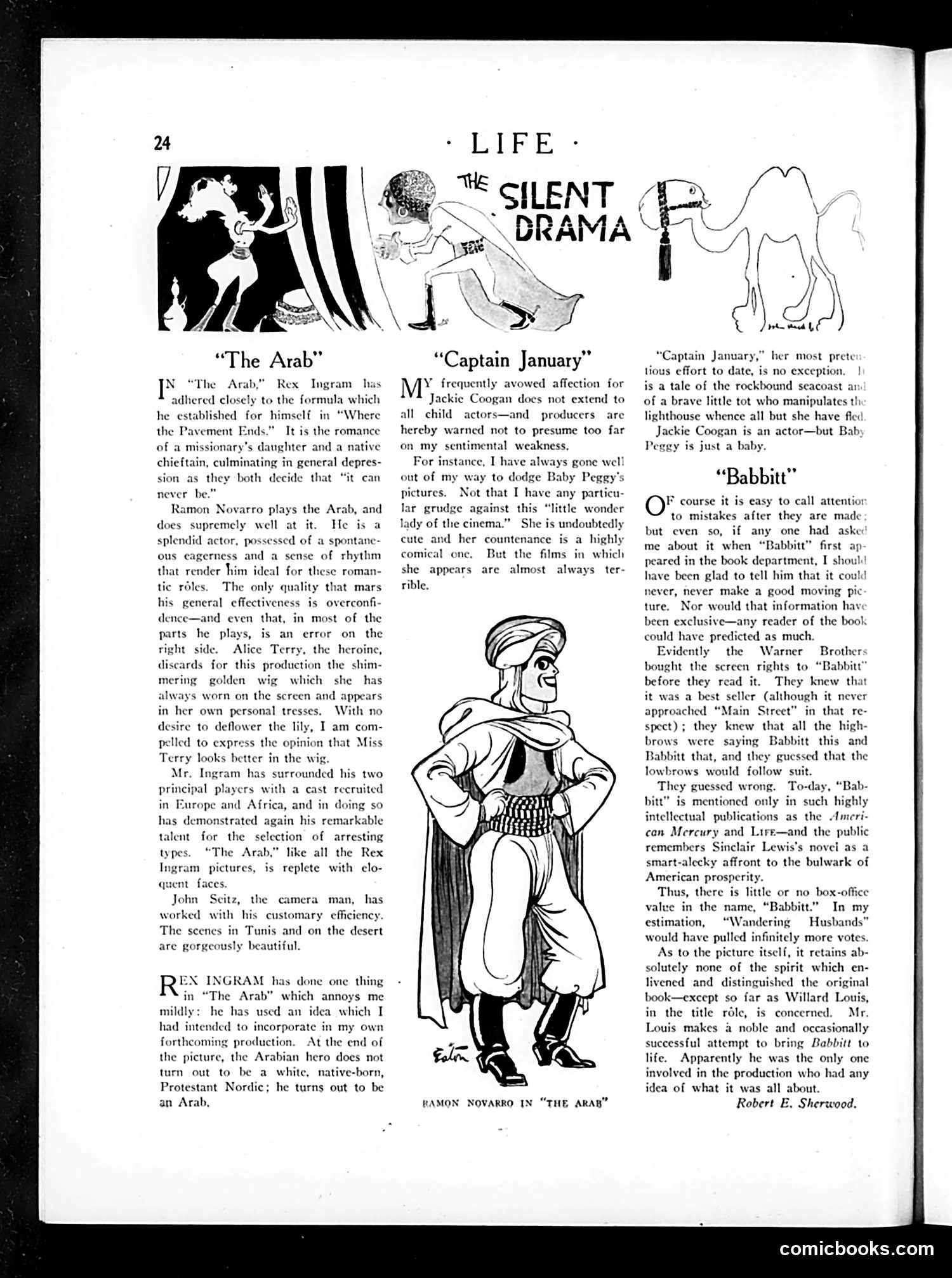
This page reviews three silent films. **"The Arab"** stars Ramon Novarro in a romantic drama about a missionary's daughter and a native chieftain. The reviewer praises Novarro's acting but notes the film follows Rex Ingram's established formula. The satire emerges in the final paragraph: the reviewer complains that Ingram "annoyingly" revealed the Arab hero is actually Arab—not a white, Protestant Nordic in disguise, which was apparently the expected plot twist of the era. **"Captain January"** features child star Baby Peggy. The critic dismisses it as terrible despite Peggy's cuteness, arguing child actors cannot carry films. **"Babbitt"** adapts Sinclair Lewis's novel. The reviewer claims Warner Brothers bought screen rights without understanding the book wouldn't translate to cinema, and that audiences remember Lewis's work as anti-American rather than entertaining—making the film commercially worthless.
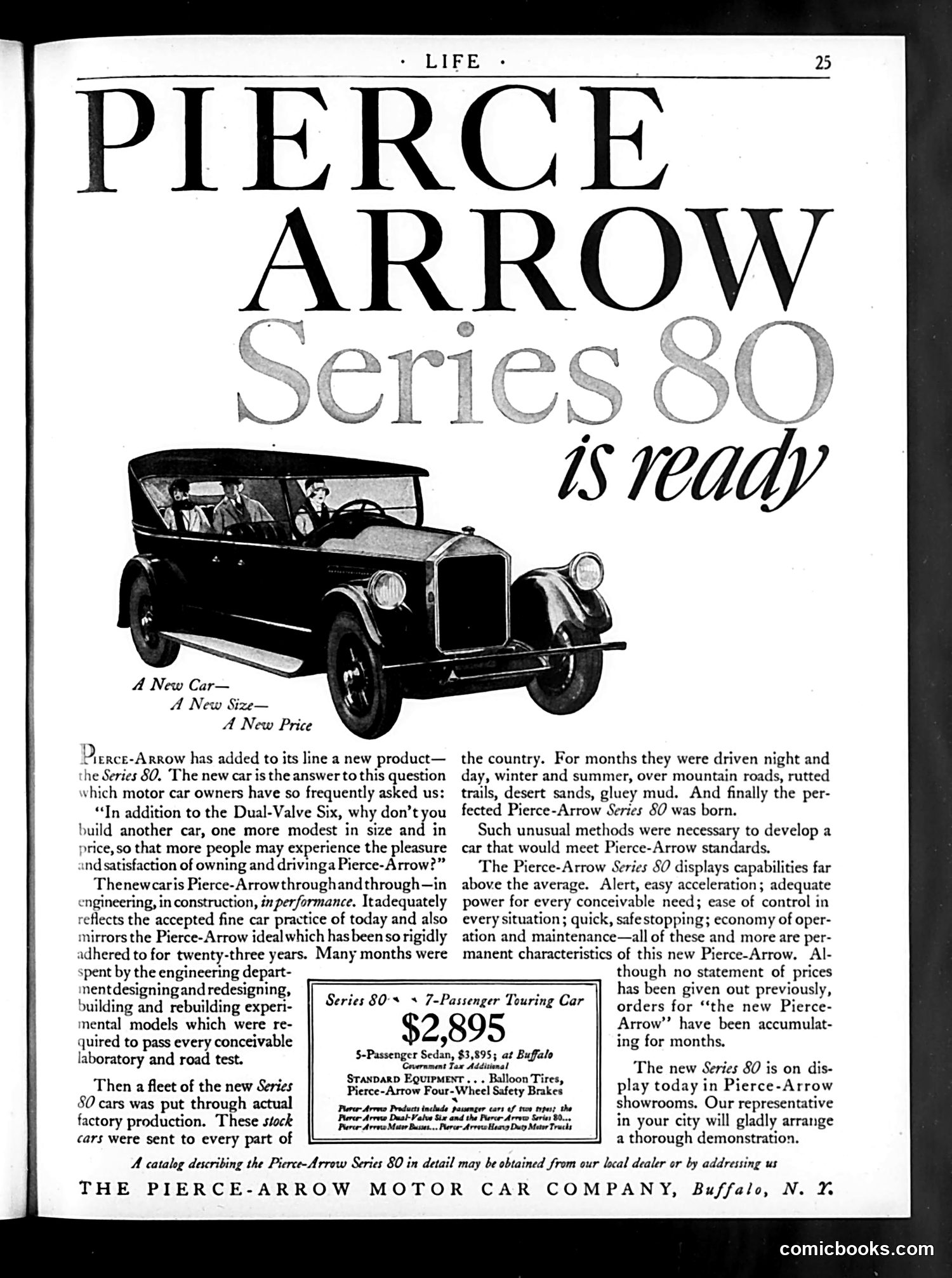
This is **not a cartoon or satire**—it's a straightforward automobile advertisement from *Life* magazine (appearing to be from the 1920s based on styling and typography). Pierce-Arrow, a luxury car manufacturer, announces its new Series 80 model, positioned as an answer to customer demand for a smaller, more affordable Pierce-Arrow. The ad emphasizes that despite the lower price ($2,895), the Series 80 maintains Pierce-Arrow's engineering standards through rigorous testing—cars were driven "night and day, winter and summer, over mountain roads, rutted trails, desert sands, gluey mud." The image shows a touring car with passengers, highlighting its practical design. The advertisement stresses performance features (acceleration, power, control, stopping ability) and economy of operation for middle-class buyers who couldn't afford the luxury marque's flagship Dual-Valve Six. This represents early-1920s marketing strategy: expanding market reach by creating a "junior luxury" tier while preserving brand prestige.
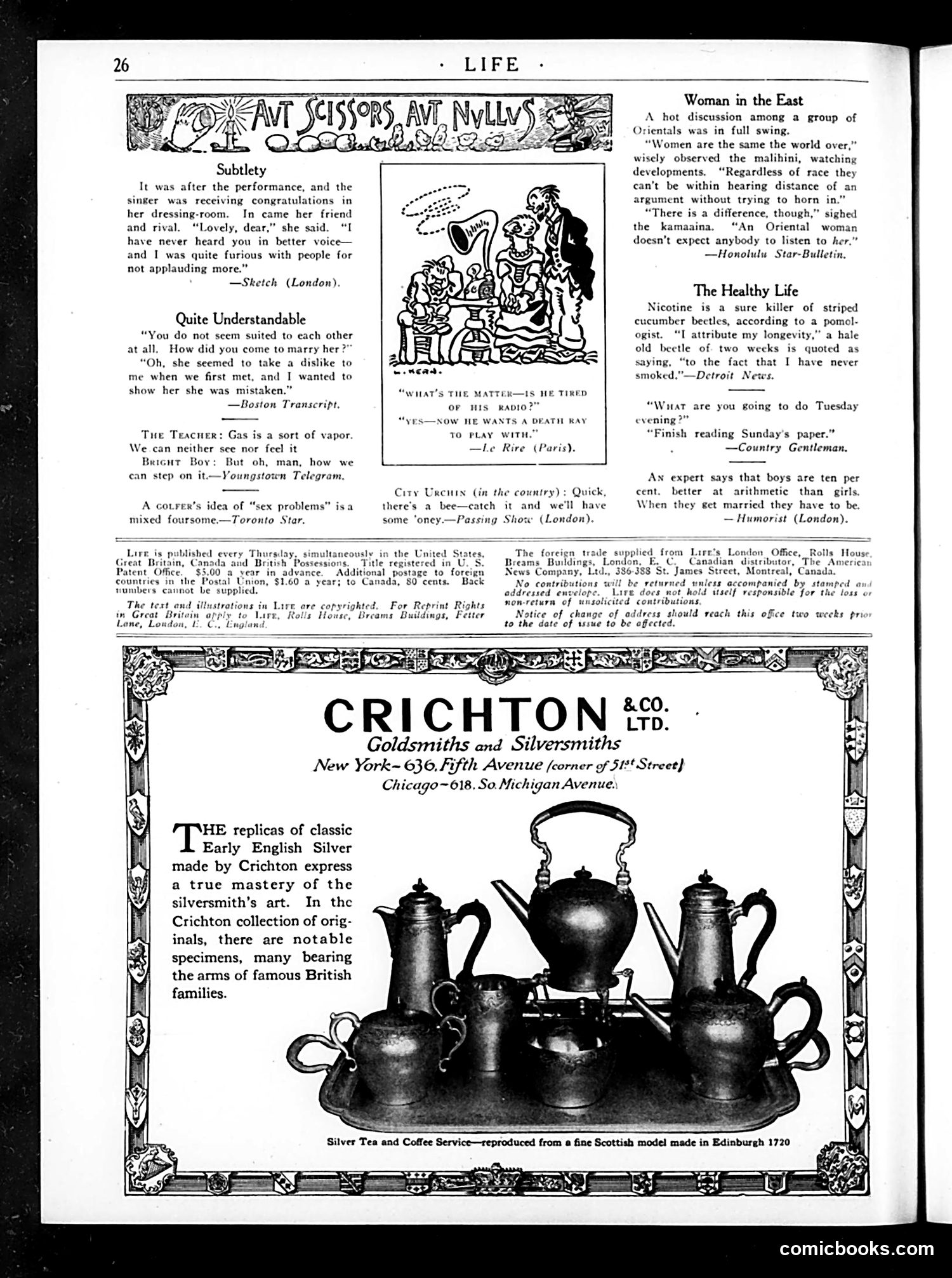
This page contains several brief humor items typical of Life's satirical format, plus a Crichton & Co. silver advertisement. The cartoons mock social conventions and gender dynamics: 1. **"Subtlety"** satirizes backhanded compliments—a rival singer congratulates a performer while admitting she was "furious" people didn't applaud less, masking jealousy with false praise. 2. **"Quite Understandable"** jokes about perverse courtship logic: a man married a woman specifically because she disliked him, wanting to prove her wrong—absurd male stubbornness presented as explanation. 3. The **radio cartoon** shows a character wanting a "death ray to play with," likely referencing early sci-fi technology fantasies in popular culture. 4. **"Woman in the East"** presents orientalist stereotyping, suggesting Oriental women don't expect to be heard in arguments—a dismissive ethnic generalization treated as amusing observation. The remaining items are brief quips about gas, beetles, and mathematics—typical period humor. The page is primarily advertising space for luxury silver goods, targeting affluent readers.
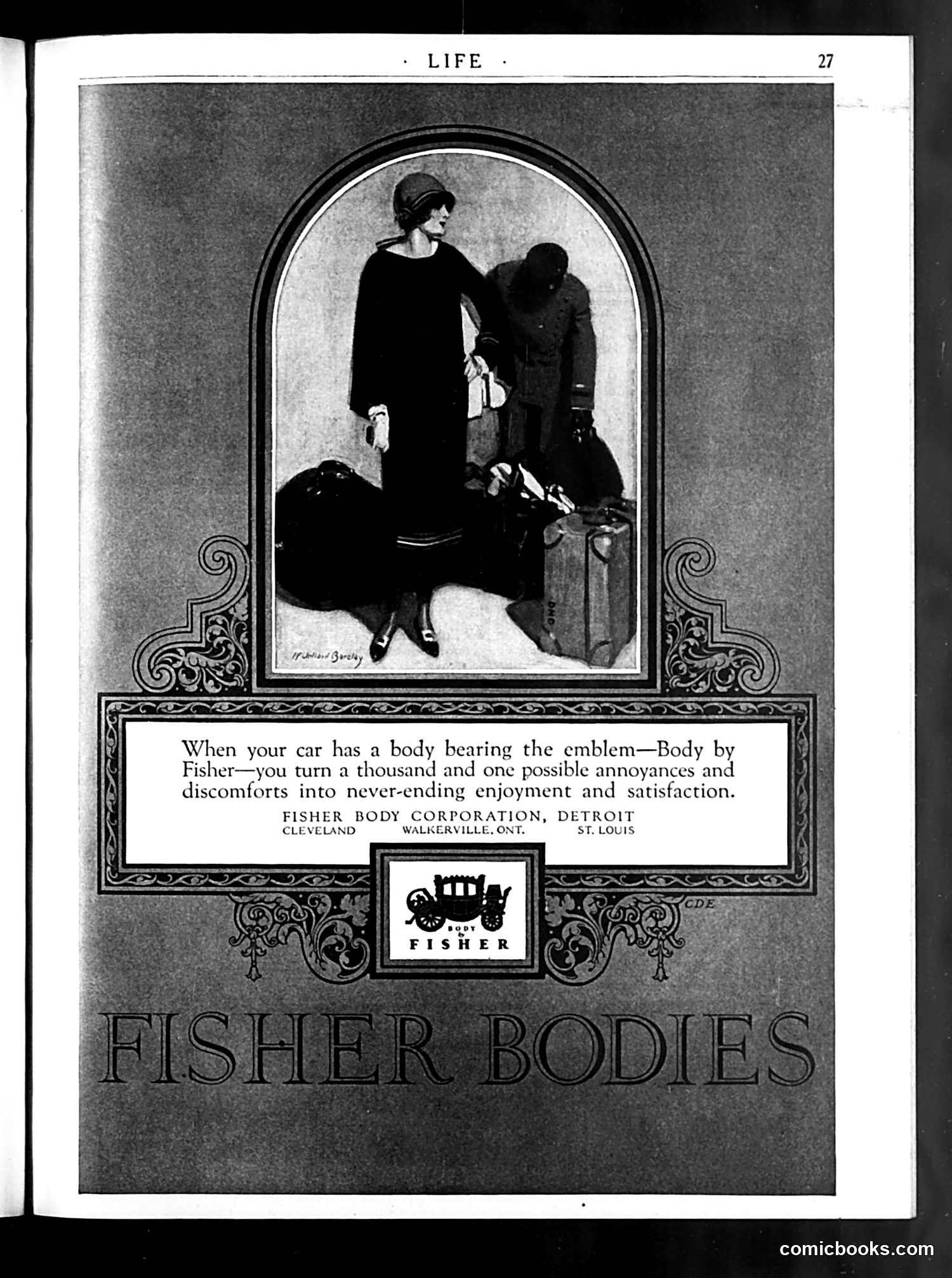
This is a Fisher Body Corporation advertisement, not political satire. The image shows two well-dressed women examining or admiring a car body, illustrating the advertisement's claim that Fisher-brand car bodies transform driving into luxury and satisfaction. The ornate framing and elegant styling suggest upscale appeal. Fisher Body was a real automotive supplier known for manufacturing car bodies. The ad promises that choosing a Fisher body resolves "a thousand and one possible annoyances and discomforts" through superior craftsmanship and design. This represents typical early-twentieth-century automobile advertising, emphasizing quality and refinement to appeal to affluent consumers.
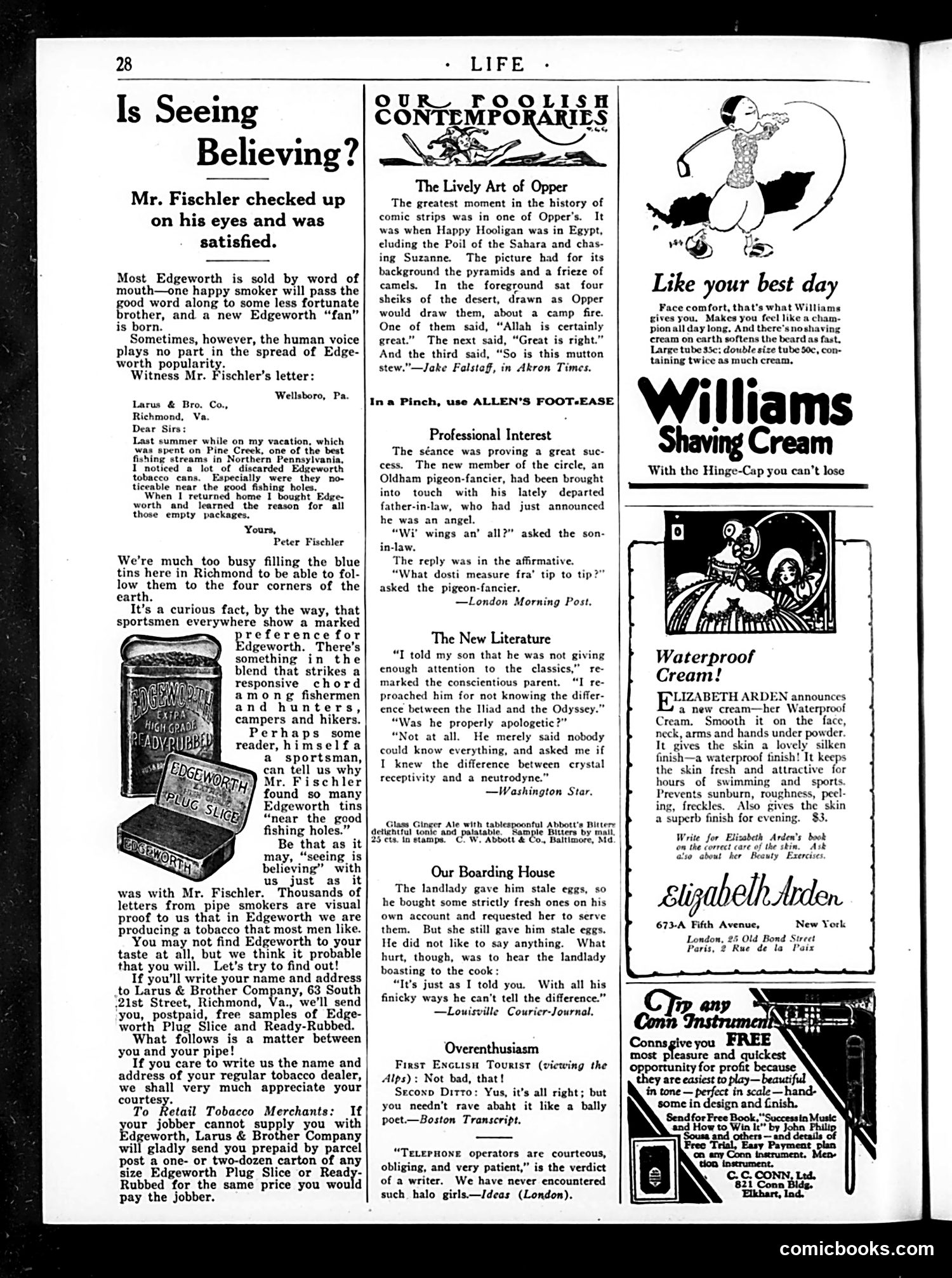
This page from *Life* magazine contains several brief humor pieces ("Our Foolish Contemporaries") and advertising. The main content includes anecdotes mocking human nature and absurdity: **"Is Seeing Believing?"** features a letter about Edgeworth tobacco—a man discovered discarded Edgeworth cans near good fishing holes, then bought the brand himself. The joke is that word-of-mouth advertising works even silently: he saw evidence of other sportsmen's choice and copied it without being told. **"Professional Interest"** mocks spiritualism séances: a man contacts his dead father-in-law through a medium, learns he's now an angel, and immediately asks the practical question of his wingspan—measuring "tip to tip" as if evaluating a pigeon (his actual hobby). **"The New Literature"** satirizes pretentious parents correcting their sons about classical literature while revealing their own ignorance. The page is primarily **advertising**: Williams Shaving Cream, Elizabeth Arden Waterproof Cream, and Allen's Foot-Ease dominate the layout, typical for 1920s-era *Life*.
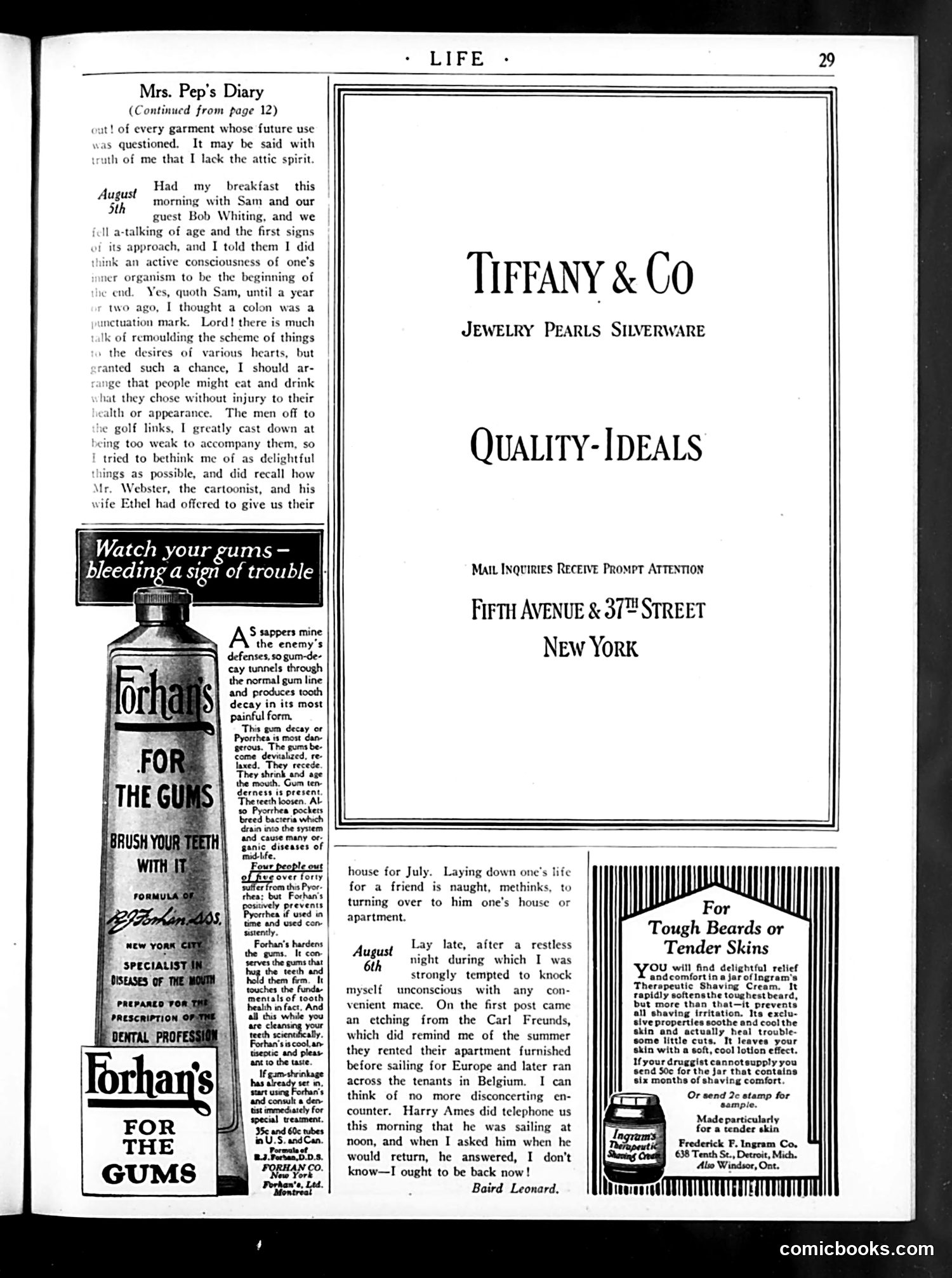
This page is primarily **advertising with a diary column**. The satirical content is minimal. **Mrs. Pep's Diary** (left column) is a humor column featuring a society woman's mundane observations about domestic life, aging, and social situations. The humor relies on genteel understatement—she compares sacrificing one's home to a friend unfavorably against laying down one's life for them, and recounts an awkward encounter with former tenants. References to "Mr. Webster, the cartoonist" appear to be casual name-drops rather than political satire. **The advertisements** dominate the page: - **Forhan's for the Gums** promotes a dental product warning against pyorrhea (gum disease) - **Ingram's Shaving Cream** targets men with sensitive skin - **Tiffany & Co.** announces their jewelry and silverware services These ads use period-typical health anxiety and masculine grooming concerns as sales pitches. There is no evident political satire or caricature on this page—it's a straightforward example of Life's mixed editorial and commercial content format.
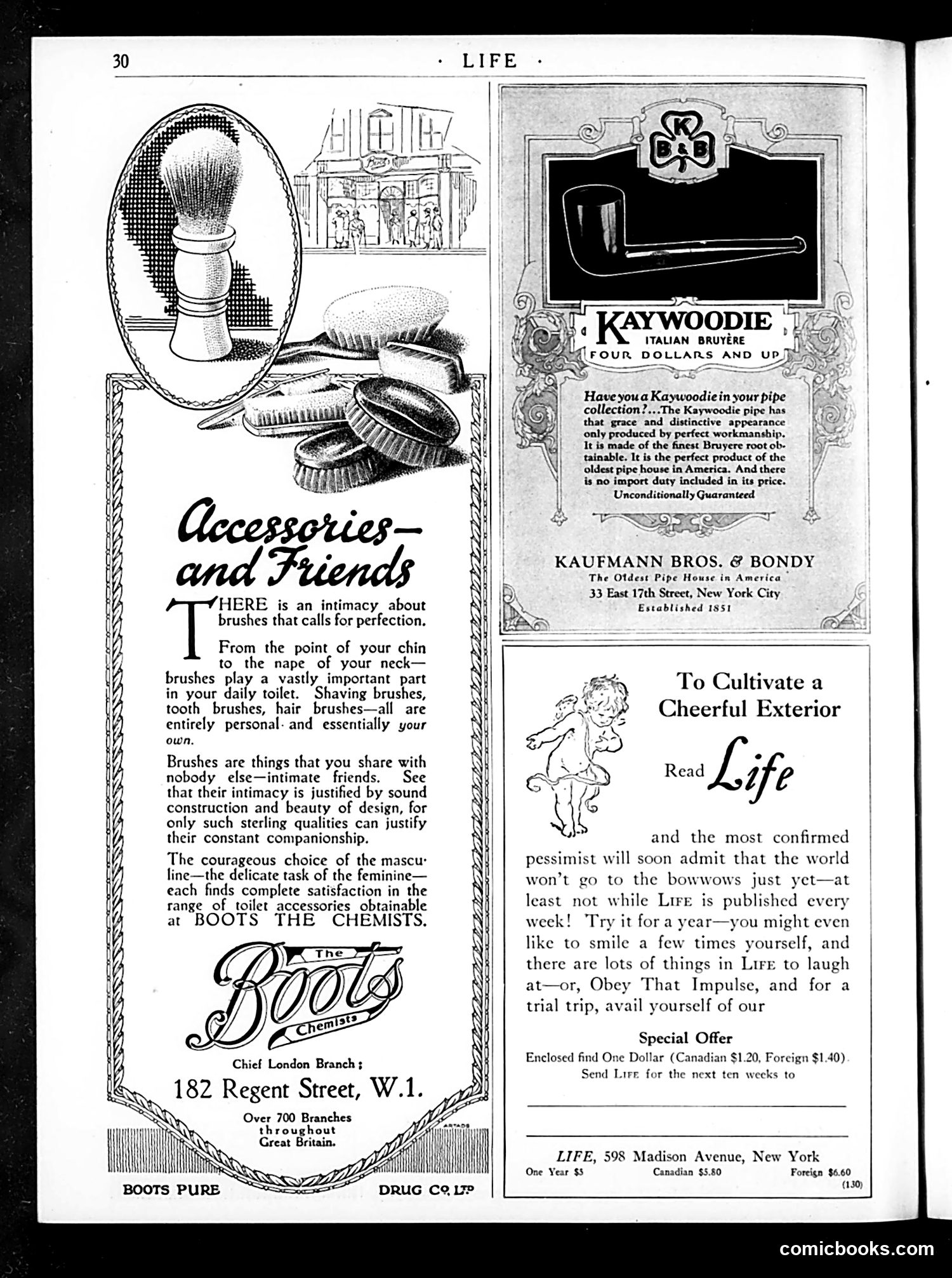
This page contains **three separate advertisements**, not editorial cartoons or satirical content: 1. **Boots the Chemists** (left): A British pharmacy chain advertising personal grooming brushes. The copy emphasizes the intimate, personal nature of brushes—shaving, tooth, and hair brushes—positioning them as essential daily companions that deserve quality construction. 2. **Kaywoodie Pipes** (top right): An American pipe manufacturer advertising Italian briar pipes, emphasizing superior craftsmanship, quality materials, and notably—**no import duty** in the price. This last point appears significant, possibly referencing 1920s-30s tariff concerns. 3. **Life Magazine subscription** (bottom right): The magazine itself advertises a trial subscription, promising humor and cheerfulness as antidotes to pessimism and world troubles. The copy suggests readers subscribe to improve their mood. The page is primarily **commercial advertising** rather than satirical content. The subscription ad's tone—offering escapist humor during uncertain times—suggests this is likely from the 1920s-1930s economic period, though the exact date isn't specified.
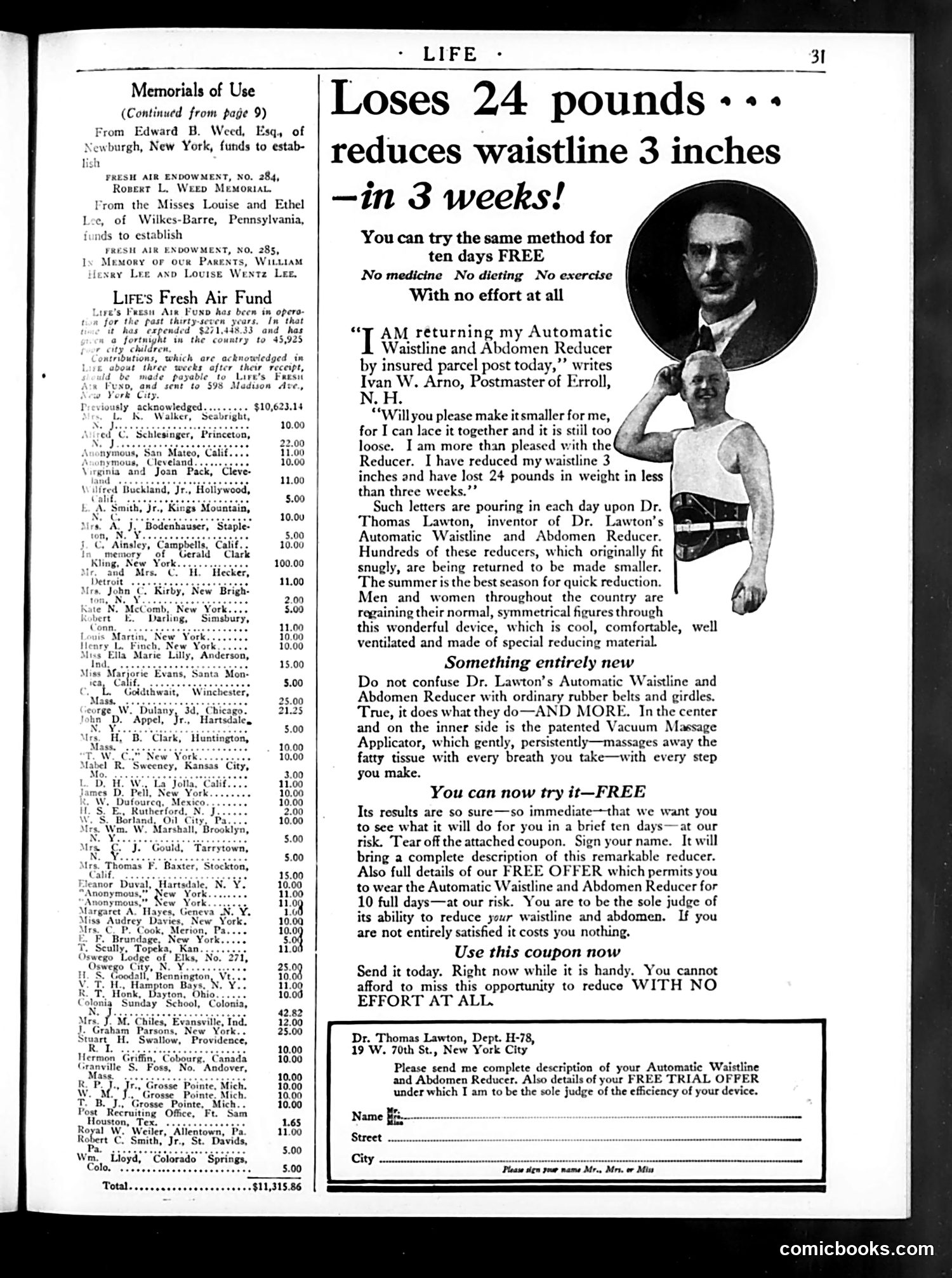
This is primarily a **paid advertisement**, not satire or editorial content. The left column lists donations to Life Magazine's Fresh Air Fund (a real charitable organization providing country vacations for poor city children). The dominant content is a full-page ad for **Dr. Thomas Lawton's "Automatic Waistline and Abdomen Reducer"**—a mechanical corset or belt device claiming to reduce weight 24 pounds and waistline 3 inches in 3 weeks with "no medicine, no dieting, no exercise." The ad features testimonial from a New Hampshire postmaster stating the device worked for him. It promises a "vacuum massage applicator" that massages away fat "with every breath you take." This represents **early 20th-century weight-loss quackery**: pseudoscientific claims about effortless body reduction through a mechanical device. The ad's breathless language and impossible promises would be recognized by modern readers as characteristic of dubious health products, though the product itself—a motorized vibrating/massaging belt—was genuinely marketed during this era.
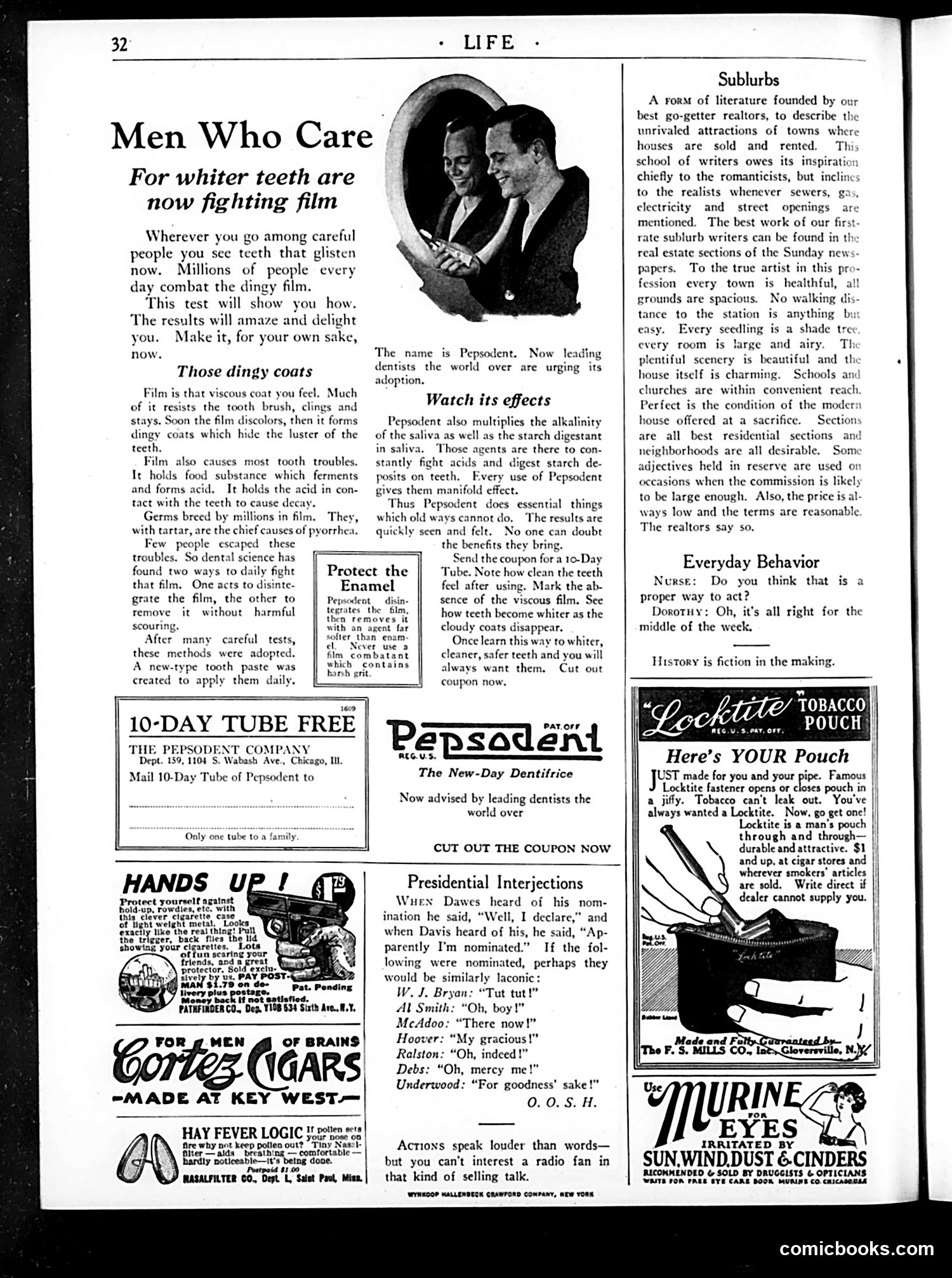
This page is primarily a **Pepsodent toothpaste advertisement** disguised as editorial content. The headline's phrase "fighting film" refers to the yellowish coating that accumulates on teeth—not any actual combat. The advertisement explains that Pepsodent's formula addresses two problems: it disintegrates the film buildup and removes it gently. The copy emphasizes scientific claims about alkalinity and saliva's natural digestants. The small "Presidential Interjections" item is a light political satire, mocking the 1924 election cycle. It imagines various politicians (Bryan, Al Smith, Debs, Underwood) reacting to hypothetical nominations with stereotypical catchphrases—suggesting political figures are predictably characterized by their stock expressions. The page also includes minor advertisements for unrelated products (cigarette case, cigars, hay fever filter, tobacco pouch). This represents early 20th-century marketing: advertising presented as informative content within editorial pages.
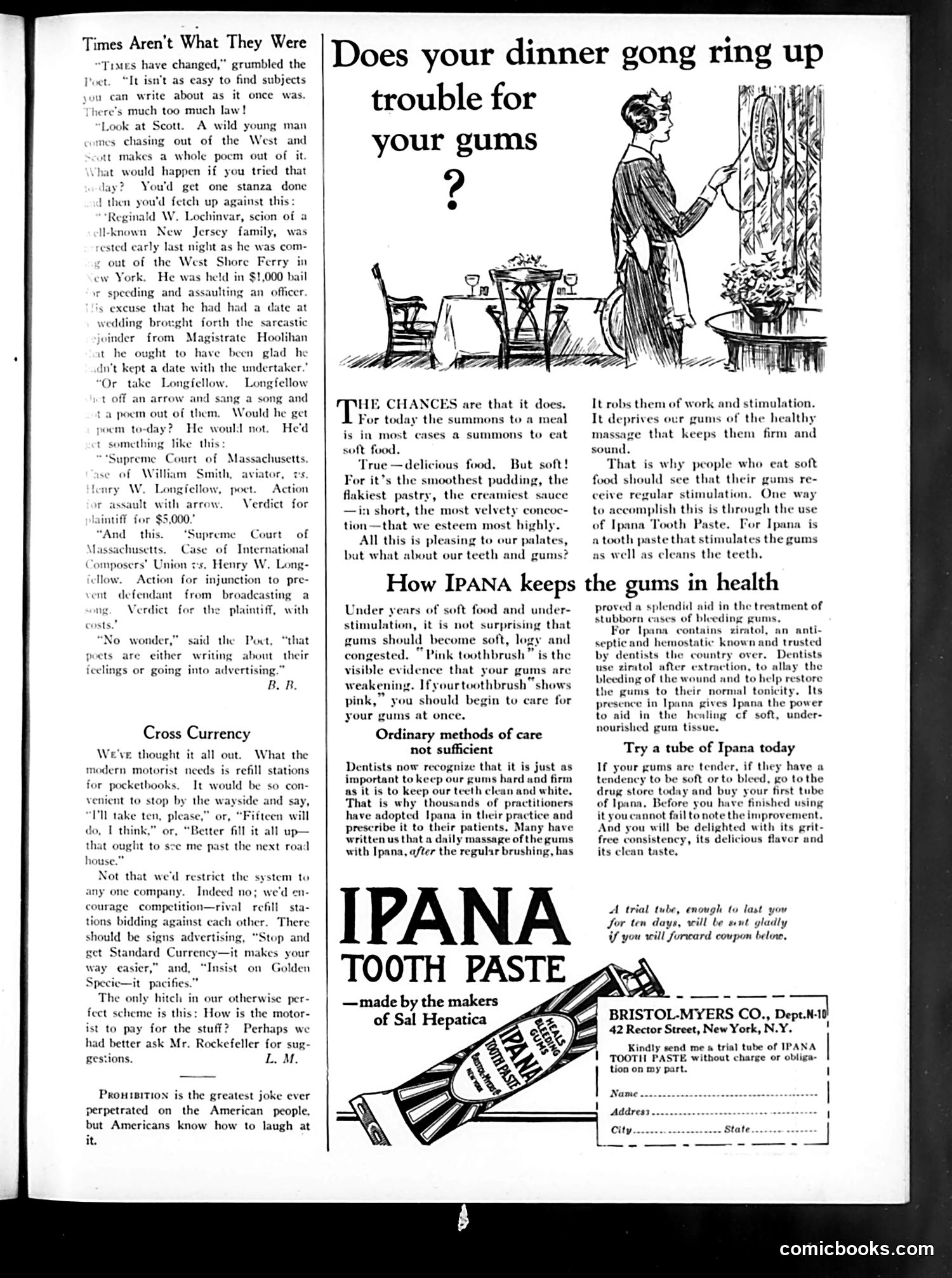
**"Times Aren't What They Were"** satirizes how modern legal restrictions have made poetry impossible. The poet laments that Romantic-era writers like Scott and Longfellow could write freely about dramatic adventures, but today any similar behavior triggers lawsuits, assault charges, and court injunctions. The joke: progress and litigation have eliminated the raw material for great literature. This reflects post-WWI anxieties about America becoming over-regulated and litigious. **"Cross Currency"** humorously proposes "refill stations" for wallets—treating money like gasoline. The satire targets economic anxiety and consumer culture: people burn through cash so quickly they need roadside refueling stops. The Rockefeller reference (America's wealthiest man) adds class commentary. **The Ipana advertisement** is a period toothpaste ad claiming soft food weakens gums, promoting their paste as a solution. While technically advertising, it reflects genuine early-20th-century dental science debates—dentists genuinely believed soft diets harmed gum health.
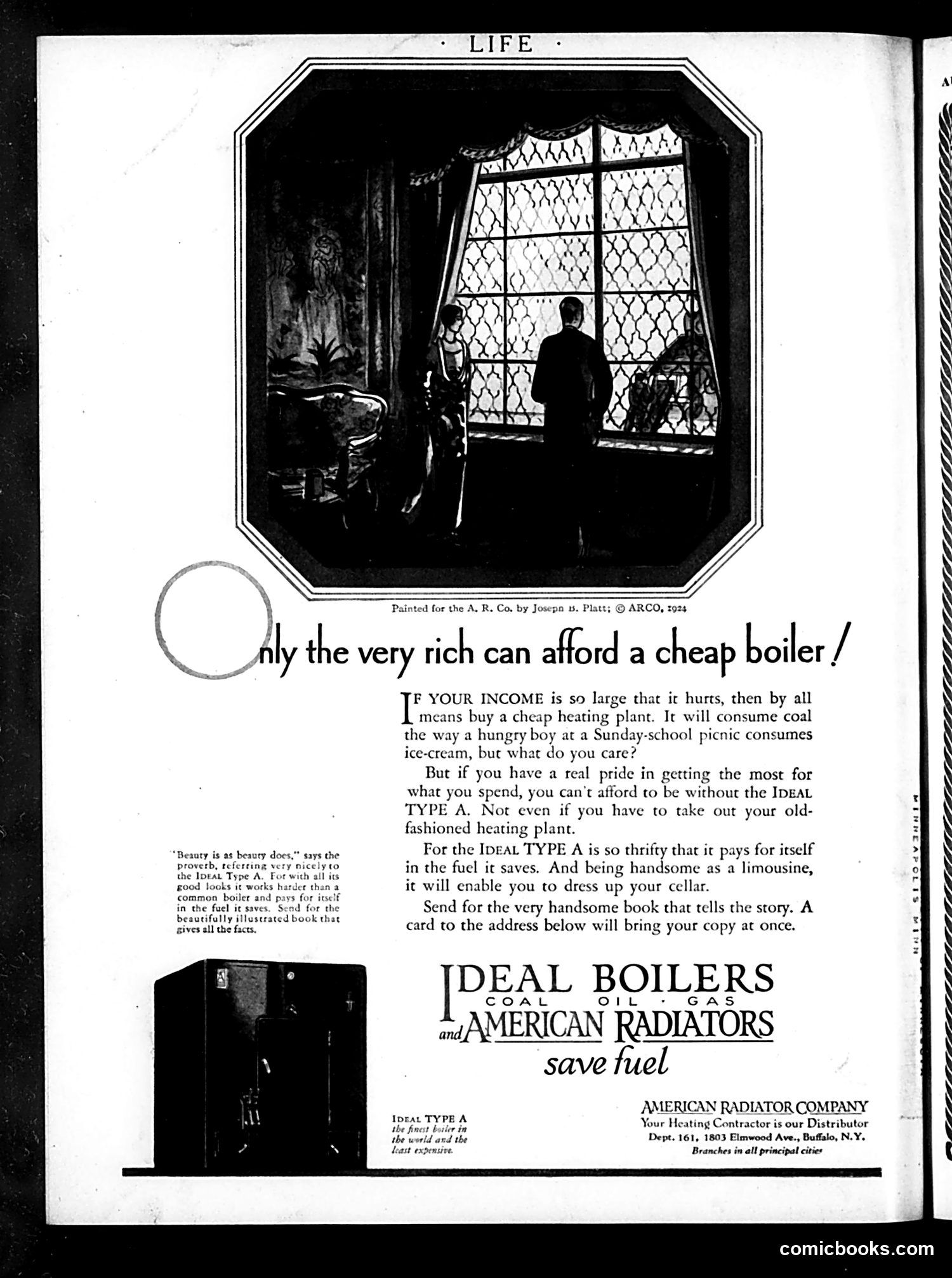
This is primarily a **1920s advertisement** for Ideal boilers and American Radiators, not a political cartoon. The page uses satirical humor to sell heating equipment. The top illustration shows wealthy people at a window—a visual metaphor for luxury. The text's satire targets **wealthy consumers** who can afford wasteful cheap boilers that burn excessive coal. The joke: only the very rich can *afford* to be inefficient; those with actual pride in value should buy the efficient Ideal Type A, which "pays for itself" through fuel savings. The advertisement positions the boiler as both economical and fashionable—"handsome as a limousine"—appealing to affluent readers' vanity and practicality simultaneously. The slogan "save fuel" reflects post-WWI energy conservation concerns (the copyright date appears to be 1924). No specific political figures are caricatured; this is consumer marketing disguised as gentle social commentary about class and consumption.