
Life, 1924-08-07 · page 25 of 36
Life — August 7, 1924 — page 25: what you’re looking at
What you’re looking at
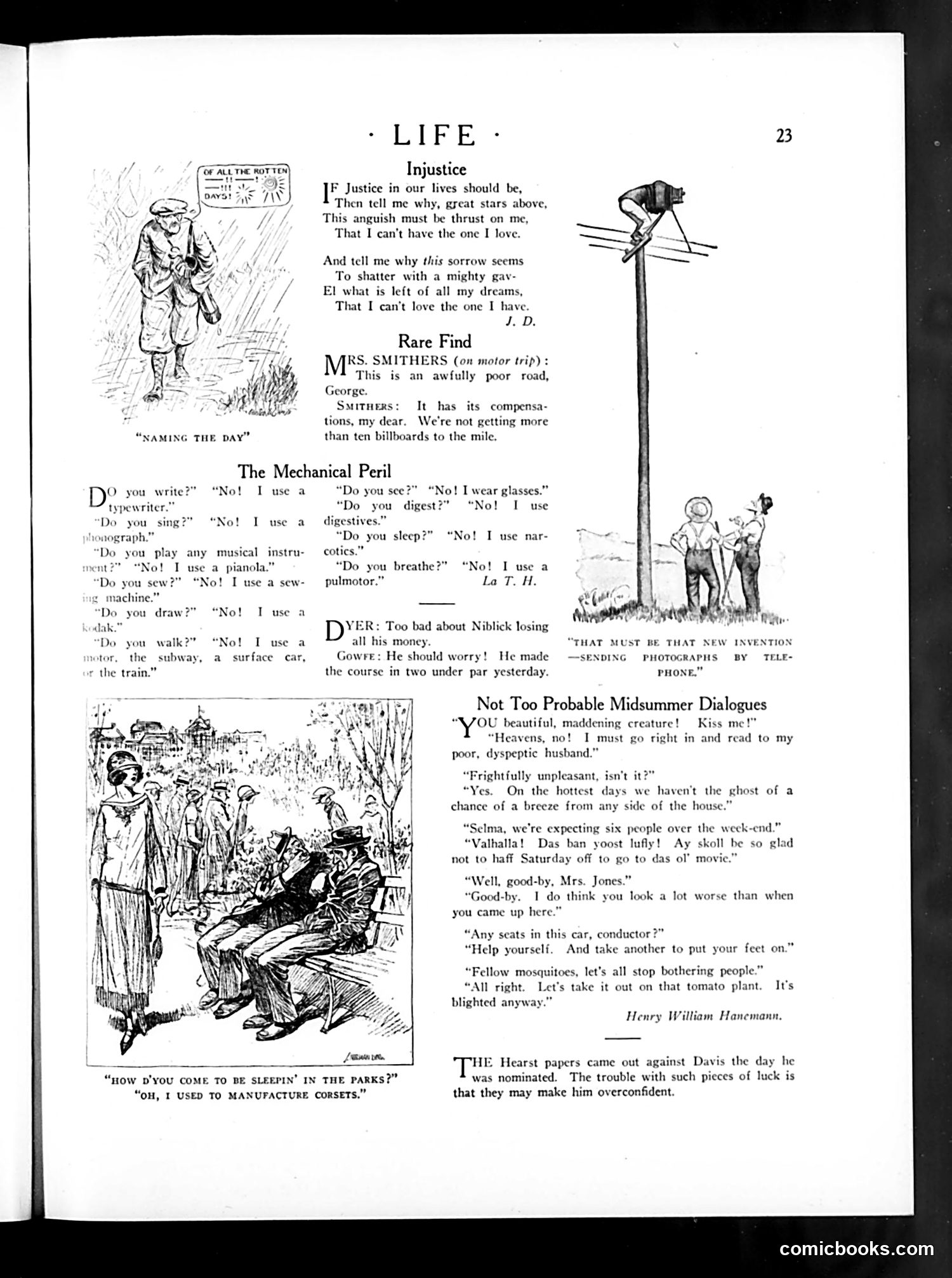
This page contains several satirical pieces typical of early 20th-century American humor: **"The Mechanical Peril"** mocks modern over-reliance on technology and conveniences. The joke lists increasingly absurd claims—people no longer write, sing, photograph, walk, or even breathe naturally, instead using typewriters, phonographs, pulomotors, etc. It's social satire about mechanization replacing human activity. **"Rare Find"** jokes about highway billboard pollution: a couple on a motor trip finds the road's only compensation is sparse advertising (ten billboards per mile rather than more). **The bottom cartoons** offer romantic and domestic humor: wives rejecting advances, complaining about summer heat and social obligations, and a conductor offering passengers space to stretch out—all gentle social commentary. **The final note** references William Randolph Hearst's newspapers opposing some candidate named Davis after his nomination, warning overconfidence could result. Overall, the page satirizes modern technology, commercialism, domestic life, and political coverage—common Life magazine targets of this era.
📄 Transcribed text from this page (OCR, searchable)
Machine-transcribed from the original scan — historical spelling and the odd misread are preserved.
- LIFE - (oe ALL THE ROTTEN) Injustice F Justice in our lives should be, Then tell me why, great stars above, This anguish must be thrust on me, That I can’t have the one I love. And tell me why this sorrow seems To shatter with a mighty gav- El what is left of all my dreams, That I can’t love the one I have. J.D. Rare Find RS. SMITHERS (on motor trip): his is an awfully poor road, George. Saitners: It has its compensa- tions, my dear. We're not getting more “NAMING THE DAY” than ten billboards to the mile, The Mechanical Peril © you write?” “No! I use a “Do you see?” ! I wear glasses.” typewriter.” “Do you digest? “No! I use Do you sing?” “No! I use a digestives.” nograph.” “Do you sleep?” “No! I use nar- you play any musical instru- cotics.” “No! I use a pian “Do you breathe?” “No! I use a ou sew?” “No! I use a se pulmotor.” La T. H. g machine.” ‘Do you draw?” “No! I dak.” YER: Too bad about Niblick losing Do you walk?" “No! I use a all his money. “THAT MUST BE THAT NEW INVENTION yotor, the subway, a surface car, Gowre: He should worry! He made = —seNDING PHOTOGRAPHS BY TELE- + the train.” the course in two under par yesterday. PHONE.” Not Too Probable Midsummer Dialogues “YOU beautiful, maddening creature! Kiss me!” “Heavens, no! I must go right in and read to my poor, dyspeptic husband.” ghtfully unpleasant, isn't ‘es. On the hottest days we haven't the ghost of a chance of a breeze from any side of the house.” “Selma, we're expecting six people over the week-end.” “Valhalla! Das ban yoost lufly! Ay skoll be so glad not to haff Saturday off to go to das ol’ movic.” “Well, good-by, Mrs. Jones.” “Good-by. I do think you look a lot worse than when you came up here.” “Any seats in this car, conductor?” “Help yourself. And take another to put your feet on.” “Fellow mosquitoes, let’s all stop bothering people.” “All right. Let's take it out on that tomato plant. It's blighted anyway.” Henry William Hanemann. . HE Hearst papers came out against Davis the day he “How p'yoU COME TO BE SLEEPIN’ IN THE PARKS?” was nominated. The trouble with such pieces of luck is “OH, I USED TO MANUFACTURE CORSETS.” that they may make him overconfident. comicbooks.com