
Life, 1924-08-07 · page 20 of 36
Life — August 7, 1924 — page 20: what you’re looking at
What you’re looking at
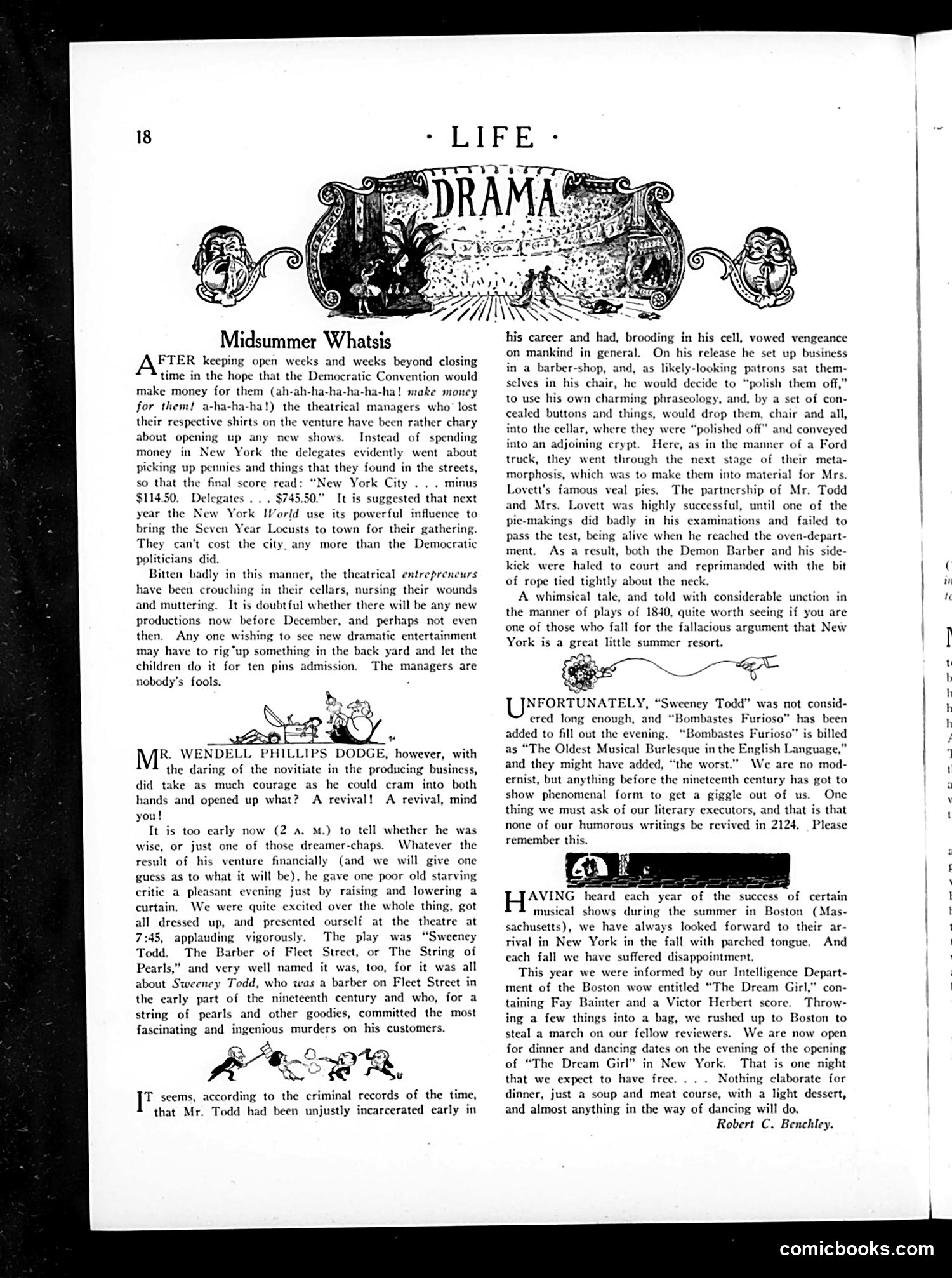
This 1910s Life article satirizes New York's theatrical community after a Democratic Convention failed to boost box office receipts as hoped. The piece mocks theater managers who avoided opening new productions, fearful of financial loss—instead suggesting they might as well let children perform plays in backyards for pennies admission. The main review covers a revival of "Sweeney Todd, the Barber of Fleet Street"—a Victorian melodrama about a murderous barber who kills customers and sells them as meat pies through his partner Mrs. Lovett. The critic uses the play's absurd plot (trapdoors, secret buttons, bodies converted to pie filling) to gently mock both the archaic theatrical form and the desperate state of summer entertainment. The satire targets theatrical entrepreneurs' risk-aversion post-convention, while affectionately covering a campy period piece that appeals only to those deluded enough to think New York offers decent summer resort entertainment.
📄 Transcribed text from this page (OCR, searchable)
Machine-transcribed from the original scan — historical spelling and the odd misread are preserved.
18 - LIFE: Midsummer Whatsis ASTER keeping open weeks and weeks beyond closing time in the hope that the Democratic Convention would make money for them (ah-ah-ha-h ha! make money for them! a-ha-ha-h the theatrical managers who’ lost their respective shirts on the venture have been rather chary about opening up any new shows. Instead of spending money in New York the delegates evidently went about picking up pennies and things that they found in the streets, so that the final score read: “New York City . . . minus $114.50. Delegates . . . $745.50." It is suggested that next year the New York HWorld use its powerful influence to bring the Seven Year Locusts to town for their gathering. They can't cost the city, any more than the Democratic politicians did. Bitten badly in this manner, the theatrical entrepreneurs have been crouching in their cellars, nursing their wounds and muttering. It is doubtful whether there will be any new productions now before December, and perhaps not even then. Any one wishing to see new dramatic entertainment may have to rig*up something in the back yard and let the children do it for ten pins admission. The managers are nobody's fools. R. W. DELL PHILLIPS DODGE, however, with the daring of the novitiate in the producing business, did take as much courage as he could cram into both hands and opened up what? A revival! A revival, mind you! It is too early now (2 a. M.) to tell whether he was wise, or just one of those dreamer-chaps. Whatever the result of his venture financially (and we will give one guess as to what it will be), he gave one poor old starving critic a pleasant evening just by raising and lowering a curtain. We were quite excited over the whole thing, got all dressed up, and presented ourself at the theatre at 7:45, applauding vigorously. The play was “Sweeney Todd. The Barber of Fleet Strect, or The String of Pearls,” and very well named it was, too, for it was all about Sweeney Todd, who was a barber on Fleet Street in the early part of the nineteenth century and who, for a string of pearls and other goodies, committed the most fascinating and ingenious murders on his customers. PRMD R 'T seems, according to the criminal records of the time, that Mr. Todd had been unjustly incarcerated early in his career and had, brooding in his cell, vowed vengeance on mankind in general. On his release he set up business in a barber-shop, and, as likely-looking patrons sat them- selves in his chair, he would decide to “polish them off,” to use his own charming phraseology, and, by a set of con- cealed buttons and things, would drop them, chair and all, into the cellar, where they were “polished off” and conveyed into an adjoining crypt. Here, as in the manner of a Ford truck, they went through the next stage of their meta- morphosis, which was to make them into material for Mrs. Lovett’s famous veal pies. The partnership of Mr. Todd and Mrs. Lovett was highly successful, until one of the pie-makings did badly in his examinations and failed to pass the test, being alive when he reached the oven-depart- ment. As a result, both the Demon Barber and his side- kick were haled to court and reprimanded with the bit of rope tied tightly about the neck. A whimsical tale, and told with considerable unction in the manner of plays of 1840, quite worth secing if you are one of those who fall for the fallacious argument that New York is a great little summer resort. U NFORTUNATELY, “Sweeney Todd” was not consid- ered long enough, and “Bombastes Furioso” has been added to fill out the evening. “Bombastes Furioso” is billed as “The Oldest Musical Burlesque in the English Language,” and they might have added, “the worst.” We are no mod- ernist, but anything before the nineteenth century has got to show phenomenal form to get a giggle out of us. One thing we must ask of our literary executors, and that is that none of our humorous writings be revived in 2124. Please remember this. AVING heard each year of the success of certain musical shows during the summer in Boston (Mas- sachusetts), we have always looked forward to their ar- rival in New York in the fall with parched tongue. And each fall we have suffered disappointment. This year we were informed by our Intelligence Depart- ment of the Boston wow entitled “The Dream Girl,” con- taining Fay Bainter and a Victor Herbert score. Throw- ing a few things into a bag, we rushed up to Boston to steal a march on our fellow reviewers. We are now open for dinner and dancing dates on the evening of the opening of “The Dream Girl” in New York. That is one night that we expect to have fre Nothing claborate for dinner, just a soup and meat course, with a light dessert, and almost anything in the way of dancing will do. Robert C. Benchley. comicbooks.com