
Life, 1924-08-07 · page 26 of 36
Life — August 7, 1924 — page 26: what you’re looking at
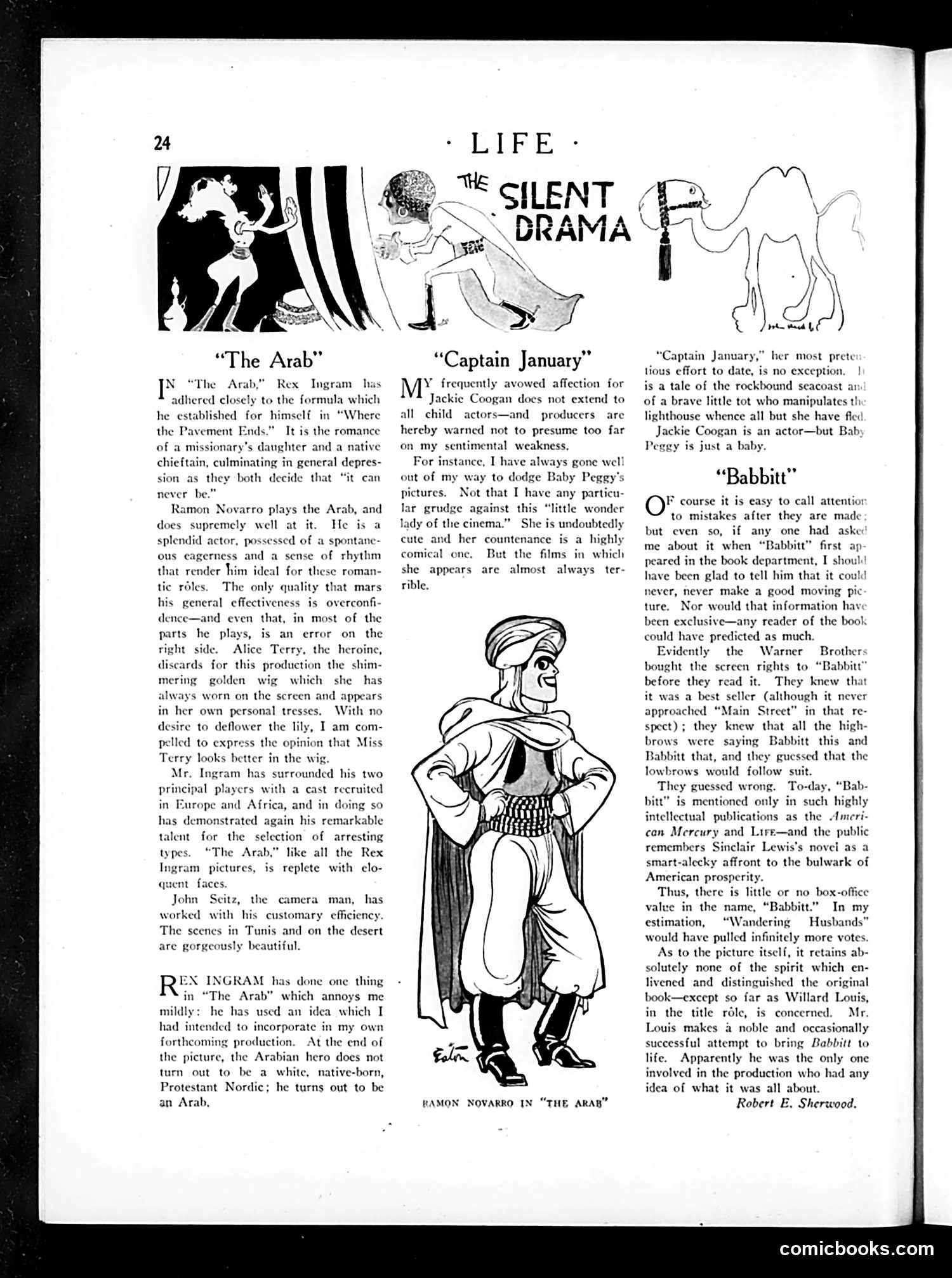
What you’re looking at
This page reviews three silent films. **"The Arab"** stars Ramon Novarro in a romantic drama about a missionary's daughter and a native chieftain. The reviewer praises Novarro's acting but notes the film follows Rex Ingram's established formula. The satire emerges in the final paragraph: the reviewer complains that Ingram "annoyingly" revealed the Arab hero is actually Arab—not a white, Protestant Nordic in disguise, which was apparently the expected plot twist of the era. **"Captain January"** features child star Baby Peggy. The critic dismisses it as terrible despite Peggy's cuteness, arguing child actors cannot carry films. **"Babbitt"** adapts Sinclair Lewis's novel. The reviewer claims Warner Brothers bought screen rights without understanding the book wouldn't translate to cinema, and that audiences remember Lewis's work as anti-American rather than entertaining—making the film commercially worthless.
📄 Transcribed text from this page (OCR, searchable)
Machine-transcribed from the original scan — historical spelling and the odd misread are preserved.
“The Arab” “The Arab,” Rex adhered closely to the formula wi he established for himself in “Where the Pavement Ends.” It is the romance of a missionary’s daughter and a native chieftain, culminating in general depres- sion as they both decide that “it can Ingram has never be. Ramon Novarro plays the Arab, and does supremely well at it. He is a splendid actor, possessed of a spontane- ous eagerness and a sense of rhythm that render him ideal for these roman- tie roles. The onl his general effectiveness is overconfi- dence—and even that, in most of the parts he plays, is an error on the right side. quality that mars Alice Terry, the heroine, discards for this production the shim- mering golden which she has always worn on the screen and appears in her own personal tresses. With no desire to deflower the lily, I am com- pelled to express the opinion that Miss Terry looks better in the wig Mr. Ingram has surrounded his two principal players with a cast recruited in Europe and Africa, and in doing so has demonstrated again his remarkable talent for the selection of arresting types. “The Arab,” like all the Rex Ingram pictures, is replete with clo- wig quent faces. man, has worked with his customary efficiency. John Scitz, the camera The scenes in Tunis and on the desert are gorgeously beautiful. X INGRAM has done one thing in “The Arab” which annoys me mildly: he has used an idea which I had intended to incorporate in my own forthcoming production. At the end of the picture, the Arabian hero docs not turn out to be a white, native-born, Protestant Nordic; he turns out to be an Arab, ‘ LIFE : SILENT \ “Captain January” Y frequently avowed affection for Jackie Coogan does not extend to all child producers are hereby warned not to presume too far on my sentimental weakness, For instane 'S gone well out of my way to dodge Baby Peggy's pictures. Not that I have any particu- lar grudge against this “little wonder lady of the cinema.” She is undoubtedly cute and her countenance is a highly comical one. But the films in which she appears are almost always ter- rible. actors—and T have alwa RAMON NOVARRO IN “THE ARAB” Kn } \\\ J dg “Captain January,” her most prete tious effort to date, is no exception. | is a tale of the rockbound seacoast ar of a brave little tot who manipulates th. lighthouse whence all but she have fle: Jackie Coogan is an actor—but Bab: wey is just a baby. “Babbitt” F course it is easy to call attentior to mistakes after they are made but even so, if any one had aske: me about it when “Babbitt” first ap peared in the book department, I shoul! have been glad to tell him that it could never, never make a good moving pic ture. Nor would that information hav been exclusive—any reader of the book could have predicted as much. Evidently the Warner Brother bought the screen rights to “Babbitt” before they read it. They knew that it was a best seller (although it never approached “Main Street” in that re- spect); they knew that all the high- brows were saying Babbitt this and Babbitt that, and they guessed that the lowbrows would follow suit. They guessed wrong. To-day, “Bab- bitt” is mentioned only in such highly intellectual publications as the Ameri- can Mercury and Lire—and the public remembers Sinclair Lewis's novel as a smart-alecky affront to the bulwark of American prosperity. Thus, there is little or no box-office value in the name, “Babbitt.” In my estimation, “Wandering — Husbands” would have pulled infinitely more votes. As to the picture itself, it retains ab- solutely none of the spirit which en- livened and distinguished the original book—except so far as Willard Louis, in the title rdle, is concerned. Mr. Louis makes a noble and occasionally successful attempt to bring Babbitt to life. Apparently he was the only one involved in the production who had any idea of what it was all about. Robert E. Sherwood. comicbooks.com