
Life, 1924-08-07 · page 16 of 36
Life — August 7, 1924 — page 16: what you’re looking at
What you’re looking at
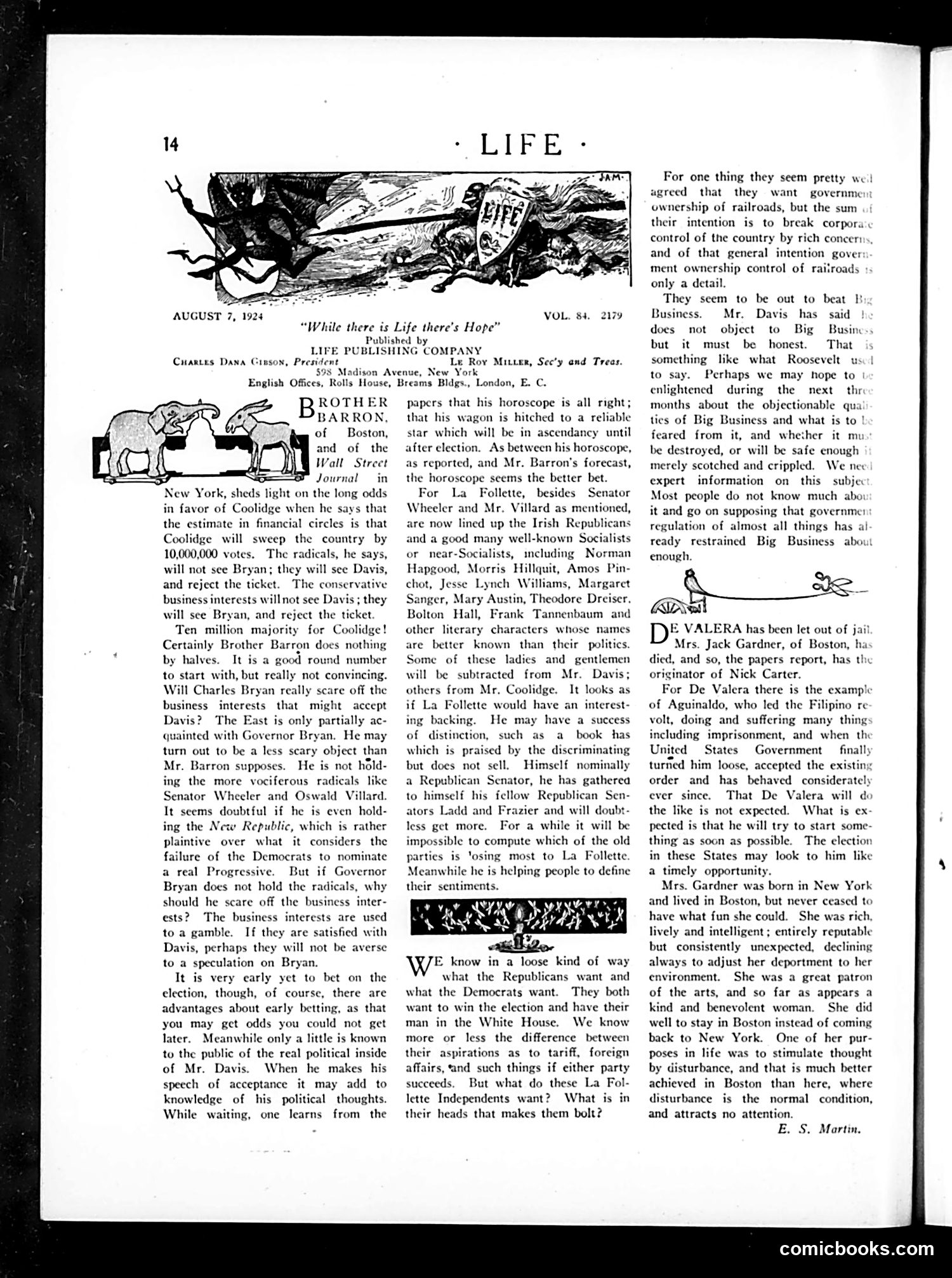
The main cartoon depicts Brother Barron of Boston offering political commentary on the 1924 election. The text discusses tension within Republican circles: Barron's horoscope suggests his favored candidate will win, but he supports the conservative ticket while progressives back La Follette's independent candidacy. The satire critiques wealthy business interests attempting to control politics. Barron represents conservative Republicans worried that independent/progressive candidates might split the vote and weaken their position. The cartoon mocks how business elites use pseudointellectual justifications (like horoscopes) to rationalize their political preferences. The piece also addresses the actual political split: wealthy Republicans versus La Follette's progressive insurgency—a genuine 1924 electoral tension—while questioning what ordinary independents actually want politically.
📄 Transcribed text from this page (OCR, searchable)
Machine-transcribed from the original scan — historical spelling and the odd misread are preserved.
AUGUST 7, 1924 VOL. 84. 2179 “While there is Life there's Hope” Published by LIFE PUBLI Cuartes Dana Ginson, President 'G COMPANY Le Roy Mutter, Sec’y and Treas. $98 Madison Avenue, New York English Offices, Rolls House, Breams Bldgs., London, E. C. ROTHER BARRON, of Boston, of the Wall Street Journal in heds light on the long odds in favor of Coolidge when he says that the estimate in financial circles is that Coolidge will sweep the country by 10,000,000 votes. The radicals, he says, will not see Bryan; they will see Davis, and reject the ticket. The conservativ business interests will not see Davis ; they will see Bryan, and reject the ticket. Ten million majority for Coolid, Certainly Brother Barron does nothing by halves. It is a good round number to start with, but really not convincing. Will Charles Bryan really scare off the business interests that might accept Davis? The East is only partially ac- quainted with Governor Bryan. He may turn out to be a less scary object than Mr. Barron suppo: He is not hold- ing the more vociferous radicals like Senator Wheeler and Oswald Villard. It ms doubtful if he is even hold- ing the New Republic, which is rather plaintive over what it considers the failure of the Democrats to nominate a real Progressive. But if Governor Bryan does not hold the radicals, why should he scare off the business inter- ests? The business interests are used toa gamble. If they are satisfied with Davis, perhaps they will not be averse to a speculation on Bryan. It is very carly yet to bet on the election, though, of course, there are advantages about early betting, as that you may get odds you could not get later. Meanwhile only a little is known to the public of the real political inside of Mr. Davis. When he makes his speech of acceptance it may add to knowledge of his political thoughts. While waiting, one learns from the papers that his horoscope is all right; that his wagon is hitched to a reliable star which will be in ascendancy until after election. As between his horoscope, as reported, and Mr. Barron's forecast, the horoscope seems the better bet. For La Ilette, besides Senator Wheeler and Mr. Villard as mentioned, are now lined up the Irish Republicans and a good many well-known Socialists or near-Socialists, mcluding Norman Hapgood, Morris Hillquit, Amos Pin- chot, Jesse Lynch Williams, Margarct nger, Mary Austin, Theodore Dreiser. Bolton Hall, Frank Tannenbaum and other literary characters whose names are better known than their politics. Some of these ladies and gentlemen will be subtracted from Mr. Davi others from Mr, Coolid; Tt looks as if La Follette would have an interest- ing backing. He may have a success of distinction, such as a book has which is praised by the discriminating but does not sell. Himself nominally a Republican Senator, he has gatherea to himself his fellow Republican Sen- ators Ladd and Frazier and will dout less get more. For a while it will be impossible to compute which of the old parties is ‘osing most to La Follette. Meanwhile he is helping people to define their sentiments. ABS Se SR 72K + E know in a loose kind of way what the Republicans want and what the Democrats want. They both want to win the election and have their man in the White House. We know more or less the difference between their aspirations as to tariff, foreign affairs, and such things if cither party succeeds. But what do these La Fol- lette Independents want? What is in their heads that makes them bolt? For one thing they seem pretty we: agreed that they want governme ownership of railroads, but the sum their intention is to break corpora control of the country by rich concerns, and of that general intention gover ment ownership control of raitroads only a detail. They seem to be out to beat I Business. © Mr. Davis has said does not object to Big Busin but it must be honest. That something like what Roosevelt us to Perhaps we may hope to | enlightened during the next thr months about the objectionable qua ties of Big Business and what is to | feared from it, and whether it mu be destroyed, or will be safe enough merely scotched and crippled. We nec expert information on this subjec Most people do not know much abo it and go on supposing that governme: regulation of almost all things has al ready restrained Big Business about enough. E VALERA has been let out of jail Mrs. Jack Gardner, of Boston, ha died, and so, the papers report, has the iginator of Nick Carte For De Valera there is the exampl of Aguinaldo, who led the Filipino re volt, doing and suffering many thing including imprisonment, and when the United States Government _ finally turned him loose, accepted the existing order and has behaved considerately ever since. That De Valera will do the like is not expected. What is ex- pected is that he will try to start some- thing as soon as possible. The election in these States may look to him like a timely opportunity. Mrs. Gardner was born in New York and lived in Boston, but never ceased to have what fun she could. She was rich, lively and intelligent ; entirely reputable but consistently unexpected, declining always to adjust her deportment to her environment. She was a great patron of the arts, and so far as appears a kind and benevolent woman. She did well to stay in Boston instead of coming back to New York. One of her pur- poses in life was to stimulate thought by disturbance, and that is much better achieved in Boston than here, where disturbance is the normal condition, and attracts no attention. E. S. Martin, comicbooks.com