
A complete issue · 40 pages · 1924
Life — April 17, 1924
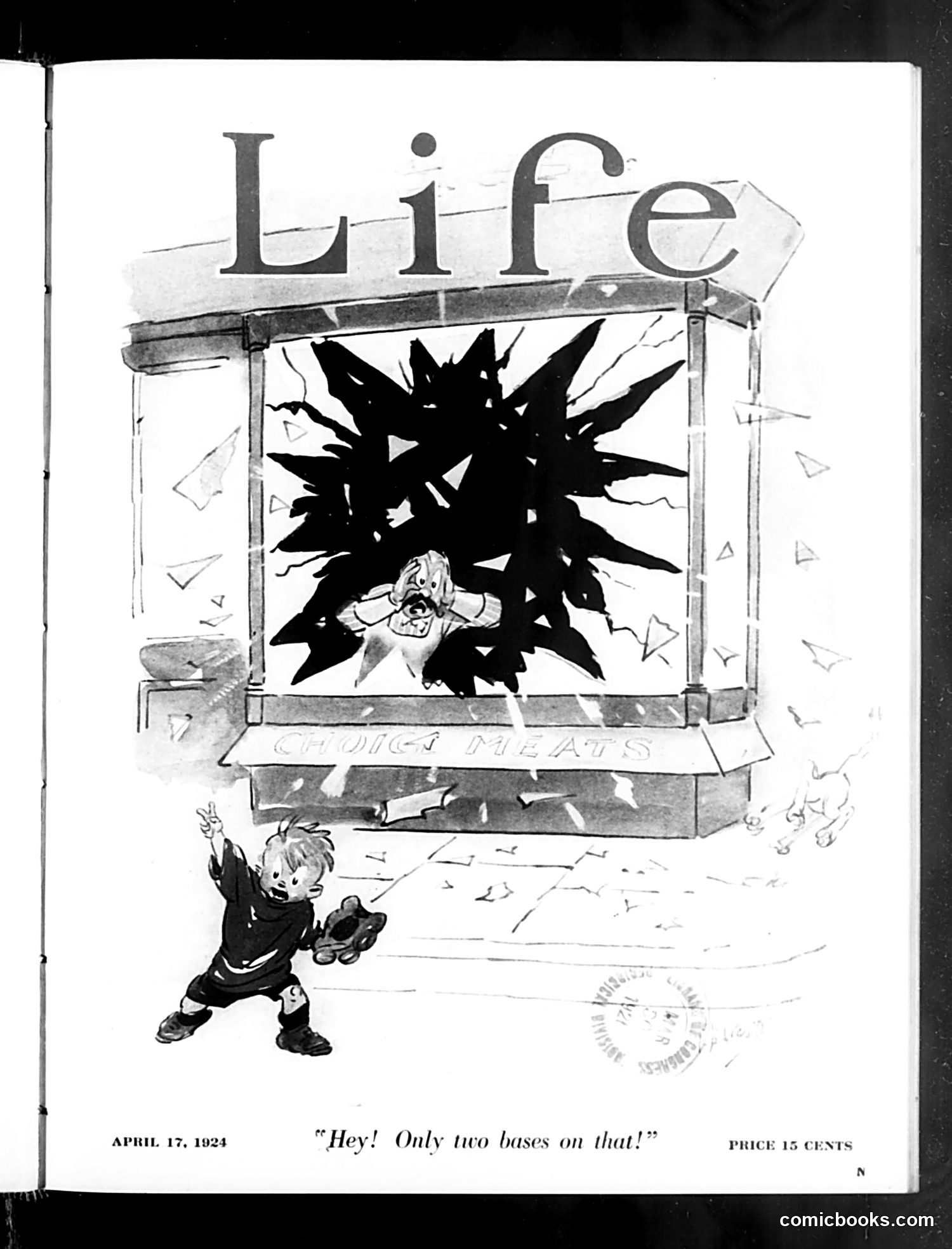
This is a satirical cover depicting a movie theater showing a film called "Life" (the magazine's title). A child stands outside reacting with alarm to the explosive action depicted on screen—a dramatic burst of black spikes suggesting violent chaos or a dramatic explosion. The caption reads: "Hey! Only two bases on that!" This baseball reference suggests the cartoon critiques sensationalism in cinema. The joke appears to be that modern movies depict exaggerated, over-the-top action that exceeds reasonable bounds—even a child recognizes the excess. The cartoonist seems to mock contemporary film's tendency toward melodrama and unrealistic spectacle, comparing it to breaking baseball rules. The satire targets both the movie industry's sensationalism and public appetite for such entertainment.
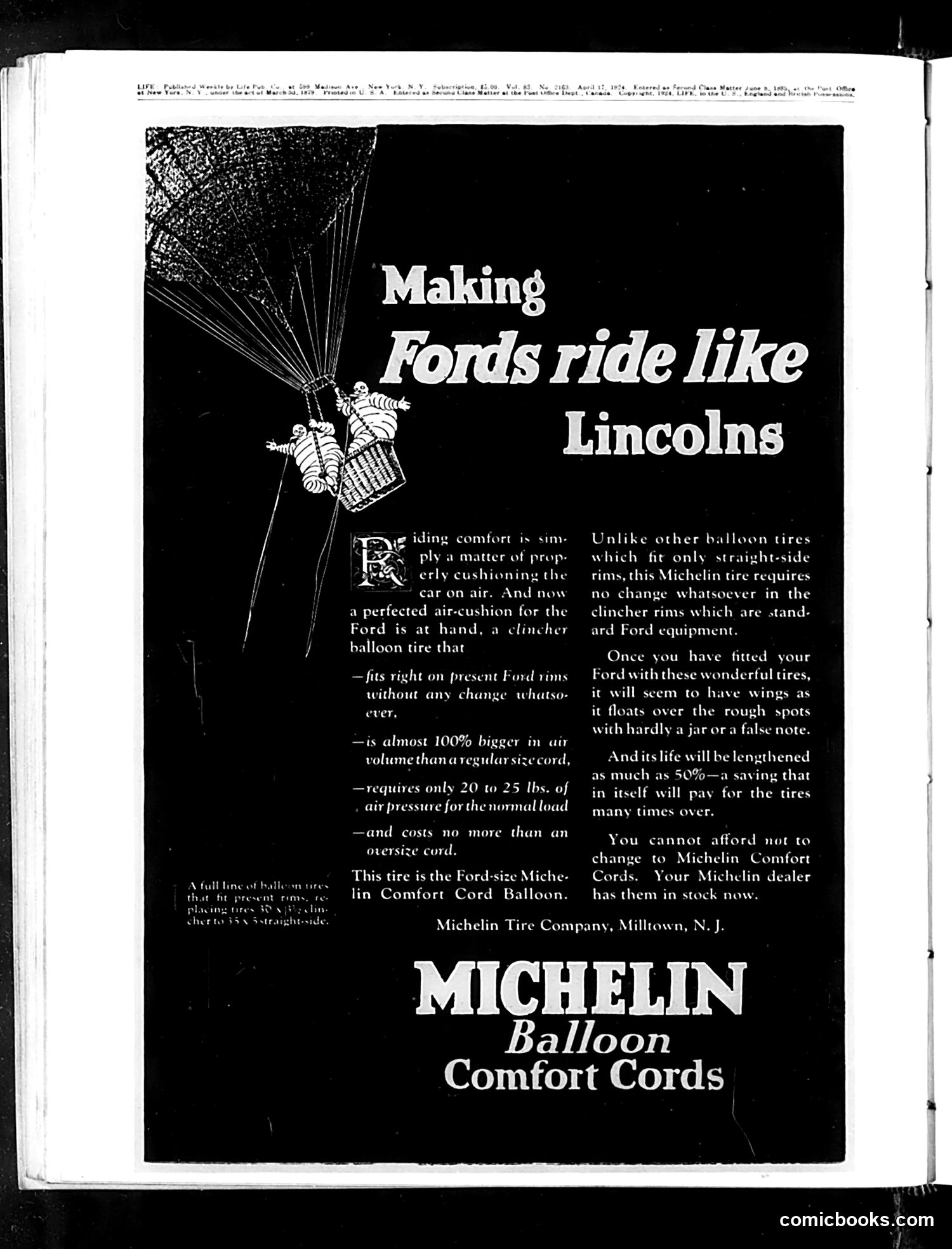
This page is primarily **advertising, not editorial content or satire**. It's a Michelin Tire Company advertisement for "Balloon Comfort Cords" tires, published in *Life* magazine. The advertisement features an illustration of two figures in a hot air balloon, promoting Michelin's new tire technology designed for Ford automobiles. The ad emphasizes comfort and convenience—the balloon tire requires minimal air pressure and fits Ford rims without modification. The balloon/hot air imagery is **metaphorical advertising language**, not political satire: the copy promises that Fords equipped with these tires will ride "like Lincolns" (the luxury competitor), implying a smooth, floating sensation. There are no political cartoons or satirical figures to decode—this is commercial promotion typical of *Life*'s advertising pages in this era.
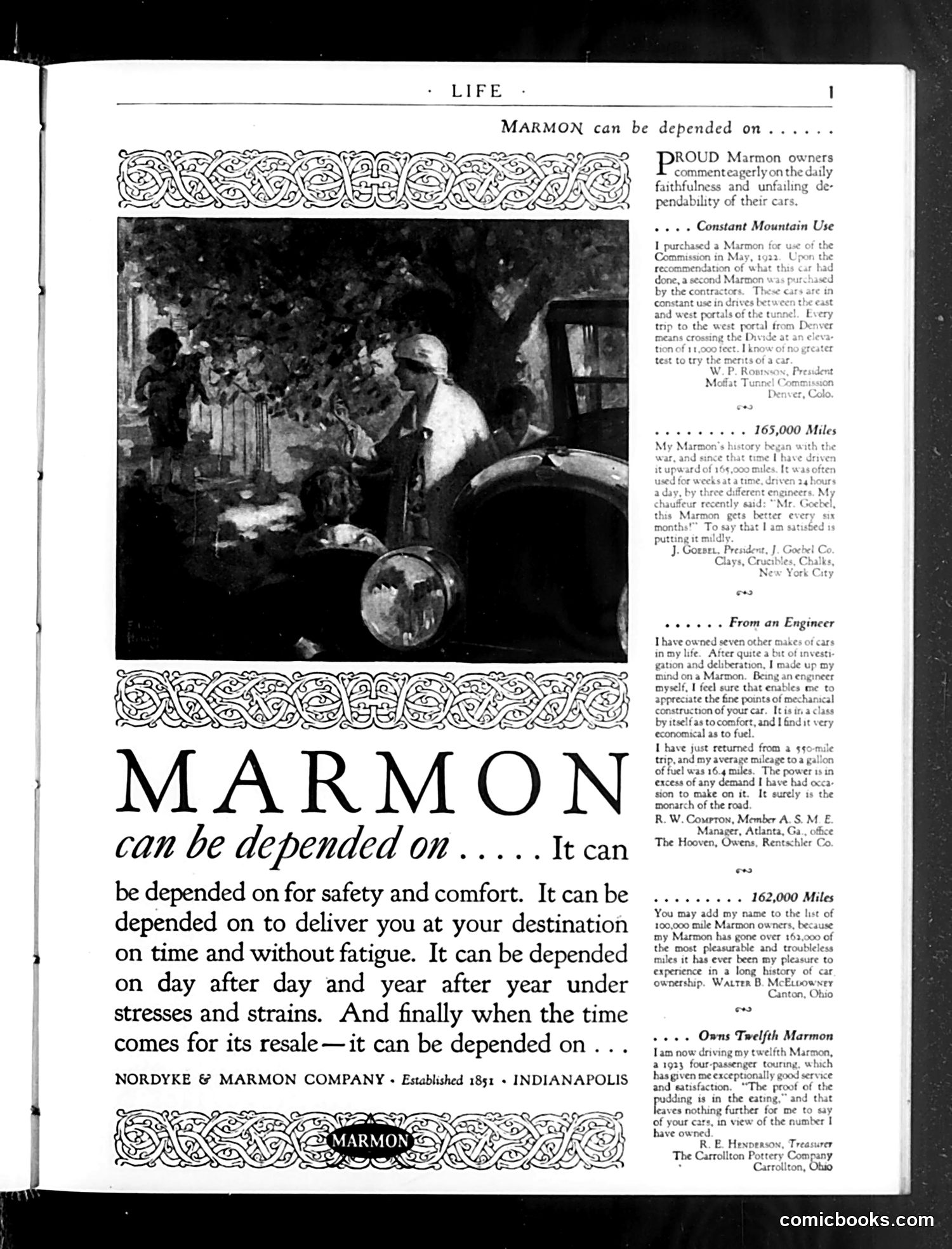
This page is **primarily an advertisement**, not a political cartoon. It's a Marmon automobile advertisement from Nordyke & Marmon Company (established 1851, Indianapolis). The ad features a photograph of what appears to be a 1920s car with passengers and includes testimonials from satisfied owners praising the vehicle's reliability. The claims emphasize dependability across various uses: mountain driving, high mileage (165,000 and 162,000 miles mentioned), engineering performance, and resale value. The decorative Celtic knotwork borders and large typography create visual interest, but there is no political satire or social commentary here. This is straightforward automotive marketing targeting affluent buyers by showcasing real-world testimonials about durability and value retention.
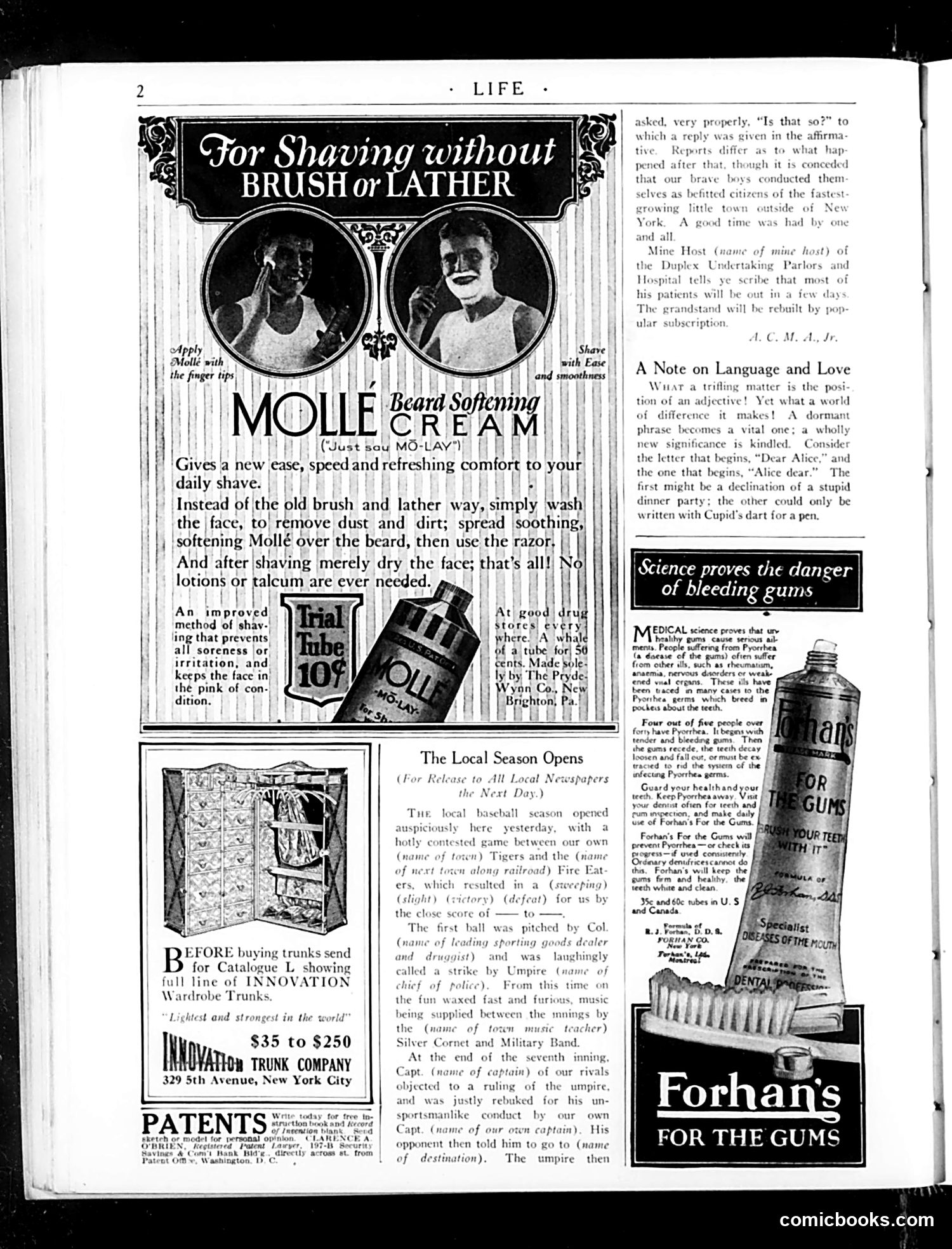
This page is **primarily advertising**, not political satire. The dominant content features three commercial advertisements: 1. **Mollé Beard Softening Cream** (top): A shaving product ad showing two men demonstrating the application method. The pitch emphasizes convenience—no brush or lather needed, just wash, apply cream, and shave. 2. **Innovation Trunk Company** (middle-left): An ad for luggage, claiming to sell "the lightest and strongest in the world" at prices from $35-$250. 3. **Forhan's For the Gums** (right): A dental product advertisement warning about gum disease ("bleeding gums") and promoting their solution. The page also contains a brief article about a local baseball season opening. There is **no political cartoon or satirical content** visible on this page.
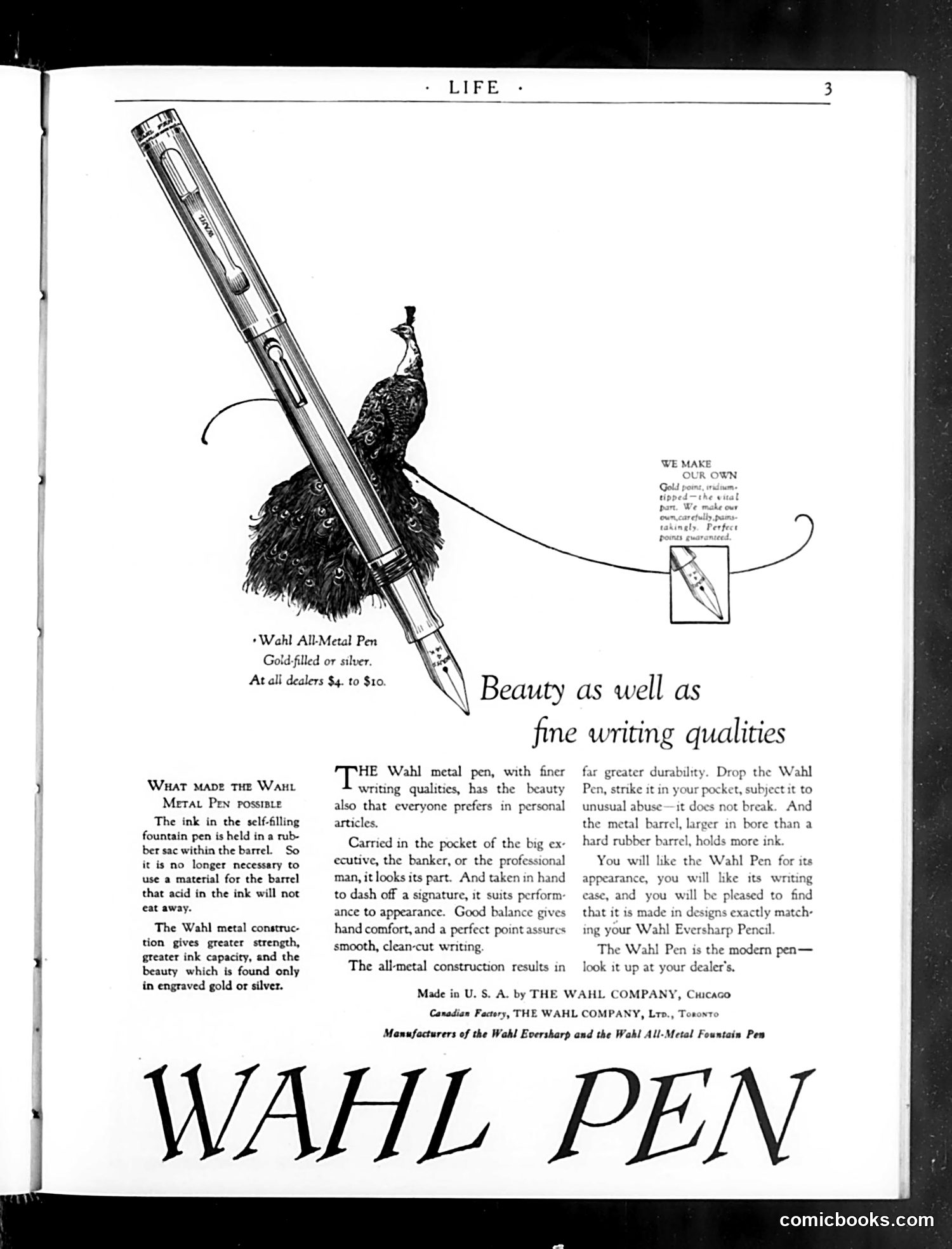
This page is **primarily a product advertisement**, not satire or political commentary. It advertises the Wahl All-Metal Pen, manufactured by the Wahl Company of Chicago (with a Canadian factory in Toronto). The illustration shows a peacock perched on an oversized fountain pen—a visual metaphor for elegance and display. The peacock symbolizes beauty and pride, connecting to the ad's headline: "Beauty as well as fine writing qualities." The advertisement emphasizes the pen's durability, superior ink capacity, and professional appearance suitable for businessmen and executives. The pricing ($4-$10) and availability ("at all dealers") suggest a mid-range luxury product from the early-to-mid twentieth century. There is no political satire present—this is straightforward commercial marketing.
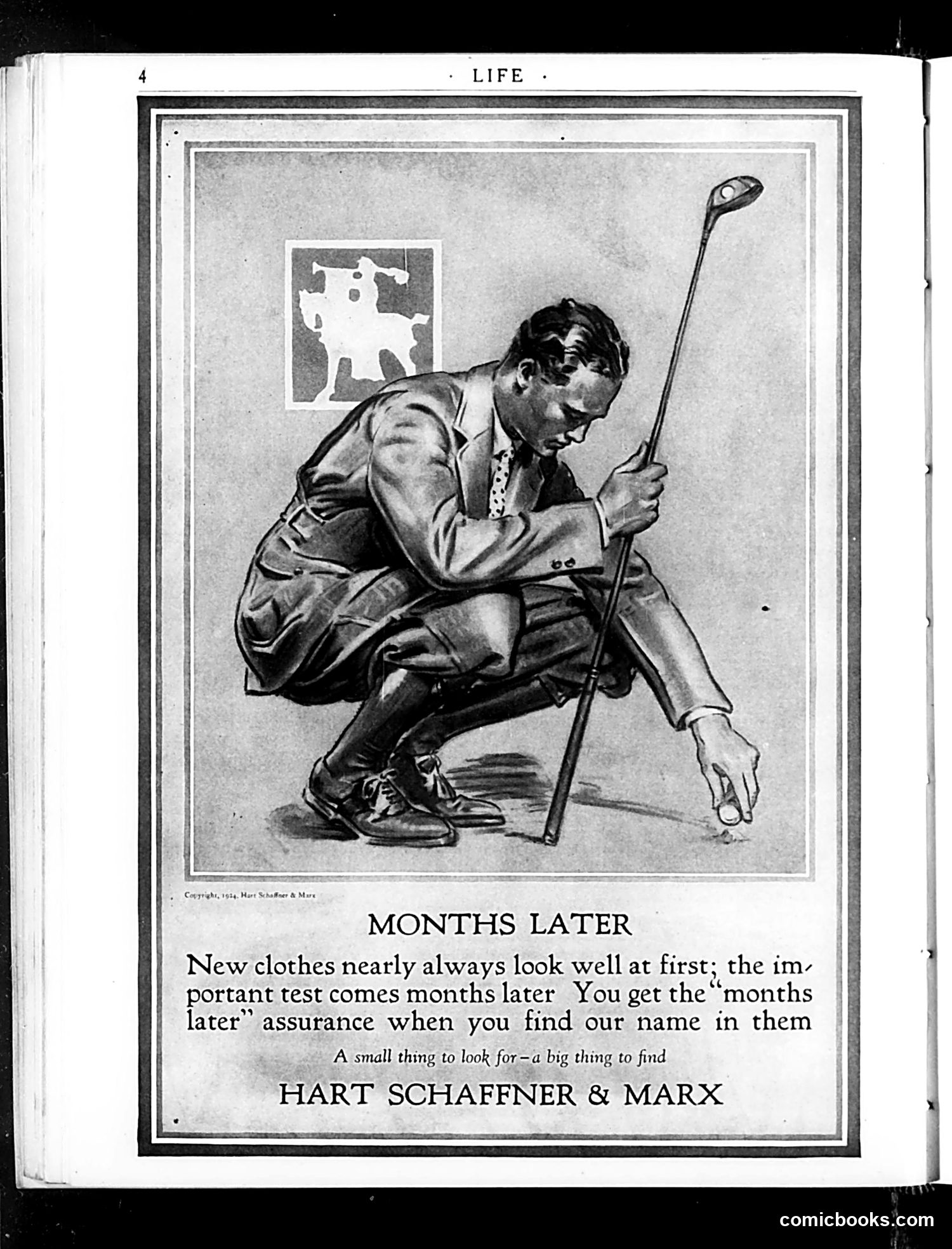
This is a **clothing advertisement**, not political satire. The image shows a man in a business suit crouching to examine fabric or seams with a magnifying glass, illustrating quality inspection. The ad's message plays on consumer anxiety about clothing durability: "New clothes nearly always look well at first; the important test comes months later." Hart Schaffner & Marx promises their garments will hold up over time—the "months later assurance" refers to durability rather than fashion. The tagline "A small thing to look for—a big thing to find" suggests checking for the manufacturer's label inside the garment as proof of quality construction. This appeals to early 20th-century consumers concerned about getting value for their money in ready-made clothing.
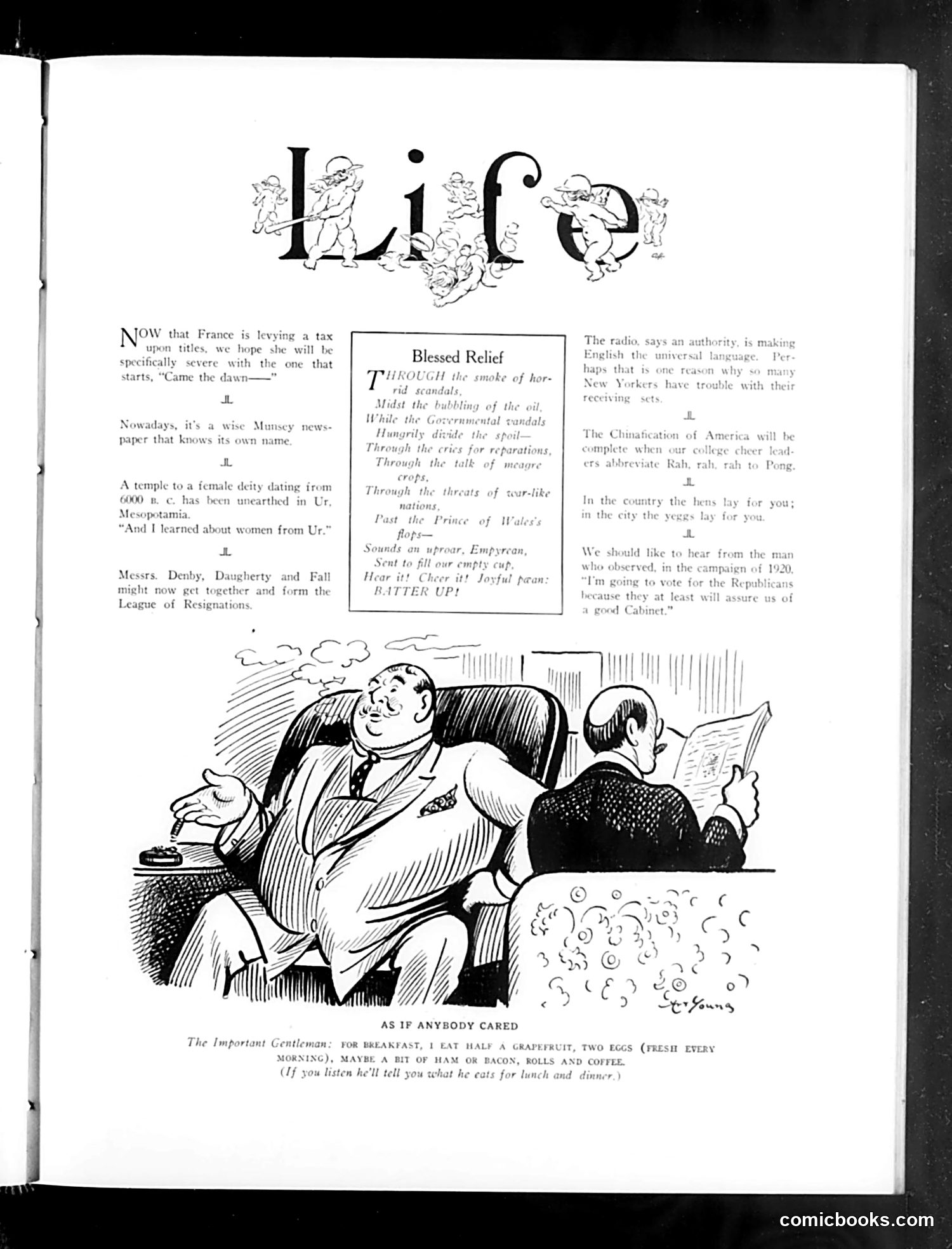
This page satirizes post-WWI American politics and social absurdities. The main cartoon, "As If Anybody Cared," depicts a portly gentleman reading a newspaper while appearing oblivious to surrounding chaos—likely mocking indifference to serious issues. The boxed section "Blessed Relief" parodies governmental scandals through mock-reverent verse, referencing French taxation disputes and political corruption ("oil" scandals likely allude to the Teapot Dome affair). Text snippets mock the "Chinafication of America," college cheerleaders, radio standardization, and voting intentions. One quote references 1920 campaign promises about a Republican "Cabinet." The overall tone suggests satirizing both governmental mismanagement and middle-class complacency during the post-war era, using humor to critique political hypocrisy and public indifference.
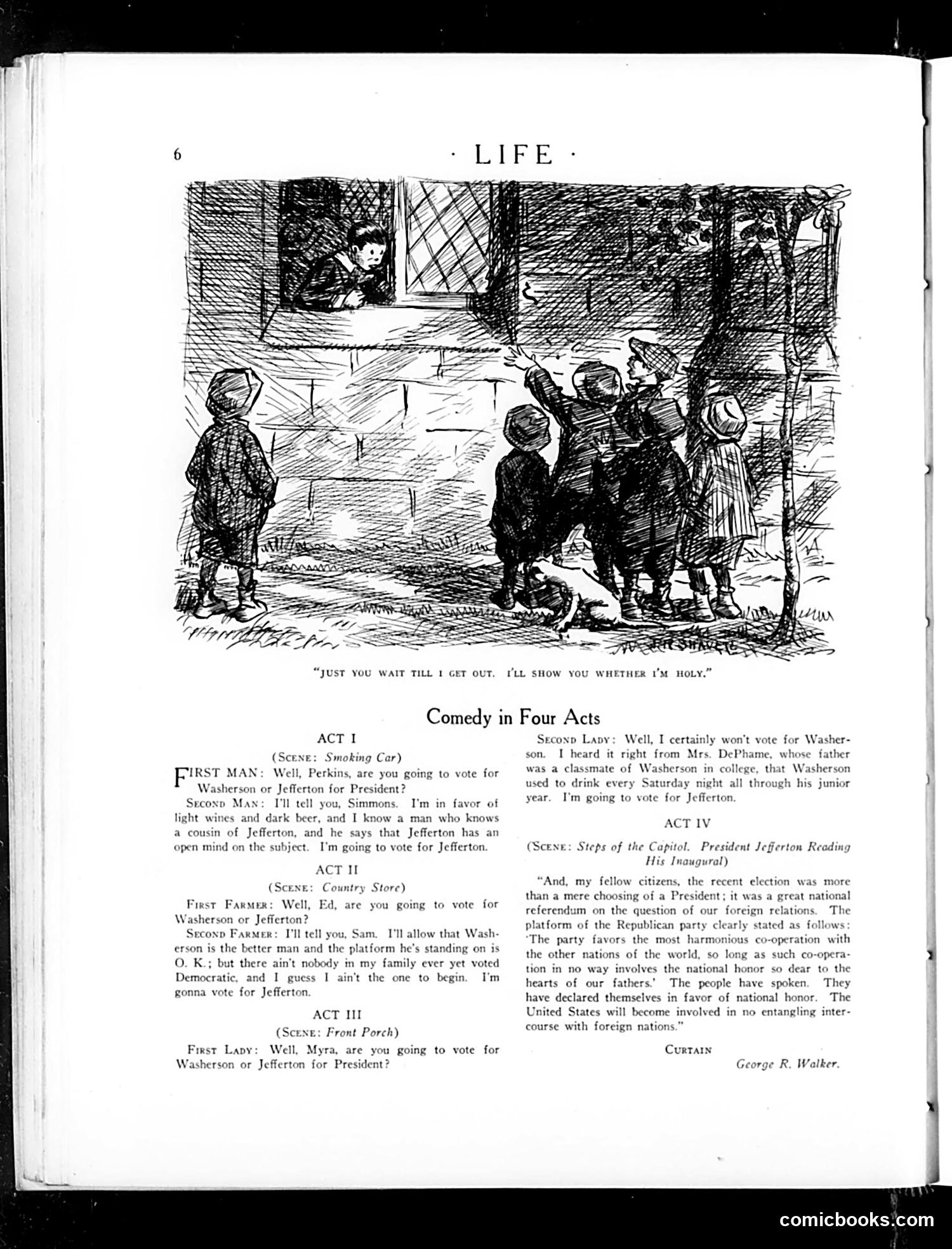
This page satirizes the 1912 U.S. presidential election through a four-act comedy. The sketch depicts ordinary Americans debating whether to vote for **Washerson** or **Jefferson** for president—transparent stand-ins for the actual candidates **William Howard Taft** and **Thomas Jefferson** (or possibly **Woodrow Wilson**). The satire mocks how citizens justify their voting choices with contradictory or superficial reasoning: one man cites "light wines and dark beer," another claims family loyalty to one party, a woman relies on gossip. Act IV presents President Jefferson's inaugural address emphasizing peaceful foreign relations. The cartoon above illustrates children playing at politics, reinforcing the joke that voter decision-making is childishly simplistic and performative rather than principled.
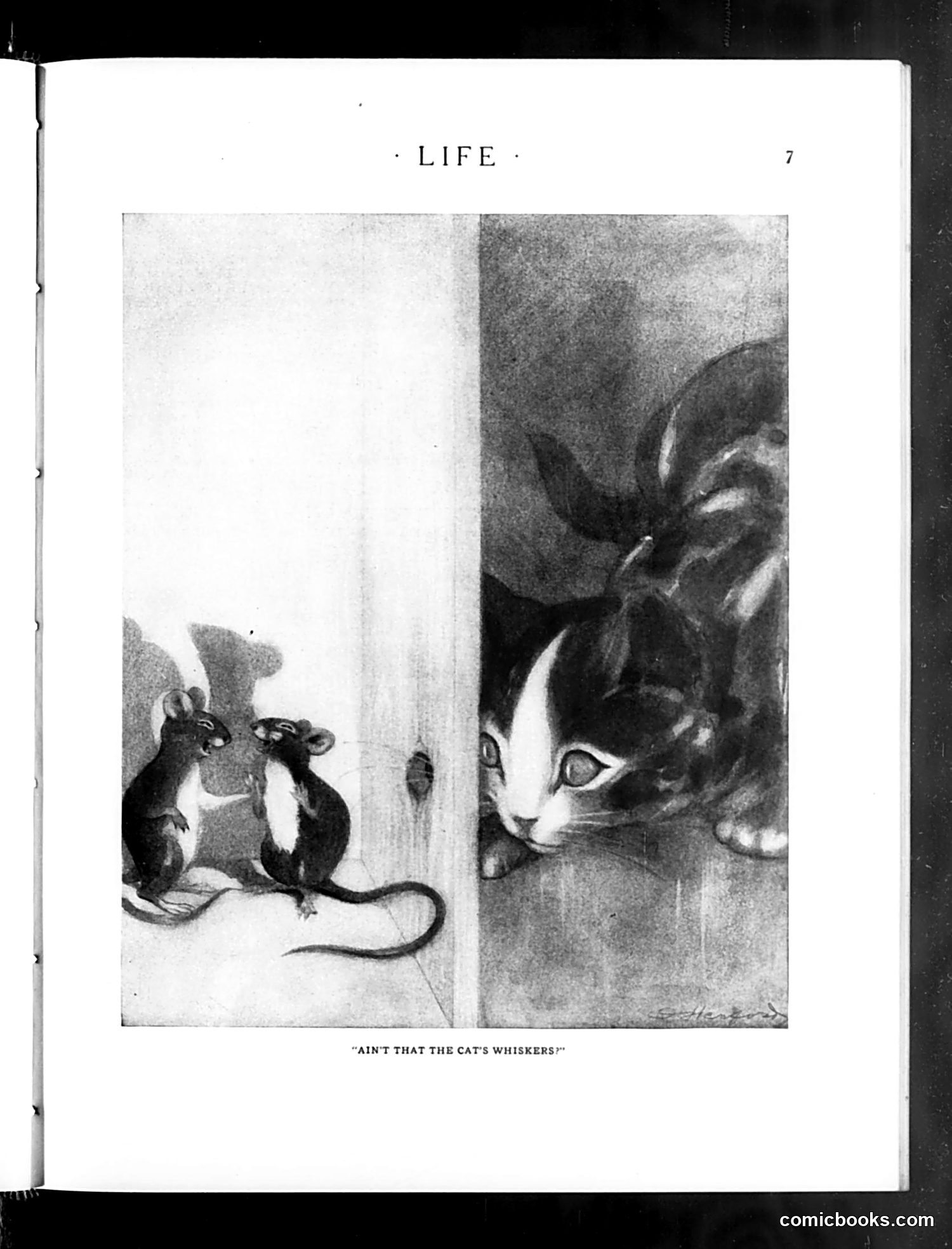
This cartoon plays on the 1920s slang phrase "cat's whiskers," meaning something excellent or fashionable. The image shows two mice confronting a cat through what appears to be a doorway or opening. The mice seem oblivious to or unconcerned about the danger the cat represents—they're commenting on the cat's appearance as if admiring it as a desirable fashion or trend. The humor lies in the ironic contrast: the mice are praising the cat (the "cat's whiskers") while simultaneously facing their natural predator. It's a visual pun combining the slang expression with literal cat's whiskers, satirizing either fashion obsession or naive behavior in the face of obvious danger. The cartoon likely mocks contemporary trends or blind admiration for things that are actually harmful.
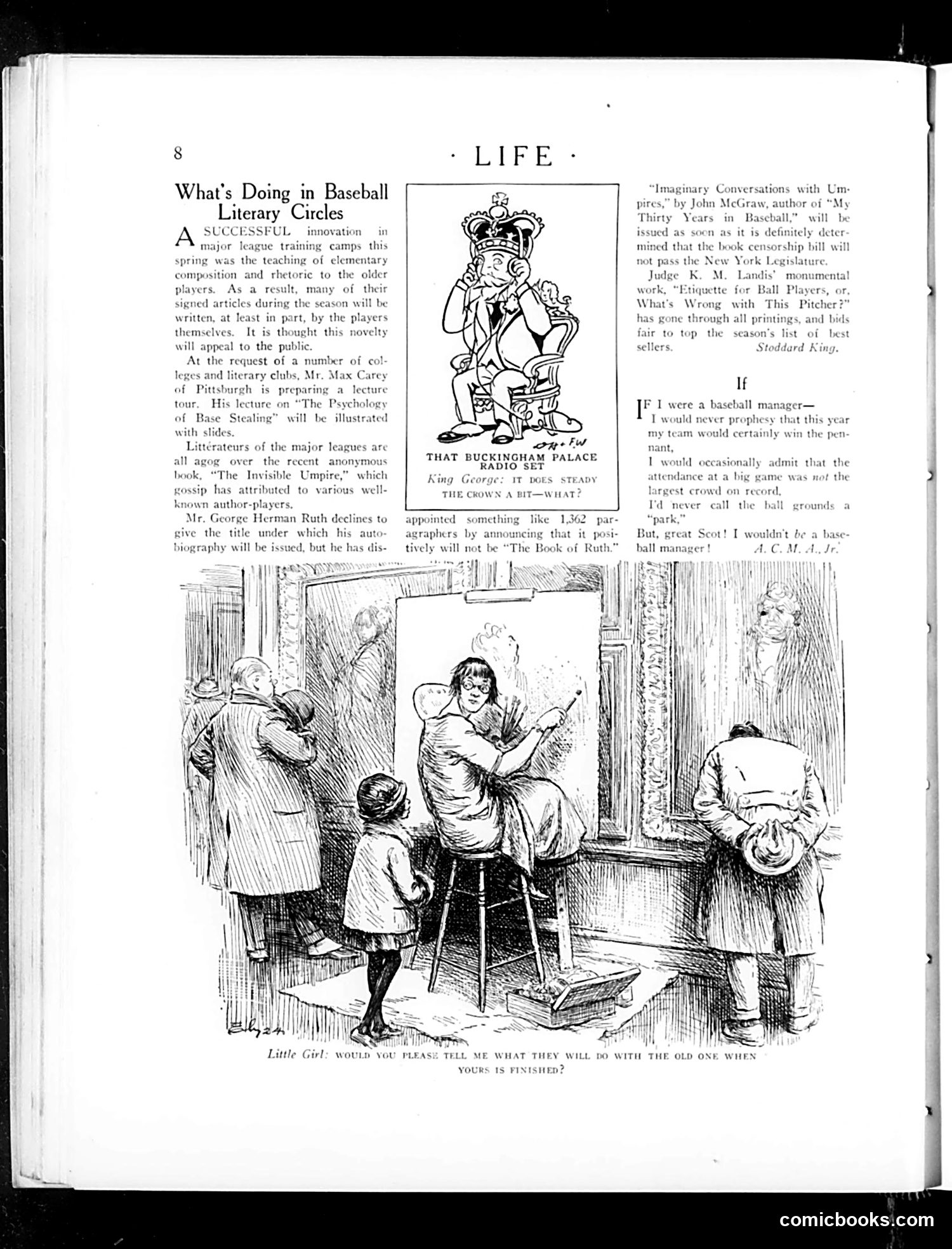
This page from *Life* magazine features baseball-related content mixed with social commentary. The main illustrated cartoon depicts a domestic scene where a woman sits sketching while several figures (appearing to be family members or visitors) stand around her. The caption reads: "Little Girl: would you please tell me what they will do with the old one when yours is finished?" The joke satirizes a woman artist's work, suggesting she's sketching a portrait to replace an existing family member—a dark humor commentary on domestic relationships. The surrounding text discusses baseball literary innovations, including mentions of "The Invisible Umpire" and references to Ruth's autobiography. The "Buckingham Palace Radio Set" illustration at top appears unrelated advertising or supplementary content, showing King George listening to radio.
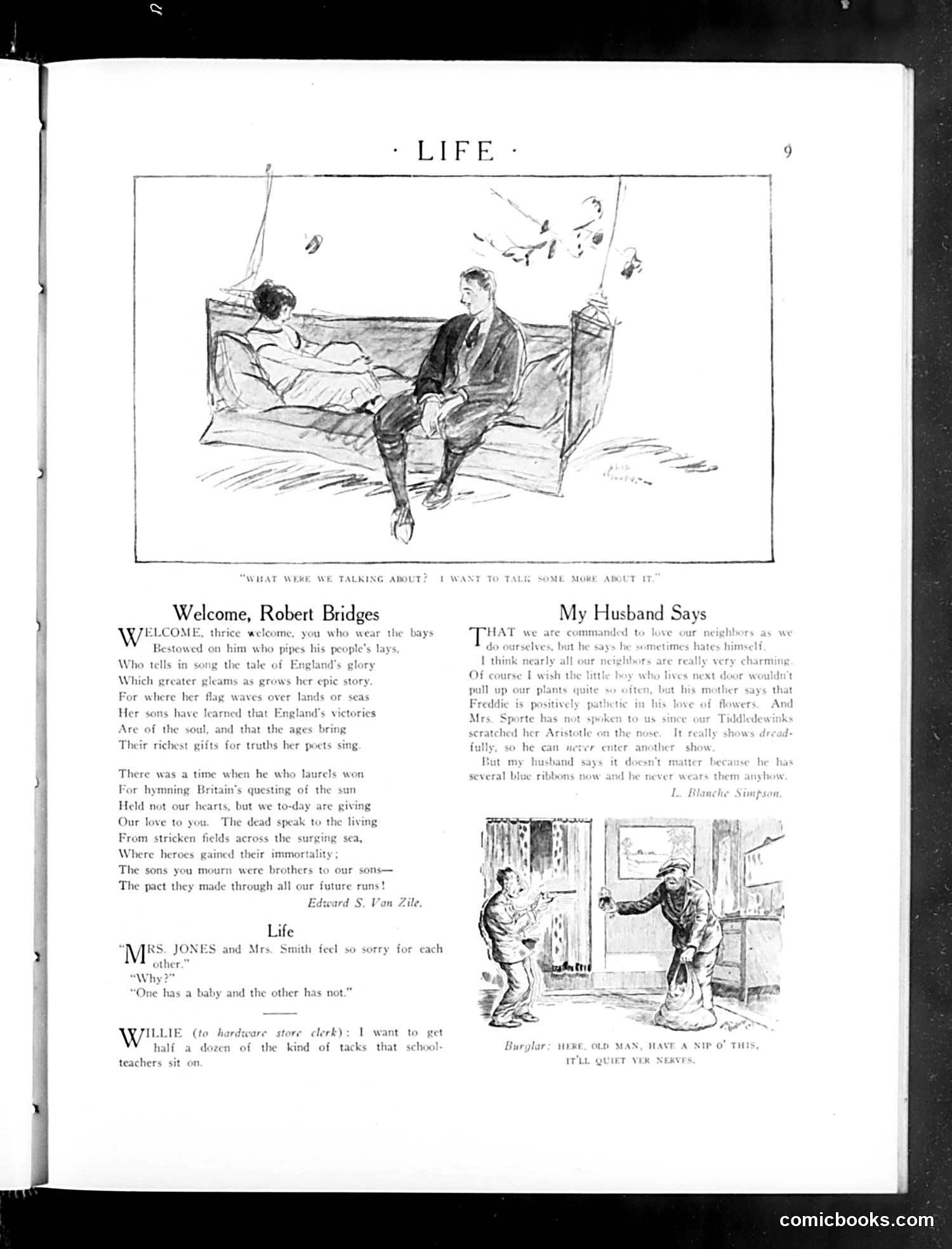
This page contains three distinct satirical pieces: **Top illustration**: Shows a couple on a bed with the caption "What were we talking about? I want to talk some more about it"—satirizing married couples who lose intimacy or engaging conversation. **"Welcome, Robert Bridges"**: A poem by Edward S. Van Zile welcoming someone (likely a notable figure of the era, though unclear from context alone). **"My Husband Says"**: A column by L. Blanche Simpson humorously complaining about her husband's indifference to neighborhood gossip and social concerns—poking fun at gender differences in social awareness. **"Life" anecdote**: A brief joke about Mrs. Jones and Mrs. Smith pitying each other—one has a baby, one doesn't. **"Willie" vignette**: Shows a schoolboy seeking "tacks that schoolteachers sit on"—classic schoolboy prank humor. The page reflects early 20th-century domestic comedy themes.
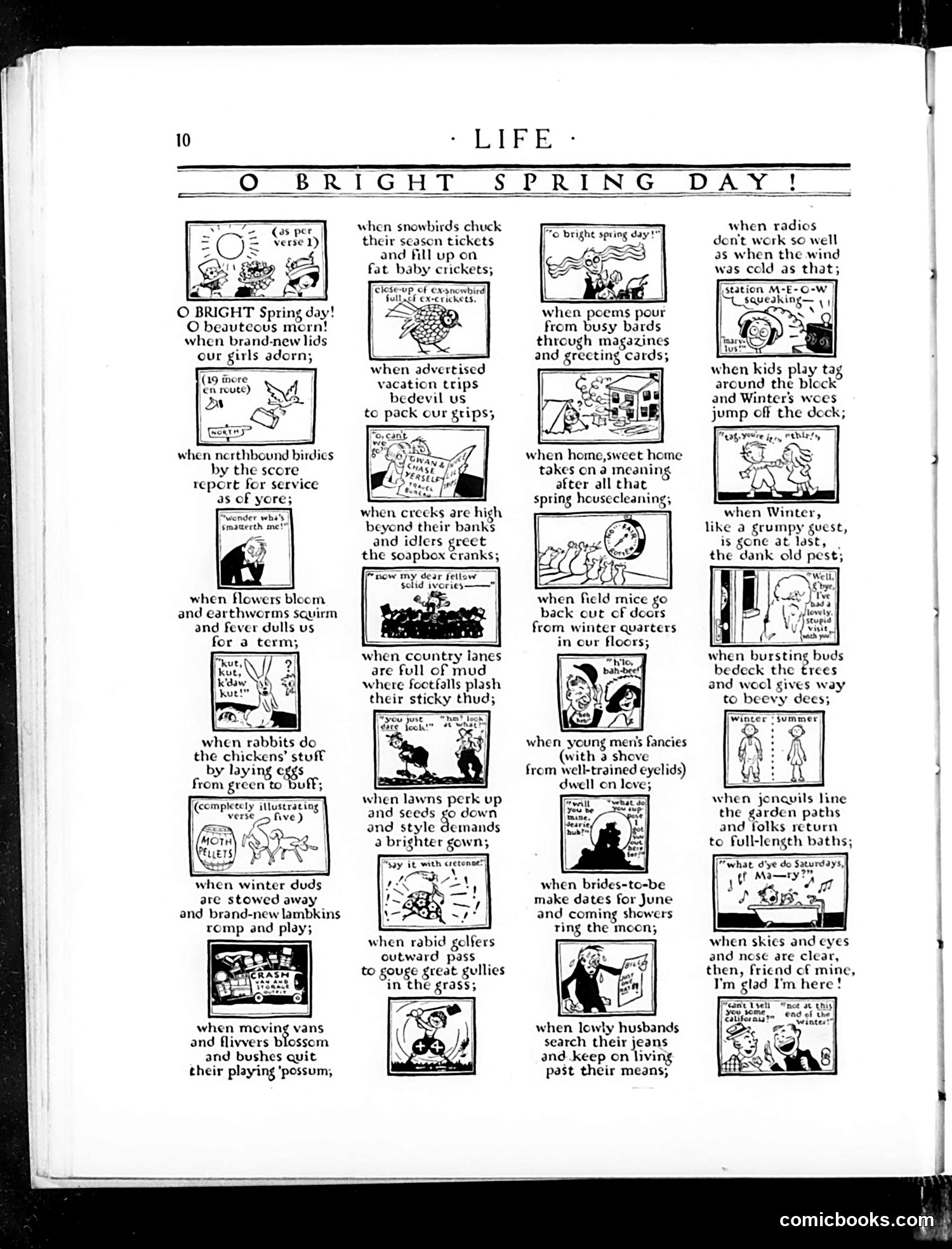
This is a humorous illustrated list celebrating the return of spring, using brief text couplets paired with small comic vignettes. Each entry describes a relatable spring activity or observation—snowbirds returning, children playing outdoors, flowers blooming, romance rekindling, moving day chaos, and home cleaning resuming. The humor is gentle and observational rather than satirical or political. It captures universal middle-class American experiences: spring cleaning exhaustion, young romance ("brides-to-be make dates for June"), the relief at winter's end, and the bustle of seasonal renewal. The cartoons use simple, accessible drawings to illustrate everyday life rather than target specific public figures or events. This appears designed as light, inclusive humor for a general audience enjoying the season's arrival.
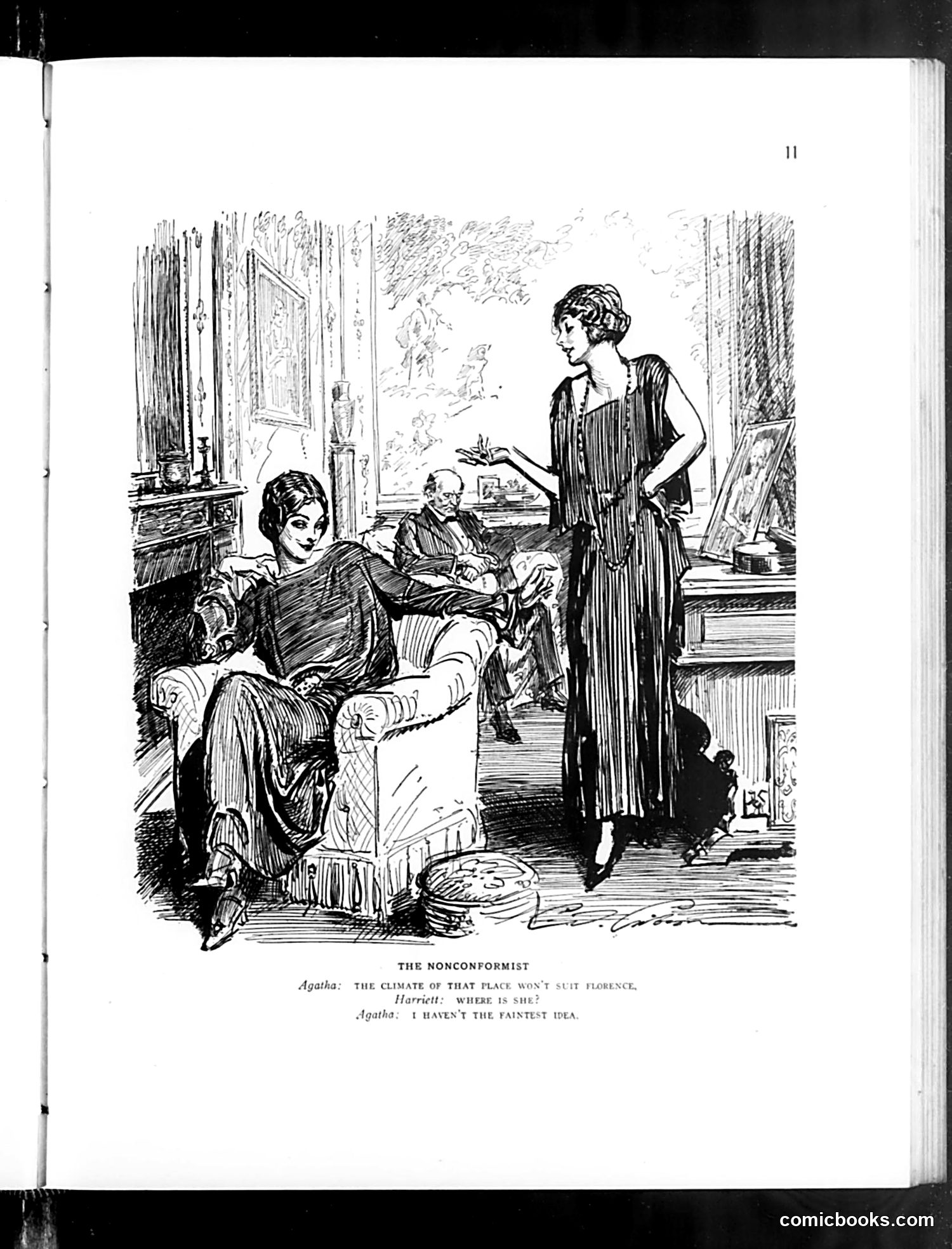
This sketch depicts a domestic scene in an artist's studio. A woman stands while two men are seated—one sketching or painting, another observing. The title and dialogue suggest social commentary on nonconformity. The exchange reveals the humor: Agatha states "the climate of that place won't suit Florence," and when Harriet asks "where is she?", Agatha replies "I haven't the faintest idea." The satire appears to target Victorian-era attitudes about women's independence and propriety. Florence's unexplained absence suggests she's behaving unconventionally—not where she's "supposed" to be. The title "The Nonconformist" likely refers to Florence as someone rejecting social expectations about women's proper place and behavior, amusing to Life's readers who valued satirizing social pretension and rigid conformity.
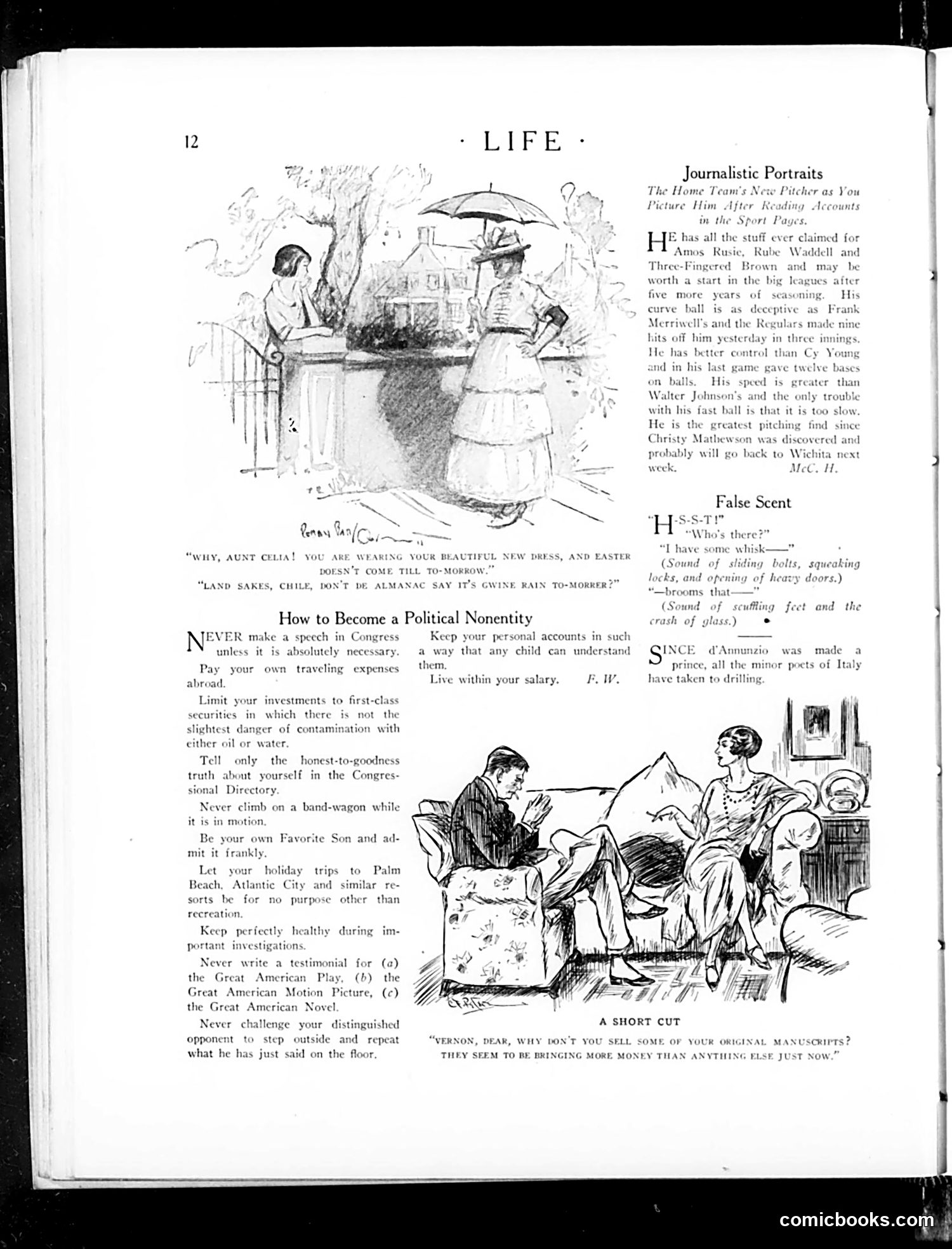
This page contains three distinct satirical pieces: 1. **"Journalistic Portraits"** (top right): A brief commentary on a baseball player (appears to be a pitcher) praised for his skills, comparing him favorably to other notable players. The satire critiques sports journalism's hyperbolic praise. 2. **"How to Become a Political Nonentity"** (left column): A tongue-in-cheek guide mocking ineffectual politicians, advising them to avoid scandals, stay within budget, and never challenge established figures—essentially satirizing politicians who make no meaningful impact. 3. **"False Scent"** and **"A Short Cut"** (right side): Two brief humorous vignettes with accompanying sketches, appearing to satirize everyday social situations, though the specific references are unclear without additional context. The page exemplifies Life's satirical approach to American politics, sports, and society.
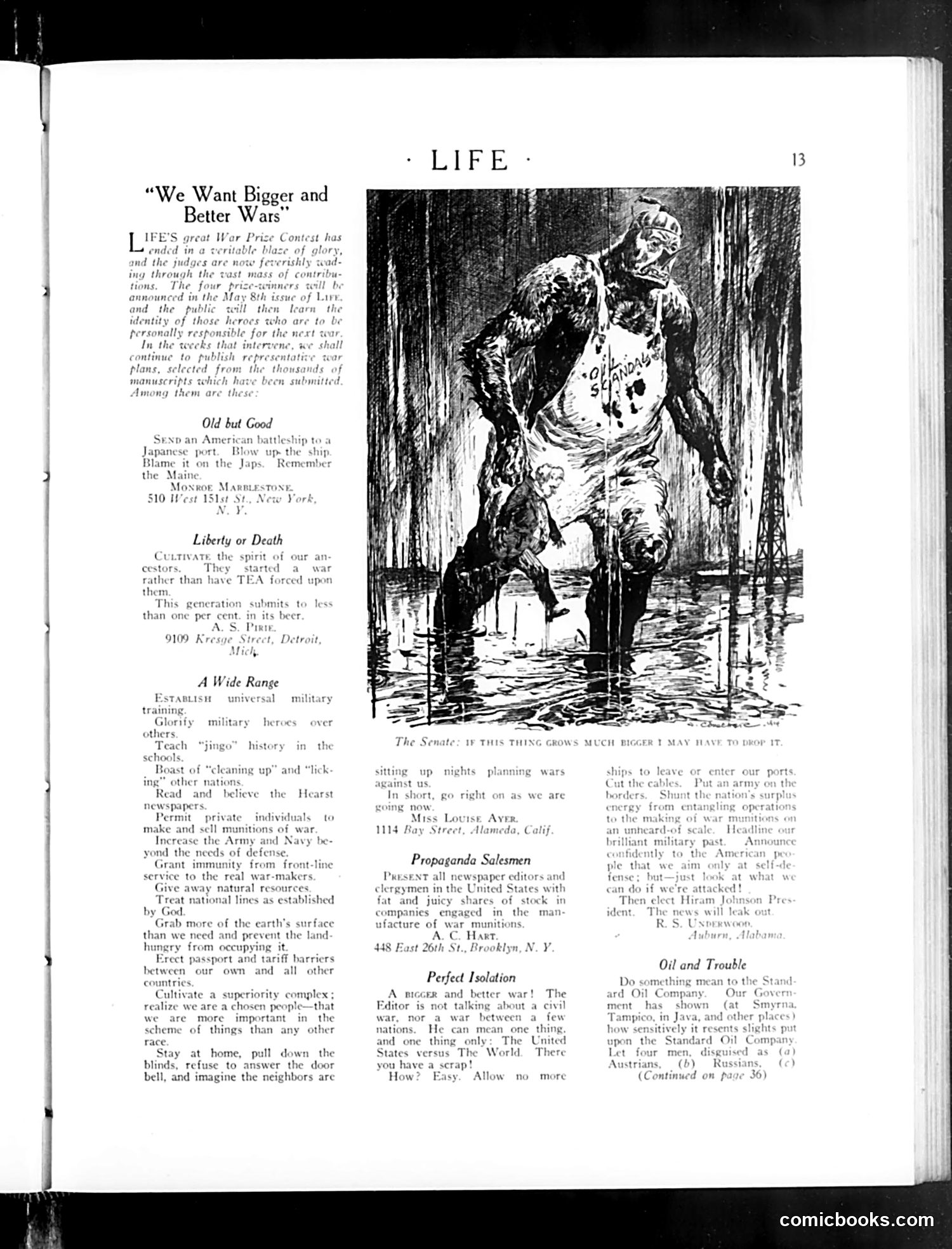
This political cartoon depicts a figure (appearing to represent a senator or political leader) straining to hold up an enormous, grotesque creature or mass labeled with military/war imagery. The exaggerated visual emphasizes the burden of escalating military expenditures and war planning. The surrounding text discusses LIFE's "Great War Prize Contest" and includes reader submissions advocating various war-related positions. Several submissions argue for increased military spending, universal military training, and aggressive foreign policy—reflecting anxieties about American military preparedness during what appears to be the World War I era. The cartoon satirizes senators' concerns that runaway war spending and military expansion are becoming unmanageable, even as public discourse increasingly demands bigger military commitments.
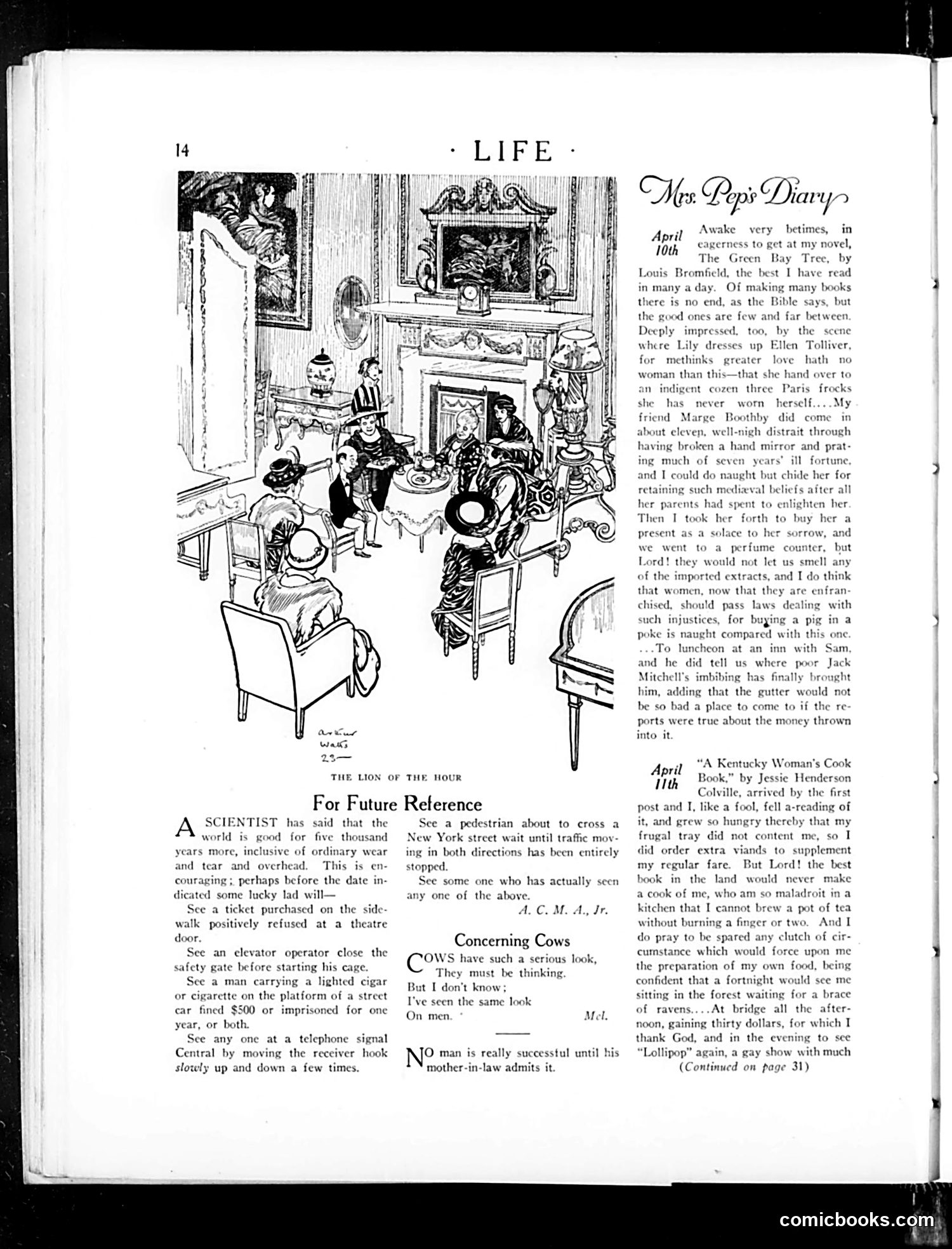
The main illustration depicts an elegant parlor scene where a woman sits prominently at center, surrounded by attentive visitors in what appears to be a social gathering. The caption "THE LION OF THE HOUR" suggests this woman is the current social celebrity or fashionable figure commanding attention. The satire targets high-society social dynamics—specifically how certain individuals become temporarily fashionable and attract crowds of admirers. The crowded, somewhat chaotic composition implies the superficiality of this attention-seeking behavior. Without additional context about the specific date, the identity of the "lion" remains unclear, though the cartoon mocks the transient nature of social celebrity and the fawning behavior of society circles pursuing the currently popular figure.
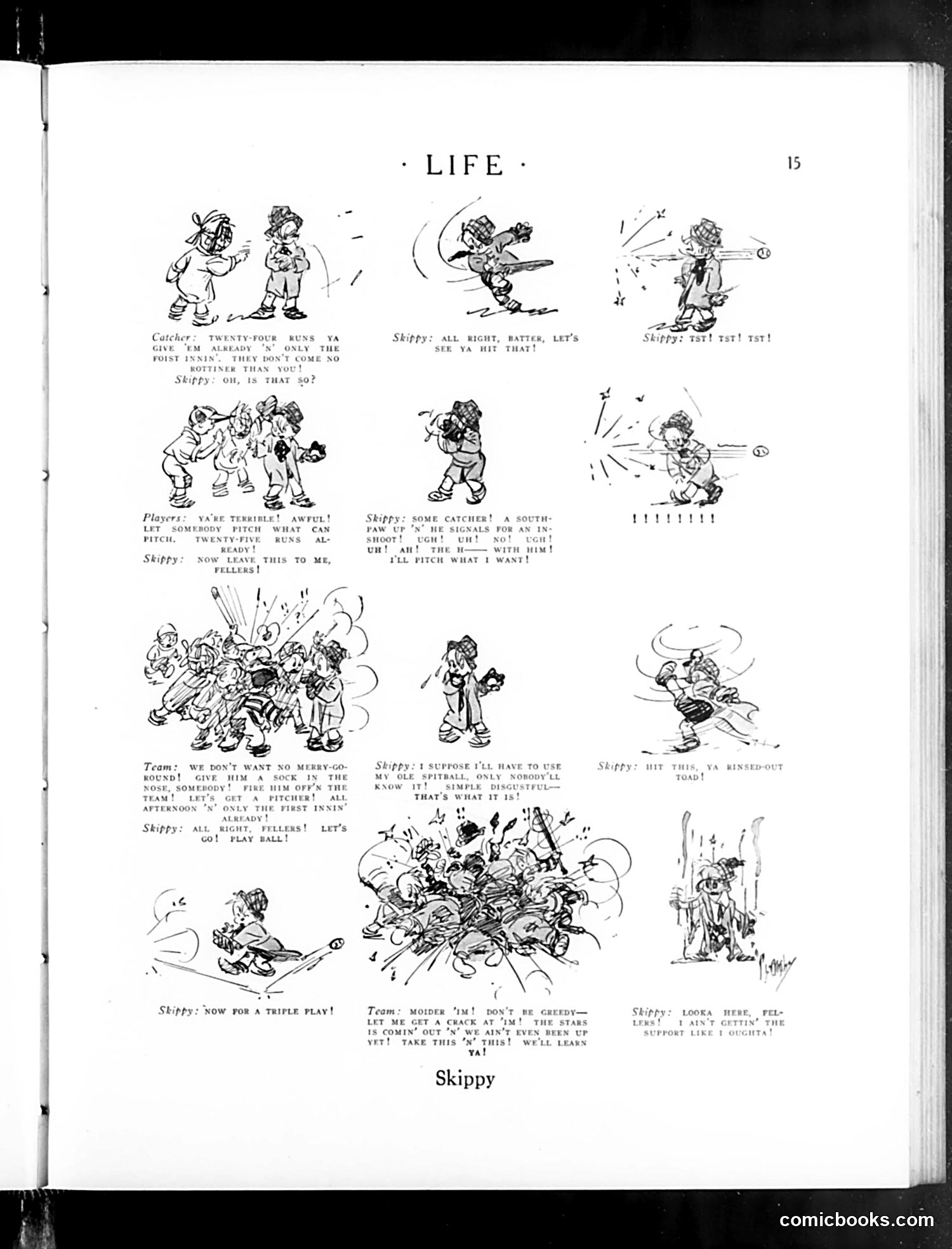
This page presents a baseball-themed comic strip featuring a character named Skippy. The strip satirizes youth baseball culture through exaggerated chaos and competitive spirit. The humor centers on Skippy's absurdly enthusiastic but incompetent baseball management. His teammates repeatedly bungle plays—batters miss, fielders collide, balls fly everywhere—yet Skippy remains undeterred, shouting increasingly grandiose strategies ("triple play," "ole spitball"). The satire targets childhood arrogance and the gap between ambitious dreams and actual ability. Adults (the "Catcher," "Team") speak in formal language, while Skippy responds with childish determination, oblivious to disaster. The final panel shows catastrophic failure despite his confidence. The joke: children's unwavering confidence despite obvious incompetence mirrors adult pretension.
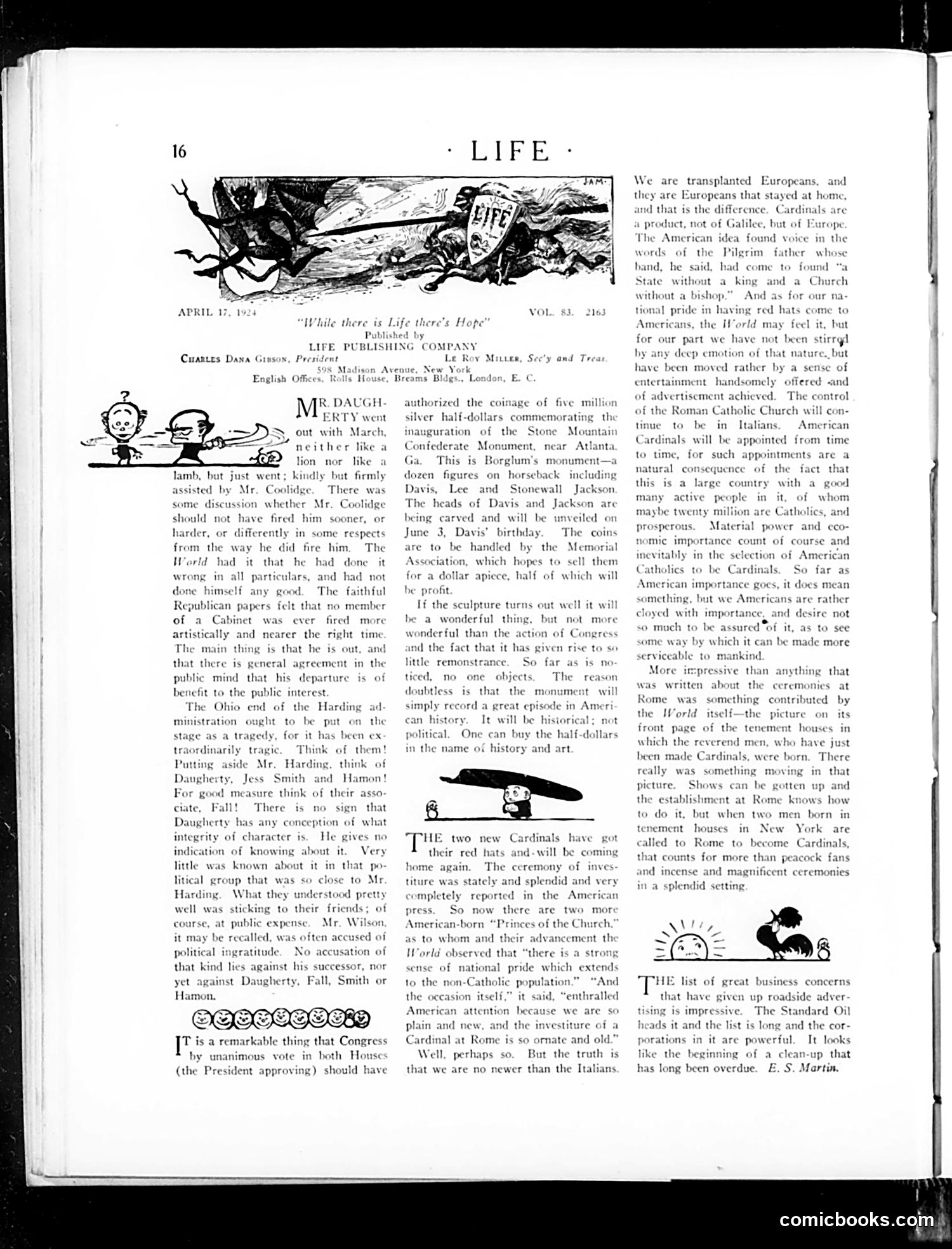
This page contains satirical commentary on recent American political events: **The Daugherty Firing**: The main article discusses President Coolidge's dismissal of Attorney General Harry Daugherty, comparing it to Ohio's corruption scandals (referencing Harding administration officials like Jess Smith and Albert Fall). The satire criticizes how Republican leaders protected their associates, contrasting this unfavorably with Wilson. **Confederate Monument Coinage**: Congress authorized five million silver half-dollars commemorating Stone Mountain Monument near Atlanta, featuring Confederate generals Davis, Lee, and Jackson. The satirist notes this generates little objection because it's "historical" rather than explicitly political—though this allows the country to profit from selling Confederate imagery. **New American Cardinals**: Two American-born men received Cardinal appointments in Rome. The satire observes Americans take pride in this international recognition, though the author notes Americans aren't actually "newer than Italians"—we're transplanted Europeans, making the pride somewhat ironic. The overall tone mocks American hypocrisy and self-deception regarding politics, history, and national identity.
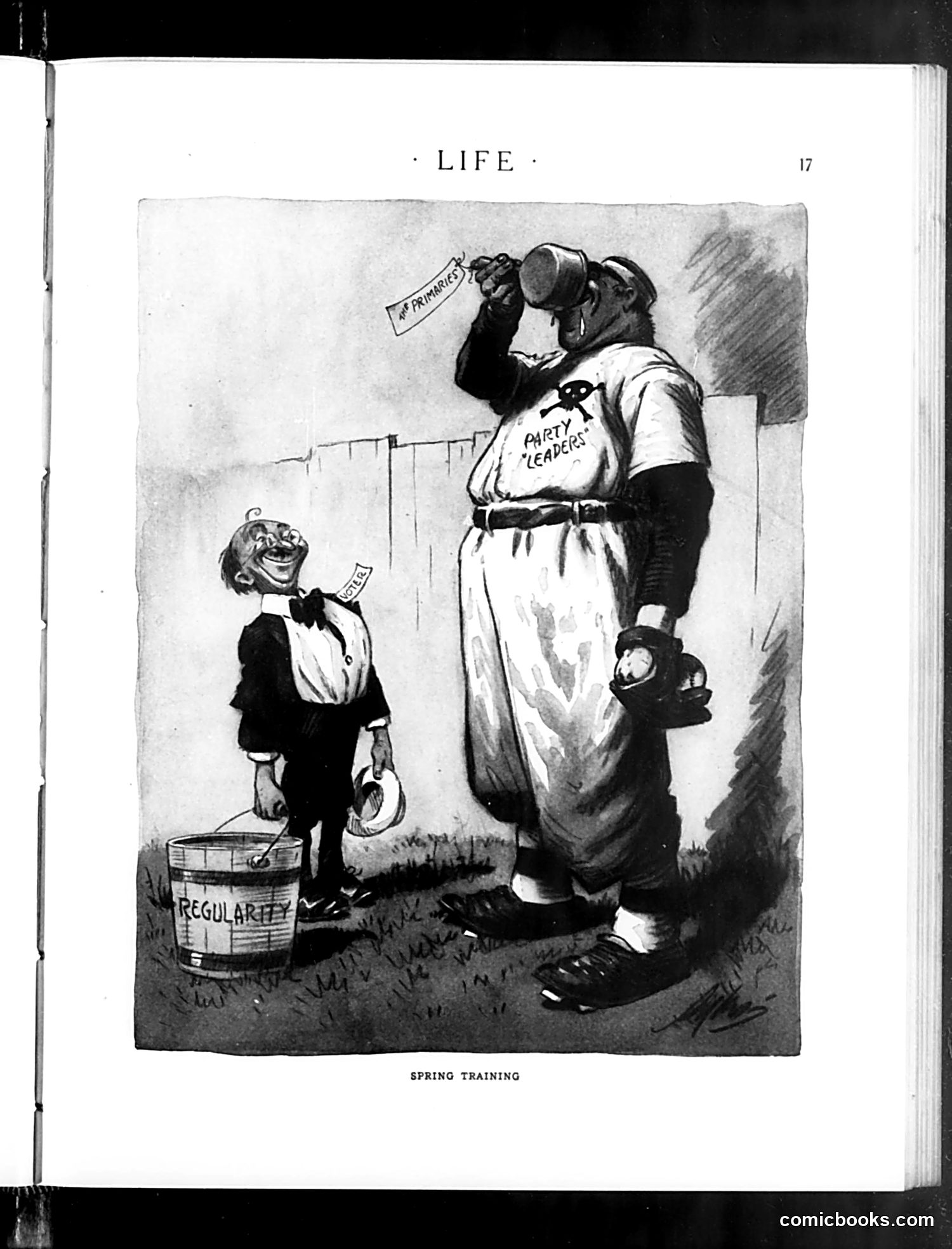
This satirical cartoon from *Life* magazine depicts "Spring Training" as political conditioning. The large female figure labeled "Party Leaders" uses a megaphone to shout instructions at a smaller, caricatured male figure standing on a bucket labeled "Regularity." The figure holds papers marked "Promises." The satire critiques how political party leadership manipulates and trains ordinary party members—portrayed as small and subordinate—to repeat party promises and maintain regular compliance. The "spring training" metaphor compares this to baseball season preparation, suggesting political parties systematically indoctrinate followers into mechanical obedience. The cartoon mocks both the leadership's controlling tactics and the members' willing submission to party discipline over independent thought.
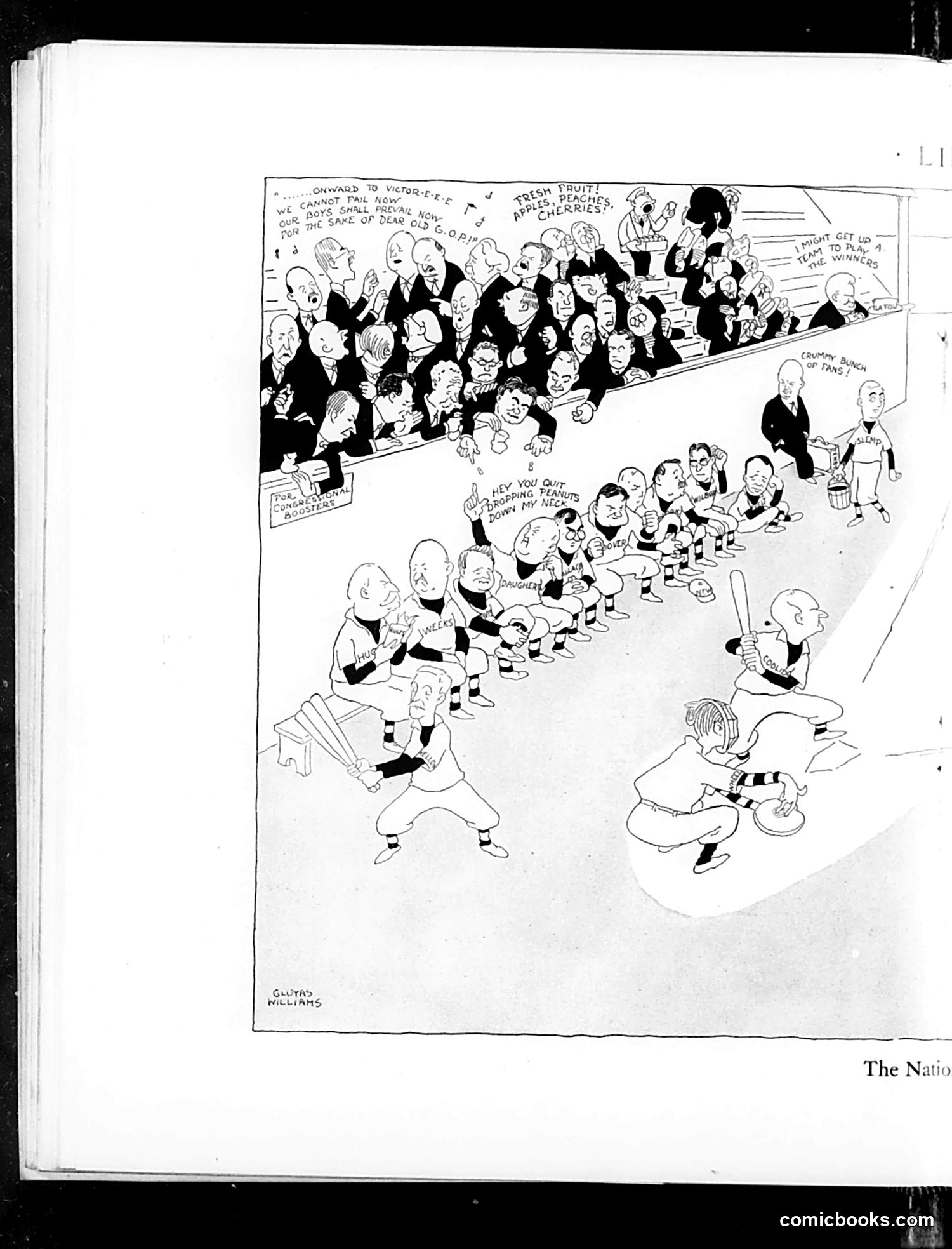
This cartoon by Gluyas Williams satirizes the American business and political establishment's relationship with baseball. A massive crowd of well-dressed businessmen and politicians watches from the stands while below, small baseball players perform. The speech bubbles suggest the elite are more interested in consuming "fresh fruit" (peaches, apples, cherries) and declaring themselves "winners" than in the actual game. One player protests they're "robbing" him of his earnings. The satire critiques how powerful figures exploit professional athletes for entertainment and profit while appropriating credit for success. The stark size difference emphasizes the power imbalance between the ruling class and working athletes, suggesting they're treated as performing animals rather than serious professionals.
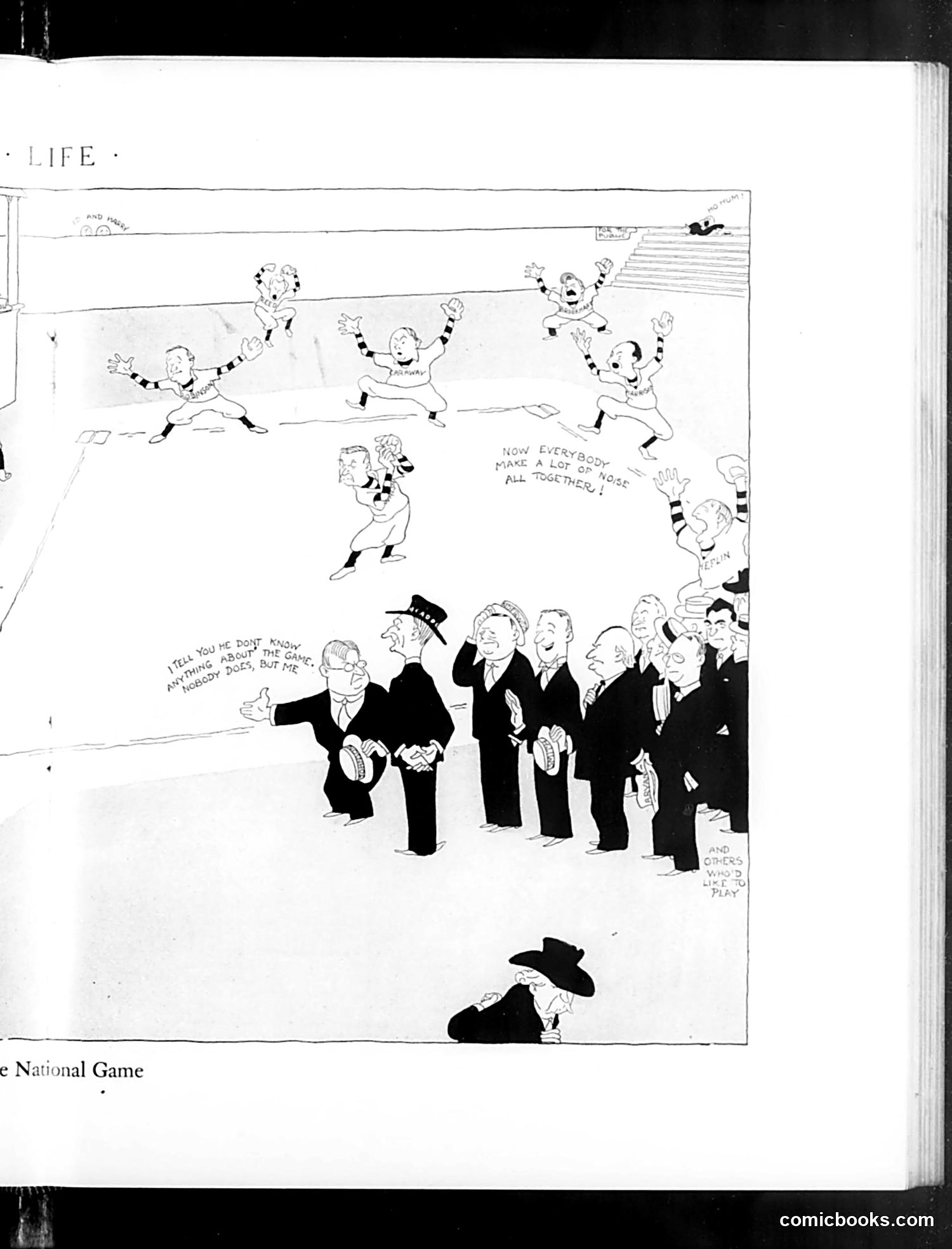
This satirical cartoon contrasts two versions of "the national game" (baseball). The upper half shows children playing baseball enthusiastically and cooperatively ("Now everybody make a lot of noise all together!"). The lower half depicts adult men in formal suits and top hats—appearing to be politicians or businessmen—watching passively or argumentatively. One figure sits apart, seemingly excluded or dejected. The satire critiques how adults, particularly political/business leaders, have corrupted or diminished the spirit of American baseball and its values of teamwork and joy. Where children embody the game's true meaning, the suited figures represent cynicism, division, and self-interest. The cartoon suggests American leadership has lost the cooperative spirit that should define the nation's character.
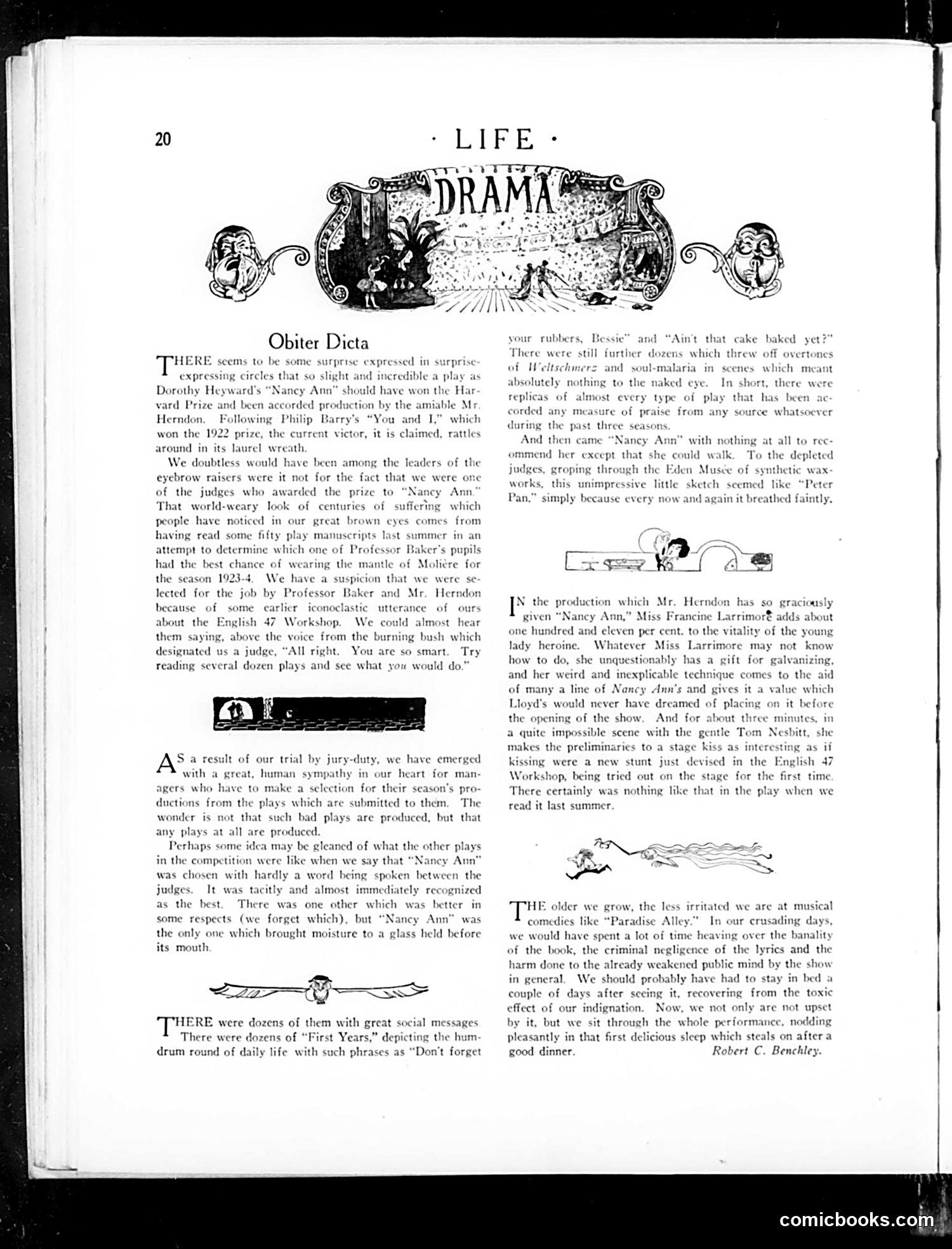
This article defends Dorothy Heyward's play "Nancy Ann," which won the Harvard Prize despite critical surprise at its apparent simplicity. The writer, a judge for the award, explains that among dozens of submitted plays—many featuring heavy social messages, pretentious "soul-malaria," or mundane domestic dialogue ("Don't forget your rubbers, Bessie")—"Nancy Ann" stood out simply because "she could walk." The satire targets both the mediocrity of contemporary theater submissions and the absurdity of judging them. The writer credits actress Francine Larrimore's performance with elevating the thin material, describing her technique as capable of making even an "impossible scene" (a stage kiss) seem interesting. The humor lies in the judges' desperate relief at finding *any* competent play, transforming modest merit into prize-worthiness by comparison to the surrounding dreck.
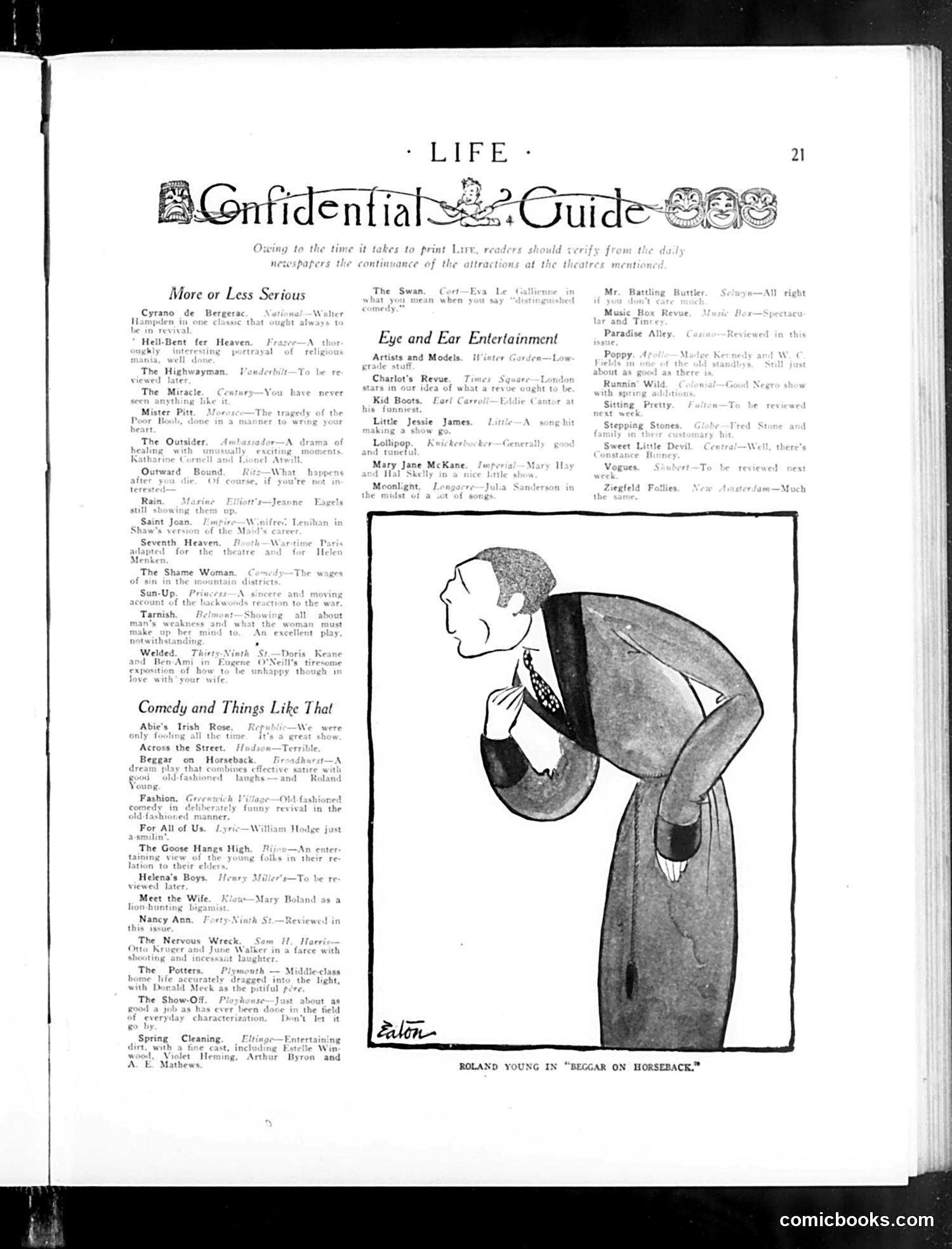
This is a theater review/entertainment guide page from *Life* magazine listing Broadway shows and productions currently running. The prominent illustration depicts **Roland Young** in the play "Beggar on Horseback"—shown as a well-dressed man in formal attire with an exaggerated, somewhat pompous posture, hand to chest. The page catalogs contemporary theatrical productions organized by tone: "More or Less Serious" plays (including *Cyrano de Bergerac*, *Hell-Bent for Heaven*) and lighter comedies (*Abie's Irish Rose*, *The Potters*). It includes cast information and brief critical notes. The cartoon itself appears to be a character study capturing Young's theatrical persona—likely satirizing the pretentious or affected mannerisms typical of stage actors of the era. The signature appears to be by the illustrator. This is essentially an **entertainment listings page**, not political satire, documenting 1920s Broadway theater culture.
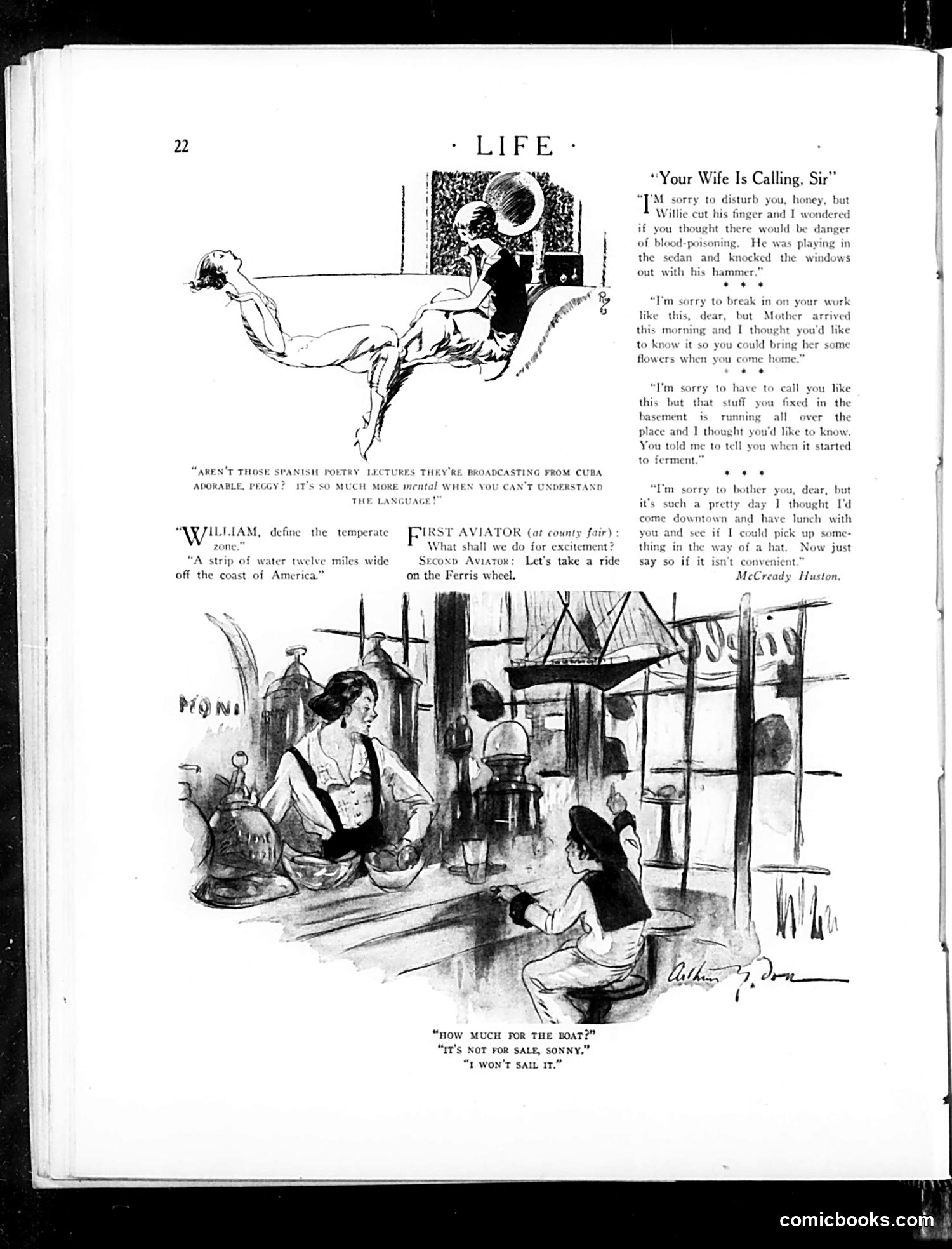
This page contains multiple satirical cartoons mocking early 20th-century social dynamics: **"Your Wife Is Calling, Sir"** presents a running joke about wives constantly interrupting husbands at work with trivial domestic crises—a child's injury, a mother's visit, basement flooding, fermentation issues—depicting wives as frivolous and demanding. **The Spanish poetry lecture joke** ridicules intellectuals who pretend to appreciate foreign culture they cannot understand, valuing the mystique of incomprehension over actual comprehension. **The "temperate zone" definition** appears to be wordplay or absurdist humor, likely mocking pedantic definitions. **The aviation section** shows two men seeking thrills on a Ferris wheel, satirizing early aviation's novelty and the public's excitement about emerging technology. **The boat scene** depicts a boy refusing to sell his boat despite offers—likely satirizing childhood stubbornness or the sentimental value of possessions. Overall, the page targets domestic disruption, false intellectualism, and modern anxieties of the era.
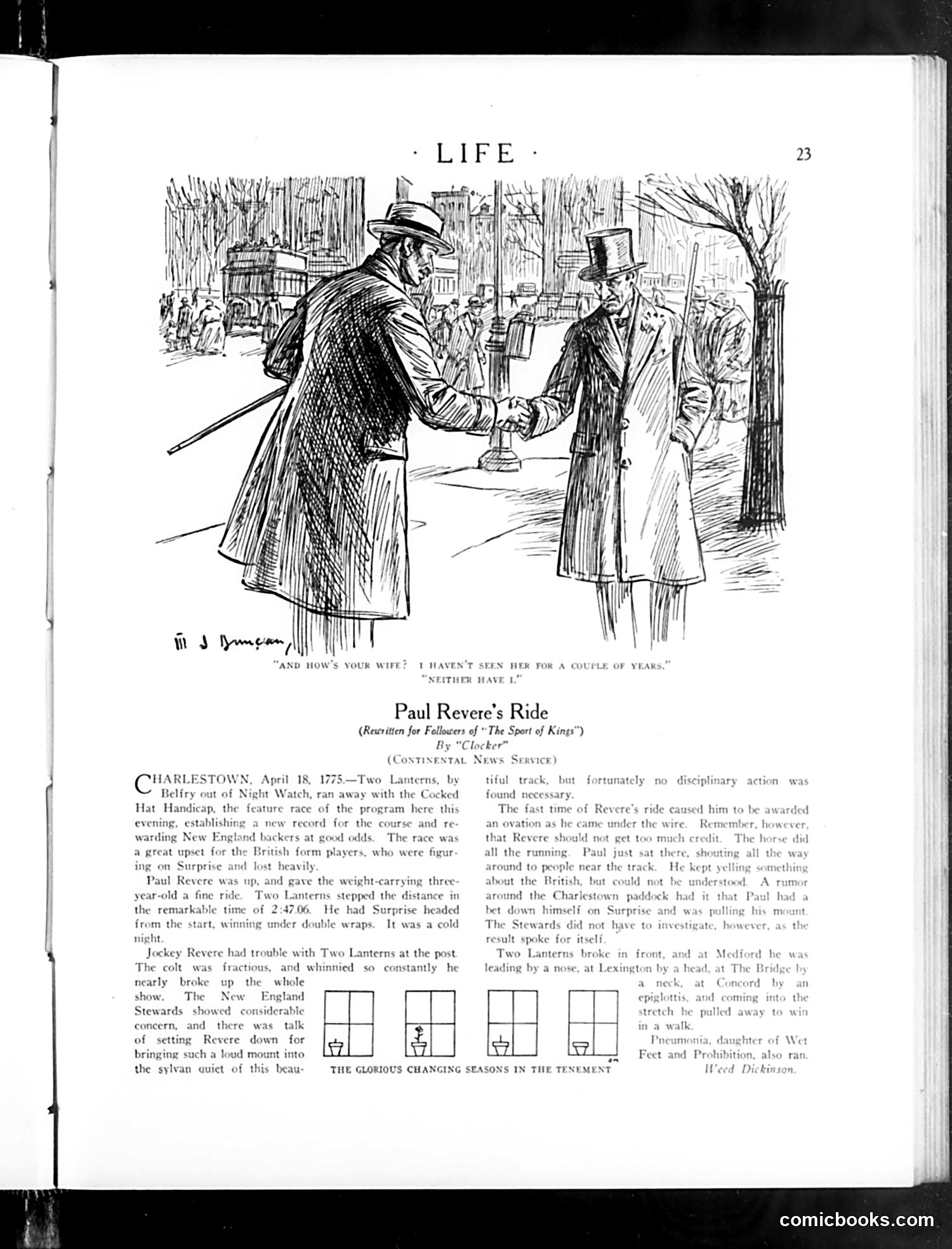
The top cartoon is a simple joke about marital estrangement. Two gentlemen meet on a city street; one asks about the other's wife, whom he hasn't seen in years. The punchline—"Neither have I"—suggests the questioner hasn't seen *his own* wife either, implying he's deliberately avoiding her. It's a light satire on domestic discord and the social awkwardness of admitting marital problems. Below this is "Paul Revere's Ride," a humorous rewriting that reimagines the famous Revolutionary War midnight ride as a horse race. Rather than an urgent patriotic mission, Revere becomes a jockey in a competition—the article uses racing terminology ("handicap," "wraps," "Stewards") to mock-heroically describe what should be a solemn historical event. The satire deflates the legend by reducing it to sporting entertainment, likely poking fun at American obsession with horse racing during this era.
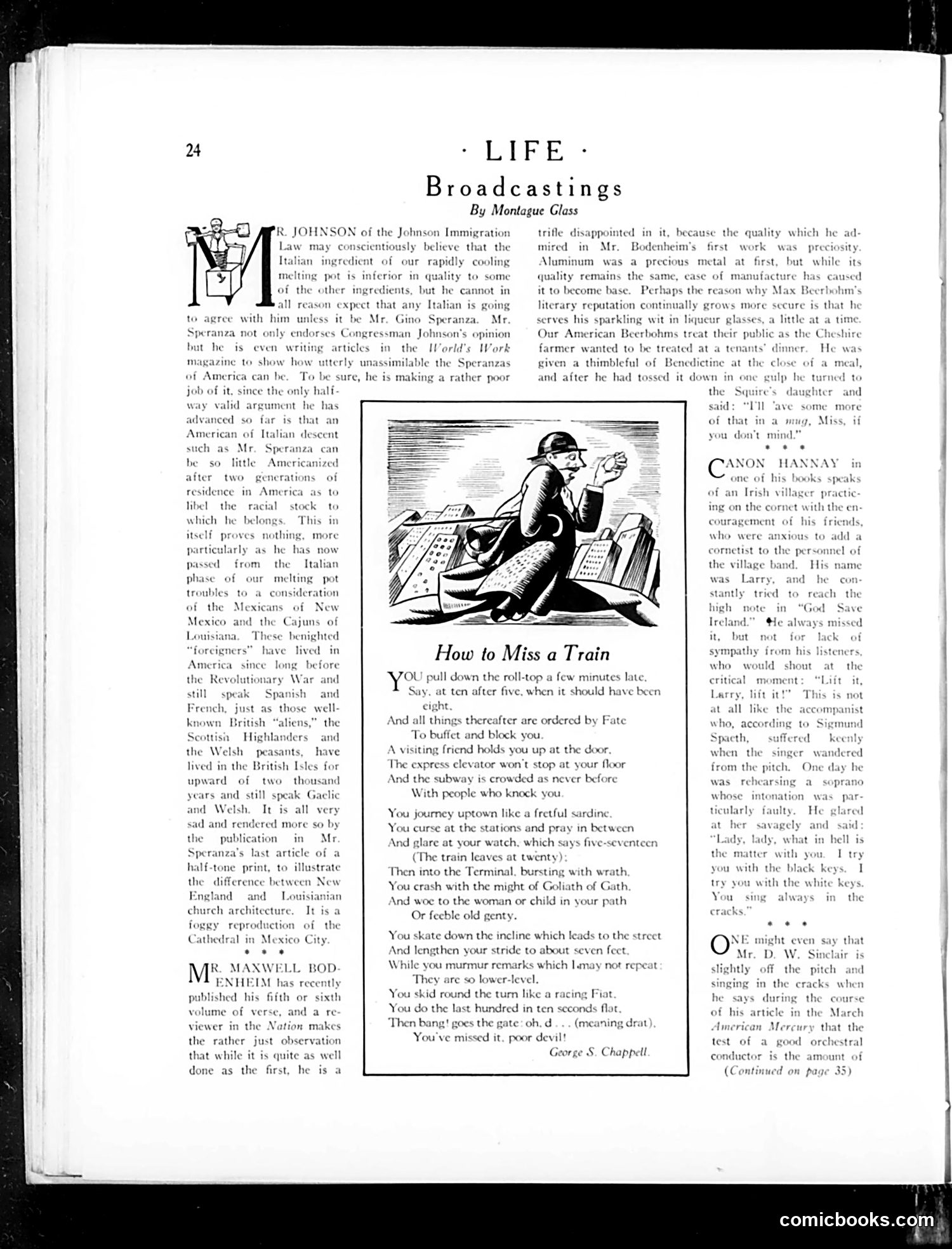
This page contains satirical commentary on American immigration and social issues circa the 1920s-1930s. **Main Content:** The lead article discusses Mr. Gino Speranza's defense of Italian immigrants against Congressman Johnson's disparaging views. The satire suggests Speranza, despite supporting Italian immigration, ironically undermines his own position through poor writing in *World's Work* magazine—he's incompetent at making his case. **The Cartoon:** "How to Miss a Train" by George S. Chappell is a humorous poem illustrated with a figure frantically juggling books and papers while running late. It satirizes the urban commuter experience—the cascade of minor disasters (overslept, slow elevator, crowded subway, distracted by watch) that inevitably cause one to miss the train. The joke relies on relatability: anyone rushing to catch transport recognizes this comedic futility. **Broader Context:** The page mixes commentary on immigration policy debates with light humor about modern urban life, typical of Life's format blending political satire with entertaining verse and illustrations for educated readers.
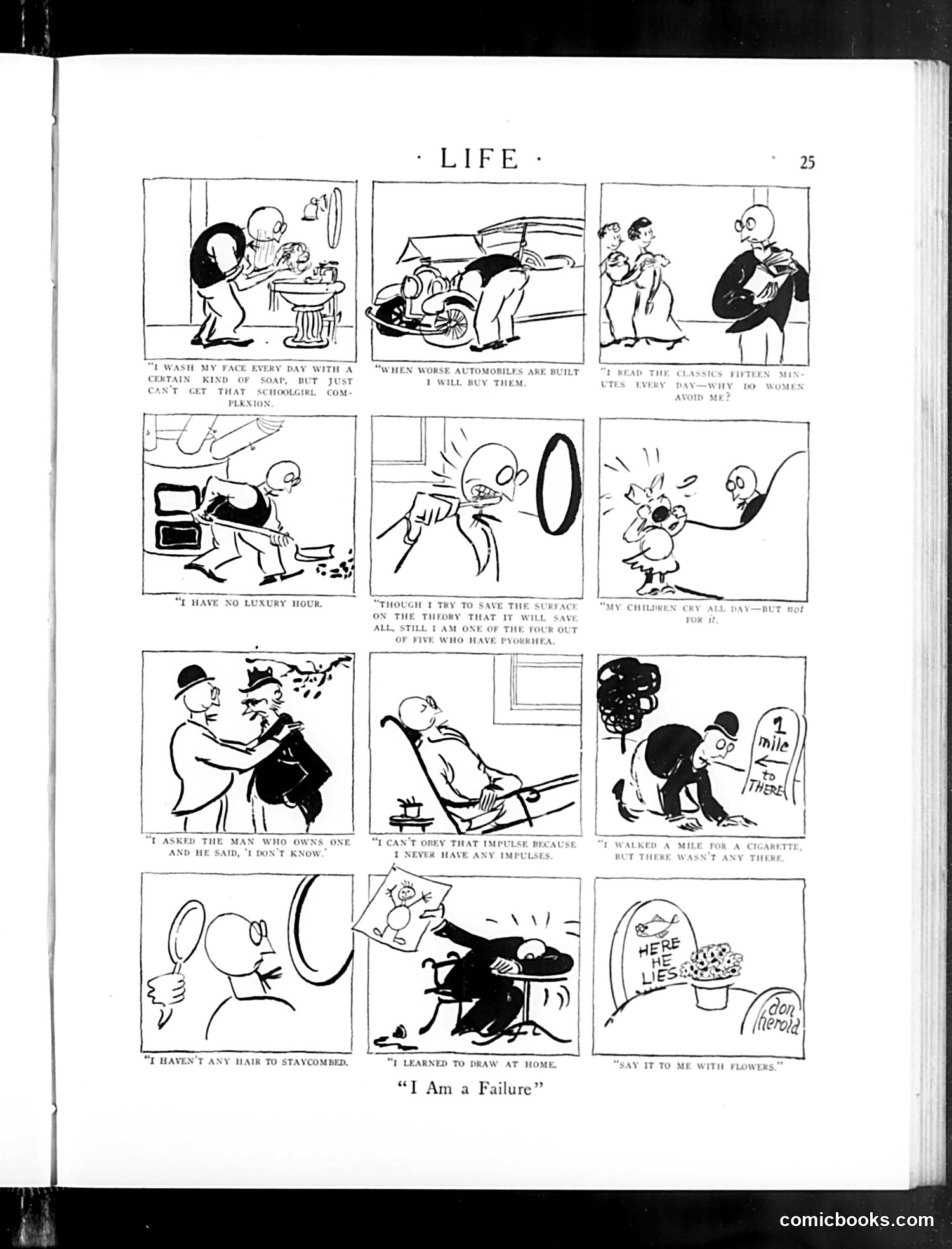
This is a satirical comic strip depicting various modern anxieties and everyday failures from the early 20th century. Each panel shows a different character lamenting personal shortcomings: inability to afford luxury soap, car troubles, classical education gaps, lack of leisure time, hair loss, impulse control issues, failed job searches, drawing ability, and romantic disappointments. The overarching theme—"I Am a Failure"—mocks the period's obsession with self-improvement and social expectations. Rather than serious misfortunes, these are mundane, relatable complaints that reveal how ordinary people internalized cultural standards of success. The satire targets both the unrealistic expectations society placed on individuals and the comic desperation with which people rationalized their ordinary circumstances.
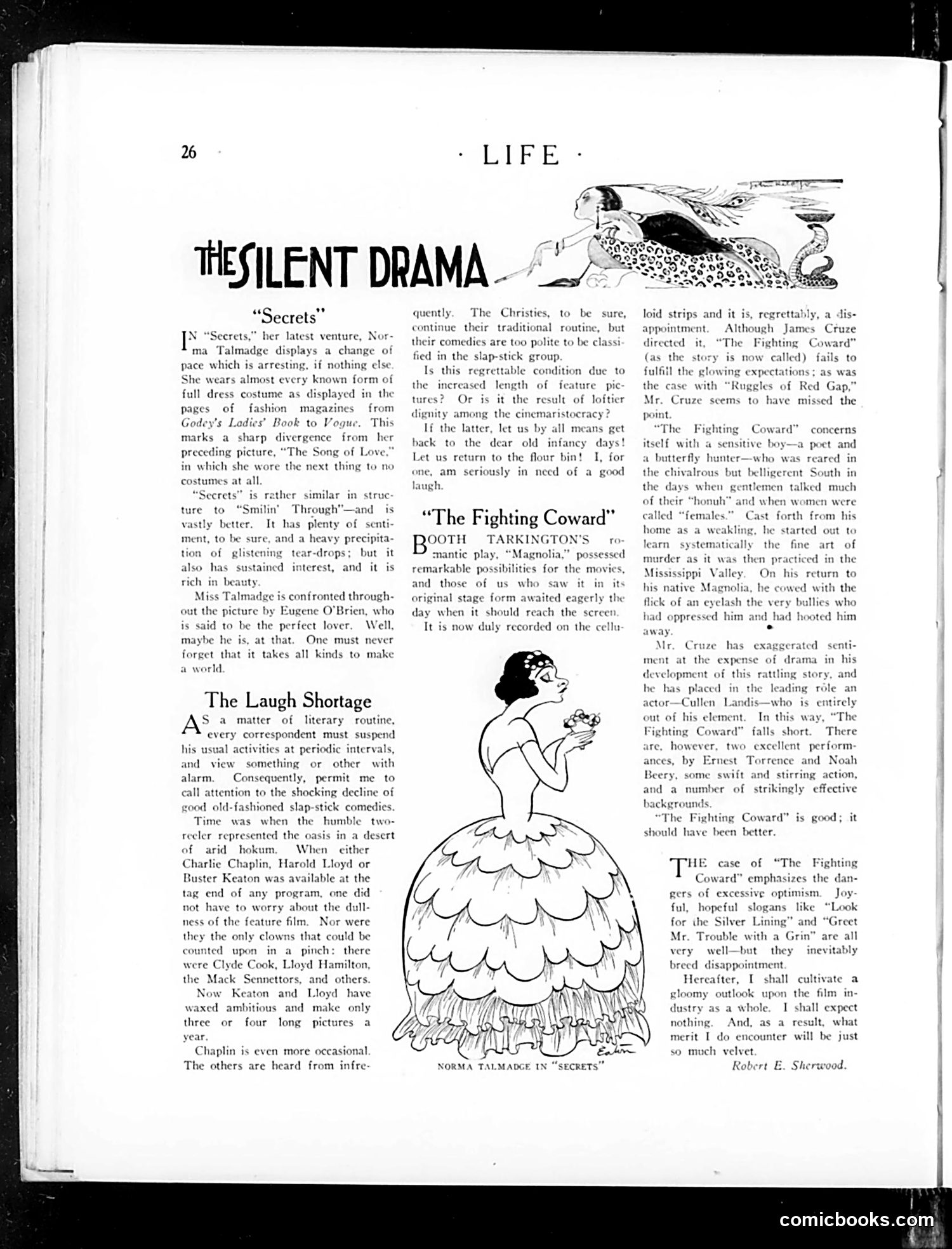
This page reviews three silent films, with particular focus on critiques of cinema trends circa the early 1920s. The central illustration depicts **Norma Talmadge** in "Secrets," satirizing her costume changes throughout the film—contrasting sharply with her previous picture "The Song of Love," which featured minimal clothing. **"The Laugh Shortage"** section laments the decline of slapstick comedy. The author criticizes that **Charlie Chaplin, Harold Lloyd, and Buster Keaton**—once reliable sources of physical humor—now make fewer films or pursue "loftier dignity." Meanwhile, gentler comedies from the Christies lack the crude, physical humor that defined earlier cinema. This reflects genuine industry concern: as film matured and gained prestige, comedians increasingly pursued feature-length dramatic roles over short comedies. **"The Fighting Coward"** review criticizes director James Cruze for failing to match the source material's promise, and faults lead actor Cullen Landis as miscast—"entirely out of his element"—though praising supporting performances by Ernest Torrence and Noah Beery. The page emphasizes quality concerns as silent cinema professionalized.
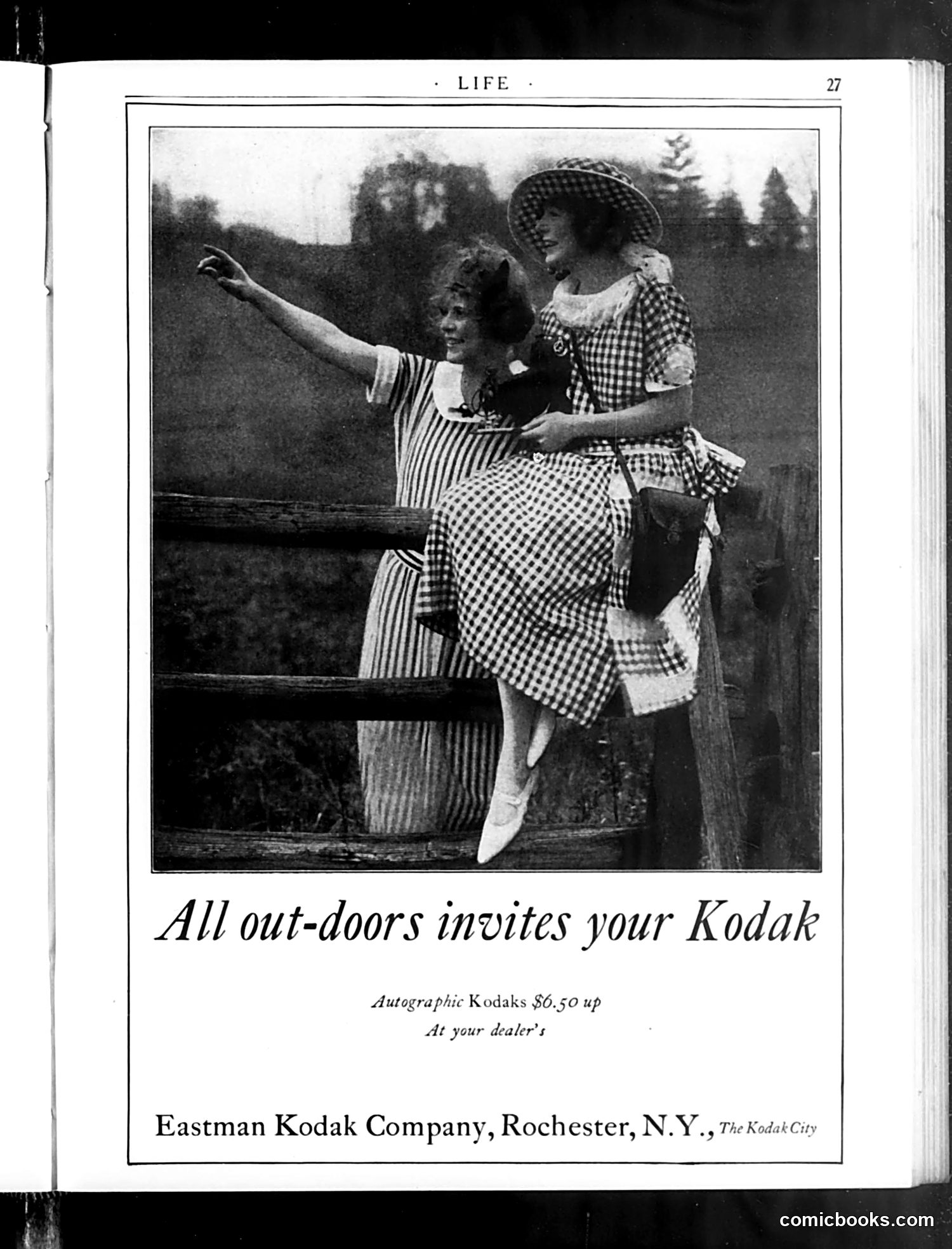
This is a Kodak advertisement, not a political cartoon. The page shows two women in 1910s-era clothing outdoors near a wooden fence, with forested hills in the background. One woman points enthusiastically into the distance while the other holds a camera. The ad's slogan—"All out-doors invites your Kodak"—encourages consumers to photograph natural scenery and outdoor activities. The Autographic Kodaks advertised at $6.50 and up represent relatively affordable consumer cameras, making photography accessible to ordinary people rather than just professionals. The image exemplifies early 20th-century marketing that positioned cameras as essential tools for capturing leisure and nature experiences.
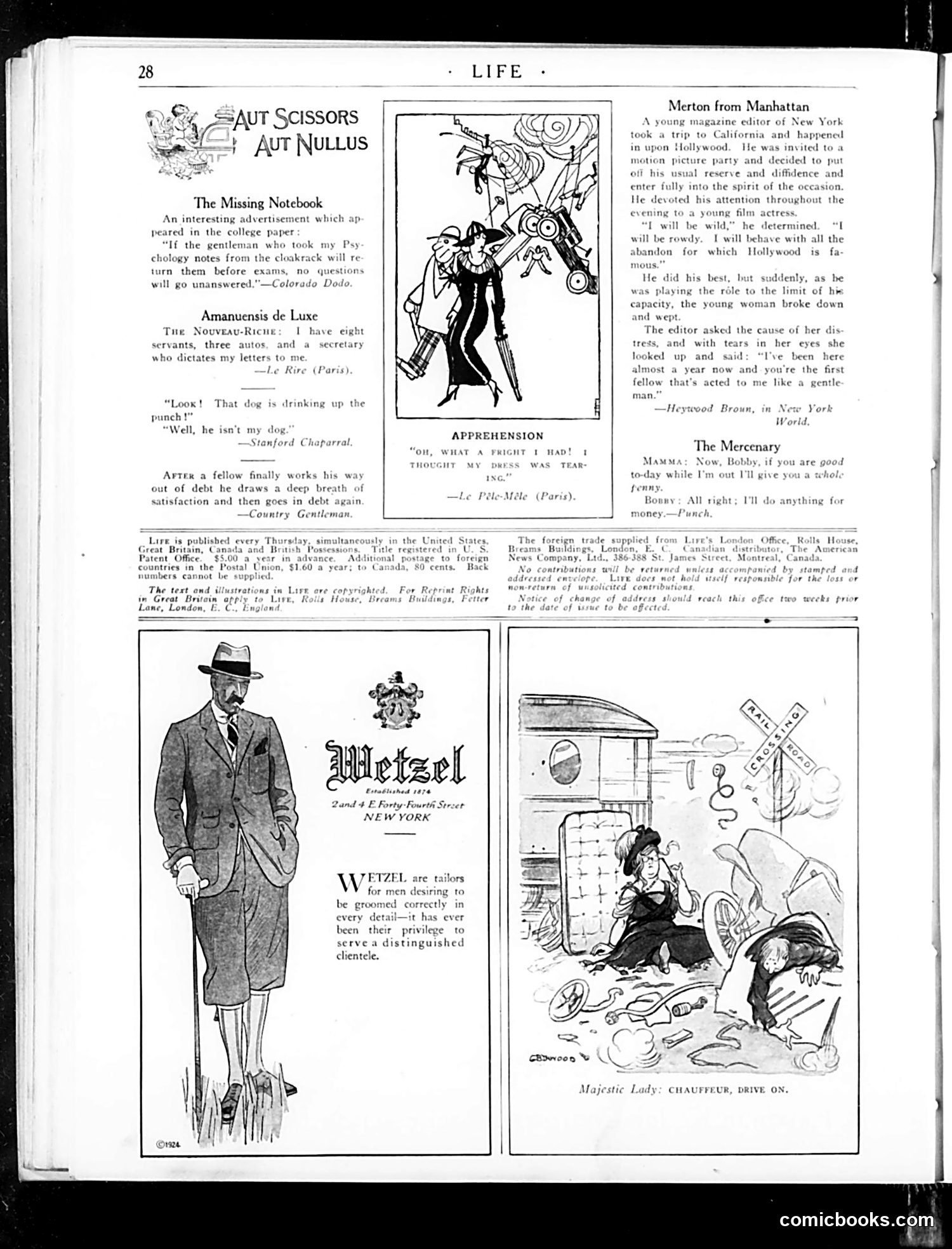
This page from *Life* magazine contains brief satirical humor pieces and advertisements typical of early 20th-century American comedy journalism. **"Aut Scissors" section** collects short jokes mocking social pretension and human folly: a lost notebook (academic absent-mindedness), a nouveau-riche employer with excessive servants, a dog drinking punch, and debt cycles. **"Merton from Manhattan"** satirizes Hollywood's corrupting influence on refined East Coast sensibilities. A proper New York editor visits California and deliberately abandons his reserve to behave rowdily at a film party—only to discover the actress he's impressing actually *valued* his gentlemanly restraint. The joke critiques both Hollywood's shallow values and the editor's misguided attempt to fit in. **"The Mercenary"** is a brief parent-child joke about conditional behavior rewards. The **Wetzel advertisement** occupies the lower half, promoting a tailoring establishment—typical magazine filler rather than editorial content. The cartoons employ gentle satire rather than political commentary, targeting character types and social behaviors recognizable across eras.
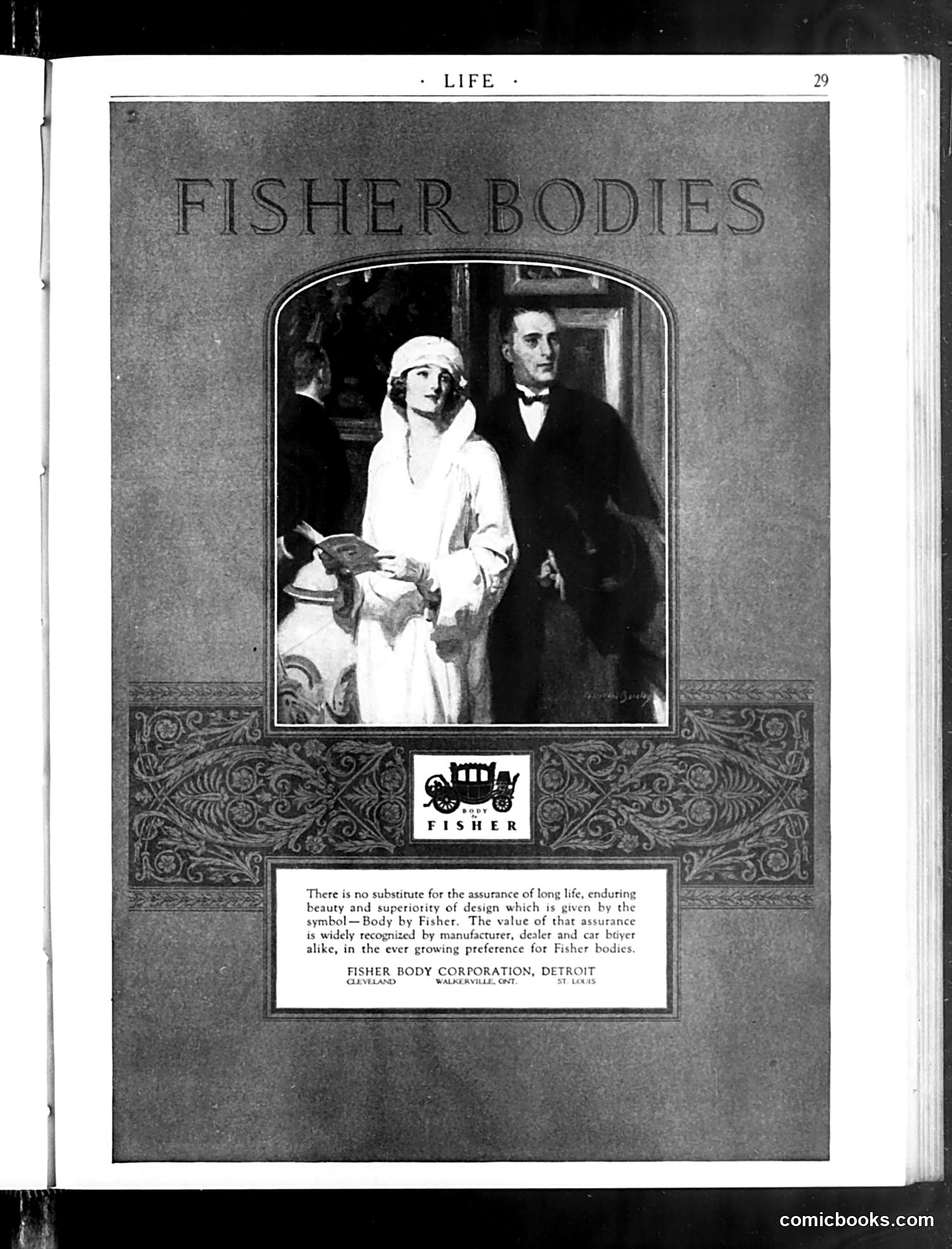
This is a **Fisher Body Corporation advertisement**, not satire or political commentary. The page promotes Fisher automotive bodies through a glamorous scene: a well-dressed woman in white (appearing elegant and refined) stands with men in formal attire, suggesting sophistication and status. The ad's message emphasizes that Fisher bodies guarantee "long life, enduring beauty and superiority of design"—selling the car body as a luxury product recognized by manufacturers, dealers, and buyers. The visual associates the product with high-class living and aspirational lifestyle. This reflects 1920s advertising strategy: linking consumer goods to elegance, permanence, and social prestige rather than purely functional benefits. Fisher Body was a major General Motors supplier, and such ads were common in *Life* magazine during this era.
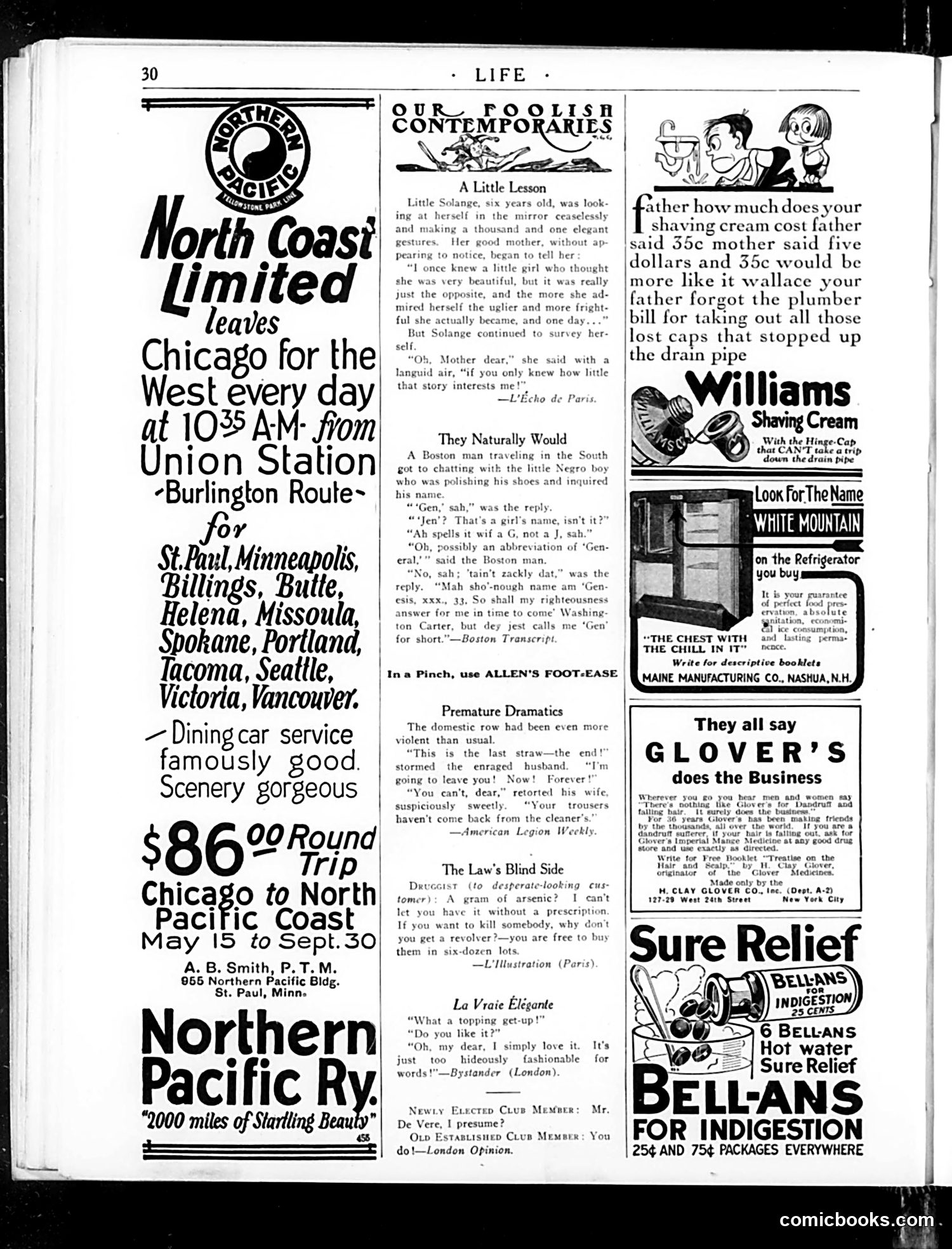
This page is primarily **advertising and light humor**, not political satire. The content includes: **Main Cartoons** ("Foolish Contemporaries" section): - Short, captioned jokes mocking social pretense and misunderstandings - "A Little Lesson": A mother tells her daughter a cautionary story about vanity - "They Naturally Would": A Boston man mishears a Black shoe-shiner's name ("Gen") as a girl's name, playing on dialect humor typical of the era - "Premature Dramatics" and "La Vraie Elegante": Brief marital and fashion jokes **The "Williams Shaving Cream" cartoon**: Shows a father confused about shaving cream costs while ignoring an overdue plumber's bill—gentle domestic humor about male obliviousness. **Bulk of page**: Railroad and product advertisements (North Coast Limited, Northern Pacific Railway, Bellans indigestion remedy, foot powder, refrigerators). The humor reflects 1920s sensibilities: mild class commentary, gender roles, and dialect-based comedy. No serious political messaging is evident.
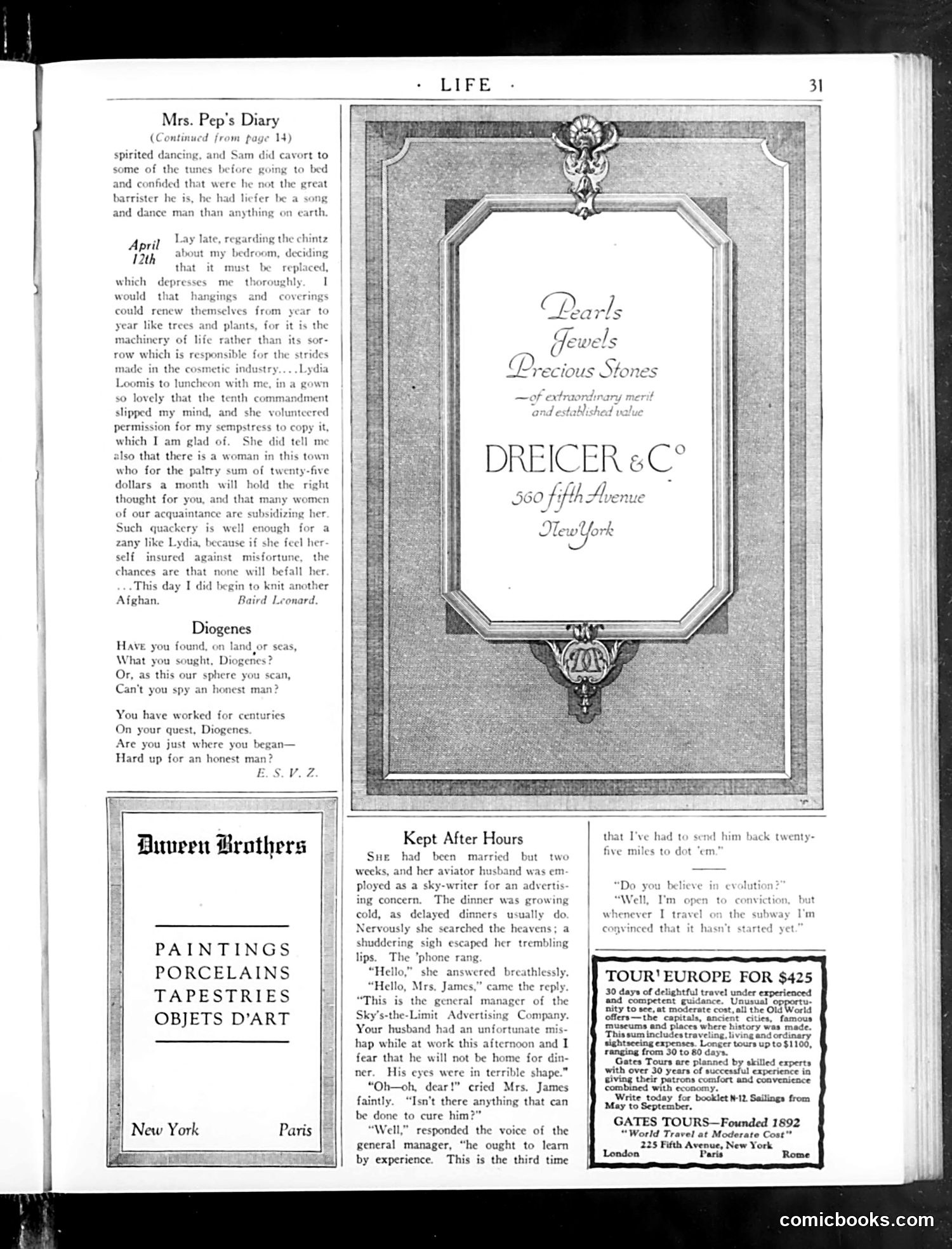
This page contains **three distinct pieces of content**: ## "Mrs. Pep's Diary" & "Diogenes" Serialized humor columns typical of Life magazine's satirical offerings. The diary excerpt mocks domestic concerns (chintz replacements, copying gowns), while the "Diogenes" poem humorously invokes the ancient Greek philosopher's famous search for an honest man—suggesting such integrity remains elusive in modern times. ## "Kept After Hours" (Main Story/Cartoon) A comedic narrative about an aviator husband employed as a "sky-writer" (an early aviation advertising method) who repeatedly makes mistakes writing advertisements in the sky. His frustrated wife receives calls from his manager reporting failures—most humorously, he's being sent back repeatedly to "dot 'em" (add periods). The joke satirizes both new aviation technology being commercialized for advertising and the absurdity of the medium itself. ## Advertisements Typical period luxury ads (Dreicer & Co jewelry, Duveen Brothers fine art, Gates Tours) showing Life's affluent readership. The page reflects 1920s-era commercial aviation as novelty and advertising innovation.
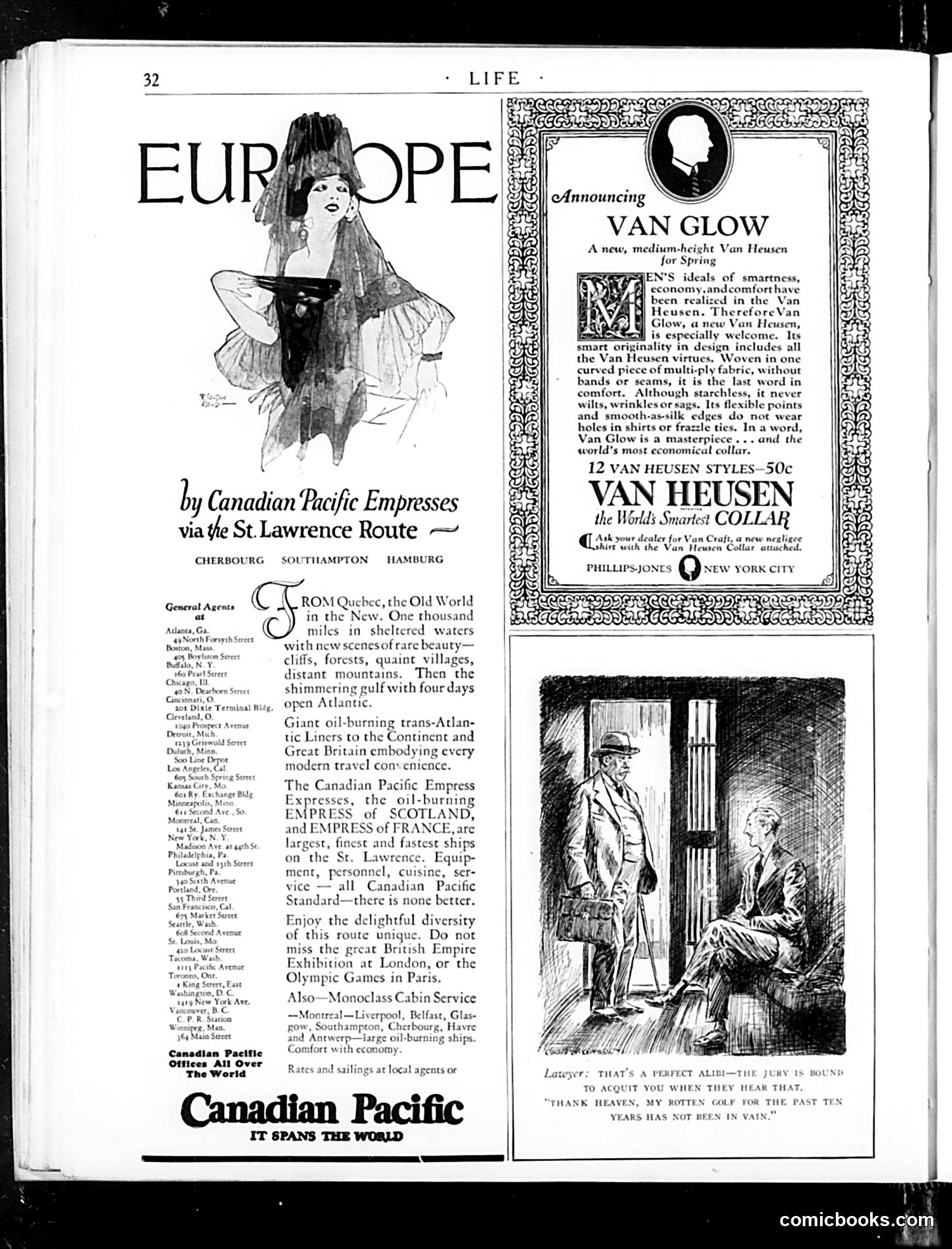
This page combines fashion/travel advertising with a single-panel cartoon joke. **The Cartoon (bottom right):** A lawyer tells his client that his poor golf skills provide the perfect legal defense. The joke is that the client can claim his terrible golf performance proves he couldn't have committed whatever crime he's accused of—apparently the defendant's incompetence at golf demonstrates general incompetence. It's absurdist humor playing on the idea that character flaws (being a bad golfer) might paradoxically serve as alibis. **The Advertising:** The page is dominated by ads for Canadian Pacific Empress ocean liners (promoting luxury transatlantic travel) and Van Heusen collars (highlighting their wrinkle-resistant, economical design). These represent typical 1920s-30s consumer goods marketing. **Context for Modern Readers:** The cartoon's humor assumes readers understand that golf was an aspirational leisure activity for wealthy professionals, making the reference to "rotten golf" a relatable character detail.
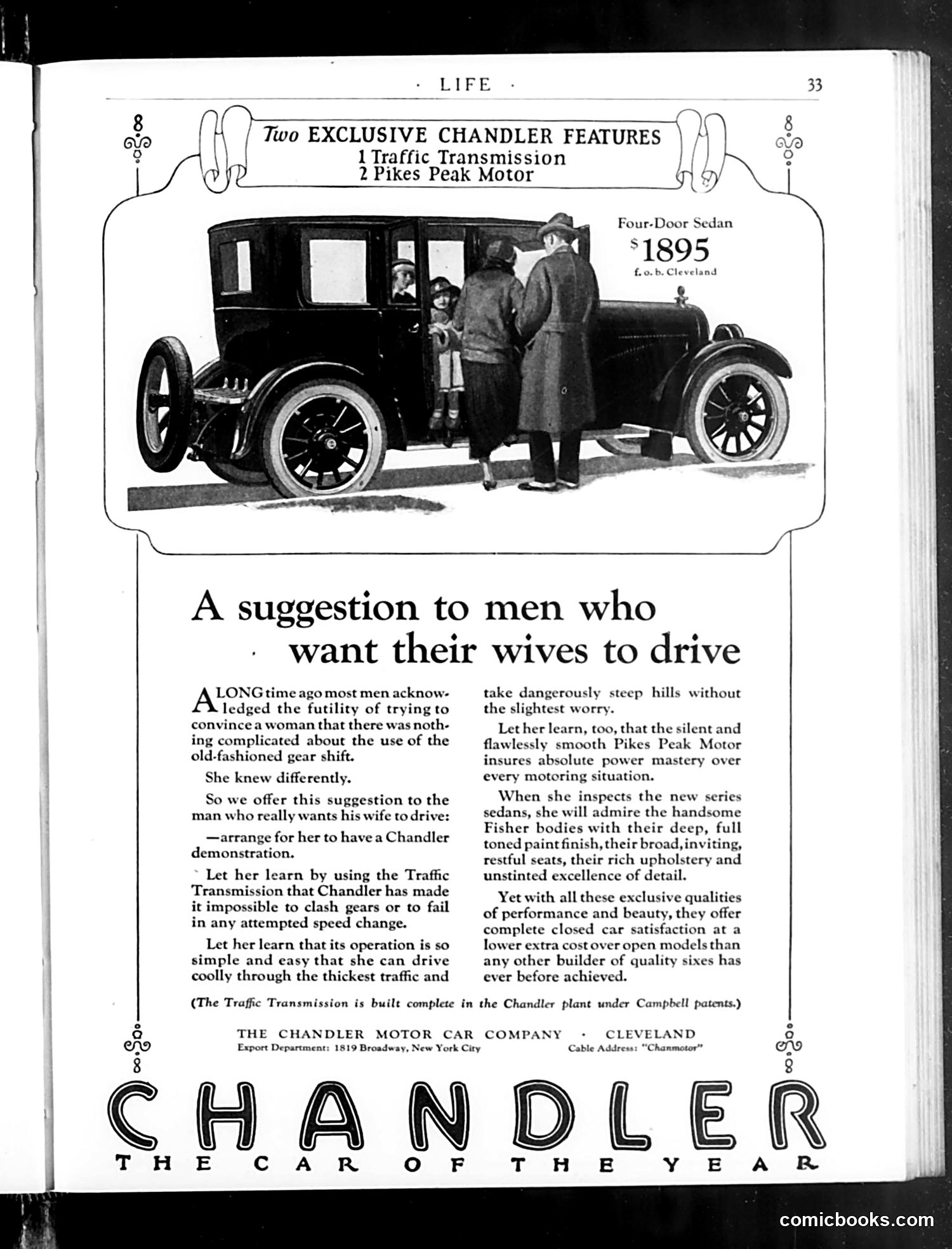
This is primarily **automobile advertising**, not satire or political commentary. The Chandler Motor Car Company uses a domestic angle to market their 1920s sedan. The "joke" reflects period gender assumptions: the ad addresses husbands, suggesting they buy a Chandler so their wives can drive safely. It plays on the stereotype that women find manual gear shifts confusing and intimidating. The ad's premise—that a woman needs a car simple enough for her to operate—is presented as a humorous "suggestion to men." The two advertised features (Traffic Transmission and Pikes Peak Motor) are positioned as so foolproof that even women could master them easily. The copy emphasizes simplicity, smoothness, and reliability as selling points, using wives' presumed mechanical incompetence as the hook. By modern standards, this reflects outdated sexism, but in its era it was standard marketing rhetoric—appealing to male decision-makers by flattering their wives' capabilities while implying women needed specially simplified equipment.
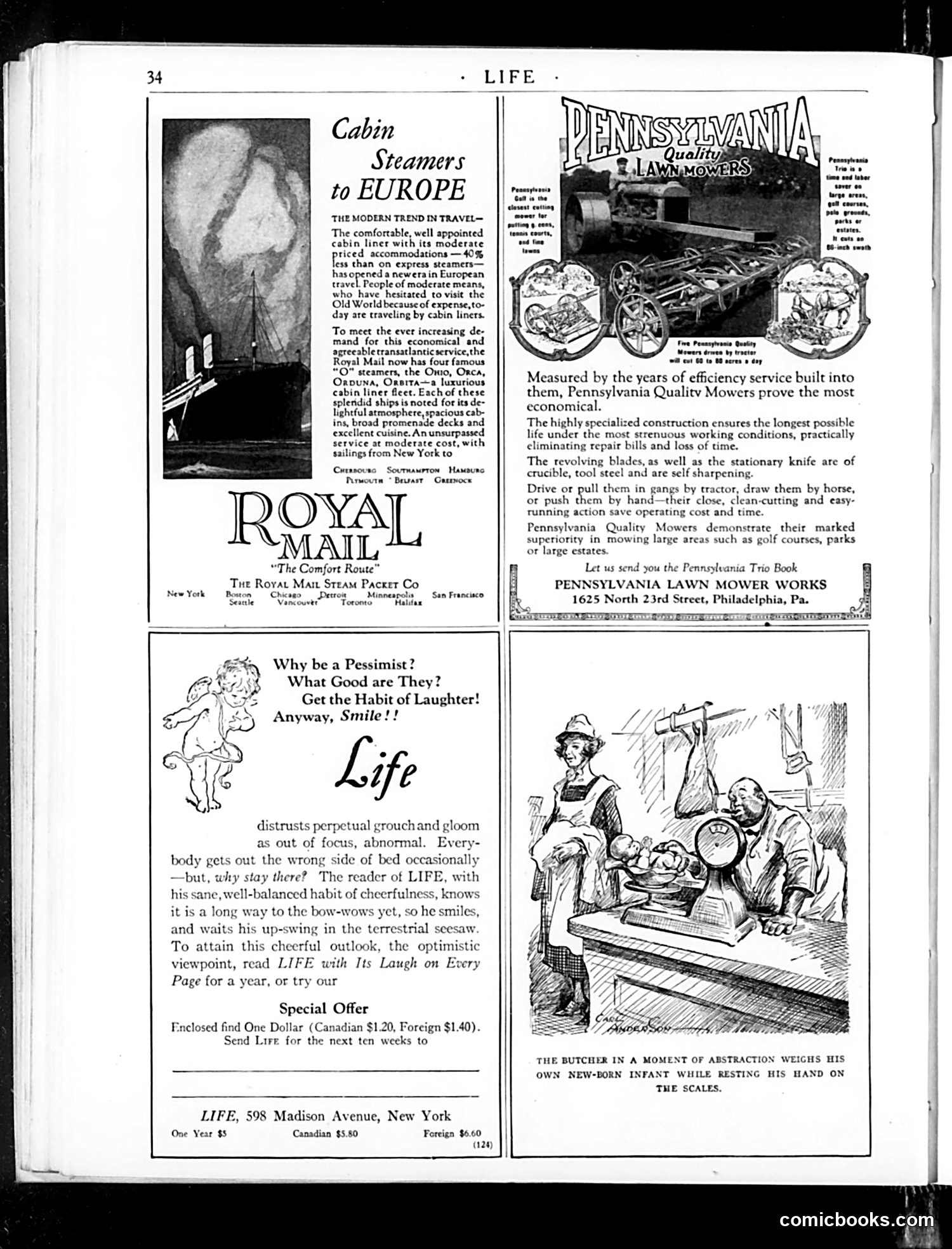
This page combines advertisements with satirical content typical of Life magazine's format. **The Advertisements:** The top half features two ads: Royal Mail steamship lines promoting affordable cabin passage to Europe for middle-class travelers (a growing market in the early 20th century), and Pennsylvania Quality Mowers advertising durable lawn equipment. **The Satire:** The bottom half contains Life's signature humor. The left section promotes Life magazine itself with the tagline "Why be a Pessimist?" — positioning the publication as an antidote to gloom, offering "a laugh on every page" to maintain cheerfulness and optimism. **The Cartoon:** The right side shows a butcher absentmindedly weighing his newborn infant on his shop scales while his hand rests on the balance. The humor lies in professional distraction: the butcher is so accustomed to his work that he unconsciously treats his infant like merchandise. This gentle joke exemplifies Life's brand of everyday observational humor about ordinary people.
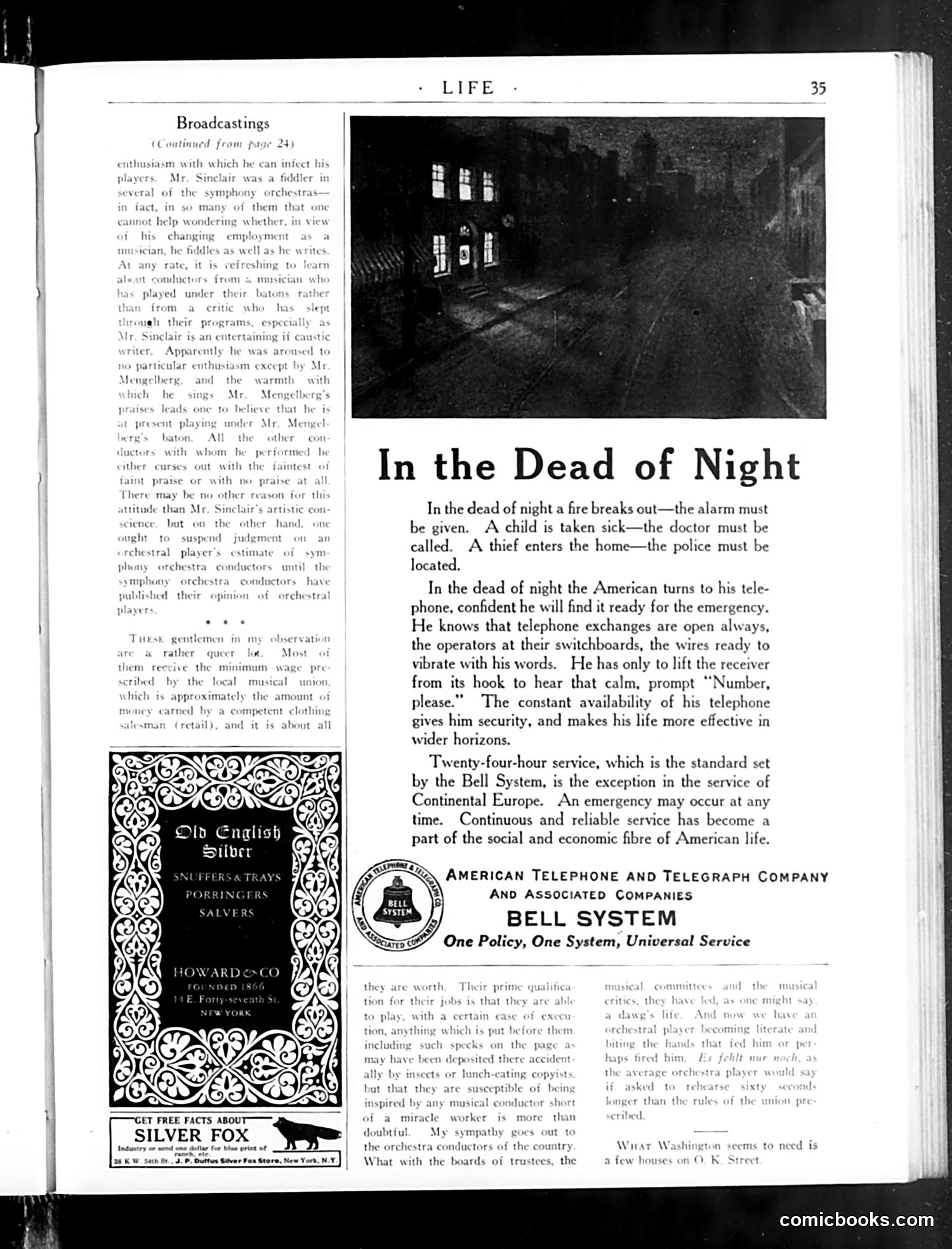
This page is primarily a **Bell System (AT&T) advertisement**, not satire or political commentary. The large image depicts a darkened residential building at night, illustrating the advertisement's central claim: that telephone service provides security and reliability during emergencies. The ad's pitch emphasizes American telephone superiority—specifically 24-hour availability—compared to "Continental Europe," where emergency service is less reliable. The text appeals to readers' sense of safety: fires, sick children, and burglaries may strike "in the dead of night," but the telephone offers immediate access to help ("Number, please"). The page also contains a smaller advertisement for **Old English Silver** flatware by Howard & Co. (founded 1865), and mentions a **Silver Fox promotion** with a small fox-head logo. The broadcasting commentary at page top appears unrelated to the telephone ad—it discusses orchestral conductors and musicians, suggesting this is a partial continuation from an earlier article. This reflects 1920s-30s advertising strategy: positioning telephone infrastructure as essential to modern American life and security.
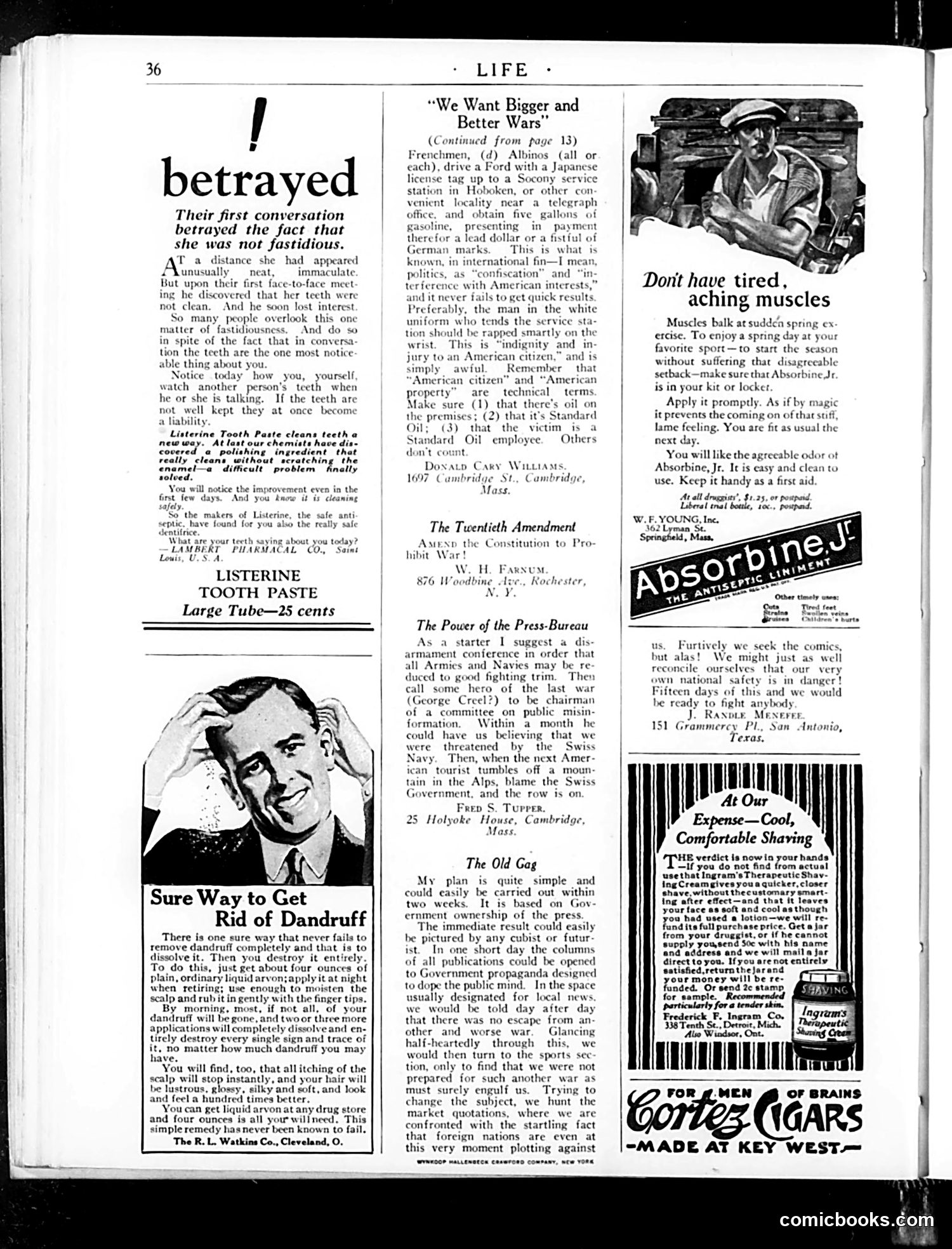
This page mixes genuine product advertising with social commentary typical of *Life* magazine's satirical mission. The main visual—a man's face—accompanies "betrayed," a short story about a woman whose poor dental hygiene ruins her romantic prospects. This introduces the **Listerine Tooth Paste advertisement** below, which exploits social anxiety about appearance and cleanliness to sell products. The copy warns that unclean teeth are a "liability" in conversation, reflecting period anxieties about class markers and respectability. The other advertisements (dandruff remedy, shaving cream, cigars) follow the same pattern: identifying social embarrassment, then offering commercial solutions. The letters to the editor—on war, disarmament, and press manipulation—represent *Life*'s satirical voice, mocking government propaganda and suggesting that manufactured international incidents (like a tourist's accident) could be weaponized for political purposes. This reflects post-WWI skepticism about official narratives. Together, the page satirizes how commercial and political interests exploit ordinary anxieties.
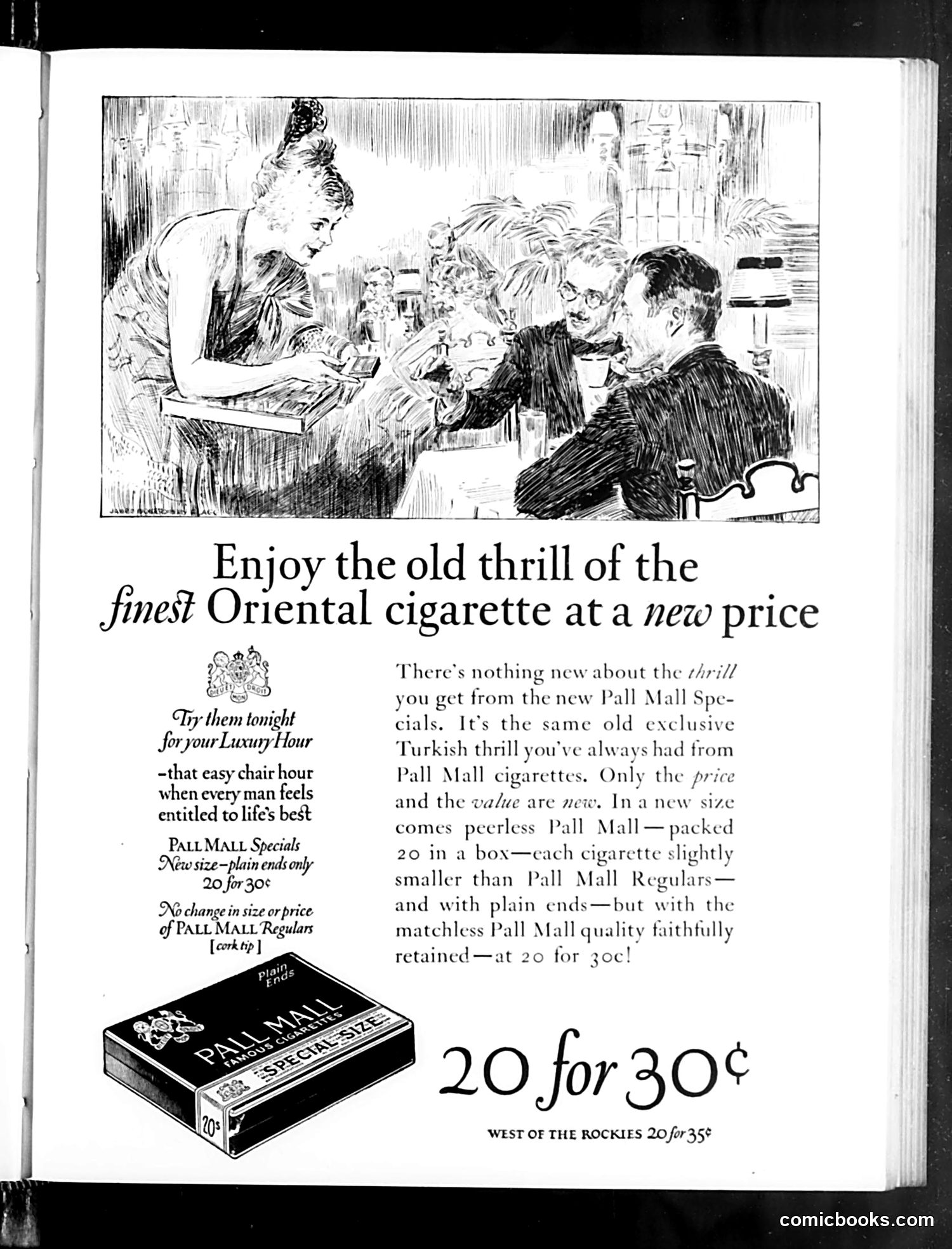
This page is **primarily a cigarette advertisement**, not political satire. The illustration shows a well-dressed woman serving cigarettes to three men in what appears to be an upscale social setting, emphasizing luxury and sophistication. The "joke" or selling point is economic rather than satirical: Pall Mall is introducing a new smaller cigarette size at a reduced price (20 for 30¢), positioning it as maintaining quality while lowering cost during what was likely the economically challenging 1930s era. The ad appeals to masculine leisure culture—the "Luxury Hour" when "every man feels entitled to life's best"—reflecting period attitudes about class, gender, and consumption. The woman serves while men enjoy the product, reflecting typical 1930s-40s advertising gender dynamics. This is commercial messaging with no apparent political commentary.
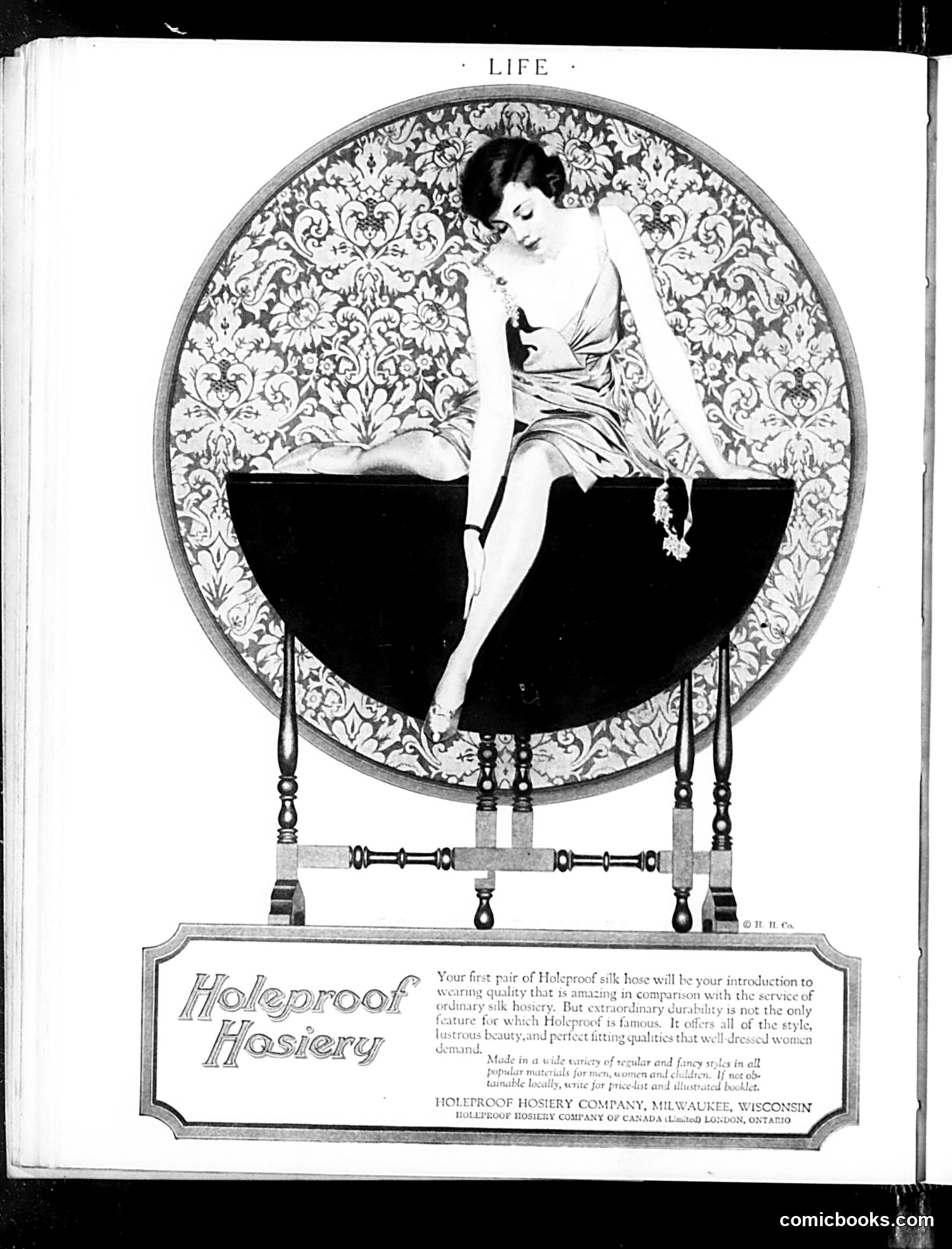
This is primarily a **Holeproof Hosiery advertisement** rather than political satire or editorial cartoon. The image shows a woman in classical drapery seated in an ornate circular frame with decorative damask wallpaper. The ad emphasizes the product's durability and quality—claiming Holeproof silk hose offers "extraordinary durability" alongside style and fit qualities "that well-dressed women demand." The classical aesthetic (the woman's pose, the decorative frame) suggests luxury and elegance, positioning hosiery as a premium product. The text notes they're "Made in Canada" and available in "popular materials for men, women and children." This reflects early 20th-century advertising strategy: using artistic presentation and claims of superior construction to justify premium pricing for what is essentially a practical garment.