
Life, 1924-04-17 · page 22 of 40
Life — April 17, 1924 — page 22: what you’re looking at
What you’re looking at
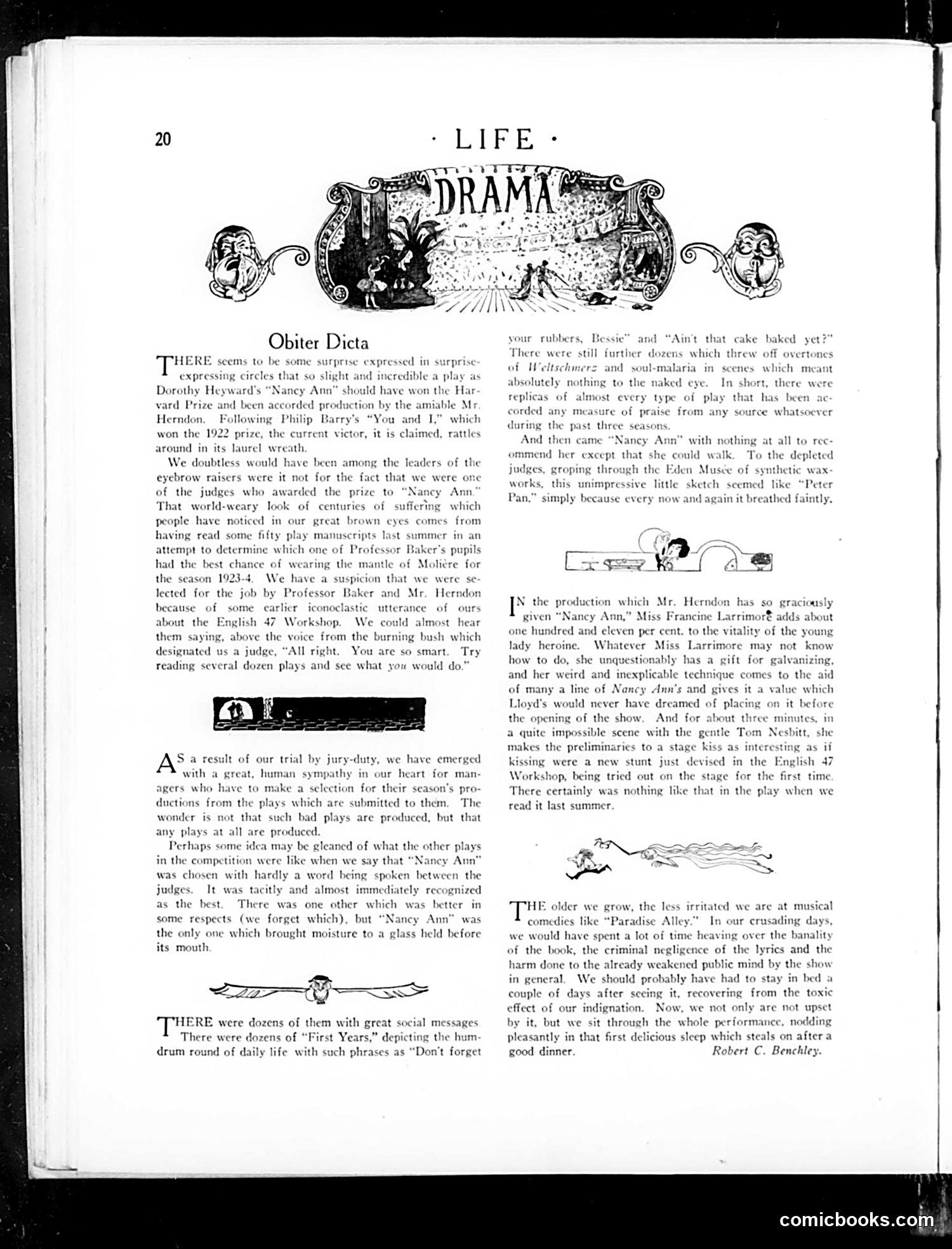
This article defends Dorothy Heyward's play "Nancy Ann," which won the Harvard Prize despite critical surprise at its apparent simplicity. The writer, a judge for the award, explains that among dozens of submitted plays—many featuring heavy social messages, pretentious "soul-malaria," or mundane domestic dialogue ("Don't forget your rubbers, Bessie")—"Nancy Ann" stood out simply because "she could walk." The satire targets both the mediocrity of contemporary theater submissions and the absurdity of judging them. The writer credits actress Francine Larrimore's performance with elevating the thin material, describing her technique as capable of making even an "impossible scene" (a stage kiss) seem interesting. The humor lies in the judges' desperate relief at finding *any* competent play, transforming modest merit into prize-worthiness by comparison to the surrounding dreck.
📄 Transcribed text from this page (OCR, searchable)
Machine-transcribed from the original scan — historical spelling and the odd misread are preserved.
Obiter Dicta THERE scems to be some surprise expressed in surpris expressing circles that so slight and incredible a play as Dorothy Heyward’s “Nancy Ann” should have won the Har vard Prize and been accorded production by the amiable Mr Herndon. Following Philip Barry’s “You and 1,” which won the 1922 prize, the current v , it is claimed, rattles around in its laurel wreath We doubtless would g the leaders of the eyebrow raisers were it not for the fact that we were one of the judges who awarded the prize to “Nancy Ann That world-weary look of centuries of suffering which people have noticed in our great brown eyes comes from having read some fifty play manuscripts last summer in an attempt to determine which one of Professor Baker's pupils had the best chance of wearing the mantle of Moliére for the season 1923-4. We have a suspicion that we were se. lected for the job by Professor Baker and Mr. Herndon because of some earlier iconoclastic utterance of ours about the English 47 Workshop. We could almost hear saying, above the voice from the burning bush which sa judge, “All right. You are so smart of our trial by jury-duty, we have emerged with a great, human sympathy in our heart for man- agers who have to make a selection for their season’s pro- ductions from the plays which are submitted to them. The wonder is not that such bad plays are produced, but that any plays at all produced. Perhaps some idea may be gleaned of what the other plays in the competition were like when we say that “Nancy Ann" was chosen with hardly a word being spoken between the judges. It was tacitly and almost immediately recognized as the best. There was one other which was better in some respects (we forget which), but “Nancy Ann” was the only one which brought moisture to a glass held before its mouth. = HERE were dozens of them with great social messages There were dozens of “First Years,” depicting the hum drum round of daily life with such phrases as “Don't forget your rubbers, Bessie” and “Ain't that cake baked ye There were still further dozens which threw off overtones of Weltschmers and soul-malaria in scenes which meant absolutely nothing to the naked eye. In short, there were replicas of almost every type of play that has been corded any measure of praise from any source whatsoever during the past three seasons And then came “Nancy Ann” with nothing at all to rec- nmend her except that she could walk. To the deplete judges, groping through the Eden Mus¢e of synthetic wax works, unimpressive little sketch seemed like “Peter Pan,” simply because every now and again it breathed faintly, N the production which Mr. Herndon has so graciously given “Nancy Ann,” Miss Francine one hundred and eleven per cent. to th rimor® adds about lity of the young lady heroine. Whatever Miss Larrimore may not know how to do, she unquestionably has a gift for galvanizing, and her weird and inexplicable technique comes to the aid : "s and gives it a value which Lloyd's would never have dreamed of placing on it before the opening of the show. And for at a quite impossible scene with the gentle Tom Nesbitt, she makes the preliminaries to a stage kiss as interesting as if kissing were a new stunt just devised in the English 47 Workshop, being tried out on the stage for the first time out three minutes, in There certainly was nothing like that in the play when we read it last summer. HE older we grow, the less irritated we are at musical comedies like “Paradise Alley.” In our crusading days, we would have spent a lot of time heaving over the banality of the book, the criminal negligence of the lyrics and the harm done to the already weakened public mind by the show in general. We should probably have had to stay in bed a couple of days after seeing it, recovering from the toxic ‘ect of our indignation. Now, we not only are not upset it, but we sit through the whole performance, nodding santly in that first delicious sleep which steals on after a good dinner. Robert C. Benchley. comicbooks.com