
Life, 1924-04-17 · page 28 of 40
Life — April 17, 1924 — page 28: what you’re looking at
What you’re looking at
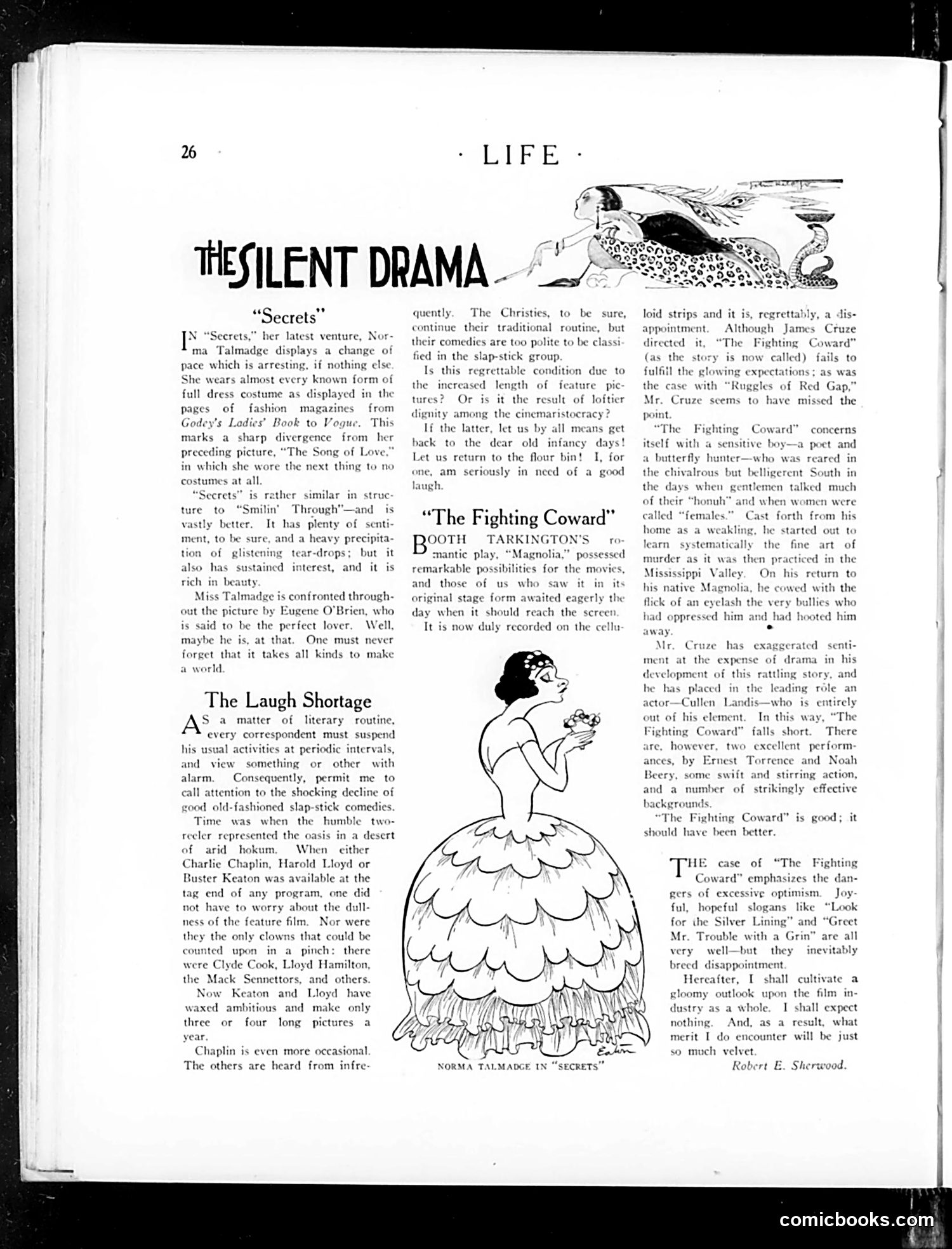
This page reviews three silent films, with particular focus on critiques of cinema trends circa the early 1920s. The central illustration depicts **Norma Talmadge** in "Secrets," satirizing her costume changes throughout the film—contrasting sharply with her previous picture "The Song of Love," which featured minimal clothing. **"The Laugh Shortage"** section laments the decline of slapstick comedy. The author criticizes that **Charlie Chaplin, Harold Lloyd, and Buster Keaton**—once reliable sources of physical humor—now make fewer films or pursue "loftier dignity." Meanwhile, gentler comedies from the Christies lack the crude, physical humor that defined earlier cinema. This reflects genuine industry concern: as film matured and gained prestige, comedians increasingly pursued feature-length dramatic roles over short comedies. **"The Fighting Coward"** review criticizes director James Cruze for failing to match the source material's promise, and faults lead actor Cullen Landis as miscast—"entirely out of his element"—though praising supporting performances by Ernest Torrence and Noah Beery. The page emphasizes quality concerns as silent cinema professionalized.
📄 Transcribed text from this page (OCR, searchable)
Machine-transcribed from the original scan — historical spelling and the odd misread are preserved.
“Secrets” Secrets,” [s y her latest venture, Nor- ma Talmadge displays a change pace which is arresting, if nothing else She wears almost every known form of full dress costume as displayed in the pages of fashion magazines from Godey’s Ladies’ Book to Vogue. This marks a sharp divergence from her preceding picture, “The Song of Love in which she we he next thing to no costumes at all. “Secrets” is rather similar in ture to “Smilin’ better. It ment, to be Through"—and_ is vast! has plenty of and a heavy precipita- tear-drops; but it interest, and it is tion of g also has sustained rich in beauty Miss Talmadge is confronted through- the picture by Eugene O'Brien, who is said to be the perfect lover, Well, at that. One must never takes all kinds to make maybe he is forget that it The Laugh Shortage a matter of literary routine, ‘ every correspondent must suspend his usual activities at periodic intervals, and view something or other with alarm. Consequently, permit me to call attention to the shocking decline of good old-fashioned slap-stick comedies Time when the humble two- recler represented the oasis in a desert of arid hokum, When either Charlie Chaplin, Harold Lloyd or Buster Keaton was available at the tag end of any program, one did have to worry about the dull- ness of the feature film. Nor were they the only clowns that could be upon in a pinch: there were Clyde Cook, Lloyd Hamilton, the Mack Sennettors, Now Keaton and waxed ambitious four was counted and others Lloyd have make o and three or long pictures year Chaplin is even more occasional The others are heard from infre quently. The Christies, to be continue their traditional routine, but heir comedies are too polite to be classi fied in the slap-stick group. Is this regrettable condition due to length of fe ures? Or is it the the increased re pic loftier dignity among the cinemaristocracy? If the latter, back to the Let us re result of let us by all means get dear old infancy days! n to the flour bin! I, for one, am seriously in need of a good laugh. “The Fighting Coward” OOTH TARKINGTON’S — ro mantic play, “Magnolia, remarkable possibilities for the movies, possessed and those of us who saw it in al stage form awaited eagerly the when it should reach the origi day sereet It is now duly recorded on the cellu NORMA TALMADGE IN “SECRETS” sure, loid strips and it is, regretta appointment. Although James Cruze directed it, “The Fighting Coward” (as the story is now called) fails to fulfill the glowing expectations ; as was case with “Ruggles of Red Gap,” Mr. Cruze scems to have missed the point “The Fighting Coward” concerns itself with « sensitive boy—a poet and 1 butterfly hunter the chivalrous who was reared in hin much but belligerent So the days when gentlemen talk of their “honuh” and when women were called “females.” Cast forth from home as a weakling, he started out to learn ne art of iced in the systematically the f murder as it was then prac Mississippi Valley. On his Magnolia, he e« eyelash the return to his native flick of an had oppressed him and had | ed with the very bullies who voted him has ted senti- ment at the drama in his development of this expense ¢ ig story, a he has placed in ding role an actor—Cullen Lar his element lis—wh is entirely out of In this way, “The Fighting Coward” falls short. There are, however, two excellent. perform ances, by Ernest Torrence and Noah Beery, some swift and stirring action, and a number of strikingly effective backgrounds. Coward” “The Fighting is good; it should have been better. HE case of “The Fighting emphasizes the dan- Joy Coward” gers of excessive optimism ful, hopeful slogans like “Look for the Silver Lining” and “Greet Mr. Trouble with a Grin” are all well—but they breed disappointment Hereafter, I shall cultivate a gloomy outlook upon the film in- I shall expect result, what will be just very inevitably dustry as a whole. And, as a nter nothing merit I so much velvet Robert E do encour Sherwood. | comicbooks.com