
A complete issue · 42 pages · 1924
Life — March 20, 1924
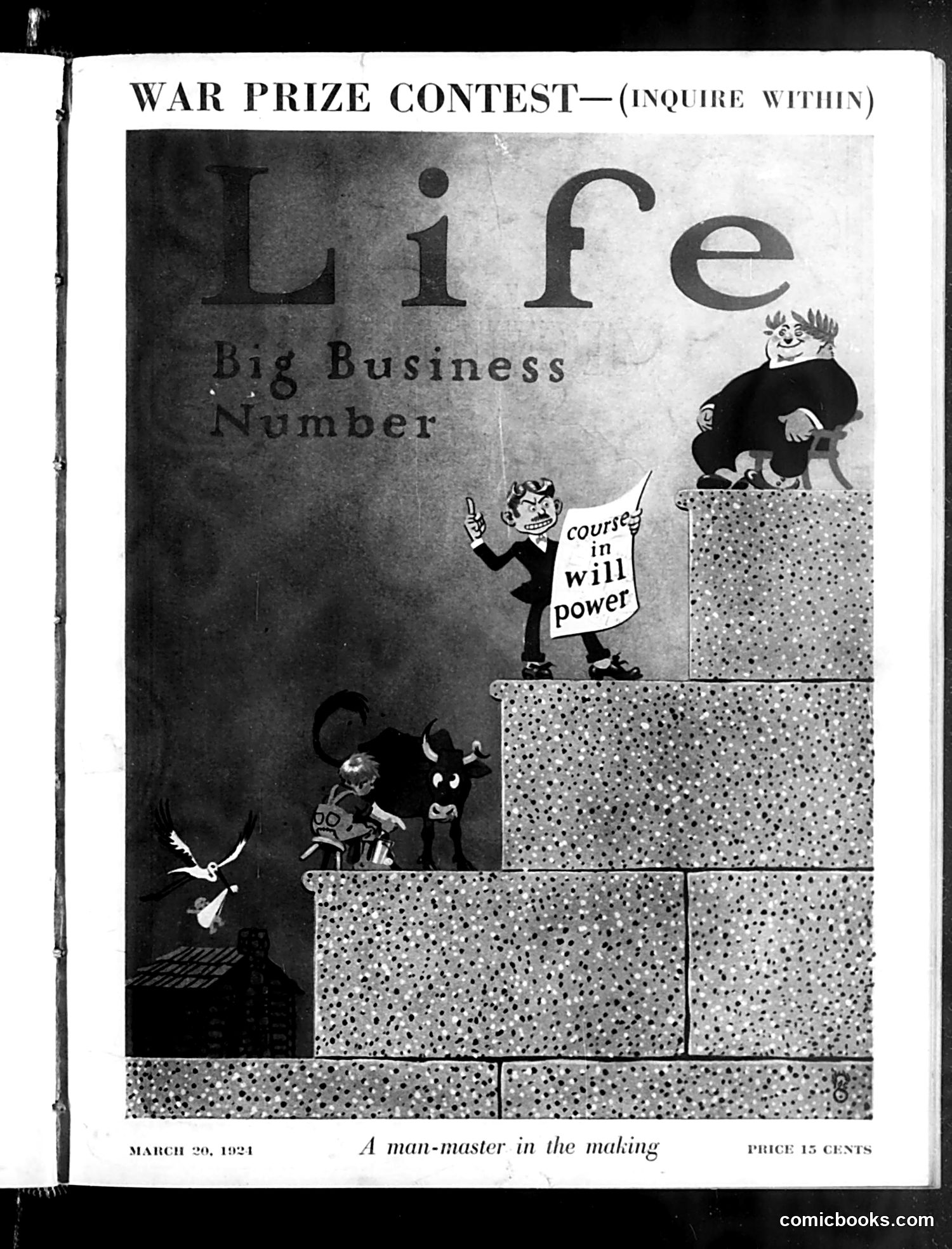
This is a "War Prize Contest" cover depicting a multi-tiered pyramid structure labeled "Big Business Number." The illustration shows figures climbing upward, with one character holding a sign reading "course in will power" on an intermediate level, while a larger figure sits atop the structure. Below, smaller characters (appearing to include caricatures suggesting different nationalities or groups) struggle at the base. The satire critiques post-WWI capitalism and wealth inequality: the "will power" sign mocks the bootstrap mythology that anyone can succeed through determination alone, while the pyramid structure suggests the actual barriers to upward mobility. The "man-master in the making" subtitle appears ironic—only the privileged few at the top truly gain power, while others remain trapped below regardless of effort.
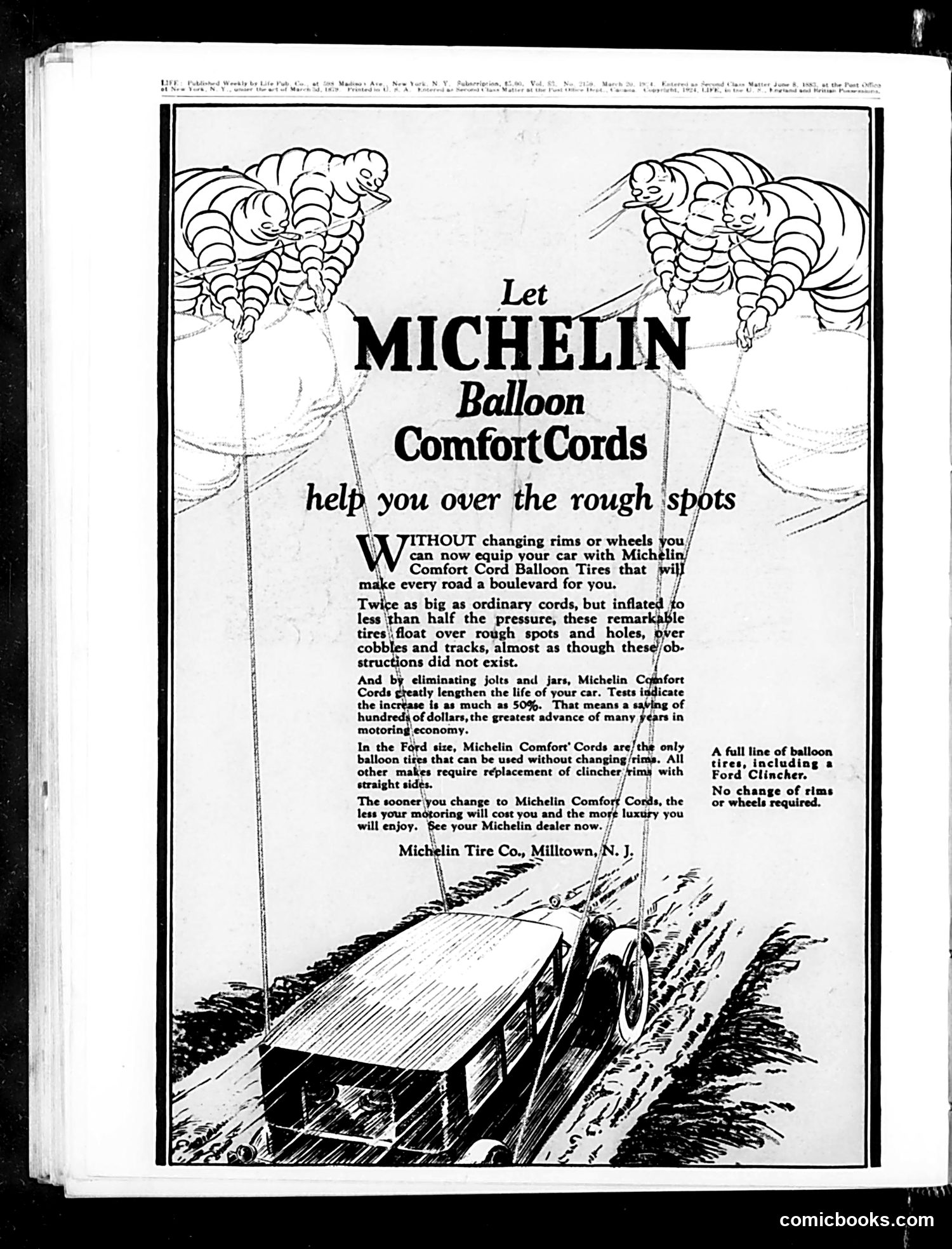
This is **not a cartoon or satire** — it's a straightforward **advertisement** for Michelin Balloon Comfort Cord tires, published in *Life* magazine (likely early 1920s based on styling). The ad features two whimsical illustrations of the Michelin Man mascot (Bibendum) holding balloon tires aloft like actual balloons on strings, floating above a car traversing rough terrain. The visual metaphor emphasizes the tires' key selling point: they're inflated to lower pressure than standard tires, allowing them to absorb bumps and holes without changing rims or wheels. The ad highlights practical benefits—smoother rides, reduced wear, cost savings up to 50%—and targets Ford owners specifically, noting these are the only balloon tires compatible with Ford's existing rims. This represents early automotive advertising emphasizing technological innovation in tire design.
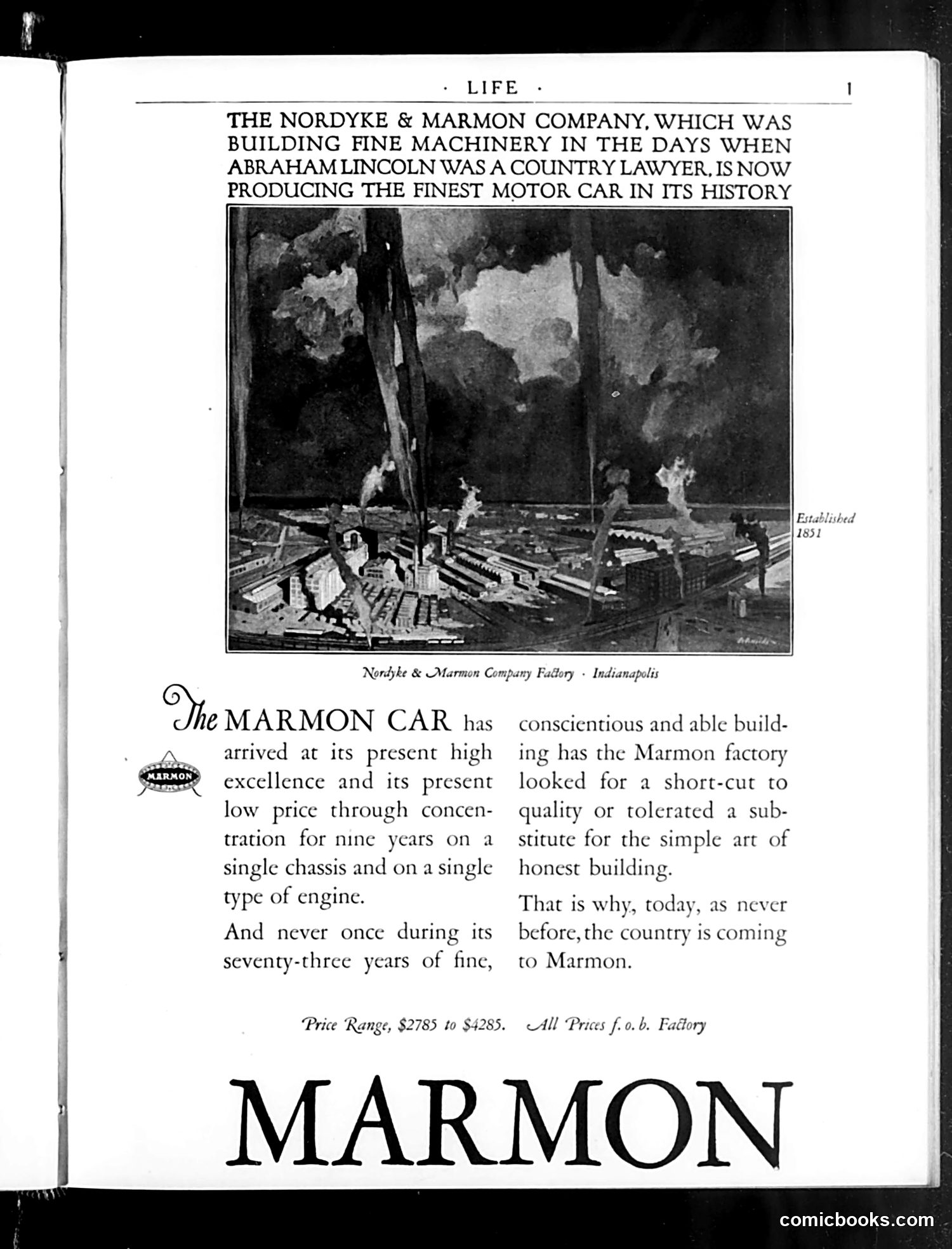
This page is primarily **advertising**, not satire or cartoon commentary. It's a Marmon automobile advertisement from *Life* magazine. The ad emphasizes the Marmon Car's quality and consistency, highlighting that the Nordyke & Marmon Company—historically a precision machinery manufacturer from when "Abraham Lincoln was a country lawyer"—now produces automobiles. The key message: Marmon maintains its reputation for meticulous craftsmanship rather than cutting corners. The text explicitly states the company never compromised quality during "seventy-three years" of operation, contrasting this with competitors who might use cheaper substitutes. The factory photograph serves as visual proof of serious manufacturing infrastructure. The price range ($2785-$3285) positions it as a premium vehicle. This is a prestige appeal to buyers valuing heritage and reliability over economy.
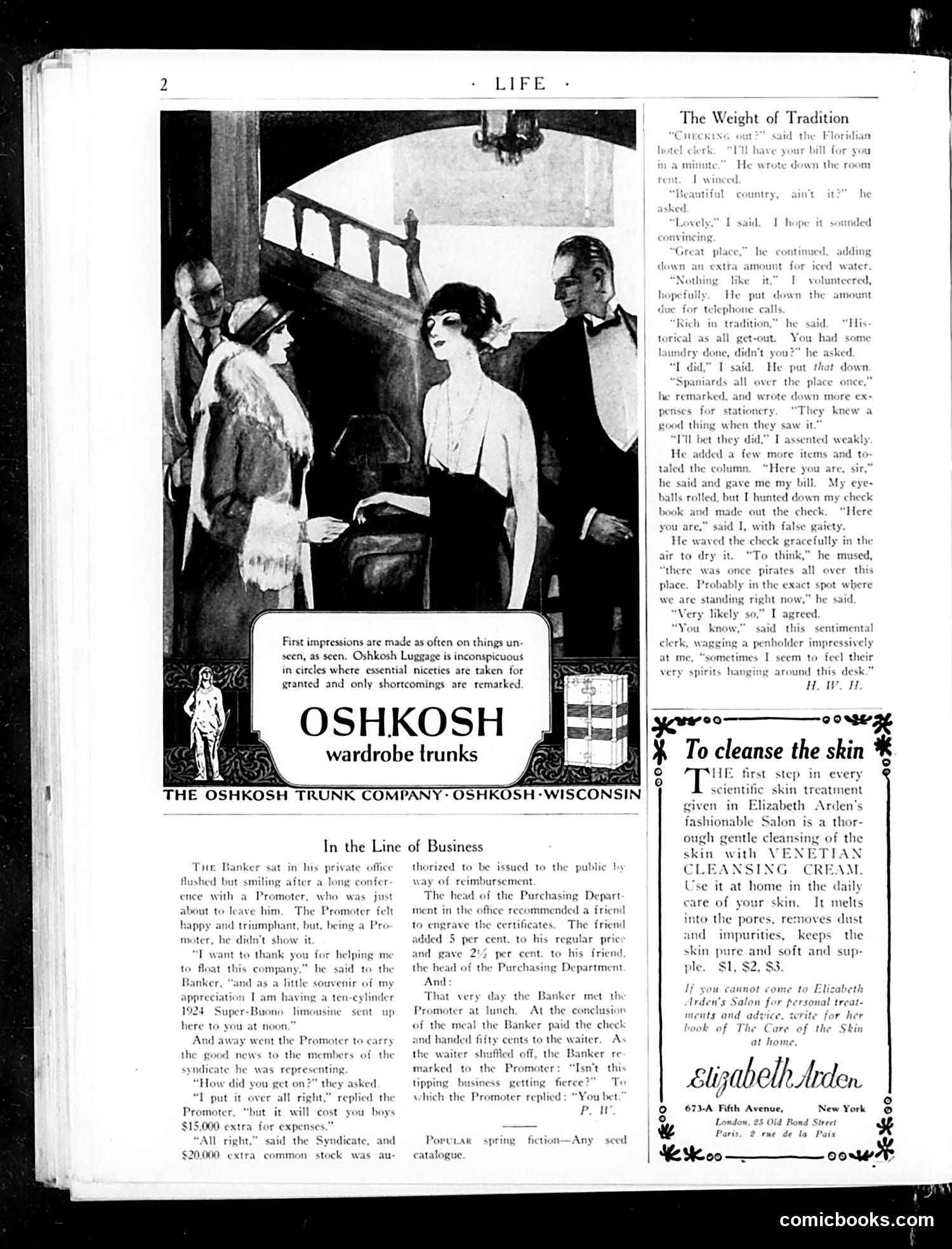
This page contains a short satirical story titled "In the Line of Business" alongside period advertisements (Oshkosh trunks, Elizabeth Arden skincare). The story appears to mock corporate expense practices and syndicates. A Banker thanks a Promoter for helping float a company, offering him a "1924 Super-Buono limousine" as thanks. The Promoter negotiates syndication rights with other Bankers, extracting premiums (5%, 2.5%) for the privilege. At lunch, the Banker pays the check and asks the Promoter if "this business getting fierce?" — to which the Promoter replies "You bet," implying competitive greed. The satire targets early 1920s financial practices: inflated corporate perks, kickbacks disguised as business arrangements, and the increasingly cutthroat nature of financial syndication during the Jazz Age boom.
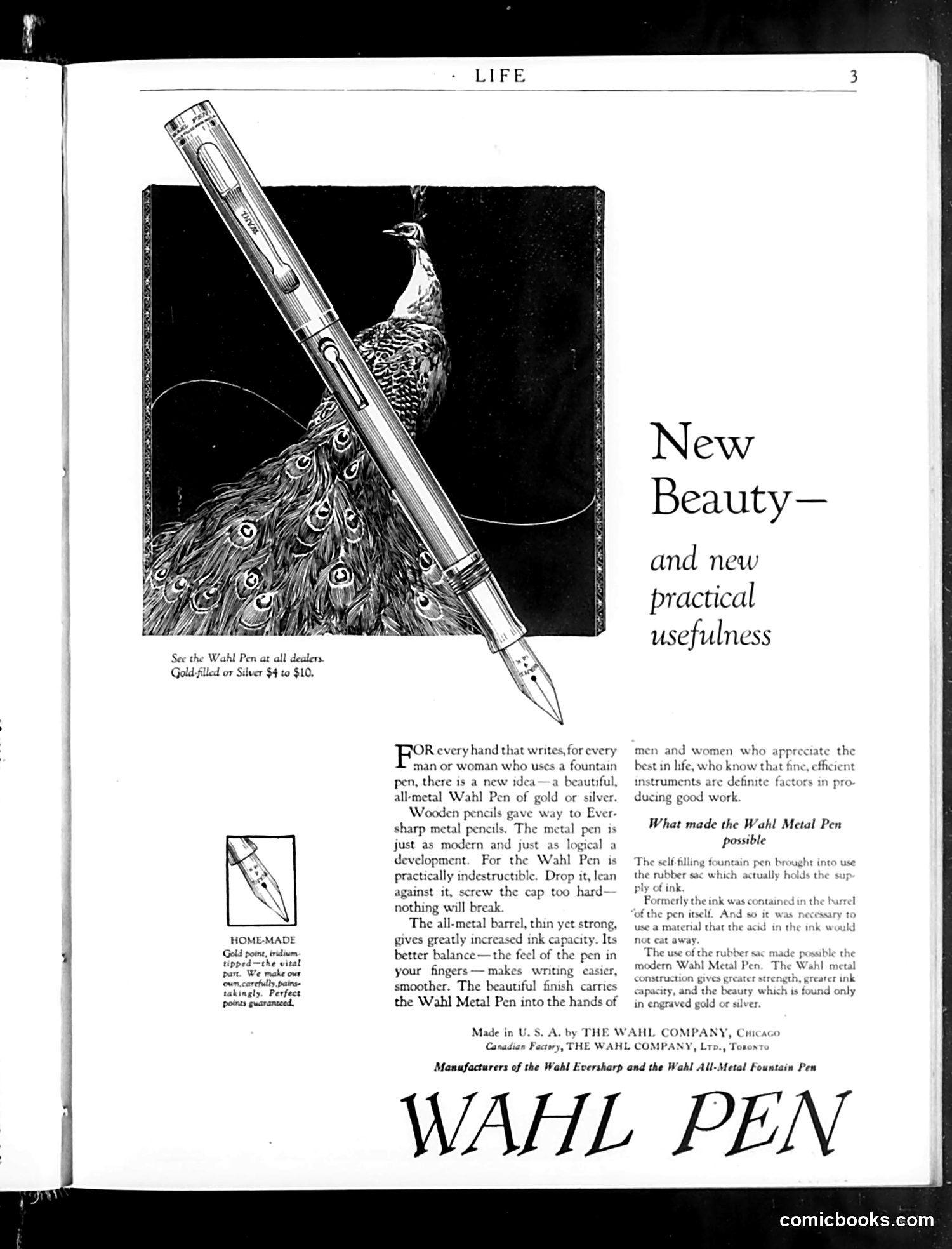
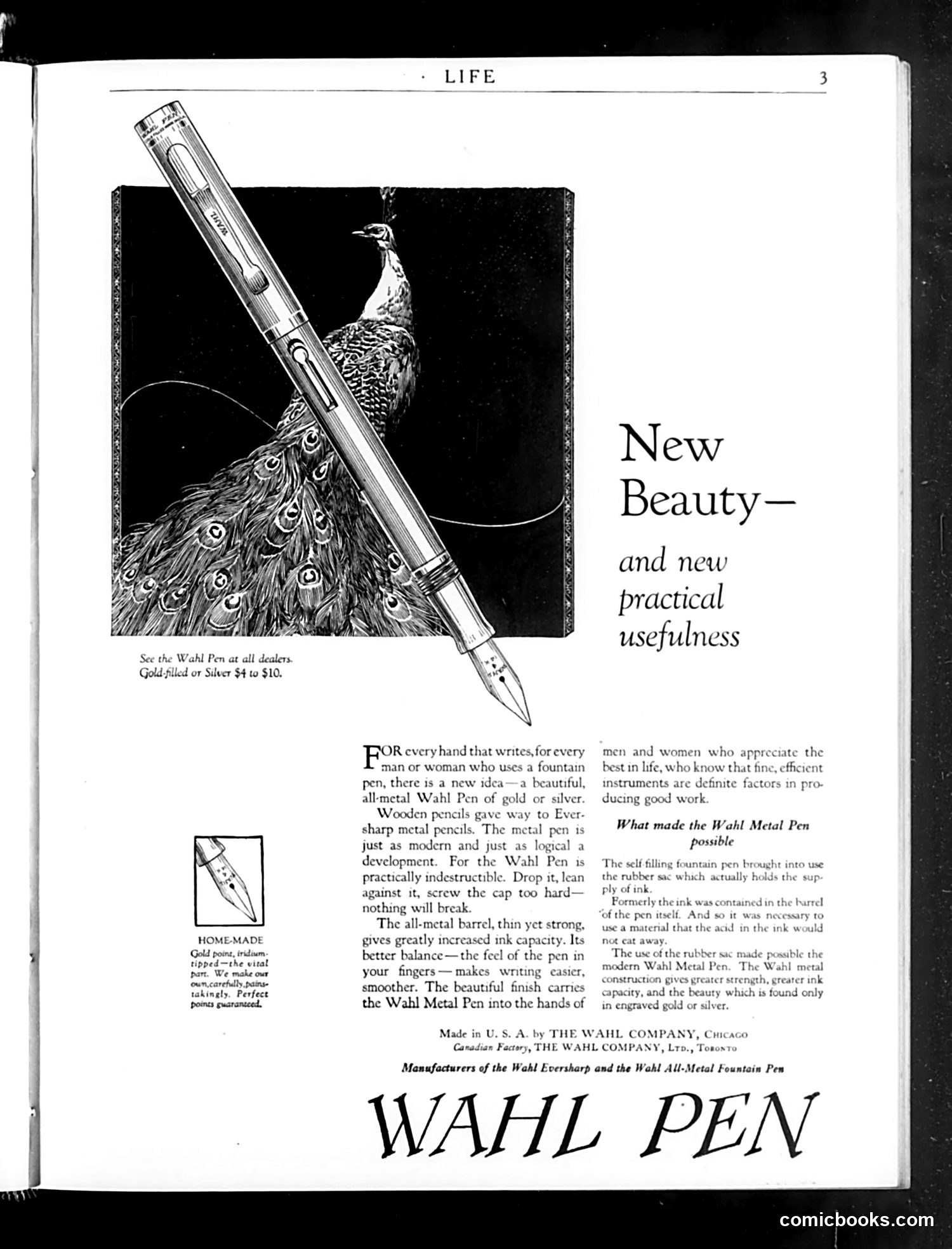
This page is **primarily an advertisement**, not political satire. It promotes the Wahl Metal Pen—a fountain pen made of gold or silver. The decorative illustration features a **peacock**, a bird traditionally associated with beauty and display. This connects to the ad's headline: "New Beauty—and new practical usefulness." The peacock symbolizes the pen's aesthetic appeal while the text emphasizes its practical durability and design improvements (self-filling mechanism, unbreakable metal barrel). There is no political cartoon or satirical commentary here. The peacock is purely decorative imagery chosen to market the product's combination of elegance and functionality. This is straightforward commercial advertising typical of *Life* magazine's revenue model.
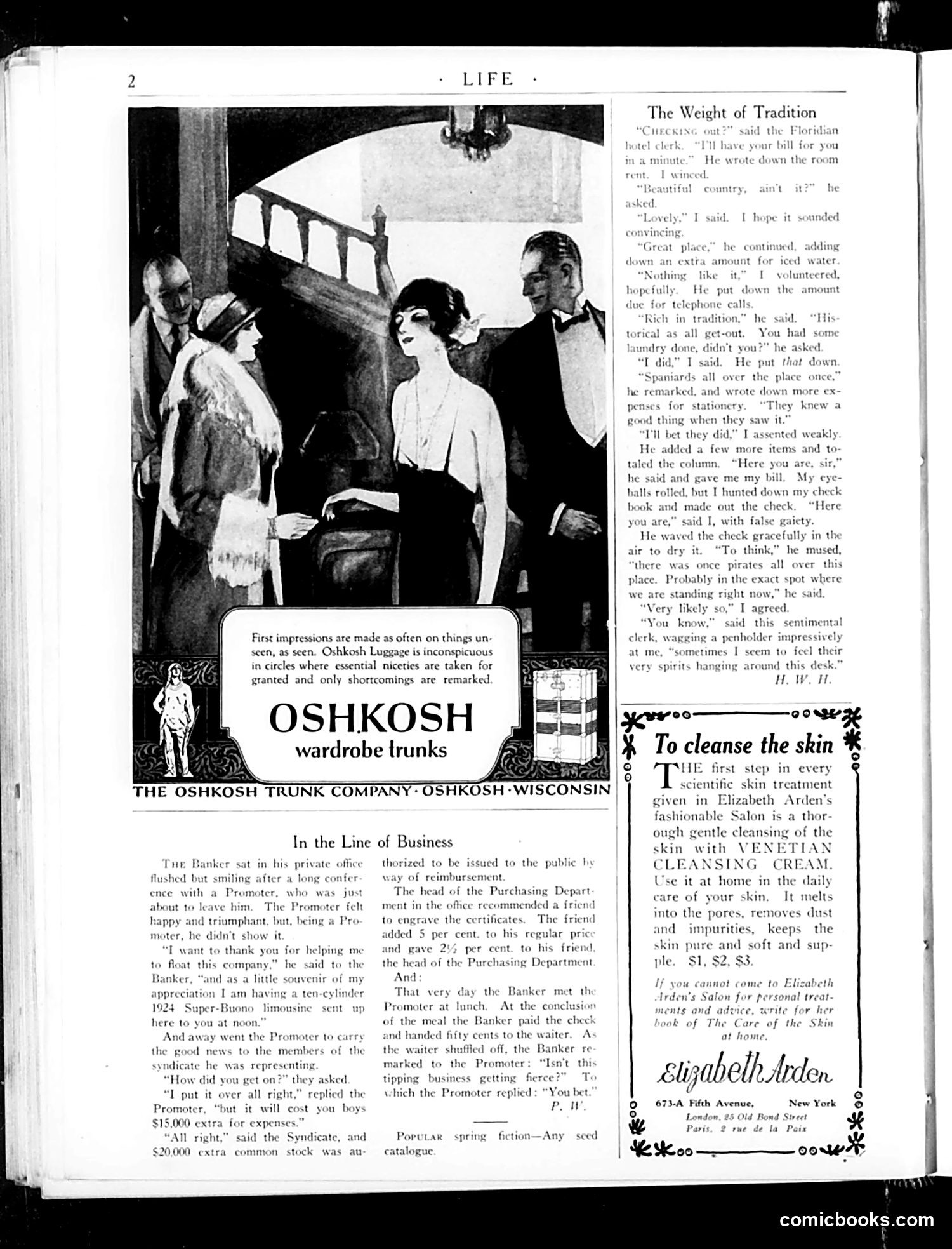
This page is primarily **advertising and narrative fiction**, not political satire. The main image shows a hotel scene advertising **Oshkosh Luggage** (wardrobe trunks). The accompanying story "In the Line of Business" describes a banker negotiating reimbursement through a purchasing department, establishing that the luggage is "inconspicuous in circles where essential niceties are taken for granted." The narrative satirizes **corporate bureaucracy and class pretension**: a banker must justify business expenses through proper channels, and the luggage serves as a marker of respectability and business propriety. The Oshkosh company positions their product as suitably discreet for the professional classes. Additional ads for Elizabeth Arden skincare appear on the right. This is typical 1920s magazine advertising targeting affluent readers.
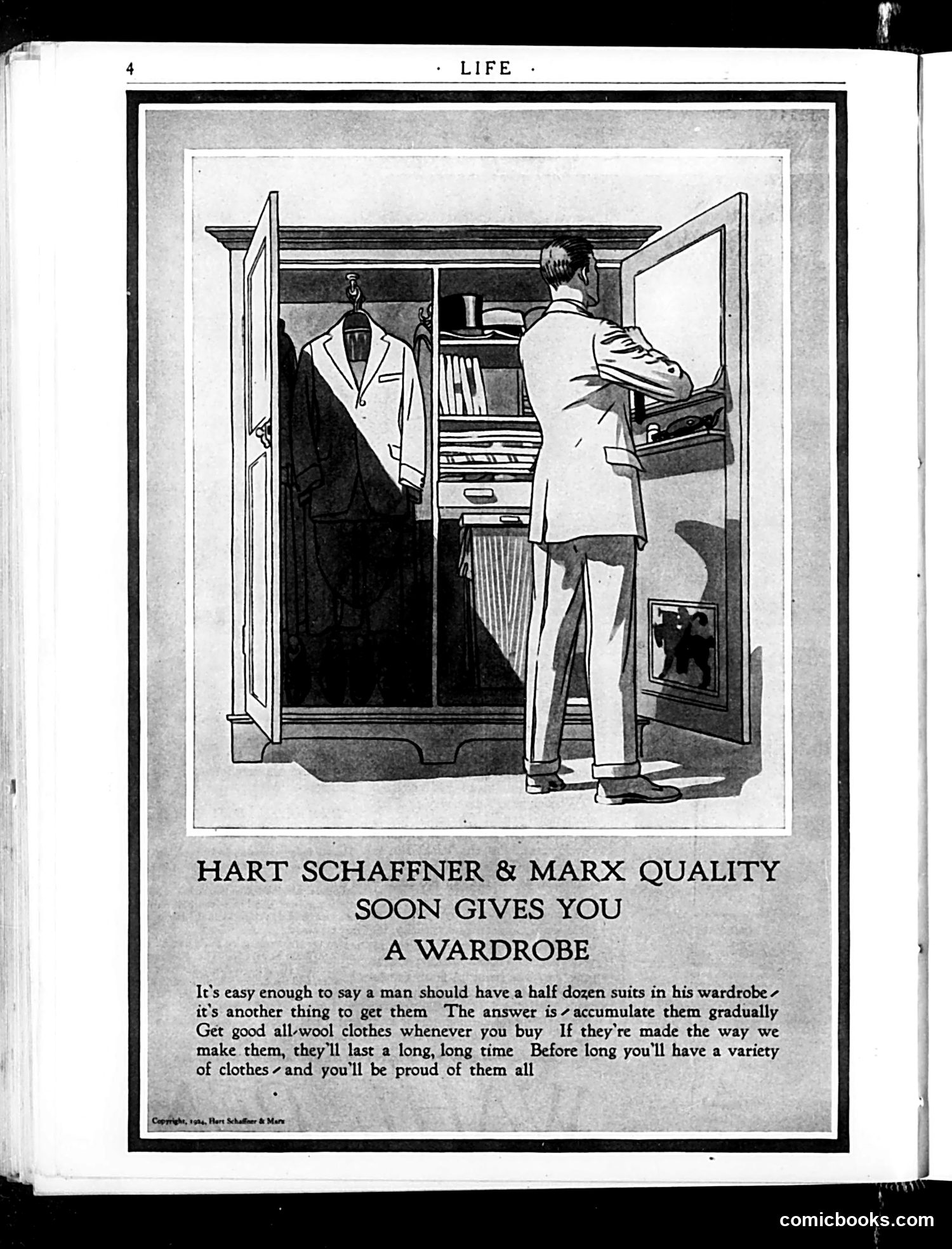
This is a **clothing advertisement**, not political satire. Hart Schaffner & Marx, a men's clothing manufacturer, advertises their quality suits to encourage gradual wardrobe building. The illustration shows a man at his closet selecting from multiple jackets and suits. The ad's message targets middle-class men concerned about appearing well-dressed: rather than buying one expensive suit, accumulate several quality garments over time. The copy emphasizes that all-wool Hart Schaffner & Marx clothes "last a long, long time," making gradual investment practical. This reflects early 20th-century consumer culture, when branded quality goods promised durability and status. The ad assumes its male reader aspires to maintain a varied, respectable wardrobe—a marker of professional success and social standing in that era.
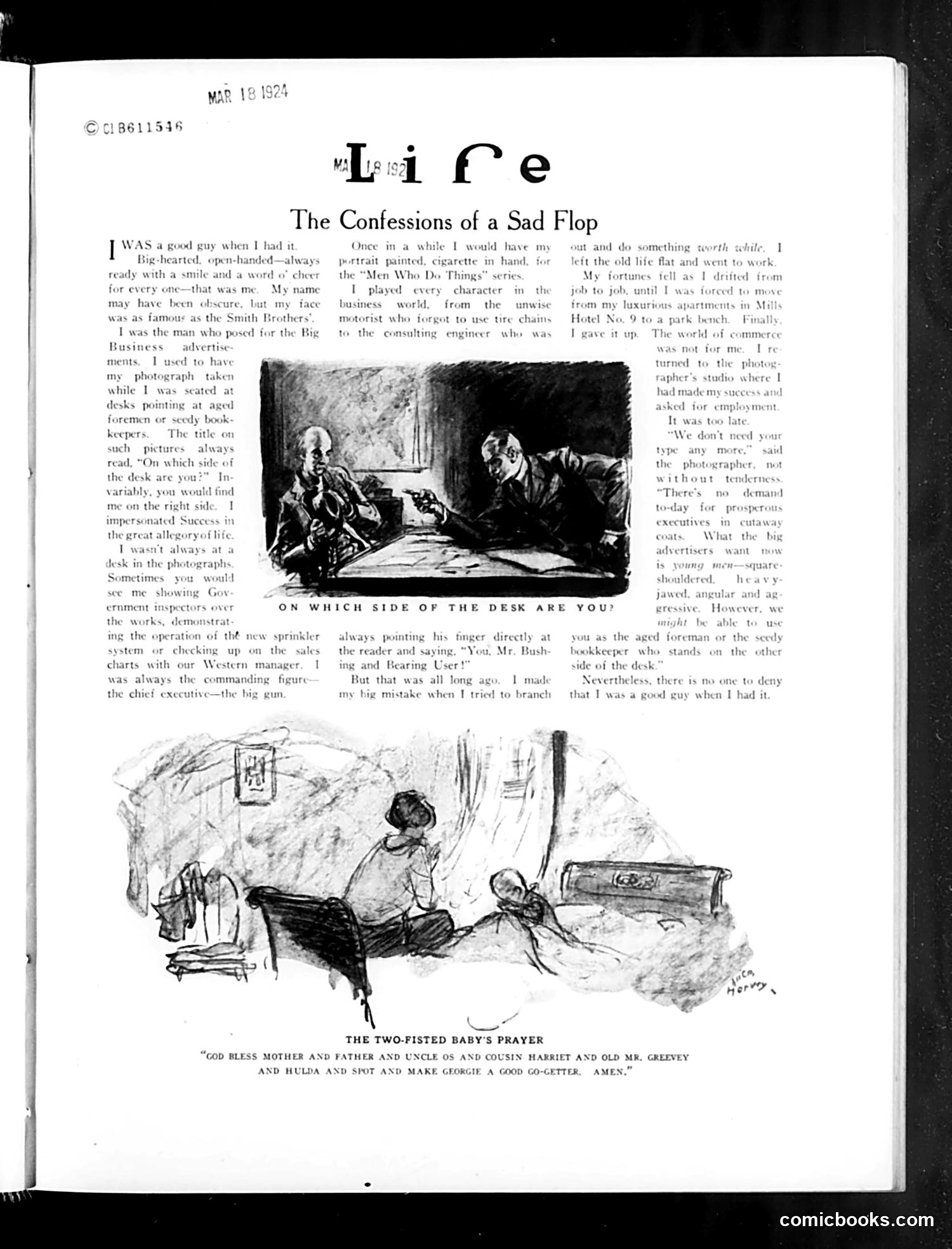
This is a humorous autobiographical essay, not a political cartoon. The author describes his failed career as a commercial illustrator and advertising man, claiming he was "a good guy" with talent but poor judgment. The two illustrations support the narrative: the top image shows two men at a desk in what appears to be a business setting (captioned "On Which Side of the Desk Are You?"), depicting the author's failed attempt to branch into management. The lower sketch, "The Two-Fisted Baby's Prayer," humorously depicts a child's bedtime prayer, apparently illustrating the author's domestic life. The piece is satirical commentary on American business culture and individual failure during the 1920s, using self-deprecating humor to critique both himself and corporate ambition.
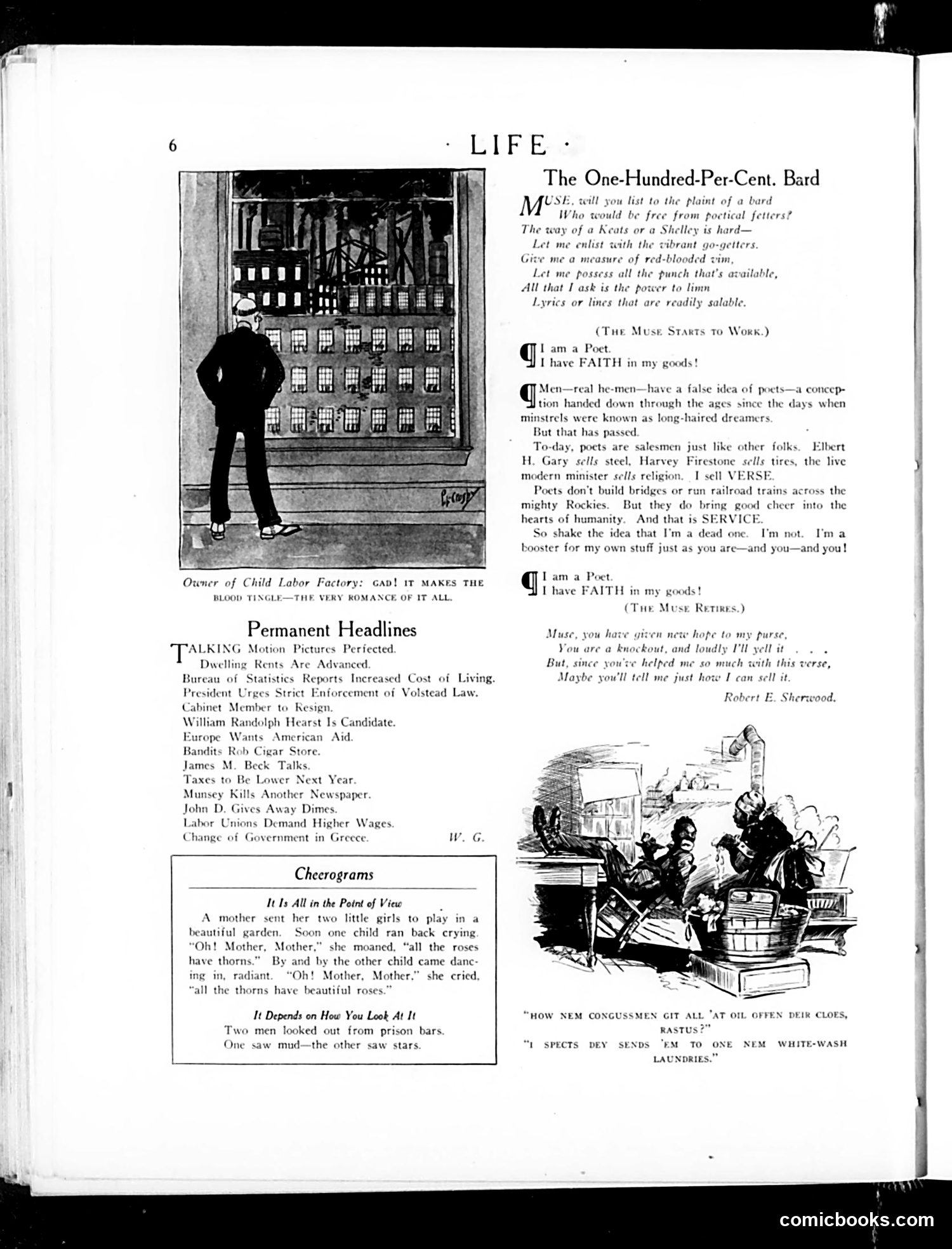
This page features "The One-Hundred-Per-Cent. Bard," a satirical poem about modern poets. The main cartoon shows a man in formal attire standing before a factory building, captioned "Owner of Child Labor Factory: Gad! It makes the blood tingle—the very romance of it all." The satire mocks the contradiction between romantic poetry ideals and industrial capitalism's harsh realities. The poet-speaker claims faith in their craft while defending verse's social value, yet the accompanying image exposes the brutal irony: actual "romance" exists in exploitative child labor factories. The piece critiques how poets sanitize or ignore industrial society's moral corruption, using their art to justify or ignore social injustice rather than challenge it.
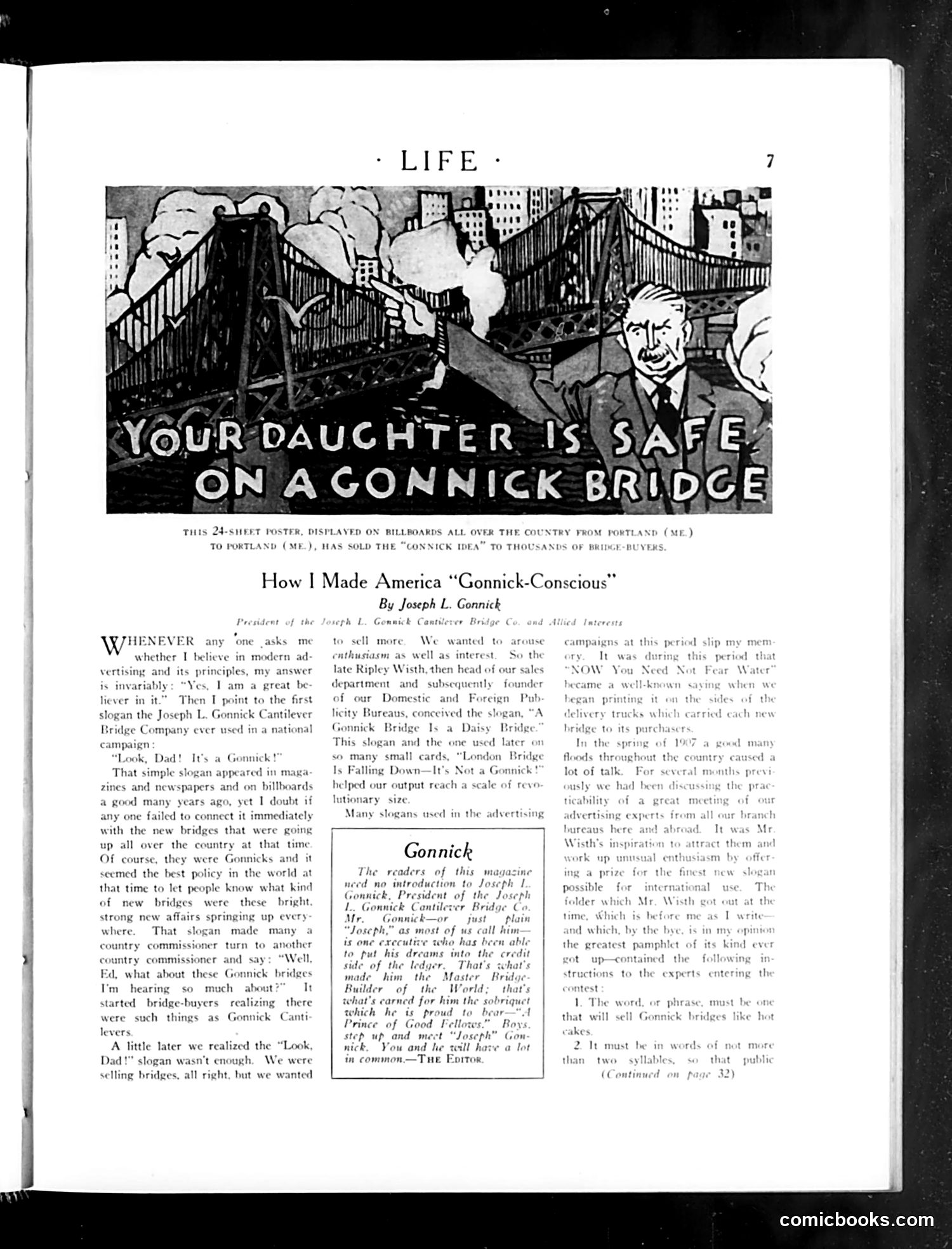
This page from *Life* magazine features an advertisement for Gonnick Cantilever Bridges, using the headline "Your Daughter Is Safe on a Gonnick Bridge." The accompanying article by Joseph L. Gonnick explains how he made America "Gonnick-Conscious" through an aggressive advertising campaign. The satire targets the company's marketing strategy: Gonnick used emotional appeals (emphasizing child safety) and ubiquitous billboards to build brand awareness. The cartoon depicts a man confidently reassuring viewers about bridge safety while industrial bridges span in the background. The humor lies in mocking both corporate advertising manipulation—particularly how companies exploit parental concerns—and the repetitive saturation of public spaces with branded messaging. It's a critique of early 20th-century consumer culture and aggressive marketing tactics.
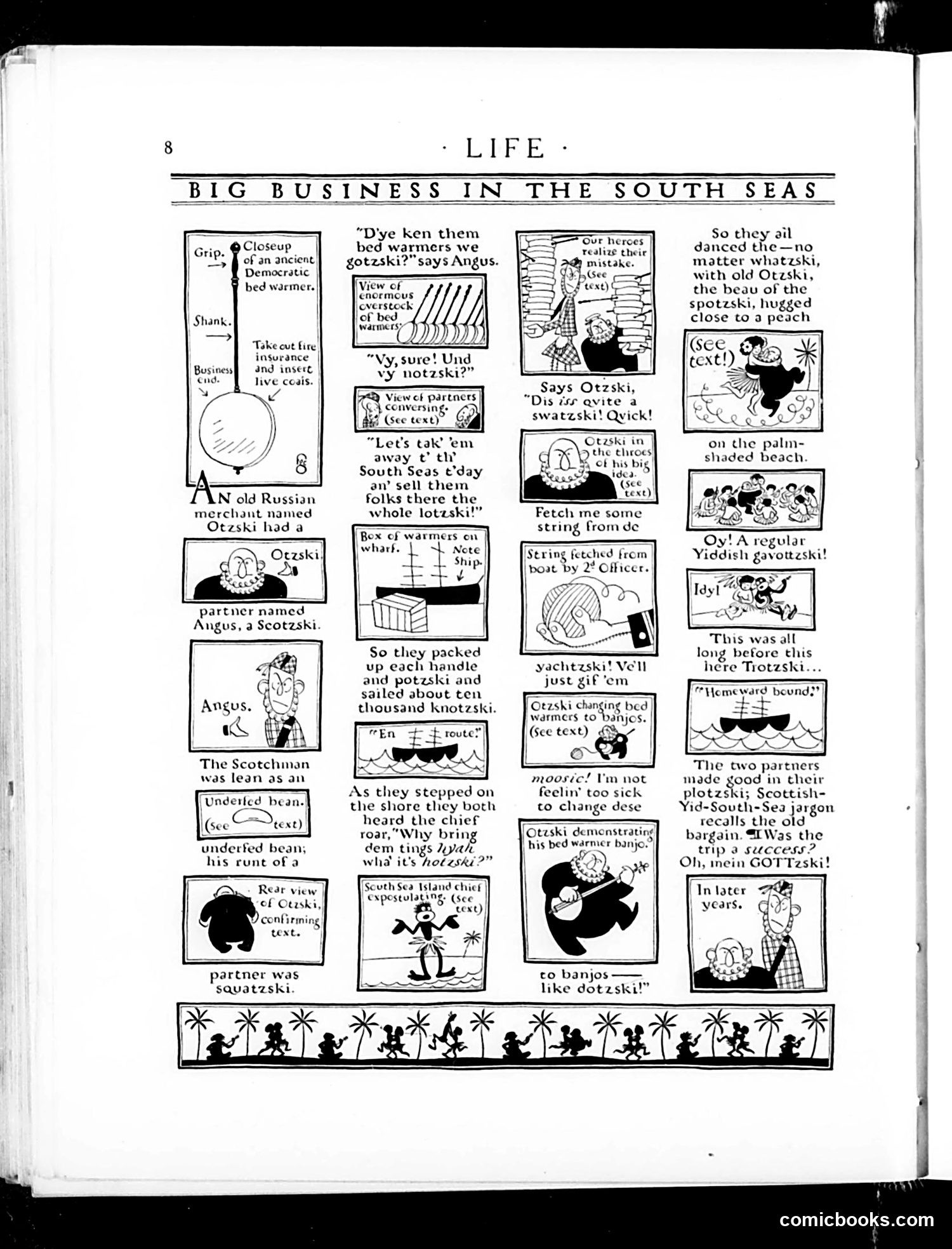
This is a humorous comic strip about two merchants—an old Russian named Otzski and his Scottish partner Angus—who develop a lucrative business selling bed warmers to South Sea Islanders. The satire mocks both colonial commerce and ethnic stereotypes. It plays on the absurdity of salesmen convincing tropical island populations they need warming devices for a climate where they're unnecessary. The Yiddish and Scottish dialect humor was typical of early 20th-century American comic entertainment, reflecting the immigrant populations of that era. The punchline involves the traders eventually returning home, having made a successful profit from this ridiculous scheme—satirizing how business ventures exploit perceived "primitive" markets and uninformed consumers abroad.
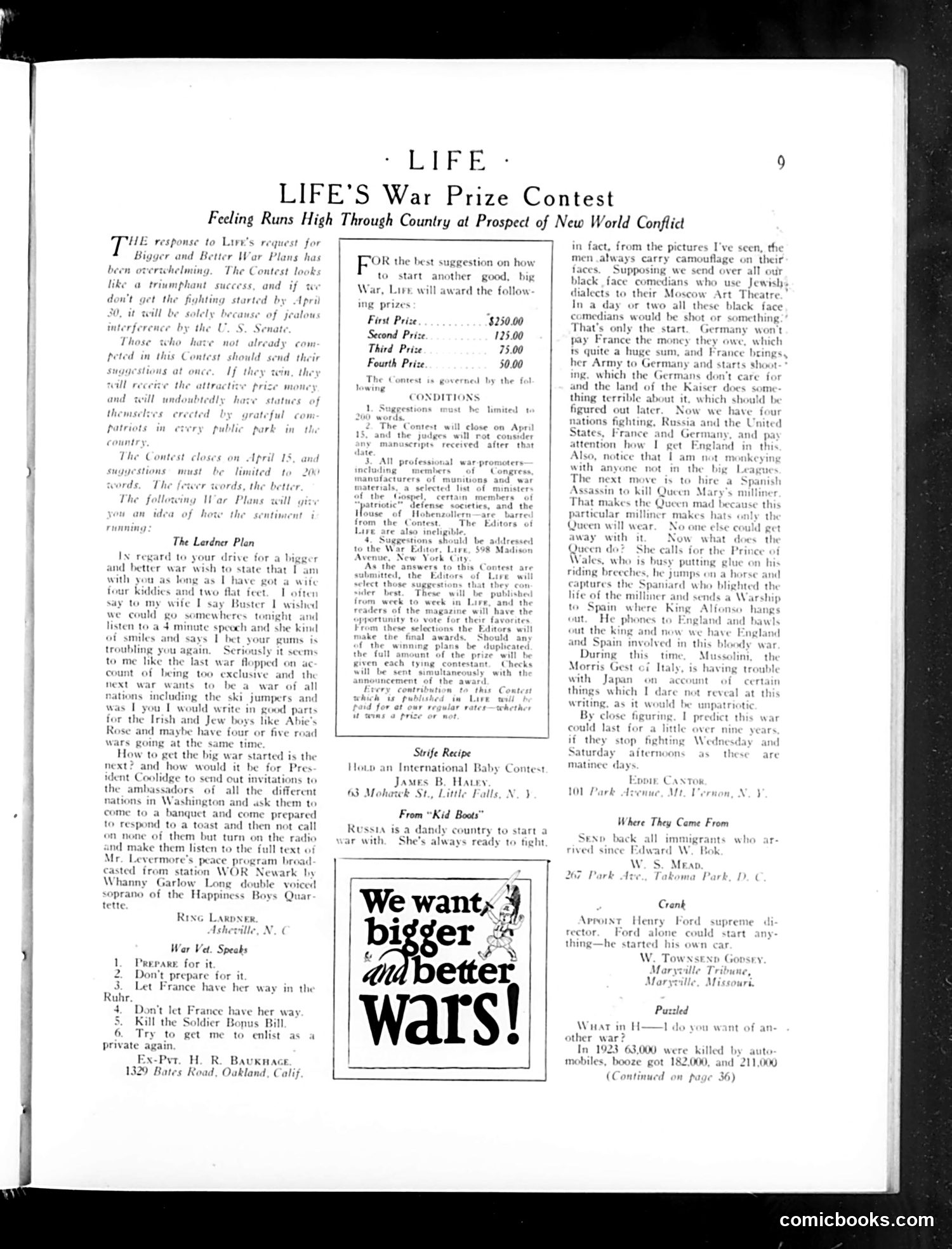
This page announces Life magazine's "War Prize Contest," soliciting reader suggestions for how to start "another good, big War." The $250 first prize reflects the magazine's satirical stance toward contemporary militarism and international conflict. The prominent cartoon advertisement reading "We want bigger and better wars!" appears to mock jingoistic rhetoric and warmongering sentiment of the era. The illustration shows a caricatured figure (unclear which specific person or type) enthusiastically advocating for expanded warfare. The contest conditions and accompanying letters suggest Life is satirizing American attitudes toward foreign policy, military expansion, and industrial war preparation—likely referencing post-WWI tensions and emerging global conflicts. The tone is darkly comedic, using exaggeration to critique pro-war sentiment.
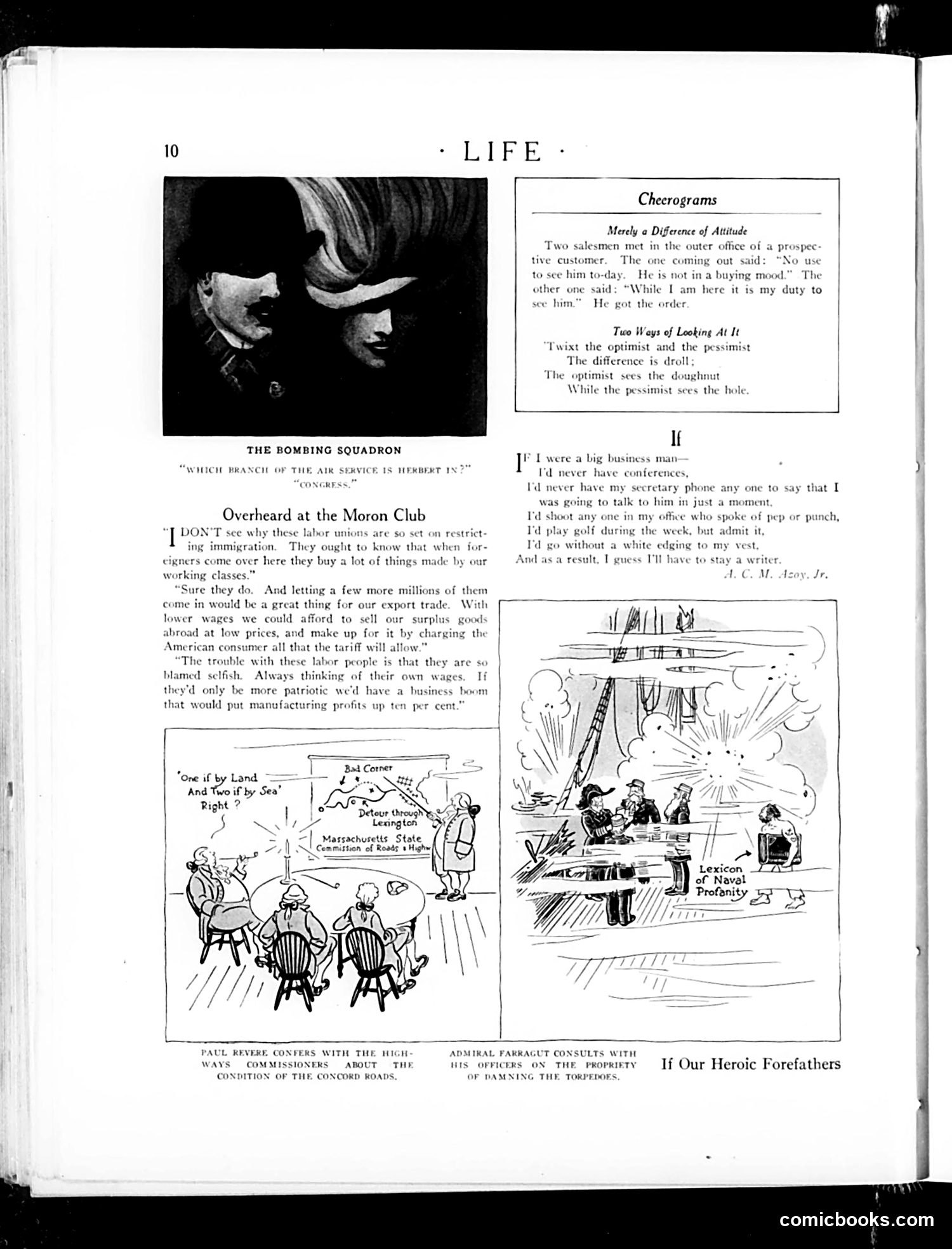
This page contains satirical commentary on labor unions and trade policy. **"Overheard at the Moron Club"** mocks union leaders for opposing immigration, arguing they selfishly restrict labor supply to protect wages rather than considering broader economic benefits. The satire suggests such protectionism harms American export trade and consumer prices. **The left cartoon** shows Paul Revere warning about poor road conditions on the Concord Roads—a historical reference joke positioning infrastructure concerns as urgent. **The right cartoon** depicts Admiral Farragut consulting with naval officers about torpedo defense, invoking historical military imagery (likely WWI-era, given the bombing squadron photo at top). The page satirizes both labor attitudes and military/government decision-making through historical parallels, typical of Life magazine's approach to contemporary social criticism.
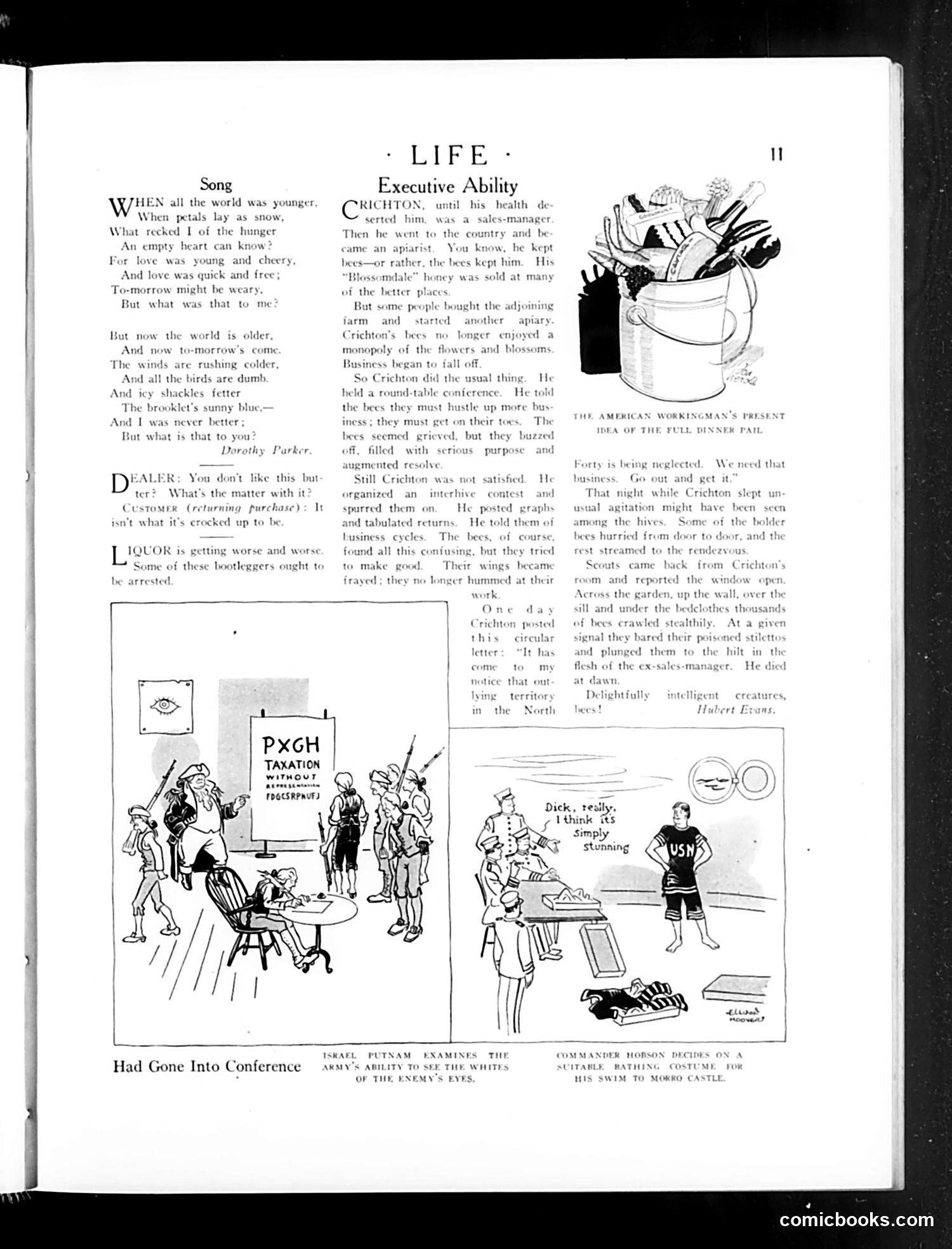
This page contains satirical commentary and cartoons from Life magazine's "Life" section. The main content includes: **"Executive Ability"** - A story about Crichton, a beekeeper-turned-salesman whose business fails. He attempts to reorganize his bee operation through management conferences and competitive tactics, but the bees ultimately rebel, abandoning their work. The satire mocks corporate management fads and the disconnect between business theory and practical reality. **The cartoons** illustrate absurd management scenarios: one shows what appears to be a taxation conference, another depicts a military examination of enemy positions, and a third shows someone evaluating a swimming costume. The overall message critiques how businessmen apply elaborate organizational schemes without understanding actual conditions, using the bees' revolt as metaphor for worker resistance to misguided corporate restructuring.
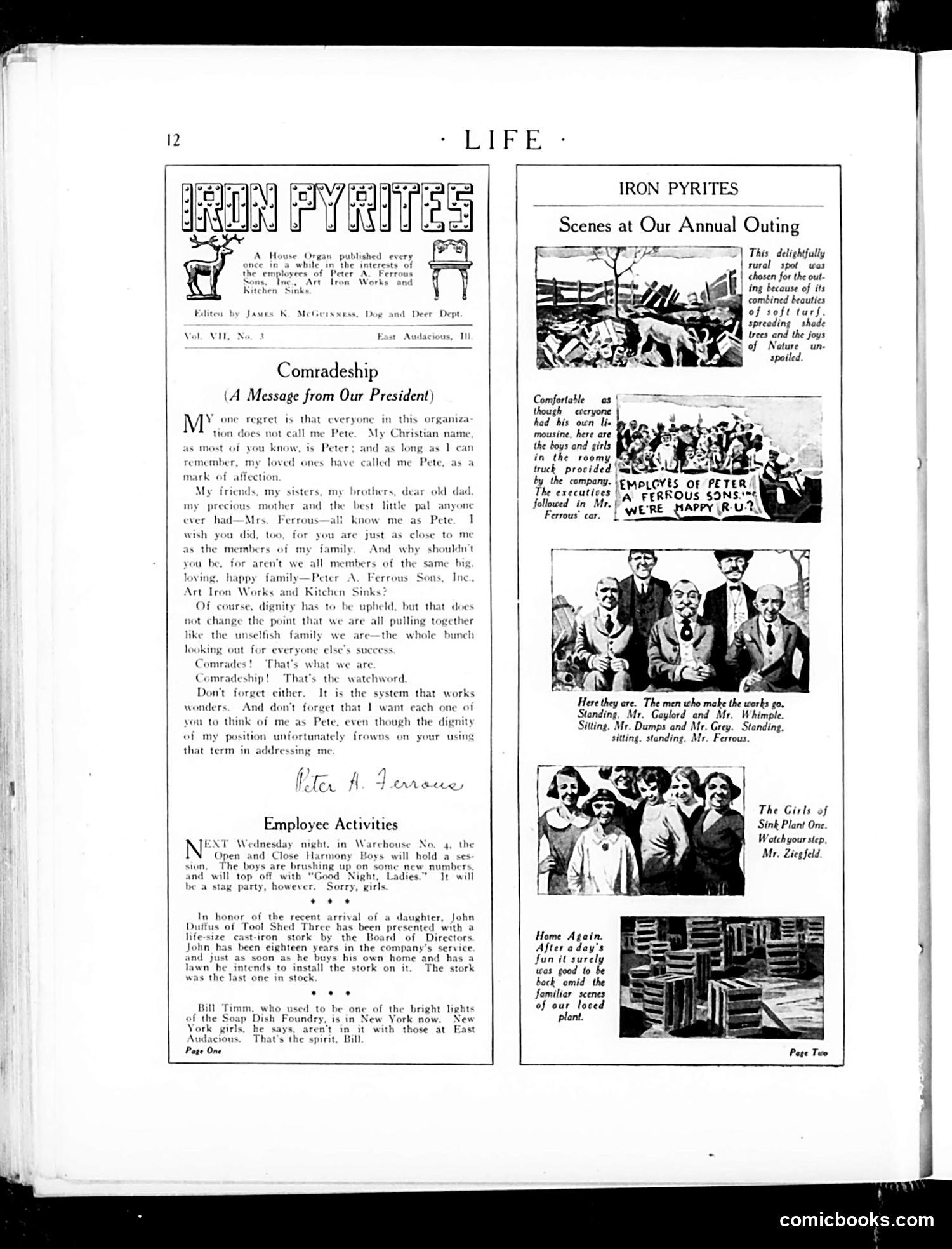
This page features company communications and photos from Peter A. Ferrous, Inc. (an Art Iron Works and Kitchen Sinks manufacturer based in East Andaucus, Illinois). The left side contains a "Message from Our President" emphasizing workplace "comradeship" — using informal, familial language to address employees as "Pete" and framing the company as one big family pulling together for mutual success. The right side shows photos from the company's annual outing: employees relaxing outdoors, group portraits of male workers, and female employees at the "Sink Plant One." The photos present a seemingly happy workforce, captioned with names and positive sentiment ("We're Happy R.U.!"). This appears to be internal company propaganda rather than satire — promotional content designed to foster employee loyalty and corporate unity during what was likely the early-to-mid 20th century.
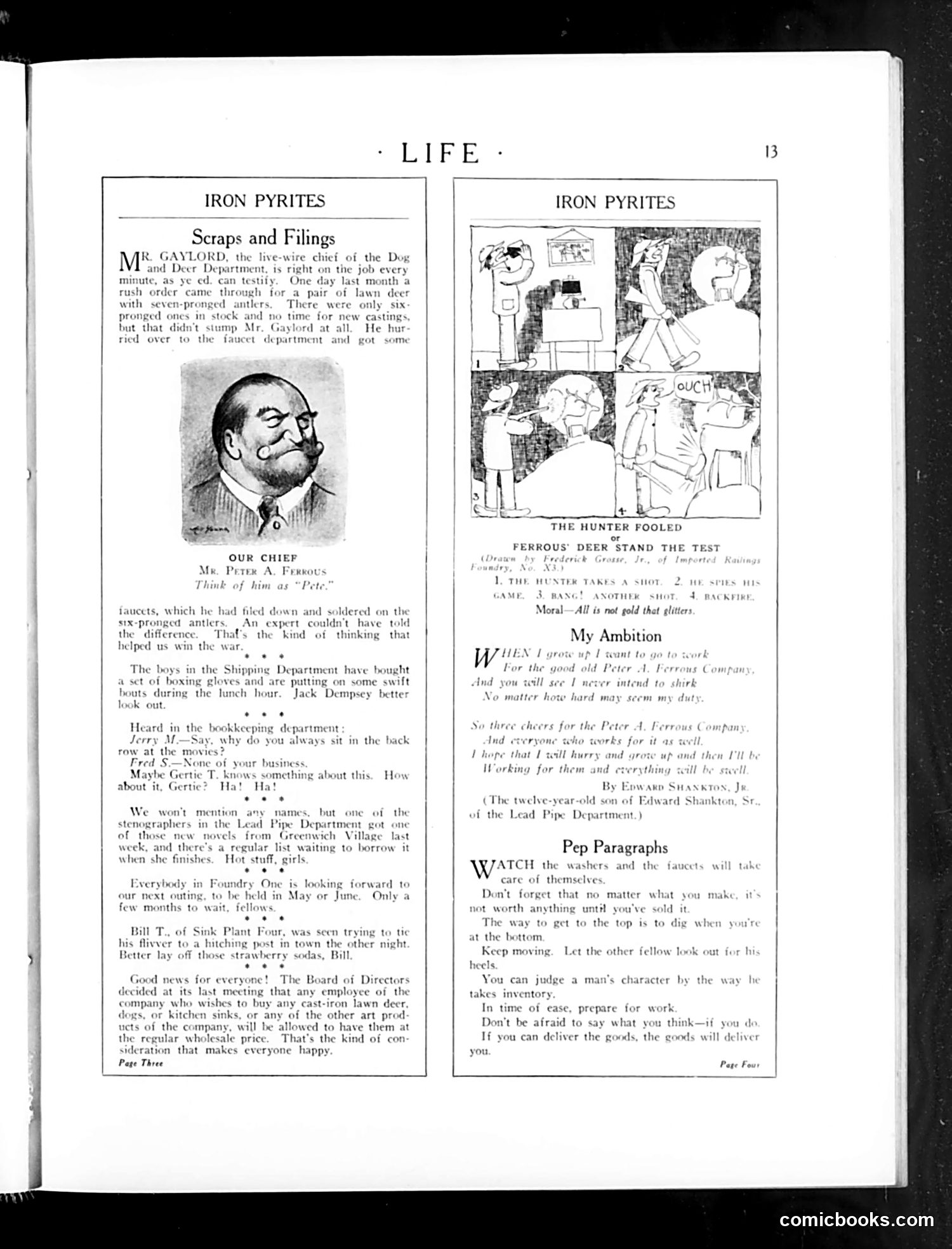
This page contains humorous office anecdotes labeled "Iron Pyrites," a column mixing workplace gossip with satirical observations. The left column features a portrait of "Our Chief," identified as Mr. Peter A. Ferrous (a pun on "ferrous"/iron), head of the Dog and Deer Department. The anecdotes mock various workplace characters and situations: a five-wire chief constantly testing textiles, an employee who stole castings, and office bureaucracy around borrowed faucets and strawberry sodas. The right side includes a comic strip titled "The Hunter Fooled" depicting deer hunters, plus an aspirational poem "My Ambition" by a young employee, and practical "Pep Paragraphs" offering workplace advice. The overall tone satirizes mundane industrial office life and worker aspirations.
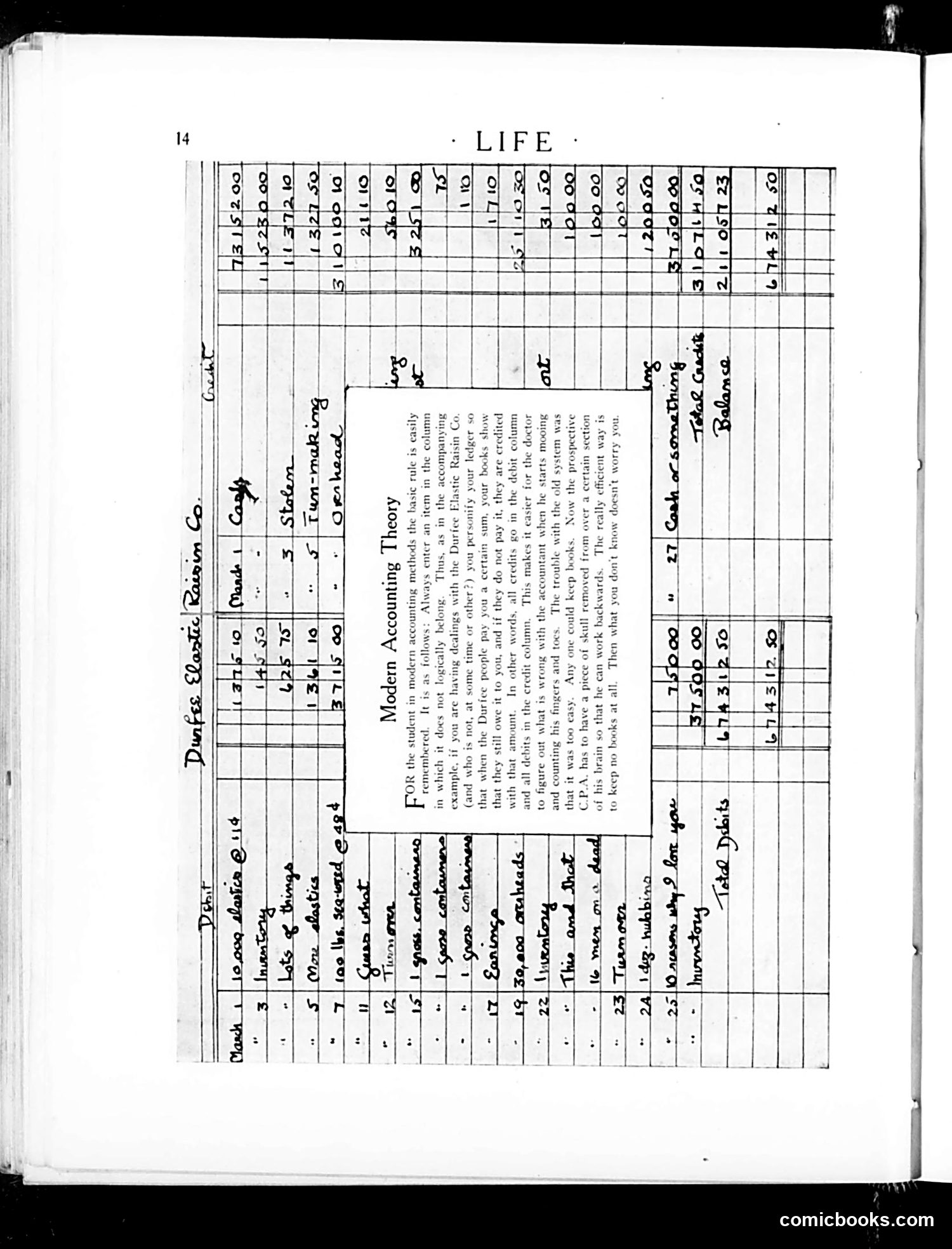
This page from *Life* magazine appears to be primarily a data table or chart titled "Duplex Classical Raison Co." with columns for various measurements or categories. There's a central text block labeled "Modern Accounting Theory" containing dense paragraphs of explanatory text about accounting principles. The page layout suggests this is either educational content about accounting practices or satirical commentary on business/financial systems—*Life*'s specialty. However, without clearer visibility of specific illustrations, caricatures, or identifying figures, I cannot definitively interpret the satirical intent or identify particular targets of the humor. The technical nature of the content and tabular format make the page's specific message unclear from this reproduction.
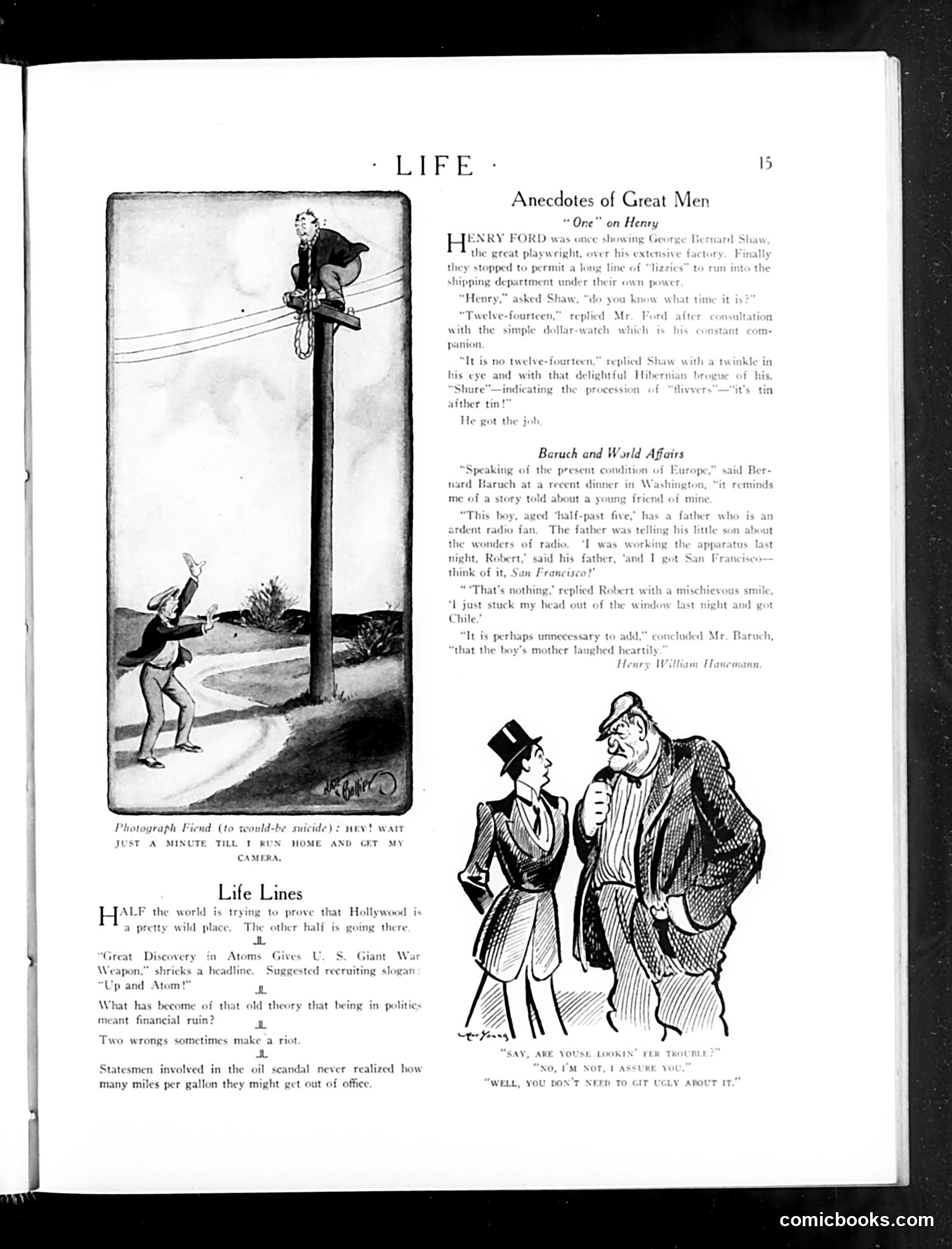
This page contains three separate satirical pieces: **"One on Henry"** mocks Henry Ford's famous Model T ("flivver"). George Bernard Shaw asks Ford how many cars pass by—Ford answers "twelve-fourteen," revealing his indifference to the endless stream of his own mass-produced vehicles. The joke is that Ford's revolutionary assembly line has become so successful it's almost invisible to him. **"Baruch and World Affairs"** presents Bernard Baruch (a prominent financier and advisor) telling an anecdote about a boy who sticks his head out a window in Chile—a random non-sequitur that undercuts Baruch's pretensions to discussing serious geopolitical matters. The satire suggests his commentary is as disconnected and absurd as the boy's action. **"Life Lines"** contains brief commentary on Hollywood's wildness and references an oil scandal involving statesmen (likely Teapot Dome), joking that corrupt politicians didn't calculate their "miles per gallon" profit from office. The bottom cartoon shows a street conversation unrelated to the text above it.
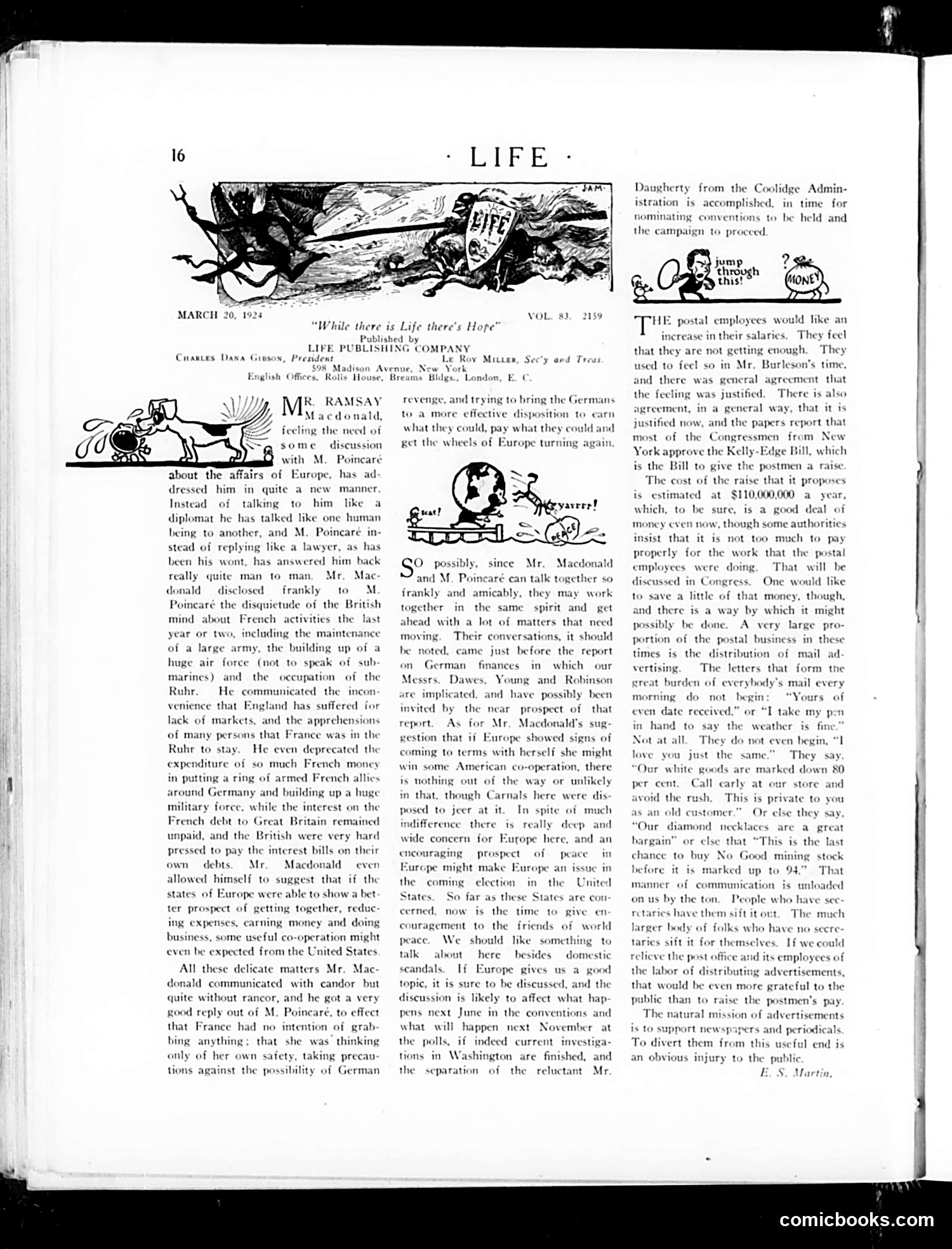
This page discusses diplomatic negotiations between British Prime Minister Ramsay MacDonald and French Premier Raymond Poincaré regarding post-World War I European economic recovery and security concerns. **The Main Issue**: MacDonald and Poincaré are talking frankly—unusually as equals rather than formal diplomats—about France's heavy military spending, occupation of the Ruhr region (German territory seized as reparations security), and Britain's own war debts. The article suggests their constructive dialogue might encourage American economic cooperation in European reconstruction. **The Satire's Point**: The piece implies that if Europe can demonstrate financial stability and reduced tensions, it could become a campaign issue in America's upcoming elections, potentially generating U.S. support for peace efforts. **Secondary Item**: A brief note mentions postal workers seeking salary increases and references the removal of Attorney General Harry Daugherty from the Coolidge administration—contemporary political scandals overshadowing European affairs. The overall tone suggests cautious optimism that rational diplomatic discussion might resolve Europe's postwar economic crisis.
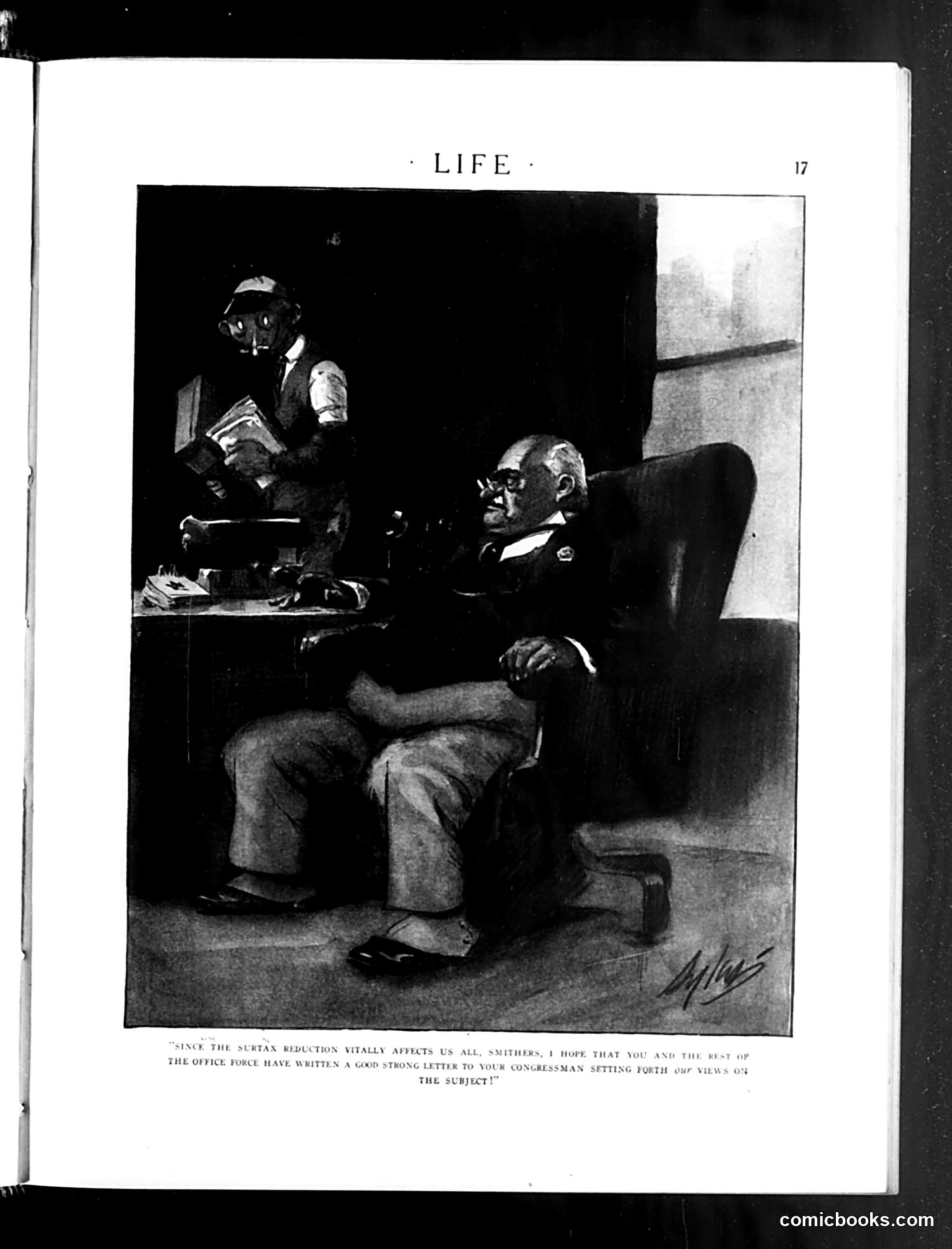
This Life magazine cartoon satirizes office workers' political advocacy regarding tax policy. The image shows a businessman seated while an office worker (standing, wearing a mask-like face) presents him with a letter. The caption indicates the office staff has collectively written to their congressman about a "surtax reduction" that "vitally affects us all." The satire mocks the workers' presumption in petitioning their employer's congressman on a tax matter, and likely ridicules the self-interested nature of their appeal—framing a tax cut as something that benefits them personally rather than the nation broadly. The masked appearance of the standing figure may suggest the depersonalized, uniform quality of office work. The cartoon criticizes either the workers' audacity or their transparent self-interest in tax policy advocacy.
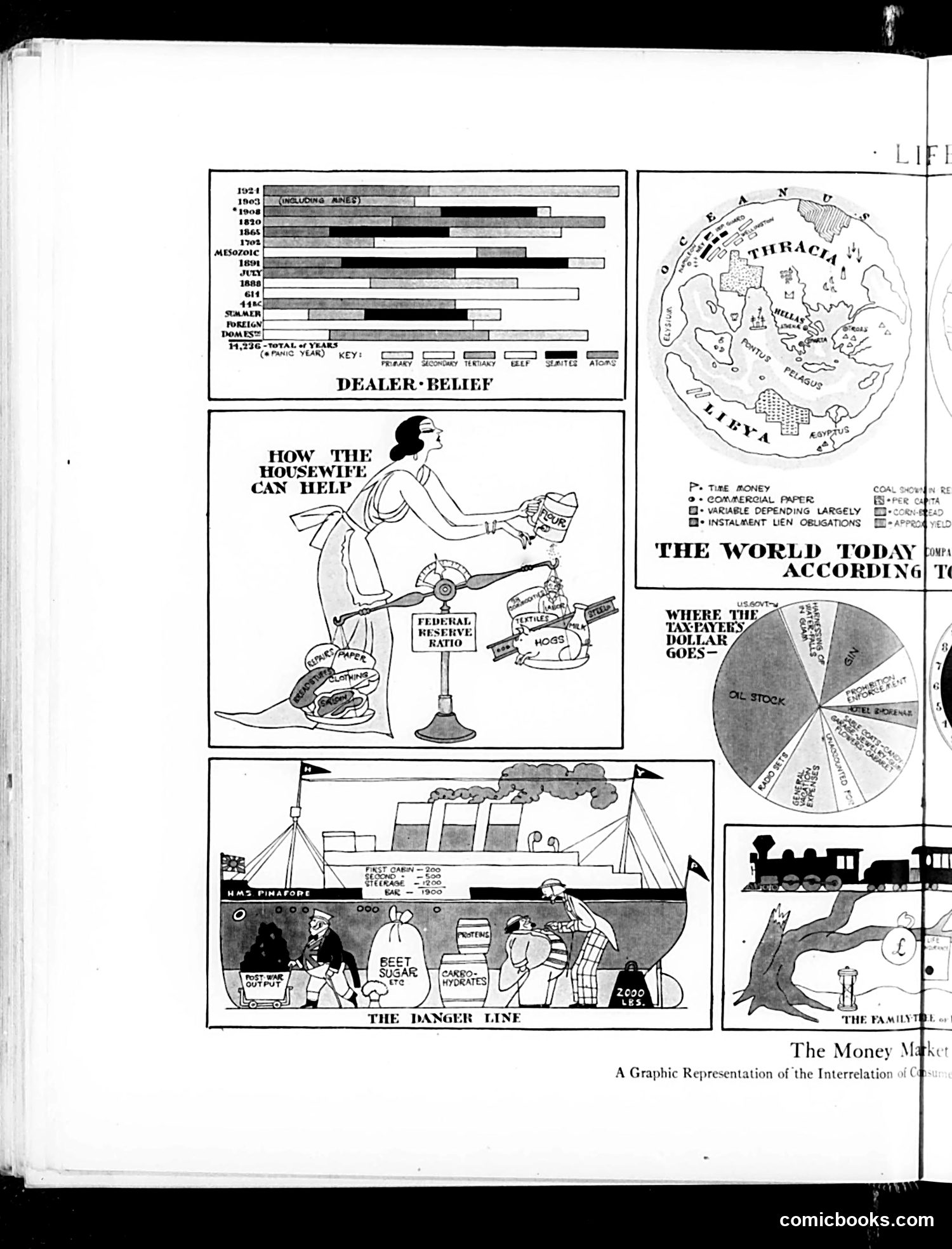
This Life magazine page uses infographics to satirize post-WWI economic complexity and financial interconnection. **"Dealer Belief"** (top chart) tracks fluctuating commodity prices over years, suggesting speculative instability in markets. **"How the Housewife Can Help"** depicts a woman literally balancing the "Federal Reserve Ratio" like a scale, juggling various financial instruments (money, commercial paper, installment obligations). The satire mocks how ordinary households were now entangled in abstract financial mechanisms beyond their understanding or control. **"The Danger Line"** (bottom) shows a ship loaded with cargo labeled "beet sugar," "carbo-hydrates," and "output," illustrating how consumer goods, production, and credit formed a precarious system—one miscalculation could sink the economy. Together, these cartoons express anxiety about how modern finance had become dangerously complex and interdependent, affecting everyday Americans who couldn't comprehend the system controlling their livelihoods.
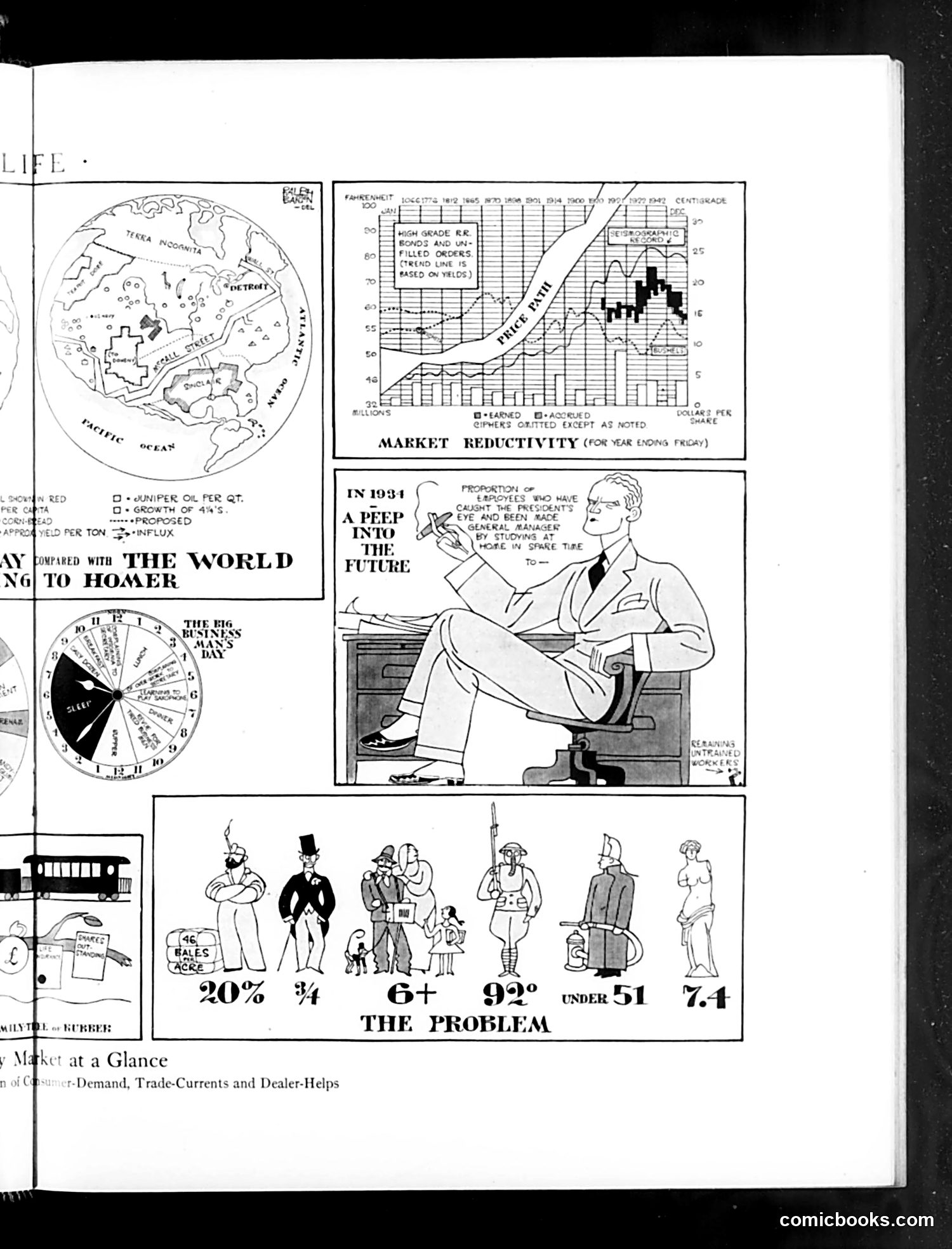
This page presents economic and social commentary from the early 1930s (likely around 1931, given the "1931" notation visible). **Top section:** Charts showing "Market Reductivity" track declining productivity and prices during the Great Depression, with various commodity measurements. **Center cartoon:** "A Peep Into the Future" depicts a businessman contemplating technological advancement—likely referencing optimism about science solving economic problems, a common Depression-era theme. **Bottom section:** "The Problem" uses statistics and illustrated figures to quantify social issues: 20% unemployment, $1 (likely millions in debt or losses), 6+ children per family, 92° temperature, populations under 51 years old, and 7.1 (unclear metric). The figures represent different demographics affected by Depression hardships. The overall message critiques economic conditions while ironically juxtaposing hopeful futurism against present suffering—characteristic of Life magazine's satirical approach to 1930s crises.
This page discusses David Belasco's announced retirement from theatrical producing on June 1, 1924, in response to demands from the Actors' Equity Association—a significant labor dispute in American theater history. The satirical commentary is skeptical of Belasco's threat. The author notes Belasco previously threatened retirement five years earlier if actors won a strike, and mentions Cohan promised to "run that elevator"—both empty threats. The piece mocks Belasco's recent productions as largely mediocre, contrasting them unfavorably with superior plays from other theatrical sources. It suggests only "mystical" organizations and unsophisticated New York audiences genuinely regretted Belasco's potential departure. The article's real point: Belasco's retirement threat is grandstanding theater politics. His productions don't justify the fuss, and his departure wouldn't represent the catastrophic loss he implied.
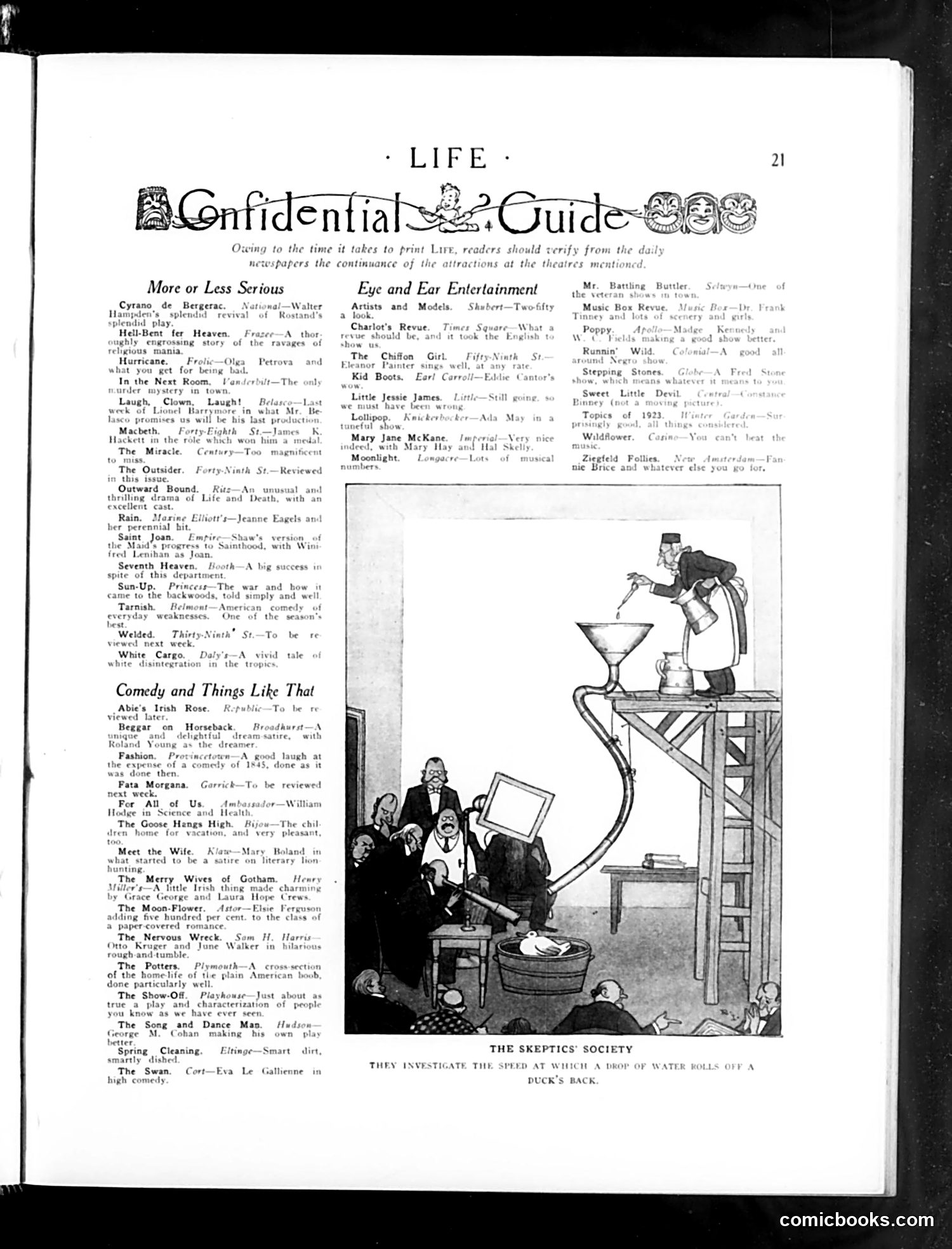
This cartoon satirizes the pseudoscientific investigations of paranormal enthusiasts and spiritualism believers—popular fascinations in the early 1920s. The image shows a group of formally-dressed figures (likely representing self-styled "skeptics" or paranormal investigators) conducting an absurd experiment: measuring the speed at which a drop of water falls off a duck's back. The setup—with its elaborate apparatus and serious demeanor—mocks the pretentious methodology these groups employed to investigate supernatural claims. The humor lies in the disconnect between their rigorous, scientific-appearing setup and their ridiculous subject matter. The phrase "duck's back" likely references the common expression "water off a duck's back" (meaning something harmless or easily dismissed), amplifying the joke: these investigators take trivial matters with unwarranted gravity. This reflects broader 1920s cultural skepticism toward spiritualism and the various "societies" investigating psychic phenomena that flourished after World War I.
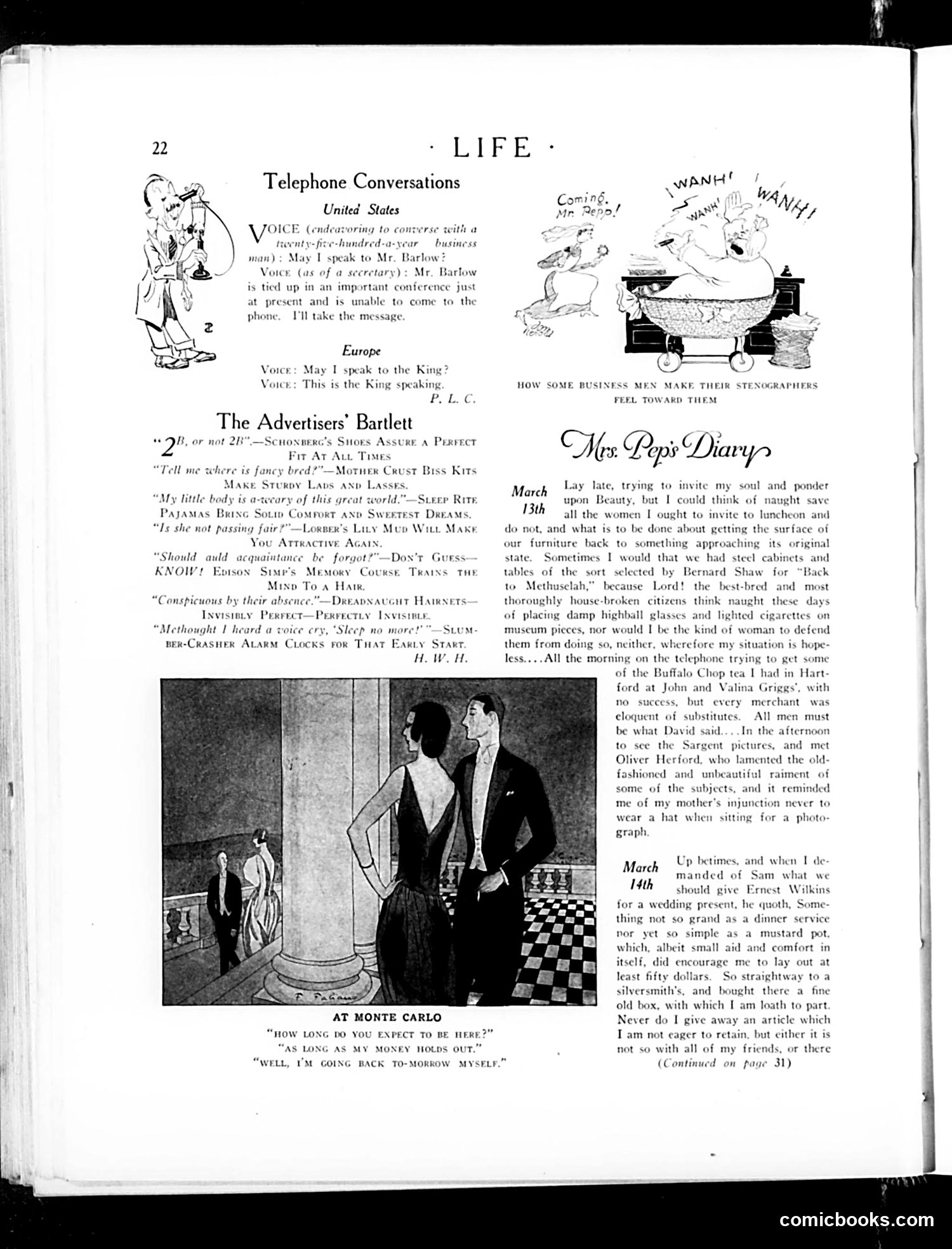
This 1920s Life magazine page contains three satirical sections: **"Telephone Conversations"** mocks the era's status consciousness. The U.S. joke shows a businessman's secretary deflecting calls—implying the executive is too important to answer. The Europe counterpart presents a absurdist contrast: calling a European king, who answers directly, suggesting American pretension versus Old World directness. **"The Advertisers' Bartlett"** is a parody advertisement section where famous Shakespeare quotes are humorously rewritten as product endorsements (pajamas, alarm clocks, etc.)—satirizing how advertisers then co-opted culture to sell mundane goods. **The cartoon "At Monte Carlo"** depicts wealthy tourists at the famous gambling destination discussing money. The exchange mocks the casual attitude of the rich toward spending: one visitor plans to stay "as long as my money holds out," with another casually committing to return tomorrow—suggesting frivolous, unlimited wealth among the leisure class. Throughout, the satire targets early 20th-century American social pretension, commercialism, and wealth disparity.
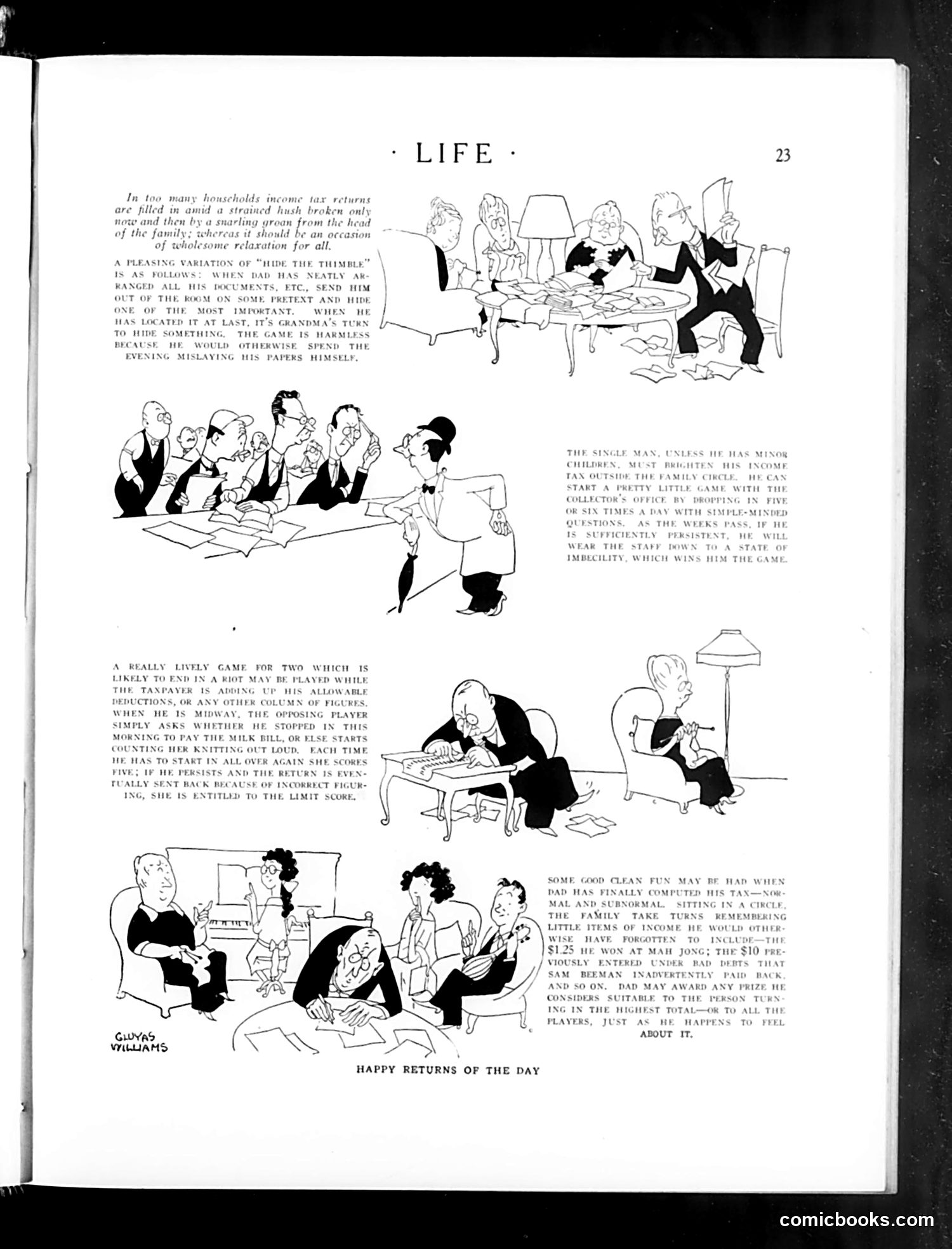
This page satirizes family tax-preparation season, depicting games to distract a father ("Dad") while he struggles with income tax calculations—a source of household frustration. The cartoons show: 1. **"Hide the Thimble" variant**: Family members hide Dad's documents to prevent him from losing papers while doing taxes 2. **Disruption game**: A spouse intentionally interrupts Dad's math with random questions (did you pay the milk bill?) to force recalculations 3. **Family guessing game**: When Dad finally completes his tax return, family members guess forgotten income items he excluded The satire targets both the tedium of tax filing and family dynamics—suggesting taxes are so painful that creating deliberate chaos becomes entertainment. The title "Happy Returns" puns on both tax returns and the holiday phrase, implying this annual domestic chaos is inevitable.
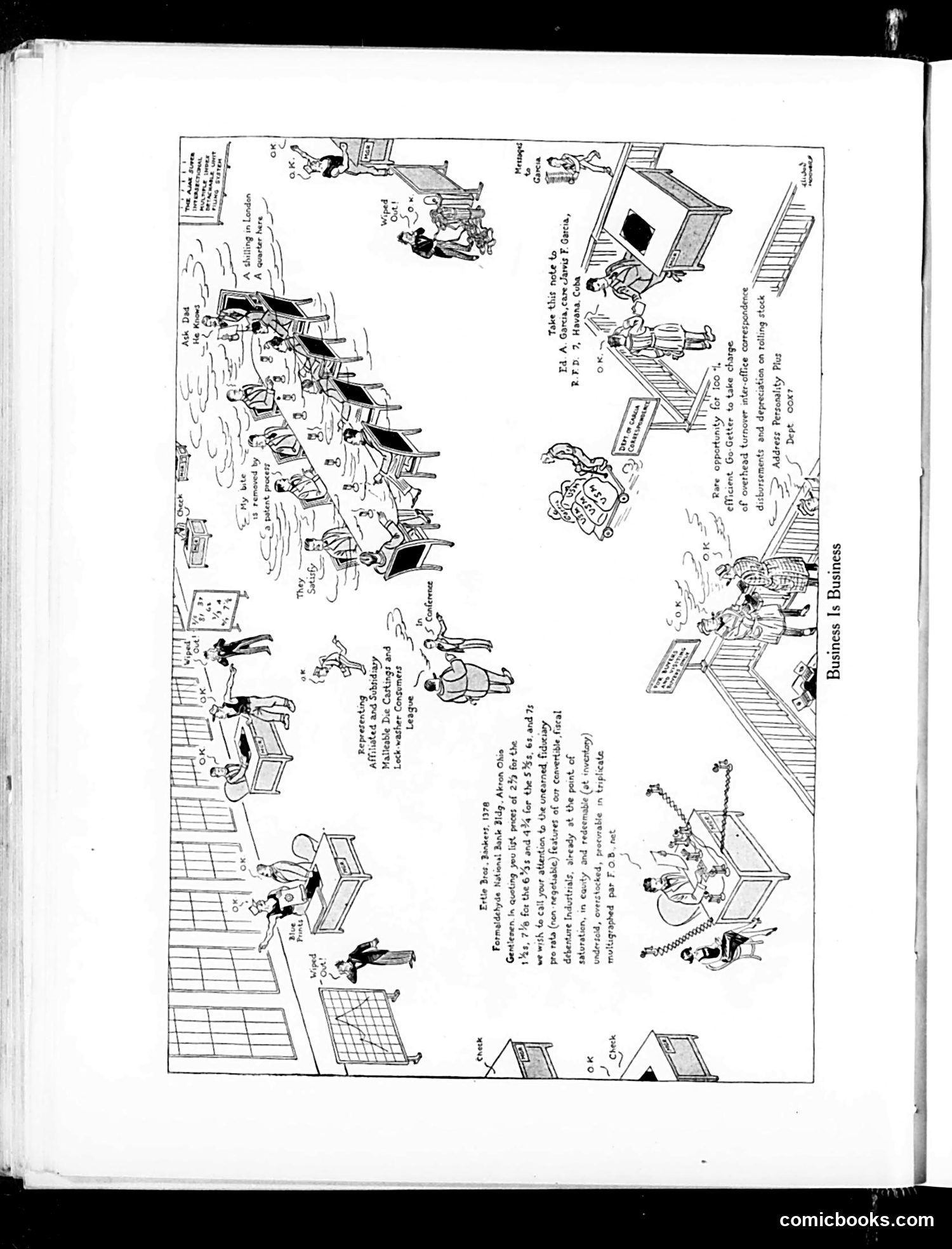
I cannot reliably read the OCR text on this page—it appears heavily corrupted or inverted. While I can see this is a cartoon/illustration page with multiple panels showing figures in various scenes (appearing to depict business or social situations based on the architectural settings and character interactions), I cannot confidently identify the specific figures, political references, or satirical intent without legible text. The page header reads "Business is Business," suggesting the satire concerns commercial or mercantile behavior, but without clear captions or readable OCR text, I cannot accurately explain what specific people, events, or social commentary are depicted. To provide accurate historical context, I would need either a clearer image or reliable text transcription.
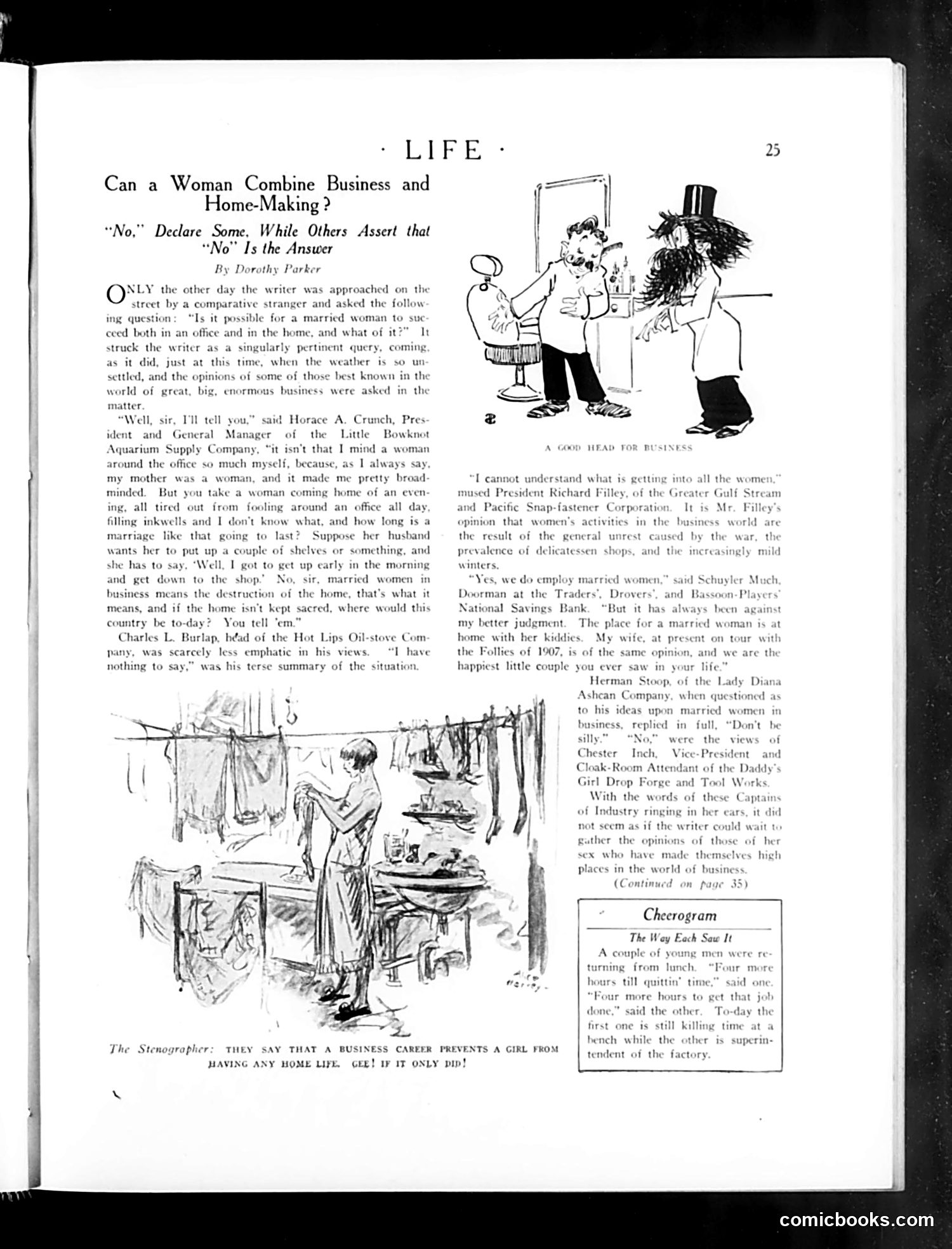
This 1920s satirical article by Dorothy Parker solicits opinions from male business leaders on whether married women can successfully work and maintain homes. The piece mocks their responses through their own contradictions. **The figures** are unnamed executives from various companies (Little Bowknot Aquarium Supply, Hot Lips Oil-stove Company, traders' banks, etc.)—representing typical business establishment views. **The satire:** Each man claims to support working women while immediately undermining the idea. One says his mother was a woman (so he's progressive), then describes the exhaustion and domestic chaos a working wife creates. Another says he has "nothing to say" while delivering lengthy objections. **The lower cartoon** shows a stenographer sarcastically responding: "They say a business career prevents home life. GEE! If it only did!"—implying women face impossible expectations: work without sacrificing domestic duties. **The point:** Parker exposes male hypocrisy and the cultural assumption that women's primary duty is homemaking, making their employment secondary and burdensome.
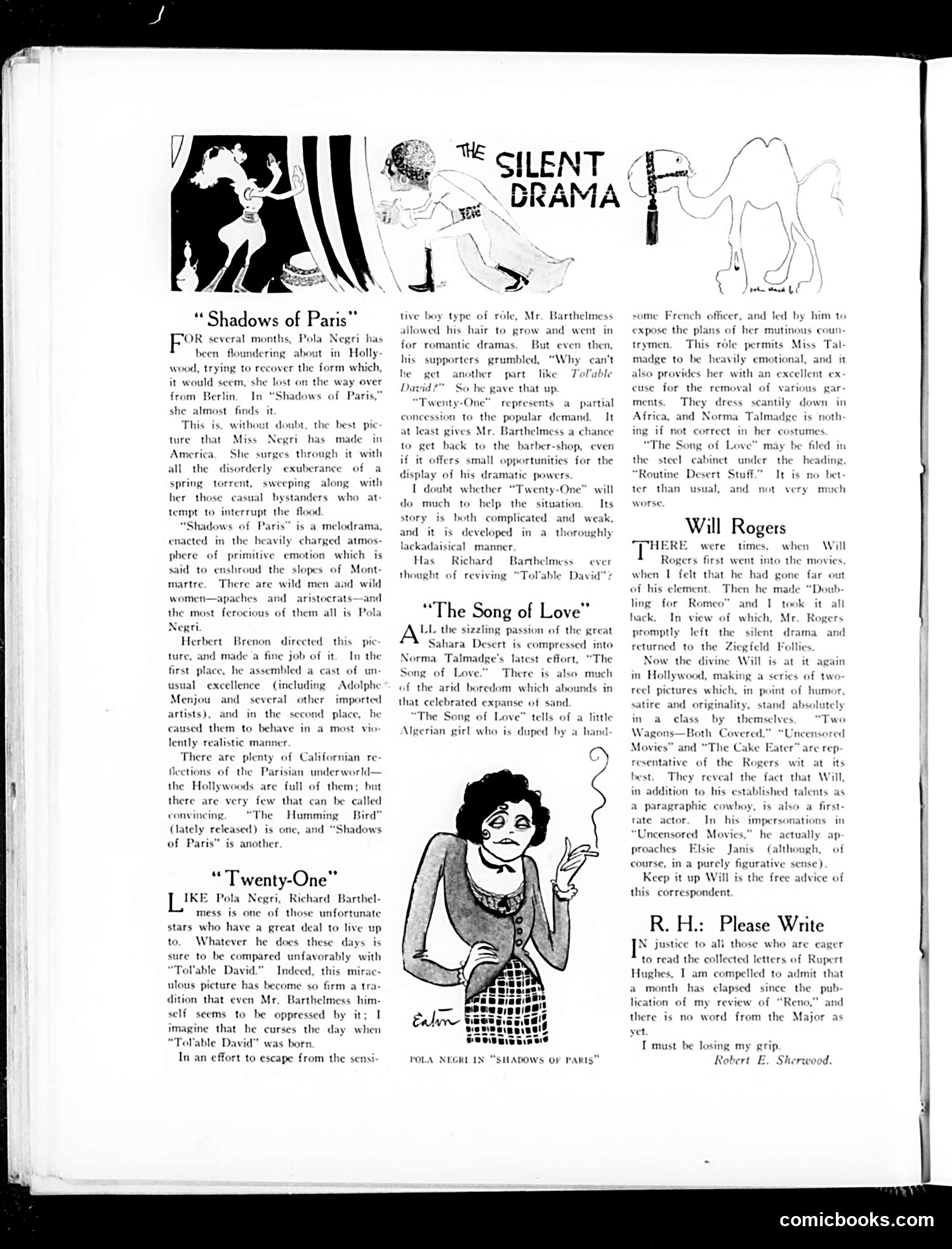
This page reviews several silent films, demonstrating how early 1920s cinema criticism worked. The text discusses performances by major silent film stars: **Pola Negri** in "Shadows of Paris" is praised as her best American work—a melodrama set in Parisian underworld depicting apaches (street criminals) and aristocrats. **Richard Barthelmess** is discussed as typecast since his success in "Tol'able David" (a sensitive boy role). His new film "Twenty-One" represents his attempt to escape this image by playing romantic leads instead, though critics doubt it helps. **Norma Talmadge** in "The Song of Love" plays an Algerian girl seduced by a French officer—the review notes she's appropriately emotional and correctly costumed for desert scenes. **Will Rogers** is credited with successfully transitioning from stage (Ziegfeld Follies) to film through comedic two-reel pictures showing humor and originality. The column satirizes how studios and audiences trapped stars in repetitive roles, while praising those who successfully diversified their performances.
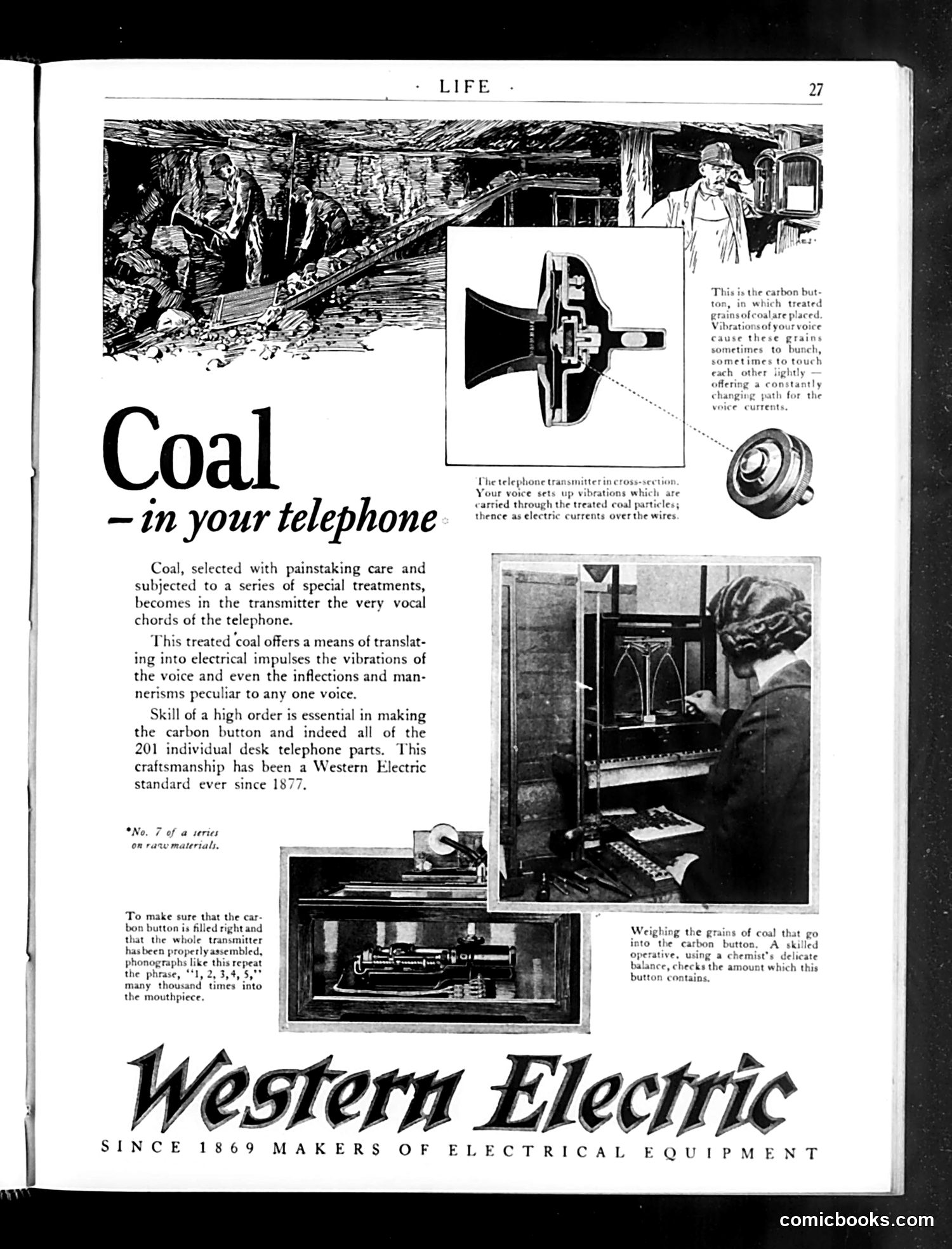
This is primarily **advertising copy**, not satire or political commentary. Western Electric promotes how coal serves as a critical component in telephone transmitters—specifically carbon granules in the transmitter button that convert voice vibrations into electrical signals. The page explains the manufacturing process: treated coal grains are precisely measured and assembled into carbon buttons, then tested by phonographs repeatedly speaking "1, 2, 3, 4, 5" to ensure quality. The photographs show skilled workers weighing coal particles with precision instruments and inspecting finished components. The implied message: modern telephone technology relies on careful industrial craftsmanship—a quality Western Electric has maintained "since 1869." This is part of a series promoting "raw materials" in electrical equipment. There is no satire intended; it's straightforward product promotion positioning coal as essential infrastructure for American communication technology.
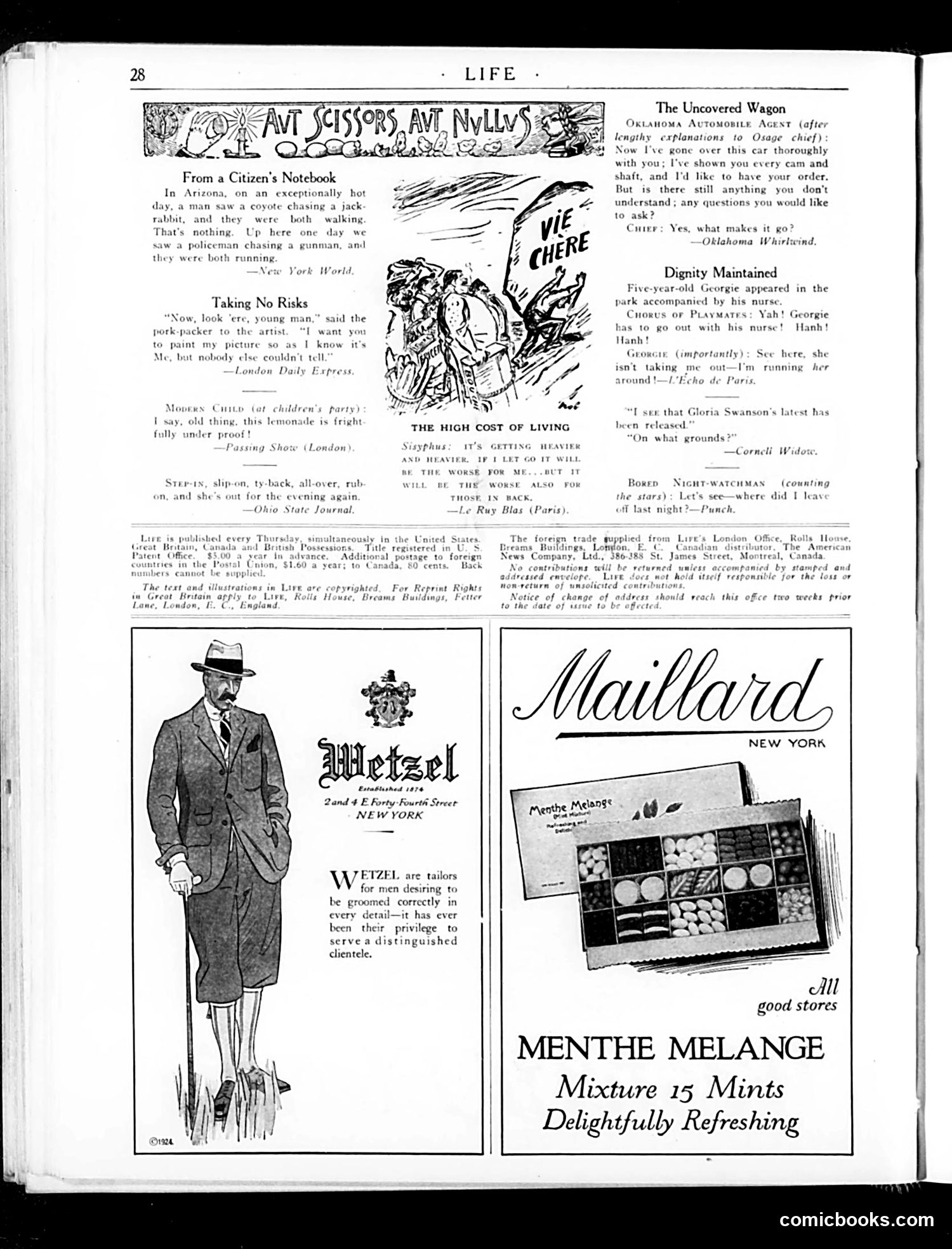
This page from *Life* contains several brief satirical vignettes mocking everyday absurdities: **"From a Citizen's Notebook"** collects humorous observations, including one about witnessing a coyote chasing a jackrabbit in Arizona—presented as mundane compared to urban oddities. **"Taking No Risks"** jokes about a pork-packer commissioning a portrait so unflattering that only he recognizes himself—satirizing vanity and artistic compromise. **"The High Cost of Living"** depicts an Oklahoma car salesman explaining an automobile to a Native American customer, who asks what makes it go—poking fun at the absurdity of explaining modern technology to someone unfamiliar with it, and possibly at automotive advertising's verbosity. Other brief jokes mock children's behavior, celebrity news, and bureaucratic weight. The page is primarily **advertising space** featuring Wetzel tailors and Maillard candy, reflecting *Life*'s revenue model. These were typical satirical formats for the era's humor magazines.
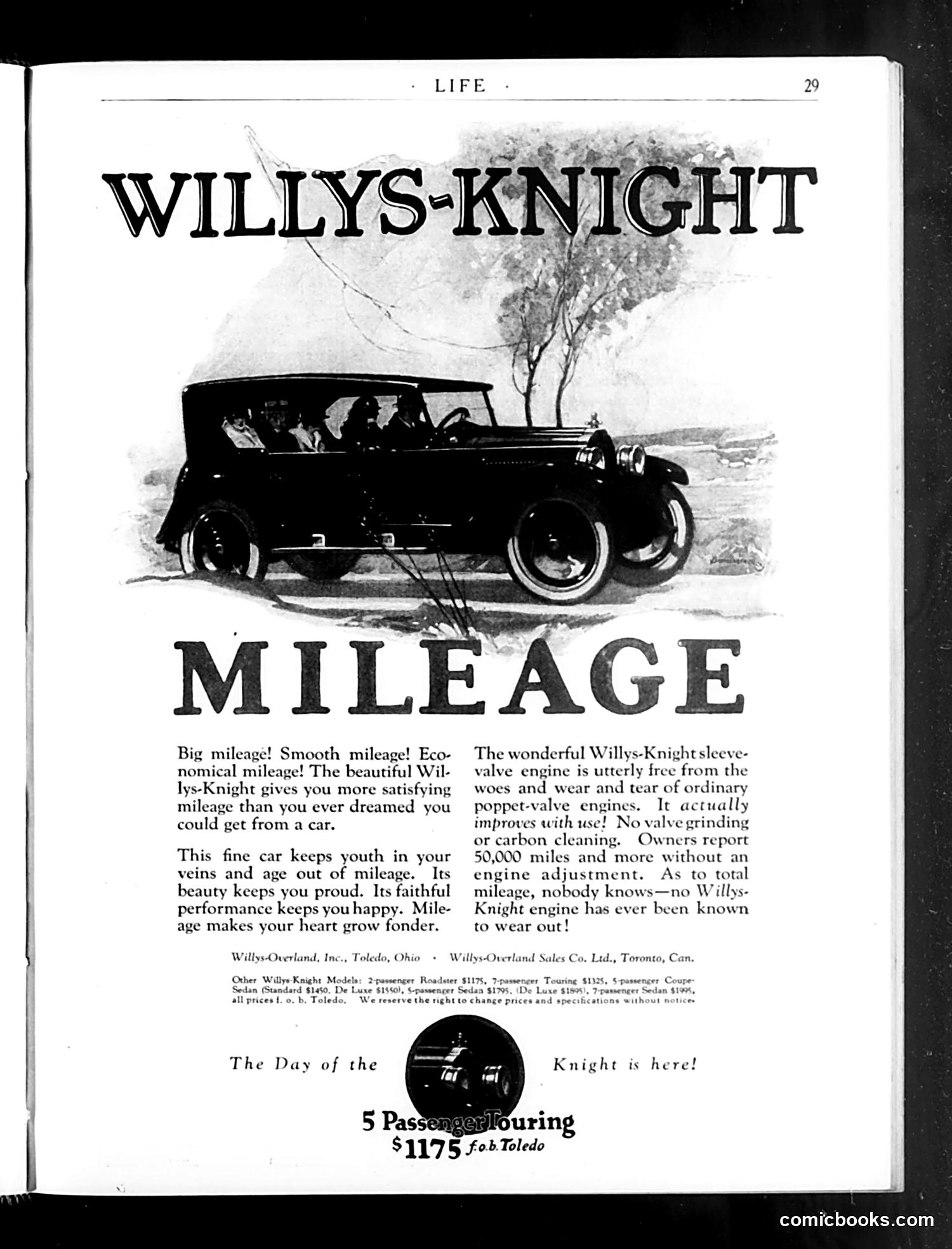
This is a **full-page automobile advertisement**, not political satire. It promotes the Willys-Knight car, manufactured by Willys-Overland in Toledo, Ohio, circa 1920s. The ad emphasizes the car's exceptional fuel economy and durability, particularly its innovative sleeve-valve engine. Key marketing claims include: - Superior mileage compared to competitors - Engine "improves with use" and requires no valve grinding or carbon cleaning - Owner reports of 50,000+ miles without adjustment - Claims no Willys-Knight engine has ever worn out The illustration shows a touring car with passengers beneath a tree, suggesting leisure and reliability. The $1,175 price point (f.o.b. Toledo) positioned it as an affordable, practical family vehicle. This represents typical early automotive advertising emphasizing mechanical innovation and economy—concerns central to 1920s consumers.
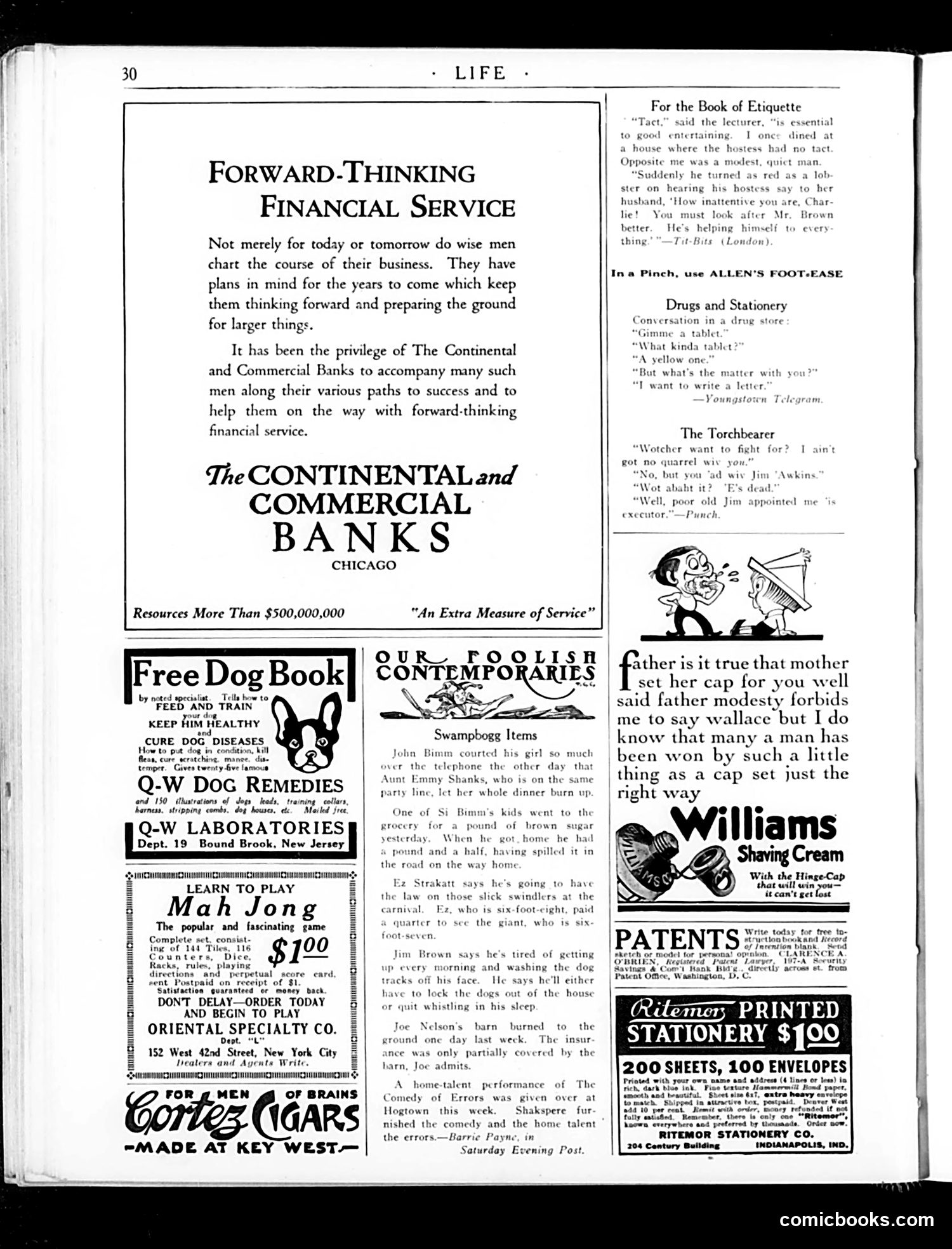
This page is primarily **advertisements and humor fillers** rather than political satire. The main content includes: **"Swampogg Items"** — A humor section featuring brief anecdotes about small-town life, including stories about children spilling groceries, dogs being washed, and barn fires. These are gentle, domestic jokes typical of early 20th-century American humor magazines. **Cartoon snippets** accompanying these items show simple comic scenarios — a man being scolded by his hostess, a figure being struck. **Advertisements** dominate the page: dog training books, Mah Jong games, shaving cream, printed stationery, and the Continental and Commercial Banks advertisement emphasizing "forward-thinking financial service." The **Williams Shaving Cream ad** features a distinctive hinge-cap design. There is **no apparent political satire** on this page. Rather, it reflects early 1900s middlebrow American humor — domestic mishaps and small-town social observations — surrounded by consumer product marketing. The tone is gentle and nostalgic rather than satirical or critical.
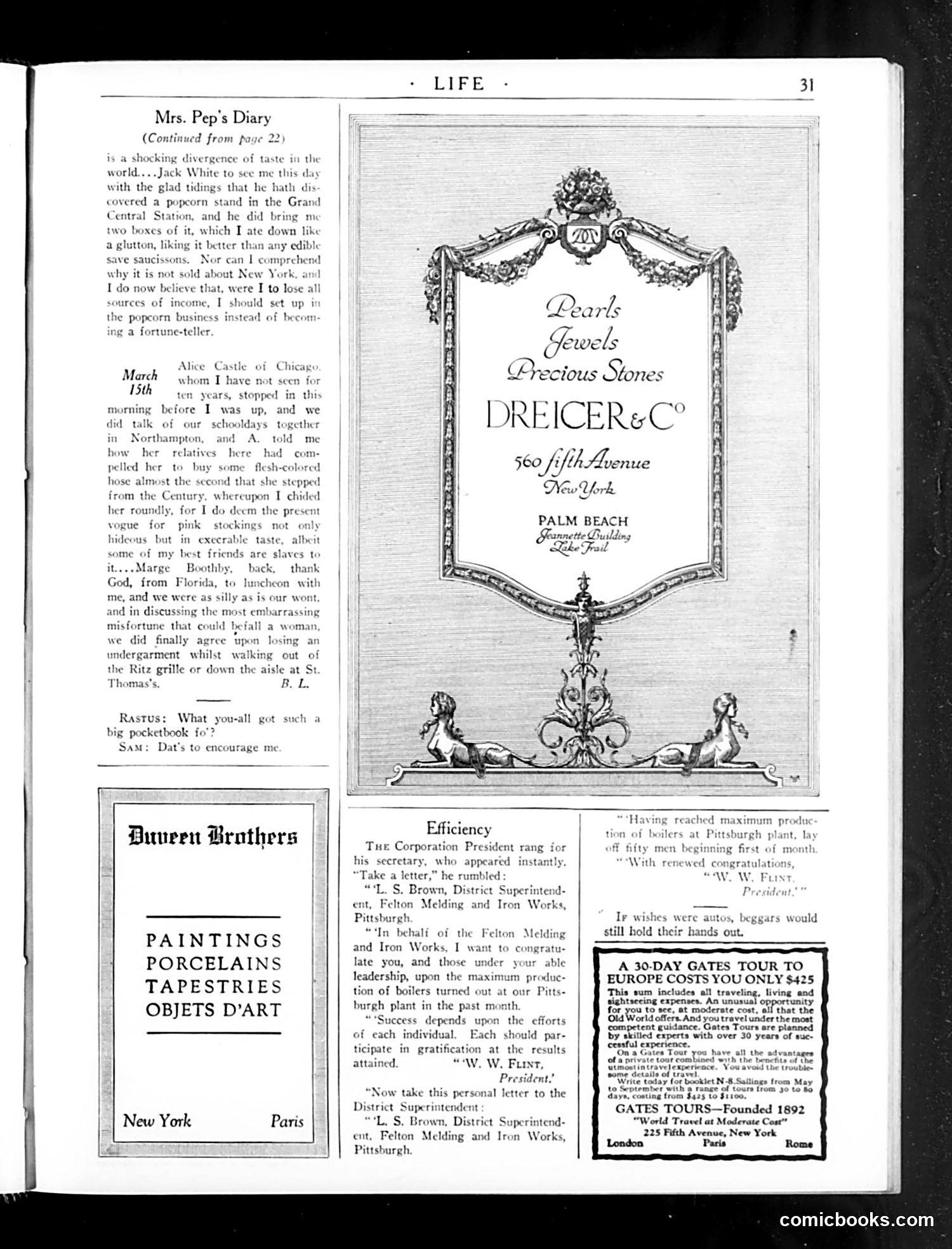
This page is primarily **advertising and social commentary**, not a political cartoon. The main content consists of: **"Mrs. Pep's Diary"** — a satirical gossip column mocking upper-class social pretensions. It ridicules wealthy society figures' trivial concerns: a friend's discovery of popcorn at Grand Central Station, complaints about flesh-colored stockings being both hideous and fashionable, and embarrassing moments in high-end venues like the Ritz. The tone suggests Life magazine is lampooning the affectations and superficiality of the leisure class. **"Rastus" and "Sam" dialogue** — a brief joke appearing to use stereotypical dialect, likely dated period humor. The remainder comprises **luxury advertisements** (Dreicer & Co. jewels, Duveen Brothers art dealers, Gates Tours to Europe) targeting the same wealthy audience being satirized above — creating ironic juxtaposition between mockery and marketing to the same demographic. The page reflects *Life*'s role as satirical commentary on American upper-class culture circa the 1920s-30s.
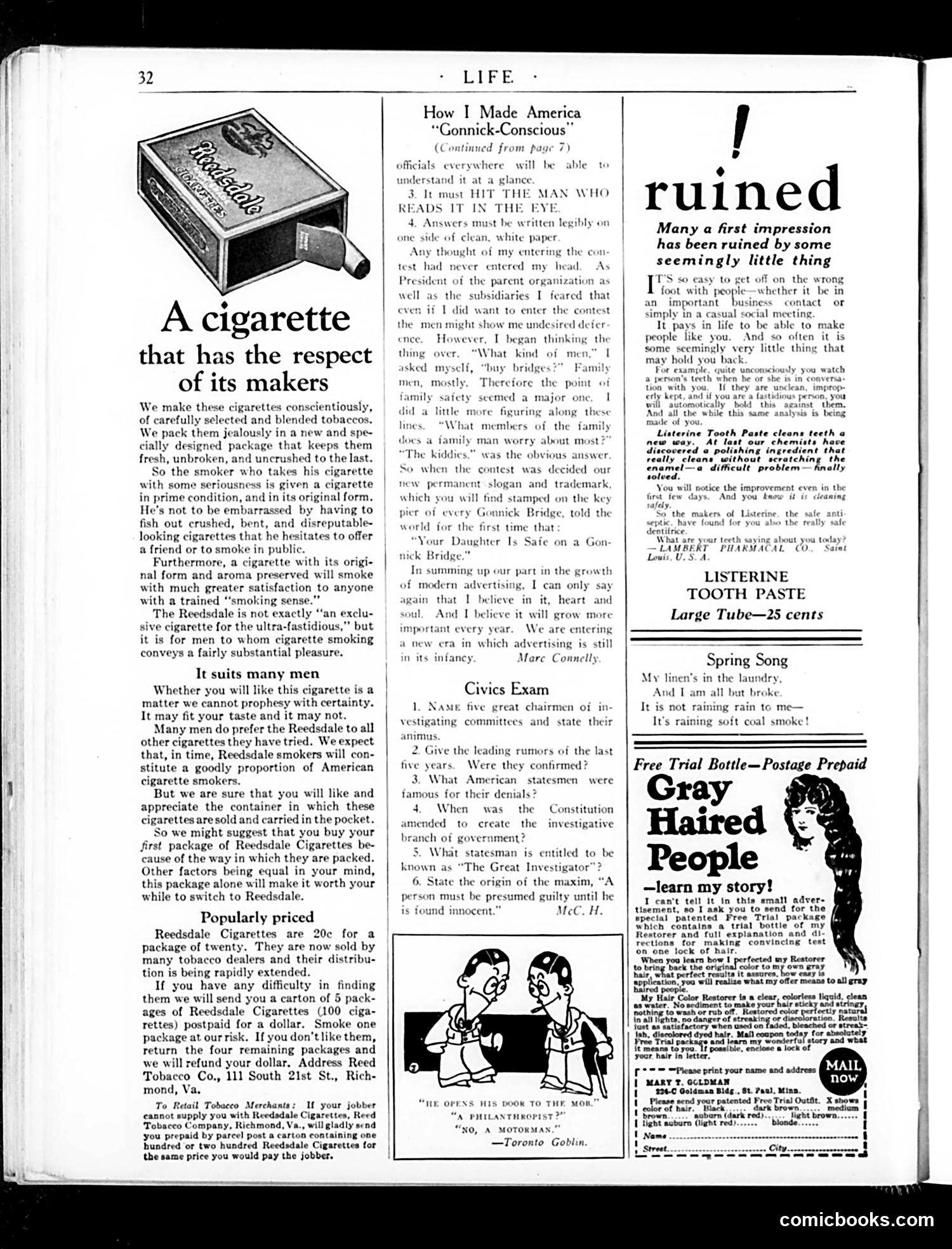
This page contains primarily **advertisements** rather than political satire. The dominant content is a Reedsdale Cigarettes ad emphasizing quality packaging and "respect" for consumers—a marketing pitch typical of early 20th-century tobacco advertising. The small cartoon depicts two figures examining a book, with caption "'He opens his book to the more philanthropist?' 'No, a motorman.'"—a class-based joke contrasting expectations (philanthropist = wealthy, educated) with reality (motorman = working-class transit operator). The page also includes an article titled "How I Made America 'Gonnick-Conscious'" about advertising strategy, discussing how products targeting families should emphasize safety ("Your Daughter Is Safe on a Gonnick Bridge"). **For modern readers:** This reflects an era when advertisements directly appealed to middle-class anxieties about propriety and family safety, and when class distinctions were casually reinforced through humor.
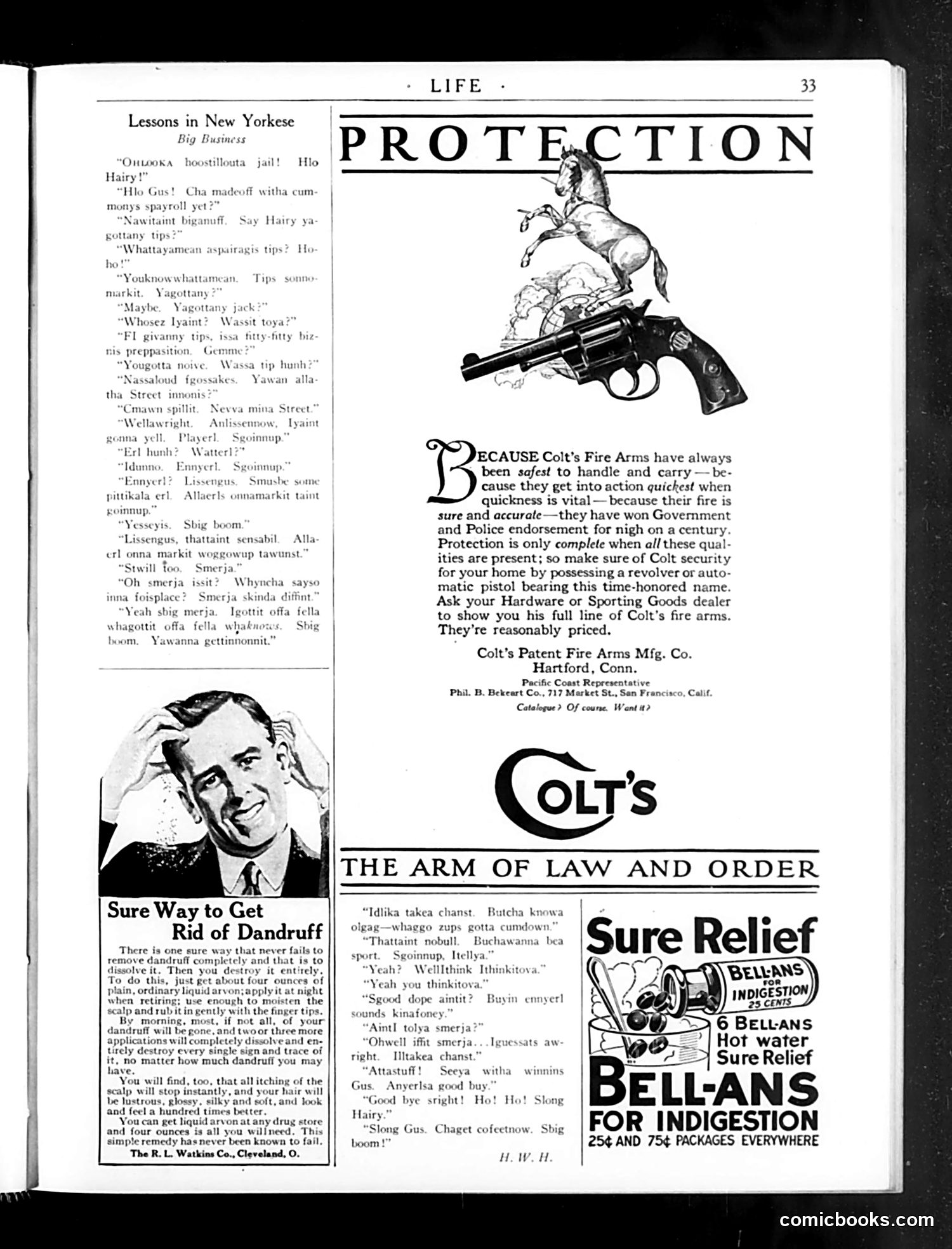
This page satirizes how working-class New Yorkers spoke in the early 20th century. The left column presents a dialogue heavy with dropped consonants, slurred words, and distinctive accent markers ("Cha madeoff," "Whattayamean," "Cmawn split"). The accompanying illustration shows a man in business attire, suggesting the satire targets white-collar workers adopting or maintaining rough street vernacular. The humor comes from the contrast between supposed "big business" dealings and crude, barely-intelligible speech. Phrases like "Yagottany tips?" and "Sgoinnup" parody New York's distinctive accent and grammar patterns of the era—a common target of national humor magazines that treated regional dialects as inherently comic. The page is otherwise filled with period advertisements (Colt firearms, Bellans antacid, dandruff remedy), typical of Life magazine's format.
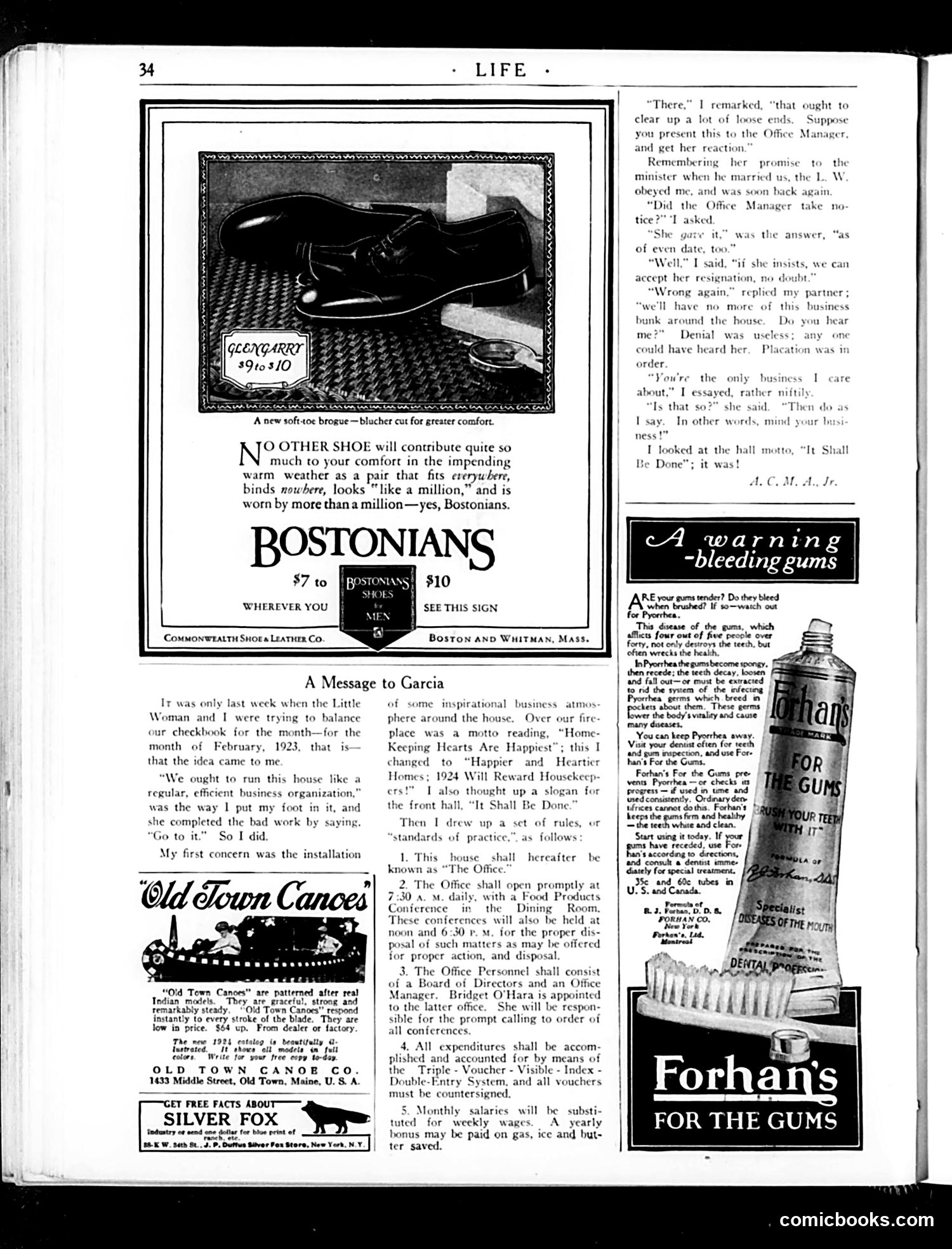
This page is primarily **advertising and humorous domestic narrative**, not political satire. The main content, "A Message to Garcia," presents a husband's attempt to run his household like a business office—a satire on 1920s efficiency culture and bureaucratic management trends. He appoints his housemaid Bridget O'Hara as "Office Manager" and establishes formal procedures (conferences, voucher systems, salaries). The humor lies in the wife's resistance: she refuses to accept his organizational schemes, asserting that "You're the only business I care about"—a gentle critique of applying rigid business logic to domestic life. The surrounding **advertisements** reflect period concerns: Bostonians shoes ($7-10), Old Town Canoes, and notably "Forhan's for the Gums," promoting treatment for pyorrhea (gum disease), which the ad claims affects "four out of five people over forty." There is **no political cartoon** on this page. The satire is social commentary on marriage dynamics and the era's obsession with efficiency and scientific management in all life spheres.
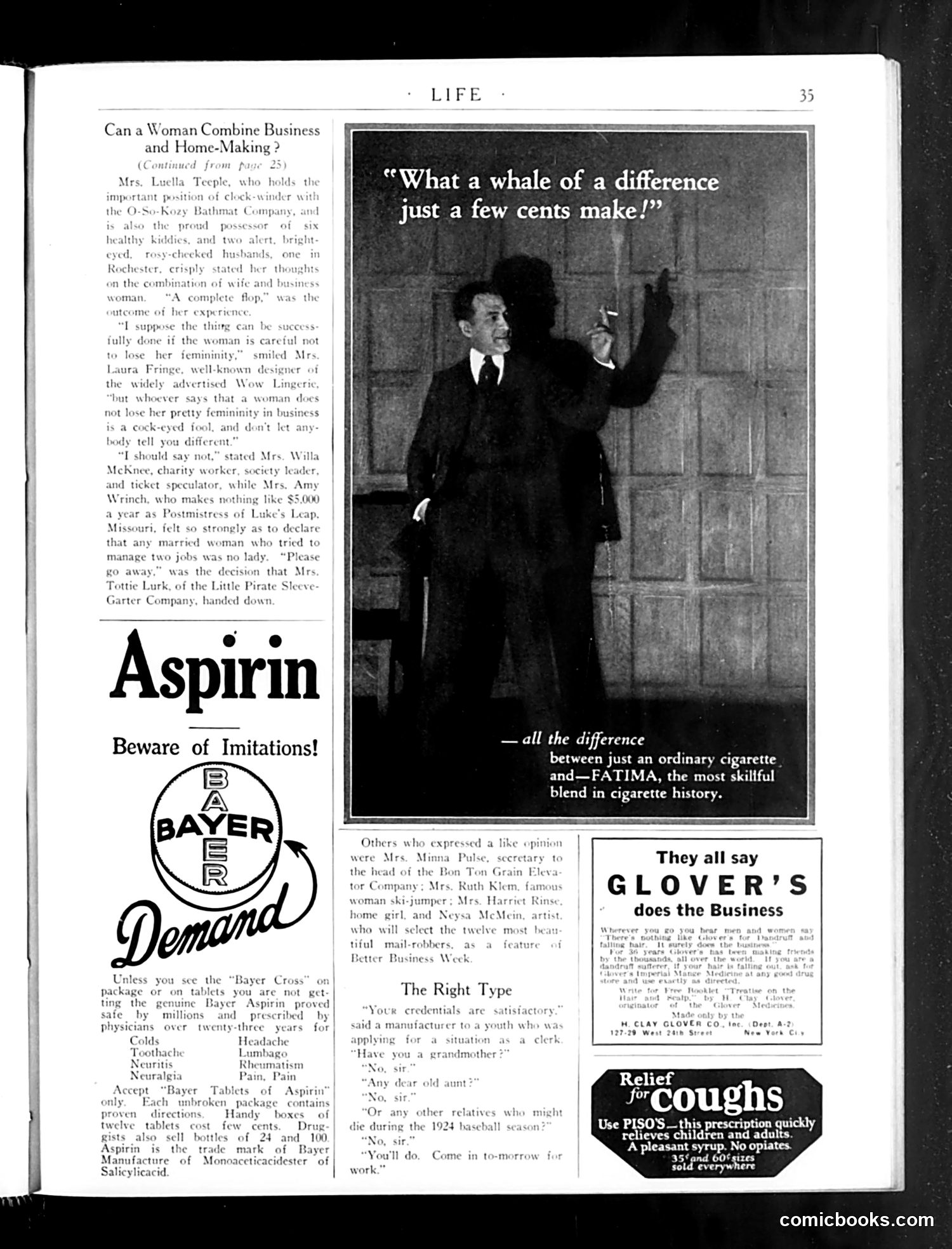
This page mixes editorial content with period advertising. The main article debates whether women can successfully manage both business and homemaking—a contemporary concern in the 1920s. Various women are quoted offering contradictory views: some insist women retain femininity in business, others claim trying to manage two jobs makes one "no lady." Mrs. Tottie Lurk's response—simply telling someone to "go away"—appears to be satirical commentary on the impracticality of the question itself. The advertisements reflect 1920s consumer culture: Bayer Aspirin warns against imitations (trademark protection was contentious), Fatima cigarettes emphasize quality through subtle pricing, Glover's targets businesswomen, and Piso's cough syrup uses nostalgic "grandmother" appeal. The satire lies in juxtaposing serious debate about women's roles with ads marketing products *to* working women—inadvertently proving women successfully operated in both spheres.
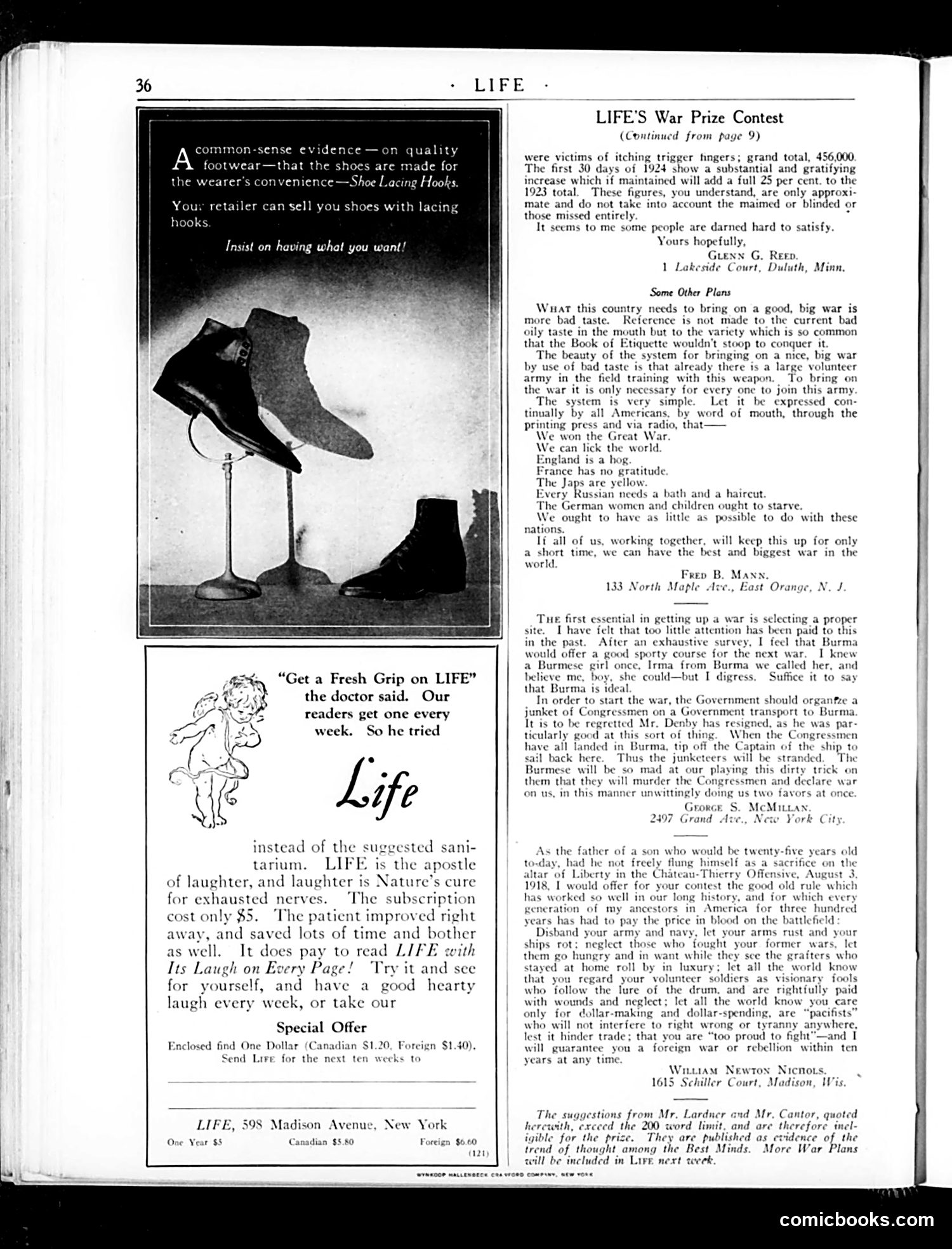
This page combines advertising and satirical war commentary typical of 1920s *Life* magazine. The **top advertisement** promotes "Shoe Lacing Hooks"—a mundane footwear convenience—using typical early-20th-century consumer messaging ("Insist on having what you want!"). Below it, *Life* advertises itself as therapeutic humor: a doctor supposedly prescribes the magazine's "laughter" instead of sanitarium treatment for "exhausted nerves," positioning satire as mental health. The dominant content is *Life's* **War Prize Contest**, soliciting reader submissions about starting future wars. The entries are darkly satirical, proposing absurd schemes: spreading nationalist propaganda ("We can lick the world"), staging congressional junkies to Burma to provoke conflict, and offering cynical observations about warfare's true beneficiaries. One contributor notes his son died in WWI, adding bitter weight to the satire. The satire targets American militarism, nationalist rhetoric, and post-WWI jingoism—mocking both warmongering attitudes and the ease of manufacturing international conflict through propaganda and manufactured grievances.
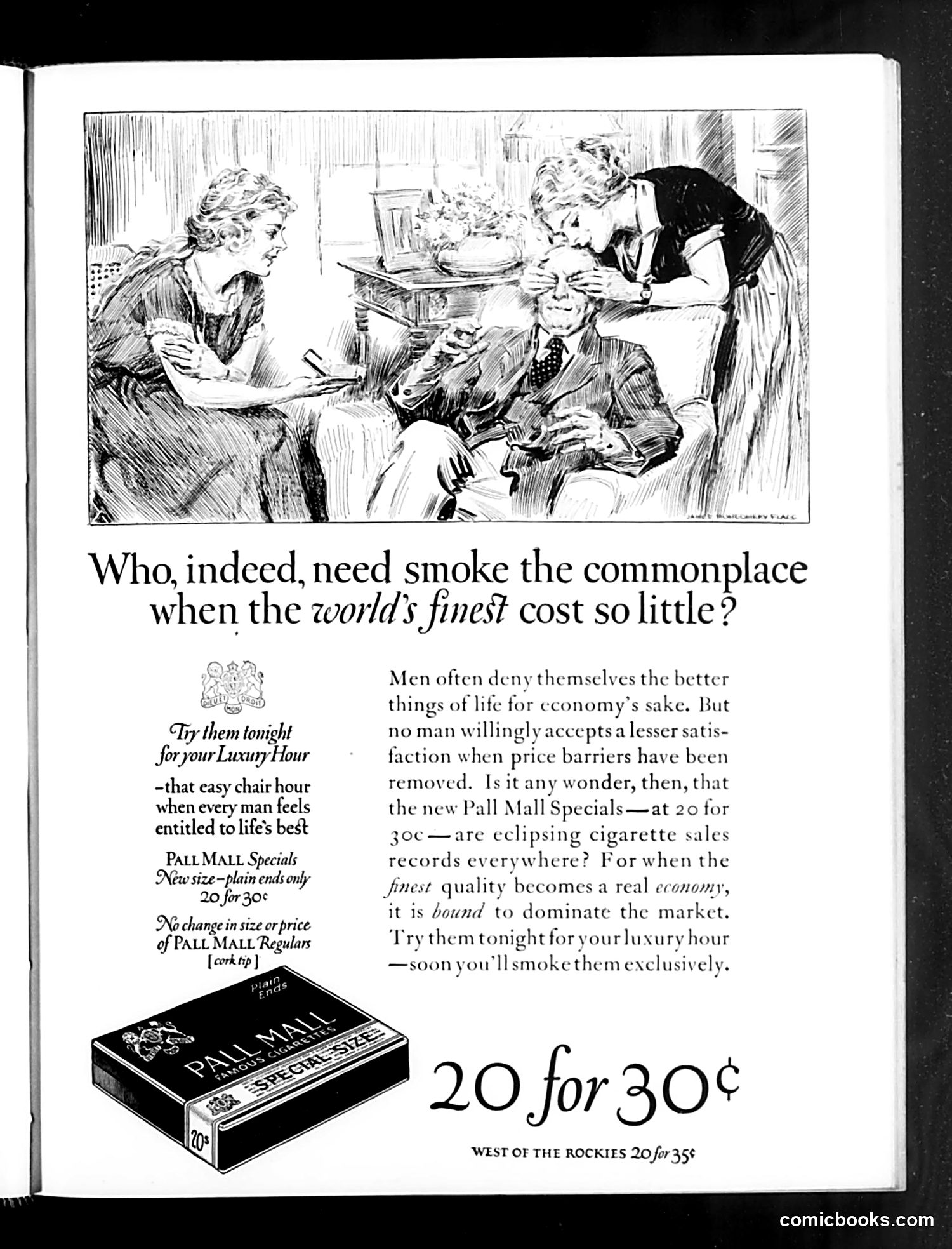
This is primarily a **cigarette advertisement**, not satire. The sketch shows a domestic scene—apparently a woman and children enjoying leisure time together, suggesting comfort and family contentment. The ad's pitch targets male consumers by arguing that premium cigarettes (Pall Mall Specials) cost so little that there's no rational reason to smoke inferior brands. The text explicitly appeals to masculine pride: men shouldn't deny themselves "life's best" when price barriers have been removed. The framing as a "Luxury Hour" suggests cigarette smoking as a deserved leisure activity—a reward for the working man. By modern standards, this is striking: the ad normalizes smoking around children and frames quality tobacco as an accessible luxury good, without any health warnings (which were not yet legally required). The pricing structure (20 for 30¢) emphasizes affordability of the "world's finest."
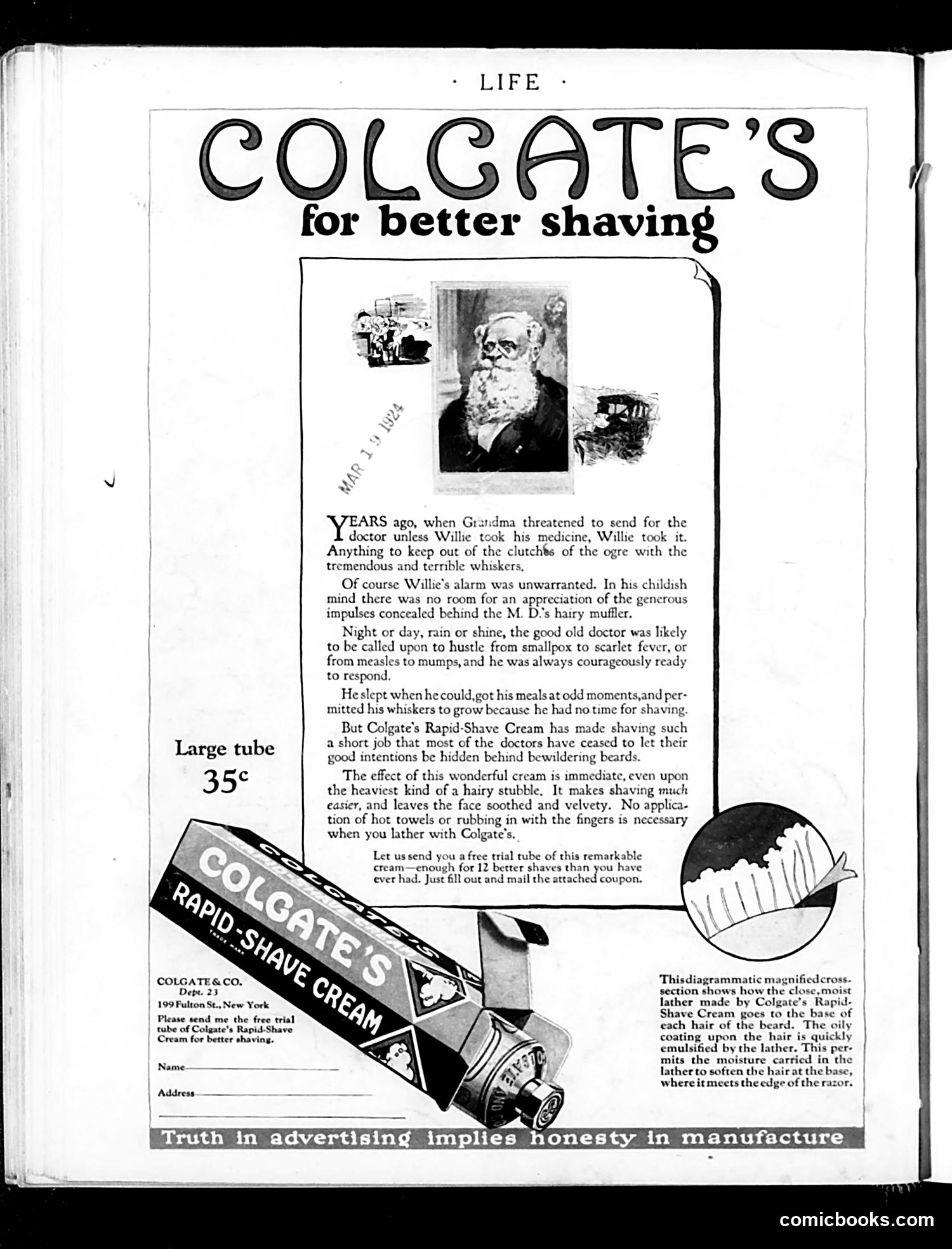
This is a straightforward **product advertisement**, not satire or political commentary. The page uses a sentimental narrative device common in early 20th-century advertising. The story depicts a young boy ("Willie") frightened by his grandfather's large beard, explaining why the elderly doctor character allows his whiskers to grow—he's too busy making house calls to shave. The advertisement then pivots to claim Colgate's Rapid-Shave Cream is so efficient that busy doctors like him can now maintain clean-shaven appearances. The accompanying diagram shows how the cream's lather penetrates to the hair base, softening whiskers for easier shaving. The large product tube is displayed with pricing (35¢). The tagline—"Truth in advertising implies honesty in manufacture"—was a common corporate messaging strategy of the era, emphasizing reliability and quality during a period of growing consumer skepticism about patent medicines and toiletries. This is primarily a **sales pitch using nostalgic family imagery**, not editorial commentary.