
Life, 1924-03-20 · page 24 of 42
Life — March 20, 1924 — page 24: what you’re looking at
What you’re looking at
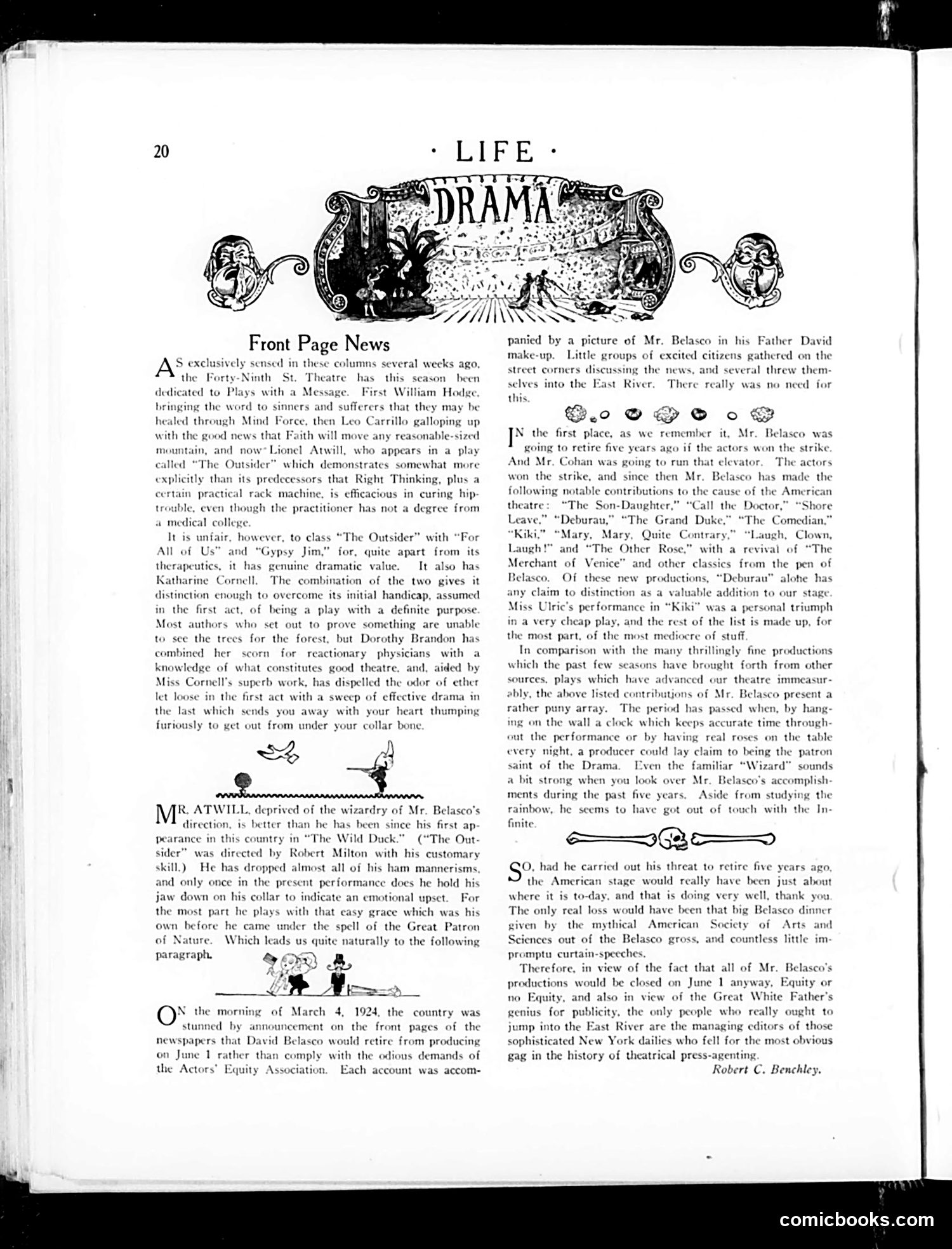
This page discusses David Belasco's announced retirement from theatrical producing on June 1, 1924, in response to demands from the Actors' Equity Association—a significant labor dispute in American theater history. The satirical commentary is skeptical of Belasco's threat. The author notes Belasco previously threatened retirement five years earlier if actors won a strike, and mentions Cohan promised to "run that elevator"—both empty threats. The piece mocks Belasco's recent productions as largely mediocre, contrasting them unfavorably with superior plays from other theatrical sources. It suggests only "mystical" organizations and unsophisticated New York audiences genuinely regretted Belasco's potential departure. The article's real point: Belasco's retirement threat is grandstanding theater politics. His productions don't justify the fuss, and his departure wouldn't represent the catastrophic loss he implied.
📄 Transcribed text from this page (OCR, searchable)
Machine-transcribed from the original scan — historical spelling and the odd misread are preserved.
BE 711\\WS Front Page News $ exclusively sensed in these columns several weeks ago, the rty-Ninth St. The dedicated to Plays with a Message. atre has this season been First William Hodge bringing the word to sinners and sufferers that they may be healed through Mind Force, then Leo C with the good news that rrillo galloping up ith will move any reasonable-sized ain, and now* Lionel Atwill, who appears in a play called “The Outsider” which demonst explicitly tha tes somewhat more its predecessors that Right Thinking, plus a in practical rack machine, is efficacious in curing hip ble, even though the practitioner has not a degree from a medical college. It is unfair, however, to class “The Outsider” with All of Us” and “Gypsy Jim,” for, quite apart from its therapeutics, it has genuine dramatic value. It also has Katharine Cornell. The combi: ation of the two gives it distinction enough to overcome its initial handicap, assumed nite purpose hing are unable but Dorothy Brandon has in the first act, of being a play with a de Most aut rs who set out to prove so: to see the trees for the forest combined her scorn for reactionary physicians with a id, aided by Miss Cornell's superb work, has dispelled the odor of ether knowledge of what constitutes good theatre. let loose in the first act with a sweep of effective drama in the last which sends you away with your heart thumping furiously to get out from under your collar bone =% 4 it aetna en La R. ATWILL, deprived of the wizardry of Mr. Belasco's direction, is better than he has been since his first ap: The Wild Duck.” (“The Out- was directed by Robert Milton with his customary pearance in this country in ) He has dropped almost all of his ham mannerisms. and only once in the present performance does he hold his jaw down on his collar to indicate an emotional upset. For the most part he plays with that casy grace which was his own before he came under the spell of the Great Patron Which leads us quite naturally to the following N the morning of March 4, 1924, the country was stunned by announcement on the front pages of the newspapers that David Belasco would retire from producing on June 1 rather than comply with the odious demands of the Actors’ Equity Association Each account was accom- panied by a picture of Mr. Belasco in his Father David make-up. Little groups of excited citizens gathered on the street corners discuss: and several threw them- There really was no need 9G QDS oo YS N the first place, as we remember it, Mr the news, selves into the East: River, this. Belasco was going to retire five years ago if the actors won the strike. And Mr, Cohan was going to run that elevator. won the strike, and since then Mr. Bel following notable contributions to the cause ¢ theatre: “The Leave,” “Debura “Mary * and The actors has made the the merican 1-Daughte all the Doctor,” “Shore .” “The Grand Duke,” “The Comedian,” Mary. h, Clown, The Other Rose,” with a revival of “The Merchant of Venice Bel. Quite Contrary,” 1 other classics from the pen of 0. Of these new prod ions, “Deburau” alohe has im to distincti a valuable addition to our stage Miss Ulric’s performance in Kiki” was a personal triumph and the rest of the list is made up, for the most part, of the most mediocre of stuff. a very cheap pl In comparison with the many thrillingly fine productions which the past few seas ns have ght forth from other sources, plays which have advanced our theatre immeasur- ably, the above listed contri rather puny a ons of Mr. Belasco present a ray. The period has passed when, by h: 1a clock which keeps accurate time through out the performance or by having real roses on the table ing on the wa night, a producer could lay claim to being the patron saint of the Drama a bit stro Even the familiar “Wizard” sounds g when you look over Mr. Belasco’s accomplish ments during the past five years, Aside from studying the got out of h with the In- 33> O, had he carried out his threat to retire five yea ainbow, he seems to hav finite the American stage would really have been just about where it is to-day, and that is « ng very well, thank you. The only real loss would have been that big Belasco dinner ty of Arts and Sciences out of the Belasco gross, and countless little im P the mythical American given by mptu curtain-speeches. Therefore, in view of the fact that all of Mr productions would be cl Equity, and alsc genius for publicity, the only people who reall nt to jump into the East River are the managing editors of those sophisticated New York dailies who fell for the most obvious Belasco's ed on June 1 ai n view of the ( way, t White quity or ather’s gag in the history of theatrical press-agentir Robert C. Benchley. comicbooks.com