
Life, 1924-03-20 · page 20 of 42
Life — March 20, 1924 — page 20: what you’re looking at
What you’re looking at
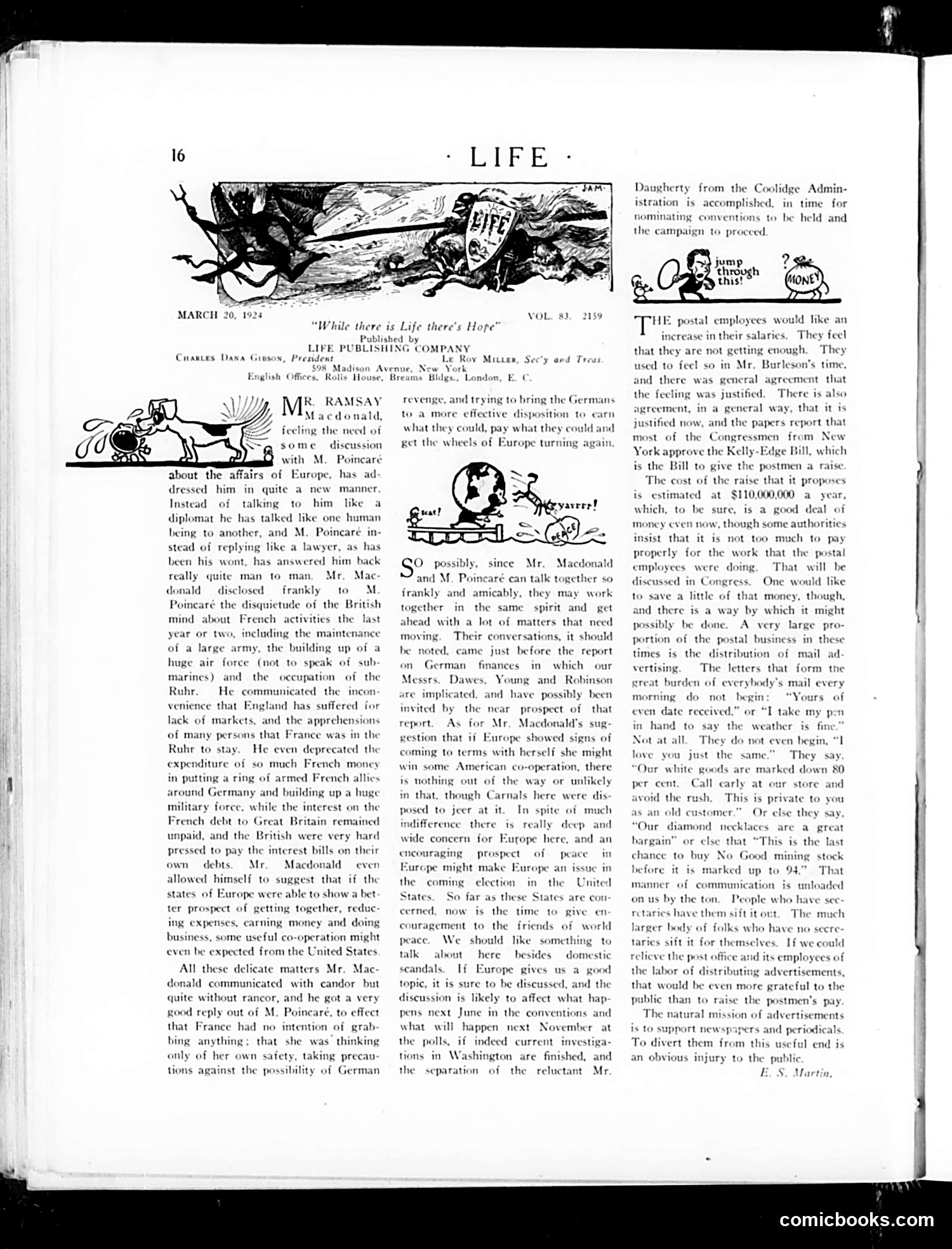
This page discusses diplomatic negotiations between British Prime Minister Ramsay MacDonald and French Premier Raymond Poincaré regarding post-World War I European economic recovery and security concerns. **The Main Issue**: MacDonald and Poincaré are talking frankly—unusually as equals rather than formal diplomats—about France's heavy military spending, occupation of the Ruhr region (German territory seized as reparations security), and Britain's own war debts. The article suggests their constructive dialogue might encourage American economic cooperation in European reconstruction. **The Satire's Point**: The piece implies that if Europe can demonstrate financial stability and reduced tensions, it could become a campaign issue in America's upcoming elections, potentially generating U.S. support for peace efforts. **Secondary Item**: A brief note mentions postal workers seeking salary increases and references the removal of Attorney General Harry Daugherty from the Coolidge administration—contemporary political scandals overshadowing European affairs. The overall tone suggests cautious optimism that rational diplomatic discussion might resolve Europe's postwar economic crisis.
📄 Transcribed text from this page (OCR, searchable)
Machine-transcribed from the original scan — historical spelling and the odd misread are preserved.
Rolis House R. RAMSAY Macdonald, feeling the need of some discussion with M. Poincare about the affairs of E dressed him in quite a new manner Instead of talking to him like diplomat he has talked like one human her, and M. Poincaré in- rope, has ad being to anoth stead of replying like a lawyer, as has been his wont, has answered him back really quite man to man. Mr, Mac donald disclosed frankly to M etude of the British ivities the last year or two, including the maintenance Poincaré the dis mind about French ai of a large army, the building up of a huge air force (not to speak of sub. the mmunicated the incon and has suffered for marines) and the occupation of Ruhr He c venience that Ev lack of markets, and the apprehensions of many persons that France was in the Ruhr to stay expenditure of so much French money He even deprecated the putting a ring of armed French allies nd C military force, while the interest French debt to Great Britain ren unpaid, and the British were very hard arc rmany and building up a huge the ned pressed to pay the interest bills on their own debts. Mr. Macdonald — even st that if, the states of Europe were able to show a bet allowed himself to suge ter prospect of getting together, reduc ing expenses, earning money and doing business, some useful co-operation migh even be expected from the United States All these delicate matters Mr. Mac- donald communicated with candor but quite without rancor, and he got a very good reply out of M. Poincaré, to effect that France had no intention of grab bing anything; that she was’ thinking only of her own safety, taking precau tions against the possibility of German re is Life there's Hope’ bli sh: HING COMPANY Le Roy Miter, y and Treas Jison Avenue, New York gs, London, E. ¢ revenge, and trying to bring the Germans toan what they could, pay what they effective disposition to ca ld and get the wheels of Europe turning again n SO Possibly, since Mr. Ms and M. Poincaré can talk together so y. they may work frankly and amic together in the same spirit and get ahead with a lot of matters that need i be noted, came just before the report moving. Their conversations, it show on German finances in which our Messrs. Dawes, Young and Robinson are implicated, and have possibly been invited by the near prospect of that report. As for Mr. Macdonald's sug- gestion that if Europe showed signs of coming to terms with herself she might win some American co-operation, there is nothing out of the way or unlikely in that. though Carnals here were dis posed to jeer at it. In spite of much indifference there is really deep and wide concern for Europe here, and an couraging prospect. of peace in arope might make Europe an issue in the coming election in the United S ates. as these States are cou cerned, now is the time > give en couragement to the friends of world peace. We should like something to talk about here besides domestic scandals. If Europe gives us a good topic, it is sure to be discussed, and the discussion is likely to affect what hay pens next June in the conventions and what will happen next November at the polls, tions in Washington are finished, and if indeed current investiga the separation of the reluctant’ Mr Daugherty from the Coolidge Admin- istration is accomplished, in time for nominat » be held and gf conventions the campaign to proceed “THE postal employees would Tike an increase in their salaries. They feel that they are not getting enough. They used to feel so in Mr. Burle on’s time, that the fecling was justified. There is al and there was general agreeme agreement, in a general way, that it is justified now, and the papers report tha most of the Congressmen from New York approve the Kelly-Edge Bill, which is the Bill to give the postmen a raise The cost of the raise that it proposes is estimated at $110,000,000 a yea which, to be sure, is a good deal of money even now, though some authorities m insist that it is not te properly for the work that the postal sch to pay employees were doing. That will be discussed in Congress. One would like to save a little of that money, though, way by which it might and there is possibly be done. A very large pro- portion of the postal business in these times is the distribution of mail ad. vertising The letters that form the great burden of everybody's mail every morning do not begin: “Yours of “I take my pon weather is fine.” even date received. in ha Not at all love you just the same.” They say to say th They do not even begin, “1 “Our white goods are marked down 80 ly at our store and per cent. Call ca avoid the rush. This is private to you as an old customer.” Or else they say, “Our diamond necklaces are a great bargain” or else that “This is the last chance to buy No Good mining stock before it is marked up to 94.” That manner of communication is unloaded Ve sec on us by the ton. People wh retaries have them sift it out. The much larger body of folks who have no secre- taries sift it for themselves. If we could relieve the post office and its employees of the labor of distribut: advertisements, that would be even more grateful to the publ 7 is to support newspapers and periodicals To divert them from this useful end is an obvious injury to the public E. S. Martin than to raise the postmen’s pay ¢ natural mission of advertisements comicbooks.com