
Life, 1924-03-20 · page 29 of 42
Life — March 20, 1924 — page 29: what you’re looking at
What you’re looking at
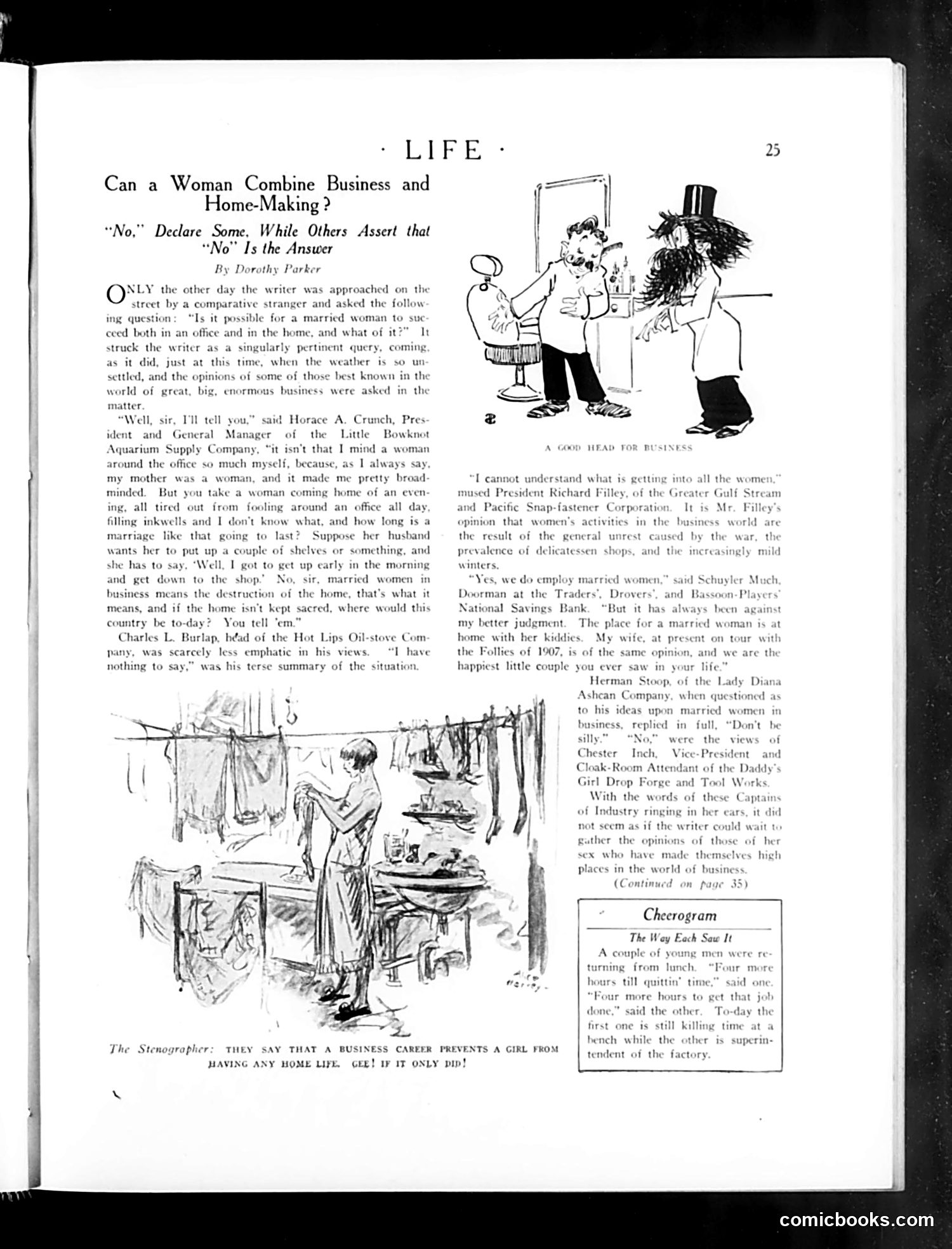
This 1920s satirical article by Dorothy Parker solicits opinions from male business leaders on whether married women can successfully work and maintain homes. The piece mocks their responses through their own contradictions. **The figures** are unnamed executives from various companies (Little Bowknot Aquarium Supply, Hot Lips Oil-stove Company, traders' banks, etc.)—representing typical business establishment views. **The satire:** Each man claims to support working women while immediately undermining the idea. One says his mother was a woman (so he's progressive), then describes the exhaustion and domestic chaos a working wife creates. Another says he has "nothing to say" while delivering lengthy objections. **The lower cartoon** shows a stenographer sarcastically responding: "They say a business career prevents home life. GEE! If it only did!"—implying women face impossible expectations: work without sacrificing domestic duties. **The point:** Parker exposes male hypocrisy and the cultural assumption that women's primary duty is homemaking, making their employment secondary and burdensome.
📄 Transcribed text from this page (OCR, searchable)
Machine-transcribed from the original scan — historical spelling and the odd misread are preserved.
Can a Woman Combine Business and Home-Making ? “No,” Declare Some, While Others Assert that “No” Is the Answer By Dorothy Parker LY the other day the writer street by a comparative str approached on the er and asked the follow a married woman to O ing question: “Is it possible fe ceed both in an office and in the home, and what of it? struck the writer as a singularly pertinent query, co as it did, just at this time, when the weather is settled, est known world of great , enormous business were asked in the matter. “Well, sir, Vl tell ” said H ident and General Manager of the Little Bowh ace A, Crunch, Pres ot Aquarium Supply Company, “it isn't that I mind a woman around the office so much myself, because, as 1 always say my mother was a woman, and it made me pretty t minded. But you take a woman coming home of an even mused Presi¢ ing, all tired out from fo filling inkwells and I don't k marriage like that gc wants her to put up a c she has to say, ‘Well, I g and get business means the destruction of the home, that’s what wn to the shop” No, sir, married women. in means, and if the home isn't kept sacred, where would this Natic country be to-d You tell ‘em.” my better judgment Charles L. Burlap, héad of the Hot Lips Oil-stove Com home pe nothing to say,” was his terse summary of the situat . Was The Stenographer: THEY SAY THAT A BUSINESS CAREER PREVENTS A GIRL FROM HAVING ANY HOME LIFE. GEE! IF IT ONLY pip! LIFE - iderstand what Richard Fil g around an office all day and Pacific Snap-faste nw what, and how long is a opinion that to last? Suppose her husband the gen ple of shelves or something, and prevalence of delicates to get up early in the morning winters. “Yes, we do employ married women,” said Doorman at the aders’, Drovers’, and cely less emphatic in his views. “I have the Follies of 1907, happiest little uple you ever saw in your life it has alw The place for a marr of the same opi Herman Stoop, ¢ Ashcan Company, when to his ideas upon married we ss, replied in full, “Don't t silly were the view Vice-President and ant of the Daddy Tool of these Drop Fi With the wor of I not seem as if the writer co’ stry ringing in her gather the opinions of those of he sex who have places in the we r | Cheerogram ‘The Wey Each Saw It ning from urs till quitt done,” said th more he To-day the x time at a first one is hench while the other is superin- tendent of the factory comicbooks.com