
Life, 1924-03-20 · page 30 of 42
Life — March 20, 1924 — page 30: what you’re looking at
What you’re looking at
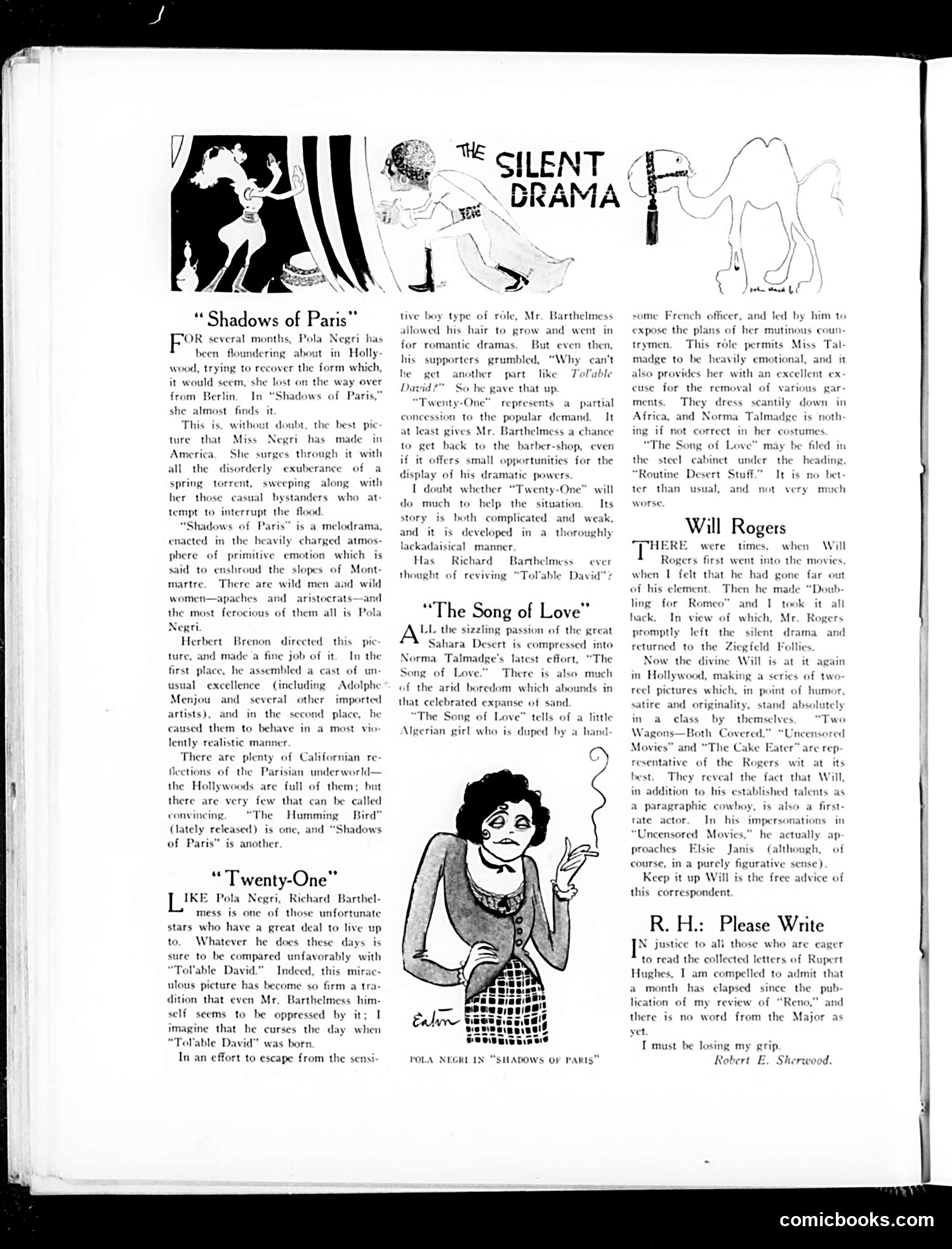
This page reviews several silent films, demonstrating how early 1920s cinema criticism worked. The text discusses performances by major silent film stars: **Pola Negri** in "Shadows of Paris" is praised as her best American work—a melodrama set in Parisian underworld depicting apaches (street criminals) and aristocrats. **Richard Barthelmess** is discussed as typecast since his success in "Tol'able David" (a sensitive boy role). His new film "Twenty-One" represents his attempt to escape this image by playing romantic leads instead, though critics doubt it helps. **Norma Talmadge** in "The Song of Love" plays an Algerian girl seduced by a French officer—the review notes she's appropriately emotional and correctly costumed for desert scenes. **Will Rogers** is credited with successfully transitioning from stage (Ziegfeld Follies) to film through comedic two-reel pictures showing humor and originality. The column satirizes how studios and audiences trapped stars in repetitive roles, while praising those who successfully diversified their performances.
📄 Transcribed text from this page (OCR, searchable)
Machine-transcribed from the original scan — historical spelling and the odd misread are preserved.
“Shadows of Paris” ‘OR several months, Pola Negri has been floundering about in Holly wood, trying to recover the form which, it would scem, she lost on th m Berlin. In “Shadows of almost finds it This is, without doubt, the best pic ture that Negri has America. way over Paris,” sh Miss She made in with surges throug! exuberance of a with all the di: lerly spring te along her tempt to interrupt the flood. nt, sweeping those casual bystanders who at Shadows of Paris” is a melodrama, enacted in the heavily charged atmos- phere of primitive which is said to enshroud the slopes of Mont- There are women—apaches and emotion martre wild men and wild aristocrats—and the most ferocious of them all is Pola Negri Herbert Brenon directed this pic ture, and made a fine job of it. In the first place, he assembled a cast of un usual excellence (including Adolphe Menjou and several other imported artists), and in the second place, he caused them to behave in a most vie lently realistic manner There are plenty of Californian re Parisian underworld— re full of them; but fections of the the Hollywoods there are very few that can be called “The Humming Bird” ased) is one, and “Shadows of Paris” is another “Twenty-One” LIKE Pola Negri, Richard Barthel- mess is one of those unfortunate great deal to live up he does stars who have a to. Whatever days is sure to be compared unfavorably with “ToVable David.” Indeed ulous picture has become so firm a tri dition that even Mr. sel these this mir. Barthelmess him- seems to be oppressed by it; I imagine that he curses the day when “Tol'able David” was born. In an effort to escape from the sensi “ SILENT sare tive boy type of role, Mr. Barthelmess allowed his hair to grow and went in dramas. B for romantic even then, his supporters grumbled, “Why. can't he get another part like Tol'abl David?” So he gave that up. wenty-One” represents a partial concession to the popular demand. It at least gives Mr. Barthelmess a chance to get back to the barber-shop, even if it offers small opportunities for the dist his dramatic I doubt whether “Twenty-One” will do much to help the situation. — Its powers. story h complicated and weak, and it is developed in a thoroughly lackadaisical manner Has Richard ught of reviving “Tol “The Song of Love” the sizzling passion of the great Sahara Desert is compressed into ‘almadge’s latest effort, “The There is also much of the arid boredom which abounds in Barthelmess rle David"? ever A Norma of Love.” that celebrated expanse of sand “The tells of a little an girl who is duped by at ong of Love” SHADOWS OF PARIS” POLA NEGRI IN } it pm gl ne French officer, and led by him to of her mutinous cou This réle Miss Tal madge to be heavily emotional expose the pl trymen permits and it also provides her with an excellent ex cuse for the removal of ments. They various gar- dress sea tily down in Af . and Norma Talmadge is noth ing if not correct in her costumes. he Song of Love” may be filed in the steel cabinet under the ading. “Routine Desert Stu It no bet an usual, and not very much Will Rogers HERE were times, when Will Rogers first went into the movies, when I felt that he had gone far of his element. Then he made “De ling for Romeo” and I took it which, Mr. Re silent d ack. In view of promptly left the returned to the Ziegicld Follies. N Will in Hollywood, making a series of twe ma ow the divine is at it rain reel pictures which, in point of humor re 1 originality, stand absolutely in a class by themselves, “Two Wagons—Both Covered.” “Uncensoree Movies” and “The Cake Eater” rep resentative of the Rogers wit at its best. They reveal the fact that Will in addition to his established talents as a paragraphic cowboy rate actor. In his impers Uncensored Movies,” he Elsie Janis course, in a purely figurative se is also a first tions in actually ap proaches (althougl of ) Keep it up Will is the free advice of this correspondent R. H.: Please Write to ali those who are justice eager to read the collected letters of Rupert Hughes, I am compelled to admit that a month has elapsed since the pub lication of my review of “Reno,” and there is no word from the Major as yet. I must be losing my grip Robert E. Sherwood. comicbooks.com