
A complete issue · 42 pages · 1924
Life — March 6, 1924
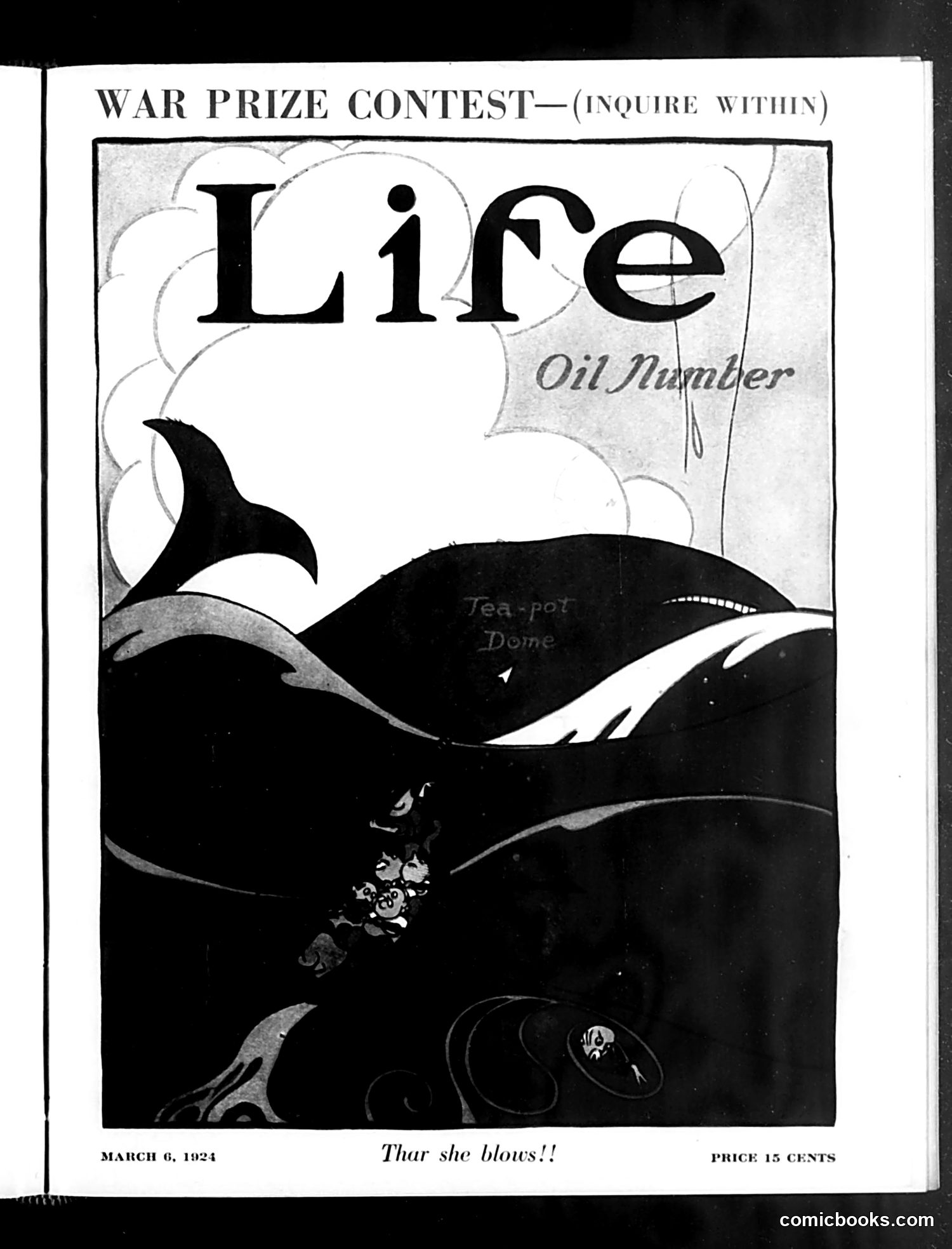
This is a satirical cartoon contest entry titled "Life: Oil Number." The image depicts an underwater scene with a whale spouting oil instead of water, accompanied by text reading "Tea-pot Dome" and the tagline "Thar she blows!!" The cartoon references the **Teapot Dome Scandal**, a major 1920s corruption affair where Interior Secretary Albert Fall secretly leased federal oil reserves (including Wyoming's Teapot Dome field) to private oil companies in exchange for bribes. The whale-as-oil-geyser is a pun on whale hunting imagery ("thar she blows"), treating the scandal as a resource to be exploited. The satire mocks both the scandal itself and the government's role in facilitating private profit from public resources.
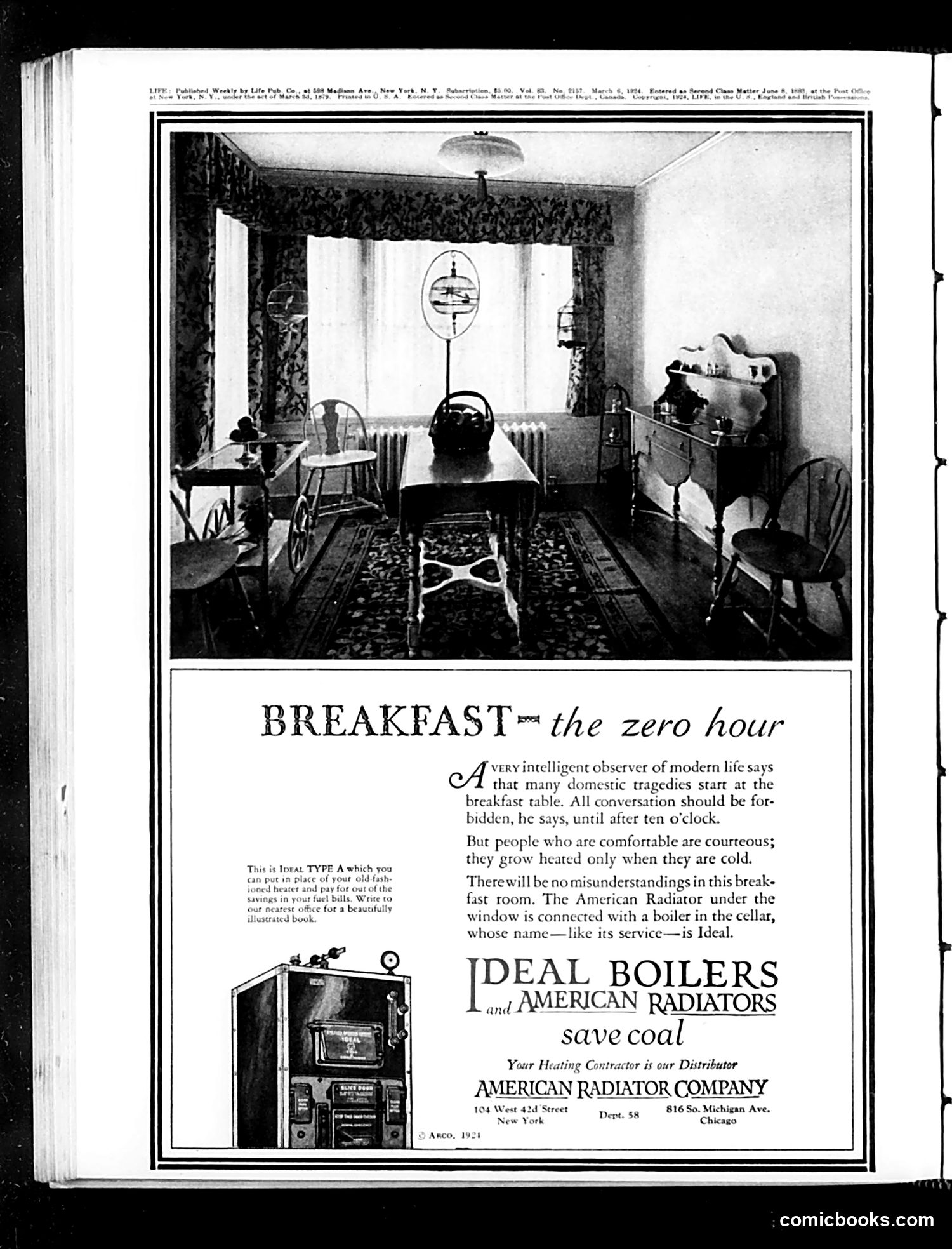
This is primarily an advertisement for Ideal Boilers and American Radiators, not a political cartoon. The ad uses a domestic scene—a bedroom with a sleeping child and radiator—to market heating systems. The satirical element is minimal but present in the headline "BREAKFAST—the zero hour," which references an observer's claim that family conflicts originate at the breakfast table. The ad argues that comfortable homes (kept warm by their radiator system) prevent such "domestic tragedies" because "people who are comfortable are courteous; they grow heated only when they are cold." This is 1920s advertising copy using gentle humor and social commentary to sell heating equipment by linking domestic harmony to temperature control.
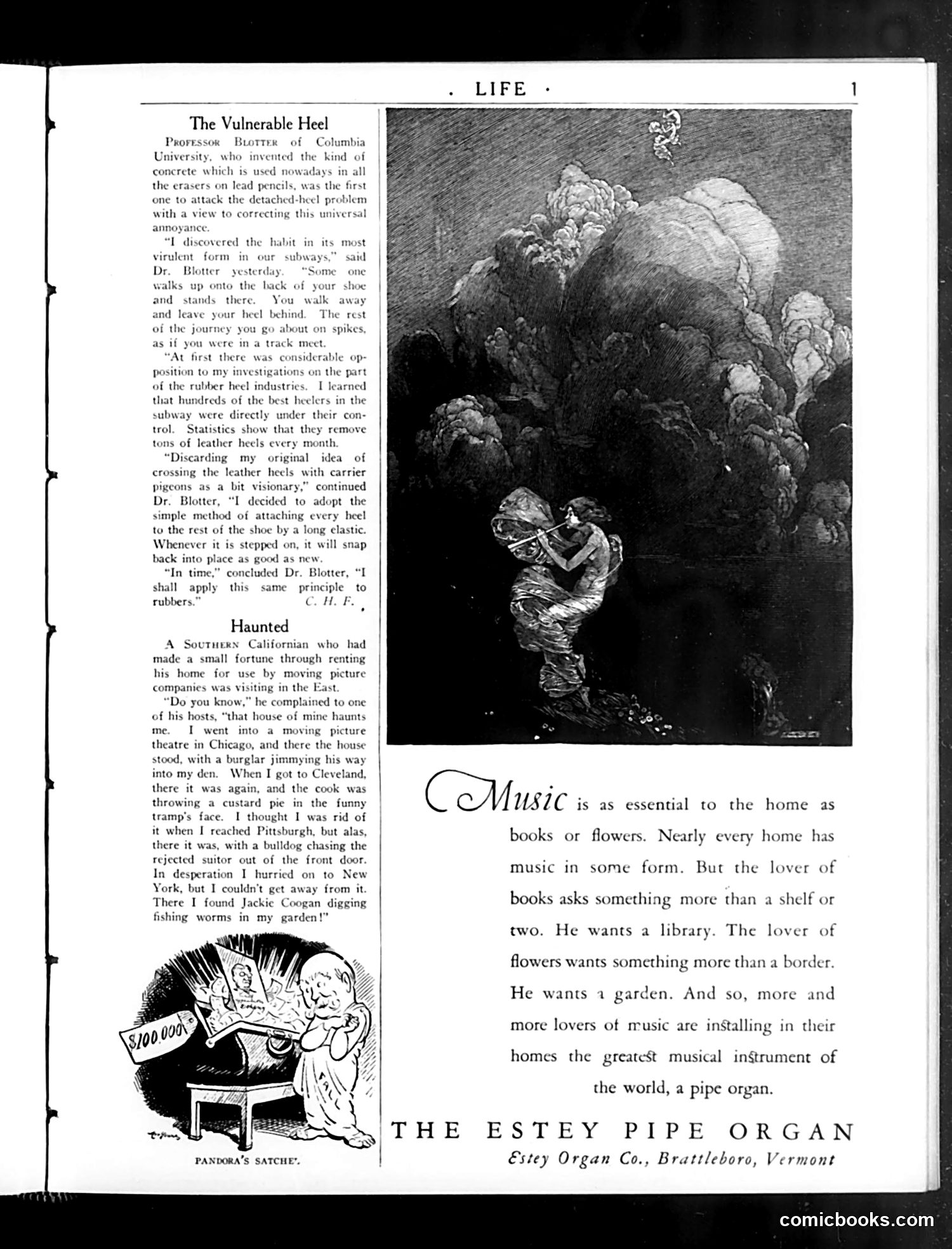
This small cartoon depicts two cherubs or putti opening a large satchel labeled "$100,000," from which money spills out. The caption "PANDORA'S SATCHEL" makes the classical reference explicit. The satire compares the satchel to Pandora's Box from Greek mythology—the vessel that, when opened, released all evils upon humanity. Here, the joke inverts the myth: instead of releasing troubles, opening this satchel releases vast sums of money ($100,000 was an enormous sum in the early 20th century). The cartoon likely mocks either sudden wealth, get-rich-quick schemes, or the notion that finding large amounts of money is somehow dangerous or corrupting—a cautionary tale dressed as a seemingly fortunate discovery. The accompanying story "Haunted" supports themes of unexpected, troublesome fortune.
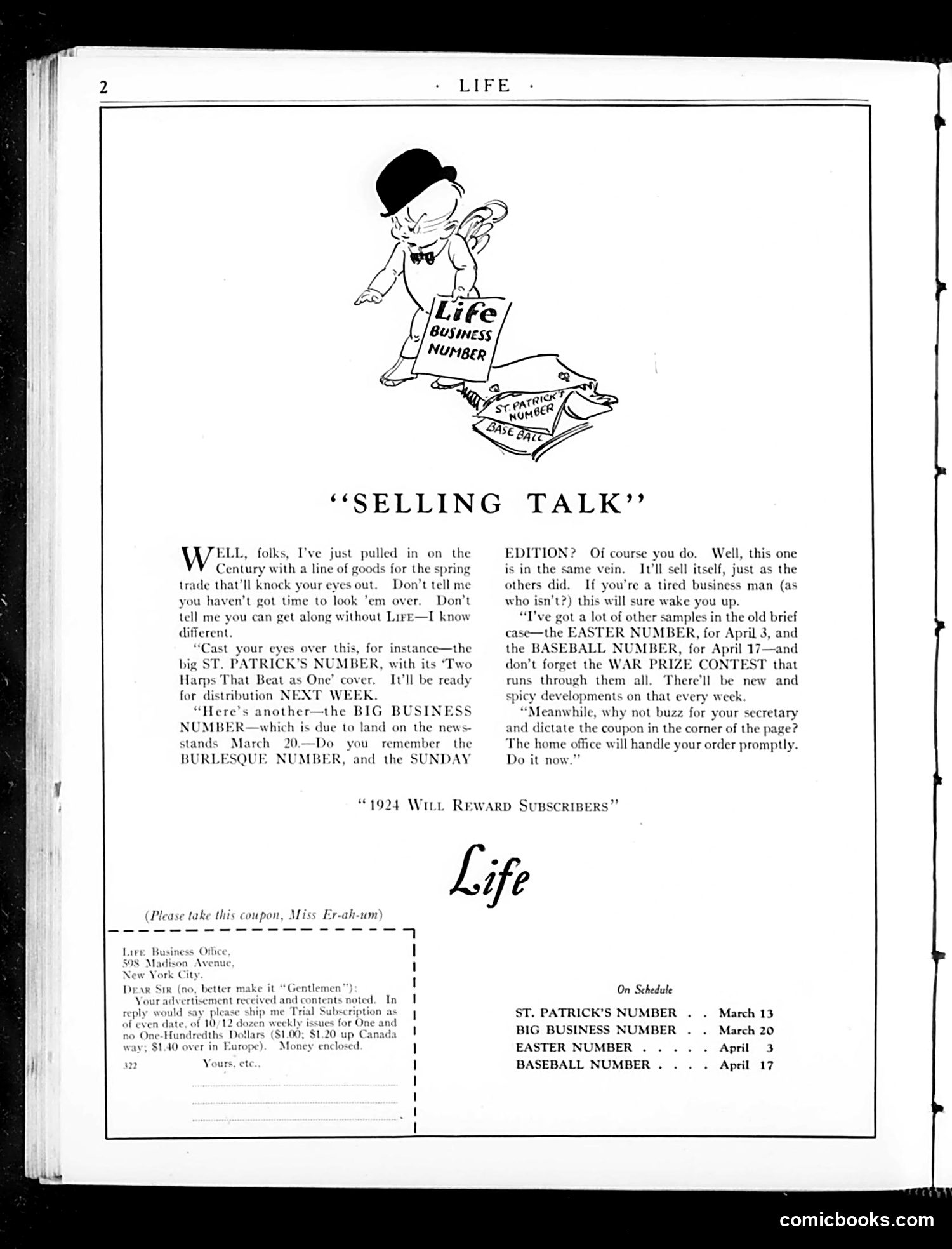
This is primarily a **subscription advertisement** for Life magazine disguised as editorial content. The cartoon depicts a cheerful character in a bowler hat juggling various special issues as sales pitches. The "joke" targets tired business executives by suggesting Life's upcoming numbered special editions—St. Patrick's Number, Big Business Number, Easter Number, and Baseball Number—will "knock your eyes out" with fresh content worth reading despite subscription fatigue. The satire mocks both the magazine's relentless special-edition marketing strategy and the sales-speak ("selling talk") used to convince weary subscribers that yet another themed issue justifies their continued subscription. It's self-aware humor about publication marketing tactics.
This page is primarily **advertising and reader mail**, not political satire. The left side features ads for the Hotel McAlpin in New York and shaving products. The center and right contain reader letters praising Edgeworth tobacco, with one letter from Norfolk, Virginia noting the satisfaction of making/smoking quality tobacco. A small "Neighborhood News Note" discusses neighbors purchasing a car, using gentle humor about changing social dynamics and friendships. The page includes a section titled "Perhaps All Three?" with a light joke about professions (doctor, lawyer, bootlegger), the last referencing Prohibition-era illegal alcohol production—relevant context for the 1920s publication date. Overall, this represents **commercial content and light social humor** rather than political commentary.
This is **not a cartoon or satire page** — it's a **full-page advertisement** for Phoenix Hosiery of Milwaukee. The ad uses ornate Art Deco design with decorative borders and typography typical of early 20th-century magazine advertising. The text emphasizes quality and durability as the foundation of the brand's reputation ("Fame is the by-product of work well done"). The message targets multiple demographics ("men, women and children") and promises products that withstand "outstanding elegance and long-mileage endurance." This reflects the commercial concerns of the era: hosiery was a significant consumer product, and durability claims were a major selling point before synthetic fabrics became common. There is no political satire or social commentary here—simply branded commercial messaging placed in *Life* magazine's pages.
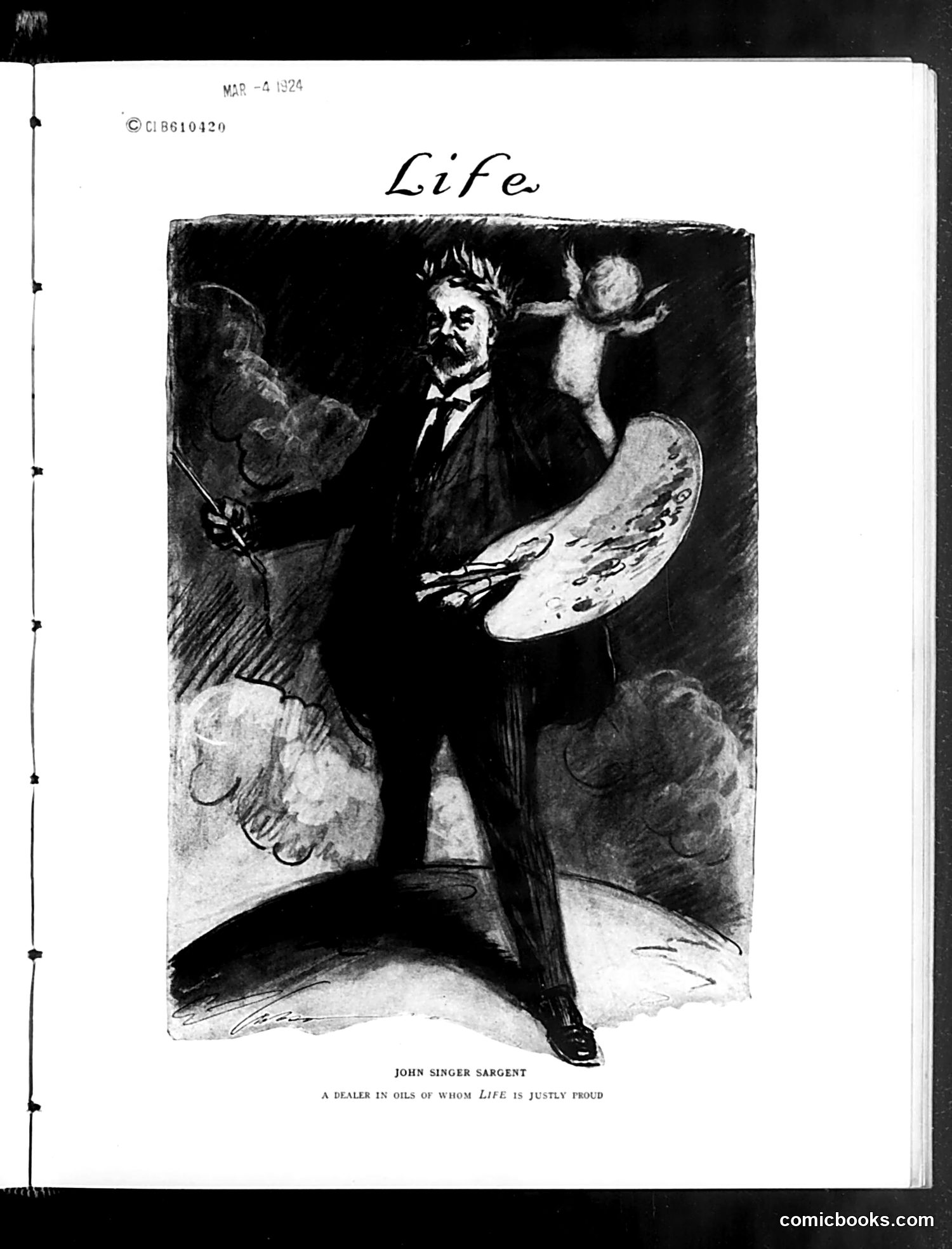
This is a title page or cover featuring a satirical illustration of **John Singer Sargent**, the famous American portrait painter. The caption reads: "A Dealer in Oils of Whom Life is Justly Proud." The cartoon depicts Sargent as an artistic figure surrounded by cherubs and holding a painter's palette, presenting him as a master of his craft. The pun on "dealer in oils" plays on both his profession (painting in oils) and suggests he's a commercial success. The date stamp shows **MAR -4 1924**, placing this in Life's early period as a satirical weekly. The illustration celebrates Sargent's prominence in American art and culture of the era, though the "justly proud" caption suggests gentle mockery of either his self-importance or American pride in his accomplishments.
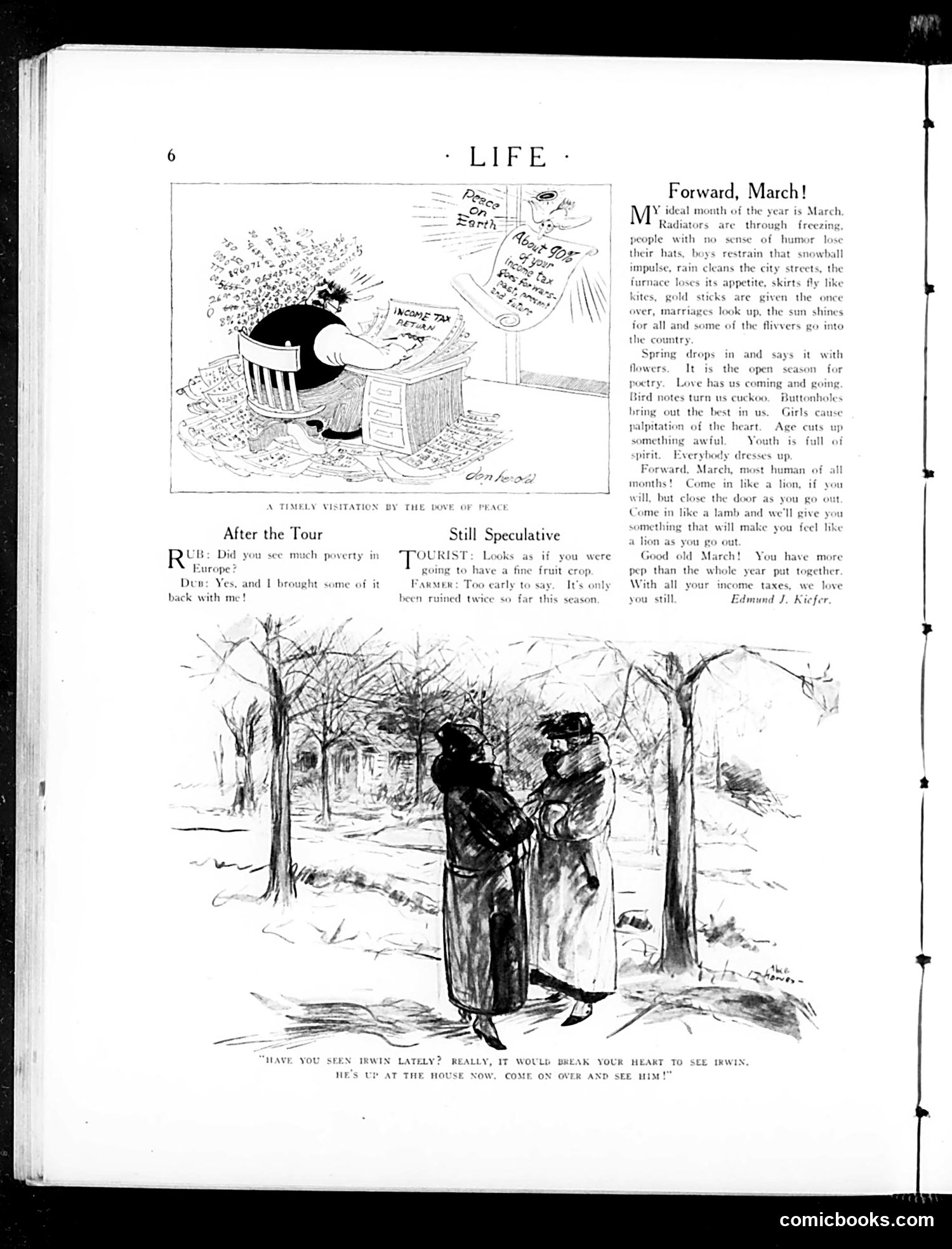
This page contains three distinct pieces: 1. **"A Timely Visitation by the Dove of Peace"** (top): A satirical cartoon showing a figure buried under papers labeled with various taxes and financial obligations. The "dove of peace" ironically dumps more burdens on them, suggesting post-WWI economic hardship and taxation were considered oppressive rather than peaceful. 2. **"After the Tour"** (left dialogue): A conversation about European poverty, likely referencing post-war European conditions that American tourists witnessed. 3. **"Still Speculative"** (right dialogue): Discusses fruit crop prospects, typical agricultural speculation. 4. **"Forward, March!"** (right column): An editorial celebrating March's arrival and spring's renewal, with poetic language about youth and new beginnings—standard seasonal magazine fare. The page primarily addresses post-war economic anxiety through satire.
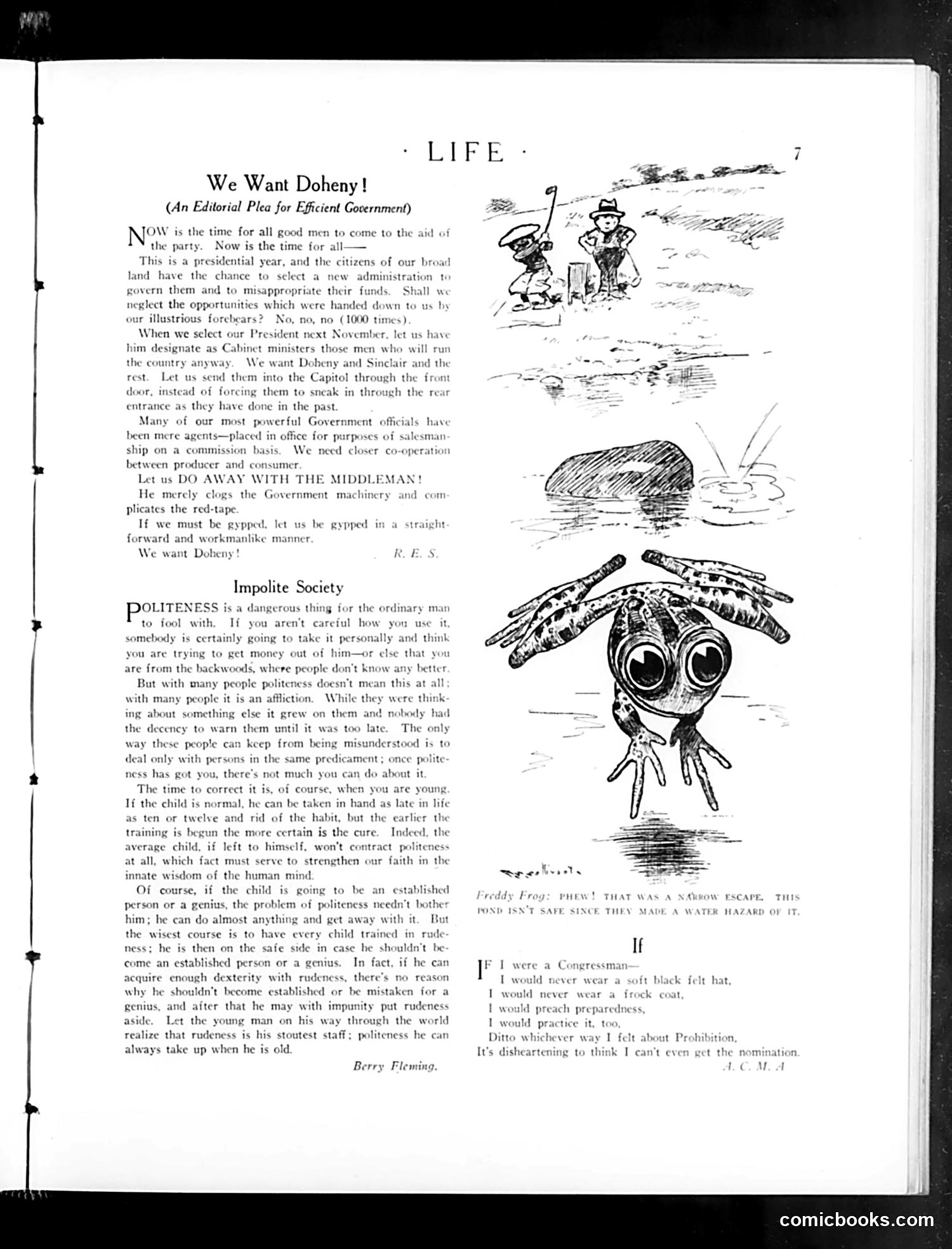
This editorial cartoon critiques government corruption and inefficiency. The headline "We Want Doheny!" appears to reference Edward Doheny, an oil magnate involved in the Teapot Dome scandal of the early 1920s—a major corruption case where government officials secretly leased federal oil reserves to private interests. The editorial argues for selecting competent Cabinet members and eliminating "middlemen" in government. It mocks how officials operate on commission-based salesmanship rather than public service, suggesting the government has become a corrupt apparatus serving private wealth. The cartoon illustrations (showing absurd creatures and scenarios) reinforce the satirical tone that current governance is ridiculous and needs reforming through selecting honest, straightforward leaders like "Doheny and Sinclair"—likely sarcastically naming the very figures implicated in corruption scandals.
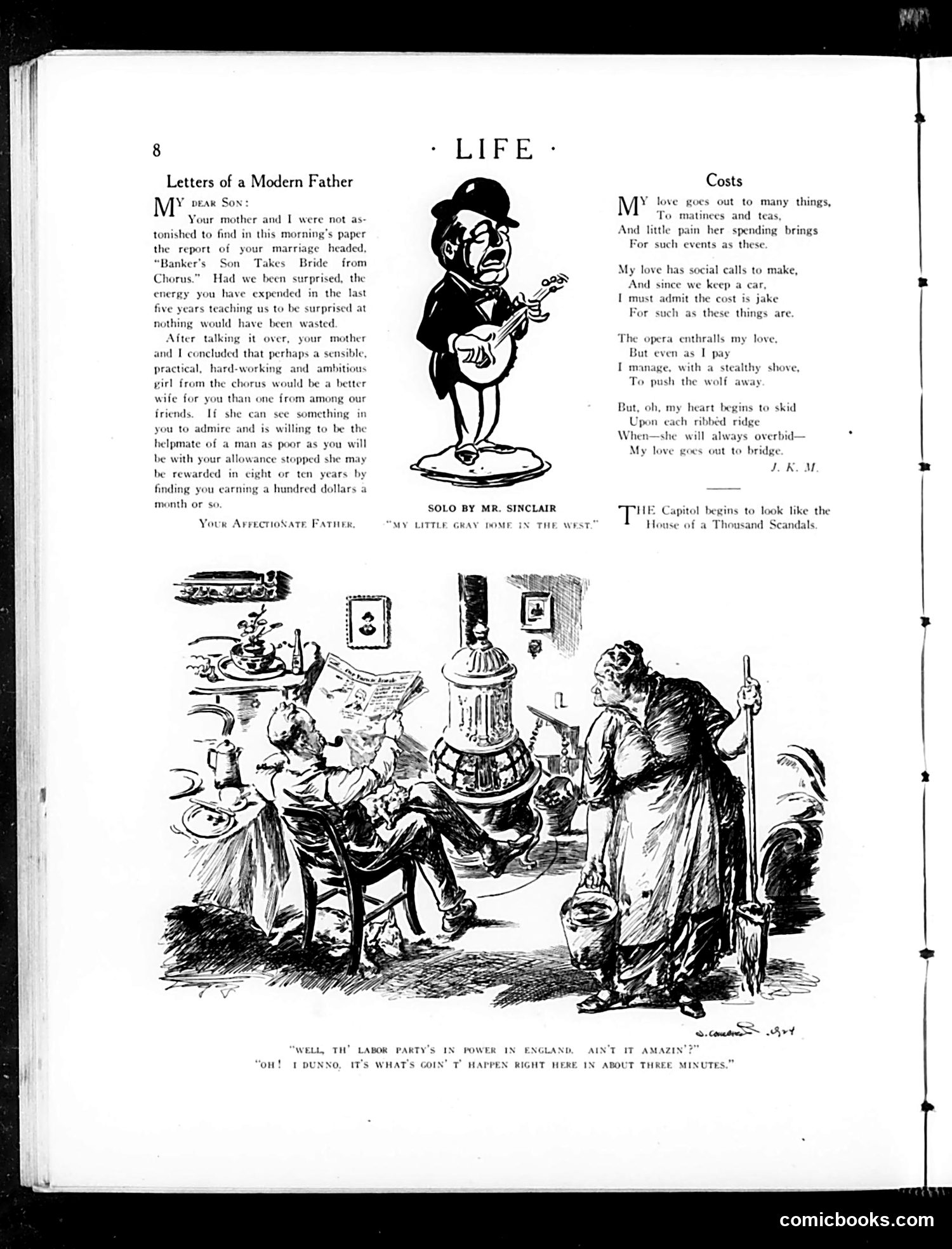
This page contains three distinct pieces: 1. **"Letters of a Modern Father"**: A letter advising a son that marrying a practical, hardworking woman would be better than marrying someone wealthy. The writer suggests the son will be rewarded financially within 8-10 years. 2. **"Costs"** (poem by J.K.M.): A wife's lament about her husband's complaints regarding her spending on social events, opera, and a car—portraying the tension between a wife's desires and a husband's financial concerns. 3. **Lower cartoon**: Depicts chaos in what appears to be a domestic or governmental setting, with the caption referencing "the Labor Party's in power in England" and something happening "in about three minutes." This likely satirizes British Labour Party politics and concerns about rapid social/economic change, though the specific historical moment is unclear without a date.
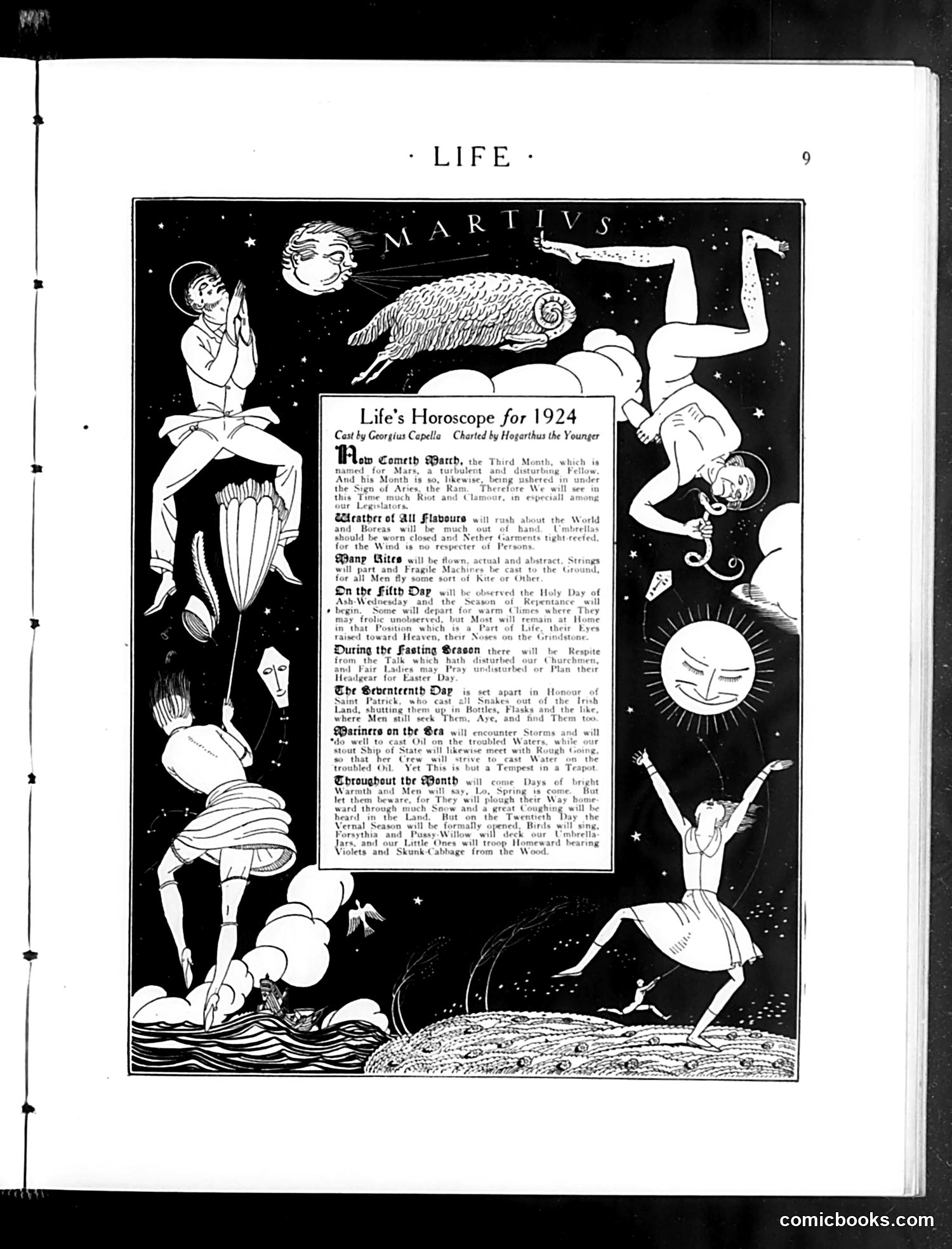
This is a satirical horoscope illustrated with Art Deco-style figures floating in a starry cosmos. The central text, credited to George Capella and illustrated by Hazeltine, provides "predictions" for various astrological signs and events throughout 1924. The horoscope references specific 1924 concerns: the Third Month (Mars), Easter observances, fasting seasons, and spring planting. It contains whimsical advice about winds, storms, and seasonal activities mixed with tongue-in-cheek social commentary typical of *Life* magazine's satirical style. The decorative border features stylized human figures in playful poses—acrobats, dancers, and cherubs—rendered in the geometric, modernist aesthetic popular in 1920s illustration. Rather than mocking specific political figures, this piece gently satirizes popular belief in astrology through elaborate pseudo-astrological predictions.
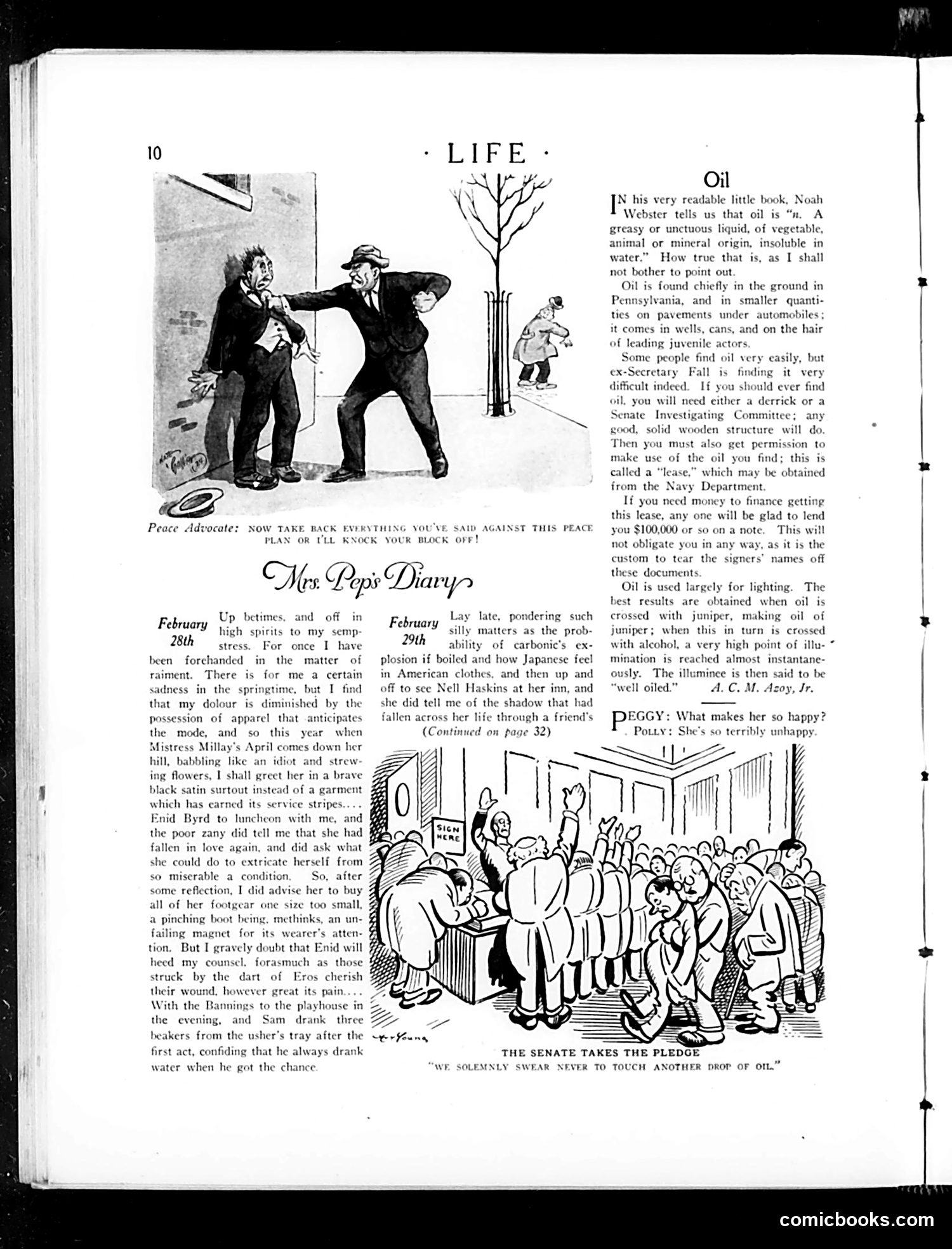
The top cartoon depicts two men in suits arguing over oil rights, with one threatening violence ("I'LL KNOCK YOUR BLOCK OFF!") if the other won't accept a "peace plan." This satirizes post-WWI petroleum diplomacy and corporate/government conflicts over oil resources. The lower cartoon shows the U.S. Senate collectively taking a pledge: "WE SOLEMNLY SWEAR NEVER TO TOUCH ANOTHER DROP OF OIL." This mocks Senate hypocrisy—likely referencing the Teapot Dome scandal (1921-1923), where senators secretly profited from oil leases while publicly opposing oil development. The cartoon ridicules their false promises of ethical conduct regarding natural resource exploitation. Both images critique corruption and dishonesty in post-war American politics and business.
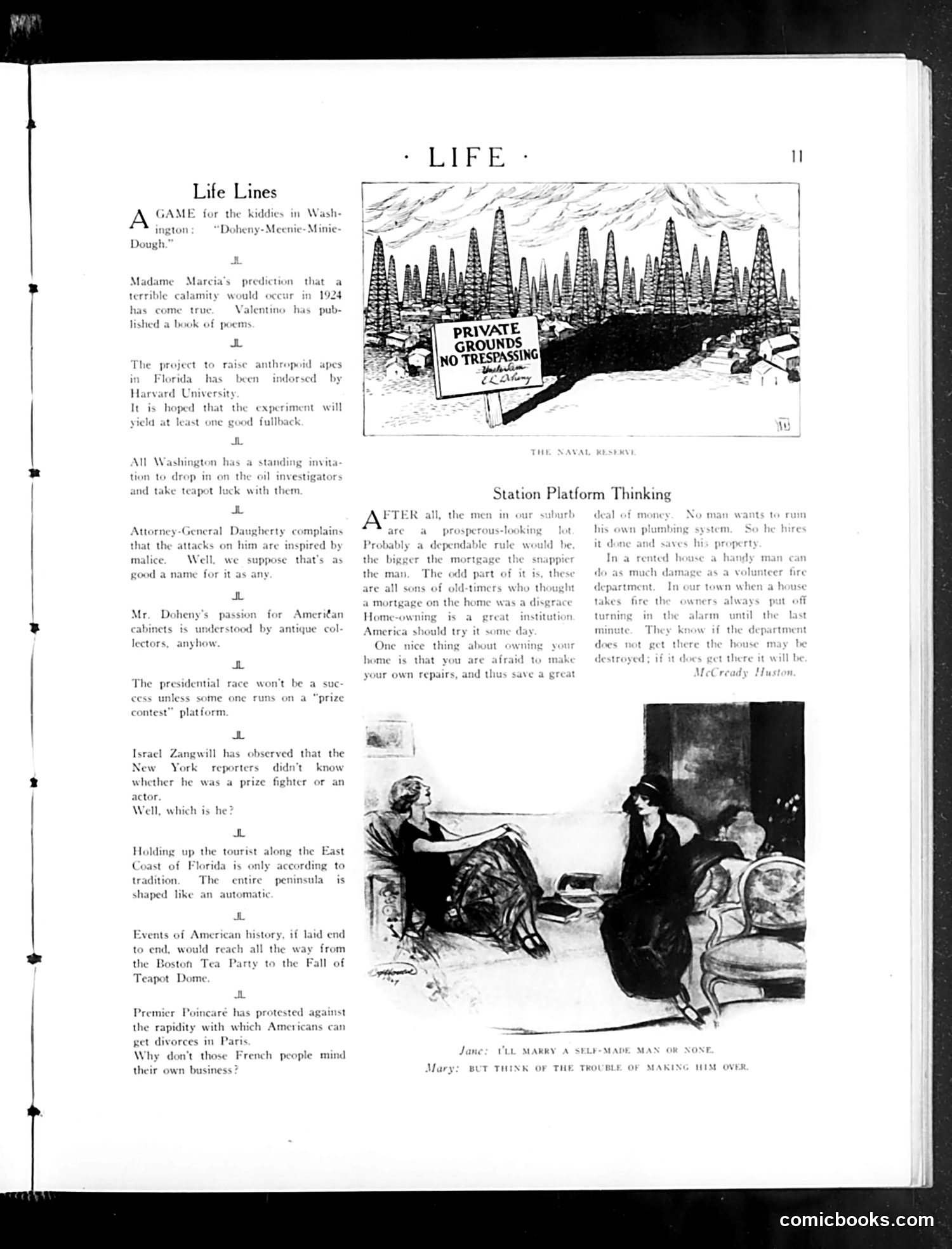
This cartoon satirizes wealthy property owners' exclusive land practices. The image shows a pristine forest landscape dominated by a "PRIVATE GROUNDS / NO TRESPASSING" sign, labeled "THE NAVAL RESERVE" below. The satire targets the contrast between public rhetoric about national resources and private appropriation of them. The "Naval Reserve" designation suggests government or military ownership, yet the prominent trespassing sign emphasizes private control and exclusion—likely mocking wealthy individuals or corporations who claim public interest while denying access to valuable land. The cartoon critiques how nominally "public" or strategically important lands become effectively privatized through ownership or control by the wealthy, preventing ordinary citizens from enjoying or benefiting from these resources.
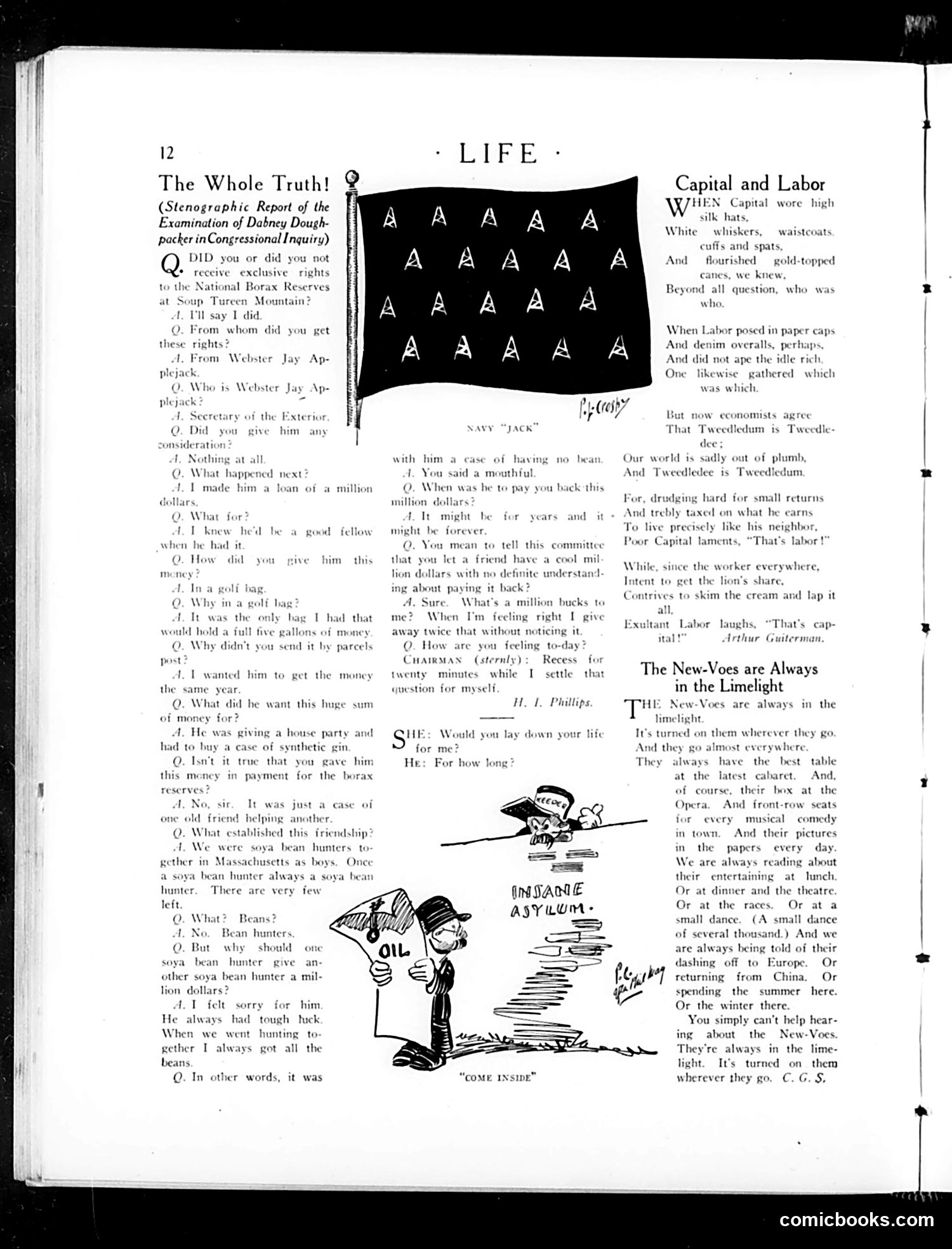
This page contains two distinct items: **"The Whole Truth!"** is a stenographic transcript of Congressional testimony by Dabney Doughpocket regarding National Forest Reserves at South Teton Mountain. The Q&A format satirizes the evasiveness of wealthy industrialists testifying before Congress—Doughpocket consistently deflects questions about giving money to politicians and receiving favorable treatment, claiming ignorance or reframing self-dealing as mere friendship. The joke mocks how the wealthy use vague language to obscure corruption. **The cartoons** (showing figures labeled "INSANE ASYLUM" and "OIL") appear to lampoon industrial exploitation and the mental gymnastics required to justify it. **"The New-Voes are Always in the Limelight"** is brief commentary praising a theatrical troupe's constant public visibility. The page satirizes Gilded Age corporate influence on government.
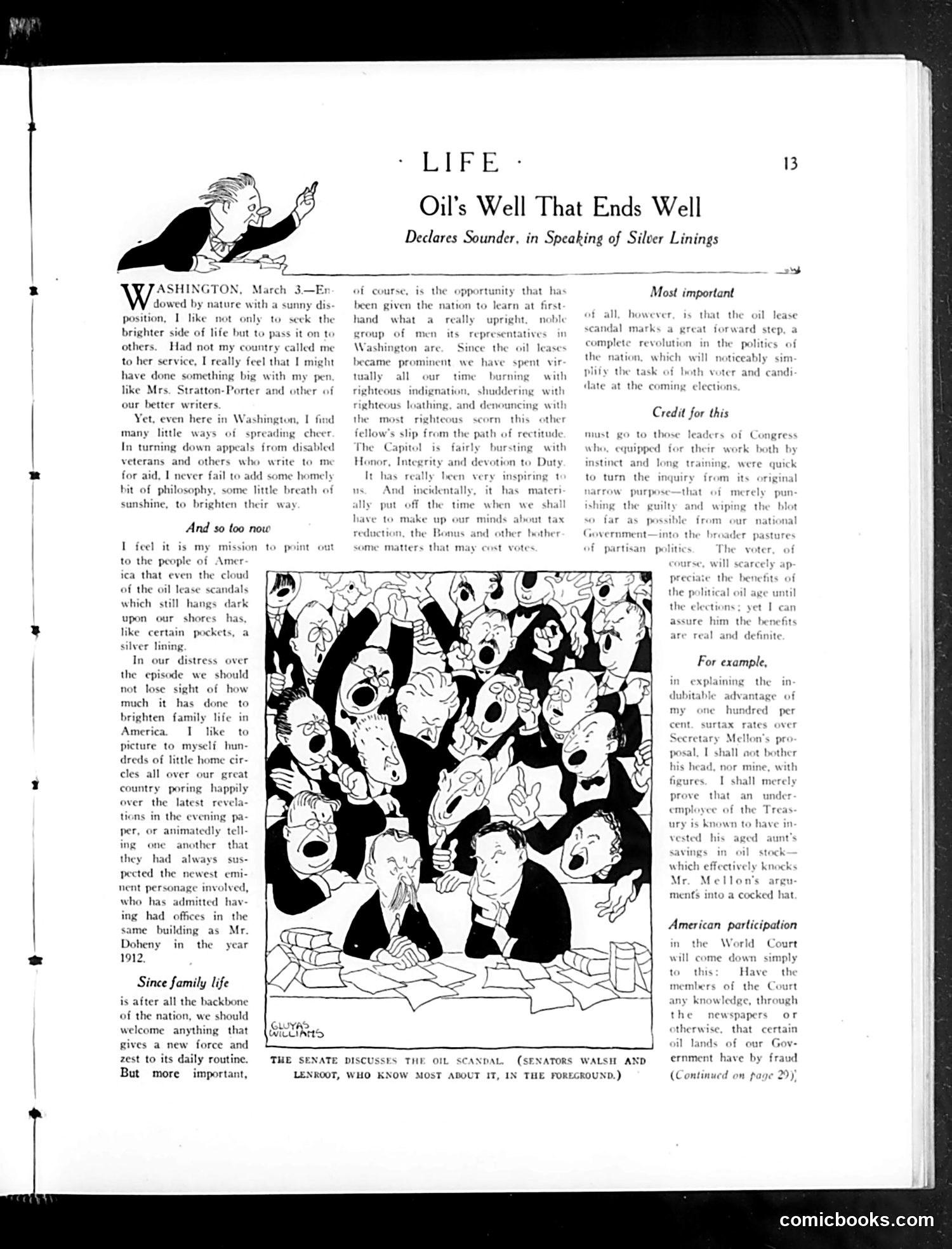
This *Life* magazine article satirizes the **oil lease scandal** affecting the Harding administration (circa 1921-1923, based on the March 3 Washington dateline reference). The central cartoon depicts senators in heated debate, with the caption identifying **Senators Walsh and Lenroot** as key figures "who know most about it." The crowded, chaotic drawing emphasizes the scandal's contentious nature. The text discusses oil leases on government land and suggests certain congressional leaders may have profited fraudulently. The author argues for transparency while praising those investigating the corruption—a clear reference to the **Teapot Dome scandal**, where oil reserves were secretly leased to private interests. The "silver lining" is that such scandals expose governmental wrongdoing and strengthen democratic accountability.
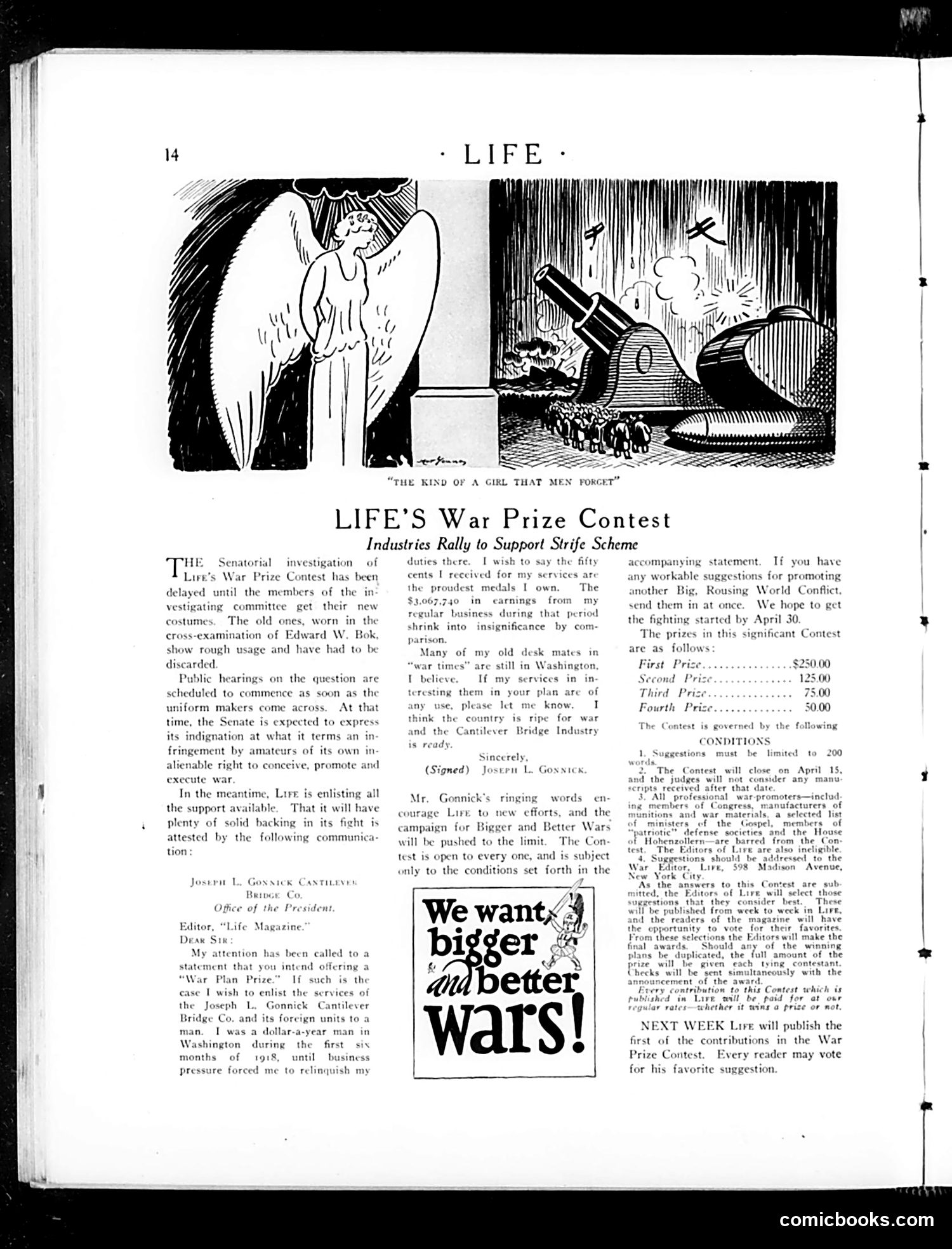
This page announces Life Magazine's "War Prize Contest," soliciting public suggestions for bigger and better wars. The satirical premise is explicit: a large advertisement declares "We want bigger and better wars!" The cartoon at top left depicts an angelic figure, captioned "The Kind of a Girl That Men Forget," contrasted with a right panel showing military equipment (cannon, aircraft). The juxtaposition sarcastically suggests that while romantic ideals are abandoned during wartime, weapons manufacture flourishes. The contest invites readers to submit war-related ideas, offering cash prizes ($250 down to $5). This is dark satire mocking American industrial enthusiasm for warfare and the business interests profiting from conflict. The piece appears to critique both militarism and the corporate machinery supporting it, published during the World War I era when such satire was common in Life's editorial stance.
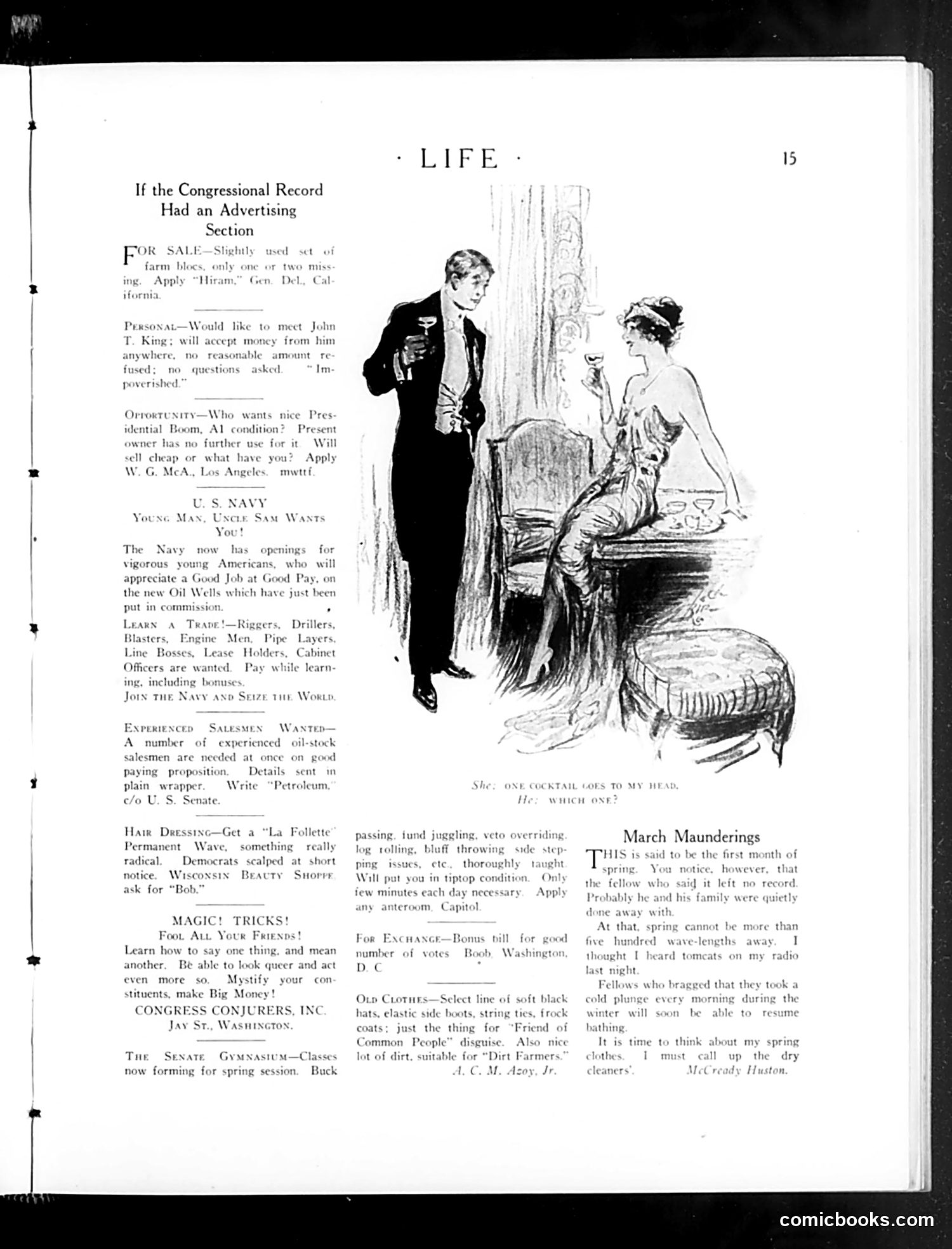
This page contains a satirical cartoon and period advertisements. The main illustration shows a well-dressed man in formal attire standing beside a woman seated at a desk or table, with the caption "She: one cocktail goes to my head. He: which one?" **The Satire:** This is a joke about Prohibition-era drinking. The woman claims alcohol affects her quickly, but the man's question implies she's actually had multiple cocktails—mocking either her denial or her capacity. The cartoon satirizes the hypocrisy of the Prohibition era, when Americans openly flouted alcohol bans while maintaining pretenses of sobriety. **Context:** Published during or shortly after Prohibition (1920-1933), this reflects how widespread illegal drinking was, even among respectable middle-class Americans depicted here in formal settings. The surrounding text consists of classified advertisements for various services and goods.
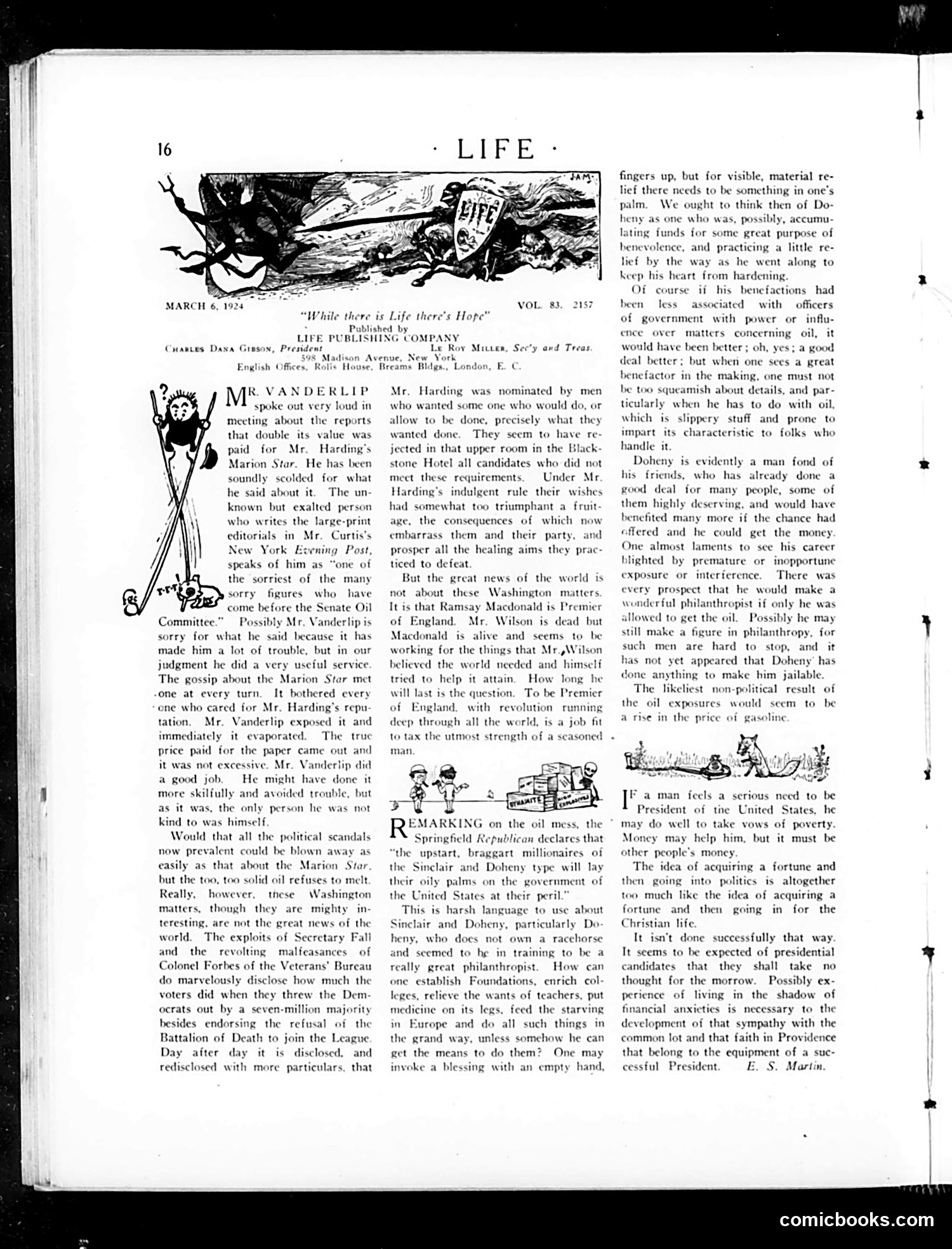
This page discusses the Teapot Dome scandal era of the Harding administration. The main editorial defends Frank Vanderlip, a banker who publicly challenged inflated reports about President Harding's purchase of the *Marion Star* newspaper. Though Vanderlip faced criticism from establishment figures (notably the *New York Evening Post*), the editor argues he performed a public service by exposing and deflating the gossip—the truth proved the price was reasonable. The piece sarcastically notes that scandals involving Secretary of Interior Albert Fall and Veterans Bureau chief Colonel Forbes have similarly "disclose[d]" voter mistakes in rejecting Democrats by a seven-million majority. It contrasts these Washington embarrassments with international optimism about Ramsay MacDonald becoming Britain's first Labour Prime Minister. A secondary editorial defends oil magnate Harry Sinclair and Harry Doheny against accusations they'll "lay their oily palms on the government," sarcastically questioning how philanthropists can fund foundations without money.
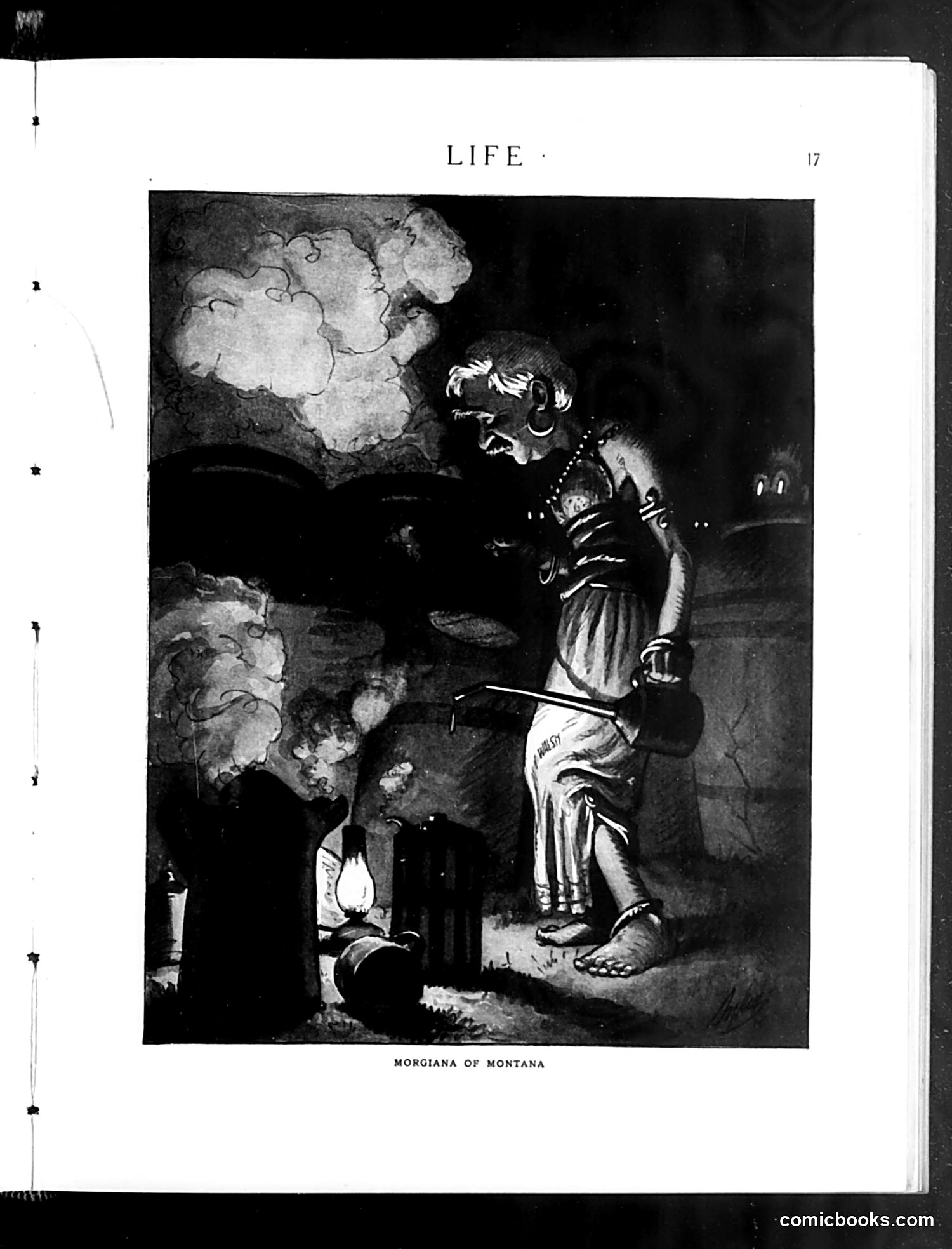
This illustration depicts a dramatic scene likely referencing a historical or literary figure. The caption "Morgiana of Montana" suggests a female character from the American West, possibly alluding to a real person or fictional archetype. The image shows a woman in period clothing with an exaggerated facial expression, holding what appears to be a sword or large blade, confronting or threatening male figures whose grotesque heads appear above her. The theatrical, melodramatic style is typical of Life magazine's satirical approach. Without additional context from the magazine's publication date or surrounding text, the specific political or social satire remains unclear. The image may mock either the woman's character or those she opposes, but the precise target and meaning would require knowing the historical moment and any accompanying article or editorial commentary.
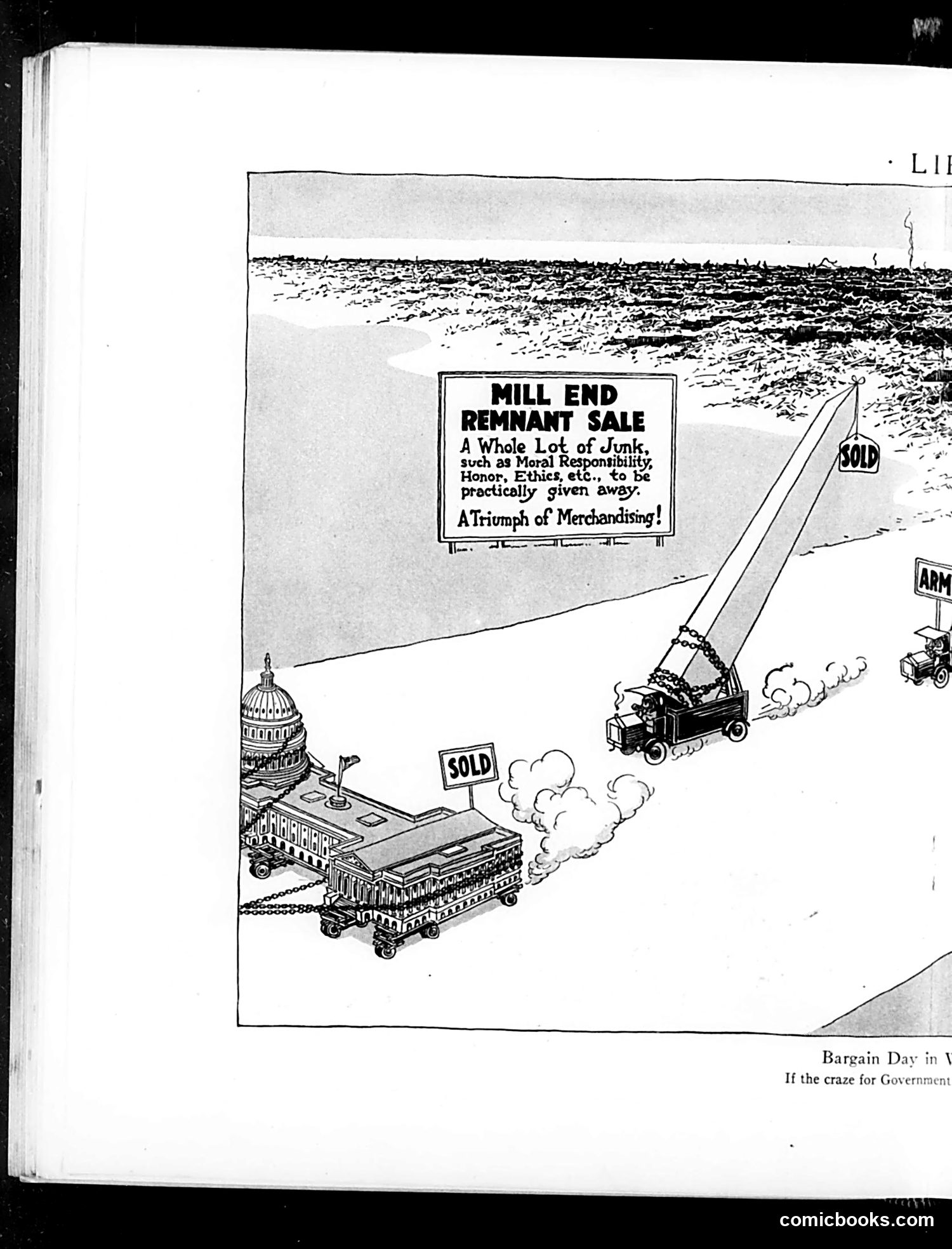
This satirical cartoon depicts government assets being auctioned off as a "Mill End Remnant Sale." The Capitol building is shown on a moving platform labeled "SOLD," alongside what appears to be the Washington Monument on another truck, also marked "SOLD." The satire mocks the liquidation of American governmental institutions and values—the sale advertises "Moral Responsibility, Honor, Ethics, etc., to be practically given away," suggesting the government is disposing of its principles for profit. The phrase "A Triumph of Merchandising!" drips with irony. The cartoon likely critiques either post-WWI disarmament, government downsizing, or political corruption of its era. Without a visible date, the exact historical moment is unclear, though the style suggests early-to-mid twentieth century. The barren landscape emphasizes the bleakness of this "bargain day."
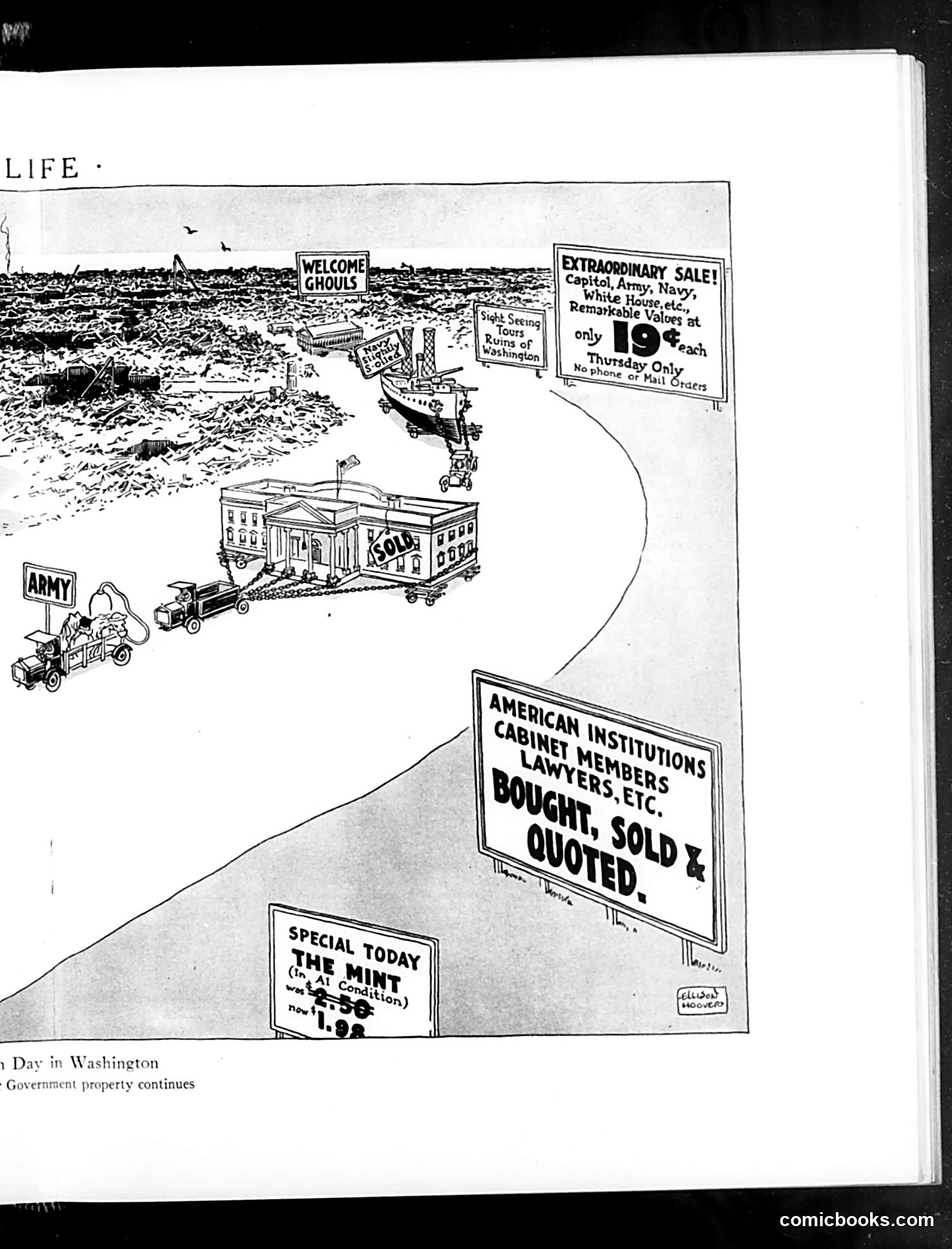
This satirical cartoon depicts the fire-sale of American government property and institutions. The White House is labeled "SOLD," being auctioned off alongside the Capitol and other federal buildings. Signs advertise these assets at bargain prices (19¢ each) to "Welcome Ghouls" and offer "Extraordinary Sales." The cartoon critiques the apparent selling-off or dissolution of government institutions—possibly referencing corruption, mismanagement, or political upheaval during an unspecified crisis. The "ruins of Washington" reference and inclusion of Army/Navy/White House merchandise suggests satire about either post-war asset liquidation or perceived government collapse. Without the publication date visible, the exact political moment is unclear, though the style suggests early-to-mid 20th century.
This is a theater criticism page reviewing the play "Beggar on Horseback" by Kaufman and Connelly. The critic praises the production as remarkably funny and artistically ambitious, despite acknowledging that satirical attacks on "Business Bunk" and commercialism aren't entirely novel. The review highlights **Roland Young** as the young musician lead, praising his nuanced performance through an extended Freudian dream sequence (lasting from 8:30 to 11 p.m.). It also commends **George Barbier** in a trial scene and mentions a pantomime designed by **Deems Taylor**. The piece notes the play's satirical target: the smug materialism and conformity of modern American civilization—"business efficiency, literary standardization, artistic streetwalking." A mock newspaper distributed between acts receives particular praise. The satire aims at 1920s American consumer culture and corporate conformity, positioning the play as culturally significant despite derivative elements.
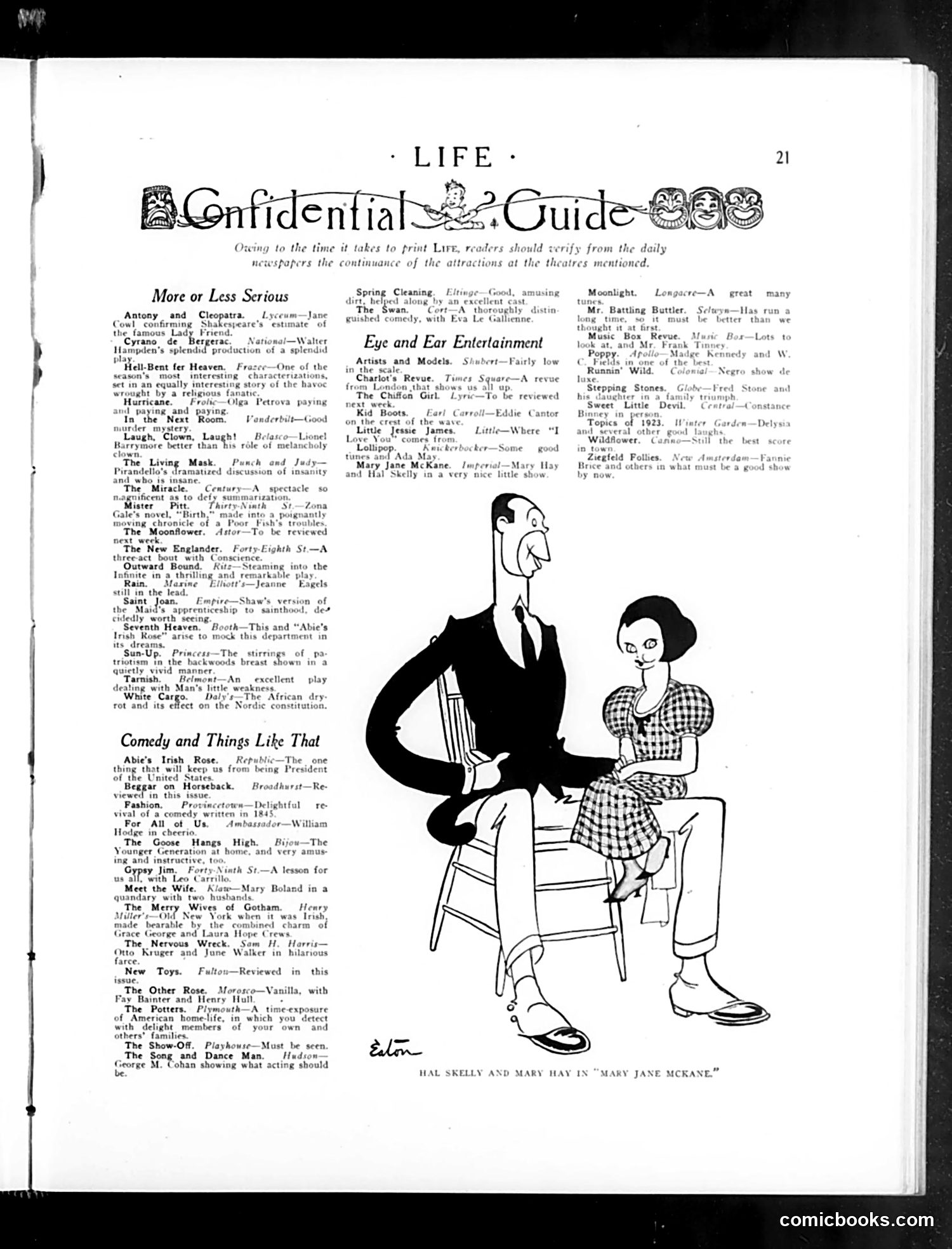
This page is a **theater guide and reviews section** from Life magazine, not a political cartoon. It lists Broadway shows opening that season with brief critical comments. The only illustration shows **Hal Skelly and Mary Hay in "Mary Jane McKane,"** a musical comedy. The cartoon-style drawing depicts a tall, angular man in formal attire sitting beside a woman in a checkered dress—typical vaudeville-era theatrical caricature meant to promote the show. The text reviews are standard theater criticism: praising Eva Le Gallienne's performance in *The Swan*, noting Lionel Barrymore's work in *Laugh, Clown, Laugh*, and recommending shows like George M. Cohan's *The Song and Dance Man*. Several entries note revivals of older comedies and new works exploring social themes (like *Beggar on Horseback* and *Abie's Irish Rose*). This is essentially **period advertising and entertainment journalism**—a snapshot of 1920s Broadway offerings for Life's readers.
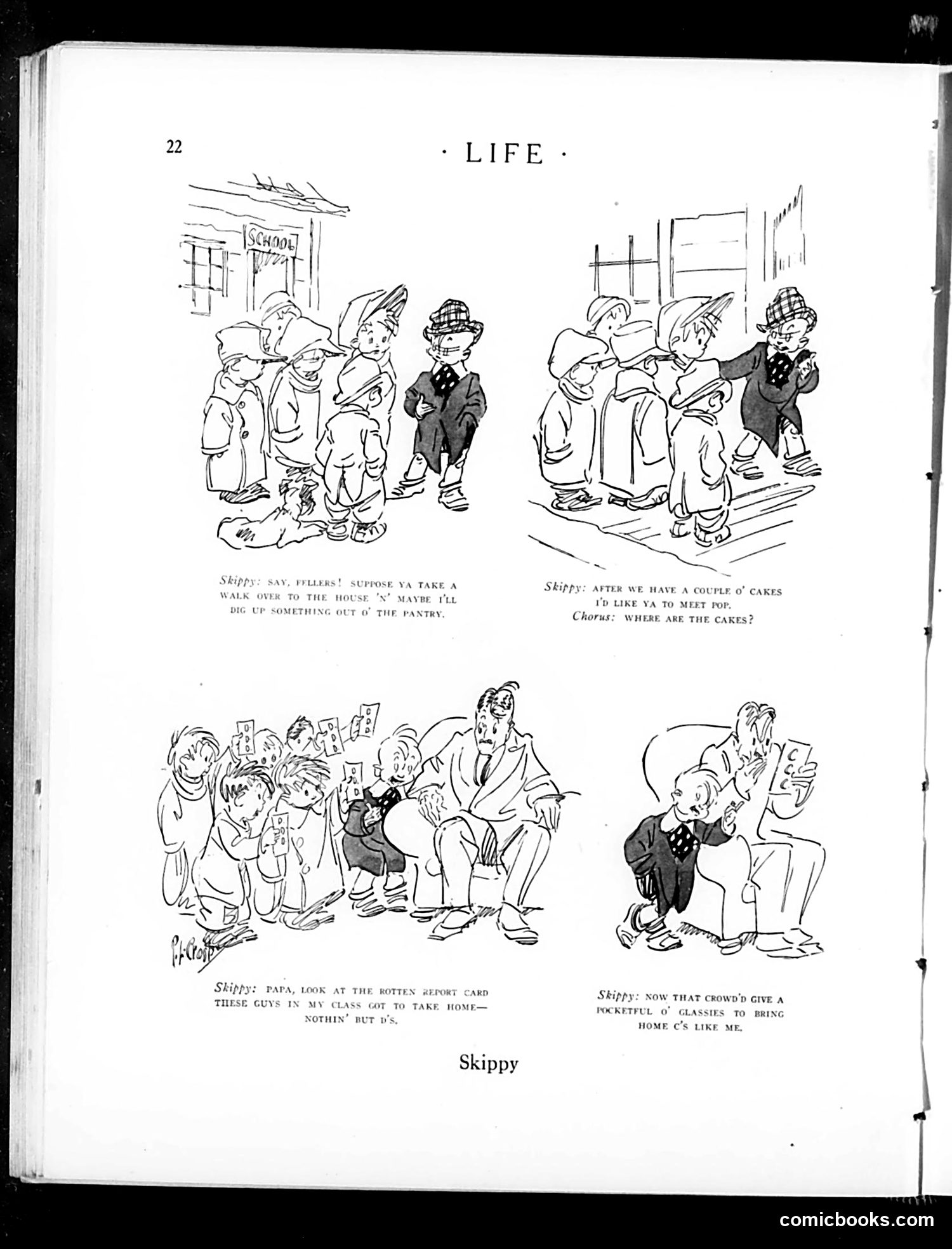
This is a children's comic strip titled "Skippy" depicting a young boy's schemes to obtain cakes. The four panels show: 1. Skippy proposes taking a walk to a neighbor's house to "dig up something out of the pantry" 2. Friends ask where the cakes are 3. Skippy shows his father "rotten" sport cards the boys got, implying they're worthless 4. Skippy fantasizes about a crowd giving him "a pocketful o' glasses" to bring home cakes "like me" The humor relies on Skippy's transparent attempts at manipulation—trying to mooch food while pretending to have obtained valueless items. It's gentle satire of childhood scheming and the universal desire for sweets, with no political content. The strip exemplifies early 20th-century American humor aimed at juvenile readers.
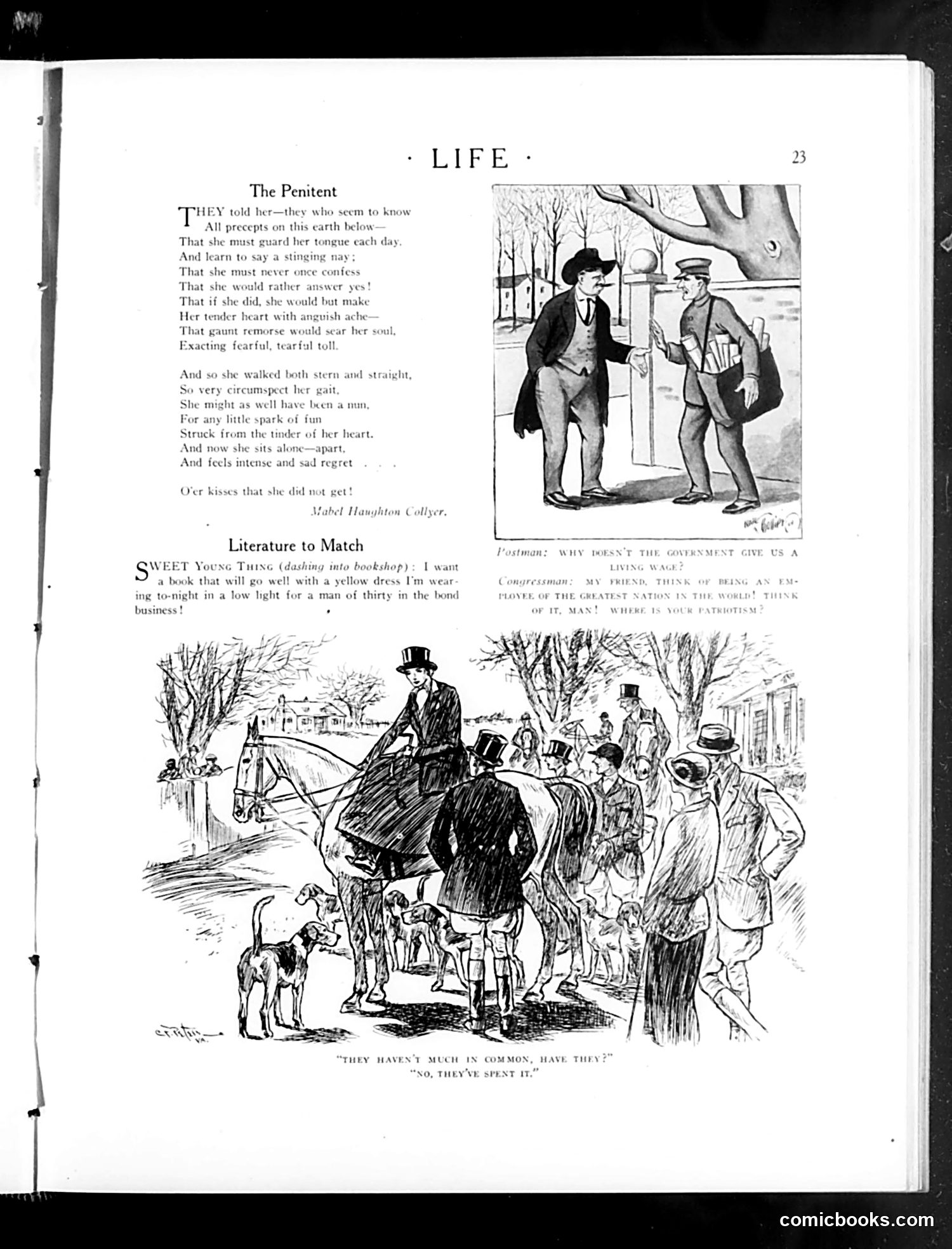
**"The Penitent"** (top): A poem by Mabel Haughton Collyer depicting a woman who resisted romantic advances, now regretfully contemplating the kisses she rejected. The satire targets Victorian courtship anxieties and female restraint—mocking both the strict moral codes women were supposed to follow and their potential regret. **"Literature to Match"** (bottom): A young woman seeks a book to complement her yellow evening dress for a date with a wealthy thirty-year-old man. The punchline—"They haven't much in common, have they? / No, they've spent it"—satirizes both gold-digging dating practices and the superficiality of matching accessories to romantic prospects. The humor suggests the couple shares nothing except his money, which he's already spent. Both pieces satirize courtship customs and female economic dependence in the early 20th century, treating romance as transactional and women's choices as constrained by social and financial pressures.
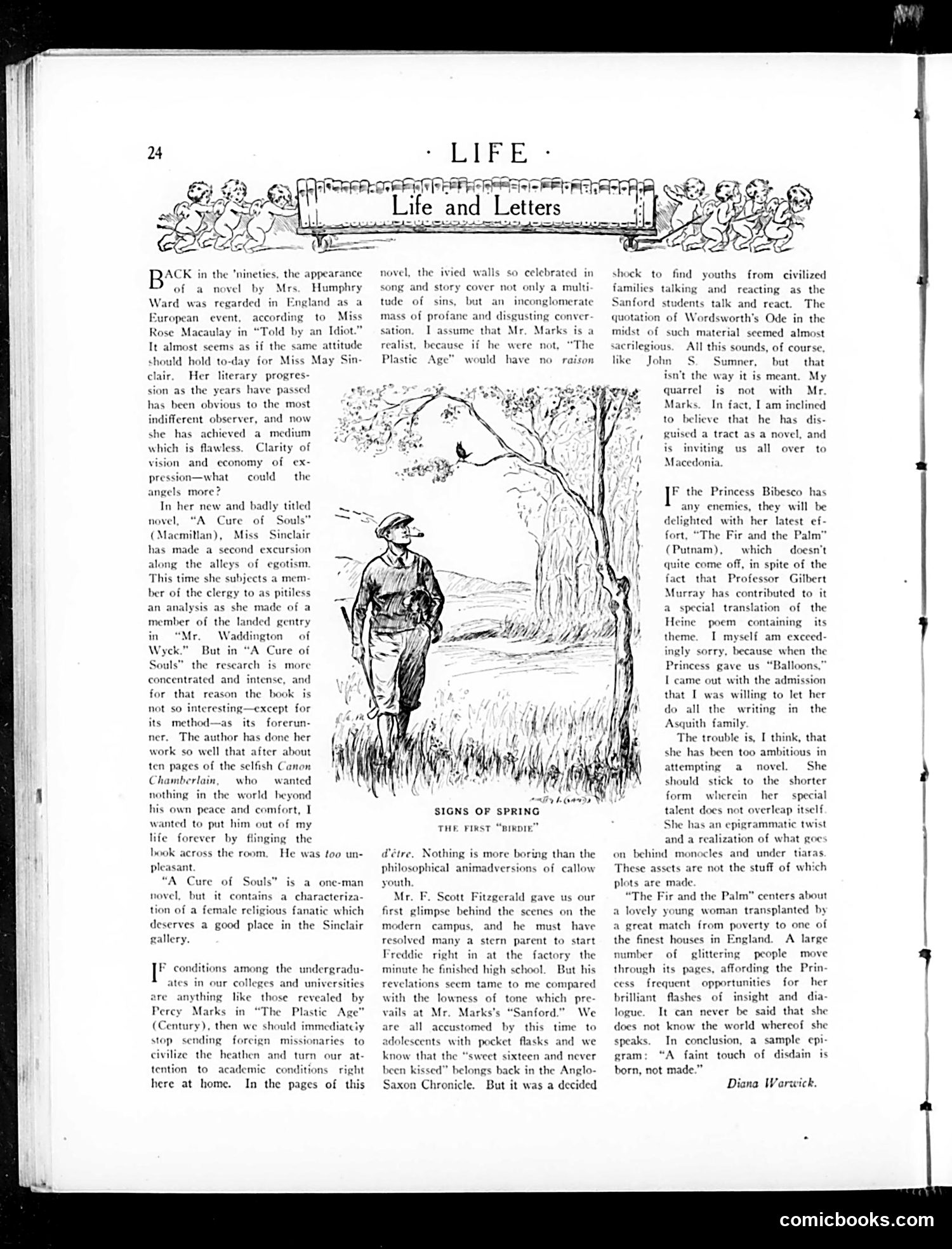
This page reviews contemporary novels, critiquing their literary merit and social commentary. The illustration shows a man walking past a large tree—likely accompanying a review of Percy Marks's *The Plastic Age*, which exposes moral decay at American colleges. The reviewer argues that conditions described in Marks's novel are so scandalous that missionary work should focus on domestic college campuses rather than foreign "heathen." References to "pocket flasks" and permissive student behavior reflect post-Prohibition era concerns about youth morality. The comparison to F. Scott Fitzgerald's earlier campus novel suggests *The Plastic Age* goes further in depicting depravity. Reviews also cover May Sinclair's *A Cure of Souls* and Princess Bibesco's *The Fir and the Palm*. The tone is literary-critical rather than political, offering middlebrow cultural commentary typical of Life's audience during the Jazz Age.
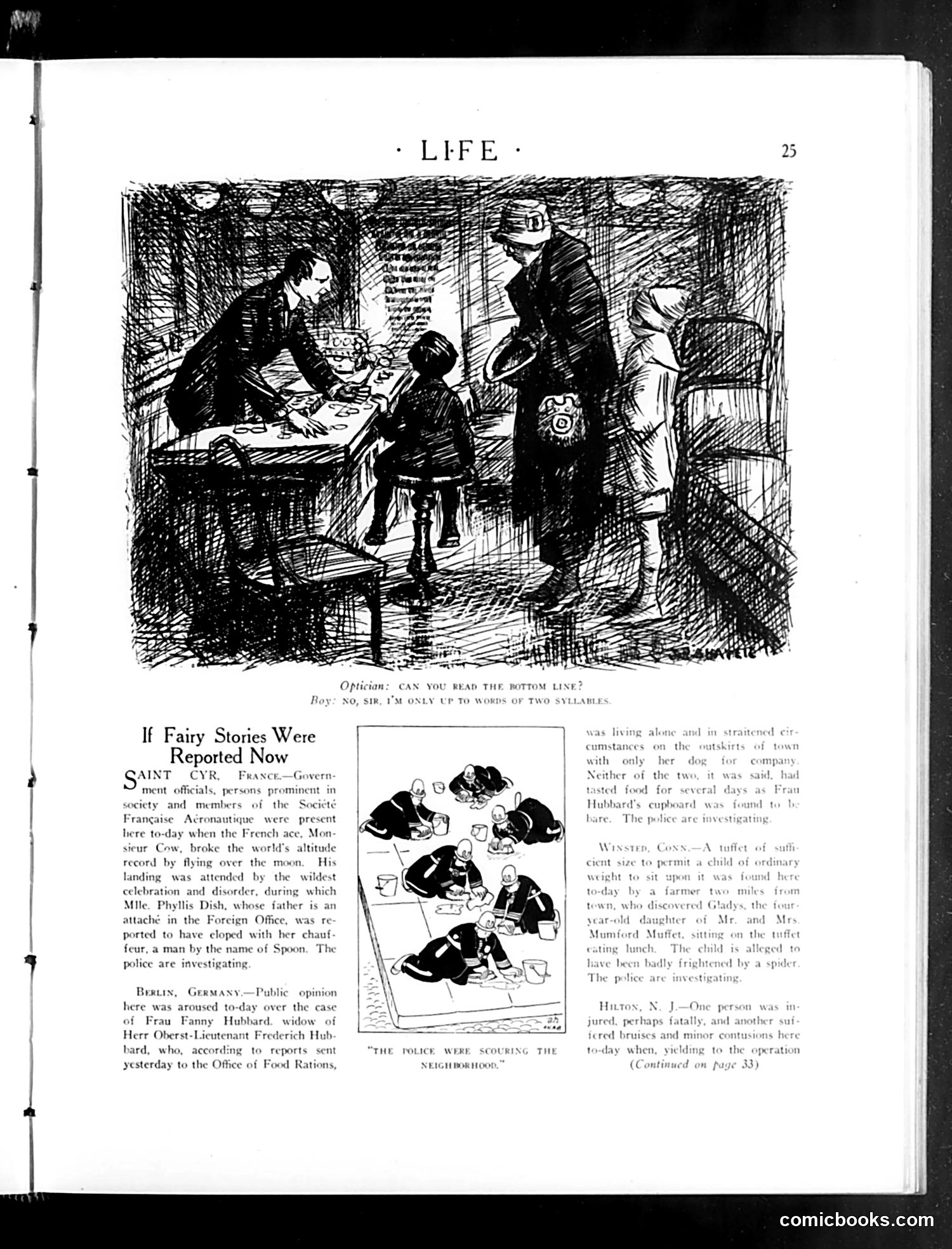
This page satirizes how fairy tales would sound if reported as modern newspaper crime blotters. The top cartoon shows an eye doctor's examination joke—a boy admitting he can only read two-syllable words, undermining the "bottom line" (both literal and figurative). The main text parodies serious journalism by applying it to absurd scenarios: a French aviator breaking altitude records by flying to the moon, with attendant scandals (an elopement); a German widow's mysterious circumstances investigated by food rations officials. These mock-serious dispatches from exotic locations mimic *Life*'s typical "news from abroad" format while treating impossible or nonsensical events with deadpan journalistic tone. The satire critiques both the overwrought drama of contemporary newspaper reporting and the gap between mundane reality and sensationalized coverage. By treating fantastical events as routine news, *Life* mocks journalism's tendency toward manufactured scandal and melodrama.
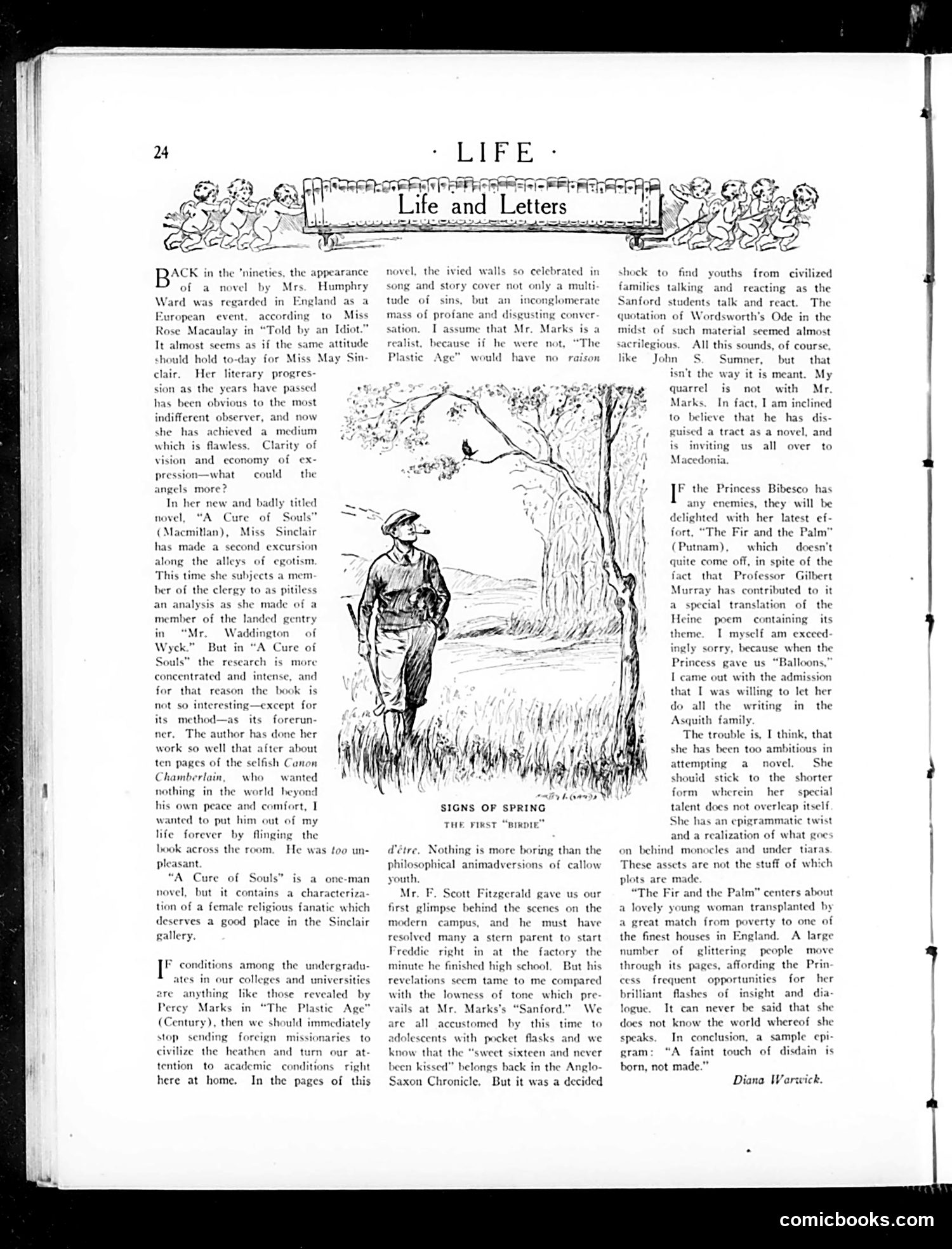
This page from *Life* magazine presents literary reviews under "Life and Letters." The main illustration depicts a man in period clothing walking through a rural landscape—likely representing a character from one of the discussed novels. The reviews critique several contemporary novels, including works by Mrs. Humphry Ward and Miss May Sinclair. The critics discuss themes of realism, morality, and literary craft. One review addresses a novel set at "Sanford" (likely a college), criticizing its depiction of students using profanity and irreverent language—shocking to civilized families of the era. The satire targets Victorian sensibilities: readers are scandalized by realistic portrayals of youth behavior and frank language in fiction. References to "John S. Sumner" (a real anti-obscenity activist) underscore anxieties about moral content in literature. The page reflects 1920s-era literary debates about whether novels should present idealized or honest depictions of modern life—a central modernist controversy of the period.
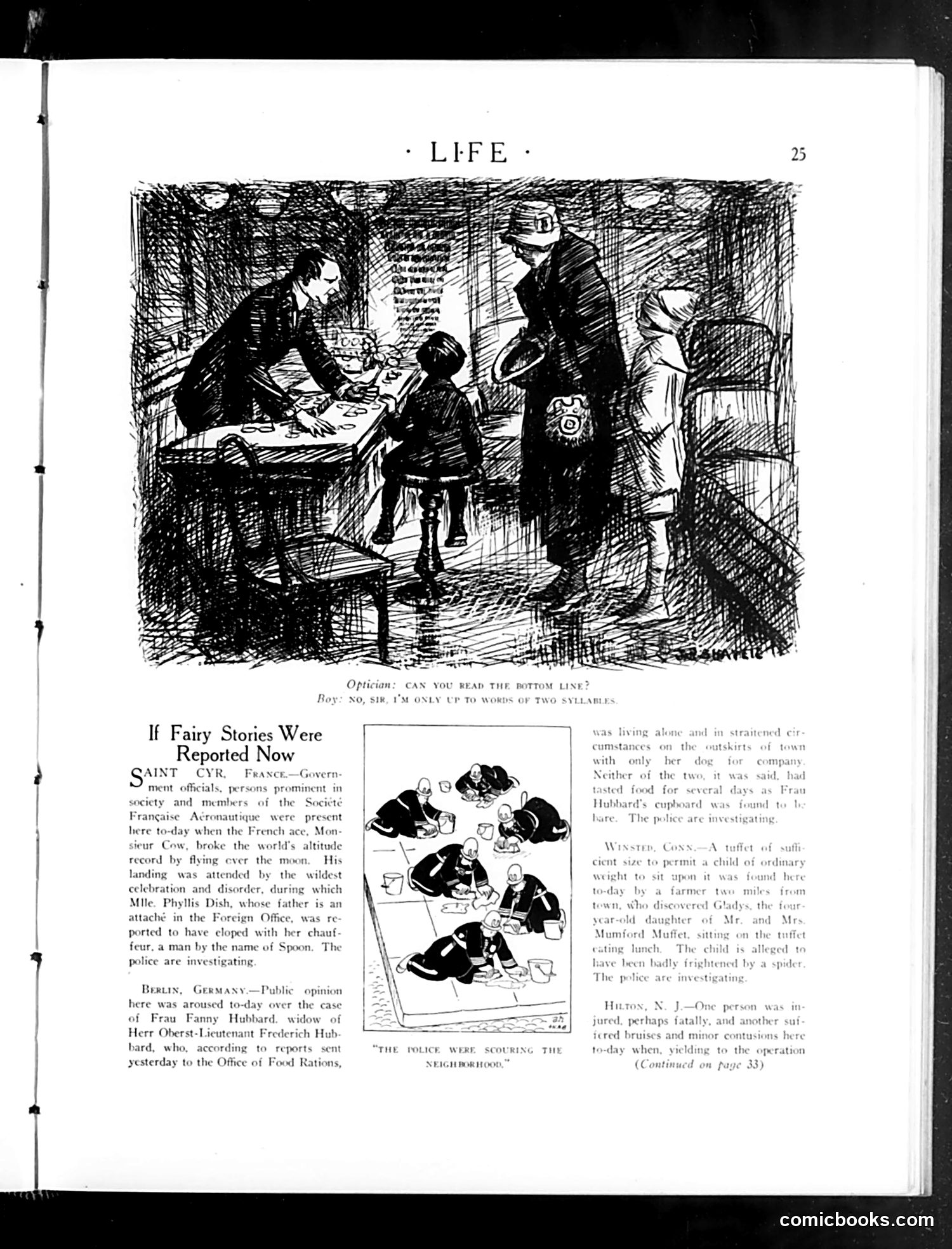
This page contains two satirical pieces about how fairy tales and nursery rhymes would be reported as news in the modern era (early 20th century). **"If Fairy Stories Were Reported Now"** reimagines classic tales as mundane newspaper stories. References include: - "Humpty Dumpty" (the fall) - "Hey Diddle Diddle" (the cow jumping) - "Mary Had a Little Lamb" and similar nursery characters The joke: bureaucratic, clinical news reporting strips away the whimsy of fairy tales, reducing magic to scandal, scandal sheets, and police investigations. It's satirizing how modern journalism sensationalizes and trivializes everything. The lower cartoon shows an optician's eye test, with the caption mocking someone who can only read the top lines—a visual joke about literacy or vision limitations. The satire targets early-20th-century journalism's breathless, gossipy tone and society's obsession with minor scandals, while poking fun at how modern life makes even the fantastical seem banal and investigatable.
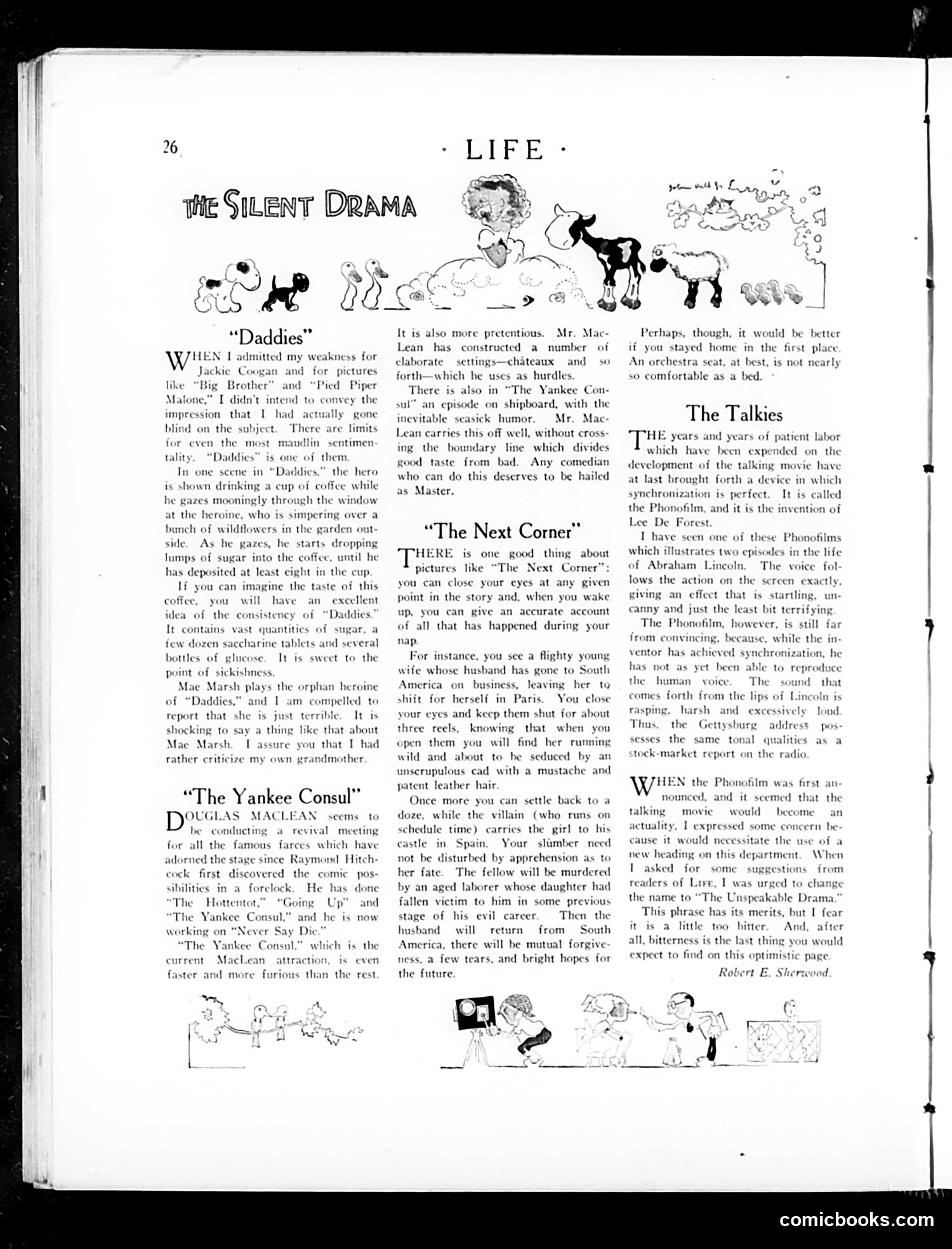
This page contains film criticism from Life's "Silent Drama" column, reviewing several contemporary movies: **"Daddies"** - A sentimental Jackie Coogan picture criticized as excessively saccharine. The reviewer mocks the plot (hero dropping sugar into coffee while gazing at the heroine) and Mae Marsh's performance as overwrought melodrama. **"The Yankee Consul"** - Douglas MacLean's theatrical farce adapted to film, praised for elaborate set design and shipboard comedy that maintains good taste without crossing into bad humor. **"The Next Corner"** - A predictable romance where viewers can safely close their eyes knowing exactly what will happen: a flighty wife in Paris will nearly be seduced by a villainous cad with a mustache before being rescued when the villain is murdered by an avenging laborer. **"The Talkies"** - A brief note celebrating Lee De Forest's Phonofilm invention, which achieves perfect lip-sync synchronization between sound and image—described as "startling" and "uncanny." The tone is witty and sardonic throughout, mocking both sentimental plots and technological novelty.
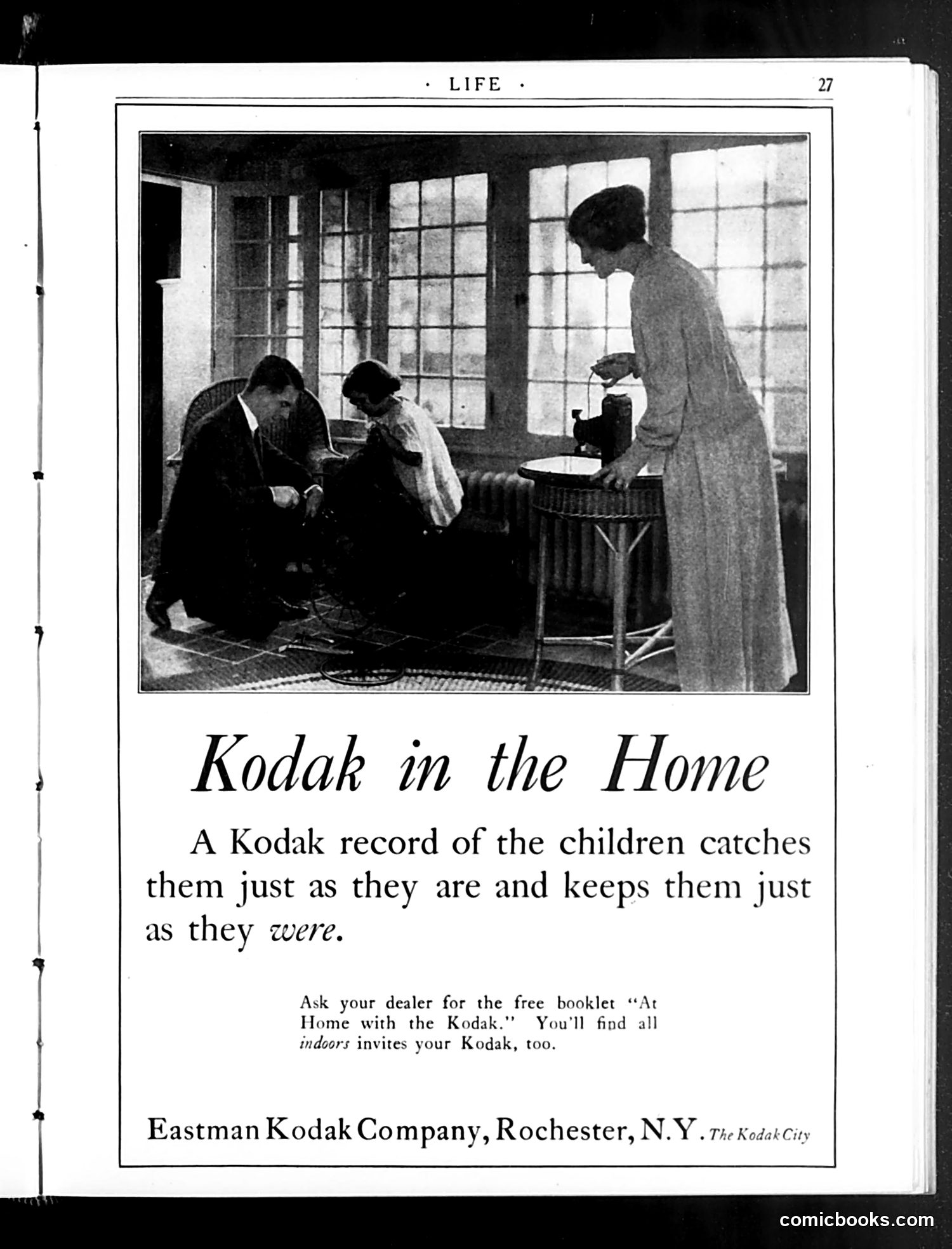
This is a **Kodak advertisement**, not a political cartoon. The page shows a domestic scene with three figures—two seated, one standing—in a sunlit room with large windows, apparently during a casual family moment. The ad promotes home photography as a way to preserve family memories. The tagline emphasizes photography's nostalgic appeal: it "catches them just as they are and keeps them just as they *were*"—suggesting parents should document their children before they grow up. There is no satire or political commentary here. This is straightforward commercial advertising from Life magazine, leveraging emotional appeals about family preservation to market Kodak cameras for home use. The focus on indoor photography reflects early-20th-century camera technology improvements that made interior shots more practical.
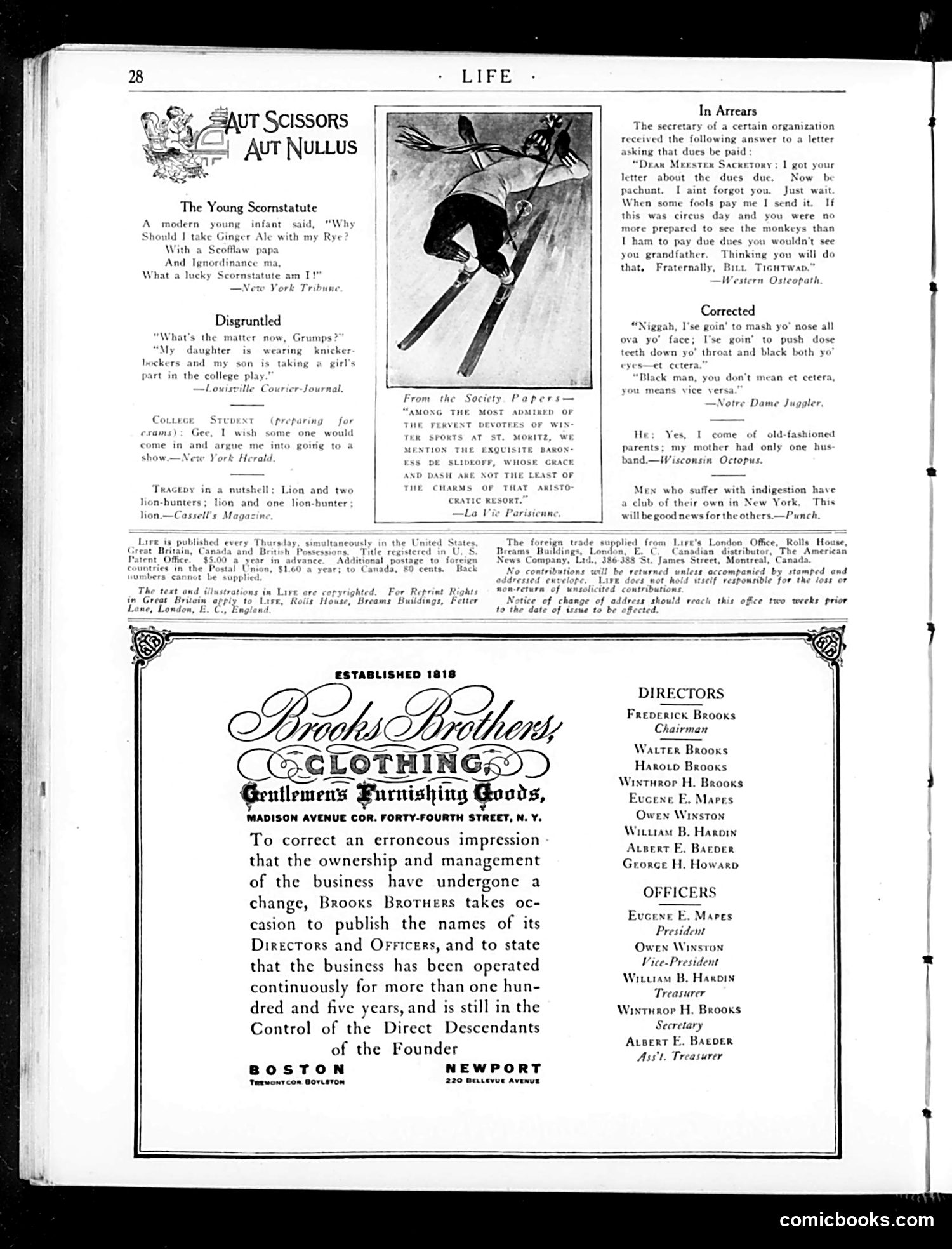
This page contains several brief humorous items typical of early 20th-century satirical magazines: **"The Young Scornstatute"**: A short verse mocking a spoiled child with negligent parents—social satire on permissive parenting. **"Disgruntled"**: A father complains his daughter wears "knickerbockers" (bloomers) and acts in college plays—satirizing evolving gender roles and women's increasing independence. **"Tragedy in a Nutshell"**: A one-liner joke about lion hunters. **Center Image**: Appears to show a skier, illustrating text about winter sports devotees at St. Moritz. **Three Short Jokes** on the right mock organizational incompetence, racial dialect humor (period-typical and offensive), and old-fashioned parenting. The page is primarily **advertising for Brooks Brothers**, announcing continuity of family ownership and listing directors—establishing the company's 100+ year heritage. The humor reflects period attitudes toward women's roles, class distinctions, and relies heavily on ethnic/racial caricature now considered offensive.
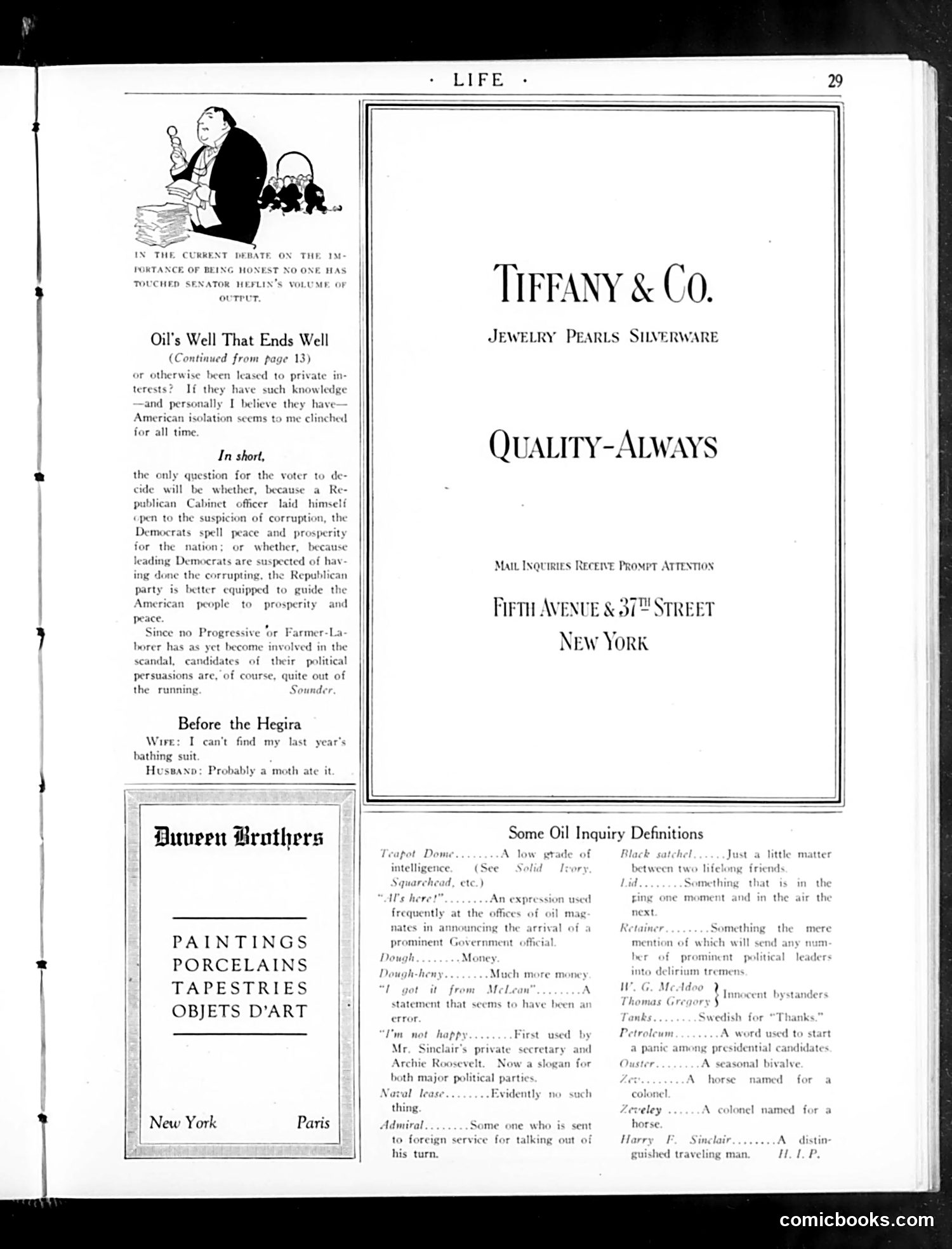
This page contains a political satire article titled **"Oil's Well That Ends Well,"** continuing from page 13, which addresses **the Teapot Dome scandal**—a major corruption controversy of the early 1920s involving a Republican Cabinet officer who secretly leased federal oil reserves to private interests. The cartoon at top-left shows a portly man surrounded by papers, captioned as referencing **Senator Heflin's volume of output** in current debates about government honesty. The piece argues that voters must decide whether Democrats or Republicans are better equipped to govern, given this corruption, while noting that Progressive and Farmer-Labor candidates remain uninvolved and thus "quite out of the running." The brief joke "Before the Hegira" plays on a wife finding her bathing suit missing—likely eaten by moths—a domestic humor filler typical of Life's format. The page also includes advertisements for **Tiffany & Co.** jewelry and **Duveén Brothers** art dealers, reflecting Life's dual role as satirical commentary mixed with luxury brand marketing.
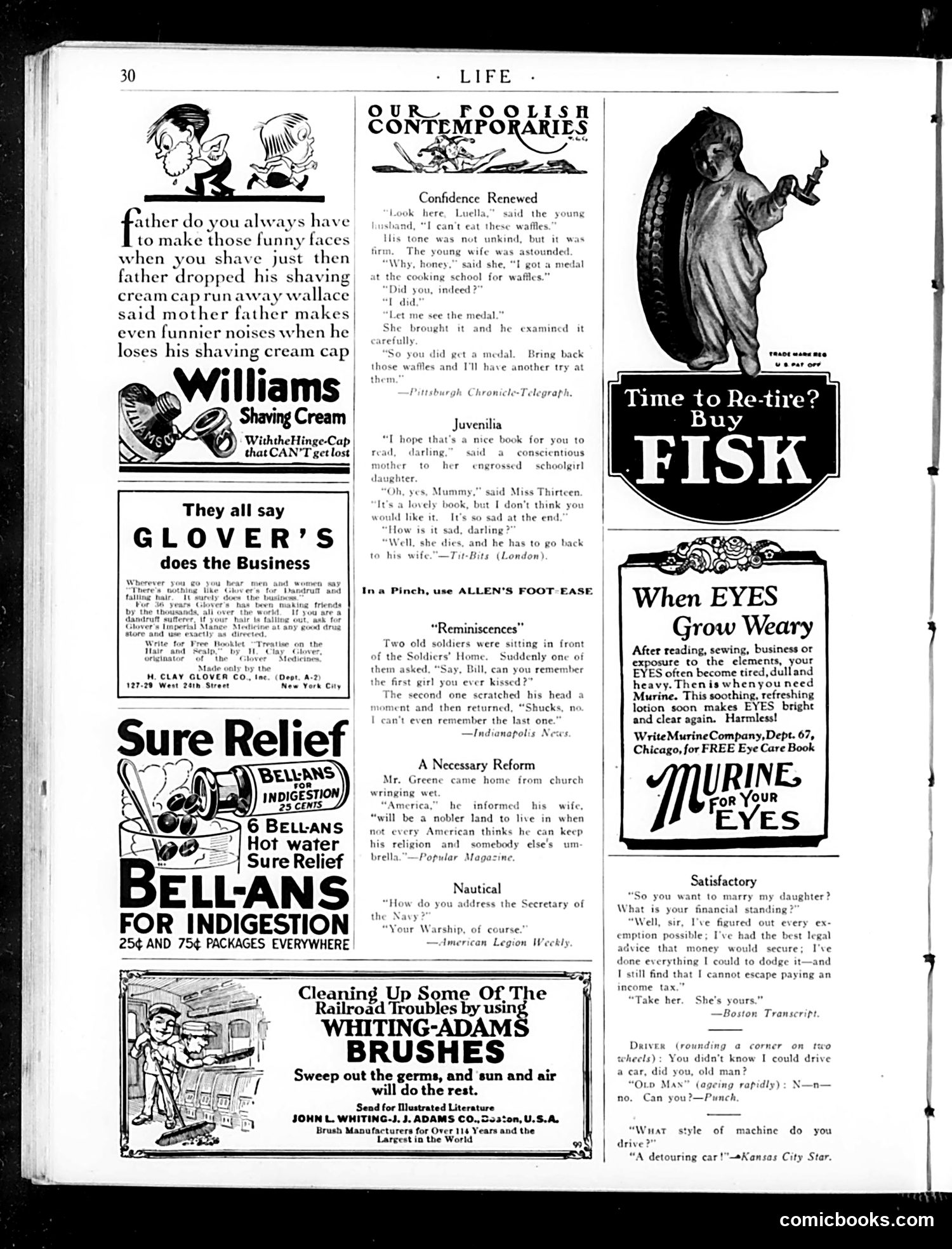
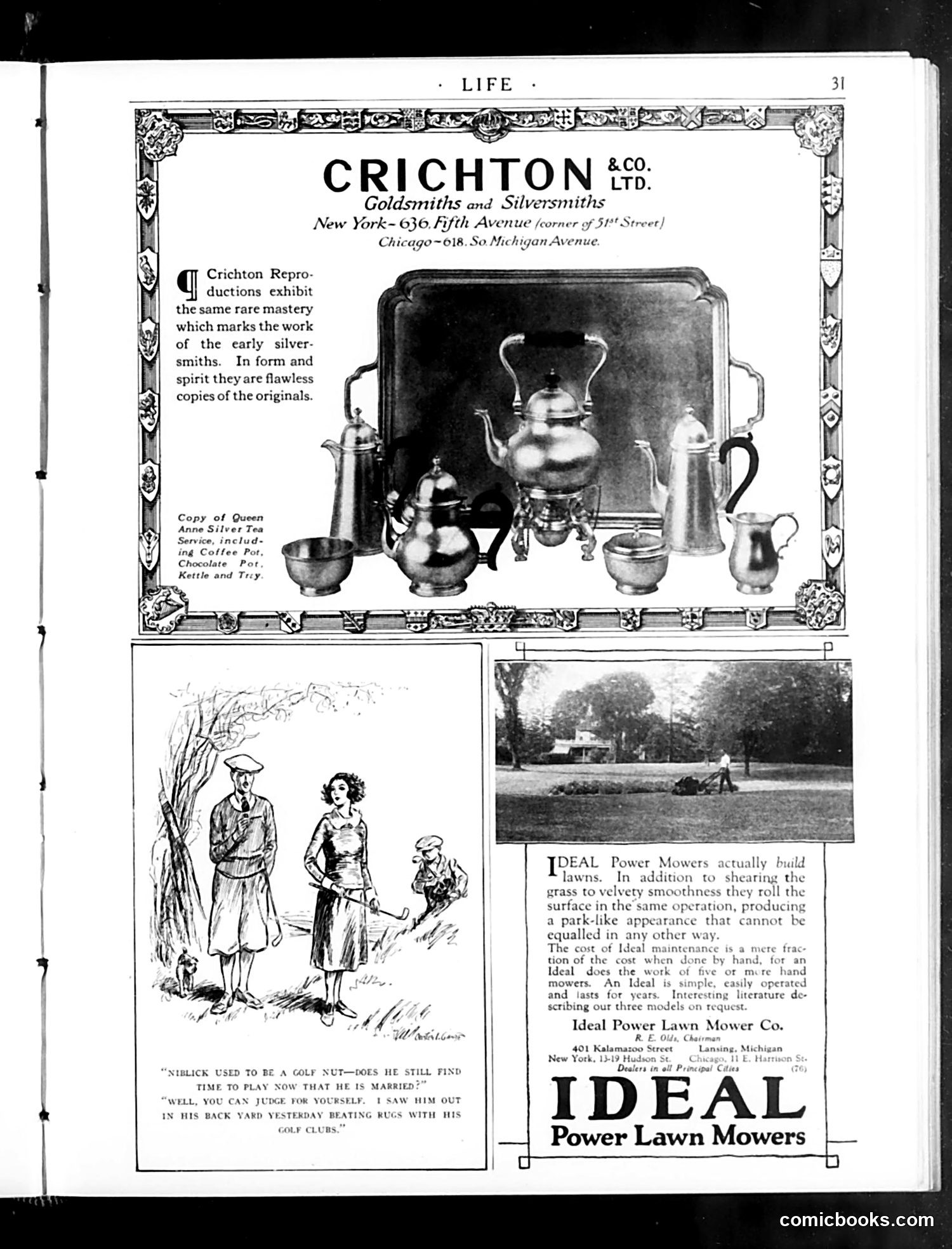
This is primarily a **vintage advertising page** from Life magazine, not political satire. The small cartoon (lower left) is a domestic humor joke: A man once known as a "golf nut" who spent all his time golfing now beats rugs in his backyard instead of playing. The punchline implies marriage has domesticated him—he's lost his leisure time to household chores. This reflects early-20th-century gender-role humor where married men were depicted as losing their freedom to wives and domestic responsibilities. The page otherwise contains advertisements for luxury silverware (Crichton & Co.) and power lawn mowers (Ideal), representing products marketed to middle/upper-class homeowners. The joke's humor depends on understanding that golf was a leisure activity for men of means, and that marriage traditionally meant loss of personal time—assumptions that feel dated today.
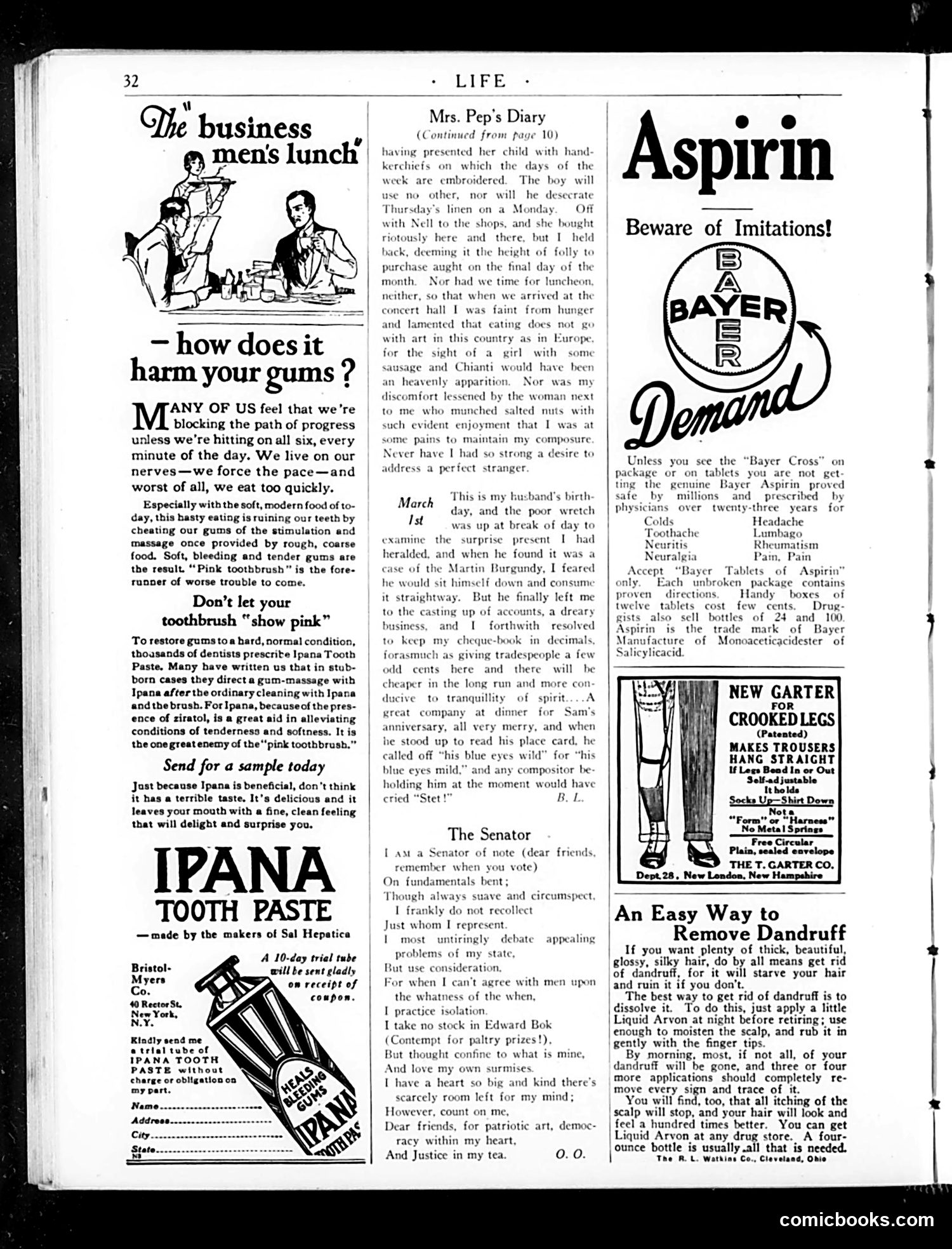
This page primarily consists of **advertisements** rather than satirical cartoons. The main content includes: **"The Business Men's Lunch"** — A brief satirical piece about how rushed eating habits damage gums. It mocks modern business culture's frenetic pace ("we force the pace") and argues that soft modern food, eaten too quickly, causes gum disease ("Pink toothbrush"). This is framed as social criticism of American business culture's unhealthy lifestyle. **Mrs. Pep's Diary** — A serialized humor column recounting domestic observations, including complaints about eating during concert attendance and a husband's birthday gift mishap. **"The Senator"** — A short poem apparently by a politician reflecting on his role. The page is dominated by **product advertisements**: Ipana Toothpaste, Bayer Aspirin, and a garter product called "New Garter for Crookedlegs." These ads employ the period's typical marketing appeals—medical endorsements and promised remedies for minor afflictions. The satirical content is minimal; the page functions primarily as a revenue-generating advertising vehicle with modest editorial humor pieces.
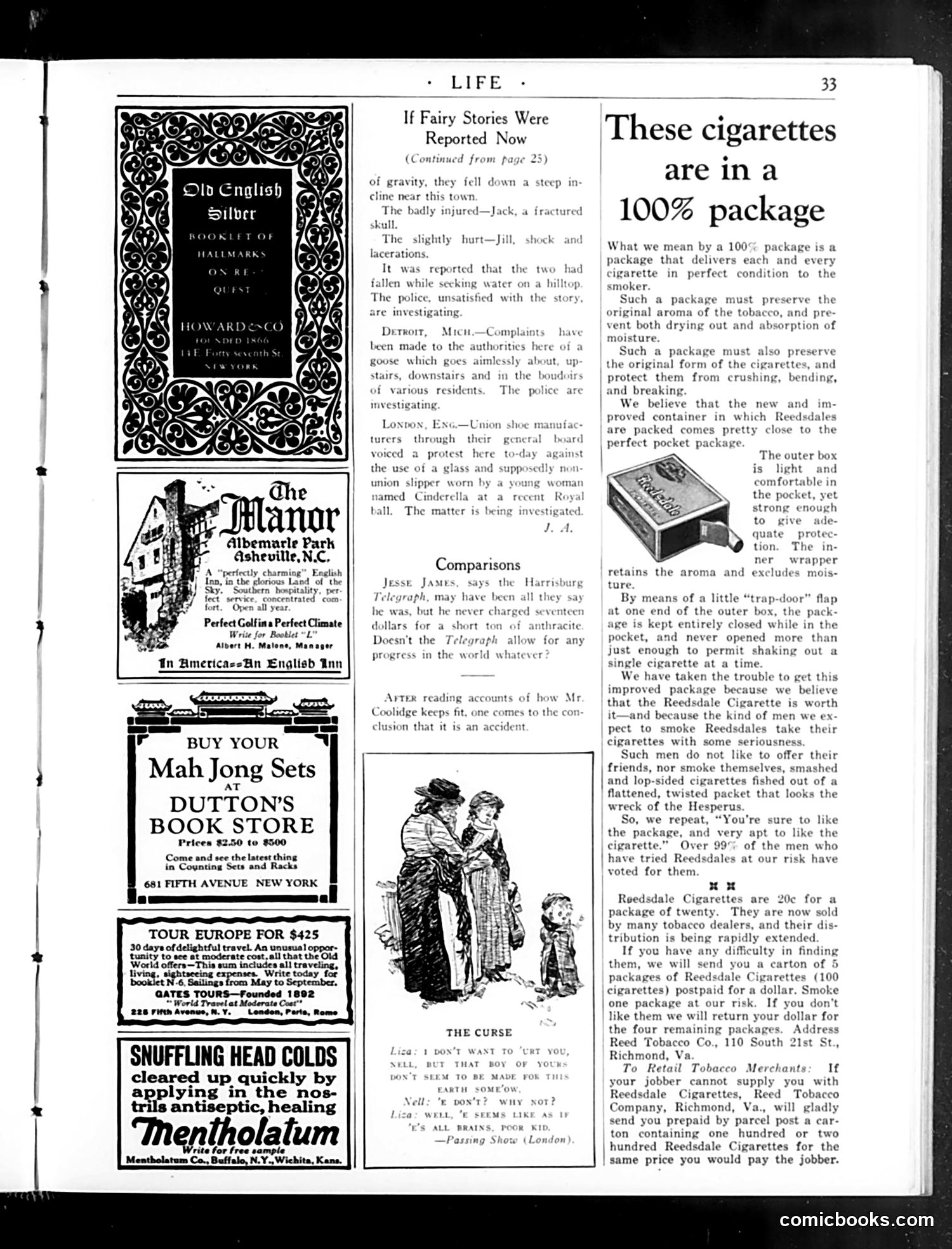
This page is primarily **advertising and commercial content**, not political satire. The main feature is a Reedsdale Cigarettes advertisement promoting their "100% package"—a protective packaging design meant to preserve cigarette quality and aroma while preventing damage in pockets. The sidebar titled "If Fairy Stories Were Reported Now" is a **humorous satirical piece** that reimagines classic nursery rhymes (Jack and Jill, Cinderella) as modern newspaper reports. It mocks contemporary journalism's obsession with factual details, police investigations, and mundane reporting—treating whimsical tales as accident reports and crime stories. The satire targets how serious, bureaucratic modern reporting strips away the charm of folklore. The page also includes small period advertisements for luxury goods (English inns, Mah Jong sets, European tours) and a Mentholatum cold remedy ad with a brief comic dialogue at bottom about a boy being "all brains, poor kid." The overall tone reflects 1920s-era magazine humor and consumer culture.
This cartoon satirizes the hypocrisy of Dr. Crank Hayne, a syndicate essayist who publicly preaches that "man is essentially honest" and that trusting people promotes integrity. However, his actions throughout the day directly contradict this philosophy. While dictating his optimistic essay, Hayne simultaneously: - Notices his safe left open and demands it be closed - Calls about theft insurance for his new car - Orders his office boy to install locks and burglar alarms at his country home - Instructs his wife not to wear diamonds in public and to discharge a maid he distrusts The joke is the stark gap between Hayne's published idealism and his actual behavior—he trusts no one and takes every precaution against theft. The cartoon mocks self-righteous public figures who profess noble philosophies they don't personally practice, a timeless target of satire.
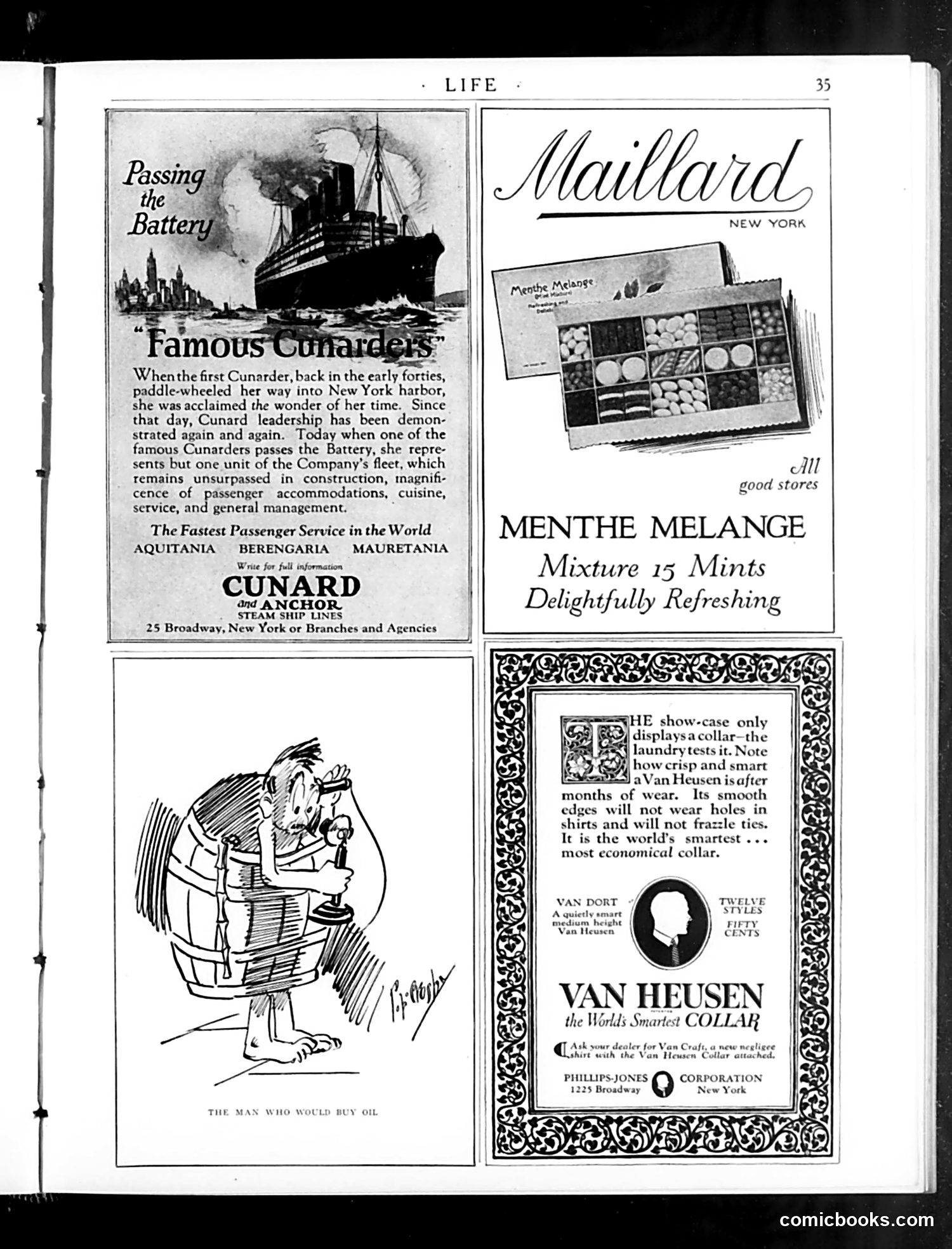
This is primarily an **advertising page** rather than political satire. The page contains four distinct advertisements: 1. **Cunard Steamship Lines** (upper left): Promotes luxury ocean liners (Aquitania, Berengaria, Mauretania) as the fastest passenger service, referencing their historical dominance since the 1840s. 2. **Maillard Candy** (upper right): Markets "Menthe Melange" mint candies as refreshing treats. 3. **"The Man Who Would Buy Oil"** (lower left): A cartoon caricature of an exaggerated figure, likely satirizing speculators or investors during the oil boom era, though the specific reference is unclear from the visible text. 4. **Van Heusen Collars** (lower right): Advertises detachable shirt collars as durable and economical, emphasizing their resistance to wear and fraying. The page reflects early 20th-century consumer culture, with emphasis on luxury travel, refined products, and practical innovations.
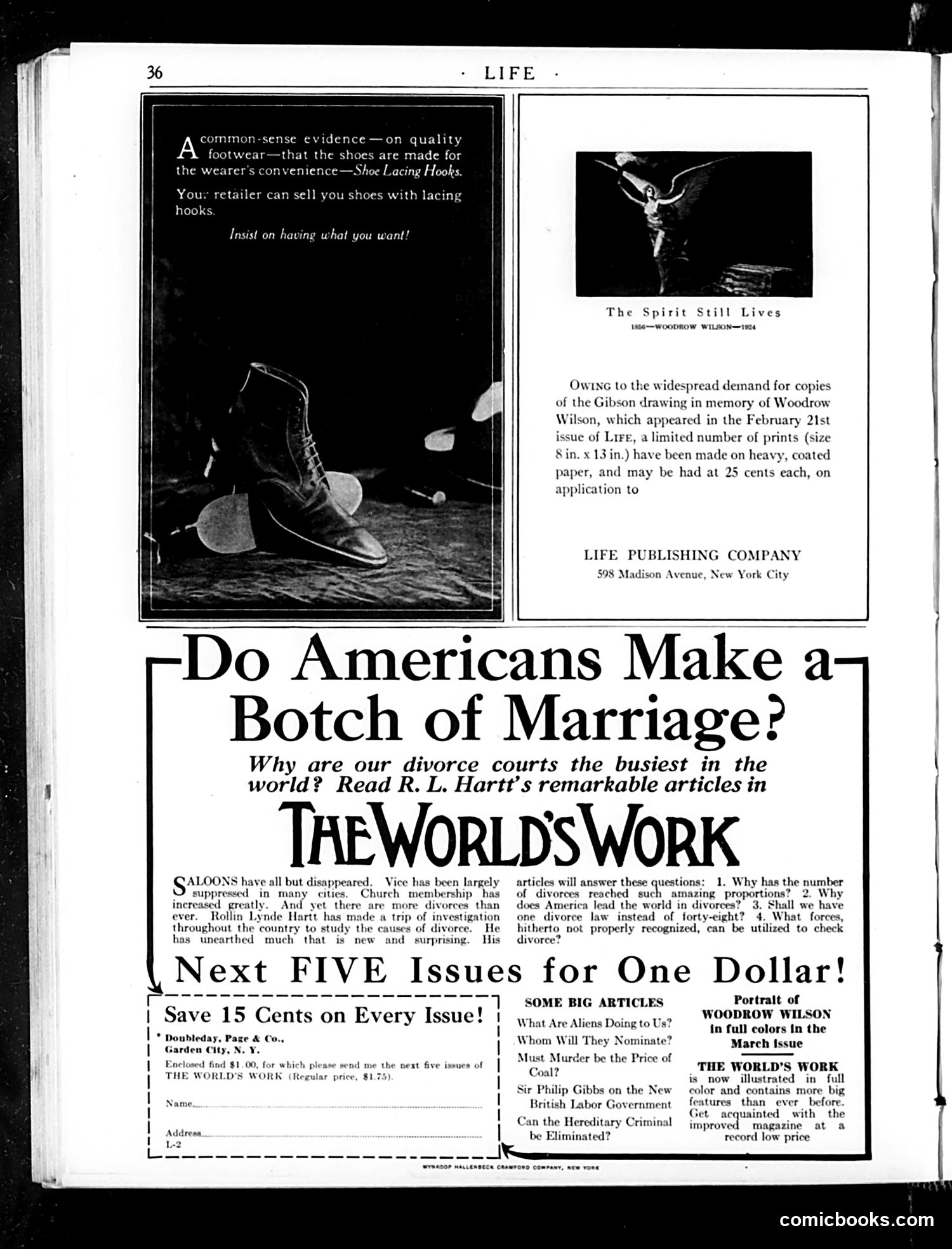
This page is primarily **advertising and promotion** rather than political satire. Key elements: **Upper sections:** Advertisement for shoe lacing hooks (practical product marketing) and a memorial notice for a Gibson drawing honoring President Woodrow Wilson (died 1924), available as prints for 25 cents. **Main feature:** Promotion for *The World's Work* magazine, advertising an article series by R.L. Hartt titled "Do Americans Make a Botch of Marriage?" The hook is sensationalist—claiming American divorce courts are "the busiest in the world" and promising to explain why America leads in divorces. The questions posed (unified divorce law vs. state-by-state variation, hereditary criminality) reflect Progressive Era concerns about social reform. **Bottom:** Subscription offer for five issues of *The World's Work* for one dollar, with teasers about articles on aliens, nominations, and labor issues. The page reflects early-1920s magazine competition through eye-catching headlines and bargain subscriptions rather than containing political cartoons or satire in the traditional sense.
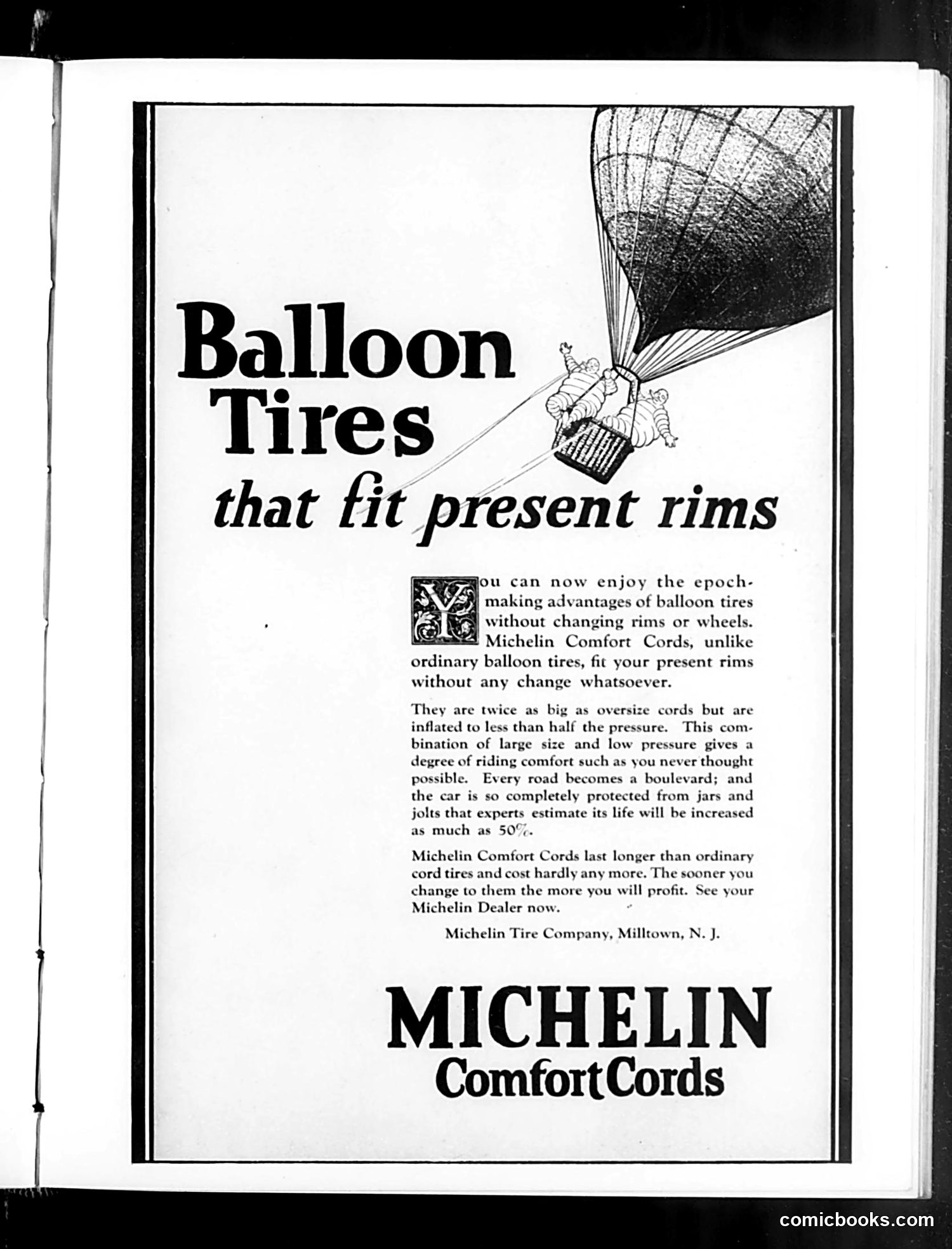
This page is primarily **advertising, not satire or political commentary**. It's a Michelin Tire Company advertisement for "Comfort Cords"—balloon tires designed to fit existing vehicle rims without modifications. The illustration shows a hot air balloon in the upper right, visually pun on the product name "balloon tires." The advertisement's key claim is that these tires offer the comfort advantages of balloon tires (larger size, low pressure) while fitting standard rims—eliminating the need for expensive wheel replacements. The copy targets early 20th-century car owners by emphasizing convenience and value: no modification required, improved ride quality ("every road becomes a boulevard"), longer tire life, and potential 50% increase in vehicle lifespan. This was pitched as a practical upgrade to existing automobiles. There is no political or satirical content visible. This is straightforward consumer marketing from the Michelin Tire Company's Milltown, New Jersey operation.
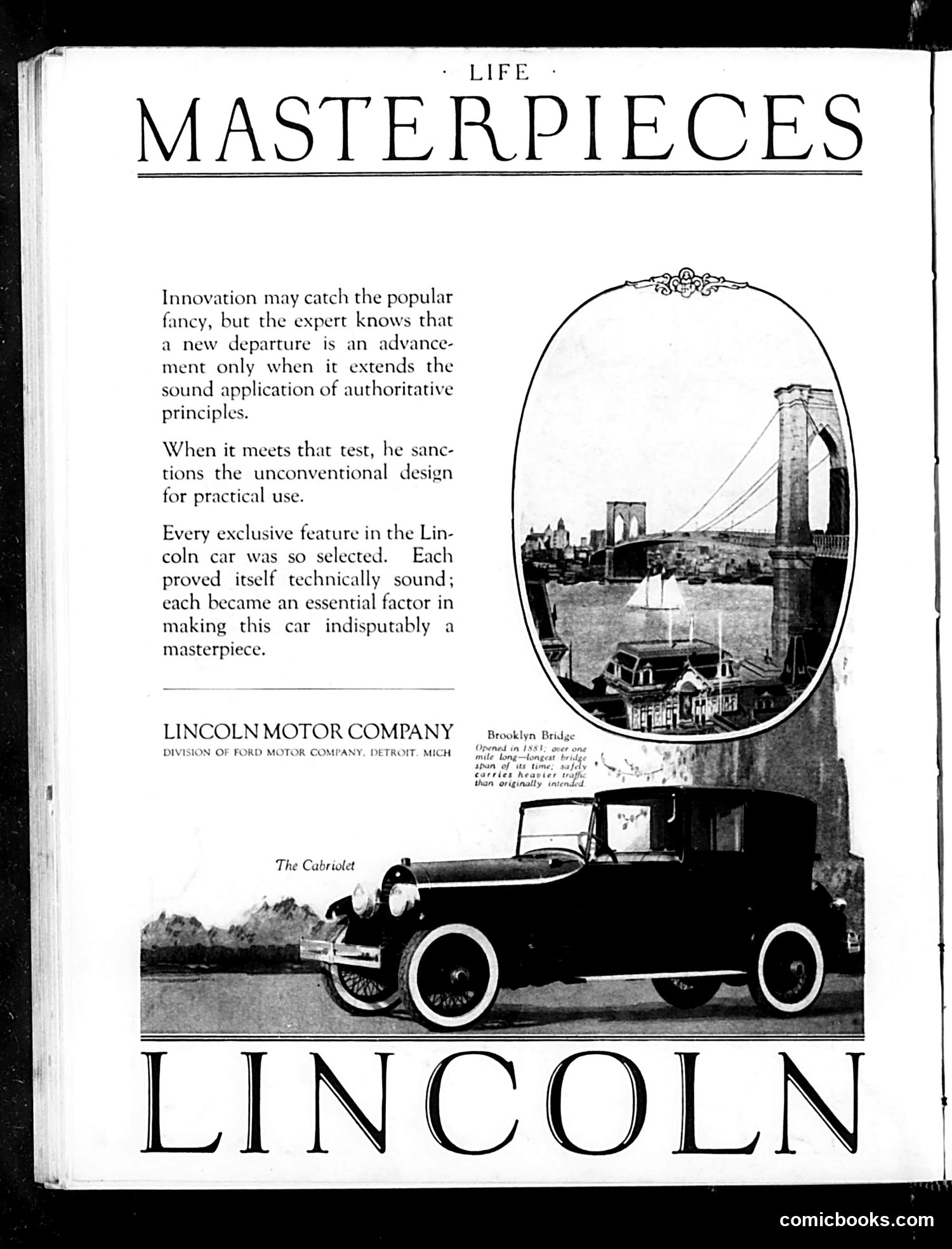
This is primarily a **Lincoln automobile advertisement**, not political satire. The page uses "Masterpieces" as its framing concept, comparing the Lincoln car to artistic masterworks like the Brooklyn Bridge (shown in the oval image). The advertisement argues that Lincoln's innovations aren't mere trend-chasing but represent legitimate engineering advances grounded in "authoritative principles." Each feature allegedly proved "technically sound." The car pictured is identified as "The Cabriolet." This reflects **1920s advertising strategy**: positioning luxury automobiles as expressions of American industrial achievement and progress. The Brooklyn Bridge comparison elevates the car to the status of celebrated engineering landmarks. There's no political commentary or satire here—it's straightforward corporate messaging appealing to consumers' aspirations for quality and innovation during the automobile industry's expansion.