
Life, 1924-03-06 · page 28 of 42
Life — March 6, 1924 — page 28: what you’re looking at
What you’re looking at
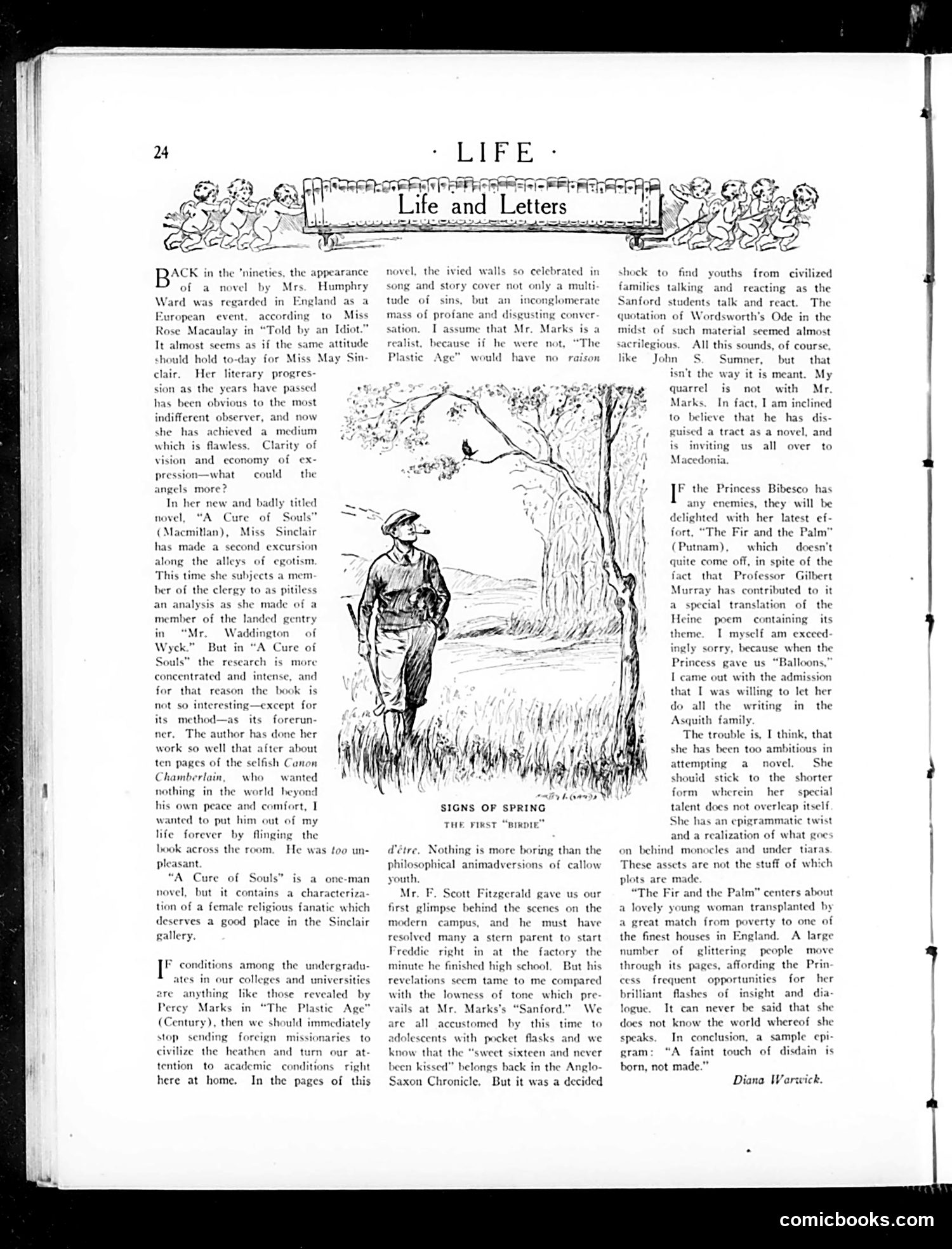
This page from *Life* magazine presents literary reviews under "Life and Letters." The main illustration depicts a man in period clothing walking through a rural landscape—likely representing a character from one of the discussed novels. The reviews critique several contemporary novels, including works by Mrs. Humphry Ward and Miss May Sinclair. The critics discuss themes of realism, morality, and literary craft. One review addresses a novel set at "Sanford" (likely a college), criticizing its depiction of students using profanity and irreverent language—shocking to civilized families of the era. The satire targets Victorian sensibilities: readers are scandalized by realistic portrayals of youth behavior and frank language in fiction. References to "John S. Sumner" (a real anti-obscenity activist) underscore anxieties about moral content in literature. The page reflects 1920s-era literary debates about whether novels should present idealized or honest depictions of modern life—a central modernist controversy of the period.
📄 Transcribed text from this page (OCR, searchable)
Machine-transcribed from the original scan — historical spelling and the odd misread are preserved.
BER PEF RCRERS ie RE REE) Life and Letters SA A At ee so celebrated in shock to find youths from. civilized nd story cover not only a multi families talking and reacting as the ded in England as a tude of sins, but an i merate Sanford students talk and react The CK in the ‘nineties, the appearance novel, the ivied w f a novel by Mrs. Humphry song ‘ard was re sropean event. according to Miss — mass of profane and disgusting conver- quotation of Wordsworth's Ode in the »se Macaulay in “Told by an Id sation. I assume that Mr. Marks is a midst of such material seemed almost It almost scems as if the same attitude realist, because if he were not, “The — sacrilegious. All this sounds, of course Age” would have no should hold to-day for Miss May $ like John S. Sumner, but that clair. Her literary progres- isn't the way it is meant. My sion as the years have passed quarrel is not with Mr. Marks. In fact, I am inclined to believe that he has dis- has been obvious to the most indifferent observer, and now she has achieved a medit which is flawless. Clarity of guised a tract as a novel, and is inviting us all over to Macedonia vision and economy of ex- pression—what could the > angels more In hi 1 badly titled novel, “A Cure of §$ (Macmitlan), Miss Sinclair has made a second excursion [F the Princess Bibesco has any enemies, they will be delighted with her latest fort, “The Fir and the Palm (Putnam), which — doesn’t ro new nals” along the alleys of egotism ite come off, in spite of the fact that Professor Gilbert This time she subjects a mem ber of the clergy to as pitiless Murray has contributed to it an analysis as she made of a a special translation of the Heine poem containing its heme. I myself am exceed member of the landed gentry in fr \ Wyck But in “A Cure of Souls” the research is me ‘addington — of sly sorry, because when the Princess gave us “Balloons,” concentrated and intense, and for that reason the book is not so interesting—except for I came out with the admission that I was willing to let her do all the writing in the Asquith family. The trouble is, I think, that she has been too ambitious in its method—as its forerun- ner. The author has do work so well that after ten pages of the selfish Canon attempting a novel. She FY Chamberlain, who wanted should stick to the shorter j nothing in the world heyond form wherein her special | his own peace comfort, I SIGNS OF SPRING talent does not overleap itself | wanted to put him out of my THE FIRST “INDIR” She has an epigrammatic twist \ life forever by flinging the and a realization of what goes | i book across the room. He was too une d’ Nothing is more boring than the on behind monocles and under tiaras. pleasant philosophical animadversions of callow These assets are not the stuff of which | “A Cure of Souls” is a one-man — youth. plots are made. novel, but it contains a characteriza- Mr. F. Scott Fitzgerald gave us our “The Fir and the Palm” centers about tion of a female reli; 1s fanatic which first glimpse behind the scenes on the a lovely young woman transplanted by deserves a good place in the Sinclair modern campus, and he must have a great match from poverty to one of gallery. re | igh school. But his through its pages, affording the Prin: ates in our colleges and universities revelations seem tame to me compared cess frequent opportunities for her are anything like those revealed by with the lowness of t h pre- brilliant flashes of insight and dia Perey Marks in “The Plastic Age” vails at Mr. Marks’s “Sanford.” We logue. It can never be said that she (Century), then we should immediately are all accustomed by this time to does not know the world whereof she stop sending foreign missionaries to lescents with pocket flasks and we — speaks. In conclusion, a sample cpi- civilize the heathen and turn our at- know that the “swect sixteen and never gram: “A faint touch of disdain is ] tention to academic conditions right been kissed” belongs back in the Anglo- — born, not made.” here at home. In the pages of this Saxon Chronicle, But it was a decided Diana Warwick. Ived many a stern parent to start the finest houses in England. A large | Freddie right in at the factory the number of glittering people move 4 conditions among the undergradu- minute he finished comicbooks.com