
Life, 1924-03-06 · page 18 of 42
Life — March 6, 1924 — page 18: what you’re looking at
What you’re looking at
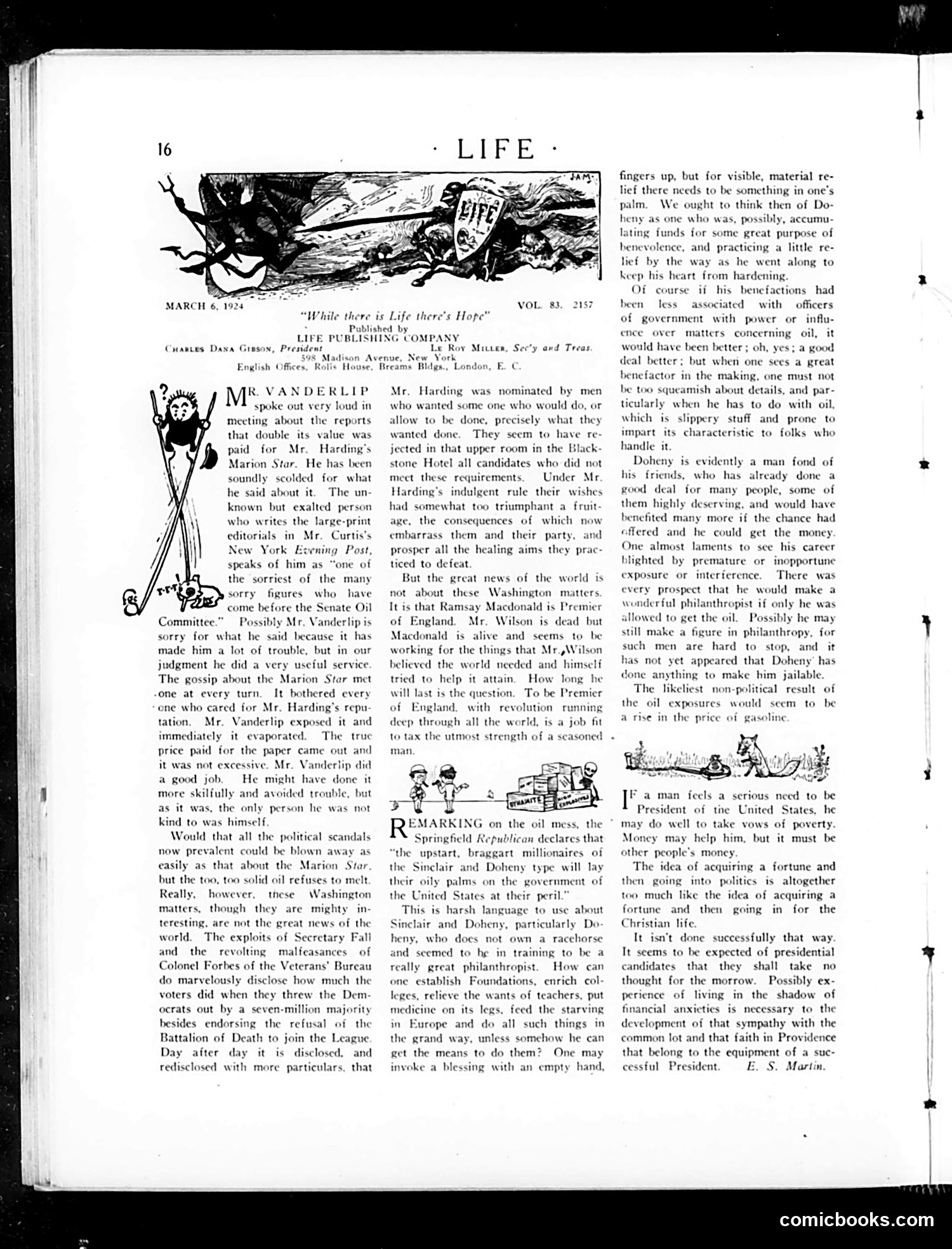
This page discusses the Teapot Dome scandal era of the Harding administration. The main editorial defends Frank Vanderlip, a banker who publicly challenged inflated reports about President Harding's purchase of the *Marion Star* newspaper. Though Vanderlip faced criticism from establishment figures (notably the *New York Evening Post*), the editor argues he performed a public service by exposing and deflating the gossip—the truth proved the price was reasonable. The piece sarcastically notes that scandals involving Secretary of Interior Albert Fall and Veterans Bureau chief Colonel Forbes have similarly "disclose[d]" voter mistakes in rejecting Democrats by a seven-million majority. It contrasts these Washington embarrassments with international optimism about Ramsay MacDonald becoming Britain's first Labour Prime Minister. A secondary editorial defends oil magnate Harry Sinclair and Harry Doheny against accusations they'll "lay their oily palms on the government," sarcastically questioning how philanthropists can fund foundations without money.
📄 Transcribed text from this page (OCR, searchable)
Machine-transcribed from the original scan — historical spelling and the odd misread are preserved.
MARCH 6, 1924 “While there is Life there's Hope” P. LIFE PUBLISH Crantes Dana Grasox, President $98 Madison Av English Offices, Rolis House R. VANDERLIP spoke out very loud in meeting about the reports that double its value was paid for Mr. Harding's Marion Star. He has been soundly scolded for what he said about it. The un known but exalted person who writes the large-print editorials in| Mr. Curtis's New York Evening Post, speaks of him as “one of the sorriest of the many sorry figures who have come before the Senate Oil Committee.” Possibly Mr, Vanderlip is sorry for what he said because it has made him a lot of trouble, but in our judgment he did a very useful service. The gossip about the Marion Star met -one at every turn. It bothered every one who cared for Mr. Harding's repu tation. Mr. Vanderlip exposed it and immediately it evaporated. The truc price paid for the paper came out and it was not excessive. Mr. Vanderlip did a good job. He might have done it more skilfully and avoided trouble, but as it was, the only person he was not kind to was himself Would that all the political scandals now prevalent could be blown away as easily as that about the Marion Star but the too, too solid oil refuses to melt Really, however, these Washington matters, though they are mighty in- teresting, are not the great news of the world. The exploits of Secretary Fall and the revolting malfeasances of Colonel Forbes of the Veterans’ Bureau do marvelously disclose how much the voters did when they threw the Dem- ocrats out by a seven-million majority besides endorsing the refusal of the Battalion of Death to join the League. Day after day it is disclosed, and redisclosed with more particulars, that plished by ING COMPANY Le Roy Mitter, Sec’y avd Treas ue, New Y ns Bldgs., Lon Mr. Harding was nominated by men who wanted some one who would do, or allow to be done, precisely what they wanted done, They seem to have re- jected in that upper room in the Black- stone Hotel all candidates who did ne meet these requirements. Under Mr Harding's indulgent rule their wishes had somewhat too triumphant a fruit age. the consequences of which now embarrass them and their party, and prosper all the healing aims they prac- ticed to defeat But the great news of the world is not about these Washington matters. It is that Ramsay Macdonald is Premier of England. Mr, Wilson is dead but Macdonald is alive and seems to be working for the things that Mr.,Wilson believed the world needed and himself tried to help it attain. How long he will last is the question. To be Premier of England, with revolution running deep through all the world, is a job fit to taxt utmost strength of a seasoned man. EMARKING on the oil mess, the Springfield Republican declares that “the upstart, braggart millionaires of the Sinclair and Doheny type will lay their oily palms on the government of the United States at their peril.” This is harsh language to use about Sinclair and Doheny, particularly Do heny, who docs not own a racchorse and scemed to he in training to be a really great philanthropist. How can one establish Foundations, enrich col leges, relieve the wants of teachers, put medicine on its legs. feed the starving in Europe and do all such things in the grand way, unless somehow he can get the means to do them? One ma invoke a blessing with an empty hand, fingers up, but for visible, material re: lief there needs to be something in one’s palm. We ought to think then of Do- heny as one who was, possibly, accumu- lating funds for some great purpose of benevolence, and practicing a little re- lief by the way as he went along to keep his heart from hardening Of course if his benefactions had been less associated with — officers of government with power or influ- ence over matters concerning oil, it would have been better; oh, yes; a good deal better; but when one sees a great benefactor in the making, one must not be too squeamish about details, and f ticularly when he has to do with oil, which is slippery stuff and prone to impart its characteristic to folks who handle it re Doheny is evidently a man fond of his friends, who has already done a g them highly deserving, and would have benefited many more if the chance had effered and he could get the money One almost laments to see his career ighted by premature or inopportune xd deal for many people, some of exposure or interference. There was every prospect that he would make a wonderful philanthropist if only he was lowed to get the oil. Possibly he may still make a figure in philanthropy, for such men are hard to stop, and it S not yet appeared that Doheny’ has done anything to make him jailable The likeliest non-political result of the oil exposures would seem to be a rise in the price of gasoline ¥ at er [Fa man feels a serious need to be President of the United States, he may do well to take vows « poverty. Money may help him, but it must be other people's money The idea of acquiring a fortune and then going into politics is altogether too much like the idea of acquiring a fortune and then going in for the Christian life. It isn’t done successfully that way. It seems to be expected of presidential candidates that they shall take no thought for the morrow. Possibly ex- perience of living in the shadow of financial anxieties is necessary to the development of that sympathy with the common lot and that faith in Providence that belong to the equipment of a suc- cessful President, E. S. Martin wt. comicbooks.com