
Life, 1924-03-06 · page 30 of 42
Life — March 6, 1924 — page 30: what you’re looking at
What you’re looking at
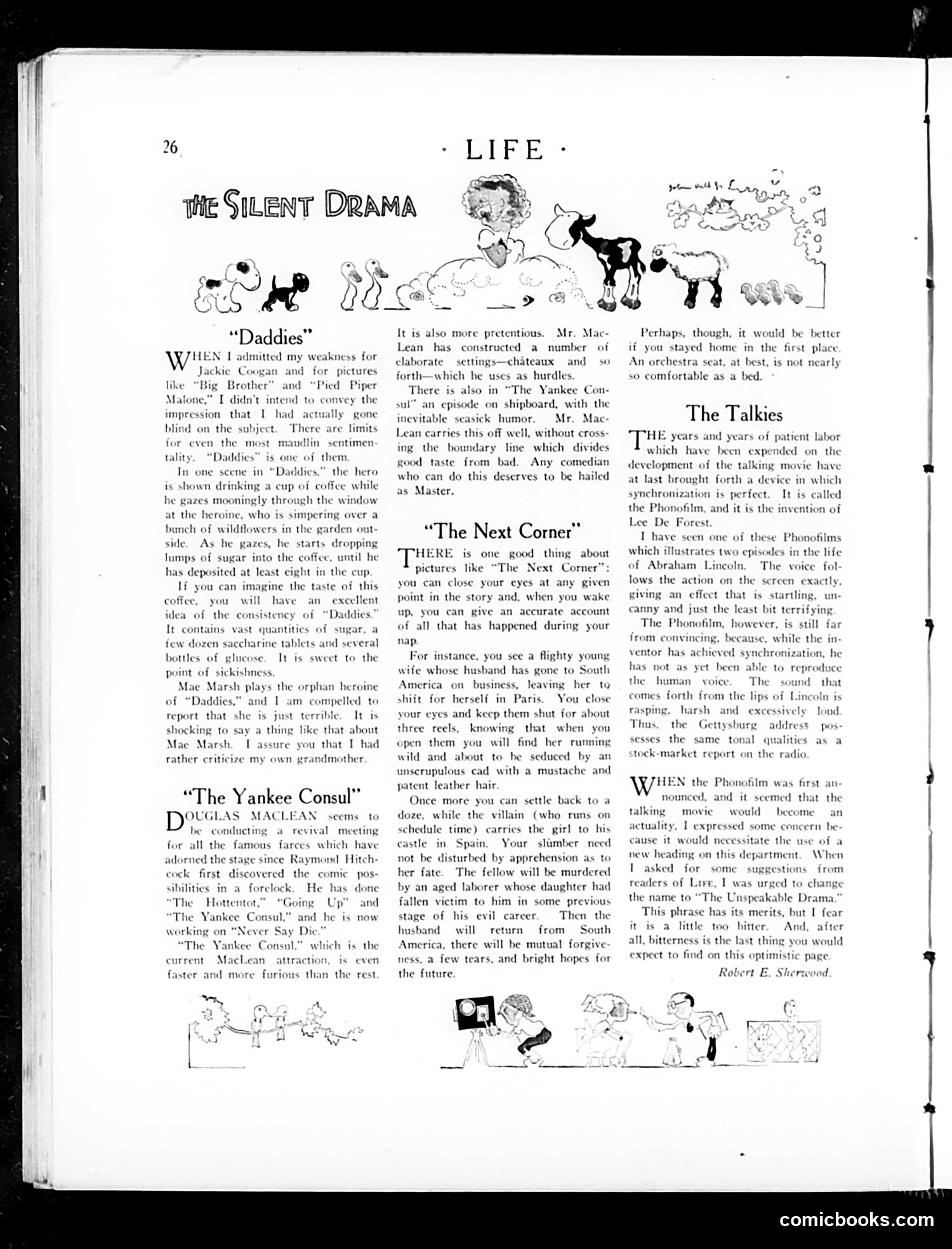
This page contains film criticism from Life's "Silent Drama" column, reviewing several contemporary movies: **"Daddies"** - A sentimental Jackie Coogan picture criticized as excessively saccharine. The reviewer mocks the plot (hero dropping sugar into coffee while gazing at the heroine) and Mae Marsh's performance as overwrought melodrama. **"The Yankee Consul"** - Douglas MacLean's theatrical farce adapted to film, praised for elaborate set design and shipboard comedy that maintains good taste without crossing into bad humor. **"The Next Corner"** - A predictable romance where viewers can safely close their eyes knowing exactly what will happen: a flighty wife in Paris will nearly be seduced by a villainous cad with a mustache before being rescued when the villain is murdered by an avenging laborer. **"The Talkies"** - A brief note celebrating Lee De Forest's Phonofilm invention, which achieves perfect lip-sync synchronization between sound and image—described as "startling" and "uncanny." The tone is witty and sardonic throughout, mocking both sentimental plots and technological novelty.
📄 Transcribed text from this page (OCR, searchable)
Machine-transcribed from the original scan — historical spelling and the odd misread are preserved.
“Daddies” WHEN admitted my weakness for Jackie Coogan and for pictures “Big Brother” and “Pied Piper TE didn’t intend to convey th impression that I had actually bl for even the most maudlin sentimen tality, “Daddies” is one of them one don the subject. There are limits scene in “Daddies,” the hero is shown drinking a cup In ¢ i coffee while he gazes mooningly through the window at the heroine, who is simpering over a bunch rden out zes, he starts dropping the coffee, until he wildflowers int side. As he he Ra f sugar i has deposited at least eight in the cup If you can imagine the taste of this lumps coffee, you will have an excellent idea of the consistency of “Daddies. It contains vast quantities of sugar, a few dozen saccharine tablets and several bottles of glucose. It is sweet to the point of sickishness. Mae Marsh plays the orphan heroine of “Daddies,” and I am compelled to report nat she is just terrible. It is shocking to say a thing like that about Mae Marsh. [ assure you that I ha mother “The Yankee Consul” D‘ ILGLAS MACLEAN) seems to be conducting a revival meeting rather criticize my own g for all the famous farces which have adorned the stage since Raymond Hitch- cock first discovered the comic pos- sibilities in a forelock. He has done “The Hottentot,” “Going Up" and The Yankee Consul,” and he is now work Never Say Die.” “The Yankee Consul,” whic rent. Maclea attrac aster and mor jous than the rest h is the even te SILENT DRAMA Lot It is also more pretentious. Mr. Mac- Lean has constructed a number of claborate settings—chateaux and so forth—which he uses as hurdles. There is also in “The Yankee Con- sul” an episode on shipboard, with the inevitable seasick humor. Mr. Mac Lean carries this off well, without cross: ing the boundary line which divides good taste from bad. Any comedian who can do this deserves to be hailed as Master, “The Next Corner” HERE is one good thing about pictures like “The Next Corner”: you can close your eyes at any given p up, you can give an accurate account of all that has happened during your int in the story and, when you wake nap. For instance, you sce a flighty young wife whose husband has gone to South America on business, leaving her to shift for herself in Paris. You close ‘p them shut for about three reels, knowing that when you open them you will find her running your eyes and kei wild and about to be seduced by an unscrupulous cad with a mustache and patent leather hair Once more you can settle back to a doze, while the villain (who runs on schedule time) carries the girl to his ar slumber need castle in. Spain. not be disturbed by apprehension as to her fate. The fellow will be murdered by an aged laborer whose daughter had fallen victim to him in some previous stage of his evil career. Then the husband will return from South America, there will be mutual forgive ness, a few tears, and bright hopes for the future. Perhaps, though, it would be better if you stayed home in the first place An orchestra seat, at best, is not nearly so comfortable as a bed. The Talkies HE years and years of patient labor which have been expended on. the development of the talk: at last brought forth a device in which synchronization is perfect. It is called the Phonofilm, and it is the invention of Lee De I have seen one of these Phonofilms which illustrates two episodes in the life f Abraham L In. The voice fol lows the action on the sereen exactly. giving an effect that is startling, un- canny and just the least bit terrifying movie have orest The Phonofilm, however, is still far from convincing, because, while the in ventor has achieved synchronization, he has n the | comes f asp Thus, the Gettysburg address pos as yet been le to reproduce man voice. The sound that rth from the lips of I ris r ig. harsh and excessively loud. sesses the same tonal qualities as a tock-market report on the radio. HEN the Phonofilm was first an: nounce¢ and it seemed that the talking movie would become an actuality, I expressed some concern be cause it would necessitate the use of a n this department. When new headir I asked for some sugge ms from readers of Lire, I was urged to change the name to “The Unspeakable Drama.” This phrase has its merits, but I fear it is a little too bitter. And, after all, bitterness is the last thi mu would y expect to find on this optimistic page Rober Sherwood. | comicbooks.com