
Life, 1924-03-06 · page 22 of 42
Life — March 6, 1924 — page 22: what you’re looking at
What you’re looking at
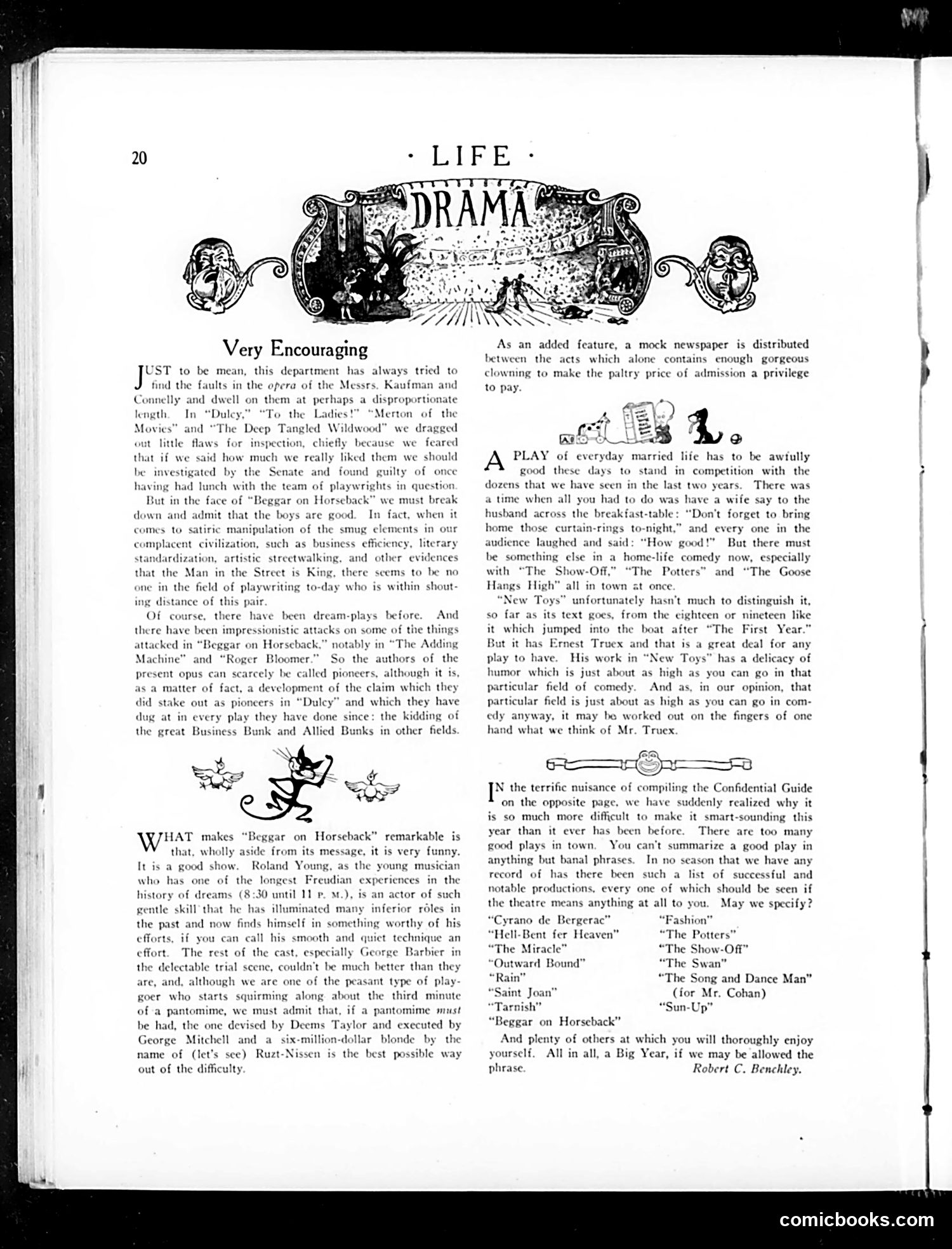
This is a theater criticism page reviewing the play "Beggar on Horseback" by Kaufman and Connelly. The critic praises the production as remarkably funny and artistically ambitious, despite acknowledging that satirical attacks on "Business Bunk" and commercialism aren't entirely novel. The review highlights **Roland Young** as the young musician lead, praising his nuanced performance through an extended Freudian dream sequence (lasting from 8:30 to 11 p.m.). It also commends **George Barbier** in a trial scene and mentions a pantomime designed by **Deems Taylor**. The piece notes the play's satirical target: the smug materialism and conformity of modern American civilization—"business efficiency, literary standardization, artistic streetwalking." A mock newspaper distributed between acts receives particular praise. The satire aims at 1920s American consumer culture and corporate conformity, positioning the play as culturally significant despite derivative elements.
📄 Transcribed text from this page (OCR, searchable)
Machine-transcribed from the original scan — historical spelling and the odd misread are preserved.
Very Encouraging UST to be mean, this department has always tried to find the faults in the opera of the Messrs, Kaufn Connelly and dwell on them at perhaps a disproportionate length. In “Duley,” the I Movies” and “The Deep Tangled Wildwood” we dragged out little flaws for inspection, chiefly because we feared that if we said how much we really liked them we should es! “Merton of the be investigated by the Senate and found guilty of once having had lunch with the team of playwr But in the face of “Beggar on Horseback” we must break down and admit that the boys are good. In f comes to satiric ma ts in ques t, when it om of the smug cler ipulat complacent civilization, nts in our such as business e¢ iency, literary standardization, artistic streetwalking, and other evidences t the Man in the Strect is King, there seems to be no ne in the field of playwriting to-day who is within shout- ts c, there have been dream-plays before. And there have been impressionistic attacks on some of the things attacked in “Beggar on Horseback,” notably in “The Addir Machine” and ing distance of this p: Of ra “Roger Bloomer.” So the authors of the present opus can scarcely be called pioneers, although it is, is a matter of fact, a development of the claim which they did stake out as and which they have dug at in every play they have done since: the kidding of the great Business Bunk and Allied Bunks in other fields neers in “Du ran Sa Od HAT makes “Beggar on Horseback” remarkable is that, wholly aside from its message, it is very fu It is a good s ‘ w. Roland Young, as who has one of the longest Fi history of dreams (8:30 until 11 Pp. s.), is an actor ntle skill that he has illumin the past and now fin young musiciar eudian experiences in the f such vy inferior roles in s himself in something worthy of his g ted ma efforts, if you can call his smooth and quiet technique an effort. The rest of the cast, especially George Barbier in the delectable trial scene, couldn't be much better than they are, and, although we are one of the peasant type of play goer who starts squirming along about the third minute ofa pantomime, we must admit that, if a pantomime must be had, the one devised by Deems Taylor and executed by George Mitchell and a six-million-dollar blonde by the name of (let's sce) Ruzt-Nissen is the best possible way out of the difficulty As an added feature, a mock newspaper is distributed between the acts which alone contains enough gorgeous clowning to make the paltry price of admission a privilege to pay. e A PLAY of everyday married life has to be awtully good these days to stand in competition with the dozens that we have seen in the last two years. There was a time when all you had to do was have a wife say to the husband across the breakfast-table Don't forget to bring h in-rings to-night,” and every one in the audience laughed and said: “How good But there must now, especially w-Off,” “The Potters” and “The Goose 1 in town at once me those curt. be something else in a home-life comed with “The S'! Hangs Hi New so far as its text goes, from the cightcen or nineteen like it which jumped into the boat after “The First Year.” it has Ernest Truex and that is a great deal for any play to have. His work i w Toys” has a delicacy of humor which is just about as high as you can go in that n, that particular field is just about as high as you can go in com- unfortunately hasn't much to distinguish it, particular field of comedy. And as, in our opin’ edy anyway, it may be worked out on the fingers of one hand what we think of Mr. Truex. N the terrific nuisance of compiling the Confidential Guide on the opposite page, we have suddenly realized why it is so much more difficult to make it smart-sounding this year than it ever has been before. There are too many good plays in town. Y ou can't summarize a good play in anything but banal phrases. In no season that we have any record of has there been such a list of successful and notable productions, every i of which should be seen if the theatre means anything at all to you. May we specify? “Cyrano de Bergerac” “Hell-Bent fer Heaven” “The Miracle” Outward Bound” Ra n “The Song and Dance Man” int Joan” (ior Mr. Cohan) rnish” “Sun-Up” “Beggar on Horseback” And plenty of others at which you will thoroughly enjoy yourself, All in all, a Big Year, if we may be allowed the phrase. Robert C. Benchley. er t comicbooks.com