
A complete issue · 36 pages · 1924
Life — February 14, 1924
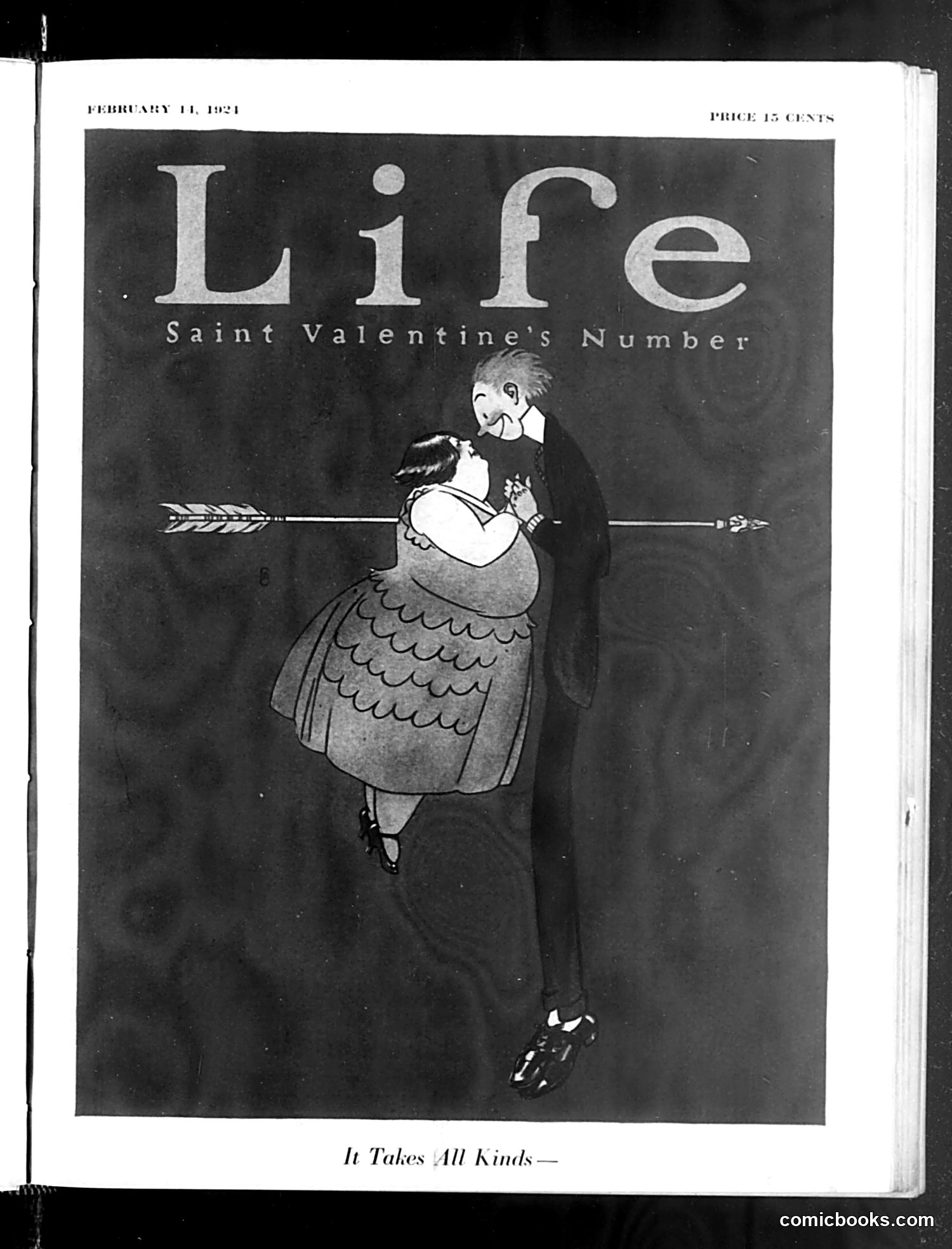
This is the cover of Life's Valentine's Day issue. The illustration shows Cupid (recognizable by his wings and arrow through his heart) carrying an exaggerated, rotund female figure. The woman wears a scaled or feathered dress and has an oversized body, depicted in an unflattering caricature style typical of 1920s satirical illustration. The caption "It Takes All Kinds—" suggests the joke concerns romantic compatibility or the variety of romantic prospects available. The satirical point appears to mock either the desperation of romance or the physical diversity of potential partners. The grotesque exaggeration of the woman's figure was a common—though by modern standards offensive—comedic device in period humor magazines.
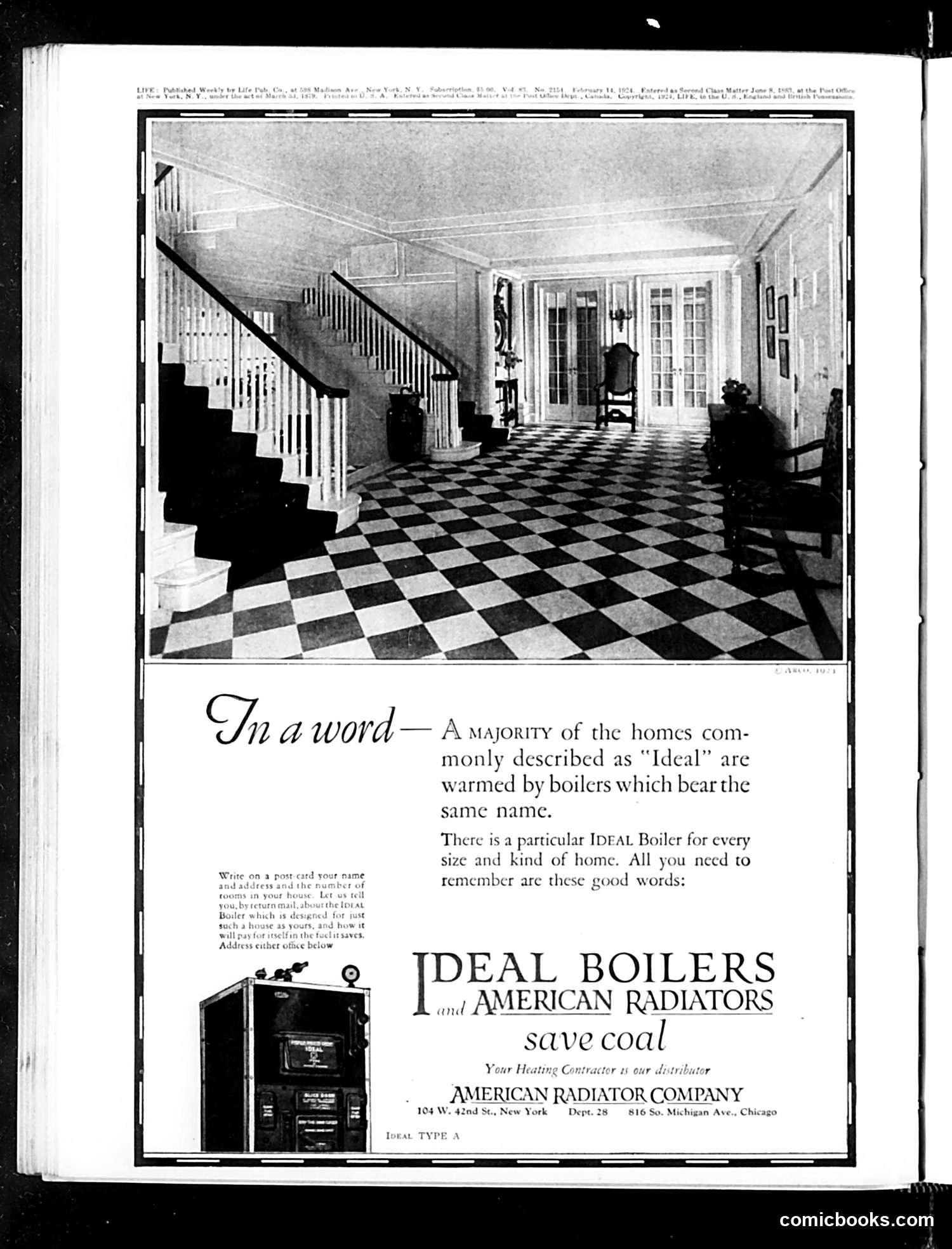
This page is primarily an advertisement for Ideal Boilers and American Radiators, not political satire. The upper portion shows a stylish 1920s-era residential interior—a grand foyer with a checkerboard floor, staircase, and French doors—demonstrating an "ideal" home. The ad's text claims that most homes called "ideal" are heated by boilers bearing that same brand name, positioning the product as synonymous with quality home heating. The copy emphasizes that Ideal makes boilers suited to every home size, and that these systems "save coal"—a practical selling point during an era when coal heating was standard but expensive. The lower portion shows an actual Ideal Type A boiler unit. This is straightforward advertising, not editorial commentary or political cartooning. The "ideal" framing is purely commercial rhetoric.
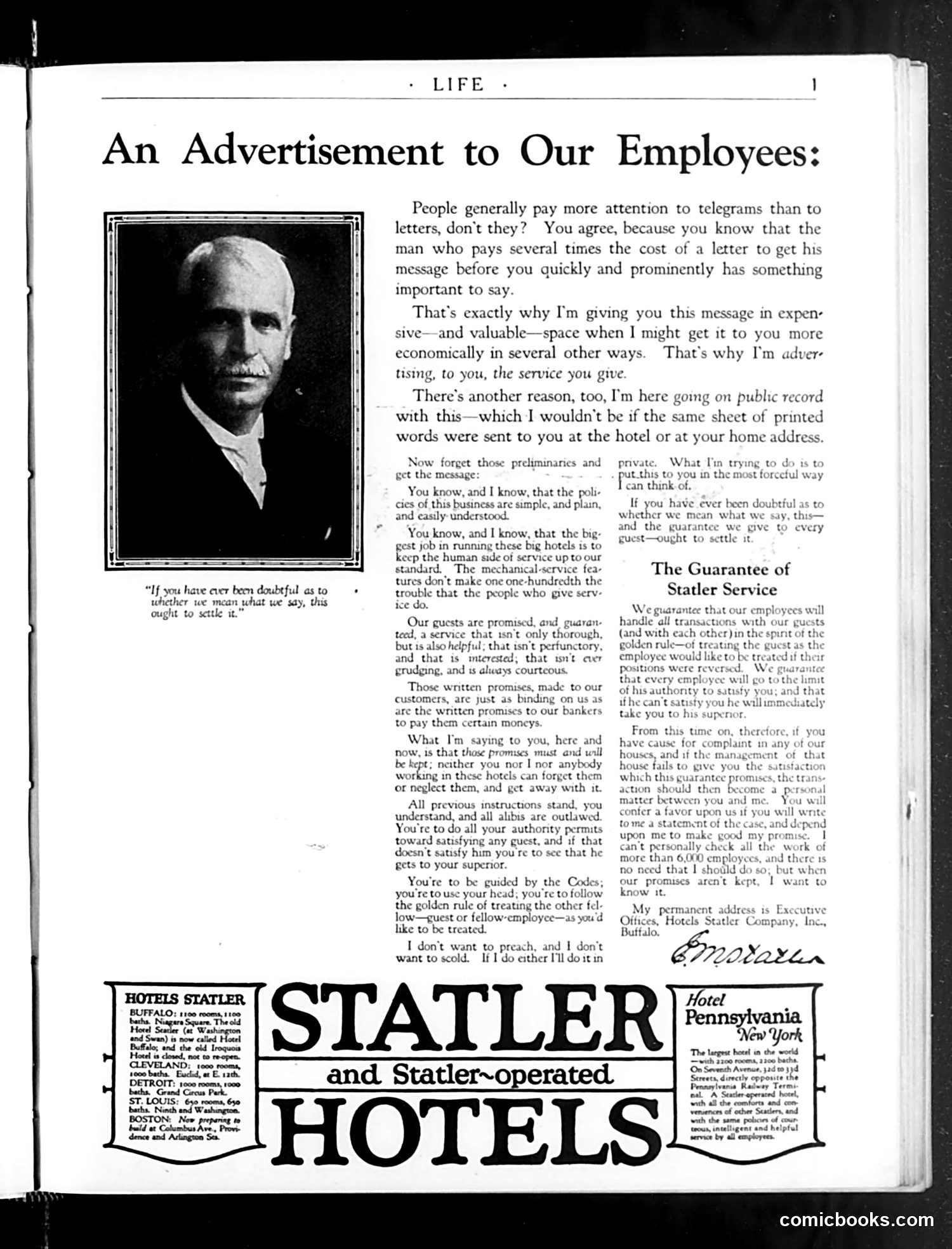
This page is **primarily an advertisement**, not a political cartoon. It features "An Advertisement to Our Employees" for Statler Hotels, a major hotel chain of the era. The image shows a formal portrait of an unnamed businessman (likely a Statler executive) alongside text explaining the company's service philosophy. The message emphasizes that employees must treat guests with respect and courtesy—"the golden rule of treating the other fellow...as you would like to be treated." The advertisement's framing as a formal "public record" statement suggests this was a serious corporate ethics declaration. The "Guarantee of Statler Service" promises guests will receive satisfactory treatment or can escalate complaints to management. This reflects early 20th-century hospitality industry standards and corporate PR messaging rather than satire.
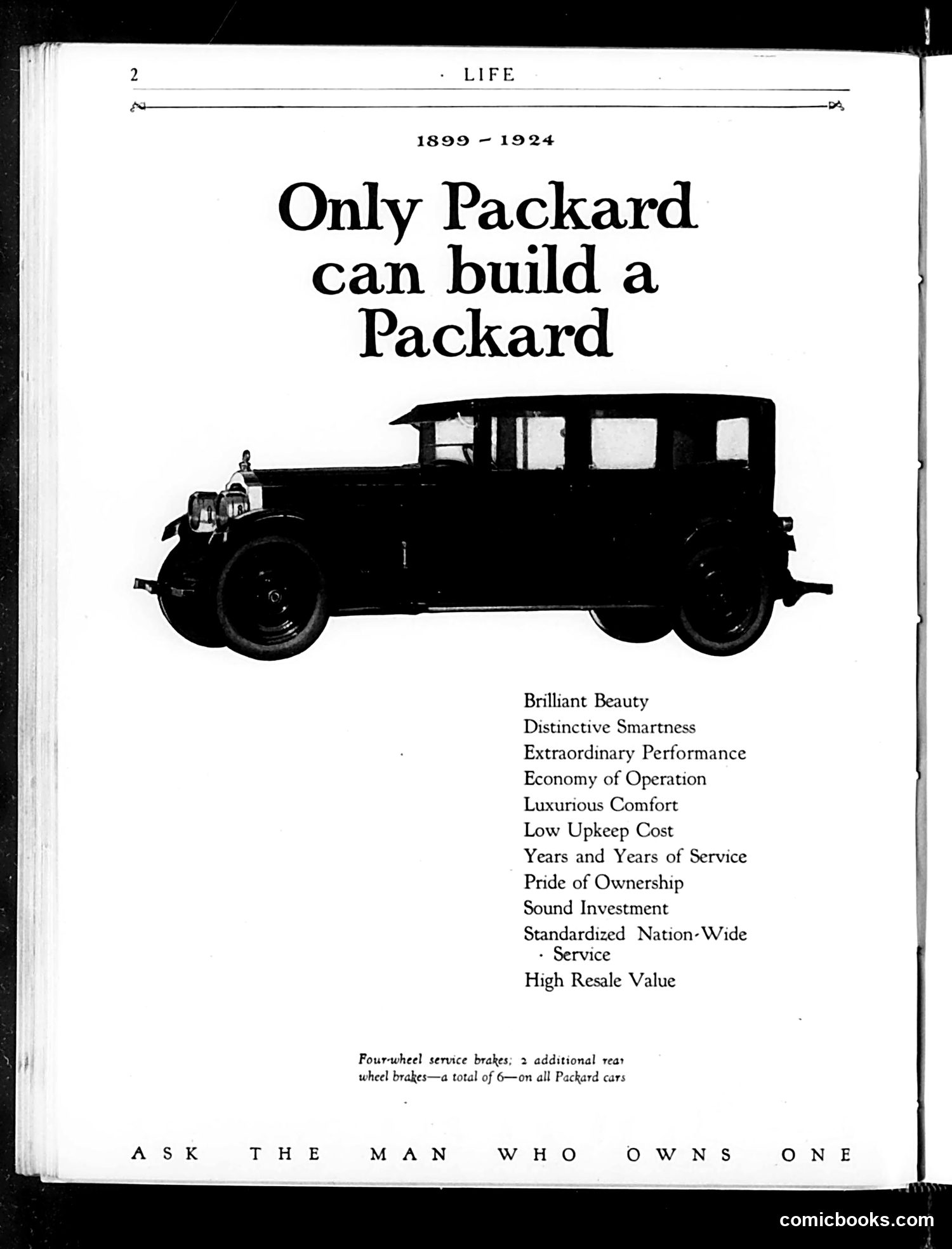
This is a **straightforward advertisement**, not satire or political commentary. It's a Packard automobile ad from Life magazine (1899-1924 period). The ad makes a clever play on words: "Only Packard can build a Packard"—meaning only the Packard company can manufacture quality Packard automobiles. Below the silhouette of a luxury sedan, it lists desirable features: beauty, performance, comfort, low maintenance costs, and resale value. The tagline "Ask the man who owns one" was Packard's famous advertising slogan, appealing to customer testimonials. The small text notes advanced braking technology (six brakes total). This represents early 20th-century luxury car marketing targeting wealthy buyers who valued engineering quality and prestige—there's no satire here, just premium product positioning.
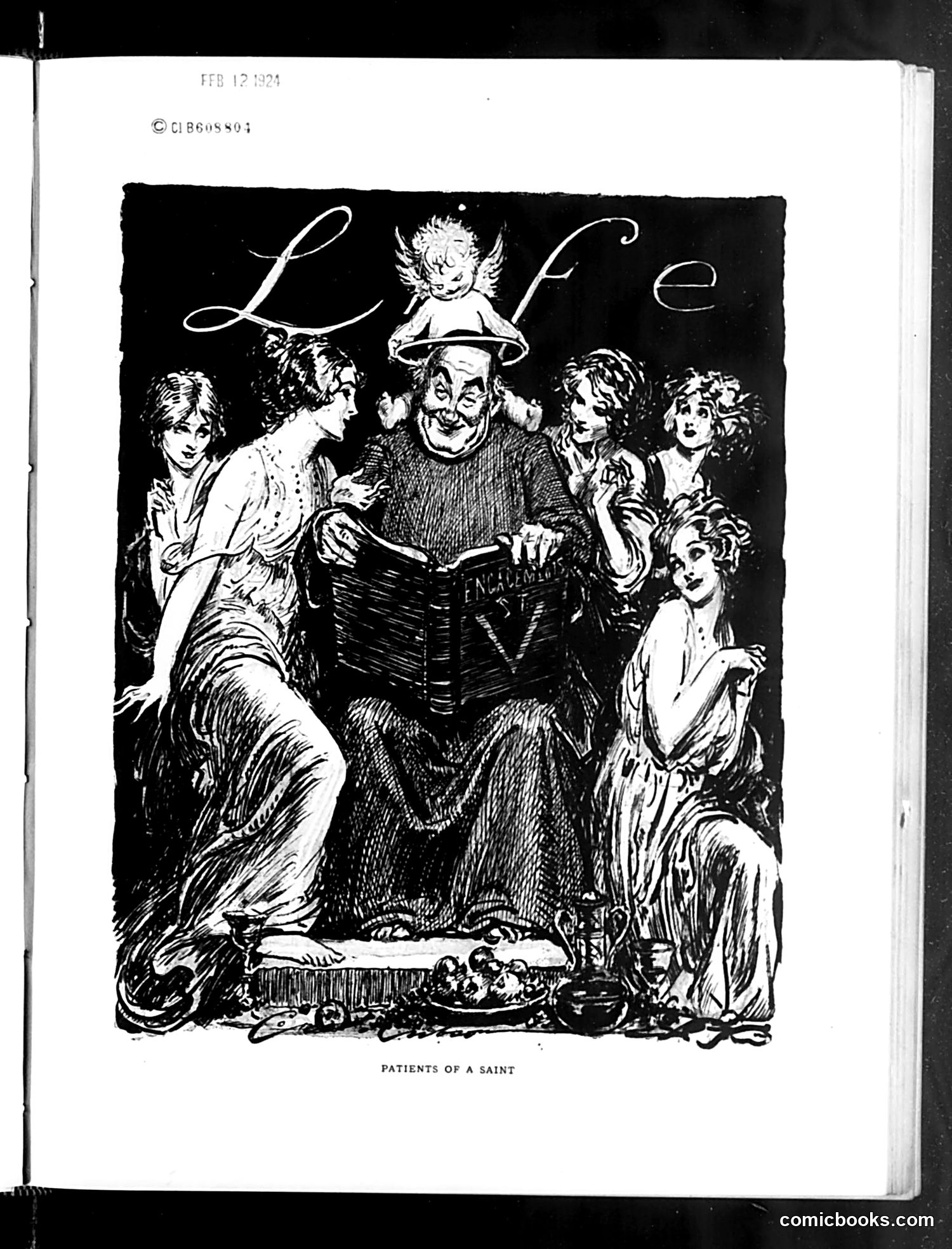
This satirical illustration depicts a central male figure—likely a priest or religious authority—surrounded by women in various states of distress or supplication. The title "Patients of a Saint" suggests ironic commentary on religious exploitation or abuse of power. The angel hovering above and the halo-like hat worn by the central figure mock the veneration of this man as saintly. The women's expressions and body language suggest vulnerability or desperation. The food and domestic items at the bottom imply the women are dependent on or indebted to this figure. The satire appears to critique how religious authority can be manipulated to exploit or control vulnerable people—particularly women—who seek spiritual guidance or material assistance. The "Life" magazine context suggests this addresses contemporary concerns about clerical misconduct or fraud.
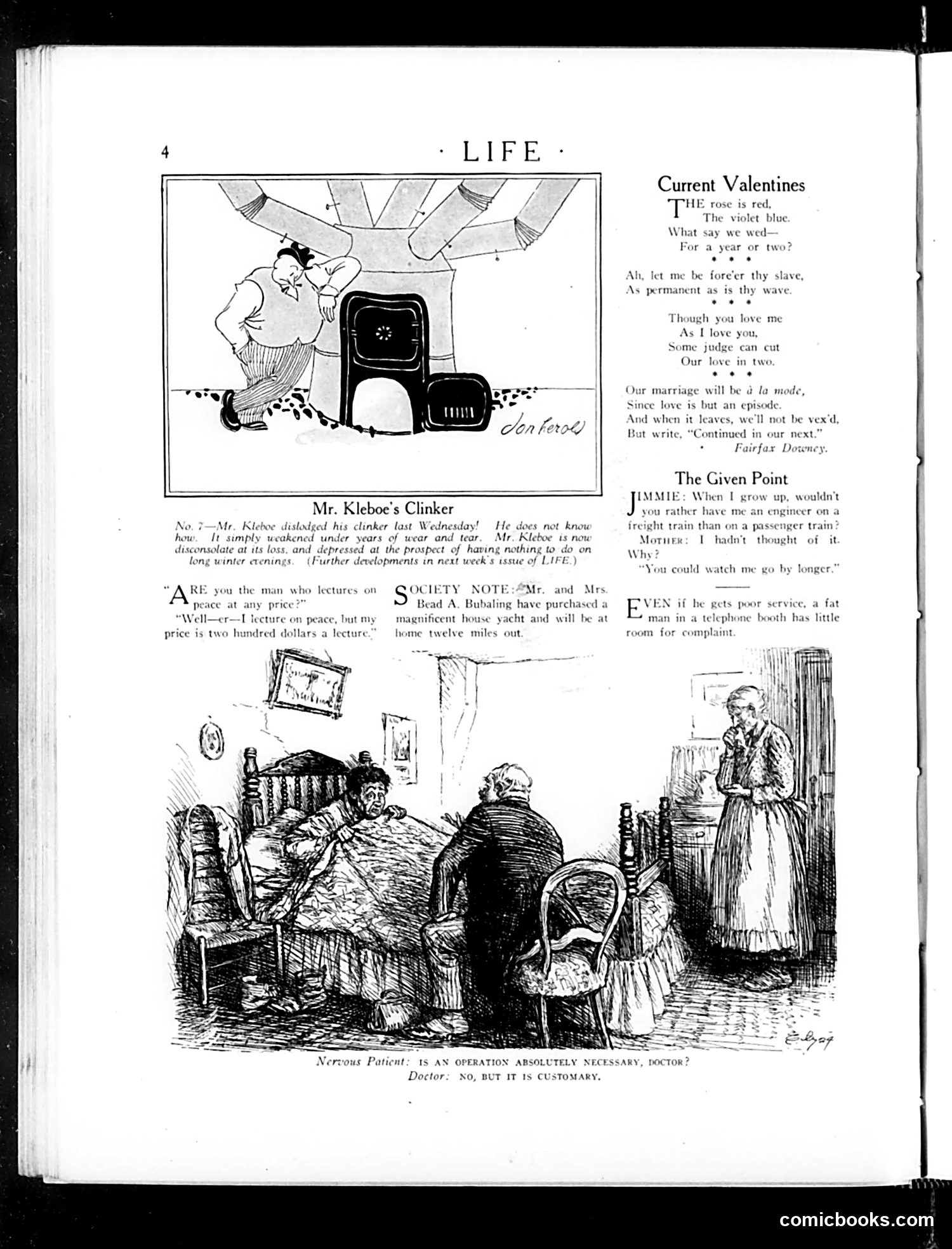
This page contains three distinct satirical pieces from early 20th-century Life magazine: **"Mr. Kleboe's Clinker"** (top): A cartoon depicting a disheveled man, noting he "does not know how" his watch weakened under stress. The joke satirizes someone's incompetence or excuses for failure. **"Current Valentines"** (right): Humorous faux-Valentine poems mocking marriage and relationships, including cynical observations like "Our marriage will be a la mode, / Since love is but an episode." **"The Given Point"** (bottom): A sketch-based story about conversation between characters, with dialogue about engineers and travel. **"Nervous Patient"** (lower illustration): Shows a doctor's visit scene; the patient asks if surgery is necessary, and the doctor responds it's "customary"—satirizing unnecessary medical procedures or doctors' financial motivations. The page reflects early 1900s social commentary on marriage, medical practice, and everyday follies.
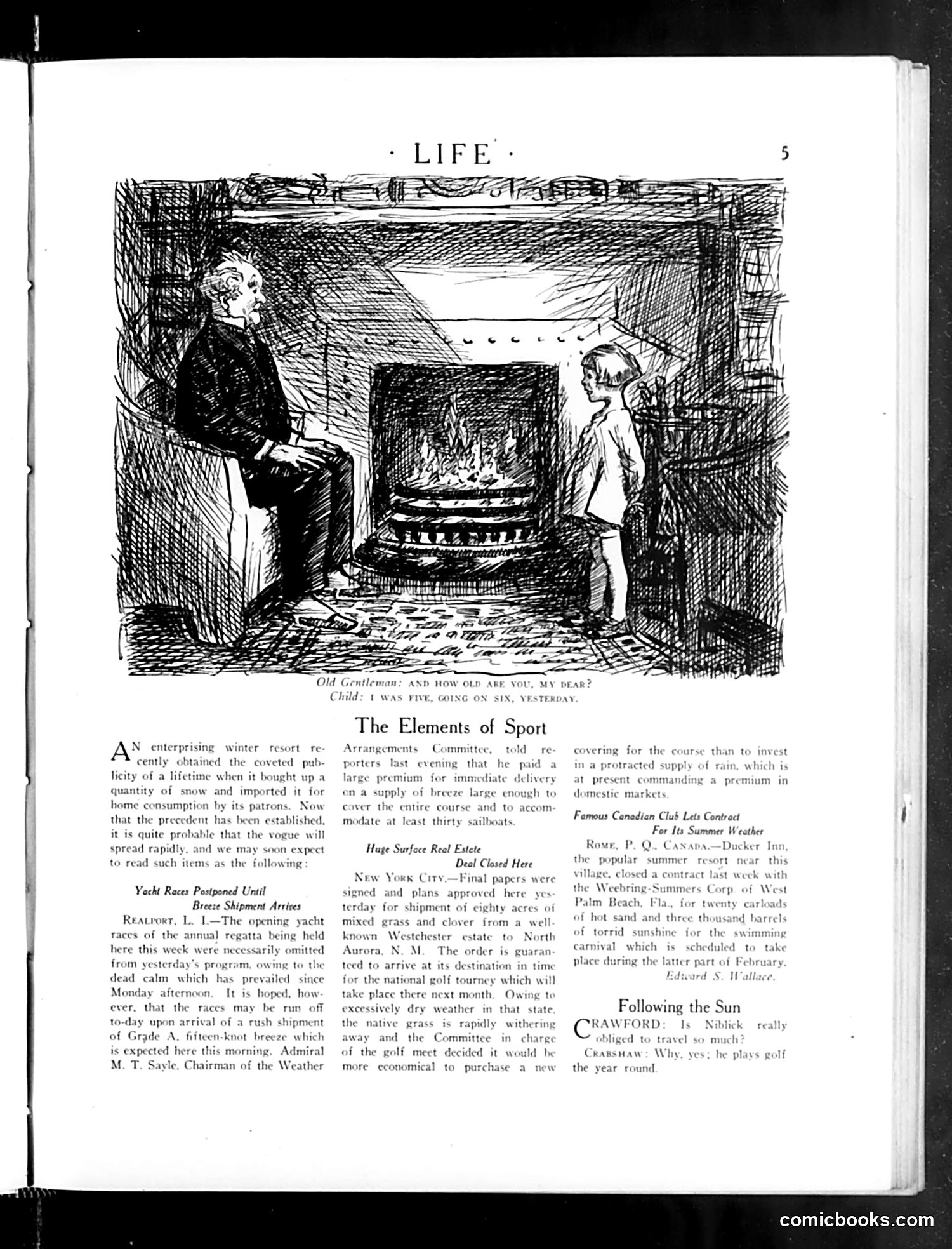
The main illustration depicts a domestic scene with two figures by a fireplace. The caption reads: "Old Gentleman: AND HOW OLD ARE YOU, MY DEAR? / Child: I WAS FIVE, GOING ON SIX, YESTERDAY." This is a gentle humor piece playing on childhood logic—the child's confused or overly literal interpretation of aging, claiming to have aged from five to "going on six" in a single day. It's the kind of innocent, observational humor Life magazine frequently featured about everyday family life and children's amusing misunderstandings. The page also contains brief articles about sports and leisure activities ("The Elements of Sport," "Yacht Races Postponed Until," etc.), typical of Life's miscellaneous content mixing social commentary with lifestyle reporting.
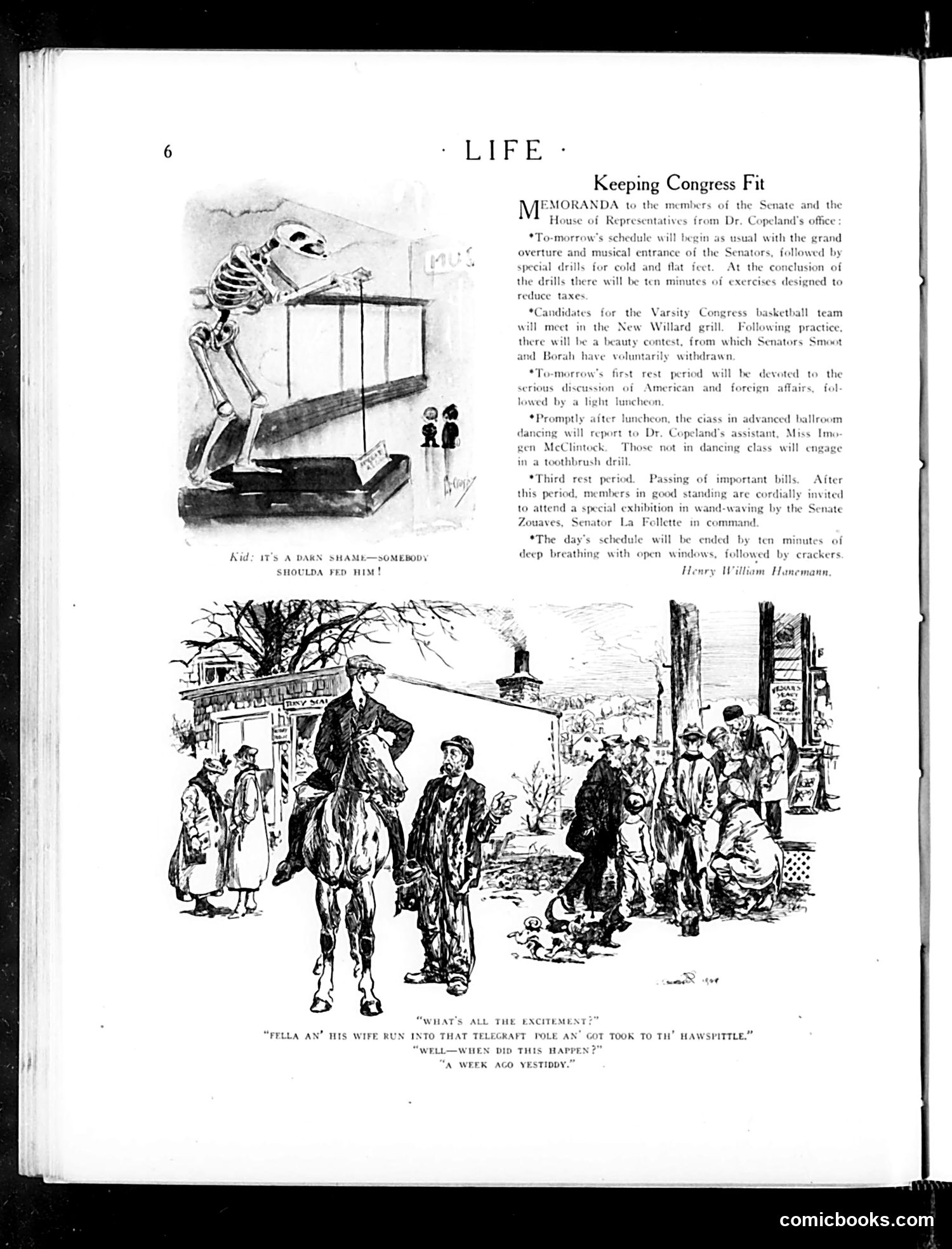
This page satirizes Congressional daily routines through two cartoons. The top cartoon depicts a skeleton operating a rowing machine, captioned "It's a hard sham—somebody shoulder for him!" This mockingly suggests Congress members are physically exhausted or "dead" from their duties. The bottom cartoon shows mounted cavalry and townspeople gathered around a telegraph pole, with dialogue implying Ella's horse ran into the pole a week ago. The caption reads: "What's all the excitement?" / "Ella an' his wife run into that telegraph pole an' got took to th' hawspittle." / "Well—when did this happen?" / "A week ago yestiddy." The joke appears to satirize Congress's slow responsiveness—they're discussing ancient news as though it's current, suggesting governmental inefficiency and delayed reactions to events.
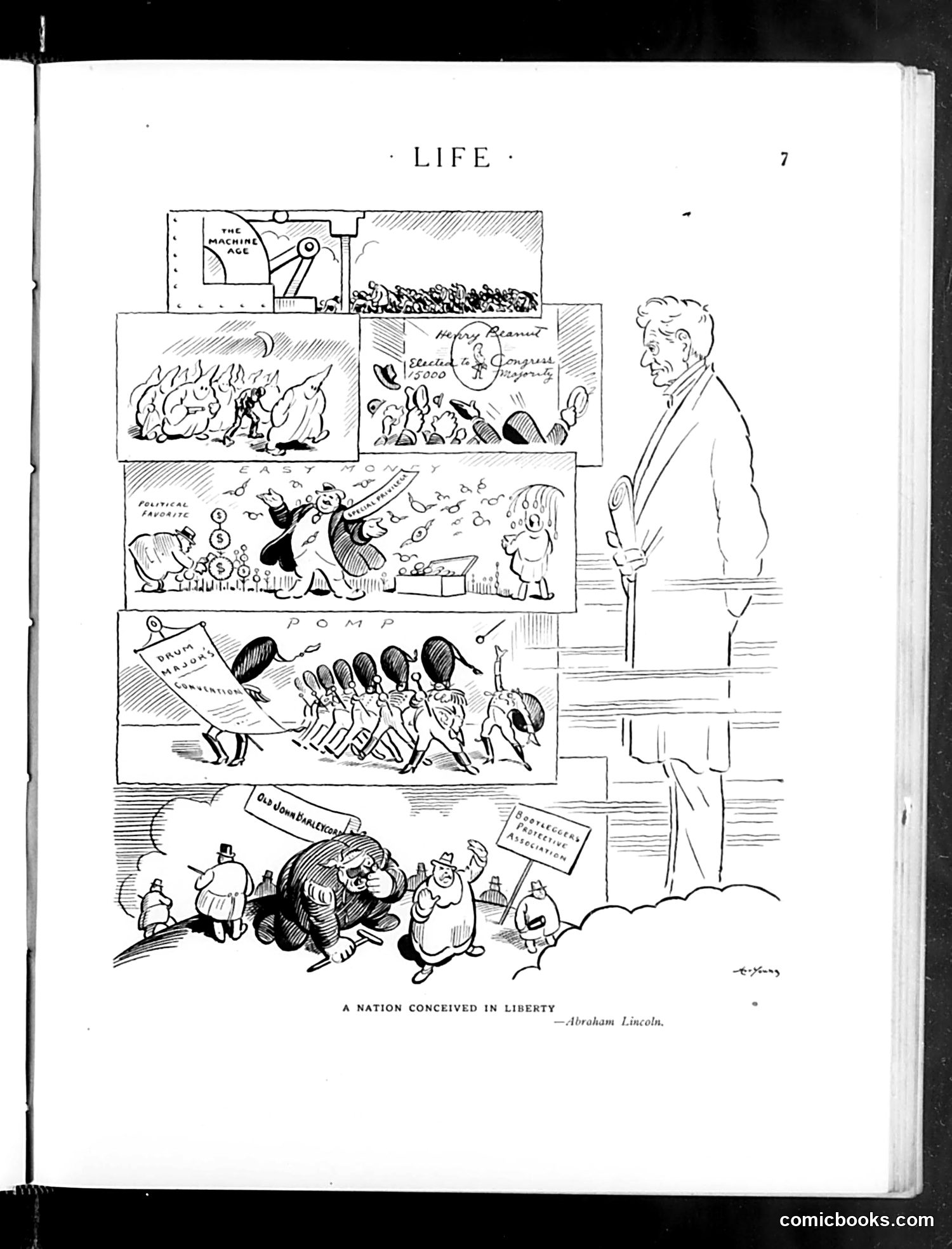
This is a multi-panel political cartoon satirizing American democracy and social progress. The top panels show "The Machine Age" producing wealth and goods, while lower panels depict various social problems: poverty ("Political Parasite"), inequality, and corruption ("Graft and Blackmail"). On the right stands an observant figure, possibly representing a political leader or commentator. The bottom scene shows struggling citizens amid clouds labeled with social ills. The Abraham Lincoln epigraph—"A Nation Conceived in Liberty"—suggests bitter irony: despite America's founding ideals, the cartoon critiques how industrial capitalism and political corruption have failed ordinary people. The machine age promised progress but instead generated poverty and exploitation, undermining democracy itself. The cartoon's message: American ideals remain unrealized.
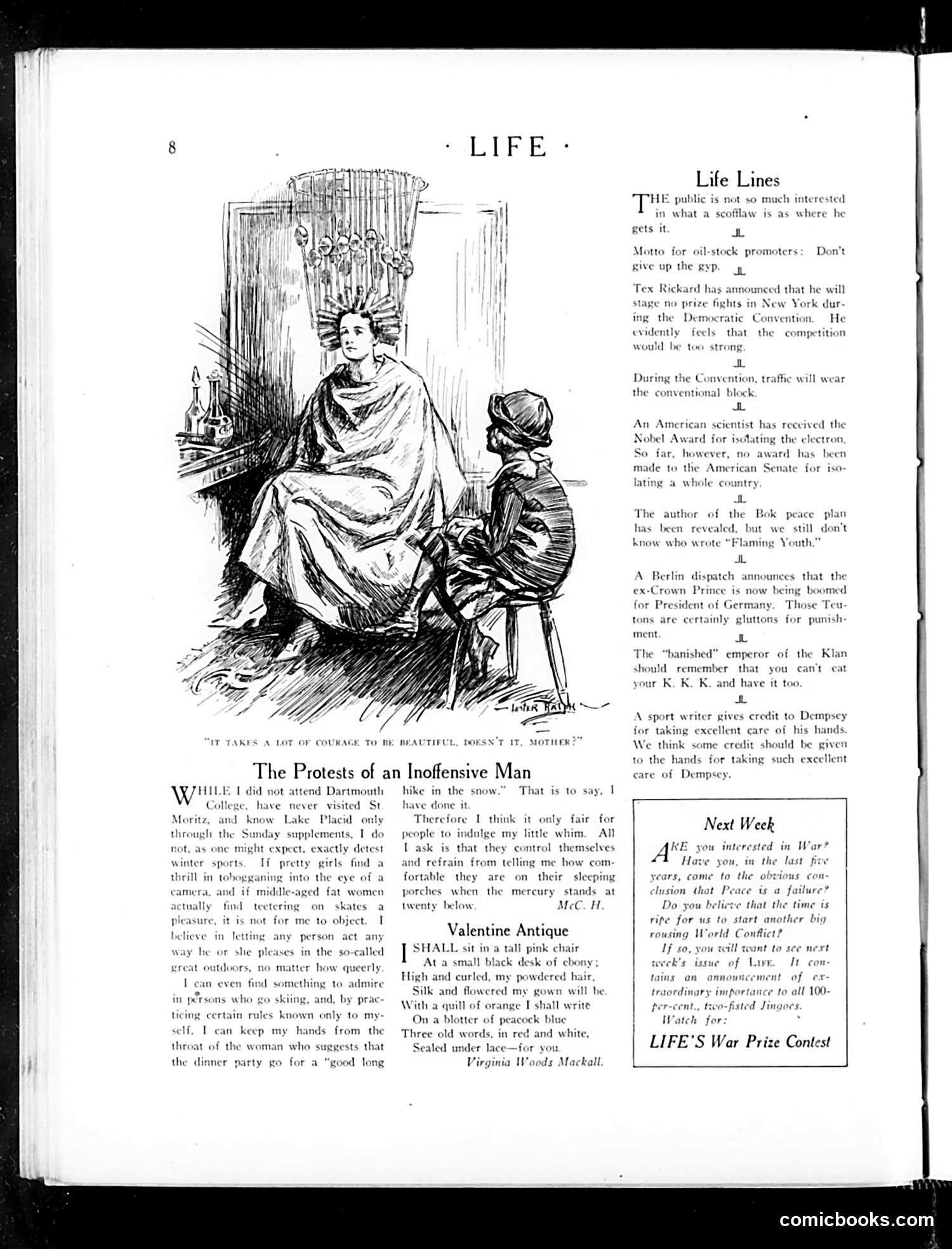
The main illustration depicts a woman in classical robes (likely representing Liberty or America) with children, captioned "It takes a lot of courage to be beautiful, doesn't it, mother?" This appears satirical commentary on American ideals versus reality during a period of social tension. The "Life Lines" column contains brief political jokes and observations, including references to Tex Rickard (boxing promoter), the Democratic Convention, and a "banished emperor of the Klan"—likely referencing post-1920s KKK decline. One item mocks the American Senate for not isolating a country, contrasting with a Nobel Prize awarded to a scientist. The page reflects 1920s-era satirical commentary on American politics, social movements, and contemporary events through short, punchy jokes typical of Life magazine's format.
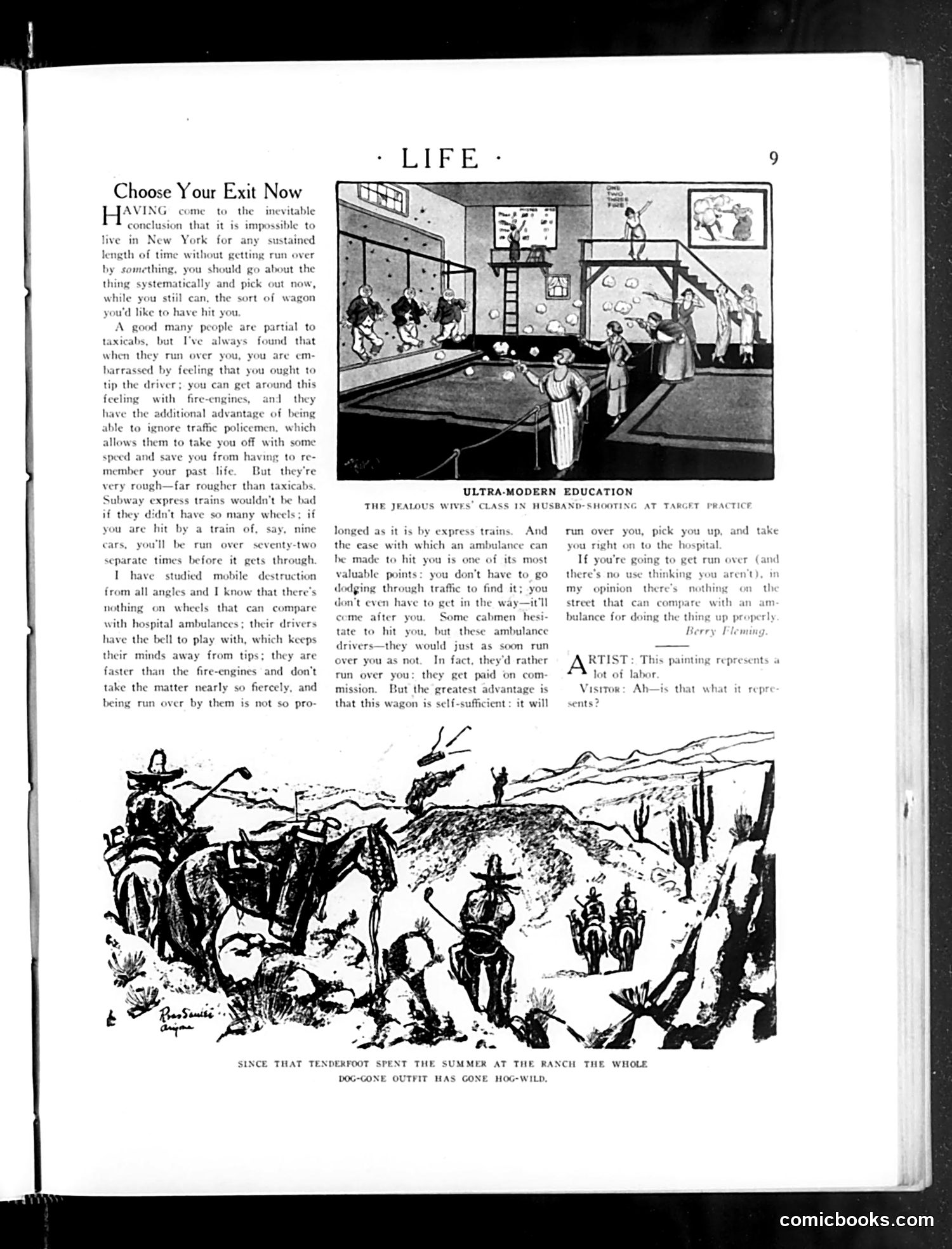
This page contains two distinct satirical pieces from *Life* magazine: **Top section ("Choose Your Exit Now"):** A humorous essay arguing that New Yorkers should preemptively choose how they'll die in the city since it's inevitable. The author compares various methods—taxicabs, subway trains, ambulances—with darkly comic observations about traffic hazards and the self-sufficiency of emergency vehicles. It's social satire targeting New York City's notorious dangerous traffic and congestion, treating accidental death as an inevitable urban reality rather than exception. **Bottom cartoon ("Ultra-Modern Education"):** Depicts a gun-shooting class for "jealous wives," satirizing 1920s-30s gender politics and changing social mores. The joke targets women's expanding roles and leisure activities while maintaining traditional marital anxieties—it's simultaneously mocking both women's independence and male insecurity about infidelity. Both pieces reflect period anxieties about modern urban life and shifting social conventions.
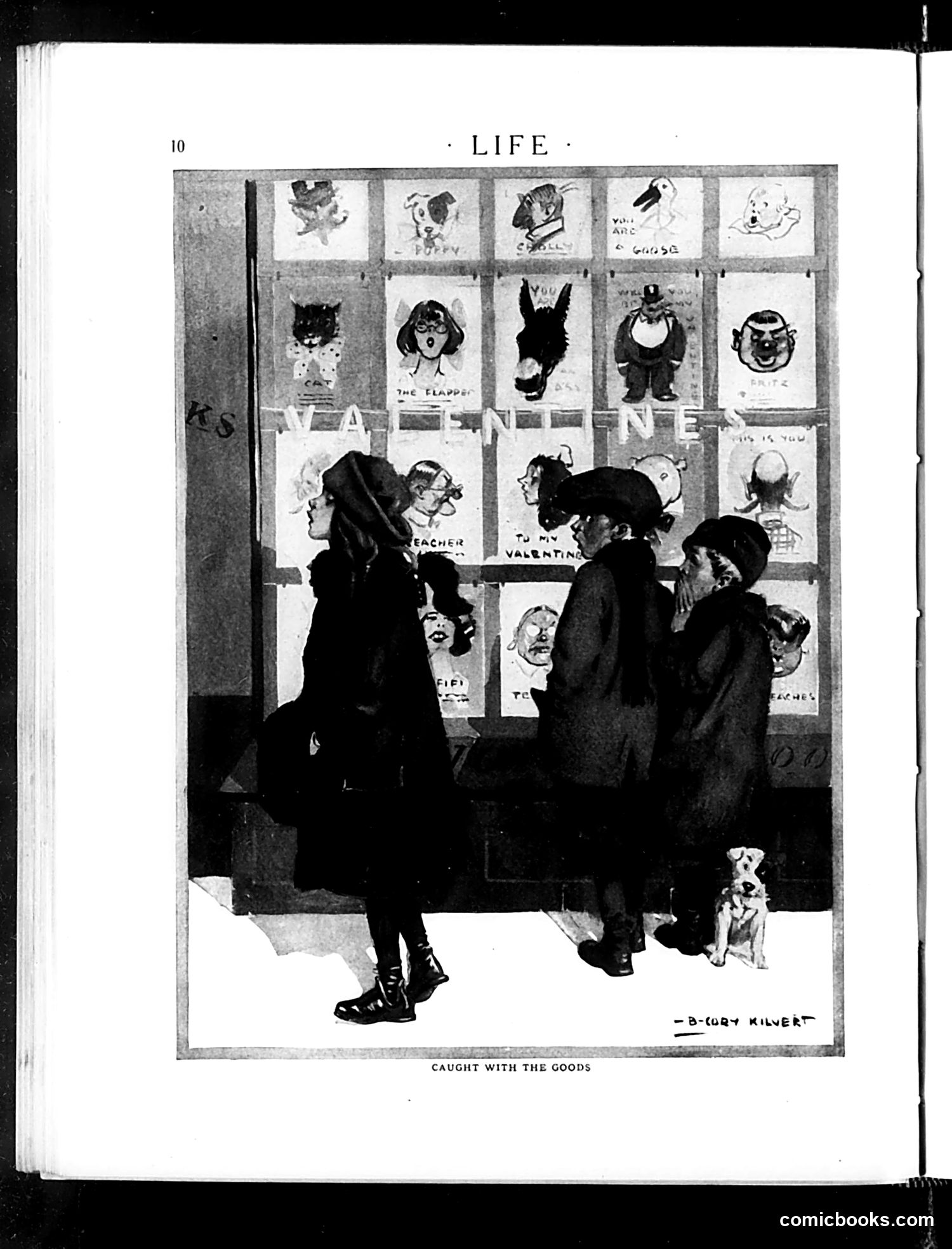
This cartoon by D. Cub Kilvert satirizes window shopping, likely during the early 20th century. The image shows well-dressed people examining an elaborate shop display window featuring numerous cartoon animal characters and caricatured faces—many labeled (visible text includes "TEACHER," "VALENTINE," and others, though some labels are unclear). The title "Caught with the Goods" suggests these shoppers are being caught in the act of window shopping, perhaps critiquing consumer behavior or materialism of the era. The small dog at ground level observes the scene, possibly adding ironic commentary about who are the "real" consumers. The satirical humor targets urban middle-class shopping culture and window display marketing tactics popular during this period.
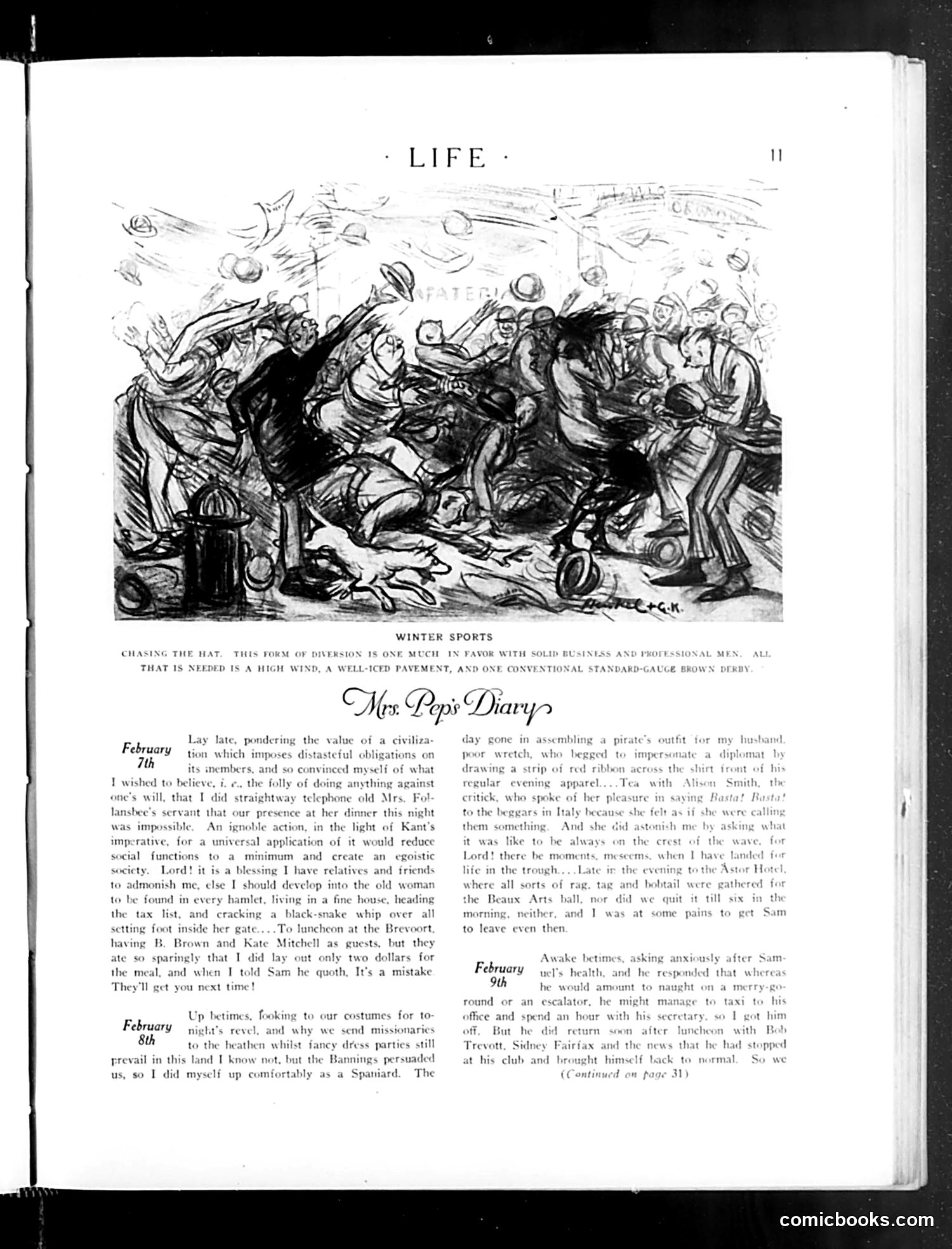
This satirical illustration depicts a chaotic winter scene labeled "Winter Sports," showing well-dressed figures engaged in rowdy behavior—chasing hats, falling, and generally causing mayhem in the snow. The caption critiques this form of "diversion" as unsuitable for "solid business and professional men," suggesting it lacks "a well-iced pavement, and one conventional standard-gauge brown derby." The satire targets the undignified conduct of respectable gentlemen abandoning decorum during winter recreation. The cartoon mocks how supposedly serious businessmen lose composure and propriety when engaging in casual winter games, tumbling about like children rather than maintaining the stiff formality expected of their social class. The accompanying "Mrs. Pop's Diary" column documents similar social observations from early 20th-century elite society.
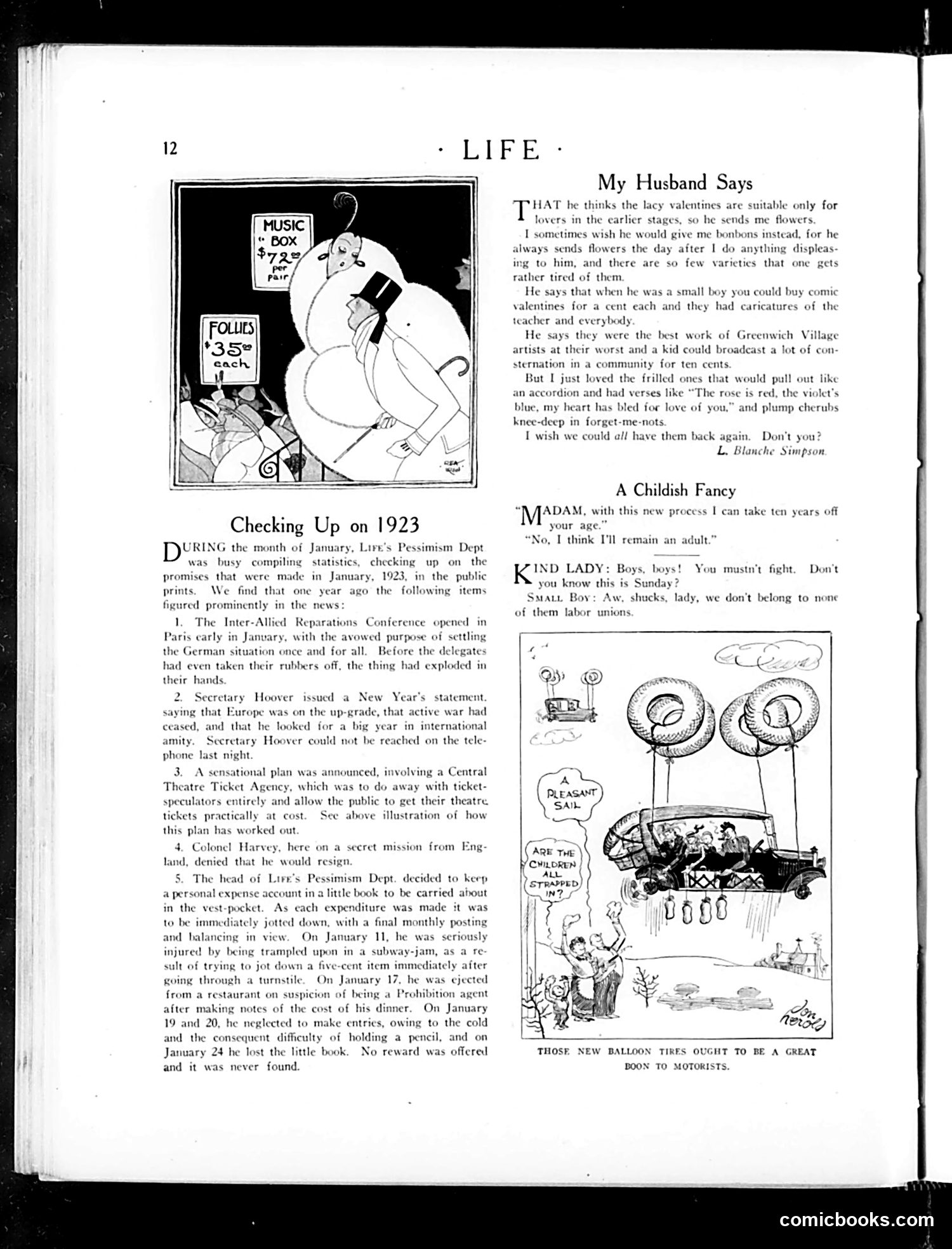
This page contains three distinct items: 1. **"Checking Up on 1923"** - A humorous retrospective listing notable January 1923 events, including the Inter-Allied Reparations Conference, Secretary Hoover's statements about the economy, and various bureaucratic mishaps (a lost expense book, a trampled subway-jam incident). 2. **"My Husband Says"** - A column by L. Blanche Sympton about Valentine's Day preferences, contrasting her husband's dismissal of lacy valentines as childish with her nostalgia for elaborate, accordion-style cards from childhood. 3. **"A Childish Fancy"** - A dialogue joke between a kind lady and small boy about age, followed by a cartoon showing children in a basket suspended from large balloon tires, captioned as a motorist novelty. The satire targets post-war bureaucracy and romantic conventions.
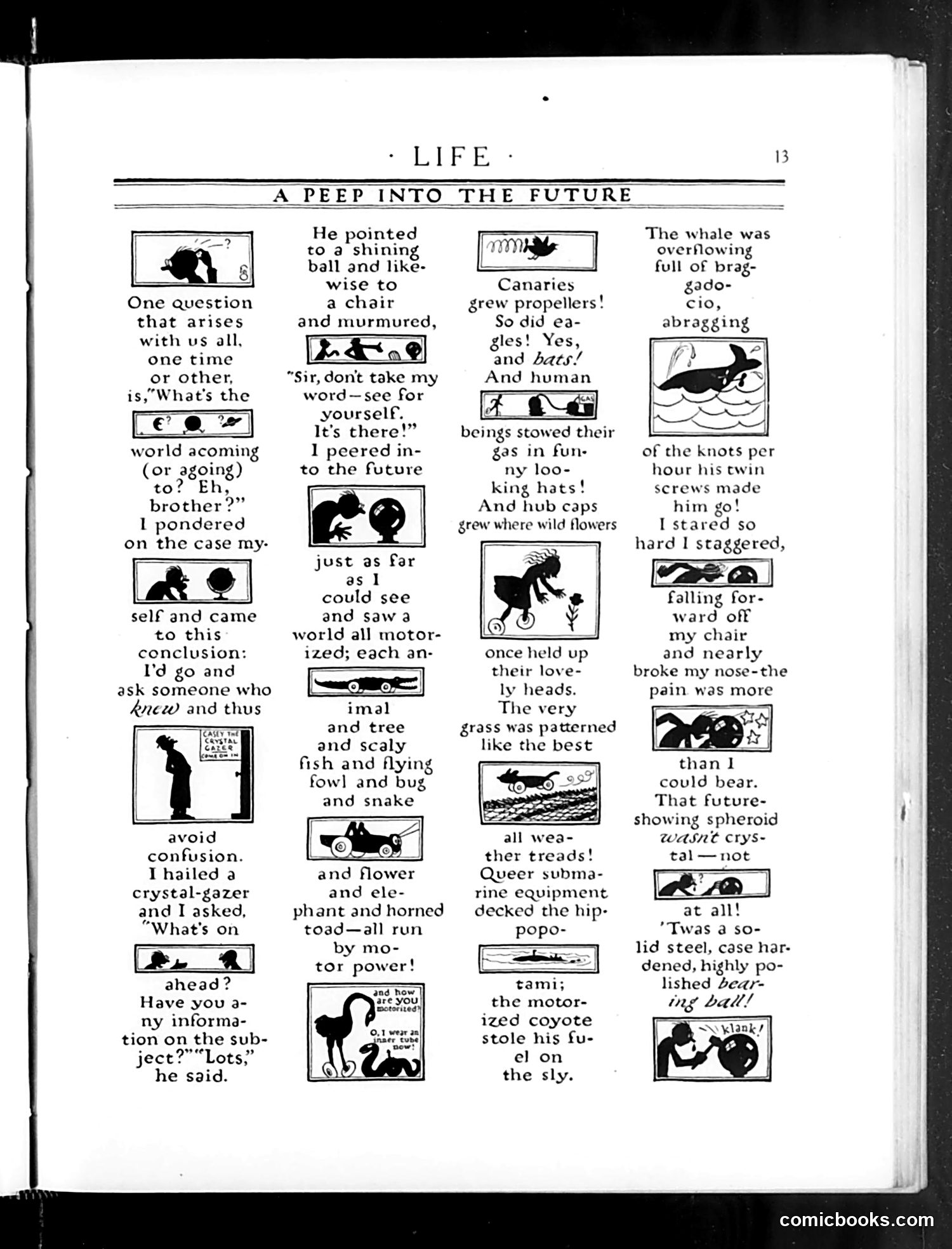
This page satirizes predictions about technological and social progress. The narrator consults a "crystal-gazer" to learn "what's on ahead," and is told about a fantastical future world. The satire catalogs absurd inventions and scenarios: motorized vehicles everywhere, canaries with propellers, whales with mechanical parts, submarines, and animals wearing human technology. The humor lies in mocking overly optimistic predictions of mechanization and progress—suggesting that future advancement would be chaotic, ridiculous, and poorly integrated into nature. The small illustrations with silhouettes depict these bizarre hybrids of animals and machinery, emphasizing the satirist's skepticism about whether technological "progress" would actually improve life or simply create confusion and danger ("pain was more than I could bear"). This reflects turn-of-the-century anxieties about rapid industrialization.
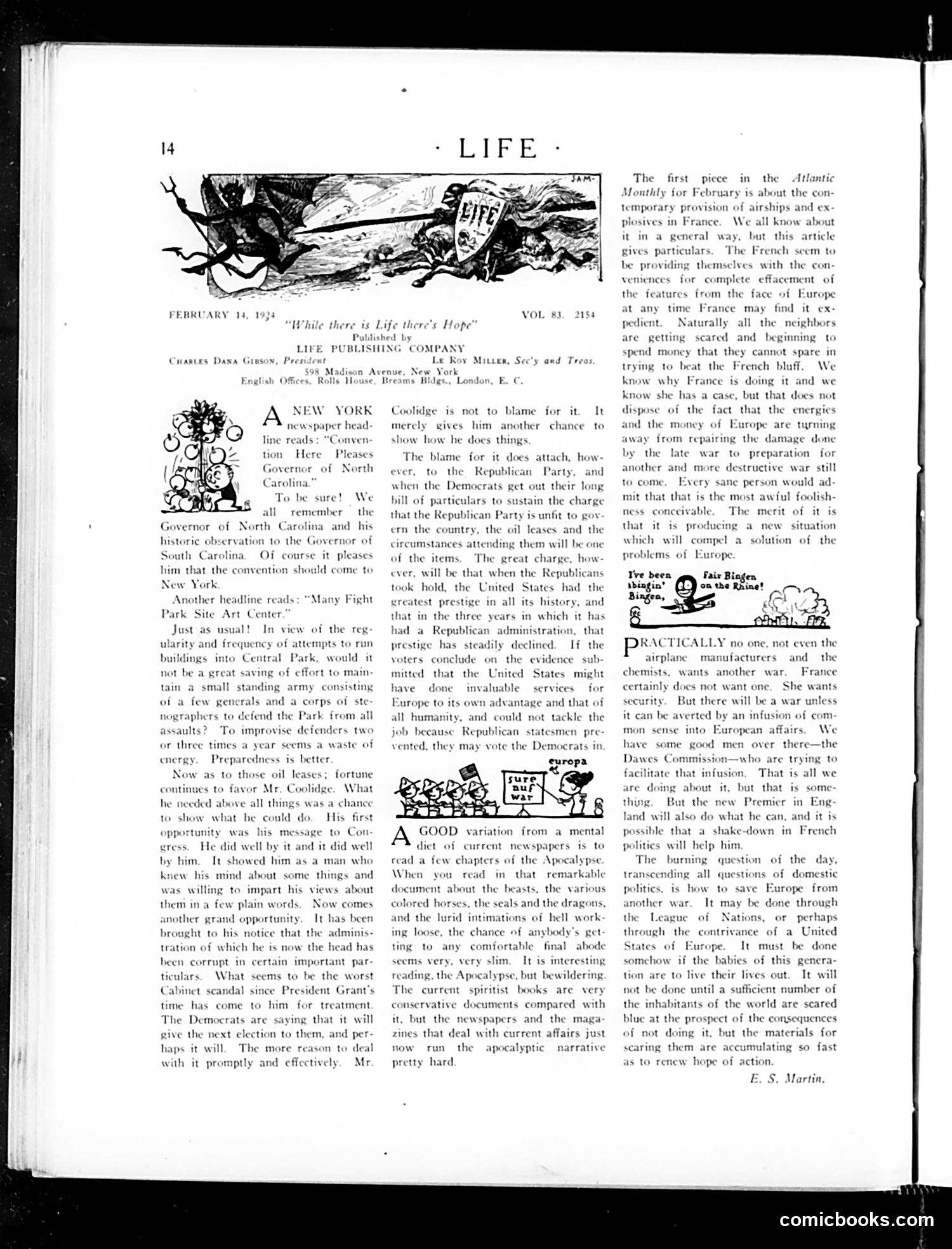
The page contains political commentary about Republican governance and French security concerns. The main text discusses New York Governor Coolidge and Republican Party credibility, with criticism that Republican administration has become corrupt and lost prestige. The cartoons (visible but small) appear to reference: - **"I've been Stung!"** - likely depicting a figure cheated or deceived - **"Europa" cartoon** - appears to show European concerns about war preparation The article argues that Democrats may gain electoral advantage if Republicans lose voter confidence. The final commentary warns that without sufficient political action, war materiel accumulation threatens European stability, suggesting international consequences of domestic political failures. The overall tone is pessimistic about preserving peace amid political instability.
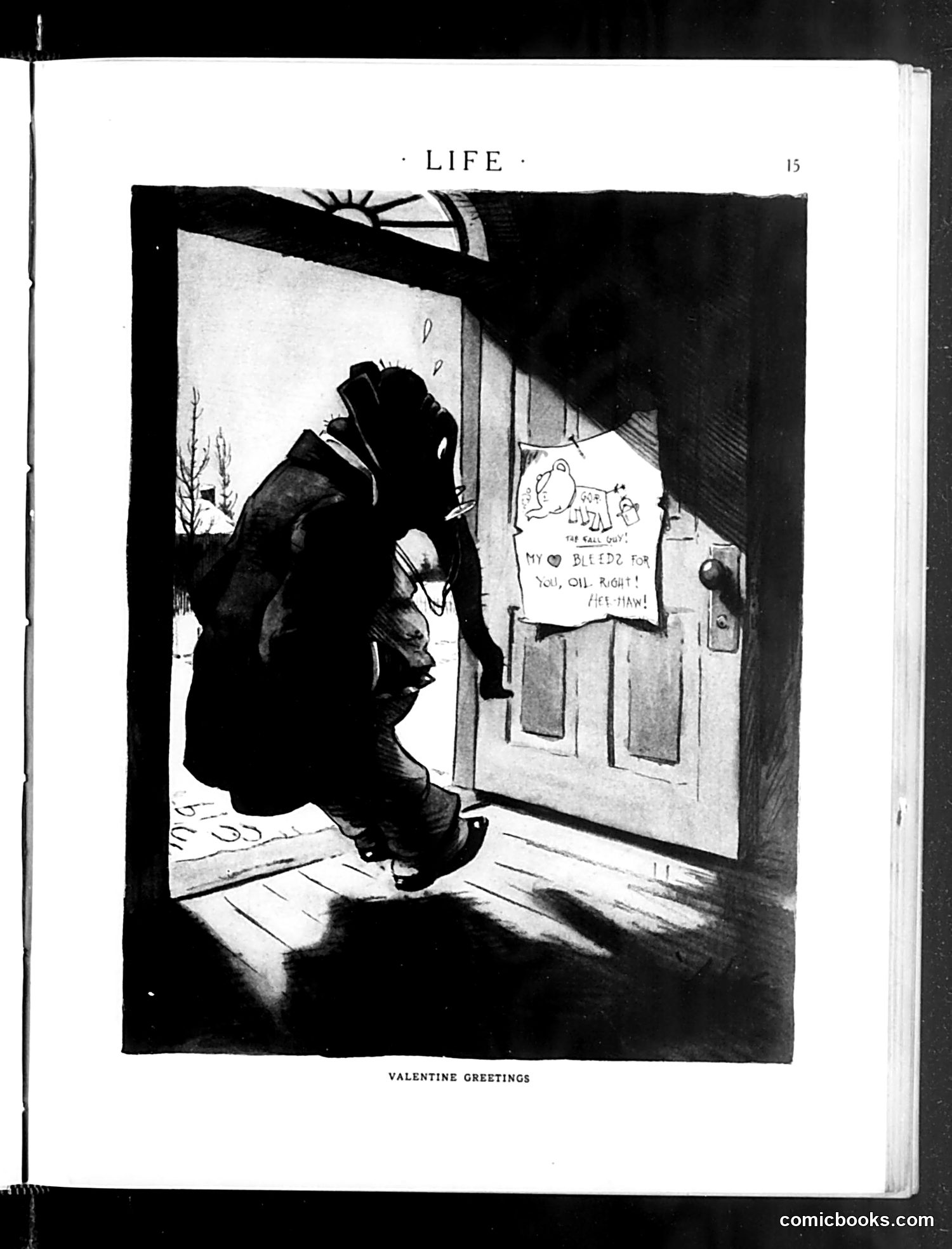
This cartoon depicts a figure in winter clothing looking through a doorway at a child's drawing and note posted on the inside. The note reads "MY ❤ BLED FOR YOU, OH RIGHT! HIFI-HAW!" with crude stick-figure drawings above it labeled "THE BALL OUT?" The satire appears to target sentimental Valentine's Day greetings, particularly exaggerated romantic or patriotic declarations. The crude childish handwriting and drawings mock overwrought emotional expression—the contrast between flowery Valentine sentiment and this deliberately crude, almost mocking message creates the humor. The "heart bled for you" phrase was common in romantic rhetoric of the era. The cartoon satirizes this clichéd sentimentality by presenting it rendered in deliberately juvenile, awkward fashion, suggesting the gap between genuine feeling and hollow conventional expressions.
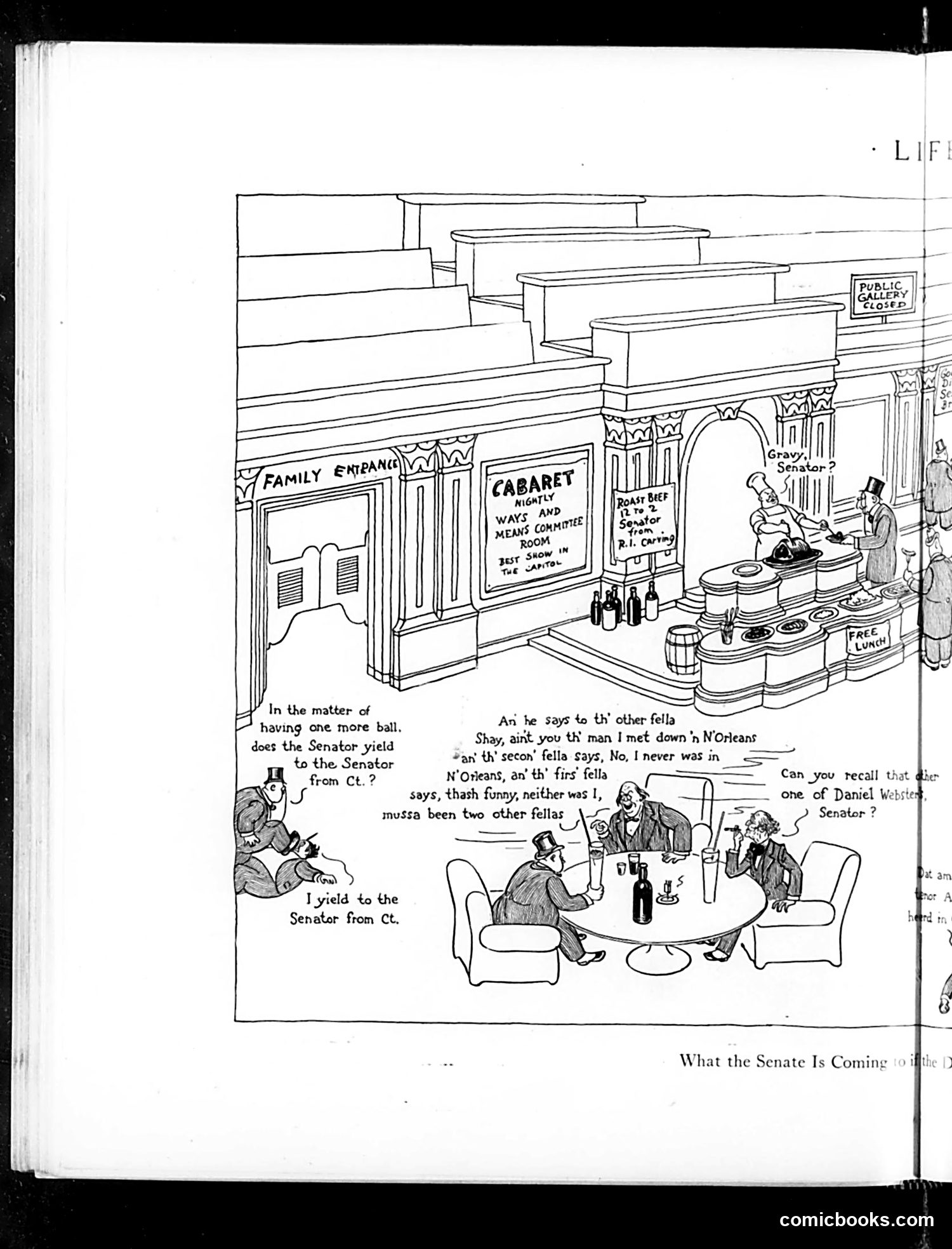
This is a satirical cartoon about Senate corruption and bribery during the Prohibition era. The scene depicts a luxurious cabaret with "free lunch" and alcohol—illegal under Prohibition—suggesting senators openly flouted the law. The dialogue mocks a senator from Connecticut who claims he yielded on "one more ball" (likely a legislative vote) to another senator. The men's conversation—reminiscent of New Orleans colloquial speech—creates comedic confusion about identity, suggesting these politicians are interchangeable or forgettable figures engaged in shady dealings. The cartoon satirizes senators' apparent comfort with vice and corruption. The "Public Gallery Closed" sign indicates secrecy. The title "What the Senate Is Coming to" expresses the cartoonist's criticism of institutional moral decline, implying that senators prioritize backroom deals and illegal pleasures over governing honestly.
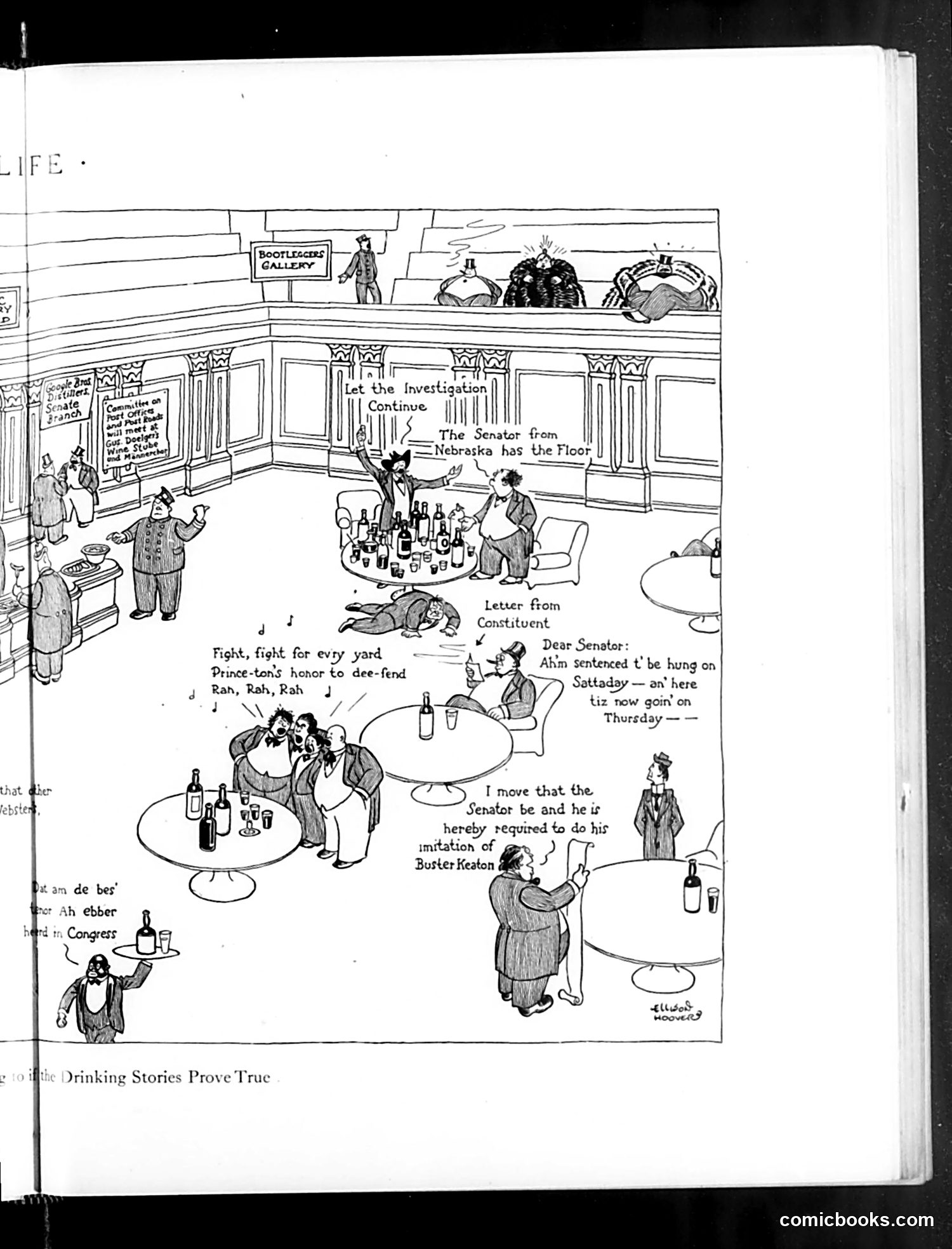
This Life magazine cartoon satirizes Congressional corruption and debauchery during what appears to be a Senate investigation. The setting depicts senators in an ornate chamber surrounded by alcohol bottles, completely intoxicated and distracted from official business. Key elements include: - **"The Senator from Nebraska has the Floor"**: A senator appears to be conducting official proceedings while drunk - **"Letter from Constituent"**: References a constituent's complaint about a death sentence delay, ignored amid the drinking - **"Fight, fight for every yard / Prince-ton's honor to defend"**: A senator singing drunkenly (possibly a Princeton reference) - **"Imitation of Butler Keaton"**: A comedic motion suggesting senators are performing theatrical antics rather than conducting serious government work The cartoon's title, "Drinking Stories Prove True," implies that popular stories about Congressional drinking and incompetence are accurate. It mocks senators as more interested in alcohol and entertainment than constituent concerns or legitimate legislative work—a scathing indictment of government corruption and negligence.
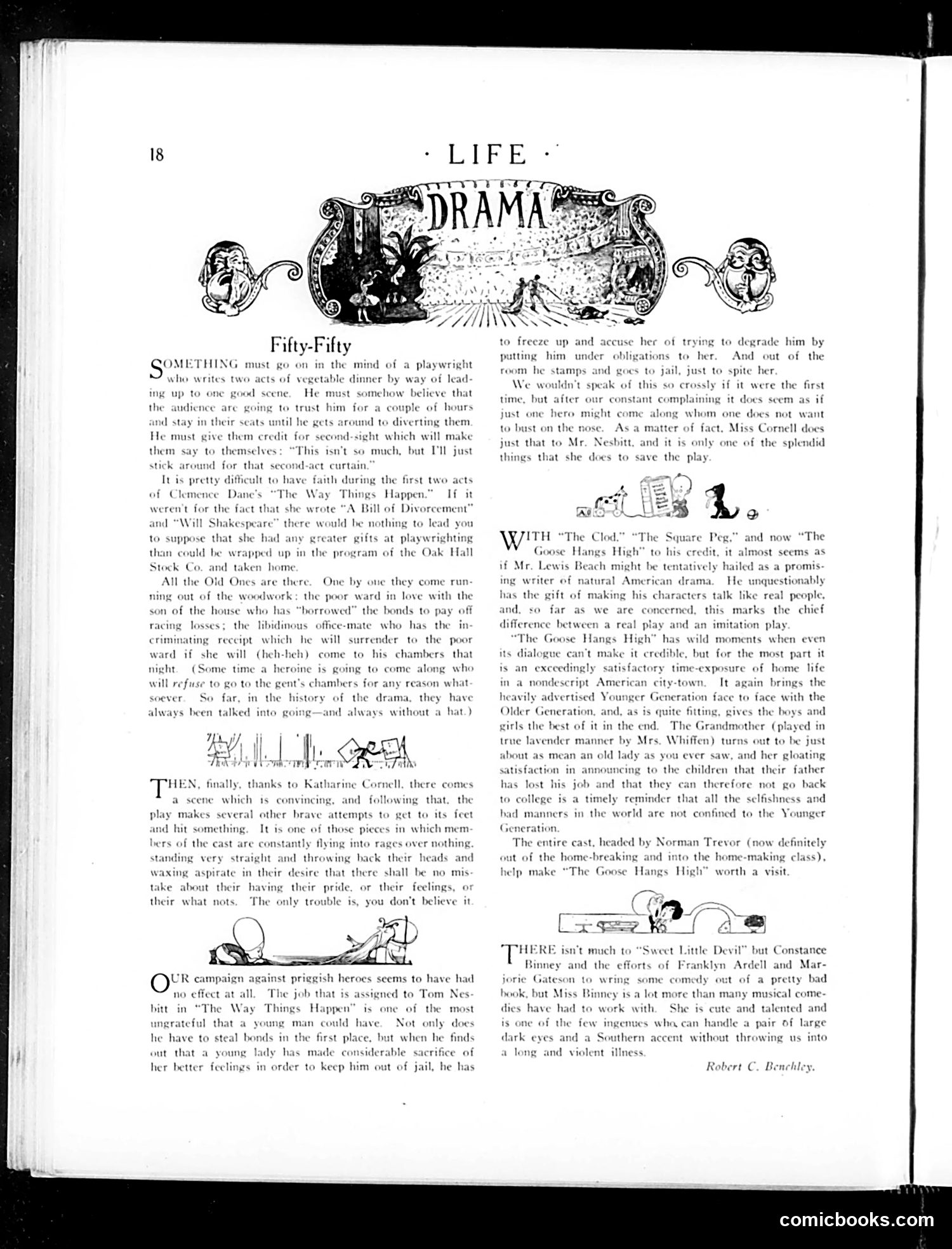
This page reviews three Broadway plays in the "Drama" section. The critic discusses: **"The Way Things Happen"** by Clemence Dane—criticized for tedious first two acts before a good final scene. The reviewer mocks predictable plot devices (poor ward in love, borrowed bonds, office seduction scenes) as hackneyed theater clichés. Katharine Cornell's performance saves the play, though the male lead (Nesbitt) plays an insufferable priggish hero unconvincingly. **"The Goose Hangs High"** by Lewis Beach—praised as realistic American comedy featuring the "Younger Generation versus Older Generation" conflict. The critic credits Beach's dialogue with making characters sound like real people, though acknowledges some moments strain credibility. **"Sweet Little Devil"**—briefly mentioned as featuring Constance Binney attempting comedy from a weak script. The satirical drawings illustrate theatrical conventions and audience behavior. The overall tone critiques both lazy playwriting formulas and actors unable to transcend poor material, while praising authentic characterization.
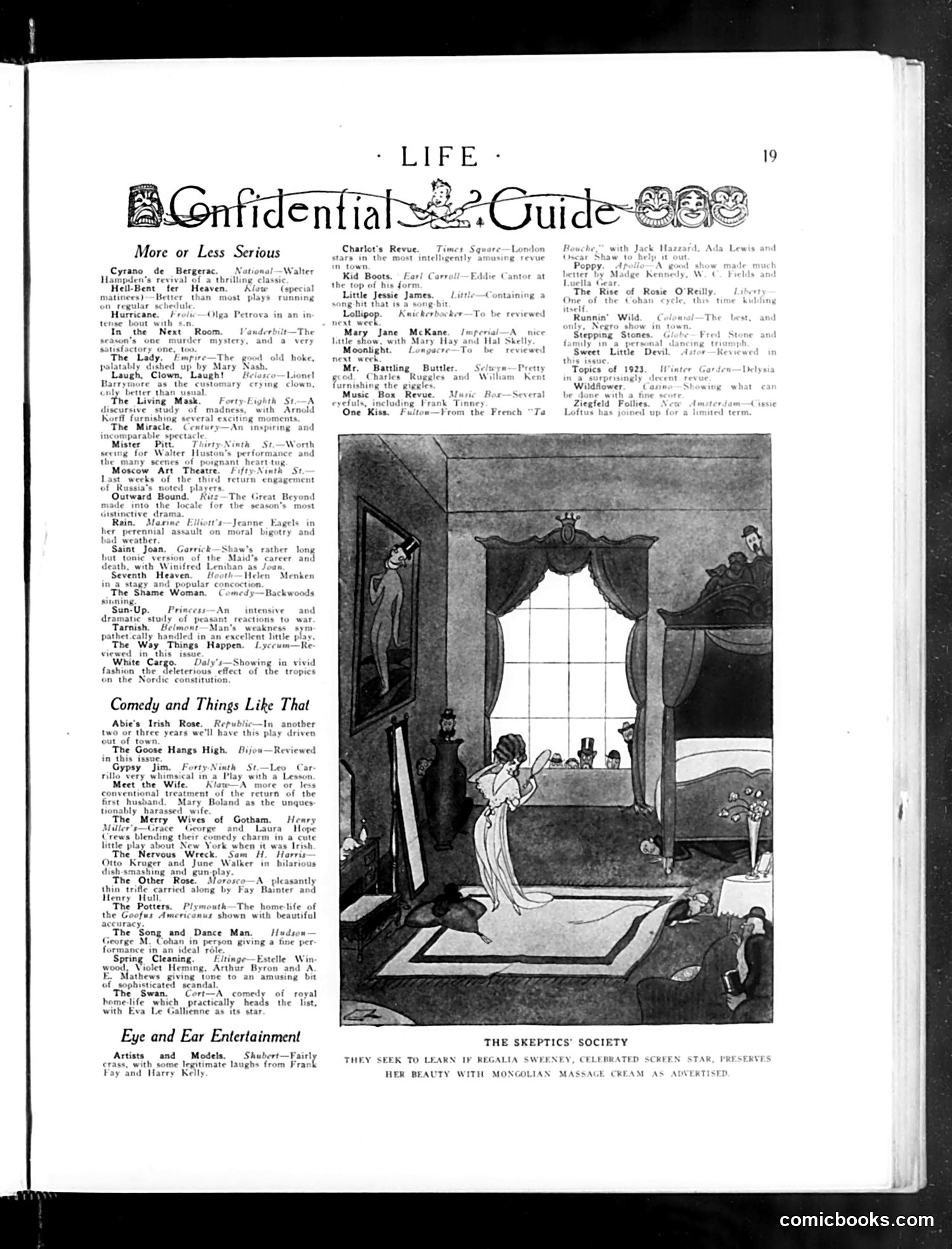
This single-panel cartoon satirizes the vanity of Hollywood actresses and the pseudoscientific beauty treatments marketed to them. The image shows a glamorous woman receiving a facial massage from an attendant, while skeptical onlookers observe from doorways—the "skeptics" of the title. The caption reads that they're checking whether actress Regalia Sweeney preserves her beauty using "Mongolian massage cream as advertised"—mocking both the absurd exotic-sounding product name and the celebrity endorsement culture. The joke targets two things: actresses' desperation to maintain youth through dubious treatments, and the gullibility of consumers who believe celebrities' endorsements of such products. This reflects 1920s anxieties about mass marketing and the growing Hollywood star system, satirizing both celebrity culture and the patent-medicine industry's aggressive advertising tactics.
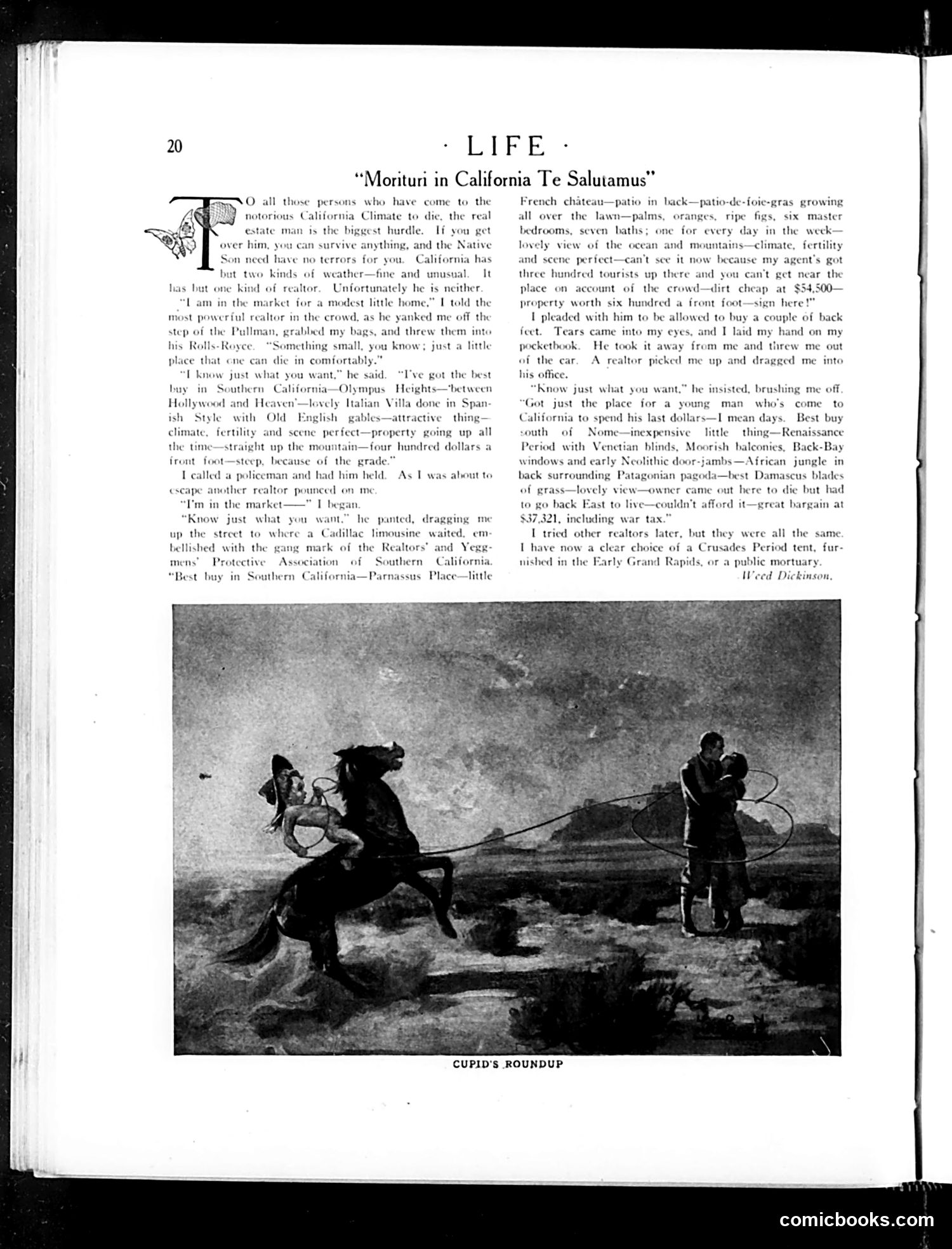
This is satirical commentary on California real estate salesmen during the early 20th century. The title—Latin for "Those about to die salute you"—sets a darkly comic tone about the perils of buying property in California. The piece mocks aggressive realtors who aggressively pursue potential buyers, each claiming to have the "perfect" property. The humor comes from the absurdly inflated descriptions ("Olympus Heights—between Hollywood and Heaven") paired with actual high prices and obvious drawbacks (properties on steep grades, inaccessible due to tourist crowds, or owned by people fleeing the state). The accompanying image, "Cupid's Roundup," shows a cowboy on horseback lassoing a figure while another person stands with a bicycle—likely a visual pun on realtors "roping in" or corralling unwilling buyers. The satire targets the exaggeration and high-pressure tactics of California real estate marketing, suggesting that buying property there is financially dangerous—hence "morituri" (the dying).
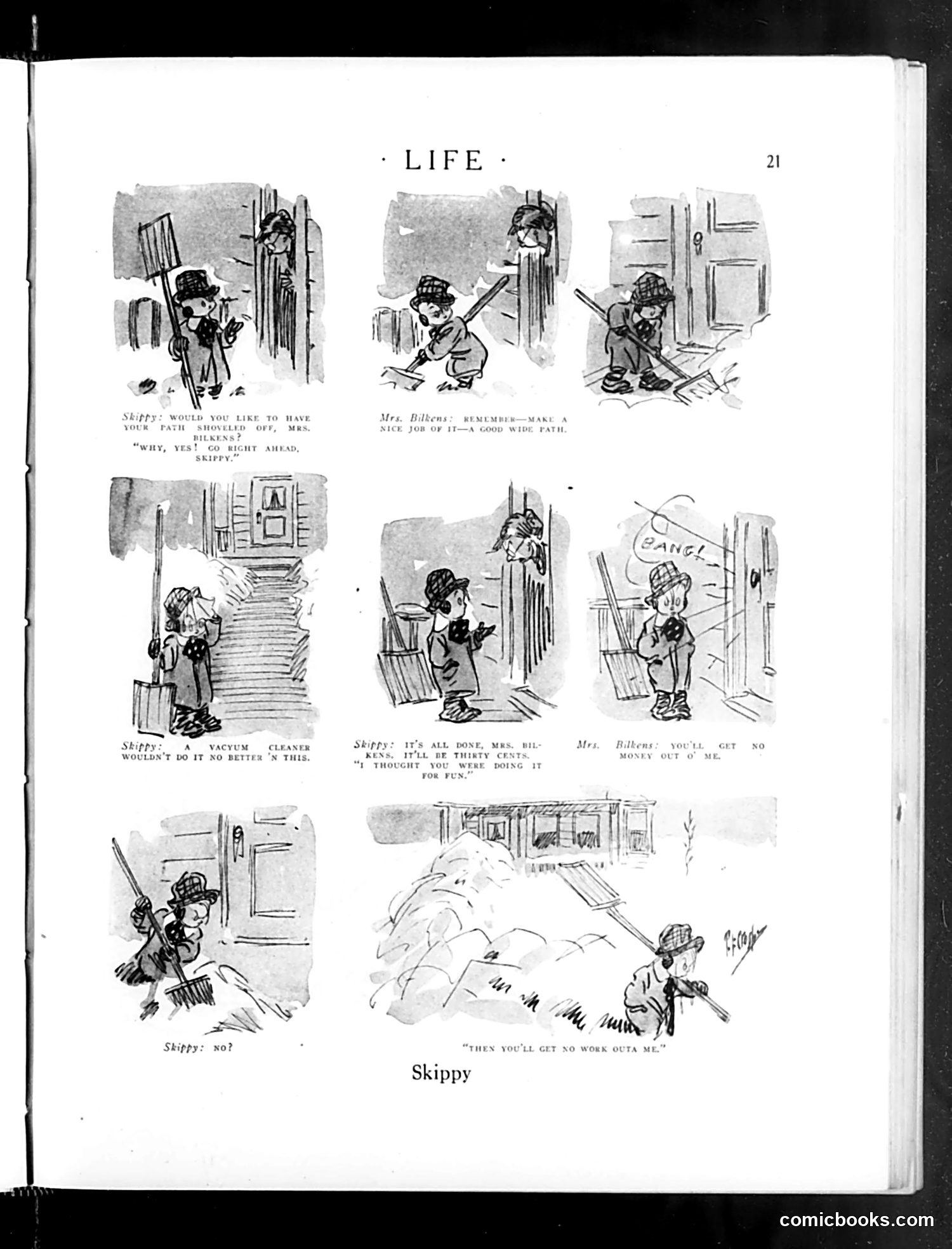
This page features "Skippy," a popular early 20th-century comic strip about a mischievous young boy. The humor centers on Skippy's attempts to avoid chores—specifically sweeping—by negotiating with an adult (Mrs. Bilkens, likely his mother or caretaker). The strip's joke sequence shows Skippy's escalating excuses and manipulation: he tries to redirect blame to Mrs. Sickens' path, proposes it as "good exercise," claims the vacuum cleaner would work better, negotiates payment, and ultimately refuses with "Then you'll get no work outa me." The satire reflects period attitudes about childhood labor expectations and the battle of wills between children and adults over household responsibilities. Skippy represents the clever, defiant child winning through negotiation rather than obedience.
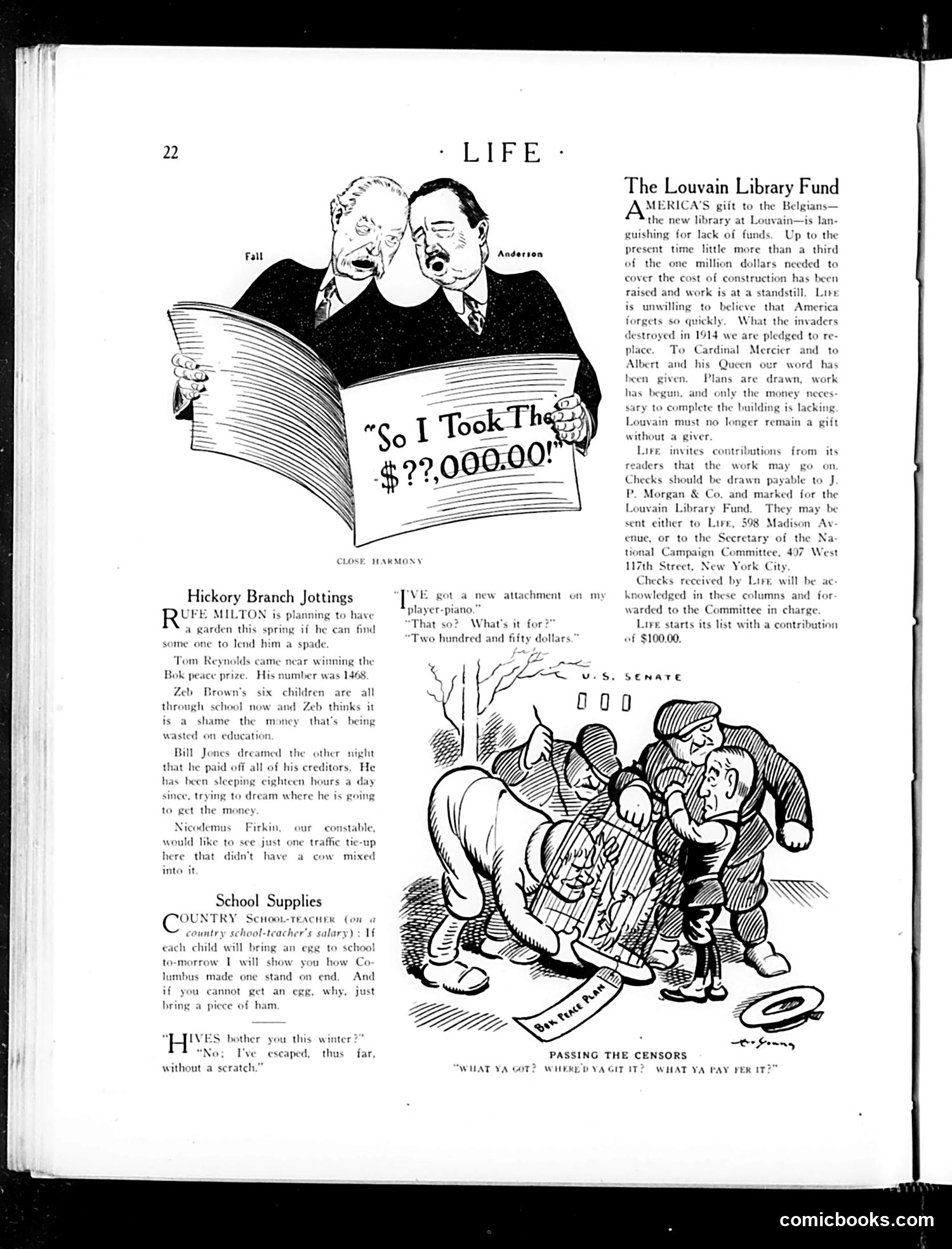
**Top Cartoon ("So I Took The $???,000.00!"):** Two men labeled "Fail" and "Anderson" examine a newspaper showing enormous costs. This satirizes the Louvain Library Fund campaign—Belgium's library destroyed in WWI needed $1 million for reconstruction. The cartoon mocks the gap between pledged American aid and actual donations received. The figures appear to represent prominent figures in the fundraising effort shocked by the expense. **"Passing the Censors" Cartoon:** Depicts figures (likely representing war profiteers or smugglers) being questioned by Senate censors about contraband goods. The dialogue—"What ya got? Where'd ya git it? What ya pay fer it?"—satirizes post-WWI concerns about black-market goods and wartime profiteering passing through government oversight. **Lower Text Sections:** The "Hickory Branch Jottings" and other brief humor items are small-town Americana jokes about rural life—gardens, school supplies, traffic accidents involving cows—typical satirical filler for the era. The page overall addresses American post-war obligations and domestic profiteering concerns.
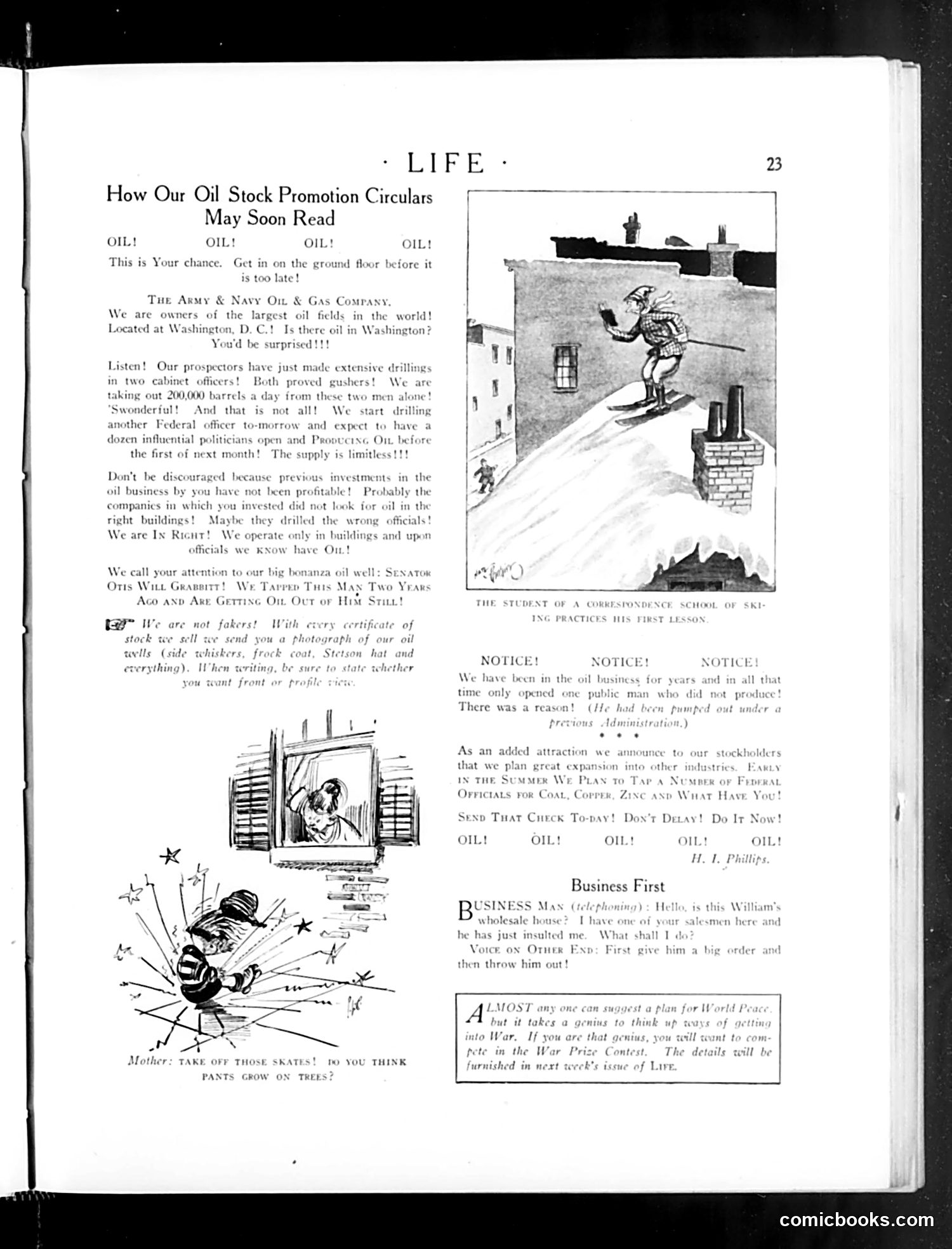
This page satirizes the rampant oil stock promotion schemes of the early 20th century. The mock circular from the "Army & Navy Oil & Gas Company" parodies fraudulent investment pitches that made absurd claims—locating oil in Washington D.C., claiming politicians and military officers as backers, and promising impossible returns (200,000 barrels daily). The satire targets how such schemes exploited investors by: - Name-dropping politicians to appear legitimate - Making obviously false claims - Blaming previous investors' failures on their own incompetence rather than the scheme's fraudulence - Creating artificial urgency ("Don't Delay!") The accompanying cartoons mock gullible investors: one shows someone skiing off a building (reckless investing), another depicts someone being knocked senseless by financial loss. The "Business First" section adds ironic commentary on misplaced priorities. This reflects Life magazine's role exposing financial chicanery during an era of widespread stock market speculation and fraud.
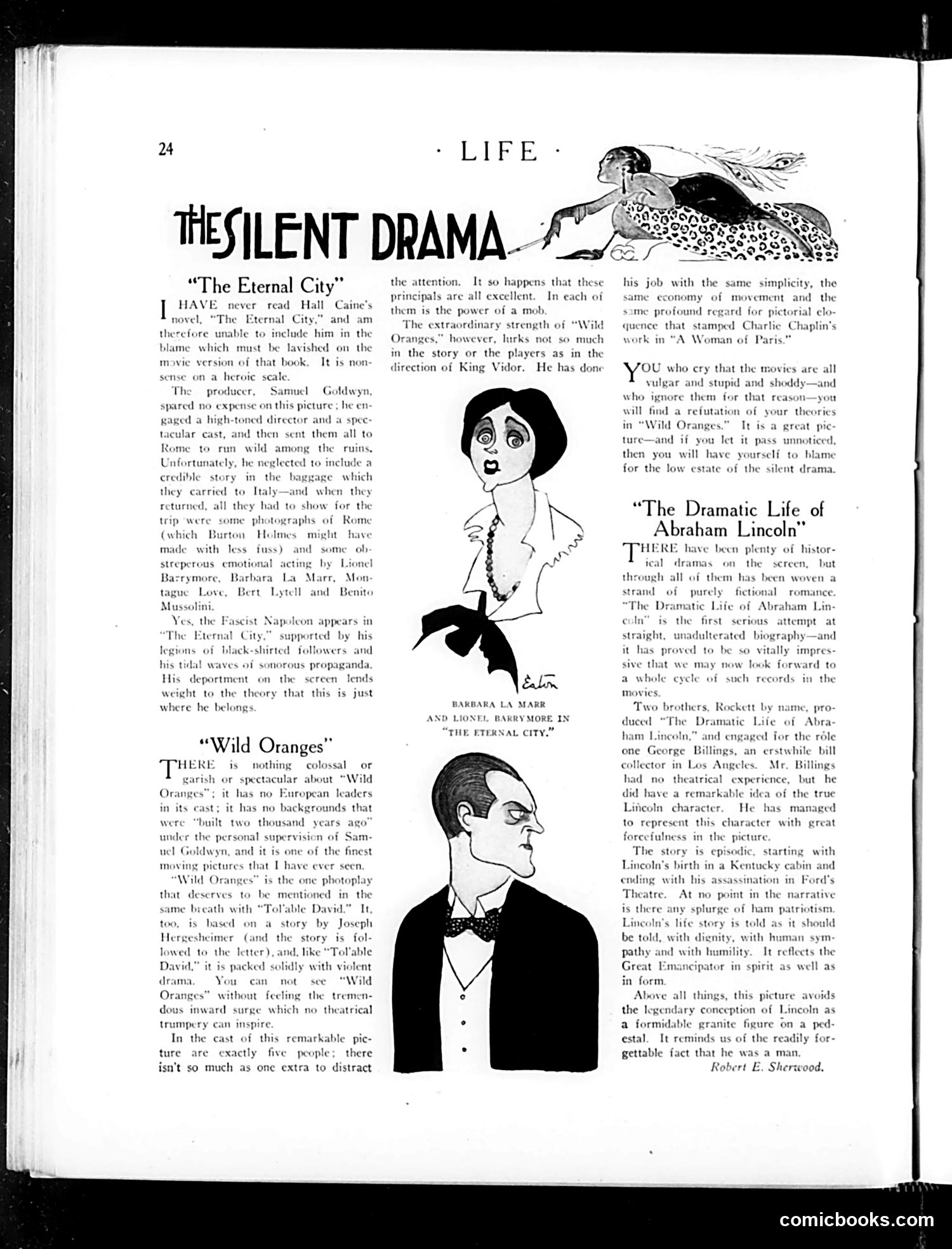
This page reviews three 1920s silent films. The illustrations are portrait sketches of actors in these productions. **"The Eternal City"** and **"Wild Oranges"** are praised as examples of quality cinema. The critic notes that "Wild Oranges," directed by King Vidor, succeeds through directorial skill rather than spectacle—despite producer Samuel Goldwyn's expensive Roman location shooting. The text dismisses those who call movies "vulgar and stupid," arguing these films prove otherwise. **"The Dramatic Life of Abraham Lincoln"** is highlighted as cinema's first serious biographical attempt rather than fictional romance. Notably, the lead actor (George Billings) was a Los Angeles bill collector with no theatrical experience, yet the critic praises his dignified portrayal. The film covers Lincoln's life from Kentucky birth through Ford's Theatre assassination, avoiding "ham patriotism" for human dignity. The sketched portraits show Barbara La Marr (from "The Eternal City") and an unnamed male actor (likely from Lincoln film), characteristic of period entertainment journalism.
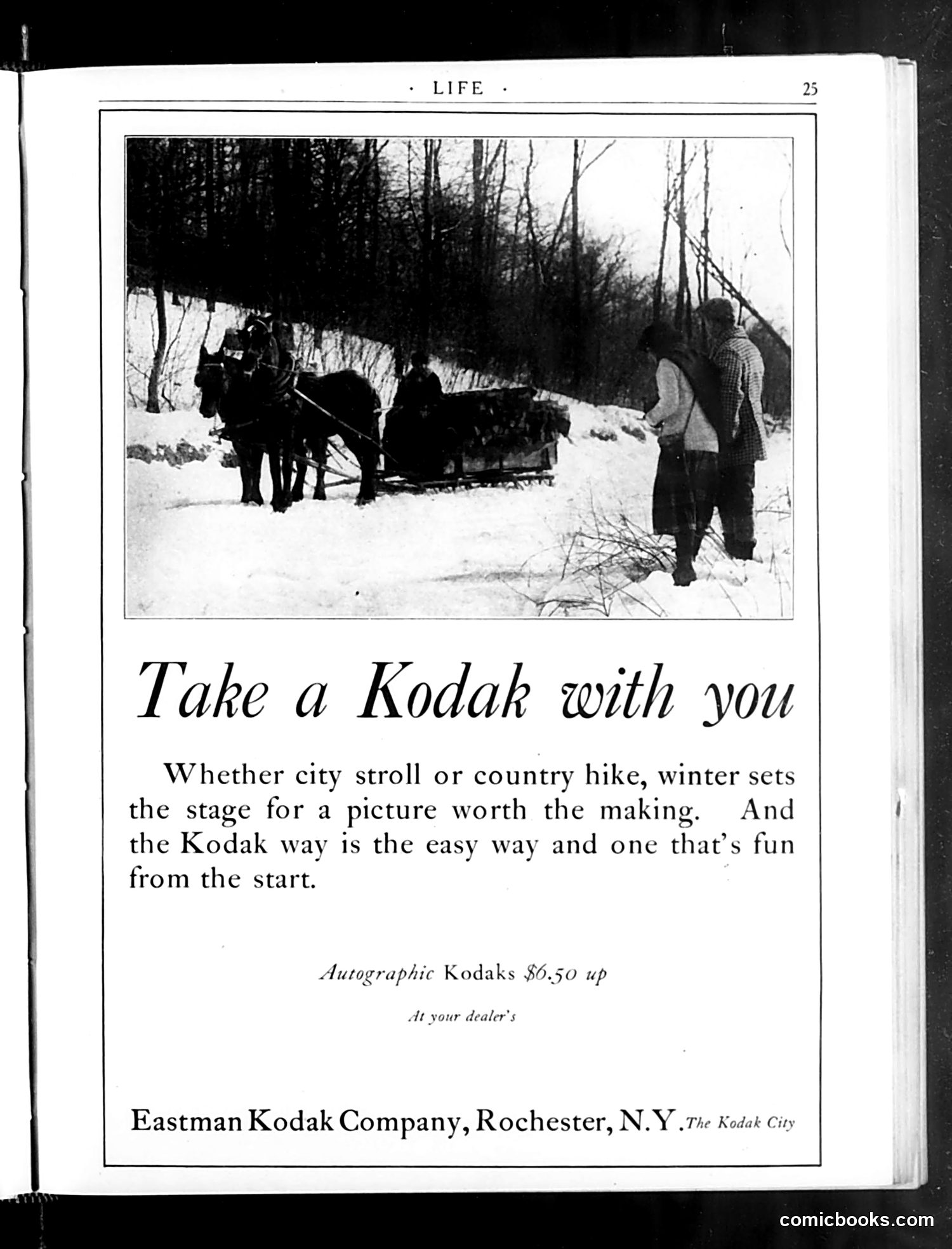
This is a **Kodak advertisement**, not political satire or comics. The page shows a winter scene with a horse-drawn sleigh and people in a snowy landscape, illustrating recreational winter activities. The text promotes Autographic Kodaks (cameras starting at $6.50) by suggesting that winter outings—whether urban or rural—provide ideal photo opportunities. The "Kodak way" is framed as easy and enjoyable for amateur photographers. This reflects early 20th-century marketing emphasizing how portable cameras democratized photography for ordinary consumers. There is no cartoon, caricature, or satirical commentary present—it's straightforward product promotion appearing in *Life* magazine's advertising section.
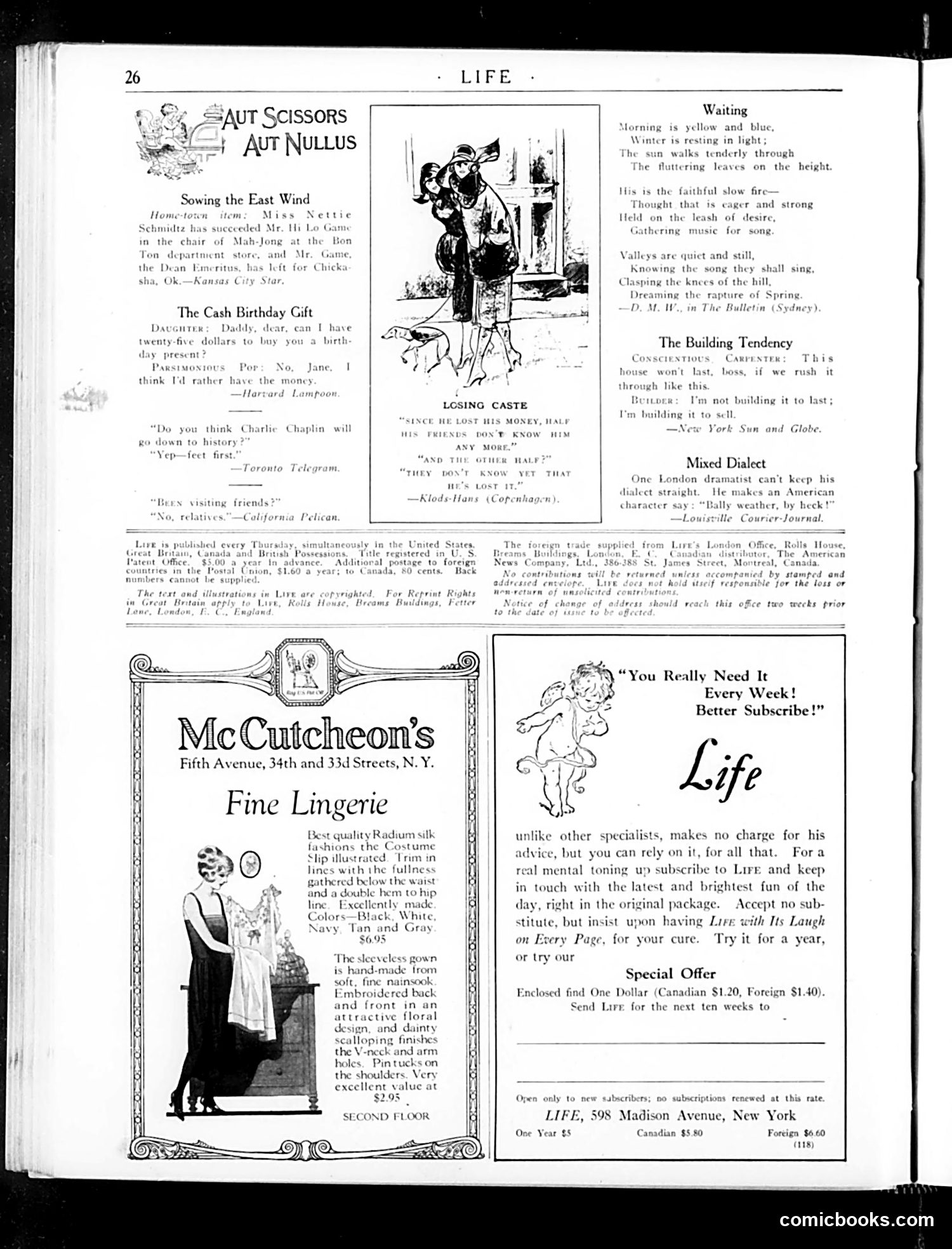
This is primarily a **advertisements and miscellaneous content page** from Life magazine, with minimal satirical cartoons. The main visual element is a **McCutcheon's lingerie advertisement** featuring a woman modeling undergarments—typical early 20th-century fashion advertising emphasizing quality fabrics and tailored design. The scattered text snippets appear to be excerpts from various Life contributions: poetry ("Waiting," "Sowing the East Wind"), short humor pieces ("The Cash Birthday Gift," "Mixed Dialect"), and social commentary ("The Building Tendency"). These represent Life's format of mixing light verse, jokes, and observations on contemporary manners. One recurring joke concerns **Charlie Chaplin**—a reference to the famous silent-film comedian popular during this era. The page concludes with a **Life magazine subscription pitch**, urging readers to subscribe for weekly entertainment. The overall content emphasizes Life's brand as a source of sophisticated humor and cultural commentary for educated readers. No specific political satire is evident on this particular page.
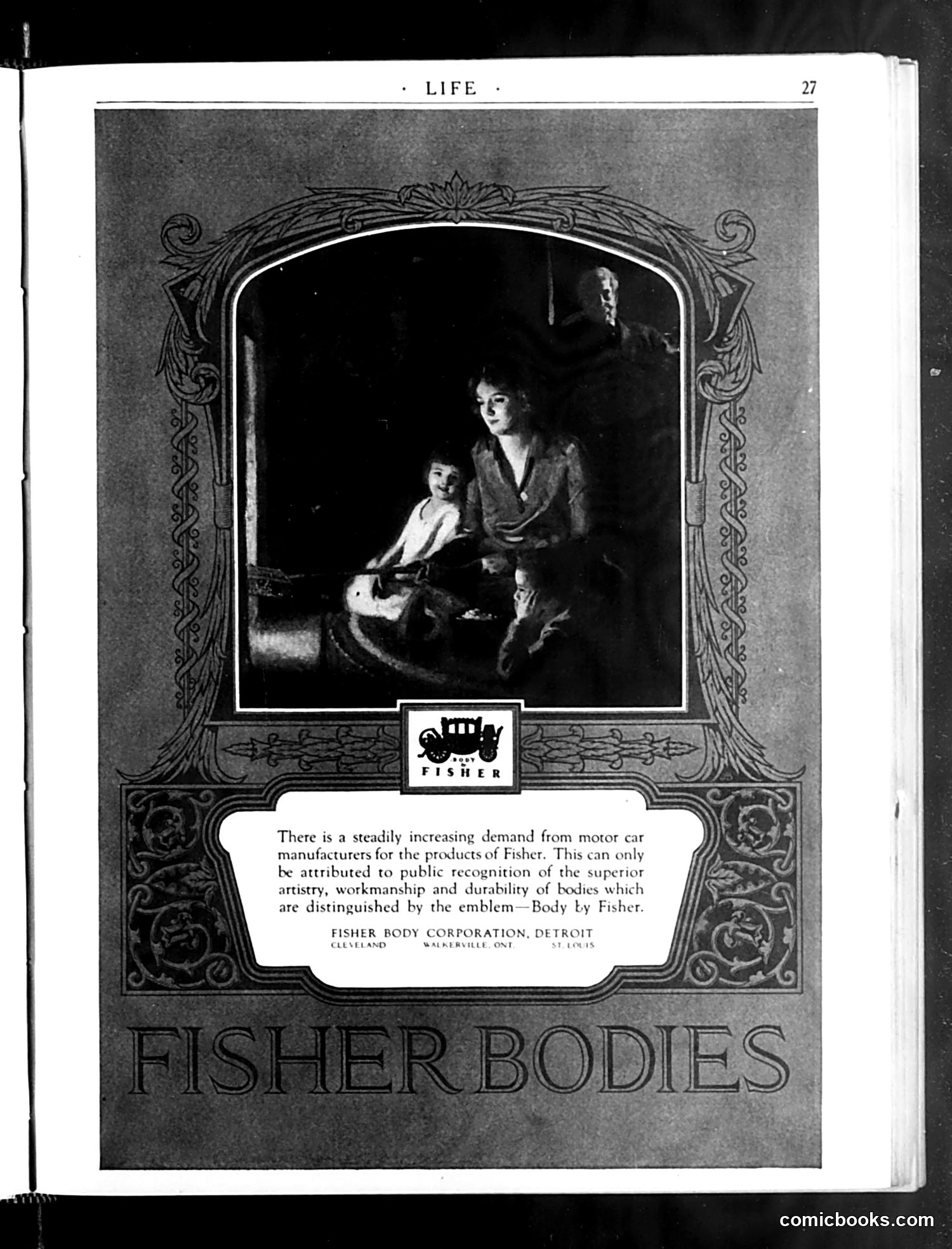
This is a **Fisher Body Corporation advertisement**, not political satire. The page promotes Fisher as a supplier of automobile bodies to car manufacturers, emphasizing their reputation for superior craftsmanship and durability. The ornate frame contains a dramatic photograph showing what appears to be a woman and child in an elegant automobile interior, likely designed to convey luxury and quality to potential buyers. The "steadily increasing demand" claim serves as marketing proof of Fisher's market dominance. The Fisher emblem (a coach-and-horses logo) is positioned as a mark of distinction—a selling point for car manufacturers to advertise to consumers. This reflects early automotive-era marketing, where body builders like Fisher were distinct from engine manufacturers, and their branding mattered to buyers. It's essentially a B2B advertisement in a consumer magazine.
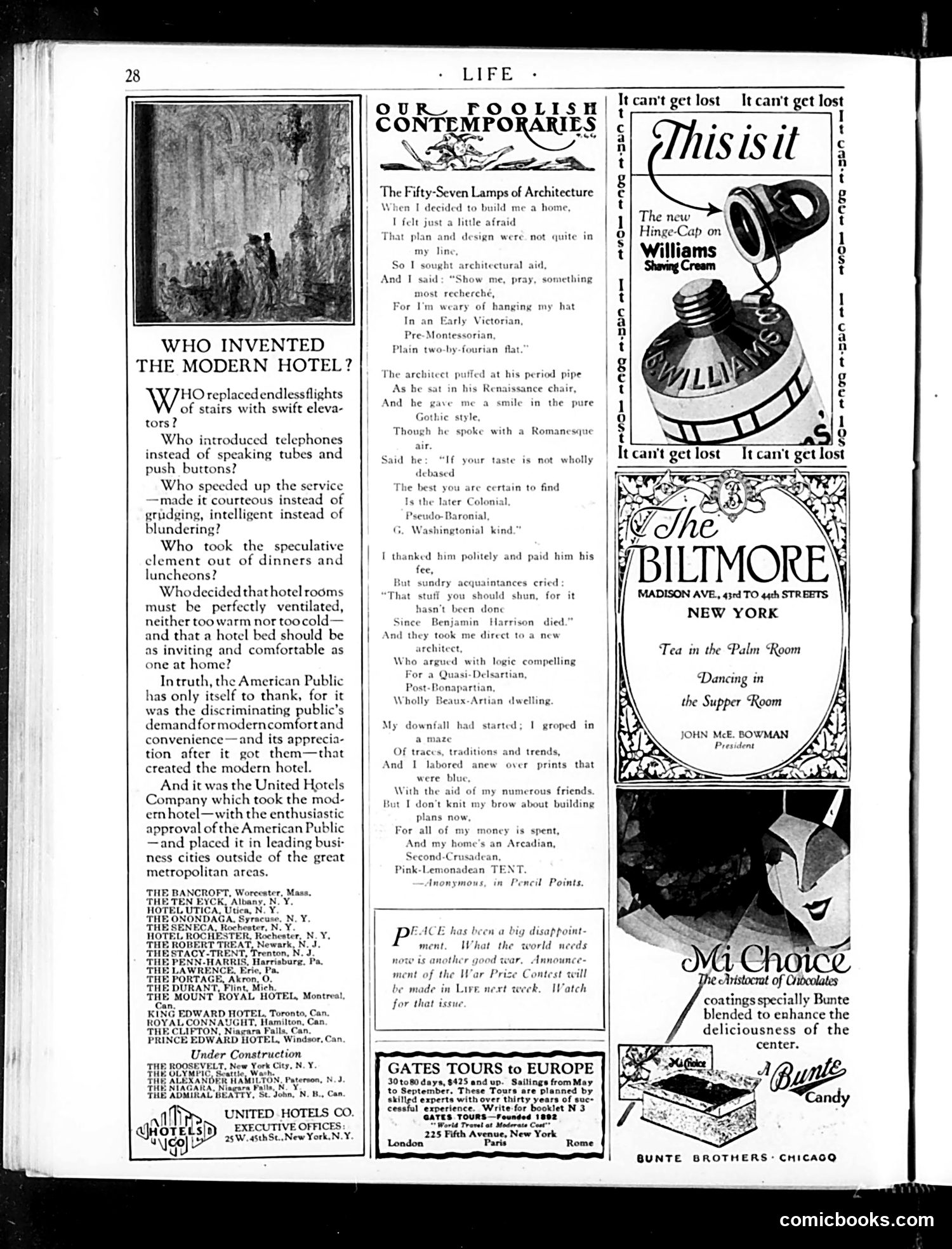
This page contains primarily **advertisements and promotional content** rather than political satire or comics. The main elements are: 1. **United Hotels Company ad** (left): A lengthy corporate argument claiming the American public—not any individual—"invented" the modern hotel by demanding comfort and convenience. Lists their chain of properties across North America. 2. **"Foolish Contemporaries" poem** (center): A humorous verse about someone building a home, consulting an architect about styles. The joke is the architect recommends increasingly pretentious architectural references (Colonial, Pseudo-Baronial, "Quasi-Delsartian," "Wholly Beaux-Artian"), mocking overcomplicated design language. 3. **Product advertisements** (right): Williams Shaving Cream (Hinge-Cap feature), The Biltmore Hotel (New York), Bunté Chocolates. 4. **Gates Tours Europe notice** (bottom center): Travel booking announcement. The page reflects early 20th-century advertising style—using humor and aspirational messaging to promote luxury goods and services to an upscale readership.
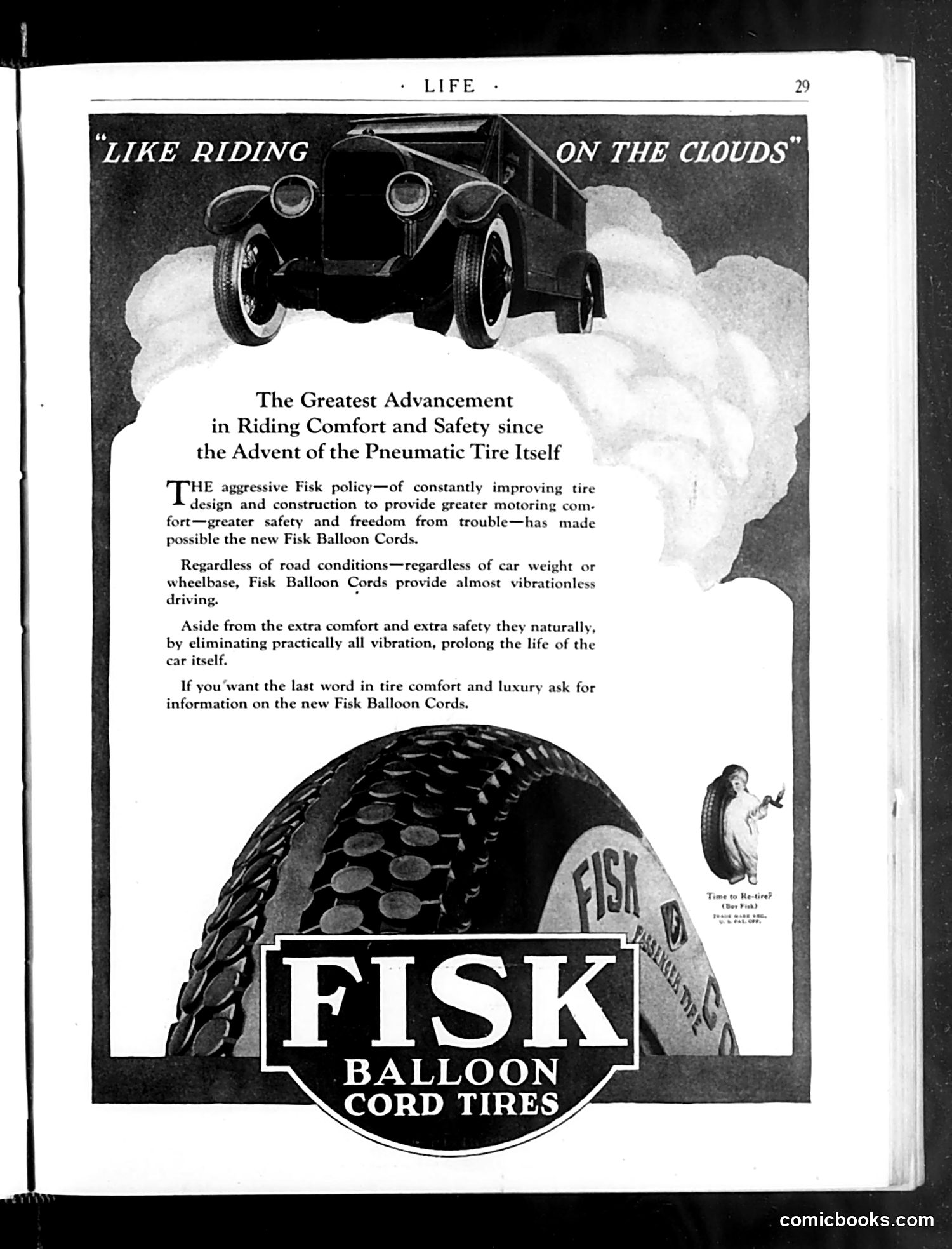
This is a **Fisk tire advertisement**, not political satire. The page features promotional copy for "Fisk Balloon Cord Tires," a real automotive product from the early 20th century. The imagery shows a vintage automobile literally riding atop clouds, illustrating the advertising slogan "Like Riding on the Clouds" — a metaphor for exceptional smoothness and comfort. The large tire image displays the product's balloon-cord construction. The advertisement claims Fisk's tires represent "the greatest advancement in riding comfort and safety since the pneumatic tire itself," emphasizing reduced vibration and improved durability. This reflects genuine automotive innovation of the era, when tire technology was rapidly evolving. There is no political cartoon or satire present — this is straightforward commercial advertising from *Life* magazine's advertisements section.
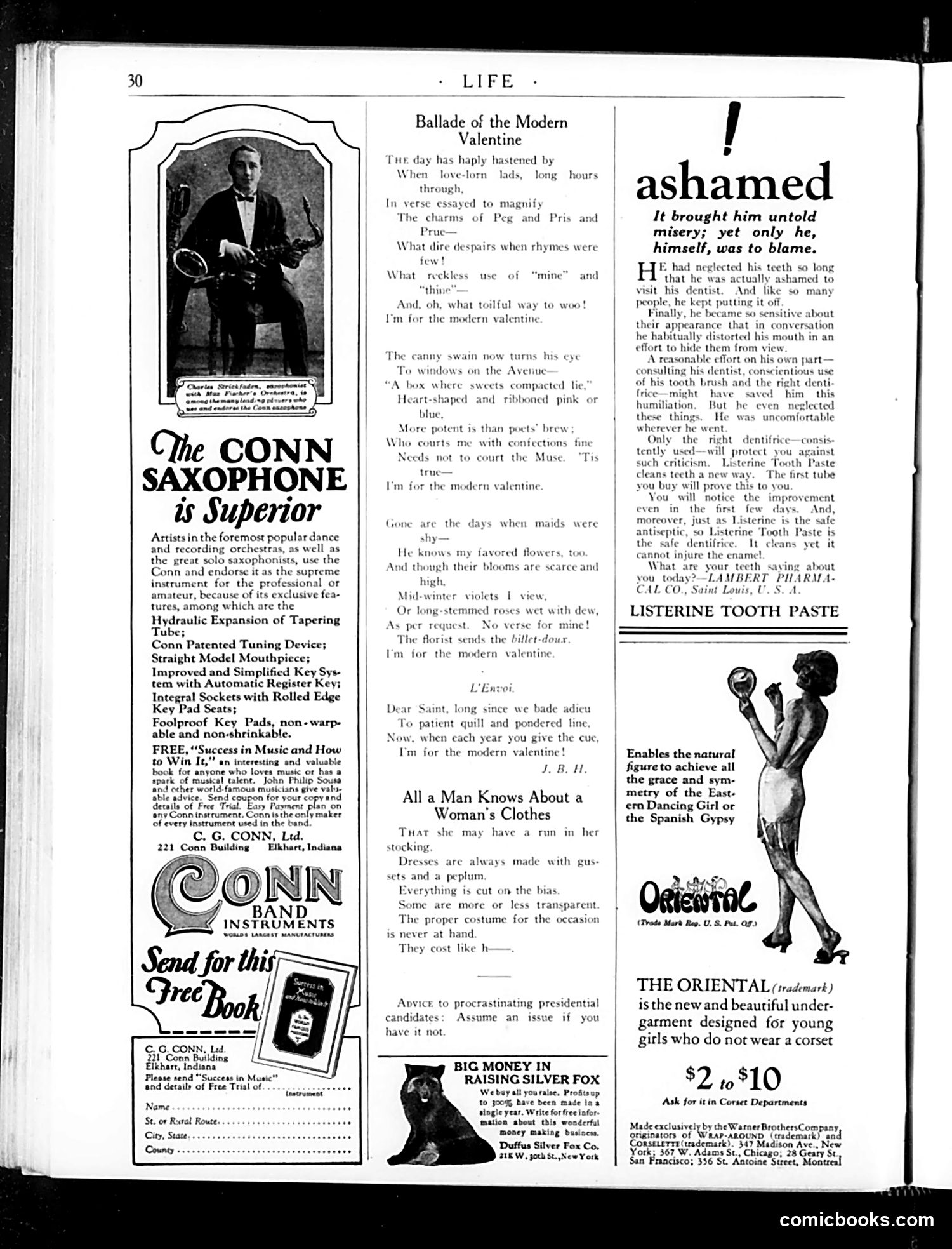
This page is primarily **advertising** with some light satirical poetry. The main content includes: 1. **Conn Saxophone Advertisement**: A full-page ad featuring a musician endorsing Conn saxophones as superior instruments, targeting both professionals and amateurs. This reflects 1920s-30s jazz culture's popularity. 2. **"Ballade of the Modern Valentine"**: A humorous poem satirizing modern courtship, contrasting old-fashioned romantic verse with contemporary consumerism—the "modern" lover buys candy and flowers rather than composing poetry. 3. **"All a Man Knows About a Woman's Clothes"**: A brief satirical list poking fun at male ignorance about fashion (gussets, peplums, bias cuts, transparency, expense). 4. **Product Advertisements**: Including Listerine Tooth Paste (with a morality tale about dental neglect causing shame) and Oriental corsets. The page reflects early 20th-century advertising culture and gentle social satire about gender roles, consumer culture, and modern romance—typical of *Life* magazine's approach.
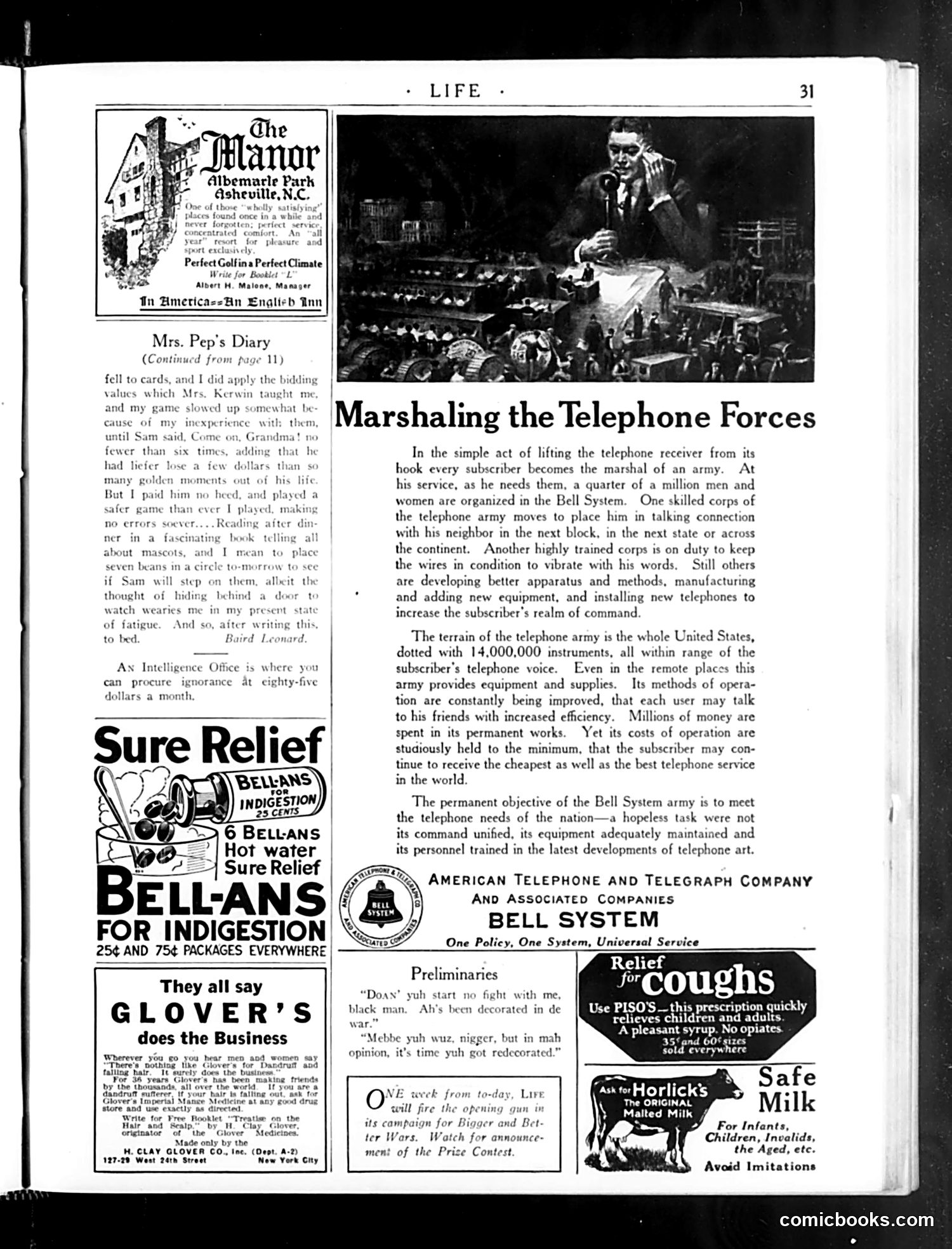
This page is primarily **advertising and corporate messaging** rather than satirical political cartoons. The dominant feature is a full-page Bell System advertisement titled "Marshaling the Telephone Forces," which uses military metaphor to celebrate the telephone infrastructure—portraying subscribers as "marshals" commanding a vast army of 250,000 workers and 14 million instruments across America. The small "Preliminaries" section at bottom contains **racist dialect humor** typical of early 20th-century publications, featuring African American characters in stereotypical speech patterns ("Doan' yuh start no fight with me, black man"). The reference to decorations "in de war" and a forthcoming contest appears to relate to WWI-era content. The remainder comprises period advertisements for indigestion remedies (Bell-Ans), hair products (Glover's), cough medicine, and infant milk—standard commercial content with no satirical intent.
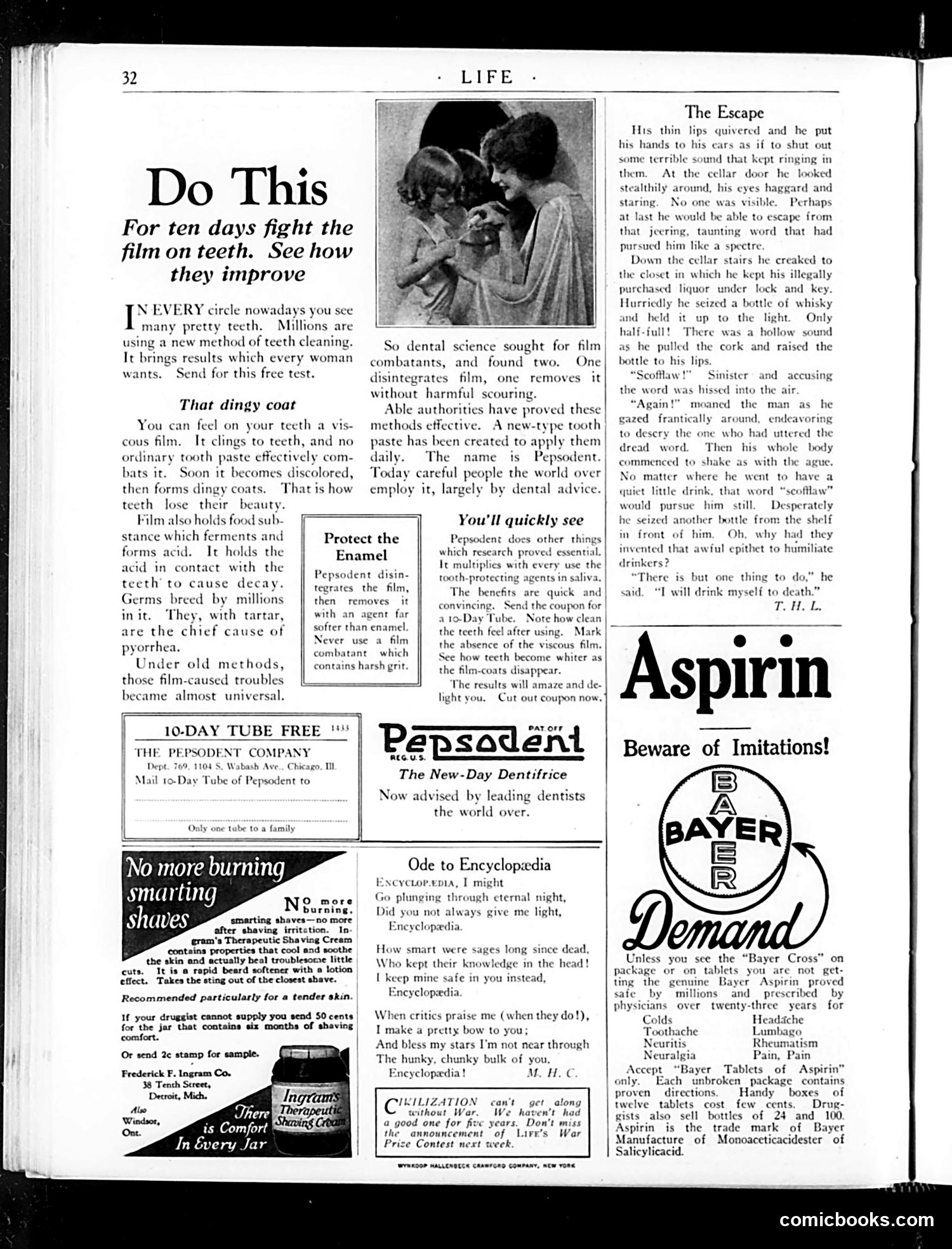
This page is primarily **advertising** for dental and consumer products (Pepsodent toothpaste, Aspirin, shaving cream), typical of 1920s-30s magazine layout. The fictional narrative "The Escape" appears to be **satirizing Prohibition enforcement**. A man desperately seeks alcohol while haunted by the word "scofflaw"—a term coined around 1924 referring to those who openly defied Prohibition laws. The story mocks both the anxiety of illegal drinkers and the moral fervor of Prohibition advocates. The man's desperation and suicidal declaration ("I will drink myself to death") suggest the satire critiques the absurdity of Prohibition's impact on ordinary citizens. The reference to liquor "under lock and key" and "illegally purchased" directly invokes Prohibition-era contraband practices. The satirical tone indicates *Life* magazine's skeptical view of Prohibition's effectiveness and morality—a common position among urban, educated publications of that era.
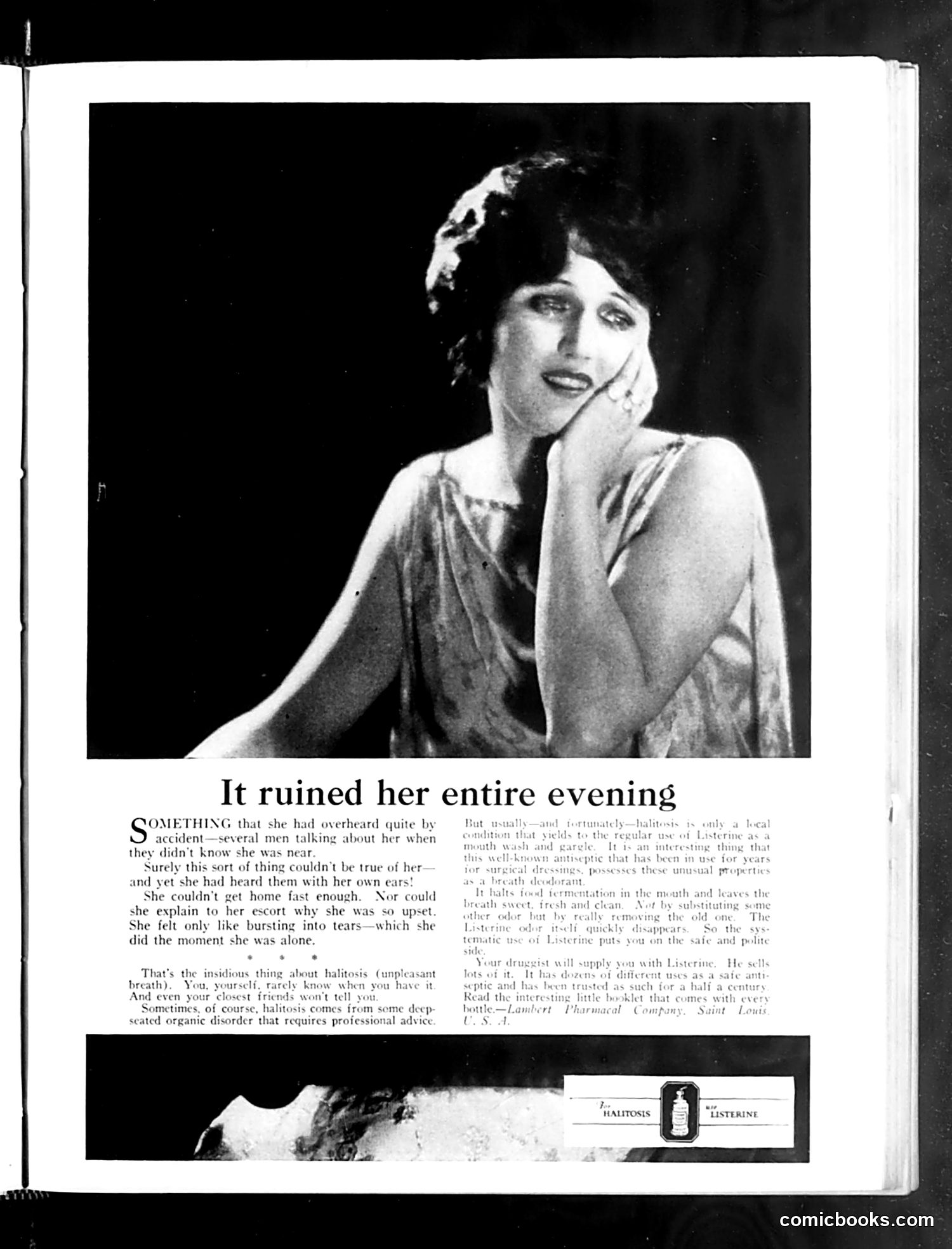
This is a **Listerine advertisement**, not a political cartoon. The page uses a melodramatic narrative to sell mouthwash by exploiting social anxiety. **The scenario:** A woman overhears men discussing her (implied) bad breath. Distressed and unable to explain her upset to her escort, she goes home and cries. **The pitch:** The ad acknowledges that halitosis (bad breath) can stem from serious health issues, but suggests it's often a "local condition" treatable with Listerine mouthwash and gargling. It notes the product has been "trusted as such for half a century." **The social context:** This reflects early-20th-century advertising that weaponized social embarrassment—particularly targeting women—to sell hygiene products. The implicit message: bad breath could ruin your evening, your reputation, and your romantic prospects. This is a classic example of **shame-based marketing**, not satire or political commentary.
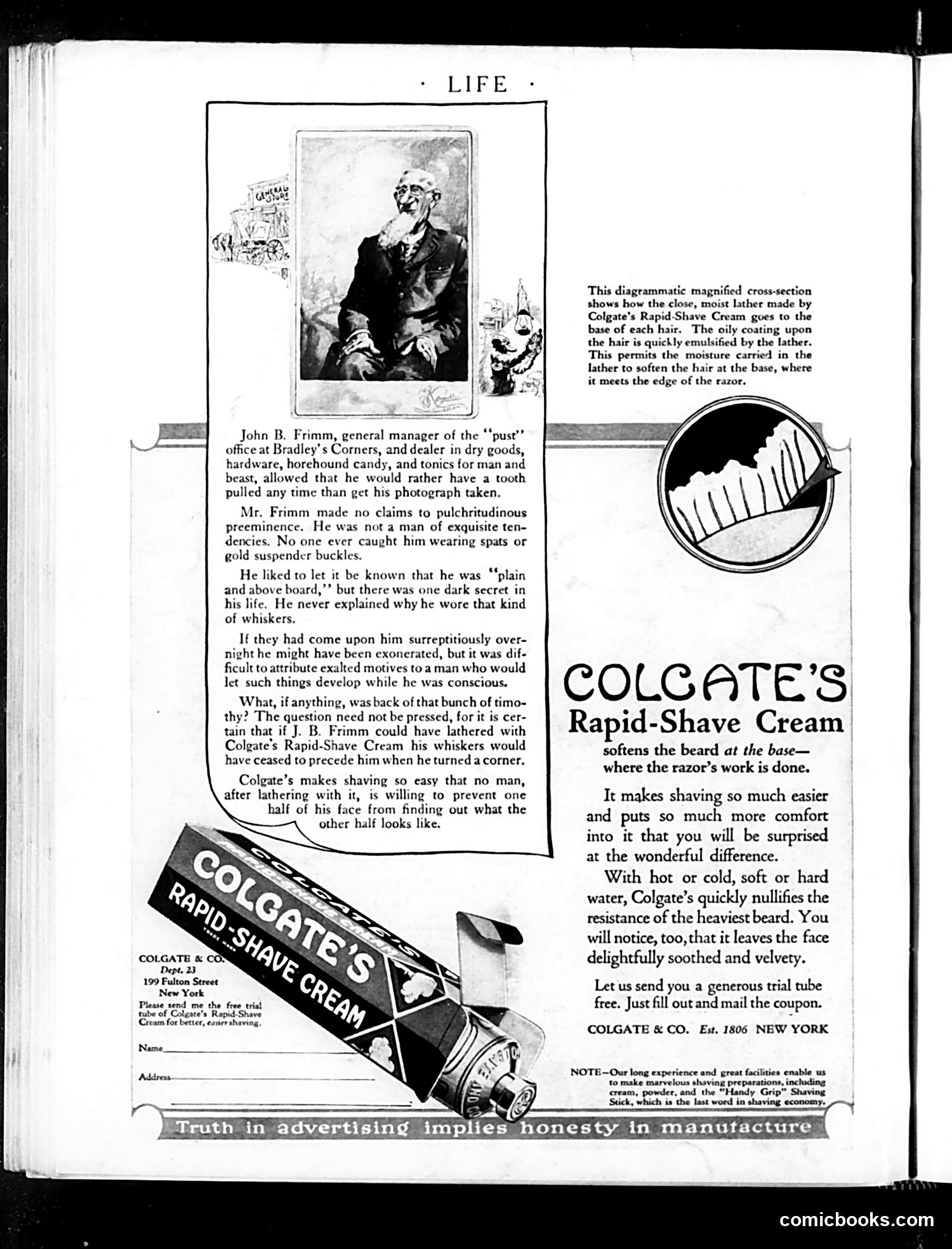
This is primarily a **Colgate's Rapid-Shave Cream advertisement**, not political satire. The page uses humor to sell the product. The "cartoon" element is a satirical character sketch of **John B. Frimm**, a plain-spoken small-town merchant (post office manager at Bradley's Corners) who refuses to be photographed. The joke: he has an unexplained, peculiar beard that he consciously maintains—a vanity that contradicts his claimed "plain and above board" character. The satire mocks the contradiction between his modest pretensions and his obvious pride in these distinctive whiskers. The advertisement's pitch is that Colgate's cream makes shaving so effortless that even a man like Frimm—who apparently values his whiskers—would abandon them if he tried the product's superior lathering and beard-softening properties. The technical diagram shows how the cream works at the hair base. This is lighthearted character humor deployed for advertising purposes, typical of early 20th-century Life magazine's satirical commercial approach.