
Life, 1924-02-14 · page 26 of 36
Life — February 14, 1924 — page 26: what you’re looking at
What you’re looking at
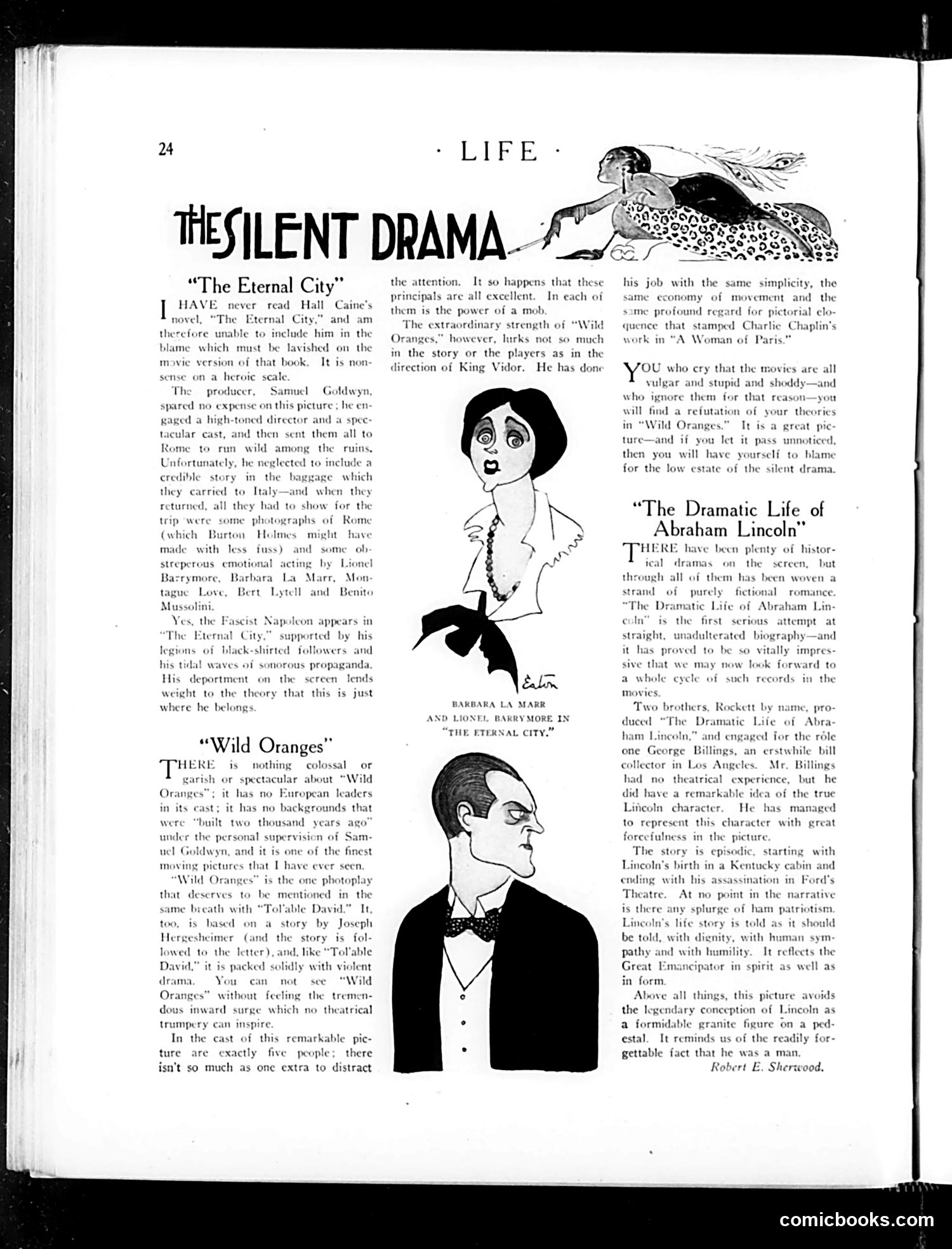
This page reviews three 1920s silent films. The illustrations are portrait sketches of actors in these productions. **"The Eternal City"** and **"Wild Oranges"** are praised as examples of quality cinema. The critic notes that "Wild Oranges," directed by King Vidor, succeeds through directorial skill rather than spectacle—despite producer Samuel Goldwyn's expensive Roman location shooting. The text dismisses those who call movies "vulgar and stupid," arguing these films prove otherwise. **"The Dramatic Life of Abraham Lincoln"** is highlighted as cinema's first serious biographical attempt rather than fictional romance. Notably, the lead actor (George Billings) was a Los Angeles bill collector with no theatrical experience, yet the critic praises his dignified portrayal. The film covers Lincoln's life from Kentucky birth through Ford's Theatre assassination, avoiding "ham patriotism" for human dignity. The sketched portraits show Barbara La Marr (from "The Eternal City") and an unnamed male actor (likely from Lincoln film), characteristic of period entertainment journalism.
📄 Transcribed text from this page (OCR, searchable)
Machine-transcribed from the original scan — historical spelling and the odd misread are preserved.
24 TESILENT DRAMA." “The Eternal City” the attention. It so happens that these his job with the same simplicity, the .. principals are all excellent. In each of — same economy of movement and. the never read Hall Caine’s el, “The Eternal City,” and am refore unable to include him in the them is the power of a mob. same profound regard for pictorial elo: The extraordinary strength of “Wild — quence that stamped Charlie Chaplin's Oranges,” however, lurks not so much — work in “A Woman of Paris.” in the story or the players as in the direction of King Vidor. He has done ‘OU who cry that the movies are all vulgar and stupid and shoddy—and who ig them for that reason—you will find a refutation of your theo me which must be lavished on the movie version of that book. It is non sense on a heroic scale The producer, Samuel Goldwyn spared no expense on this picture; he en zed a high-toned director and a spec- { then sent them all to run wild among the ruin in “Wild Oranges.” It is a great pic ture—and if you let it pass unnotice then you will have yourself to blame aes eae Pee octet inch for the low estate of the silent drama. credible story in the | which they carried to Italy—and when they (which Burton Holmes might have Abraham Lincoln” made with less fu Senne: al ‘ HERE have been’ plenty’ of streperous emotional acting by Lionel ical dramas on the screen, Barrymore, Barbara La Marr, M through all of them has been woven tague Love, Bert Lytell and Benito strand { purely fietional rom: Mussolini “The Dramatic Life of Abraham L Yes, the Fascist Napoleon appears in In” is the first serious attempt at The Eternal City,” supported by his straight, unadulterated biography—and legions of black-shirted followers and it has proved to be so vitally impres his tidal waves of sonorous propaganda, sive that we may now look forward to His deportment on the sereen lends ein a whole cycle of such records in the weight to the theory that this is just movies where he belongs BARBARA LA MARR Two brothers, Rockett by name ‘0 “THE ETERNAL CITY, ham Lincoln,” and engaged jor the réle “Wild Oranges” one George Billings, an erstwhile bill HERE is nothing colossal or collector in Los Angeles. Mr. Billings sh or spectacular about “Wild had no. theatrical duced “The Dramatic Lite of Abra experience, but he has no European leaders did have a remarkable idea of the true st; it has no backgrounds that Lincoln character. He has managed w built two thousand years to represent this character with great under the personal supervision of Sam orcefulness he picture ucl Goldwyn, and it is one of the finest The story is episodic, starting with moving pictures that I have ever seen. Lincoln's birth in a Kentucky cabin and Wild Oranges” is the one photog ending with his assassination in Ford's that deserves to be me ed in the Theatre. At no point in the narrative same breath with “Tolable David.” It is there any splurge of ham patriotism too, is hased story by Joseph Lincoln's life story is told as it Id Hergesheimer (and the story is fol- be told, with dignity, with human sym lowed to the letter), and, like able pathy and with humility. It reflects the David,” it is packed solidly with violent Great Emar rin spirit as well as drama. You can not see “Wild in form. Oranges” without feeling the tremen- Above all things, this picture avoids dous inward surge which no theatrical the legendary conception of Lincoln as trumpery can inspire a formidable granite figure on a ped- In the cast of this remarkable pic- estal. It reminds us of the readily for- ture are exactly five people; there gettable fact that he was a man isn't so much as one extra to distract Robert E. Sherwood. comicbooks.com