
Life, 1924-02-14 · page 20 of 36
Life — February 14, 1924 — page 20: what you’re looking at
What you’re looking at
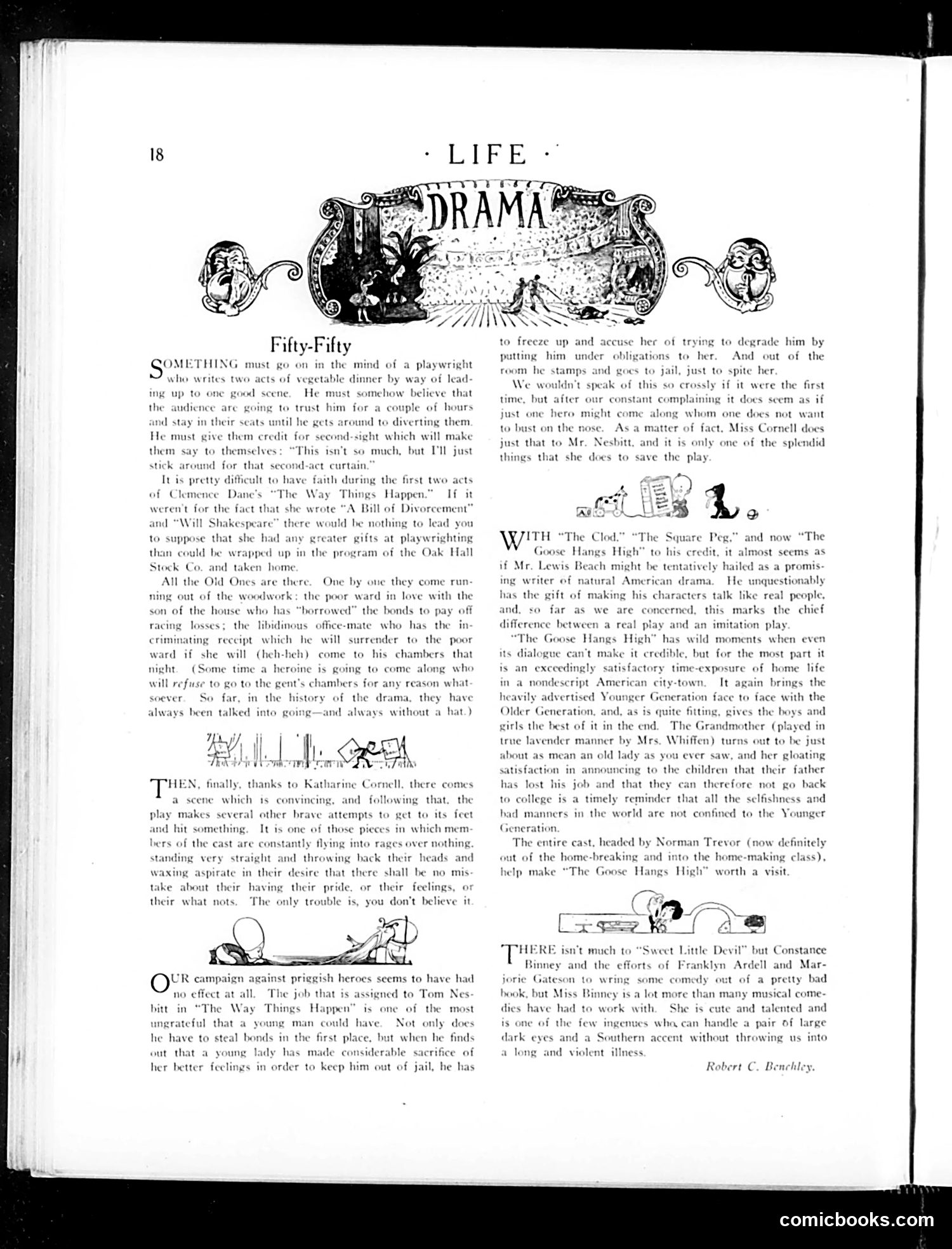
This page reviews three Broadway plays in the "Drama" section. The critic discusses: **"The Way Things Happen"** by Clemence Dane—criticized for tedious first two acts before a good final scene. The reviewer mocks predictable plot devices (poor ward in love, borrowed bonds, office seduction scenes) as hackneyed theater clichés. Katharine Cornell's performance saves the play, though the male lead (Nesbitt) plays an insufferable priggish hero unconvincingly. **"The Goose Hangs High"** by Lewis Beach—praised as realistic American comedy featuring the "Younger Generation versus Older Generation" conflict. The critic credits Beach's dialogue with making characters sound like real people, though acknowledges some moments strain credibility. **"Sweet Little Devil"**—briefly mentioned as featuring Constance Binney attempting comedy from a weak script. The satirical drawings illustrate theatrical conventions and audience behavior. The overall tone critiques both lazy playwriting formulas and actors unable to transcend poor material, while praising authentic characterization.
📄 Transcribed text from this page (OCR, searchable)
Machine-transcribed from the original scan — historical spelling and the odd misread are preserved.
othe M7711 som! THING must go on in the mind of a playwright who writes two acts of vegetable dinner by way of lead- up to one good scene, He must somehow believe that the audience are to trust him for a couple of hours and stay in their seats until he gets around to diverting them He must ve them credit for second-sight which will make them say to themselves: “This isn't so much, but TM just stick around for that second-act curtain It is pretty difficult to have faith during the first two acts of Clemence Dane's “The Way Things Happen.” If weren't for the fact that she wrote “A Bill of Divorcement” and “Will Shakespeare” there would be noth to suppose that she had any greater gifts at playwr than could be wrapped up in the program of the Oak Hall Stock Co. and taken home All the Old Ones are there. One by z out of the woodwork ne they come run- the poor ward in love with the f the house who has “borrowed” the bonds to pay « ses; the libidi office-mate who has the in ating receipt which he will surrender to the poor dif she will (heh-t come to his chambers that night. (Some time a heroine is going to come along who Will refuse to go to the gent's chambers for any reason what soever. So far, in of the drama, they have and always without a hat.) THEN finally, thanks to Kai Cornell, th a scene which 1s convinei and following that, the always been talked comes play makes several other brave attempts to get to its feet hit something. It is one of those pieces in which mem s over nothing and throwing back their heads and waxing aspirate in their desire that there shall be no mis hers of the cast are con ly Aying into ra standing very straight take about their having their pride. or their feelings, their what nots. The only trouble is, you don't believe it O R campaign ag all no effect at all. The job that signed to Tom Nes hittin “The Way Things Happen” is one of the most Not only does e, but when he finds ast priggish heroes seems to have had rateful that a yor man could have he have to steal bonds in the first p out that a young lady has made considerable sacrifice of her better feclings in order to keep him out of jail, he has to freeze up and a ce of trying to degrade him by putting him under obligations to her. And out of the room he stamps and We wouldn't speak « time, but after our constant complaining it just to spite her this so crossly if it were the first s seem as if x whom one does not want f fact, Miss Cornell does just that to Mr. Nesbitt, and it is only one of the splendid just one hero might com to bust on the nose. As a matter things that she does to save the play '@) a) 4. With “The Clod.” “The Square Peg.” Goose Hangs High” to his credit, it Lewis Beach might be t and now “The st seems as ely hailed as a promis natural American drama. He ift of nquestionably naking his characters talk like real people, marks the chief ion play so far as we are cor difference between a real play : nimi ‘The Goose Hangs High” has wild moments when even its dialogue can’t make it credible, but for the most part it is an exceedingly satisfactory time-exposure of home life in a nondescript American city-town. It again brings the heavily advertised Younger Generation face to face with the Older Generation, and, as is quite fittin; girls the best of it in the end. The ¢ true lavender manner by Mrs, Whiffer about as mean an old lady as you ever saw, and her gloating satisfaction in announ to the children that their father has lost and nat they can therefore not go back to college is a timely reminder t all the selfishness and had manners in the world are not confined to the Younger Generation The entire cast, headed by Norman Trevor (now de out of the home-breaking and into the home-making cla help make * Goose Hang worth a visit “Sweet Little Devil” but Constance rts of Franklyn Ardell Mar- jorie Gateson to wring some comedy out of a pretty bad book, but Miss B dies have had to work with. She “THERE isn’t much to Binney and the rey is a lot more than many musical come- cute and talented and is one of the few ingenues wha can handle a pair of large dark eyes and a hern accent without throwing us into 1 long and viol Robert C. Bene comicbooks.com