
A complete issue · 40 pages · 1924
Life — February 7, 1924
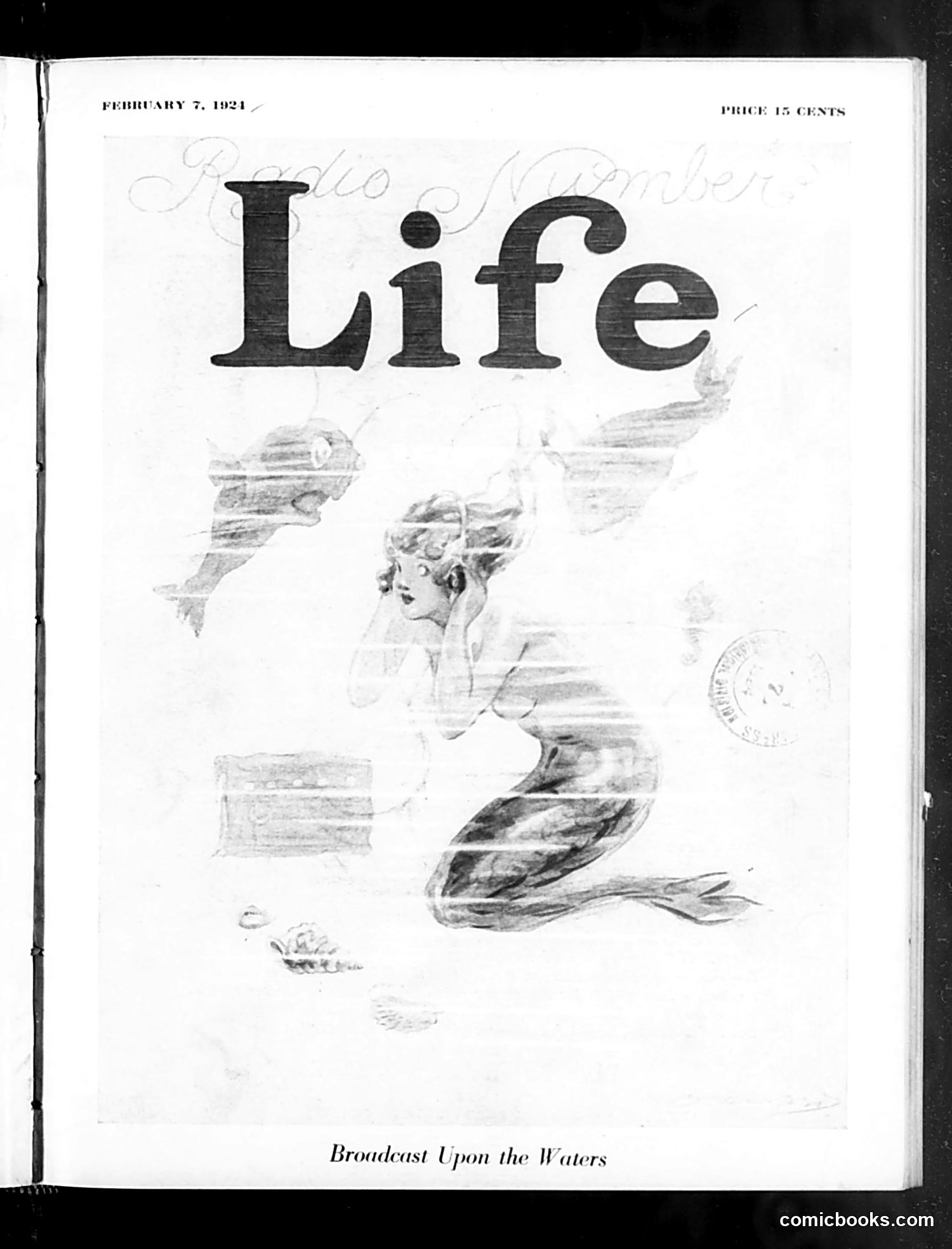
This is a cover for *Life* magazine's "Broadcast Upon the Waters" feature. The large word "Life" dominates the composition, with an illustration below showing a woman's face and a radio transmitter or broadcast tower. The imagery plays on the emerging technology of radio broadcasting in the early 1920s—a genuinely novel phenomenon at the time. The satire likely comments on radio's newfound cultural power to reach masses of people simultaneously ("broadcast upon the waters" suggests widespread dissemination). The woman's expression and the artistic treatment suggest commentary on how radio was reshaping entertainment, communication, or perhaps celebrity culture. The exact satirical target remains unclear without seeing the accompanying article.
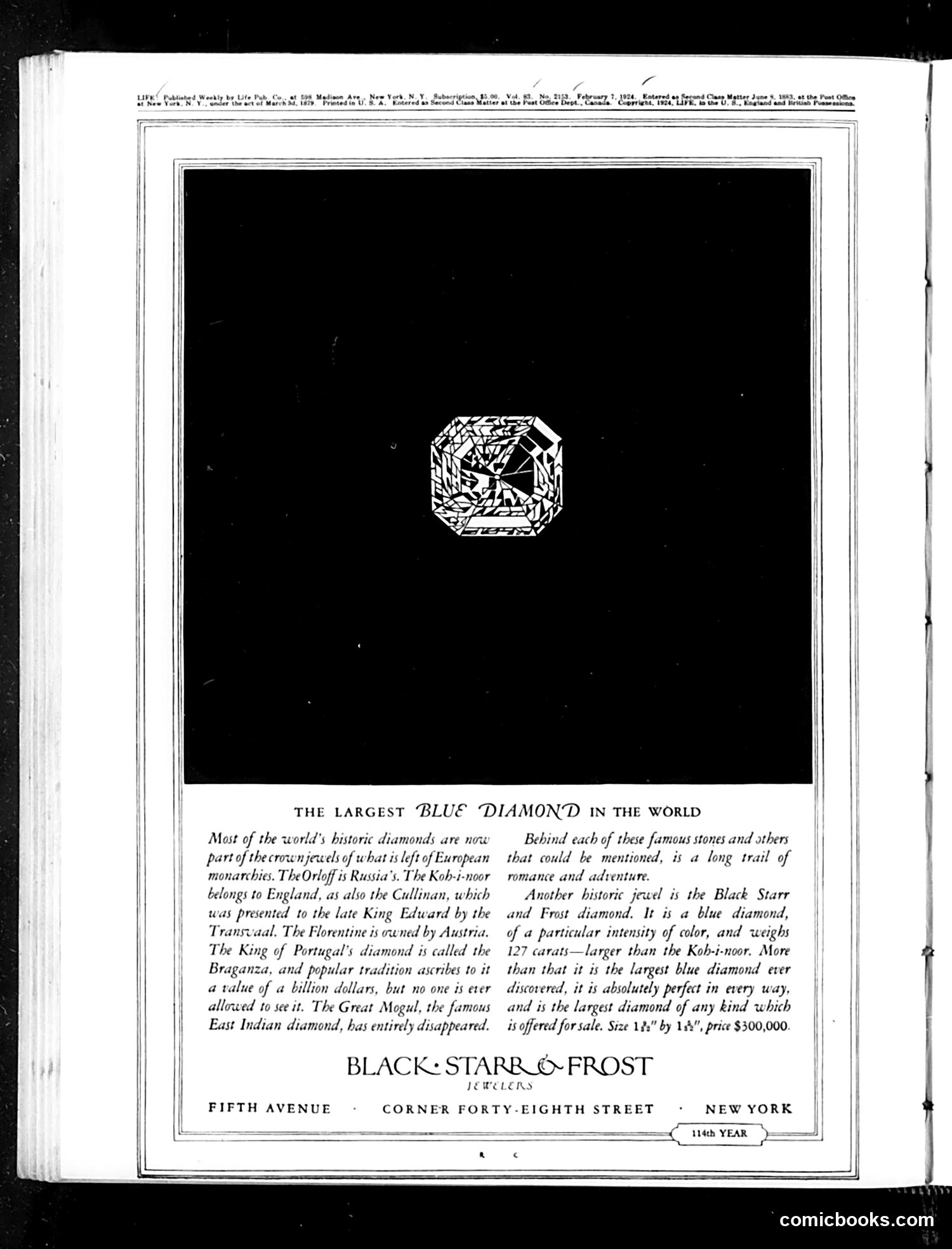
This page is primarily **advertising, not political satire or cartooning**. It's a full-page advertisement from Black, Starr & Frost, a New York jeweler, showcasing "The Largest Blue Diamond in the World." The copy discusses historic diamonds owned by European monarchies (the Orlov of Russia, the Koh-i-noor in England, Portugal's Braganza) and mentions the "Black Starr" and "First" diamonds. The advertiser claims their blue diamond is the largest of its kind ever discovered—127 carats, larger than the Koh-i-noor—and "absolutely perfect in every way," offered for sale at $300,000. The single small illustration at top center depicts the diamond itself. This is luxury goods marketing, not editorial commentary.
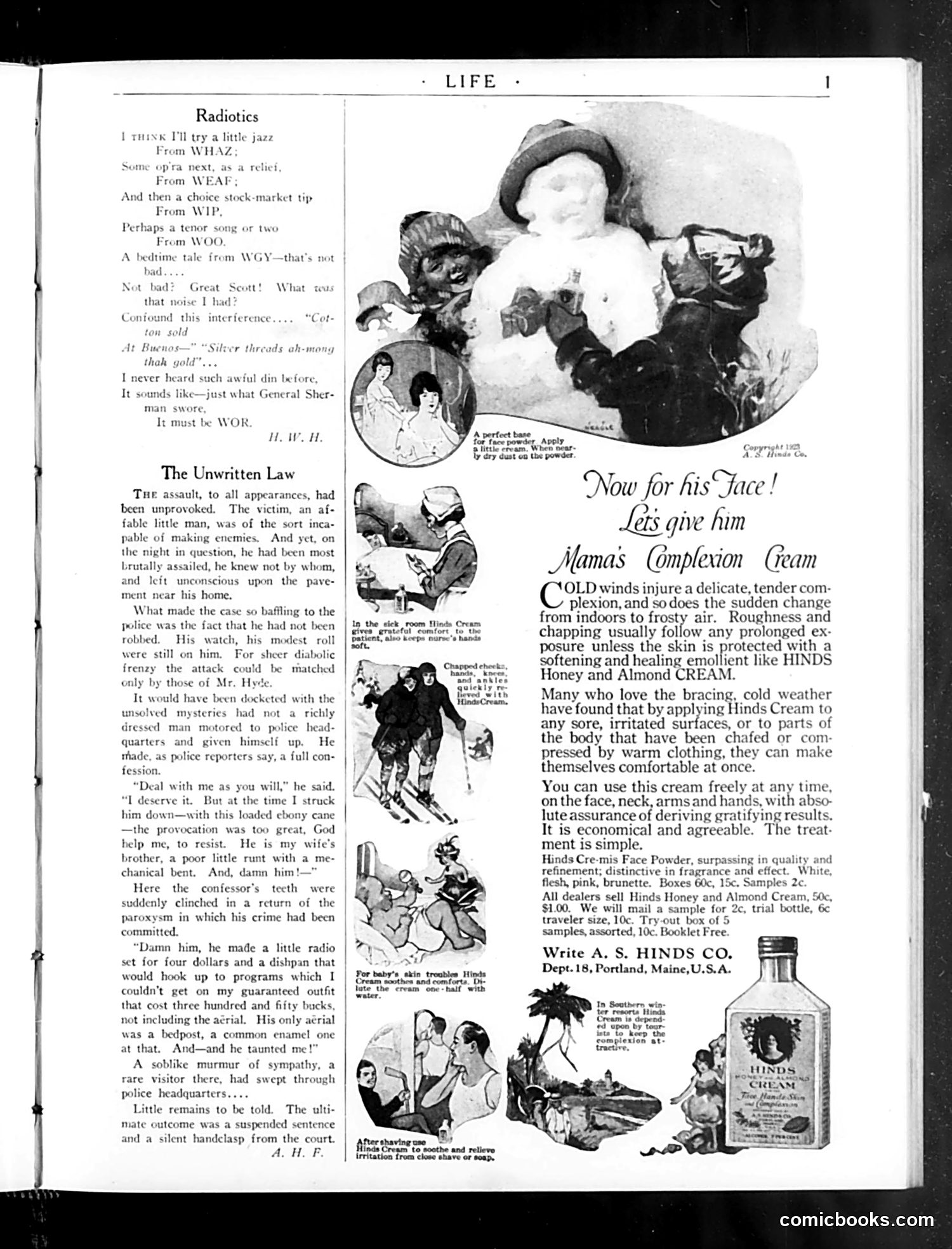
This page contains two distinct elements: **Left Side - "Radiotics" & "The Unwritten Law":** A satirical column about radio station call letters (WHAZ, WEAF, WIP, WOO, WGY) and a short story about a man assaulted for an unspecified transgression. The narrative suggests he may have violated an unwritten social code, possibly involving a woman, leading to his beating by unknown assailants. The story critiques vigilante justice and mob violence outside the law. **Right Side - Hinds Honey and Almond Cream Advertisement:** A full-page advertisement featuring illustrated vignettes of women and children using the cosmetic product. The ad claims the cream protects delicate skin from cold and wind damage. This is straightforward commercial content, not satire—typical of Life's revenue model mixing editorial and advertising content. The page juxtaposes serious social commentary with consumer marketing.
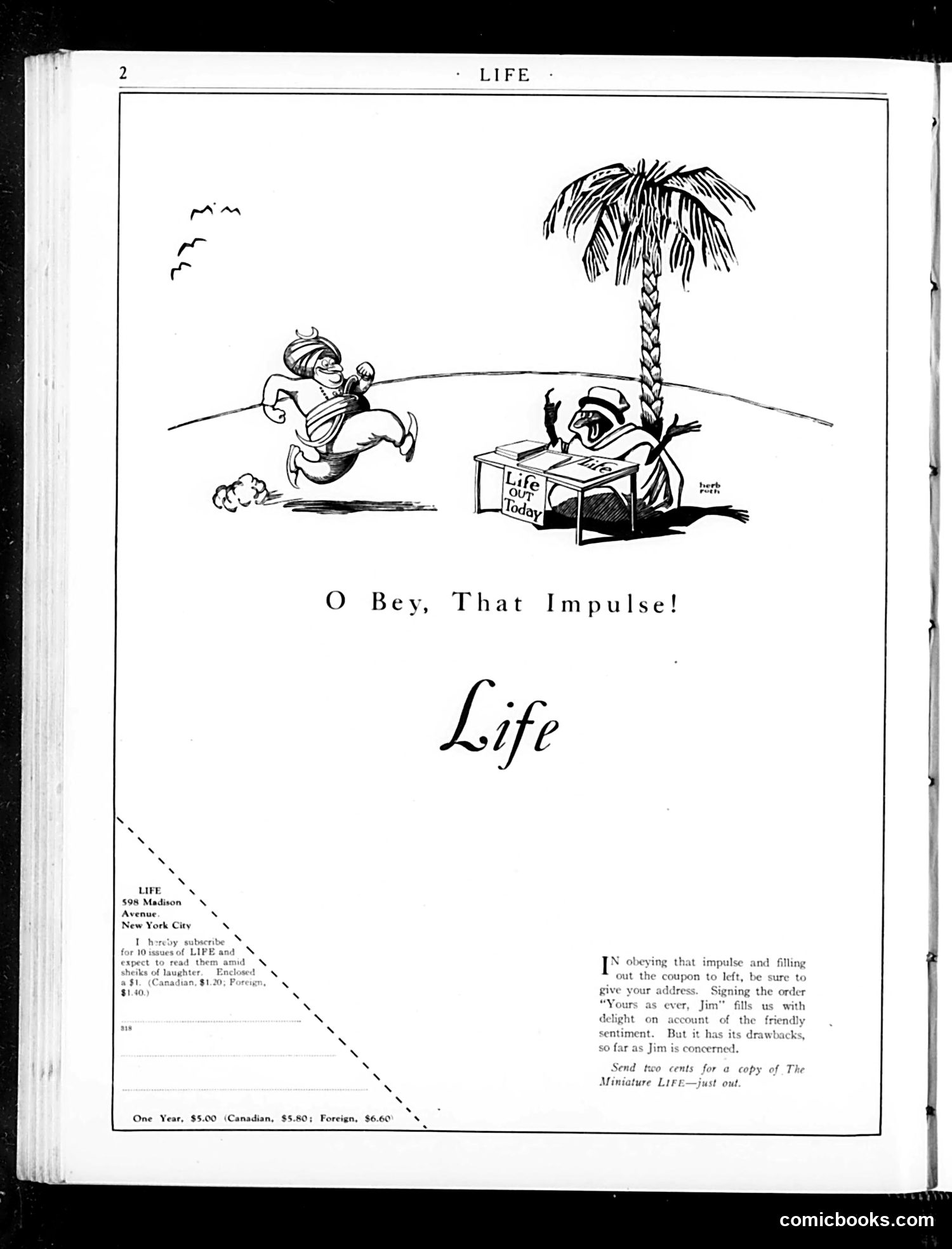
This page features a satirical cartoon titled "O Bey, That Impulse!" The illustration depicts a boy running energetically toward a kiosk selling "Life out Today," while a palm tree and birds appear in a tropical setting. The satire targets the impulsive nature of subscription solicitation. The accompanying text acknowledges that while responding to such impulses brings "delight on account of the friendly sentiment," there are drawbacks "so far as Jim is concerned"—suggesting the magazine profits from spontaneous subscriptions without equal benefit to the subscriber. The cartoon mocks both the marketing tactics of Life magazine itself and the human tendency toward unthinking consumer impulses. It's self-aware advertising humor, presenting subscription appeals as irresistible compulsions while admitting the one-sided advantage to the publisher.
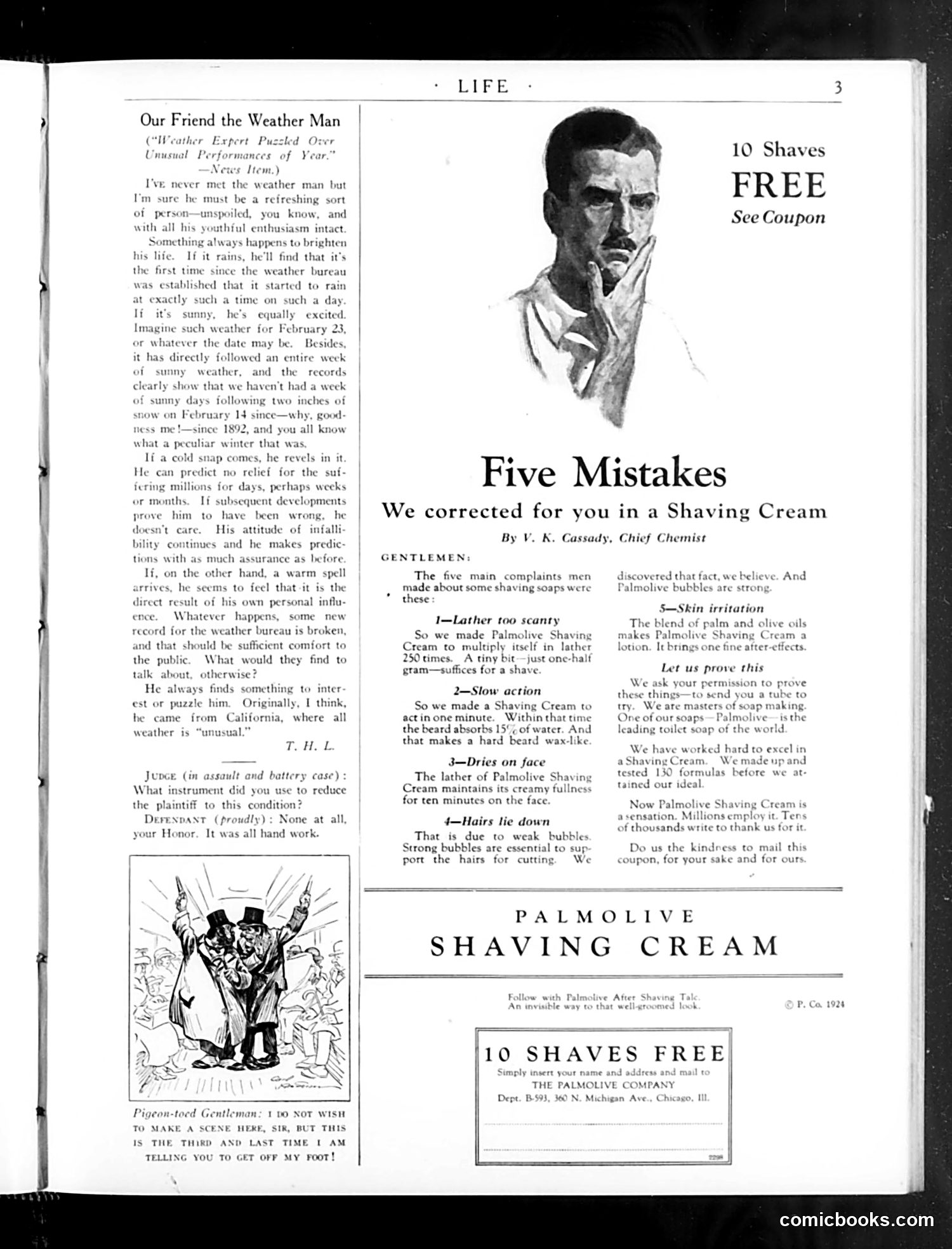
This page is primarily **advertising**, not political satire. The dominant content is a Palmolive Shaving Cream advertisement promoting "Five Mistakes We corrected for you in a Shaving Cream" by chemist V. K. Cassady. The upper left contains a brief humorous essay titled "Our Friend the Weather Man," gently mocking weather forecasters' tendency to find excitement in any meteorological condition, whether rain or sunshine. Below that is a small cartoon labeled "Pigeon-toed Gentleman," showing a frustrated man claiming "I do not wish to make a scene here, sir, but this is the third and last time I am telling you to get off my foot!"—a simple visual joke about social awkwardness. The page reflects Life magazine's characteristic blend of light humor and commercial content typical of 1920s publications.
This page is **not a political cartoon or satire** — it's a **full-page advertisement** for Phoenix Hosiery from Milwaukee. The ad uses elevating language about human progress, claiming that Phoenix hosiery represents technological advancement by making quality foot-coverings affordable to "men, women and children" at low cost. It credits "Phoenix leadership" with setting "the standard hosiery of the world." The ornate decorative border and formal typography are typical of early 20th-century luxury advertising. The rhetorical strategy ironically inflates socks/stockings to the level of civilization-defining achievement — a humorous exaggeration, but it's sincere advertising copy rather than satire. The page appears in *Life* magazine's advertising section, not editorial content.
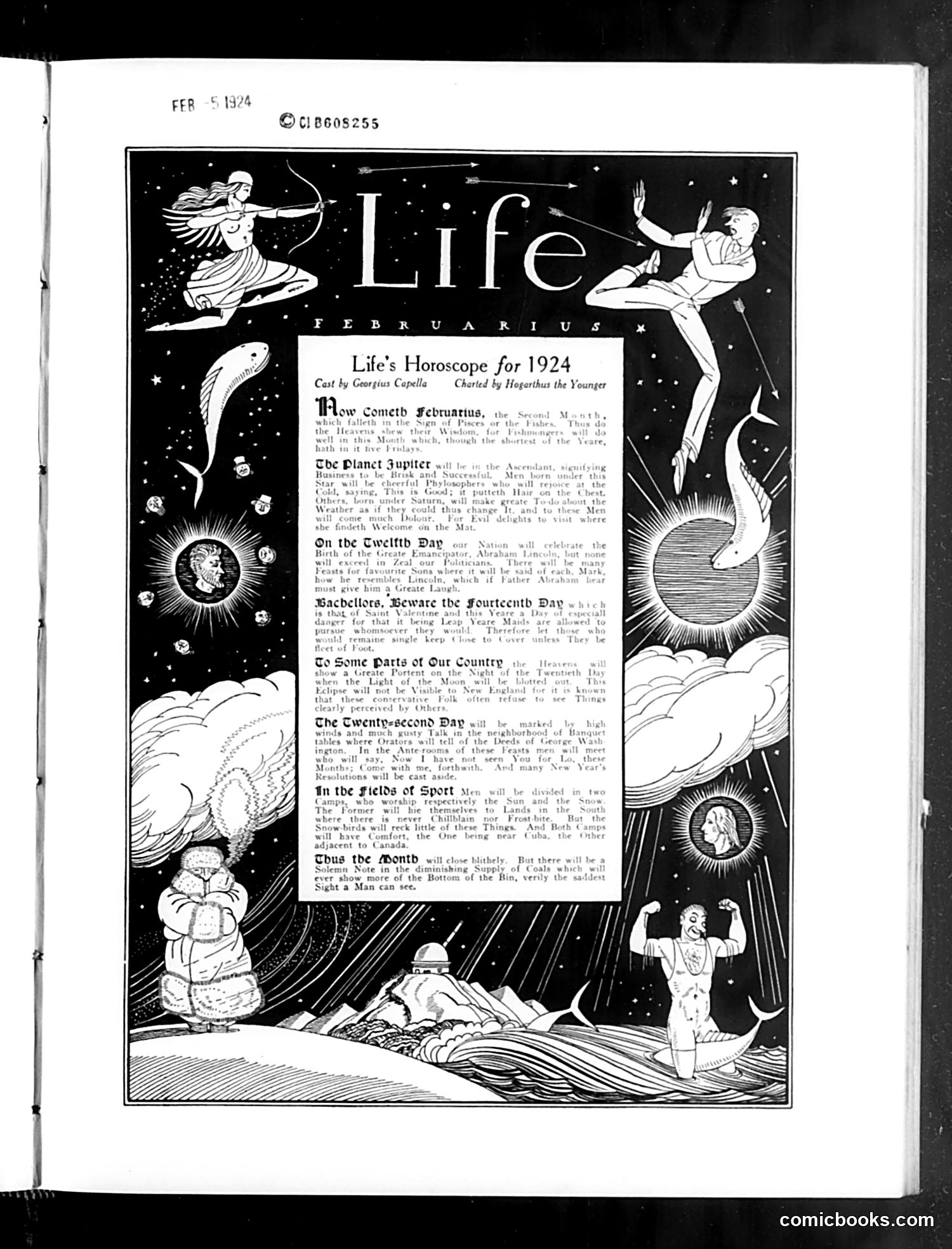
This is a satirical horoscope page cast by "Georgius Capella" for February 1924. The ornate border features zodiac imagery with celestial figures and astronomical symbols. The text provides mock astrological predictions for various events and groups in 1924, including: - **Comet Februarius** in Pisces - **Planet Jupiter** bringing good fortune to philosophers - **The Twelfth Day** (Epiphany) and Abraham Lincoln's birthday celebrations - **Leap Year** warnings about unwed women pursuing men - **The Twenty-second Day** (Washington's birthday) predictions - **Sports** forecasts dividing worship between Sun and Snow - **End of Month** predictions about coal angels The satire mocks the pseudo-scientific nature of astrology by applying it to contemporary American holidays, social customs, and seasonal events, presenting absurd predictions as serious celestial prophecies.
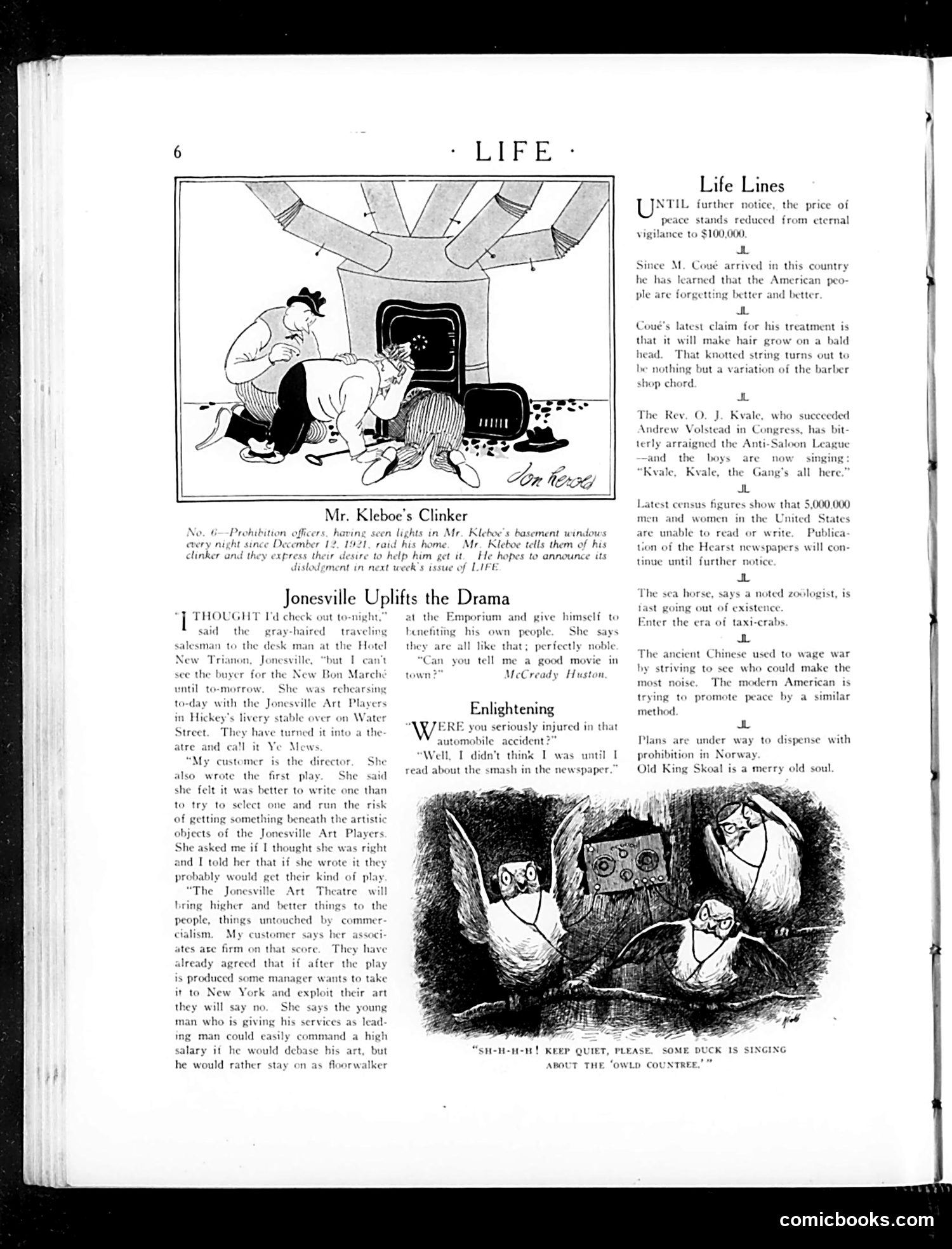
The cartoon shows Prohibition officers raiding a basement speakeasy, discovering illegal alcohol. The joke plays on the term "clinker"—slang for both a mistake and a defective product. The caption notes officers "having seen lights in Mr. Kleboe's basement windows" conducted a raid in December 1921, finding his home operation. The surrounding text discusses theatrical productions in Jonesville and a humorous piece about an automobile accident. The cartoon satirizes Prohibition enforcement during the 1920s, when such raids were common. The image's comic style mocks both the criminal operation and the law enforcement response, reflecting contemporary public skepticism about Prohibition's effectiveness and the absurdity of underground alcohol production.
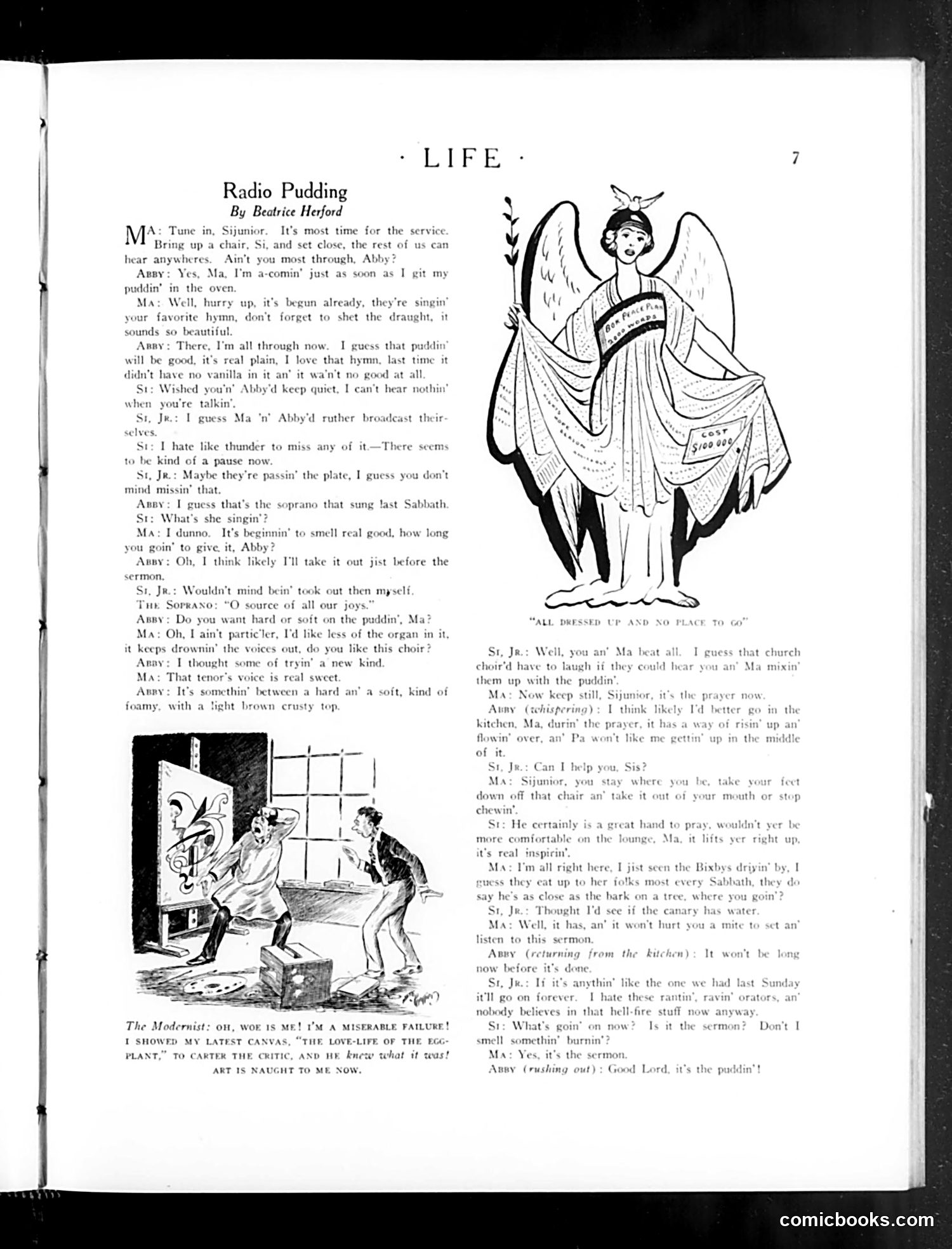
This is a humorous domestic sketch by Beatrice Herford about a family preparing Sunday dinner during a radio broadcast of a church service. The joke centers on the distraction and irreverence of modern technology interrupting traditional religious observance. The scene depicts family members (Ma, Pa, Abbey, Si, and Si Ja) attempting to listen to a radio sermon while cooking a pudding. The humor lies in their divided attention—they're more focused on the food and making wisecracks about the broadcast than genuinely worshiping. The angel illustration labeled "All dressed up and no place to go" reinforces the satire: religious piety is being displaced by secular domestic concerns and the novelty of radio entertainment. This reflects 1920s anxiety about how new media technology was eroding traditional family and religious practices.
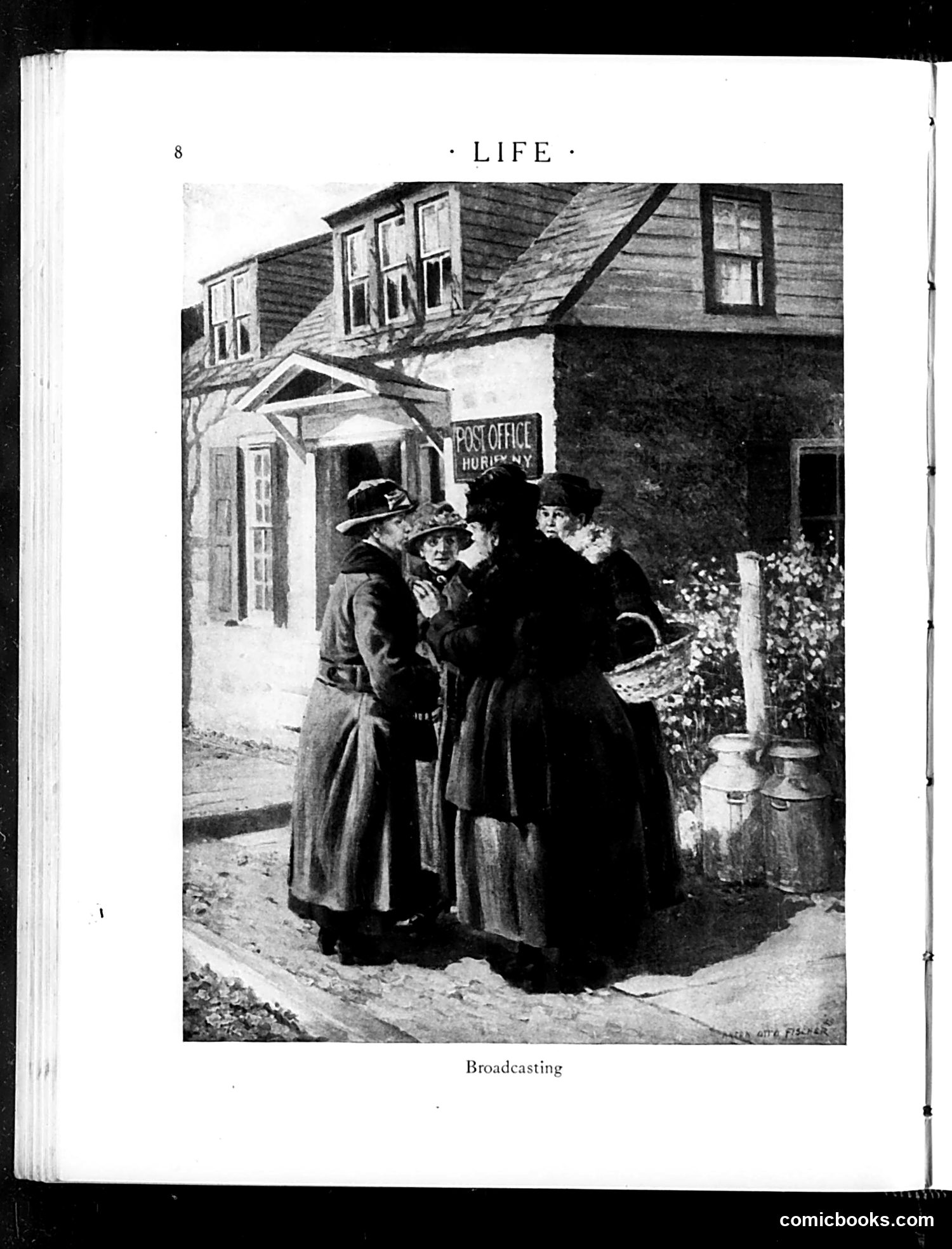
This satirical illustration depicts women gathered outside a rural post office, engaged in gossip. The caption "Broadcasting" is a pun: these women are "broadcasting" news and rumors through their community conversations, much like radio broadcasts disseminate information to the masses. The humor relies on a gendered stereotype common to early 20th-century satire—that women are natural gossips who spread information indiscriminately. By equating their casual chatting with formal radio "broadcasting," the cartoon mocks both women's communication habits and, perhaps, the newer technology of radio itself as merely formalized gossip. The modest rural setting emphasizes the contrast between small-town social networks and modern mass media.
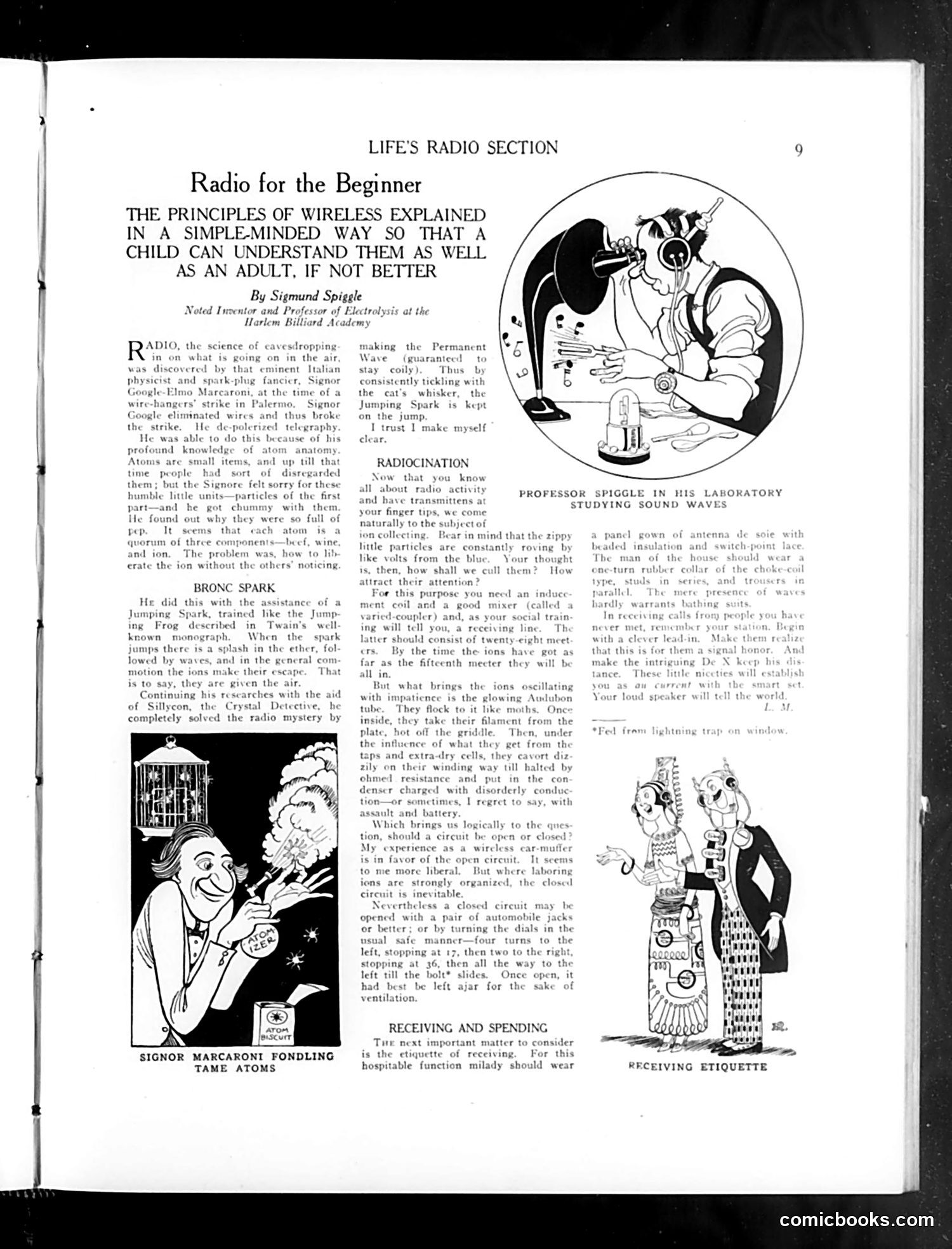
This instructional article by Sigmund Spiggle explains wireless radio principles to general readers. The cartoons illustrate the science humorously: **"Signor Marcaroni Fondling Tame Atoms"** (left) depicts an Italian physicist manipulating atoms—likely referencing Guglielmo Marconi, the Italian inventor credited with developing wireless telegraphy, mentioned in the article's opening. The exaggerated caricature plays on Italian identity. **"Professor Spiggle in His Laboratory"** and **"Receiving Etiquette"** (right panels) show practical radio applications: antenna construction and proper radio-receiving decorum. The satire gently mocks contemporary radio enthusiasm while explaining its scientific basis in accessible, comedic terms for lay readers unfamiliar with this emerging technology.
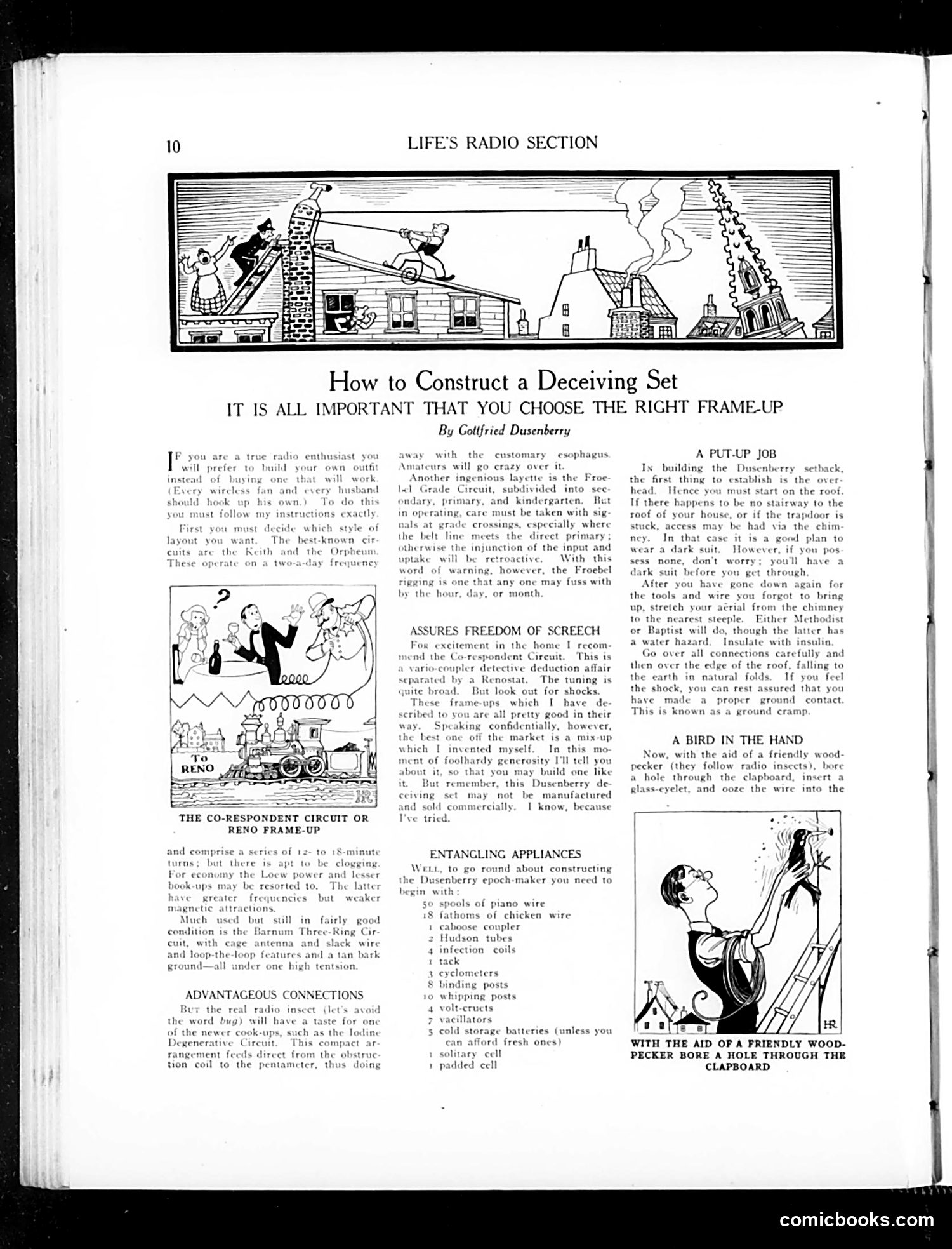
This page is a humorous DIY guide for building a homemade radio receiver, written by Gottfried Dusenberry. The satirical framing—calling it a "deceiving set"—plays on the era's fascination with radio technology and the challenge of building working receivers from scratch. The cartoons illustrate practical obstacles: one shows frustrated people with a failed "Co-Respondent Circuit or Reno Frame-Up" (likely a pun on divorce proceedings, which were associated with Nevada); another depicts someone climbing through a clapboard to string an aerial wire outdoors. The humor derives from depicting radio construction as comically difficult and requiring absurd physical effort. This reflects the 1920s-30s period when amateur radio building was genuinely challenging and popular among enthusiasts despite frequent failures.
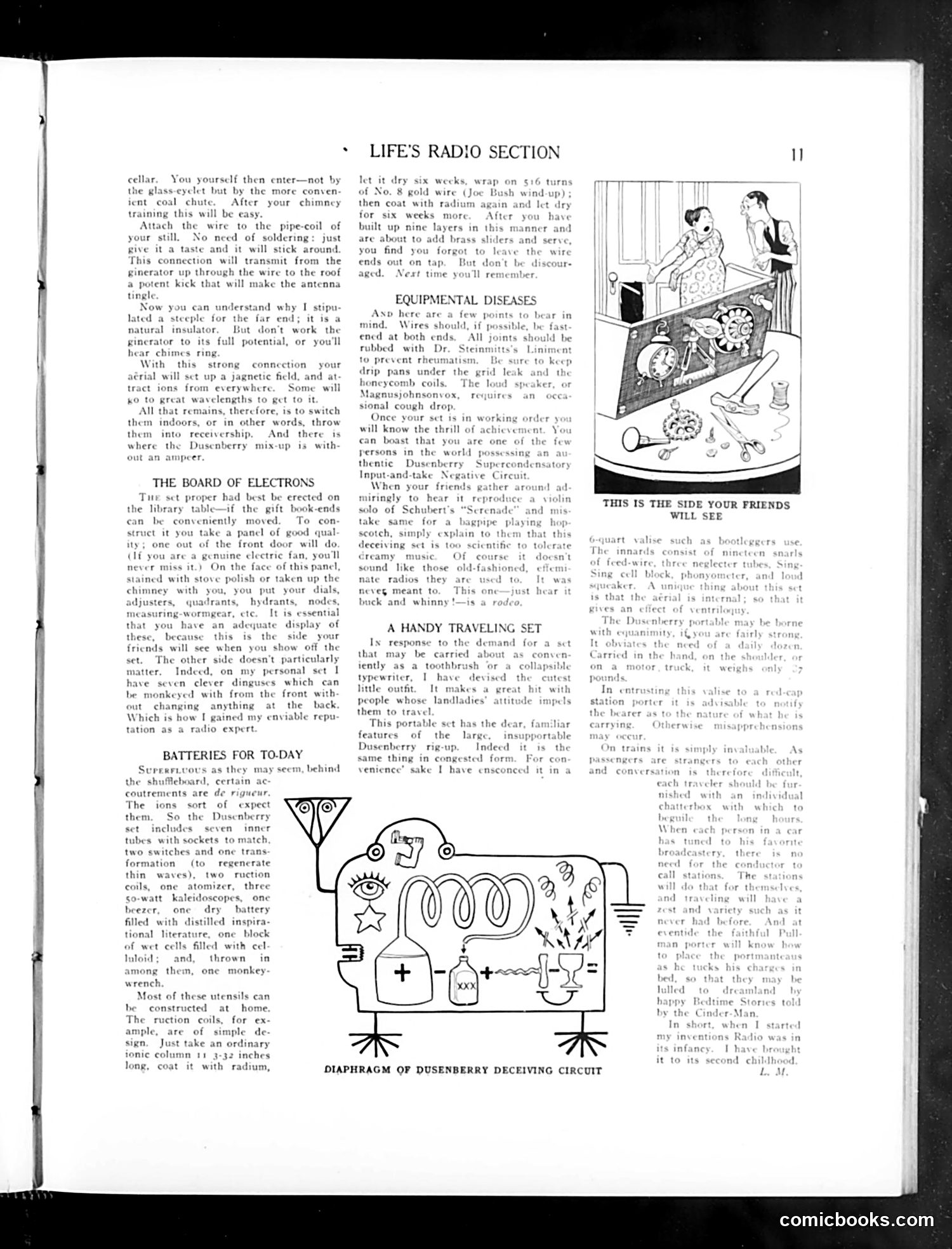
This page is instructional rather than satirical. It's a "Life's Radio Section" teaching readers how to build homemade radio equipment during what appears to be the early-to-mid 20th century. The main cartoon shows a couple examining an assembled radio receiver—likely meant to inspire amateur builders. The technical diagrams demonstrate a "Dusenberry Receiving Circuit" with labeled components (coils, batteries, capacitors). The text discusses building antennas, addressing common equipment problems ("Equipmental Diseases"), and includes a humorous section titled "A Handy Traveling Set" promoting portable radios. The satirical element is mild—gentle humor about radio enthusiasm and the social status of owning working radio equipment, presented as practical lifestyle advice for readers interested in this emerging technology.
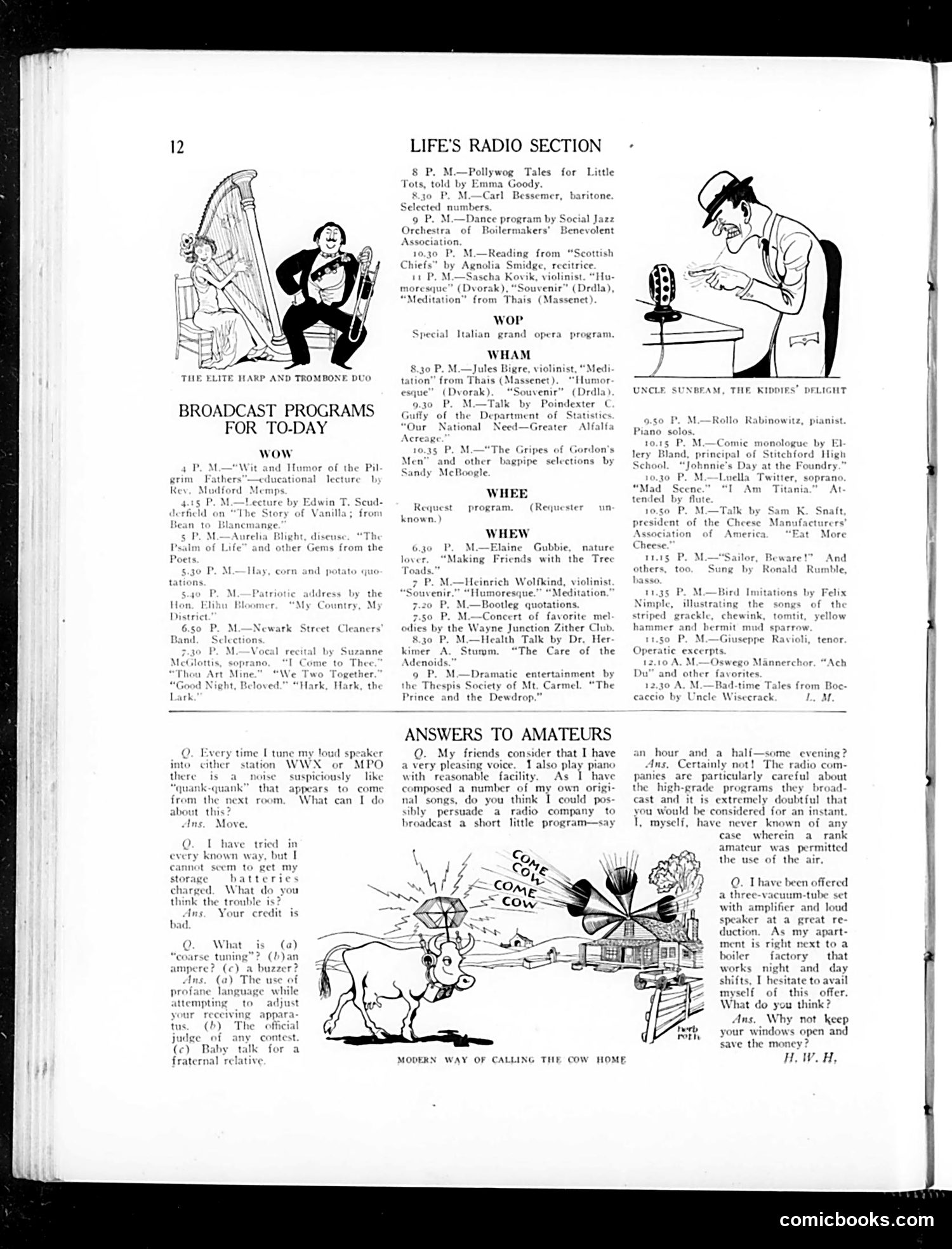
This cartoon satirizes early radio technology's impact on rural life. The illustration shows a farmer using radio broadcasts instead of traditional methods to call cattle home. Rather than manually herding or using a bell, he's operating a radio transmitter while the cow listens to the broadcast signal. The joke targets the rapid technological disruption of traditional farm practices in the 1920s-30s. It humorously suggests that radio—then a novel luxury—has become so ubiquitous that even fundamental agricultural tasks are being "modernized" in absurd ways. The cartoon reflects contemporary anxiety about technology's wholesale replacement of established rural customs, poking fun at both farmer eagerness to adopt new gadgets and radio's perceived cultural omnipresence.
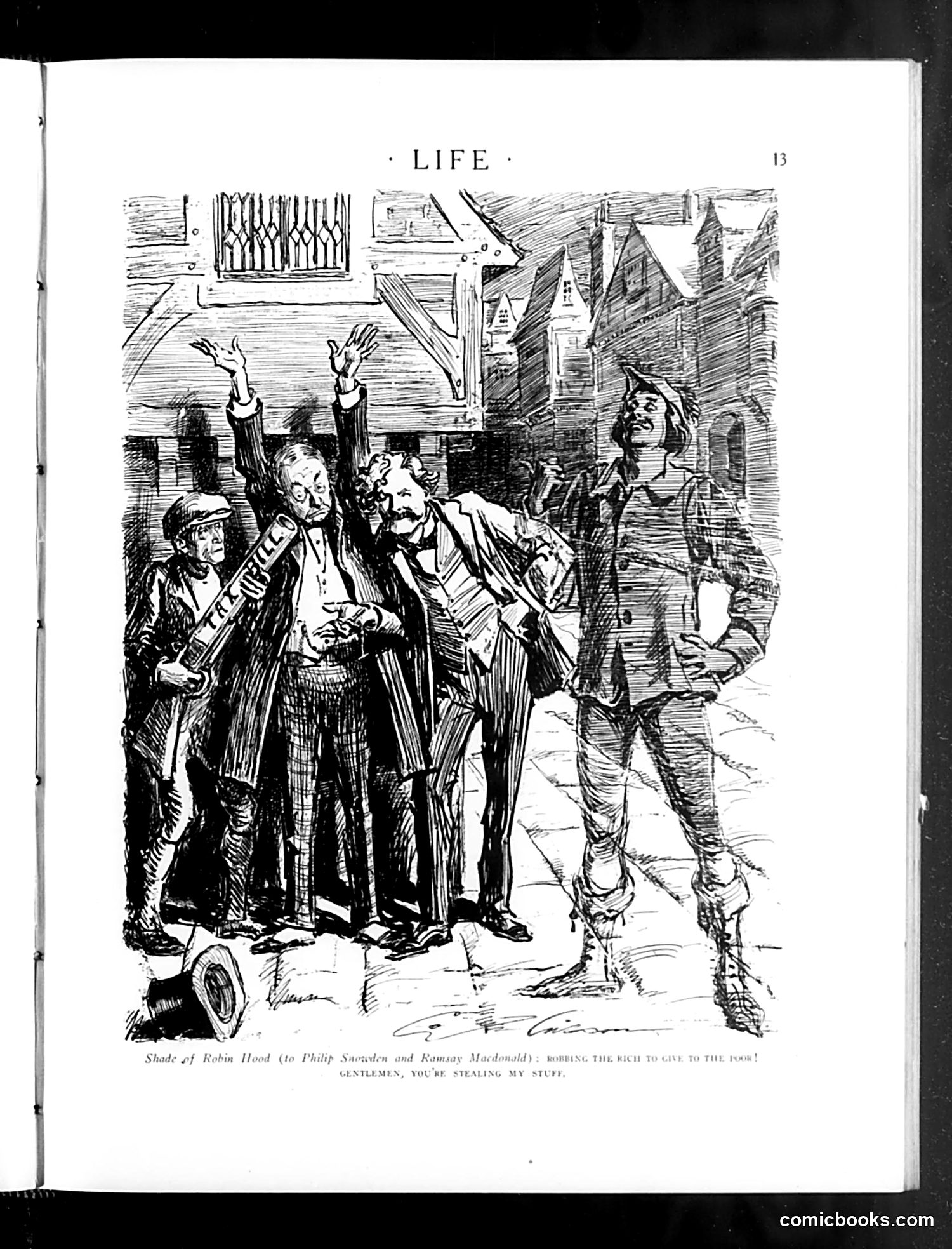
This satirical cartoon references the Robin Hood legend to critique wealthy industrialists of the Gilded Age. The caption identifies the figures as "Philip Swindon and Rommay Macdonald" (likely pseudonyms for prominent businessmen), depicted as modern "robbers" confronted by a righteous figure. The joke inverts Robin Hood's moral framework: instead of stealing from the rich to give to the poor, these gentlemen are accused of "robbing the rich to give to the poor"—but sarcastically. The implication is that wealthy men using philanthropic gestures or political claims of helping workers are actually self-serving, merely redistributing wealth while enriching themselves. The dramatic street scene and period clothing emphasize the clash between romanticized Robin Hood mythology and brutal capitalist reality.
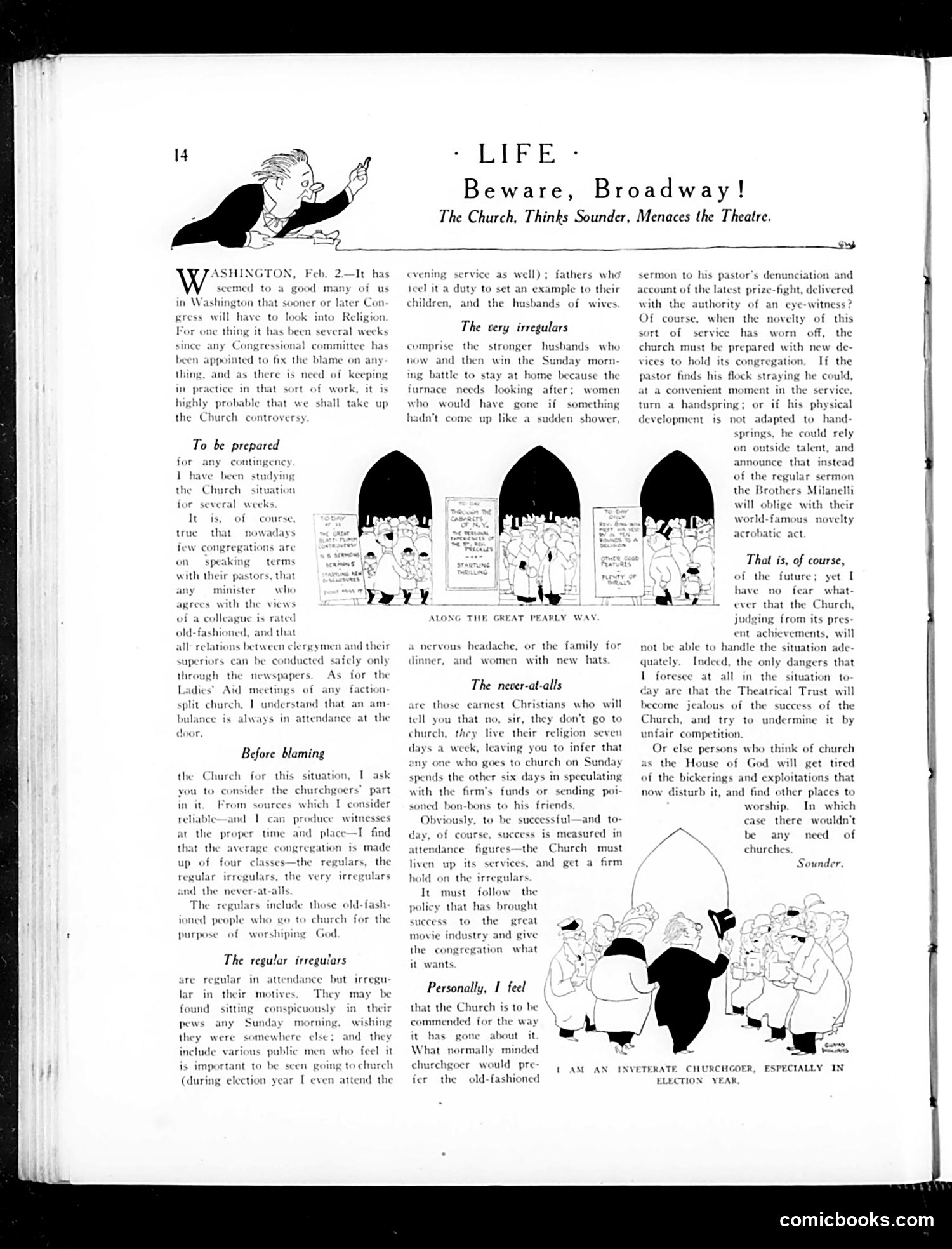
This satirical piece criticizes religious leaders' efforts to reform Broadway entertainment. The author argues that while the Church seeks to regulate theatrical content, it risks losing congregants—particularly "regulars" (faithful attendees) and "irregulars" (occasional churchgoers). The three illustrated arches labeled "Along the Great Pearly Way" depict churchgoers in a sanctuary setting, contrasting with the bottom cartoon showing congregation members departing, labeled "I am an Inveterate Churchgoer, Especially in Election Year." The satire's point: churches attempting to police Broadway may alienate their own members, who enjoy theatrical entertainment. The author warns that moral policing could backfire, pushing congregants away from church entirely—an ironic loss given the Church's stated goals.
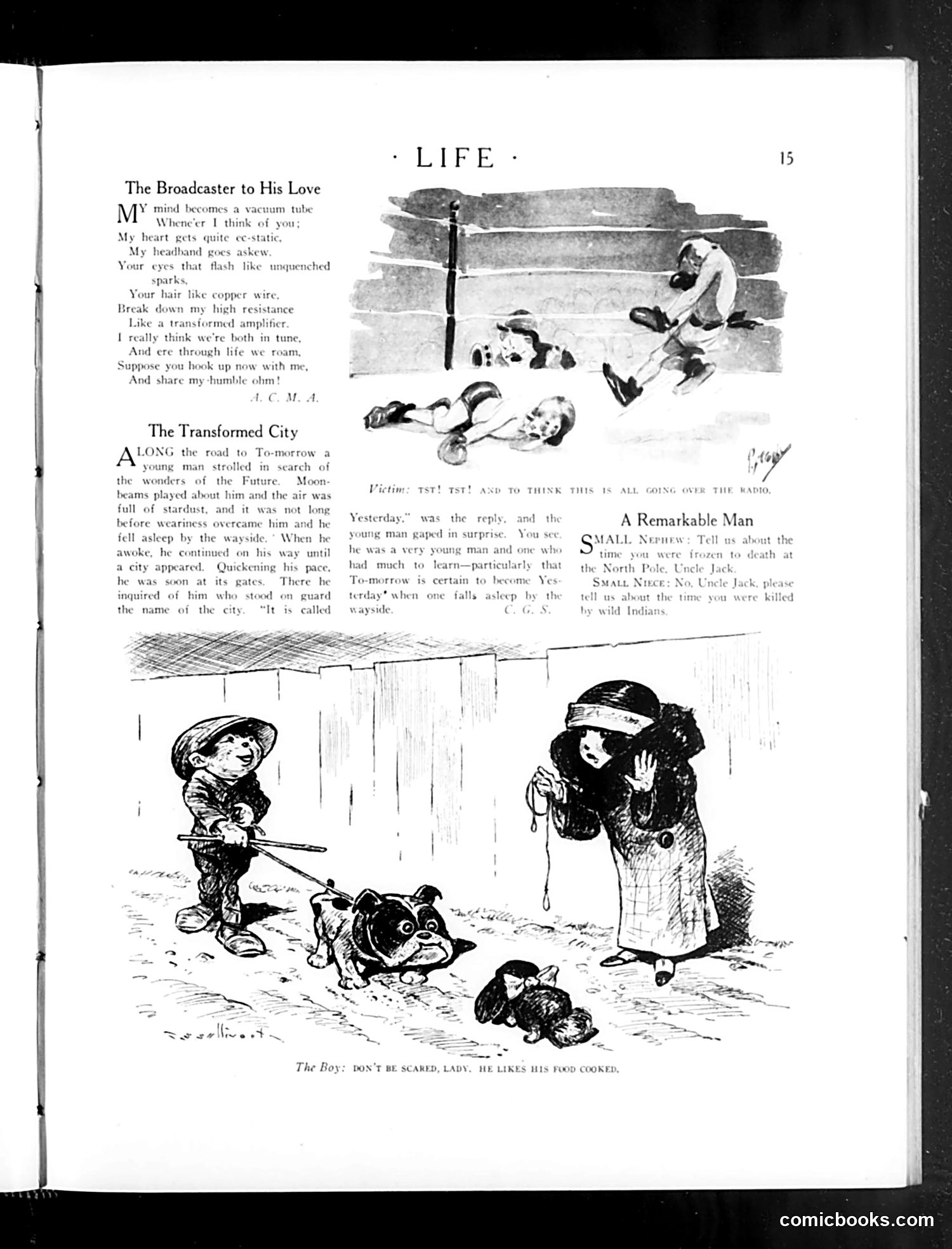
This page contains three distinct pieces: 1. **"The Broadcaster to His Love"** — a poem using radio/electrical metaphors for romantic devotion (vacuum tubes, copper wire, transmitter). 2. **"The Transformed City"** — a short story about a young man who falls asleep by a roadside and wakes in a futuristic city called "To-morrow." The satire mocks utopian visions of technological progress. 3. **"A Remarkable Man"** — dialogue between a small nephew and uncle about "Uncle Jack" at the North Pole, apparently involving a humorous (likely exaggerated) survival story. 4. **Bottom cartoon** — shows a boy fishing with dogs, captioned "Don't be scared, lady. He likes his food cooked." The joke appears to mock either the boy's cooking or safety standards of the era. The page reflects early-20th-century Life's blend of technological satire and domestic humor.
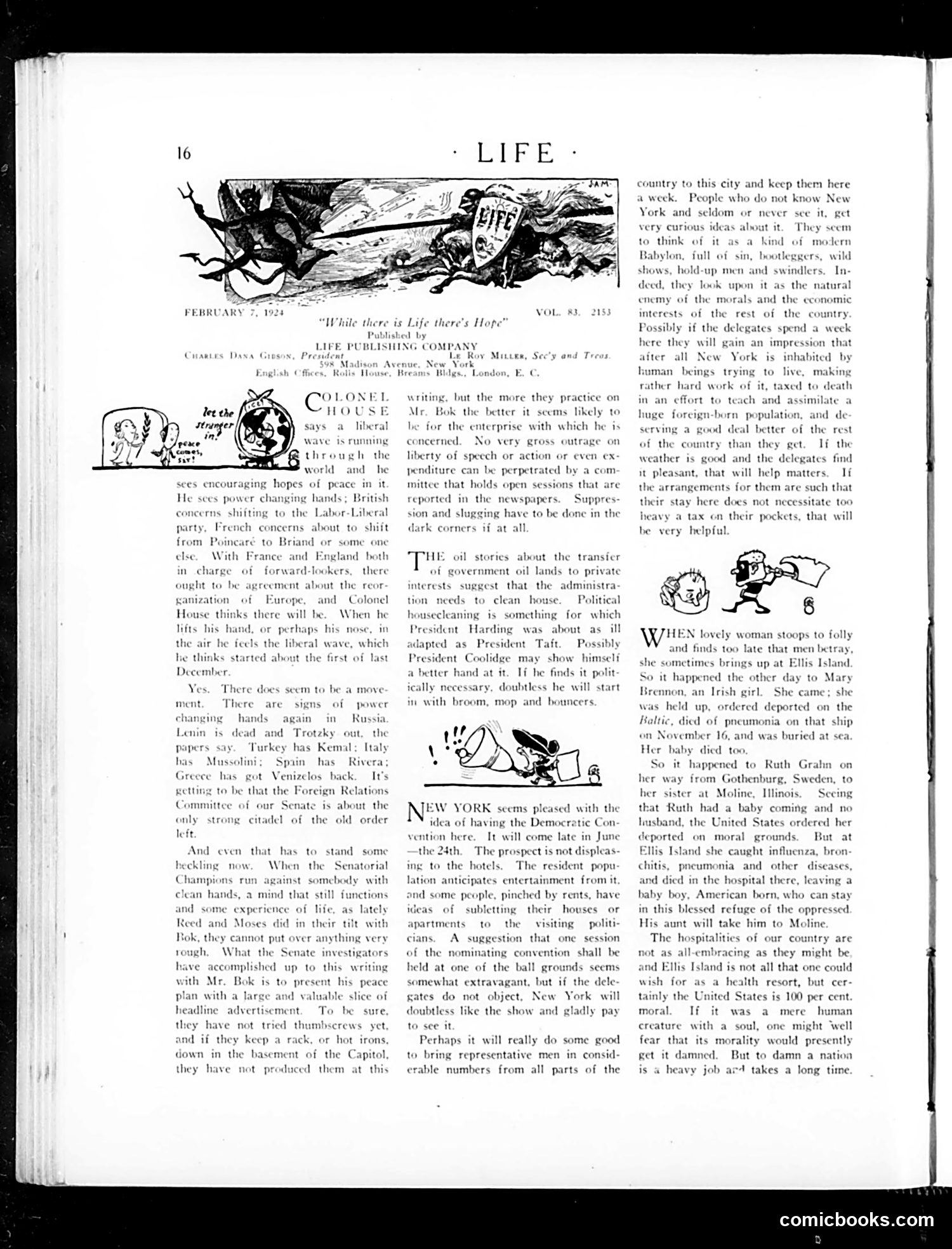
This page mixes political commentary with social satire. The main text discusses Colonel House (Woodrow Wilson's advisor) observing global power shifts—Lenin dead, Trotsky out, various European leaders rising (Mussolini, Kemal, Venizelos). The author notes ironically that America's Senate Foreign Relations Committee remains "the only strong citadel of the old order left." The commentary then pivots to Edward Bok's peace plan efforts and the upcoming 1924 Democratic Convention in New York. The satire targets New Yorkers' stereotypes about themselves—outsiders view the city as "a kind of modern Babylon, full of sin, bootleggers, wild shows, hold-up men and swindlers." The author suggests hosting the convention might improve the city's reputation by showing delegates that New York contains ordinary working people, not just criminals and vice. The small illustrations appear humorous but are difficult to interpret clearly from reproduction quality.
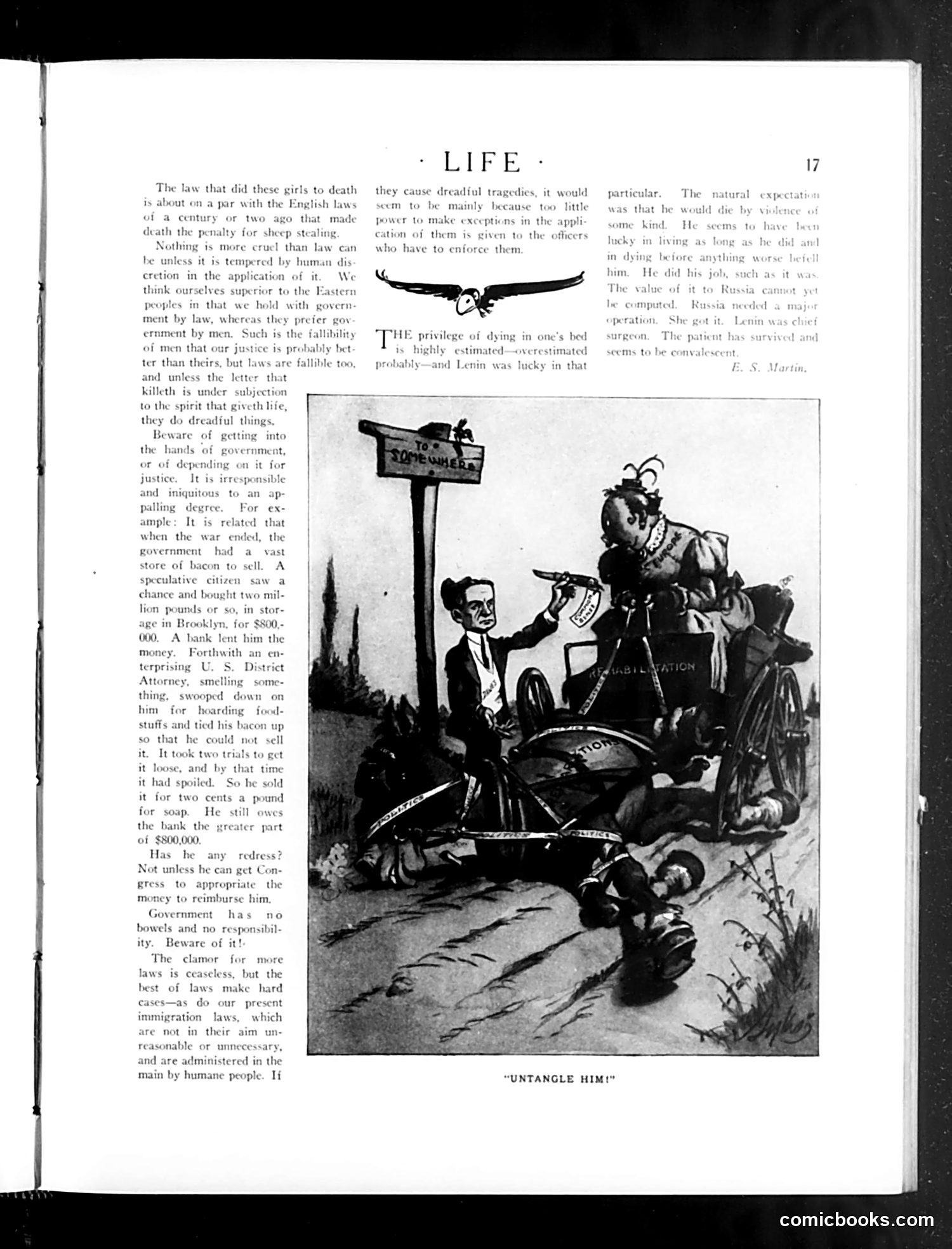
This page combines political commentary with satire about government overreach and the danger of entrusting power to officials. **The Main Cartoon ("Untangle Him!")** depicts a man in a suit struggling with red tape while attempting to help a woman. The imagery suggests bureaucratic entanglement—the figure appears to be a government official or businessman caught in regulations meant to assist or regulate commerce. **The Text's Context:** The surrounding article criticizes how laws, particularly immigration and wartime regulations, are administered. It warns against depending on government for justice, noting that while Western nations claim superiority for "government by law" rather than "government by men" (comparing favorably to Eastern systems), laws still require human discretion and compassion to be fairly applied. **The Satire's Point:** Government regulations intended to prevent fraud or hoarding can paradoxically harm honest people through red tape and bureaucratic complexity. The cartoon title "Untangle Him!" suggests the absurdity of regulations creating problems they were meant to solve.
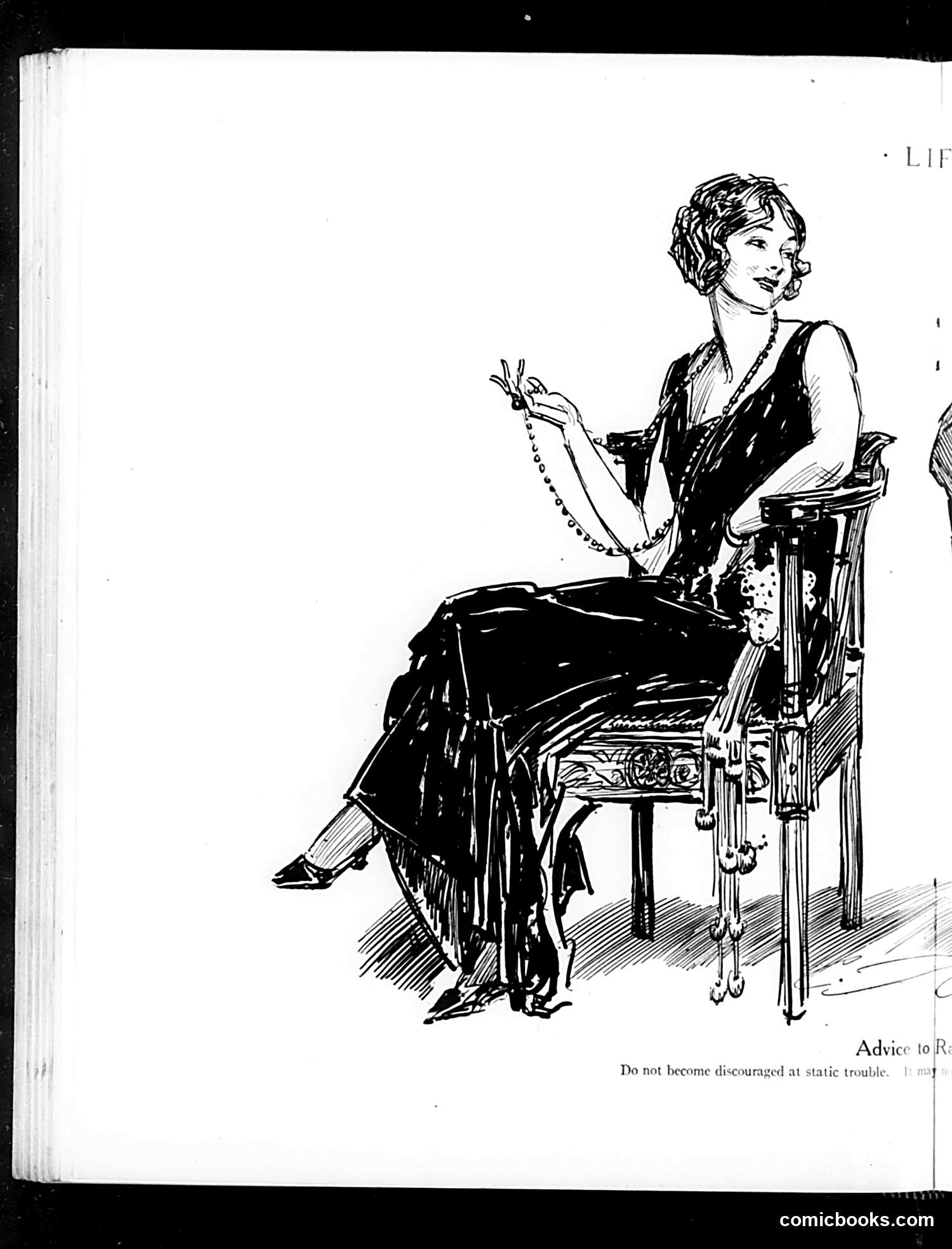
This page contains a single illustration with accompanying text. The image shows a woman seated in an ornate chair, holding what appears to be a beaded necklace or string of pearls, wearing 1920s-style clothing and hairstyle. The visible text reads: "Advice to Radio listeners: Do not become discouraged at static trouble." This is a joke about radio reception problems—a common frustration for early radio listeners in the 1920s-1930s. The cartoon plays on the double meaning: while ostensibly offering encouragement about radio static interference, the image of the woman examining her beaded necklace suggests an alternative interpretation about "static" (clinging or clingy behavior) in personal relationships. The satire humorously conflates technical radio troubles with romantic or social complications.
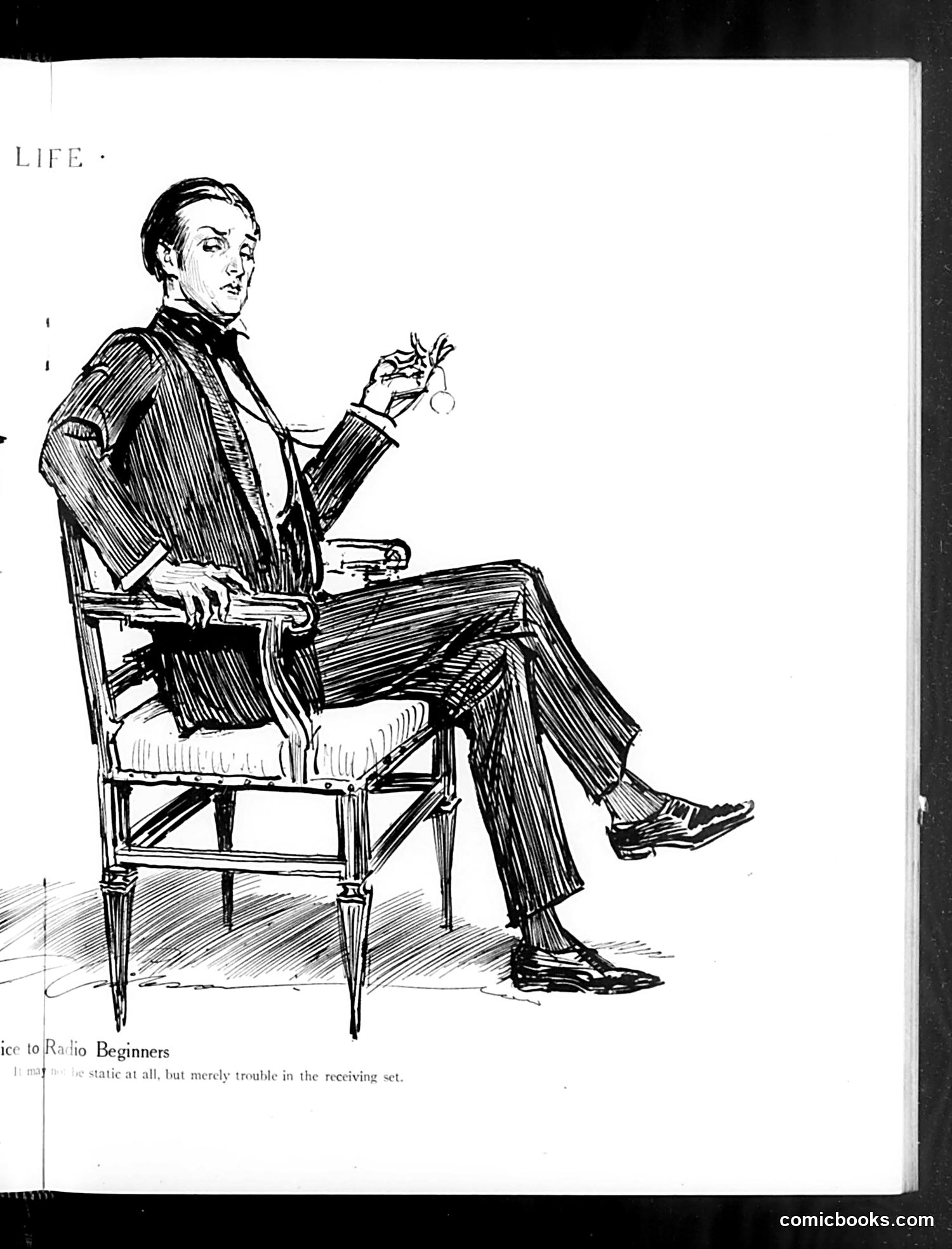
This page from *Life* magazine features a satirical illustration titled "LIFE" showing a well-dressed man seated in a chair, holding what appears to be a radio crystal or receiving component. The partial text references "Radio Beginners" and mentions that static "may be trouble in the receiving set." This appears to be early radio-era satire, likely from the 1920s when amateur radio was becoming popular. The joke seems to mock inexperienced radio enthusiasts—the well-dressed gentleman's sophisticated appearance contrasts with his fumbling with simple radio equipment, suggesting pretension or incompetence among radio hobbyists. The satire targets the gap between how radio beginners presented themselves versus their actual technical ability.
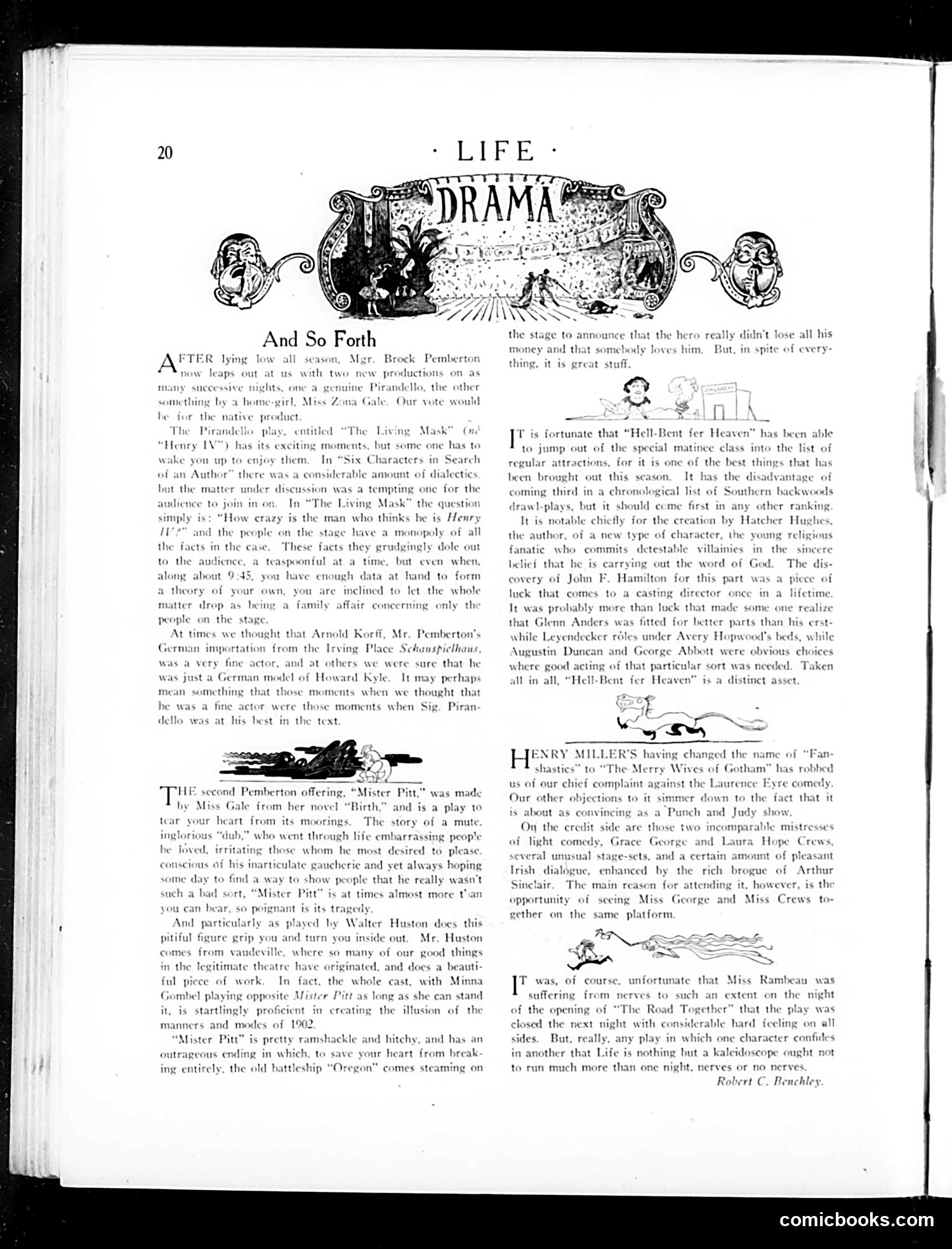
This page reviews several Broadway plays from the early 1900s. The key references: **"The Living Mask"** - a production featuring Arnold Korff, an actor the reviewer finds inconsistent. The review suggests Korff performs better when following playwright Pirandello's text closely, implying the actor's own interpretations weaken the work. **"Mister Pitt"** - adapted from a novel, starring Walter Huston. It's a sentimental drama about a mute man navigating society, praised for its 1902-era authenticity and the cast's performances, particularly Huston's emotional depth. **"Hell-Bent for Heaven"** - notable for introducing actor John F. Hamilton in a role as a religious fanatic who commits crimes believing he serves God—a "new type of character" for theater at the time. **"The Merry Wives of Gotham"** - criticized as unconvincing, though Grace George and Laura Hope Crews receive praise for their comedic talents and stage presence. The reviews employ period theatrical criticism standards, emphasizing emotional authenticity and character innovation.
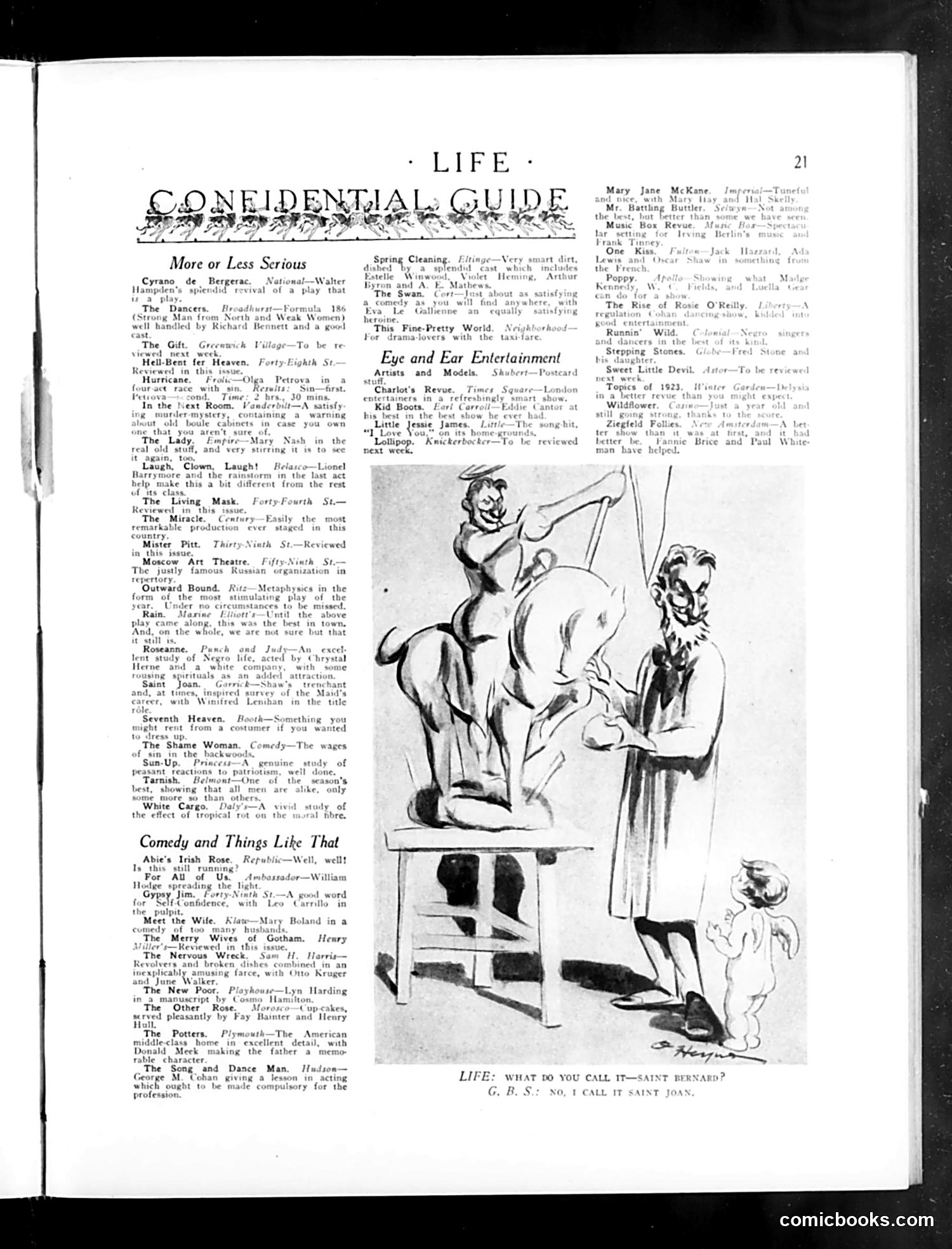
This page from Life magazine reviews theatrical productions currently running in New York City. The main cartoon depicts a sculptor or artist at work on a statue, with two cherubic figures observing. The caption reads: "LIFE: WHAT DO YOU CALL IT?—SAINT BERNARD? G.B.S.: NO, I CALL IT SAINT JOAN." This is a satirical reference to George Bernard Shaw (G.B.S.), the Irish playwright whose controversial play "Saint Joan" is listed in the theater reviews on this page. The joke mocks Shaw's artistic pretensions—the questioner mistakes the sculptor's work for a Saint Bernard (the dog breed), while Shaw insists it's actually Saint Joan. This playfully suggests Shaw's modernist aesthetic might be so abstract or unconventional that viewers cannot recognize his intended subject. The cartoon gently ridicules both avant-garde art and Shaw's reputation for intellectual obscurity.
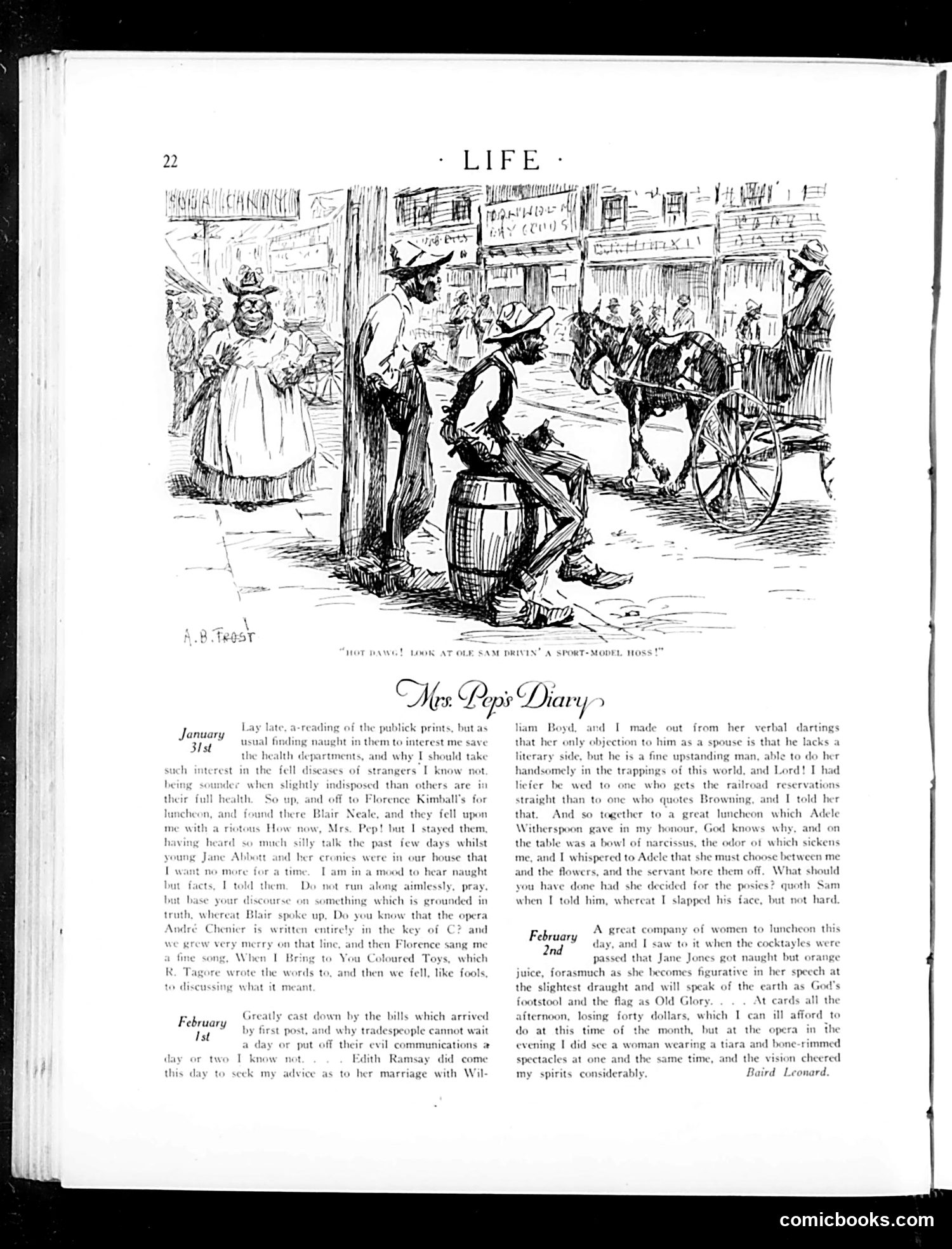
This page presents **"Mrs. Pep's Diary,"** a humorous serialized column satirizing upper-class social life. The illustration depicts a street scene with well-dressed figures and horse-drawn vehicles, accompanying the caption "HOT DAWG! LOOK AT OLE SAM DRIVIN' A SPORT-MODEL HOSS!"—likely mocking someone's ostentatious display of a fancy automobile or carriage. The diary entries (January-February) humorously chronicle domestic and social follies: marital anxieties, tedious social obligations, opera attendance, and financial frivolousness. The satire targets Gilded Age pretension—the obsession with proper comportment, fashionable society, and conspicuous consumption. References to "cocktails," "luncheon," and opera signal wealth; complaints about money despite apparent affluence underscore the irony. The column's breathless, gossipy tone mocks women's social preoccupations and romantic drama. This represents *Life* magazine's typical early-20th-century satirical treatment of privileged society through fictional diary humor.
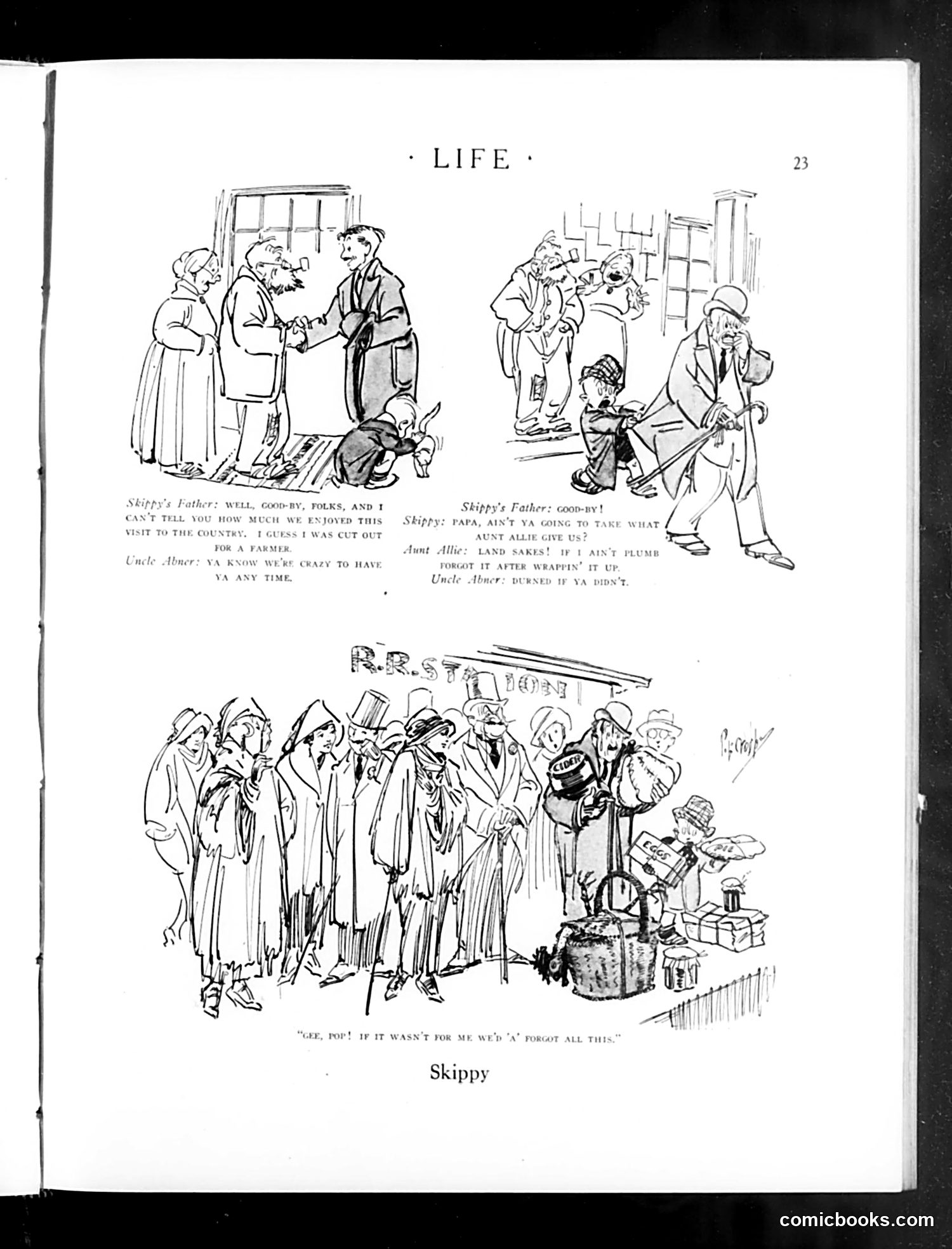
This page features three comic strips depicting "Skippy," a young boy character. The humor centers on Skippy's interactions with adults and family members in everyday situations. **Top left**: Skippy's father says goodbye before leaving for the countryside, while Uncle Abner warns the parents that Skippy is "crazy" and likely to cause trouble during visits. **Top right**: Skippy's father departs, with Aunt Allie and Uncle Abner joking about what Skippy might steal or break while visiting. **Bottom panel**: Shows the aftermath—multiple people gathered around what appears to be Christmas presents or gifts at an R.R.S. location, with Skippy's father commenting: "Gee, Pop! If it wasn't for me we'd 'a' forgot all this." The satire suggests Skippy's reputation for mischief precedes him, yet he ultimately proves valuable or indispensable to family gatherings.
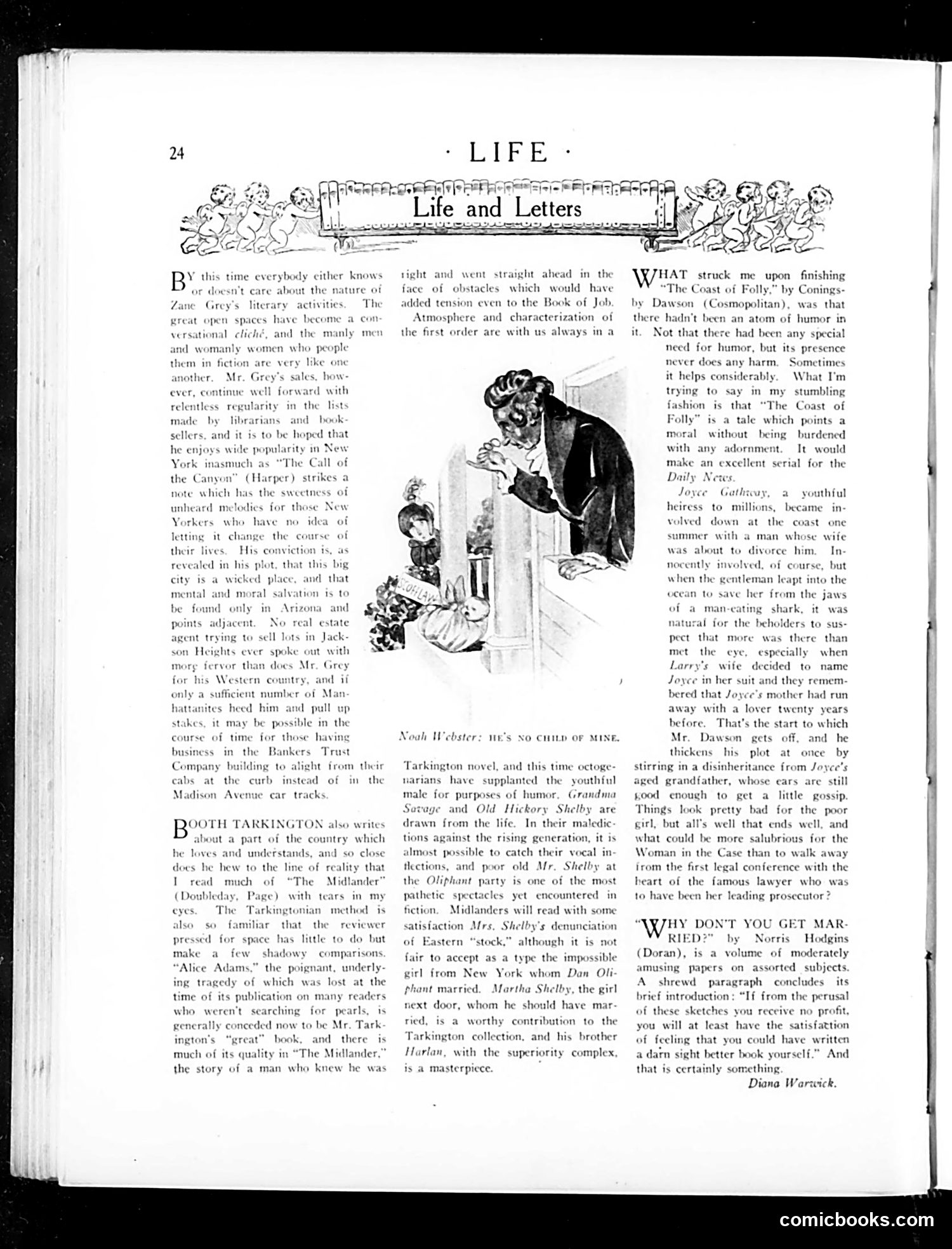
This page reviews three contemporary American novels (circa 1920s), focusing on works by **Zane Grey**, **Booth Tarkington**, and an unnamed author of "The Coast of Folly" by Comingsby Dawson. The accompanying illustration depicts a domestic scene: a man leans toward a woman at a window or doorway while a child watches below—likely illustrating a plot point from one of the reviewed novels. **The satire targets**: Grey's romanticization of the American West as a moral corrective for corrupt Eastern city-dwellers; Tarkington's use of elderly characters (Grandma, Old Mr. Shelby) as vehicles for generational critique; and Dawson's melodramatic society romance featuring infidelity, divorce, and shark attacks. The reviewer's tone is gently mocking—praising these authors' commercial success while noting their reliance on predictable character types and contrived plots designed for mass appeal rather than literary substance. The critique reflects period literary snobbery about popular fiction.
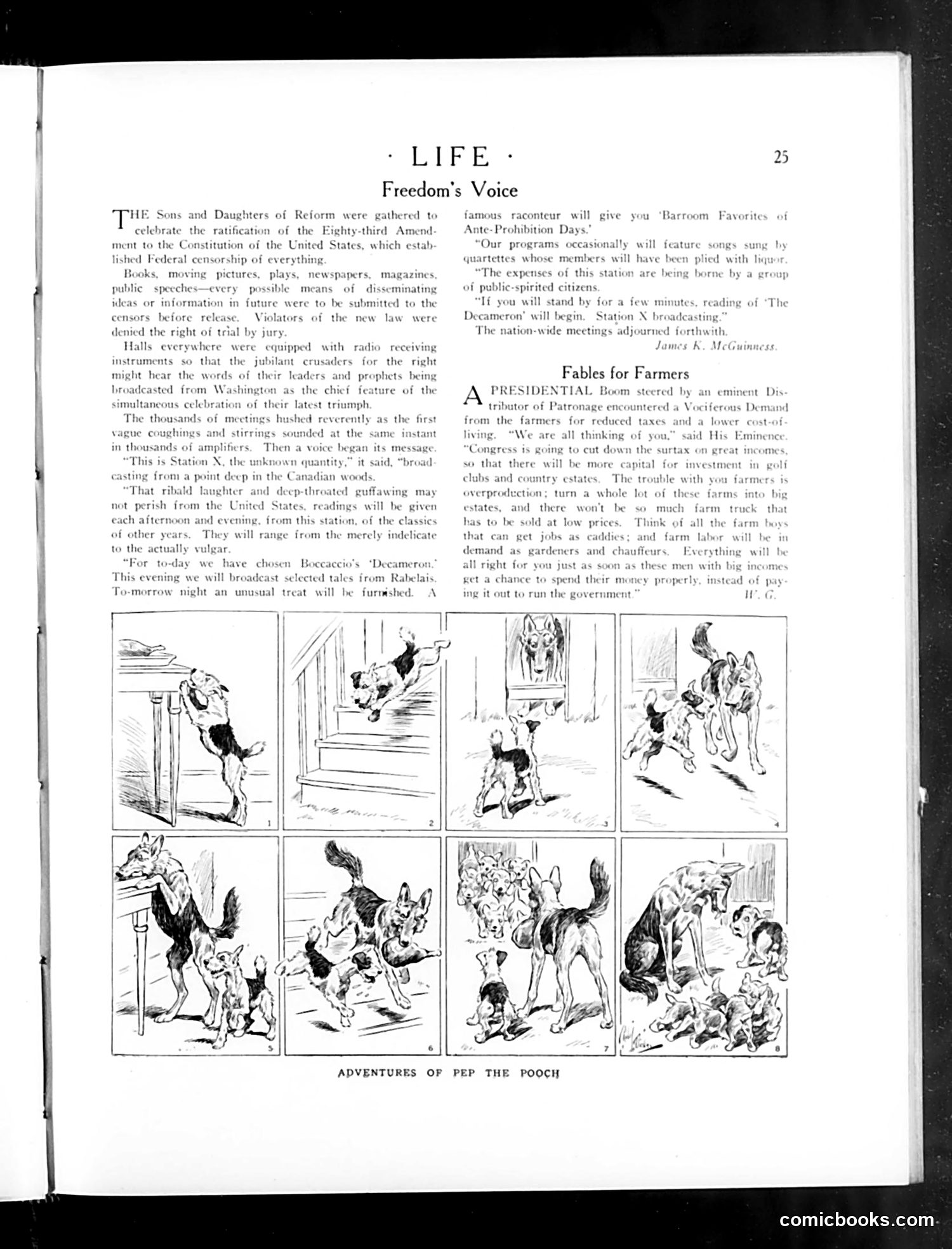
This page satirizes the **Eighteenth Amendment** (Prohibition) ratification celebrations of 1919. The top article mocks the "Sons and Daughters of Reform" who gathered to celebrate, describing radio broadcasts of classical literature readings—specifically mentioning Boccaccio's *Decameron* and tales from Rabelais, both works famous for bawdy content. The satire's point: reformers celebrated censorship of "obscene" materials while their own classical selections contained similar content. The "Fables for Farmers" section presents a political pitch to farmers promising tax cuts and agricultural prosperity, likely representing post-WWI political promises. **"Adventures of Pep the Pooch"** is a comic strip sequence (8 panels) showing a dog's misadventures, apparently unrelated to the political content above. The overall page criticizes Prohibition-era reform movements as hypocritical and out-of-touch with reality.
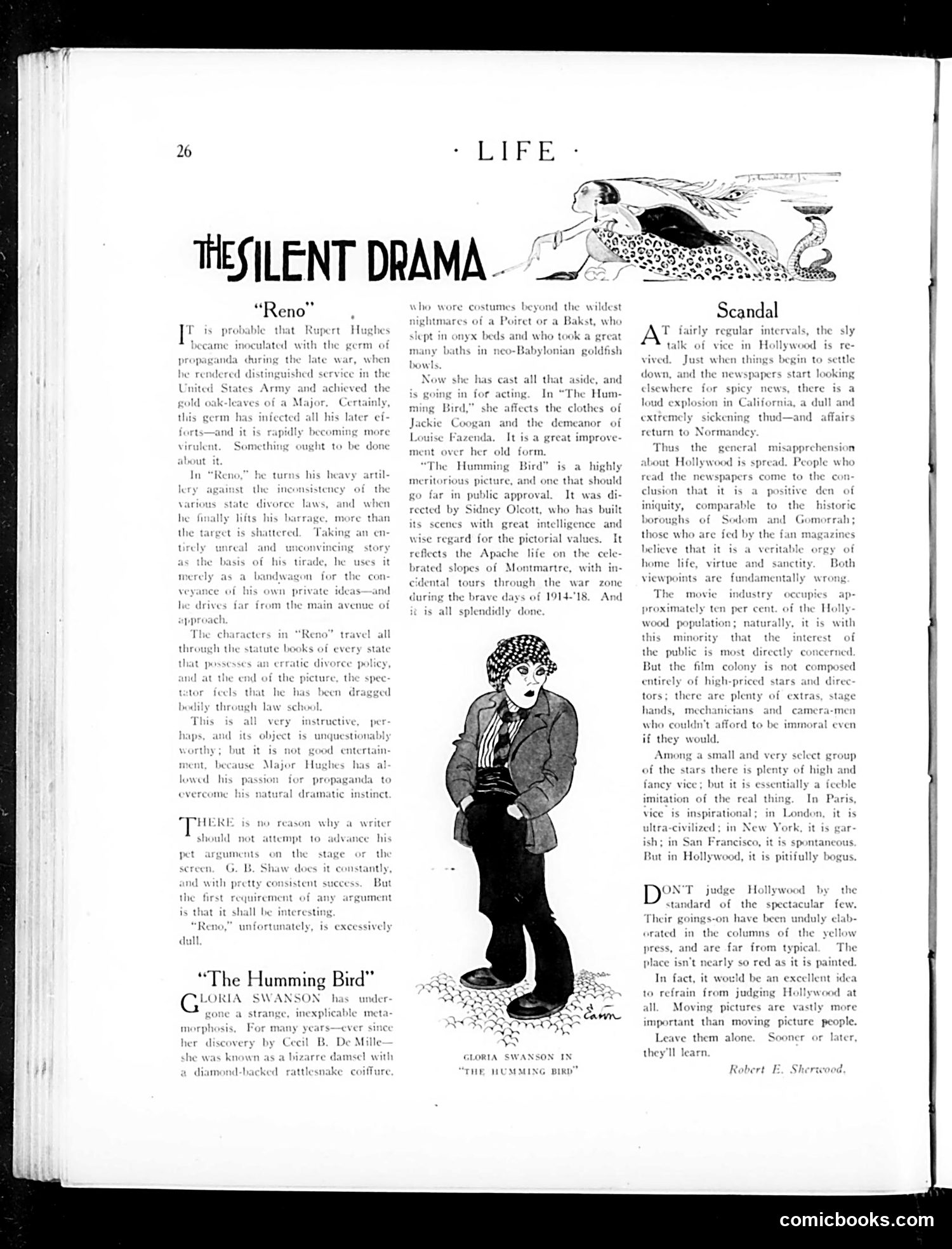
This page reviews two films: "Reno" (starring Rupert Hughes) and "The Humming Bird" (starring Gloria Swanson). The illustration shows Swanson in a stylized pose—likely meant to capture her distinctive appearance, which the text notes included a "diamond-backed rattlesnake coiffure" (an unusual, exotic hairstyle). The broader satire targets Hollywood's reputation for scandal. The text discusses how gossip columns exaggerate misconduct among film stars, comparing these rumors to biblical depravity ("Sedom and Gomorrah"). The author argues that while some stars engage in vice, the film industry's workforce—extras, technicians, cameramen—are ordinary people who "couldn't afford to be immoral even if they would." The piece mocks yellow journalism's sensationalism while defending Hollywood's broader working population against moral panic. It's essentially arguing: don't judge the entire industry by a few notorious stars' behavior.
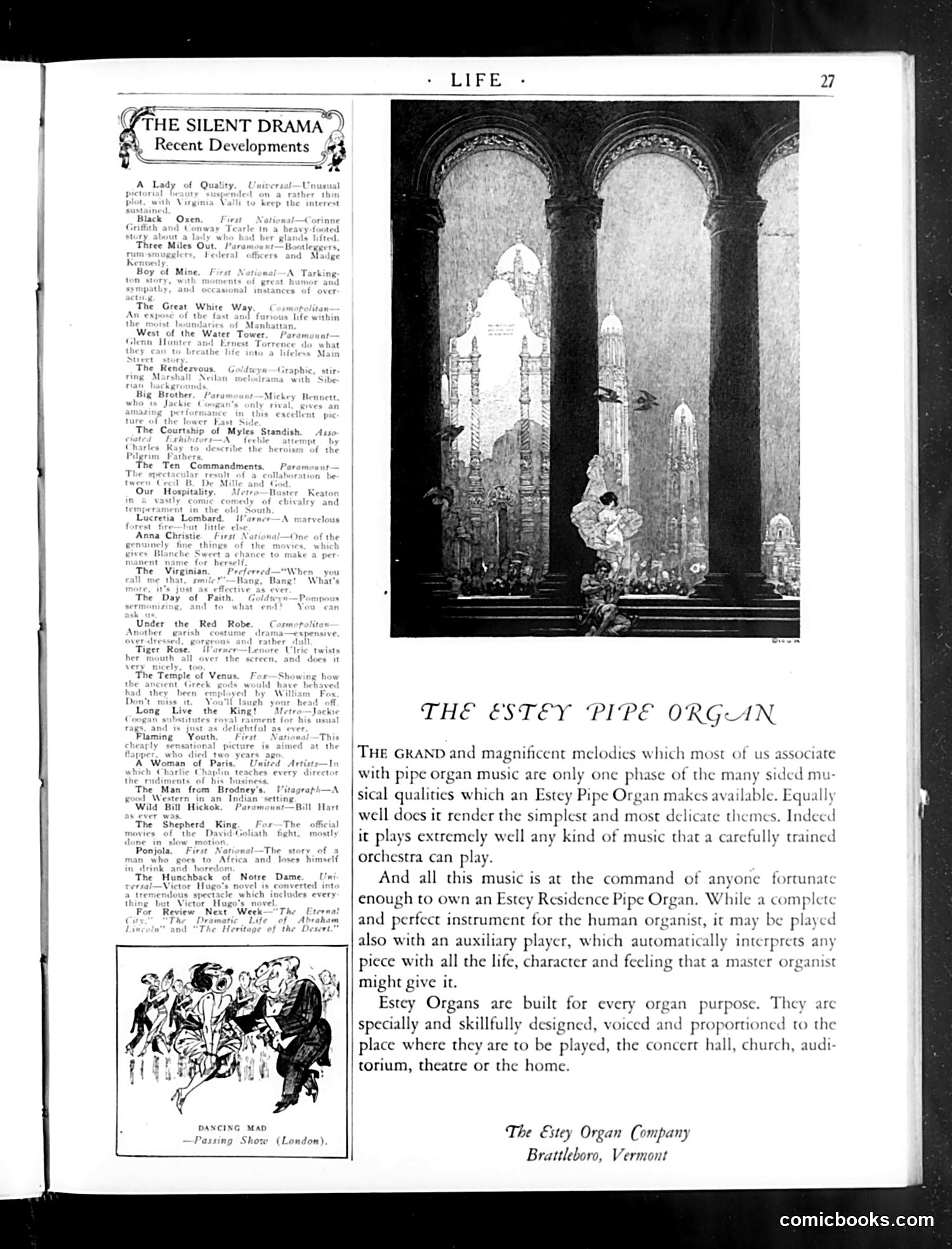
This page combines a film review section with a full-page advertisement. The left column lists recent movie releases—typical silent films of the era with their studios and brief descriptions. Notable titles include *The Ten Commandments* (Cecil B. DeMille), *Our Hospitality* (Buster Keaton), and *A Woman of Paris* (Charlie Chaplin). The small cartoon labeled "Dancing Mad" (credited to *Passing Show*, London) shows a group of people dancing wildly—likely satirizing the 1920s jazz age and the moral panic around flapper culture and modern dancing, which conservatives viewed as scandalous. The large image above shows an ornate interior (possibly a cathedral or concert hall), accompanying an Estey Pipe Organ advertisement claiming the instrument can play any type of music an orchestra can produce. This represents typical luxury advertising for affluent homes during the Roaring Twenties.
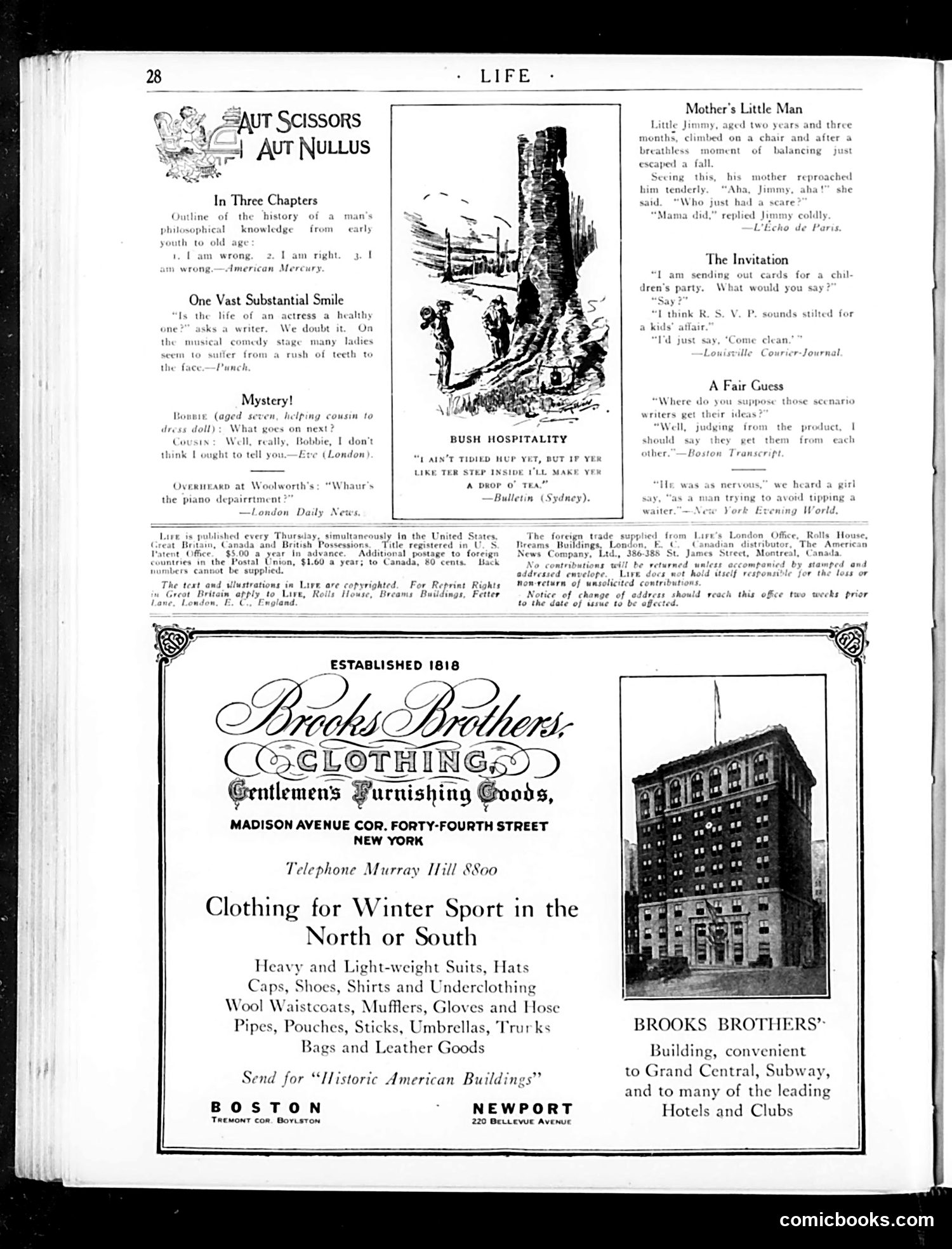
This page from *Life* magazine contains **multiple short humorous anecdotes** rather than a single cartoon. The jokes satirize human nature and social conventions: **"Mother's Little Man"** — A child named Jimmy, caught balanced on a chair, blames his mother for "having a scare," reversing responsibility with childish logic. **"The Invitation"** — Humor about R.S.V.P. (the French acronym for formal response requests), with a child misinterpreting it as something "sifted for kids." **"Bush Hospitality"** — An Australian colloquialism joke where someone offers tea in a rustic setting, presented as charming frontier friendliness. **"Mystery"** and other brief items employ similar light domestic humor. The page is primarily **advertising** for Brooks Brothers clothing, occupying the lower half with their New York and Boston locations prominently featured. The overall tone is gentle, family-friendly satire on everyday social situations and miscommunications rather than political commentary.
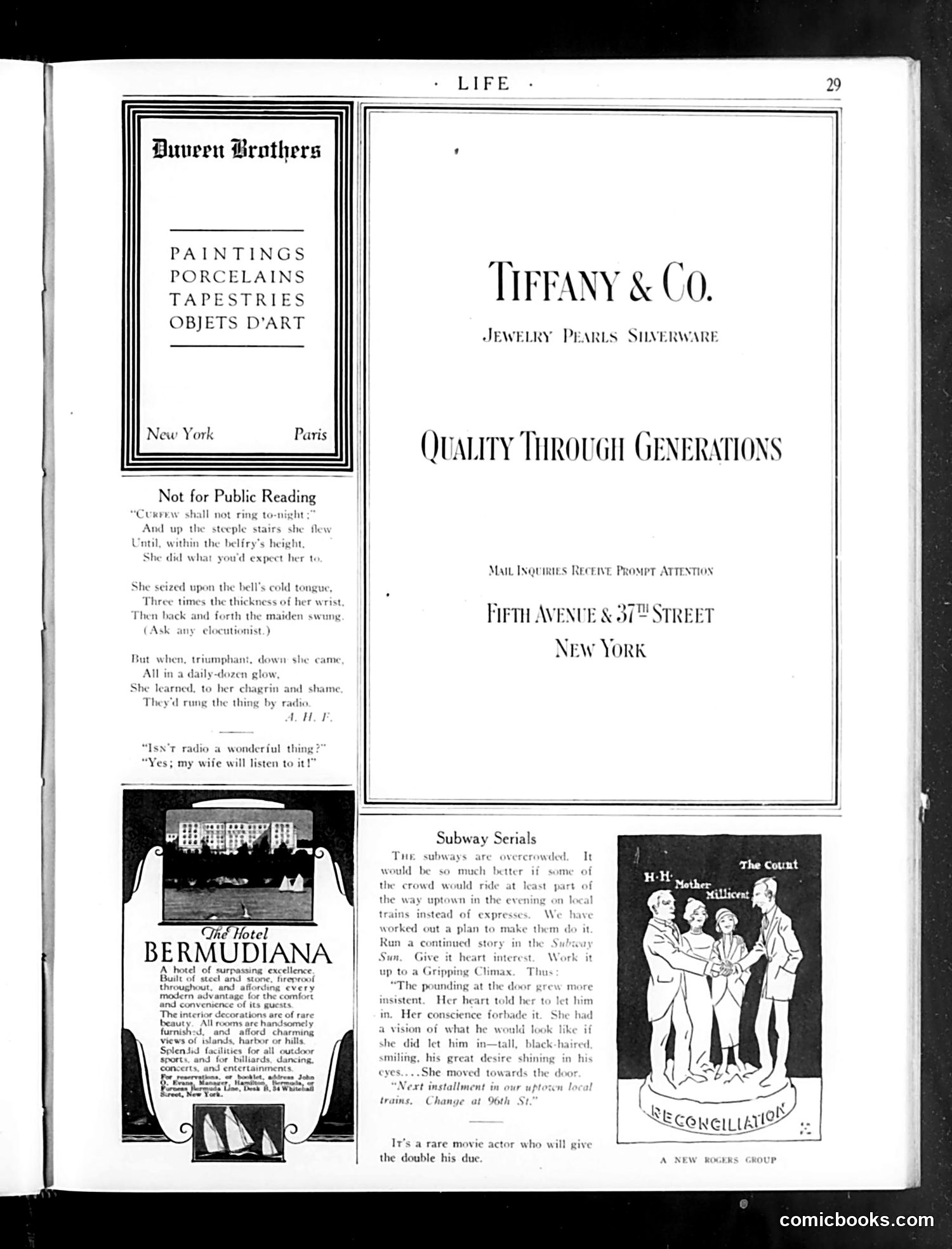
This page is primarily **advertising** for luxury brands (Dueen Brothers art dealers, Tiffany & Co., Hotel Bermudiana), with two pieces of satirical content: 1. **"Not for Public Reading"** — A humorous poem mocking overwrought dramatic recitations. It parodies the Victorian-era elocution piece "Curfew Shall Not Ring To-Night," replacing its earnest tragedy with absurdist humor (a woman literally rings a bell with her body). The joke satirizes dramatic oratory and melodrama. 2. **"Subway Serials"** — Satirizes serialized fiction in newspapers. It mocks both the overcrowded NYC subway system and the melodramatic plots of pulp fiction—suggesting serialized stories should run on trains instead to ease congestion. The accompanying illustration titled "Reconciliation" appears to be a Rogers Group (sentimental Victorian statuary) parody, ridiculing the saccharine emotionality of popular entertainment. The final line about movie actors giving their "double his due" is unclear without more context.
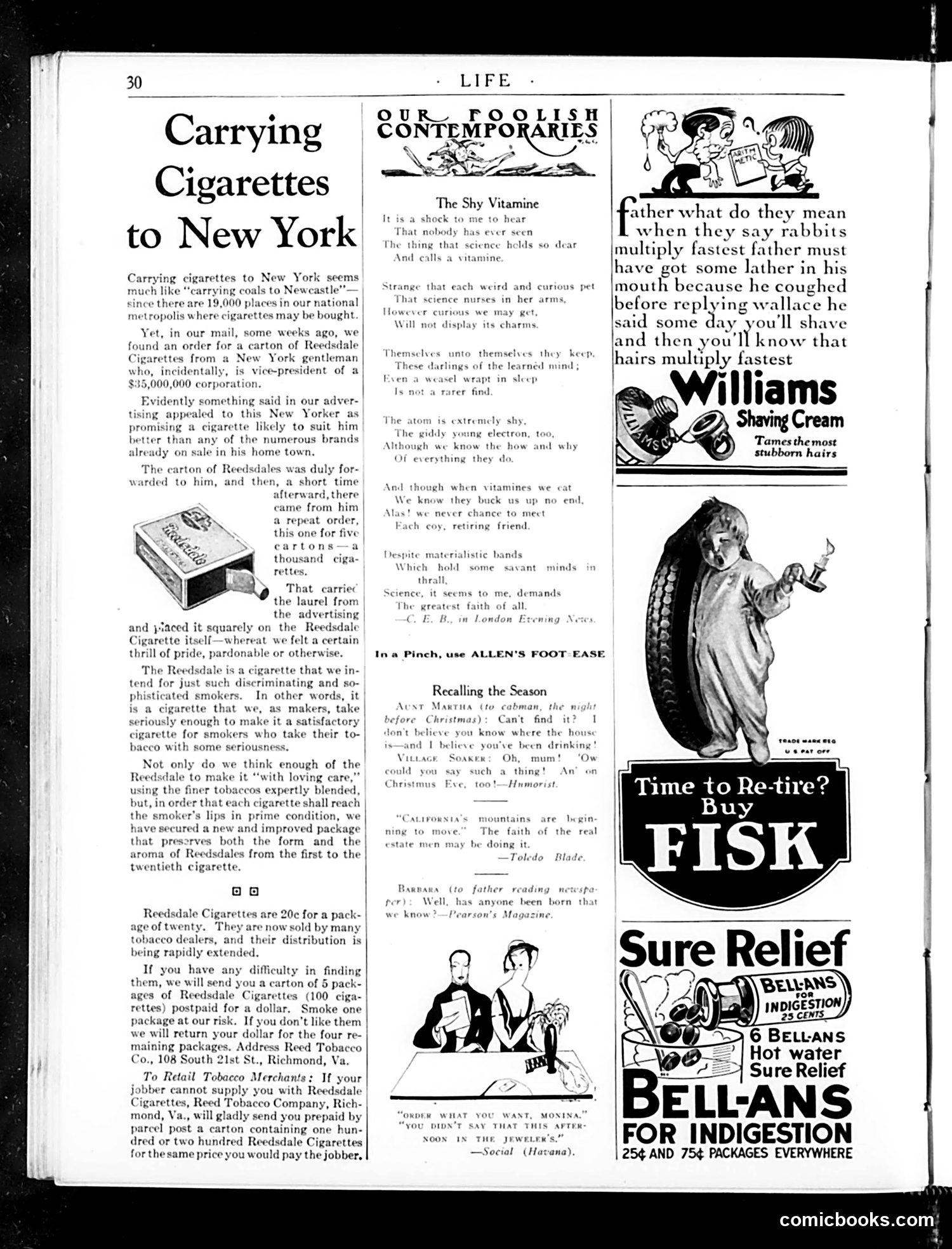
This page is primarily **advertising disguised as editorial content**, typical of early 20th-century magazines. The main feature, "Carrying Cigarettes to New York," is a promotional piece for Reedsdale Cigarettes framed as a humorous anecdote. It claims a satisfied New York customer repeatedly ordered their product—an ironic "coals to Newcastle" scenario suggesting the cigarettes were so good they sold even in cigarette-saturated New York. The appeal is to "discriminating" smokers valuing quality tobacco and improved packaging. The page also includes: - **"The Shy Vitamine"**: A whimsical poem mocking the public's fascination with newly-discovered vitamins (1920s health trend) - **"Recalling the Season"**: Humorous holiday anecdotes - **Advertisements**: Williams Shaving Cream, Allen's Foot Ease, Fisk tires, and Bellans indigestion remedy The cartoon showing rabbits multiplying is a visual pun for the shaving cream's claim to prevent stubborn hair regrowth. The overall page reflects 1920s consumer culture and advertising strategies.
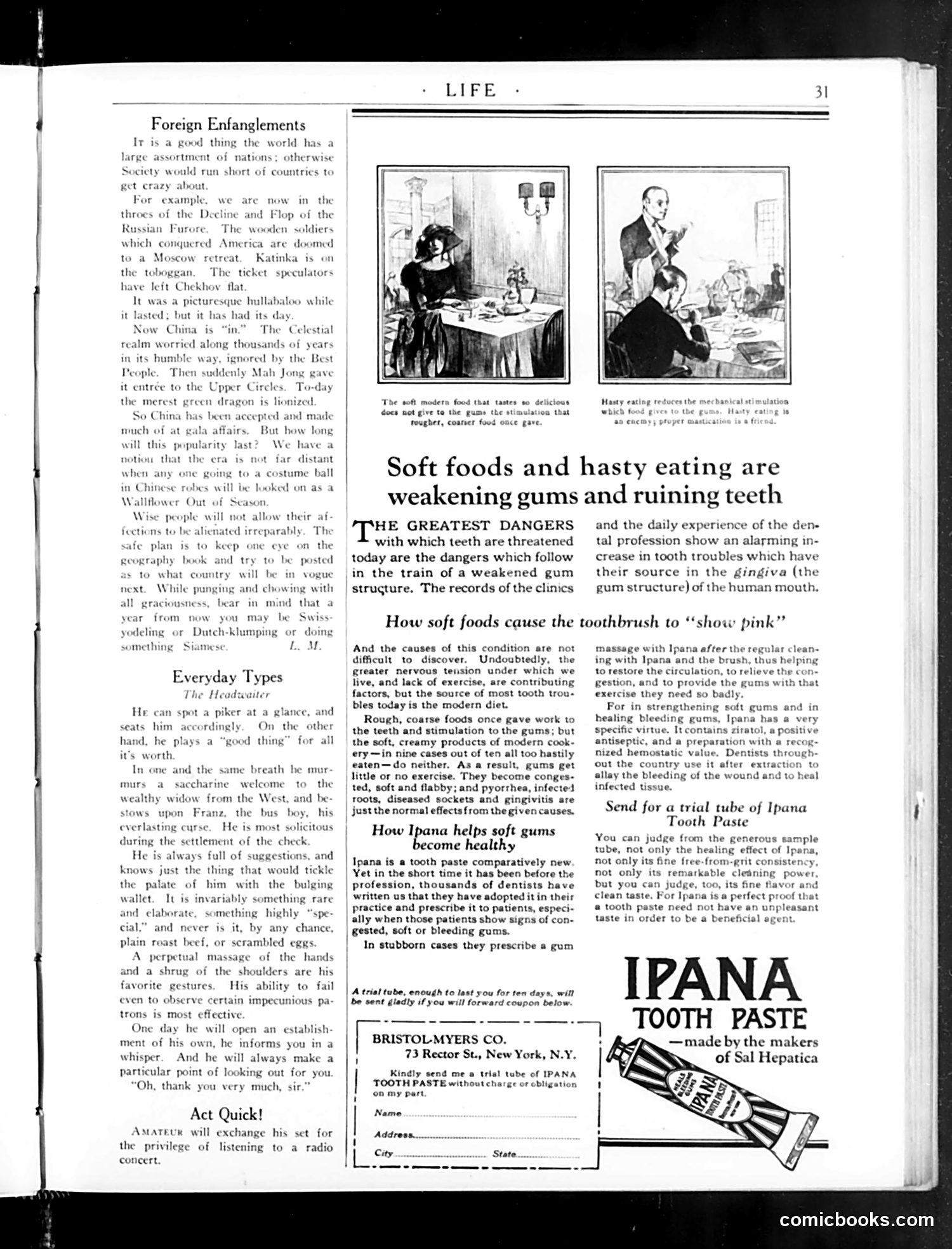
This page combines political commentary with a dental product advertisement, typical of Life's satirical format. ## "Foreign Entanglements" Section The opening essay mocks America's fickle attention to international affairs. It references the "Decline and Flop of the Russian Furore" (likely the Russian Revolution aftermath), noting how American high society briefly obsesses over whatever is fashionable—first Russia, now China ("Mah Jong gave it entrée to the Upper Circles"). The satire suggests that geopolitical interest is superficial and trends rapidly shift, comparing nations to social fads. The cartoons illustrate this fickleness: one shows someone absorbed in foreign intrigue; the other depicts hasty eating at a restaurant, visually connecting mindless consumption habits to mindless political engagement. ## Advertising Section The majority advertises **Ipana Tooth Paste**, marketed by Bristol-Myers. The copy connects soft modern foods to dental decay, claiming rough foods historically exercised gums. Ipana promises to heal weakened gums—a contemporary health concern. The coupon invites trial use. The juxtaposition suggests: just as Americans superficially adopt foreign trends, they've adopted unhealthy modern eating habits, requiring commercial solutions.
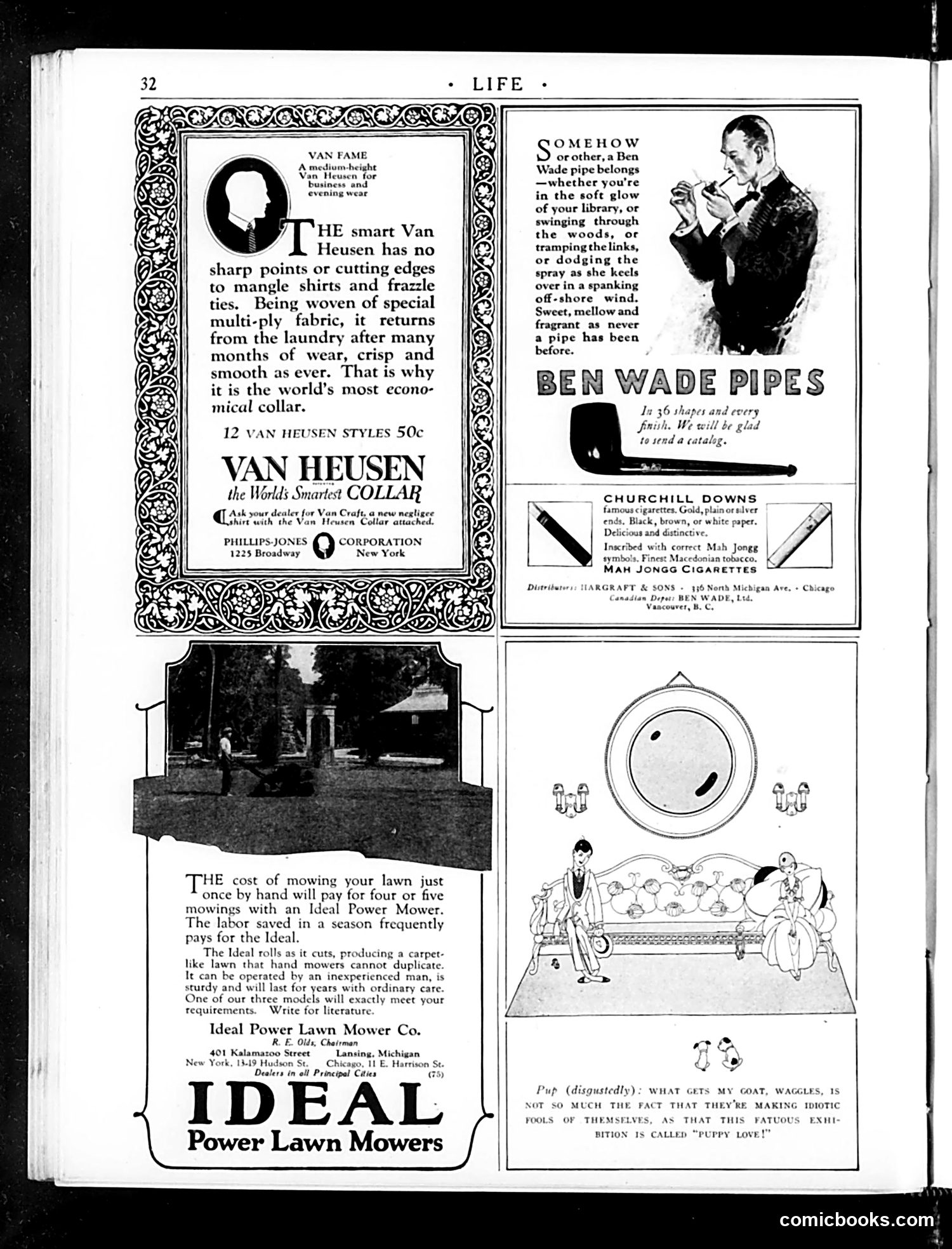
This page is primarily **advertising**, featuring products typical of the 1920s era: Van Heusen collars, Ben Wade pipes, Churchill Downs cigarettes, Mah Jongg cigarettes, and Ideal Power Lawn Mowers. The only cartoon content appears at bottom right: a small comic titled "Pup" showing a dog complaining to another animal (Waggles) about a "Puppy Love" exhibition. The joke is a simple pun—the dog is annoyed that humans are mocking young love by calling it "puppy love," finding the term insulting and foolish. The page reflects 1920s consumer culture and leisure interests (lawn care, smoking, formal wear). The cartoon's humor relies on basic anthropomorphization and wordplay rather than political or social satire. Nothing on this page requires specialized historical context beyond understanding period consumer goods and simple animal-based humor conventions.
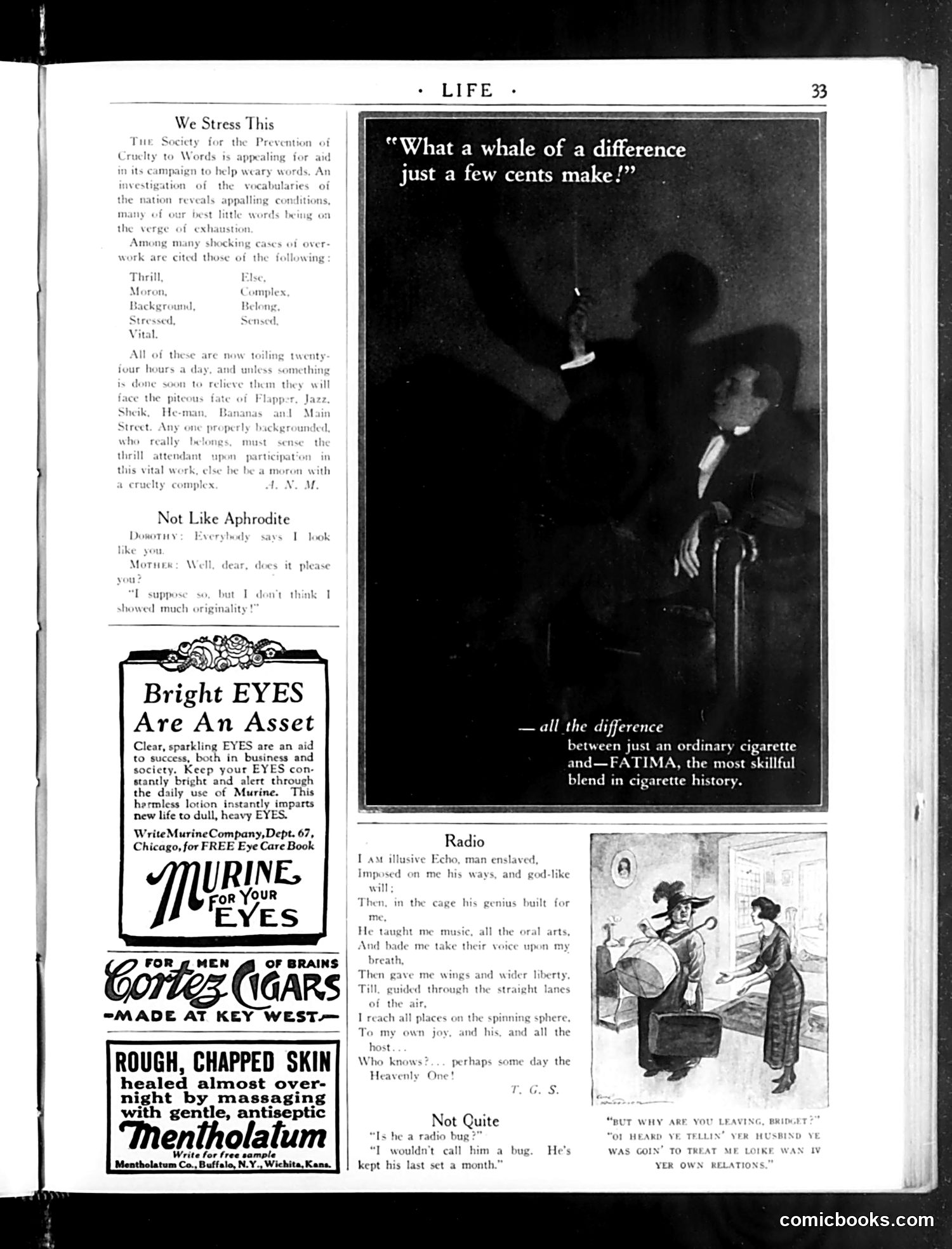
This page is predominantly **advertising**, with minor satirical content. The main advertisements promote consumer products: Murine eye lotion, Cortes cigars, and Mentholalum skin treatment—typical early-20th-century patent medicines and goods. The largest ad features a **Fatima cigarette advertisement** with a dramatic photograph of a woman, using the sales pitch that small price differences yield major quality improvements—a common advertising strategy of the era. The small satirical pieces are brief dialogue jokes: - "Not Like Aphrodite" mocks a woman's lack of originality - "Not Quite" plays on the term "radio bug" (an enthusiast), joking that someone isn't truly devoted if they couldn't keep one radio set working a month - "Radio" is a sentimental poem about radio's cultural power These modest jokes reflect Life's traditional satirical format, though this page emphasizes commercial content over social commentary.
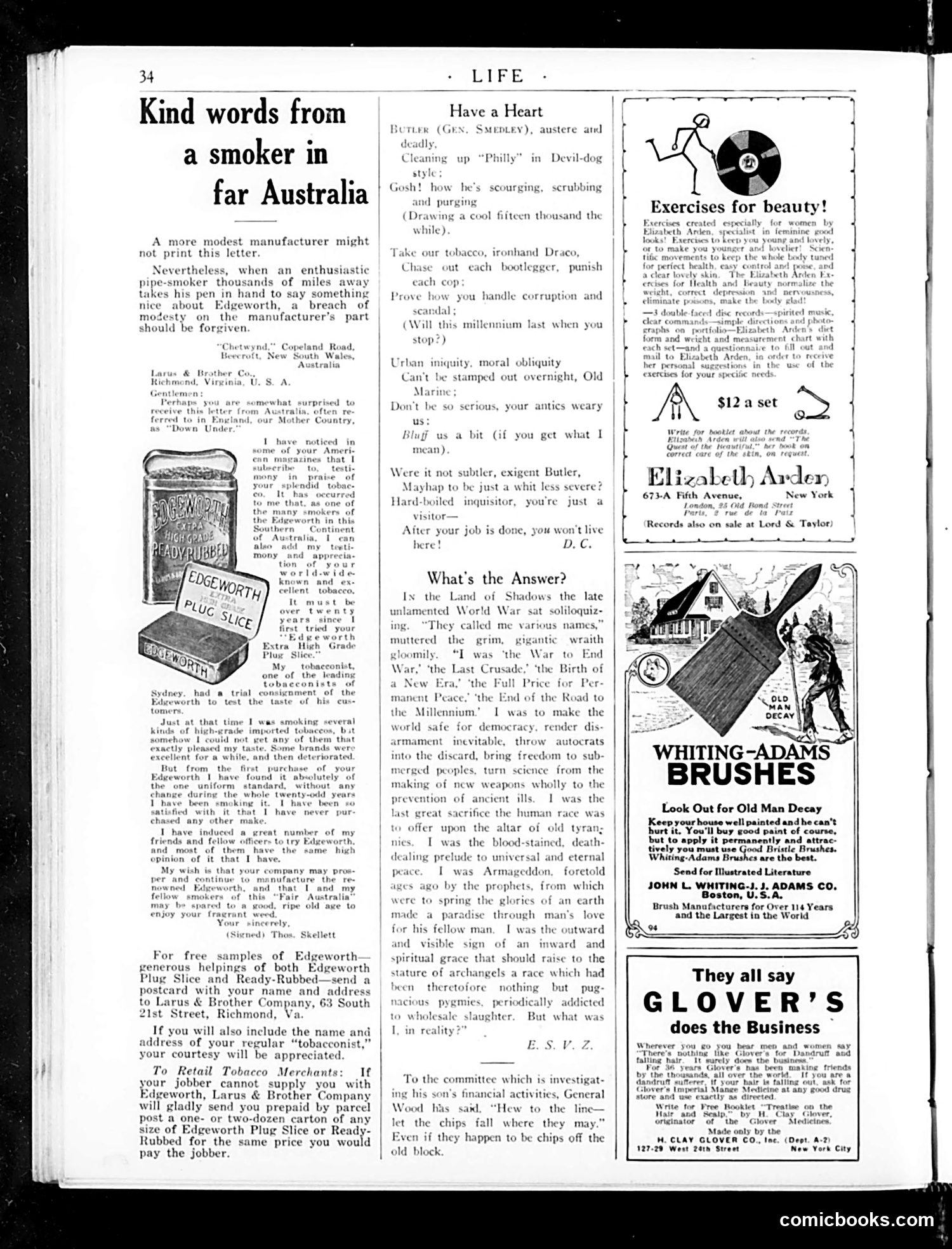
This page contains multiple satirical pieces and advertisements typical of Life's format: **Main Article**: "Kind words from a smoker in far Australia" is a humorous letter praising Edgeworth pipe tobacco. The writer, a distant Australian smoker, offers mock-serious "advice" to American society—urging elimination of corruption, bootleggers, and moral decay in comedic, exaggerated terms. The satire lies in presenting tobacco advertisements as genuine social commentary. **"What's the Answer?"**: A longer piece appears to be a post-WWI reflection, with someone (likely representing the war itself or a military figure) describing their purpose and ultimate failure. It's a cynical meditation on how the "War to End All Wars" failed to deliver promised peace and transformation. **Advertisements**: Elizabeth Arden beauty exercises and Whiting-Adams brushes fill the remaining space—standard period advertising. The overall tone reflects 1920s-era American skepticism about post-war promises and uses humor to address social problems like Prohibition-era corruption.
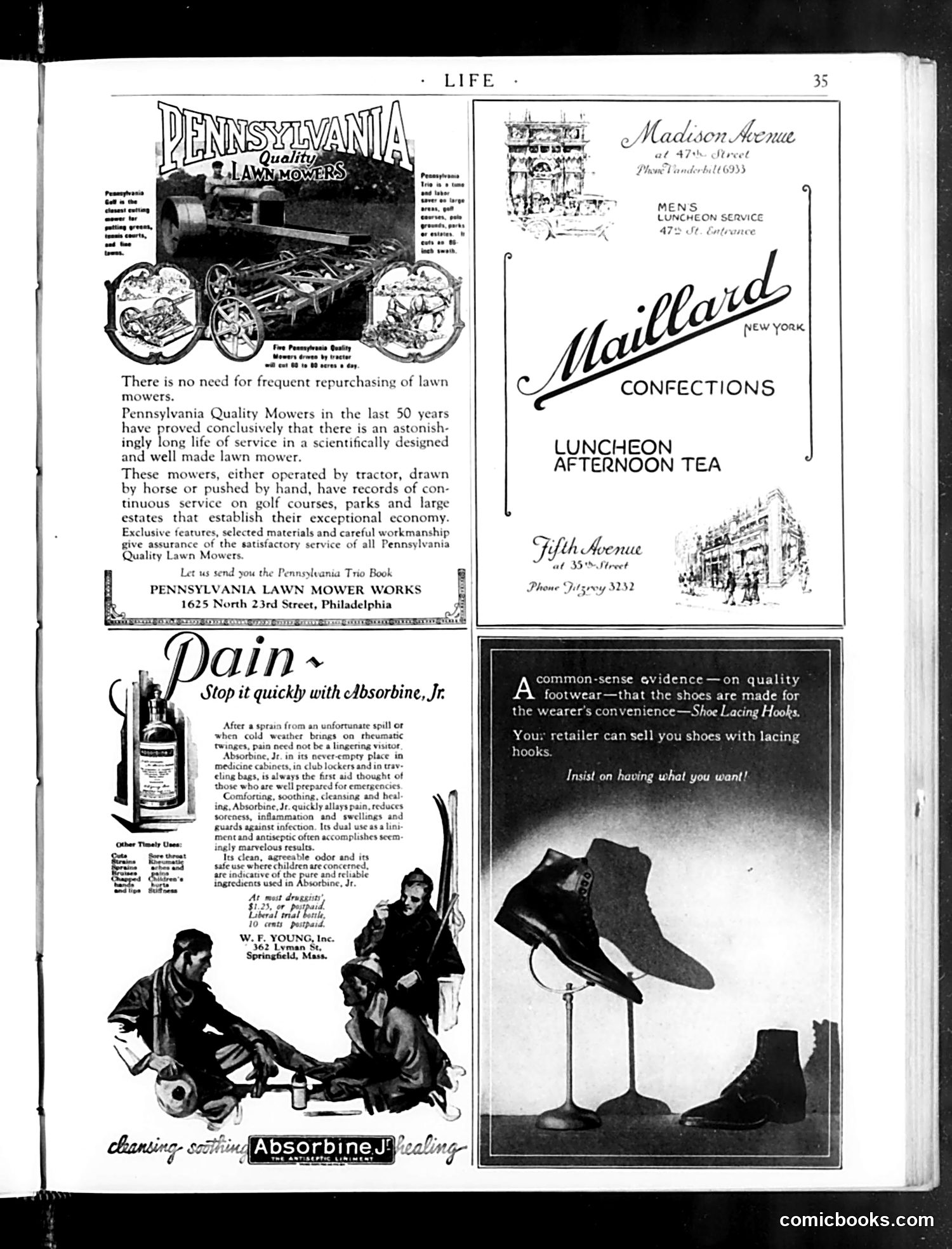
This is primarily an **advertising page** from Life magazine (appears to be early 20th century based on style). There is no political cartoon or satire. The page contains four advertisements: 1. **Pennsylvania Lawn Mower Works** — promotes durable mowers for estates and golf courses, emphasizing long service life 2. **Absorbine, Jr.** — a medicinal liniment/antiseptic for sprains, rheumatism, and infection (shows figures treating an injury) 3. **Mailard Confections** and **Madison Avenue/Fifth Avenue establishments** — New York dining venues advertising luncheon and afternoon tea services 4. **Shoe Lacing Hooks** — advocates for shoes with improved lacing mechanisms, urging consumers to "insist on having what you want" The page reflects early-20th-century consumer culture and product marketing. The Absorbine ad and shoe hook ad include mild persuasive messaging about quality and consumer choice, but no political or satirical content is present. This appears to be a straightforward commercial advertising section rather than editorial content.
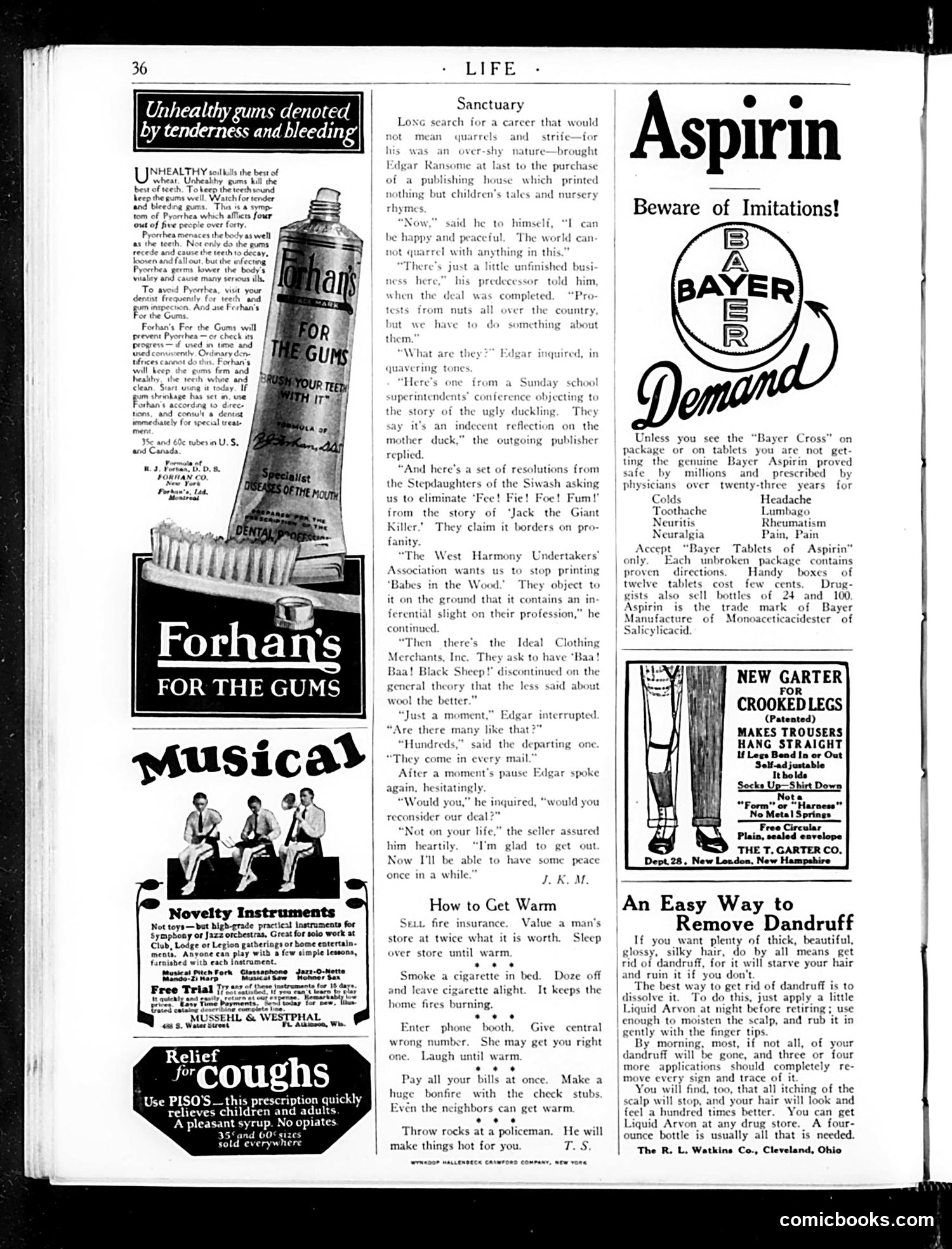
This page is primarily **advertisements and filler content**, with one substantial satirical article titled "Sanctuary." ## "Sanctuary" Article A humorous short story about Edgar Long, who purchases a children's publishing house seeking peaceful work away from commercial strife. The satire lies in the absurd complaints he immediately receives from various groups objecting to classic fairy tales: Sunday school superintendents object to "The Ugly Duckling" as demeaning; the "Stepdaughters of Siwash" want to eliminate "Fee Fi Fo Fum" from "Jack the Giant Killer" as profane; undertakers object to "Babes in the Wood" as insulting their profession; and clothiers want "Baa Baa Black Sheep" discontinued. The joke: even children's literature cannot escape social complaints and manufactured outrage. The seller gleefully exits, leaving Edgar disillusioned. ## Advertisements The rest comprises typical 1920s ads: Forhans toothpaste, novelty musical instruments, Piso's cough syrup, Bayer Aspirin (warning against counterfeits), and Carter's garter for crooked legs—reflecting period consumer concerns and available products.
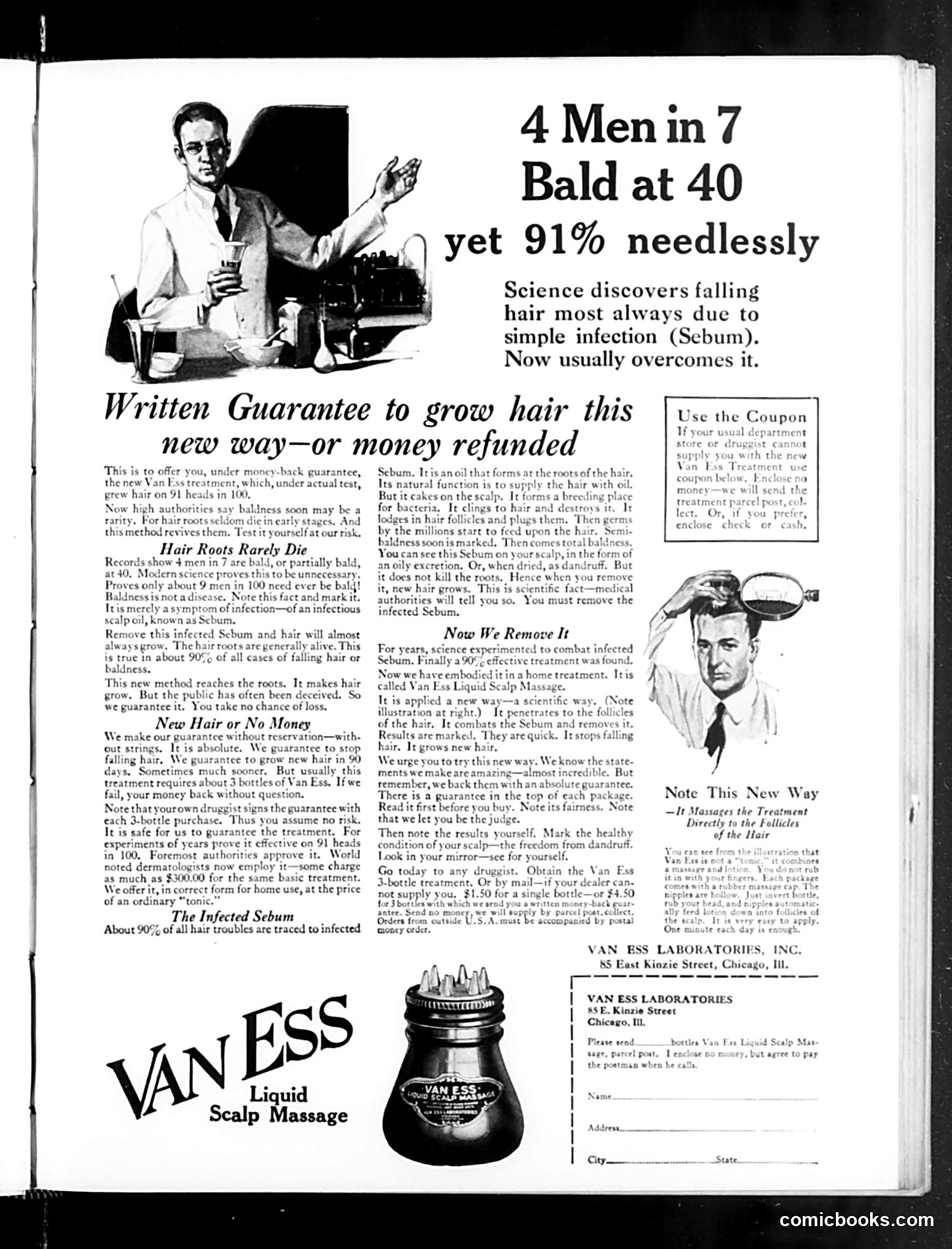
This is primarily a **patent medicine advertisement**, not satire or cartoon content. It's a full-page ad for "Van Ess Liquid Scalp Massage," a hair-loss treatment marketed with pseudo-scientific claims typical of early 20th-century quack medicine. **Key claims made:** - Baldness is caused by "infected Sebum" (scalp infection) - The product removes this infection and regrows hair - Guarantees new hair in 90 days or money back - Claims dermatologists charge $300 for the same treatment **The "satire" (if any) is unintentional:** The ad uses exaggerated statistics ("4 men in 7 bald at 40," "91% needlessly" bald) and invokes fake scientific authority to sell an ineffective product—exactly the kind of false advertising that would later be regulated. Modern readers would recognize this as a classic example of **snake oil marketing**, exploiting male insecurity about hair loss with dubious remedies and money-back guarantees designed to seem trustworthy.
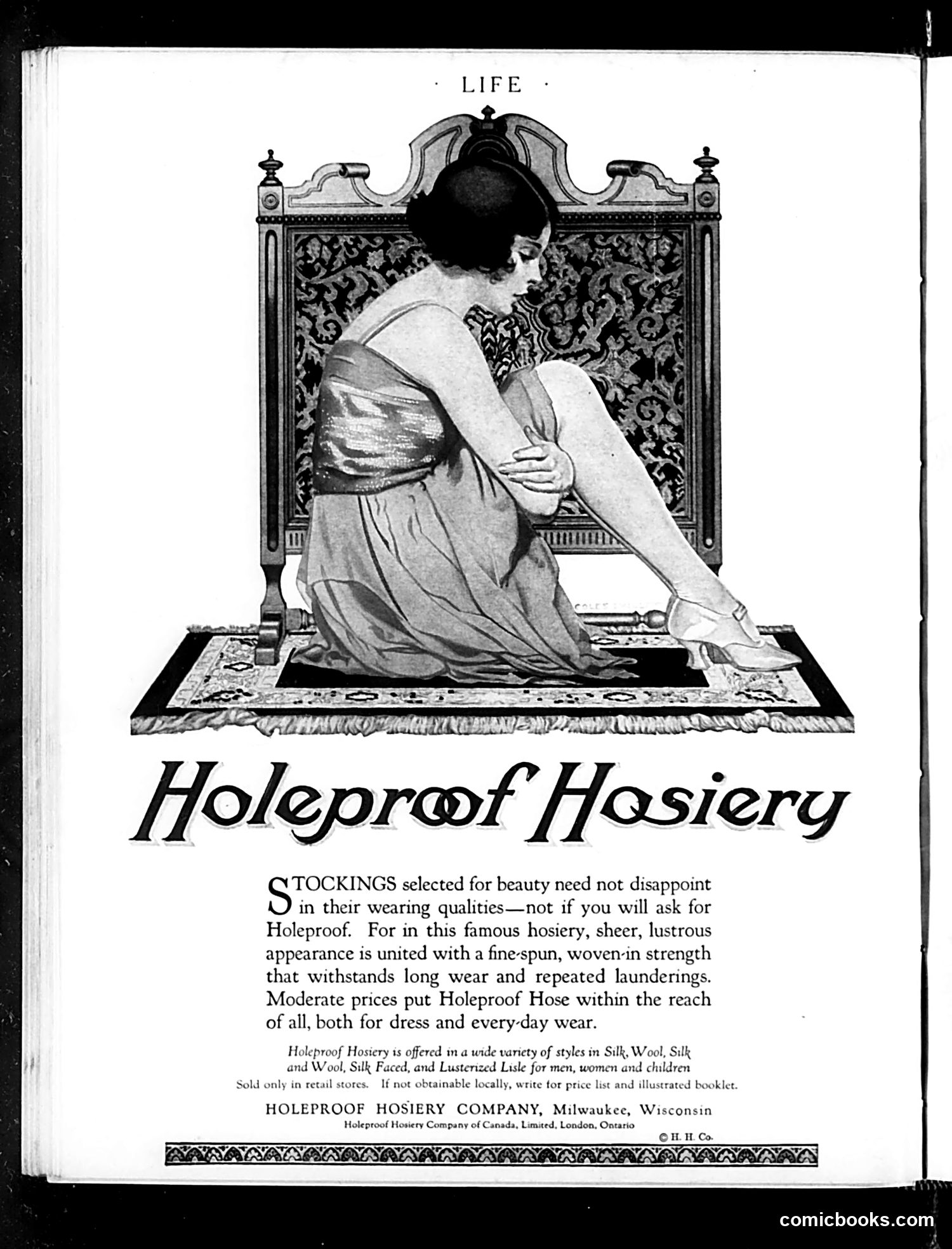
This is a **full-page advertisement**, not satire or political commentary. It promotes Holeproof brand stockings/hosiery, featuring an elegant woman in classical dress, posed before an ornate mirror. The ad's appeal is straightforward: women want attractive stockings that also wear durably through repeated use and washing. The "classical" styling—the woman's pose, the decorated frame, the "LIFE" masthead—lends sophistication to a mundane product. The sales pitch emphasizes that beauty and practicality aren't contradictory: Holeproof offers "sheer, lustrous appearance" combined with "woven-in strength." The moderate pricing claim suggests accessibility across economic classes. This represents typical early 20th-century consumer advertising in *Life* magazine, targeting middle-class women concerned with both appearance and household economy.