
Life, 1924-02-07 · page 16 of 40
Life — February 7, 1924 — page 16: what you’re looking at
What you’re looking at
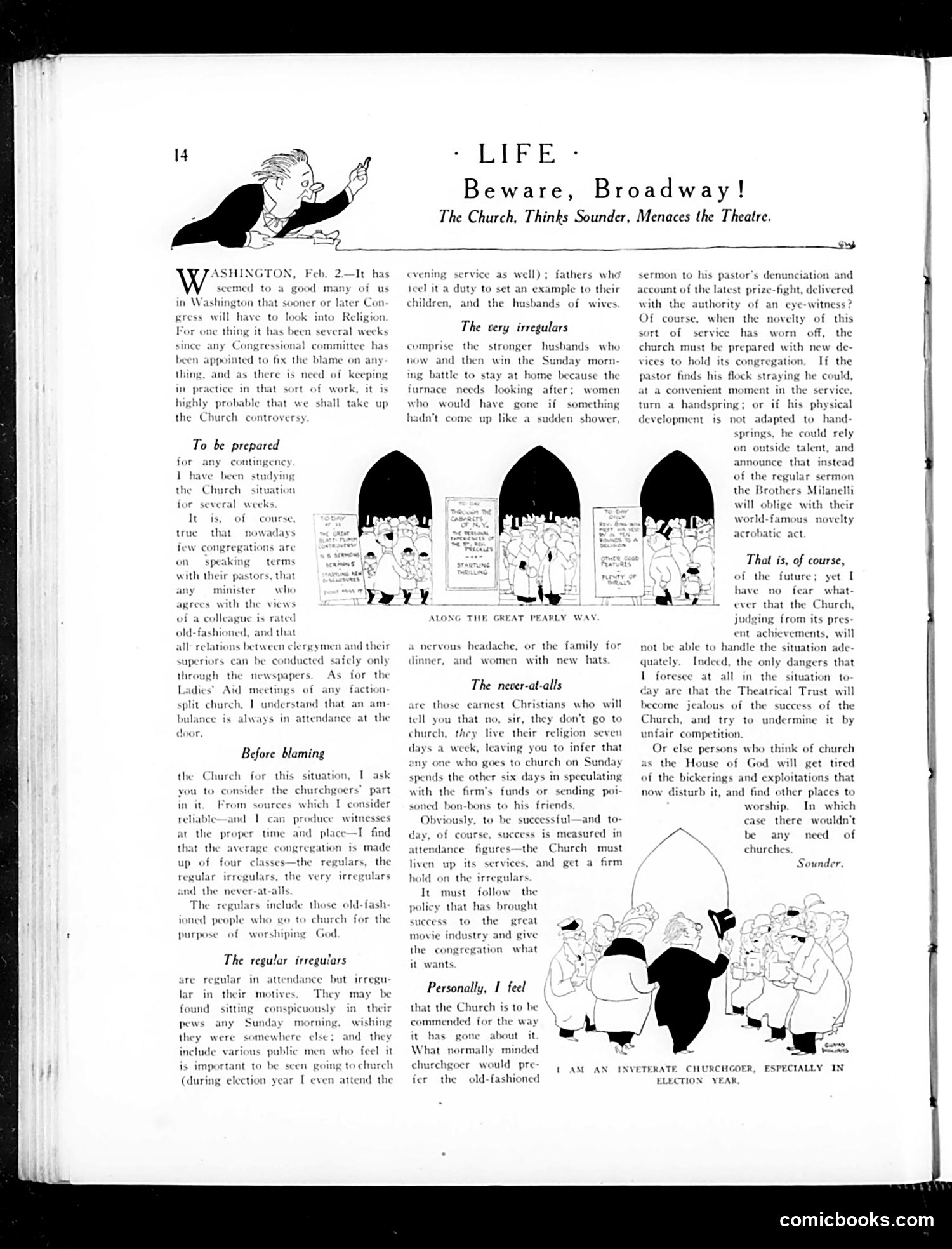
This satirical piece criticizes religious leaders' efforts to reform Broadway entertainment. The author argues that while the Church seeks to regulate theatrical content, it risks losing congregants—particularly "regulars" (faithful attendees) and "irregulars" (occasional churchgoers). The three illustrated arches labeled "Along the Great Pearly Way" depict churchgoers in a sanctuary setting, contrasting with the bottom cartoon showing congregation members departing, labeled "I am an Inveterate Churchgoer, Especially in Election Year." The satire's point: churches attempting to police Broadway may alienate their own members, who enjoy theatrical entertainment. The author warns that moral policing could backfire, pushing congregants away from church entirely—an ironic loss given the Church's stated goals.
📄 Transcribed text from this page (OCR, searchable)
Machine-transcribed from the original scan — historical spelling and the odd misread are preserved.
LIFE + Beware, Broadway! The Church, Thinks Sounder, Menaces the Theatre. ASHINGTON, Feb. 2—It has seemed to a good many of us in Washi n that sooner or later Con gress will have to look into Reli For one thi has been several weeks since any Congressi committee has Leen appointed to fix the blame on any thing, and as there is need of keeping t of work, it is in practice in that highly probable that we shall take up the Church controversy To be prepared for a y contingency I have been studying the Church situation for several weeks. It is, of course true that nowadays few congregations are on Speaking — terms : with their pastors, that any — minister who rees with the views of a colleague is rated old-fashioned, and that all relations between clergymen and th superiors can be conducted safely only through the newspapers. As for the Ladies’ Aid meetings of any factic split church, I understand that an am bulance is always in attendance at the Before blaming the Church for this situation, [I ask 4 to consider the chure oers’ part rees which | consider and 1 can produce witnesses proper time and place—I find that the average congregation is made rs, the very irregulars up of four classes—the regul regular irregulars, t and the never-at-alls The regulars include those old-fash: church for the God. ioned people who eo t purpose of worshiping The regular irregutars are re jar in attendance irregu- ir motives. They may be found sitting conspicuously lar in their wishing pews any Sunday morn they were somewhere else and they include various public men who feel it is important to be seen going to church (during election year I even attend the evening service as well); fathers wh¢ cel it a duty to set an example to their Idren, and the husbands of wives. The very irregulars comprise the stronger husbands who now and then win the Sunday morn ing battle to stay at home because the furnace needs looking after; women who would have gone if something hadn't come up like a sudden shower. ALONG THE GREAT PEARLY WAY a nervous headache, or the family for linner, and women with new ha The never-at-alls are those earnest Christians who will tell you that no, sir, they don’t go to church, they live their religion seven days a week, leaving you to infer that any one who goes to church on Sunday spends the other six days in speculating with the firm's funds or sending poi soned bon-bons to his friends Obviously, to be successful—and_ to- success is measured in attendance figures—the Church must s services, and get a firm liven up It must follow the policy that has brought the irregulars. success to the great movie industry and give jon what the con, it wants. Personally, 1 feel that the Church is to he commended for the way it has gone about it What normally minded churchgoer would pre- ier the old-fashioned non to his pastor's denunciation account of the latest prize-fight, delivered with the authority of an eye-witness? Of course, when the novelty of this sort of service has worn off, the church must be prepared with new de- vices to hold its congregation, If the pastor finds his flock stra ig he could, at a convenient moment in the service, turn a handspring; or if his physical development is not adapted to hand- springs, he could rely n outside talent, and announce that instead of the re the Brothers Milanelli will oblige with their world-famous novelty jar sermon acrobatic act L That is, of course, | I “ of the future; yet a: x ari have no fear what- ever that the Church judging from its pres ent achievements, will not be able to handle the situatic Indecd, the only dangers that I foresee at all in the situs quately n to cay are that the Theatrical Trust will become jealous of the success of the Church, and try to undermine it by unfair competition. Or else persons who think of church as the House of God will get tired of the bickerings and exploitations that now disturb it, and find other places to worship. In which case there wouldn't fon be any need of y, churches. 1 AM AN INVETERATE CHURCHGOER, ESPECIALLY IN ELECTION YEAR _— — ) i comicbooks.com