
Life, 1924-02-07 · page 26 of 40
Life — February 7, 1924 — page 26: what you’re looking at
What you’re looking at
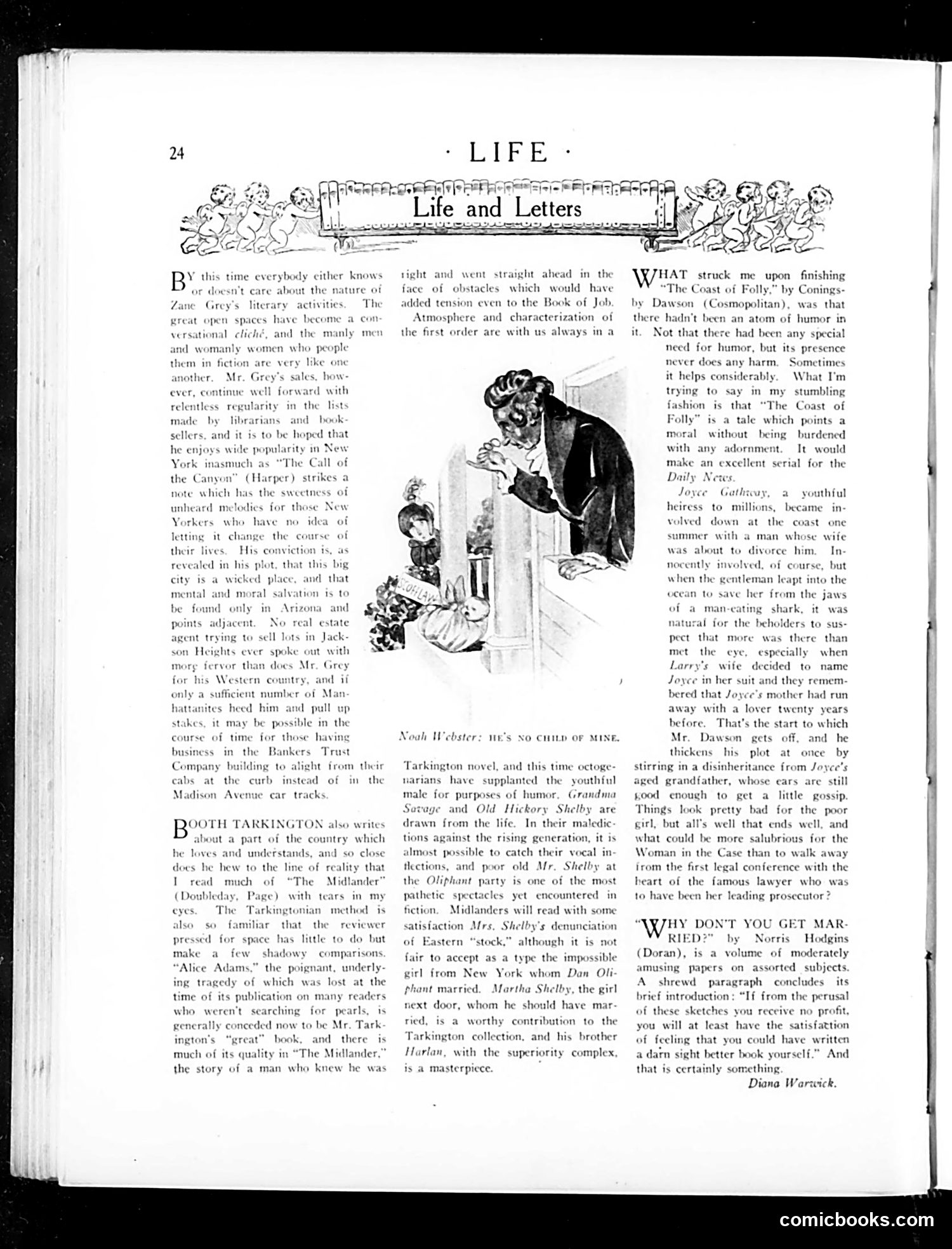
This page reviews three contemporary American novels (circa 1920s), focusing on works by **Zane Grey**, **Booth Tarkington**, and an unnamed author of "The Coast of Folly" by Comingsby Dawson. The accompanying illustration depicts a domestic scene: a man leans toward a woman at a window or doorway while a child watches below—likely illustrating a plot point from one of the reviewed novels. **The satire targets**: Grey's romanticization of the American West as a moral corrective for corrupt Eastern city-dwellers; Tarkington's use of elderly characters (Grandma, Old Mr. Shelby) as vehicles for generational critique; and Dawson's melodramatic society romance featuring infidelity, divorce, and shark attacks. The reviewer's tone is gently mocking—praising these authors' commercial success while noting their reliance on predictable character types and contrived plots designed for mass appeal rather than literary substance. The critique reflects period literary snobbery about popular fiction.
📄 Transcribed text from this page (OCR, searchable)
Machine-transcribed from the original scan — historical spelling and the odd misread are preserved.
ease sont Qag sac Life and errs FrreGhesrr PaSeee ree BX this time everybody either knows about the nature of Zane Grey's literary activities. The At open spaces have become a con hé, and the manly m versational cli and womanly wom hem in fiet r. Mr ever, continue well Grey's sales. forward with ity in. the relentless regul by libr sellers, and ians and to be hoped that fairl mat he enjoys w Y s "The Call (Harper smui the Canyon ) strikes a note which has the sweetness of unheard melodies New Yorkers who | a of it chang © of ives. His ¢ revealed in his plot, that this big city is a wicked place, and that 1 moral salvation is mental a only rizona and estate agent trying to sell Tots in Jack- son Heights ever spoke out wi me rvor th does Mr. Grey s Western cour numbe adjacent try, and if i Man all up only a suffici hattanites heed him stakes it may be possible in the course of time for having bu: in. the ankers Trust Ce building ght from their cabs at the curb instead of in the Madison Avenue car tracks B‘ JOTH TARKINGTON also wr about a part of the country which k es and understands, and so close he hew to the line of reality th cad much of “The M 1 (Doubleday, Page) with tears in) my ner” eyes. The Tarkingtonian method is that the reviewer to do but pressed for space few fowy comparisons. ms,” the poignant, underly- tragedy of which was lost at the time of its publication on many readers who weren't searching for pearls, is rally conceded now to be Mr. Tark ington’s reat nok, and there is much of its quality The Midlander the story of a man who knew he was went straight ahead in the tacles would have mn even to the Book of Job. right face of ob which added ten: Atmosphere the first order are with us always in a and characterization of Noah Webster: We's No City OF MINE. ‘Tarking! narians have mn novel, and this time octoge- supplanted the youthful ior purposes of humor. Grandma and Old Hickory Shelby are drawn from the life. In their maledic tions against the rising generation, it is almost possible to catch their vocal in old Mr. Shelby at the Oliphant party is one of the most tlections, and poc pathetic spectacles yet encountered. in n. Midlanders will read with some b isiaction Mrs, Sh “stock, fair to accept as a type the impossible York whom Dan Oli Martha Shelby, the girl y's denunciation of Eastern although it is not girl from New phant married id have mar next door, whom he sh ried, is worthy contribution to the Tarkington collection, and his brother Harlan is a masterpiece. with the superiority complex, HAT by Dawson struck he Coast of Folly,” by Conir (Cosmopolitan), wa there hadn't been ar it me upon finishing that n atom of humor in Not that there had been any special need for humor, but its presence never does any harm it helps conside heiress Ived noc rr ummer wit trying to say fashion is that Folly” is t moral withot with any adc Gat to millions, de was about to div ntly ocean to save man-es 1 for the beh pect that m met the cy wife say in my Sometimes ably. What I'm stumbling ‘The Coast of ale which points a ut being burdened ommment. It would an excellent serial for the Ne Inwuy, a youthful became in at the coast one a man whose wife eo him. In Ived, of course, but when the gentleman leapt into the her from the jaws ting shark it was Jers to sus- was there than c, especially when decided to name Joyce in her suit and they remem bered that Joyce's mother had run away with a lover twenty years before That's the start te Mr. Dawson gets thickens his stirring in a disinhe aged grandfather, w kood Things look enough to get a pretty which and he by e's plot at ance from Ji ¢ ears are still little gossip. bad for the poor girl, but all's well that ends well, and what could be more salubrious for the Woman in the Case than to walk away from the first legal conference with the heart of the famous lawyer who was to have been her leading prosecutor? “ HY DON RIED? (Doran), is by a vol am YOU GET MAR Norris Hodgins of moderately amusing papers on assorted subjects. A. shrewd para brief introduction of these sketches you receive no you will at least have the raph concludes _ its “If from the perusal tisfattion of feeling that you could have written ac that is certa’ ly some mm sight better book yourself.” And hing. Diana Warwick. = tet comicbooks.com