
A complete issue · 36 pages · 1923
Life — December 13, 1923
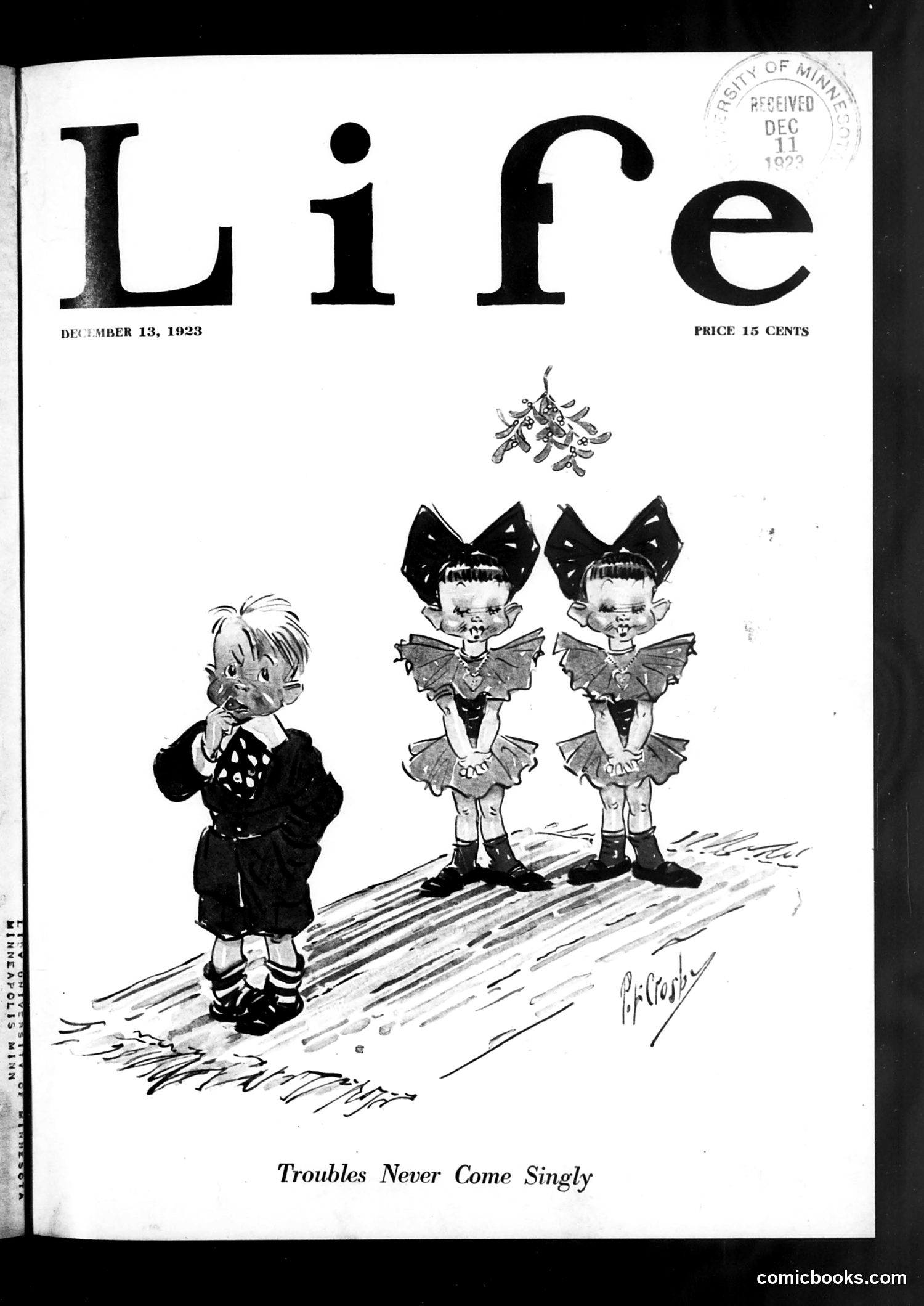
**The Cartoon:** The illustration depicts a child on the left observing two identical fairy or elf-like figures with large bows, labeled "Troubles Never Come Singly." The mistletoe hung above reinforces the Christmas holiday context. **The Satire:** The visual pun plays on the common expression that troubles arrive in pairs or multiples—here literalized by showing two identical troublemakers appearing simultaneously. The Christmas setting suggests holiday-season anxieties: financial worries during festive spending, family obligations, or domestic complications intensifying during winter celebrations. **For Modern Readers:** This satirizes the relatable human experience of compounding problems, especially acute during expensive holiday periods. The twee illustration style and somewhat grim humor reflect 1920s sensibilities about holiday stress—concerns that remain surprisingly timeless.
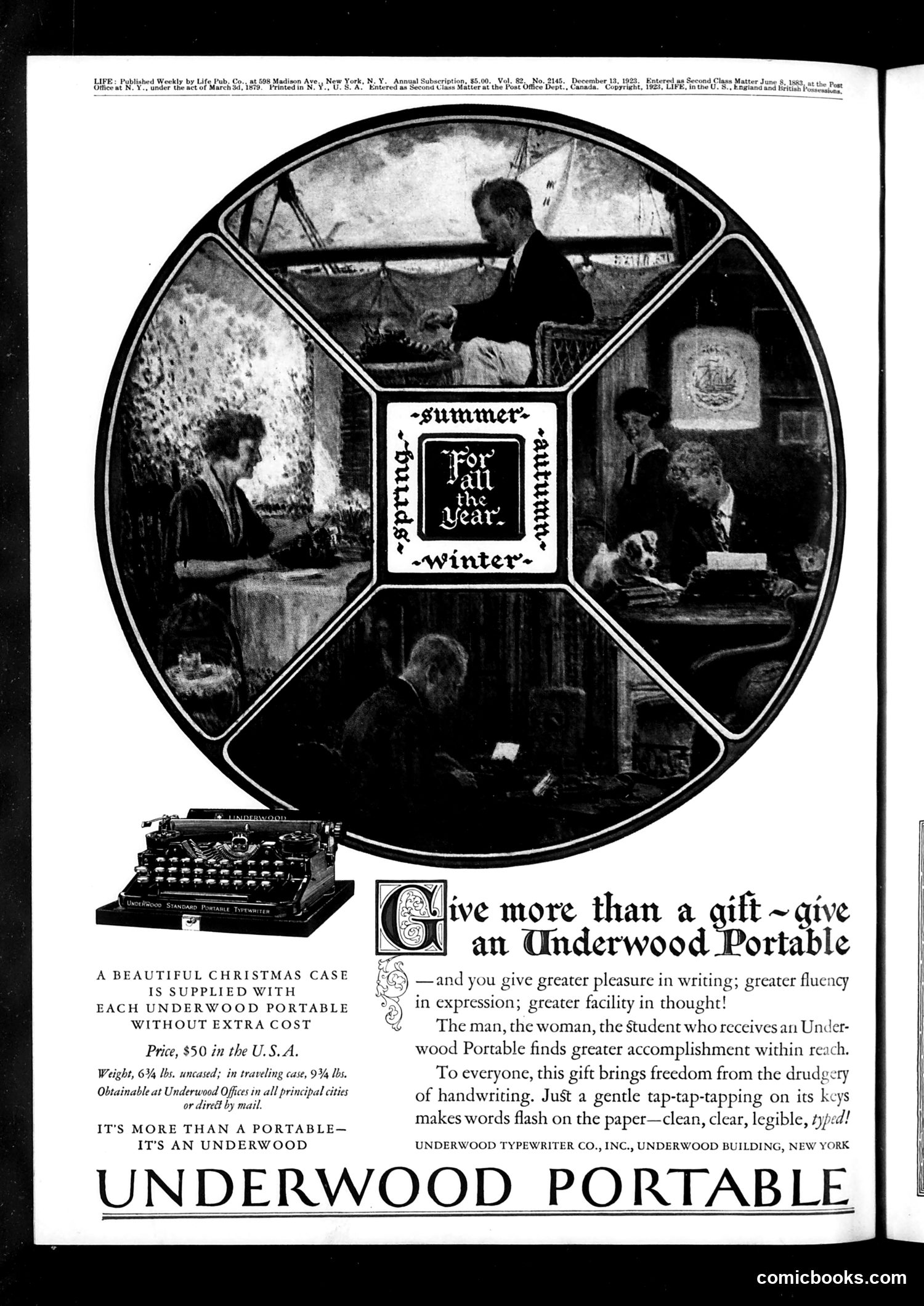
This page is primarily **advertising**, not political satire. It promotes the Underwood Portable typewriter as a Christmas gift for 1922. The circular illustration shows six scenes of people using typewriters across different seasons ("summer," "fall," "winter," "spring") and contexts—depicting writers, students, and professionals at work. The advertisement emphasizes that an Underwood Portable enables "greater pleasure in writing" and "greater fluency in expression." The sales pitch targets gift-givers with the slogan "Give more than a gift—give an Underwood Portable," positioning the typewriter as a tool for accomplishment and liberation from "the drudgery of handwriting." At $50, it was positioned as an aspirational but accessible luxury item. There is **no political cartoon or satire** on this page.
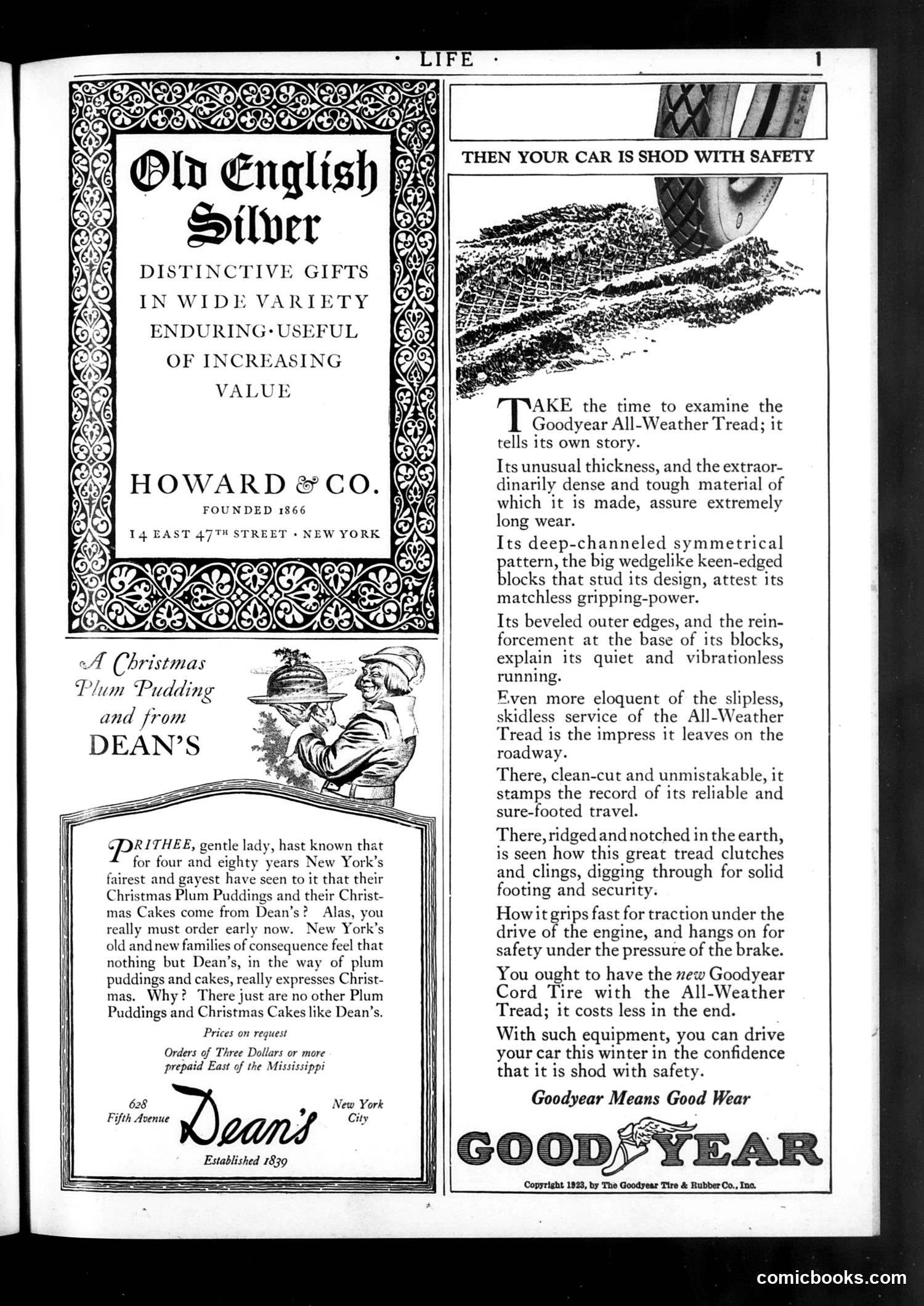
This page contains **advertisements rather than editorial cartoons or satire**. The left side advertises **Old English Silver** gifts from Howard & Co. (founded 1866) and **Dean's Christmas Plum Pudding**—luxury items marketed to wealthy consumers. The Dean's ad uses "Prithee, gentle lady" in mock-archaic language, a common period affectation for upscale food marketing. The right side features a **Goodyear All-Weather Tread tire advertisement**. The image shows a tire tread pattern and emphasizes winter driving safety. The copy describes the tire's durability and grip, concluding with the Goodyear slogan "Means Good Wear." These are straightforward commercial advertisements aimed at affluent early-20th-century Life magazine readers—no political satire or cartoon humor is present on this page.
This is a **Phoenix Hosiery advertisement**, not a satirical cartoon. The ad makes a comparative claim about women's and men's hosiery durability. The copywriting employs a rhetorical tactic common to early 20th-century marketing: it frames the product claim as a gender debate ("Women vs. men!"), then argues that because women take more steps daily than men, their hosiery endures harder wear. Therefore, Phoenix Hosiery—which allegedly performs equally well in both masculine and feminine versions—must be superior to competitors. The ornate decorative border and typography reflect the period's advertising aesthetic. This represents straightforward commercial messaging rather than political satire, using gender comparison as a marketing hook to sell durability and elegance to both sexes.
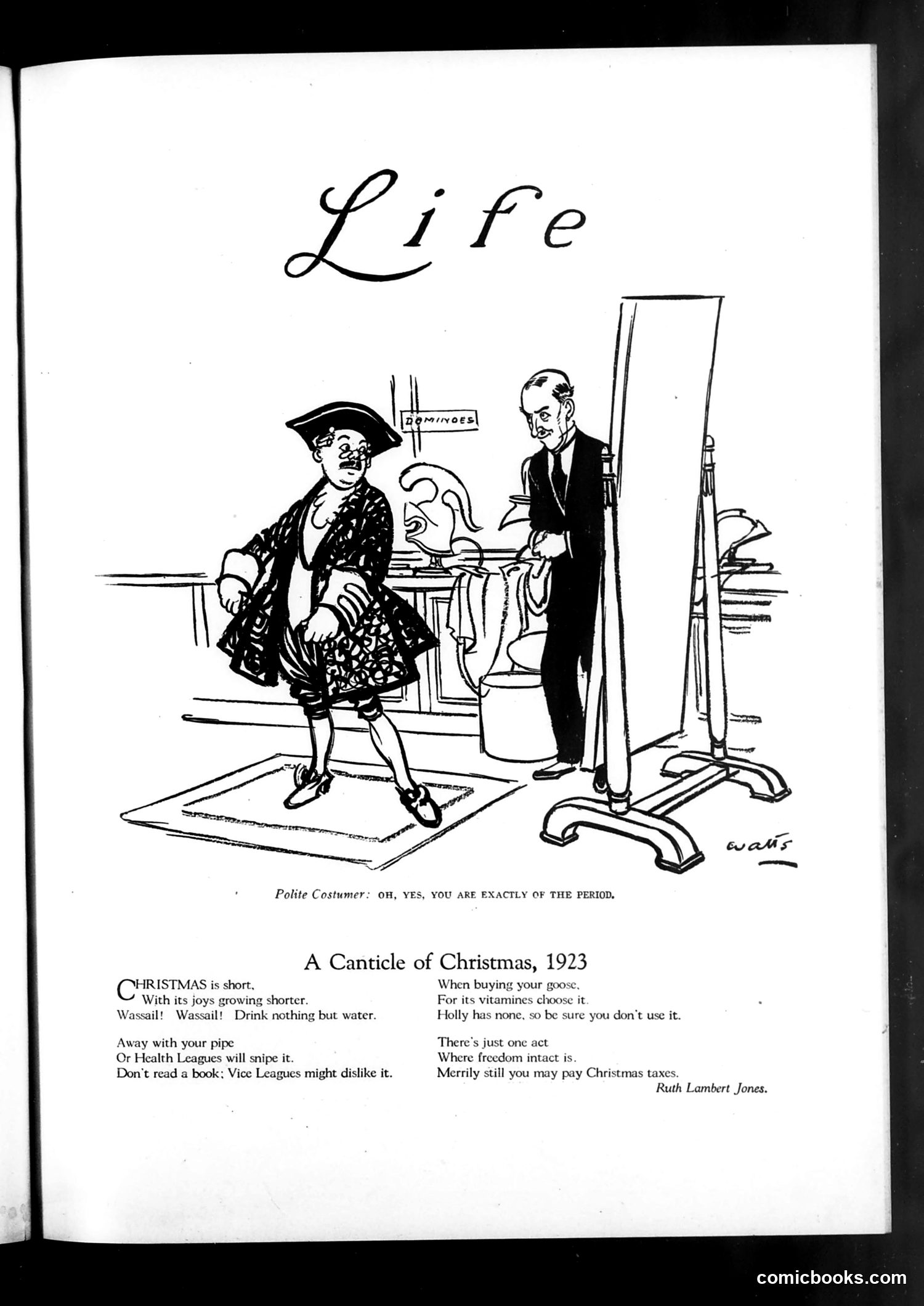
This satirical poem by Ruth Lambert Jones mocks 1920s moral panic and restrictive social movements. The cartoon shows a tailor fitting a woman while a man observes—illustrating the poem's critique of various prohibition-era concerns. The satire targets: - **Temperance/Prohibition advocates** ("Wassail! Wassail! Drink nothing but water") - **Censorship movements** ("Health Leagues will snipe it," "Vice Leagues might dislike it") - **Moral policing** of everyday activities—reading, smoking, clothing choices The "Polite Costumer" caption suggests ironic commentary on how fashion itself faced moral scrutiny. The poem's final lines about "freedom intact" and "Christmas taxes" suggest frustration with government overreach and moral busybodies restricting innocent pleasures during the post-WWI era.
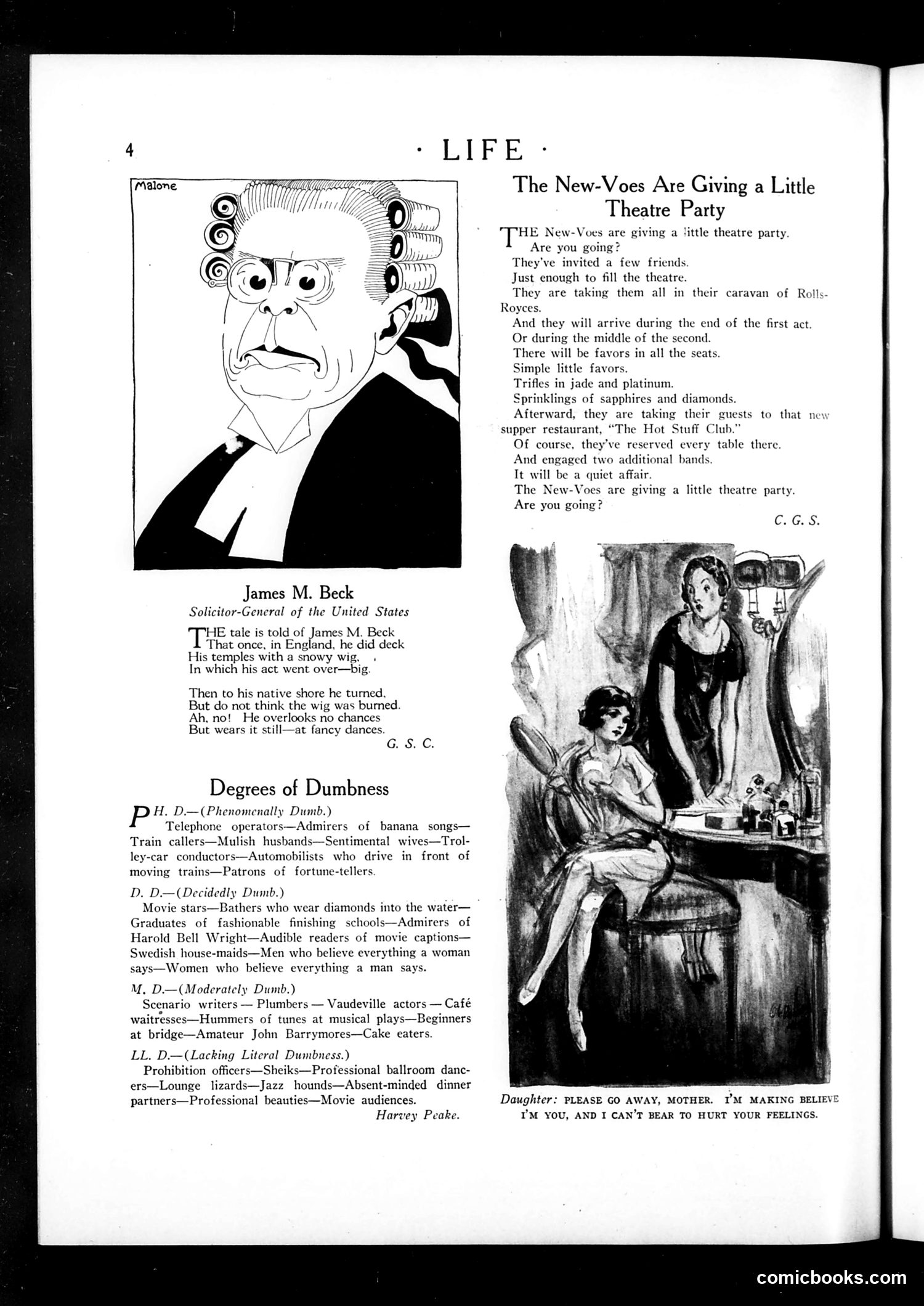
**James M. Beck Caricature (left):** The exaggerated facial features—bulging eyes, protruding ears, elaborate hair—mock James M. Beck, Solicitor-General of the United States. The accompanying verse jokes that he once wore a snowy wig to deck his temples in England, and now wears it still to fancy dances back home. This appears to be social ridicule of his appearance and fashion choices rather than political critique. **"Degrees of Dumbness" (bottom left):** A humorous hierarchy classifying types of foolishness from "Ph.D." (phenomenally dumb) through various social types—train callers, telephone operators, and fortune-teller patrons—down to "L.L.D." (lacking literal dumbness), including prohibition officers and professional beauties. It's satirical social commentary on contemporary American types and behaviors. **Right illustration:** A domestic scene between mother and daughter discussing hurt feelings, likely satirizing family melodrama of the era.
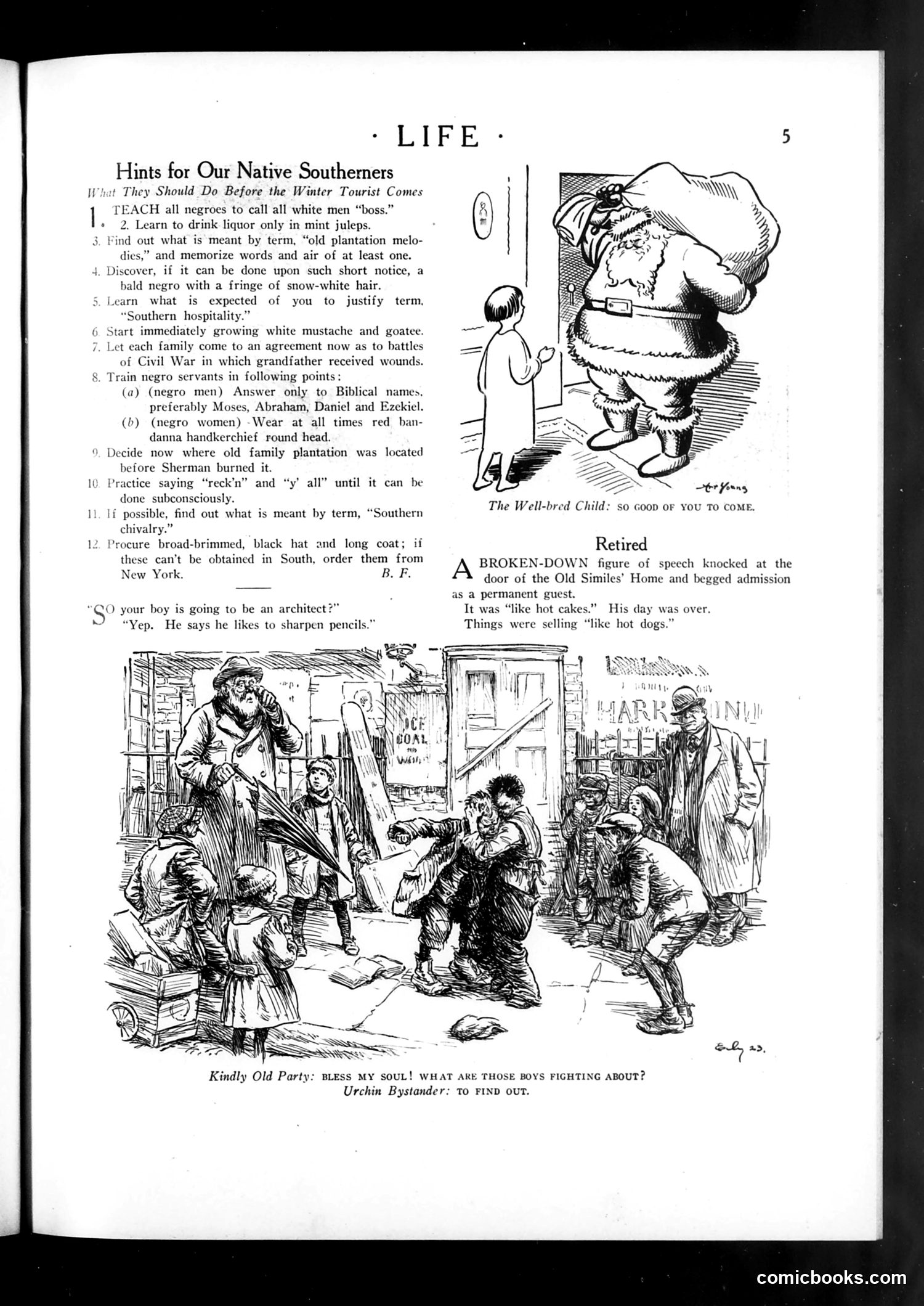
This page contains racist satire targeting Black Southerners during the post-Civil War era. The top section, "Hints for Our Native Southerners," lists offensive stereotypes and instructions—including teaching Black people to call white people "boss" and mocking their speech patterns with phrases like "reck'n" and "y'all." The bottom cartoon depicts poor Black children in a street scene. The caption quotes an elderly white character asking what "those boys" are fighting about, with the punchline suggesting they need investigation to determine their motives. The overall message reinforces white supremacist attitudes common to the period, depicting Black people as inherently inferior, subservient, and comical. This represents Life magazine's editorial stance on race relations during Reconstruction or the immediate post-slavery period.
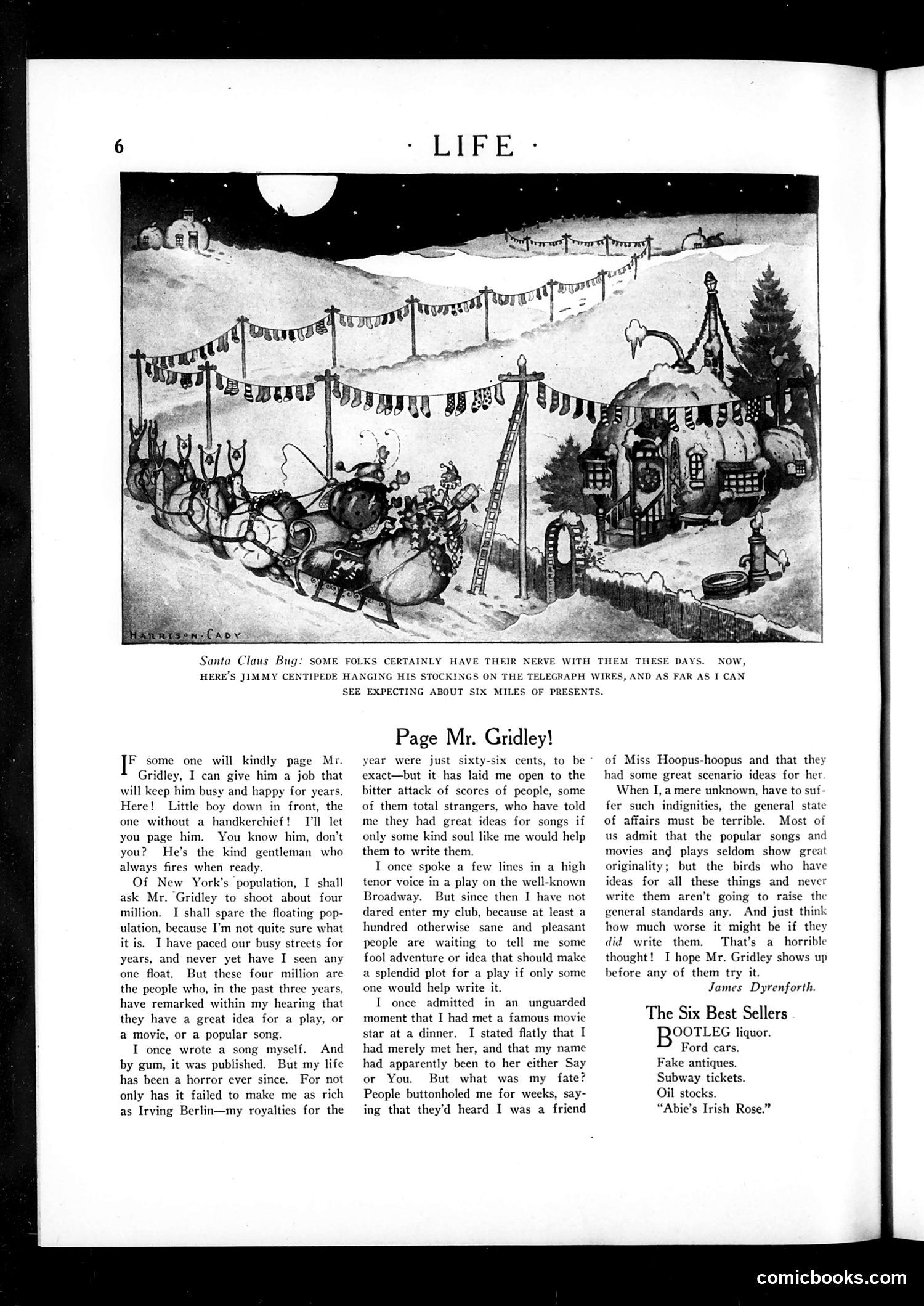
This page features a whimsical Christmas illustration titled "Santa Claus Bug" by Harry Cady, showing Santa's sleigh delivering presents across a snowy landscape with houses and decorations visible for miles. Below is an article titled "Page Mr. Gridley!" where the author humorously complains about being mistaken for or confused with someone else named "Mr. Gridley." The writer discusses how people buttonhole him claiming to know him, mentioning a supposed encounter with a famous movie star who seemed to recognize him—but the encounter created awkward confusion. The piece satirizes the common social embarrassment of mistaken identity and people's tendency to make false claims about knowing celebrities or important figures. It's gentle, relatable humor about everyday social mishaps rather than political satire.
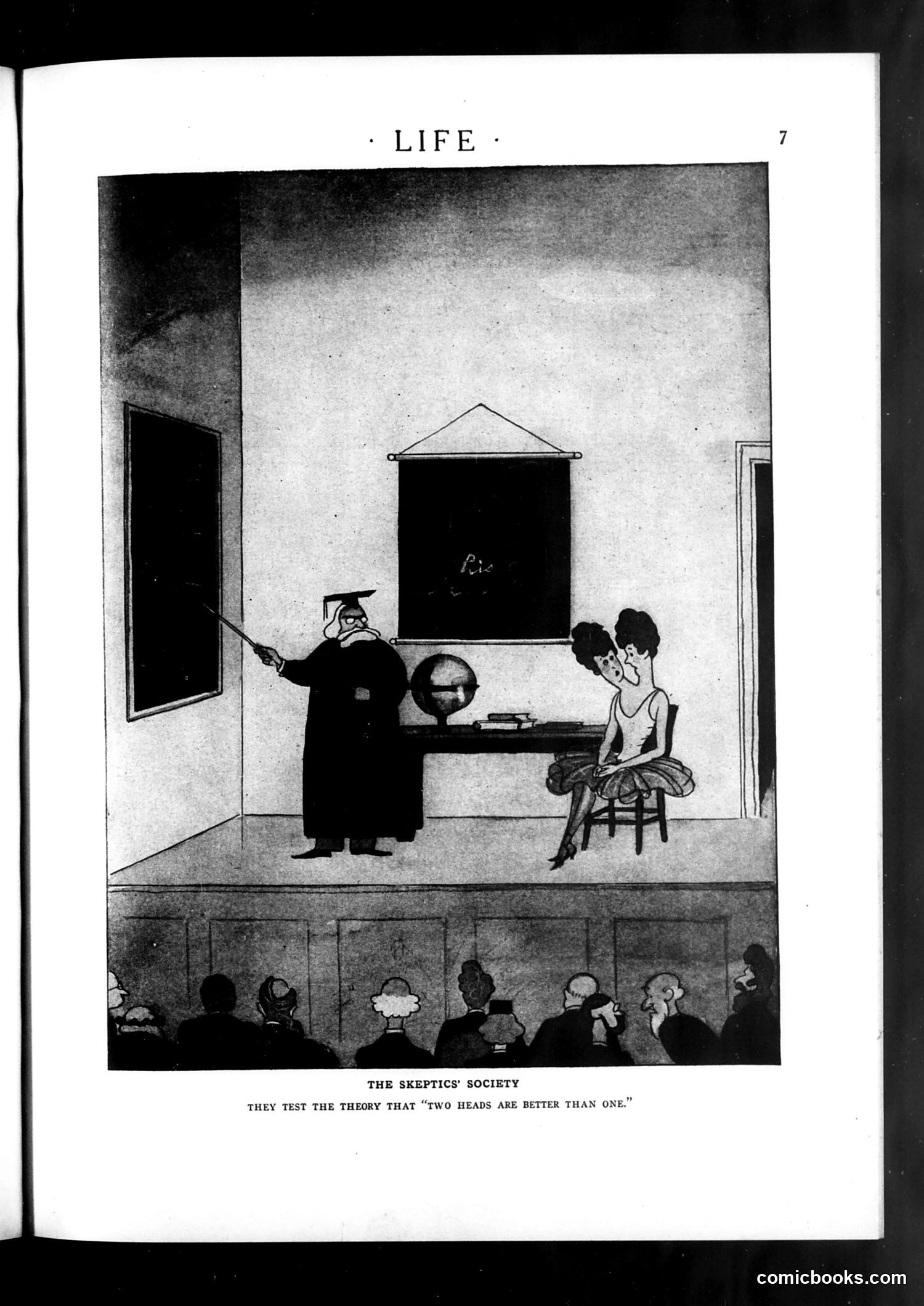
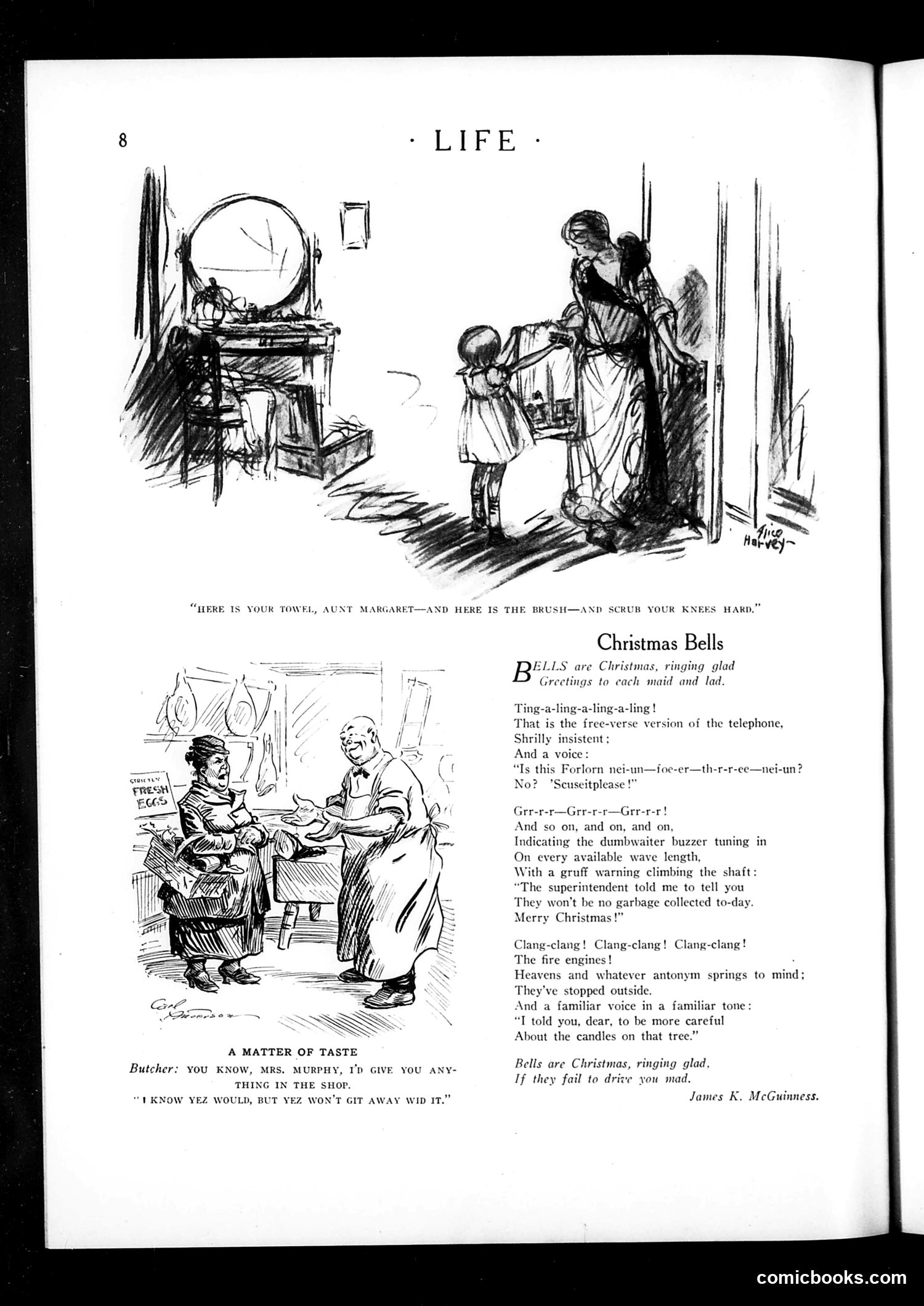
This page contains two separate comic sketches satirizing domestic life and social class: **Top sketch:** An aunt instructs a young niece on household cleaning—scrubbing knees and using a brush—depicting the working-class domestic duties expected of poor children. **Bottom sketch ("A Matter of Taste"):** A butcher tells Mrs. Murphy he'll provide anything in the shop, and she replies she won't "git away wid it," suggesting she lacks money to purchase meat. This mocks working-class poverty and the butcher's condescension. **"Christmas Bells" poem:** A sentimental piece contrasting Christmas joy with domestic hardship—telephone interruptions, fire engines, and warnings about tree candles—satirizing the gap between holiday ideals and grimy urban reality. The page satirizes working-class life, poverty, and the gap between social pretense and actual circumstances in early 20th-century America.
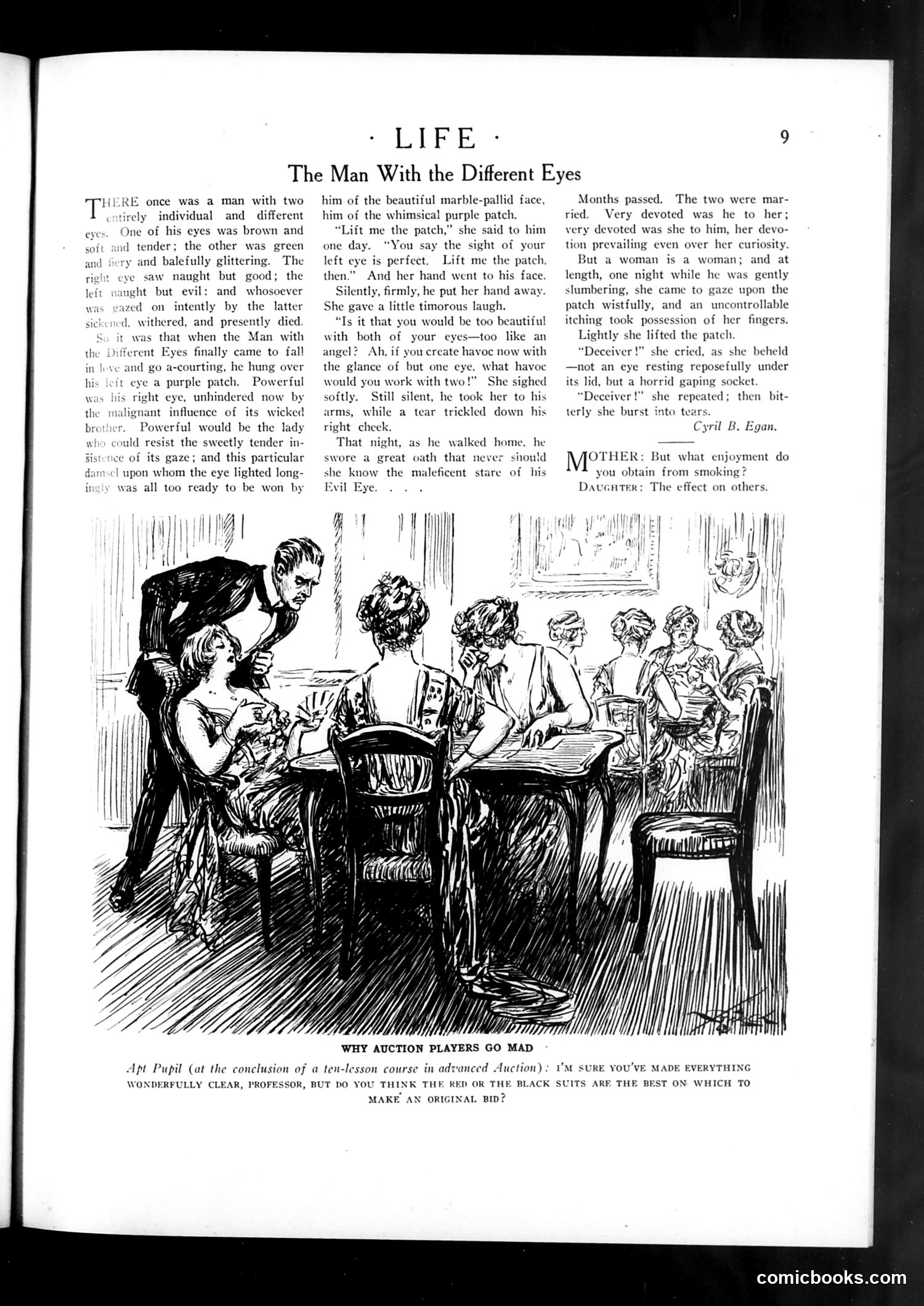
The page contains two distinct pieces: **Top story**: "The Man With the Different Eyes" by Cyril E. Egan tells of a man whose mismatched eyes (one beautiful, one evil-looking) attract a woman who becomes obsessed with his "evil eye." She eventually steals his eye patch, suggesting psychological obsession with perceived defects. **Bottom cartoon**: "Why Auction Players Go Mad" satirizes bridge or card game instruction. The illustration shows a professor teaching auction bidding to female students while other women observe. The caption jokes that students struggle to understand which suit color (red vs. black) makes the best bid—poking fun at both the complexity of auction rules and, perhaps, the difficulty of teaching women card games.
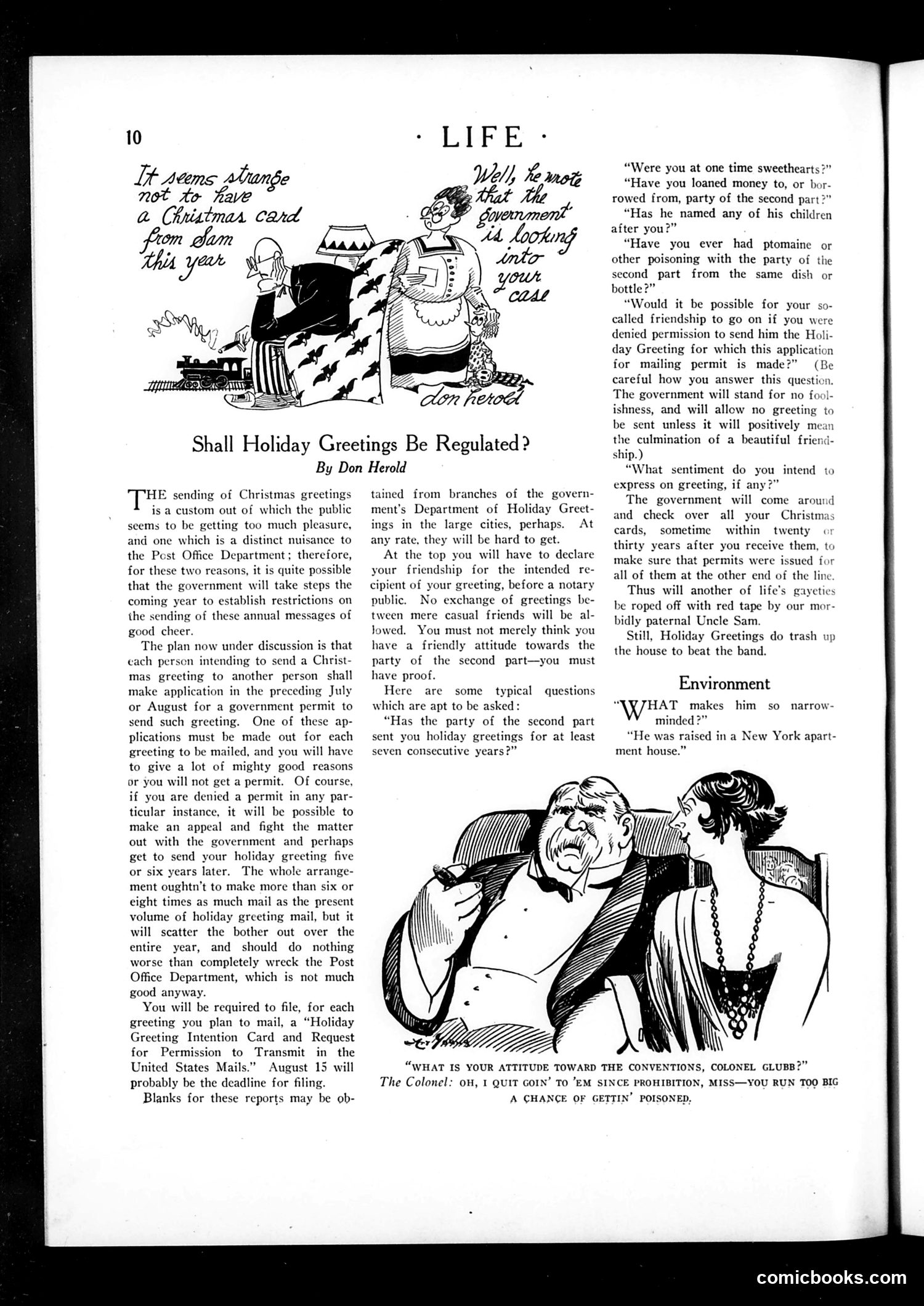
This page satirizes government regulation of Christmas greetings. The article "Shall Holiday Greetings Be Regulated?" by Don Herold proposes a humorous bureaucratic scheme requiring permits to send holiday cards—applications due in July or August, with extensive questionnaires about friendships and attitudes. The top cartoon mocks this absurdity, showing a man buried under bureaucratic paperwork while holiday imagery surrounds him. The lower illustration titled "Environment" depicts a Colonel and woman discussing conventions and attitudes, with the Colonel dismissing concerns about social restrictions ("you run too big a chance of gettin' poisoned"). The satire critiques government overreach and the bureaucratization of everyday life—concerns about excessive regulation that clearly resonated with 1920s readers.
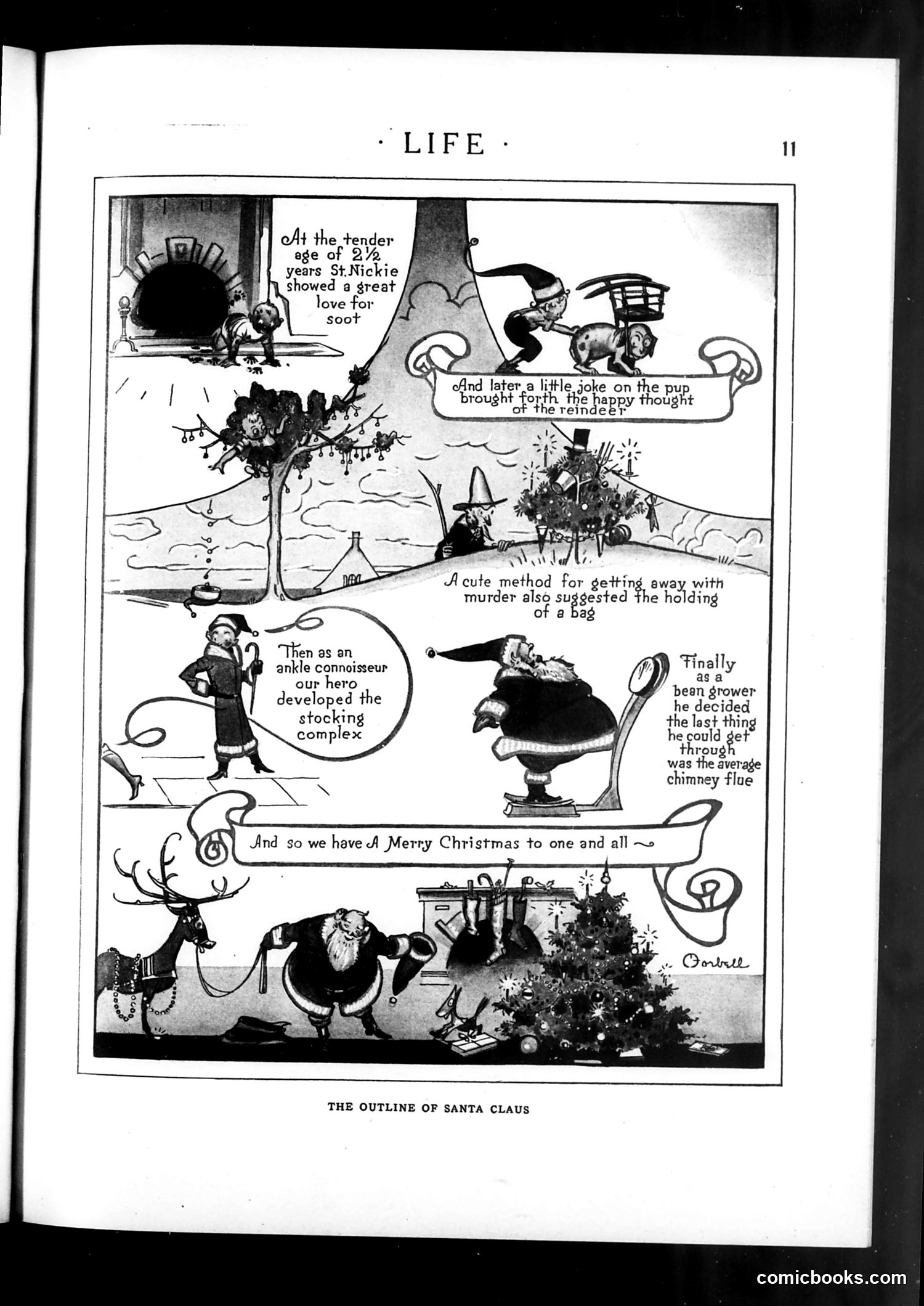
This satirical comic traces the origin story of Santa Claus through various humorous vignettes. The narrative suggests that Saint Nickie, at age 2½, developed an early love for soot (likely referencing chimney-related activities). Later episodes depict the character developing a "stocking complex" and devising methods for "getting away with murder" while holding bags. The final panel humorously suggests that Santa's eventual mastery of chimney-flue navigation completed his transformation. The bottom panel shows the finished Santa Claus figure with reindeer, Christmas tree, and holiday gifts—presenting the comic as a tongue-in-cheek "origin myth" explaining how Santa became the figure we know today. The humor relies on absurdist logic and exaggeration rather than political commentary.
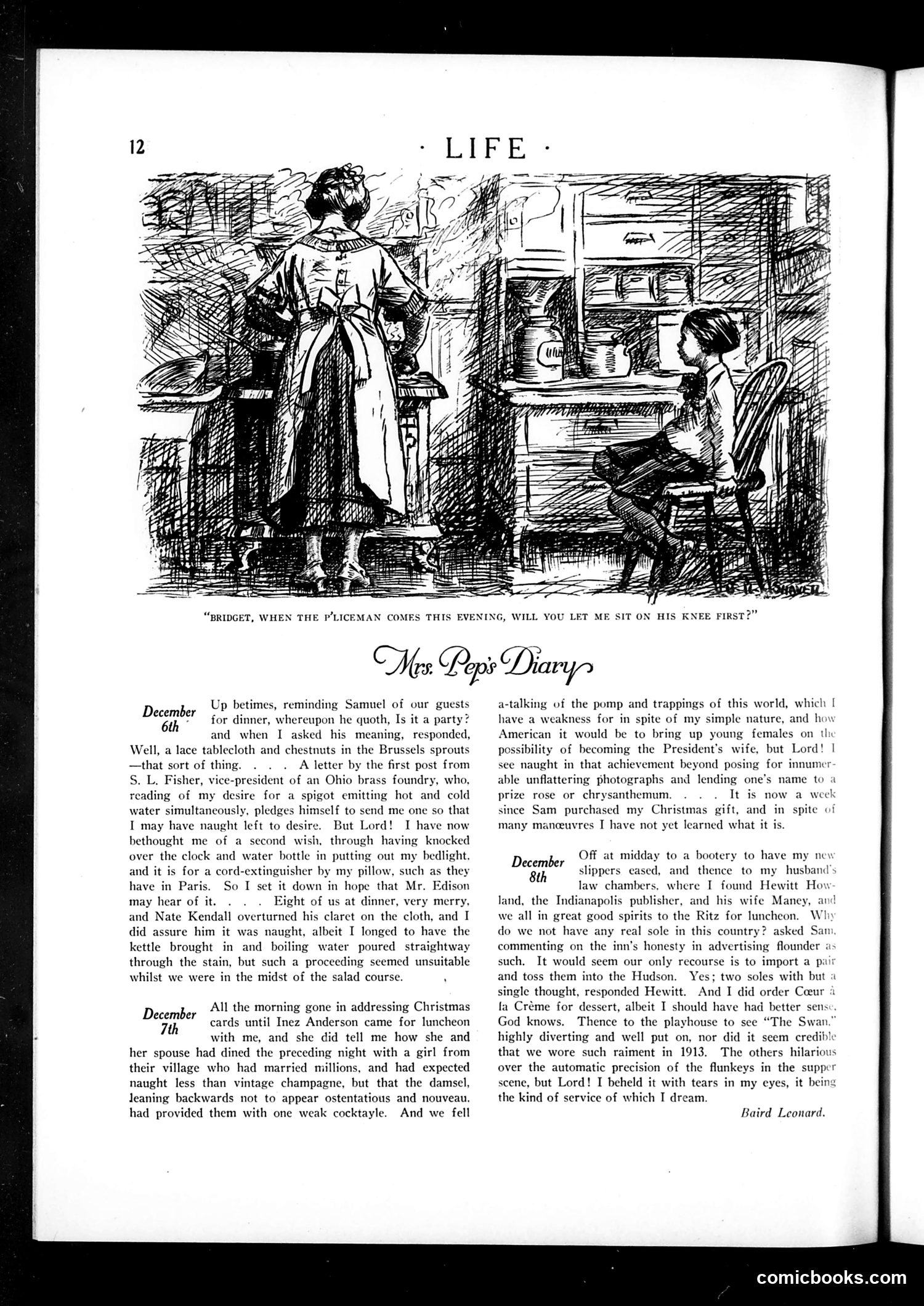
This page from *Life* magazine presents a humorous domestic diary by "Baird Leonard." The cartoon at top illustrates a scene of a woman (likely a maid or servant) standing while a man sits, with the caption: "BRIDGET, WHEN THE PLICEMAN COMES THIS EVENING, WILL YOU LET ME SIT ON HIS KNEE FIRST?" The joke plays on class dynamics and social propriety of the era. The dialogue suggests the woman is instructing household staff about entertaining a visitor (possibly a suitor or admirer), with an ironic request about seating precedence—implying the speaker wants priority attention before the servant does. The diary entries below discuss Christmas gifts, dinner parties, and social observations, reflecting upper-class domestic life and period attitudes toward etiquette and propriety.
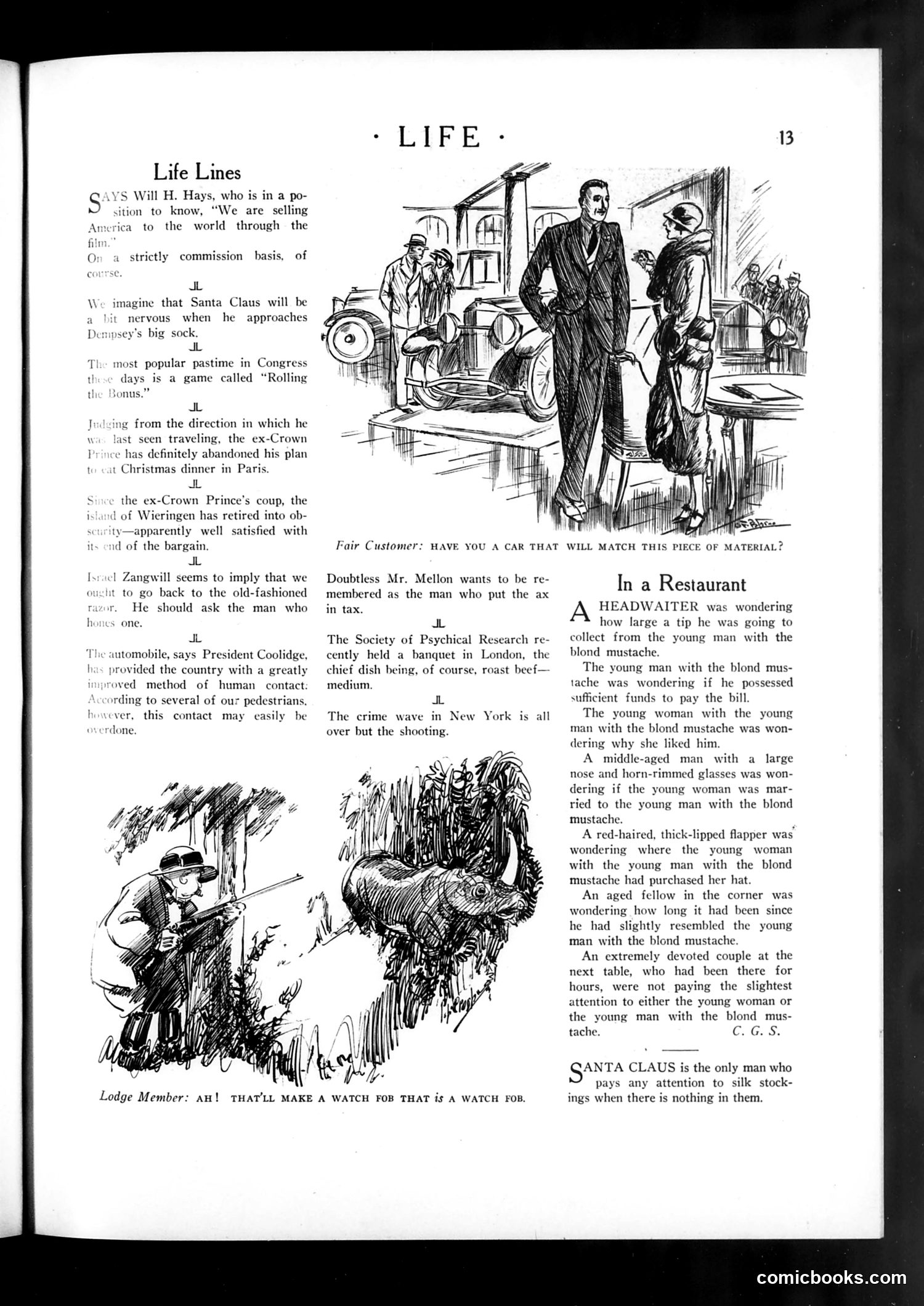
This page contains several satirical vignettes typical of Life's humor format: **"Life Lines"** (left column): Brief jokes about contemporary topics—Santa Claus, Congress, an ex-Crown Prince (likely European royalty from WWI era), and automobiles as a new social phenomenon. **Top cartoon**: Shows a well-dressed man negotiating with a car salesman, captioned "Fair Customer: HAVE YOU A CAR THAT WILL MATCH THIS PIECE OF MATERIAL?" The satire mocks nouveau riche ostentation—wealthy people choosing cars to match their clothing rather than practical considerations. **"In a Restaurant"** (right): Humorous observations about diners obsessing over a young man's blood mustache, satirizing shallow social observation and class pretension in public dining. **Bottom cartoon**: A ledger member making a joke about watches as Christmas gifts. The overall tone reflects Jazz Age satirical commentary on consumerism, class, and social affectation.
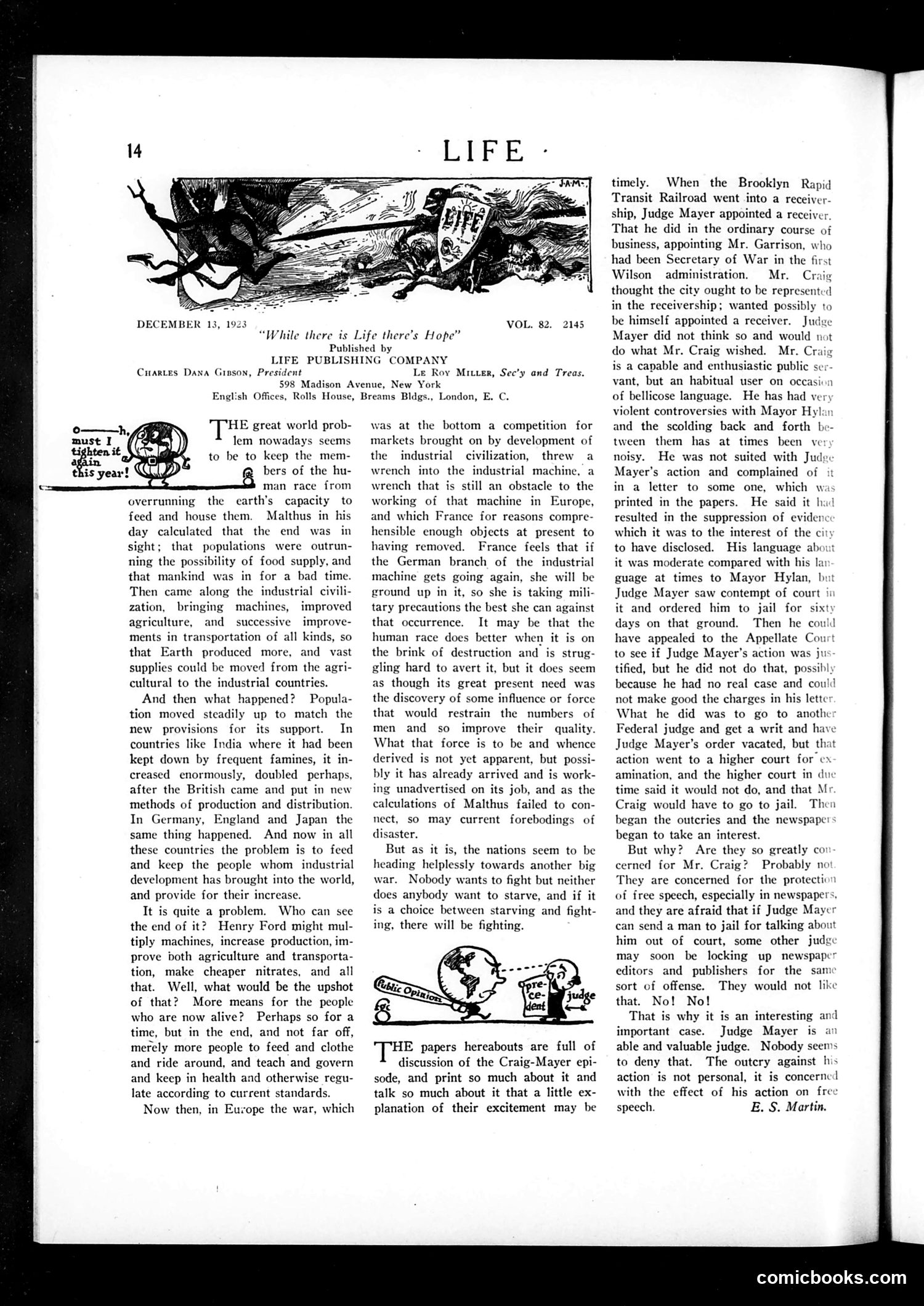
This December 1923 *Life* page discusses a legal dispute between judges Craig and Mayer regarding the Brooklyn Rapid Transit Railroad receivership. Judge Mayer appointed a receiver; Judge Craig objected, viewing it as a power grab. The article criticizes Craig's inflammatory letter published in newspapers, warning this could set a dangerous precedent for judicial conduct—judges jailing journalists for reporting on court matters. The cartoons illustrate the dispute: the top shows Craig and Mayer in conflict (the figure labeled "FIRE" suggesting inflammatory rhetoric), while the lower cartoon depicts a globe labeled with legal terms, suggesting the case's broader implications for free speech and judicial authority. The satire criticizes judges weaponizing contempt charges against press freedom.
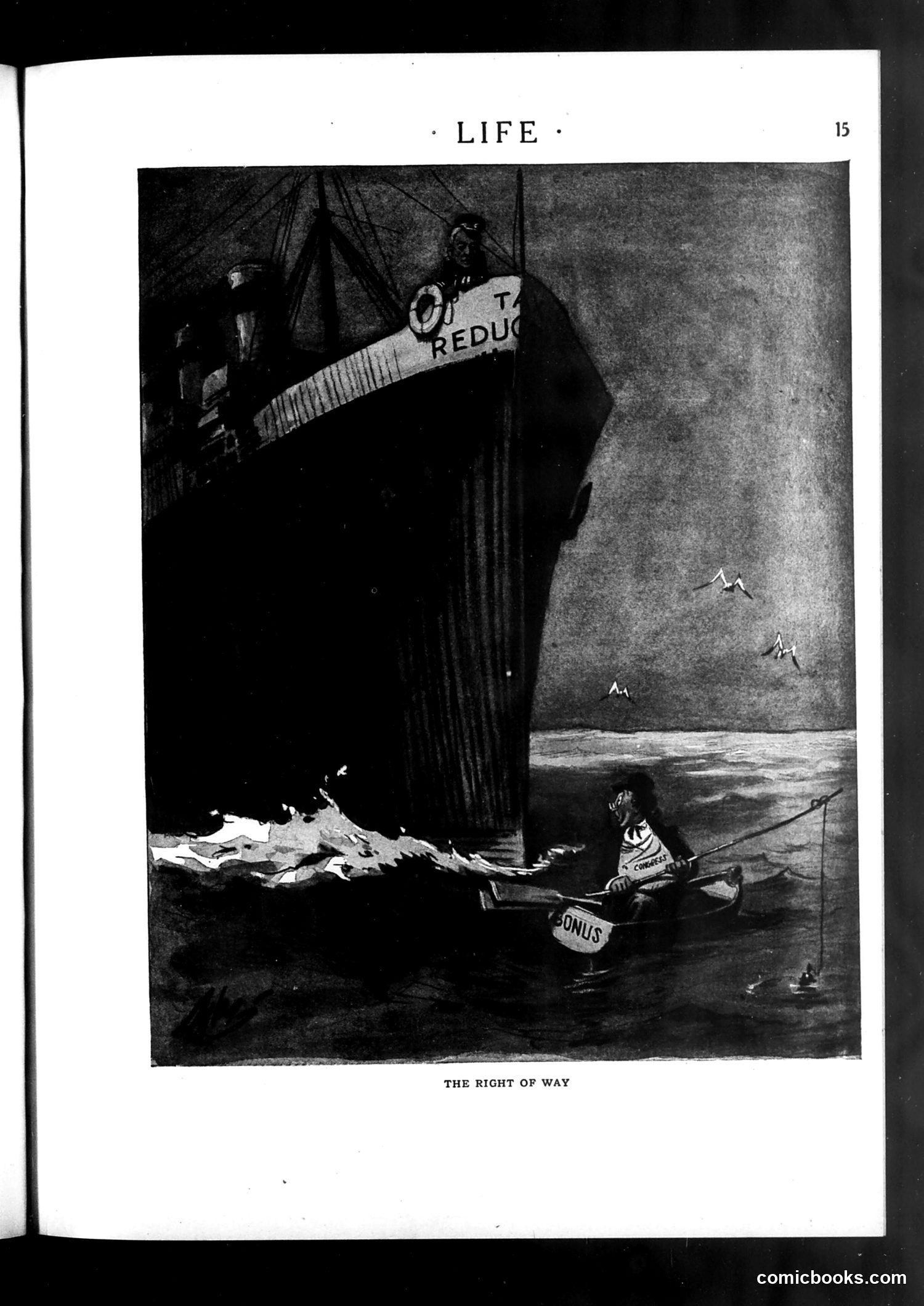
This political cartoon depicts a collision scenario at sea. A large ship labeled "REDUCTION" bears down on a small fishing boat labeled "BONUS" with a figure aboard. The ship appears to display "REDUC" (likely "REDUCTION"), while papers or debris scatter below. The satire critiques government policy prioritizing budget reduction over veterans' benefits. The "BONUS" likely references the WWI veterans' bonus—a contentious issue in early 20th-century American politics. The cartoon suggests that cost-cutting measures steamroll over promised veteran compensation, with the small boat's vulnerable position emphasizing how fiscal policies marginalize those who fought in war. The title "The Right of Way" ironically comments on which institution claims priority in national policy.
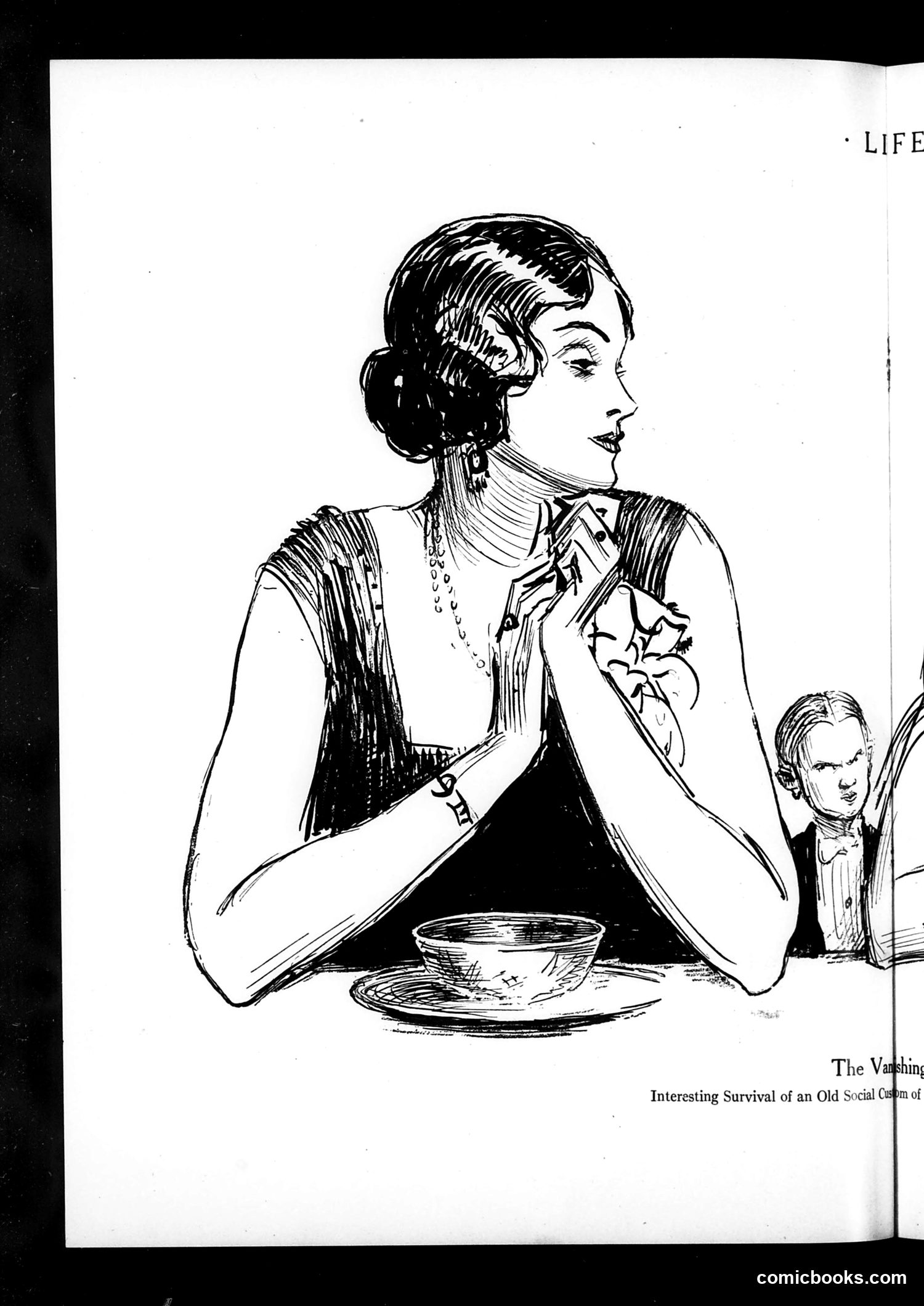
This page from *Life* magazine features a pen-and-ink illustration titled "The Vanishing" with subtitle "Interesting Survival of an Old Social Custom of..." The image depicts a well-dressed woman in 1920s-30s attire at a dining table, holding a handkerchief to her face in what appears to be distress or emotion. A child peeks from behind her. The drawing style and composition suggest social satire about changing customs. The title's reference to something "vanishing" and an "old social custom" likely critiques outdated feminine behavior—possibly excessive emotional displays, fainting spells, or other Victorian-era affectations that were becoming obsolete in modern society. The incomplete caption prevents full certainty of the exact custom being mocked, but the imagery suggests commentary on evolving gender norms and social expectations during this era.
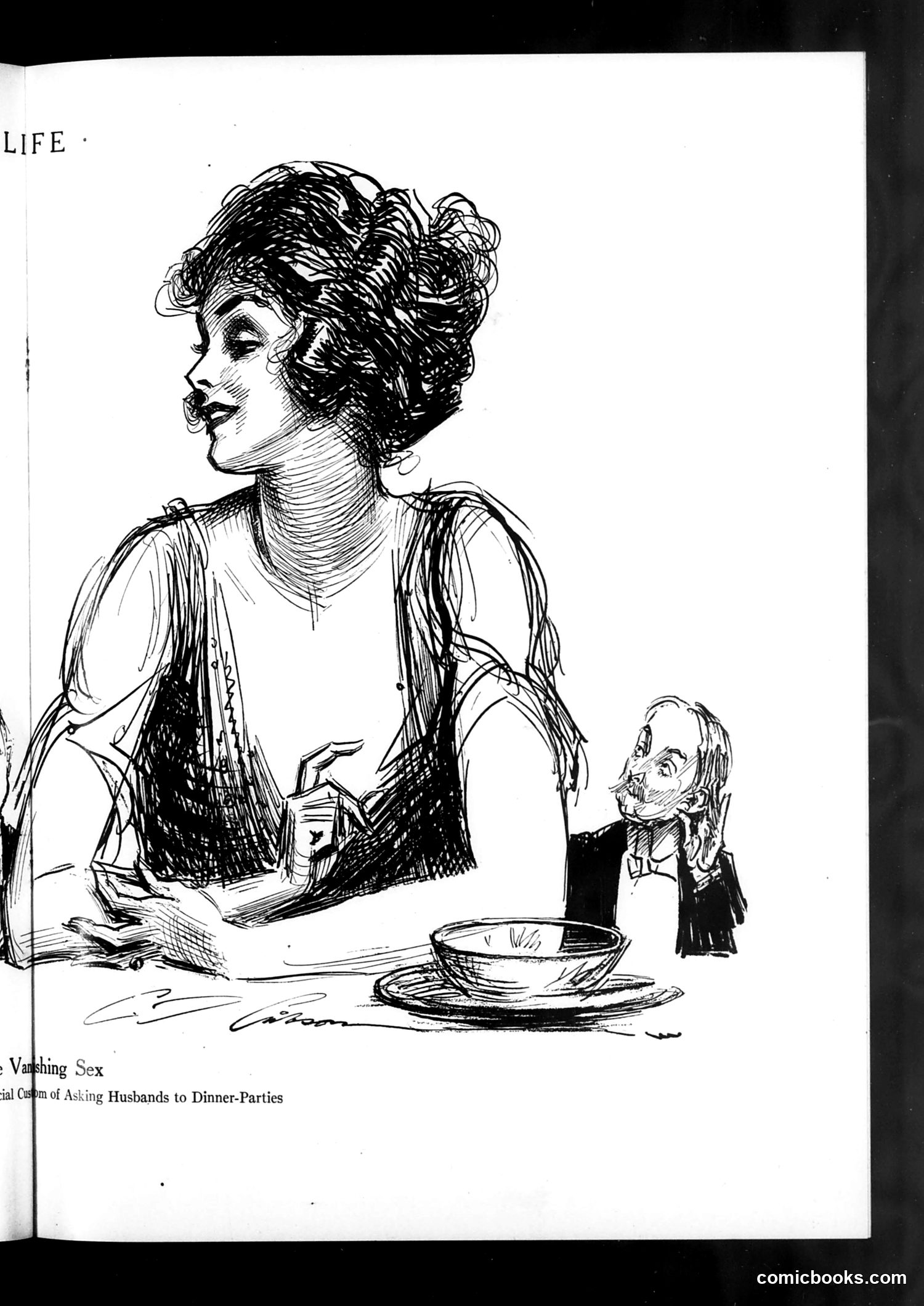
This *Life* magazine cartoon satirizes early 20th-century gender dynamics. The title "The Vanishing Sex" (partially visible) and subtitle reference "The Social Custom of Asking Husbands to Dinner-Parties." The image shows a large woman towering over a tiny man at a dining table, inverting traditional size/power hierarchies. The satire suggests that wives are becoming dominant figures in social life—specifically, they control dinner invitations and guest lists, reducing husbands to insignificant accessories. This reflects anxieties about changing women's roles and the women's suffrage movement of the era. The "vanishing" husband represents fears that male social authority was being eclipsed by female decision-making in domestic and social spheres. The exaggerated scale visually mocks these contemporary gender-role concerns.
This is a theater criticism column reviewing three Broadway plays. The author compares "Meet the Wife" unfavorably to "The Torch Bearers," praising Mary Boland's earlier performance. He critiques actor Berton Churchill's portrayal of Robert E. Lee as monotonous, contrasting it with Alfred Lunt's more dynamic performance in the same production. The review of "The Failures" humorously describes its depressing quality—so effectively bleak that the reviewer lost his appetite, even though he acknowledges the play's technical merit. He praises lead actors Ben Ami and Winifred Lenihan's powerful performances, joking about Ben Ami's intense acting style ("sadistic performance") in a previous play, worrying he might actually bite his co-star. The small decorative cartoons are generic theatrical vignettes, not political commentary.
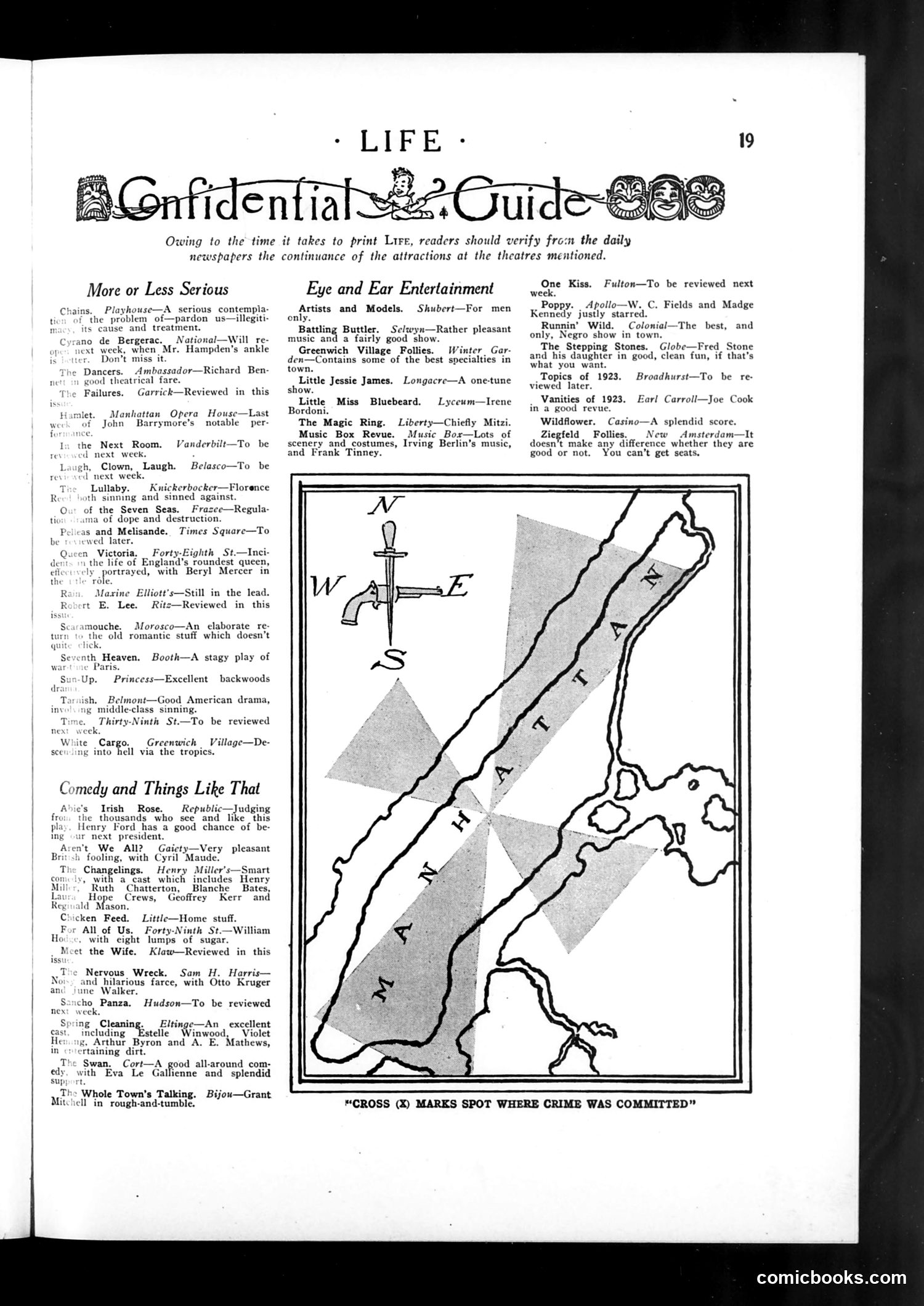
This page is primarily a **theatre guide and entertainment listings** rather than a political cartoon. The main visual element is a **map diagram** labeled "CROSS (X) MARKS SPOT WHERE CRIME WAS COMMITTED" — appearing to be a compass rose overlaid on a shaded area, likely illustrating a crime scene for theatrical or narrative purposes. The bulk of the page consists of **theatre reviews and recommendations** organized into categories: "More or Less Serious," "Comedy and Things Like That," and "Eye and Ear Entertainment." These brief reviews cover Broadway shows, musicals, and revues popular in the early 1920s, noting casts and venues. Notable shows mentioned include "Abie's Irish Rose" (hugely popular), "Greenwich Village Follies," and various Ziegfeld productions. The tone is casual and gossipy, typical of Life's entertainment coverage. **There is no significant political satire or social commentary** on this particular page — it functions as a practical entertainment guide for contemporary readers.
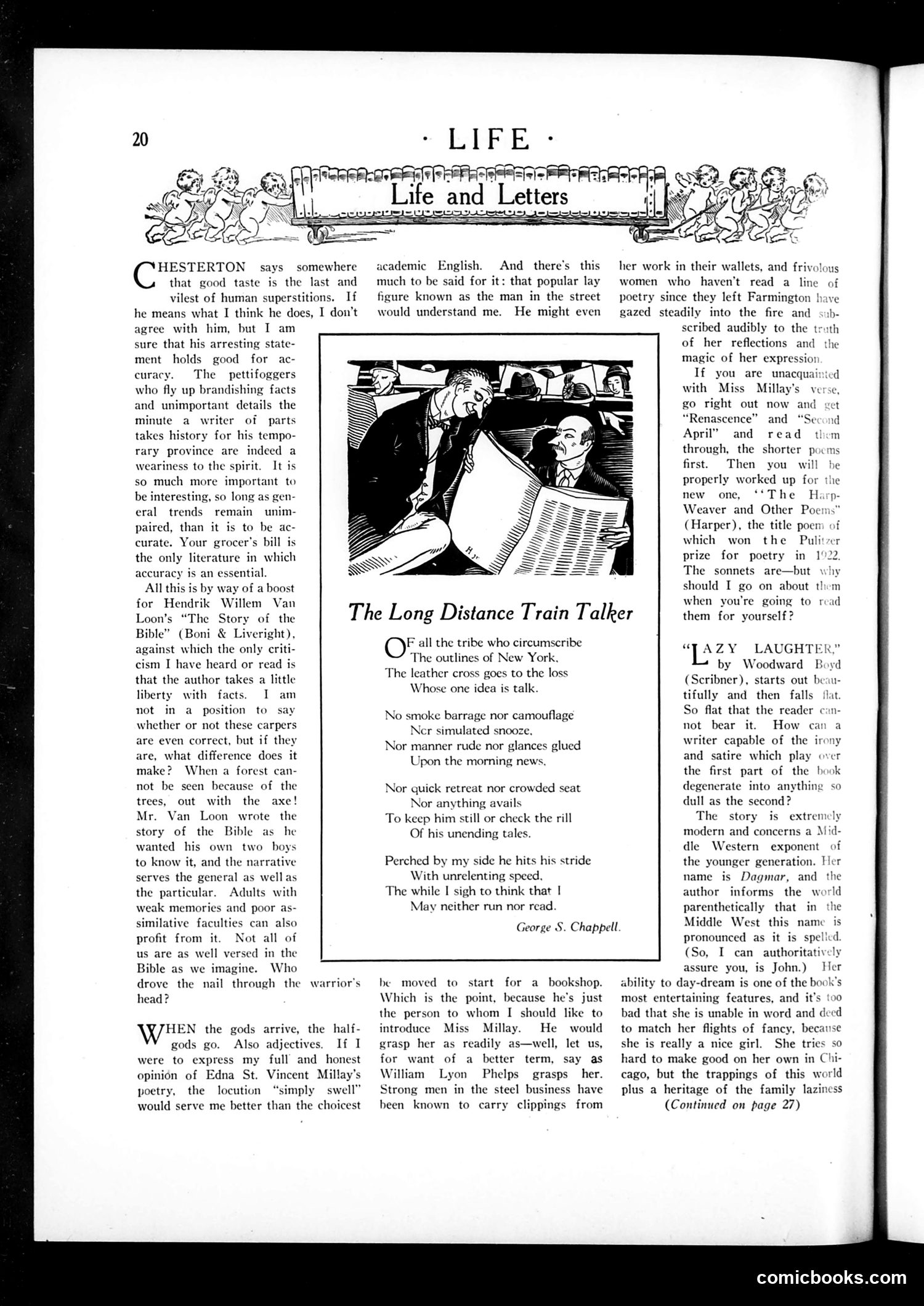
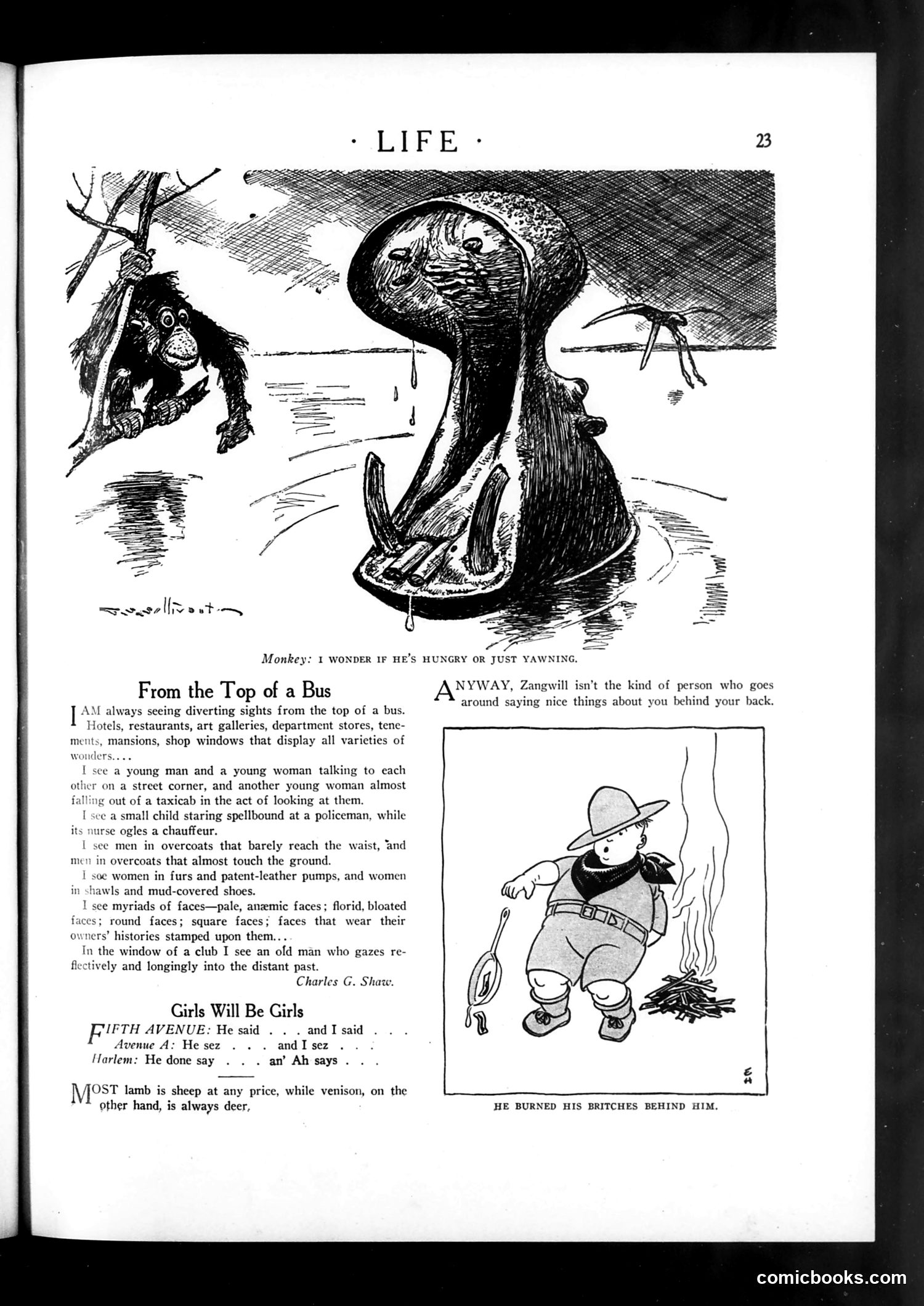
This page features a humorous poem by George S. Chappell about an annoying fellow passenger on a train who talks incessantly. The illustration shows two men in a train car—one attempting to read a newspaper while his seatmate gestures animatedly, dominating the conversation. The poem's joke is timeless: the talkative passenger prevents the narrator from doing anything ("May neither run nor read"), describing how no social avoidance strategy works against "his unending tales." The surrounding text discusses poet Edna St. Vincent Millay and the value of accessible literary criticism, suggesting Life's editorial stance that good writing should engage ordinary readers ("the man in the street"), not just academics. The train-talker poem exemplifies this democratized approach to humor—a relatable, everyday frustration rendered as sophisticated verse for a general audience.
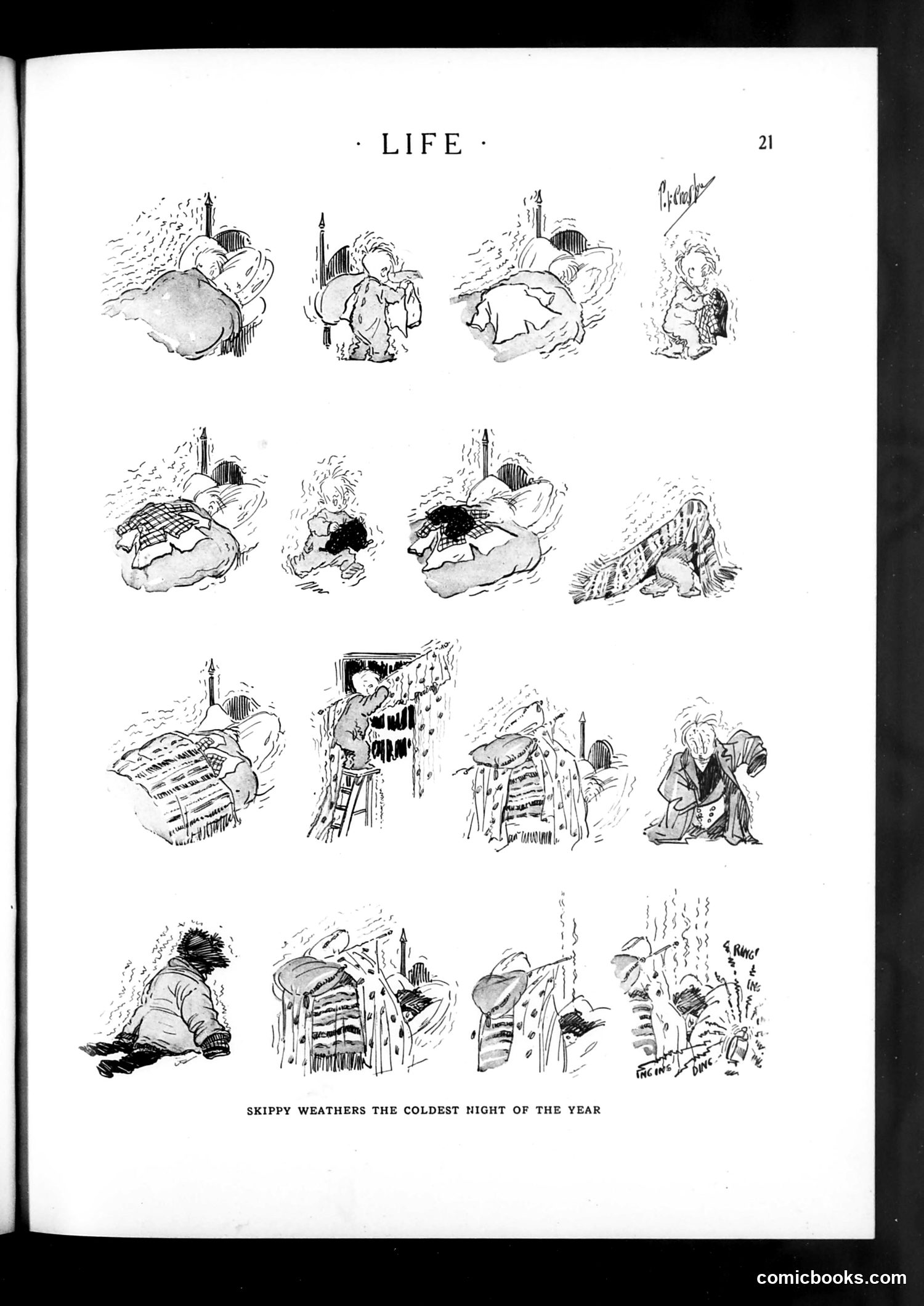
This is a multi-panel comic strip titled "Skippy Weathers the Coldest Night of the Year." The strip depicts a character named Skippy attempting to survive an extremely cold winter night through increasingly desperate and humorous methods. The panels show Skippy bundled in progressively elaborate bedding and clothing arrangements—blankets, quilts, and various household items—trying to stay warm. The visual humor comes from the escalating absurdity of his solutions, including what appears to be sleeping in unusual positions and using improvised insulation. The satire targets the hardship of extreme cold weather, particularly for those with limited resources. It's a gentle, domestic humor piece common to Life magazine's editorial comics, depicting universal human struggles with winter conditions through a relatable character's misadventures.
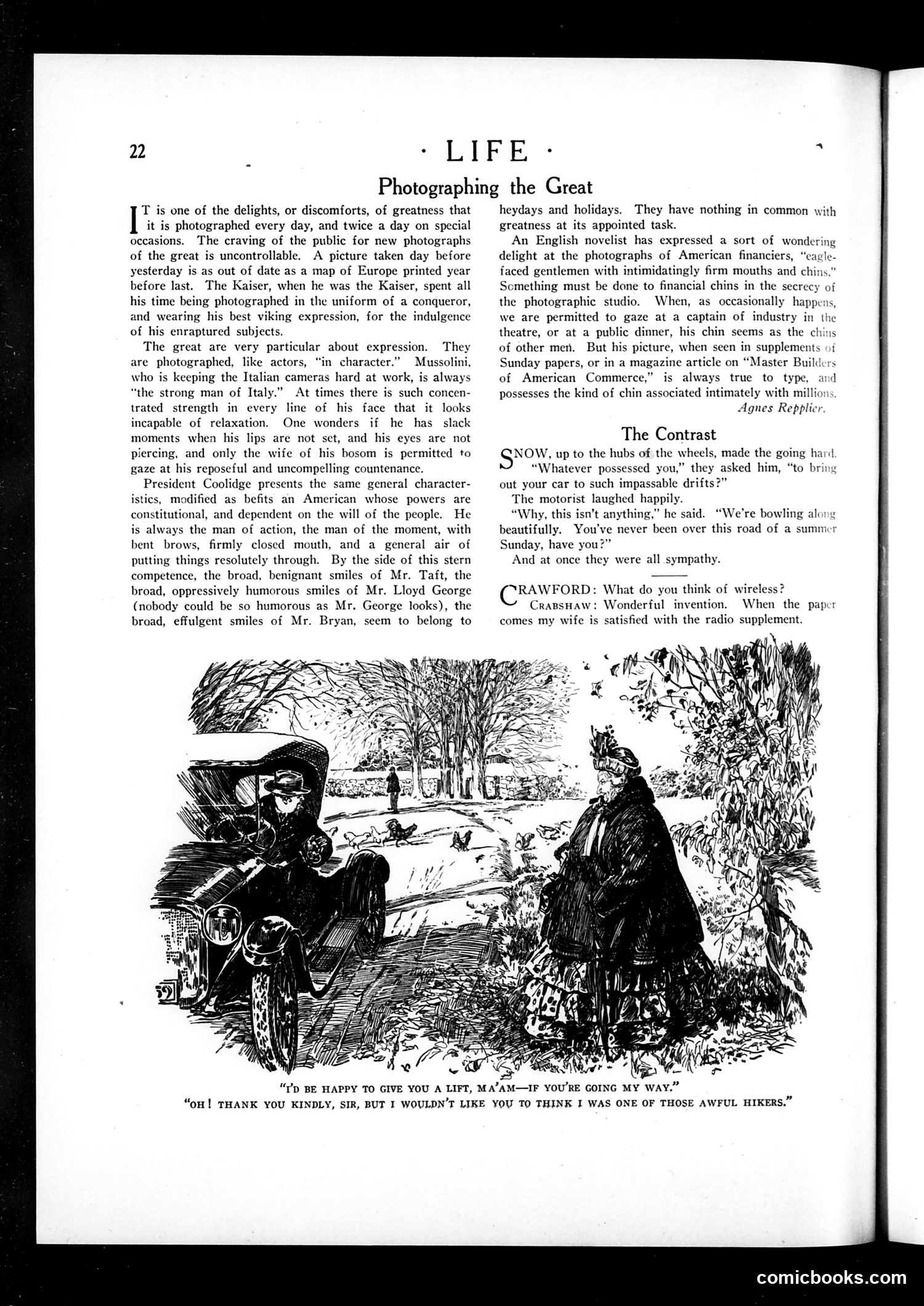
This page from Life satirizes the carefully managed public images of political and business leaders. The main article "Photographing the Great" critiques how prominent figures—including Kaiser Wilhelm, Mussolini, President Coolidge, Taft, Lloyd George, and Bryan—meticulously control their photographic personas, always projecting "character" and stern competence rather than their actual selves. The piece notes the irony that American financiers photograph with intimidating "firm mouths and chins," yet appear ordinary in person. The cartoon below depicts a motorist stuck in deep snow, cheerfully offering a ride to a woman who hesitates, not wanting to be mistaken for a "hiker"—reflecting 1920s-30s social anxieties about respectability and class appearance. The humor highlights how people carefully manage their public image, mirroring the article's theme about the gap between curated presentation and reality.
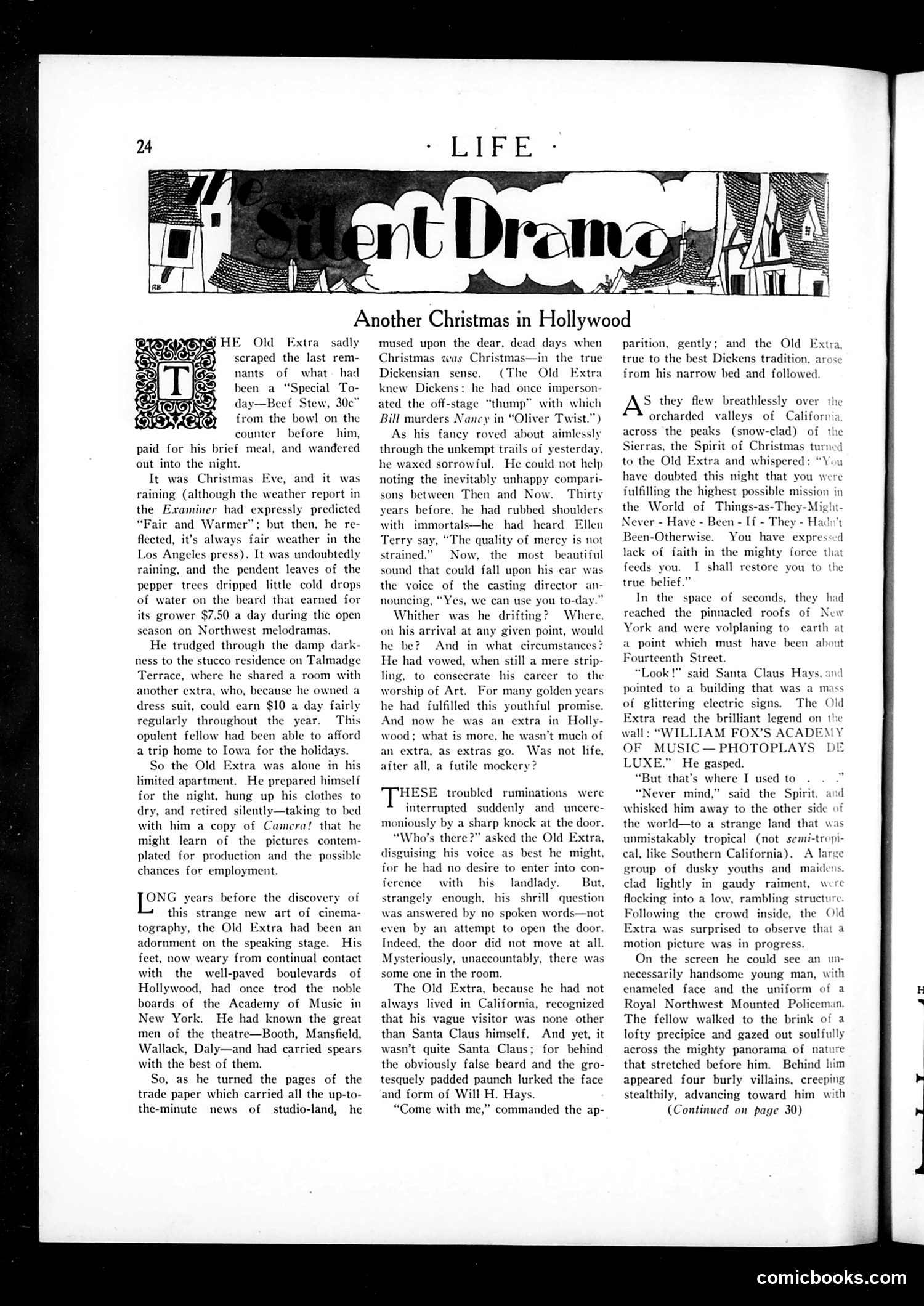
This is a sentimental satirical story about an aging stage actor reduced to playing minor film extras in Hollywood. The narrative contrasts his former prestige—he performed alongside legendary actors like Edwin Booth and knew Ellen Terry—with his current degradation: earning $7.50 daily as background talent, living in a shabby rooming house, and desperately studying trade papers for work opportunities. The satire targets Hollywood's ruthless treatment of aging performers and the film industry's indifference to theatrical tradition. The Old Extra's Christmas Eve solitude, his poverty (a 30-cent beef stew dinner), and his bitter reflections on how art has become a "futile mockery" underscore the story's melancholy critique. The mysterious knock at his door—which appears to be Santa Claus—suggests an intervening fantasy conclusion about to unfold, likely offering redemption or harsh reality check.
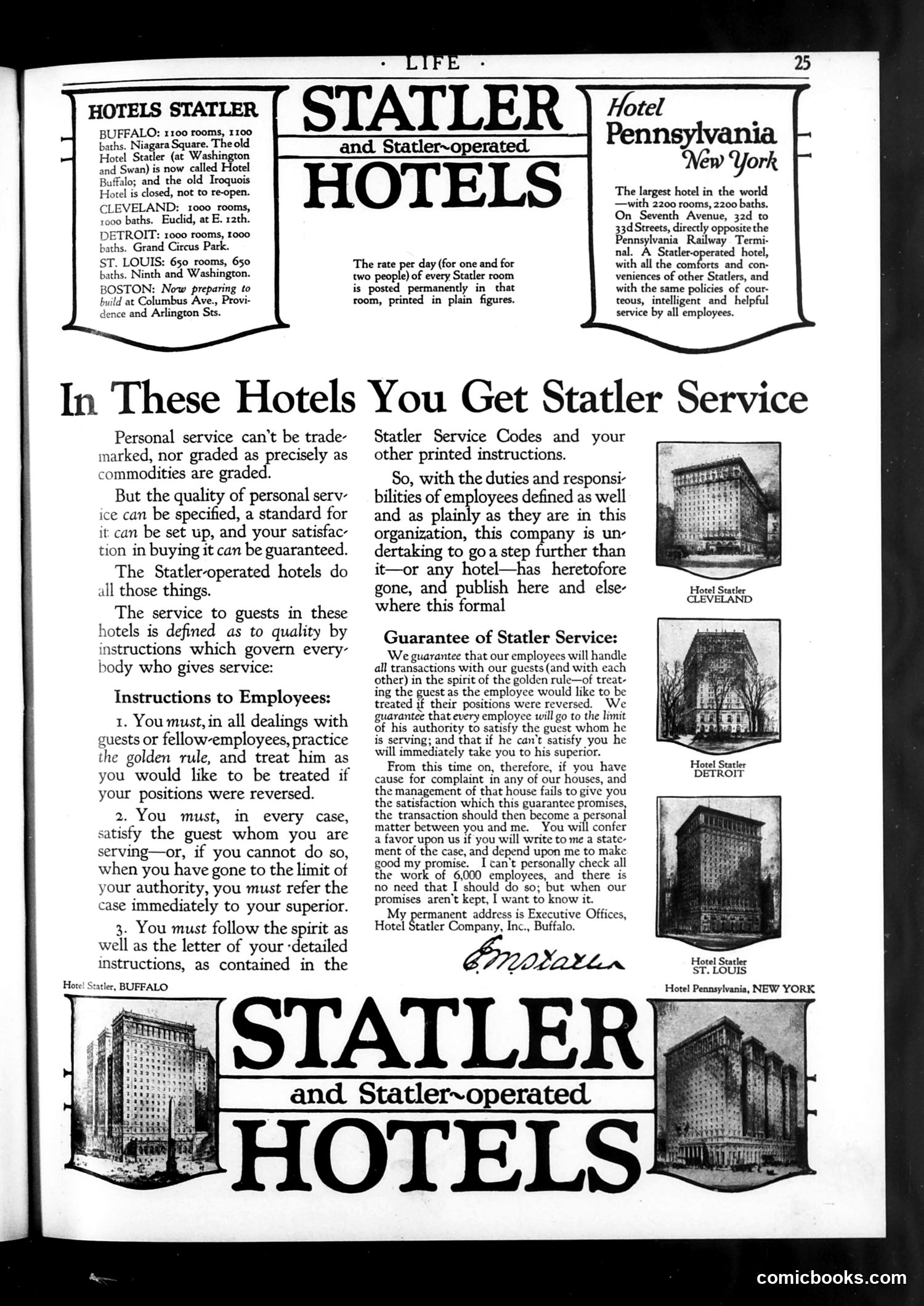
This is primarily **advertising copy**, not satire or political commentary. It's a corporate advertisement for Statler Hotels appearing in *Life* magazine. The page promotes the Statler hotel chain's service guarantee. The key pitch: unlike personal service which "can't be trademarked," Statler claims to have standardized quality through written instructions and employee codes based on the "golden rule." The advertisement includes: - A list of Statler locations (Buffalo, Cleveland, Detroit, St. Louis, Boston) - Photographs of four hotel buildings - A formal "Guarantee of Statler Service" signed by what appears to be the company founder, promising employees will treat guests as they'd wish to be treated, and that guests can escalate complaints directly to executive management **The implicit claim**: In an era before standardized hospitality chains, Statler positioned itself as innovative by claiming to apply manufacturing-style quality control to hotel service—a novel idea at the time. The guarantee's personal appeal to management suggests this was meant to distinguish Statler from competitors who offered no such formal promises. No satire is evident; this is straightforward early-20th-century corporate marketing emphasizing reliability and ethical treatment.
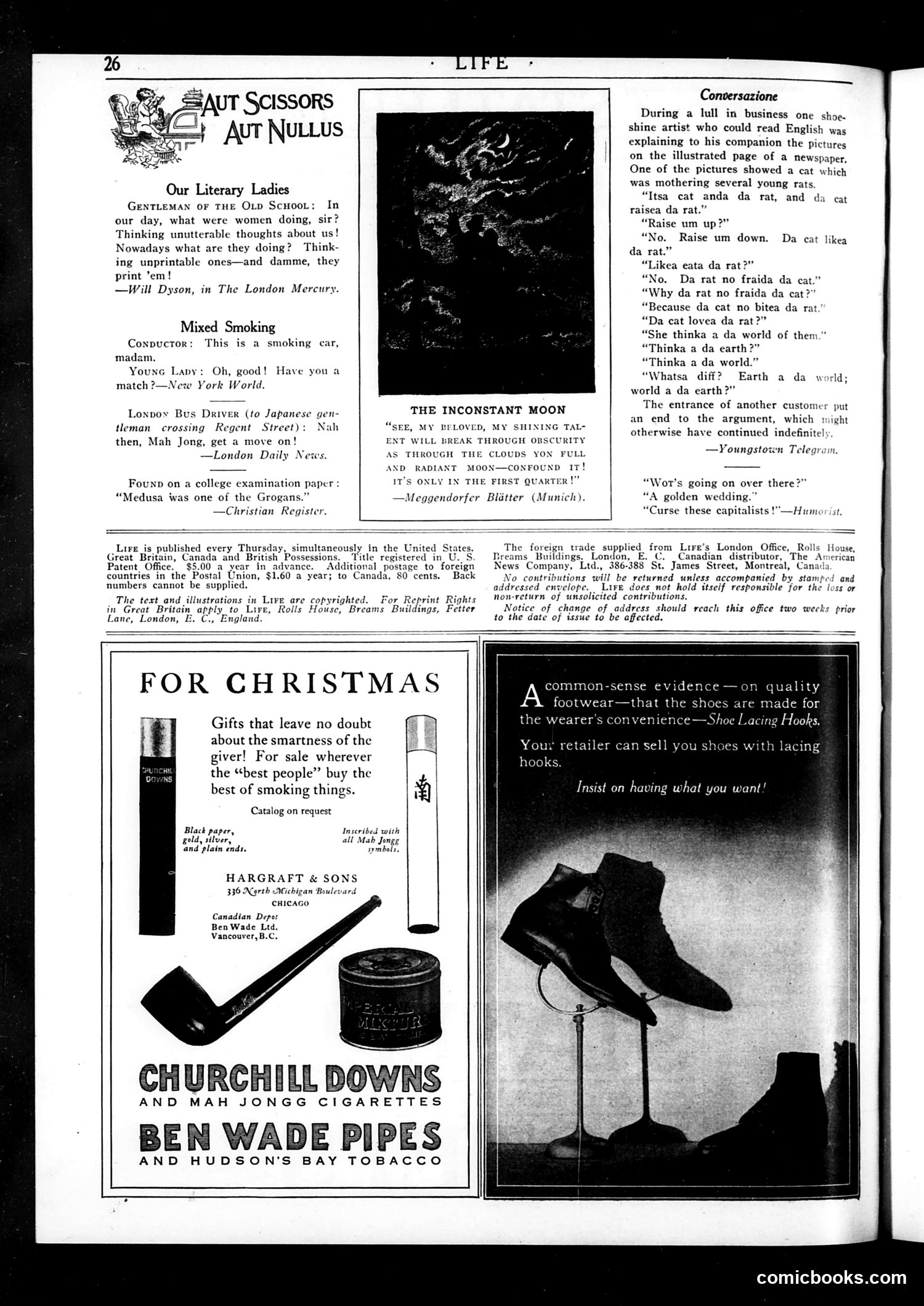
This page combines satirical commentary with advertisements, typical of 1920s Life magazine. **The Satire:** "Aut Scissors, Aut Nullus" ("Scissors or Nothing") collects brief humorous observations. The pieces mock contemporary social changes: women's increasing independence and outspokenness ("thinking unprintable ones—and damme, they print 'em!"), casual smoking etiquette ("mixed smoking" in public transport), and a comedic dialogue between two shoeshine workers discussing a newspaper photo of a cat mothering rats—playing on language barriers and working-class philosophy. **The Cartoon:** "The Inconstant Moon" likely satirizes romantic poetry and lovers' complaints about the moon's unreliability as a metaphor for constancy. **The Advertisements:** The Christmas ads promote smoking products (pipes, cigarettes, tobacco) and shoe lacing hooks—positioned as "gifts" for discerning people. This reflects the era before tobacco health warnings. The page documents 1920s attitudes: emerging female autonomy treated as comic shock, working-class urban life, and casual promotion of smoking as luxury goods.
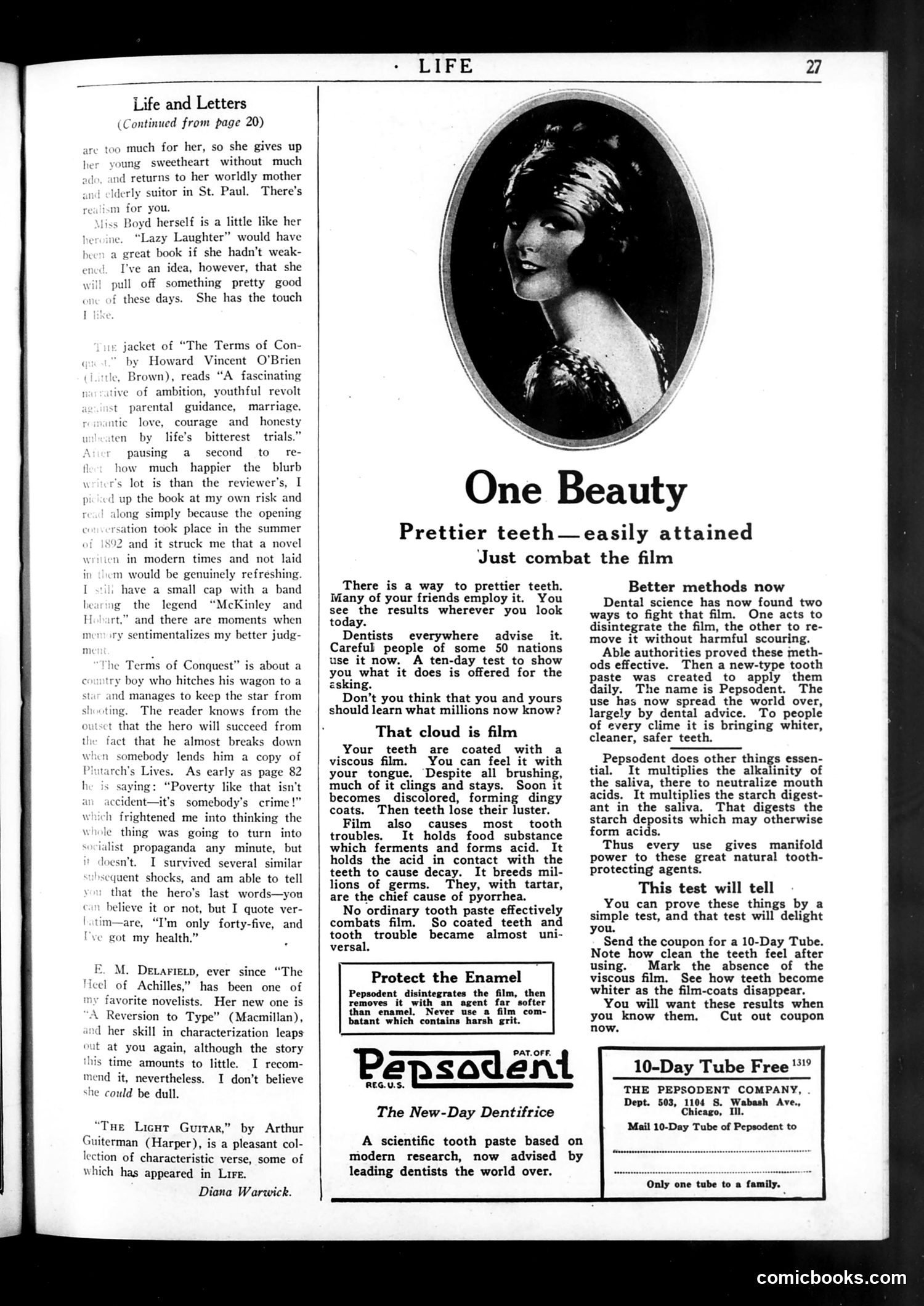
This page is primarily **advertising**, not political satire. The dominant content is a Pepsodent toothpaste advertisement featuring a glamorous woman's portrait and the headline "One Beauty." The ad represents early 20th-century marketing strategy: it explains a scientific "problem" (invisible film coating teeth) that the advertiser claims to have solved. The copy promises prettier teeth through this new product, citing endorsements from "dentists everywhere" and "careful people of some 50 nations"—typical persuasion tactics of the era. The left column contains book reviews from *Life*'s "Life and Letters" section, discussing novels by various authors. These are literary criticism, not satire. **There is no political cartoon on this page.** The imagery is purely commercial—a beauty advertisement designed to sell toothpaste by appealing to vanity and manufactured anxiety about dental hygiene.
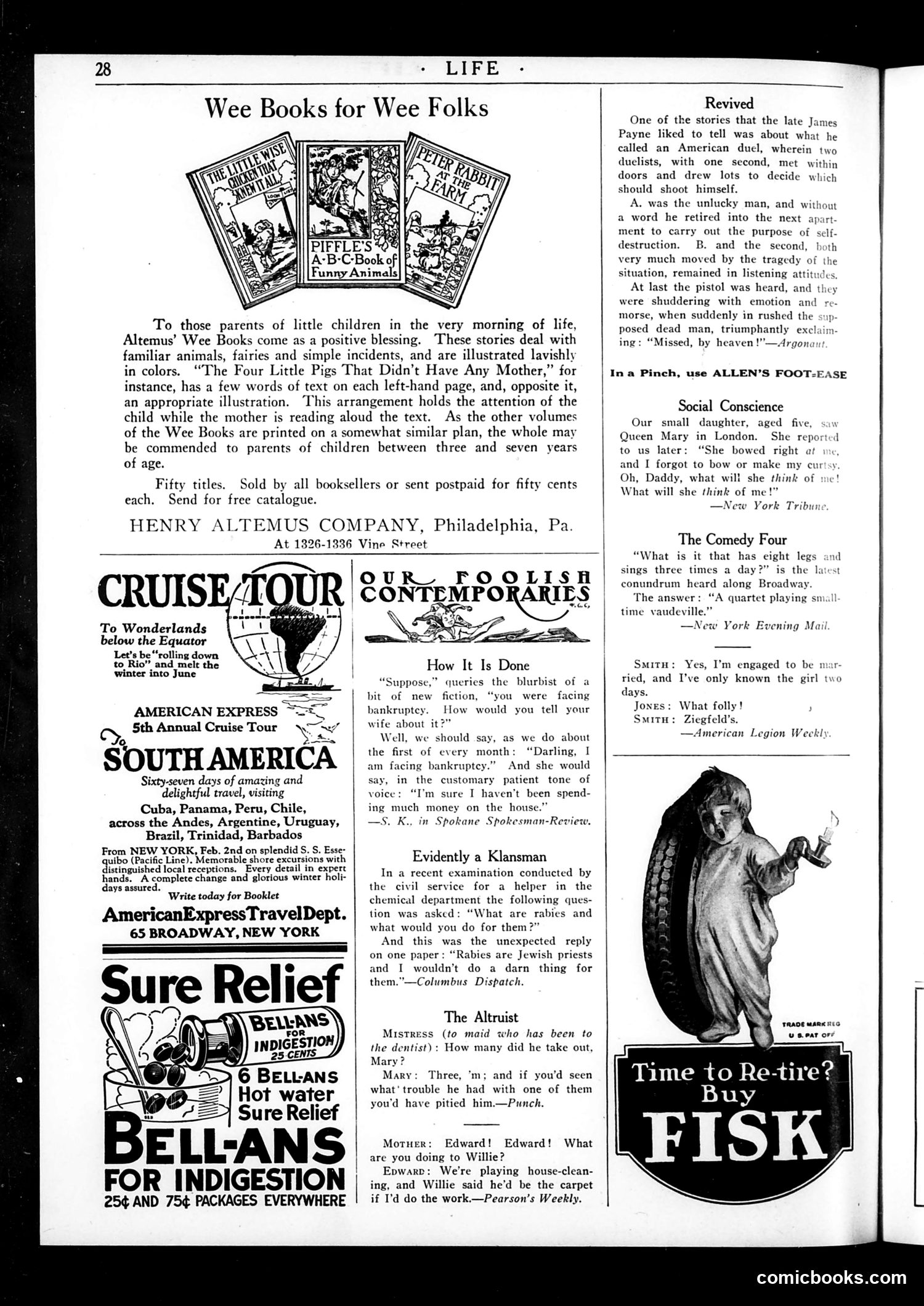
This page is primarily **advertising and humor content**, typical of Life magazine's mixed format. Key sections: **Main Content:** - **"Wee Books for Wee Folks"** advertisement for children's literature published by Henry Altemus Company - Multiple **travel and product ads** (American Express cruises to South America, Bellans indigestion remedy, Fisk tires) **Humor Sections:** Several short jokes appear, including one titled **"Evidently a Klansman"** — a civil service exam joke where an applicant defines "rabies" as "Jewish priests" and says he "wouldn't do a darn thing for them." This is a direct satirical jab at the KKK's antisemitism and general ignorance, treating bigotry as ridiculous. Other jokes mock marital dynamics, dental visits, and children's play. **No political cartoons appear** on this page; instead, the satire is embedded in the humor columns, critiquing contemporary American prejudices and social absurdities through brief anecdotes.
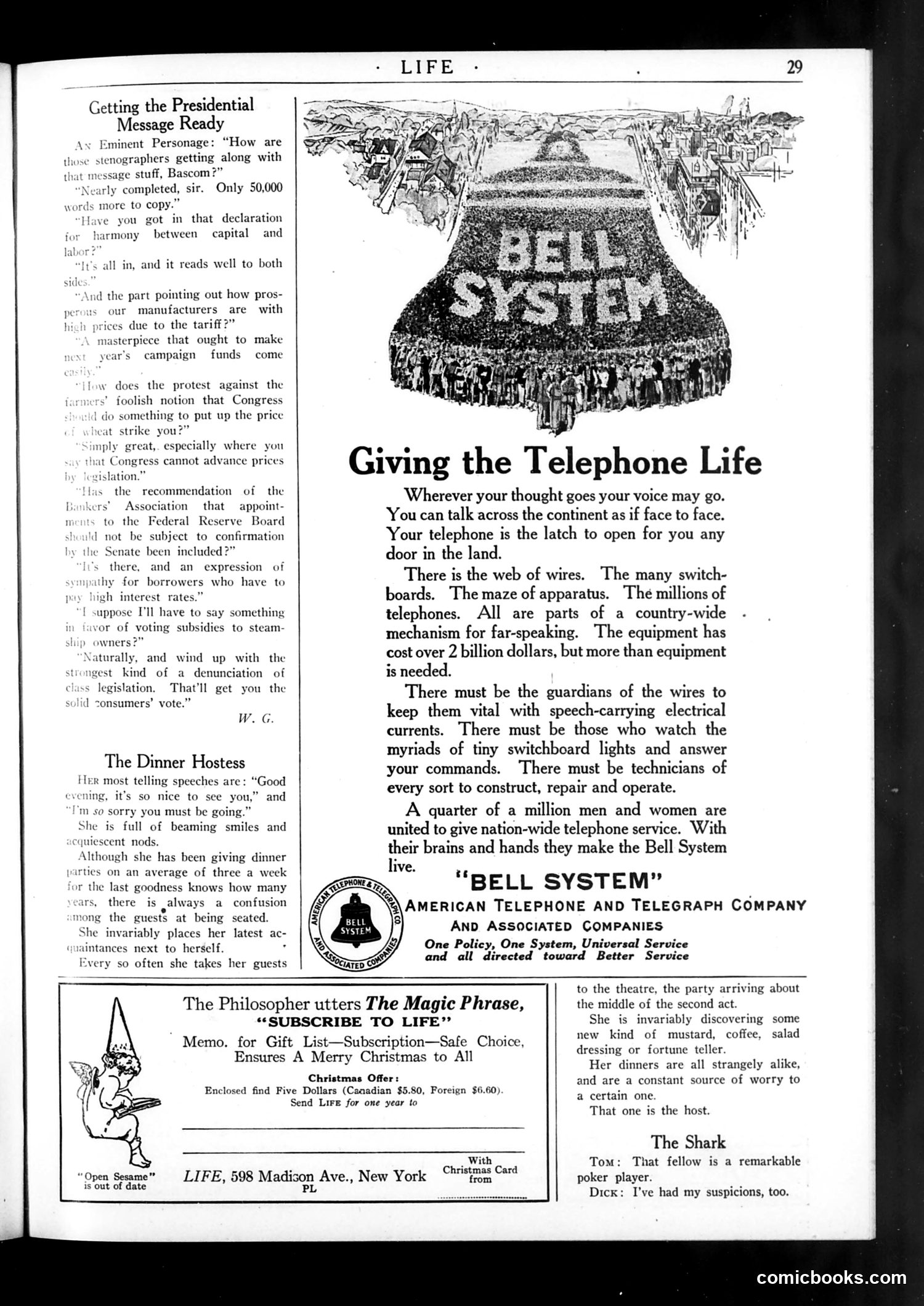
This page contains satirical commentary on **presidential speechwriting** and several advertisements. The main cartoon, "Getting the Presidential Message Ready," depicts a politician (addressed as "Bascom") discussing a prepared presidential speech. The satire mocks how campaign speeches are constructed to appeal to multiple constituencies—containing pro-business tariff arguments, anti-labor rhetoric, Federal Reserve recommendations, and subsidies for steamship owners—all packaged to win voter support. The joke is that the speech cynically combines contradictory positions tailored to different interest groups rather than expressing genuine principle. The page also includes: - A lengthy **Bell System advertisement** celebrating telephone infrastructure - "The Dinner Hostess," a social satire about a woman hosting frequent dinners - "The Shark," a brief joke about a poker player The political satire reflects early-20th-century concerns about manufactured political messaging and pandering to special interests during election campaigns.
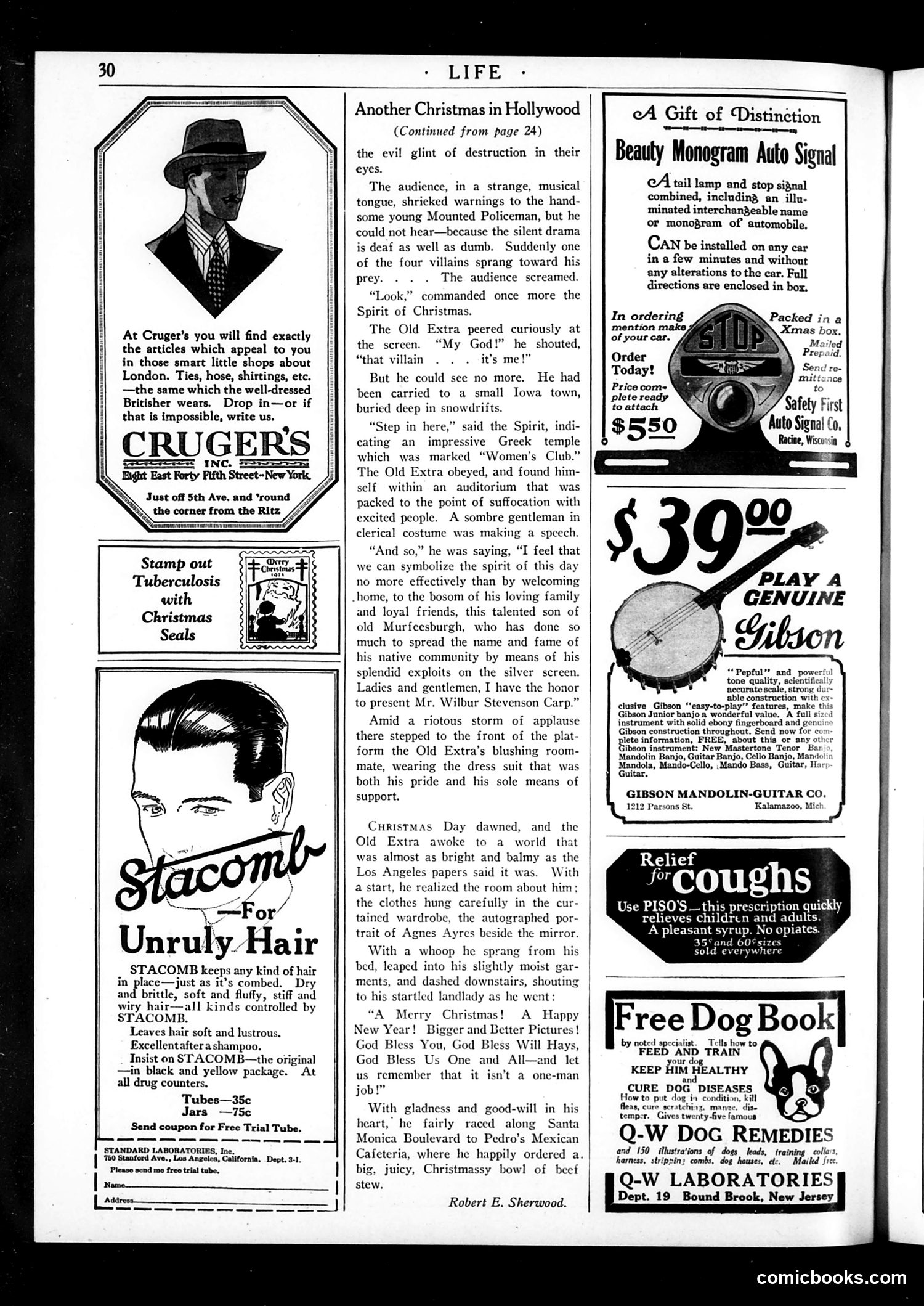
This page presents a serialized short story by Robert E. Sherwood about an aging, struggling extra in silent-era Hollywood. The narrative uses a *Christmas Carol*-like structure: a "Spirit of Christmas" shows the Old Extra scenes of his former glory—a young Mounted Policeman he once played on film, and his roommate being honored back home in their native Iowa town. The satire targets Hollywood's harsh treatment of aging actors and the gap between screen fame and real-life poverty. The Old Extra's roommate owns only one suit, which serves as both his pride and sole asset. The story's gentle irony culminates in the Extra's humble Christmas joy—ordering beef stew—suggesting that redemption comes through accepting modest reality rather than chasing cinematic glory. References to "Will Hays" (Hollywood's censor) and "Agnes Ayres" (a contemporary silent film star) ground this in 1920s cinema culture. The page also contains period advertisements for hair products and musical instruments.
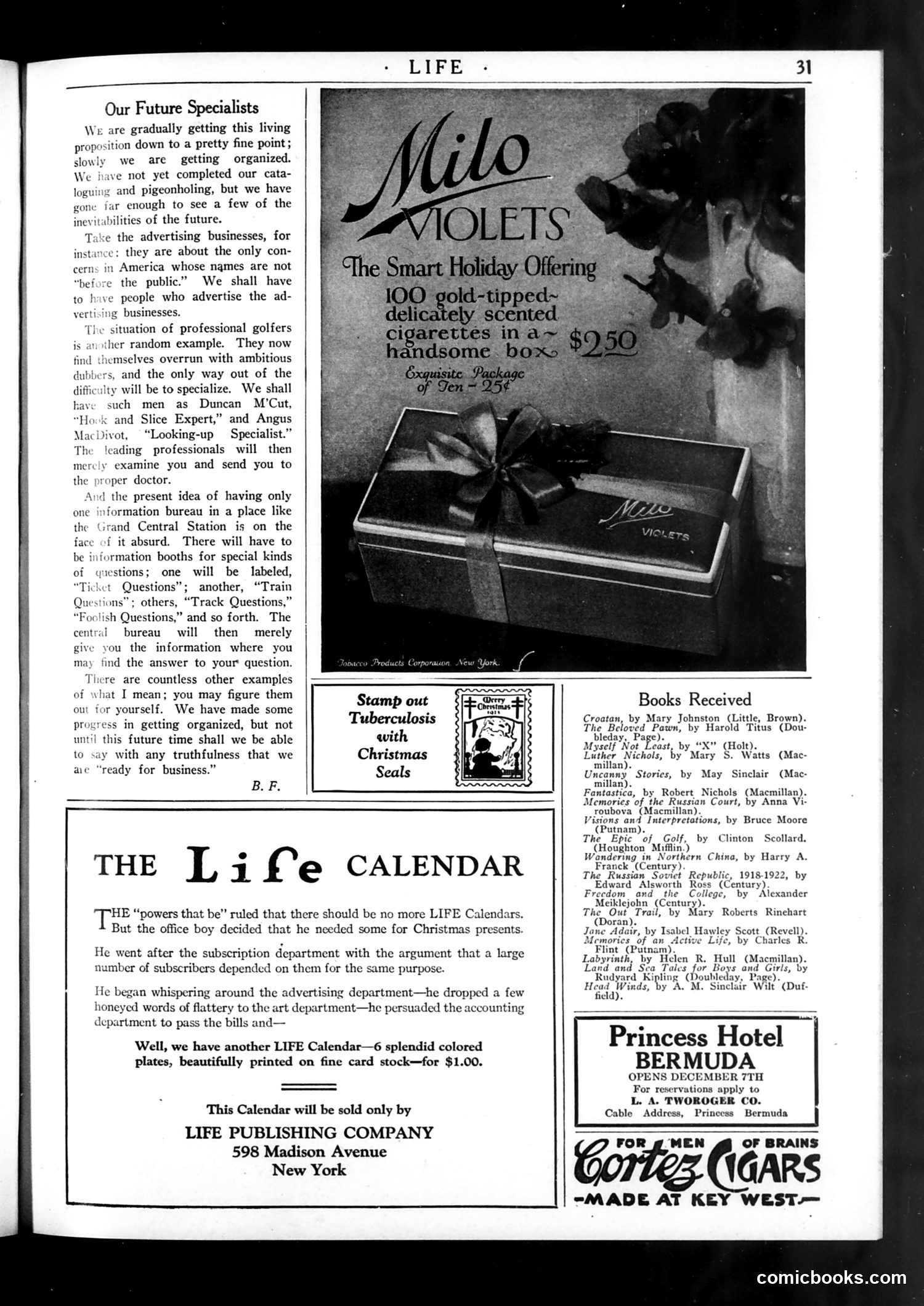
This article satirizes early 20th-century America's obsession with specialization and bureaucratic organization. The author (B.F.) mocks the trend of fragmenting professions into ever-narrower specialties. The satire targets absurdities already visible: advertising agencies will need people to advertise *advertising itself*; golf professionals will split into subspecialists like "Hook and Slice Expert" and "Looking-up Specialist"; Grand Central Station's single information bureau will spawn dozens of specialized booths for "Ticket Questions," "Foolish Questions," etc. The humor lies in extrapolating real organizational trends to ridiculous extremes—suggesting that modern society's drive toward efficiency and expertise is producing increasingly pointless fragmentation. The office-boy anecdote about the LIFE Calendar reinforces this: despite corporate rules against calendars, one determined employee navigates the bureaucracy by appealing to different departments' interests—itself an example of unnecessary specialization. The piece is mostly **advertising and filler** rather than a traditional political cartoon.
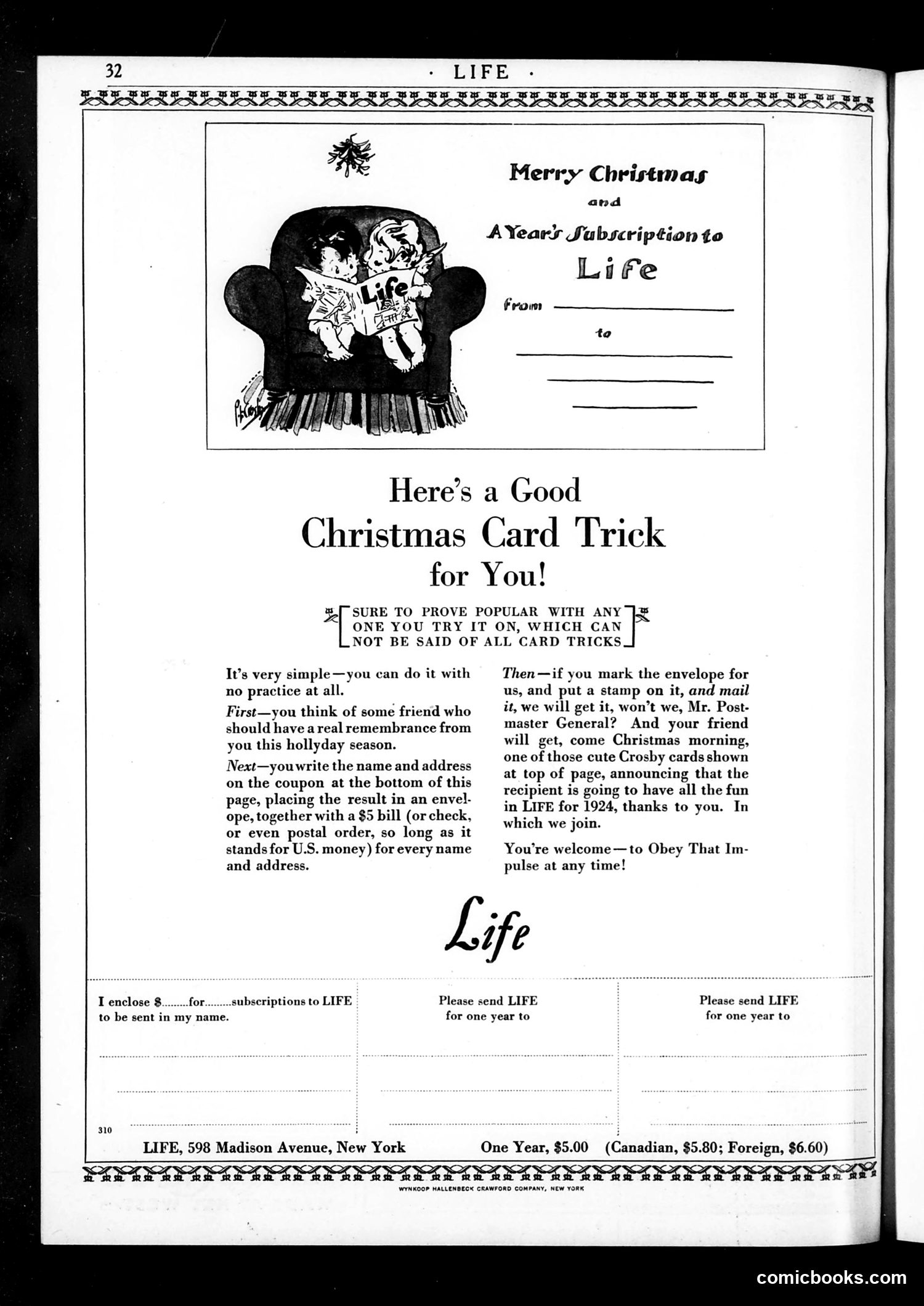
This page is primarily a **subscription advertisement** rather than a political cartoon. It promotes Life magazine's Christmas gift offer: a one-year subscription for $5. The "Christmas Card Trick" is a humorous sales pitch. The "trick" is straightforward—send Life magazine money with a recipient's name, and Life will mail them a Crosby card announcing their year-long subscription as a gift. The joke's appeal lies in its simplicity presented as clever deception: there's no actual card trick involved, just a straightforward transaction dressed up in playful language. The cute illustration at top shows children with a Life magazine, reinforcing the gift's appeal. The phrase "Obey That Impulse" at the end uses mild persuasive language typical of 1920s advertising. There are no political references or caricatures—this is commercial messaging targeting holiday gift-givers.
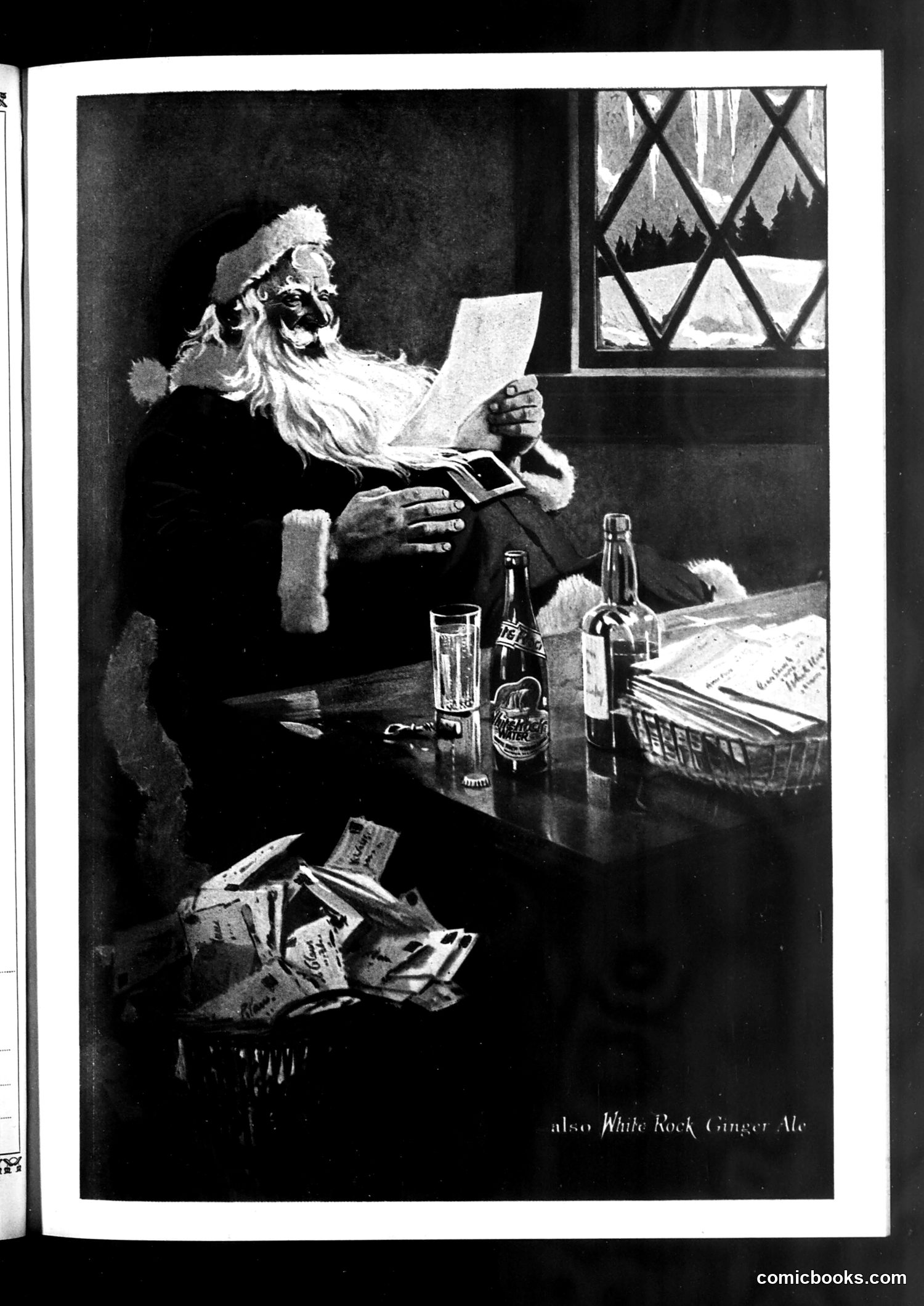
This is a vintage advertisement rather than political satire. It depicts Santa Claus at what appears to be his workshop or headquarters during the Christmas season. He sits at a desk reviewing what looks like letters or lists (presumably from children), surrounded by bottles of White Rock Ginger Ale and scattered gift boxes or merchandise. The ad uses the Santa figure to convey holiday cheer and wholesomeness while promoting the ginger ale beverage. The snowy window and cozy interior setting reinforce seasonal themes. The "also" in the text suggests this was part of a larger advertising campaign. The message implicitly links the product with Christmas tradition and family celebration—common marketing strategies for beverages during the holiday season.
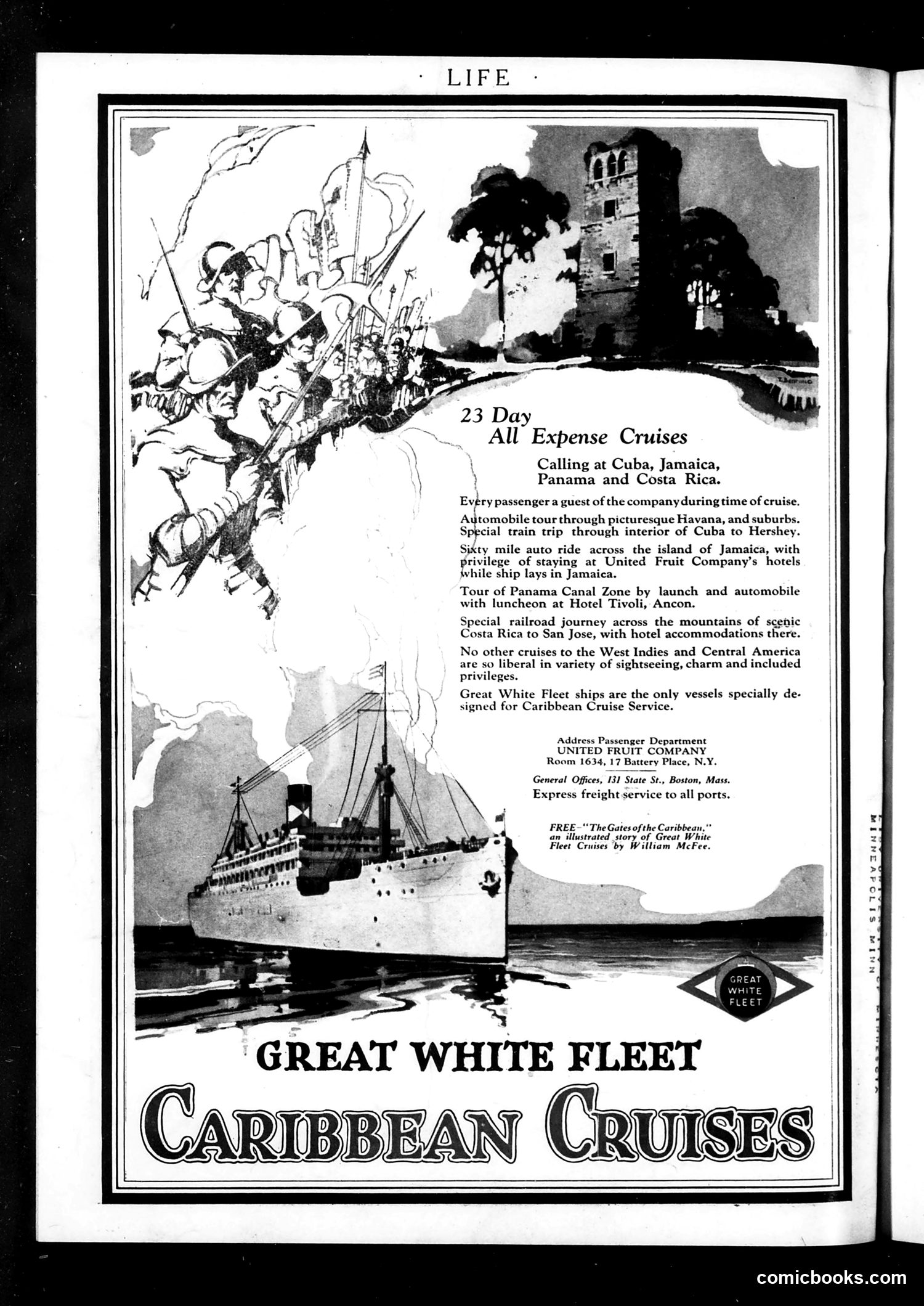
This is a **cruise line advertisement**, not political satire. The United Fruit Company advertises luxury 23-day Caribbean cruises aboard their "Great White Fleet" ships. The illustration shows colonial-era conquistadors and conquistador imagery (left side), contrasting with a modern steamship and Caribbean colonial architecture (right side). This juxtaposition appears designed to evoke romance and historical adventure—suggesting passengers will experience exotic colonial settings. The ad emphasizes all-inclusive luxury: automobile tours, private train trips, and stays at United Fruit Company hotels throughout Cuba, Jamaica, Panama, and Costa Rica. A free illustrated booklet is offered. **For modern readers**: This reflects early 20th-century American leisure travel and United Fruit's commercial dominance in Central America. The romanticized colonial imagery would be considered problematic today, but contemporary audiences saw it as appealing exoticism. The ad subtly reinforces U.S. corporate control over Caribbean infrastructure and tourism.