
Life, 1923-12-13 · page 16 of 36
Life — December 13, 1923 — page 16: what you’re looking at
What you’re looking at
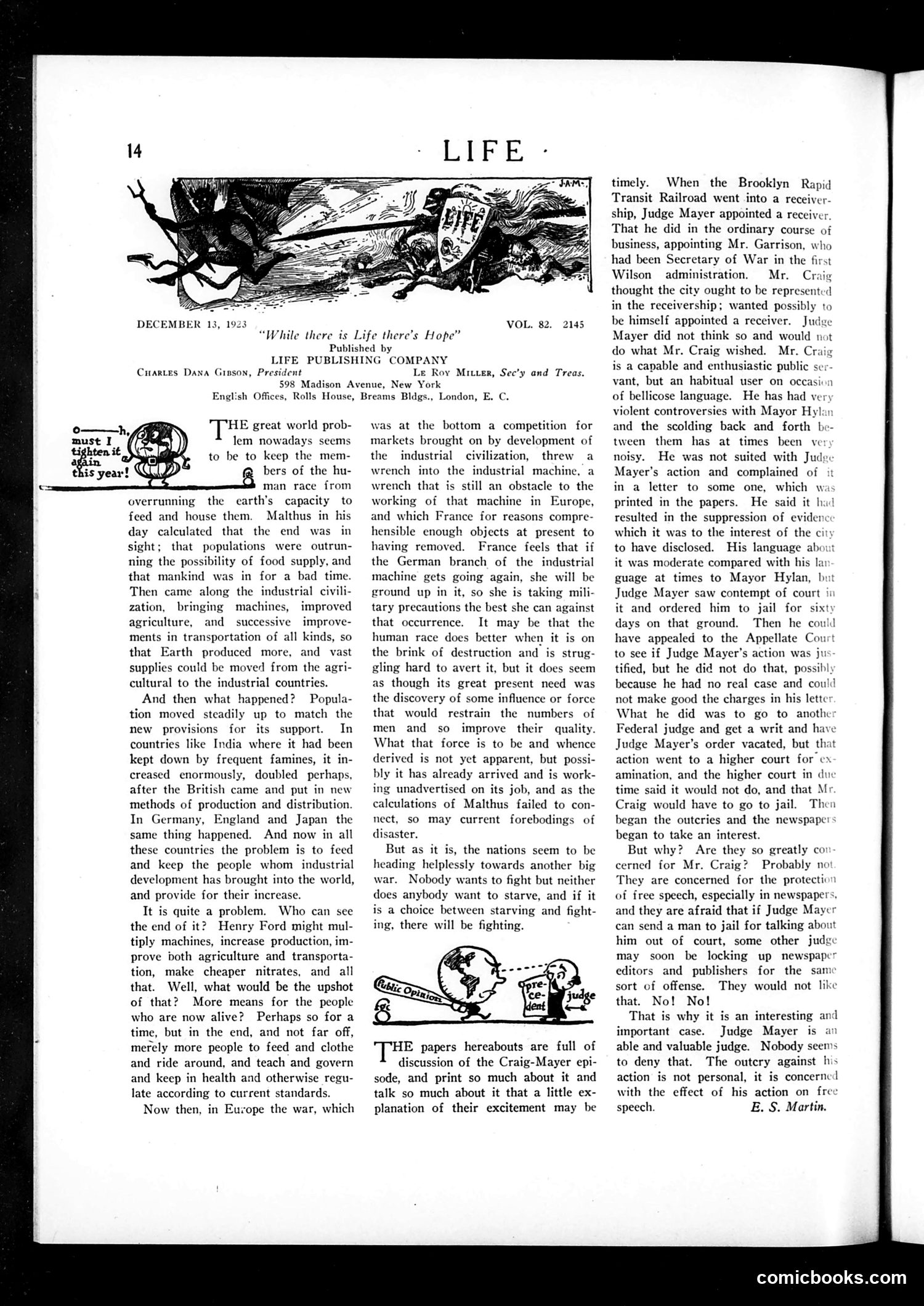
This December 1923 *Life* page discusses a legal dispute between judges Craig and Mayer regarding the Brooklyn Rapid Transit Railroad receivership. Judge Mayer appointed a receiver; Judge Craig objected, viewing it as a power grab. The article criticizes Craig's inflammatory letter published in newspapers, warning this could set a dangerous precedent for judicial conduct—judges jailing journalists for reporting on court matters. The cartoons illustrate the dispute: the top shows Craig and Mayer in conflict (the figure labeled "FIRE" suggesting inflammatory rhetoric), while the lower cartoon depicts a globe labeled with legal terms, suggesting the case's broader implications for free speech and judicial authority. The satire criticizes judges weaponizing contempt charges against press freedom.
📄 Transcribed text from this page (OCR, searchable)
Machine-transcribed from the original scan — historical spelling and the odd misread are preserved.
this year! “While there is Life there’s Hope” Published by LIFE Cuartes Dana Grnson, President PUBLISHING COMPANY Le Roy Miter, Sec’y and Treas. 598 Madison Avenue, New York English Offices, Rolls House, Breams Bldgs., London, E. C. THE great world prob- lem nowadays seems to be to keep the mem- @ bers of the hu- man race from overrunning the earth's capacity to feed and house them. Malthus in his day calculated that the end was in sight; that populations were outrun- ning the possibility of food supply, and that mankind was in for a bad time. Then came along the industrial civili- zation, bringing machines, improved agriculture, and successive improve- ments in transportation of all kinds, so that Earth produced more, and vast supplies could be moved from the agri- cultural to the industrial countries. And then what happened? Popula- tion moved steadily up to match the new provisions for its support. In countries like India where it had been kept down by frequent famines, it in- creased enormously, doubled perhaps, after the British came and put in new methods of production and distribution. In Germany, England and Japan the same thing happened. And now in all these countries the problem is to feed and keep the people whom industrial development has brought into the world, and provide for their increase. It is quite a problem. Who can see the end of it? Henry Ford might mul- tiply machines, increase production, im- prove both agriculture and transporta- tion, make cheaper nitrates, and all that. Well, what would be the upshot of that? More means for the people who are now alive? Perhaps so for a time, but in the end, and not far off, merely more people to feed and clothe and ride around, and teach and govern and keep in health and otherwise regu- late according to current standards. Now then, in Europe the war, which was at the bottom a competition for markets brought on by development of the industrial civilization, threw a wrench into the industrial machine, a wrench that is still an obstacle to the working of that machine in Europe, and which France for reasons compre- hensible enough objects at present to having removed. France feels that if the German branch of the industrial machine gets going again, she will be ground up in it, so she is taking mili- tary precautions the best she can against that occurrence. It may be that the human race does better when it is on the brink of destruction and is strug- gling hard to avert it, but it does seem as though its great present need was the discovery of some influence or force that would restrain the numbers of men and so improve their quality. What that force is to be and whence derived is not yet apparent, but possi- bly it has already arrived and is work- ing unadvertised on its job, and as the calculations of Malthus failed to con- nect, so may current forebodings of disaster. But as it is, the nations seem to be heading helplessly towards another big war. Nobody wants to fight but neither does anybody want to starve, and if it is a choice between starving and fight- ing, there will be fighting. THE papers hereabouts are full of discussion of the Craig-Mayer epi- sode, and print so much about it and talk so much about it that a little ex- planation of their excitement may be timely. When the Brooklyn Rapid Transit Railroad went into a receiver- ship, Judge Mayer appointed a receiver. That he did in the ordinary course of business, appointing Mr. Garrison, who had been Secretary of War in the first Wilson administration. Mr. Craig thought the city ought to be represented in the receivership; wanted possibly to be himself appointed a receiver. Judy Mayer did not think so and would not do what Mr. Craig wished. Mr. Craig is a capable and enthusiastic public ser- vant, but an habitual user on occasion of bellicose language. He has had ver violent controversies with Mayor Hyla: and the scolding back and forth be- tween them has at times been ve noisy. He was not suited with Judy: Mayer's action and complained of in a letter to some one, which w printed in the papers. He said it h resulted in the suppression of evidenc which it was to the interest of the city to have disclosed. His language abx it was moderate compared with his lai guage at times to Mayor Hylan, but Judge Mayer saw contempt of court in it and ordered him to jail for sixt days on that ground. Then he could have appealed to the Appellate Court to see if Judge Mayer's action was ju tified, but he did not do that, possi because he had no real case and could not make good the charges in his lett What he did was to go to anothe Federal judge and get a writ and have Judge Mayer's order vacated, but that action went to a higher court for ex amination, and the higher court in duc time said it would not do, and that Mr Craig would have to go to jail. Then began the outcries and the newspapers began to take an interest. But why? Are they so greatly co’ cerned for Mr. Craig? Probably no They are concerned for the protection of free speech, especially in newspapers, and they are afraid that if Judge Mayer can send a man to jail for talking about him out of court, some other judg may soon be locking up newspaper editors and publishers for the sam sort of offense. They would not like that. No! No! That is why it is an interesting and important case. Judge Mayer 1 able and valuable judge. Nobody s to deny that. The outcry against his action is not personal, it is concerned with the effect of his action on fre speech. E. S. Martin. comicbooks.com