
Life, 1923-12-13 · page 22 of 36
Life — December 13, 1923 — page 22: what you’re looking at
What you’re looking at
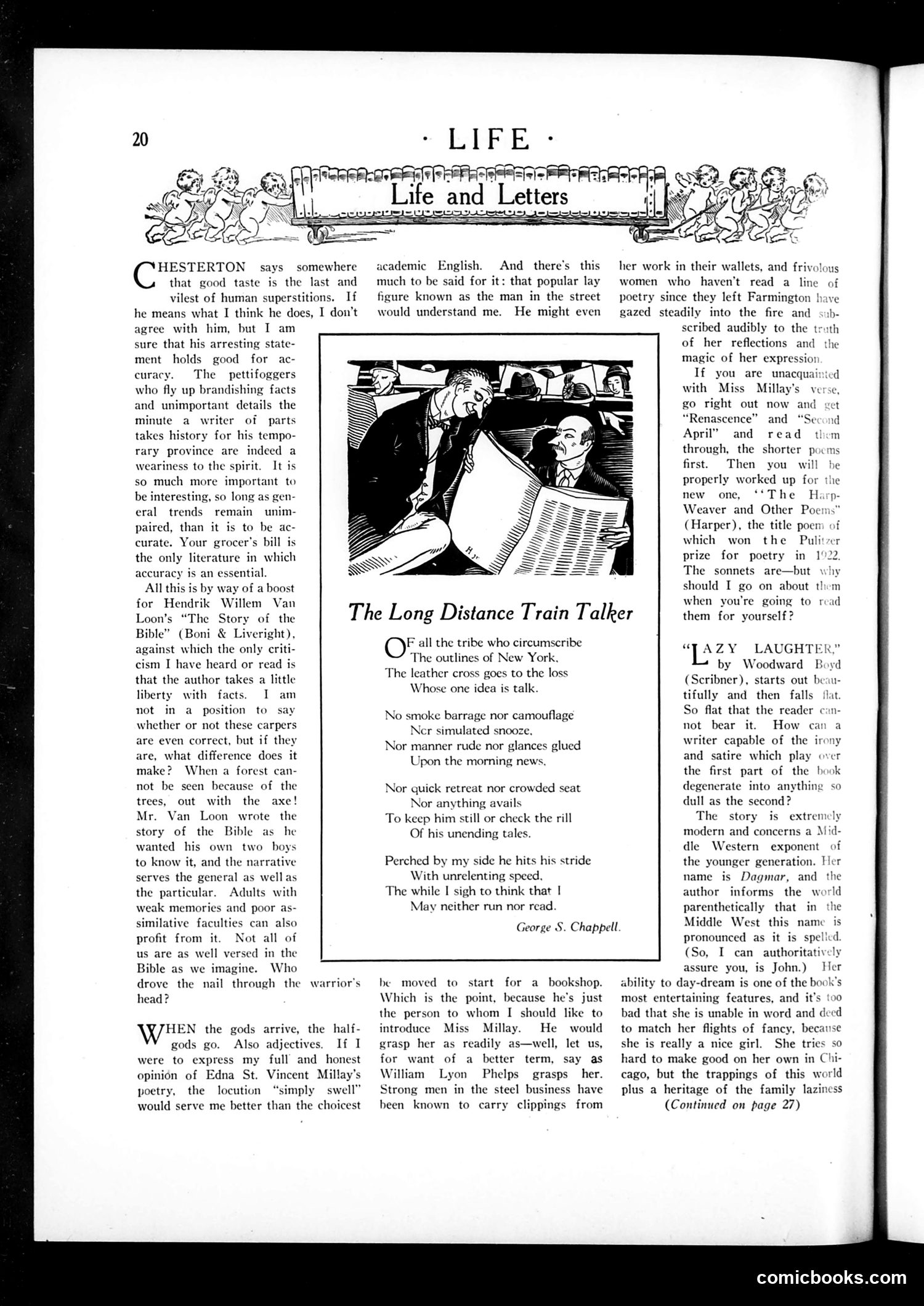
This page features a humorous poem by George S. Chappell about an annoying fellow passenger on a train who talks incessantly. The illustration shows two men in a train car—one attempting to read a newspaper while his seatmate gestures animatedly, dominating the conversation. The poem's joke is timeless: the talkative passenger prevents the narrator from doing anything ("May neither run nor read"), describing how no social avoidance strategy works against "his unending tales." The surrounding text discusses poet Edna St. Vincent Millay and the value of accessible literary criticism, suggesting Life's editorial stance that good writing should engage ordinary readers ("the man in the street"), not just academics. The train-talker poem exemplifies this democratized approach to humor—a relatable, everyday frustration rendered as sophisticated verse for a general audience.
📄 Transcribed text from this page (OCR, searchable)
Machine-transcribed from the original scan — historical spelling and the odd misread are preserved.
HESTERTON somewhere that good taste and vilest of human superstitions. If he means what I think he does, I don’t agree with him, but I am sure that his arresting state- ment holds good for ac- curacy. The pettifoggers who fly up brandishing facts and unimportant details the minute a writer of parts takes history for his tempo- rary province are indeed a It is so much more important to weariness to the spirit. be interesting, so long as gen- eral trends remain unim- paired, than it is to be ac- curate. Your grocer’s bill is the only literature in which s an essential. y of a boost for Hendrik Willem Van Loon’s “The Story of the Bible” (Boni & Liveright), against which the only criti- cism I have heard or read is that the author takes a little liberty with facts. I not in a position to whether or not these carpers are even correct, but if they are, what difference does it make? When a forest can- not be seen because of the trees, out with the Mr. Van Loon wrote story of the Bible wanted his own two boys to know it, and the narrative serves the general as well as the particular. Adults with weak memories and poor as- similative faculties can also profit from it. Not all of us are as well versed in the Bible as we imagine. Who drove the nail through the head? am say axe! the as he warrior’s HEN the gods arrive, the half- gods go. Also adjectives. If I were to express my full and honest opinion of Edna St. Vincent Millay’s poetry, the locution “simply swell” would serve me better than the choicest = _Life and _L academic English. And there's this much to be said for it: that popular lay figure known as the man in the street would understand me. He might even F all the tribe who circumscribe The outlines of New York. The leather cross goes to the loss Whose one idea is talk. No smoke barrage nor camouflage Ner simulated snooze, Nor manner rude nor glances glued Upon the morning news. Nor quick retreat nor crowded seat Nor anything avails To keep him still or check the rill Of his unending tales. Perched by my side he hits his stride With unrelenting speed, The while | sigh to think that | May neither run nor read. George 5. Chappell be moved to start for a bookshop. Which is the point, because he’s just the person to whom I should like to introduce Miss Millay. He would grasp her as readily as—well, let us, for want of a better term, say as William Lyon Phelps grasps her. Strong men in the steel business have been known to carry clippings from her work in their wallets, and frivolo women poetry who haven't read a_ line since they left Farmington | gazed steadily into the fire and The Long Distance Train Talker scribed audibly to the t of her reflections and magic of her expressio: If you are unacquai with Miss Millay’s ve go right out now and “Renascence” and “Si April”? and read ¢ through, the shorter poci first. Then you will properly worked up for + new one, ‘‘The H Weaver and Other Poe (Harper), the title poen which won the Pulitx prize for poetry in 1°22 The sonnets are—but should I go on about t! when you're going to r them for yourself? AZY LAUGHTER, by Woodward B (Scribner), starts out bi tifully and then falls So flat that the reader « not bear it. How writer capable of the ir and satire which play « the first part of the book degenerate into anything dull as the second? The story is extreme! modern and concerns a Mi dle Western exponent the younger generation. name is Dagmar, and author informs the w parenthetically that in Middle West this name is pronounced as it is spelled. (So, I can authoritatively assure you, is John.) Her can the ability to day-dream is one of the book's most entertaining features, and it’s ‘00 bad that she is unable in word and deed to match her flights of fancy, because she is really a nice girl. hard to make good on her own in Chi- cago, but the trappings of this world plus a heritage of the family laziness (Continued on page 27) comicbooks.com