
Life, 1923-12-13 · page 26 of 36
Life — December 13, 1923 — page 26: what you’re looking at
What you’re looking at
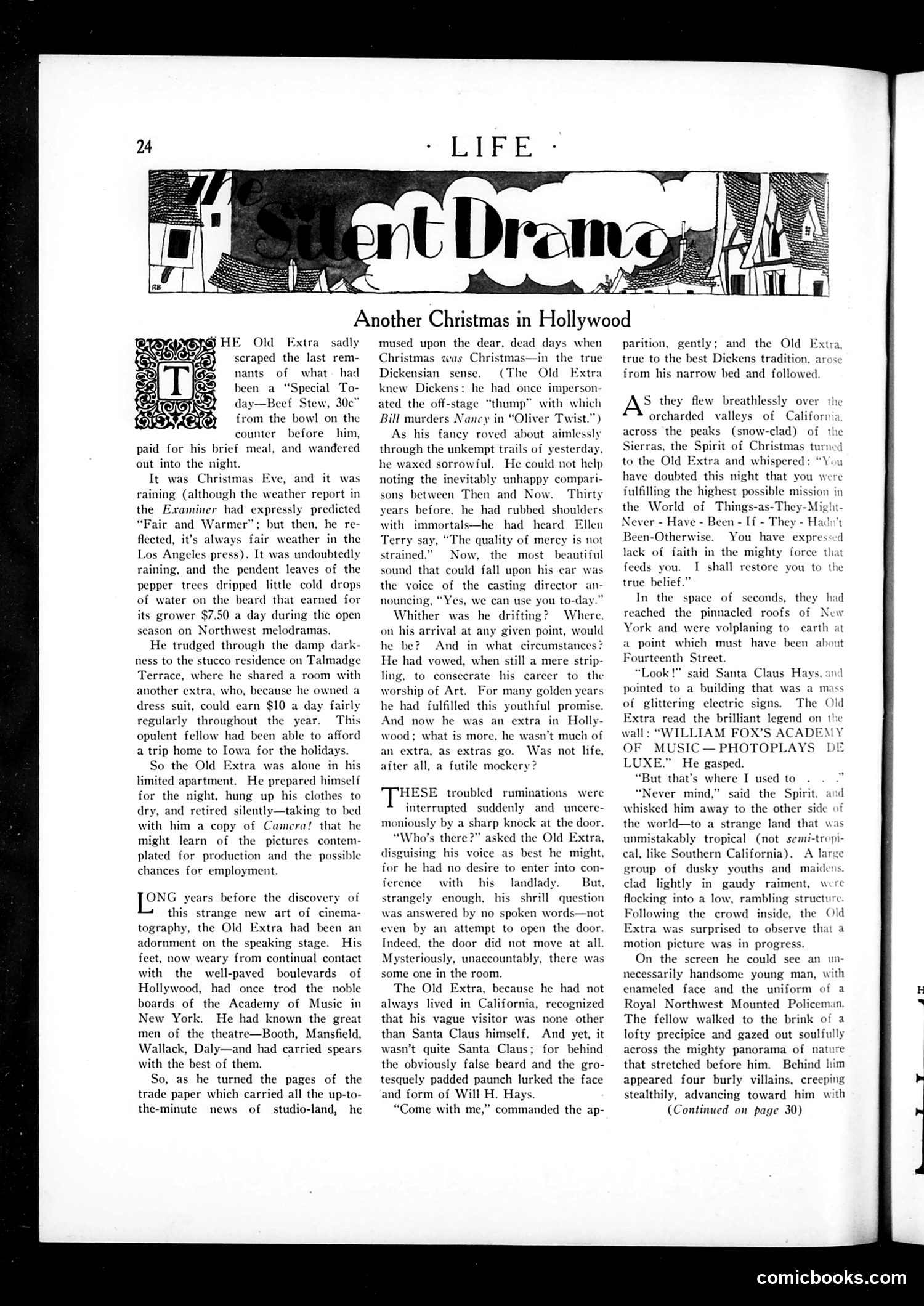
This is a sentimental satirical story about an aging stage actor reduced to playing minor film extras in Hollywood. The narrative contrasts his former prestige—he performed alongside legendary actors like Edwin Booth and knew Ellen Terry—with his current degradation: earning $7.50 daily as background talent, living in a shabby rooming house, and desperately studying trade papers for work opportunities. The satire targets Hollywood's ruthless treatment of aging performers and the film industry's indifference to theatrical tradition. The Old Extra's Christmas Eve solitude, his poverty (a 30-cent beef stew dinner), and his bitter reflections on how art has become a "futile mockery" underscore the story's melancholy critique. The mysterious knock at his door—which appears to be Santa Claus—suggests an intervening fantasy conclusion about to unfold, likely offering redemption or harsh reality check.
📄 Transcribed text from this page (OCR, searchable)
Machine-transcribed from the original scan — historical spelling and the odd misread are preserved.
Another Christmas in Hollywood Old Extra sadly scraped the last rem- nants of what had been a “Special To- day—Beef Stew, 30c” from the bowl on the counter before him, paid for his brief meal, and wandered out into the night. It was Christmas Eve, and it was raining (although the weather report in the Examiner had expressly predicted “Fair and Warme but then, he re- flected, it’s always fair weather in the Los Angeles press). It was undoubtedly raining, and the pendent leaves of the pepper trees dripped little cold drops of water on the beard that earned for its grower $7.50 a day during the open season on Northwest melodramas. He trudged through the damp dark- ness to the stucco residence on Talmadge Terrace, where he shared a room with another extra, who, because he owned a dress suit, could earn $10 a day fairly regularly throughout the year. This opulent fellow had been able to afford a trip home to Iowa for the holidays. So the Old Extra was alone in hi limited apartment. He prepared him for the night, hung up his clothes to dry, and retired silently—taking to bed with him a copy of Camera! that he might learn of the pictures contem- plated for production and the possible chances for employment. [? G years before the discovery of this strange new art of cinema- tography, the Old Extra had been an adornment on the speaking stage. His feet, now weary from continual contact with the well-paved boulevards of Hollywood, had once trod the noble boards of the Academy of Music in New York. He had known the great men of the theatre—Booth, Mansfield, Wallack, Daly—and had carried spe with the best of them. So, as he turned the pages of the trade paper which carried all the up-to- the-minute news of studio-land, he mused upon the dear, dead days when Christmas Christmas—in the true Dickensian sense. (The Old Extra knew Dickens: he had once imperson- ated the off-stage “thump” with which Bill murders Nancy in “Oliver Twist.”) As his fancy roved about aimlessly through the unkempt trails of yesterday, he waxed sorrowful. He could not help noting the inevitably unhappy compari- sons between Then and Now. Thirty years before, he had rubbed shoulders with immortals—he had heard E Terry say, “The quality of mercy strained. Now, the most bea sound that could fall upon his car was the voice of the casting director an- nouncing, “Yes, we can use you to-day.” Whither was he driftin Where, on his arrival at any given point, would he be? And in what circumstance: He had vowed, when still a mere strip- ling, to consecrate his career to the worship of Art. For many golden years he had fulfilled this youthful promise. And now he was an extra in Holly- wood; what is more, he wasn’t much of an extra, as extras go. Was not life, after all, a futile mockery? 'HESE troubled ruminations were interrupted suddenly and uncere- moniously by a sharp knock at the door. “Who's there?” asked the Old Extra, disguising his voice as best he might, for he had no desire to enter into con- ference with his landlady. — But, strangely enough, his shrill question was answered by no spoken words—not even by an attempt to open the door. Indeed, the door did not move at all. Mysteriously, unaccountably, there was some one in the room. The Old Extra, because he had not always lived in California, recognized that his vague visitor was none other than Santa Claus himself. And yet, it wasn’t quite Santa Claus; for behind the obviously false beard and the gro- tesquely padded paunch lurked the face and form of Will H. Hays. “Come with me,” commanded the ap- parition, gently; and the Old Extra true to the best Dickens tradition, arose from his narrow bed and followed. S they flew breathlessly over orcharded valleys of California, across the peaks (snow-clad) of the Sierras, the Spirit of Christmas turned to the Old tra and whispered: “You have doubted this night that you were fulfilling the highest possible missio the World of Things-as-They-Mi; Never - Have - Been - If - Th Been-Otherwise. You have exp lack of faith in the mighty force that feeds you. I shall restore you to the true belief.” In the space of seconds, they had reached the pinnacled roofs of New York and were volplaning to earth at a point which must have been about Fourteenth Street “Look !" said Santa Claus Hays, ad pointed to a building that was a mass of glittering electric signs. The Old Extra read the brilliant legend on the wall: “WILLIAM FOX’S ACADEMY OF MUSIC—PHOTOPLAYS DE LUXE.” He gasped. “But that’s where I used to “Never mind,” said the Spirit, and whisked him away to the other side of the world—to a strange land that was unmistakably tropical (not semi-tropi- cal, like Southern California). A la group of dusky youths and maid clad lightly in gaudy raiment, were flocking into a low, rambling structure Following the crowd ide, the Old Extra was surprised to observe that a motion picture was in progress. On the screen he could see an un- necessarily handsome young man, with enameled face and the uniform of a Royal Northwest Mounted Policeman. The fellow walked to the brink of a lofty precipice and gazed out soulfully across the mighty panorama of nature that stretched before him. Behind him appeared four burly villains, creeping stealthily, advancing toward him with (Continued on page 30) comicbooks.com an vy