
Life, 1923-12-13 · page 20 of 36
Life — December 13, 1923 — page 20: what you’re looking at
What you’re looking at
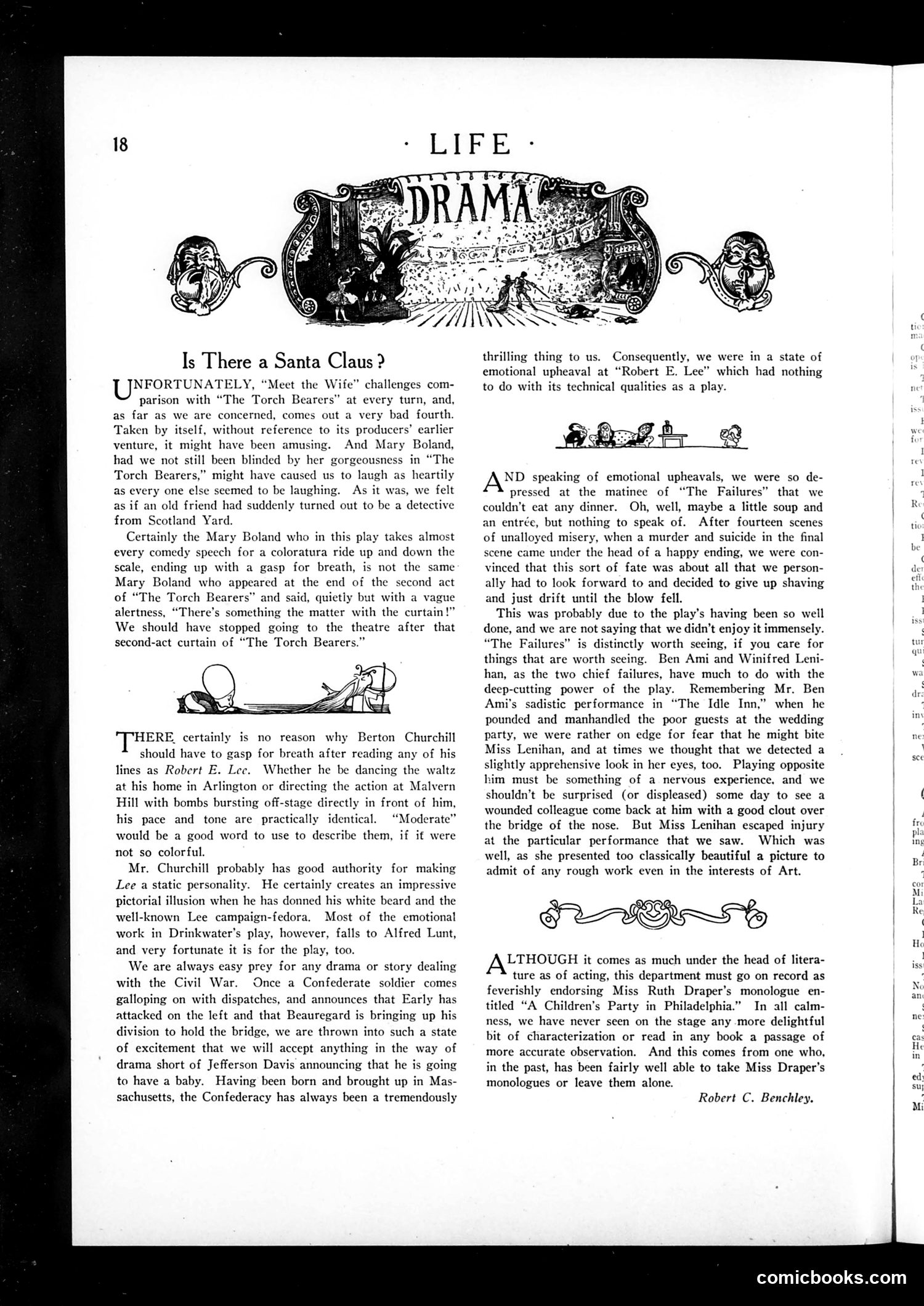
This is a theater criticism column reviewing three Broadway plays. The author compares "Meet the Wife" unfavorably to "The Torch Bearers," praising Mary Boland's earlier performance. He critiques actor Berton Churchill's portrayal of Robert E. Lee as monotonous, contrasting it with Alfred Lunt's more dynamic performance in the same production. The review of "The Failures" humorously describes its depressing quality—so effectively bleak that the reviewer lost his appetite, even though he acknowledges the play's technical merit. He praises lead actors Ben Ami and Winifred Lenihan's powerful performances, joking about Ben Ami's intense acting style ("sadistic performance") in a previous play, worrying he might actually bite his co-star. The small decorative cartoons are generic theatrical vignettes, not political commentary.
📄 Transcribed text from this page (OCR, searchable)
Machine-transcribed from the original scan — historical spelling and the odd misread are preserved.
Is There a Santa Claus > NFORTUNATELY, “Meet the W challenges com- parison with “The Torch Bearers” at every turn, and, as far as we are concerned, comes out a very bad fourth. Taken by itself, without reference to its producers’ earlier venture, it might have been amusing. And Mary Boland, had we not still been blinded by her gorgeousness in “The Torch Bearers,” might have caused us to laugh as heartily as every one else seemed to be laughing. As it was, we felt as if an old friend had suddenly turned out to be a detective from Scotland Yard. Certainly the Mary Boland who in this play takes almost every comedy speech for a coloratura ride up and down the scale, ending up with a gasp for breath, is not the same Mary Boland who appeared at the end of the second act of “The Torch Bearers” and said, quietiy but with a vague alertness, “There’s something the matter with the curtain!” We should have stopped going to the theatre after that second-act curtain of “The Torch Bearers.” 'HERE certainly is no reason why Berton Churchill should have to gasp for breath after reading any of his lines as Robert E. Lec. Whether he be dancing the waltz at his home in Arlington or directing the action at Malvern Hill with bombs bursting off-stage directly in front of him, his pace and tone are practically identical. “Moderate” would be a good word to use to describe them, if if were not so colorful. Mr. Churchill probably has good authority for making Lee a static personality. He certainly creates an impressive pictorial illusion when he has donned his white beard and the well-known Lee campaign-fedora. Most of the emotional work in Drinkwater’s play, however, falls to Alfred Lunt, and very fortunate it is for the play, too. We are always easy prey for any drama or story dealing with the Civil War. Once a Confederate soldier comes galloping on with dispatches, and announces that Early has attacked on the left and that Beauregard is bringing up his division to hold the bridge, we are thrown into such a state of excitement that we will accept anything in the way of drama short of Jefferson Davis announcing that he is going to have a baby. Having been born and brought up in Mas- sachusetts, the Confederacy has always been a tremendously thrilling thing to us. Consequently, we were in a state of emotional upheaval at “Robert E. Lee” which had nothing to do with its technical qualities as a play. ND speaking of emotional upheavals, we were so de- pressed at the matinee of “The Failures” that we couldn’t eat any dinner. Oh, well, maybe a little soup and an entrée, but nothing to speak of. After fourteen scenes of unalloyed misery, when a murder and suicide in the final scene came under the head of a happy ending, we were con- vinced that this sort of fate was about all that we person- ally had to look forward to and decided to give up shaving and just drift until the blow fell. This was probably due to the play’s having been so well done, and we are not saying that we didn’t enjoy it immensely. “The Failures” is distinctly worth seeing, if you care for things that are worth seeing. Ben Ami and Winifred Leni- han, as the two chief failures, have much to do with the deep-cutting power of the play. Remembering Mr. Ben Ami’s sadistic performance in “The Idle Inn,” when he pounded and manhandled the poor guests at the wedding party, we were rather on edge for fear that he might bite Miss Lenihan, and at times we thought that we detected a slightly apprehensive look in her eyes, too. Playing opposite him must be something of a nervous experience, and we shouldn’t be surprised (or displeased) some day to see a wounded colleague come back at him with a good clout over the bridge of the nose. But Miss Lenihan escaped injury at the particular performance that we saw. Which was well, as she presented too classically beautiful a picture to admit of any rough work even in the interests of Art. ee ee) LTHOUGH it comes as much under the head of litera- ture as of acting, this department must go on record as feverishly endorsing Miss Ruth Draper’s monologue en- titled “A Children’s Party in Philadelphia.” In all calm- ness, we have never seen on the stage any more delightful bit of characterization or read in any book a passage of more accurate observation. And this comes from one who, in the past, has been fairly well able to take Miss Draper’s monologues or leave them alone. Robert C. Benchley. comicbooks.com ed) su