
A complete issue · 34 pages · 1923
Life — October 25, 1923
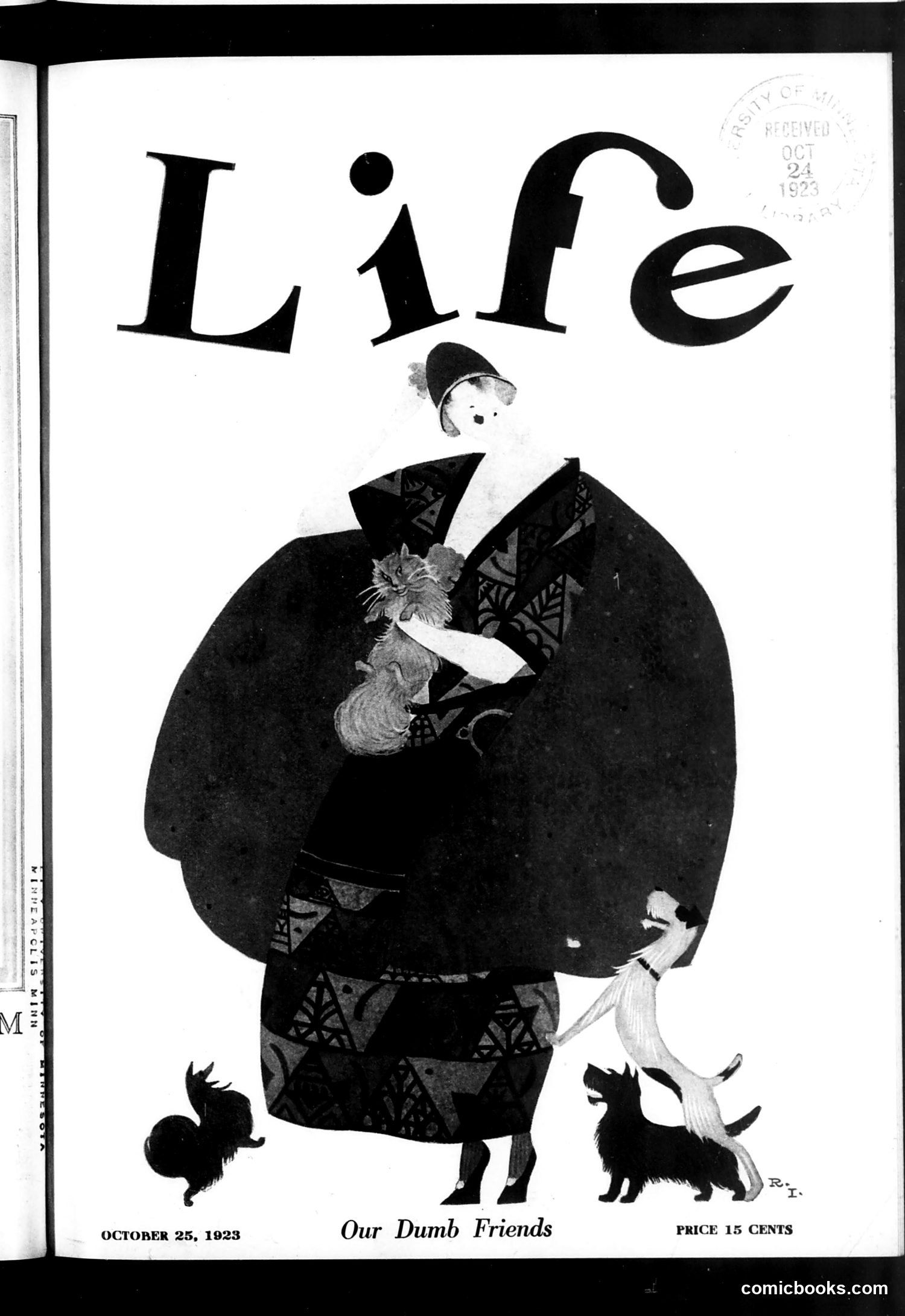
This is the cover of Life magazine from October 25, 1928, priced at 15 cents. The title "Our Dumb Friends" refers to animals—a common euphemism of that era for pets and domestic creatures who cannot speak. The illustration shows a fashionable woman in 1920s attire (cloche hat, dark coat with geometric patterns) holding a cat, surrounded by small dogs. The style is typical Art Deco illustration of the period. The subtitle "Our Dumb Friends" is a straightforward reference to companion animals, likely setting up humorous or sentimental stories about pets within the magazine. This appears to be a standard cover design rather than political satire, focusing on the popular subject of pets in American homes during the Jazz Age.
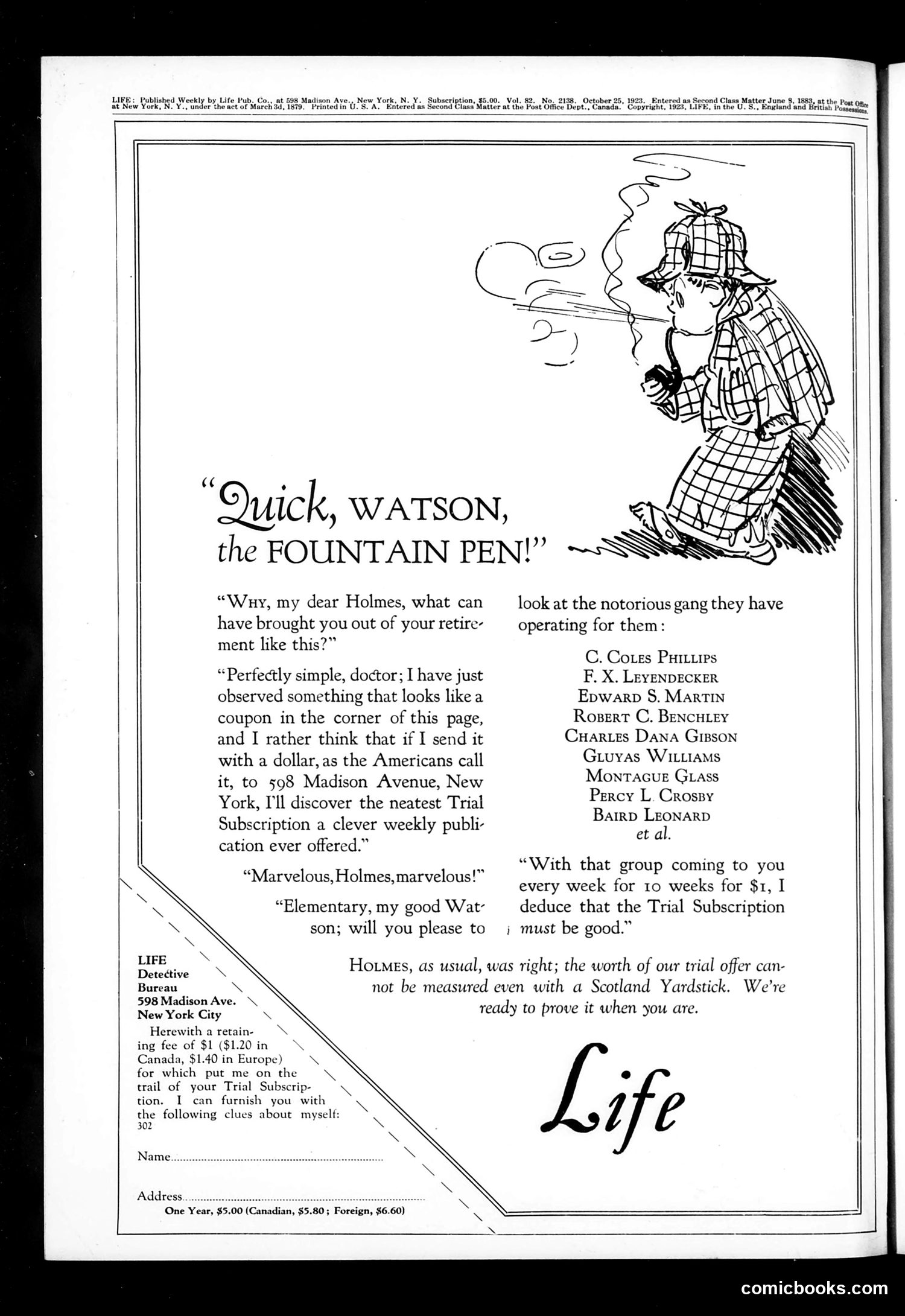
This page is primarily a **subscription advertisement** for Life magazine itself, using a Sherlock Holmes pastiche to promote their "Trial Subscription" offer. The cartoon depicts Holmes telling Watson to obtain a fountain pen coupon from a Life magazine page, claiming it will reveal something interesting. Watson obliges, discovering the trial subscription offer—prompting Holmes's exclamation about the "clever weekly publication." The advertisement then lists prominent contributors (C. Coles Phillips, F.X. Leyendecker, etc.), positioning Life as a prestigious publication. The humor derives from the meta-joke: Holmes deduces the magazine's quality through a seemingly trivial coupon, echoing his famous deductive methods. The subscription cost is listed as $1 for the trial period. This is pure **house advertising**, not political satire.
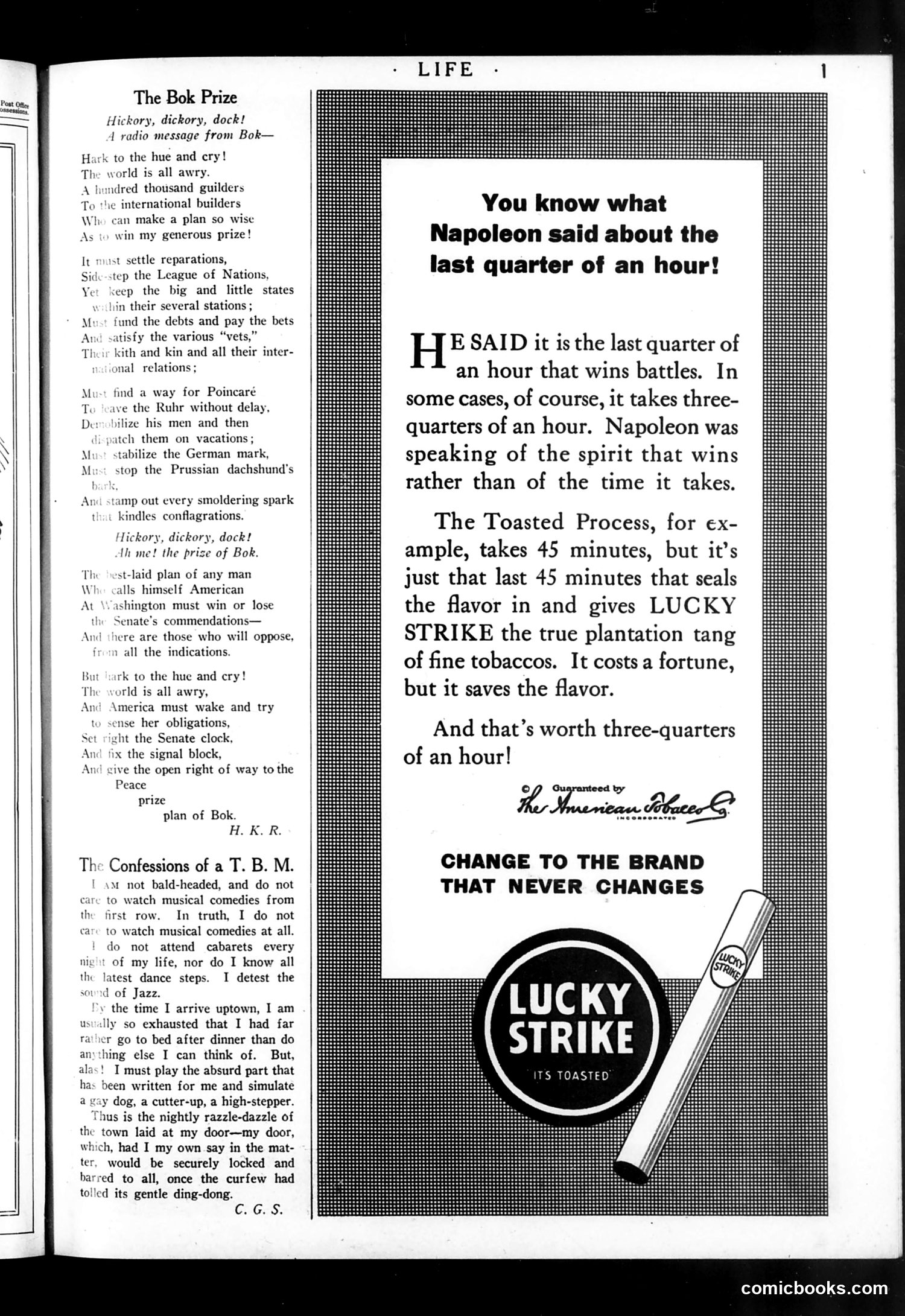
This page is **primarily a cigarette advertisement** for Lucky Strike tobacco, not a political cartoon. The ad uses a Napoleon reference as its hook: "You know what Napoleon said about the last quarter of an hour!" It claims Napoleon valued the final moments before victory—comparing this to Lucky Strike's "Toasted Process," a 45-minute manufacturing step that allegedly seals in flavor. The "Confessions of a T.B.M." piece on the left is unrelated satirical commentary about urban entertainment preferences—someone humorously admitting they don't attend jazz clubs or cabarets despite living in town. The advertisement's closing tagline—"Change to the brand that never changes"—ironically reflects how cigarette marketing worked: emphasizing consistency and tradition as selling points. This is a straightforward commercial message disguised as clever wit, typical of 1920s advertising strategy.
This is an advertisement, not political satire. It promotes the Packard Single-Six automobile, positioned as an exceptionally high-quality American luxury car. The text emphasizes the vehicle's reliability and performance—it costs under 900 pounds in England, achieves 25+ miles per hour, and climbs hills admirably despite lacking a large engine. The author expresses genuine admiration for the car's engineering while humorously lamenting it's American-made rather than British. He claims it ranks among the world's best automobiles and suggests it would be worth showcasing to manufacturers in Coventry, Birmingham, and Manchester—England's motor-industry centers. The tone blends genuine product praise with lighthearted national rivalry, typical of early 20th-century automotive journalism.
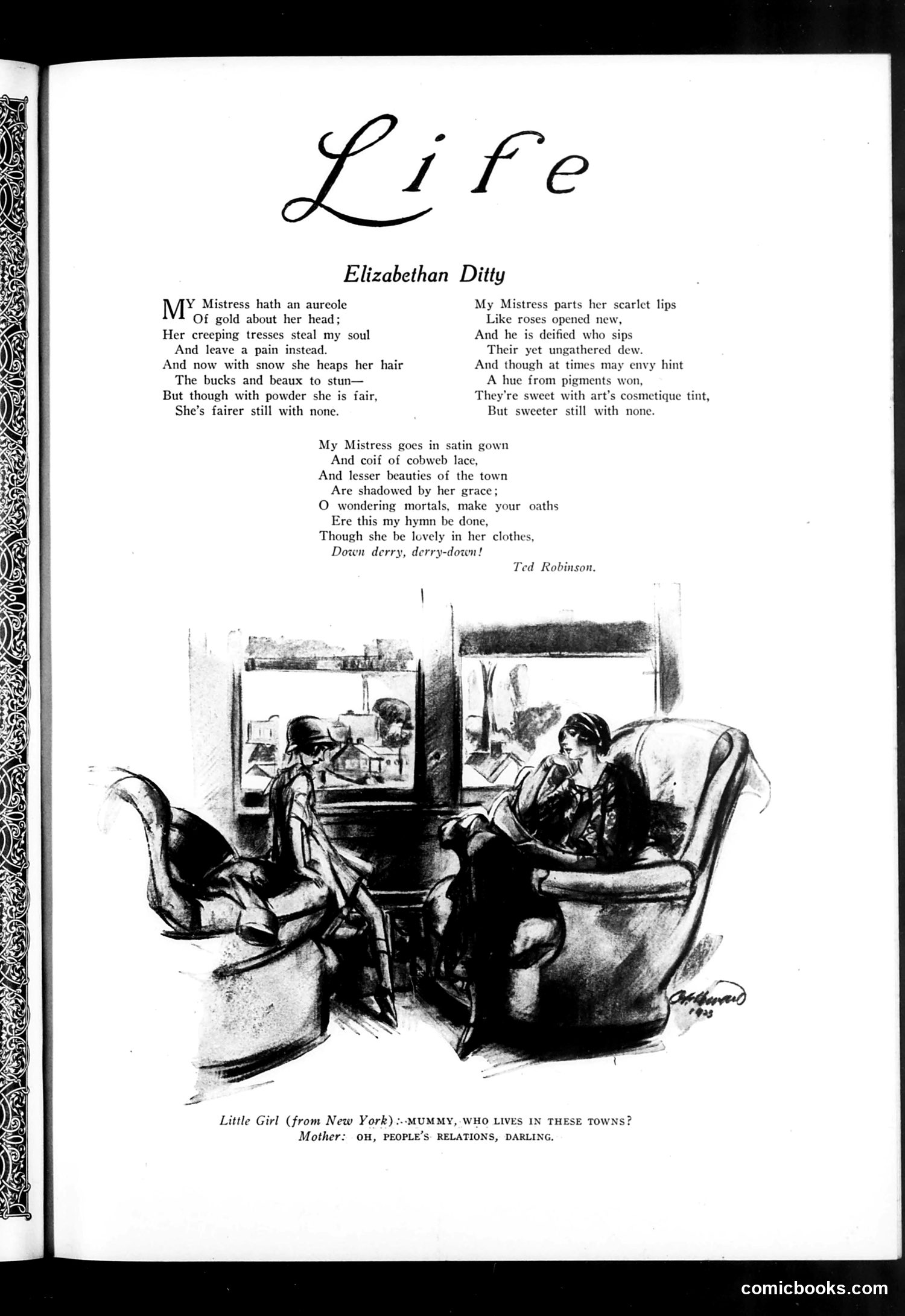
This page features "Life" by Elizabethan Ditty, a poem by Ted Robinson praising an idealized woman's beauty and grace. The accompanying illustration shows two women in what appears to be a parlor, with one asking the other "Mummy, who lives in these towns?" and the mother responding "Oh, people's relations, darling." The joke relies on wordplay: "people's relations" (meaning relatives/family members) is presented as if it's a literal descriptor of who inhabits towns—a humorous non-answer that deflects the child's innocent question with verbal cleverness. This reflects early 20th-century satirical humor typical of *Life* magazine, which often used witty dialogue and social observation to mock polite society and the absurdities of upper-class conversation.
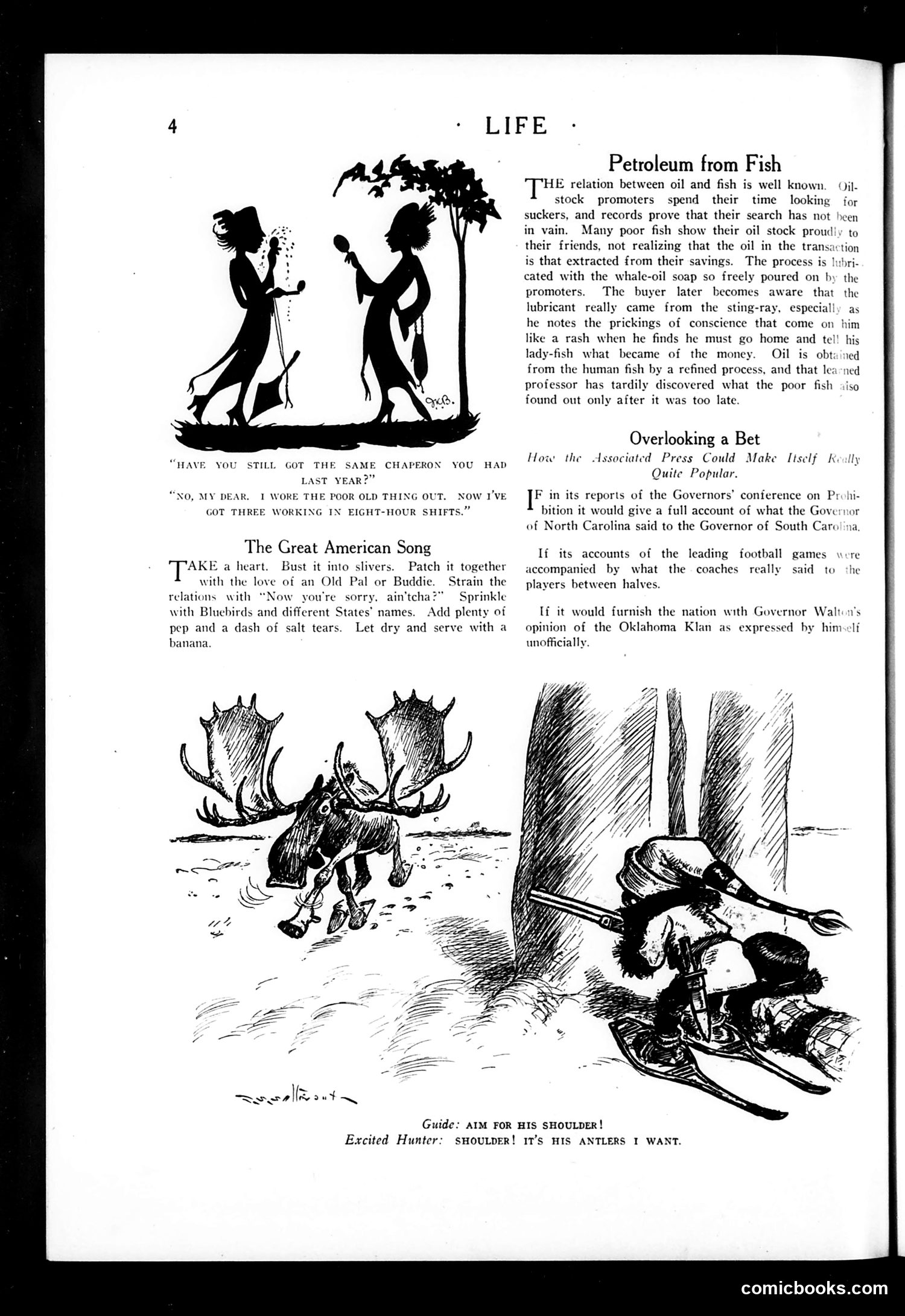
This page contains three distinct pieces of satire: 1. **"Petroleum from Fish"**: A mock-serious article mocking oil-stock promoters who defraud poor people by claiming fish contain extractable oil. The satire is that investors later discover the "lubricant" came from stingrays, and the poor fish victims unknowingly financed the scheme. 2. **"The Great American Song"**: A humorous recipe-style piece satirizing patriotic sentiment by treating American identity like food preparation—mixing regional references ("Bluebirds," "different States"), popular songs ("Now you're sorry"), and colloquial expressions into one consumable product. 3. **"Overlooking a Bet"**: Criticizes the Associated Press for incomplete reporting—specifically that they omit controversial statements (like a governor's opinion of the KKK) from news coverage, thereby failing to inform the public fully. The moose-hunting cartoon below satirizes hunters' misguided aims.
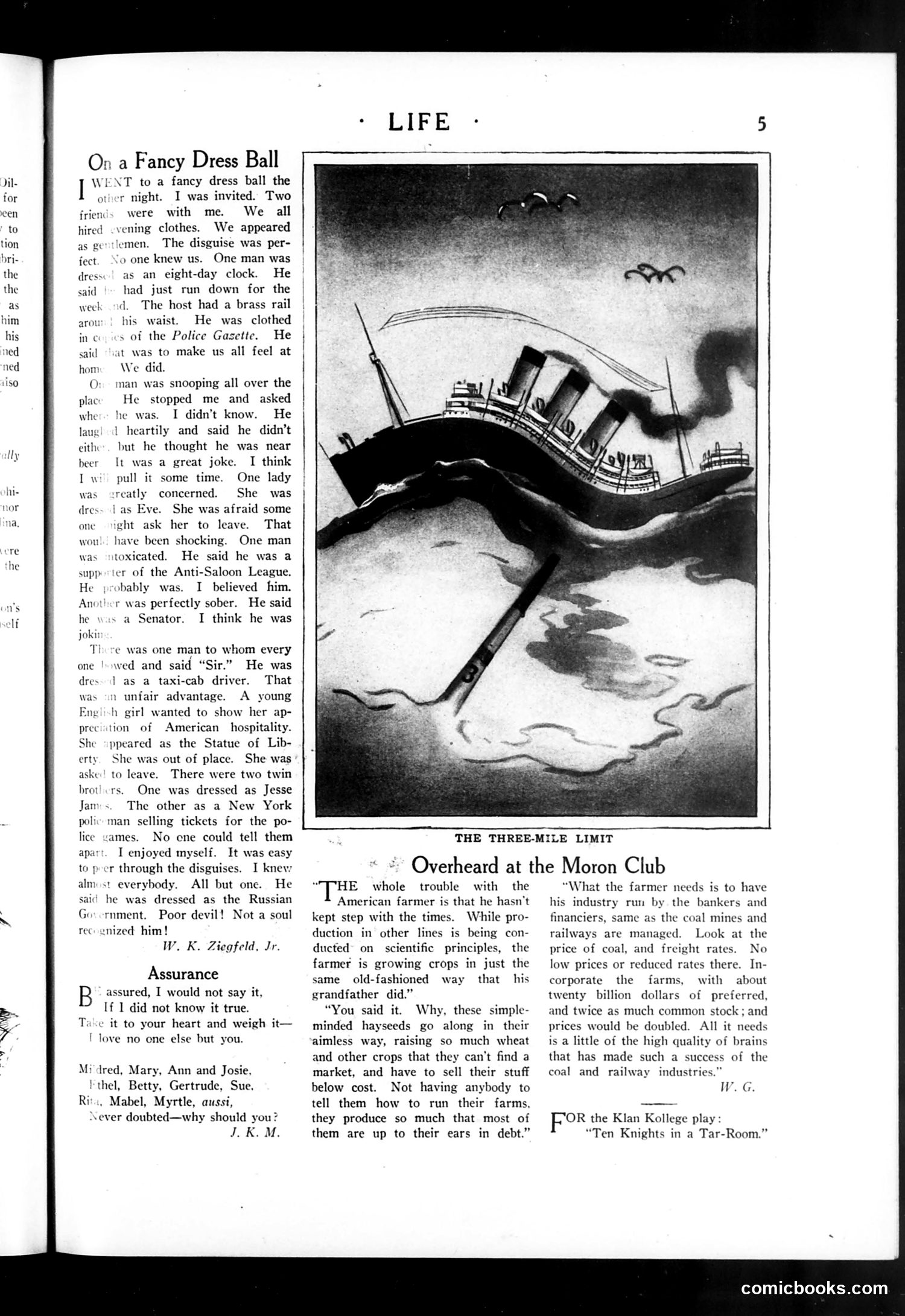
The main illustration titled "THE THREE-MILE LIMIT" depicts a ship (the RMS Titanic, based on its distinctive design) sinking at an extreme angle. The cartoon critiques American agricultural policy during Prohibition era. The accompanying article "Overhead at the Moron Club" satirizes farmers' economic struggles. It argues that American farmers, clinging to outdated methods, cannot compete in modern markets. The piece mocks their supposed ignorance, suggesting farmers produce excessive crops they cannot sell, leaving them deeply in debt. The satire targets both farmer naïveté and broader economic mismanagement during this period. The title "Moron Club" reflects the era's harsh characterization of rural populations as intellectually inferior to urban, industrial society.
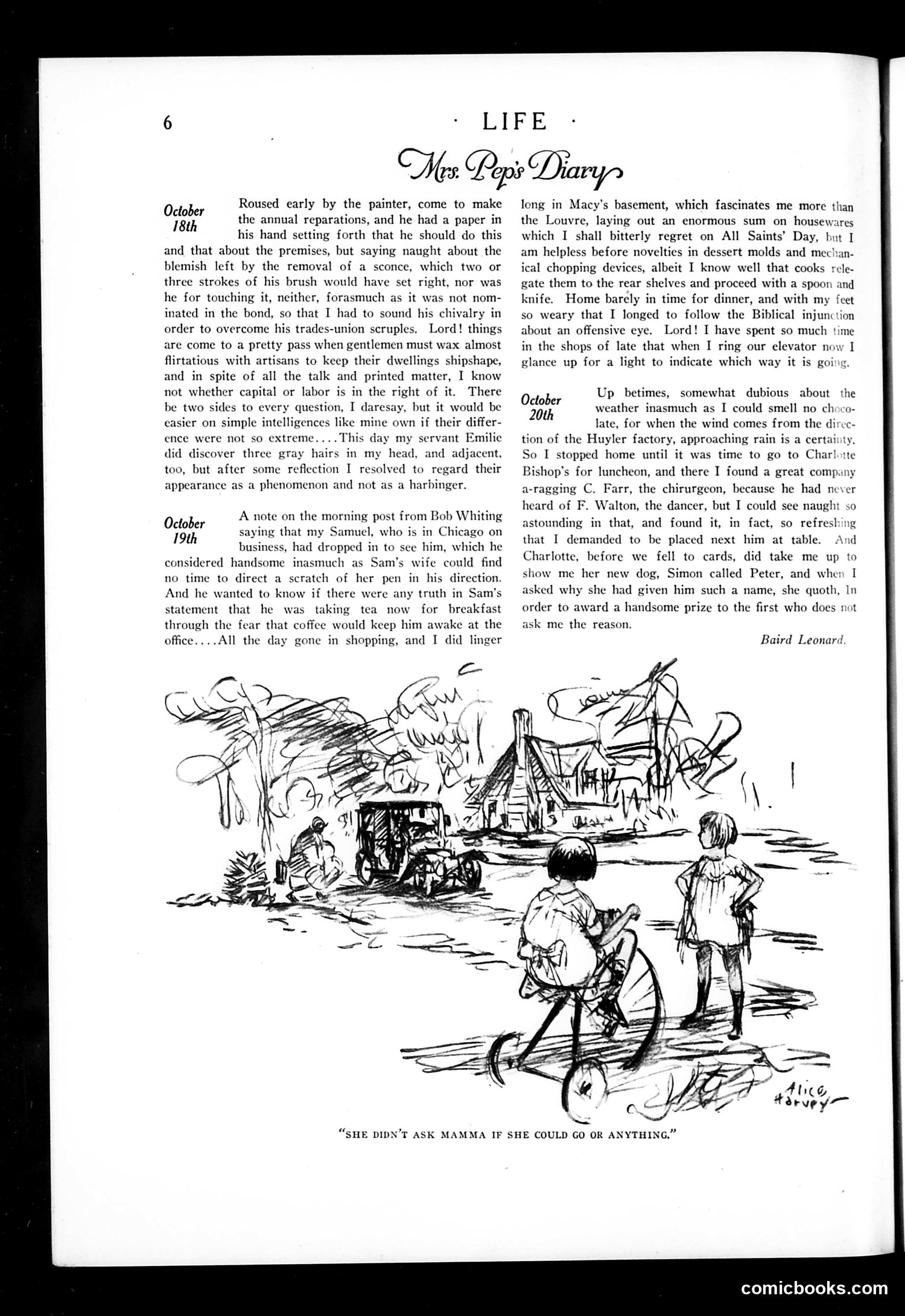
This page from *Life* magazine presents a domestic diary entry with an accompanying illustration by Alice Harvey. The cartoon depicts children at play near what appears to be a construction site or industrial area, with ramshackle buildings and equipment in the background. The caption—"She didn't ask mamma if she could go or anything"—satirizes parental supervision and children's independence. The illustration suggests a somewhat dangerous, unsupervised setting, highlighting anxieties about urban child safety and parental oversight common to early 20th-century middle-class concerns. The diary's gossipy tone about social encounters (theater, shopping, dining) contrasts with this commentary on children's autonomy, creating gentle domestic satire typical of *Life's* humor targeting family life.
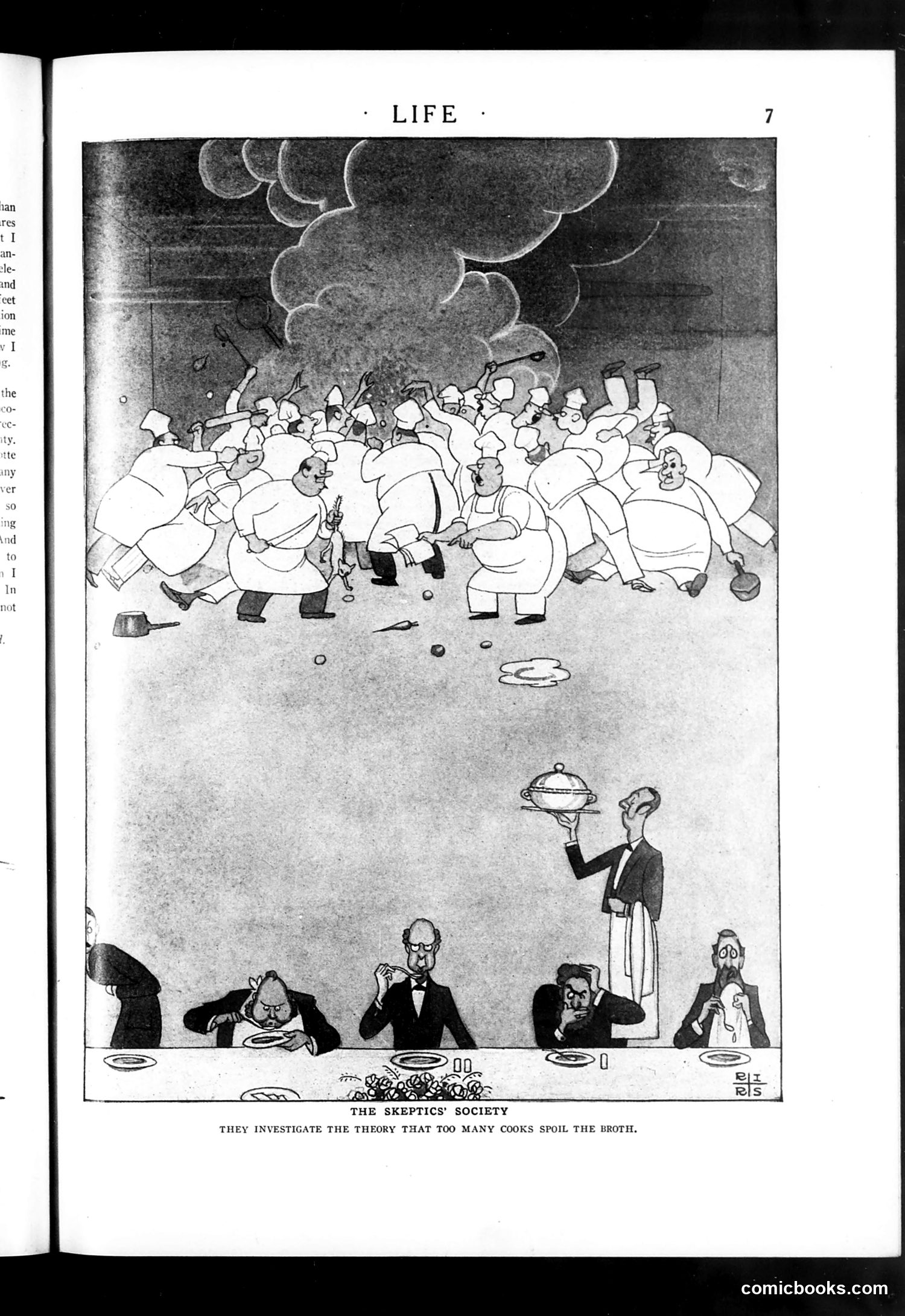
This satirical cartoon depicts a formal dinner gathering of gentlemen from "The Skeptics' Society" investigating the proverb "too many cooks spoil the broth." The joke operates on two levels: Above, a chaotic crowd of rotund, working-class cooks argue and gesticulate wildly over a pot, creating literal chaos. Below, well-dressed gentlemen of apparent refinement sit at a formal dinner table, observing this controlled experiment with scientific detachment—one presenting a covered dish to the group. The satire mocks both the pretension of intellectual societies conducting obvious investigations, and the class contrast between the educated "skeptics" conducting orderly analysis versus the disorder of working laborers. The caption ironically treats a common folk saying as worthy of formal scientific study.
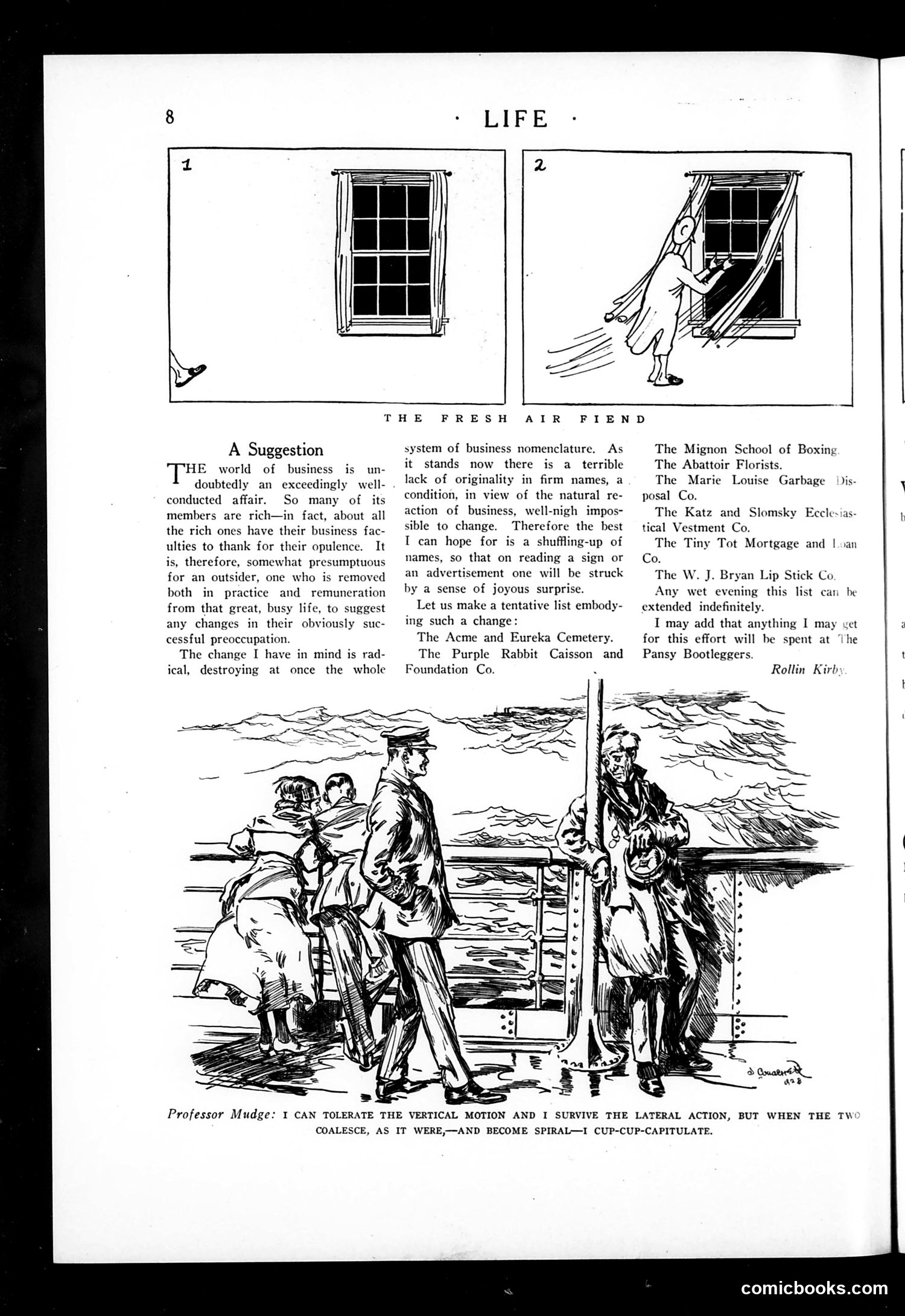
This page contains two cartoon panels (1-2) and one larger illustration satirizing attitudes toward fresh air and seasickness. **Panels 1-2** titled "The Fresh Air Fiend" show someone enthusiastically opening a window despite apparent resistance—mocking people obsessed with fresh air ventilation, a health trend of the era. **The main cartoon** depicts a ship scene where "Professor Mudge" boasts he can tolerate vertical motion and survive lateral action, but when the two "coalesce" and become "spiral," he experiences "cut-cup-capitate"—a humorous reference to seasickness combined with vomiting. The satire mocks pseudo-scientific medical pretension and the gap between theoretical confidence and practical reality when facing actual seasickness. The page also lists humorous business name changes ("The Acme and Eureka Cemetery" etc.), continuing the satirical tone.
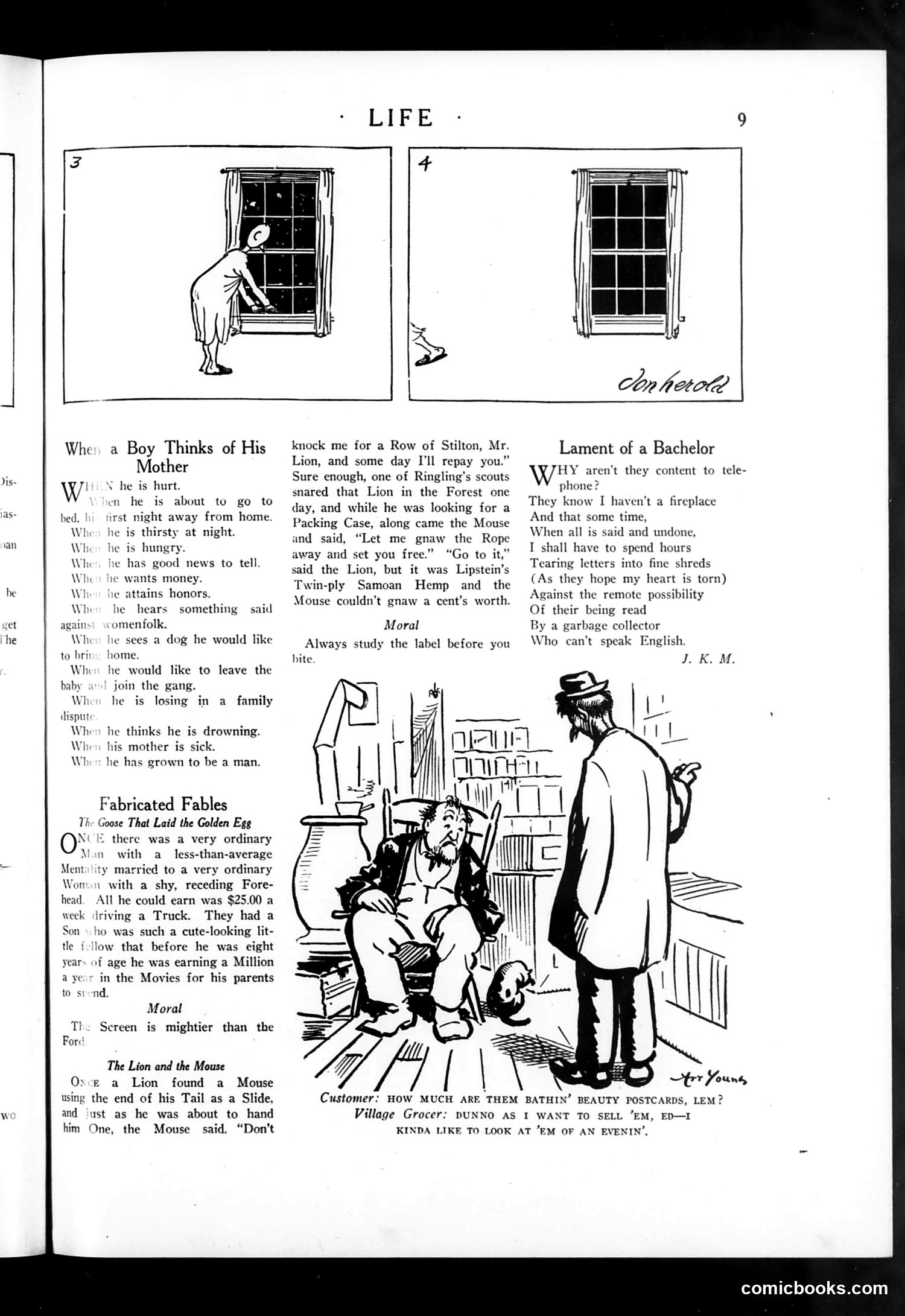
This page contains several satirical pieces typical of early 20th-century Life magazine humor: **Top panels (3-4)**: Simple visual gags about a boy looking out a window and a bachelor lamenting lack of modern conveniences like telephones and fireplaces. **"Lament of a Bachelor"**: A poem mocking unmarried men's domestic helplessness, with fears of letters being read by a garbage collector "who can't speak English"—a joke reflecting period anxieties about immigrant workers. **Bottom cartoon**: Depicts what appears to be a morality tale about studying product labels, showing a customer interrogating a grocer about beauty postcards. The humor targets consumer gullibility and suggests grocers were selling promotional beauty postcards alongside food—a common early 1900s retail practice. The overall tone reflects genteel, domestic humor aimed at middle-class readers.
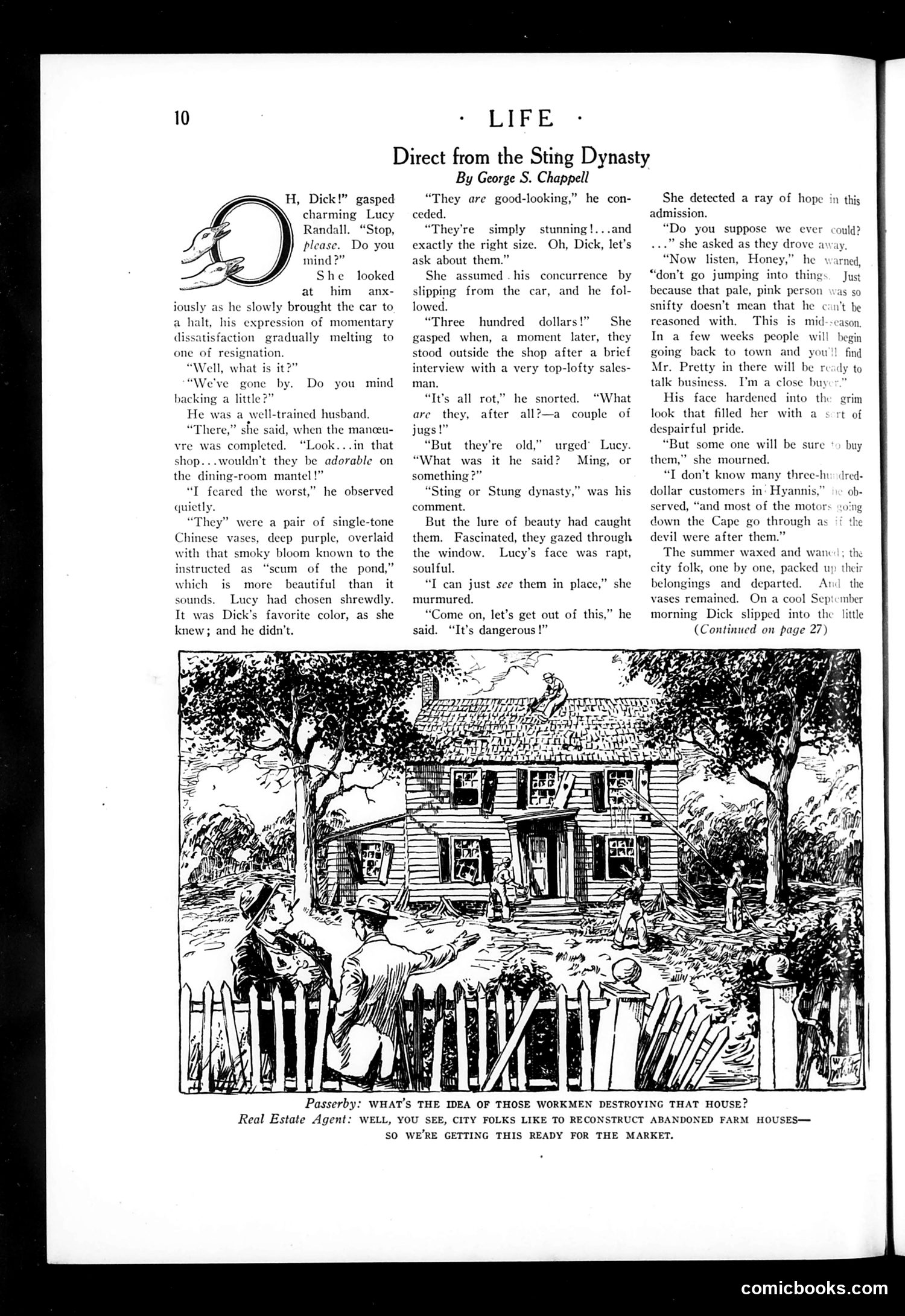
This page combines a short story about a couple (Dick and Lucy Randall) shopping for Chinese vases with a single-panel cartoon below. The story depicts Dick dismissing his wife's interest in decorative purchases, showing marital tension typical of domestic humor from this era. The cartoon satirizes **real estate speculation**. A real estate agent explains to a passerby that workers are "destroying" an abandoned farmhouse to prepare it for market to city folks wanting reconstructed rural properties. The joke mocks urban buyers' desire for "authentic" country homes and agents' willingness to demolish and rebuild structures to meet artificial demand—suggesting the commodification and inauthenticity of rural nostalgia among city dwellers.
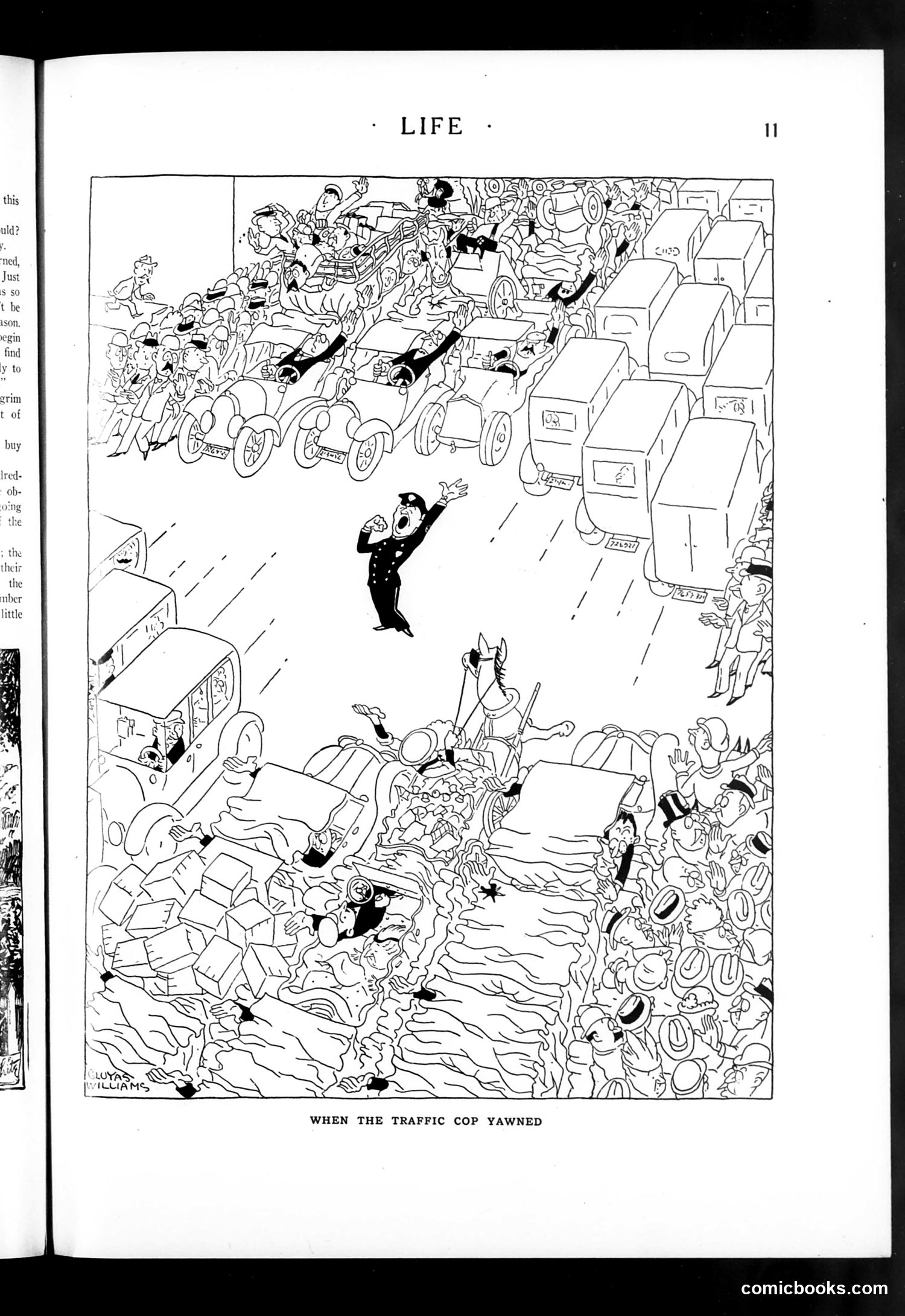
This cartoon satirizes urban traffic chaos. The scene depicts a massive traffic jam of automobiles with a police officer standing in the middle, apparently yawning or distracted. The implication is that when the traffic cop loses focus or attention—literally yawning on the job—the entire system collapses into pandemonium. The cartoon mocks both incompetent traffic enforcement and the rapid growth of automobile congestion in early 20th-century American cities. It suggests that maintaining order in increasingly crowded urban streets requires constant vigilance, and even a momentary lapse by those responsible creates disorder. The exaggerated, chaotic scene emphasizes how dependent modern city life had become on functional traffic management.
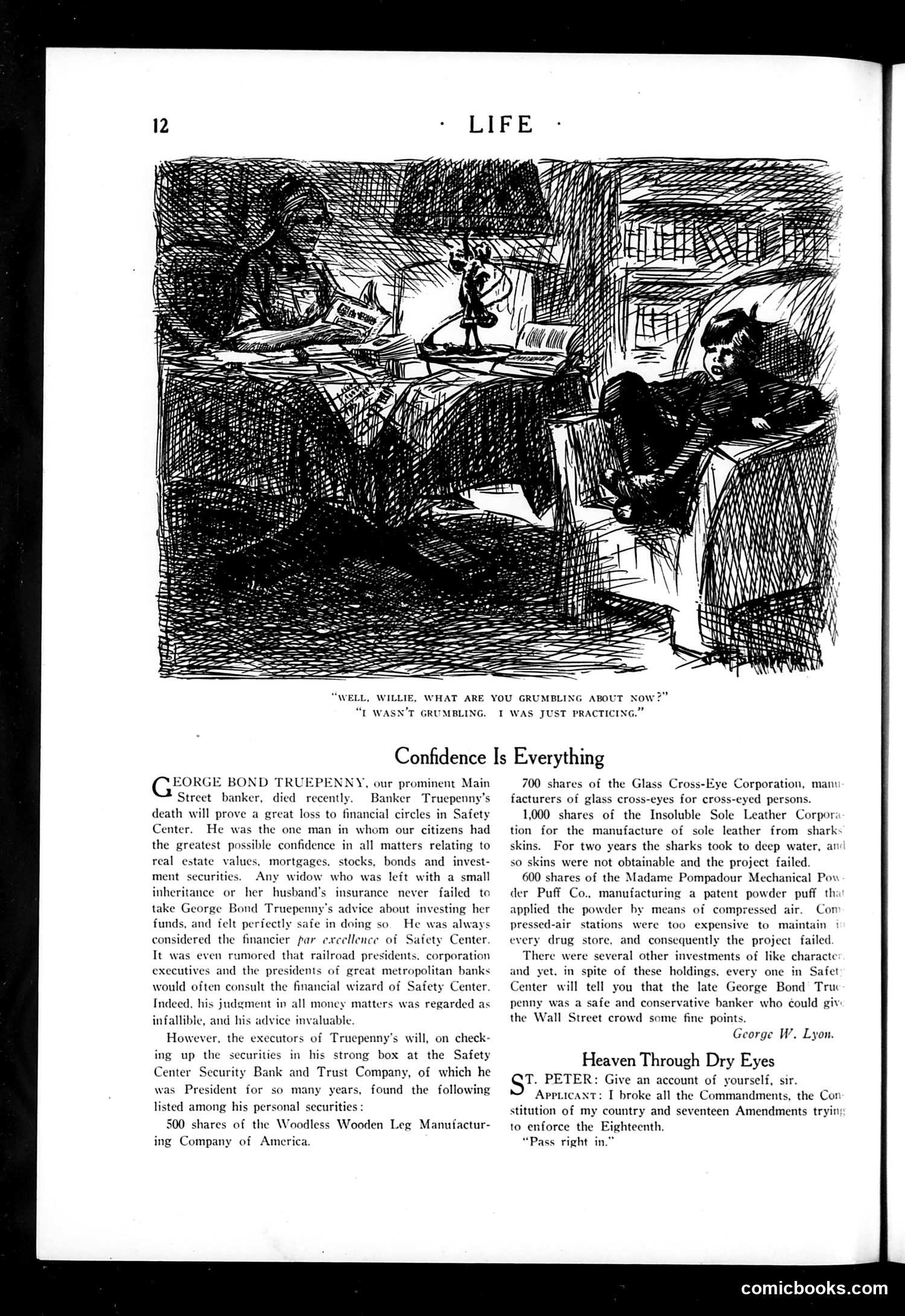
The cartoon depicts a domestic scene where a woman asks a man (labeled "Willie") why he's grumbling. He responds that he was "just practicing"—implying he's rehearsing complaints. The accompanying article, "Confidence Is Everything," discusses George Bond Truepenny, a prominent banker at Safety Center who recently died. The text reveals Truepenny's executors discovered his personal securities included questionable investments: 500 shares in a "Woolless Woolen Leg Manufacturing Company," and various other dubious holdings (glass cross-eyes, insoluble leather products, mechanical powder puffs). The satire targets misplaced investor confidence in financial "wizards" who give bad advice. The cartoon's "practicing" complaint mirrors the article's theme: people blindly trust authority figures without questioning—whether in marriage or investing—even when the advice proves worthless.
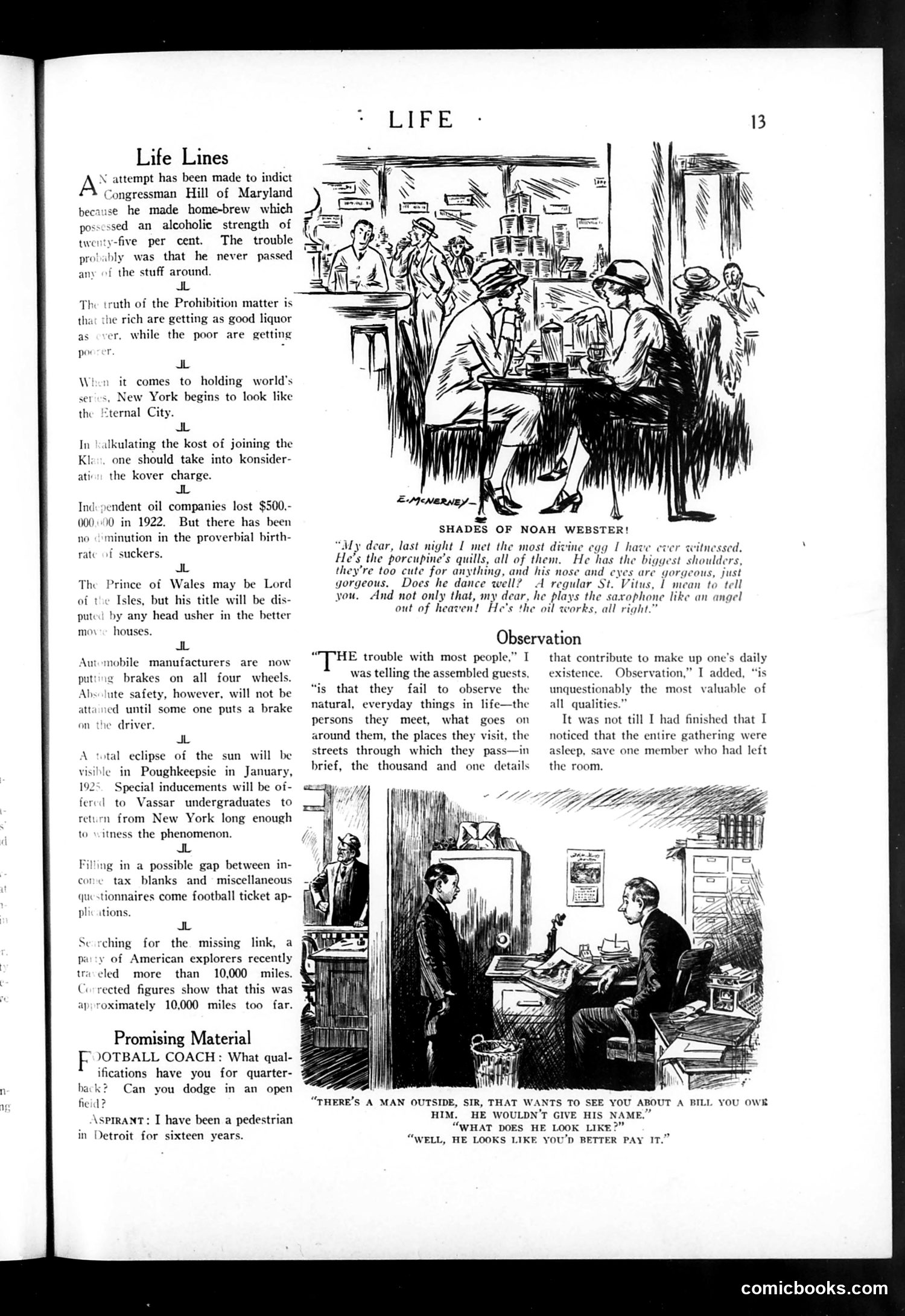
This page contains several short satirical pieces typical of Life magazine's humor section. **"Life Lines"** offers brief social commentary, including jokes about Prohibition (alcohol being unequally enforced—rich getting good liquor while poor get worse), and observations about New York City becoming crowded. **"Observation"** presents a dinner-party anecdote about a guest who lacks observational skills, missing everyday details around him. **Two cartoons** appear lower on the page: 1. Top: "Shade of Noah Webster" – depicts men at leisure, with dialogue about someone's impressive qualities and musical talent. 2. Bottom: An office scene where a debt collector confronts someone about an unpaid bill, with the debtor attempting to avoid payment by claiming not to recognize the creditor. Both cartoons humorously depict common social embarrassments around money and awkward encounters.
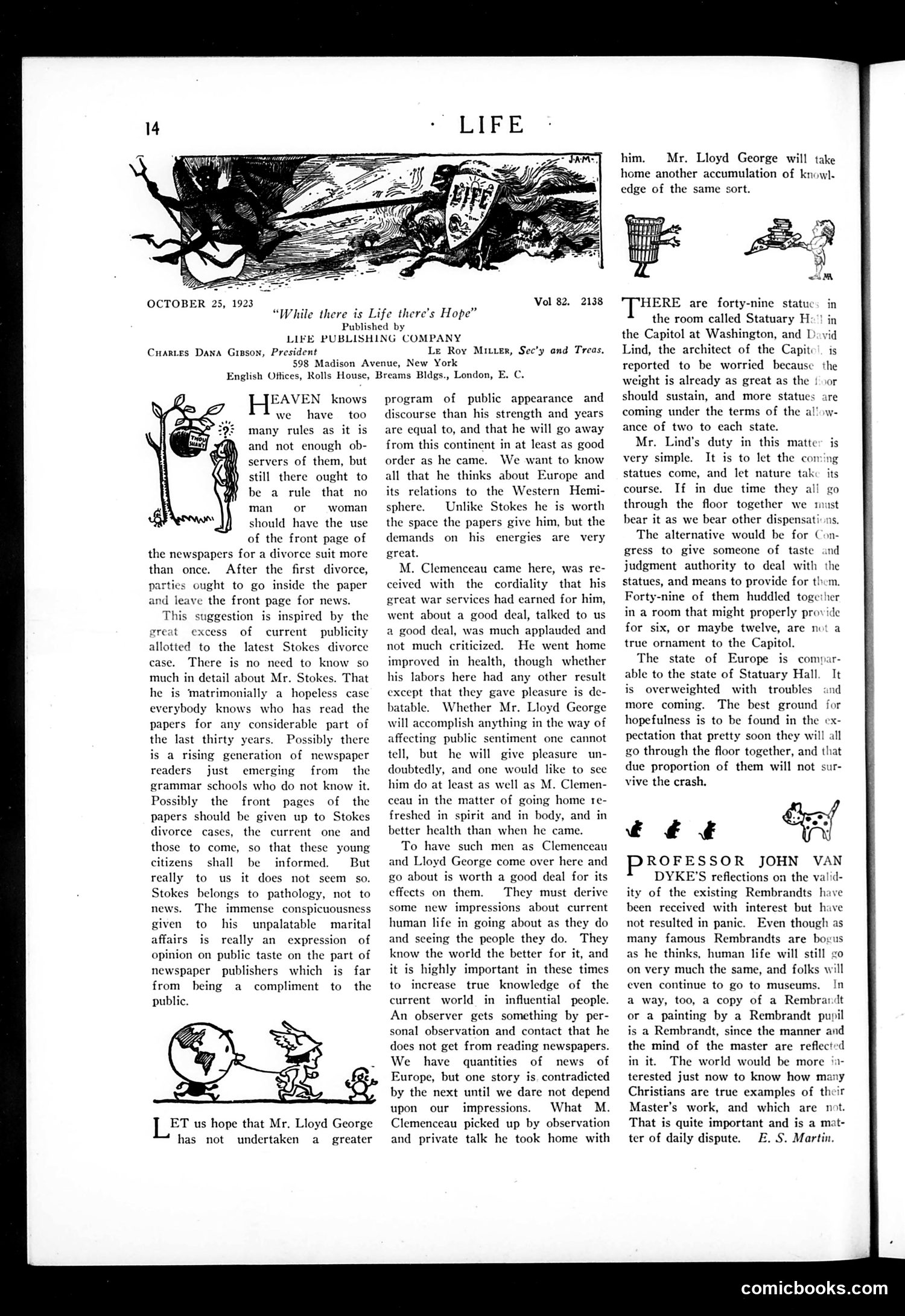
This page contains editorial commentary rather than political cartoons. The main article discusses David Lloyd George's recent visit to America and his observations about European affairs and American public opinion. The text criticizes newspaper coverage of Lloyd George's divorce proceedings, arguing that divorce details received excessive front-page attention. The author suggests newspapers should instead focus on informing citizens about substantive matters—like Lloyd George's insights on Europe and international relations—rather than sensationalism. A secondary piece discusses Professor John Van Dyke's reflections on art and culture, noting that personal observation provides insights newspapers cannot. The small decorative illustrations are generic ornamental drawings, not pointed political satire.
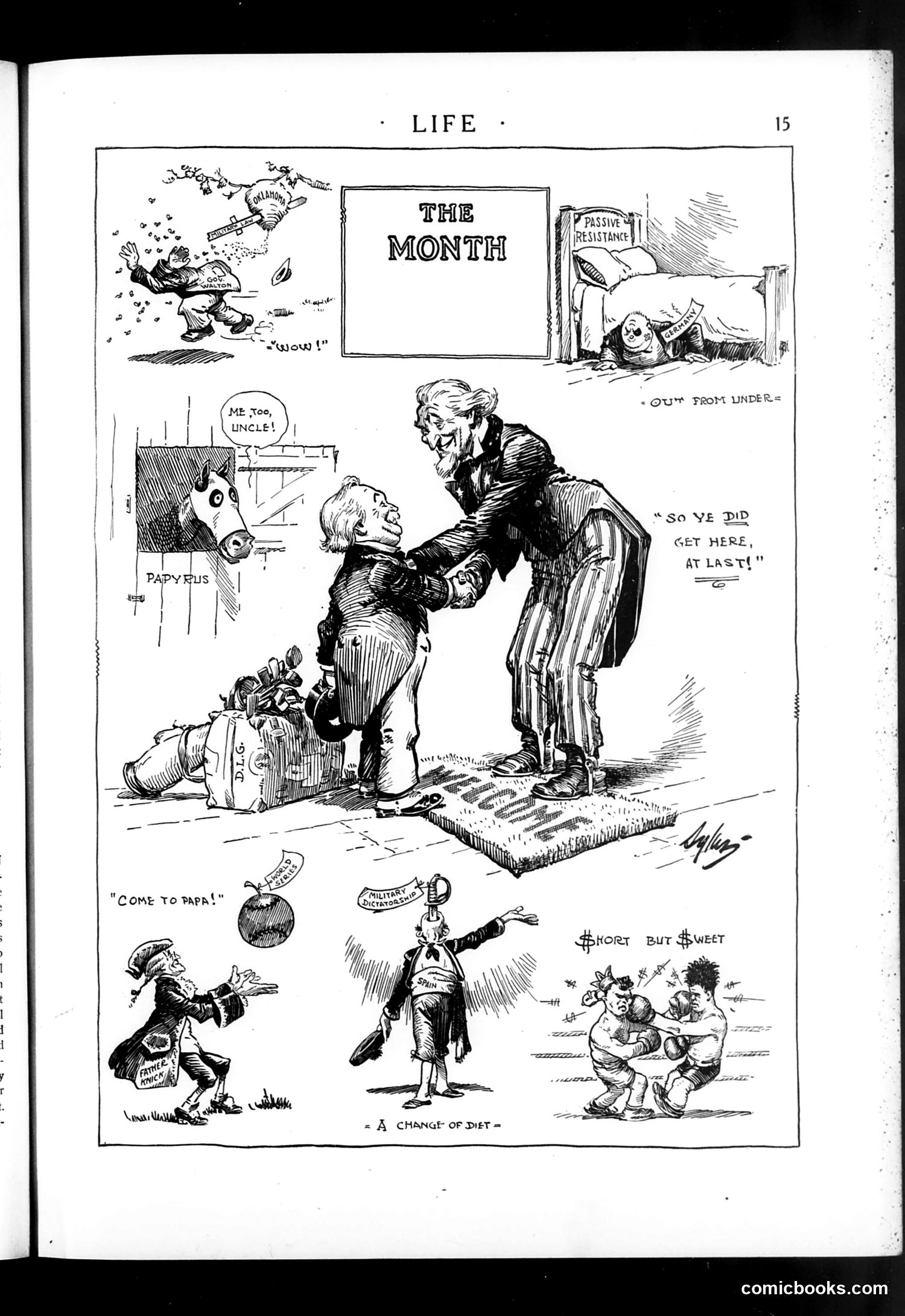
This page presents several political cartoons satirizing contemporary events. The central image shows an adult figure greeting a child arriving "out from under," likely referencing a child emerging from some difficult situation or constraint. Below are smaller vignettes labeled "A Change of Diet" and "$hort but $weet," depicting figures exchanging money or goods—possibly satirizing financial dealings or political corruption common to the era. The upper right shows someone in bed labeled "Passive Resistance," suggesting commentary on non-violent protest movements. Various caricatures and labeled figures (including what appears to be "Papyrus") suggest specific political figures or events, though their exact identities require additional historical context to confirm definitively. The overall tone mocks political hypocrisy and financial manipulation of the period.
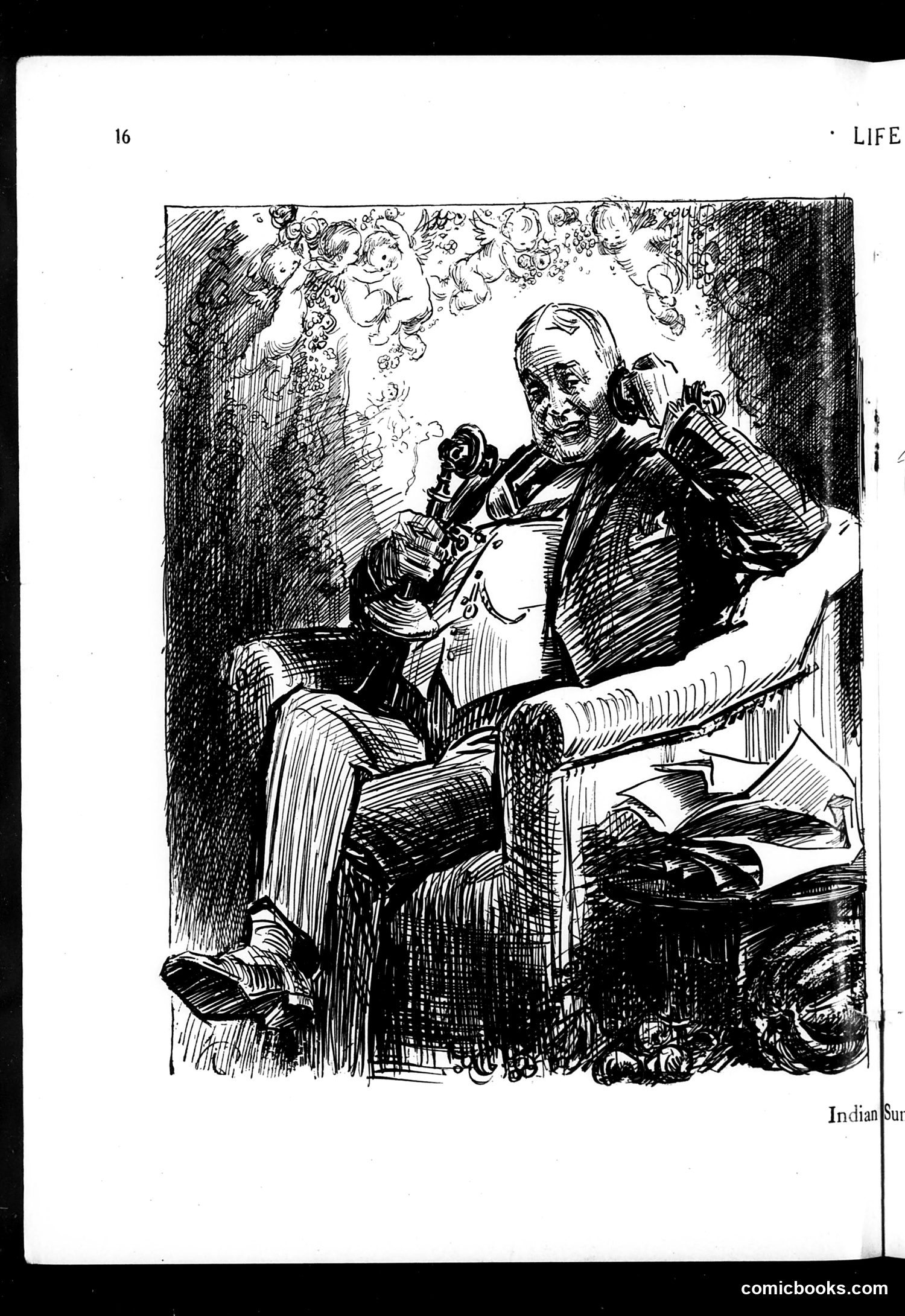
This ink illustration depicts a portly, bald man in formal attire sitting in a chair, smoking a cigar and holding what appears to be a pipe or similar object. Above him floats a cloud of cherub-like figures or babies. The caption reads "Indian Sur" (possibly "Indian Summer"), suggesting a seasonal or temporal reference. The cherubs likely represent pleasant or idealistic notions. The figure's corpulent, self-satisfied pose—lounging comfortably while indulging in tobacco—may satirize complacency, excess, or obliviousness to surrounding realities. Without additional context about *Life* magazine's publication date or the complete caption, the specific political target remains unclear, though the satire appears to criticize either a particular public figure or a general social attitude of indulgent contentment.
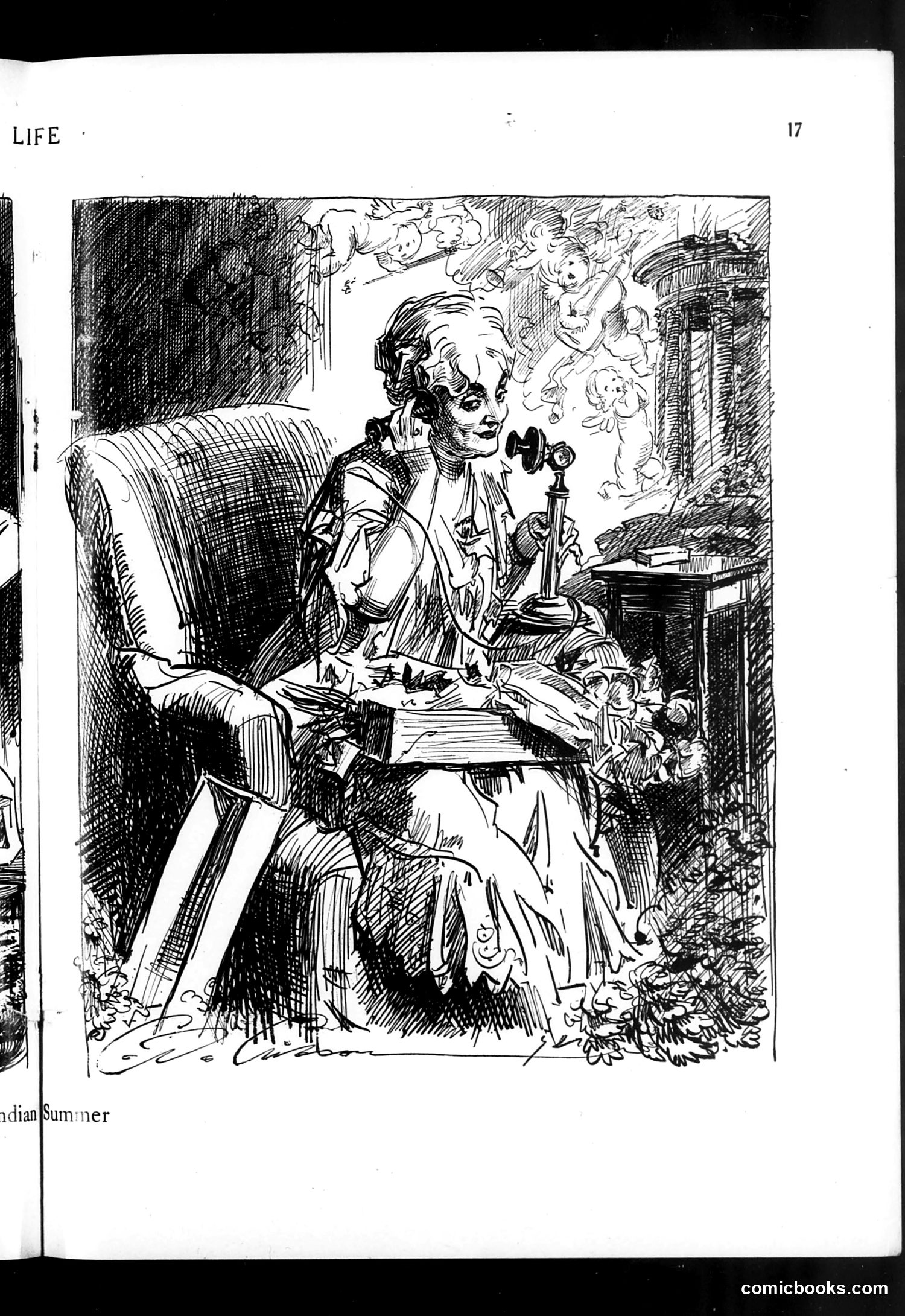
This page 17 from *Life* magazine contains a satirical illustration of a woman seated in an armchair, speaking into an old-fashioned microphone. The artwork employs detailed cross-hatching typical of early-to-mid 20th century political cartooning. The cartoon appears to satirize radio broadcasting and public speaking, likely commenting on women's increased prominence in media. Cherubs or classical figures in the upper portion may reference grandiose artistic pretension. The woman's formal dress and focused demeanor suggest she represents either a specific public figure or a type—possibly mocking earnest or pretentious radio personalities of the era. The OCR text is largely illegible, preventing identification of the specific subject or satirical point. Without clearer attribution or context, the exact political or social critique remains unclear.
This page reviews three theatrical productions. The critic favorably compares **"Tarnish"** (by Gilbert Emery) to **"Windows"** (by John Galsworthy), finding the former more dramatically engaging despite tackling similar moral themes. The satire targets Galsworthy's overly didactic approach: characters repeatedly reference war disillusionment and jail time until their earnestness becomes tedious rather than meaningful. A particular jab targets the stage servant-problem—working-class characters (butlers, charwomen) who spout Nietzsche and Hegel philosophy. The critic jokes this will spark a "feudal movement" to keep servants from intellectualizing on the job. **"Tarnish"** succeeds because it conveys comparable messages through naturalistic dialogue and believable characters, including the aging satyr Adolph Tevis (Albert Gran) and actress Ann Harding, whom the critic praises despite admitting bias toward beautiful young women onstage. The review credits producer John Cromwell for recognizing "Tarnish's" popular appeal when other managers rejected it.
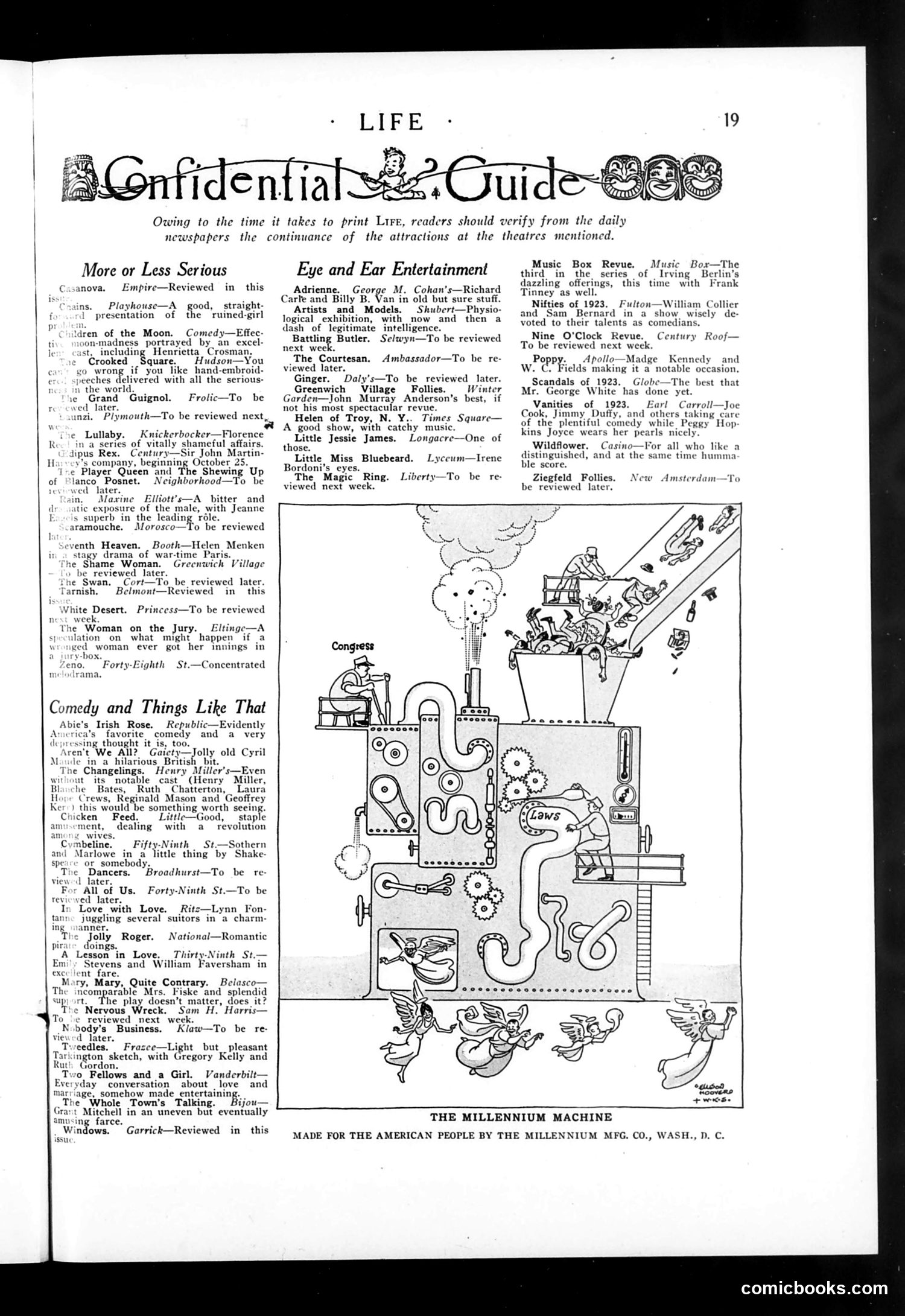
This page features a humorous cartoon titled "The Millennium Machine," depicting an absurdly complex contraption supposedly designed to solve American social problems. The machine is a Rube Goldberg-style device filled with gears, pulleys, conveyor belts, and various mechanical elements, all supposedly working together toward some utopian result. The satire targets early-20th-century American faith in technological and mechanical solutions to social issues. By showing an impossibly complicated machine that appears to accomplish nothing practical, Life magazine mocks the era's optimism that industrialization and engineering could cure all societal ills—poverty, crime, inequality, and moral problems included. The cartoonist uses visual absurdity to suggest that real social problems cannot be "engineered away" through machines or simple mechanical fixes. This reflects growing skepticism about whether progress and technology alone could deliver the promised utopian future. The surrounding text lists Broadway theatrical productions for reference, a standard Life magazine feature of the period.
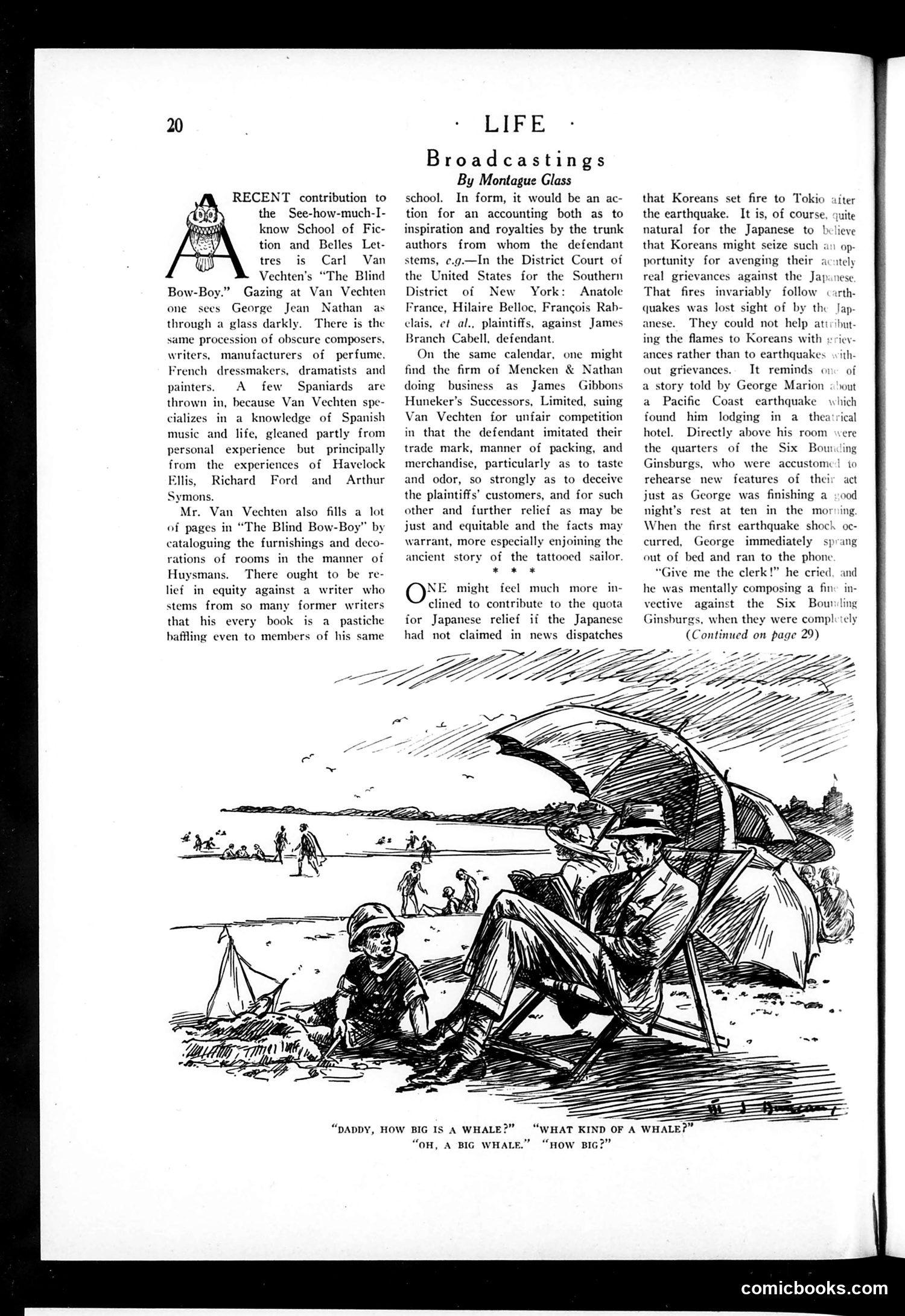
This page contains two distinct pieces of satire: **The Book Review (top):** Critic Montague Glass skewers novelist Carl Van Vechten's "The Blind Bow-Boy" as derivative pastiche—essentially accusing Van Vechten of stitching together ideas from Havelock Ellis, Richard Ford, Arthur Symons, and others without originality. The satire imagines lawsuits where French literary figures (Anatole France, Hilaire Belloc, Rabelais) could sue Van Vechten for "unfair competition" and plagiarism. **The Cartoon (bottom):** A child asks his father about whale size during what appears to be a beach excursion. This is gentle, non-political humor about parental communication—the father's vague answer ("a big whale") prompts increasingly specific questions, illustrating the frustration of childhood interrogation. **The Middle Section** discusses Japanese earthquake relief and Japanese-Korean tensions, mentioning alleged Korean arson during the Tokyo earthquake—a reference to the 1923 Great Kanto earthquake and subsequent anti-Korean violence. The page mixes literary criticism, social commentary on international affairs, and family humor.
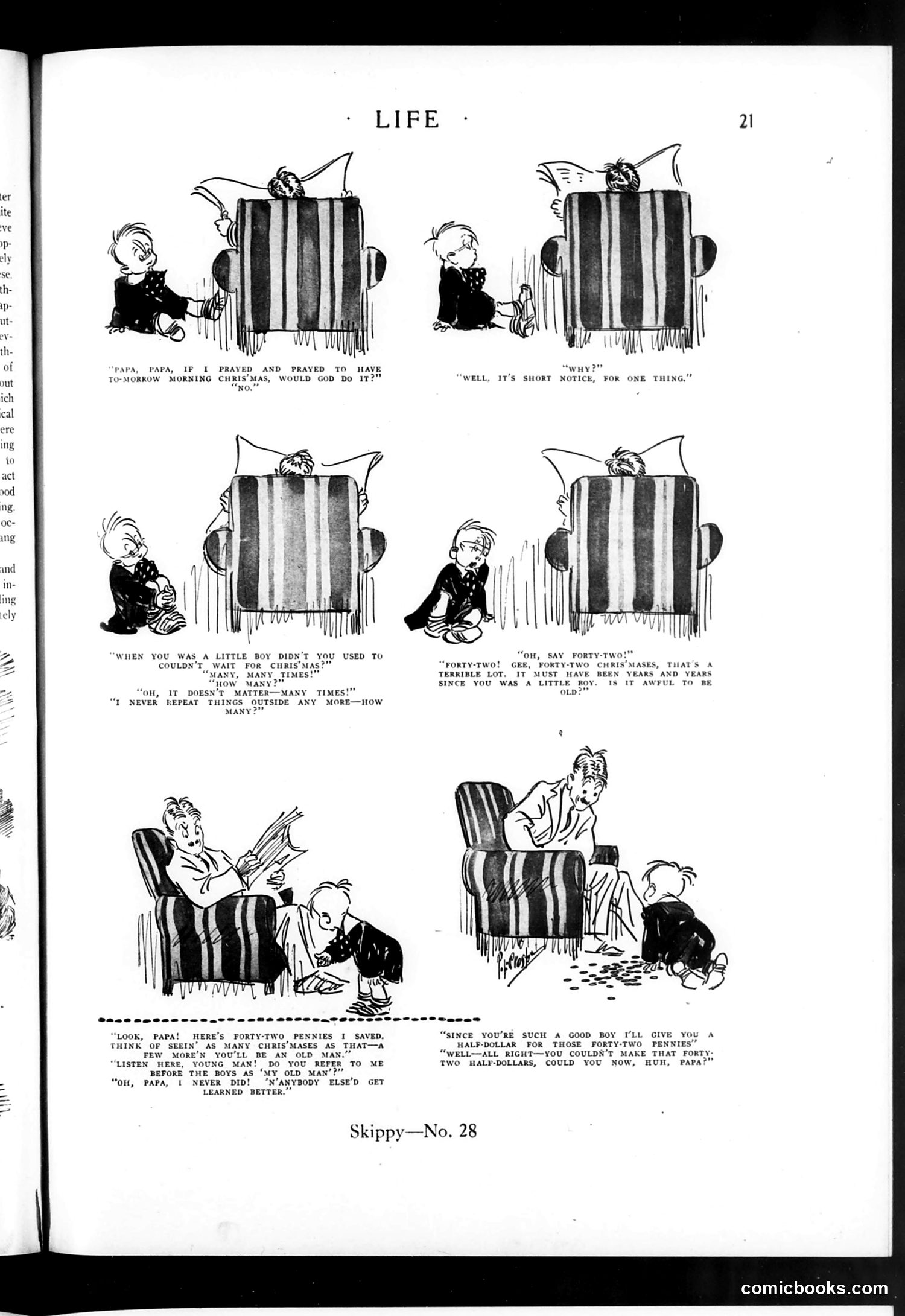
This is a humorous comic strip about a clever young boy (Skippy) negotiating with his father. The strip's humor derives from the child's precocious logic and manipulation of adult sentimentality. The boy asks his father about accelerating Christmas, then references having saved 42 pennies—equivalent to 42 future Christmases. He uses this number to make his aging father melancholic, commenting on how old the father will be. When the sentimental father offers a half-dollar (50 cents) for the 42 pennies as a reward for being "good," Skippy immediately pivots, asking if the father could convert that into 42 half-dollars—a transparent attempt to multiply his reward. The satire targets both childhood manipulation tactics and paternal sentimentality. It's a gentle family humor piece typical of *Life* magazine's comedy, showing how children exploit parental emotions and generosity through flattery and arithmetic.
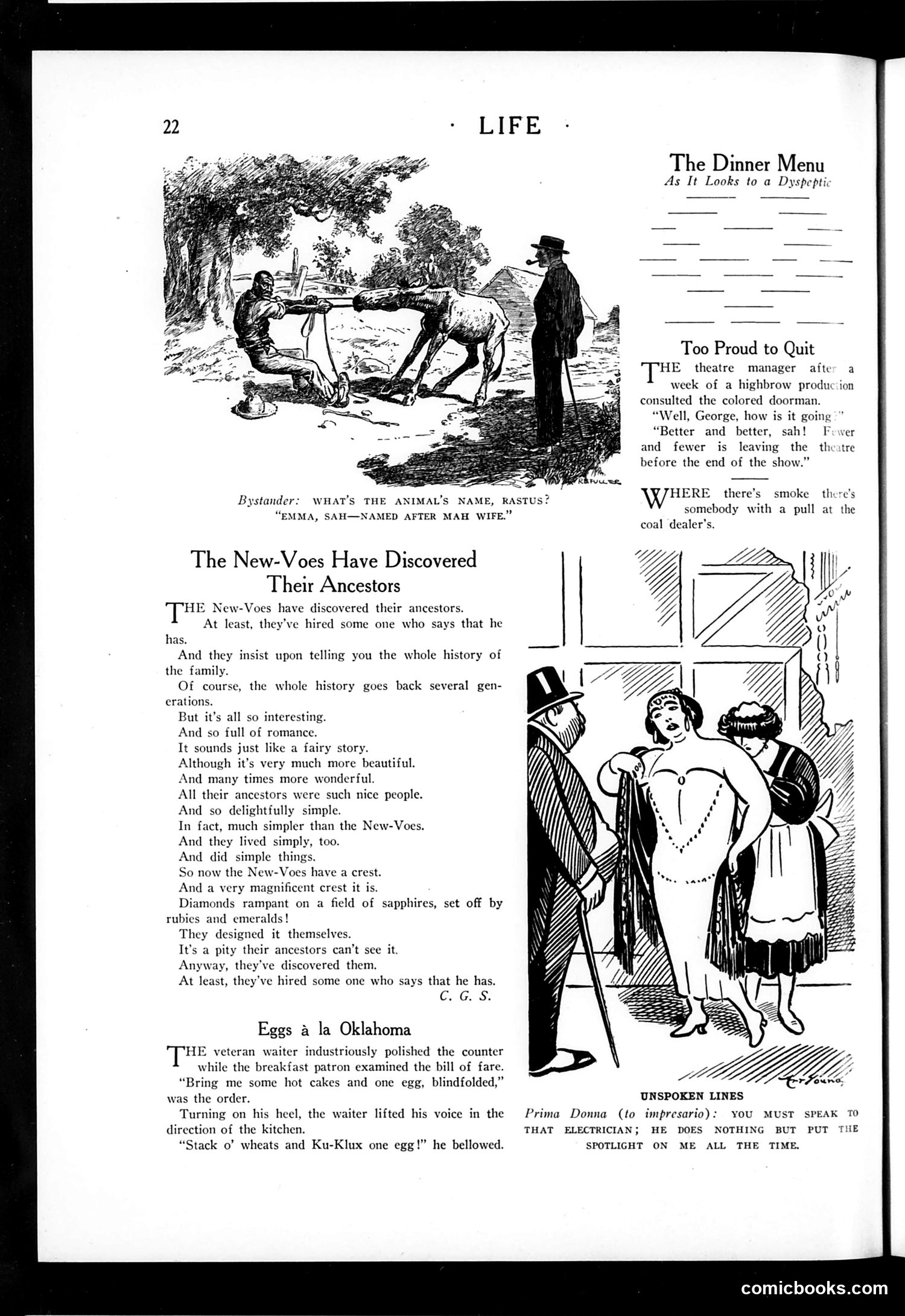
This page contains several satirical sketches mocking early 20th-century American social pretensions and racial attitudes. **"The New-Voes Have Discovered Their Ancestors"** ridicules newly wealthy families (the "New-Voes," likely "nouveau riche") who hire genealogists to fabricate aristocratic lineages. The joke: they design their own elaborate coat of arms with diamonds and emeralds, oblivious that their invented ancestors couldn't appreciate it. It satirizes social climbing and manufactured respectability among the newly rich. **"Eggs à la Oklahoma"** contains a racial slur in its punchline, using "Ku-Klux" as a restaurant kitchen order for a blindfolded egg—a tasteless reference to the KKK that reflects the magazine's casual racism. The other sketches joke about theatrical complaints, a waiter's dialogue about a mule, and a diva's vanity about stage lighting. The racial caricatures and slurs throughout reflect Life magazine's period attitudes, now deeply offensive.
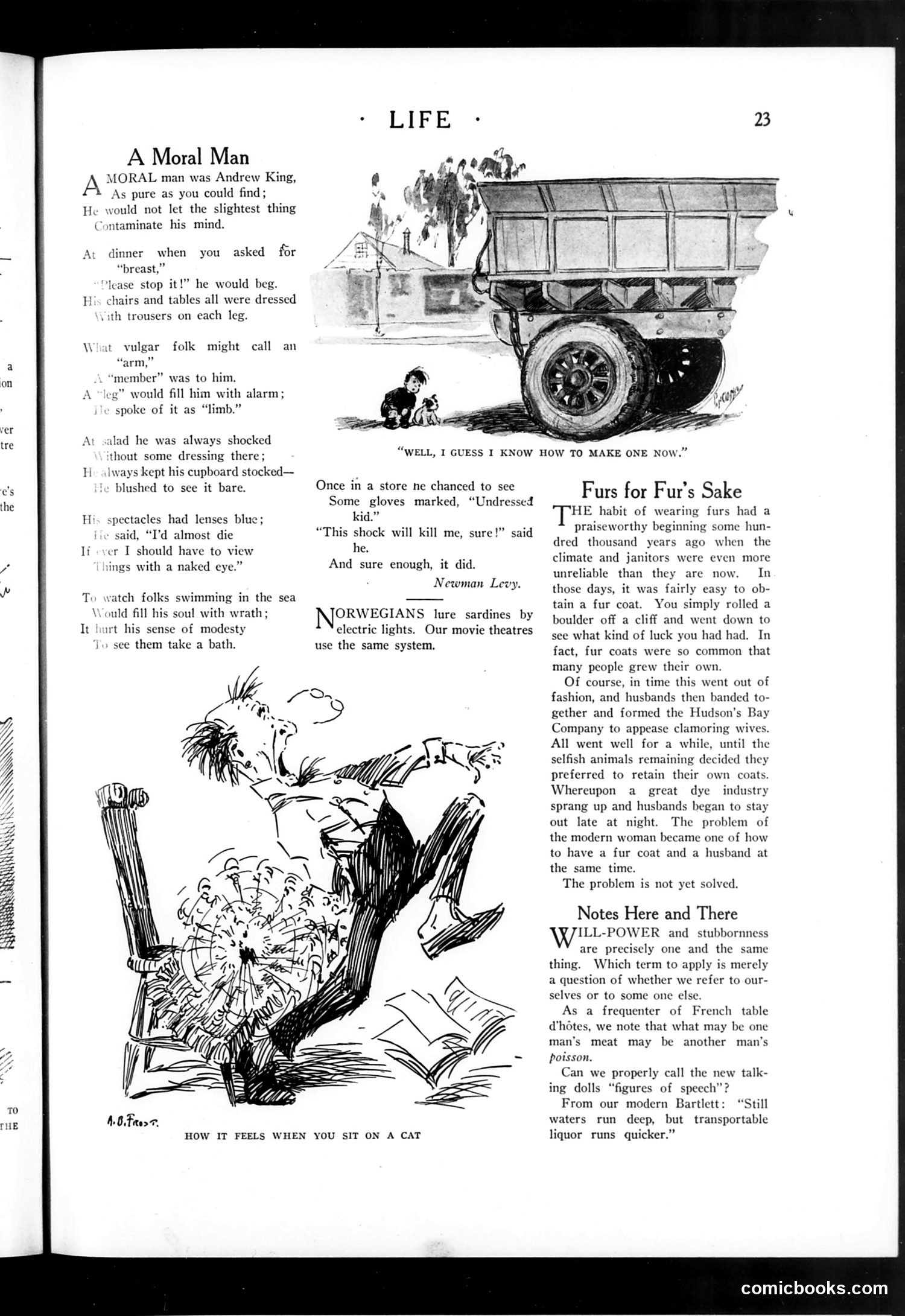
This page contains three satirical pieces typical of early 20th-century American humor: **"A Moral Man"** mocks excessive Victorian prudishness through Andrew King, a man so obsessed with propriety that he euphemizes body parts ("limb" for leg, "member" for arm) and avoids anything suggesting nudity. The joke culminates when he dies from shock upon seeing gloves labeled "Undressed kid"—he cannot even handle the word "undressed." The satire targets rigid moral hypocrisy and social pretension. **"Furs for Fur's Sake"** humorously traces fur fashion history, joking that modern women want both fur coats *and* husbands—an impossible demand since obtaining furs requires husbands to work late into the night. This reflects 1920s anxieties about changing women's expectations and consumer desires. **"Notes Here and There"** contains brief, unrelated witticisms about stubbornness, French dining, talking dolls, and alcohol—typical magazine filler humor. The cartoons—a truck scene and a cat illustration—provide visual comedy supporting the text's themes of social awkwardness and modern life's absurdities.
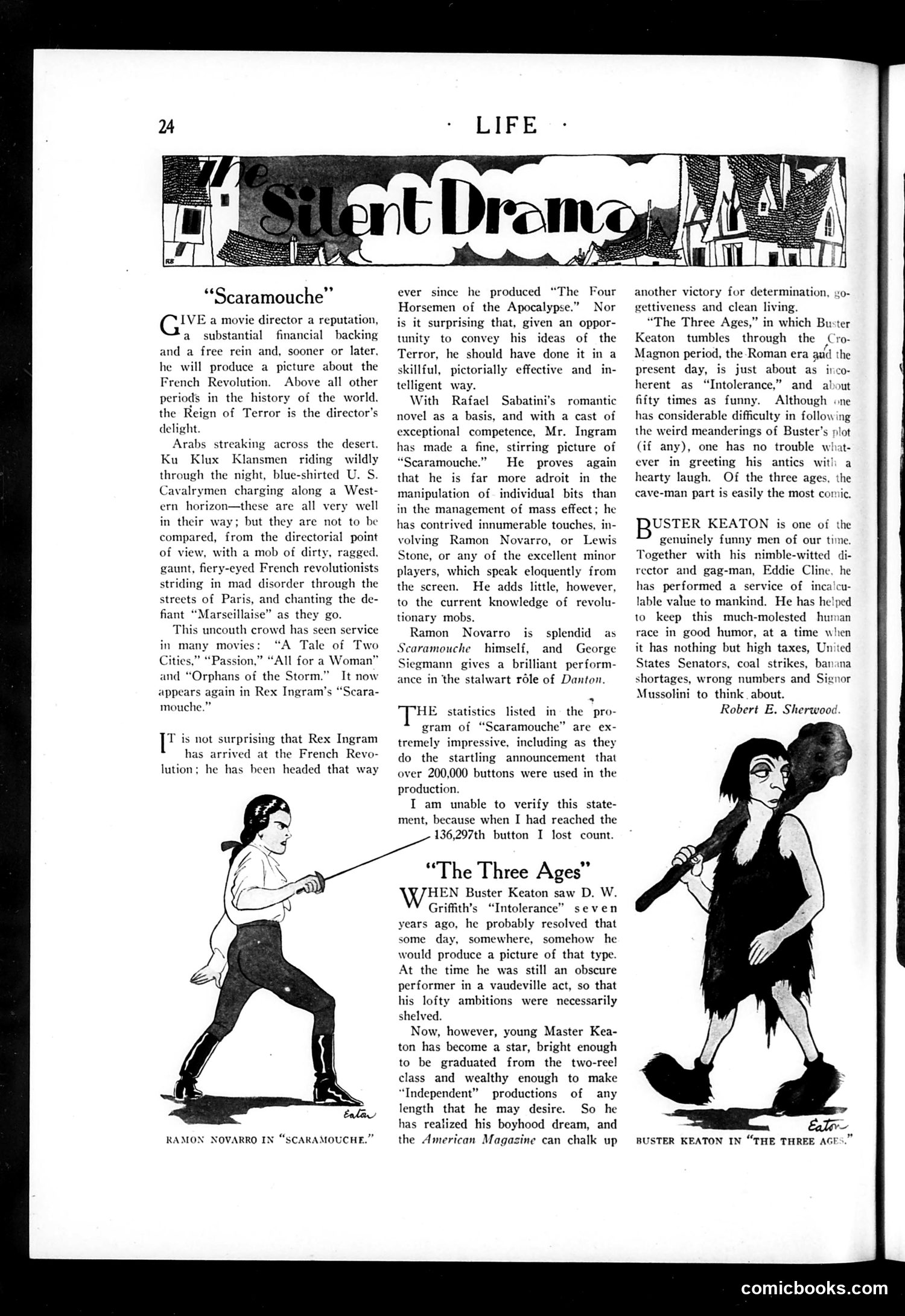
This page reviews two silent films from the early 1920s: **"Scaramouche"** stars Ramon Novarro in a French Revolution drama directed by Rex Ingram. The critic notes Ingram's obsession with depicting the Revolution—citing it as Hollywood's favorite historical backdrop alongside desert adventures and Ku Klux Klan imagery. The review praises Ingram's skillful direction of individual scenes while critiquing his handling of crowd sequences. A satirical jab appears in the closing: the production boasted using 200,000 buttons, prompting the reviewer to humorously claim they "lost count" at 136,297—mocking Hollywood's tendency toward inflated production statistics as a marketing tool. **"The Three Ages"** stars Buster Keaton in a three-era comedy (caveman, Roman, modern) apparently inspired by D.W. Griffith's "Intolerance." The critic celebrates Keaton's success graduating from vaudeville to independent filmmaking, calling him "genuinely funny" and praising his gag-work. Despite the film's incoherent plot, its humor carries it—the caveman sequences supposedly being funniest. Both reviews employ witty condescension typical of period film criticism.
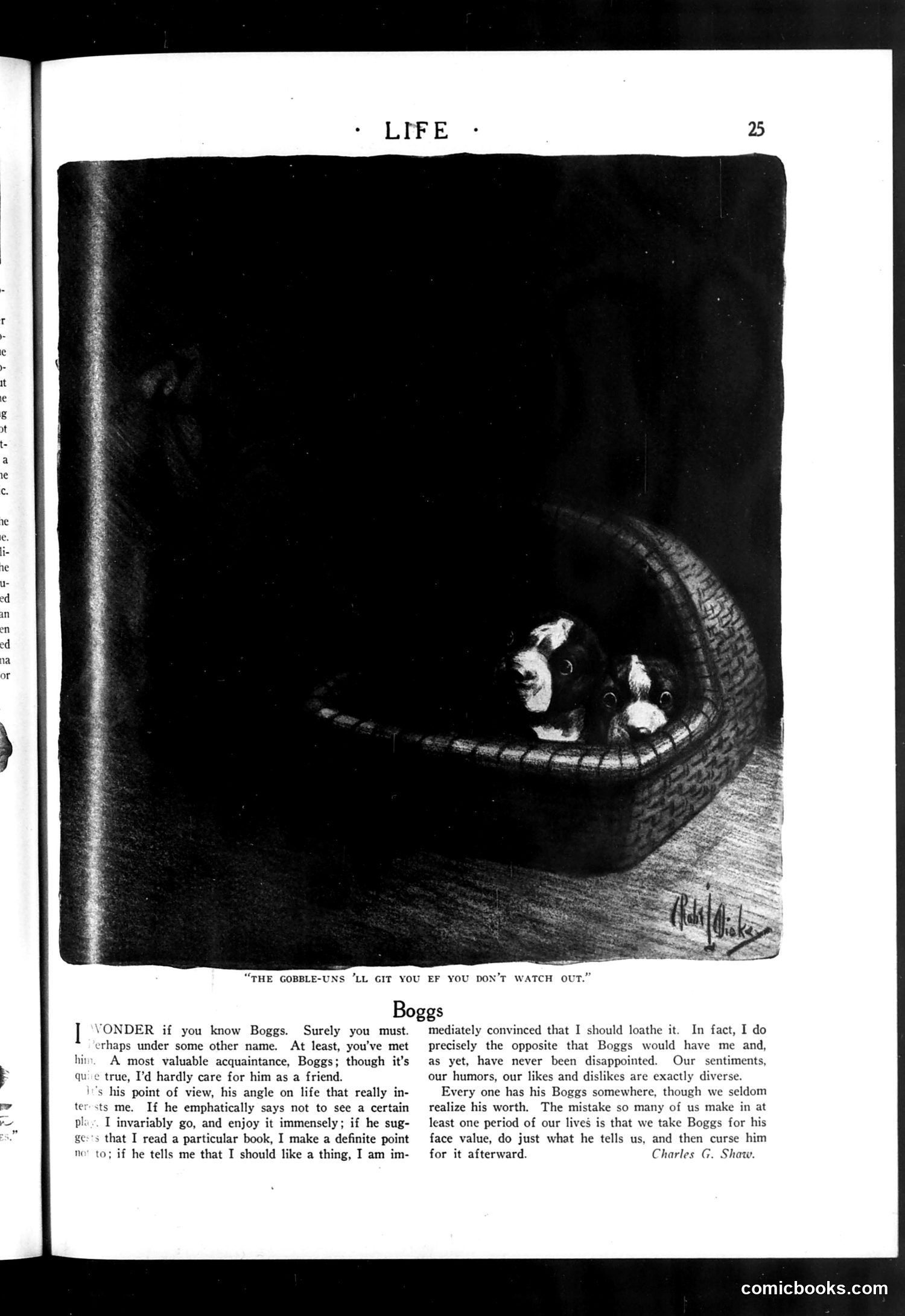
This page from *Life* magazine features a cartoon and accompanying essay about a social type called "Boggs." **The Cartoon:** Shows two small dogs huddled in what appears to be a wicker basket or chair, set against a dark background. The caption quotes James Whitcomb Riley's famous poem line: "The Gobble-uns 'll git you ef you don't watch out"—a humorous, deliberately ominous warning. **The Satire:** The essay by Charles G. Shaw uses "Boggs" as a universal type—the contrarian acquaintance whose opinions are reliably wrong. The joke is that if Boggs recommends something, you should do the opposite. Shaw argues most people foolishly trust Boggs's judgment at face value, then blame him afterward for their disappointment. **The Connection:** The cartoon illustrates this dynamic humorously: the anxious dogs awaiting some unnamed threat (the "gobble-uns") parallels how people naively follow Boggs's advice, expecting disaster. The satire gently mocks our tendency to take advice from unreliable sources without critical thinking.
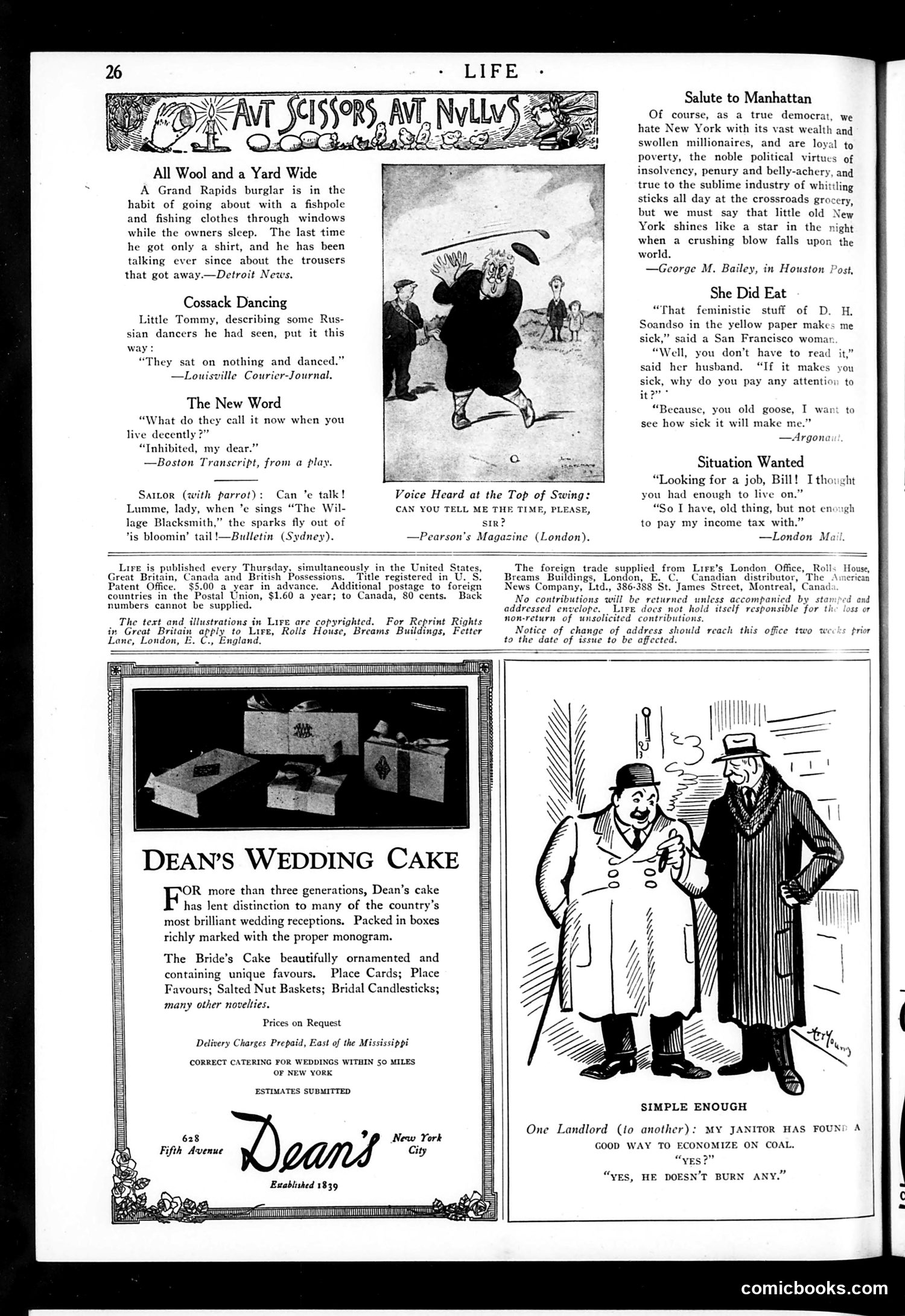
This page contains brief humor pieces and advertisements typical of early 20th-century Life magazine's satirical format. **The Cartoons/Jokes:** The page features short, punchy joke items mocking social types and contemporary concerns. "Simple Enough" shows two landlords discussing a janitor's cost-cutting: he economizes on coal by simply not burning any—satirizing penny-pinching property owners. The "Voice Heard at the Top of Swing" references income tax burden, likely reflecting post-WWI tax increases affecting even the middle class. **Social Commentary:** "Salute to Manhattan" ironically praises New York despite claiming to despise its wealth, suggesting ambivalence about American capitalism. "She Did Eat" mocks a woman who complains about feminist literature while obsessively reading it—poking fun at both feminism and female hypocrisy. **Content:** Most pieces are brief, syndicated jokes from various newspapers. The page is largely advertising for Dean's Wedding Cake, indicating the magazine's commercial focus. The humor reflects pre-modern sensibilities: brief, pun-driven, and focused on class, gender, and economic anxieties of the era.
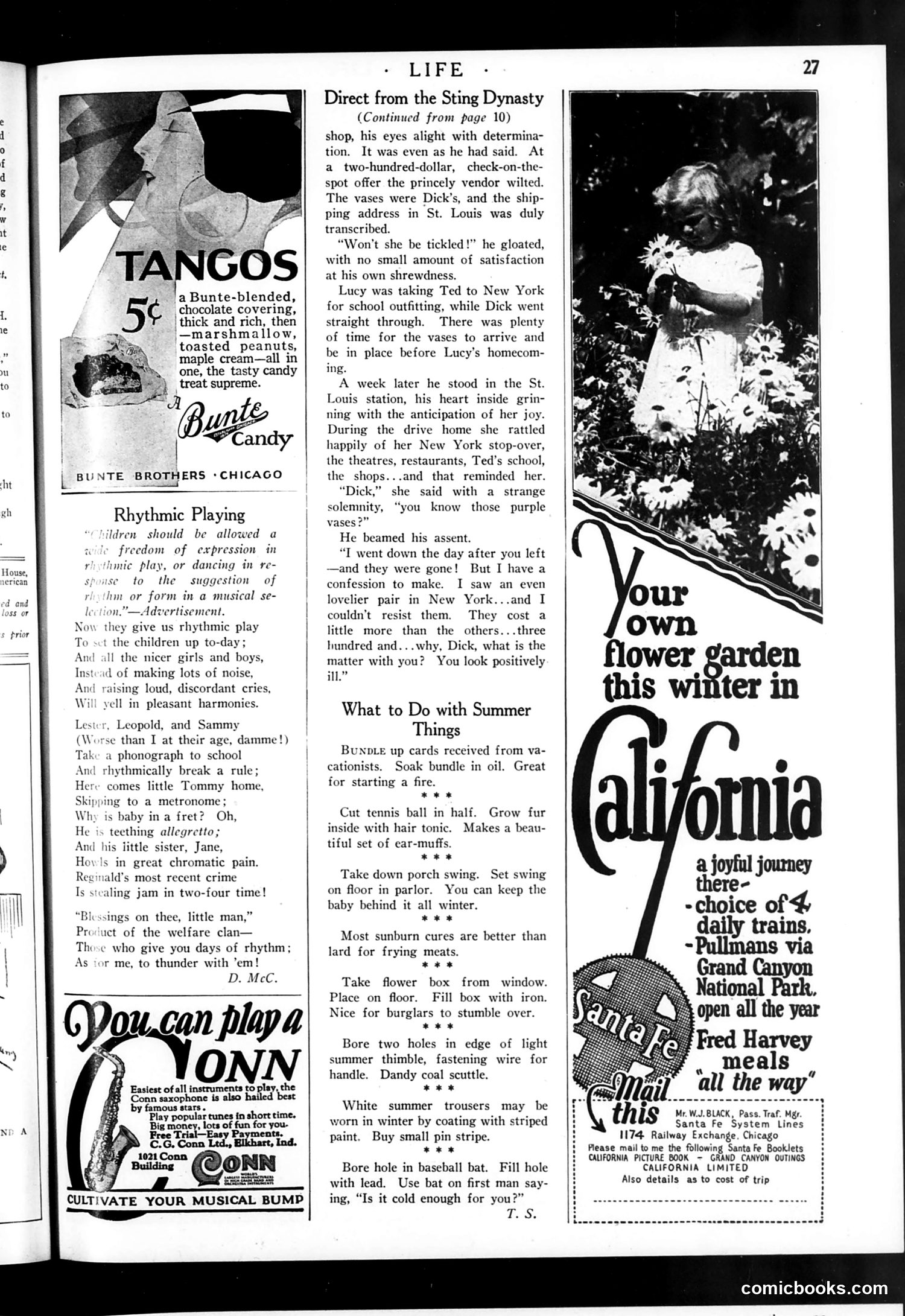
This page contains multiple advertisements and satirical content typical of 1920s *Life* magazine. The main story "Direct from the Sting Dynasty" is a humorous narrative about newlyweds Dick and Lucy feuding over decorative vases—he purchases an expensive pair as a surprise, only to learn she's already bought a different, costlier pair. The satire mocks romantic misunderstandings and marital competitiveness over luxury goods. The "Rhythmic Playing" section satirizes educational trends promoting musical rhythm exercises for children, with comic verses imagining children obsessively keeping tempo ("teething allegretto," "chromatic pain"). "What to Do with Summer Things" offers absurd, tongue-in-cheek reuse suggestions—turning a baseball bat into a weapon by filling it with lead, for instance. The page also includes product advertisements (Tangos candy, Conn saxophone), typical of the era's commercial magazine content.
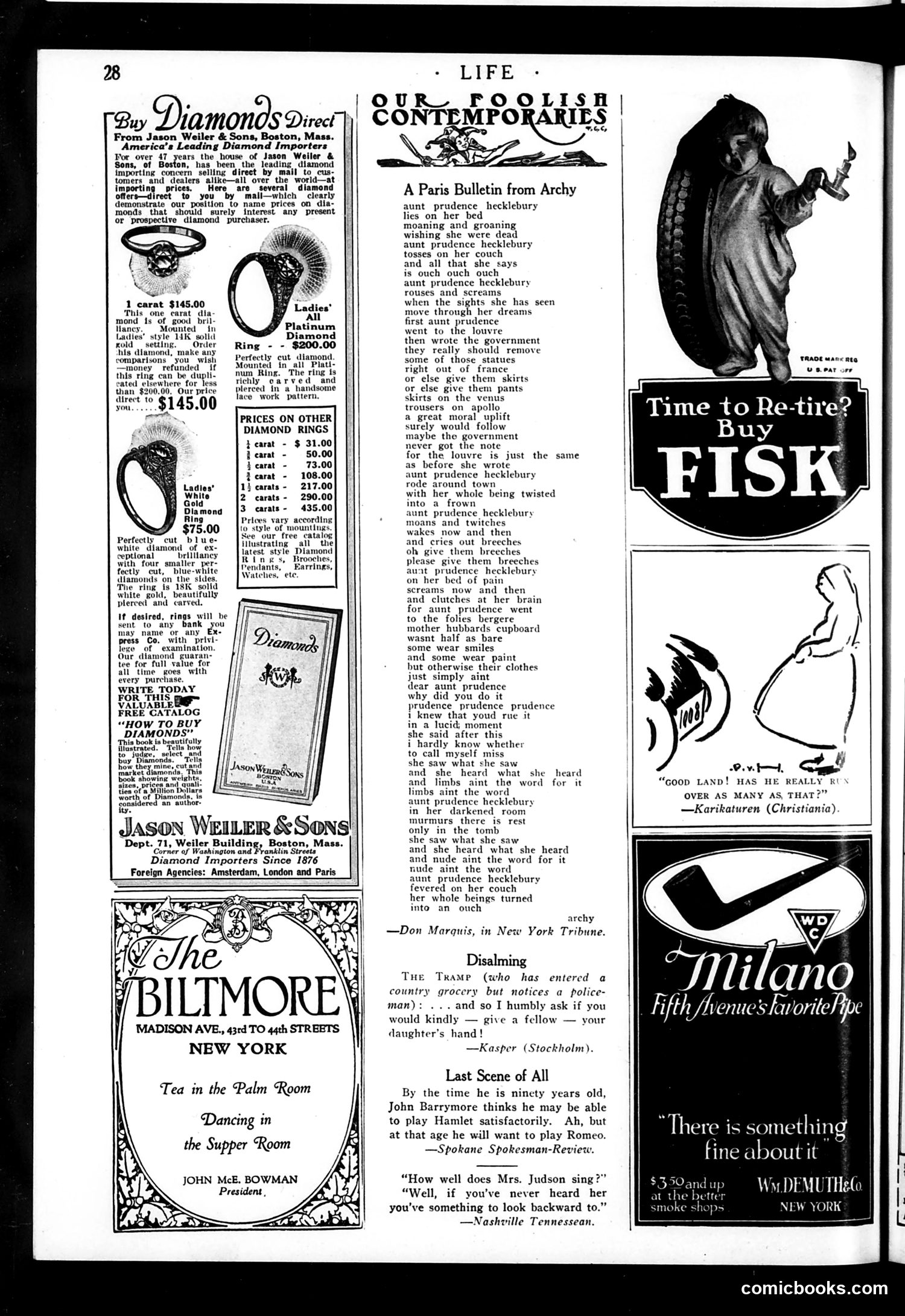
This page consists primarily of **advertisements** (diamonds, hotels, pipes) interspersed with **satirical poetry and cartoons** typical of Life magazine's format. The main satirical content is "A Paris Bulletin from Archy"—a humorous poem by Don Marquis (credited to "archy," his famous cockroach character). It mocks American prudishness through Aunt Prudence Hecklebury, who visits the Louvre and Folies Bergère in Paris, then campaigns to censor classical nude statuary and force dancers to wear clothing. The joke satirizes American moral conservatism clashing with European artistic tradition—the aunts' earnest crusade to "improve" French art through covering nudity appears absurdly provincial. The cartoon illustrations show the aunt in various states of scandalized distress. This reflects early 20th-century American attitudes about sexuality and art, poking fun at those who viewed European culture as morally dangerous. The page also includes brief joke snippets mocking other contemporary figures and attitudes.
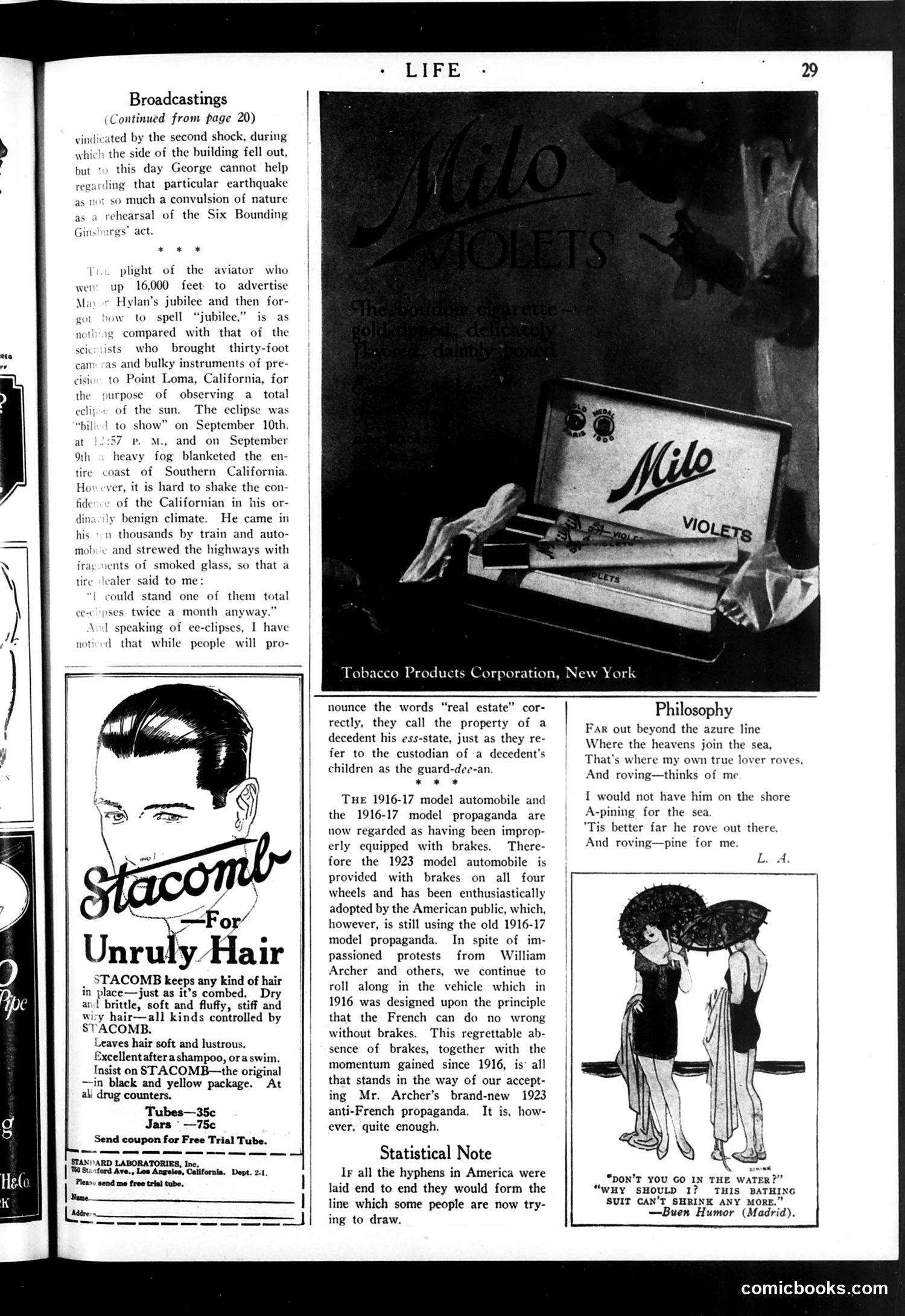
This page mixes humor columns, advertisements, and cartoons typical of 1920s *Life* magazine's satirical style. **The "Broadcastings" column** contains gossipy anecdotes about contemporary events: an earthquake in California, an aviator's failed aerial advertisement for Mayor Hylan's jubilee, and eclipse-chasers who brought expensive equipment to Point Loma only to encounter fog. The humor relies on absurdist mishaps and California stereotypes. **A cartoon** (bottom right) shows a woman in a bathing suit, with the caption joking that her suit "can't shrink any more"—satirizing both poor garment quality and women's body insecurity, credited to a Spanish humor magazine. **The "Statistical Note"** is wordplay: if America's hyphens were laid end-to-end, they'd form "the line which some people are now trying to draw"—likely referencing political or social division debates of the era. **Advertisements** include Stacomb hair product and Milo violets (tobacco). The page exemplifies *Life*'s mix of topical satire, visual gags, and commercial content aimed at educated, urban readers.
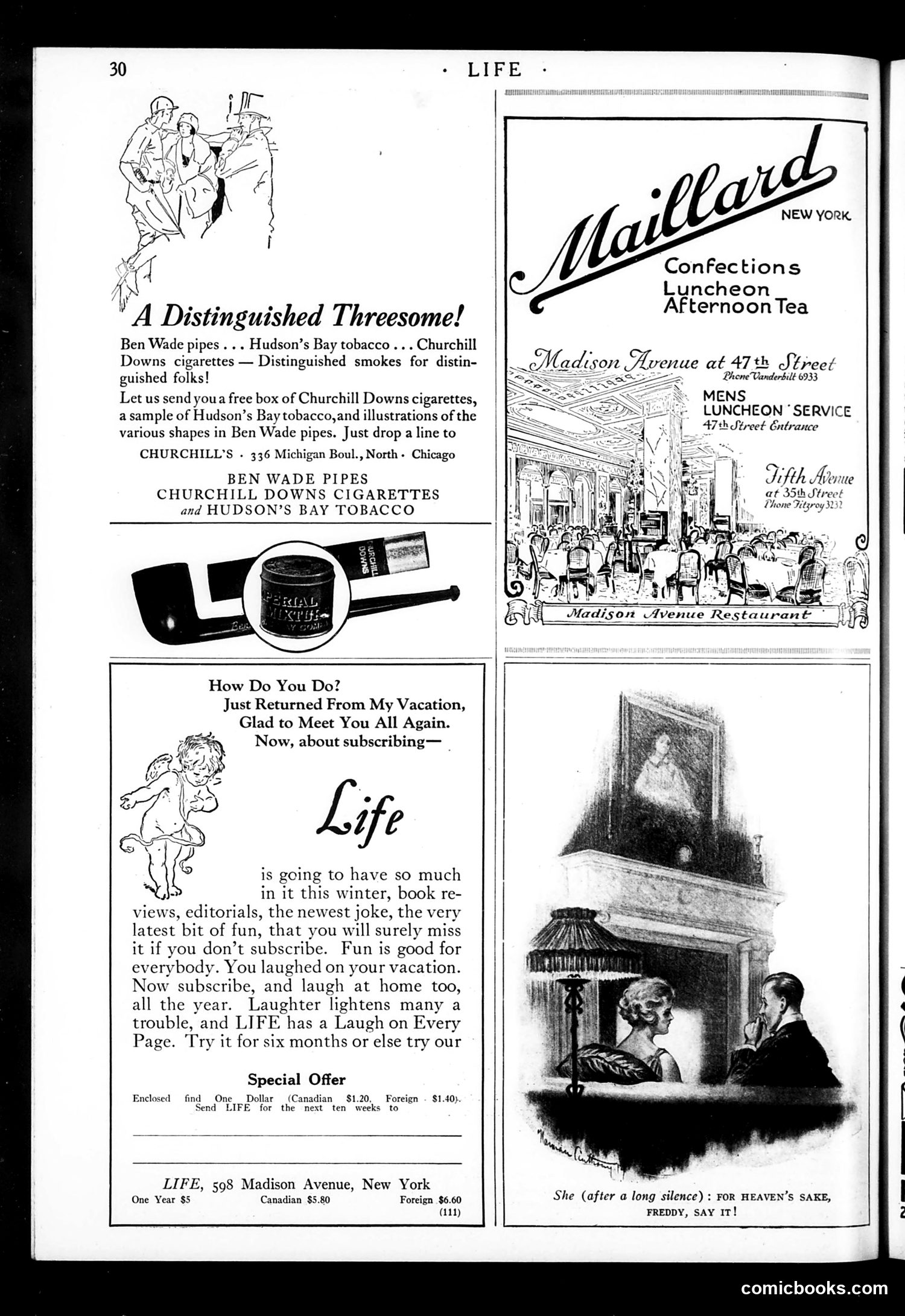
This page combines advertisements and subscription promotion with one cartoon. The main content includes: **Advertisements:** Churchill's tobacco products (Ben Wade pipes, Churchill Downs cigarettes, Hudson's Bay tobacco) and Maillard restaurant in New York, both targeting affluent readers. **The Cartoon:** The bottom right shows a domestic scene captioned "She (after a long silence): FOR HEAVEN'S SAKE, FREDDY, SAY IT!" A woman and man sit at what appears to be a fireplace; her exasperated plea suggests an awkward silence in their relationship. The humor relies on the uncomfortable social tension of two people unable to communicate—likely reflecting early 20th-century anxieties about marital conversation or romantic expression. **Subscription Pitch:** The left side uses a cherub mascot to encourage Life subscriptions, emphasizing humor and entertainment as stress relief ("Laughter lightens many a trouble"). The page reflects Life's primary function: satirical humor and advertising for the urban, middle-to-upper-class audience.
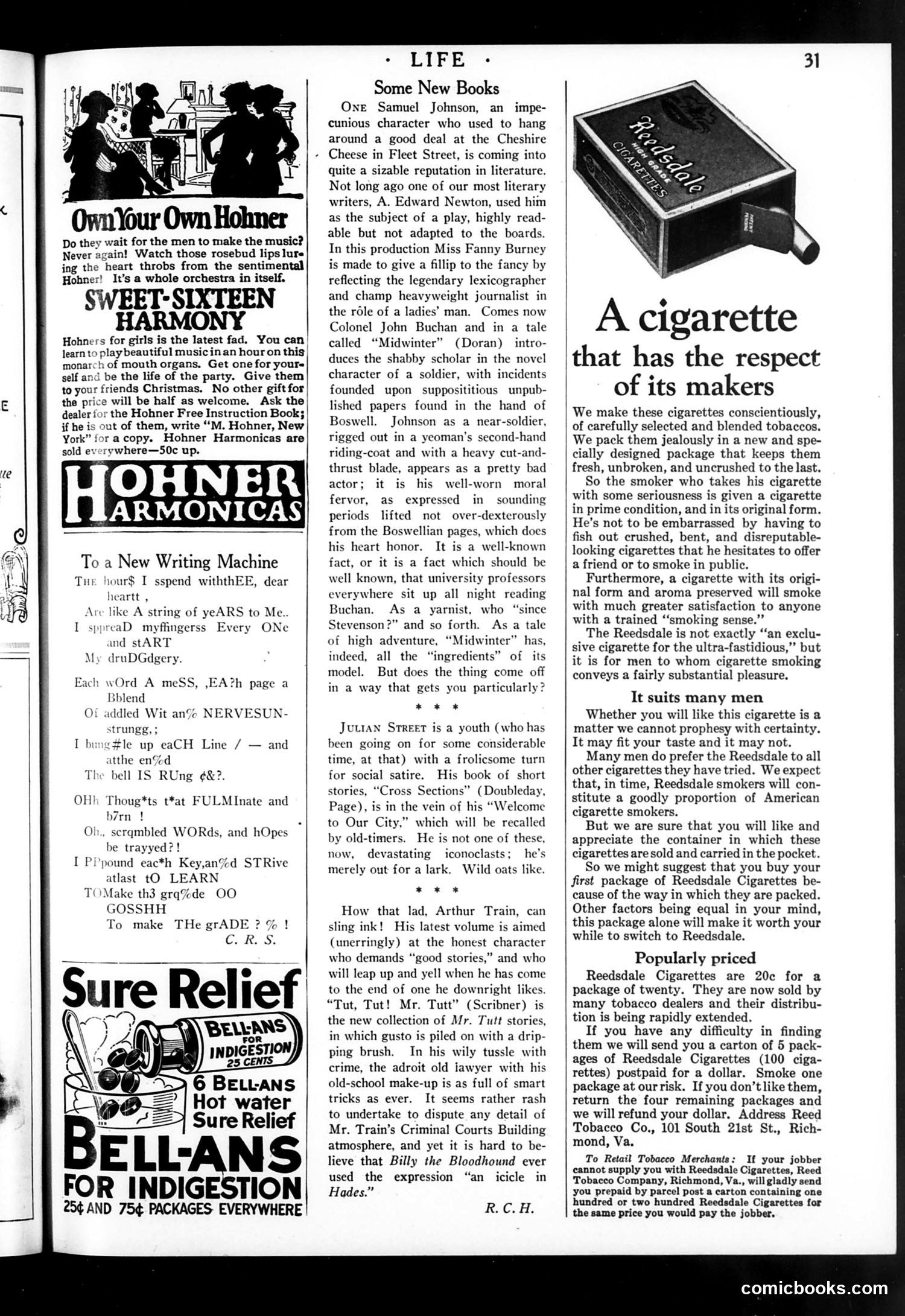
This page primarily contains **book reviews and advertisements** rather than political cartoons. The main content discusses literary works: Samuel Johnson's growing reputation (appearing in a play by A. Edward Newton and a novel called "Midwinter" by John Buchan), and Julian Street's satirical short stories. These are straightforward literary critiques with no apparent satire or political commentary. The advertisements—for Hohner Harmonicas, a writing machine, and Bellans indigestion relief—use typical early 20th-century marketing appeals (novelty, convenience, health benefits) but contain no satirical intent. The large **Reedsdale Cigarettes advertisement** occupies significant space, emphasizing quality tobacco selection and careful packaging. This reflects the era's open cigarette marketing before health warnings. Overall, this is a **miscellaneous content page** mixing book reviews with commercial advertising, lacking the satirical or political commentary a modern reader might expect from Life magazine's name.
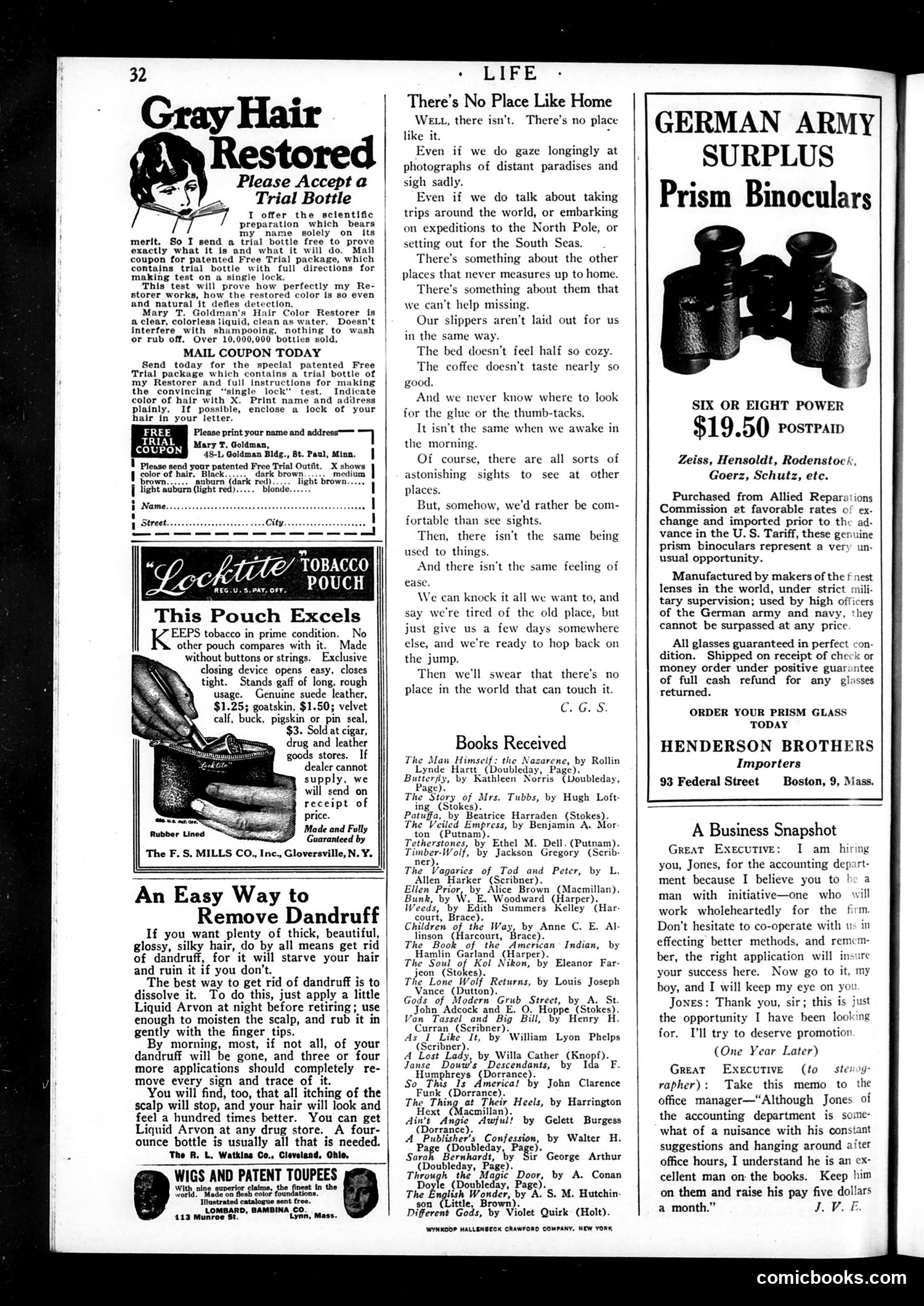
This page is primarily **advertising**, not satire or political commentary. It contains multiple product advertisements typical of the era: **Main Content:** - Hair restoration product (Mary T. Goldman's Hair Color Restorer) - Tobacco pouch - Dandruff treatment (Liquid Arvon) - Wigs and toupees - German Army surplus binoculars **The Editorial Essay** ("There's No Place Like Home") is a sentimental, non-satirical piece expressing nostalgia for domestic comfort over exotic travel—a common theme in period magazines. It celebrates homely details (slippers, coffee, thumb-tacks) over distant adventures. **Historical Context:** The German Army binoculars represent surplus military equipment available after WWI, marketed to American consumers as quality optical instruments. This is a standard commercial magazine page with no discernible political cartoons, caricatures, or satire requiring historical context to understand. It reflects 1920s-30s consumer culture and advertising conventions.