
Life, 1923-10-25 · page 16 of 34
Life — October 25, 1923 — page 16: what you’re looking at
What you’re looking at
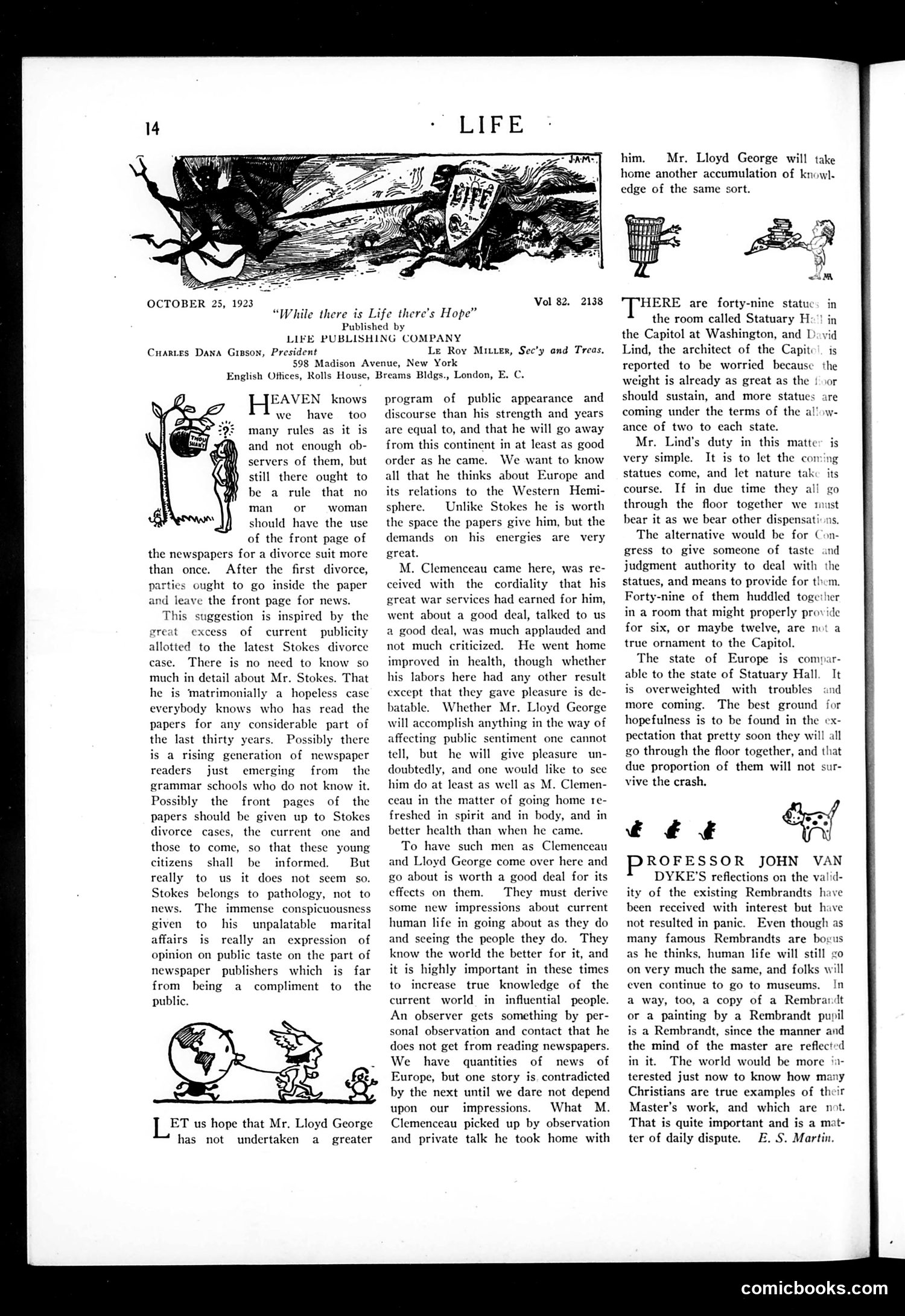
This page contains editorial commentary rather than political cartoons. The main article discusses David Lloyd George's recent visit to America and his observations about European affairs and American public opinion. The text criticizes newspaper coverage of Lloyd George's divorce proceedings, arguing that divorce details received excessive front-page attention. The author suggests newspapers should instead focus on informing citizens about substantive matters—like Lloyd George's insights on Europe and international relations—rather than sensationalism. A secondary piece discusses Professor John Van Dyke's reflections on art and culture, noting that personal observation provides insights newspapers cannot. The small decorative illustrations are generic ornamental drawings, not pointed political satire.
📄 Transcribed text from this page (OCR, searchable)
Machine-transcribed from the original scan — historical spelling and the odd misread are preserved.
OCTOBER 25, 1923 Vol 82, 2138 “While there is Life there's Hope” Published by LIFE PUBLISHING COMPANY Cuartes Dana Gipson, President Le Roy Mutter, Sec’y and Treas. 598 Madison Avenue, New York English Offices, Rolls House, Breams Bldgs., London, E. C. HEAVEN knows we have too many rules as it is and not enough ob- servers of them, but still there ought to be a rule that no man or woman should have the use of the front page of the newspapers for a divorce suit more than once. After the first divorce, parties ought to go inside the paper and leave the front page for news. This suggestion is inspired by the great excess of current publicity allotted to the latest Stokes divorce case. There is no need to know so much in detail about Mr. Stokes. That he is ‘matrimonially a hopeless case everybody knows who has read the papers for any considerable part of the last thirty years. Possibly there is a rising generation of newspaper readers just emerging from the grammar schools who do not know it. Possibly the front pages of the papers should be given up to Stokes divorce cases, the current one and those to come, so that these young citizens shall be informed. But really to us it does not seem so. Stokes belongs to pathology, not to news. The immense conspicuousness given to his unpalatable marital affairs is really an expression of opinion on public taste on the part of newspaper publishers which is far from being a compliment to the public. ET us hope that Mr. Lloyd George has not undertaken a_ greater program of public appearance and discourse than his strength and years are equal to, and that he will go away from this continent in at least as good order as he came. We want to know all that he thinks about Europe and its relations to the Western Hemi- sphere. Unlike Stokes he is worth the space the papers give him, but the energies are very demands on_ his great. M. Clemenceau came here, was re- ceived with the cordiality that his great war services had earned for him, went about a good deal, talked to us a good deal, was much applauded and not much criticized. He went home improved in health, though whether his labors here had any other result except that they gave pleasure is de- batable. Whether Mr. Lloyd George will accomplish anything in the way of affecting public sentiment one cannot tell, but he will give pleasure un- doubtedly, and one would like to see him do at least as well as M. Clemen- ceau in the matter of going home re- freshed in spirit and in body, and in better health than when he came. To have such men as Clemenceau and Lloyd George come over here and go about is worth a good deal for its effects on them. They must derive some new impressions about current human life in going about as they do and seeing the people they do. They know the world the better for it, and it is highly important in these times to increase true knowledge of the current world in influential people. An observer gets something by per- sonal observation and contact that he does not get from reading newspapers. We have quantities of news of Europe, but one story is. contradicted by the next until we dare not depend upon our impressions. What M. Clemenceau picked up by observation and private talk he took home with him. Mr. Lloyd George will take home another accumulation of knowl. edge of the same sort. "[ HERE are forty-nine statues in the room called Statuary H:! in the Capitol at Washington, and Dovid Lind, the architect of the Capite'!. is reported to be worried because the weight is already as great as the { vor should sustain, and more statues are coming under the terms of the al!ow- ance of two to each state. Mr. Lind’s duty in this matter is very simple. It is to let the coming statues come, and let nature take its course. If in due time they al! go through the floor together we tust bear it as we bear other dispensativns. The alternative would be for Con- gress to give someone of taste and judgment authority to deal with the statues, and means to provide for them. Forty-nine of them huddled together in a room that might properly provide for six, or maybe twelve, are not a true ornament to the Capitol. The state of Europe is compar- able to the state of Statuary Hall. It is overweighted with troubles and more coming. The best ground for hopefulness is to be found in the ex- pectation that pretty soon they will all go through the floor together, and that due proportion of them will not sur- vive the crash, & € € PROFESSOR JOHN VAN DYKE'’S reflections on the valid- ity of the existing Rembrandts have been received with interest but have not resulted in panic. Even though as many famous Rembrandts are bogus as he thinks, human life will still go on very much the same, and folks will even continue to go to museums. In a way, too, a copy of a Rembrandt or a painting by a Rembrandt pupil is a Rembrandt, since the manner and the mind of the master are reflected in it. The world would be more in- terested just now to know how many Christians are true examples of their Master’s work, and which are not. That is quite important and is a mat- ter of daily dispute. E. S. Martin. comicbooks.com