
Life, 1923-10-25 · page 20 of 34
Life — October 25, 1923 — page 20: what you’re looking at
What you’re looking at
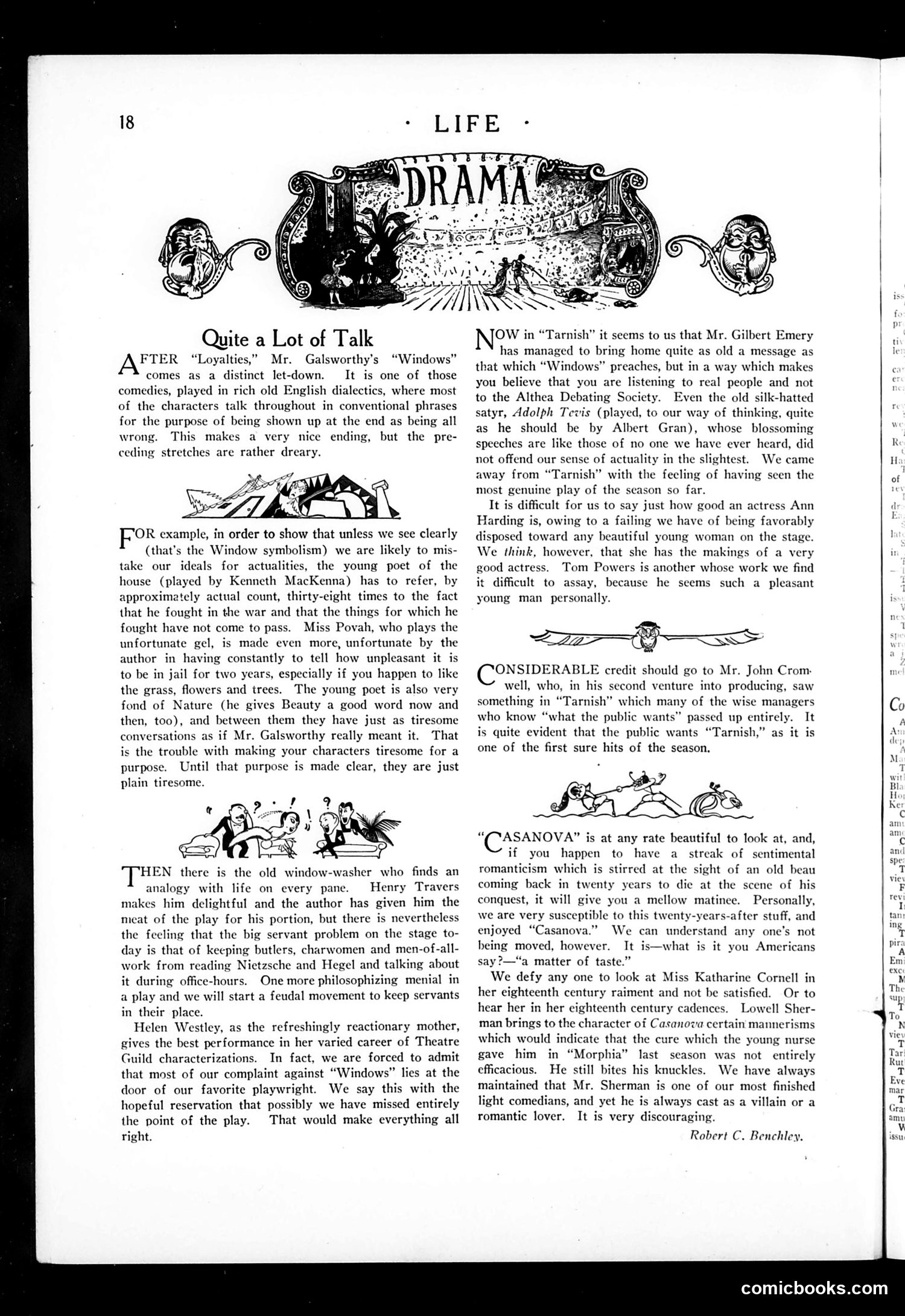
This page reviews three theatrical productions. The critic favorably compares **"Tarnish"** (by Gilbert Emery) to **"Windows"** (by John Galsworthy), finding the former more dramatically engaging despite tackling similar moral themes. The satire targets Galsworthy's overly didactic approach: characters repeatedly reference war disillusionment and jail time until their earnestness becomes tedious rather than meaningful. A particular jab targets the stage servant-problem—working-class characters (butlers, charwomen) who spout Nietzsche and Hegel philosophy. The critic jokes this will spark a "feudal movement" to keep servants from intellectualizing on the job. **"Tarnish"** succeeds because it conveys comparable messages through naturalistic dialogue and believable characters, including the aging satyr Adolph Tevis (Albert Gran) and actress Ann Harding, whom the critic praises despite admitting bias toward beautiful young women onstage. The review credits producer John Cromwell for recognizing "Tarnish's" popular appeal when other managers rejected it.
📄 Transcribed text from this page (OCR, searchable)
Machine-transcribed from the original scan — historical spelling and the odd misread are preserved.
Quite a Lot of Talk FTER “Loyalties,” Mr. Galsworthy’s “Windows” comes as a distinct let-down. It is one of those comedies, played in rich old English dialectics, where most of the characters talk throughout in conventional phrases for the purpose of being shown up at the end as being all wrong. This makes a very nice ending, but the pre- ceding stretches are rather dreary. For example, in order to show that unless we see clearly (that’s the Window symbolism) we are likely to mis- take our ideals for actualities, the young poet of the house (played by Kenneth MacKenna) has to refer, by approximately actual count, thirty-eight times to the fact that he fought in the war and that the things for which he fought have not come to pass. Miss Povah, who plays the unfortunate gel, is made even more, unfortunate by the author in having constantly to tell how unpleasant it is to be in jail for two years, especially if you happen to like the grass, flowers and trees. The young poet is also very fond of Nature (he gives Beauty a good word now and then, too), and between them they have just as tiresome conversations as if Mr. Galsworthy really meant it. That is the trouble with making your characters tiresome for a purpose. Until that purpose is made clear, they are just plain tiresome. HEN there is the old window-washer who finds an analogy with life on every pane. Henry Travers makes him delightful and the author has given him the meat of the play for his portion, but there is nevertheless the feeling that the big servant problem on the stage to- day is that of keeping butlers, charwomen and men-of-all- work from reading Nietzsche and Hegel and talking about it during office-hours. One more philosophizing menial in a play and we will start a feudal movement to keep servants in their place. Helen Westley, as the refreshingly reactionary mother, gives the best performance in her varied career of Theatre Guild characterizations. In fact, we are forced to admit that most of our complaint against “Windows” lies at the door of our favorite playwright. We say this with the hopeful reservation that possibly we have missed entirely the point of the play. That would make everything all right. OW in “Tarnish” it seems to us that Mr. Gilbert Emery has managed to bring home quite as old a message as that which “Windows” preaches, but in a way which makes you believe that you are listening to real people and not to the Althea Debating Society. Even the old silk-hatted satyr, Adolph Tevis (played, to our way of thin! quite as he should be by Albert Gran), whose blossoming speeches are like those of no one we have ever heard, did not offend our sense of actuality in the slightest. We came away from “Tarnish” with the feeling of having seen the most genuine play of the season so far. It is difficult for us to say just how good an actress Ann Harding is, owing to a failing we have of being favorably disposed toward any beautiful young woman on the stage. We think, however, that she has the makings of a very good actress. Tom Powers is another whose work we find it difficult to assay, because he seems such a_ pleasant young man personally. en ed ONSIDERABLE credit should go to Mr. John Crom. well, who, in his second venture into producing, saw something in “Tarnish” which many of the wise managers who know “what the public wants” passed up entirely. It is quite evident that the public wants “Tarnish,” as it is one of the first sure hits of the season, “CCASANOVA?” is at any rate beautiful to look at, and, if you happen to have a_ streak of sentimental romanticism which is stirred at the sight of an old beau coming back in twenty years to die at the scene of his conquest, it will give you a mellow matinee. Personally, we are very susceptible to this twenty-years-after stuff, and enjoyed “Casanova.” We can understand any one’s not being moved, however. It what is it you Americans say ?—“a matter of taste.” We defy any one to look at Miss Katharine Cornell in her eighteenth century raiment and not be satisfied. Or to hear her in her eighteenth century cadences. Lowell Sher- man brings to the character of Casanova certain mannerisms which would indicate that the cure which the young nurse gave him in “Morphia” last season was not entirely efficacious. He still bites his knuckles. We have always maintained that Mr. Sherman is one of our most finished light comedians, and yet he is always cast as a villain or a romantic lover. It is very discouraging. Robert C. Benchley. comicbooks.com