
Life, 1923-10-25 · page 26 of 34
Life — October 25, 1923 — page 26: what you’re looking at
What you’re looking at
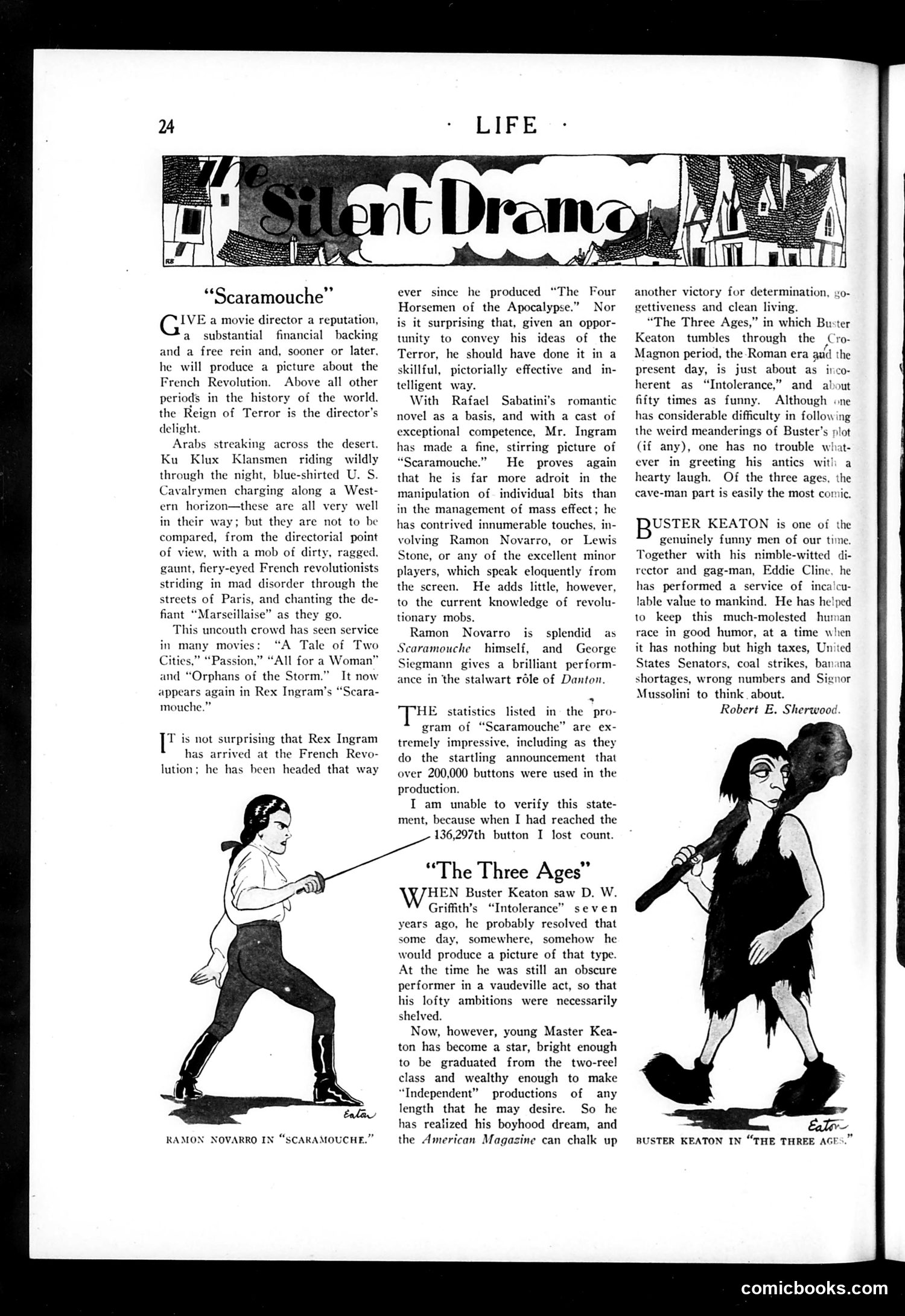
This page reviews two silent films from the early 1920s: **"Scaramouche"** stars Ramon Novarro in a French Revolution drama directed by Rex Ingram. The critic notes Ingram's obsession with depicting the Revolution—citing it as Hollywood's favorite historical backdrop alongside desert adventures and Ku Klux Klan imagery. The review praises Ingram's skillful direction of individual scenes while critiquing his handling of crowd sequences. A satirical jab appears in the closing: the production boasted using 200,000 buttons, prompting the reviewer to humorously claim they "lost count" at 136,297—mocking Hollywood's tendency toward inflated production statistics as a marketing tool. **"The Three Ages"** stars Buster Keaton in a three-era comedy (caveman, Roman, modern) apparently inspired by D.W. Griffith's "Intolerance." The critic celebrates Keaton's success graduating from vaudeville to independent filmmaking, calling him "genuinely funny" and praising his gag-work. Despite the film's incoherent plot, its humor carries it—the caveman sequences supposedly being funniest. Both reviews employ witty condescension typical of period film criticism.
📄 Transcribed text from this page (OCR, searchable)
Machine-transcribed from the original scan — historical spelling and the odd misread are preserved.
” “‘Scaramouche GIVE a movie director a reputation, a substantial financial backing and a free rein and, sooner or later, he will produce a picture about the French Revolution. Above all other periods in the history of the world. the Reign of Terror is the director's delight. Arabs streaking across the desert. Ku Klux riding wildly through the night, blue-shirted U. S. Cavalrymen charging along a West- ern horizon—these are all very well in their way; but they are not to be compared, from the directorial point of view, with a mob of dirty, ragged. gaunt, fiery-eyed French revolutionists striding in mad disorder through the streets of Paris, and chanting the de- fiant “Marseillai as they go. This uncouth crowd has seen service in many me “A Tale of Two Cities,” “Passion,” “All for a Woman” and “Orphans of the Storm.” It now appears again in Rex Ingram’s “Scara- mouche.” Klansmen T is not surprising that Rex Ingram has arrived at the French Revo- lution; he has been headed that way balan RAMON NOVARRO IN “SCARAMOUCHE.” ever since he produced “The Four Horsemen of the Apocalypse.” Nor is it surprising that, given an oppor- tunity to convey his ideas of the Terror, he should have done it in a skillful, pictorially effective and in- telligent way. With Rafael Sabatini’s romantic novel as a basis, and with a cast of exceptional competence, Mr. Ingram has made a fine, stirring picture of “Scaramouche.” He proves again that he is far more adroit in the manipulation of individual bits than in the management of mass effect; he has contrived innumerable touches, in- volving Ramon Novarro, or Lewis Stone, or any of the excellent minor players, which speak eloquently from He adds little, however, to the current knowledge of revolu- tionary mobs. Ramon Scaramouche the screen. Novarro is splendid as himself, and George gmann gives a brilliant perform- ance in the stalwart role of Danton. 'HE listed in the pro- gram of “Scaramouche” are ex- tremely impressive, including as they do the startling announcement that over 200,000 buttons were used in the production. I am unable to verify this state- ment, because when I had reached the 136,297th button I lost count. “The Three Ages” HEN Buster Keaton saw D. W. Griffith’s “Intolerance” seven years ago, he probably resolved that some day, somewhere, somehow he would produce a picture of that type. At the time he was still an obscure performer in a vaudeville act, so that his lofty ambitions were necessarily shelved. Now, however, young Master Kea- ton has become a star, bright enough to be graduated from the two-reel class and wealthy enough to make “Independent” productions of any length that he may desire. So he has realized his boyhood dream, and the American Magazine can chalk up statistics another victory for determination, yo- gettiveness and clean living. “The Three Ages,” in which Buster Keaton tumbles through the Cr Magnon period, the-Roman era gud the present day, is just about as ine herent as “Intolerance,” and about fifty times as funny. Although one has considerable difficulty in following the weird meanderings of Buster’s plot (if any), one has no trouble what- ever in greeting his antics wit hearty laugh. Of the three age: cave-man part is easily the most co’ USTER KEATON is one of the genuinely funny men of our time. Together with his nimble-witted di- rector and gag-man, Eddie Cline, he has performed a service of inca!cu- lable value to mankind. He has helped to keep this much-molested human race in good humor, at a time when it has nothing but high taxes, United States Senators, coal strikes, banana shortages, wrong numbers and Signor Mussolini to think. about. Robert E. Sherwood. BUSTER KEATON IN “THE THREE AGES.” comicbooks.com