
A complete issue · 36 pages · 1923
Life — August 23, 1923
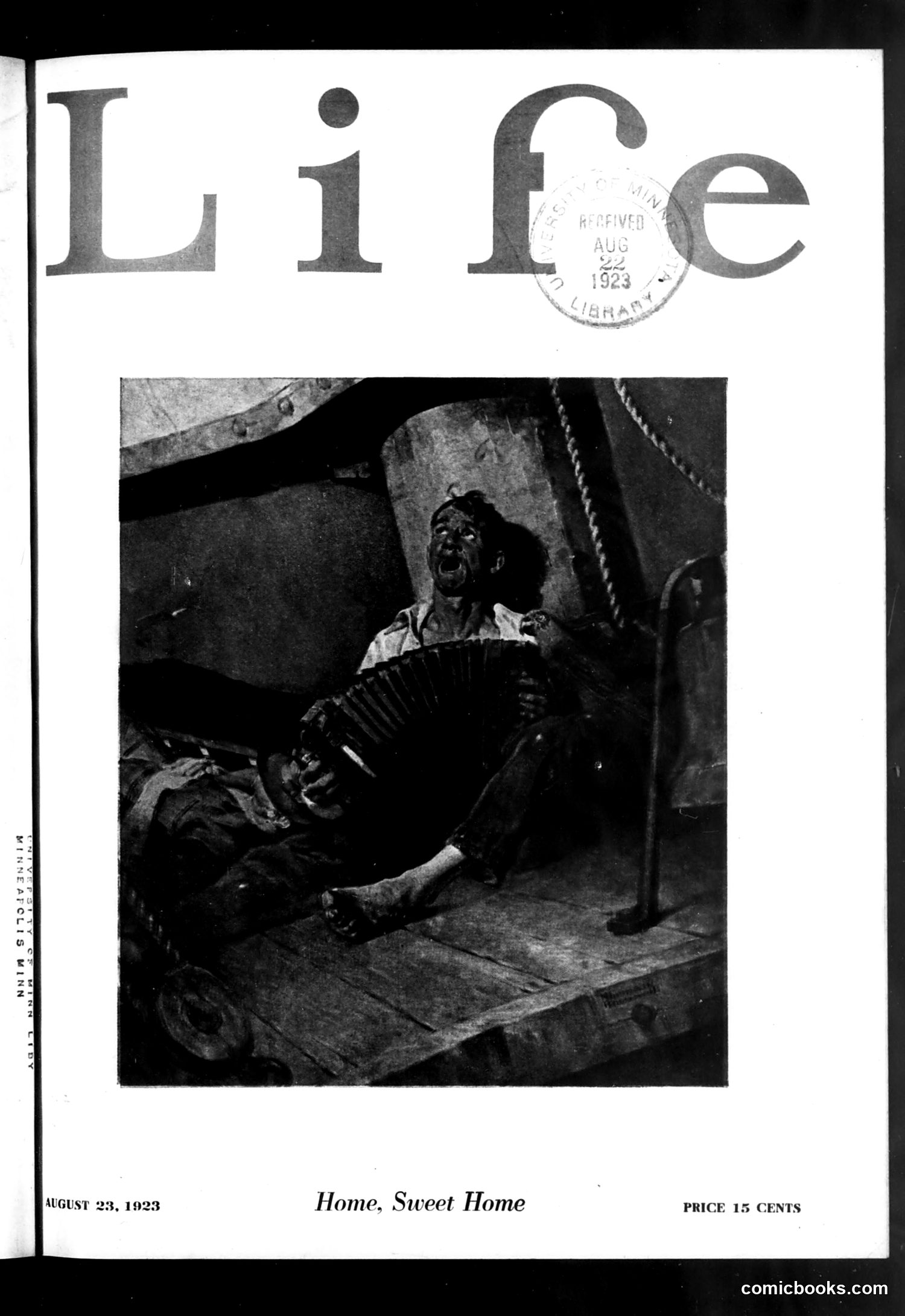
This page features a photograph titled "Home, Sweet Home" depicting a man playing an accordion inside what appears to be a cramped, makeshift living space—likely a ship's cabin or similarly confined quarters based on the visible structural elements (ropes, curved walls). The satire appears to comment on modest or uncomfortable living conditions by pairing the sentimental phrase "Home, Sweet Home" with this unglamorous reality. The accordion-player's animated expression suggests forced cheerfulness despite tight circumstances. This likely critiques either working-class housing conditions of the 1920s or, given the nautical appearance, commentary on immigrants' experiences or sailors' quarters. The humor derives from the gap between the idealized notion of "home" and the cramped, humble actual conditions shown.
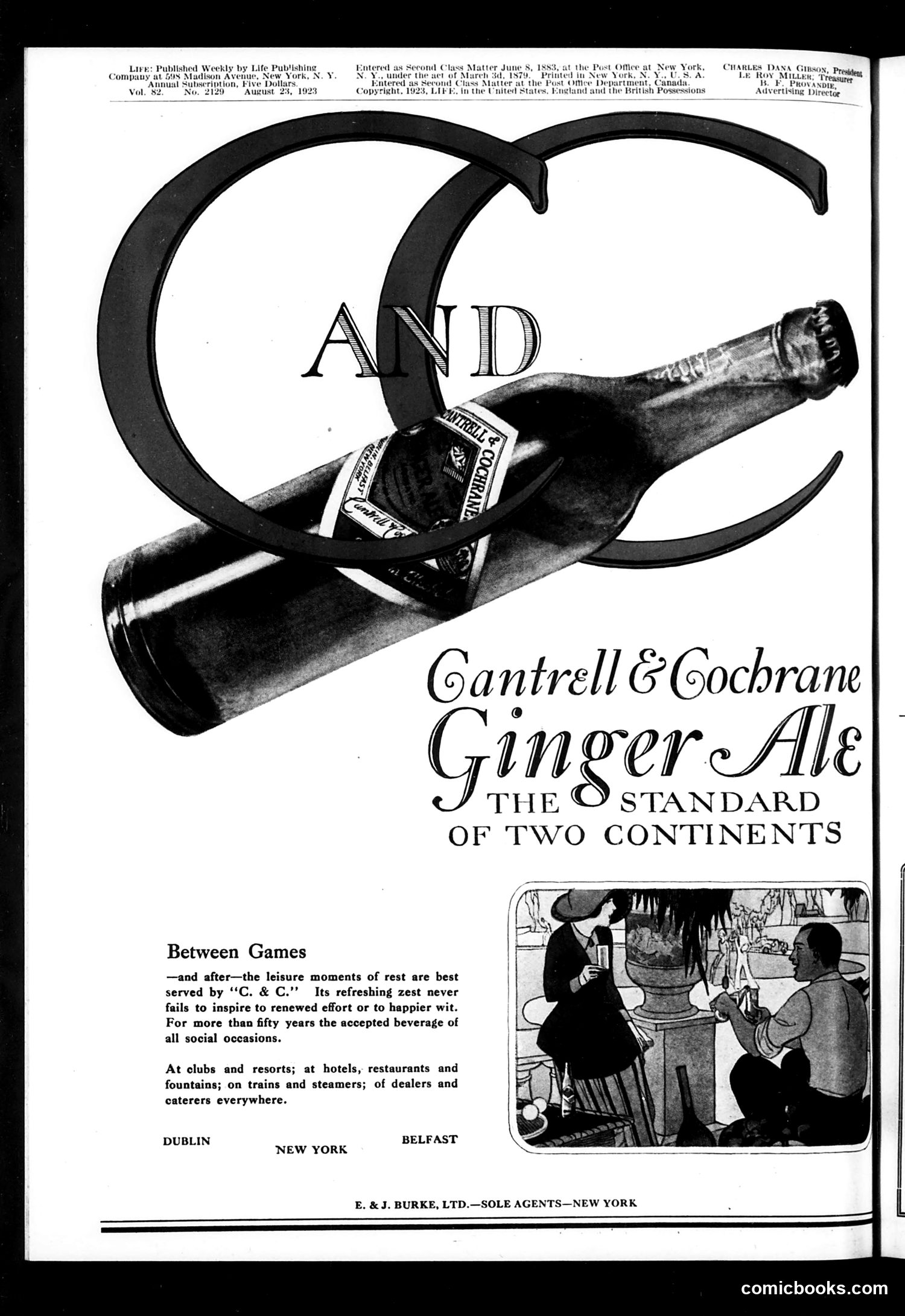
This page is primarily an **advertisement for Cantrell & Cochrane Ginger Ale**, not political satire. The large "C&C" logo dominates the composition, with a bottle of ginger ale positioned through the letters. The ad's tagline claims this is "**The Standard of Two Continents**"—referring to its availability in both North America and Europe (distribution listed in Dublin, Belfast, and New York). The small photograph labeled "Between Games" shows people consuming the beverage at what appears to be a social gathering, reinforcing the product's positioning as an acceptable refreshment for "social occasions" at clubs, resorts, hotels, and restaurants. This is commercial advertising, not political commentary or satire.
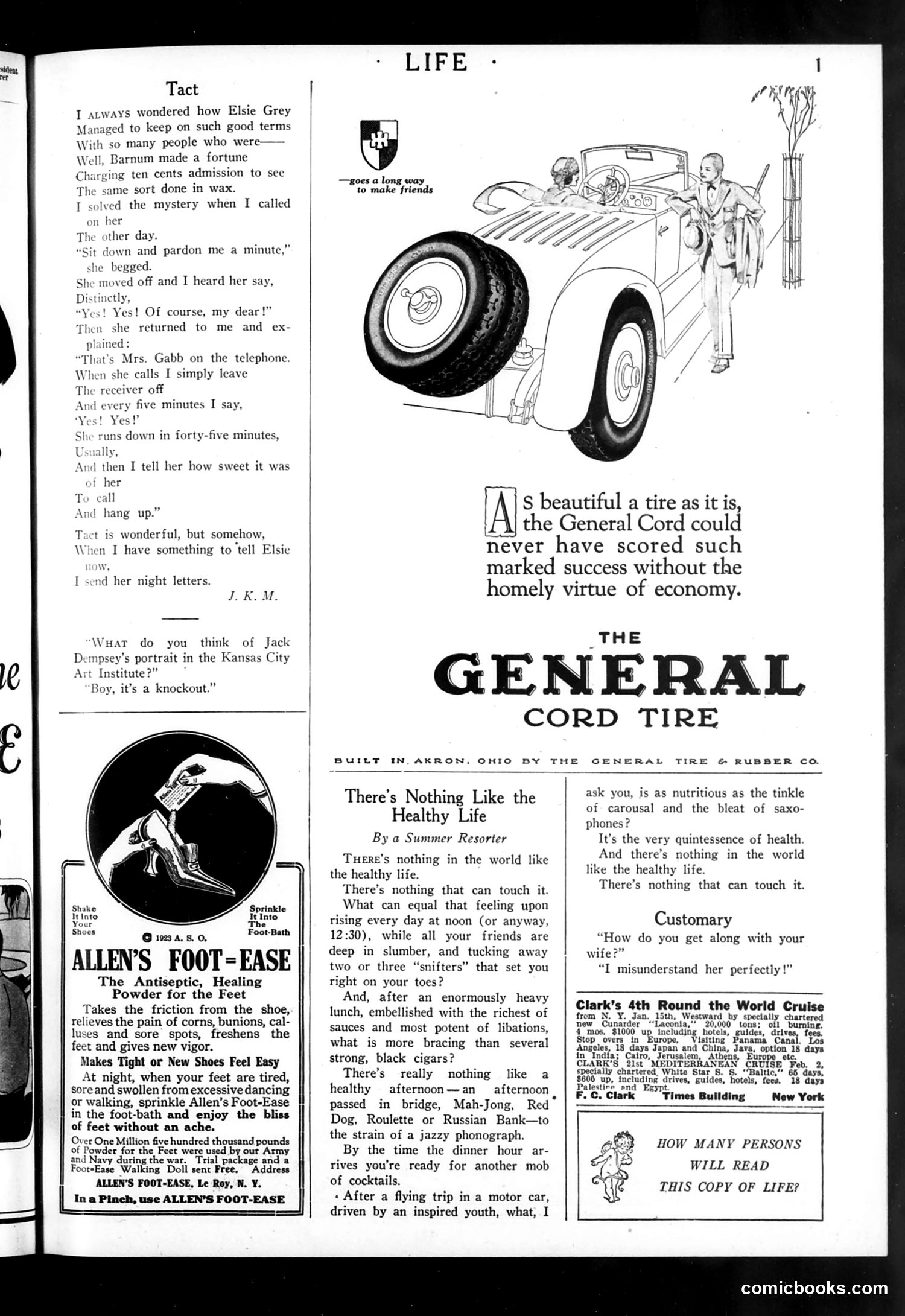
This page is primarily **advertising and lifestyle content** rather than political satire. The main elements are: **"Tact" poem** (left): A humorous piece about maintaining a friendship with someone named Elsie Grey, played for domestic comedy rather than political commentary. **General Cord Tire advertisement** (center/right): The dominant content features a convertible automobile and promotes General Cord Tires, emphasizing "economy" as a virtue. This reflects 1920s consumer culture and automobile enthusiasm. **Supporting advertisements**: Allen's Foot-Ease (a medicinal powder) and a "healthy life" article about summer leisure activities. **"How Many Persons Will Read This Copy of Life?"** (bottom right): Appears to be a self-promotional circulation boast. The page reflects early 20th-century American consumer culture and advertising practices rather than political cartoons or satire.
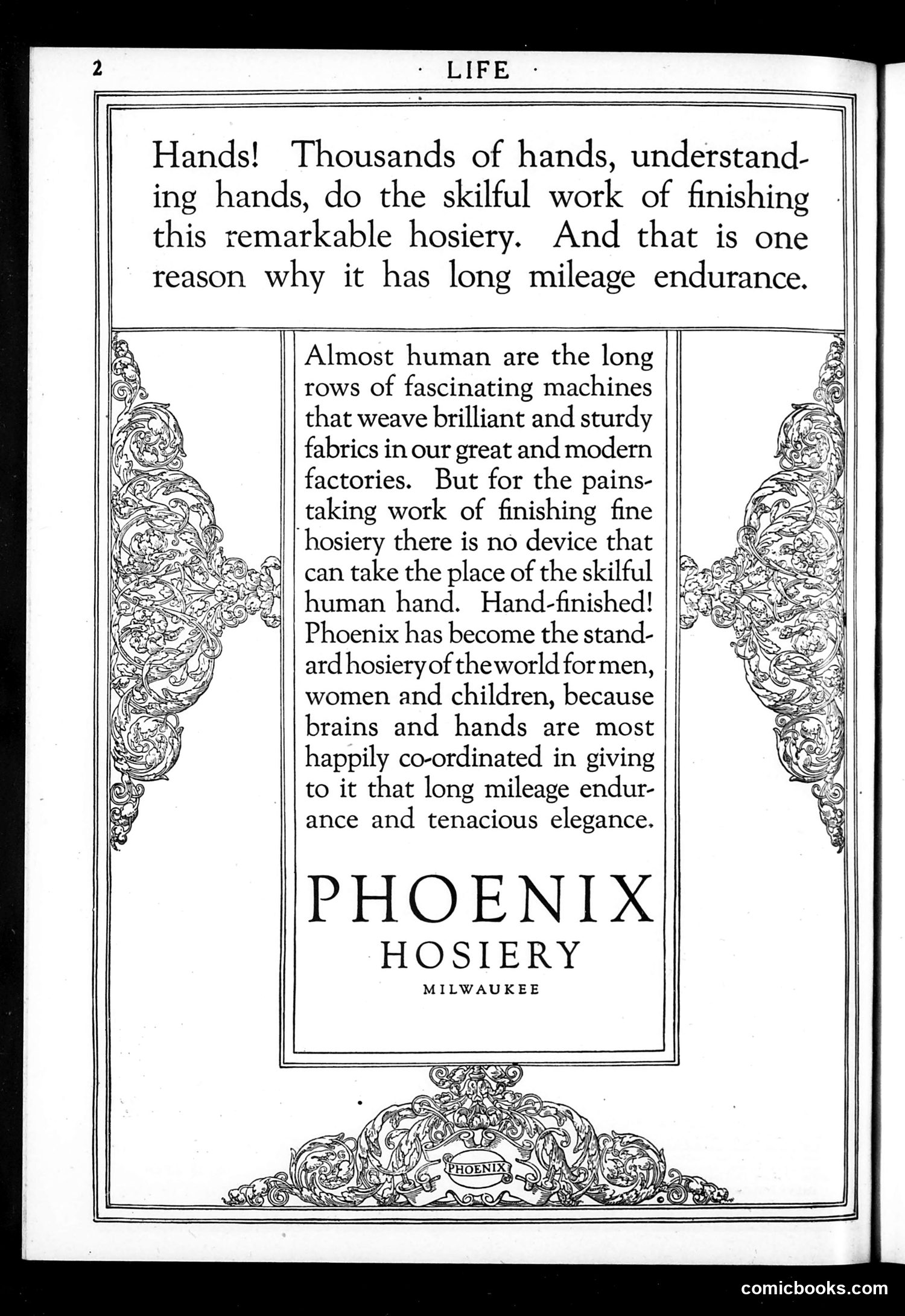
This is not a cartoon or satire—it's a **straightforward advertisement for Phoenix Hosiery** (a Milwaukee manufacturer), appearing in *Life* magazine. The ad emphasizes that while machines weave fabric, **skilled human hands are essential for finishing hosiery**. It argues this hand-finishing work gives Phoenix socks and stockings superior "long mileage endurance and tenacious elegance." The ornate decorative borders frame the product name prominently. The text celebrates the coordination of "brains and hands" as superior to mechanical production alone. This represents early-20th-century marketing that positioned **hand-finishing as a quality differentiator**—emphasizing craftsmanship to justify premium pricing in an increasingly industrialized manufacturing era.
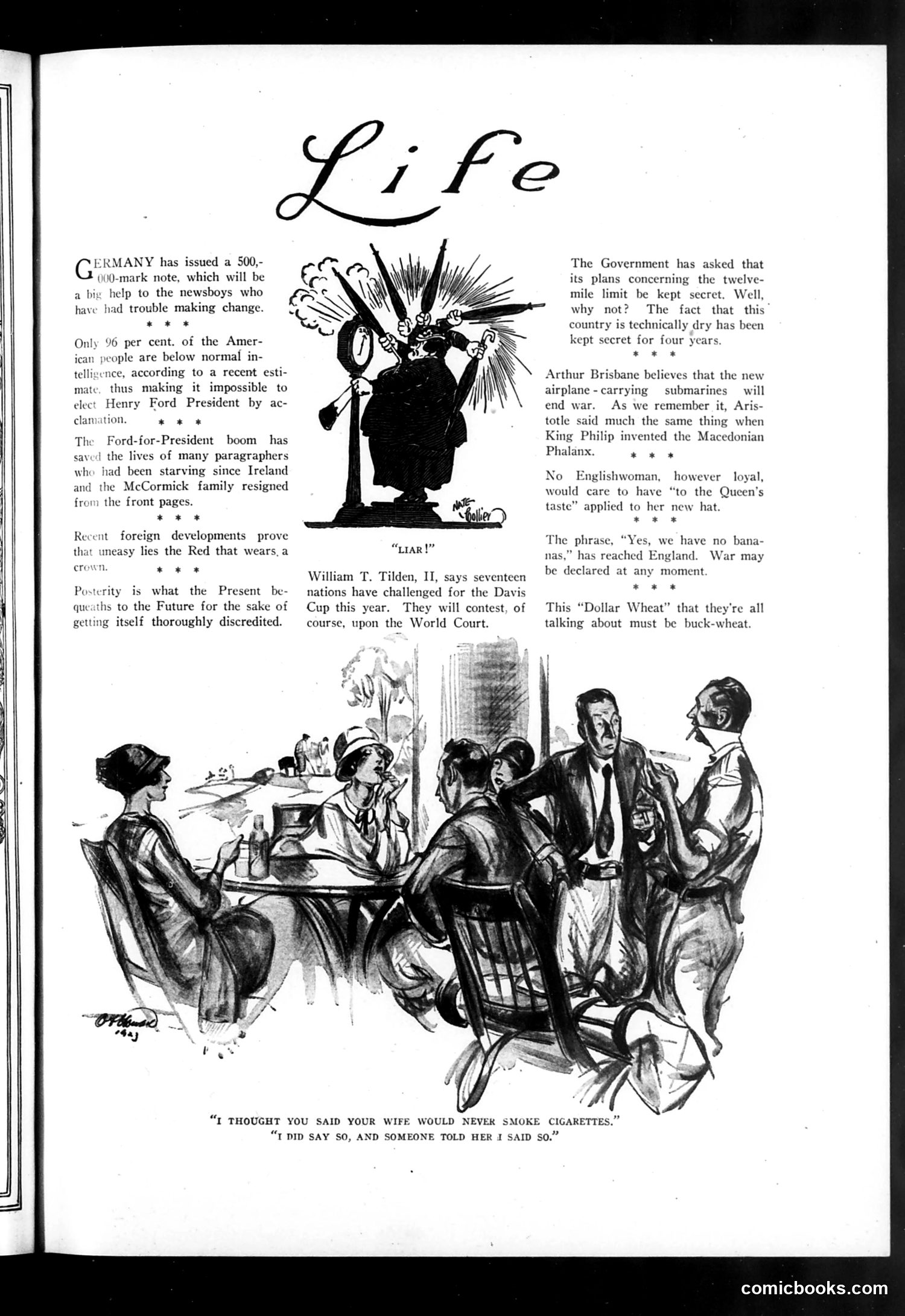
This page contains two distinct cartoons from an early 20th-century issue. **Top cartoon ("Liar!"):** Shows an explosion erupting from a human head, likely satirizing exaggerated claims or propaganda. The accompanying text references Germany's 500-mark note, Ford's cost-cutting innovations, and claims about American literacy rates—suggesting the cartoon mocks false or inflated statements in public discourse. **Bottom cartoon:** Depicts a social gathering where a man apologizes for his wife smoking cigarettes, saying "someone told her I said so." This satirizes gender dynamics and marital communication of the era, when women smoking was still controversial and husbands' authority over wives' behavior was expected. Both pieces use humor to critique contemporary social attitudes and public dishonesty.
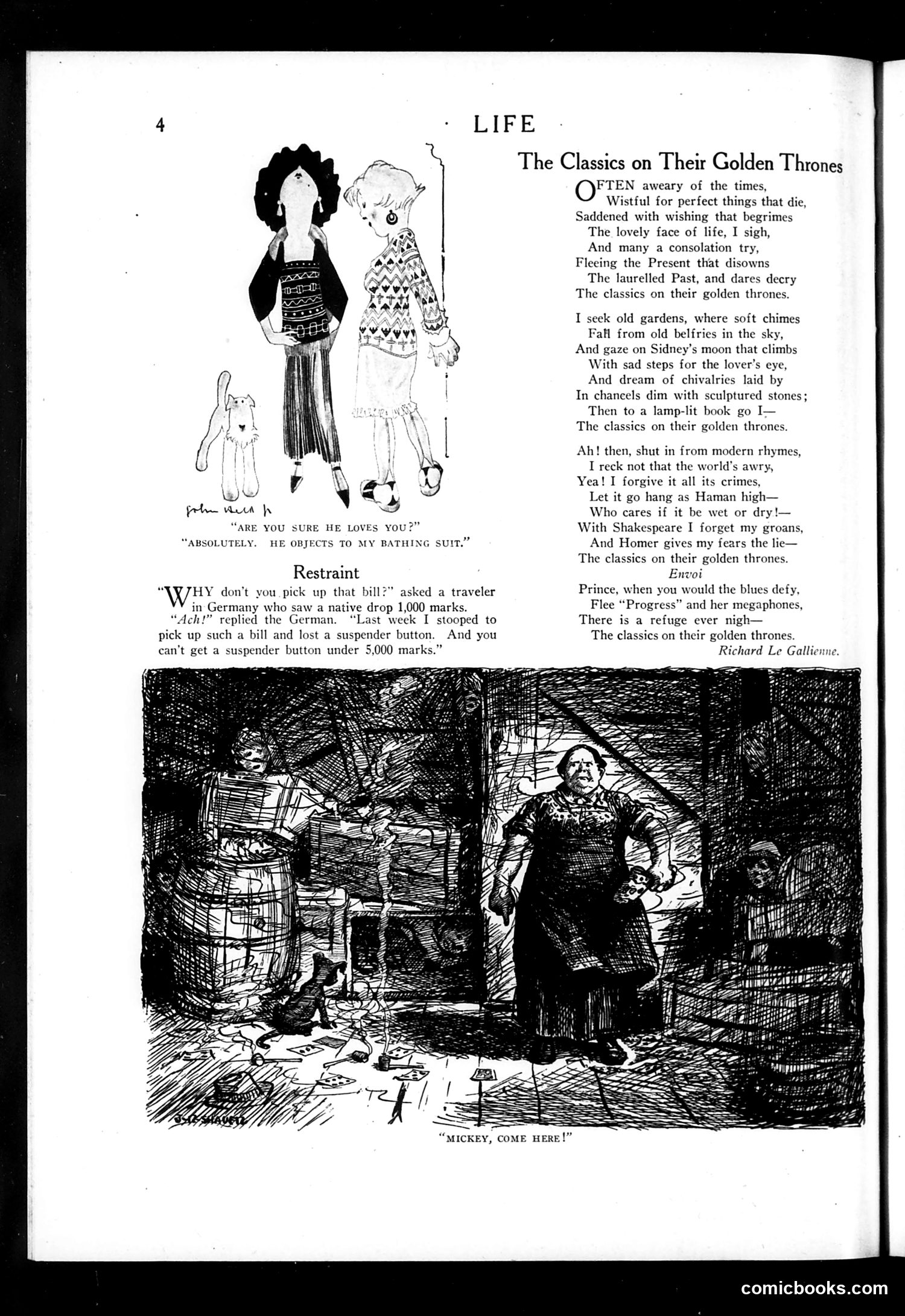
**Top Cartoon**: Two fashionable women discuss bathing suits. One asks "ARE YOU SURE HE LOVES YOU?" and receives the reply "ABSOLUTELY. HE OBJECTS TO MY BATHING SUIT." This is a lighthearted joke about courtship—suggesting a man's criticism of a woman's swimwear paradoxically proves his affection, as he wouldn't bother objecting if he didn't care. **"Restraint" Anecdote**: A traveler in Germany questions a native about picking up a large bill, only to learn the native lost a suspender button costing far more to replace. This satirizes post-WWI German hyperinflation, where currency became so devalued that ordinary items cost astronomical sums. **Bottom Illustration**: Shows an indoor scene with figures and scattered items. Caption reads "MICKEY, COME HERE!"—likely a domestic comic scene, though the specific reference is unclear without additional context.
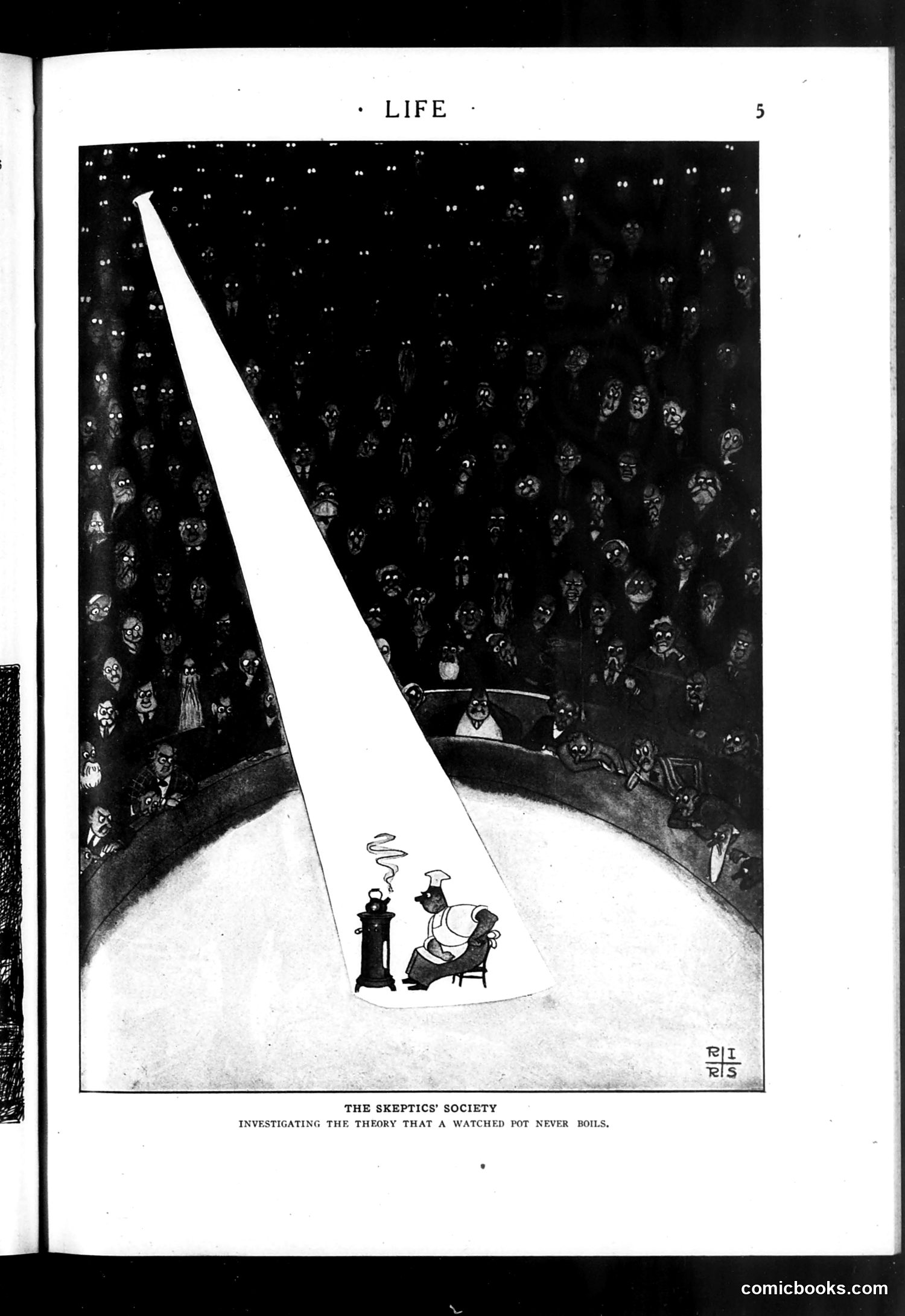
This cartoon satirizes a scientific society investigating the proverb "a watched pot never boils." The image depicts two figures in a spotlight within a circus-like arena, surrounded by an enormous crowd of onlookers in the darkness above—emphasizing how this trivial investigation has attracted massive public attention. The satire mocks both pseudoscientific organizations that lend credibility to folk wisdom through formal "investigation," and the public's gullible fascination with such enterprises. By staging this mundane kitchen experiment as a grand spectacle with hundreds of witnesses, the cartoonist ridicules the absurdity of treating common sayings as matters requiring serious scientific scrutiny and theatrical presentation.
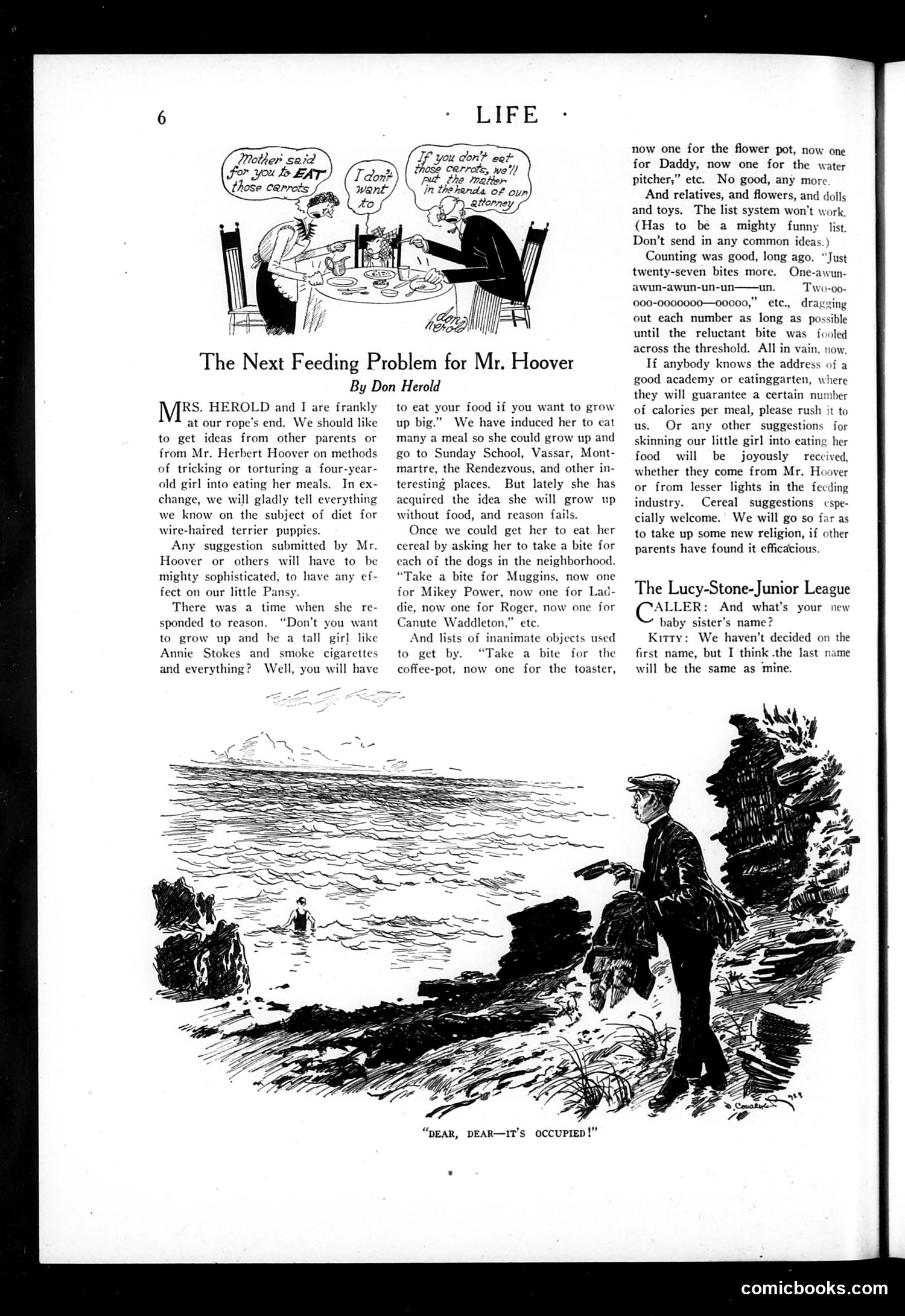
The top cartoon satirizes Herbert Hoover's approach to Depression-era child nutrition. A mother and child sit at a sparse table while the child refuses to eat, saying "I don't want to" and "I'm not hungry." The mother counters with Hoover's rhetoric about eating more to "grow up big." The satire targets Hoover's policy suggestions that Americans simply consume more as an economic stimulus—a tone-deaf response to Depression hardship. The cartoon mocks this disconnect: telling a malnourished child to eat more when food is scarce reveals the fundamental inadequacy of Hoover's approach to mass poverty. The lower illustration, "Dear, Dear—It's Occupied!" appears unrelated editorial content about leisure/beach access.
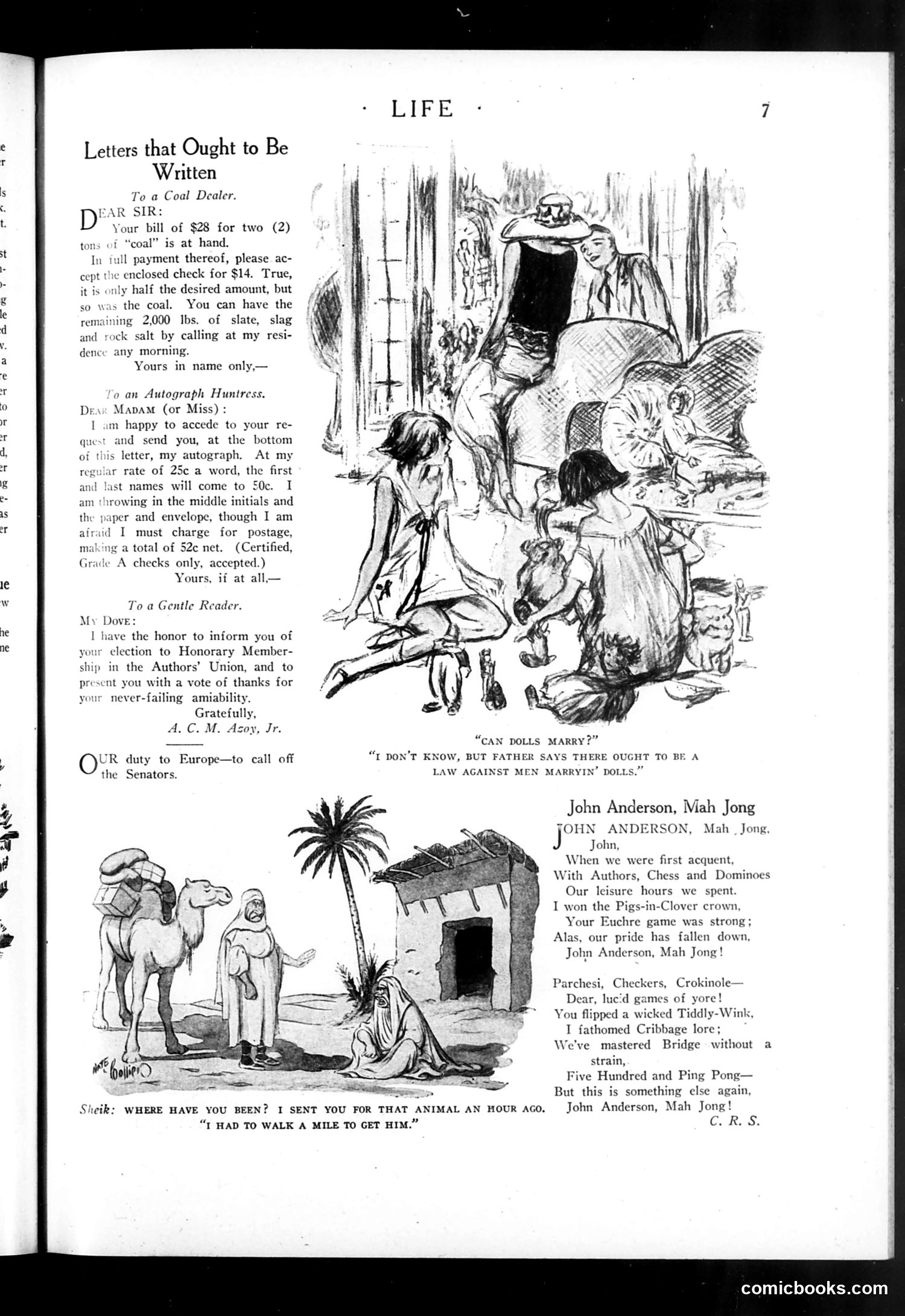
This page from *Life* magazine features satirical "Letters That Ought to Be Written"—humorous fictional correspondence addressing social absurdities. The main cartoon depicts children playing with dolls, with the caption: "Can dolls marry?" and a child's response: "I don't know, but Father says there ought to be a law against men marrying dolls." The joke satirizes men who marry women perceived as superficial or doll-like—critiquing both the women and the men who choose them. This reflects early 20th-century anxieties about gender roles and marriage standards. The "law against" phrasing adds comedic exaggeration. Below appears a poem about "John Anderson, Mah Jong," likely mocking the period's faddish games (Mah Jong was newly popular in America). The cartoon and content are typical of *Life's* light social satire targeting contemporary manners and trends.
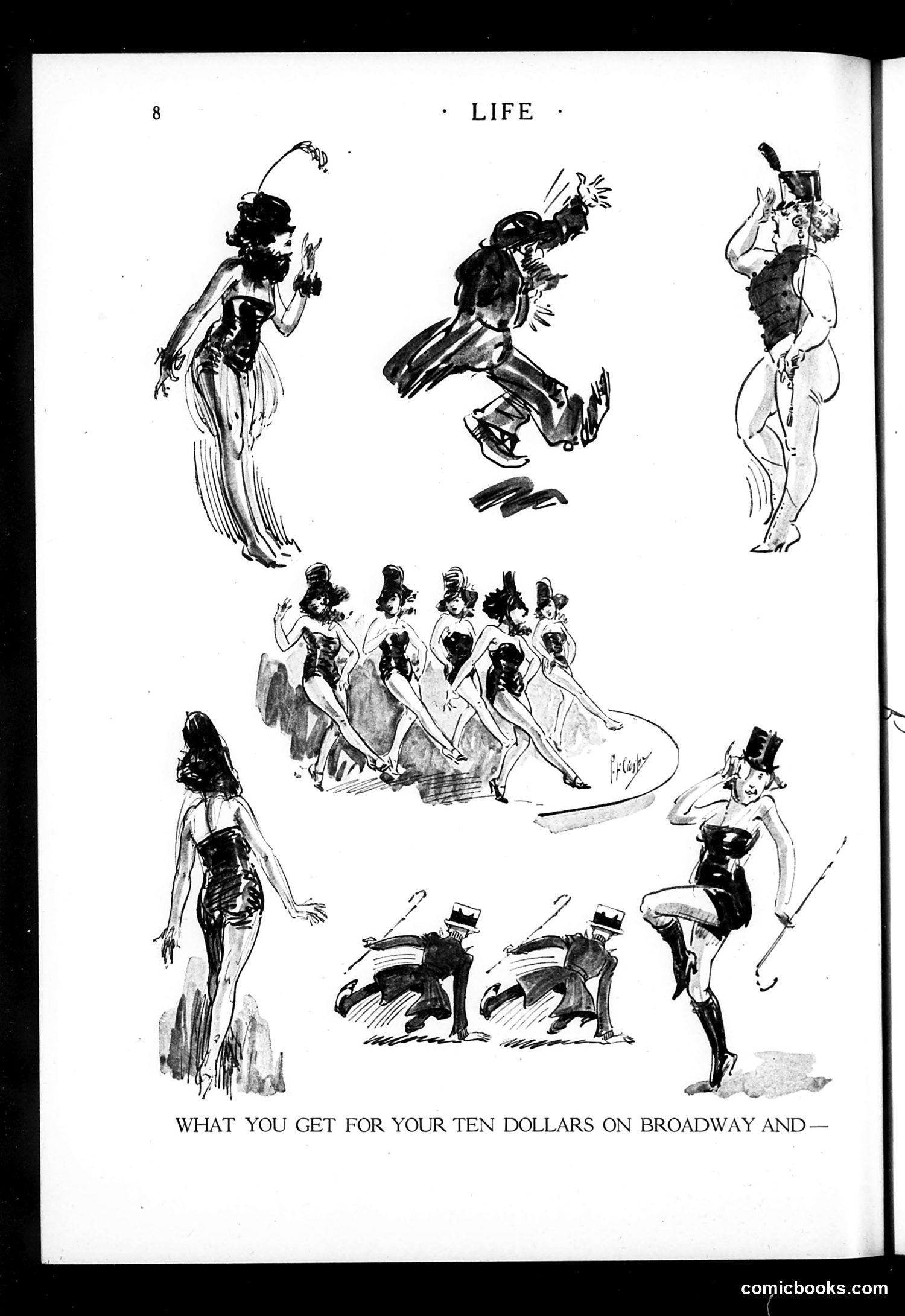
This is a satirical commentary on Broadway theater prices and entertainment value. The caption suggests that for a ten-dollar ticket (expensive for the era), audiences received primarily scantily-clad chorus dancers rather than substantive theatrical content. The sketches depict various female performers in states of undress or provocative poses—including a chorus line, solo dancers, and acrobatic performers. The satire mocks Broadway's commercialization, implying that producers prioritized spectacle and female bodies over artistic merit or storytelling. This reflects early 20th-century debates about Broadway's evolution from serious theater toward revue-style entertainment featuring elaborate dance numbers and chorus girls, which critics viewed as cheapening theatrical arts while charging premium prices.
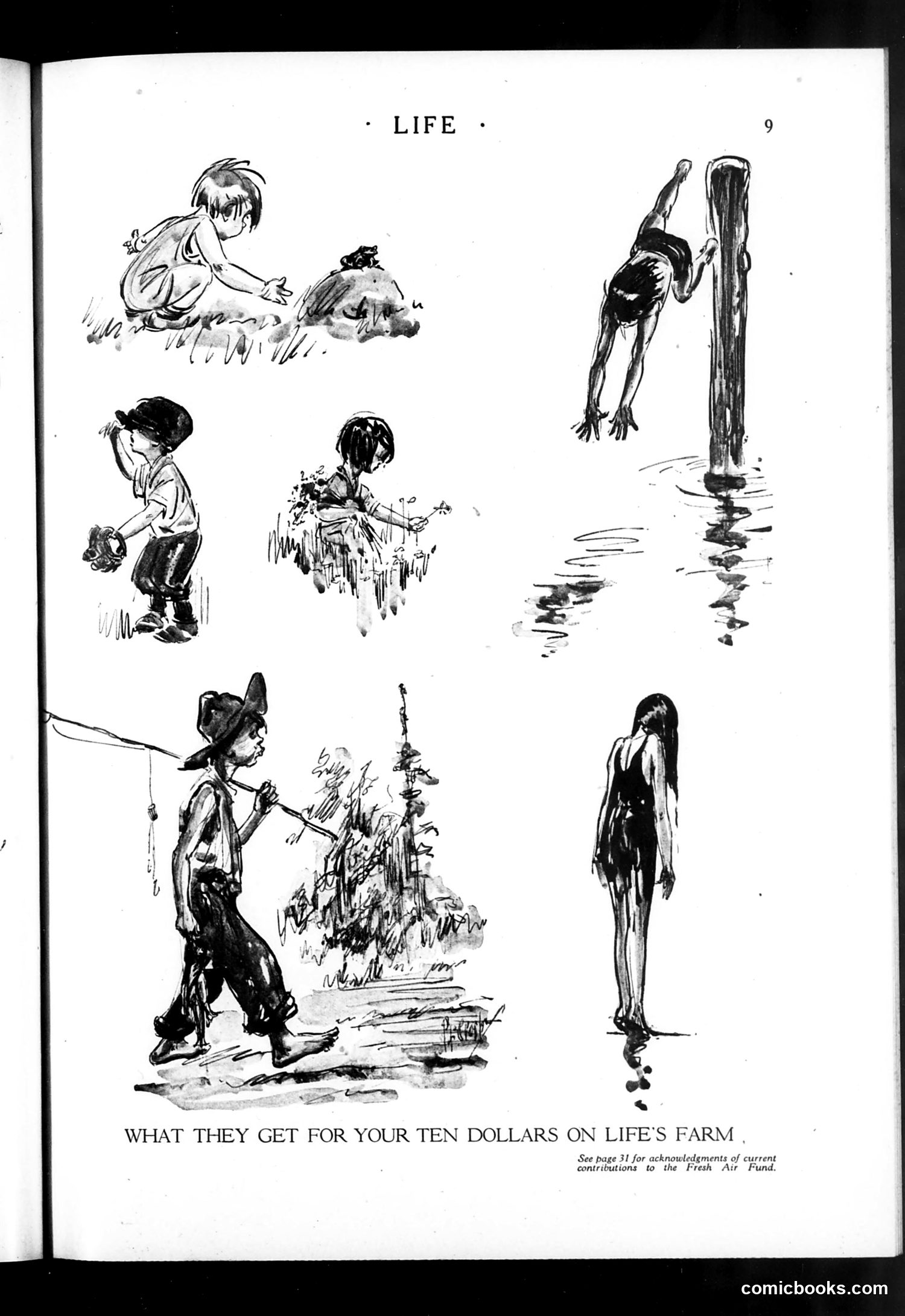
This page presents a satirical commentary on child labor and exploitation, titled "What They Get for Your Ten Dollars on Life's Farm." The sketches depict children engaged in various forms of physical labor and hardship—farming work, carrying heavy loads, climbing, fishing in harsh conditions, and standing malnourished. The satire suggests that donations to "Life's Farm" (likely a charitable organization or program) result in children being subjected to grueling work rather than receiving proper care or education. The ten-dollar reference indicates the cost of supporting a child, implying donors' money goes toward exploitative labor rather than genuine welfare. This appears to be exposé-style satire critiquing inadequate or fraudulent child welfare programs of the era.
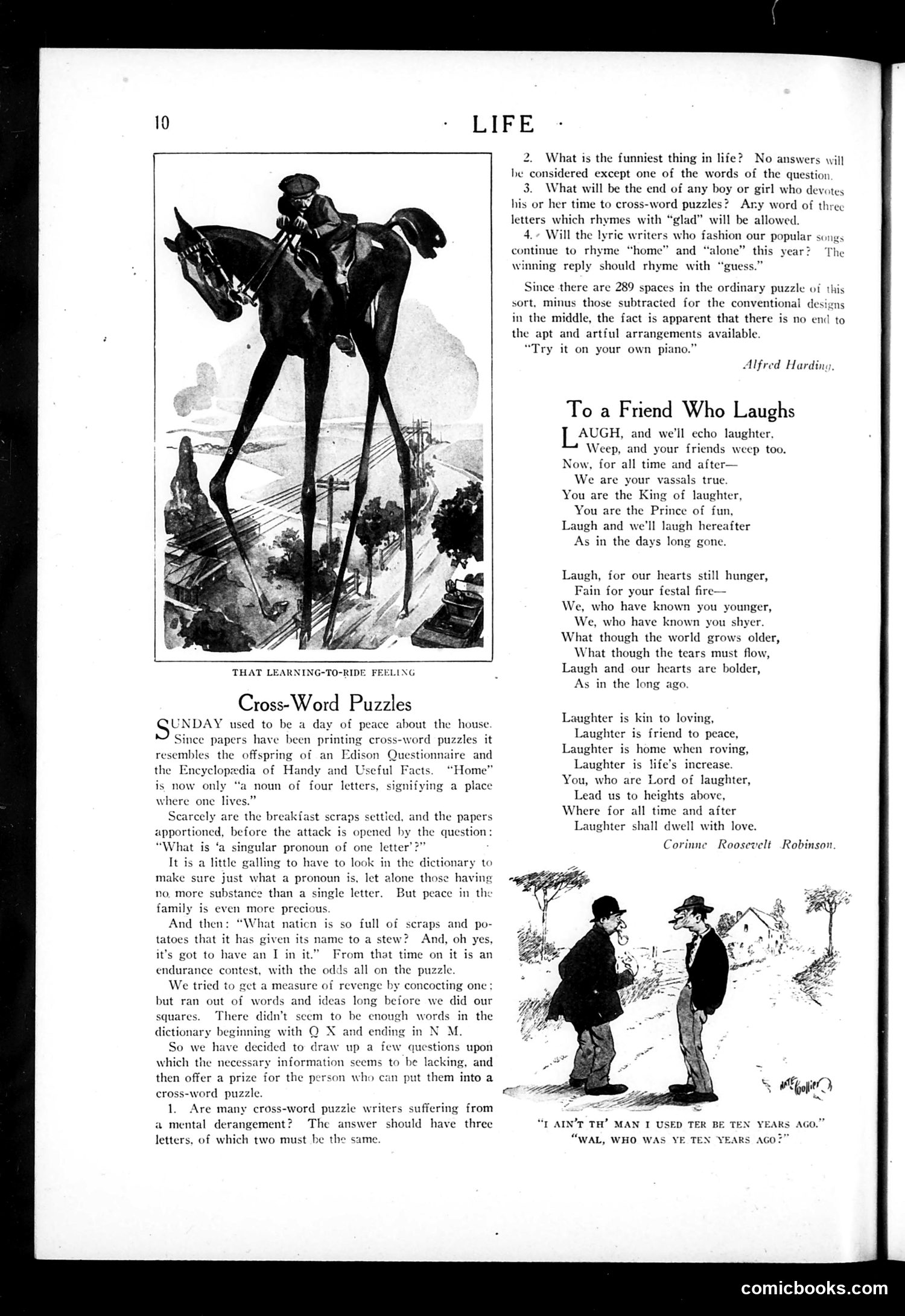
This page contains two main elements: **Top illustration ("That Learning-to-Ride Feeling")**: Shows an exaggerated, elongated horse and rider in an awkward, unstable posture—the horse's legs are impossibly thin and splayed. This satirizes the discomfort and loss of dignity novice riders experience, capturing the physical awkwardness and fear of falling. **"Cross-Word Puzzles" article and poem**: The text discusses the then-popular craze of crossword puzzles, noting their rapid proliferation in newspapers. It humorously acknowledges the puzzle-writing challenges and offers tongue-in-cheek "contest questions" for puzzle creators. The accompanying poem "To a Friend Who Laughs" celebrates laughter and joy. The page reflects early 1920s leisure culture—when crossword puzzles were a novel, widespread fad—and gentle humor about everyday experiences like learning to ride horses.
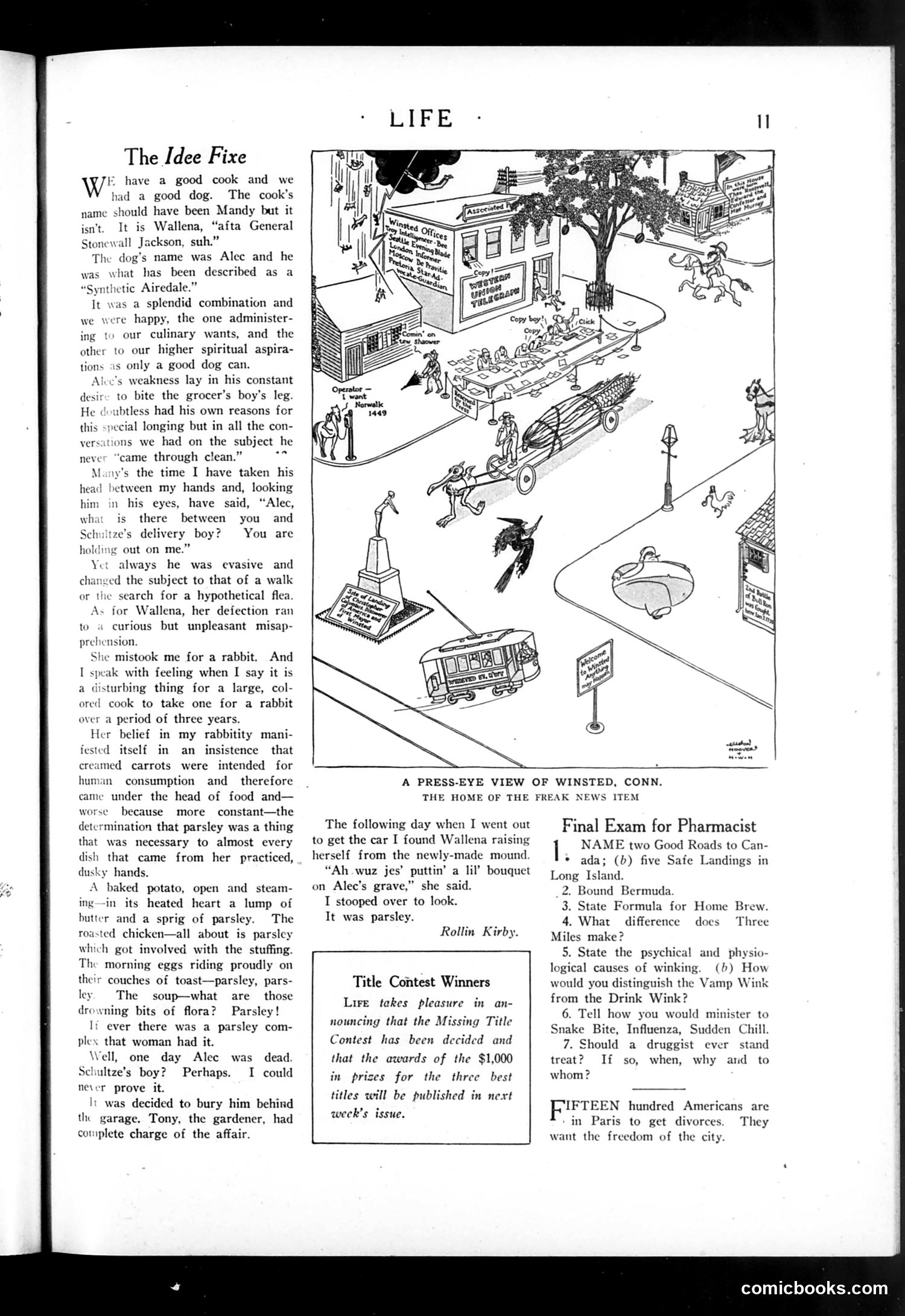
This page features "The Idee Fixe," a humorous essay about a household's cook named Wallena and dog named Alec. The accompanying illustration is a bird's-eye view cartoon of Winsted, Connecticut, showing everyday street life—storefronts, vehicles, pedestrians, and a dog. The satire gently mocks obsessive personality traits: Wallena's fixation on using creamed carrots (intended for human consumption) for the dog, and Alec's compulsion to bite delivery boys' legs. The humor derives from how these "fixed ideas" persist despite being illogical or problematic. The page also includes a "Final Exam for Pharmacist" quiz and announces winners of a title-naming contest, typical magazine filler content of the era.
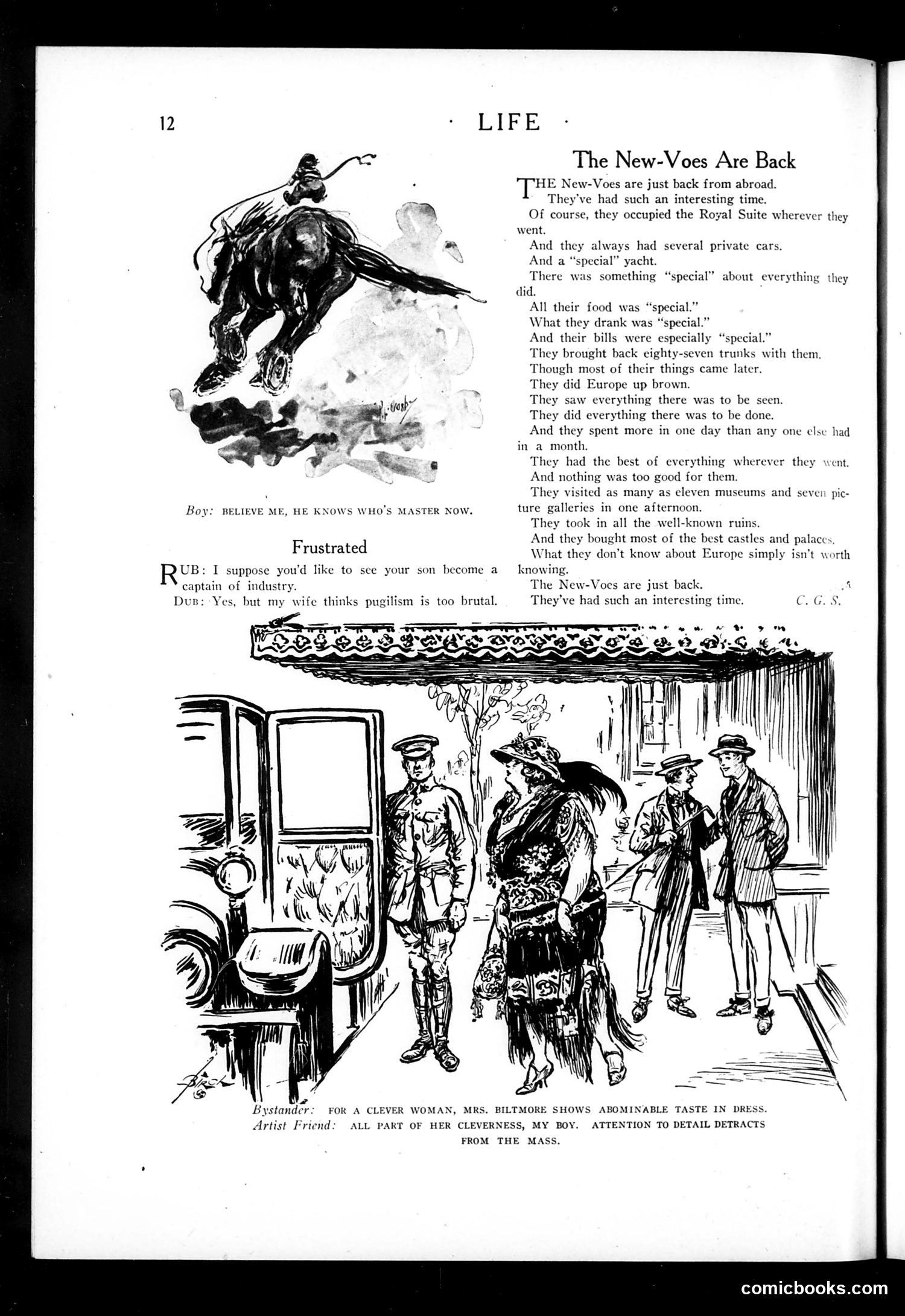
This page contains two distinct satirical pieces: **"The New-Voes Are Back"** mocks wealthy Americans who've returned from a European tour. The satire targets their pretentiousness: everything they experienced abroad was "special"—special food, drink, bills, and possessions. They visited eleven museums and bought castles/palaces in a single afternoon. The humor lies in their ostentatious display of wealth and their assumption that European culture is inherently superior, while paradoxically knowing nothing substantive about Europe. **"Frustrated"** is a brief dialogue where Rub desires his son become a "captain of industry," but Dub's wife considers industrialism "too brutal"—likely satirizing early 20th-century anxieties about capitalism and industrial labor conditions. The bottom cartoon about "Mrs. Biltmore" and dress appears incomplete on this page.
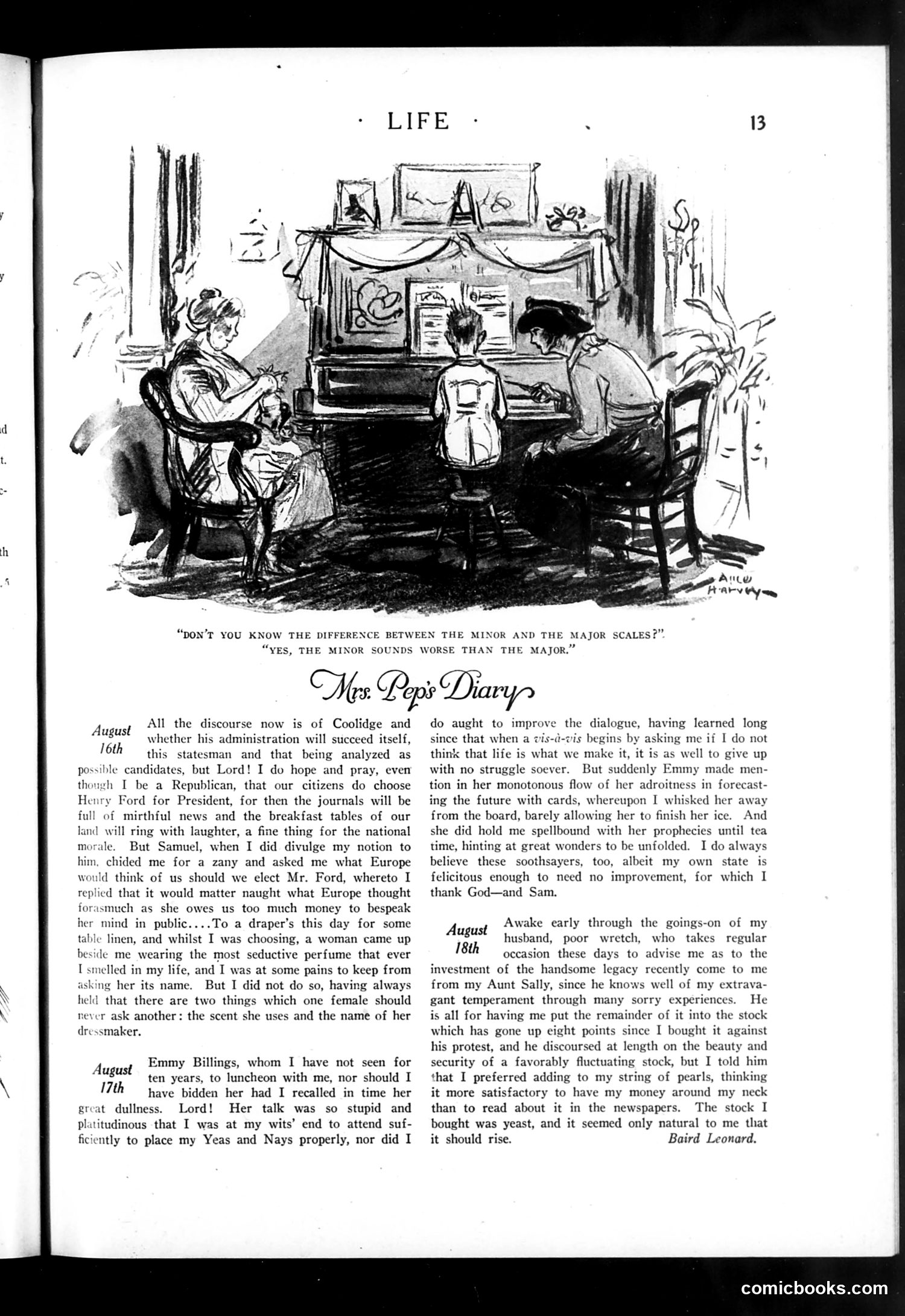
The cartoon depicts a music lesson scene with the caption: "Don't you know the difference between the minor and the major scales?" / "Yes, the minor sounds worse than the major." This is a simple humor piece playing on a child's misunderstanding of musical terminology. The joke conflates "minor" (a musical mode) with "minor" (meaning lesser/worse), suggesting the child thinks the minor scale is literally *worse* sounding rather than simply a different musical form. Below is "Mrs. Pep's Diary," a gossip column featuring dated entries (August 15th, 17th, 18th) discussing social matters including politics, stock investments, and dinner party etiquette among the upper class. The entries reference contemporary concerns like political administration and financial markets, typical of early 20th-century satirical magazine content.
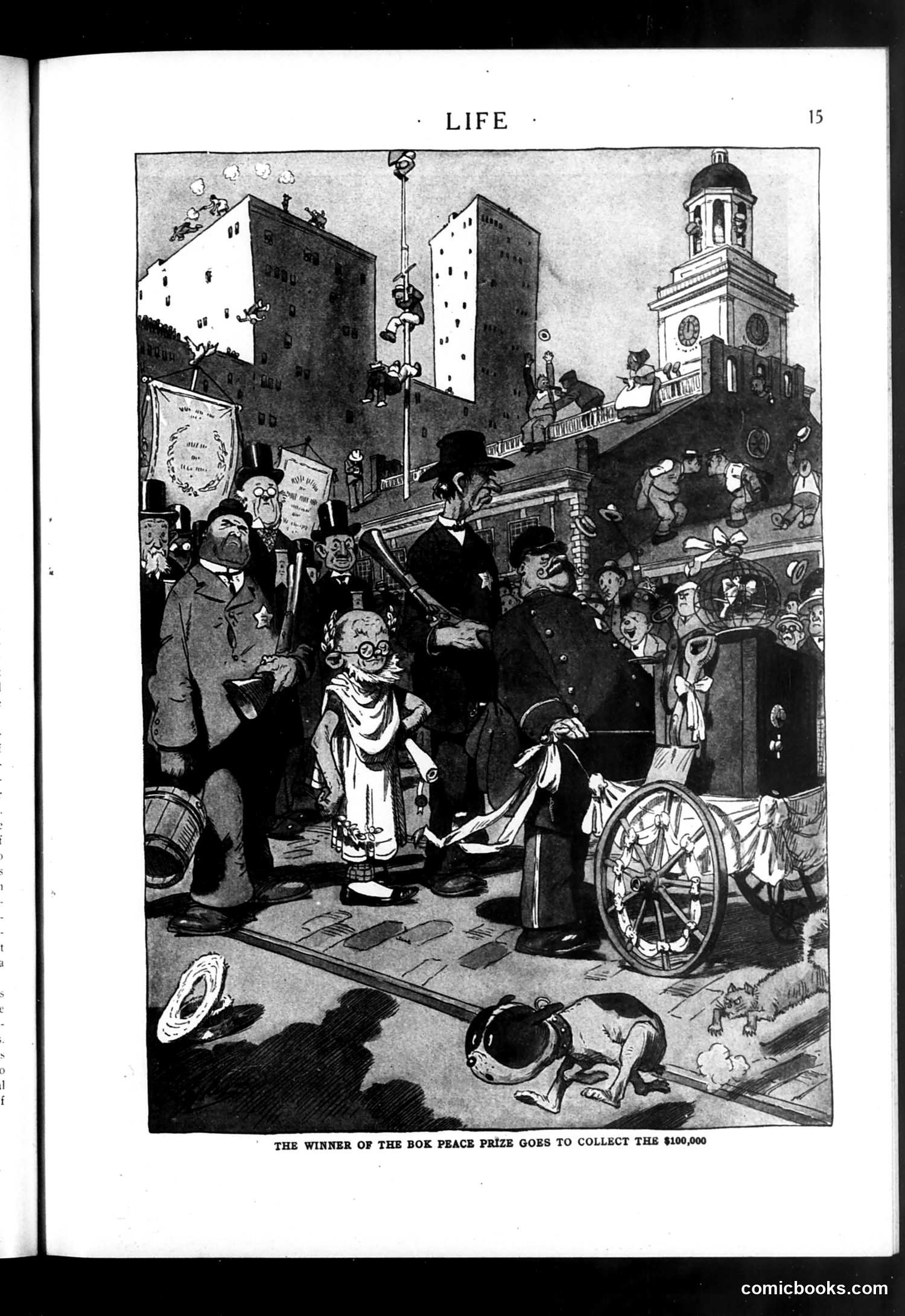
This political satire depicts the winner of the Bok Peace Prize attempting to collect their $100,000 award in a chaotic urban street scene. The cartoon appears to critique the irony of awarding a peace prize while depicting turbulent, violent circumstances. The crowd is unruly and disorganized, with various figures in period dress (appearing early 20th century). A dog in the foreground and scattered objects suggest disorder rather than the dignified peace the prize supposedly celebrates. The satire likely mocks either the prize's legitimacy, the recipient's worthiness, or the gap between pacifist ideals and the messy reality of actually achieving peace. The architectural backdrop—including a prominent church—may emphasize institutional hypocrisy regarding peaceful values.
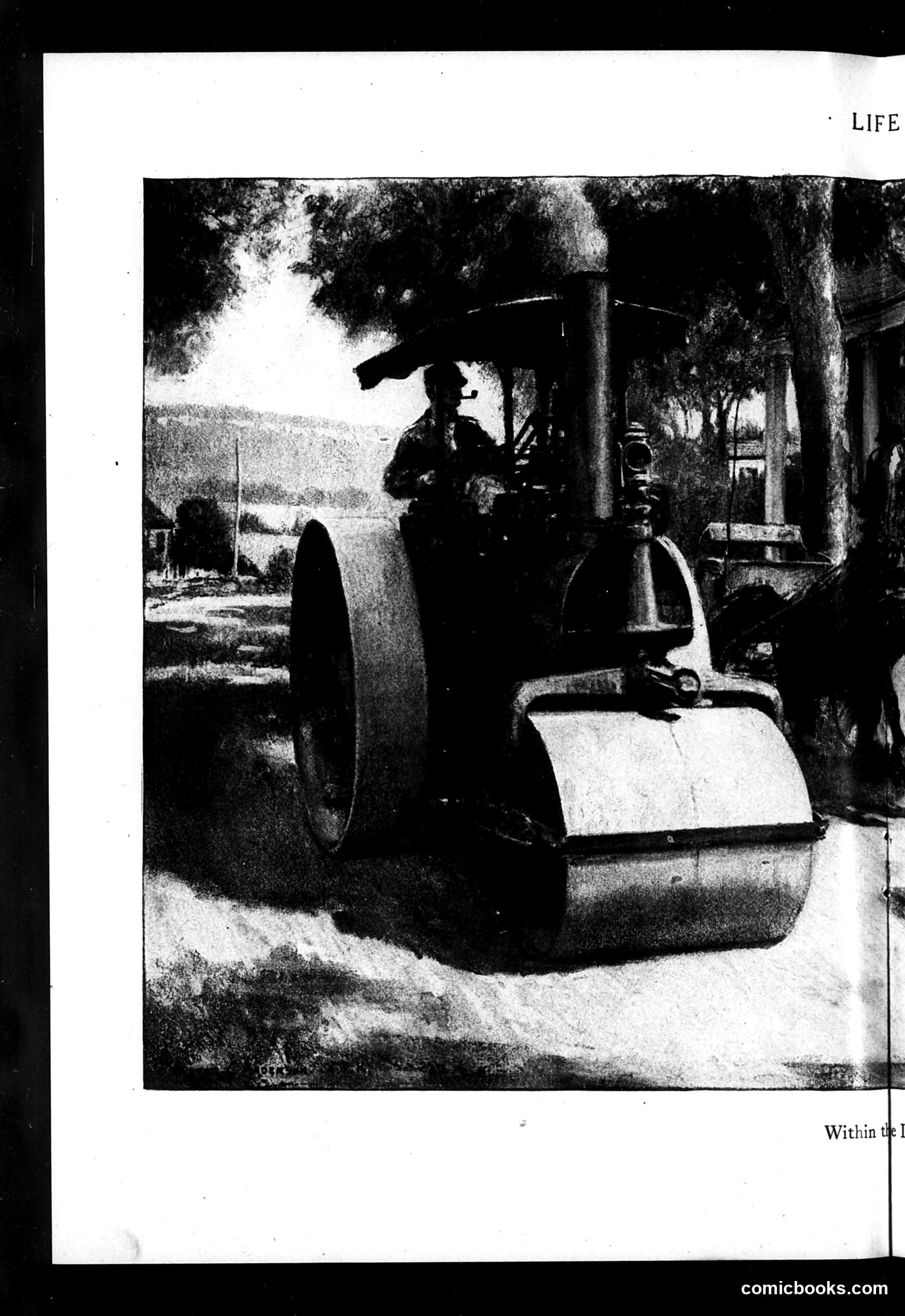
This appears to be a photograph rather than a political cartoon or satirical illustration. It shows a steam roller or road-compacting machine operated by a silhouetted figure, positioned on a rural road with trees and hills visible in the background. The image quality is grainy, typical of early-to-mid 20th century reproduction. Without accompanying text explaining the photograph's context or satirical purpose, I cannot definitively identify what political or social commentary it intends. The caption reads only "Within U" (likely incomplete). The page header says "LIFE," confirming this is from the satirical magazine, but the photograph's specific meaning—whether it comments on infrastructure, labor, government programs, or something else—remains unclear from the image alone.
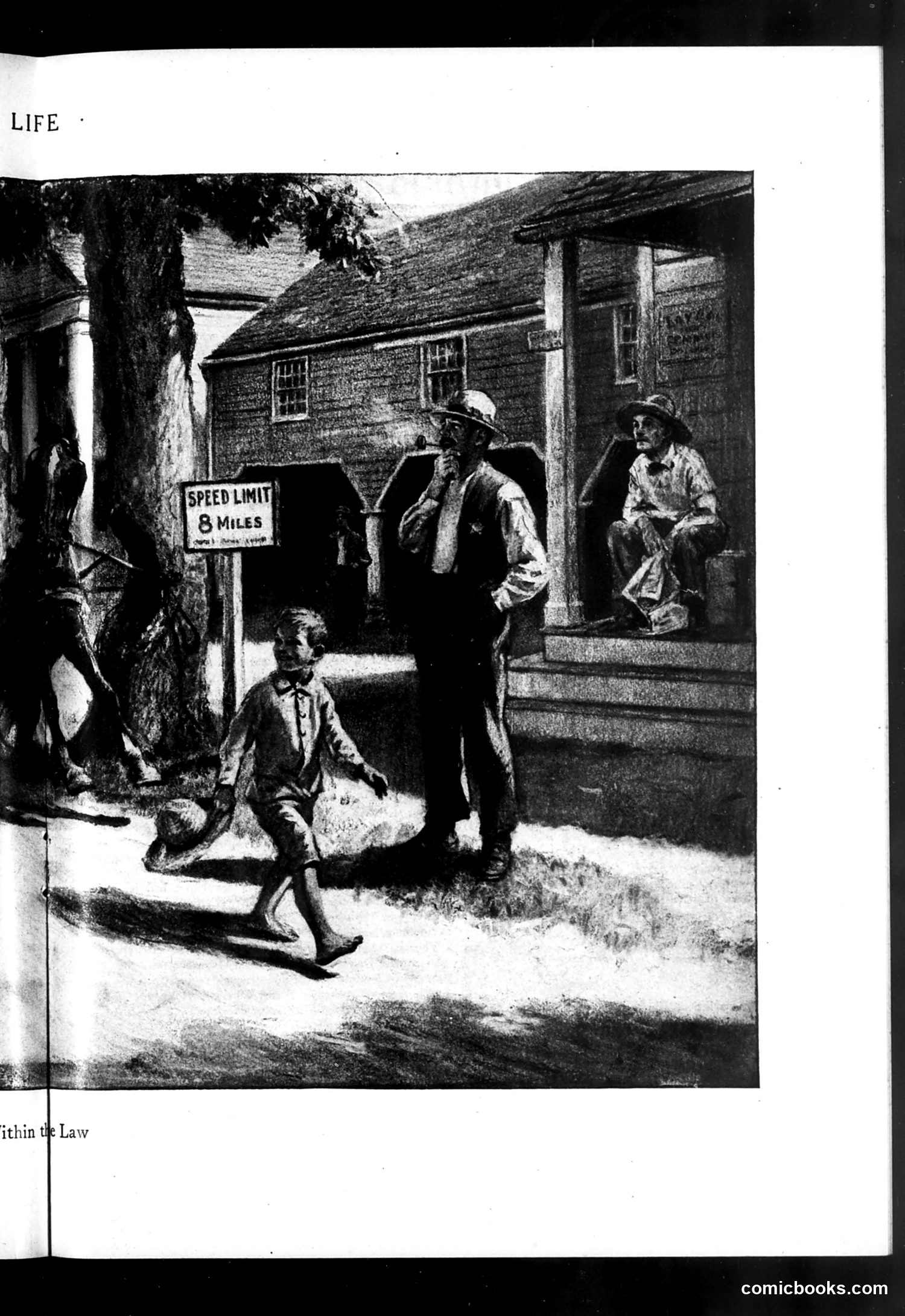
This appears to be a satirical illustration from Life magazine titled "Within the Law" (visible at bottom). The image shows a rural scene with a speed limit sign reading "8 MILES" prominently displayed. Several figures—adults and a child—are depicted near modest buildings, with the child appearing to run or move quickly past the sign. The satire likely comments on the contrast between official regulations (the speed limit sign) and rural realities where such laws may be ignored or seem absurd in their strict enforcement. The inclusion of a child running suggests commentary on the impracticality or irony of speed restrictions in small-town settings. Without additional context about when this was published, the specific target of the satire remains unclear.
This page reviews two theatrical productions opening in New York. The main article discusses "In Love with Love," praising its cast—particularly actress Lynn Fontanne—and crediting the performances and direction (by Robert Milton) for elevating thin material by playwright Vincent Lawrence. It notes actor Henry Hull appears younger than previously. The secondary review critiques "Thumbs Down," a murder mystery play. The satire lies in its absurdist plot: a young man immediately confesses to killing someone named Sheridan in Act One, yet the play continues through multiple acts with courtroom scenes and repeated confessions by different characters, all claiming responsibility. The reviewer mocks the playwright's inability to construct a coherent narrative—the "evidence" makes no logical sense. This reflects Life magazine's satirical stance toward Broadway melodramas of the era, poking fun at contrived murder-mystery plots and dramatic conventions that prioritized spectacle over sense.
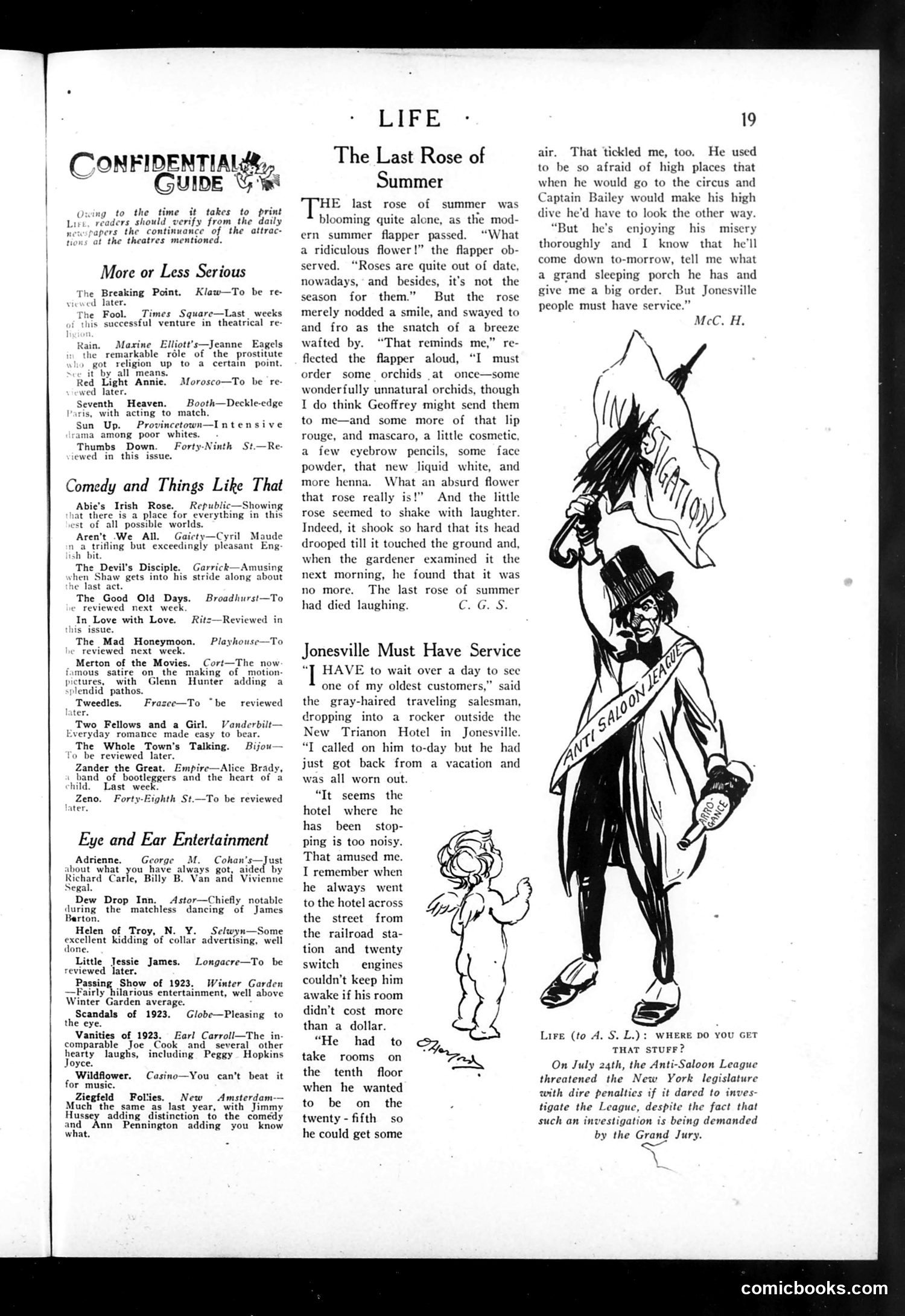
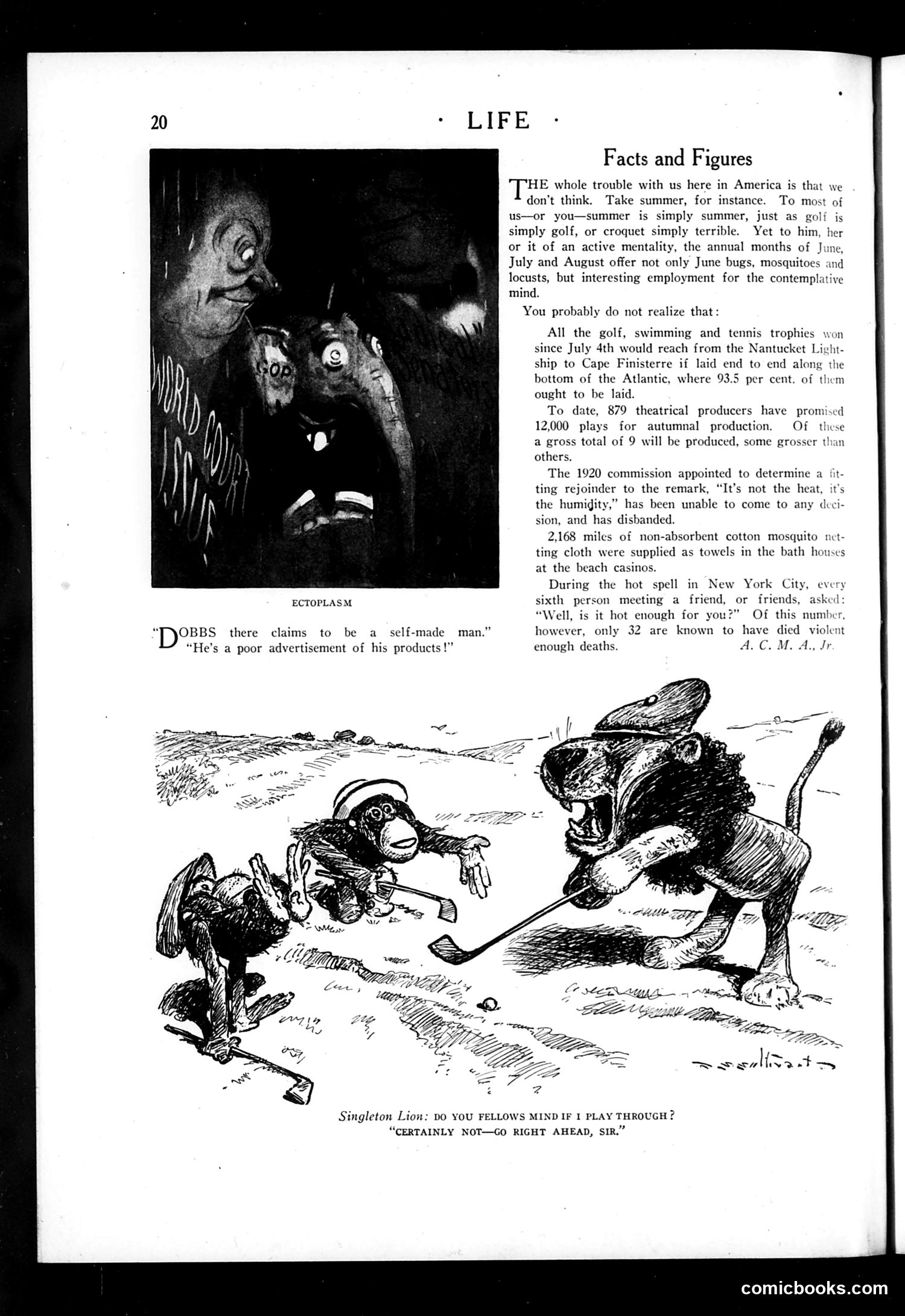
This page contains two separate humorous pieces: **Top Section ("Facts and Figures"):** A mock-serious article presenting absurd "statistics" about American summer life—trophy lengths, theatrical production promises, and a commission disbanded over the heat-vs-humidity debate. The satire mocks Americans' tendency to overcomplicate simple things and our obsession with quantifying everything. The final joke notes that during NYC's heat wave, while everyone asked "Is it hot enough for you?", only 32 people actually died from it—a dark humor comment on the phrase's mundane overuse. **Bottom Cartoon ("Singleton Lion"):** A lion approaches three monkeys playing golf on a savanna. The monkeys politely allow the predator to play through, treating him as a fellow golfer. The joke inverts natural hierarchy: even faced with a dangerous animal, the monkeys maintain golf etiquette. It satirizes how absurdly seriously golfers take their game—civilized rules supersede survival instinct. Both pieces mock American leisure culture and the gap between pretense and reality.
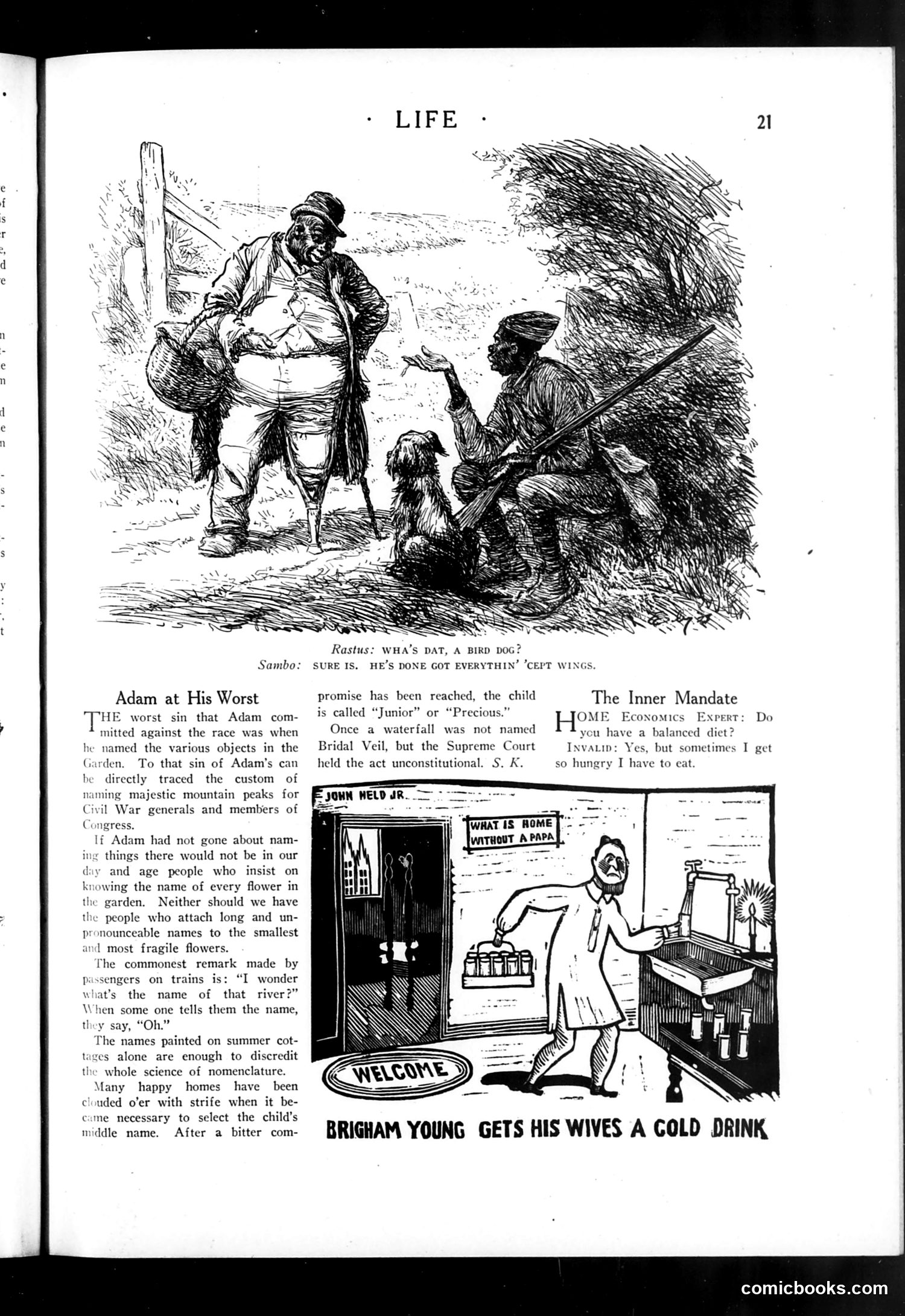
This page contains three distinct satirical pieces: **"Adam at His Worst"** critiques excessive naming practices—particularly of geographical features after Civil War generals and congressmen, and the ornate naming of summer cottages. The essay mocks both the obsession with nomenclature and the domestic strife caused by selecting children's middle names. **"Sambo" and "Rastus" dialogue** (top illustration) features racist caricatures in a crude joke about a hunting dog's abilities, using period stereotypes. **"The Inner Mandate"** is a brief joke about an invalid claiming poverty prevents a balanced diet, despite eating enough to satisfy hunger—satirizing either malnutrition excuses or economic hardship. **"Brigham Young Gets His Wives a Cold Drink"** references the polygamist Mormon leader, presenting a domestic comic about offering multiple wives refreshment—playing on his historical notoriety for polygamy. The page reflects early-20th-century Life magazine's mix of social commentary, crude ethnic humor (now offensive), and topical American references targeting public figures and contemporary absurdities.
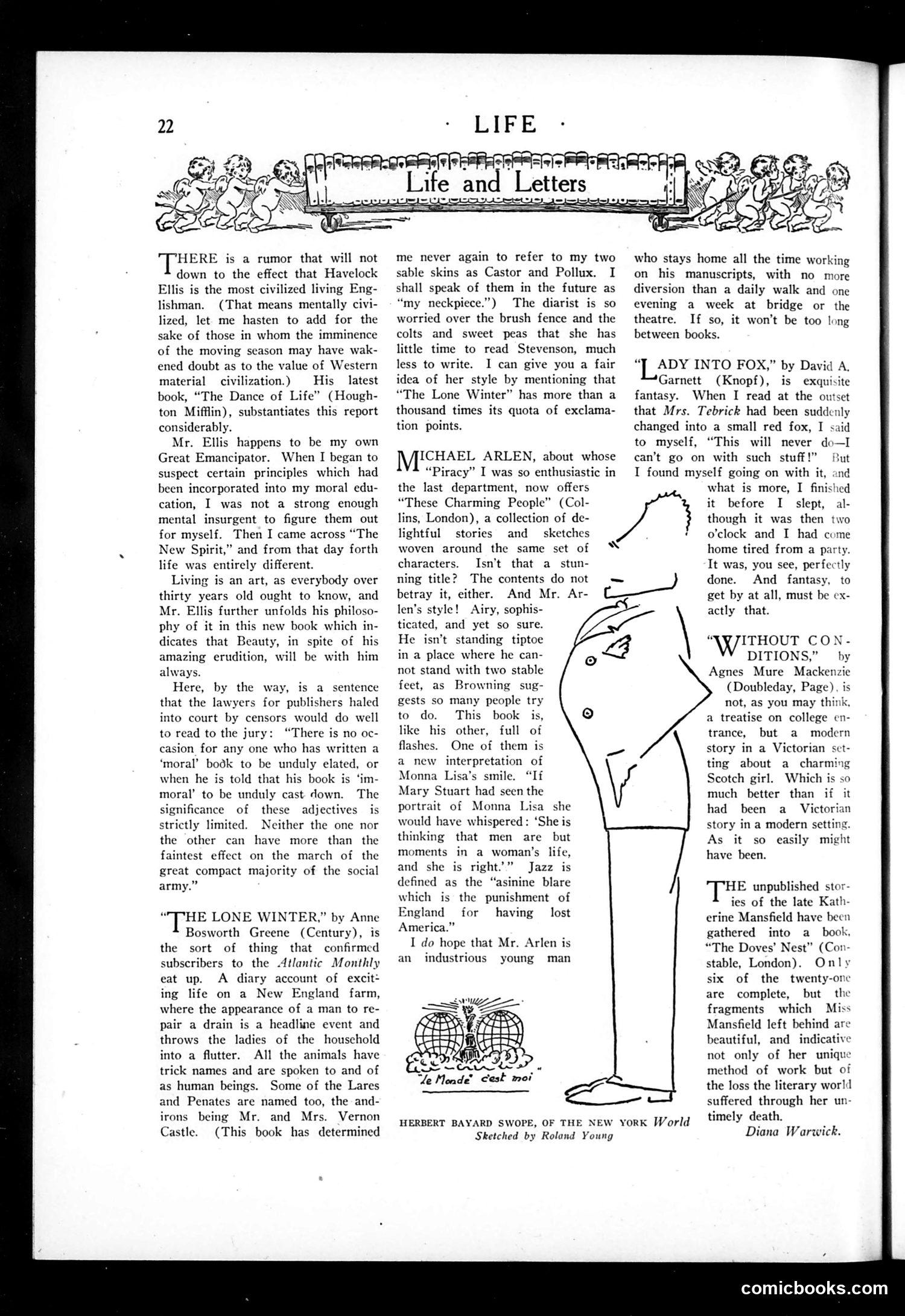
This is a book review column titled "Life and Letters" featuring literary criticism rather than political satire. The page reviews three books: 1. **Havelock Ellis's "The Dance of Life"** — The reviewer praises Ellis, calling him "the most civilized living Englishman" and crediting his earlier work "The New Spirit" with fundamentally changing their worldview. The quoted passage defends moral philosophy against censorship. 2. **Anne Bosworth Greene's "The Lone Winter"** — A satirical review mocking a diary about New England farm life, poking fun at the narrator's overwrought writing style (excessive exclamation points) and trivial concerns. 3. **Michael Arlen's "These Charming People"** — Praise for his sophisticated short stories, with quoted examples of his witty observations. The only illustration is a sketch of **Herbert Bayard Swope** of the New York *World* by Roland Young at the page bottom—likely identifying the column's author or a notable contemporary journalist. This is literary commentary, not political cartoons.
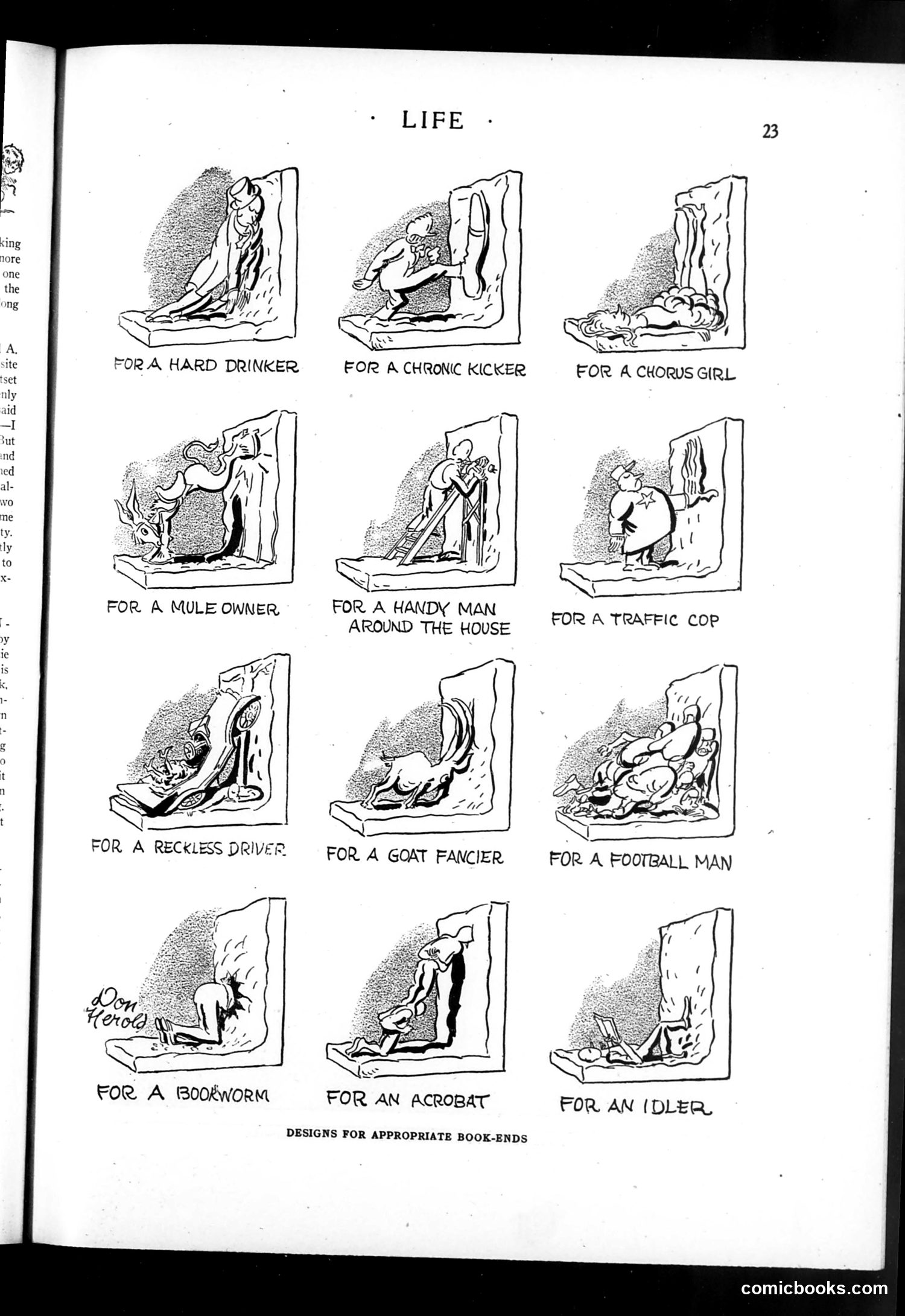
This page presents a humorous series of bookend designs, each tailored to a specific social "type" or occupation. The satire works by showing figures literally crushed, trapped, or contorted between books—suggesting these types of people deserve such fate. Examples include: a "hard drinker" slumped drunk, a "chronic kicker" (complainer) being kicked, a "traffic cop" pinned, a "reckless driver" crashed, and a "football man" flattened. The bookends transform stereotypical character flaws into physical punishment. This reflects early 20th-century satirical humor targeting recognizable social archetypes and occupational caricatures. The joke relies on cruel exaggeration and wordplay—"appropriate" bookends for "appropriate" people—a style of social satire common in *Life* magazine's editorial cartooning.
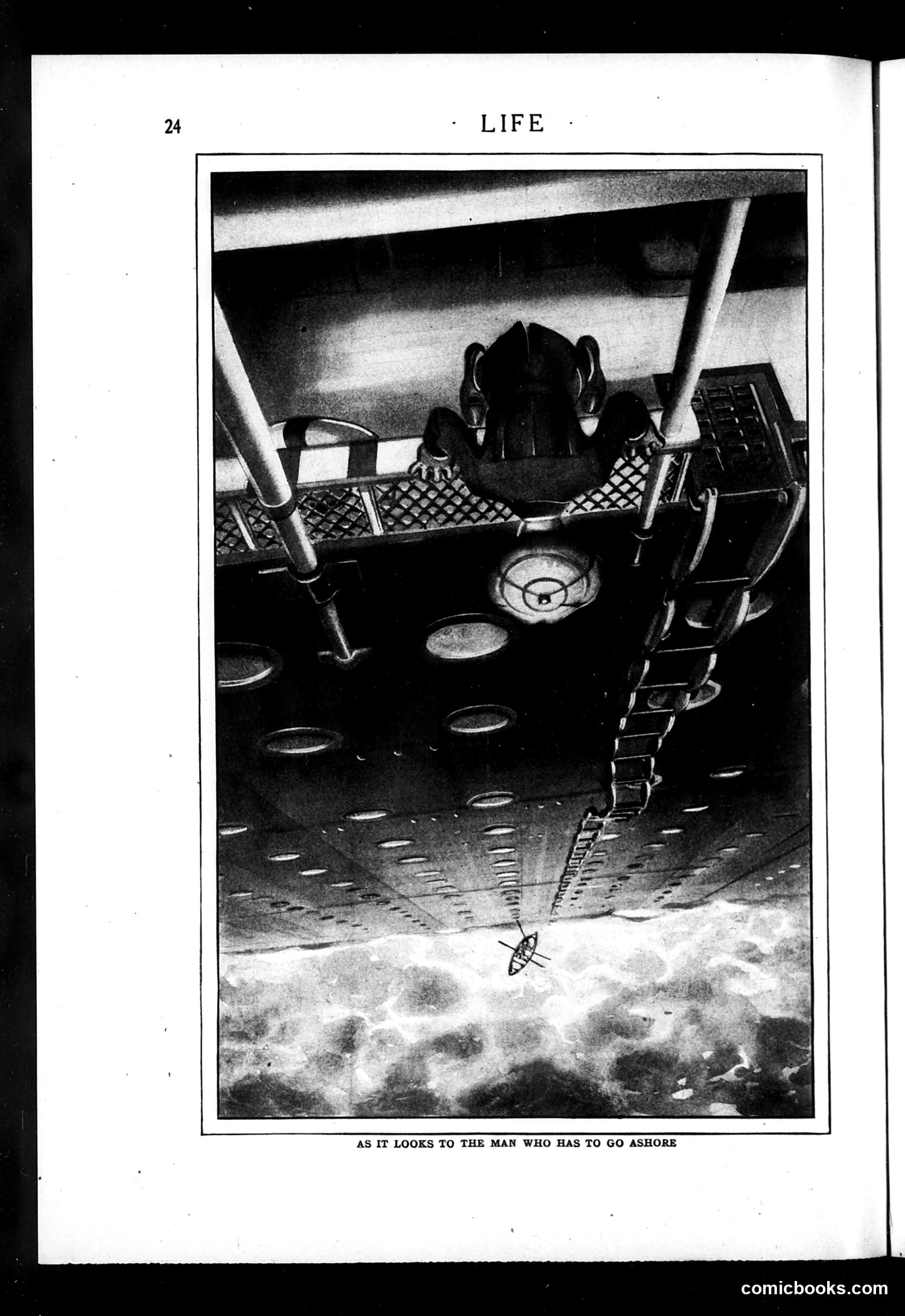
This appears to be a WWI-era illustration from *Life* magazine showing an overhead view of a ship's interior. The caption "AS IT LOOKS TO THE MAN WHO HAS TO GO ASHORE" suggests the perspective of a sailor preparing to disembark. The image depicts the ship's deck machinery, rigging, and structural elements from above, with a small figure visible below on the ground—likely representing the sailor about to leave the vessel. The composition emphasizes the scale and complexity of the ship relative to the individual. The satire likely comments on either: the soldier's apprehension about leaving the relative safety of the ship, or perhaps the overwhelming bureaucratic/logistical apparatus of military life. Without additional context or publication date certainty, the exact satirical target remains unclear.
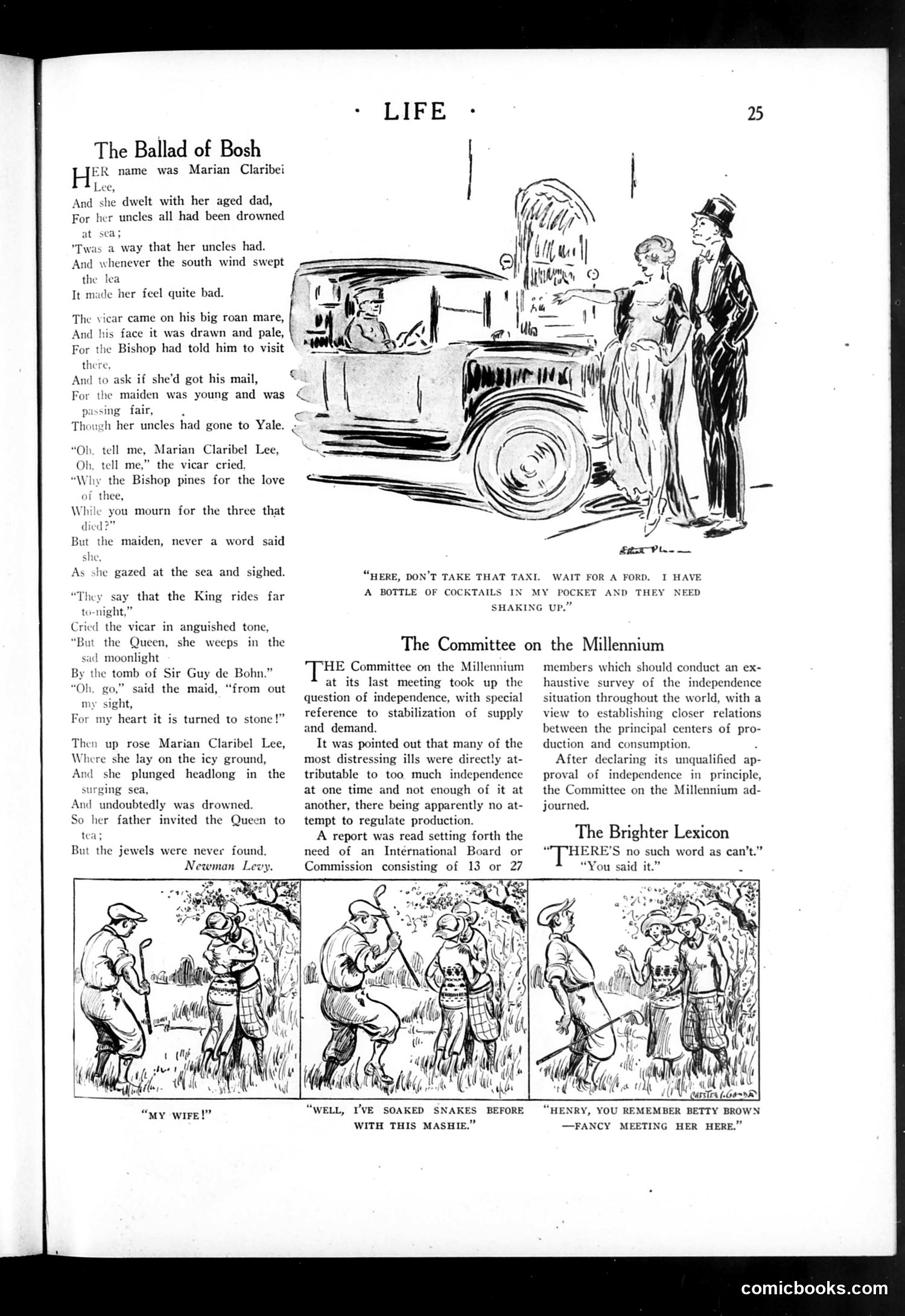
**"The Ballad of Bosh"** is a mock-heroic poem satirizing overwrought Victorian melodrama. It ridicules sentimental literary conventions through absurd plot points: a maiden pining over drowned uncles, a lovelorn bishop, cryptic references to the King and Queen, and culminating in her inexplicable drowning. The deliberately stilted rhymes and overwrought emotional declarations parody romantic ballads popular in period literature. **The taxi cartoon** mocks Prohibition-era drinking culture, showing a well-dressed man offering "cocktails" from his pocket to someone choosing a Ford over a taxi—joking that alcohol needs "shaking up" (mixing). **"The Committee on the Millennium"** satirizes bureaucratic absurdity: a committee solemnly debates regulating "independence" as if it were a commodity requiring production controls and international oversight—mocking League of Nations-style governance and corporate management speak applied to abstract concepts. **"The Brighter Lexicon"** presents simple wordplay jokes about contradictions and misunderstandings. The three comic strips below show slapstick golf humor involving mistaken identities and romantic complications.
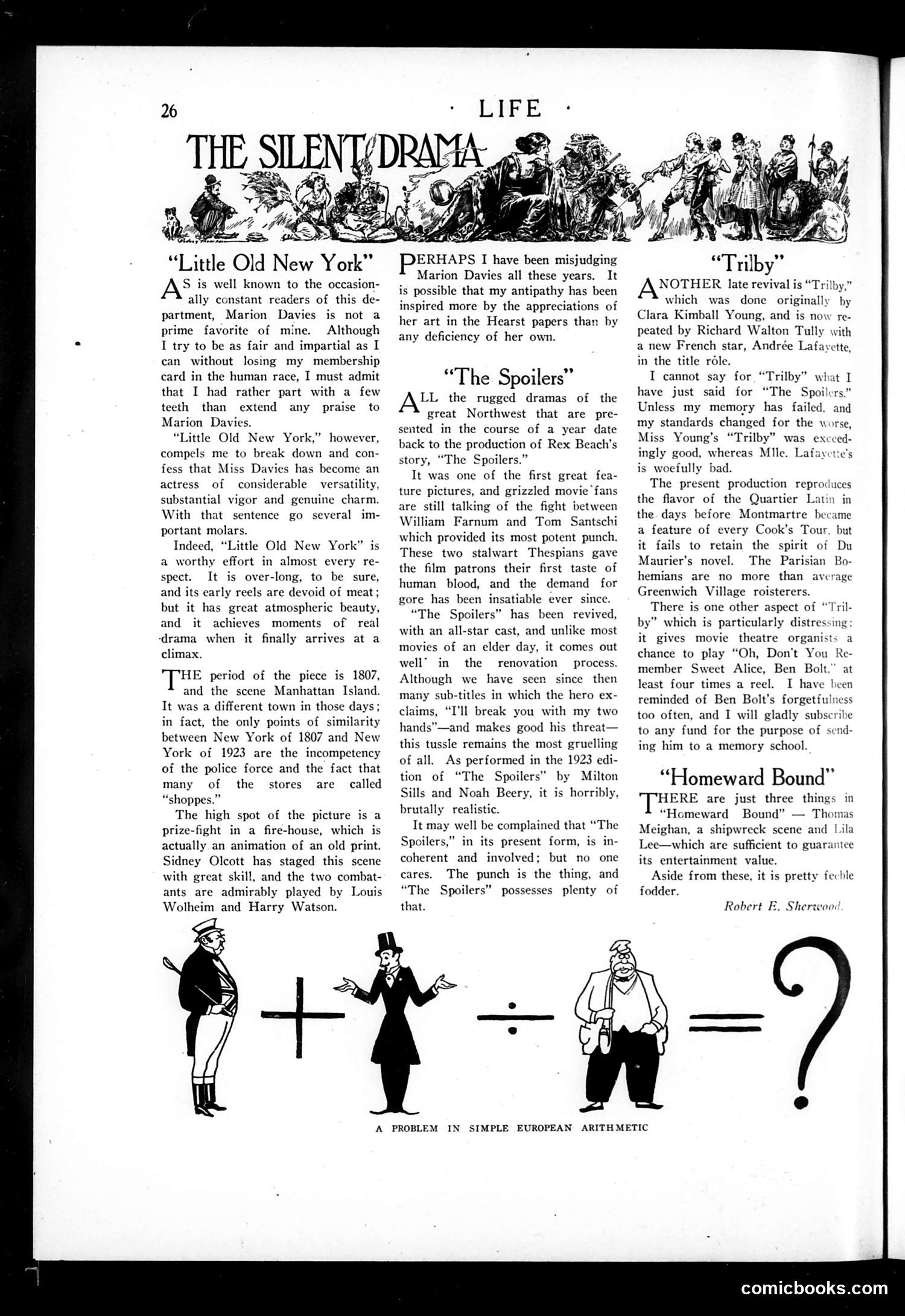
This page reviews three silent films. The critic praises Marion Davies' versatility in "Little Old New York" (set in 1807 Manhattan), despite personal antipathy toward her—likely influenced by her association with William Randolph Hearst's newspapers, which frequently promoted her work. "The Spoilers" is praised for its famous fight scene between actors William Farnum and Tom Santschi, which the critic notes was groundbreaking for depicting on-screen violence. The 1923 revival with Milton Sills and Noah Beery maintains this brutal realism. "Trilby" (a French remake) receives harsh criticism. The original starred Clara Kimball Young; this version features French actress Andrée Lafayette. The critic finds it fails to capture the spirit of du Maurier's novel, reducing Parisian bohemia to mere "Greenwich Village roisterers." The cartoon below depicts a mathematical puzzle with three figures—a satirical commentary on European politics or social dynamics, though the specific reference remains unclear from the image alone.
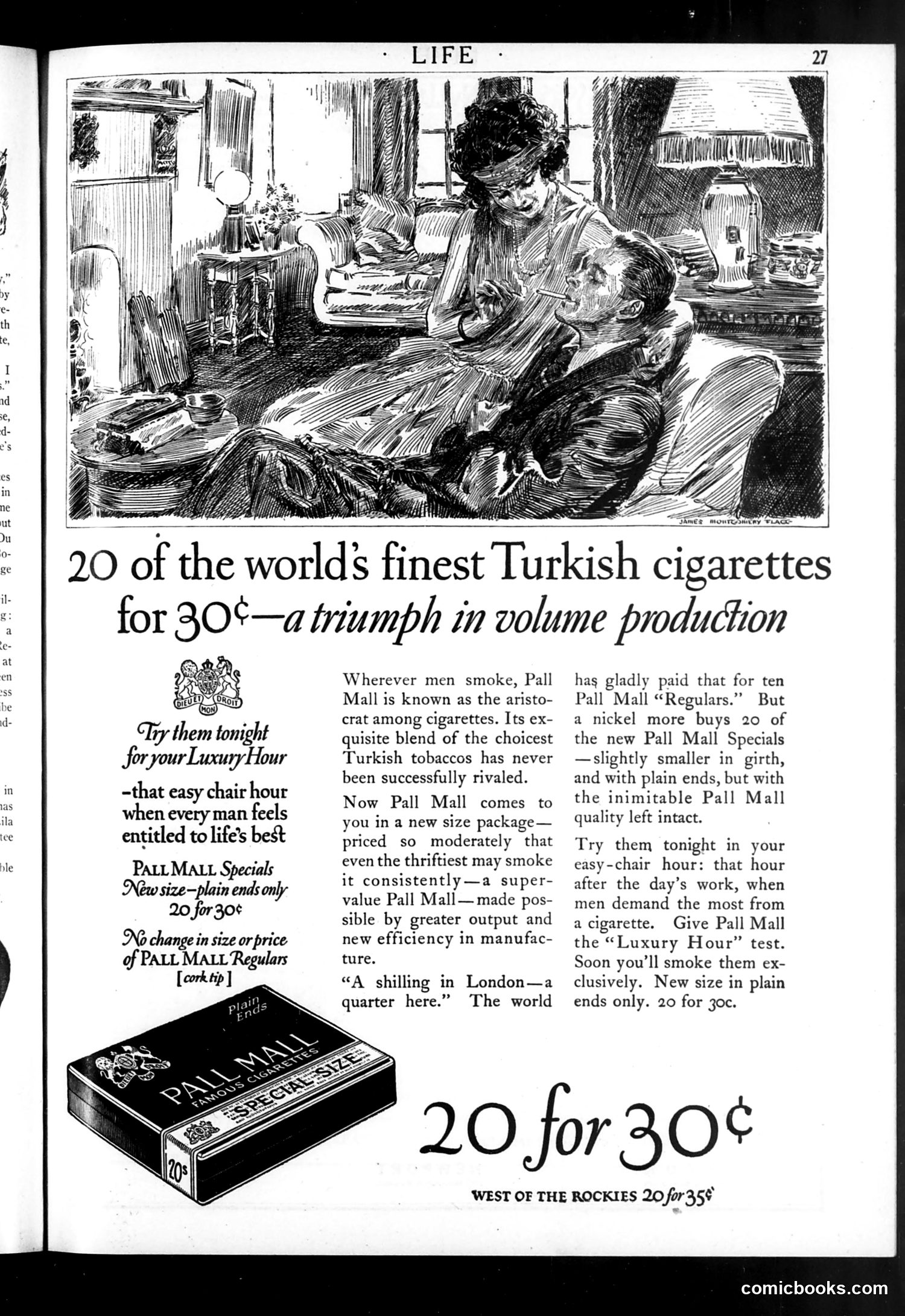
This is primarily a **cigarette advertisement** for Pall Mall, not political satire. The illustration depicts a domestic scene—a woman attending to a relaxed man in an armchair, with another man visible in the background—establishing the marketed "Luxury Hour" concept. The ad positions Pall Mall as an aristocratic, premium product ("aristrocrat among cigarettes") while introducing a new budget option: the "Pall Mall Specials" at 20 for 30¢. The marketing strategy emphasizes efficiency gains allowing lower prices without sacrificing quality. The "Luxury Hour" framing reflects early 20th-century consumer culture—packaging leisure and relaxation as an affordable entitlement for working men. The gendered domestic setting, with a woman serving a reclining man, reflects period norms about household roles. This represents vintage advertising rather than satirical commentary on social or political issues.
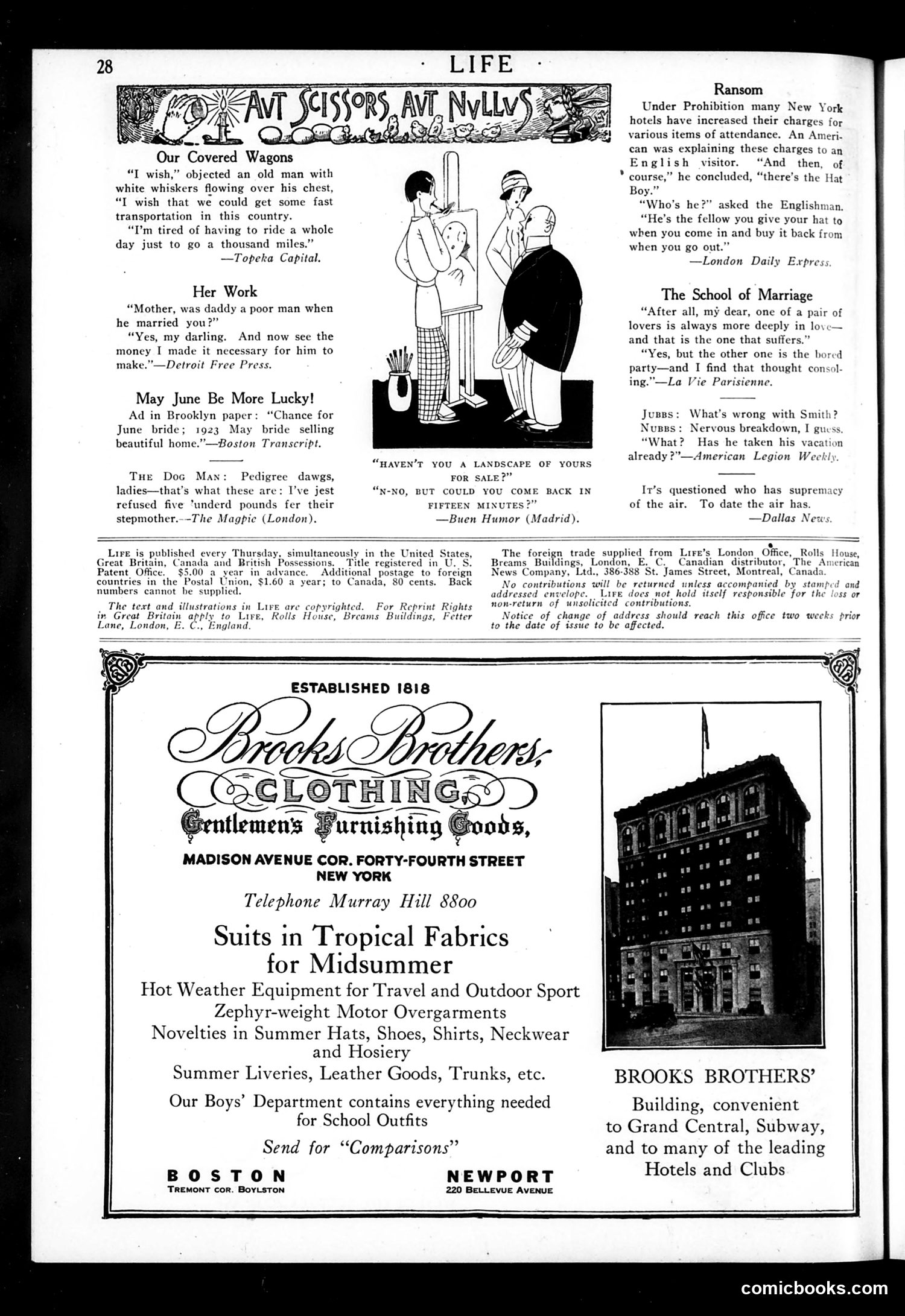
This page from *Life* magazine presents a collection of brief humorous anecdotes and jokes from various sources, reflecting early 1920s social concerns. **Key satirical points:** 1. **Transportation complaint**: Mocks American infrastructure inadequacy—people still endure full-day journeys for modest distances. 2. **"Her Work"**: Jokes that a wife's financial management has made her once-poor husband spend more money than he did as a bachelor—reversing traditional gender roles for comedic effect. 3. **"Ransom/Prohibition"**: References Prohibition-era hotel price gouging, where a "Hat Boy" charges customers to store and return hats—essentially selling back their own belongings. The joke critiques American opportunism during alcohol prohibition. 4. **Marriage satire**: Mocks romantic ideals by suggesting the less-in-love partner actually benefits emotionally, while the devoted one suffers boredom. The page is mostly advertisements for Brooks Brothers clothing, with these brief jokes functioning as filler content typical of satirical magazines of the era.
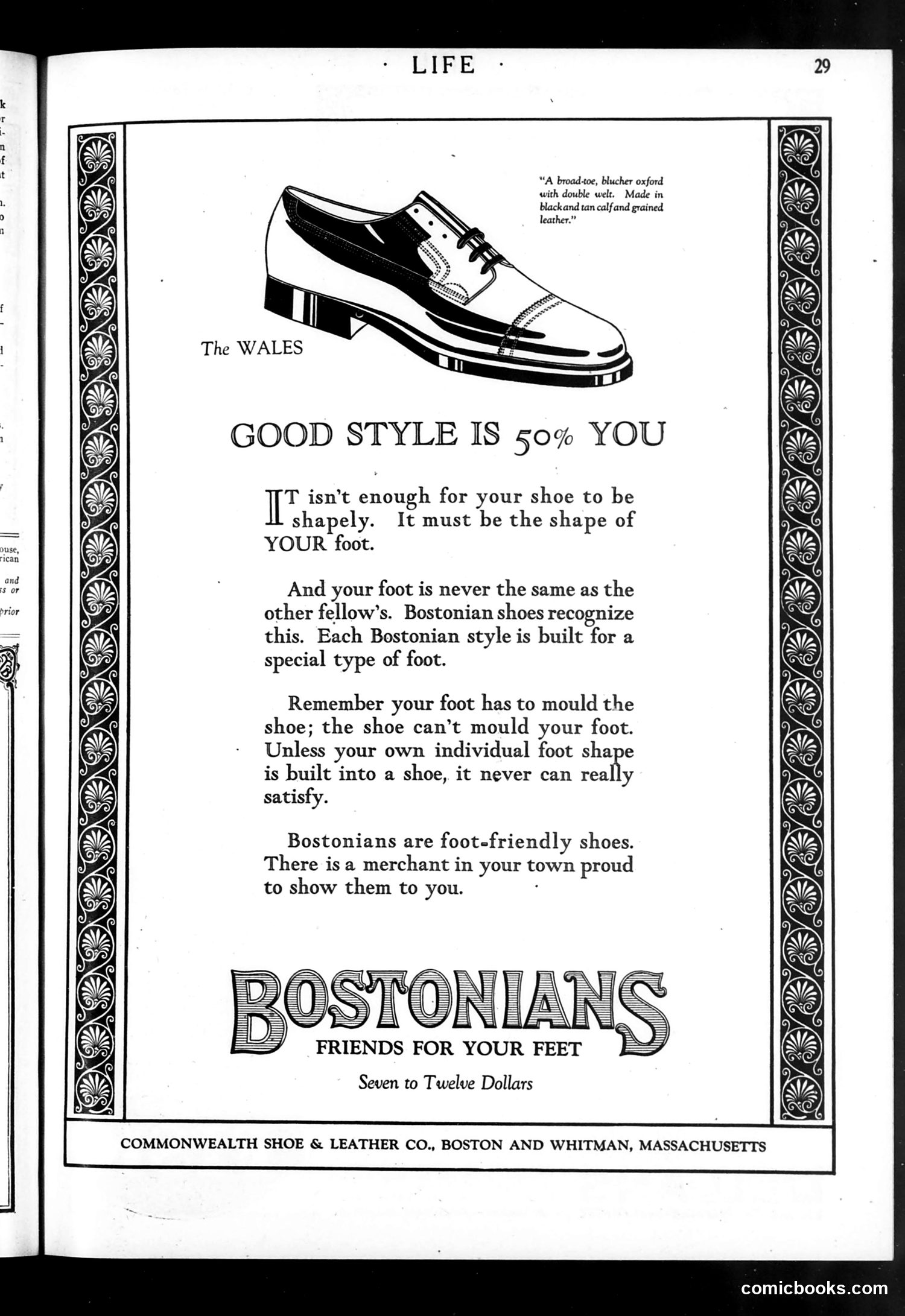
This page is primarily **advertising, not satire or commentary**. It's a Bostonian shoes advertisement from Life magazine promoting "The Wales" oxford shoe model. The ad uses a pseudo-philosophical pitch rather than humor: it argues that good style depends 50% on the wearer, emphasizing that shoes must conform to individual foot shapes rather than forcing feet into standardized molds. The copywriting appeals to individualism and comfort—a selling strategy positioning Bostonian shoes as thoughtfully designed for diverse feet. The shoe illustration shows a two-tone oxford with decorative banding. The ad closes with "Friends for Your Feet" and notes availability through local merchants at $7-12—substantial pricing for the era, suggesting a quality product. There's no political satire visible. This is straightforward period advertising using personality-based marketing language common to 1920s-30s consumer media.
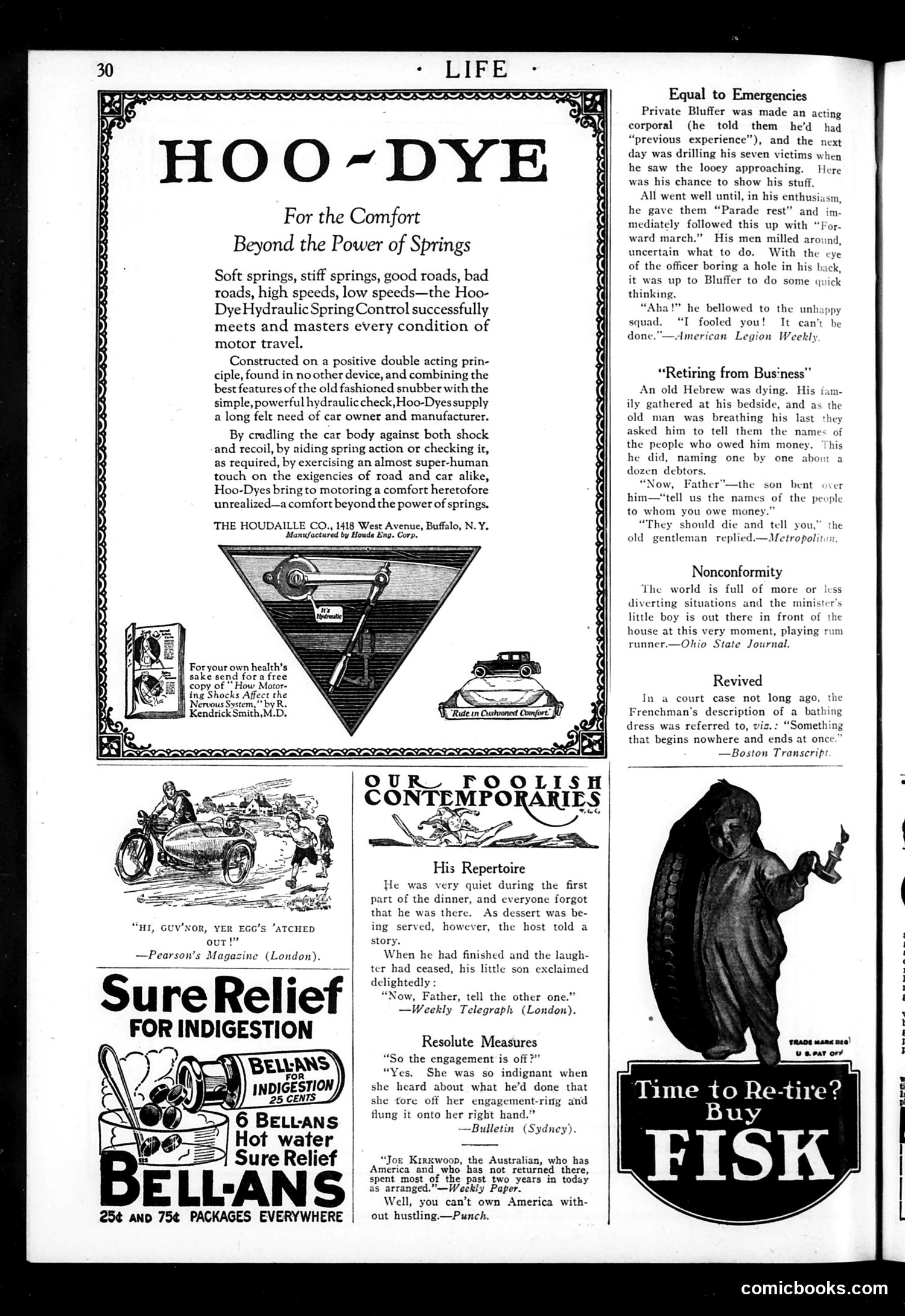
This page mixes automobile advertising with brief humorous anecdotes reprinted from various publications under "Our Foolish Contemporaries"—Life's regular feature mocking other newspapers and magazines. The main advertisement promotes "Hoo-Dye" hydraulic spring suspension for automobiles, emphasizing comfort on poor roads—a practical concern for 1920s motorists. The satirical items include: a story about "Private Bluffer," a soldier faking military knowledge; an anecdote about a dying Hebrew listing debtors but refusing to name creditors; and a joke about a minister's child playing "rum runner" (referencing Prohibition-era bootlegging). The humor relies on mild stereotyping and wordplay typical of the era. A Fisk tire advertisement appears below, featuring a drowsy figure warning against tired driving. These brief jokes reflect early 20th-century publication style—newspapers and magazines regularly reprinted humorous items from competitors as filler content and entertainment.
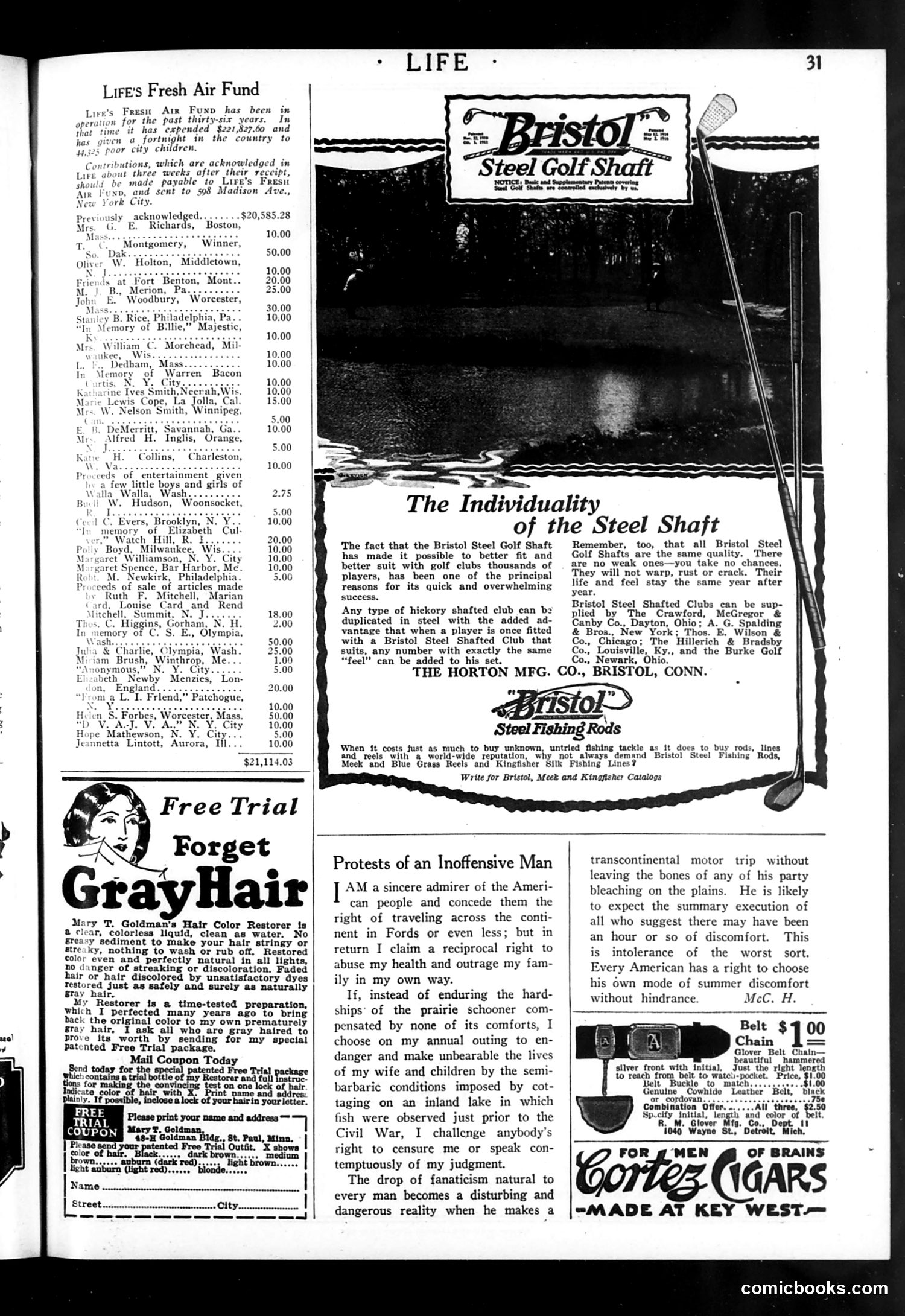
This page is primarily **advertising** interspersed with a brief opinion piece. The main ads promote Bristol Steel Golf Shafts and Fishing Rods, emphasizing reliability and consistency ("no weak ones"). On the left, Life's Fresh Air Fund lists donor contributions to send city children to the countryside—a Progressive Era charitable initiative reflecting concerns about urban children's health. Below that, a "Free Trial" ad for Mary T. Goldman's Hair Color Restorer addresses anxieties about aging appearance, particularly for women. The notable content is "Protests of an Inoffensive Man," a short essay by someone defending their right to take a risky summer automobile trip (likely by Ford, a popular budget car of the era) despite family concerns. The author sardonically claims Americans have freedom to cross continents in cheap cars, so he deserves freedom to endanger his own family's health as he chooses—a critique of selective American attitudes toward personal liberty and risk-taking.
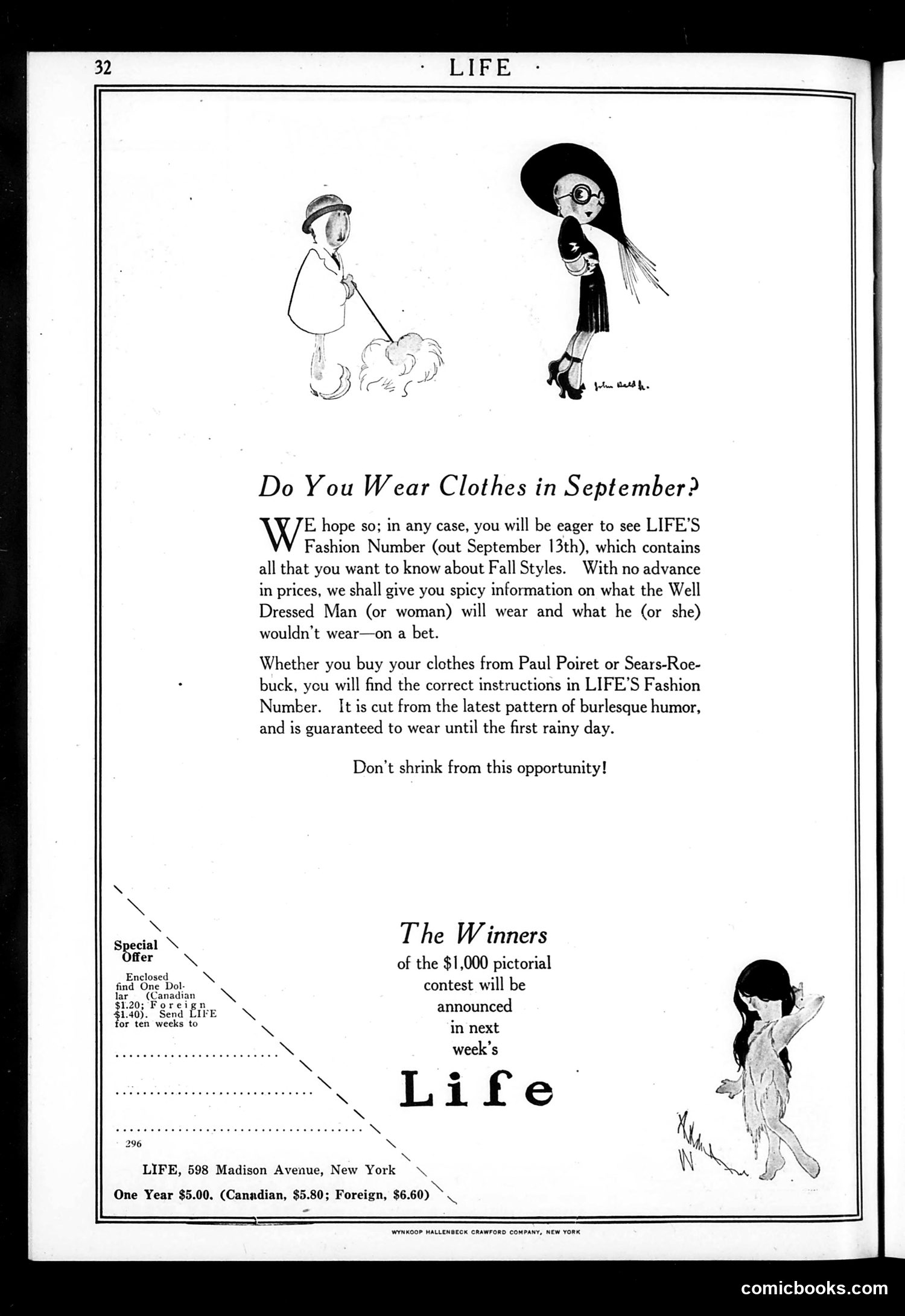
This page promotes Life's upcoming Fashion Number issue, using satirical humor typical of the era's sophisticated magazine culture. The two cartoon illustrations mock contemporary fashion: one shows a woman in an exaggerated wide-brimmed hat with goggles (poking fun at fashionable excess), the other depicts a man walking a small poodle (satirizing foppish style). The text humorously promises that Life's fashion advice applies equally to high-end designer Paul Poiret and budget retailer Sears-Roebuck—implying fashion advice transcends price point. The joke about clothing being "guaranteed to wear until the first rainy day" mocks the impermanence of trendy styles. The ad also mentions a separate "$1,000 pictorial contest," typical of magazines using contests to boost circulation. This is primarily advertisement content masquerading as editorial matter.
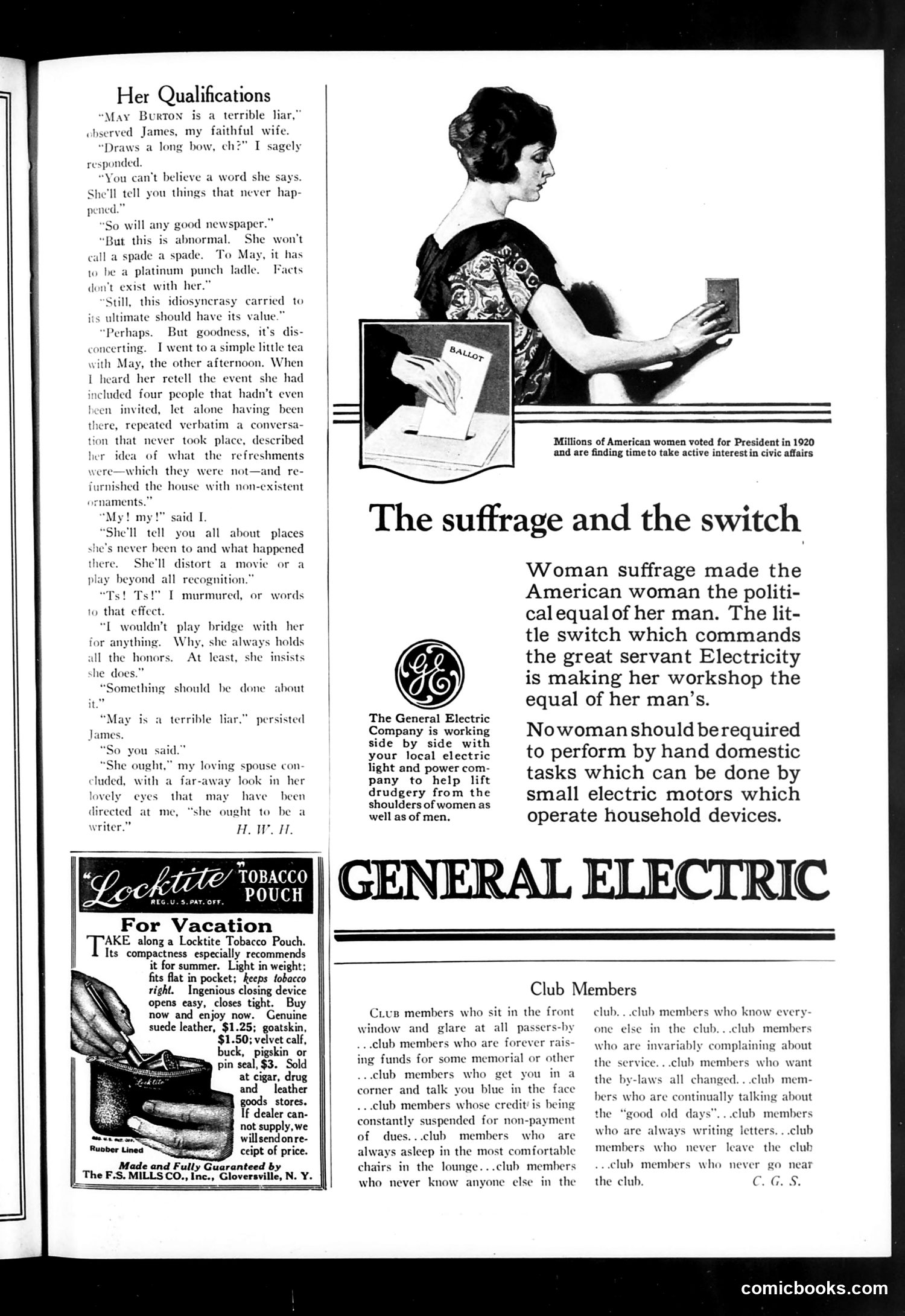
This page contains two distinct pieces of social commentary: **"Her Qualifications"** (left): A humorous dialogue satirizing women who exaggerate or fabricate stories. A husband complains to his friend that his wife May is a chronic liar—embellishing tea parties with invented guests, distorting movies, and inflating her bridge-game winnings. The satire targets women's perceived tendency toward hyperbole and dishonesty, a common stereotype of the era. **"The Suffrage and the Switch"** (right): A General Electric advertisement capitalizing on women's recent 1920 suffrage victory. It equates political equality with domestic labor-saving through electrical appliances. The ad argues electric motors should liberate women from manual household work, framing technology as advancing gender equality—though notably, still within the domestic sphere. The page juxtaposes these: one mocking women's credibility, the other celebrating their newfound civic power while redirecting them toward kitchen efficiency. This reflects post-1920 attitudes: women gained voting rights but remained expected to manage households.
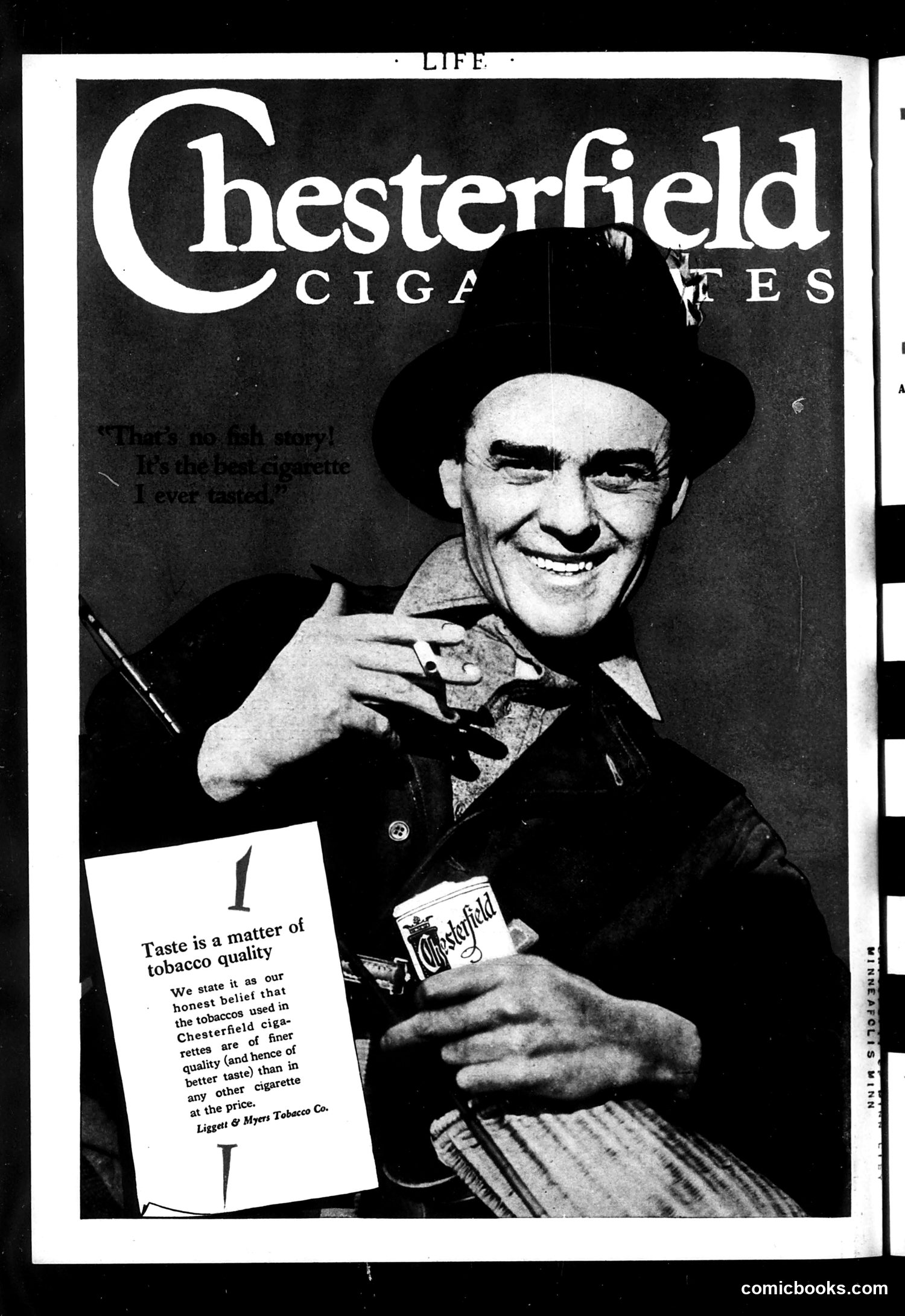
This is a vintage cigarette advertisement from *Life* magazine featuring a man in a cowboy hat holding a Chesterfield cigarette package. The ad includes a testimonial quote: "That's no fish story! It's the best cigarette I ever tasted." Below is a text block titled "Taste is a matter of tobacco quality," claiming Chesterfield uses superior tobacco than competitors at comparable prices. The advertiser is Liggett & Myers Tobacco Co. This represents early 20th-century advertising before tobacco health warnings were required. The folksy, testimonial-style marketing and association with masculine imagery (the cowboy) were typical sales tactics of the era.