
Life, 1923-08-23 · page 24 of 36
Life — August 23, 1923 — page 24: what you’re looking at
What you’re looking at
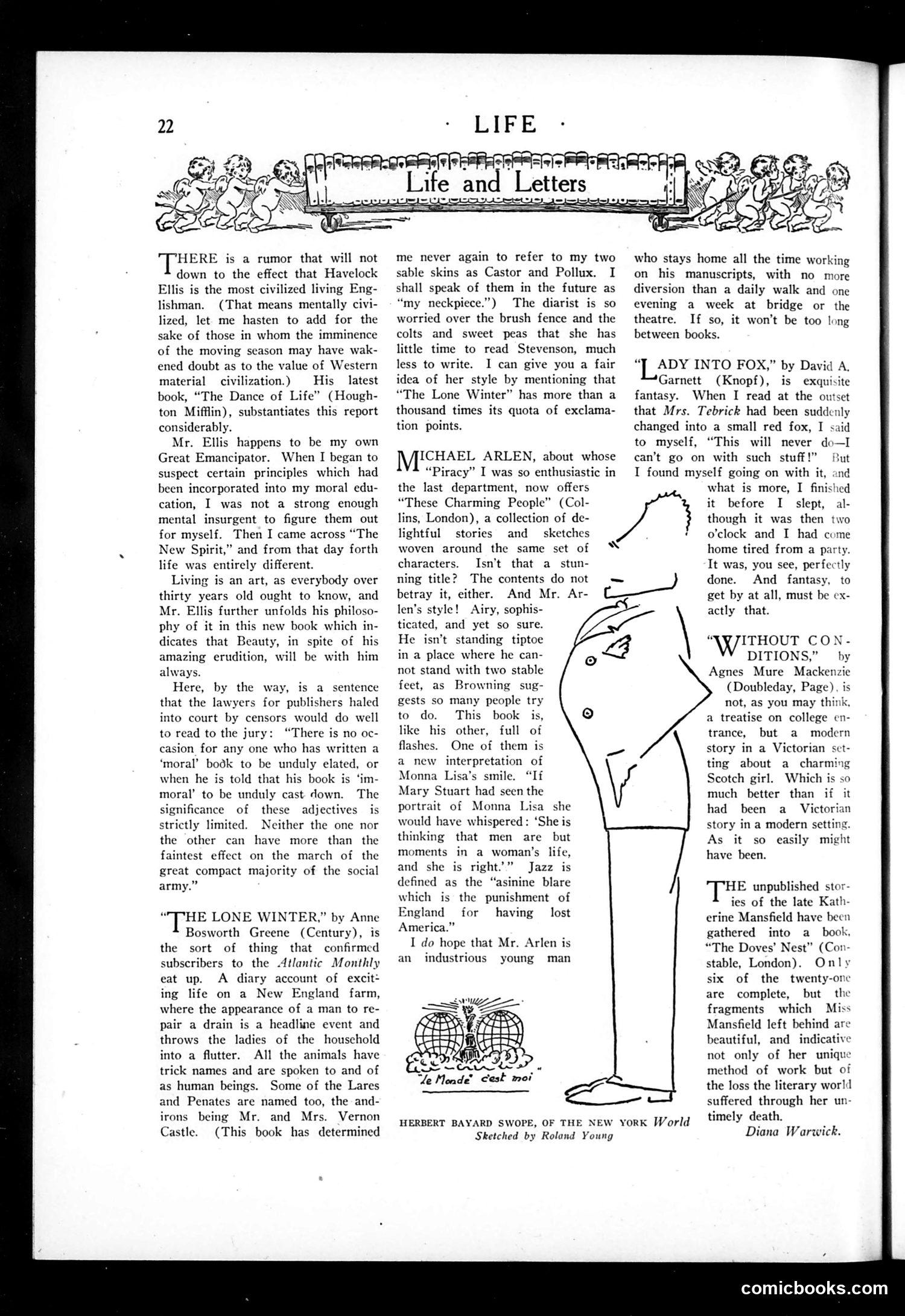
This is a book review column titled "Life and Letters" featuring literary criticism rather than political satire. The page reviews three books: 1. **Havelock Ellis's "The Dance of Life"** — The reviewer praises Ellis, calling him "the most civilized living Englishman" and crediting his earlier work "The New Spirit" with fundamentally changing their worldview. The quoted passage defends moral philosophy against censorship. 2. **Anne Bosworth Greene's "The Lone Winter"** — A satirical review mocking a diary about New England farm life, poking fun at the narrator's overwrought writing style (excessive exclamation points) and trivial concerns. 3. **Michael Arlen's "These Charming People"** — Praise for his sophisticated short stories, with quoted examples of his witty observations. The only illustration is a sketch of **Herbert Bayard Swope** of the New York *World* by Roland Young at the page bottom—likely identifying the column's author or a notable contemporary journalist. This is literary commentary, not political cartoons.
📄 Transcribed text from this page (OCR, searchable)
Machine-transcribed from the original scan — historical spelling and the odd misread are preserved.
HERE is a rumor that will not down to the effect that Havelock Ellis is the most civilized living Eng- lishman. (That means mentally civi- lized, let me hasten to add for the sake of those in whom the imminence of the moving season may have wak- ened doubt as to the value of Western material civilization.) His latest book, “The Dance of Life” (Hough- ton Mifflin), substantiates this report considerably. Mr. Ellis happens to be my own Great Emancipator. When I began to suspect certain principles which had been incorporated into my moral edu- cation, I was not a strong enough mental insurgent to figure them out for myself. Then I came across “The New Spirit,” and from that day forth life was entirely different. Living is an art, as everybody over thirty years old ought to know, and Mr. Ellis further unfolds his philoso- phy of it in this new book which in- dicates that Beauty, in spite of his amazing erudition, will be with him always. Here, by the way, is a sentence that the lawyers for publishers haled into court by censors would do well to read to the jury: “There is no oc- casion for any one who has written a ‘moral’ bodk to be unduly elated, or when he is told that his book is ‘im- moral’ to be unduly cast down. The significance of these adjectives is strictly limited. Neither the one nor the other can more than the faintest effect on the march of the great compact majority of the social army.” have 'HE LONE WINTER,” by Anne Bosworth Greene (Century), is the sort of thing that confirmed subscribers to the Atlantic Monthly eat up. A diary account of excit= ing life on a New England farm, where the appearance of a man to re- pair a drain is a headline event and throws the ladies of the household into a flutter. All the animals have trick names and are spoken to and of as human beings. Some of the Lares and Penates are named too, the and- irons being Mr. and Mrs. Vernon Castle. (This book has determined RRRRTIe "Lite and Letters me never again to refer to my two sable skins as Castor and Pollux. I shall speak of them in the future as “my neckpiece.”) The diarist is so worried over the brush fence and the colts and sweet peas that she has little time to read Stevenson, much less to write. I can give you a fair idea of her style by mentioning that “The Lone Winter” has more than a thousand times its quota of exclama- tion points. ICHAEL ARLEN, about whose “Piracy” I was so enthusiastic in the last department, now offers “These Charming People” (Col- lins, London), a collection of de- lightful stories and sketches woven around the same set of characters. Isn't that a stun- ning title? The contents do not betray it, either. And Mr. Ar- len’s style! Airy, sophis- ticated, and yet so sure. He isn’t standing tiptoe in a place where he can- not stand with two stable feet, as Browning sug- gests so many people try to do. This book is, like his other, full of flashes. One of them is a new interpretation of Monna Lisa’s smile. “If Mary Stuart had seen the portrait of Monna Lisa she would have whispered: ‘She is thinking that men are but moments in a woman's life, and she is right.” Jazz is defined as the “asinine blare which is the punishment of England for having lost America.” I do hope that Mr. Arlen is an industrious young man “le Mende’ cest mot HERBERT BAYARD SWOPE, OF THE NEW YoRK World Sketched by Roland Young who stays home all the time working on his manuscripts, with no more diversion than a daily walk and one evening a week at bridge or the theatre. If so, it won't be too long between books. ADY INTO FOX,” by David A. Garnett (Knopf), is exquisite fantasy. When I read at the outset that Mrs. Tebrick had been suddenly changed into a small red fox, I said to myself, “This will never do—I can’t go on with such stuff!” But I found myself going on with it, and what is more, I finished it before I slept, al- 5 though it was then two * o'clock and I had come home tired from a party. It was, you see, perfectly done. And fantasy, to get by at all, must be ex- actly that. ITHOUT CON- DITIONS,” by Agnes Mure Mackenzie (Doubleday, Page), is not, as you may think, a treatise on college en- trance, but a modern story in a Victorian sct- ting about a charming Scotch girl. Which is so much better than if it had been a_ Victorian story in a modern setting. As it so easily might have been. THE unpublished stor- ies of the late Kath- erine Mansfield have been gathered into a_ book, “The Doves’ Nest” (Con- stable, London). Only six of the twenty-one are complete, but the fragments which Miss Mansfield left behind are beautiful, and indicative not only of her unique method of work but of the loss the literary world suffered through her un- timely death. Diana Warwick. comicbooks.com