
Life, 1923-08-23 · page 28 of 36
Life — August 23, 1923 — page 28: what you’re looking at
What you’re looking at
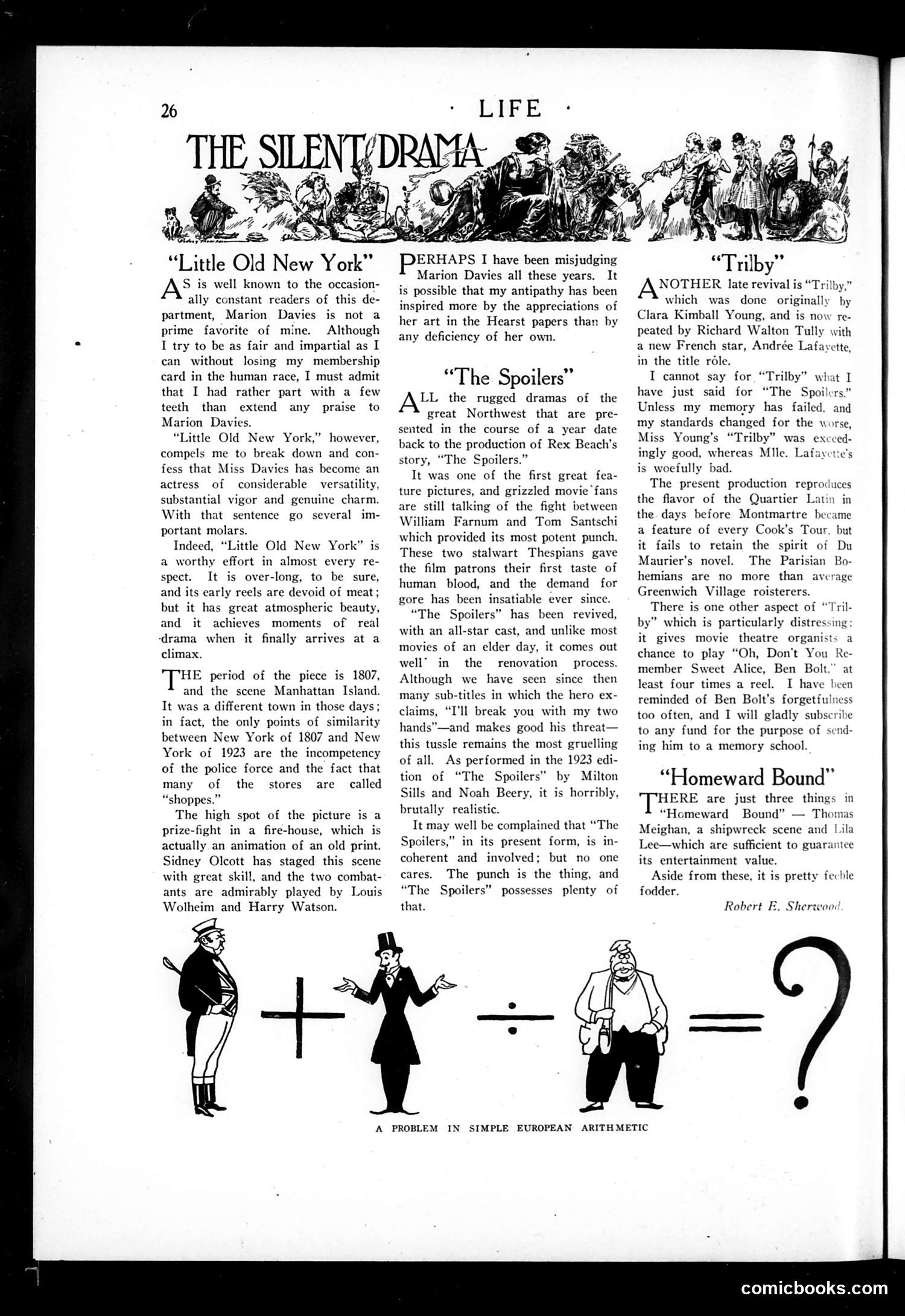
This page reviews three silent films. The critic praises Marion Davies' versatility in "Little Old New York" (set in 1807 Manhattan), despite personal antipathy toward her—likely influenced by her association with William Randolph Hearst's newspapers, which frequently promoted her work. "The Spoilers" is praised for its famous fight scene between actors William Farnum and Tom Santschi, which the critic notes was groundbreaking for depicting on-screen violence. The 1923 revival with Milton Sills and Noah Beery maintains this brutal realism. "Trilby" (a French remake) receives harsh criticism. The original starred Clara Kimball Young; this version features French actress Andrée Lafayette. The critic finds it fails to capture the spirit of du Maurier's novel, reducing Parisian bohemia to mere "Greenwich Village roisterers." The cartoon below depicts a mathematical puzzle with three figures—a satirical commentary on European politics or social dynamics, though the specific reference remains unclear from the image alone.
📄 Transcribed text from this page (OCR, searchable)
Machine-transcribed from the original scan — historical spelling and the odd misread are preserved.
“Little Old New York” S is well known to the occasion- ally constant readers of this de- partment, Marion Davies is not a prime favorite of mine. Although I try to be as fair and impartial as I can without losing my membership card in the human race, I must admit that I had rather part with a few teeth than extend any praise to Marion Davies. “Little Old New York,” however, compels me to break down and con- fess that Miss Davies has become an actress of considerable versatility, substantial vigor and genuine charm. With that sentence go portant molars. Indeed, “Little Old New York” is a worthy effort in almost every re- spect. It is over-long, to be sure, and its early reels are devoid of meat; but it has great atmospheric beauty, and it achieves moments of real ‘drama when it finally arrives at a climax. "THE period of the piece is 1807, and the scene Manhattan Island. It was a different town in those days; in fact, the only points of similarity between New York of 1807 and New York of 1923 are the incompetency of the police force and the fact that many of the stores are called “shoppes.” The high spot of the picture is a prize-fight in a fire-house, which is actually an animation of an old print. Sidney Olcott has staged this scene with great skill, and the two combat- ants are admirably played by Louis Wolheim and Harry Watson. several im- PERHAPS I have been misjudging Marion Davies all these years. It is possible that my antipathy has been inspired more by the appreciations of her art in the Hearst papers than by any deficiency of her own. “The Spoilers” Alu the rugged dramas of the great Northwest that are pre- sented in the course of a year date back to the production of Rex Beach's story, “The Spoilers.” It was one of the first great fea- ture pictures, and grizzled movie fans are still talking of the fight between William Farnum and Tom Santschi which provided its most potent punch. These two stalwart Thespians gave the film patrons their first taste of human blood, and the demand for gore has been insatiable ever since. “The Spoilers” has been revived, with an all-star cast, and unlike most movies of an elder day, it comes out well” in the renovation process. Although we have seen since then many sub-titles in which the hero ex- claims, “I'll break you with my two hands”—and makes good his threat— this tussle remains the most gruelling of all. As performed in the 1923 edi- tion of “The Spoilers” by Milton Sills and Noah Beery, it is horribly, brutally realistic. It may well be complained that “The Spoilers,” in its present form, is in- coherent and involved; but no one cares. The punch is the thing, and “The Spoilers” possesses plenty of that. which was done originally by Clara Kimball Young, and is now re- peated by Richard Walton Tully with a new French star, Andrée Lafz in the title rdle. I cannot say for “Trilby” what I have just said for “The Spoilers. Unless my memory has failed, and my standards changed for the worse, Miss Young’s “Trilby” was exceed- ingly good, whereas Mlle. La is woefully bad. The present production reproduces the flavor of the Quartier Latin in the days before Montmartre became a feature of every Cook’s Tour, but it fails to retain the spirit of Du Maurier’s novel. The Parisian Bo- hemians are no more than Greenwich Village roisterers. There is one other aspect of “Tril- by” which is particularly distressing : it gives movie theatre organists a chance to play “Oh, Don't You Re- member Sweet Alice, Ben Bolt,” at least four times a reel. I have been reminded of Ben Bolt’s forgetfulness too often, and I will gladly subscribe to any fund for the purpose of send- ing him to a memory school. “Homeward Bound” 'HERE are just three things in “Homeward Bound” — Thomas Meighan, a shipwreck scene and Lila Lee—which are sufficient to guarantee its entertainment value. Aside from these, it is pretty fechle fodder. ette, average Robert E. Sherwoor bi) A PROBLEM IN SIMPLE EUROPEAN ARITHMETIC comicbooks.com