
Life, 1923-08-23 · page 16 of 36
Life — August 23, 1923 — page 16: what you’re looking at
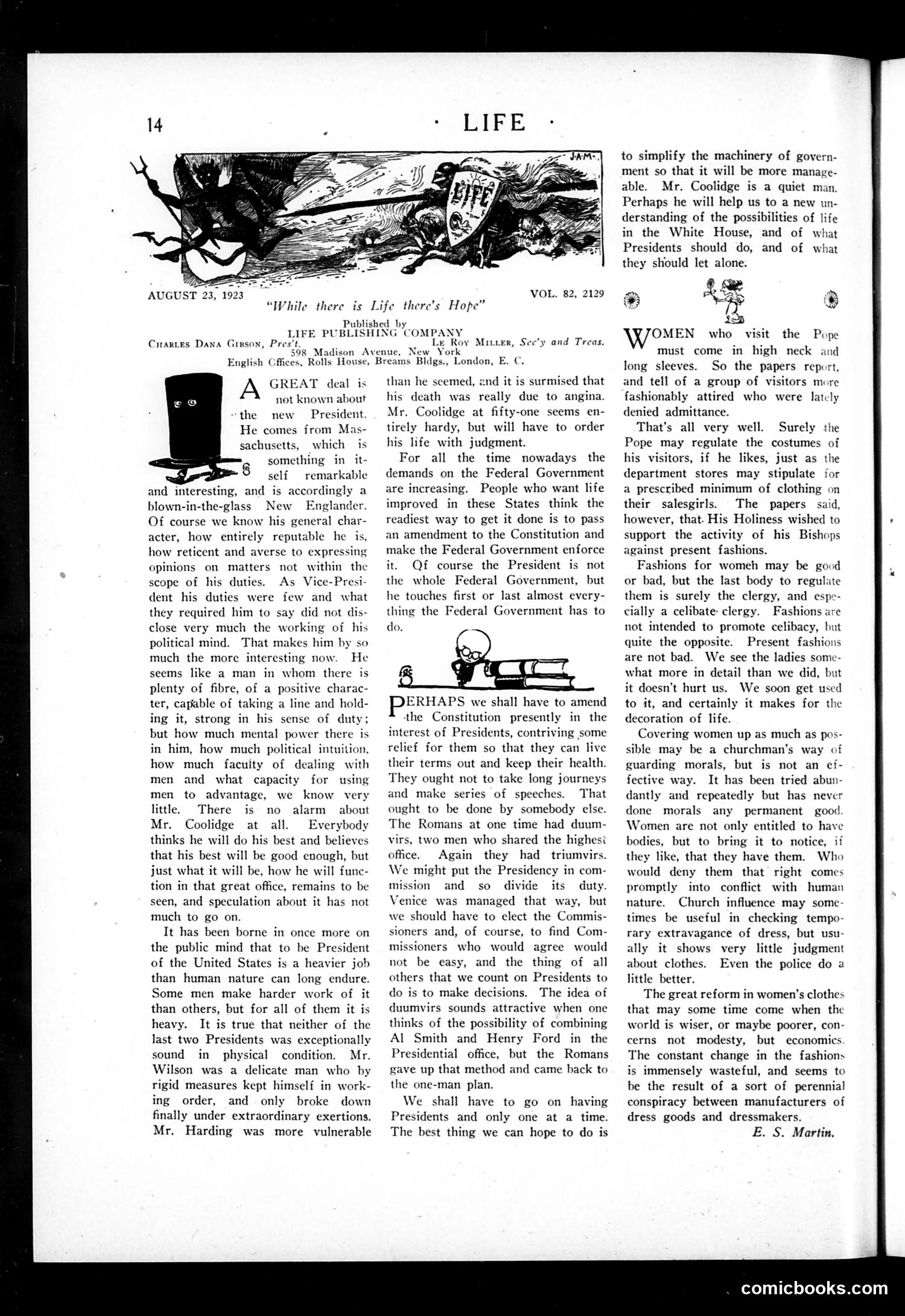
A restored page from Life, 1923-08-23. Page through the whole issue in the reader above.
📄 Transcribed text from this page (OCR, searchable)
Machine-transcribed from the original scan — historical spelling and the odd misread are preserved.
VOL. 82, 2129 “While there is Life ther Publish PUBLISH LIFE Cirartes Dana Grnson, Pres’t . Madison Avenue, hed by ING COMPA i Roy Mutter, Sec’y and Treas. New York English Cffices, Rolls House, Breams Bldgs., London, E. C. GREAT not known about deal is President He comes from Mas- sachusetts, which is something in it- self remarkable and interesting, and is accordingly a blown-in-the-glass New Englander. Of course we know his general cha acter, how entirely reputable he is, how reticent and averse to expressing opinions on matters not within the scope of his duties. As Vice-Presi- dent his duties few and what they required him to say did not dis- close very much the working of his political mind. That makes him by so much the more interesting now. He seems like a man in whom there is plenty of fibre, of a positive charac- ter, capable of taking a line and hold- ing it, strong in his sense of duty; but how much mental power there is in him, how much political intuition, how much facuity of dealing with men and what capacity for using men to advantage, we know very little. There is no alarm about Mr. Coolidge at all. Everybody thinks he will do his best and believes that his best will be good enough, but just what it will be, how he will func- tion in that great office, remains to be seen, and speculation about it has not much to go on. It has been borne in once more on the public mind that to be President of the United States is a heavier job than human nature can long endure. Some men make harder work of it than others, but for all of them it is heavy. It is true that neither of the last two Presidents was exceptionally sound in physical condition. Mr. Wilson was a delicate man who by rigid measures kept himself in work- ing order, and only broke down finally under extraordinary exertions. Mr. Harding was more vulnerable the new 2 were than he scemed, znd it is surmised that his death was really due to angina. Mr. Coolidge at fifty-one seems en- tirely hardy, but will have to order his life with judgment. For all the time nowadays the demands on the Federal Government are increasing. People who want life improved in these States think the readiest way to get it done is to pass an amendment to the Constitution and make the Federal Government enforce it. Qf course the President is not the whole Federal Government, but he touches first or last almost every- thing the Federal Government has to do. R ERHAPS we shall have to amend the Constitution presently in the interest of Presidents, contriving some relief for them so that they can live their terms out and keep their health. They ought not to take long journeys and make series of speeches. That ought to be done by somebody else. The Romans at one time had duum- virs, two men who shared the highesi office. Again they had triumvirs. We might put the Presidency in com- mission and so divide its duty. Venice was managed that w but we should have to elect the Commis- sioners and, of course, to find Com- missioners who would agree would not be easy, and the thing of all others that we count on Presidents to do is to make decisions. The idea of duumvirs sounds attractive when one thinks of the possibility of combining Al Smith and Henry Ford in the Presidential office, but the Romans gave up that method and came back to the one-man plan. We shall have to go on having Presidents and only one at a time. The best thing we can hope to do is to simplify the machinery of govern- ment so that it will be more manage- able. Mr. Coolidge is a quiet man. Perhaps he will help us to a new un- derstanding of the possibilities of life in the White House, and of what Presidents should do, and of what they should let alone. es WOMEN who visit the Pope must come in high neck and long sleeves. So the papers report, and tell of a group of visitors more fashionably attired who were latcly denied admittance. That's all very well. Surely the Pope may regulate the costumes of his visitors, if he likes, just as the department stores may stipulate for a prescribed minimum of clothing on their salesgirls. The papers said, however, that. His Holiness wished to support the activity of his Bishops against present fashions. Fashions for womeh may be good or bad, but the last body to regulate them is surely the clergy, and esp: cially a celibate clergy. Fashions are not intended to promote celibacy, but quite the opposite. Present fashions are not bad. We see the ladies some- what more in detail than we did, but it doesn’t hurt us. We soon get used to it, and certainly it makes for the decoration of life. Covering women up as much as pos- sible may be a churchman’s way of guarding morals, but is not an ef- fective way. It has been tried abun- dantly and repeatedly but has never done morals any permanent good Women are not only entitled to have bodies, but to bring it to notice, if they like, that they have them. Who would deny them that right comes promptly into conflict with human nature. Church influence may some times be useful in checking tempo- rary extravagance of dress, but usu- ally it shows very little judgment about clothes. Even the police do a little better. The great reform in women’s clothes that may some time come when the world is wiser, or maybe poorer, con- cerns not modesty, but economics. The constant change in the fashions is immensely wasteful, and seems to be the result of a sort of perennial conspiracy between manufacturers of dress goods and dressmakers. E. S. Martin. comicbooks.com